


IEC TR 62063:1999
(Main)High-voltage switchgear and controlgear - The use of electronic and associated technologies in auxiliary equipment of switchgear and controlgear
General Information
- Abstract
This technical report is intended to provide basic guidance for the introduction of improvements in the IEC standards related to HV switchgear and controlgear. Such improvements are required to allow the users of switchgear to benefit from all the possibilities provided by electronic equipment.
- Status
- Replaced
- Publication Date
- 05-Aug-1999
- Technical Committee
- SC 17A - Switching devices
Buy Documents
IEC TR 62063:1999 - High-voltage switchgear and controlgear - The use of electronic and associated technologies in auxiliary equipment of switchgear and controlgear Released:8/6/1999
Overview
IEC TR 62063:1999 provides essential guidance for the integration of electronic and associated technologies into the auxiliary equipment of high-voltage (HV) switchgear and controlgear. Developed by the International Electrotechnical Commission (IEC), this technical report addresses the growing presence and importance of electronic devices within HV switchgear systems, emphasizing the need for improved interoperability, standardized communication protocols, and clear responsibility boundaries among manufacturers. The report serves as a strategic reference for the evolution of related IEC standards, ensuring users of HV switchgear can fully leverage the enhanced capabilities made possible by advanced electronic technologies.
Key Topics
The technical report covers several crucial areas relevant to the modernization and standardization of HV switchgear and controlgear auxiliary equipment:
- Introduction of Electronic Technologies: Guidance on implementing electronic devices in auxiliary equipment, including distributed architectures, microprocessor-based components, and digital communication systems.
- Standardization Needs: Emphasis on the urgent requirement to standardize interfaces and communication protocols to prevent confusion and improve equipment interoperability.
- System Architecture: Insights into the evolution from conventional to electronic-based auxiliary equipment, re-defining boundaries between primary (high-voltage) and auxiliary (control and monitoring) systems.
- Dependability and Safety: Addressing new concepts in reliability, availability, maintainability, and safety as electronic components become more prevalent.
- Manufacturer Responsibility: Clarification of manufacturing responsibilities and equipment boundaries, particularly in the case of multi-vendor supply chains.
- Maintenance and Monitoring: Recommendations on adopting modern maintenance strategies, such as reliability-centered maintenance (RCM), and integrating advanced monitoring functionalities.
Applications
IEC TR 62063:1999 offers practical value across several industry applications:
- Substation Automation: Enables smarter substations by encouraging the use of electronic monitoring and control within HV switchgear auxiliary equipment.
- Systems Integration: Assists manufacturers and operators in ensuring interoperability between multi-vendor components through guidance on interfaces and communication protocols.
- Retrofits and Upgrades: Supports modernization of existing switchgear installations, allowing for phased upgrades with new electronic devices while addressing compatibility and maintenance strategies.
- Reliability Improvements: Helps end users and manufacturers implement best practices in maintenance and diagnostic monitoring, leading to enhanced reliability and operational efficiency in HV networks.
- Safety Compliance: Reinforces requirements for safety and dependability, essential for utilities and industries working with high-voltage equipment.
Related Standards
IEC TR 62063:1999 references and aligns with several key international standards to provide robust guidance:
- IEC 60050 Series: International Electrotechnical Vocabulary for dependability, quality of service, and automatic control.
- IEC 60605 Series: Standards for equipment reliability testing, encompassing general requirements, test design, and statistical assessment.
- IEC 60694: Common specifications for high-voltage switchgear and controlgear standards.
- IEC 61000-5 Series: Guides for electromagnetic compatibility (EMC), installation, earthing, cabling, and mitigation techniques.
- IEC 61123, IEC 61140, IEC 61201, IEC 60863: Covering reliability test plans, protection against electric shock, low-voltage limits, and predictions for reliability, maintainability, and availability.
- ANSI/IEEE 110 and UNIPEDE Norm 13: Recommendations and test conditions for automation and control of power plants and substations.
By aligning with these related standards, IEC TR 62063:1999 provides a comprehensive framework for the future-ready implementation of electronic technologies in high-voltage switchgear auxiliary systems, supporting safer, more efficient, and more reliable energy infrastructure.
Relations
- Effective Date
- 05-Sep-2023
Buy Documents
IEC TR 62063:1999 - High-voltage switchgear and controlgear - The use of electronic and associated technologies in auxiliary equipment of switchgear and controlgear Released:8/6/1999
Get Certified
Connect with accredited certification bodies for this standard

IMQ S.p.A. (Certification)
Italian electrical product certification.

SLG Prüf- und Zertifizierungs GmbH
German testing and certification body.

UL Solutions
Global safety science company with testing, inspection and certification.
Sponsored listings
Frequently Asked Questions
IEC TR 62063:1999 is a technical report published by the International Electrotechnical Commission (IEC). Its full title is "High-voltage switchgear and controlgear - The use of electronic and associated technologies in auxiliary equipment of switchgear and controlgear". This standard covers: This technical report is intended to provide basic guidance for the introduction of improvements in the IEC standards related to HV switchgear and controlgear. Such improvements are required to allow the users of switchgear to benefit from all the possibilities provided by electronic equipment.
This technical report is intended to provide basic guidance for the introduction of improvements in the IEC standards related to HV switchgear and controlgear. Such improvements are required to allow the users of switchgear to benefit from all the possibilities provided by electronic equipment.
IEC TR 62063:1999 is classified under the following ICS (International Classification for Standards) categories: 29.130.10 - High voltage switchgear and controlgear; 31.020 - Electronic components in general. The ICS classification helps identify the subject area and facilitates finding related standards.
IEC TR 62063:1999 has the following relationships with other standards: It is inter standard links to IEC TR 62271-322:2026. Understanding these relationships helps ensure you are using the most current and applicable version of the standard.
IEC TR 62063:1999 is available in PDF format for immediate download after purchase. The document can be added to your cart and obtained through the secure checkout process. Digital delivery ensures instant access to the complete standard document.
Standards Content (Sample)
RAPPORT CEI
TECHNIQUE IEC
TR 62063
TECHNICAL
Première édition
REPORT
First edition
1999-08
Appareillage à haute tension –
Utilisation de l'électronique et des technologies
associées dans les équipements auxiliaires
de l'appareillage
High-voltage switchgear and controlgear –
The use of electronic and associated technologies
in auxiliary equipment of switchgear
and controlgear
Numéro de référence
Reference number
IEC/TR 62063:1999
Numéros des publications Numbering
Depuis le 1er janvier 1997, les publications de la CEI As from 1 January 1997 all IEC publications are
sont numérotées à partir de 60000. issued with a designation in the 60000 series.
Publications consolidées Consolidated publications
Les versions consolidées de certaines publications de Consolidated versions of some IEC publications
la CEI incorporant les amendements sont disponibles. including amendments are available. For example,
Par exemple, les numéros d’édition 1.0, 1.1 et 1.2 edition numbers 1.0, 1.1 and 1.2 refer, respectively, to
indiquent respectivement la publication de base, la the base publication, the base publication incor-
publication de base incorporant l’amendement 1, et la porating amendment 1 and the base publication
publication de base incorporant les amendements 1 incorporating amendments 1 and 2.
et 2.
Validité de la présente publication Validity of this publication
Le contenu technique des publications de la CEI est The technical content of IEC publications is kept
constamment revu par la CEI afin qu'il reflète l'état under constant review by the IEC, thus ensuring that
actuel de la technique. the content reflects current technology.
Des renseignements relatifs à la date de reconfir- Information relating to the date of the reconfirmation
mation de la publication sont disponibles dans le of the publication is available in the IEC catalogue.
Catalogue de la CEI.
Les renseignements relatifs à des questions à l’étude et Information on the subjects under consideration and
des travaux en cours entrepris par le comité technique work in progress undertaken by the technical
qui a établi cette publication, ainsi que la liste des committee which has prepared this publication, as well
publications établies, se trouvent dans les documents ci- as the list of publications issued, is to be found at the
dessous: following IEC sources:
• «Site web» de la CEI*
•
IEC web site*
• Catalogue des publications de la CEI
Publié annuellement et mis à jour • Catalogue of IEC publications
régulièrement Published yearly with regular updates
(Catalogue en ligne)* (On-line catalogue)*
• Bulletin de la CEI • IEC Bulletin
Disponible à la fois au «site web» de la CEI* Available both at the IEC web site* and
et comme périodique imprimé as a printed periodical
Terminologie, symboles graphiques Terminology, graphical and letter
et littéraux symbols
En ce qui concerne la terminologie générale, le lecteur For general terminology, readers are referred to
se reportera à la CEI 60050: Vocabulaire Electro- IEC 60050: International Electrotechnical Vocabulary
technique International (VEI). (IEV).
Pour les symboles graphiques, les symboles littéraux For graphical symbols, and letter symbols and signs
et les signes d'usage général approuvés par la CEI, le approved by the IEC for general use, readers are
lecteur consultera la CEI 60027: Symboles littéraux à referred to publications IEC 60027: Letter symbols to
utiliser en électrotechnique, la CEI 60417: Symboles be used in electrical technology, IEC 60417: Graphical
graphiques utilisables sur le matériel. Index, relevé et symbols for use on equipment. Index, survey and
compilation des feuilles individuelles, et la CEI 60617: compilation of the single sheets and IEC 60617:
Symboles graphiques pour schémas. Graphical symbols for diagrams.
* Voir adresse «site web» sur la page de titre. * See web site address on title page.
RAPPORT CEI
TECHNIQUE IEC
TR 62063
TECHNICAL
Première édition
REPORT
First edition
1999-08
Appareillage à haute tension –
Utilisation de l'électronique et des technologies
associées dans les équipements auxiliaires
de l'appareillage
High-voltage switchgear and controlgear –
The use of electronic and associated technologies
in auxiliary equipment of switchgear
and controlgear
IEC 1999 Droits de reproduction réservés Copyright - all rights reserved
Aucune partie de cette publication ne peut être reproduite ni No part of this publication may be reproduced or utilized in
utilisée sous quelque forme que ce soit et par aucun procédé, any form or by any means, electronic or mechanical,
électronique ou mécanique, y compris la photo-copie et les including photocopying and microfilm, without permission in
microfilms, sans l'accord écrit de l'éditeur. writing from the publisher.
International Electrotechnical Commission 3, rue de Varembé Geneva, Switzerland
Telefax: +41 22 919 0300 e-mail: inmail@iec.ch IEC web site http://www.iec.ch
CODE PRIX
Commission Electrotechnique Internationale
W
PRICE CODE
International Electrotechnical Commission
Pour prix, voir catalogue en vigueur
For price, see current catalogue
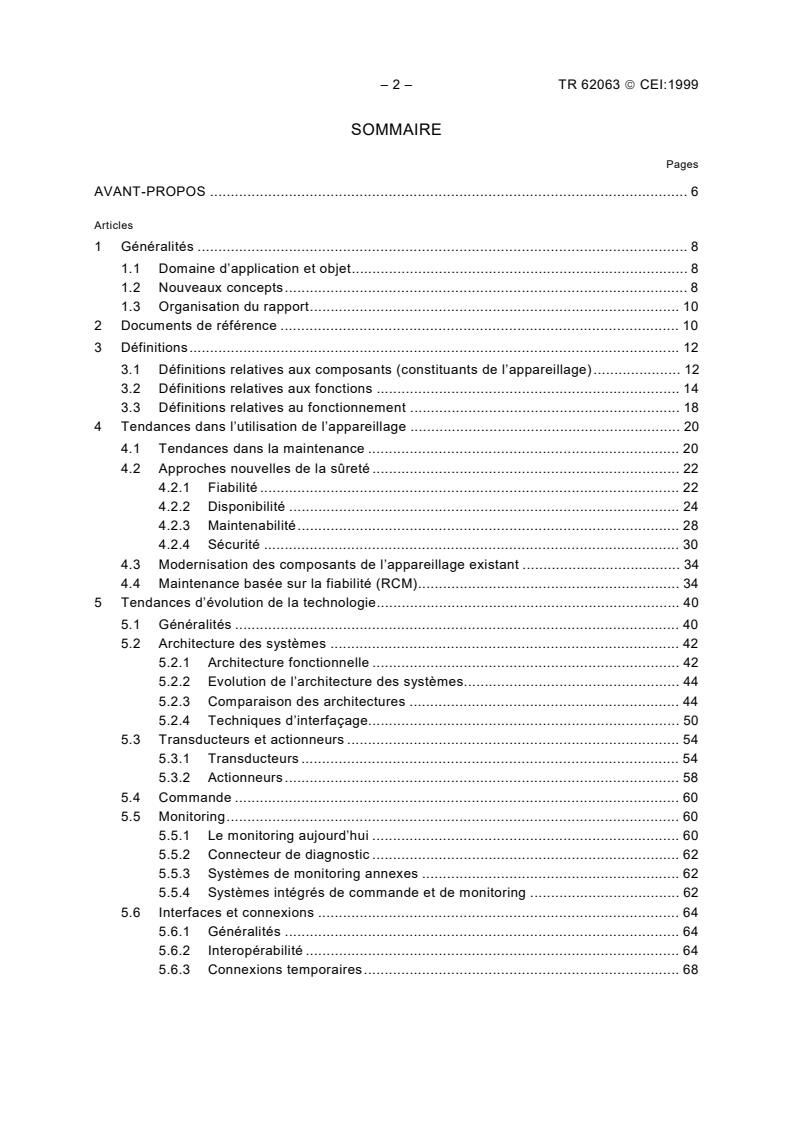
– 2 – TR 62063 CEI:1999
SOMMAIRE
Pages
AVANT-PROPOS . 6
Articles
1 Généralités . 8
1.1 Domaine d’application et objet. 8
1.2 Nouveaux concepts. 8
1.3 Organisation du rapport. 10
2 Documents de référence . 10
3 Définitions. 12
3.1 Définitions relatives aux composants (constituants de l’appareillage) . 12
3.2 Définitions relatives aux fonctions . 14
3.3 Définitions relatives au fonctionnement . 18
4 Tendances dans l’utilisation de l’appareillage . 20
4.1 Tendances dans la maintenance . 20
4.2 Approches nouvelles de la sûreté . 22
4.2.1 Fiabilité . 22
4.2.2 Disponibilité . 24
4.2.3 Maintenabilité. 28
4.2.4 Sécurité . 30
4.3 Modernisation des composants de l’appareillage existant . 34
4.4 Maintenance basée sur la fiabilité (RCM). 34
5 Tendances d’évolution de la technologie. 40
5.1 Généralités . 40
5.2 Architecture des systèmes . 42
5.2.1 Architecture fonctionnelle . 42
5.2.2 Evolution de l’architecture des systèmes. 44
5.2.3 Comparaison des architectures . 44
5.2.4 Techniques d’interfaçage. 50
5.3 Transducteurs et actionneurs . 54
5.3.1 Transducteurs . 54
5.3.2 Actionneurs. 58
5.4 Commande . 60
5.5 Monitoring. 60
5.5.1 Le monitoring aujourd’hui . 60
5.5.2 Connecteur de diagnostic . 62
5.5.3 Systèmes de monitoring annexes . 62
5.5.4 Systèmes intégrés de commande et de monitoring . 62
5.6 Interfaces et connexions . 64
5.6.1 Généralités . 64
5.6.2 Interopérabilité . 64
5.6.3 Connexions temporaires. 68
TR 62063 IEC:1999 – 3 –
CONTENTS
Page
FOREWORD . 7
Clause
1 General. 9
1.1 Scope and object . 9
1.2 New concepts . 9
1.3 Organisation of the report. 11
2 Reference documents . 11
3 Definitions. 13
3.1 Definitions related to components (parts of switchgear and controlgear) . 13
3.2 Definitions related to functions . 15
3.3 Definitions related to operation features . 19
4 Trends in the use of switchgear and controlgear . 21
4.1 Trends in maintenance. 21
4.2 New concepts in dependability. 23
4.2.1 Reliability . 23
4.2.2 Availability. 25
4.2.3 Maintainability . 29
4.2.4 Safety . 31
4.3 Retrofitting of existing switchgear components . 35
4.4 Reliability centered maintenance . 35
5 Trends in technology . 41
5.1 General. 41
5.2 System architecture . 43
5.2.1 Functional architecture . 43
5.2.2 Evolution of system architecture . 45
5.2.3 Architecture comparison. 45
5.2.4 Interfacing techniques . 51
5.3 Transducers and actuators. 55
5.3.1 Transducers. 55
5.3.2 Actuators . 59
5.4 Control. 61
5.5 Monitoring. 61
5.5.1 Monitoring today. 61
5.5.2 Diagnostic connector. 63
5.5.3 Add-on monitoring system . 63
5.5.4 Integrated system for control and monitoring . 63
5.6 Interface and connection . 65
5.6.1 General. 65
5.6.2 Interoperability . 65
5.6.3 Temporary connections . 69
– 4 – TR 62063 CEI:1999
Articles Pages
6 Recommandations pour l’utilisation des nouvelles technologies dans les postes . 68
6.1 Installation . 68
6.2 Transducteurs et actionneurs . 70
6.3 Aspects diélectriques . 72
6.4 Sûreté et sécurité. 72
6.5 Degré de protection des connecteurs . 74
6.6 Maintenance . 74
6.6.1 Recommandations à l’usage des constructeurs. 74
6.6.2 Disponibilité des rechanges . 74
7 Evolution suggérée des normes CEI . 76
7.1 Changements induits par l’utilisation des technologies nouvelles . 76
7.2 Changements induits par l’introduction des réseaux de terrain normalisés . 78
Tableau 1 – Niveau de disponibilité en fonction de la technologie. 26
Tableau 2 – Maintenabilité en fonction de la technologie . 30
Tableau 3 – Niveau MTBF en fonction de la technologie (valeurs types) . 32
Tableau 4 – Exigences et recommandations pour l’installation
des transducteurs et actionneurs . 72
TR 62063 IEC:1999 – 5 –
Clause Page
6 Recommendations for use of new technologies in substations . 69
6.1 Installation . 69
6.2 Transducers and actuators. 71
6.3 Dielectric aspects. 73
6.4 Safety and security. 73
6.5 Degree of protection for connectors. 75
6.6 Maintenance . 75
6.6.1 Recommendations for the manufacturer . 75
6.6.2 Availability of spares. 75
7 Suggested evolution of IEC standards . 77
7.1 Changes induced by introduction of new technologies. 77
7.2 Changes induced by the introduction of standardized fieldbus. 79
Table 1 – Availability level according to technology . 27
Table 2 – Maintainability according to technology. 31
Table 3 – MTBF level according to technology (typical values) . 33
Table 4 – Requirements and guidelines for installation of transducers and actuators . 73
– 6 – TR 62063 CEI:1999
COMMISSION ÉLECTROTECHNIQUE INTERNATIONALE
____________
APPAREILLAGE À HAUTE TENSION – UTILISATION DE L’ÉLECTRONIQUE
ET DES TECHNOLOGIES ASSOCIÉES DANS LES ÉQUIPEMENTS
AUXILIAIRES DE L’APPAREILLAGE
AVANT-PROPOS
1) La CEI (Commission Électrotechnique Internationale) est une organisation mondiale de normalisation composée
de l'ensemble des comités électrotechniques nationaux (Comités nationaux de la CEI). La CEI a pour objet de
favoriser la coopération internationale pour toutes les questions de normalisation dans les domaines de
l'électricité et de l'électronique. A cet effet, la CEI, entre autres activités, publie des Normes internationales.
Leur élaboration est confiée à des comités d'études, aux travaux desquels tout Comité national intéressé par le
sujet traité peut participer. Les organisations internationales, gouvernementales et non gouvernementales, en
liaison avec la CEI, participent également aux travaux. La CEI collabore étroitement avec l'Organisation
Internationale de Normalisation (ISO), selon des conditions fixées par accord entre les deux organisations.
2) Les décisions ou accords officiels de la CEI concernant les questions techniques représentent, dans la mesure
du possible, un accord international sur les sujets étudiés, étant donné que les Comités nationaux intéressés
sont représentés dans chaque comité d’études.
3) Les documents produits se présentent sous la forme de recommandations internationales. Ils sont publiés
comme normes, spécifications techniques, rapports techniques ou guides et agréés comme tels par les Comités
nationaux.
4) Dans le but d'encourager l'unification internationale, les Comités nationaux de la CEI s'engagent à appliquer de
façon transparente, dans toute la mesure possible, les Normes internationales de la CEI dans leurs normes
nationales et régionales. Toute divergence entre la norme de la CEI et la norme nationale ou régionale
correspondante doit être indiquée en termes clairs dans cette dernière.
5) La CEI n’a fixé aucune procédure concernant le marquage comme indication d’approbation et sa responsabilité
n’est pas engagée quand un matériel est déclaré conforme à l’une de ses normes.
6) L’attention est attirée sur le fait que certains des éléments du présent rapport technique peuvent faire l’objet de
droits de propriété intellectuelle ou de droits analogues. La CEI ne saurait être tenue pour responsable de ne
pas avoir identifié de tels droits de propriété et de ne pas avoir signalé leur existence.
La tâche principale des comités d’études de la CEI est l’élaboration des Normes
internationales. Toutefois, un comité d’études peut proposer la publication d’un rapport
technique lorsqu’il a réuni des données de nature différente de celles qui sont normalement
publiées comme Normes internationales, cela pouvant comprendre, par exemple, des
informations sur l’état de la technique.
Un rapport technique ne doit pas nécessairement être révisé avant que les données qu’il
contient ne soient plus jugées valables ou utiles par le groupe de maintenance.
La CEI 62063, qui est un rapport technique, a été établie par le sous-comité 17A: Appareillage
à haute tension, du comité d’études 17 de la CEI: Appareillage.
Le texte de ce rapport technique est issu des documents suivants:
Projet d’enquête Décision
17A/521/CD 17A/535/RM
Le rapport de vote indiqué dans le tableau ci-dessus donne toute information sur le vote ayant
abouti à l'approbation de ce rapport technique.
Ce document, purement informatif, ne doit pas être considéré comme une Norme
internationale.
TR 62063 IEC:1999 – 7 –
INTERNATIONAL ELECTROTECHNICAL COMMISSION
____________
HIGH-VOLTAGE SWITCHGEAR AND CONTROLGEAR –
THE USE OF ELECTRONIC AND ASSOCIATED TECHNOLOGIES
IN AUXILIARY EQUIPMENT OF SWITCHGEAR AND CONTROLGEAR
FOREWORD
1) The IEC (International Electrotechnical Commission) is a worldwide organization for standardization comprising
all national electrotechnical committees (IEC National Committees). The object of the IEC is to promote
international co-operation on all questions concerning standardization in the electrical and electronic fields. To
this end and in addition to other activities, the IEC publishes International Standards. Their preparation is
entrusted to technical committees; any IEC National Committee interested in the subject dealt with may
participate in this preparatory work. International, governmental and non-governmental organizations liaising
with the IEC also participate in this preparation. The IEC collaborates closely with the International Organization
for Standardization (ISO) in accordance with conditions determined by agreement between the two
organizations.
2) The formal decisions or agreements of the IEC on technical matters express, as nearly as possible, an
international consensus of opinion on the relevant subjects since each technical committee has representation
from all interested National Committees.
3) The documents produced have the form of recommendations for international use and are published in the form
of standards, technical reports or guides and they are accepted by the National Committees in that sense.
4) In order to promote international unification, IEC National Committees undertake to apply IEC International
Standards transparently to the maximum extent possible in their national and regional standards. Any
divergence between the IEC Standard and the corresponding national or regional standard should be clearly
indicated in the latter.
5) The IEC provides no marking procedure to indicate its approval and cannot be rendered responsible for any
equipment declared to be in conformity with one of its standards.
6) Attention is drawn to the possibility that some of the elements of this technical report may be the subject of
patent rights. The IEC should not be held responsible for identifying any or all such patent rights.
The main task of IEC technical committees is to prepare International Standards. However, a
technical committee may propose the publication of a technical report when it has collected
data of a different kind from that which is normally published as an International Standard, for
example "state of the art".
Technical reports do not necessarily have to be reviewed until the data they provide are
considered to be no longer valid or useful by the maintenance team.
IEC 62063, which is a technical report, has been prepared by subcommittee 17A: High-voltage
switchgear and controlgear, of IEC technical committee 17: Switchgear and controlgear.
The text of this technical report is based on the following documents:
Enquiry draft Decision
17A/521/CD 17A/535/RM
Full information on the voting for the approval of this technical report can be found in the report
on voting indicated in the above table.
This document which is purely informative is not to be regarded as an International Standard.
– 8 – TR 62063 CEI:1999
APPAREILLAGE À HAUTE TENSION – UTILISATION DE L’ÉLECTRONIQUE
ET DES TECHNOLOGIES ASSOCIÉES DANS LES ÉQUIPEMENTS
AUXILIAIRES DE L’APPAREILLAGE
1 Généralités
1.1 Domaine d’application et objet
Le présent rapport technique a pour but de fournir un guide de base pour l’insertion des
améliorations au sein des normes relatives à l’appareillage à haute tension. De telles
améliorations sont rendues nécessaires pour permettre aux utilisateurs de l’appareillage de
bénéficier de toutes les possibilités offertes par les technologies électroniques.
Un grand nombre de dispositifs dits non conventionnels apparaissent ou sont susceptibles
d’être installés dans un proche avenir. Il y a un besoin urgent de normaliser les interfaces et en
particulier les protocoles de communication qui peuvent être utilisés par ces dispositifs afin
d’éviter des situations confuses et d’améliorer l’interopérabilité de tels équipements. La
communication est à l’étude au sein de plusieurs groupes de travail du SC 17A et du CE 57.
Il convient que le présent rapport soit pris en considération par ces groupes.
Les technologies d’aujourd’hui permettent d’utiliser des dispositifs électroniques pour la totalité
ou certaines parties des équipements auxiliaires associés à l’appareillage. Le présent rapport
introduit de nouveaux articles applicables à ces technologies. Il définit également les
différentes classes de fonctions à implémenter, avec les limites associées, pour:
• apporter à l’utilisateur les garanties de sécurité de fonctionnement, indépendamment de la
technologie choisie. Cela exige, par exemple dans le cas des transducteurs, la présence
d’articles relatifs à la précision, au temps de réponse, aux possibilités de test, etc.;
• permettre aux constructeurs d’assurer les fonctions demandées à l’aide de leurs
techniques propres, sans dépendre de normes non officielles: libre choix dans l’utilisation
ou non des fibres optiques, des liens numériques ou conventionnels, des réseaux de
communication, etc.
1.2 Nouveaux concepts
L’appareillage peut être considéré comme composé de deux sous-ensembles:
• l’équipement primaire, c’est-à-dire la partie haute tension de l’appareil, assurant l’isolement
de la haute tension, le passage du courant et la coupure;
• l’équipement auxiliaire, c’est-à-dire la partie basse tension de l’appareil, dédiée à la
commande et à la surveillance d’état des éléments principaux.
Dans la technologie actuelle, les deux parties sont fournies généralement par un même
constructeur. Les limites de l’appareillage sont de ce fait facilement identifiées, et sont fixées
en général au répartiteur.
L’introduction des technologies électroniques induit des changements significatifs sur plusieurs
points:
• l’équipement auxiliaire n’est plus nécessairement solidaire de l’appareil mais peut être
déporté en un point quelconque depuis l’armoire de commande locale de l’appareil jusqu'à
la salle de commande du poste. Les limites de l’appareillage ne sont plus physiquement
fixées aux contours de l’armoire de commande locale;
TR 62063 IEC:1999 – 9 –
HIGH-VOLTAGE SWITCHGEAR AND CONTROLGEAR –
THE USE OF ELECTRONIC AND ASSOCIATED TECHNOLOGIES
IN AUXILIARY EQUIPMENT OF SWITCHGEAR AND CONTROLGEAR
1 General
1.1 Scope and object
This technical report is intended to provide basic guidance for the introduction of improvements
in the IEC standards related to HV switchgear and controlgear. Such improvements are
required to allow the users of switchgear to benefit from all the possibilities provided by
electronic equipment.
A large number of so-called non-conventional devices are arising or are expected to be
installed in the future. There is an urgent need to standardise interfaces and particularly
communication protocols which may be used by these devices to avoid confusing situations
and to improve the interoperability of such devices. Communication is being considered by
different working groups within SC 17A and TC 57. This report should be taken into
consideration by these working groups.
Today's technology allows the implementation of all, or part of, switchgear and controlgear
associated auxiliary equipment by means of electronic devices. This report introduces new
clauses in order to cover these technologies. It also defines the different classes of functions to
be ensured, as well as the associated boundaries, which will:
• provide the user with a guarantee of operating security, independently of the chosen
technology. This will require, if the case of transducers is taken as an example, the
presence of clauses concerning accuracy, response time, testability, etc.;
• allow manufacturers to ensure the required functions by means of their own techniques,
without being dependent upon widespread unofficial standards: free choice to use or not to
use optical fibres, digital links or traditional links, communication networks, etc.
1.2 New concepts
A switchgear can be considered in terms of its two sub-parts:
– primary equipment, i.e. the high voltage part of the switchgear, dedicated to high voltage
insulation, current flow and interruption;
– auxiliary equipment, i.e. the low voltage part of the switchgear, dedicated to the control and
monitoring of the main components.
Using present technology, both parts are generally supplied by a single switchgear
manufacturer. The boundary of switchgear is then easily identified as being generally the
terminal block.
Introducing electronic technologies results in significant changes on several points:
• the location of the auxiliary equipment is not necessarily confined to the related switchgear,
but can be distributed at any location, from the local control cubicle of the switchgear to the
control room of the substation. The boundary of the switchgear is no longer physically
attached to the local control cubicle location;
– 10 – TR 62063 CEI:1999
• par ailleurs, différents constituants de l’équipement auxiliaire peuvent être fournis par des
constructeurs différents;
• de plus, les technologies électroniques basées sur des architectures distribuées, les
composants à base de microprocesseurs et les communications numériques introduisent
une approche nouvelle de la sûreté. Cela entraîne des modifications dans les stratégies de
maintenance aussi bien que dans l’utilisation de l’appareillage.
La conséquence en est l’émergence des questions relatives à la responsabilité, en cas de
défaut survenant dans le poste. Le présent rapport suggère des améliorations des normes CEI
correspondantes en apportant des clarifications fondées sur une identification non ambiguë
des frontières entre équipements et sur la responsabilité des constructeurs correspondants.
1.3 Organisation du rapport
Ce rapport est divisé en quatre parties principales.
La première partie (article 4) décrit les tendances dans l’utilisation de l’appareillage tandis que
l’article 5 s’attache à décrire les tendances relatives à la technologie et à leurs conséquences
sur l’architecture des systèmes. L’article 6 propose des recommandations pour l’emploi des
technologies nouvelles dans les postes électriques. Le dernier article (article 7) suggère des
modifications à apporter aux normes CEI pour donner des réponses appropriées aux situations
nouvelles.
2 Documents de référence
CEI 60050-191:1990, Vocabulaire Electrotechnique International (VEI) – Chapitre 191: Sûreté
de fonctionnement et qualité de service
CEI 60050-351:1998, Vocabulaire Electrotechnique International (VEI) – Partie 351:
Commande et régulation automatiques
CEI 60050-721:1991, Vocabulaire Electrotechnique International (VEI) – Chapitre 721:
Télégraphie, télécopie et communication de données
CEI 60605-1:1978, Essai de fiabilité des équipements – Première partie: Prescriptions
générales
CEI 60605-2:1994, Essai de fiabilité des équipements – Partie 2: Conception des cycles
d'essai
CEI 60605-3 (toutes les parties), Essai de fiabilité des équipements – Partie 3: Conditions
d'essai préférentielles
CEI 60605-4:1986, Essai de fiabilité des équipements – Quatrième partie: Méthode de calcul
des estimateurs ponctuels et des limites de confiance résultant d'essais de détermination de la
fiabilité d'équipements
CEI 60605-6:1997, Essais de fiabilité des équipements – Partie 6: Tests de validité des
hypothèses du taux de défaillance constant ou de l'intensité de défaillance constante
CEI 60694:1996, Spécifications communes aux normes de l'appareillage à haute tension
1)
Amendement 1
CEI 60863:1986, Présentation des résultats de la prévision des caractéristiques de fiabilité,
maintenabilité et disponibilité
________
1)
A publier.
TR 62063 IEC:1999 – 11 –
• moreover, different components of the auxiliary equipment may be supplied by different
manufacturers;
• additionally, electronic technologies using distributed architectures, microprocessor-based
components and digital communications induce new concepts in dependability. That results
in modifications of maintenance policies as well as user operation of the switchgear.
In consequence, the question arises of the responsibility in case of failure occurring within the
substation. The present report suggests improvements in relevant IEC standards which clarify
this point by an unambiguous identification of the limits between equipment and the associated
manufacturer responsibility.
1.3 Organisation of the report
This report consists of four main parts.
The first part (clause 4) describes the trends in user exploitation of the switchgear and clause 5
focuses on trends regarding technology and consequences for system architectures. Clause 6
proposes some recommendations for use of new technologies in substations. The last part
(clause 7) suggests appropriate modifications in IEC standards in order to comply with the
relevant new situations.
2 Reference documents
IEC 60050-191:1990, International Electrotechnical Vocabulary (IEV) – Chapter 191:
Dependability and quality of service
IEC 60050-351:1998, International Electrotechnical Vocabulary (IEV) – Part 351: Automatic
control
IEC 60050-721:1991, International Electrotechnical Vocabulary (IEV) – Part 721: Telegraphy,
facsimile and data communication
IEC 60605-1:1978, Equipment reliability testing – Part 1: General requirements
IEC 60605-2:1994, Equipment reliability testing – Part 2: Design of test cycles
IEC 60605-3 (all parts), Equipment reliability testing – Part 3: Preferred test conditions
IEC 60605-4:1986, Equipment reliability testing – Part 4: Procedures for determining point
estimates and confidence limits for equipment reliability determination test
IEC 60605-6:1997, Equipment reliability testing – Part 6: Tests for the validity of the constant
failure rate or constant failure intensity assumptions
IEC 60694:1996, Common specifications for high-voltage switchgear and controlgear standards
1)
Amendment 1
IEC 60863:1986, Presentation of reliability, maintainability and availability predictions
________
1)
To be published.
– 12 – TR 62063 CEI:1999
CEI 61000-5-1:1996, Compatibilité électromagnétique (CEM) – Partie 5: Guides d'installation et
d'atténuation – Section 1: Considérations générales – Publication fondamentale en CEM
CEI 61000-5-2:1997, Compatibilité électromagnétique (CEM) – Partie 5: Guides d'installation et
d'atténuation – Section 2: Mise à la terre et câblage – Considérations générales – Publication
fondamentale en CEM
CEI 61000-5-6: Compatibilité électromagnétique (CEM) – Partie 5: Guides d'installation et
d'atténuation – Section 6: Atténuation des influences EM externes (à l'étude)
CEI 61123:1991, Essai de fiabilité – Plans d'essai de conformité pour une proportion de succès
CEI 61140:1997, Protection contre les chocs électriques – Aspects communs pour les
installations et aux matériels
CEI 61201:1992, Très basse tension (TBT) – Valeurs limites
ANSI/IEEE 110:1993, Recommandations pour l’utilisation des équipements électroniques
sensibles pour l’alimentation et la mise à la terre
UNIPEDE Norme 13:1995, Automatisation et commande d’appareils pour les centrales et les
postes – Chapitre 7: Conditions de tests
3 Définitions
Pour les besoins du présent rapport technique, les définitions de la CEI 60694 ainsi que les
suivantes s’appliquent.
3.1 Définitions relatives aux composants (constituants de l’appareillage)
3.1.1
dispositif analogique
dispositif dont la sortie varie de manière continue en fonction de son entrée, dans la plage
définie
3.1.2
dispositif numérique
dispositif dont la sortie est une valeur numérique codée, fonction de l’entrée (la sortie au
dispositif peut être de type série ou parallèle)
3.1.3
appareillage intelligent
appareillage possédant des caractéristiques de haut niveau, doté d’équipement électronique,
de transmetteurs et d’actionneurs pour assurer non seulement les fonctions de base mais
offrant aussi la capacité de remplir des fonctions supplémentaires en particulier dans le
domaine du monitoring et des diagnostics
3.1.4
appareillage idéalisé
appareillage non affecté par des défauts internes tels que vieillissement, fuites de gaz ou
d’huile, usure électrique ou mécanique et qui réagit à des sollicitations externes. En ce sens,
un appareillage idéalisé ne requiert aucun système de monitoring pour assurer un
fonctionnement satisfaisant (appareillage sans maintenance)
NOTE Un tel appareillage n’existe évidemment pas mais le concept est défini pour établir une distinction claire
entre ce qui relève de la fonction de l’appareillage et ce qui est nécessaire à un comportement satisfaisant dudit
appareillage.
TR 62063 IEC:1999 – 13 –
IEC 61000-5-1:1996, Electromagnetic compatibility (EMC) – Part 5: Installation and mitigation
guidelines – Section 1: General considerations – Basic EMC publication
IEC 61000-5-2:1997, Electromagnetic compatibility (EMC) – Part 5: Installation and mitigation
guidelines – Section 2: Earthing and cabling – Basic EMC publication
IEC 61000-5-6: Electromagnetic compatibility (EMC) – Part 5: Installation and mitigation
guidelines – Section 6: Mitigation of external EM influences (under consideration)
IEC 61123:1991, Reliability testing – Compliance test plans for success ratio
IEC 61140:1997, Protection against electric shock – Common aspects for installation and
equipment
IEC 61201:1992, Extra-low voltage (ELV) – Limit values
ANSI/IEEE 110:1993, IEEE recommended practice for powering and grounding sensitive
electronic equipment
UNIPEDE Norm 13:1995, Automation and control apparatus for generating stations and
substations – Chapter 7: Conditions during testing
3 Definitions
For the purposes of this technical report the definitions in IEC 60694 and the following apply.
3.1 Definitions related to components (parts of switchgear and controlgear)
3.1.1
analogue device
device whose output is continuously variable throughout its range, and is dependent on the
input to the device
3.1.2
numeric device
device whose output is a digital code dependent on the input to the device (the output of
the device may be either serial or parallel)
3.1.3
intelligent switchgear
switchgear and controlgear with enhanced features, equipped with electronic equipment,
transducers and actuators performing not only the switchgear basic functions, but also offering
additional functions especially in the field of monitoring and diagnostics
3.1.4
idealised switchgear
switchgear and controlgear which is not subjected to any internal failure like ageing effect, gas
or oil leakage, or electrical and mechanical wear and reacts only to external solicitations. In
that respect, idealised switchgear does not require the use of a monitoring system to ensure
correct operation (maintenance-free switchgear and controlgear)
NOTE Such switchgear and controlgear does not exist, obviously, but this concept is defined to make clear the
distinction between what is required for functional operation and what is required to ensure a correct behaviour of
the switchgear and controlgear.
– 14 – TR 62063 CEI:1999
3.1.5
transmetteur
dispositif capable de recevoir une information sous forme d’une grandeur physique donnée et
de la convertir sous une forme similaire ou autre grandeur physique, suivant une loi définie,
pour la transmission ou l’utilisation
3.1.6
capteur
élément d’un transmetteur qui convertit le signal d’entrée en une grandeur utilisable pour la
mesure
3.1.7
point d’interface
répartiteur accessible à l’utilisateur en vue de sa connexion à un autre équipement
3.1.8
connexion temporaire
connexion qui n’est pas nécessaire au fonctionnement normal de l’appareillage et qui est
utilisée à des fins de maintenance ou de validation
3.1.9
actionneur
élément de commande final d’un circuit auxiliaire
NOTE L’élément de commande final est généralement de type mécanique (vanne, amortisseur, vis, etc.) mais
peut aussi être d’une autre nature (excitation d’un générateur par exemple).
3.1.10
transmission parallèle
transmission simultanée des éléments d’un signal ou d’un caractère ou d’un bloc sur des
canaux séparés
[VEI 721-11-17, modifiée]
3.1.11
transmission série
transmission des éléments d’un signal ou d’un caractère ou d’un bloc, à des intervalles de
temps successifs, contigus ou non
[VEI 721-11-16, modifiée]
3.2 Définitions relatives aux fonctions
3.2.1
fonctions de base de l’appareillage
fonctions nécessaires pour assurer l’utilisation normale de l’appareillage idéalisé en réaction à
des événements externes à celui-ci
NOTE Pour fonctionner correctement, il faut qu’un appareil idéalisé (voir la définition) soit piloté en tenant compte
de l’état de certains dispositifs ayant une influence sur lui. Par exemple, l’autorisation de manoeuvre d’un
sectionneur est conditionnée par la position du disjoncteur de mise à la terre associé. Conformément aux normes
existantes et suivant les exigences courantes des utilisateurs, il faut qu'un certain nombre de fonctions soient
assurées. En ce qui concerne l’équipement auxiliaire, ces fonctions sont réalisées aujourd’hui par des dispositifs
mécaniques ou électromécaniques câblés et peuvent être désignées par le terme général de fonctions de base de
l’appareillage.
Exemples de fonctions de base: ouverture, fermeture, indication de la position, antipompage, verrouillage,
communication, etc.
TR 62063 IEC:1999 – 15 –
3.1.5
transducer
device which accepts information in the form of a physical quantity and converts it to
information in the form of the same or another physical quantity, according to a definite law, for
transmission or use
3.1.6
sensor
part of a transducer that converts the input signal into a form suitable for measurement
3.1.7
interfacing point
terminal available to the user for connection to other equipment
3.1.8
temporary connection
connection which is not required during the normal operation of the switchgear and controlgear
and which is used only for commissioning or maintenance purposes
3.1.9
actuator
final controlling element of an auxiliary circuit
NOTE The final controlling elements are generally of mechanical type (valves, dampers, vices, etc.) but they can
also be of another nature (exciter of a generator, for example).
3.1.10
...