

IEC 61340-4-4:2018
(Main)Electrostatics - Part 4-4: Standard test methods for specific applications - Electrostatic classification of flexible intermediate bulk containers (FIBC)
General Information
- Abstract
IEC 61340-4-4:2018 specifies requirements for flexible intermediate bulk containers (FIBC) between 0,25 m3 and 3 m3 in volume, intended for use in hazardous explosive atmospheres. The explosive atmosphere can be created by the contents in the FIBC or can exist outside the FIBC. The requirements include:
– classification and labelling of FIBC;
– classification of inner liners;
– specification of test methods for each type of FIBC, inner liner, labels and document pockets;
– design and performance requirements for FIBC, inner liners, labels and document pockets;
– safe use of FIBC (including those with inner liners) within different zones defined for explosion endangered environments, described for areas where combustible dusts are, or can be, present (IEC 60079-10-2), and for explosive gas atmospheres (IEC 60079-10-1);
– procedures for type qualification and certification of FIBC, including the safe use of inner liners. This third edition cancels and replaces the second edition, published in 2012, and Amendment 1:2014. This edition constitutes a technical revision. This edition includes the following significant technical changes with respect to the previous edition:
a) in light of experimental evidence, the maximum resistance to ground limit for Type C FIBC, and corresponding resistance limits for inner liners used in Type C FIBC has been increased from 10 M ohms to 100 M ohms;
b) the classification of Type L1 inner liners has been revised and extended to include Type L1C inner liners made from multi-layer materials with a conductive internal layer;
c) a labelling requirement to include a reference to IEC TS 60079-32-1 for guidance on earthing has been added.
- Status
- Published
- Publication Date
- 29-Jan-2018
- Technical Committee
- TC 101 - Electrostatics
- Drafting Committee
- MT 7 - TC 101/MT 7
- Current Stage
- PPUB - Publication issued
- Start Date
- 30-Jan-2018
- Completion Date
- 09-Feb-2018
Buy Documents
IEC 61340-4-4:2018 RLV - Electrostatics - Part 4-4: Standard test methods for specific applications - Electrostatic classification of flexible intermediate bulk containers (FIBC) Released:1/30/2018
IEC 61340-4-4:2018 - Electrostatics - Part 4-4: Standard test methods for specific applications - Electrostatic classification of flexible intermediate bulk containers (FIBC) Released:1/30/2018
Overview
IEC 61340-4-4:2018 - "Electrostatics - Part 4-4: Electrostatic classification of flexible intermediate bulk containers (FIBC)" defines electrostatic safety, test methods and classification for FIBC (0.25 m3 to 3 m3) intended for use in hazardous explosive atmospheres. The standard covers FIBC bodies, inner liners, labels and document pockets, and specifies test procedures, design/performance requirements, labelling and type qualification/certification. It also gives guidance for safe use in zones defined for combustible dusts (IEC 60079-10-2) and explosive gas atmospheres (IEC 60079-10-1).
Key topics and requirements
- Scope and classification: Defines FIBC types (Type A, B, C, D) and inner liner types (L1, L1C, L2, L3) based on electrostatic behaviour and construction.
- Test methods: Standardised procedures for electrical breakdown voltage, ignition testing, surface resistivity, and resistance to a groundable point; sampling, conditioning and detailed test reporting requirements are included.
- Design & performance: Requirements for construction, conductive elements, and insulating layers of liners and labels to mitigate electrostatic risks.
- Labelling: Mandatory classification and marking requirements for FIBC; a new labelling requirement references IEC TS 60079-32-1 for earthing guidance.
- Safe use & zones: Guidance for permitted combinations of FIBC and inner liners within explosion-hazard zones and for environments with combustible dust or flammable gases.
- Type qualification & certification: Procedures for factory testing, type qualification and certification, including provisions for inner liners.
- Significant 2018 changes:
- Resistance-to-ground limit for Type C FIBC (and corresponding inner liners) increased from 10 MΩ to 100 MΩ.
- Classification extended to Type L1C inner liners with conductive internal layers.
- Labelling must reference IEC TS 60079-32-1 for earthing guidance.
Applications
- Selection, specification and procurement of FIBC for use where contents or external atmosphere may form explosive mixtures (chemical, pharmaceutical, food, mining, agriculture, plastics).
- Design and manufacture of FIBC, inner liners, labels and document pockets to meet electrostatic safety requirements.
- Testing laboratories and certification bodies performing type qualification, ignition and electrical tests.
- Health & safety, process and plant engineers implementing safe handling, earthing/grounding and storage procedures for bulk bags in hazardous areas.
Who should use this standard
- FIBC manufacturers and designers
- Third‑party testing and certification bodies
- Occupational safety and process engineers
- Regulatory authorities and procurement teams specifying bulk packaging for hazardous atmospheres
Related standards
- IEC 60079-10-1 (flammable gas zone classification)
- IEC 60079-10-2 (combustible dust zone classification)
- IEC TS 60079-32-1 (guidance on earthing of electrostatic hazards)
Keywords: IEC 61340-4-4, FIBC, electrostatics, electrostatic classification, inner liner, ignition testing, resistance to ground, hazardous explosive atmospheres, earthing, IEC 60079.
Relations
- Effective Date
- 25-Aug-2026
- Effective Date
- 05-Sep-2023
- Effective Date
- 05-Sep-2023
Buy Documents
IEC 61340-4-4:2018 RLV - Electrostatics - Part 4-4: Standard test methods for specific applications - Electrostatic classification of flexible intermediate bulk containers (FIBC) Released:1/30/2018
IEC 61340-4-4:2018 - Electrostatics - Part 4-4: Standard test methods for specific applications - Electrostatic classification of flexible intermediate bulk containers (FIBC) Released:1/30/2018
Get Certified
Connect with accredited certification bodies for this standard

IMQ S.p.A. (Certification)
Italian electrical product certification.

SLG Prüf- und Zertifizierungs GmbH
German testing and certification body.

UL Solutions
Global safety science company with testing, inspection and certification.
Sponsored listings
Frequently Asked Questions
IEC 61340-4-4:2018 is a standard published by the International Electrotechnical Commission (IEC). Its full title is "Electrostatics - Part 4-4: Standard test methods for specific applications - Electrostatic classification of flexible intermediate bulk containers (FIBC)". This standard covers: IEC 61340-4-4:2018 specifies requirements for flexible intermediate bulk containers (FIBC) between 0,25 m3 and 3 m3 in volume, intended for use in hazardous explosive atmospheres. The explosive atmosphere can be created by the contents in the FIBC or can exist outside the FIBC. The requirements include: – classification and labelling of FIBC; – classification of inner liners; – specification of test methods for each type of FIBC, inner liner, labels and document pockets; – design and performance requirements for FIBC, inner liners, labels and document pockets; – safe use of FIBC (including those with inner liners) within different zones defined for explosion endangered environments, described for areas where combustible dusts are, or can be, present (IEC 60079-10-2), and for explosive gas atmospheres (IEC 60079-10-1); – procedures for type qualification and certification of FIBC, including the safe use of inner liners. This third edition cancels and replaces the second edition, published in 2012, and Amendment 1:2014. This edition constitutes a technical revision. This edition includes the following significant technical changes with respect to the previous edition: a) in light of experimental evidence, the maximum resistance to ground limit for Type C FIBC, and corresponding resistance limits for inner liners used in Type C FIBC has been increased from 10 M ohms to 100 M ohms; b) the classification of Type L1 inner liners has been revised and extended to include Type L1C inner liners made from multi-layer materials with a conductive internal layer; c) a labelling requirement to include a reference to IEC TS 60079-32-1 for guidance on earthing has been added.
IEC 61340-4-4:2018 specifies requirements for flexible intermediate bulk containers (FIBC) between 0,25 m3 and 3 m3 in volume, intended for use in hazardous explosive atmospheres. The explosive atmosphere can be created by the contents in the FIBC or can exist outside the FIBC. The requirements include: – classification and labelling of FIBC; – classification of inner liners; – specification of test methods for each type of FIBC, inner liner, labels and document pockets; – design and performance requirements for FIBC, inner liners, labels and document pockets; – safe use of FIBC (including those with inner liners) within different zones defined for explosion endangered environments, described for areas where combustible dusts are, or can be, present (IEC 60079-10-2), and for explosive gas atmospheres (IEC 60079-10-1); – procedures for type qualification and certification of FIBC, including the safe use of inner liners. This third edition cancels and replaces the second edition, published in 2012, and Amendment 1:2014. This edition constitutes a technical revision. This edition includes the following significant technical changes with respect to the previous edition: a) in light of experimental evidence, the maximum resistance to ground limit for Type C FIBC, and corresponding resistance limits for inner liners used in Type C FIBC has been increased from 10 M ohms to 100 M ohms; b) the classification of Type L1 inner liners has been revised and extended to include Type L1C inner liners made from multi-layer materials with a conductive internal layer; c) a labelling requirement to include a reference to IEC TS 60079-32-1 for guidance on earthing has been added.
IEC 61340-4-4:2018 is classified under the following ICS (International Classification for Standards) categories: 17.220.99 - Other standards related to electricity and magnetism; 29.020 - Electrical engineering in general; 55.080 - Sacks. Bags. The ICS classification helps identify the subject area and facilitates finding related standards.
IEC 61340-4-4:2018 has the following relationships with other standards: It is inter standard links to EN ISO 21898:2024, IEC 61340-4-4:2012/AMD1:2014, IEC 61340-4-4:2012. Understanding these relationships helps ensure you are using the most current and applicable version of the standard.
IEC 61340-4-4:2018 is available in PDF format for immediate download after purchase. The document can be added to your cart and obtained through the secure checkout process. Digital delivery ensures instant access to the complete standard document.
Standards Content (Sample)
IEC 61340-4-4 ®
Edition 3.0 2018-01
REDLINE VERSION
INTERNATIONAL
STANDARD
colour
inside
Electrostatics –
Part 4-4: Standard test methods for specific applications – Electrostatic
classification of flexible intermediate bulk containers (FIBC)
All rights reserved. Unless otherwise specified, no part of this publication may be reproduced or utilized in any form
or by any means, electronic or mechanical, including photocopying and microfilm, without permission in writing from
either IEC or IEC's member National Committee in the country of the requester. If you have any questions about IEC
copyright or have an enquiry about obtaining additional rights to this publication, please contact the address below or
your local IEC member National Committee for further information.
IEC Central Office Tel.: +41 22 919 02 11
3, rue de Varembé info@iec.ch
CH-1211 Geneva 20 www.iec.ch
Switzerland
About the IEC
The International Electrotechnical Commission (IEC) is the leading global organization that prepares and publishes
International Standards for all electrical, electronic and related technologies.
About IEC publications
The technical content of IEC publications is kept under constant review by the IEC. Please make sure that you have the
latest edition, a corrigenda or an amendment might have been published.
IEC Catalogue - webstore.iec.ch/catalogue Electropedia - www.electropedia.org
The stand-alone application for consulting the entire The world's leading online dictionary of electronic and
bibliographical information on IEC International Standards, electrical terms containing 21 000 terms and definitions in
Technical Specifications, Technical Reports and other English and French, with equivalent terms in 16 additional
documents. Available for PC, Mac OS, Android Tablets and languages. Also known as the International Electrotechnical
iPad. Vocabulary (IEV) online.
IEC publications search - webstore.iec.ch/advsearchform IEC Glossary - std.iec.ch/glossary
The advanced search enables to find IEC publications by a 67 000 electrotechnical terminology entries in English and
variety of criteria (reference number, text, technical French extracted from the Terms and Definitions clause of
committee,…). It also gives information on projects, replaced IEC publications issued since 2002. Some entries have been
and withdrawn publications. collected from earlier publications of IEC TC 37, 77, 86 and
CISPR.
IEC Just Published - webstore.iec.ch/justpublished
Stay up to date on all new IEC publications. Just Published IEC Customer Service Centre - webstore.iec.ch/csc
details all new publications released. Available online and If you wish to give us your feedback on this publication or
also once a month by email. need further assistance, please contact the Customer Service
Centre: sales@iec.ch.
IEC 61340-4-4 ®
Edition 3.0 2018-01
REDLINE VERSION
INTERNATIONAL
STANDARD
colour
inside
Electrostatics –
Part 4-4: Standard test methods for specific applications – Electrostatic
classification of flexible intermediate bulk containers (FIBC)
INTERNATIONAL
ELECTROTECHNICAL
COMMISSION
ICS 17.220.99; 29.020; 55.080 ISBN 978-2-8322-5354-0
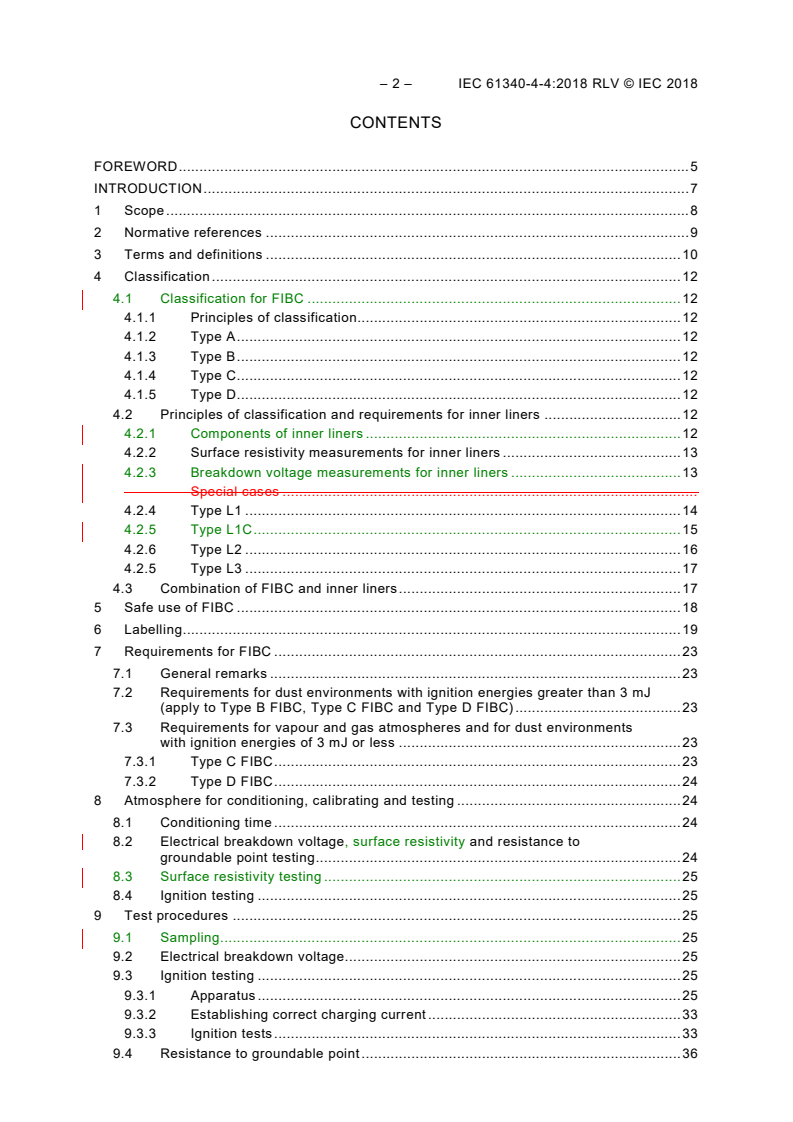
– 2 – IEC 61340-4-4:2018 RLV © IEC 2018
CONTENTS
FOREWORD . 5
INTRODUCTION . 7
1 Scope . 8
2 Normative references . 9
3 Terms and definitions . 10
4 Classification . 12
4.1 Classification for FIBC . 12
4.1.1 Principles of classification. 12
4.1.2 Type A . 12
4.1.3 Type B . 12
4.1.4 Type C. 12
4.1.5 Type D. 12
4.2 Principles of classification and requirements for inner liners . 12
4.2.1 Components of inner liners . 12
4.2.2 Surface resistivity measurements for inner liners . 13
4.2.3 Breakdown voltage measurements for inner liners . 13
Special cases .
4.2.4 Type L1 . 14
4.2.5 Type L1C . 15
4.2.6 Type L2 . 16
4.2.5 Type L3 . 17
4.3 Combination of FIBC and inner liners . 17
5 Safe use of FIBC . 18
6 Labelling . 19
7 Requirements for FIBC . 23
7.1 General remarks . 23
7.2 Requirements for dust environments with ignition energies greater than 3 mJ
(apply to Type B FIBC, Type C FIBC and Type D FIBC) . 23
7.3 Requirements for vapour and gas atmospheres and for dust environments
with ignition energies of 3 mJ or less . 23
7.3.1 Type C FIBC . 23
7.3.2 Type D FIBC . 24
8 Atmosphere for conditioning, calibrating and testing . 24
8.1 Conditioning time . 24
8.2 Electrical breakdown voltage, surface resistivity and resistance to
groundable point testing . 24
8.3 Surface resistivity testing . 25
8.4 Ignition testing . 25
9 Test procedures . 25
9.1 Sampling. 25
9.2 Electrical breakdown voltage. 25
9.3 Ignition testing . 25
9.3.1 Apparatus . 25
9.3.2 Establishing correct charging current . 33
9.3.3 Ignition tests . 33
9.4 Resistance to groundable point . 36
9.4.1 Apparatus . 36
9.4.2 Test procedure . 36
10 Test report . 37
10.1 General . 37
10.2 For all types of testing . 38
10.3 For electrical breakdown voltage testing . 38
10.4 For ignition testing . 38
10.5 For resistance to groundable point testing . 38
10.6 For surface resistivity testing of inner liners, labels and document pockets . 38
10.7 For test reports issued by accredited testing authorities . 38
Annex A (normative informative) Electrical breakdown voltage – Typical voltage/time
graphs . 40
Annex B (normative) Polypropylene pellets for ignition testing . 41
Annex C (informative) Guidance on test methods for manufacturing quality control . 42
C.1 Introductory remarks . 42
C.2 Test methods . 42
C.2.1 Resistance measurements . 42
C.2.2 Charge decay measurements . 43
C.2.3 Charge transfer measurements . 43
Annex D (normative) Classification of hazardous areas and zones . 44
Annex E (informative) Risks associated with cone discharges . 45
Annex F (informative) Explanation for resistance and resistivity limits, and thickness
limits for insulating layers of inner liners . 46
F.1 Resistance to groundable point limit for Type C FIBC . 46
F.2 Resistivity of inner liners . 46
F.3 Thickness of insulating layers of inner liners . 46
Bibliography . 48
Figure 1 – Examples of inner liners in FIBC . 13
Figure 2 – Example of a label for Type B FIBC . 20
Figure 3 – Example of a label for Type C FIBC . 21
Figure 4 – Example of a label for Type D FIBC . 21
Figure 5 – Example of labels for Type C FIBC designated earth bonding points . 22
Figure 6 – Ignition probe . 27
Figure 7 – Perforated metal plate for use in ignition probe . 28
Figure 8 – Gas control and mixing apparatus (schematic) . 29
Figure 9 – FIBC filling rig (schematic) . 31
Figure 10 – Corona charging unit (schematic) . 32
Figure A.1 – Example of voltage/time graph for material showing distinct breakdown . 40
Figure A.2 – Example of voltage/time graph for material showing reduction in rate of
voltage rise because of conduction within the test material . 40
Table 1 – Permissible configurations and requirements for Type L1 inner liners (without
conductive internal layers) . 15
Table 2 – Permissible configurations and requirements for Type L1C inner liners (with
conductive internal layers) . 16
Table 3 – Permissible configurations and requirements for Type L2 inner liners . 17
– 4 – IEC 61340-4-4:2018 RLV © IEC 2018
Table 4 – Permissible configurations and requirements for Type L3 inner liners . 17
Table 5 – Use of different types of FIBC . 18
Table 6 – Inner liners and FIBC: combinations that are permissible and not permissible
in hazardous explosive atmospheres . 19
Table 7 – Volume concentrations of flammable gas mixture . 28
Table 8 – Example of full sample description to be included in the test report . 39
Table B.1 – Particle size distribution of polypropylene pellets . 41
Table D.1 – Classification of hazardous areas in IEC 60079-10-1 and IEC 60079-10-2 . 44
Table D.2 – Classification of zones in IEC 60079-10-1 and IEC 60079-10-2 . 44
INTERNATIONAL ELECTROTECHNICAL COMMISSION
____________
ELECTROSTATICS –
Part 4-4: Standard test methods for specific applications –
Electrostatic classification of flexible intermediate bulk containers (FIBC)
FOREWORD
1) The International Electrotechnical Commission (IEC) is a worldwide organization for standardization comprising
all national electrotechnical committees (IEC National Committees). The object of IEC is to promote
international co-operation on all questions concerning standardization in the electrical and electronic fields. To
this end and in addition to other activities, IEC publishes International Standards, Technical Specifications,
Technical Reports, Publicly Available Specifications (PAS) and Guides (hereafter referred to as "IEC
Publication(s)"). Their preparation is entrusted to technical committees; any IEC National Committee interested
in the subject dealt with may participate in this preparatory work. International, governmental and non-
governmental organizations liaising with the IEC also participate in this preparation. IEC collaborates closely
with the International Organization for Standardization (ISO) in accordance with conditions determined by
agreement between the two organizations.
2) The formal decisions or agreements of IEC on technical matters express, as nearly as possible, an international
consensus of opinion on the relevant subjects since each technical committee has representation from all
interested IEC National Committees.
3) IEC Publications have the form of recommendations for international use and are accepted by IEC National
Committees in that sense. While all reasonable efforts are made to ensure that the technical content of IEC
Publications is accurate, IEC cannot be held responsible for the way in which they are used or for any
misinterpretation by any end user.
4) In order to promote international uniformity, IEC National Committees undertake to apply IEC Publications
transparently to the maximum extent possible in their national and regional publications. Any divergence
between any IEC Publication and the corresponding national or regional publication shall be clearly indicated in
the latter.
5) IEC itself does not provide any attestation of conformity. Independent certification bodies provide conformity
assessment services and, in some areas, access to IEC marks of conformity. IEC is not responsible for any
services carried out by independent certification bodies.
6) All users should ensure that they have the latest edition of this publication.
7) No liability shall attach to IEC or its directors, employees, servants or agents including individual experts and
members of its technical committees and IEC National Committees for any personal injury, property damage or
other damage of any nature whatsoever, whether direct or indirect, or for costs (including legal fees) and
expenses arising out of the publication, use of, or reliance upon, this IEC Publication or any other IEC
Publications.
8) Attention is drawn to the Normative references cited in this publication. Use of the referenced publications is
indispensable for the correct application of this publication.
9) Attention is drawn to the possibility that some of the elements of this IEC Publication may be the subject of
patent rights. IEC shall not be held responsible for identifying any or all such patent rights.
This redline version of the official IEC Standard allows the user to identify the changes
made to the previous edition. A vertical bar appears in the margin wherever a change
has been made. Additions are in green text, deletions are in strikethrough red text.
– 6 – IEC 61340-4-4:2018 RLV © IEC 2018
International Standard IEC 61340-4-4 has been prepared by IEC technical committee 101:
Electrostatics.
This third edition cancels and replaces the second edition, published in 2012, and
Amendment 1:2014. This edition constitutes a technical revision.
This edition includes the following significant technical changes with respect to the previous
edition:
a) in light of experimental evidence, the maximum resistance to ground limit for Type C FIBC,
and corresponding resistance limits for inner liners used in Type C FIBC has been
7 8
increased from 1,0 × 10 Ω to 1,0 × 10 Ω;
b) the classification of Type L1 inner liners has been revised and extended to include Type
L1C inner liners made from multi-layer materials with a conductive internal layer;
c) a labelling requirement to include a reference to IEC TS 60079-32-1 for guidance on
earthing has been added.
The text of this International Standard is based on the following documents:
FDIS Report on voting
101/546/FDIS 101/555/RVD
Full information on the voting for the approval of this International Standard can be found in
the report on voting indicated in the above table.
This document has been drafted in accordance with the ISO/IEC Directives, Part 2.
A list of all parts in the IEC 61340 series, published under the general title Electrostatics, can
be found on the IEC website.
The committee has decided that the contents of this document will remain unchanged until the
stability date indicated on the IEC website under "http://webstore.iec.ch" in the data related to
the specific document. At this date, the document will be
• reconfirmed,
• withdrawn,
• replaced by a revised edition, or
• amended.
IMPORTANT – The 'colour inside' logo on the cover page of this publication indicates
that it contains colours which are considered to be useful for the correct
understanding of its contents. Users should therefore print this document using a
colour printer.
INTRODUCTION
Flexible intermediate bulk containers (FIBC) are widely used for the storage, transportation
and handling of powdered, flaked or granular material. Typically, they are constructed from
woven polypropylene fabric in the form of cubic bags of about 1 m volume, although they can
3 3
vary in shape and in size from 0,25 m to 3 m . The fabric used may be a single layer, a
multi-layer laminate, or a coated fabric. Untreated polypropylene is an electrical insulator, as
is often the case with the products placed in FIBC. There is ample opportunity for the
generation of electrostatic charge during filling and emptying operations and in unprotected
FIBC high levels of charge can quickly build up. In such cases, electrostatic discharges are
inevitable and can be a severe problem when FIBC are used in hazardous explosive
atmospheres.
A hazardous explosive atmosphere can be generated when handling fine powders that create
dust clouds or thin layers of powder, both of which can be ignited by electrostatic discharges.
A hazardous explosive atmosphere can also be generated when using gases or volatile
solvents. In these industrial situations, there is clearly a need to eliminate incendive
electrostatic discharges.
As with any industrial equipment, a thorough risk assessment should always be conducted
before using FIBC in potentially hazardous situations. This part of IEC 61340 describes a
system of classification, test methods, performance and design requirements and safe use
procedures that can be used by manufacturers, specifiers and end-users as part of a risk
assessment of any FIBC intended for use within a hazardous explosive atmosphere. However,
it does not include procedures for evaluating the specific risks of electrostatic discharges
arising from products within FIBC, for example cone discharges, from personnel or from
equipment used near FIBC. Information on risks associated with cone discharges is given in
Annex E.
CAUTION: The test methods specified in this document involve the use of high voltage
power supplies and flammable gases that may present hazards if handled incorrectly,
particularly by unqualified or inexperienced personnel. Users of this document are
encouraged to carry out proper risk assessments and pay due regard to local regulations
before undertaking any of the test procedures.
– 8 – IEC 61340-4-4:2018 RLV © IEC 2018
ELECTROSTATICS –
Part 4-4: Standard test methods for specific applications –
Electrostatic classification of flexible intermediate bulk containers (FIBC)
1 Scope
This part of IEC 61340 specifies requirements for flexible intermediate bulk containers (FIBC)
3 3
between 0,25 m and 3 m in volume, intended for use in hazardous explosive atmospheres.
The explosive atmosphere may can be created by the contents in the FIBC or may can exist
outside the FIBC.
The requirements include:
– classification and labelling of FIBC;
– classification of inner liners;
– specification of test methods for each type of FIBC, inner liner, labels and document
pockets;
– design and performance requirements for FIBC, inner liners, labels and document pockets;
– safe use of FIBC (including those with inner liners) within different zones defined for
explosion endangered environments, described for areas where combustible dusts are, or
may can be, present (IEC 60079-10-2), and for explosive gas atmospheres (IEC 60079-
10-1);
– procedures for type qualification and certification of FIBC, including the safe use of inner
liners.
NOTE 1 Guidance on test methods that may can be used for manufacturing quality control is given in Annex C.
The requirements of this document are applicable to all types of FIBC and inner liners, tested
as manufactured, prior to use and intended for use in hazardous explosive atmospheres:
Zones 1 and 2 (Groups IIA and IIB only) and Zones 21 and 22 (see Annex D for classification
of hazardous areas and explosion groups). For some types of FIBC, the requirements of this
document apply only to use in hazardous explosive atmospheres with minimum ignition
energy of 0,14 mJ or greater and where charging currents do not exceed 3,0 µA.
NOTE 2 0,14 mJ is the represents a realistic minimum ignition energy of for a typical Group IIB gas or vapour
atmosphere. Although more sensitive materials exist, 0,14 mJ is the lowest minimum ignition energy of any
material that is likely to be present when FIBC are emptied. 3,0 µA is the highest charging current likely to be
found in common industrial processes. This combination of minimum ignition energy and charging current
represents the most severe conditions that might be expected in practice.
FIBC are not normally used in Zone 0 or Zone 20. If FIBC are used in Zone 0 or Zone 20, the
requirements of this document are applicable, together with additional requirements that are
beyond the scope of this document to define.
The volume contained within FIBC can be designated as Zone 20, in which case the
requirements of this document are applicable.
Solids containing residual solvent can result in a hazardous explosive atmosphere within
FIBC, possibly resulting in the volume being designated as Zone 1 or Zone 2; in which case
the requirements of this document are applicable.
Compliance with the requirements specified in this document does not necessarily ensure that
hazardous electrostatic discharges, for example cone discharges, will not be generated by the
contents in FIBC. Information on the risks associated with cone discharges is given in
Annex E.
Compliance with the requirements of this document does not mitigate the need for full risk
assessment. For example, metal and other conductive powders and toner powders may can
require additional precautions to prevent hazardous discharges from the powders.
NOTE 3 In the examples mentioned in the paragraph above, additional precautions may can be necessary in the
case of metal or other conductive powder because if the powder is isolated and becomes charged, incendiary
sparks may can occur, and in the case of toner powders, incendiary discharges may can occur during rapid filling
and emptying operations. IEC TS 60079-32-1 [1] gives guidance on additional precautions that may can be
necessary.
Test methods included in this document may can be used in association with other
performance requirements, for example when a risk assessment has shown the minimum
ignition energy of concern is less than 0,14 mJ, charging currents are greater than 3,0 µA, or
the ambient conditions are outside of the range specified in this document.
Compliance with the requirements specified in this document does not necessarily ensure that
electric shocks to personnel will not occur from FIBC during normal use.
2 Normative references
The following documents are referred to in the text in such a way that some or all of their
content constitutes requirements of this document. For dated references, only the edition
cited applies. For undated references, the latest edition of the referenced document (including
any amendments) applies.
IEC 60079-10-1, Explosive atmospheres – Part 10-1: Classification of areas – Explosive gas
atmospheres
IEC 60079-10-2, Explosive atmospheres – Part 10-2: Classification of areas – Combustible
Explosive dust atmospheres
IEC 60243-1:1998 2013, Electric strength of insulating materials – Test methods – Part 1:
Tests at power frequencies
IEC 60243-2, Electric strength of insulating materials – Test methods – Part 2: Additional
requirements for tests using direct voltage
IEC 60417-5019:2006, Graphical symbols for use on equipment (available at:
http://www.graphical-symbols.info/equipment)
IEC 61241-2-3, Electrical apparatus for use in the presence of combustible dust – Part 2: Test
methods – Section 3: Method for determining minimum ignition energy of dust/air mixtures
IEC 61340-2-3, Electrostatics – Part 2-3: Methods of test for determining the resistance and
resistivity of solid planar materials used to avoid electrostatic charge accumulation
ISO/IEC 80079-20-2, Explosive atmospheres – Part 20-2: Material characteristics –
Combustible dusts test methods
ISO 7000:2004, Graphical symbols for use on equipment – Index and synopsis Registered
symbols (available at: http://www.graphical-symbols.info/equipment)
____________
Numbers in square brackets refer to the Bibliography.
– 10 – IEC 61340-4-4:2018 RLV © IEC 2018
ISO 21898, Packaging – Flexible intermediate bulk containers (FIBCs) for non-dangerous
goods
ASTM E582, Standard test method for minimum ignition energy and quenching distance in
gaseous mixtures
3 Terms and definitions
For the purposes of this document, the terms and definitions given in IEC 60079-10-1,
IEC 60079-10-2 and ISO 21898 and the following apply.
ISO and IEC maintain terminological databases for use in standardization at the following
addresses:
• IEC Electropedia: available at http://www.electropedia.org/
• ISO Online browsing platform: available at http://www.iso.org/obp
3.1
multi-layer material
material comprised of more than one layer, the combination of which can be formed by
coextrusion, coating, laminating or any other process that permanently bonds all layers
together
3.2
quenching
effect of solid objects acting as heat sinks in close proximity to gas
3.3
critical quenching distance
maximum separation distance between opposing electrodes below which quenching prevents
ignition at a specified energy
Note 1 to entry: For ignitions to take place, the gap between electrodes should be is greater than the critical
quenching distance.
3.4
flammable substance
substance in the form of gas, vapour, liquid, solid, or mixture of these, capable of propagating
combustion when subjected to an ignition source
3.5
explosive atmosphere
mixture with air, under atmospheric conditions, of flammable substances in the form of gases,
vapours, mists or dusts in which, after ignition has occurred, combustion spreads to the entire
unburned mixture
3.6
hazardous explosive atmosphere
explosive atmosphere present in such quantities that precautions against ignition are required
3.7
minimum ignition energy
MIE
least electrical energy of a purely capacitive spark (i.e. no added inductance) required to
ignite a dust, gas or vapour
3.8
charging current
quantity of charge per unit time flowing into FIBC
3.9
cone discharge
electrostatic discharge running outwards across the surface from the top of highly charged,
insulating powder heaps in large containers
3.10
brush discharge
electrostatic discharge from a non-conductive, solid or liquid surface
3.11
spark
electrostatic discharge from an electrically isolated conductive object or surface
3.12
propagating brush discharge
highly energetic discharge from an insulating sheet, layer or coating on a conductive surface,
or a material of high resistivity and high breakdown voltage with the two surfaces highly
charged to opposite polarity
3.13
inner liner
liner
integral or removable container which fits into the FIBC
3.14
surface resistivity
resistivity equivalent to the surface resistance of a square area of material having electrodes
at two opposite sides
3.15
volume resistivity
resistivity equivalent to the volume resistance of a cube of material with unit length, having
the electrodes at two opposite surfaces
3.16
type qualification testing
testing used to determine the type of FIBC as specified in 4.1 and to demonstrate that FIBC
meet the requirements of Clause 7
3.17
quality control testing
testing designed to provide manufacturers and users with information that demonstrates all
FIBC produced and delivered are substantially the same as the sample FIBC used to qualify
the FIBC design
3.18
groundable point
point on FIBC designated by the manufacturer as a location to attach a grounding or earth
bonding cable or other means of earthing FIBC
NOTE There may be one or more groundable points on each FIBC. Lift loops may also be designated as
groundable points, but fortuitous earthing via lifting hooks should not be relied as these may be painted/coated, or
covered with powder etc., and so may not guarantee an adequate earth path.
– 12 – IEC 61340-4-4:2018 RLV © IEC 2018
4 Classification
4.1 Classification for FIBC
4.1.1 Principles of classification for FIBC
FIBC are classified according to one of four types: Type A, Type B, Type C and Type D. The
types are defined by the construction of the FIBC, the nature of their intended operation and
associated performance requirements.
An individual design of FIBC may only be classified as one single type; for example one FIBC
cannot shall not be simultaneously classified as both Type B and Type D, or as both Type B
and Type C, or as Type CD.
4.1.2 Type A
Type A FIBC are made from fabric or plastic sheet without any measures against the build up
of static electricity. Any FIBC that does not meet the requirements specified in Clause 7, or
which has not been tested against the requirements is classified as Type A.
4.1.3 Type B
Type B FIBC are made from fabric or plastic sheet designed to prevent the occurrence of
sparks and propagating brush discharges.
Conductive materials, as used in the manufacture of Type C FIBC for example, shall not be
used in the manufacture of Type B FIBC.
NOTE Type B FIBC are not normally connected to earth. Conductive material that is not connected to earth
creates a risk of incendiary sparks.
4.1.4 Type C
Type C FIBC are made from conductive fabric or plastic sheet, or interwoven with conductive
threads or filaments and designed to prevent the occurrence of incendiary sparks, brush
discharges and propagating brush discharges. Type C FIBC are designed to be connected to
earth during before the commencement of filling and emptying operations and remain
connected to earth during these operations.
4.1.5 Type D
Type D FIBC are made from static protective fabric designed to prevent the occurrence of
incendiary sparks, brush discharges and propagating brush discharges, without the need for a
connection from the FIBC to earth.
4.2 Principles of classification and requirements for inner liners
4.2.1 Components of inner liners
Materials used for inner liners can be single layer, or multi-layered materials. In the latter
case, the layers are typically permanently bonded together. Examples of FIBC with a single
layer inner liner and with a multi-layer inner liner are shown in Figure 1.
For the purposes of this document, and for both single layer inner liners and multi-layer inner
liners, the outside surface of the inner liner is the surface that physically contacts the FIBC,
and the inside surface of the inner liner is the surface that physically contacts the product with
which the FIBC is filled.
In Figure 1, the multi-layer inner liner is shown as comprising of three layers. In practice,
more than three layers can be used. For the purposes of this document, an internal layer is
any layer of a multi-layer liner that does not physically contact either the FIBC or the product
with which the FIBC is filled.
The electrical properties of the outside surface of a single layer or multi-layer inner liner can
be the same as the inside surface, or they can be different. For example, one of the surfaces
can be treated with a topical finish to reduce surface resistivity.
With multi-layer inner liners, there are many possible combinations of layers with similar or
different electrical properties.
Notwithstanding the many possible combinations of materials for inner liners, for the purposes
of this document it is the electrical properties of the outside surface and inside surface of
inner liners that are of interest, together with the presence of any conductive internal layers.
IEC
Key
1 FIBC 5 inside surface of multi-layer inner liner
2 outside surface of single layer inner liner 6 external layer of multi-layer inner liner
3 inside surface of single layer inner liner 7 internal layer of multi-layer inner liner
4 outside surface of multi-layer inner liner 8 external layer of multi-layer inner liner
NOTE For illustrative purposes, the layers of the multi-layer inner liner are shown separated. In practice, they are
typically permanently bonded together.
Figure 1 – Examples of inner liners in FIBC
4.2.2 Surface resistivity measurements for inner liners
Surface resistivity shall be measured according to IEC 61340-2-3. A minimum of ten
measurements shall be made at points evenly distributed over the inner liner surface. All
measurements shall be within the limits specified for the type of inner liner being tested.
4.2.3 Breakdown voltage measurements for inner liners
Breakdown voltage shall be measured according to 9.2 under the conditions specified in 8.2.
The measured breakdown voltage is highly dependent on the thickness of the insulating
material and its electrical resistivity. As even minor changes can affect the breakdown voltage,
– 14 – IEC 61340-4-4:2018 RLV © IEC 2018
the result only applies to the configuration of liner tested (including the thickness of the
individual layers for co-extruded liners, in addition to the overall thickness).
When measuring breakdown voltage between an insulating layer and an internal conductive
layer, a means of making electrical contact with the conductive layer is required. If an
electrical connection is present, for example the earth bonding point on a finished liner, this
can be used. When measuring films without earth bonding points, electrical contact with the
conductive layer can be made using a staple inserted through the film, or by partially
removing the insulating layer from an area at least 100 mm from the edge of the area where
the electrode will be applied to the insulating layer. In the latter cases, either at least two
staples shall be inserted, or at least two areas of insulating film shall be removed so that
electrical connection to the conductive layer can be checked by measuring the resistance
between staples or exposed conductive areas.
4.2.2 Special cases
Inner liners made from materials that contain a conductive layer sandwiched between two
insulating layers shall not be used in Type B or Type D FIBC. If such an inner liner is used in
Type C FIBC, the conductive layer shall be securely bonded to earth. The thickness of the
insulating layers shall be less than 700 µm, and the breakdown voltage measured between an
electrode placed on each surface in turn and the conductive layer shall be less than 4 kV,
measured according to 9.1 under the conditions specified in 8.2.
NOTE In order to avoid incendiary brush discharge, the thickness of any exposed insulating layers in contact with
non-insulating layers is limited to a maximum of 700 µm.
4.2.4 Type L1
Type L1 inner liners are made from materials with surface resistivity on at least one surface
7 8
less than or equal to 1,0 x 10 10 Ω (see Annex F), measured under the conditions specified
in 8.2. Type L1 shall not include internal conductive layers; such inner liners are classified as
Type L1C (see 4.2.5). Type L1 inner liners may be used in Type C FIBC.
If the material is multi-layered, or If the material has one surface with surface resistivity
greater than 1,0 x 10 Ω, the breakdown voltage through the material shall be less than
4 kV, measured according to 9.2 under the conditions specified in 8.2.
Fortuitous contact between the inner liner and the inside of the FIBC cannot be relied upon to
ensure proper earthing of the inner liner. Therefore, the surface with resistivity less than
1,0 x 10 Ω shall be securely connected to the earth bonding system of the FIBC via specific
connections. The connections to the earth bonding system of the FIBC shall be sufficiently
strong to withstand the stresses present during filling, transport and emptying operations and
maintain electrical continuity.
The total thickness of any layer(s) with surface resistivity greater than 1,0 x 10 Ω on the
inside (product side) of the inner liner material shall be less than 700 µm.
Permissible configurations and requirements for Type L1 inner liners are summarized in
Table 1.
Table 1 – Permissible configurations and requirements for Type L1 inner liners
(without conductive internal layers)
Parameters
Resistivity of Resistivity of
Configuration
Breakdown voltage Thickness
inside surface outside surface
V d
B
ρ ρ
I O
No measurement
7 8 7 8
1 ρ ≤ 1,0 x 10 10 Ω ρ ≤ 1,0 x 10 10 Ω No limit
I O
required
No measurement
7 8 12
2A ρ ≤ 1,0 x 10 10 Ω ρ ≤ 1,0 x 10 Ω No limit
I O
required
No measurement
12 7 8
2B
ρ ≤ 1,0 x 10 Ω ρ ≤ 1,0 x 10 10 Ω No limit
I O
required
7 8 12
3 V < 4 kV
ρ ≤ 1,0 x 10 10 Ω ρ > 1,0 x 10 Ω No limit
B
I O
12 7 8
4 V < 4 kV
ρ > 1,0 x 10 Ω ρ ≤ 1,0 x 10 10 Ω d < 700 µm
B
I O
All layers with surface resistivity less than 1,0 × 10 Ω shall be securely bonded to earth when installed in
FIBC.
4.2.5 Type L1C
Type L1C inner liners are made from multi-layered materials with an internal layer of surface
resistivity less than or equal to 1,0 × 10 Ω (see Annex F). Type L1C inner liners may be used
in Type C FIBC.
The breakdown voltage between any surface with resistivity greater than 1,0 × 10 Ω and the
conductive internal layer shall be less than 4 kV, measured according to 9.2 under the
conditions specified in 8.2.
The total thickness of any layer(s) with surface resistivity greater than 1,0 × 10 Ω on the
inside (product side) of the inner liner material shall be less than 700 µm.
All layers with surface resistivity less than 1,0 × 10 Ω shall be securely connected to the
earth bonding system of the FIBC via specific connections. The connections to the earth
bonding system of the FIBC shall be sufficiently strong to withstand the stresses present
during filling, transport and emptying operations and maintain electrical continuity.
Even if the surface of the inner liner in contact with the inside of the FIBC has a surface
resistivity less than 1,0 × 10 Ω, fortuitous contact between the inner liner and the inside of
the FIBC cannot be relied upon to ensure proper earthing of the inner liner, and specific earth
bonding connections are still required.
Permissible configurations and requirements for Type L1C inner liners are summarized in
Table 2.
– 16 – IEC 61340-4-4:2018 RLV © IEC 2018
Table 2 – Permissible conf
...
IEC 61340-4-4 ®
Edition 3.0 2018-01
INTERNATIONAL
STANDARD
NORME
INTERNATIONALE
colour
inside
Electrostatics –
Part 4-4: Standard test methods for specific applications – Electrostatic
classification of flexible intermediate bulk containers (FIBC)
Électrostatique –
Partie 4-4: Méthodes d'essai normalisées pour des applications spécifiques –
Classification électrostatique des grands récipients pour vrac souples (GRVS)
All rights reserved. Unless otherwise specified, no part of this publication may be reproduced or utilized in any form
or by any means, electronic or mechanical, including photocopying and microfilm, without permission in writing from
either IEC or IEC's member National Committee in the country of the requester. If you have any questions about IEC
copyright or have an enquiry about obtaining additional rights to this publication, please contact the address below or
your local IEC member National Committee for further information.
Droits de reproduction réservés. Sauf indication contraire, aucune partie de cette publication ne peut être reproduite
ni utilisée sous quelque forme que ce soit et par aucun procédé, électronique ou mécanique, y compris la photocopie
et les microfilms, sans l'accord écrit de l'IEC ou du Comité national de l'IEC du pays du demandeur. Si vous avez des
questions sur le copyright de l'IEC ou si vous désirez obtenir des droits supplémentaires sur cette publication, utilisez
les coordonnées ci-après ou contactez le Comité national de l'IEC de votre pays de résidence.
IEC Central Office Tel.: +41 22 919 02 11
3, rue de Varembé info@iec.ch
CH-1211 Geneva 20 www.iec.ch
Switzerland
About the IEC
The International Electrotechnical Commission (IEC) is the leading global organization that prepares and publishes
International Standards for all electrical, electronic and related technologies.
About IEC publications
The technical content of IEC publications is kept under constant review by the IEC. Please make sure that you have the
latest edition, a corrigenda or an amendment might have been published.
IEC Catalogue - webstore.iec.ch/catalogue Electropedia - www.electropedia.org
The stand-alone application for consulting the entire The world's leading online dictionary of electronic and
bibliographical information on IEC International Standards, electrical terms containing 21 000 terms and definitions in
Technical Specifications, Technical Reports and other English and French, with equivalent terms in 16 additional
documents. Available for PC, Mac OS, Android Tablets and languages. Also known as the International Electrotechnical
iPad. Vocabulary (IEV) online.
IEC publications search - webstore.iec.ch/advsearchform IEC Glossary - std.iec.ch/glossary
The advanced search enables to find IEC publications by a 67 000 electrotechnical terminology entries in English and
variety of criteria (reference number, text, technical French extracted from the Terms and Definitions clause of
committee,…). It also gives information on projects, replaced IEC publications issued since 2002. Some entries have been
and withdrawn publications. collected from earlier publications of IEC TC 37, 77, 86 and
CISPR.
IEC Just Published - webstore.iec.ch/justpublished
Stay up to date on all new IEC publications. Just Published IEC Customer Service Centre - webstore.iec.ch/csc
details all new publications released. Available online and If you wish to give us your feedback on this publication or
also once a month by email. need further assistance, please contact the Customer Service
Centre: sales@iec.ch.
A propos de l'IEC
La Commission Electrotechnique Internationale (IEC) est la première organisation mondiale qui élabore et publie des
Normes internationales pour tout ce qui a trait à l'électricité, à l'électronique et aux technologies apparentées.
A propos des publications IEC
Le contenu technique des publications IEC est constamment revu. Veuillez vous assurer que vous possédez l’édition la
plus récente, un corrigendum ou amendement peut avoir été publié.
Catalogue IEC - webstore.iec.ch/catalogue Electropedia - www.electropedia.org
Application autonome pour consulter tous les renseignements
Le premier dictionnaire en ligne de termes électroniques et
bibliographiques sur les Normes internationales,
électriques. Il contient 21 000 termes et définitions en anglais
Spécifications techniques, Rapports techniques et autres
et en français, ainsi que les termes équivalents dans 16
documents de l'IEC. Disponible pour PC, Mac OS, tablettes
langues additionnelles. Egalement appelé Vocabulaire
Android et iPad.
Electrotechnique International (IEV) en ligne.
Recherche de publications IEC -
Glossaire IEC - std.iec.ch/glossary
webstore.iec.ch/advsearchform
67 000 entrées terminologiques électrotechniques, en anglais
La recherche avancée permet de trouver des publications IEC et en français, extraites des articles Termes et Définitions des
en utilisant différents critères (numéro de référence, texte, publications IEC parues depuis 2002. Plus certaines entrées
comité d’études,…). Elle donne aussi des informations sur les antérieures extraites des publications des CE 37, 77, 86 et
projets et les publications remplacées ou retirées. CISPR de l'IEC.
IEC Just Published - webstore.iec.ch/justpublished Service Clients - webstore.iec.ch/csc
Restez informé sur les nouvelles publications IEC. Just Si vous désirez nous donner des commentaires sur cette
Published détaille les nouvelles publications parues. publication ou si vous avez des questions contactez-nous:
Disponible en ligne et aussi une fois par mois par email. sales@iec.ch.
IEC 61340-4-4 ®
Edition 3.0 2018-01
INTERNATIONAL
STANDARD
NORME
INTERNATIONALE
colour
inside
Electrostatics –
Part 4-4: Standard test methods for specific applications – Electrostatic
classification of flexible intermediate bulk containers (FIBC)
Électrostatique –
Partie 4-4: Méthodes d'essai normalisées pour des applications spécifiques –
Classification électrostatique des grands récipients pour vrac souples (GRVS)
INTERNATIONAL
ELECTROTECHNICAL
COMMISSION
COMMISSION
ELECTROTECHNIQUE
INTERNATIONALE
ICS 17.220.99; 29.020; 55.080 ISBN 978-2-8322-5264-2
– 2 – IEC 61340-4-4:2018 © IEC 2018
CONTENTS
FOREWORD . 5
INTRODUCTION . 7
1 Scope . 8
2 Normative references . 9
3 Terms and definitions . 10
4 Classification . 12
4.1 Classification for FIBC . 12
4.1.1 Principles of classification. 12
4.1.2 Type A . 12
4.1.3 Type B . 12
4.1.4 Type C. 12
4.1.5 Type D. 12
4.2 Principles of classification and requirements for inner liners . 12
4.2.1 Components of inner liners . 12
4.2.2 Surface resistivity measurements for inner liners . 13
4.2.3 Breakdown voltage measurements for inner liners . 13
4.2.4 Type L1 . 14
4.2.5 Type L1C . 15
4.2.6 Type L2 . 15
4.2.7 Type L3 . 16
4.3 Combination of FIBC and inner liners . 17
5 Safe use of FIBC . 17
6 Labelling . 19
7 Requirements for FIBC . 22
7.1 General remarks . 22
7.2 Requirements for dust environments with ignition energies greater than 3 mJ
(apply to Type B FIBC, Type C FIBC and Type D FIBC) . 22
7.3 Requirements for vapour and gas atmospheres and for dust environments
with ignition energies of 3 mJ or less . 23
7.3.1 Type C FIBC . 23
7.3.2 Type D FIBC . 23
8 Atmosphere for conditioning, calibrating and testing . 24
8.1 Conditioning time . 24
8.2 Electrical breakdown voltage, surface resistivity and resistance to
groundable point testing . 24
8.3 Surface resistivity testing . 24
8.4 Ignition testing . 24
9 Test procedures . 24
9.1 Sampling. 24
9.2 Electrical breakdown voltage. 24
9.3 Ignition testing . 25
9.3.1 Apparatus . 25
9.3.2 Establishing correct charging current . 32
9.3.3 Ignition tests . 32
9.4 Resistance to groundable point . 35
9.4.1 Apparatus . 35
9.4.2 Test procedure . 35
10 Test report . 36
10.1 General . 36
10.2 For all types of testing . 37
10.3 For electrical breakdown voltage testing . 37
10.4 For ignition testing . 37
10.5 For resistance to groundable point testing . 37
10.6 For surface resistivity testing of inner liners, labels and document pockets . 37
10.7 For test reports issued by accredited testing authorities . 37
Annex A (informative) Electrical breakdown voltage – Typical voltage/time graphs . 39
Annex B (normative) Polypropylene pellets for ignition testing . 40
Annex C (informative) Guidance on test methods for manufacturing quality control . 41
C.1 Introductory remarks . 41
C.2 Test methods . 41
C.2.1 Resistance measurements . 41
C.2.2 Charge decay measurements . 42
C.2.3 Charge transfer measurements . 42
Annex D (normative) Classification of hazardous areas and zones . 43
Annex E (informative) Risks associated with cone discharges . 44
Annex F (informative) Explanation for resistance and resistivity limits, and thickness
limits for insulating layers of inner liners . 45
F.1 Resistance to groundable point limit for Type C FIBC . 45
F.2 Resistivity of inner liners . 45
F.3 Thickness of insulating layers of inner liners . 45
Bibliography . 47
Figure 1 – Examples of inner liners in FIBC . 13
Figure 2 – Example of a label for Type B FIBC . 20
Figure 3 – Example of a label for Type C FIBC . 20
Figure 4 – Example of a label for Type D FIBC . 21
Figure 5 – Example of labels for Type C FIBC designated earth bonding points . 21
Figure 6 – Ignition probe . 26
Figure 7 – Perforated metal plate for use in ignition probe . 27
Figure 8 – Gas control and mixing apparatus (schematic) . 28
Figure 9 – FIBC filling rig (schematic) . 30
Figure 10 – Corona charging unit (schematic) . 31
Figure A.1 – Example of voltage/time graph for material showing distinct breakdown . 39
Figure A.2 – Example of voltage/time graph for material showing reduction in rate of
voltage rise because of conduction within the test material . 39
Table 1 – Permissible configurations and requirements for Type L1 inner liners (without
conductive internal layers) . 14
Table 2 – Permissible configurations and requirements for Type L1C inner liners (with
a
conductive internal layers ) . 15
Table 3 – Permissible configurations and requirements for Type L2 inner liners . 16
Table 4 – Permissible configurations and requirements for Type L3 inner liners . 17
– 4 – IEC 61340-4-4:2018 © IEC 2018
Table 5 – Use of different types of FIBC . 17
Table 6 – Inner liners and FIBC: combinations that are permissible and not permissible
in hazardous explosive atmospheres . 18
Table 7 – Volume concentrations of flammable gas mixture . 27
Table 8 – Example of full sample description to be included in the test report . 38
Table B.1 – Particle size distribution of polypropylene pellets . 40
Table D.1 – Classification of hazardous areas in IEC 60079-10-1 and IEC 60079-10-2 . 43
Table D.2 – Classification of zones in IEC 60079-10-1 and IEC 60079-10-2 . 43
INTERNATIONAL ELECTROTECHNICAL COMMISSION
____________
ELECTROSTATICS –
Part 4-4: Standard test methods for specific applications –
Electrostatic classification of flexible intermediate bulk containers (FIBC)
FOREWORD
1) The International Electrotechnical Commission (IEC) is a worldwide organization for standardization comprising
all national electrotechnical committees (IEC National Committees). The object of IEC is to promote
international co-operation on all questions concerning standardization in the electrical and electronic fields. To
this end and in addition to other activities, IEC publishes International Standards, Technical Specifications,
Technical Reports, Publicly Available Specifications (PAS) and Guides (hereafter referred to as "IEC
Publication(s)"). Their preparation is entrusted to technical committees; any IEC National Committee interested
in the subject dealt with may participate in this preparatory work. International, governmental and non-
governmental organizations liaising with the IEC also participate in this preparation. IEC collaborates closely
with the International Organization for Standardization (ISO) in accordance with conditions determined by
agreement between the two organizations.
2) The formal decisions or agreements of IEC on technical matters express, as nearly as possible, an international
consensus of opinion on the relevant subjects since each technical committee has representation from all
interested IEC National Committees.
3) IEC Publications have the form of recommendations for international use and are accepted by IEC National
Committees in that sense. While all reasonable efforts are made to ensure that the technical content of IEC
Publications is accurate, IEC cannot be held responsible for the way in which they are used or for any
misinterpretation by any end user.
4) In order to promote international uniformity, IEC National Committees undertake to apply IEC Publications
transparently to the maximum extent possible in their national and regional publications. Any divergence
between any IEC Publication and the corresponding national or regional publication shall be clearly indicated in
the latter.
5) IEC itself does not provide any attestation of conformity. Independent certification bodies provide conformity
assessment services and, in some areas, access to IEC marks of conformity. IEC is not responsible for any
services carried out by independent certification bodies.
6) All users should ensure that they have the latest edition of this publication.
7) No liability shall attach to IEC or its directors, employees, servants or agents including individual experts and
members of its technical committees and IEC National Committees for any personal injury, property damage or
other damage of any nature whatsoever, whether direct or indirect, or for costs (including legal fees) and
expenses arising out of the publication, use of, or reliance upon, this IEC Publication or any other IEC
Publications.
8) Attention is drawn to the Normative references cited in this publication. Use of the referenced publications is
indispensable for the correct application of this publication.
9) Attention is drawn to the possibility that some of the elements of this IEC Publication may be the subject of
patent rights. IEC shall not be held responsible for identifying any or all such patent rights.
International Standard IEC 61340-4-4 has been prepared by IEC technical committee 101:
Electrostatics.
This third edition cancels and replaces the second edition, published in 2012, and
Amendment 1:2014. This edition constitutes a technical revision.
This edition includes the following significant technical changes with respect to the previous
edition:
a) in light of experimental evidence, the maximum resistance to ground limit for Type C FIBC,
and corresponding resistance limits for inner liners used in Type C FIBC has been
7 8
increased from 1,0 × 10 Ω to 1,0 × 10 Ω;
b) the classification of Type L1 inner liners has been revised and extended to include Type
L1C inner liners made from multi-layer materials with a conductive internal layer;
– 6 – IEC 61340-4-4:2018 © IEC 2018
c) a labelling requirement to include a reference to IEC TS 60079-32-1 for guidance on
earthing has been added.
The text of this International Standard is based on the following documents:
FDIS Report on voting
101/546/FDIS 101/555/RVD
Full information on the voting for the approval of this International Standard can be found in
the report on voting indicated in the above table.
This document has been drafted in accordance with the ISO/IEC Directives, Part 2.
A list of all parts in the IEC 61340 series, published under the general title Electrostatics, can
be found on the IEC website.
The committee has decided that the contents of this document will remain unchanged until the
stability date indicated on the IEC website under "http://webstore.iec.ch" in the data related to
the specific document. At this date, the document will be
• reconfirmed,
• withdrawn,
• replaced by a revised edition, or
• amended.
IMPORTANT – The 'colour inside' logo on the cover page of this publication indicates
that it contains colours which are considered to be useful for the correct
understanding of its contents. Users should therefore print this document using a
colour printer.
INTRODUCTION
Flexible intermediate bulk containers (FIBC) are widely used for the storage, transportation
and handling of powdered, flaked or granular material. Typically, they are constructed from
woven polypropylene fabric in the form of cubic bags of about 1 m volume, although they can
3 3
vary in shape and in size from 0,25 m to 3 m . The fabric used may be a single layer, a
multi-layer laminate, or a coated fabric. Untreated polypropylene is an electrical insulator, as
is often the case with the products placed in FIBC. There is ample opportunity for the
generation of electrostatic charge during filling and emptying operations and in unprotected
FIBC high levels of charge can quickly build up. In such cases, electrostatic discharges are
inevitable and can be a severe problem when FIBC are used in hazardous explosive
atmospheres.
A hazardous explosive atmosphere can be generated when handling fine powders that create
dust clouds or thin layers of powder, both of which can be ignited by electrostatic discharges.
A hazardous explosive atmosphere can also be generated when using gases or volatile
solvents. In these industrial situations, there is clearly a need to eliminate incendive
electrostatic discharges.
As with any industrial equipment, a thorough risk assessment should always be conducted
before using FIBC in potentially hazardous situations. This part of IEC 61340 describes a
system of classification, test methods, performance and design requirements and safe use
procedures that can be used by manufacturers, specifiers and end-users as part of a risk
assessment of any FIBC intended for use within a hazardous explosive atmosphere. However,
it does not include procedures for evaluating the specific risks of electrostatic discharges
arising from products within FIBC, for example cone discharges, from personnel or from
equipment used near FIBC. Information on risks associated with cone discharges is given in
Annex E.
CAUTION: The test methods specified in this document involve the use of high voltage
power supplies and flammable gases that may present hazards if handled incorrectly,
particularly by unqualified or inexperienced personnel. Users of this document are
encouraged to carry out proper risk assessments and pay due regard to local regulations
before undertaking any of the test procedures.
– 8 – IEC 61340-4-4:2018 © IEC 2018
ELECTROSTATICS –
Part 4-4: Standard test methods for specific applications –
Electrostatic classification of flexible intermediate bulk containers (FIBC)
1 Scope
This part of IEC 61340 specifies requirements for flexible intermediate bulk containers (FIBC)
3 3
between 0,25 m and 3 m in volume, intended for use in hazardous explosive atmospheres.
The explosive atmosphere can be created by the contents in the FIBC or can exist outside the
FIBC.
The requirements include:
– classification and labelling of FIBC;
– classification of inner liners;
– specification of test methods for each type of FIBC, inner liner, labels and document
pockets;
– design and performance requirements for FIBC, inner liners, labels and document pockets;
– safe use of FIBC (including those with inner liners) within different zones defined for
explosion endangered environments, described for areas where combustible dusts are, or
can be, present (IEC 60079-10-2), and for explosive gas atmospheres (IEC 60079-10-1);
– procedures for type qualification and certification of FIBC, including the safe use of inner
liners.
NOTE 1 Guidance on test methods that can be used for manufacturing quality control is given in Annex C.
The requirements of this document are applicable to all types of FIBC and inner liners, tested
as manufactured, prior to use and intended for use in hazardous explosive atmospheres:
Zones 1 and 2 (Groups IIA and IIB only) and Zones 21 and 22 (see Annex D for classification
of hazardous areas and explosion groups). For some types of FIBC, the requirements of this
document apply only to use in hazardous explosive atmospheres with minimum ignition
energy of 0,14 mJ or greater and where charging currents do not exceed 3,0 µA.
NOTE 2
0,14 mJ represents a realistic minimum ignition energy for a Group IIB gas or vapour atmosphere. Although more
sensitive materials exist, 0,14 mJ is the lowest minimum ignition energy of any material that is likely to be present
when FIBC are emptied. 3,0 µA is the highest charging current likely to be found in common industrial processes.
This combination of minimum ignition energy and charging current represents the most severe conditions that
might be expected in practice.
FIBC are not normally used in Zone 0 or Zone 20. If FIBC are used in Zone 0 or Zone 20, the
requirements of this document are applicable, together with additional requirements that are
beyond the scope of this document to define.
The volume contained within FIBC can be designated as Zone 20, in which case the
requirements of this document are applicable.
Solids containing residual solvent can result in a hazardous explosive atmosphere within
FIBC, possibly resulting in the volume being designated as Zone 1 or Zone 2; in which case
the requirements of this document are applicable.
Compliance with the requirements specified in this document does not necessarily ensure that
hazardous electrostatic discharges, for example cone discharges, will not be generated by the
contents in FIBC. Information on the risks associated with cone discharges is given in
Annex E.
Compliance with the requirements of this document does not mitigate the need for full risk
assessment. For example, metal and other conductive powders and toner powders can
require additional precautions to prevent hazardous discharges from the powders.
NOTE 3 In the examples mentioned in the paragraph above, additional precautions can be necessary in the case
of metal or other conductive powder because if the powder is isolated and becomes charged, incendiary sparks can
occur, and in the case of toner powders, incendiary discharges can occur during rapid filling and emptying
operations. IEC TS 60079-32-1 [1] gives guidance on additional precautions that can be necessary.
Test methods included in this document can be used in association with other performance
requirements, for example when a risk assessment has shown the minimum ignition energy of
concern is less than 0,14 mJ, charging currents are greater than 3,0 µA, or the ambient
conditions are outside of the range specified in this document.
Compliance with the requirements specified in this document does not necessarily ensure that
electric shocks to personnel will not occur from FIBC during normal use.
2 Normative references
The following documents are referred to in the text in such a way that some or all of their
content constitutes requirements of this document. For dated references, only the edition
cited applies. For undated references, the latest edition of the referenced document (including
any amendments) applies.
IEC 60079-10-1, Explosive atmospheres – Part 10-1: Classification of areas – Explosive gas
atmospheres
IEC 60079-10-2, Explosive atmospheres – Part 10-2: Classification of areas – Explosive dust
atmospheres
IEC 60243-1:2013, Electric strength of insulating materials – Test methods – Part 1: Tests at
power frequencies
IEC 60243-2, Electric strength of insulating materials – Test methods – Part 2: Additional
requirements for tests using direct voltage
IEC 60417, Graphical symbols for use on equipment (available at: http://www.graphical-
symbols.info/equipment)
IEC 61340-2-3, Electrostatics – Part 2-3: Methods of test for determining the resistance and
resistivity of solid materials used to avoid electrostatic charge accumulation
ISO/IEC 80079-20-2, Explosive atmospheres – Part 20-2: Material characteristics –
Combustible dusts test methods
ISO 7000, Graphical symbols for use on equipment – Registered symbols (available at:
http://www.graphical-symbols.info/equipment)
ISO 21898, Packaging – Flexible intermediate bulk containers (FIBCs) for non-dangerous
goods
____________
Numbers in square brackets refer to the Bibliography.
– 10 – IEC 61340-4-4:2018 © IEC 2018
ASTM E582, Standard test method for minimum ignition energy and quenching distance in
gaseous mixtures
3 Terms and definitions
For the purposes of this document, the terms and definitions given in IEC 60079-10-1,
IEC 60079-10-2 and ISO 21898 and the following apply.
ISO and IEC maintain terminological databases for use in standardization at the following
addresses:
• IEC Electropedia: available at http://www.electropedia.org/
• ISO Online browsing platform: available at http://www.iso.org/obp
3.1
multi-layer material
material comprised of more than one layer, the combination of which can be formed by
coextrusion, coating, laminating or any other process that permanently bonds all layers
together
3.2
quenching
effect of solid objects acting as heat sinks in close proximity to gas
3.3
critical quenching distance
maximum separation distance between opposing electrodes below which quenching prevents
ignition at a specified energy
Note 1 to entry: For ignitions to take place, the gap between electrodes is greater than the critical quenching
distance.
3.4
flammable substance
substance in the form of gas, vapour, liquid, solid, or mixture of these, capable of propagating
combustion when subjected to an ignition source
3.5
explosive atmosphere
mixture with air, under atmospheric conditions, of flammable substances in the form of gases,
vapours, mists or dusts in which, after ignition has occurred, combustion spreads to the entire
unburned mixture
3.6
hazardous explosive atmosphere
explosive atmosphere present in such quantities that precautions against ignition are required
3.7
minimum ignition energy
MIE
least electrical energy of a purely capacitive spark (i.e. no added inductance) required to
ignite a dust, gas or vapour
3.8
charging current
quantity of charge per unit time flowing into FIBC
3.9
cone discharge
electrostatic discharge running outwards across the surface from the top of highly charged,
insulating powder heaps in large containers
3.10
brush discharge
electrostatic discharge from a non-conductive, solid or liquid surface
3.11
spark
electrostatic discharge from an electrically isolated conductive object or surface
3.12
propagating brush discharge
highly energetic discharge from an insulating sheet, layer or coating on a conductive surface,
or a material of high resistivity and high breakdown voltage with the two surfaces highly
charged to opposite polarity
3.13
inner liner
liner
integral or removable container which fits into the FIBC
3.14
surface resistivity
resistivity equivalent to the surface resistance of a square area of material having electrodes
at two opposite sides
3.15
volume resistivity
resistivity equivalent to the volume resistance of a cube of material with unit length, having
the electrodes at two opposite surfaces
3.16
type qualification testing
testing used to determine the type of FIBC as specified in 4.1 and to demonstrate that FIBC
meet the requirements of Clause 7
3.17
quality control testing
testing designed to provide manufacturers and users with information that demonstrates all
FIBC produced and delivered are substantially the same as the sample FIBC used to qualify
the FIBC design
3.18
groundable point
point on FIBC designated by the manufacturer as a location to attach a grounding or earth
bonding cable or other means of earthing FIBC
– 12 – IEC 61340-4-4:2018 © IEC 2018
4 Classification
4.1 Classification for FIBC
4.1.1 Principles of classification
FIBC are classified according to one of four types: Type A, Type B, Type C and Type D. The
types are defined by the construction of the FIBC, the nature of their intended operation and
associated performance requirements.
An individual design of FIBC may only be classified as one single type; for example one FIBC
shall not be simultaneously classified as both Type B and Type D, or as both Type B and
Type C, or as Type CD.
4.1.2 Type A
Type A FIBC are made from fabric or plastic sheet without any measures against the build up
of static electricity. Any FIBC that does not meet the requirements specified in Clause 7, or
which has not been tested against the requirements is classified as Type A.
4.1.3 Type B
Type B FIBC are made from fabric or plastic sheet designed to prevent the occurrence of
sparks and propagating brush discharges.
Conductive materials, as used in the manufacture of Type C FIBC for example, shall not be
used in the manufacture of Type B FIBC.
NOTE Type B FIBC are not normally connected to earth. Conductive material that is not connected to earth
creates a risk of incendiary sparks.
4.1.4 Type C
Type C FIBC are made from conductive fabric or plastic sheet, or interwoven with conductive
threads or filaments and designed to prevent the occurrence of incendiary sparks, brush
discharges and propagating brush discharges. Type C FIBC are designed to be connected to
earth before the commencement of filling and emptying operations and remain connected to
earth during these operations.
4.1.5 Type D
Type D FIBC are made from static protective fabric designed to prevent the occurrence of
incendiary sparks, brush discharges and propagating brush discharges, without the need for a
connection from the FIBC to earth.
4.2 Principles of classification and requirements for inner liners
4.2.1 Components of inner liners
Materials used for inner liners can be single layer, or multi-layered materials. In the latter
case, the layers are typically permanently bonded together. Examples of FIBC with a single
layer inner liner and with a multi-layer inner liner are shown in Figure 1.
For the purposes of this document, and for both single layer inner liners and multi-layer inner
liners, the outside surface of the inner liner is the surface that physically contacts the FIBC,
and the inside surface of the inner liner is the surface that physically contacts the product with
which the FIBC is filled.
In Figure 1, the multi-layer inner liner is shown as comprising of three layers. In practice,
more than three layers can be used. For the purposes of this document, an internal layer is
any layer of a multi-layer liner that does not physically contact either the FIBC or the product
with which the FIBC is filled.
The electrical properties of the outside surface of a single layer or multi-layer inner liner can
be the same as the inside surface, or they can be different. For example, one of the surfaces
can be treated with a topical finish to reduce surface resistivity.
With multi-layer inner liners, there are many possible combinations of layers with similar or
different electrical properties.
Notwithstanding the many possible combinations of materials for inner liners, for the purposes
of this document it is the electrical properties of the outside surface and inside surface of
inner liners that are of interest, together with the presence of any conductive internal layers.
IEC
Key
1 FIBC 5 inside surface of multi-layer inner liner
2 outside surface of single layer inner liner 6 external layer of multi-layer inner liner
3 inside surface of single layer inner liner 7 internal layer of multi-layer inner liner
4 outside surface of multi-layer inner liner 8 external layer of multi-layer inner liner
NOTE For illustrative purposes, the layers of the multi-layer inner liner are shown separated. In practice, they are
typically permanently bonded together.
Figure 1 – Examples of inner liners in FIBC
4.2.2 Surface resistivity measurements for inner liners
Surface resistivity shall be measured according to IEC 61340-2-3. A minimum of ten
measurements shall be made at points evenly distributed over the inner liner surface. All
measurements shall be within the limits specified for the type of inner liner being tested.
4.2.3 Breakdown voltage measurements for inner liners
Breakdown voltage shall be measured according to 9.2 under the conditions specified in 8.2.
The measured breakdown voltage is highly dependent on the thickness of the insulating
material and its electrical resistivity. As even minor changes can affect the breakdown voltage,
– 14 – IEC 61340-4-4:2018 © IEC 2018
the result only applies to the configuration of liner tested (including the thickness of the
individual layers for co-extruded liners, in addition to the overall thickness).
When measuring breakdown voltage between an insulating layer and an internal conductive
layer, a means of making electrical contact with the conductive layer is required. If an
electrical connection is present, for example the earth bonding point on a finished liner, this
can be used. When measuring films without earth bonding points, electrical contact with the
conductive layer can be made using a staple inserted through the film, or by partially
removing the insulating layer from an area at least 100 mm from the edge of the area where
the electrode will be applied to the insulating layer. In the latter cases, either at least two
staples shall be inserted, or at least two areas of insulating film shall be removed so that
electrical connection to the conductive layer can be checked by measuring the resistance
between staples or exposed conductive areas.
4.2.4 Type L1
Type L1 inner liners are made from materials with surface resistivity on at least one surface
less than or equal to 1,0 x 10 Ω (see Annex F), measured under the conditions specified in
8.2. Type L1 shall not include internal conductive layers; such inner liners are classified as
Type L1C (see 4.2.5). Type L1 inner liners may be used in Type C FIBC.
If the material has one surface with surface resistivity greater than 1,0 x 10 Ω, the
breakdown voltage through the material shall be less than 4 kV, measured according to 9.2
under the conditions specified in 8.2.
Fortuitous contact between the inner liner and the inside of the FIBC cannot be relied upon to
ensure proper earthing of the inner liner. Therefore, the surface with resistivity less than
1,0 x 10 Ω shall be securely connected to the earth bonding system of the FIBC via specific
connections. The connections to the earth bonding system of the FIBC shall be sufficiently
strong to withstand the stresses present during filling, transport and emptying operations and
maintain electrical continuity.
The total thickness of any layer(s) with surface resistivity greater than 1,0 x 10 Ω on the
inside (product side) of the inner liner material shall be less than 700 µm.
Permissible configurations and requirements for Type L1 inner liners are summarized in
Table 1.
Table 1 – Permissible configurations and requirements for Type L1 inner liners
(without conductive internal layers)
Parameters
Resistivity of Resistivity of
Configuration
Breakdown voltage Thickness
inside surface outside surface
V d
B
ρ ρ
I O
8 8
ρ ≤ 1,0 x 10 Ω ρ ≤ 1,0 x 10 Ω No measurement required No limit
I O
8 12
2A No measurement required No limit
ρ ≤ 1,0 x 10 Ω ρ ≤ 1,0 x 10 Ω
I O
12 8
2B No measurement required No limit
ρ ≤ 1,0 x 10 Ω ρ ≤ 1,0 x 10 Ω
I O
8 12
3 V < 4 kV No limit
ρ ≤ 1,0 x 10 Ω ρ > 1,0 x 10 Ω
B
I O
12 8
4 ρ > 1,0 x 10 Ω ρ ≤ 1,0 x 10 Ω V < 4 kV d < 700 µm
I O B
All layers with surface resistivity less than 1,0 × 10 Ω shall be securely bonded to earth when installed in
FIBC.
4.2.5 Type L1C
Type L1C inner liners are made from multi-layered materials with an internal layer of surface
resistivity less than or equal to 1,0 × 10 Ω (see Annex F). Type L1C inner liners may be used
in Type C FIBC.
The breakdown voltage between any surface with resistivity greater than 1,0 × 10
...