

IEC 61174:1998
(Main)Maritime navigation and radiocommunication equipment and systems - Electronic chart display and information system (ECDIS) - Operational and performance requirements, methods of testing and required test results
General Information
- Abstract
Specifies the performance requirements, methods of testing and required test results of equipment conforming to performance standards not inferior to those adopted by the IMO in resolution A.817.
- Status
- Published
- Publication Date
- 06-Aug-1998
- Technical Committee
- TC 80 - Maritime navigation and radiocommunication equipment and systems
- Current Stage
- DELPUB - Deleted Publication
- Start Date
- 30-Oct-2001
- Completion Date
- 28-Aug-2026
Buy Documents


IEC 61174:1998 - Maritime navigation and radiocommunication equipment and systems - Electronic chart display and information system (ECDIS) - Operational and performance requirements, methods of testing and required test results Released:8/7/1998
Overview
IEC 61174:1998 defines operational and performance requirements, methods of testing, and required test results for Electronic Chart Display and Information Systems (ECDIS). The standard is based on IMO resolution A.817 and aligns with related IMO and IHO publications (notably IHO S-52 and S-57). IEC 61174 sets out how ECDIS equipment should display and update chart data, perform navigational functions, interface with sensors, and demonstrate compliance through standardized tests and test data sets.
Key topics and technical requirements
- Performance requirements and testing: Specifies how ECDIS must be tested and what test results are required to demonstrate compliance (display redraw/regeneration times, accuracy, functional tests).
- Chart data and display: Covers the use and presentation of SENC/ENC data, compilation scale, overscale handling, and the IHO presentation library for symbols and colors.
- Presentation library and colour calibration: Requires implementation of the IHO S-52 symbol and colour specifications and a CIE colour calibration procedure to ensure correct color reproduction for day/dusk/night viewing.
- Functional features: Route planning, route monitoring, voyage recording, display modes (neighbouring area generation), priority of chart information and supplementary display functions.
- Interfaces and integration: Defines requirements for connections to other navigation sensors and systems (common reference system, position/heading/speed inputs) and compatibility with digital interfaces.
- Alarms, indicators and ergonomics: Includes requirements for malfunction alarms, indicators, and ergonomic/display characteristics to support safe bridge operation.
- Back-up and power: Addresses back-up arrangements and power supply considerations defined in related IMO amendments.
- Annexes and test data: Annexes A–F are integral (include test data set, navigational symbols, alarms); Annex G provides guidance on back-up arrangements.
Applications and users
IEC 61174 is used by:
- ECDIS and navigation equipment manufacturers for product design, testing, and certification
- Shipowners and shipyards for procurement and installation of ECDIS meeting IMO/IEC performance standards
- Type-approval and certification bodies and testing laboratories verifying compliance
- System integrators and marine electronics installers ensuring proper sensor interfaces and common reference systems
- Hydrographic offices and ENC producers to ensure data compatibility and update processes
Practical uses include product development, factory and sea trials, type approval, procurement specifications, and ensuring interoperability with ENC/SENC and shipborne navigation sensors.
Related standards (selection)
- IMO A.817 (ECDIS performance standards)
- IHO S-52 (Chart content and display specifications)
- IHO S-57 (ENC data transfer standard)
- IEC 60945 (General maritime equipment requirements)
- IEC 61162-1 (Digital interfaces - NMEA/serial formats)
Keywords: IEC 61174, ECDIS, electronic chart display and information system, IMO A.817, IHO S-52, IHO S-57, ECDIS testing, ENC, SENC, maritime navigation standards.
Relations
- Effective Date
- 05-Sep-2023
Buy Documents
IEC 61174:1998 - Maritime navigation and radiocommunication equipment and systems - Electronic chart display and information system (ECDIS) - Operational and performance requirements, methods of testing and required test results Released:8/7/1998
Get Certified
Connect with accredited certification bodies for this standard

DNV
DNV is an independent assurance and risk management provider.

Lloyd's Register
Lloyd's Register is a global professional services organisation specialising in engineering and technology.

FSC International
Forest Stewardship Council certification.
Sponsored listings
Frequently Asked Questions
IEC 61174:1998 is a standard published by the International Electrotechnical Commission (IEC). Its full title is "Maritime navigation and radiocommunication equipment and systems - Electronic chart display and information system (ECDIS) - Operational and performance requirements, methods of testing and required test results". This standard covers: Specifies the performance requirements, methods of testing and required test results of equipment conforming to performance standards not inferior to those adopted by the IMO in resolution A.817.
Specifies the performance requirements, methods of testing and required test results of equipment conforming to performance standards not inferior to those adopted by the IMO in resolution A.817.
IEC 61174:1998 is classified under the following ICS (International Classification for Standards) categories: 33.060.01 - Radiocommunications in general; 47.020.70 - Navigation and control equipment. The ICS classification helps identify the subject area and facilitates finding related standards.
IEC 61174:1998 has the following relationships with other standards: It is inter standard links to IEC 61174:2001. Understanding these relationships helps ensure you are using the most current and applicable version of the standard.
IEC 61174:1998 is available in PDF format for immediate download after purchase. The document can be added to your cart and obtained through the secure checkout process. Digital delivery ensures instant access to the complete standard document.
Standards Content (Sample)
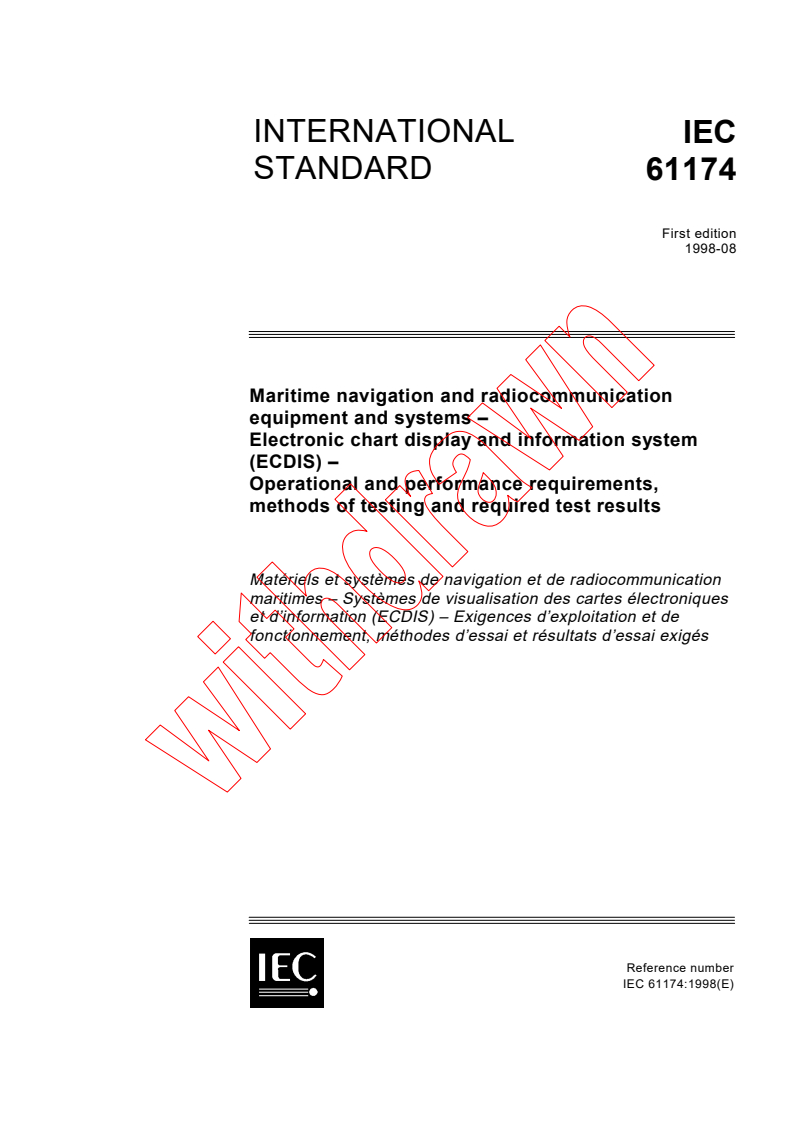
INTERNATIONAL
IEC
STANDARD
First edition
1998-08
Maritime navigation and radiocommunication
equipment and systems –
Electronic chart display and information system
(ECDIS) –
Operational and performance requirements,
methods of testing and required test results
Matériels et systèmes de navigation et de radiocommunication
maritimes – Systèmes de visualisation des cartes électroniques
et d’information (ECDIS) – Exigences d’exploitation et de
fonctionnement, méthodes d’essai et résultats d’essai exigés
Reference number
Numbering
As from 1 January 1997 all IEC publications are issued with a designation in the
60000 series.
Consolidated publications
Consolidated versions of some IEC publications including amendments are
available. For example, edition numbers 1.0, 1.1 and 1.2 refer, respectively, to the
base publication, the base publication incorporating amendment 1 and the base
publication incorporating amendments 1 and 2.
Validity of this publication
The technical content of IEC publications is kept under constant review by the IEC,
thus ensuring that the content reflects current technology.
Information relating to the date of the reconfirmation of the publication is available
in the IEC catalogue.
Information on the subjects under consideration and work in progress undertaken by
the technical committee which has prepared this publication, as well as the list of
publications issued, is to be found at the following IEC sources:
• IEC web site*
• Catalogue of IEC publications
Published yearly with regular updates
(On-line catalogue)*
• IEC Bulletin
Available both at the IEC web site* and as a printed periodical
Terminology, graphical and letter symbols
For general terminology, readers are referred to IEC 60050: International
Electrotechnical Vocabulary (IEV).
For graphical symbols, and letter symbols and signs approved by the IEC for
general use, readers are referred to publications IEC 60027: Letter symbols to be
used in electrical technology, IEC 60417: Graphical symbols for use on equipment.
Index, survey and compilation of the single sheets and IEC 60617: Graphical symbols
for diagrams.
* See web site address on title page.
INTERNATIONAL
IEC
STANDARD
First edition
1998-08
Maritime navigation and radiocommunication
equipment and systems –
Electronic chart display and information system
(ECDIS) –
Operational and performance requirements,
methods of testing and required test results
Matériels et systèmes de navigation et de radiocommunication
maritimes – Systèmes de visualisation des cartes électroniques
et d’information (ECDIS) – Exigences d’exploitation et de
fonctionnement, méthodes d’essai et résultats d’essai exigés
IEC 1998 Copyright - all rights reserved
No part of this publication may be reproduced or utilized in any form or by any means, electronic or
mechanical, including photocopying and microfilm, without permission in writing from the publisher.
International Electrotechnical Commission 3, rue de Varembé Geneva, Switzerland
Telefax: +41 22 919 0300 e-mail: inmail@iec.ch IEC web site http: //www.iec.ch
Commission Electrotechnique Internationale
PRICE CODE
XA
International Electrotechnical Commission
For price, see current catalogue
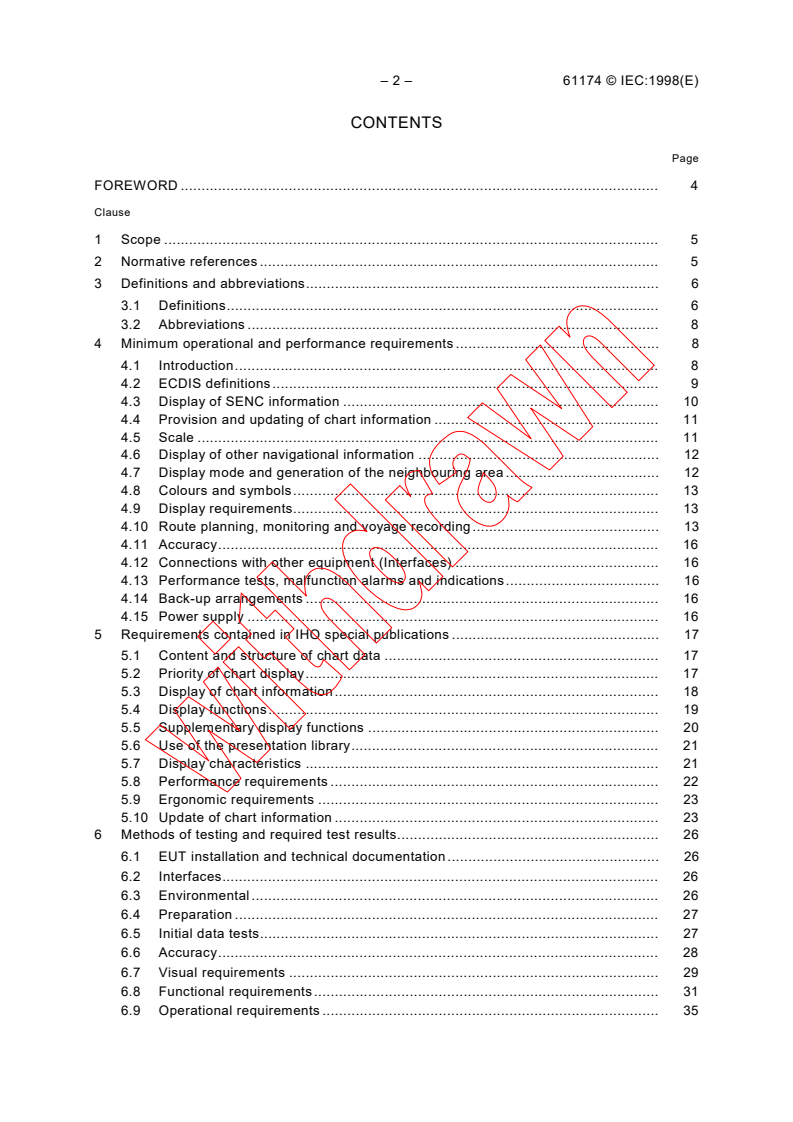
– 2 – 61174 © IEC:1998(E)
CONTENTS
Page
FOREWORD . 4
Clause
1 Scope . 5
2 Normative references . 5
3 Definitions and abbreviations. 6
3.1 Definitions. 6
3.2 Abbreviations . 8
4 Minimum operational and performance requirements . 8
4.1 Introduction. 8
4.2 ECDIS definitions. 9
4.3 Display of SENC information . 10
4.4 Provision and updating of chart information . 11
4.5 Scale . 11
4.6 Display of other navigational information . 12
4.7 Display mode and generation of the neighbouring area . 12
4.8 Colours and symbols. 13
4.9 Display requirements. 13
4.10 Route planning, monitoring and voyage recording. 13
4.11 Accuracy. 16
4.12 Connections with other equipment (Interfaces) . 16
4.13 Performance tests, malfunction alarms and indications. 16
4.14 Back-up arrangements . 16
4.15 Power supply . 16
5 Requirements contained in IHO special publications . 17
5.1 Content and structure of chart data . 17
5.2 Priority of chart display. 17
5.3 Display of chart information. 18
5.4 Display functions. 19
5.5 Supplementary display functions . 20
5.6 Use of the presentation library. 21
5.7 Display characteristics . 21
5.8 Performance requirements . 22
5.9 Ergonomic requirements . 23
5.10 Update of chart information . 23
6 Methods of testing and required test results. 26
6.1 EUT installation and technical documentation . 26
6.2 Interfaces. 26
6.3 Environmental. 26
6.4 Preparation . 27
6.5 Initial data tests. 27
6.6 Accuracy. 28
6.7 Visual requirements . 29
6.8 Functional requirements. 31
6.9 Operational requirements . 35
61174 IEC:1998(E) – 3 –
Annex A – SENC information to be displayed during route planning and route monitoring . 39
Annex B – Navigational elements and parameters. 40
Annex C – Areas for which special conditions exist . 41
Annex D – Alarms and indicators . 42
Annex E – Navigational symbols . 43
Annex F – Test data set . 49
Annex G – Back-up arrangements . 52
– 4 – 61174 © IEC:1998(E)
INTERNATIONAL ELECTROTECHNICAL COMMISSION
––––––––––
MARITIME NAVIGATION AND RADIOCOMMUNICATION
EQUIPMENT AND SYSTEMS –
ELECTRONIC CHART DISPLAY AND INFORMATION SYSTEM (ECDIS) –
OPERATIONAL AND PERFORMANCE REQUIREMENTS,
METHODS OF TESTING AND REQUIRED TEST RESULTS
FOREWORD
1) The IEC (International Electrotechnical Commission) is a worldwide organization for standardization comprising
all national electrotechnical committees (IEC National Committees). The object of the IEC is to promote
international co-operation on all questions concerning standardization in the electrical and electronic fields. To
this end and in addition to other activities, the IEC publishes International Standards. Their preparation is
entrusted to technical committees; any IEC National Committee interested in the subject dealt with may
participate in this preparatory work. International, governmental and non-governmental organizations liaising
with the IEC also participate in this preparation. The IEC collaborates closely with the International Organization
for Standardization (ISO) in accordance with conditions determined by agreement between the two
organizations.
2) The formal decisions or agreements of the IEC on technical matters express, as nearly as possible, an
international consensus of opinion on the relevant subjects since each technical committee has representation
from all interested National Committees.
3) The documents produced have the form of recommendations for international use and are published in the form
of standards, technical reports or guides and they are accepted by the National Committees in that sense.
4) In order to promote international unification, IEC National Committees undertake to apply IEC International
Standards transparently to the maximum extent possible in their national and regional standards. Any
divergence between the IEC Standard and the corresponding national or regional standard shall be clearly
indicated in the latter.
5) The IEC provides no marking procedure to indicate its approval and cannot be rendered responsible for any
equipment declared to be in conformity with one of its standards.
6) Attention is drawn to the possibility that some of the elements of this International Standard may be the subject
of patent rights. The IEC shall not be held responsible for identifying any or all such patent rights.
International Standard IEC 61174 has been prepared by IEC technical committee 80: Maritime
navigation and radiocommunication equipment and systems.
The text of this standard is based on the following documents:
FDIS Report on voting
80/190/FDIS 80/201/RVD
Full information on the voting for the approval of this standard can be found in the report on
voting indicated in the above table.
Annexes A, B, C, D, E and F form an integral part of this standard.
Annex G is for information only.
A bilingual version of this standard may be issued at a later date.
61174 IEC:1998(E) – 5 –
MARITIME NAVIGATION AND RADIOCOMMUNICATION
EQUIPMENT AND SYSTEMS –
ELECTRONIC CHART DISPLAY AND INFORMATION SYSTEM (ECDIS) –
OPERATIONAL AND PERFORMANCE REQUIREMENTS,
METHODS OF TESTING AND REQUIRED TEST RESULTS
1 Scope
This International Standard specifies the performance requirements, methods of testing and
required test results of equipment conforming to performance standards not inferior to those
adopted by the IMO in resolution A.817.
This standard is based upon the performance standards of IMO resolution A.817, and is also
associated with IMO resolution A.694 and IEC 60945. Reference is made, where appropriate,
to IMO resolution A.817, and all subclauses whose wording is identical to that in the resolution
are printed in italics.
In association with the above IMO resolution A.817, are the International Hydrographic
Organization (IHO) publications S-52 and S-57. This standard has included extracts from the
above publications where they are applicable to this equipment. Where reference is made, all
subclauses whose wording is identical to that in the publications, are printed in italics.
The requirements of this standard are not intended to prevent the use of new techniques in
equipments and systems, provided the facilities offered are not inferior to those stated.
2 Normative references
The following normative documents contain provisions which, through reference in this text,
constitute provisions of this International Standard. At the time of publication, the editions
indicated were valid. All normative documents are subject to revision, and parties to
agreements based on this International Standard are encouraged to investigate the possibility
of applying the most recent editions of the normative documents indicated below. Members of
IEC and ISO maintain registers of currently valid International Standards.
IEC 60872:1987, Marine automatic radar plotting aids (ARPA) – Operational requirements –
Methods of testing and test results
Amendment 1 (1991)
IEC 60945:1996, Maritime navigation and radiocommunication equipment and systems –
General requirements – Methods of testing and required test results
IEC 61162-1:1995, Maritime navigation and radiocommunication equipment and systems –
Digital interfaces – Part 1: Single talker and multiple listeners
ISO 9000 (all parts), Quality management and quality assurance standards
IMO:1974 (as amended), Convention for safety of life at sea (SOLAS)
IMO A.424:1979, Performance standards for gyro-compasses
– 6 – 61174 © IEC:1998(E)
IMO A.686:1991, Code on alarms and indicators
IMO A.694:1991, General requirements for shipborne radio equipment forming part of the
global maritime distress and safety system (GMDSS) and for electronic navigational aids
IMO A.817:1995, Performance standards for electronic chart display and information systems
(ECDIS)
IMO A.821:1995, Performance standards for gyro-compasses for high-speed craft
IMO A.823:1995, Performance standards for automatic radar plotting aids (ARPAs)
IMO A.824:1995, Performance standards for devices to indicate speed and distance
IMO MSC.64(67):1996, Annex 4 – Performance standards for radar equipment
IMO MSC.64(67):1996, Annex 5 – Amendment to IMO.817 – Appendix 6 – Back up arrangements
IHO S-52:1996, Specifications for chart content and display aspects of ECDIS
IHO S-52 appendix 1:1996, Guidance on updating the electronic navigational chart
IHO S-52 appendix 2:1997, Colour and symbol specifications for ECDIS
IHO S-52 appendix 3:1997, Glossary of ECDIS – related terms
IHO S-57:1996, Transfer standard for digital hydrographic data
IHO:1997, Test data set for use with IEC 61174
3 Definitions and abbreviations
Definitions of ECDIS related terms pertaining to IMO performance standards for ECDIS are
listed in 4.2. A glossary of ECDIS related terms is included in IHO S-52 appendix 3.
For the purpose of this standard the following definitions and abbreviations apply.
3.1 Definitions
3.1.1
CIE colour calibration
procedure to confirm that the colour specified in IHO S-52 appendix 2 is correctly reproduced
on the ECDIS display
3.1.2
common reference system
sensor input data, providing identical and obligatory reference pertaining to position, course,
heading, bearing, speed, velocity, etc. and horizontal datum to different subsystems within an
integrated navigation system
3.1.3
compilation scale
scale with which the chart information meets the IHO requirements for chart accuracy. It is
established by the producing hydrographic office and encoded in the ENC
61174 IEC:1998(E) – 7 –
3.1.4
corrupted data
ENC data produced according to the IHO S-57 ENC product specification, but altered or
modified during production, transmission, or retrieval
3.1.5
degrade
reduce the information content of
3.1.6
display redraw time
interval from when the display starts to change until the new display is complete
3.1.7
display regeneration time
interval from operator action until the consequent redraw is complete
3.1.8
display scale
ratio between a distance on the display and a distance on the ground, normalized and
expressed as, for example, 1:10 000
3.1.9
ENC cell
geographic division of ENC data for distributing purposes. For further information, refer to the
ENC product specification in IHO S-57
3.1.10
ENC data
data conforming to 4.2.2
3.1.11
ENC test data set
standardized data set supplied on behalf of the International Hydrographic Organization (IHO)
that is necessary to accomplish IEC testing requirements for ECDIS. This data set is encoded
according to the IHO S-57 ENC product specification and contains update information based
on IHO S-52 appendix 1. The specific requirements are listed in annex F
3.1.12
non-ENC data
data not conforming to 4.2.2
3.1.13
overscale
display of the chart information at a display scale larger than the compilation scale. Overscaling
may arise from deliberate overscaling by the mariner, or from automatic overscaling by ECDIS
in compiling a display when the data included is at various scales
– 8 – 61174 © IEC:1998(E)
3.1.14
presentation library
implementation of the display specifications in IHO S-52, appendix.2 “Colour and Symbol
Specifications for ECDIS”, by de-coding and symbolizing the SENC. It contains:
.1 the ECDIS symbol library, including the IEC navigation symbols;
.2 the ECDIS colour tables for day, dusk, and night viewing;
.3 look-up tables, linking SENC objects to the appropriate colour and symbology;
.4 conditional symbology procedures for:
– cases where symbolizing depends on circumstances, such as the mariner’s choice of
safety contour;
– cases where symbolizing is too complex to be defined in a direct look-up table;
.5 description of symbology instructions;
.6 mariner’s navigation objects, specified in the same format as chart objects for convience of
processing in ECDIS;
.7 supplementary features, for example ECDIS chart 1 colour differentiation test diagrams and
colour calibration software.
The presentation library is available in hard-copy or in digital form. The symbols shall be
replicated in size and shape, using any convenient format. The colour tables shall be
reproduced within the tolerances given in S-52 appendix 2/5.2.3. The remaining items may be
implemented in any convenient form which produces the same results as the presentation
library.
3.1.15
single operator action
single operation shall be achieved by activating a hardkey or softkey, including any necessary
cursor movement
3.2 Abbreviations
AIS Automatic identification system
ARPA Automatic radar plotting aid
ATA Automatic tracking aid
CIE Comité International de l' Eclairage
EBL Electronic bearing line
EPA Electronic plotting aid
EPFS Electronic position fixing system
EUT Equipment under test
HO Hydrographic office
VRM Variable range marker
4 Minimum operational and performance requirements
4.1 Introduction
NOTE – In the following subclauses of clause 4, the text in italics is from the identical paragraph of the annex to
IMO Resolution A.817. For example, 4.1.1 is paragraph 1.1 from the annex of A.817.
4.1.1 The primary function of the ECDIS is to contribute to safe navigation.
4.1.2 ECDIS with adequate back-up arrangements may be accepted as complying with the
up-to-date charts required by regulation V/20 of the 1974 SOLAS Convention.
61174 IEC:1998(E) – 9 –
4.1.3 In addition to the general requirements for shipborne radio equipment forming part of the
global maritime distress and safety system (GMDSS) and the requirements for electronic
*
navigational aids contained in IMO resolution A.694(17) , ECDIS shall meet the requirements of
IMO A.817.
4.1.4 ECDIS shall be capable of displaying all chart information necessary for safe and
efficient navigation originated by, and distributed on the authority of, government authorized
hydrographic offices.
4.1.5 ECDIS shall facilitate simple and reliable updating of the electronic navigational chart.
4.1.6 Use of ECDIS shall reduce the navigational workload as compared to use of the paper
chart. It shall enable the mariner to execute in a convenient and timely manner all route
planning, route monitoring and positioning currently performed on paper charts. It shall be
capable of continuously plotting the ship's position.
4.1.7 ECDIS shall have at least the same reliability and availability of presentation as the
paper chart published by government authorized hydrographic offices.
4.1.8 ECDIS shall provide appropriate alarms or indications with respect to the information
displayed or malfunction of the equipment. (See annex D.)
4.2 ECDIS definitions
For the purpose of this standard:
4.2.1 Electronic chart display and information system (ECDIS) means a navigation information
system which with adequate backup arrangements can be accepted as complying with the up-
to-date chart required by regulation V/20 of the 1974 SOLAS Convention, by displaying
selected information from a system electronic navigational chart (SENC) with positional
information from navigation sensors to assist the mariner in route planning and route
monitoring, and by displaying additional navigation-related information.
The reference geodetic datum is WGS-84.
4.2.2 Electronic Navigational Chart (ENC) means the database, standardized as to content,
structure and format, issued for use with ECDIS on the authority of government authorized
hydrographic offices. The ENC contains all the chart information necessary for safe navigation
and may contain supplementary information in addition to that contained in the paper chart
(e.g. sailing directions) which may be considered necessary for safe navigation.
The content, structure and format of the ENC are specified in IHO S-57 edition 3, including the
associated ENC product specification.
4.2.3 System electronic navigational chart (SENC) means a database resulting from the
transformation of the ENC by ECDIS for appropriate use, updates to the ENC by appropriate
means, and other data added by the mariner. It is this database that is actually accessed by
ECDIS for the display generation and other navigational functions, and is the equivalent of an
up-to-date paper chart. The SENC may also contain information from other sources.
4.2.4 Standard display means the SENC information that shall be shown when a chart is first
displayed on ECDIS. The level of the information it provides for route planning or route
monitoring may be modified by the mariner according to the mariner’s needs.
–––––––––
*
See also IEC 60945.
– 10 – 61174 © IEC:1998(E)
4.2.5 Display base means the level of SENC information which cannot be removed from the
display, consisting of information which is required at all times in all geographic areas and all
circumstances. It is not intended to be sufficient for safe navigation.
4.2.6 Further information on ECDIS definitions may be found in IHO S-52, appendix 3.
4.3 Display of SENC information
4.3.1 ECDIS shall be capable of displaying all SENC information. (See 6.5.1 and 6.8.2 to
6.8.5.)
4.3.2 SENC information available for display during route planning and route monitoring shall
be subdivided into three categories, display base, standard display and all other information.
(See 6.8.2 to 6.8.4 and annex A.)
4.3.3 ECDIS shall present the standard display at any time by a single operator action.
(See 6.8.2.)
4.3.4 When a chart is first displayed on ECDIS, it shall provide the standard display at the
largest scale available in the SENC for the displayed area. (See 6.8.1.)
This is only applicable when the first chart is displayed subsequent to power up.
4.3.5 It shall be easy to add or remove information from the ECDIS display. It shall not be
possible to remove information contained in the display base. (See 6.8.2.)
The addition or deletion of information (see annex A, 2 and 3) shall be limited to categories of
information, e.g. prohibited and restricted areas, spot soundings; not individual items, e.g. an
individual area or an individual sounding.
4.3.6 It shall be possible for the mariner to select a safety contour from the depth contours
provided by the SENC. ECDIS shall give the safety contour more emphasis than other contours
on the display. (See 6.8.8.)
4.3.7 It shall be possible for the mariner to select a safety depth. ECDIS shall emphasize
soundings equal to or less than the safety depth whenever spot soundings are selected for
display. (See 6.8.9.)
4.3.8 The ENC and all updates to it shall be displayed without any degradation of their
information content. (See 6.8.)
Degradation shall be understood as degradation in information quantity as well as quality with
respect to a standard test chart provided by government authorized hydrographic offices.
4.3.9 ECDIS shall provide a method of ensuring that the ENC and all updates to it have been
correctly loaded into the SENC. (See 6.8.15.2.)
4.3.10 The ENC data and updates to it shall be clearly distinguishable from other displayed
information, such as, for example, that listed in annex B. (See 6.8.5 and 6.8.15.2.)
Adherence to the IHO colours and symbols requirements ensure these features.
61174 IEC:1998(E) – 11 –
*
4.4 Provision and updating of chart information
4.4.1 The chart information to be used in ECDIS shall be the latest edition of information
originated by a government authorized hydrographic office, and conform to IHO standards.
(See 6.5.)
In order to identify the date and origin of the ENC in use, the ECDIS shall include a graphical
index of ENC data available, presented upon the mariner’s request and providing access to the
edition and date of each cell (S-52 6.3(d)).
A new edition of an ENC will supersede a previous ENC and its integrated updates issued by a
government authorized hydrographic office.
4.4.2 The contents of the SENC shall be adequate and up to date for the intended voyage, as
required by regulation V/20 of the 1974 SOLAS Convention. (See 6.5.)
4.4.3 It shall not be possible to alter the contents of the ENC.
4.4.4 Updates shall be stored separately from the ENC. (See 6.8.15.2.)
Separate storage of updates may utilize the same data storage area.
4.4.5 ECDIS shall be capable of accepting official updates to the ENC data provided in
conformity with IHO standards. These updates shall be automatically applied to the SENC. By
whatever means updates are received, the implementation procedure shall not interfere with
the display in use.
The contents of an update assume that all earlier updates have been applied to the SENC. A
new edition of an ENC shall supersede a previous ENC and its updates.
4.4.6 ECDIS shall also be capable of accepting updates to the ENC data entered manually
with simple means for verification prior to the final acceptance of the data. They shall be
distinguishable on the display from ENC information and its official updates and not affect
display legibility. (See 6.8.5 and 6.8.16.)
4.4.7 ECDIS shall keep a record of updates including time of application to the SENC.
(See 6.8.15.3.)
4.4.8 ECDIS shall allow the mariner to display updates so that the mariner may review their
contents and ascertain that they have been included in the SENC. (See 6.8.15.2.)
4.5 Scale
ECDIS shall provide an indication if:
.1 the information is displayed at a larger scale than that contained in the ENC; or
.2 own ship's position is covered by an ENC at a larger scale than that provided by the
display. (See 6.8.6.)
–––––––––
*
IHO S-52 appendix 1.
– 12 – 61174 © IEC:1998(E)
4.6 Display of other navigational information
4.6.1 Radar information or other navigational information may be added to the ECDIS display.
However, it shall not degrade the SENC information, and shall be clearly distinguishable from the
SENC information. (See 6.8.3, 6.8.4 and 6.8.13.)
4.6.2 ECDIS and added navigational information shall use a common reference system. If this
is not the case, an indication shall be provided. (See 6.8.12g.)
Such advice shall be included in the manufacturer’s installation handbook.
4.6.3 Radar and plotting information
4.6.3.1 Transferred radar information may contain both the radar image and ARPA or ATA or
EPA information. (See 6.2.)
Where plotting information is added it shall be indicated to the operator whether the vectors are
relative or true, and if true whether they are sea or ground stabilized.
4.6.3.2 If the radar image is added to the ECDIS display, the chart and the radar image shall
match in scale and in orientation. (See 6.8.13.)
Additionally the ECDIS and radar image shall match in projection.
4.6.3.3 The radar image and the position from the position sensor shall both be adjusted
automatically for antenna offset from the conning position. (See 6.8.13.)
4.6.3.4 It shall be possible to adjust the displayed position of the ship manually so that the
radar image matches the SENC display. (See 6.8.13.)
If an offset is applied, it shall be clearly indicated. The details of the offset shall be readily
available.
4.6.3.5 It shall be possible to remove the radar or plotting information by single operator
action. (See 6.8.13.)
4.7 Display mode and generation of the neighbouring area
4.7.1 It shall always be possible to display the SENC in a 'north-up' orientation. Other
orientations are permitted. (See 6.8.7.)
4.7.2 ECDIS shall provide for true motion mode. Other modes are permitted. (See 6.8.7.)
4.7.3 When true motion mode is in use, reset and generation of the neighbouring area shall
take place automatically at a distance from the border of the display determined by the mariner.
(See 6.8.7.)
4.7.4 It shall be possible to change manually the chart area and the position of own ship
relative to the edge of the display. (See 6.8.7.)
61174 IEC:1998(E) – 13 –
4.8 Colours and symbols
4.8.1 IHO recommended colours and symbols shall be used to represent SENC information
(IHO S-52 appendix 2). (See 6.7.1.)
4.8.2 The colours and symbols other than those mentioned in 4.8.1 shall be those used to
describe the navigational elements and parameters listed in Annex B and published by IEC
(IEC 61174 annex E). (See 6.7.1.)
4.8.3 SENC information when displayed at the scale specified in the ENC shall use the
specified size of symbols, figures and letters (IHO S-52 appendix 2). (See 6.7.1.)
4.8.4 ECDIS shall allow the mariner to select whether own ship is displayed in true scale or as
a symbol. (See 6.7.1.)
4.9 Display requirements
4.9.1 ECDIS shall be capable of displaying information for:
.1 route planning and supplementary navigation tasks;
.2 route monitoring.
(See 6.9.2 and 6.9.3.)
4.9.2 The effective size of the chart presentation for route monitoring shall be at least 270 mm
by 270 mm. (See 6.7.5.)
4.9.3 The display shall be capable of complying with the colour and resolution
recommendations of IHO (IHO S-52 appendix 2). (See 6.7.3 and 6.7.4.)
4.9.4 The method of presentation shall ensure that the displayed information is clearly visible
to more than one observer in the conditions of light normally experienced on bridge of the ship
by day and by night. (See 6.7.5.)
4.10 Route planning, monitoring and voyage recording
4.10.1 It shall be possible to carry out route planning and route monitoring in a simple and
reliable manner. (See 6.9.1.)
4.10.2 ECDIS shall be designed following ergonomic principles for user-friendly operation.
(See 6.9.1.)
4.10.3 The largest scale data available in the SENC for the area given shall always be used
by the ECDIS for all alarms or indications of crossing the ship's safety contour and of entering
a prohibited area, and for alarms and indications according to annex C. (See 6.9.3.)
4.10.4 Route planning
4.10.4.1 It shall be possible to carry out route planning including both straight and curved
segments. (See 6.9.2.)
– 14 – 61174 © IEC:1998(E)
4.10.4.2 It shall be possible to adjust a planned route by, for example:
.1 adding waypoints to a route;
.2 deleting waypoints from a route;
.3 changing the position of a waypoint;
.4 changing the order of the waypoints in the route.
(See 6.9.2.)
4.10.4.3 It shall be possible to plan an alternate route in addition to the selected route. The
selected route shall be clearly distinguishable from the other routes. (See 6.9.2.)
4.10.4.4 An indication is required if the mariner plans a route across an own ship’s safety
contour. (See 6.9.2.)
4.10.4.5 An indication is required if the mariner plans a route across the boundary of a
prohibited area or a geographic area for which special conditions exist. (See annex C and
6.9.2.)
4.10.4.6 It shall be possible for the mariner to specify a limit of deviation from the planned
route at which activation of an automatic offtrack alarm shall occur. (See 6.9.2.)
4.10.5 Route monitoring
4.10.5.1 For route monitoring the selected route and own ship's position shall appear
whenever the display covers that area. (See 6.9.3.)
4.10.5.2 It shall be possible to display a sea area that does not have the ship on the display
(e.g. for look ahead, route planning), while route monitoring. If this is done on the display used
for route monitoring, the automatic route monitoring functions (e.g. updating ship’s position,
and providing alarms and indications) shall be continuous. It shall be possible to return to the
route monitoring display covering own ship's position immediately by single operator action.
(See 6.9.3.)
4.10.5.3 ECDIS shall give an alarm if the ship, within a specified time set by the mariner, is
going to cross the safety contour. (See 6.9.3.)
4.10.5.4 ECDIS shall give an alarm or indication, as selected by the mariner, if the ship within
a specified time set by the mariner, is going to cross the boundary of a prohibited area or of a
geographical area for which special conditions exist. (See annex C and 6.9.3.)
4.10.5.5 An alarm shall be given when the specified limit for deviation from the planned route
is exceeded. (See 6.9.3.)
4.10.5.6 The ship's position shall be derived from a continuous positioning system of an
accuracy consistent with the requirements of safe navigation. Whenever possible, a second
independent positioning method of a different type shall be provided; ECDIS shall be capable
of identifying discrepancies between the two systems. (See 6.8.12.)
The ECDIS shall have means to display the position from at least two positioning methods, to
identify which method is being used, and provide a means for the operator to select the method
he wants to use.
61174 IEC:1998(E) – 15 –
4.10.5.7 ECDIS shall provide an indication when the input from the position-fixing system is
lost. ECDIS shall also repeat, but only as an indication, any alarm or indication passed to it
from a position-fixing system. (See 6.8.12.)
4.10.5.8 An alarm shall be given by ECDIS if the ship, within a specified time or distance set
by the mariner, is going to reach a critical point on the planned route. (See 6.9.3.)
ECDIS shall permit the mariner to define critical points and the time or distance at which an
alarm shall be given. The words “to reach a critical point” shall be considered passing abeam
of the critical point on the planned route.
4.10.5.9 The positioning system and the SENC shall be on the same geodetic datum. ECDIS
shall give an alarm if this is not the case. (See 6.8.12.)
4.10.5.10 It shall be possible to display an alternative route in addition to the selected route.
The selected route shall be clearly distinguishable from the other routes. During the voyage, it
shall be possible for the mariner to modify the selected sailing route or change to an alternative
route. (See 6.9.3.)
4.10.5.11 It shall be possible to display:
.1 time-labels along ship’s track manually on demand and automatically at intervals selected
between 1 and 120 min; (see 6.9.3.) and
.2 an adequate number of points, free movable electronic bearing lines (EBL), variable (VRM)
and fixed range markers and other symbols required for navigation purposes and specified
in annex B. (See 6.8.11.) An “adequate number” of EBL and VRM implies at least one of
each.
4.10.5.12 It shall be possible to enter the geographical coordinates of any position and then
display that position on demand. It shall also be possible to select any point (features, symbol
or position) on the display and read its geographical co-ordinates on demand. (See 6.8.10.)
4.10.5.13 It shall be possible to adjust the ship's geographic position manually. This manual
adjustment shall be noted alpha-numerically on the screen, maintained until altered by the
mariner and automatically recorded. (See 6.8.12 and 6.9.4.)
4.10.6 Voyage recording
4.10.6.1 ECDIS shall store and be able to reproduce certain minimum elements required to
reconstruct the navigation and verify the official database used during the previous 12 hours.
The following data shall be recorded at one minute intervals: (see 6.9.4.)
.1 to ensure a record of own ship’s past track: time, position, heading and speed; and
.2 to ensure a record of official data used: ENC source, edition, date, cell and update history.
4.10.6.2 In addition, ECDIS shall record the complete track for the entire voyage, with time
marks at intervals not exceeding 4 hours. (See 6.9.5.)
4.10.6.3 It shall not be possible to manipulate or change the recorded information. (See 6.9.4.)
4.10.6.4 ECDIS shall have a capability to preserve the record of the previous 12 hours and of
the voyage track. (See 6.9.5.)
– 16 – 61174 © IEC:1998(E)
4.11 Accuracy
4.11.1 The accuracy of all calculations performed by ECDIS shall be independent of the
characteristics of the output device and shall be consistent with the SENC accuracy. (See 6.6.)
The output device includes ECDIS display, stored memory, and/or printout.
4.11.2 Bearings and distances drawn on the display, or those measured between features
already drawn on the display, shall have an accuracy no less than that afforded by the
resolution of the display. (See 6.6.)
*
4.12 Connections with other equipment (Interfaces)
4.12.1 ECDIS shall not degrade the performance of any equipment providing sensor inputs.
Nor shall the connection of optional equipment degrade the performance of ECDIS below this
standard. (See IEC 61162 and 6.2.)
4.12.2 ECDIS shall be connected to systems providing continuous position fixing, heading and
speed information. (See 6.2.)
4.13 Performance tests, malfunction alarms and indications
4.13.1 ECDIS shall be provided with means for carrying out on-board tests of major functions
either automatically or manually. In case of a failure, the test shall display information to
indicate which module is at fault. (See 6.8.17.)
On board tests of major functions include the integrity of sensor input. If there is any detectable
reason why the information presented to the operator is invalid, adequate and clear warnings
shall be given to the operator. This clarification is consistent with IMO resolution MSC.64(67)
annex 4.
4.13.2 ECDIS shall provide suitable alarm or indication of system malfunction. (See 6.8.17.)
4.14 Back-up arrangements
4.14.1 Adequate back-up arrangements shall be provided to ensure safe navigation in case of
an ECDIS failure. (See annex G.)
.1 Facilities enabling a safe take-over of the ECDIS functions shall be provided in order to
ensure that an ECDIS failure does not result in a critical situation.
.2 A back-up arrangement shall be provided facilitating means for safe navigation of the
remaining part of the voyage in case of an ECDIS failure.
4.15 Power supply
4.15.1 It shall be possible to operate ECDIS and all equipment necessary for its normal
functioning when supplied by an emergency source of electrical power in accordance with the
appropriate requirements of chapter II-1 of the 1974 SOLAS convention.
4.15.2 Changing from one source of power supply to another, or any interruption of the
supply for a period of up to 45 s, shall not require the equipment to be re-initialized manually.
(See 6.9.6.)
The equipment is not required to remain operational during this interruption of the power
supply.
–––––––––
*
IEC 61162.
61174 IEC:1998(E) – 17 –
5 Requirements contained in IHO special publications
5.1 Content and structure of chart data
The chart data shall be delivered using the IHO transfer standard for digital hydrographic data
(S-57 and S-52/3.1(a)).
Any ECDIS shall be capable of accepting and converting official HO data (ENC) to the internal
storage structure of the individual ECDIS (system ENC or SENC). Such data includes both that
in the ENC and that delivered in digital format to update the ENC. (S-52/ 3.3(b)) (See 6.8.15.1.)
The transfer standard is designed for the distribution of digital chart data. It is recognized that it
is not the most efficient means of storing, manipulating or preparing data for display. Each
manufacturer of ECDIS systems may design his own storage formats or data structure to allow
its system to meet the performance requirements stated in this specification. The resulting
database is called the system ENC (SENC). (S-52/ 3.3(a))
The following restrictions also apply:
.1 The precision of HO supplied data shall be maintained, e.g. HO data provided in degrees
and decimal degrees, when converted to manufacturer specific formats and structures and
used in calculations, shall also be maintained to that accuracy. (S-52/3.4(b)(1)) (See 6.6.)
.2 Should the manufacturer use point reduction or smoothing operations in order to compress
the chart information in the SENC, the resultant image of the chart displayed at ENC scale
shall not differ from the ENC image by more than the display resolution. (S-52/3.4(b)(2))
(See 6.6.)
.3 HO data will be supplied in a cell structure (S-52/3.6). If this cell structure is modified, it
is the ECDIS manufacturer's responsibility to maintain cell dependent characteristics.
(S-52/3.4(b)(3)) (See 6.5 and 6.8.15.1.)
5.2 Priority of chart display
Layers are required to establish the priority of data on the display. The general rule for the
priority between different categories of information is given below: (S-52/5.3(a,b)) (see 6.8.3
and 6.8.4)
.1 ECDIS visual alarms/indications (e.g. caution, overscale);
.2 HO-data: points/lines and areas plus official updates;
.3 notices to mariners, manual input and radio navigational warnings;
.4 HO-caution (ENC cautions);
.5 HO-colour-fill area data;
.6 HO's on demand data;
.7 radar information;
.8 mariners data: point
...