

IEC 60825-4:2006
(Main)Safety of laser products - Part 4: Laser guards
General Information
- Abstract
Specifies the requirements for laser guards, permanent and temporary (for example for service), that enclose the process zone of a laser processing machine, and specifications for proprietary laser guards. This standard applies to all component parts of a guard including clear (visibly transmitting) screens and viewing windows, panels, laser curtains and walls. Requirements for beam path components, beam stops and those other parts of a protective housing of a laser product which do not enclose the process zone are contained in IEC 60825-1. In addition this part of IEC 60825 indicates: a) how to assess and specify the protective properties of a laser guard; and b) how to select a laser guard.
- Status
- Published
- Publication Date
- 28-Jun-2011
- Technical Committee
- TC 76 - Optical radiation safety and laser equipment
- Drafting Committee
- WG 7 - TC 76/WG 7
- Current Stage
- DELPUB - Deleted Publication
- Start Date
- 22-Jul-2022
- Completion Date
- 28-Aug-2026
Buy Documents
IEC 60825-4:2006 - Safety of laser products - Part 4: Laser guards Released:8/16/2006
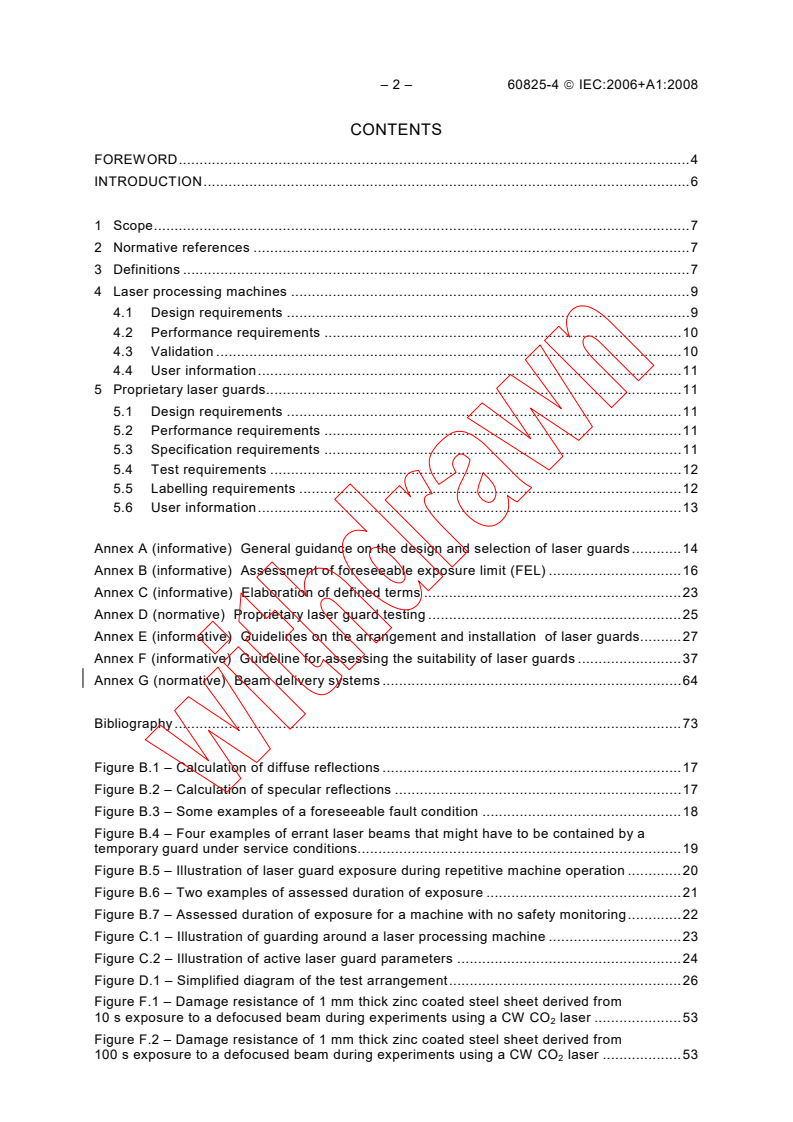
IEC 60825-4:2006+AMD1:2008 CSV - Safety of laser products - Part 4: Laser guards Released:10/28/2009
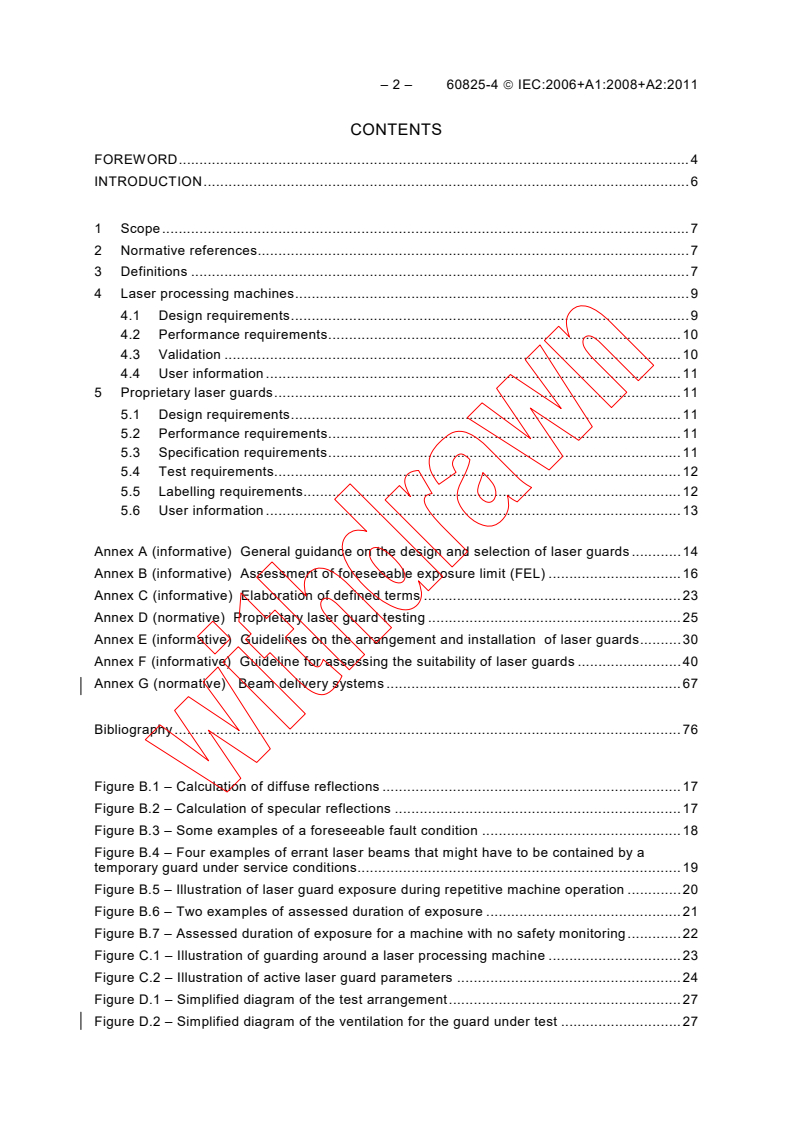
IEC 60825-4:2006+AMD1:2008+AMD2:2011 CSV - Safety of laser products - Part 4: Laser guards Released:6/29/2011
Overview
IEC 60825-4:2006 is an international standard published by the International Electrotechnical Commission (IEC) that focuses on the safety of laser products, specifically addressing laser guards. This standard defines the essential requirements for designing, testing, and selecting both permanent and temporary laser guards that enclose the process zone of laser processing machines. It covers all component parts of a guard system, including visible screens, viewing windows, panels, laser curtains, and laser walls, ensuring effective containment of hazardous laser radiation.
The standard complements IEC 60825-1, which provides general requirements on beam path components and protective housings but does not focus on laser guards that enclose the processing area. IEC 60825-4 further guides how to assess and specify the protective properties of laser guards, and it establishes criteria to aid users in selecting appropriate laser guarding solutions.
Key Topics
Scope and Application
IEC 60825-4 applies to laser guards used in industrial laser processing machines and other settings where laser operation occurs. It addresses both permanent guards integrated into the equipment and temporary guards used for service or maintenance.Design Requirements
The standard specifies how laser guards must be designed to effectively enclose the laser process zone and prevent accidental exposure to laser radiation. This includes guidelines on materials capable of resisting laser damage, mechanical integrity, and visibility through clear protective screens.Performance Requirements
It defines the necessary performance characteristics of laser guards such as resistance to laser beam damage, light transmission properties of viewing windows, and containment of stray/reflected beams within set exposure limits.Validation and Testing
IEC 60825-4 outlines test methodologies to verify that laser guards meet defined safety criteria. Proprietary laser guard components undergo rigorous test requirements to confirm compliance before being certified for use.User Information and Labelling
The standard emphasizes the importance of providing clear user information, including installation instructions, maintenance guidelines, and hazard warnings. Proper labelling of laser guards ensures users understand the protective capabilities and limitations.Guidance on Selection
IEC 60825-4 includes informative annexes providing practical guidance on choosing suitable laser guards, considering factors like laser class, expected exposure levels, and environmental conditions.
Applications
IEC 60825-4 is widely applicable across industries involving laser processing, including:
Manufacturing and Industrial Processing
Ensuring safe operation where lasers cut, weld, or engrave materials, minimizing the risk of laser exposure to operators and bystanders.Service and Maintenance
Providing standards for temporary guards used during equipment servicing to protect personnel when permanent guards may be removed or disabled.Research and Development Laboratories
Guiding the safe use of laser equipment in experimental setups where process zones require controlled enclosure.Medical and Cosmetic Laser Systems
Though focused on industrial machines, principles in this standard can assist in protecting personnel in medical laser environments where laser radiation containment is essential.
Related Standards
IEC 60825-1: Safety of laser products - Part 1: Equipment classification and requirements. This standard provides a general framework for laser product safety, including basic laser classification and requirements for beam path components.
IEC 61010: Safety requirements for electrical equipment for measurement, control, and laboratory use, providing complementary safety guidelines for electrical systems integrated with lasers.
ISO 12100: Safety of machinery - General principles for design - Risk assessment and risk reduction, offering a broader context for implementing safety in laser processing machinery.
Practical Value
Adherence to IEC 60825-4 helps manufacturers, integrators, and users of laser processing equipment to:
Enhance Workplace Safety by minimizing the risk of accidental laser exposure through effective containment.
Ensure Regulatory Compliance with internationally recognized safety requirements, facilitating market access and customer confidence.
Reduce Liability Risks by implementing validated safety guards and providing clear user instructions.
Optimize Maintenance Procedures with specifications on temporary guarding arrangements during service interventions.
Select Appropriate Safety Equipment based on laser characteristics, process demands, and environmental considerations.
By integrating the requirements of IEC 60825-4, organizations can achieve a robust laser safety management system that protects employees, equipment, and operations from laser hazards effectively.
Relations
- Effective Date
- 25-Aug-2026
- Amended By
IEC 60825-4:2006/AMD2:2011 - Amendment 2 - Safety of laser products - Part 4: Laser guards - Effective Date
- 05-Sep-2023
- Amended By
IEC 60825-4:2006/AMD1:2008 - Amendment 1 - Safety of laser products - Part 4: Laser guards - Effective Date
- 05-Sep-2023
- Effective Date
- 05-Sep-2023
- Effective Date
- 05-Sep-2023
- Effective Date
- 05-Sep-2023
- Effective Date
- 05-Sep-2023
Buy Documents
IEC 60825-4:2006 - Safety of laser products - Part 4: Laser guards Released:8/16/2006
IEC 60825-4:2006+AMD1:2008 CSV - Safety of laser products - Part 4: Laser guards Released:10/28/2009
IEC 60825-4:2006+AMD1:2008+AMD2:2011 CSV - Safety of laser products - Part 4: Laser guards Released:6/29/2011
Frequently Asked Questions
IEC 60825-4:2006 is a standard published by the International Electrotechnical Commission (IEC). Its full title is "Safety of laser products - Part 4: Laser guards". This standard covers: Specifies the requirements for laser guards, permanent and temporary (for example for service), that enclose the process zone of a laser processing machine, and specifications for proprietary laser guards. This standard applies to all component parts of a guard including clear (visibly transmitting) screens and viewing windows, panels, laser curtains and walls. Requirements for beam path components, beam stops and those other parts of a protective housing of a laser product which do not enclose the process zone are contained in IEC 60825-1. In addition this part of IEC 60825 indicates: a) how to assess and specify the protective properties of a laser guard; and b) how to select a laser guard.
Specifies the requirements for laser guards, permanent and temporary (for example for service), that enclose the process zone of a laser processing machine, and specifications for proprietary laser guards. This standard applies to all component parts of a guard including clear (visibly transmitting) screens and viewing windows, panels, laser curtains and walls. Requirements for beam path components, beam stops and those other parts of a protective housing of a laser product which do not enclose the process zone are contained in IEC 60825-1. In addition this part of IEC 60825 indicates: a) how to assess and specify the protective properties of a laser guard; and b) how to select a laser guard.
IEC 60825-4:2006 is classified under the following ICS (International Classification for Standards) categories: 01 - GENERALITIES. TERMINOLOGY. STANDARDIZATION. DOCUMENTATION; 31.260 - Optoelectronics. Laser equipment. The ICS classification helps identify the subject area and facilitates finding related standards.
IEC 60825-4:2006 has the following relationships with other standards: It is inter standard links to EN ISO 11553-1:2020, IEC 60825-4:2006/AMD2:2011, IEC 60825-4:2006/AMD1:2008, IEC 60825-4:1997, IEC 60825-4:2022, IEC 60825-4:1997/AMD2:2003, IEC 60825-4:1997/AMD1:2002. Understanding these relationships helps ensure you are using the most current and applicable version of the standard.
IEC 60825-4:2006 is available in PDF format for immediate download after purchase. The document can be added to your cart and obtained through the secure checkout process. Digital delivery ensures instant access to the complete standard document.
Standards Content (Sample)
NORME CEI
INTERNATIONALE
IEC
60825-4
INTERNATIONAL
Deuxième édition
STANDARD
Second edition
2006-08
Sécurité des appareils à laser –
Partie 4:
Protecteurs pour lasers
Safety of laser products –
Part 4:
Laser guards
Numéro de référence
Reference number
CEI/IEC 60825-4:2006
Numérotation des publications Publication numbering
Depuis le 1er janvier 1997, les publications de la CEI As from 1 January 1997 all IEC publications are
sont numérotées à partir de 60000. Ainsi, la CEI 34-1 issued with a designation in the 60000 series. For
devient la CEI 60034-1. example, IEC 34-1 is now referred to as IEC 60034-1.
Editions consolidées Consolidated editions
Les versions consolidées de certaines publications de la The IEC is now publishing consolidated versions of its
CEI incorporant les amendements sont disponibles. Par publications. For example, edition numbers 1.0, 1.1
exemple, les numéros d’édition 1.0, 1.1 et 1.2 indiquent and 1.2 refer, respectively, to the base publication,
respectivement la publication de base, la publication de the base publication incorporating amendment 1 and
base incorporant l’amendement 1, et la publication de the base publication incorporating amendments 1
base incorporant les amendements 1 et 2. and 2.
Informations supplémentaires Further information on IEC publications
sur les publications de la CEI
Le contenu technique des publications de la CEI est The technical content of IEC publications is kept
constamment revu par la CEI afin qu'il reflète l'état under constant review by the IEC, thus ensuring that
actuel de la technique. Des renseignements relatifs à the content reflects current technology. Information
cette publication, y compris sa validité, sont dispo- relating to this publication, including its validity, is
nibles dans le Catalogue des publications de la CEI available in the IEC Catalogue of publications
(voir ci-dessous) en plus des nouvelles éditions, (see below) in addition to new editions, amendments
amendements et corrigenda. Des informations sur les and corrigenda. Information on the subjects under
sujets à l’étude et l’avancement des travaux entrepris consideration and work in progress undertaken by the
par le comité d’études qui a élaboré cette publication, technical committee which has prepared this
ainsi que la liste des publications parues, sont publication, as well as the list of publications issued,
également disponibles par l’intermédiaire de: is also available from the following:
• Site web de la CEI (www.iec.ch) • IEC Web Site (www.iec.ch)
• Catalogue des publications de la CEI • Catalogue of IEC publications
Le catalogue en ligne sur le site web de la CEI The on-line catalogue on the IEC web site
(www.iec.ch/searchpub) vous permet de faire des (www.iec.ch/searchpub) enables you to search by a
recherches en utilisant de nombreux critères, variety of criteria including text searches,
comprenant des recherches textuelles, par comité technical committees and date of publication. On-
d’études ou date de publication. Des informations en line information is also available on recently
ligne sont également disponibles sur les nouvelles issued publications, withdrawn and replaced
publications, les publications remplacées ou retirées, publications, as well as corrigenda.
ainsi que sur les corrigenda.
• IEC Just Published • IEC Just Published
Ce résumé des dernières publications parues This summary of recently issued publications
(www.iec.ch/online_news/justpub) est aussi dispo- (www.iec.ch/online_news/justpub) is also available
nible par courrier électronique. Veuillez prendre by email. Please contact the Customer Service
contact avec le Service client (voir ci-dessous) Centre (see below) for further information.
pour plus d’informations.
• Service clients • Customer Service Centre
Si vous avez des questions au sujet de cette If you have any questions regarding this
publication ou avez besoin de renseignements publication or need further assistance, please
supplémentaires, prenez contact avec le Service contact the Customer Service Centre:
clients:
Email: custserv@iec.ch Email: custserv@iec.ch
Tél: +41 22 919 02 11 Tel: +41 22 919 02 11
Fax: +41 22 919 03 00 Fax: +41 22 919 03 00
.
NORME CEI
INTERNATIONALE
IEC
60825-4
INTERNATIONAL
Deuxième édition
STANDARD
Second edition
2006-08
Sécurité des appareils à laser –
Partie 4:
Protecteurs pour lasers
Safety of laser products –
Part 4:
Laser guards
IEC 2006 Droits de reproduction réservés Copyright - all rights reserved
Aucune partie de cette publication ne peut être reproduite ni No part of this publication may be reproduced or utilized in any
utilisée sous quelque forme que ce soit et par aucun procédé, form or by any means, electronic or mechanical, including
électronique ou mécanique, y compris la photocopie et les photocopying and microfilm, without permission in writing from
microfilms, sans l'accord écrit de l'éditeur. the publisher.
International Electrotechnical Commission, 3, rue de Varembé, PO Box 131, CH-1211 Geneva 20, Switzerland
Telephone: +41 22 919 02 11 Telefax: +41 22 919 03 00 E-mail: inmail@iec.ch Web: www.iec.ch
CODE PRIX
XB
PRICE CODE
Commission Electrotechnique Internationale
International Electrotechnical Commission
МеждународнаяЭлектротехническаяКомиссия
Pour prix, voir catalogue en vigueur
For price, see current catalogue
– 2 – 60825-4 CEI:2006
SOMMAIRE
AVANT-PROPOS .8
INTRODUCTION.12
1 Domaine d’application.14
2 Références normatives .14
3 Définitions .14
4 Machines de traitement à laser .18
4.1 Exigences de conception .18
4.2 Exigences de performance .20
4.3 Validation .20
4.4 Guide de l’utilisateur .22
5 Protecteur d'origine pour laser .22
5.1 Exigences de conception .22
5.2 Exigences de performances.22
5.3 Exigences de spécification.22
5.4 Exigences d'essai.24
5.5 Exigences d’étiquetage.24
5.6 Guide de l’utilisateur .26
Annexe A (informative) Guide général sur la conception et la sélection des protecteurs
pour laser .28
Annexe B (informative) Evaluation de la limite prévisible d’exposition (LPE).32
Annexe C (informative) Elaboration des termes définis .46
Annexe D (normative) Essais des protecteurs d'origine pour laser .50
Annexe E (informative) Lignes directrices pour le montage et l'installation des
protecteurs pour lasers .54
Annexe F (informative) Lignes directrices pour l’évaluation de l’aptitude des
protecteurs pour lasers .74
Bibliographie . 132
Figure B.1 – Calcul des réflexions diffuses .34
Figure B.2 – Calcul des réflexions spéculaires.34
Figure B.3 – Quelques exemples de conditions de défauts prévisibles .36
Figure B.4 – Quatre exemples de faisceaux laser erratiques susceptibles d’avoir à être
contenus par un protecteur temporaire dans des conditions d’entretien.38
Figure B.5 – Illustration de l’exposition du protecteur pour lasers au cours du
fonctionnement répétitif de la machine .40
Figure B.6 – Deux exemples de durée d’exposition évaluée.42
Figure B.7 – Durée d’exposition évaluée pour une machine sans aucun contrôle de
sécurité.44
Figure C.1 – Illustration de la protection autour d’une machine de traitement à laser.46
Figure C.2 – Illustration des paramètres des protecteurs pour lasers actifs .48
Figure D.1 – Schéma simplifié de la disposition pour l'essai.52
60825-4 IEC:2006 – 3 –
CONTENTS
FOREWORD.9
INTRODUCTION.13
1 Scope.15
2 Normative references.15
3 Definitions .15
4 Laser processing machines.19
4.1 Design requirements.19
4.2 Performance requirements.21
4.3 Validation .21
4.4 User information .23
5 Proprietary laser guards.23
5.1 Design requirements.23
5.2 Performance requirements.23
5.3 Specification requirements.23
5.4 Test requirements.25
5.5 Labelling requirements.25
5.6 User information .27
Annex A (informative) General guidance on the design and selection of laser guards.29
Annex B (informative) Assessment of foreseeable exposure limit (FEL) .33
Annex C (informative) Elaboration of defined terms .47
Annex D (normative) Proprietary laser guard testing .51
Annex E (informative) Guidelines on the arrangement and installation of laser guards.55
Annex F (informative) Guideline for assessing the suitability of laser guards .75
Bibliography . 133
Figure B.1 – Calculation of diffuse reflections .35
Figure B.2 – Calculation of specular reflections .35
Figure B.3 – Some examples of a foreseeable fault condition .37
Figure B.4 – Four examples of errant laser beams that might have to be contained by a
temporary guard under service conditions .39
Figure B.5 – Illustration of laser guard exposure during repetitive machine operation .41
Figure B.6 – Two examples of assessed duration of exposure .43
Figure B.7 – Assessed duration of exposure for a machine with no safety monitoring.45
Figure C.1 – Illustration of guarding around a laser processing machine .47
Figure C.2 – Illustration of active laser guard parameters .49
Figure D.1 – Simplified diagram of the test arrangement.53
– 4 – 60825-4 CEI:2006
Figure F.1 – Résistance aux dommages d’une feuille d’acier à revêtement en zinc
d’une épaisseur de 1 mm provenant d’une exposition de 10 s à un faisceau défocalisé
au cours d’expériences utilisant un laser CW CO . 110
Figure F.2 – Résistance aux dommages d’une feuille d’acier à revêtement en zinc
d’une épaisseur de 1 mm provenant d’une exposition de 100 s à un faisceau défocalisé
au cours d’expériences utilisant un laser CW CO . 110
Figure F.3 – Résistance aux dommages d’une feuille d’acier à revêtement en zinc
d’une épaisseur de 2 mm provenant d’une exposition de 10 s à un faisceau défocalisé
au cours d’expériences utilisant un laser CW CO . 112
Figure F.4 – Résistance aux dommages d’une feuille d’acier à revêtement en zinc
d’une épaisseur de 2 mm provenant d’une exposition de 100 s à un faisceau défocalisé
au cours d’expériences utilisant un laser CW CO . 112
Figure F.5 – Résistance aux dommages d’une feuille d’acier à revêtement en zinc
d’une épaisseur de 3 mm provenant d’une exposition de 10 s à un faisceau défocalisé
au cours d’expériences utilisant un laser CW CO . 114
Figure F.6 – Résistance aux dommages d’une feuille d’acier à revêtement en zinc
d’une épaisseur de 3 mm provenant d’une exposition de 100 s à un faisceau défocalisé
au cours d’expériences utilisant un laser CW CO . 114
Figure F.7 – Résistance aux dommages d’une feuille d’aluminium d’une épaisseur de
2 mm provenant d’une exposition de 10 s à un faisceau défocalisé au cours
d’expériences utilisant un laser CW CO . 116
Figure F.8 – Résistance aux dommages d’une feuille d’aluminium d’une épaisseur de
2 mm provenant d’une exposition de 100 s à un faisceau défocalisé au cours
d’expériences utilisant un laser CW CO . 116
Figure F.9 – Résistance aux dommages d’une feuille d’acier inoxydable d’une épaisseur
de 1 mm provenant d’une exposition de 10 s à un faisceau défocalisé au cours
d’expériences utilisant un laser CW CO . 118
Figure F.10 – Résistance aux dommages d’une feuille d’acier inoxydable d’une
épaisseur de 1 mm provenant d’une exposition de 100 s à un faisceau défocalisé au
cours d’expériences utilisant un laser CW CO . 118
Figure F.11 – Résistance aux dommages d’une feuille en polycarbonate d’une
épaisseur de 6 mm provenant d’une exposition de 10 s à un faisceau défocalisé au
cours d’expériences utilisant un laser CW CO . 120
Figure F.12 – Résistance aux dommages d’une feuille en polycarbonate d’une
épaisseur de 6 mm provenant d’une exposition de 100 s à un faisceau défocalisé au
cours d’expériences utilisant un laser CW CO . 120
Figure F.13 – Résistance aux dommages d’une feuille d’acier à revêtement en zinc
d’une épaisseur de 1 mm provenant d’une exposition de 10 s à un faisceau défocalisé
au cours d’expériences utilisant un laser CW Nd:YAG . 122
Figure F.14 – Résistance aux dommages d’une feuille d’acier à revêtement en zinc
d’une épaisseur de 1 mm provenant d’une exposition de 100 s à un faisceau défocalisé
au cours d’expériences utilisant un laser CW Nd:YAG . 122
Figure F.15 – Résistance aux dommages d’une feuille d’acier à revêtement en zinc
d’une épaisseur de 2 mm provenant d’une exposition de 10 s à un faisceau défocalisé
au cours d’expériences utilisant un laser CW Nd:YAG . 124
Figure F.16 – Résistance aux dommages d’une feuille d’acier à revêtement en zinc
d’une épaisseur de 2 mm provenant d’une exposition de 100 s à un faisceau défocalisé
au cours d’expériences utilisant un laser CW Nd:YAG . 124
Figure F.17 – Résistance aux dommages d’une feuille d’acier à revêtement en zinc
d’une épaisseur de 3 mm provenant d’une exposition de 10 s à un faisceau défocalisé
au cours d’expériences utilisant un laser CW Nd:YAG . 126
60825-4 IEC:2006 – 5 –
Figure F.1 – Damage resistance of 1 mm thick zinc coated steel sheet derived from
10 s exposure to a defocused beam during experiments using a CW CO laser . 111
Figure F.2 – Damage resistance of 1 mm thick zinc coated steel sheet derived from
100 s exposure to a defocused beam during experiments using a CW CO laser . 111
Figure F.3 – Damage resistance of 2 mm thick zinc coated steel sheet derived from
10 s exposure to a defocused beam during experiments using a CW CO laser . 113
Figure F.4 – Damage resistance of 2 mm thick zinc coated steel sheet derived from
100 s exposure to a defocused beam during experiments using a CW CO laser . 113
Figure F.5 – Damage resistance of 3 mm thick zinc coated steel sheet derived from
10 s exposure to a defocused beam during experiments using a CW CO laser . 115
Figure F.6 – Damage resistance of 3 mm thick zinc coated steel sheet derived from
100 s exposure to a defocused beam during experiments using a CW CO laser . 115
Figure F.7 – Damage resistance of 2 mm thick aluminium sheet derived from 10 s
exposure to a defocused beam during experiments using a CW CO laser . 117
Figure F.8 – Damage resistance of 2 mm thick aluminium sheet derived from 100 s
exposure to a defocused beam during experiments using a CW CO laser . 117
Figure F.9 – Damage resistance of 1 mm thick stainless steel sheet derived from 10 s
exposure to a defocused beam during experiments using a CW CO laser . 119
Figure F.10 – Damage resistance of 1 mm thick stainless steel sheet derived from
100 s exposure to a defocused beam during experiments using a CW CO laser . 119
Figure F.11 – Damage resistance of 6 mm thick polycarbonate sheet derived from 10 s
exposure to a defocused beam during experiments using a CW CO laser . 121
Figure F.12 – Damage resistance of 6 mm thick polycarbonate sheet derived from
100 s exposure to a defocused beam during experiments using a CW CO laser . 121
Figure F.13 – Damage resistance of 1 mm thick zinc coated steel sheet derived from
10 s exposure to a defocused beam during experiments using a CW Nd:YAG laser. 123
Figure F.14 – Damage resistance of 1 mm thick zinc coated steel sheet derived from
100 s exposure to a defocused beam during experiments using a CW Nd:YAG laser . 123
Figure F.15 – Damage resistance of 2 mm thick zinc coated steel sheet derived from
10 s exposure to a defocused beam during experiments using a CW Nd:YAG laser. 125
Figure F.16 – Damage resistance of 2 mm thick zinc coated steel sheet derived from
100 s exposure to a defocused beam during experiments using a CW Nd:YAG laser . 125
Figure F.17 – Damage resistance of 3 mm thick zinc coated steel sheet derived from
10 s exposure to a defocused beam during experiments using a CW Nd:YAG laser. 127
– 6 – 60825-4 CEI:2006
Figure F.18 – Résistance aux dommages d’une feuille d’acier à revêtement en zinc
d’une épaisseur de 3 mm provenant d’une exposition de 100 s à un faisceau défocalisé
au cours d’expériences utilisant un laser CW Nd:YAG . 126
Figure F.19 – Résistance aux dommages d’une feuille d’aluminium d’une épaisseur de
2 mm provenant d’une exposition de 10 s à un faisceau défocalisé au cours
d’expériences utilisant un laser CW Nd:YAG . 128
Figure F.20 – Résistance aux dommages d’une feuille d’aluminium d’une épaisseur de
2 mm provenant d’une exposition de 100 s à un faisceau défocalisé au cours
d’expériences utilisant un laser CW Nd:YAG . 128
Figure F.21 – Résistance aux dommages d’une feuille d’acier inoxydable d’une
épaisseur de 1 mm provenant d’une exposition de 10 s à un faisceau défocalisé au
cours d’expériences utilisant un laser CW Nd:YAG . 130
Figure F.22 – Résistance aux dommages d’une feuille d’acier inoxydable d’une
épaisseur de 1 mm provenant d’une exposition de 100 s à un faisceau défocalisé au
cours d’expériences utilisant un laser CW Nd:YAG . 130
Tableau D.1 – Classification des protecteurs pour laser.52
Tableau F.1 – Application de l’ALARP .80
60825-4 IEC:2006 – 7 –
Figure F.18 – Damage resistance of 3 mm thick zinc coated steel sheet derived from
100 s exposure to a defocused beam during experiments using a CW Nd:YAG laser . 127
Figure F.19 – Damage resistance of 2 mm thick aluminium sheet derived from 10 s
exposure to a defocused beam during experiments using a CW Nd:YAG laser . 129
Figure F.20 – Damage resistance of 2 mm thick aluminium sheet derived from 100 s
exposure to a defocused beam during experiments using a CW Nd:YAG laser . 129
Figure F.21 – Damage resistance of 1 mm thick stainless steel sheet derived from 10 s
exposure to a defocused beam during experiments using a CW Nd:YAG laser . 131
Figure F.22 – Damage resistance of 1 mm thick stainless steel sheet derived from
100 s exposure to a defocused beam during experiments using a CW Nd:YAG laser . 131
Table D.1 – Laser guard classification .53
Table F.1 – Application of ALARP.81
– 8 – 60825-4 CEI:2006
COMMISSION ÉLECTROTECHNIQUE INTERNATIONALE
___________
SÉCURITÉ DES APPAREILS À LASER –
Partie 4: Protecteurs pour lasers
AVANT-PROPOS
1) La Commission Electrotechnique Internationale (CEI) est une organisation mondiale de normalisation composée
de l'ensemble des comités électrotechniques nationaux (Comités nationaux de la CEI). La CEI a pour objet de
favoriser la coopération internationale pour toutes les questions de normalisation dans les domaines de
l'électricité et de l'électronique. A cet effet, la CEI – entre autres activités – publie des Normes internationales,
des Spécifications techniques, des Rapports techniques, des Spécifications accessibles au public (PAS) et des
Guides (ci-après dénommés «Publication(s) de la CEI»). Leur élaboration est confiée à des comités d'études,
aux travaux desquels tout Comité national intéressé par le sujet traité peut participer. Les organisations
internationales, gouvernementales et non gouvernementales, en liaison avec la CEI, participent également aux
travaux. La CEI collabore étroitement avec l'Organisation Internationale de Normalisation (ISO), selon des
conditions fixées par accord entre les deux organisations.
2) Les décisions ou accords officiels de la CEI concernant les questions techniques représentent, dans la mesure
du possible, un accord international sur les sujets étudiés, étant donné que les Comités nationaux de la CEI
intéressés sont représentés dans chaque comité d’études.
3) Les Publications de la CEI se présentent sous la forme de recommandations internationales et sont agréées
comme telles par les Comités nationaux de la CEI. Tous les efforts raisonnables sont entrepris afin que la CEI
s'assure de l'exactitude du contenu technique de ses publications; la CEI ne peut pas être tenue responsable de
l'éventuelle mauvaise utilisation ou interprétation qui en est faite par un quelconque utilisateur final.
4) Dans le but d'encourager l'uniformité internationale, les Comités nationaux de la CEI s'engagent, dans toute la
mesure possible, à appliquer de façon transparente les Publications de la CEI dans leurs publications
nationales et régionales. Toutes divergences entre toutes Publications de la CEI et toutes publications
nationales ou régionales correspondantes doivent être indiquées en termes clairs dans ces dernières.
5) La CEI n’a prévu aucune procédure de marquage valant indication d’approbation et n'engage pas sa
responsabilité pour les équipements déclarés conformes à une de ses Publications.
6) Tous les utilisateurs doivent s'assurer qu'ils sont en possession de la dernière édition de cette publication.
7) Aucune responsabilité ne doit être imputée à la CEI, à ses administrateurs, employés, auxiliaires ou
mandataires, y compris ses experts particuliers et les membres de ses comités d'études et des Comités
nationaux de la CEI, pour tout préjudice causé en cas de dommages corporels et matériels, ou de tout autre
dommage de quelque nature que ce soit, directe ou indirecte, ou pour supporter les coûts (y compris les frais
de justice) et les dépenses découlant de la publication ou de l'utilisation de cette Publication de la CEI ou de
toute autre Publication de la CEI, ou au crédit qui lui est accordé.
8) L'attention est attirée sur les références normatives citées dans cette publication. L'utilisation de publications
référencées est obligatoire pour une application correcte de la présente publication.
9) L’attention est attirée sur le fait que certains des éléments de la présente Publication de la CEI peuvent faire
l’objet de droits de propriété intellectuelle ou de droits analogues. La CEI ne saurait être tenue pour
responsable de ne pas avoir identifié de tels droits de propriété et de ne pas avoir signalé leur existence.
La Norme internationale CEI 60825-4 a été établie par le comité d’études 76 de la CEI:
Sécurité des rayonnements optiques et matériels laser.
Cette seconde édition de la CEI 60825-4 annule et remplace la première édition parue en
1997, l’amendement 1 (2002) et l’amendement 2 (2003).
Le document 76/342/FDIS, qui a circulé comme amendement 3 auprès des Comités nationaux
de la CEI, a conduit à la publication de la nouvelle édition.
60825-4 IEC:2006 – 9 –
INTERNATIONAL ELECTROTECHNICAL COMMISSION
___________
SAFETY OF LASER PRODUCTS –
Part 4: Laser guards
FOREWORD
1) The International Electrotechnical Commission (IEC) is a worldwide organization for standardization comprising
all national electrotechnical committees (IEC National Committees). The object of IEC is to promote
international co-operation on all questions concerning standardization in the electrical and electronic fields. To
this end and in addition to other activities, IEC publishes International Standards, Technical Specifications,
Technical Reports, Publicly Available Specifications (PAS) and Guides (hereafter referred to as “IEC
Publication(s)”). Their preparation is entrusted to technical committees; any IEC National Committee interested
in the subject dealt with may participate in this preparatory work. International, governmental and non-
governmental organizations liaising with the IEC also participate in this preparation. IEC collaborates closely
with the International Organization for Standardization (ISO) in accordance with conditions determined by
agreement between the two organizations.
2) The formal decisions or agreements of IEC on technical matters express, as nearly as possible, an international
consensus of opinion on the relevant subjects since each technical committee has representation from all
interested IEC National Committees.
3) IEC Publications have the form of recommendations for international use and are accepted by IEC National
Committees in that sense. While all reasonable efforts are made to ensure that the technical content of IEC
Publications is accurate, IEC cannot be held responsible for the way in which they are used or for any
misinterpretation by any end user.
4) In order to promote international uniformity, IEC National Committees undertake to apply IEC Publications
transparently to the maximum extent possible in their national and regional publications. Any divergence
between any IEC Publication and the corresponding national or regional publication shall be clearly indicated in
the latter.
5) IEC provides no marking procedure to indicate its approval and cannot be rendered responsible for any
equipment declared to be in conformity with an IEC Publication.
6) All users should ensure that they have the latest edition of this publication.
7) No liability shall attach to IEC or its directors, employees, servants or agents including individual experts and
members of its technical committees and IEC National Committees for any personal injury, property damage or
other damage of any nature whatsoever, whether direct or indirect, or for costs (including legal fees) and
expenses arising out of the publication, use of, or reliance upon, this IEC Publication or any other IEC
Publications.
8) Attention is drawn to the Normative references cited in this publication. Use of the referenced publications is
indispensable for the correct application of this publication.
9) Attention is drawn to the possibility that some of the elements of this IEC Publication may be the subject of
patent rights. IEC shall not be held responsible for identifying any or all such patent rights.
International Standard IEC 60825-4 has been prepared by IEC technical committee 76: Optical
radiation safety and laser equipment.
This second edition of IEC 60825-4 cancels and replaces the first edition published in 1997, its
amendment 1 (2002) and its amendment 2 (2003).
The document 76/342/FDIS, circulated to the National Committees as amendment 3, led to the
publication of the new edition.
– 10 – 60825-4 CEI:2006
Le texte de cette norme est basé sur la première édition, son Amendement 1, son
Amendement 2 et sur les documents suivants:
FDIS Rapport de vote
76/342/FDIS 76/351/RVD
Le rapport de vote indiqué dans le tableau ci-dessus donne toute information sur le vote ayant
abouti à l'approbation de cette norme.
Cette publication a été rédigée selon les Directives ISO/CEI, Partie 2.
Le comité a décidé que le contenu de cette publication ne sera pas modifié avant la date de
maintenance indiquée sur le site web de la CEI sous «http://webstore.iec.ch» dans les données
relatives à la publication recherchée. A cette date, la publication sera
• reconduite;
• supprimée;
• remplacée par une édition révisée, ou
• amendée.
60825-4 IEC:2006 – 11 –
The text of this standard is based on the first edition, its amendment 1, amendment 2 and the
following documents:
FDIS Report on voting
76/342/FDIS 76/351/RVD
Full information on the voting for the approval of this standard can be found in the report on
voting indicated in the above table.
This publication has been drafted in accordance with the ISO/IEC Directives, Part 2.
The committee has decided that the contents of this publication will remain unchanged until the
maintenance result date indicated on the IEC web site under "http://webstore.iec.ch" in the data
related to the specific publication. At this date, the publication will be
• reconfirmed,
• withdrawn,
• replaced by a revised edition, or
• amended.
– 12 – 60825-4 CEI:2006
INTRODUCTION
A de faibles niveaux d’éclairement ou d’exposition énergétique, la sélection du matériau et de
l’épaisseur de la protection contre le rayonnement laser est déterminée essentiellement par le
besoin de fournir une atténuation optique suffisante. Cependant, à des niveaux plus élevés,
une considération supplémentaire est la capacité du rayonnement laser à enlever le matériau
de l'écran de protection – généralement par fusion, oxydation ou ablation, procédés qui
pourraient conduire à un rayonnement laser pénétrant un matériau normalement opaque.
La CEI 60825-1 traite de questions fondamentales concernant les barrières pour lasers, y
compris l’accès humain, les dispositifs de verrouillage et l’étiquetage, et fournit des lignes
directrices générales sur la conception de capots et d’enceintes de protection pour les lasers
de forte puissance.
La présente partie de la CEI 60825 traite de la protection contre le rayonnement laser
uniquement. Les risques provenant du rayonnement secondaire qui peuvent se produire au
cours du traitement des matériaux ne sont pas étudiés.
Les protecteurs pour laser peuvent également être conformes aux normes pour les protecteurs
oculaires contre le rayonnement laser, mais une telle conformité n’est pas nécessairement
suffisante pour satisfaire aux exigences de la présente norme.
Lorsque le terme «éclairement énergétique» est utilisé, l’expression implique «éclairement ou
exposition énergétique, le cas échéant».
60825-4 IEC:2006 – 13 –
INTRODUCTION
At low levels of irradiance or radiant exposure, the selection of material and thickness for
shielding against laser radiation is determined primarily by a need to provide sufficient optical
attenuation. However, at higher levels, an additional consideration is the ability of the laser
radiation to remove guard material – typically by melting, oxidation or ablation; processes that
could lead to laser radiation penetrating a normally opaque material.
IEC 60825-1 deals with basic issues concerning laser guards, including human access,
interlocking and labelling, and gives general guidance on the design of protective housings and
enclosures for high-power lasers.
This part of IEC 60825 deals with protection against laser radiation only. Hazards from
secondary radiation that may arise during material processing are not addressed.
Laser guards may also comply with standards for laser protective eyewear, but such
compliance is not necessarily sufficient to satisfy the requirements of this standard.
Where the term “irradiance” is used, the expression “irradiance or radiant exposure, as
appropriate” is implied.
– 14 – 60825-4 CEI:2006
SECURITÉ DES APPAREILS À LASER –
Partie 4: Protecteurs pour lasers
1 Domaine d’application
La présente partie de la CEI 60825 spécifie les exigences pour les protecteurs pour lasers,
permanents et temporaires (par exemple pour l’entretien), qui protègent la zone de traitement
d’une machine à laser, ainsi que les spécifications pour les protecteurs d'origine pour lasers.
La présente norme s’applique à tous les composants d’un protecteur, y compris les écrans
clairs (visiblement transmetteurs) et les fenêtres d’observation, les panneaux, les rideaux pour
lasers et les parois. Les exigences pour les composants du trajet du faisceau, les dispositifs
d’arrêt du faisceau et les autres parties d’un capot de protection d’un appareil à laser qui ne
protègent pas la zone de traitement sont contenues dans la CEI 60825-1.
De plus, la présente partie de la CEI 60825 indique:
a) comment évaluer et spécifier les propriétés de protection d’un protecteur pour lasers; et
b) comment sélectionner un protecteur pour lasers.
2 Références normatives
Les documents de référence suivants sont indispensables pour l'application du présent
document. Pour les références datées, seule l'édition citée s'applique. Pour les références non
datées, la dernière édition du document de référence s'applique (y compris les éventuels
amendements).
CEI 60825-1:1993, Sécurité des appareils lasers – Partie 1: Classification des matériels,
1)
prescriptions et guide de l’utilisateur
Amendement 1 (1997)
Amendement 2 (2001)
ISO 12100-1:2003, Sécurité des machines – Notions fondamentales, principes généraux de
conception – Partie 1: Terminologie de base, méthodologie
ISO 12100-2:2003, Sécurité des machines – Notions fondamentales, principes généraux de
conception – Partie 2: Principes et spécifications techniques
ISO 11553-1:2005, Sécurité des machines – Machines à laser – Prescriptions de sécurité
3 Définitions
Dans le cadre de la présente partie de la CEI 60825, les définitions suivantes s’appliquent en
plus des définitions données dans la CEI 60825-1.
___________
1)
Il existe une édition consolidée (1.2), qui comprend la CEI 60825-1:2001 et ses Amendements 1 (1997) et 2
(2001).
60825-4 IEC:2006 – 15 –
SAFETY OF LASER PRODUCTS –
Part 4: Laser guards
1 Scope
This part of IEC 60825 specifies the requirements for laser guards, permanent and temporary
(for example for service), that enclose the process zone of a laser processing machine, and
specifications for proprietary laser guards.
This standard applies to all component parts of a guard including clear (visibly transmitting)
screens and viewing windows, panels, laser curtains and walls. Requirements for beam path
components, beam stops and those other parts of a protective housing of a laser product which
do not enclose the process zone are contained in IEC 60825-1.
In addition this part of IEC 60825 indicates:
a) how to assess and specify the protective properties of a laser guard; and
b) how to select a laser guard.
2 Normative references
The following referenced documents are indispensable for the application of this document. For
dated references, only the edition cited applies. For undated references, the latest edition of
the referenced document (including any amendments) applies.
IEC 60825-1:1993, Safety of laser products – Part 1: Equipment classification, requirements
1)
and user’s guide
Amendment 1 (1997)
Amendment 2 (2001)
ISO 12100-1:2003, Safety of machinery – Basic concepts, general principles for design –
Part 1: Basic terminology, methodology
ISO 12100-2:2003, Safety of machinery – Basic concepts, general principles for design – Part
2: Technical principles and specifications
ISO 11553-1:2005, Safety of machinery – Laser processing machines – Safety requirements
3 Definitions
For the purpose of this part of IEC 60825, the following definitions apply in addition to the
definitions given in IEC 60825-1.
––––––––––––
1)
A consolidated edition (1.2) exists, including IEC 60825-1:2001 and its Amendments 1 (1997) and 2 (2001).
– 16 – 60825-4 CEI:2006
3.1
temps de protection du protecteur actif
pour une exposition donnée à des rayonnements laser de la surface frontale d’un protecteur
actif pour lasers, le temps minimal, mesuré à partir de l’émission d’un signal d’interruption du
protecteur actif, pendant lequel le protecteur actif pour lasers peut empêcher de façon sûre au
niveau de sa face arrière le rayonnement laser accessible de dépasser la LEA (limite
d’émission accessible) de la classe 1
3.2
signal d’interruption du protecteur actif
signal émis par un protecteur actif en réponse à une exposition excessive de sa surface
frontale au rayonnement laser, et qui est destiné à entraîner une interruption automatique du
rayonnement laser
NOTE L’action d’un verrouillage de sécurité qui crée un circuit ouvert est considérée comme un «signal» dans ce
contexte.
3.3
protecteur actif pour laser
protection pour laser qui fait partie d’un système de commande lié à la sécurité. Le système de
commande produit un signal d’interruption du protecteur actif en réponse à l’effet du
rayonnement laser sur la surface frontale du protecteur pour lasers
3.4
limite prévisible d’exposition
LPE
exposition maximale à des rayonnements laser de la surface frontale du protecteur pour
lasers, dans l’intervalle de temps entre deux contrôles d’entretien, évaluée dans des conditions
de défaut normales et raisonnablement prévisibles
3.5
surface frontale
face du protecteur pour laser prévue pour être exposée aux rayonnements lasers
3.6
protecteur pour laser
écran physique qui limite l’étendue d’une zone de danger en empêchant le rayonnement laser
accessible au niveau de sa surface arrière de dépasser la LEA de la classe 1
3.7
machine à laser
machine qui utilise un laser afin de traiter les matériaux et qui se trouve dans le domaine
d’application de l’ISO 11553-1
3.8
temps d’interruption du laser
temps maximal pris, à partir de la production d’un signal d’interruption du protecteur actif, pour
que le rayonnement laser soit interrompu
NOTE Le temps d’interruption du laser ne se rapporte pas à la réponse d’un protecteur pour lasers actif, mais à la
réponse de la machine à laser, en particulier de l’obturateur de sécurité du laser.
3.9
espacement des contrôles d’entretien
temps qui s’écoule entre les contrôles d’entretien de sécurité successifs d’un protecteur pour
lasers
3.10
protecteur passif pour laser
protecteur pour lasers qui ne repose pour son fonctionnement que sur ses propriétés
physiques
60825-4 IEC:2006 – 17 –
3.1
active guard protection time
for a given laser exposure of the front surface of an active la
...
IEC 60825-4 ®
Edition 2.1 2009-10
INTERNATIONAL
STANDARD
NORME
INTERNATIONALE
Safety of laser products –
Part 4: Laser guards
Sécurité des appareils à laser –
Partie 4: Protecteurs pour lasers
All rights reserved. Unless otherwise specified, no part of this publication may be reproduced or utilized in any form or by
any means, electronic or mechanical, including photocopying and microfilm, without permission in writing from either IEC or
IEC's member National Committee in the country of the requester.
If you have any questions about IEC copyright or have an enquiry about obtaining additional rights to this publication,
please contact the address below or your local IEC member National Committee for further information.
Droits de reproduction réservés. Sauf indication contraire, aucune partie de cette publication ne peut être reproduite
ni utilisée sous quelque forme que ce soit et par aucun procédé, électronique ou mécanique, y compris la photocopie
et les microfilms, sans l'accord écrit de la CEI ou du Comité national de la CEI du pays du demandeur.
Si vous avez des questions sur le copyright de la CEI ou si vous désirez obtenir des droits supplémentaires sur cette
publication, utilisez les coordonnées ci-après ou contactez le Comité national de la CEI de votre pays de résidence.
IEC Central Office
3, rue de Varembé
CH-1211 Geneva 20
Switzerland
Email: inmail@iec.ch
Web: www.iec.ch
About the IEC
The International Electrotechnical Commission (IEC) is the leading global organization that prepares and publishes
International Standards for all electrical, electronic and related technologies.
About IEC publications
The technical content of IEC publications is kept under constant review by the IEC. Please make sure that you have the
latest edition, a corrigenda or an amendment might have been published.
ƒ Catalogue of IEC publications: www.iec.ch/searchpub
The IEC on-line Catalogue enables you to search by a variety of criteria (reference number, text, technical committee,…).
It also gives information on projects, withdrawn and replaced publications.
ƒ IEC Just Published: www.iec.ch/online_news/justpub
Stay up to date on all new IEC publications. Just Published details twice a month all new publications released. Available
on-line and also by email.
ƒ Electropedia: www.electropedia.org
The world's leading online dictionary of electronic and electrical terms containing more than 20 000 terms and definitions
in English and French, with equivalent terms in additional languages. Also known as the International Electrotechnical
Vocabulary online.
ƒ Customer Service Centre: www.iec.ch/webstore/custserv
If you wish to give us your feedback on this publication or need further assistance, please visit the Customer Service
Centre FAQ or contact us:
Email: csc@iec.ch
Tel.: +41 22 919 02 11
Fax: +41 22 919 03 00
A propos de la CEI
La Commission Electrotechnique Internationale (CEI) est la première organisation mondiale qui élabore et publie des
normes internationales pour tout ce qui a trait à l'électricité, à l'électronique et aux technologies apparentées.
A propos des publications CEI
Le contenu technique des publications de la CEI est constamment revu. Veuillez vous assurer que vous possédez
l’édition la plus récente, un corrigendum ou amendement peut avoir été publié.
ƒ Catalogue des publications de la CEI: www.iec.ch/searchpub/cur_fut-f.htm
Le Catalogue en-ligne de la CEI vous permet d’effectuer des recherches en utilisant différents critères (numéro de référence,
texte, comité d’études,…). Il donne aussi des informations sur les projets et les publications retirées ou remplacées.
ƒ Just Published CEI: www.iec.ch/online_news/justpub
Restez informé sur les nouvelles publications de la CEI. Just Published détaille deux fois par mois les nouvelles
publications parues. Disponible en-ligne et aussi par email.
ƒ Electropedia: www.electropedia.org
Le premier dictionnaire en ligne au monde de termes électroniques et électriques. Il contient plus de 20 000 termes et
définitions en anglais et en français, ainsi que les termes équivalents dans les langues additionnelles. Egalement appelé
Vocabulaire Electrotechnique International en ligne.
ƒ Service Clients: www.iec.ch/webstore/custserv/custserv_entry-f.htm
Si vous désirez nous donner des commentaires sur cette publication ou si vous avez des questions, visitez le FAQ du
Service clients ou contactez-nous:
Email: csc@iec.ch
Tél.: +41 22 919 02 11
Fax: +41 22 919 03 00
IEC 60825-4 ®
Edition 2.1 2009-10
INTERNATIONAL
STANDARD
NORME
INTERNATIONALE
Safety of laser products –
Part 4: Laser guards
Sécurité des appareils à laser –
Partie 4: Protecteurs pour lasers
INTERNATIONAL
ELECTROTECHNICAL
COMMISSION
COMMISSION
ELECTROTECHNIQUE
PRICE CODE
INTERNATIONALE
CR
CODE PRIX
ICS 31.260 ISBN 978-2-88910-305-8
– 2 – 60825-4 © IEC:2006+A1:2008
CONTENTS
FOREWORD.4
INTRODUCTION.6
1 Scope.7
2 Normative references .7
3 Definitions .7
4 Laser processing machines .9
4.1 Design requirements .9
4.2 Performance requirements .10
4.3 Validation .10
4.4 User information.11
5 Proprietary laser guards.11
5.1 Design requirements .11
5.2 Performance requirements .11
5.3 Specification requirements .11
5.4 Test requirements .12
5.5 Labelling requirements .12
5.6 User information.13
Annex A (informative) General guidance on the design and selection of laser guards.14
Annex B (informative) Assessment of foreseeable exposure limit (FEL) .16
Annex C (informative) Elaboration of defined terms .23
Annex D (normative) Proprietary laser guard testing .25
Annex E (informative) Guidelines on the arrangement and installation of laser guards.27
Annex F (informative) Guideline for assessing the suitability of laser guards .37
Annex G (normative) Beam delivery systems .64
Bibliography .73
Figure B.1 – Calculation of diffuse reflections .17
Figure B.2 – Calculation of specular reflections .17
Figure B.3 – Some examples of a foreseeable fault condition .18
Figure B.4 – Four examples of errant laser beams that might have to be contained by a
temporary guard under service conditions.19
Figure B.5 – Illustration of laser guard exposure during repetitive machine operation .20
Figure B.6 – Two examples of assessed duration of exposure .21
Figure B.7 – Assessed duration of exposure for a machine with no safety monitoring.22
Figure C.1 – Illustration of guarding around a laser processing machine .23
Figure C.2 – Illustration of active laser guard parameters .24
Figure D.1 – Simplified diagram of the test arrangement.26
Figure F.1 – Damage resistance of 1 mm thick zinc coated steel sheet derived from
10 s exposure to a defocused beam during experiments using a CW CO laser .53
Figure F.2 – Damage resistance of 1 mm thick zinc coated steel sheet derived from
100 s exposure to a defocused beam during experiments using a CW CO laser .53
60825-4 © IEC:2006+A1:2008 – 3 –
Figure F.3 – Damage resistance of 2 mm thick zinc coated steel sheet derived from
10 s exposure to a defocused beam during experiments using a CW CO laser .54
Figure F.4 – Damage resistance of 2 mm thick zinc coated steel sheet derived from
100 s exposure to a defocused beam during experiments using a CW CO laser .54
Figure F.5 – Damage resistance of 3 mm thick zinc coated steel sheet derived from
10 s exposure to a defocused beam during experiments using a CW CO laser .55
Figure F.6 – Damage resistance of 3 mm thick zinc coated steel sheet derived from
100 s exposure to a defocused beam during experiments using a CW CO laser .55
Figure F.7 – Damage resistance of 2 mm thick aluminium sheet derived from 10 s
exposure to a defocused beam during experiments using a CW CO laser.56
Figure F.8 – Damage resistance of 2 mm thick aluminium sheet derived from 100 s
exposure to a defocused beam during experiments using a CW CO laser.56
Figure F.9 – Damage resistance of 1 mm thick stainless steel sheet derived from 10 s
exposure to a defocused beam during experiments using a CW CO laser.57
Figure F.10 – Damage resistance of 1 mm thick stainless steel sheet derived from
100 s exposure to a defocused beam during experiments using a CW CO laser .57
Figure F.11 – Damage resistance of 6 mm thick polycarbonate sheet derived from 10 s
exposure to a defocused beam during experiments using a CW CO laser.58
Figure F.12 – Damage resistance of 6 mm thick polycarbonate sheet derived from
100 s exposure to a defocused beam during experiments using a CW CO laser .58
Figure F.13 – Damage resistance of 1 mm thick zinc coated steel sheet derived from
10 s exposure to a defocused beam during experiments using a CW Nd:YAG laser .59
Figure F.14 – Damage resistance of 1 mm thick zinc coated steel sheet derived from
100 s exposure to a defocused beam during experiments using a CW Nd:YAG laser .59
Figure F.15 – Damage resistance of 2 mm thick zinc coated steel sheet derived from
10 s exposure to a defocused beam during experiments using a CW Nd:YAG laser .60
Figure F.16 – Damage resistance of 2 mm thick zinc coated steel sheet derived from
100 s exposure to a defocused beam during experiments using a CW Nd:YAG laser .60
Figure F.17 – Damage resistance of 3 mm thick zinc coated steel sheet derived from
10 s exposure to a defocused beam during experiments using a CW Nd:YAG laser .61
Figure F.18 – Damage resistance of 3 mm thick zinc coated steel sheet derived from
100 s exposure to a defocused beam during experiments using a CW Nd:YAG laser .61
Figure F.19 – Damage resistance of 2 mm thick aluminium sheet derived from 10 s
exposure to a defocused beam during experiments using a CW Nd:YAG laser.62
Figure F.20 – Damage resistance of 2 mm thick aluminium sheet derived from 100 s
exposure to a defocused beam during experiments using a CW Nd:YAG laser.62
Figure F.21 – Damage resistance of 1 mm thick stainless steel sheet derived from 10 s
exposure to a defocused beam during experiments using a CW Nd:YAG laser.63
Figure F.22 – Damage resistance of 1 mm thick stainless steel sheet derived from
100 s exposure to a defocused beam during experiments using a CW Nd:YAG laser .63
Table D.1 – Laser guard classification .26
Table F.1 – Application of ALARP.40
Table G.1 – Beam delivery systems using free space beam delivery systems.69
Table G.2 – Beam delivery systems using fibre optic cables .71
– 4 – 60825-4 © IEC:2006+A1:2008
INTERNATIONAL ELECTROTECHNICAL COMMISSION
___________
SAFETY OF LASER PRODUCTS –
Part 4: Laser guards
FOREWORD
1) The International Electrotechnical Commission (IEC) is a worldwide organization for standardization comprising
all national electrotechnical committees (IEC National Committees). The object of IEC is to promote
international co-operation on all questions concerning standardization in the electrical and electronic fields. To
this end and in addition to other activities, IEC publishes International Standards, Technical Specifications,
Technical Reports, Publicly Available Specifications (PAS) and Guides (hereafter referred to as “IEC
Publication(s)”). Their preparation is entrusted to technical committees; any IEC National Committee interested
in the subject dealt with may participate in this preparatory work. International, governmental and non-
governmental organizations liaising with the IEC also participate in this preparation. IEC collaborates closely
with the International Organization for Standardization (ISO) in accordance with conditions determined by
agreement between the two organizations.
2) The formal decisions or agreements of IEC on technical matters express, as nearly as possible, an international
consensus of opinion on the relevant subjects since each technical committee has representation from all
interested IEC National Committees.
3) IEC Publications have the form of recommendations for international use and are accepted by IEC National
Committees in that sense. While all reasonable efforts are made to ensure that the technical content of IEC
Publications is accurate, IEC cannot be held responsible for the way in which they are used or for any
misinterpretation by any end user.
4) In order to promote international uniformity, IEC National Committees undertake to apply IEC Publications
transparently to the maximum extent possible in their national and regional publications. Any divergence
between any IEC Publication and the corresponding national or regional publication shall be clearly indicated in
the latter.
5) IEC itself does not provide any attestation of conformity. Independent certification bodies provide conformity
assessment services and, in some areas, access to IEC marks of conformity. IEC is not responsible for any
services carried out by independent certification bodies.
6) All users should ensure that they have the latest edition of this publication.
7) No liability shall attach to IEC or its directors, employees, servants or agents including individual experts and
members of its technical committees and IEC National Committees for any personal injury, property damage or
other damage of any nature whatsoever, whether direct or indirect, or for costs (including legal fees) and
expenses arising out of the publication, use of, or reliance upon, this IEC Publication or any other IEC
Publications.
8) Attention is drawn to the Normative references cited in this publication. Use of the referenced publications is
indispensable for the correct application of this publication.
9) Attention is drawn to the possibility that some of the elements of this IEC Publication may be the subject of
patent rights. IEC shall not be held responsible for identifying any or all such patent rights.
International Standard IEC 60825-4 has been prepared by IEC technical committee 76: Optical
radiation safety and laser equipment.
This consolidated version of IEC 60825-4 consists of the second edition (2006) [documents
76/342/FDIS and 76/351/RVD] and its amendment 1 (2008) [documents 76/383/FDIS and
76/385/RVD].
The technical content is therefore identical to the base edition and its amendment and has
been prepared for user convenience.
It bears the edition number 2.1.
A vertical line in the margin shows where the base publication has been modified by
amendment 1.
60825-4 © IEC:2006+A1:2008 – 5 –
This publication has been drafted in accordance with the ISO/IEC Directives, Part 2.
The committee has decided that the contents of the base publication and its amendments will
remain unchanged until the maintenance result date indicated on the IEC web site under
"http://webstore.iec.ch" in the data related to the specific publication. At this date,
the publication will be
• reconfirmed,
• withdrawn,
• replaced by a revised edition, or
• amended.
– 6 – 60825-4 © IEC:2006+A1:2008
INTRODUCTION
At low levels of irradiance or radiant exposure, the selection of material and thickness for
shielding against laser radiation is determined primarily by a need to provide sufficient optical
attenuation. However, at higher levels, an additional consideration is the ability of the laser
radiation to remove guard material – typically by melting, oxidation or ablation; processes that
could lead to laser radiation penetrating a normally opaque material.
IEC 60825-1 deals with basic issues concerning laser guards, including human access,
interlocking and labelling, and gives general guidance on the design of protective housings and
enclosures for high-power lasers.
This part of IEC 60825 deals with protection against laser radiation only. Hazards from
secondary radiation that may arise during material processing are not addressed.
Laser guards may also comply with standards for laser protective eyewear, but such
compliance is not necessarily sufficient to satisfy the requirements of this standard.
Where the term “irradiance” is used, the expression “irradiance or radiant exposure, as
appropriate” is implied.
60825-4 © IEC:2006+A1:2008 – 7 –
SAFETY OF LASER PRODUCTS –
Part 4: Laser guards
1 Scope
This part of IEC 60825 specifies the requirements for laser guards, permanent and temporary
(for example for service), that enclose the process zone of a laser processing machine, and
specifications for proprietary laser guards.
This standard applies to all component parts of a guard including clear (visibly transmitting)
screens and viewing windows, panels, laser curtains and walls. Requirements for beam path
components, beam stops and those other parts of a protective housing of a laser product which
do not enclose the process zone are contained in IEC 60825-1.
In addition this part of IEC 60825 indicates:
a) how to assess and specify the protective properties of a laser guard; and
b) how to select a laser guard.
2 Normative references
The following referenced documents are indispensable for the application of this document. For
dated references, only the edition cited applies. For undated references, the latest edition of
the referenced document (including any amendments) applies.
IEC 60825-1:2007, Safety of laser products – Part 1: Equipment classification and
requirements
ISO 11553-1:2005, Safety of machinery – Laser processing machines – Safety requirements
ISO 12100-1:2003, Safety of machinery – Basic concepts, general principles for design –
Part 1: Basic terminology, methodology
ISO 12100-2:2003, Safety of machinery – Basic concepts, general principles for design – Part 2:
Technical principles and specifications
ISO 13849-1:2006, Safety of machinery – Safety-related parts of control systems – Part 1:
General principles for design
ISO 14121-1:2007, Safety of machinery – Risk assessment – Part 1: Principles
3 Definitions
For the purpose of this part of IEC 60825, the following definitions apply in addition to the
definitions given in IEC 60825-1.
– 8 – 60825-4 © IEC:2006+A1:2008
3.1
active guard protection time
for a given laser exposure of the front surface of an active laser guard, the minimum time,
measured from the issue of an active guard termination signal, for which the active laser guard can
safely prevent laser radiation accessible at its rear surface from exceeding the class 1 AEL
3.2
active guard termination signal
the signal issued by an active guard in response to an excess exposure of its front surface to
laser radiation and which is intended to lead to automatic termination of the laser radiation
NOTE The action of a safety interlock becoming open circuit is considered a "signal" in this context.
3.3
active laser guard
a laser guard which is part of a safety-related control system. The control system generates an
active guard termination signal in response to the effect of laser radiation on the front surface
of the laser guard
3.4
foreseeable exposure limit
FEL
the maximum laser exposure on the front surface of the laser guard, within the maintenance
inspection interval, assessed under normal and reasonably foreseeable fault conditions
3.5
front surface
the face of the laser guard intended for exposure to laser radiation
3.6
laser guard
a physical barrier which limits the extent of a danger zone by preventing laser radiation
accessible at its rear surface from exceeding the class 1 AEL
3.7
laser processing machine
a machine which uses a laser to process materials and is within the scope of ISO 11553-1
3.8
laser termination time
the maximum time taken, from generation of an active guard termination signal, for the laser
radiation to be terminated
NOTE Laser termination time does not refer to the response of an active laser guard but to the response of the
laser processing machine, in particular the laser safety shutter.
3.9
maintenance inspection interval
the time between successive safety maintenance inspections of a laser guard
3.10
passive laser guard
a laser guard which relies for its operation on its physical properties only
60825-4 © IEC:2006+A1:2008 – 9 –
3.11
process zone
the zone where the laser beam interacts with the material to be processed
3.12
proprietary laser guard
a passive or active laser guard, offered by its manufacturer as a guard with a specified
protective exposure limit
3.13
protective exposure limit
PEL
the maximum laser exposure of the front surface of a laser guard which is specified to prevent
laser radiation accessible at its rear surface from exceeding the class 1 AEL
NOTE 1 In practice, there may be more than one maximum exposure.
NOTE 2 Different PELs may be assigned to different regions of a laser guard if these regions are clearly
identifiable (for example a viewing window forming an integral part of a laser guard).
3.14
rear surface
any surface of a laser guard that is remote from the associated laser radiation and usually
accessible to the user
3.15
reasonably foreseeable
an event (or condition) when it is credible and its likelihood of occurrence (or existence) cannot
be disregarded
3.16
safety maintenance inspection
documented inspection performed in accordance with manufacturer’s instructions
3.17
temporary laser guard
a substitute or supplementary active or passive laser guard intended to limit the extent of the
danger zone during some service operations of the laser processing machine
4 Laser processing machines
This clause specifies the requirements for laser guards that enclose the process zone and are
supplied by the laser processing machine manufacturer.
4.1 Design requirements
A laser guard shall satisfy ISO 12100-2 with respect to the general requirements for guards
and also the more specific requirements with regard to its location and method of fixture. In
addition, the following specific laser requirements shall be met.
4.1.1 General requirements
A laser guard, in its intended location, shall not give rise to any associated hazard at or beyond
its rear surface when exposed to laser radiation up to the foreseeable exposure limit.
– 10 – 60825-4 © IEC:2006+A1:2008
NOTE 1 Examples of associated hazards include: high temperature, the release of toxic materials, fire, explosion,
electricity.
NOTE 2 See Annex B for assessment of foreseeable exposure limit.
4.1.2 Consumable parts of laser guards
Provision shall be made for the replacement of parts of a laser guard prone to damage by laser
radiation.
NOTE An example of such a part would be a sacrificial or interchangeable screen.
4.2 Performance requirements
4.2.1 General
When the front surface of a laser guard is subjected to exposure to laser radiation at the
foreseeable exposure limit, the laser guard shall prevent laser radiation accessible at its rear
surface from exceeding the class 1 AEL at any time over the period of the maintenance
inspection interval. For automated laser processing machines, the minimum value of the
maintenance inspection interval shall be 8 h.
This requirement shall be satisfied over the intended lifetime of the laser guard under expected
conditions of operation.
NOTE 1 This requirement implies both low transmission of laser radiation and resistance to laser-induced
damage.
NOTE 2 Some materials may lose their protective properties due to ageing, exposure to ultraviolet radiation,
certain gases, temperature, humidity and other environmental conditions. Additionally, some materials will transmit
laser radiation under high-intensity laser exposure, even though there may be no visible damage (i.e. reversible
bleaching).
4.2.2 Active laser guards
a) The active guard protection time shall exceed the laser termination time up to the
foreseeable exposure limits.
b) The generation of an active guard termination signal shall give rise to a visible or audible
warning. A manual reset is required before laser emission can recommence.
NOTE See Annex C.2 for an elaboration of terms.
4.3 Validation
If the laser processing machine manufacturer chooses to make a laser guard, the manufacturer
shall confirm that the guard complies with the design requirements of 4.1 and can satisfy the
performance requirements set out in 4.2.
NOTE See Annex A for guidance on the design and selection of laser guards.
4.3.1 Validation of performance
4.3.1.1 The complete laser guard, or an appropriate sample of the material of construction of
the laser guard, shall be tested at each FEL identified.
NOTE 1 A table of predetermined PELs for common combinations of lasers and guarding materials, together with
suitable testing procedures shall be issued as an informative annex in a future amendment to this standard. This
could provide a simple alternative to direct testing for the majority of cases.
NOTE 2 See Annex B for the assessment of FEL.
60825-4 © IEC:2006+A1:2008 – 11 –
4.3.1.2 For testing purposes, the FEL exposure shall be achieved either:
a) by calculating or measuring the exposure and reproducing the conditions; or
b) without quantifying the FEL, by creating the machine conditions under which the FEL is
produced.
The condition of the laser guard or sample shall be such as to replicate those physical
conditions of the front surface permitted within the scope of the routine inspection instructions
and within the service life of the guard, which minimize the laser radiation protective properties
of the laser guard (for example wear and tear and surface contamination) (see 4.4.2).
4.4 User information
4.4.1 The manufacturer shall document and provide to the user the maintenance inspection
interval for the laser guard, and details of inspection and test procedures, cleaning,
replacement or repair of damaged parts, together with any restrictions of use.
4.4.2 The manufacturer shall document and provide to the user instructions that after any
actuation of the safety control system of an active guard, the cause shall be investigated,
checks shall be made for damage, and the necessary remedial action to be taken before
resetting the control system.
5 Proprietary laser guards
This clause specifies the requirements to be satisfied by suppliers of proprietary laser guards.
5.1 Design requirements
A proprietary laser guard shall not create any associated hazard at or beyond its rear surface
when exposed to laser radiation up to the specified PEL when used as specified in the user
information (see 5.6).
5.2 Performance requirements
The accessible laser radiation at the rear surface of the laser guard shall not exceed the
class 1 AEL when its front surface is subjected to laser radiation at the specified PEL. For an
active laser guard, this requirement shall apply to laser radiation accessible over the period of
the active guard protection time, measured from the moment an active guard termination signal
is issued.
This requirement shall be satisfied over the intended lifetime of the guard under expected
service conditions.
5.3 Specification requirements
The full specification of a PEL shall include the following information:
a) the magnitude and variation with time of irradiance or radiant exposure at the front surface
–2 –2
of the laser guard (in units of Wm or Jm respectively), specifying any upper limit to the
area of exposure;
b) the overall duration of exposure under these conditions;
c) the wavelength for which this PEL applies;
d) the angle of incidence and (if relevant) the polarization of the incident laser radiation;
– 12 – 60825-4 © IEC:2006+A1:2008
e) any minimum dimensions to the irradiated area (for example as might apply to an active
laser guard with discrete sensor elements so that a small diameter laser beam could pass
through the guard undetected);
f) for an active laser guard, the active guard protection time.
NOTE 1 See Clause B.1 for an elaboration of terms.
NOTE 2 In all cases, a range or set of values can be stated rather than a single value.
NOTE 3 A graphical form of presentation is acceptable (for example irradiance vs. duration with all other
parameters constant).
5.4 Test requirements
5.4.1 General
Testing shall be performed using the complete laser guard or an appropriate sample of the
material used to construct the guard. In either case, the condition of the guard or sample shall
be such as to replicate or exceed the worst permissible physical condition of the front surface,
including reduced surface reflection and damage permitted within the scope of the routine
maintenance instructions (see 5.6).
The front surface irradiation shall be either as specified by the PEL or, in the case of sample
testing, as specified in 5.4.2 below.
When the front surface is subjected to the PEL exposure conditions, the accessible laser
radiation measured at the rear surface of the laser guard shall not exceed the class 1 AEL
(tests as prescribed in Clause 8 of 60825-1). This requirement applies over the exposure
duration specified in the PEL or, in the case of an active guard, over the specified active guard
protection time measured from the moment an active guard termination signal is issued.
NOTE In cases where materials opaque at the laser wavelength(s) are used (for example metals), the transmitted
radiation will only rise to the class 1 AEL when complete (or almost complete) physical removal of material along a
path through to the rear surface has been achieved. In such cases, the rise from zero transmission to a value
greatly in excess of the class 1 AEL will therefore be rapid, and sensitive radiation detectors will not be required.
5.4.2 Sample testing
Sample guard testing shall be performed by irradiating the front surface of the guard material
using the procedure and methodology as specified in Annex D.
5.5 Labelling requirements
5.5.1 All labelling shall be placed on the rear surface of the guard.
5.5.2 The rear surface of the guard shall be clearly identified if the orientation of the guard is
important.
5.5.3 If only part of the front surface of the guard is a laser guard, this area shall be clearly
identified by a bold coloured outline and words to indicate the outer boundary of the laser
guard.
5.5.4 The labelling shall state the full PEL specification.
5.5.5 The manufacturer’s name, the date and place of manufacture according to
ISO 11553-1, and a statement of compliance with this standard shall be provided.
60825-4 © IEC:2006+A1:2008 – 13 –
5.6 User information
In addition to the specifications listed in 5.3, the following information shall be supplied to the
user by the manufacturer of a proprietary laser guard:
a) a description of the permitted uses of the laser guard;
b) a description of the form of mounting and connection of the laser guard;
c) information on the installation of the laser guard – for active laser guards this shall include
interface and supply requirements for the guard;
d) maintenance requirements, including for example details of inspection and test procedures,
cleaning, replacement or repair of damaged parts;
e) instructions, that after any actuation of the safety control system of an active guard, the
cause shall be investigated, checks shall be made for damage, and the necessary remedial
action to be taken before resetting the control system;
f) the labels in 5.5 and their locations. If only part of the front surface of the guard is a laser
guard, this area shall be identified;
g) a statement of compliance with this standard.
– 14 – 60825-4 © IEC:2006+A1:2008
Annex A
(informative)
General guidance on the design and selection of laser guards
A.1 Design of laser guards
A.1.1 Passive laser guards
Examples of a passive laser guard include the following.
a) A metal panel relying on thermal conduction, if necessary enhanced by forced air or water
cooling, to maintain the surface temperature below its melting point under normal and
reasonably foreseeable fault conditions.
b) A transparent sheet, opaque at the laser wavelength, which is unaffected by low value of
laser exposure under normal operation of the laser processing machine.
A.1.2 Active laser guards
Examples of an active laser guard include the following.
a) A guard, with discrete embedded thermal sensors, which detects overheating.
NOTE The spacing between sensors should be considered in relation to the minimum dimensions of an errant
laser beam.
b) A laser guard comprising two panels between which is contained a pressurized liquid or
gaseous medium in combination with a pressure-sensing device capable of detecting the
pressure drop following perforation of the front surface.
A.1.3 Hazard indication (passive guards)
Visible indication of exposure of the laser guard to hazardous amounts of laser radiation should
be provided where feasible (for example by adding a layer of an appropriate paint on both sides
of the laser guard).
A.1.4 Power supply (active guards)
If power is required for the proper functioning of an active guard, its supply should be arranged
so that laser operation is not possible in the absence of such power.
A.2 Selection of laser guards
A simple selection process is as follows:
a) identify the preferred position for the laser guard and estimate the FEL at this position.
Annex B gives guidance on the estimation of FEL values;
60825-4 © IEC:2006+A1:2008 – 15 –
b) if necessary, minimize the FEL under fault conditions, preferably by including automatic
monitoring in the machine which will detect the fault conditions and limit the exposure time.
Examples of alternatives include the following:
– ensure that the laser guard is sufficiently far away from beam focus produced by
focusing optics;
– install vulnerable parts of laser guard (such as viewing windows) away from regions that
could be exposed to high irradiance;
– move the laser guard farther away from the laser process zone;
– require in the essential servicing documentation for temporary laser guards, additions
such as:
• one or more persons to be present to supervise the condition of the front surface of
the laser guard, to reduce the assessed exposure duration of a passive guard;
• a hold-to-operate controller to be used by the person(s) supervising the condition of
the front surface of the laser guard, to reduce the assessed exposure duration of a
passive guard;
• additional local temporary guarding, apertures and beam dumps to be employed, to
absorb any powerful errant laser beams;
• the danger zone to be bounded by errant beam warning devices and the guard
placed beyond this zone to reduce the assessed exposure duration;
– incorporate in the design of the machine, when using temporary laser guards, beam
control features to facilitate improved laser beam control during servicing operations,
such as:
• holders for precise location of additional beam forming components (for example
turning mirrors) required during servicing;
• mounts which allow only limited scope for beam steering.
Three options then follow. The order below does not indicate a preference.
A.2.1 Option 1: passive laser guard
This is the simplest option.
NOTE Design and quality control are particularly important considerations where the absorption at the laser
wavelength is dominated by a minority additive, such as a dye in a plastic. In such cases, where the manufacturer
of the material does not specify the concentration of the absorber or the material optical attenuation at the laser
wavelength, samples from the same batch of the material should first be tested as described in 4.3.1.
A.2.2 Option 2: active laser guard
If the FEL cannot be reduced to a value where common guarding materials provide adequate
protection in the form of a passive laser guard, an active laser guard can always be used.
A.2.3 Option 3: proprietary laser guard
A proprietary laser guard can be used if the assessed FEL values are less than the PEL values
manufacturer.
quoted by the laser guard
– 16 – 60825-4 © IEC:2006+A1:2008
Annex B
(informative)
Assessment of foreseeable exposure limit (FEL)
B.1 General
FEL values may be assessed either by measurement or by calculation (see below).
The standard ISO 14121 provides a general methodology for risk assessment. The assessment
should include consideration of cumulative exposure in normal operation (for example during
each part processing cycle of the machine) over the maintenance inspection interval.
From this assessment, the most demanding combinations of irradiation, area of exposure and
exposure duration should be identified. It is quite likely that several FELs will be identified;
for example one condition may maximize the duration of exposure at a relatively low irradiance,
while another may maximize the irradiance over a shorter duration of exposure.
The full specification of an FEL comprises the following information.
a) The maximum irradiance at the front surface of the laser guard.
NOTE Irradiance is expressed as the total power or energy divided by the area of the front surface of the guard, or
specified limited area, as appropriate.
b) Any upper limit to the area of exposure of the front surface at this level of irradiance.
NOTE No limit to the area would be appropriate for protection against scattered laser radiation while an upper limit
to the exposed area would be appropriate for direct exposure to laser beams.
c) The temporal characteristics of the exposure, i.e. whether continuous wave or pulsed laser
radiation, and if the latter, then the pulse duration and pulse repetition frequency.
d) The full duration of exposure.
NOTE See Clause B.4 for an elaboration of this term.
e) The wavelength of the radiation.
f) The angle of incidence and (if relevant) the polarization of the radiation.
NOTE 1 Stipulation of angle of incidence is particularly important for laser guards exploiting interference layers to
reflect impinging laser radiation.
NOTE 2 CAUTION: At Brewster's angle of incidence "p" polarized radiation is strongly coupled into the surface of
the guard.
g) Any minimum dimensions to the irradiated area (for example as might apply to an active
laser guard with discrete sensor elements so that a small diameter laser beam could pass
through the laser guard undetected).
h) For an active laser guard, the active guard protection time.
60825-4 © IEC:2006+A1:2008 – 17 –
B.2 Reflection of laser radiation
B.2.1 Diffuse reflections
Laser guard
Assuming a Lambertian reflector with 100 %
reflectivity
P Irradiance E
A
o
P
cosθ
o
E = ⋅⋅ cos
ϕ
ϕ
A
π
R
R
θ
IEC 1570/06
Figure B.1 – Calculation of
diffuse reflections
B.2.2 Specular reflections
It is difficult to generalize for the case of specular
reflections.
For a circularly symmetric laser beam with a
A
Gaussian distribution, power P and diameter d
o 63
at the focusing lens, focal length f, the maximum
irradiance (at the centre of the Gaussian P
o
distribution) in a normal plane distance R from the
focus is: R
A’
4P ρ
⎛ f⎞
o
E =
⎜ ⎟
AA'
θ
⎝ ⎠
R
πd
Laser guard
where ρ is the reflectivity of the workpiece
surface.
IEC 1571/06
CAUTION: Certain curved surfaces may increase
the reflection hazard.
Figure B.2 – Calculation of
specular reflections
– 18 – 60825-4 © IEC:2006+A1:2008
B.3 Examples of assessment conditions
FELs should be assessed for the worst reasonably foreseeable combination(s) of available
laser parameters, workpiece materials, geometry and processes likely to be encountered
during normal operation (IEC/TR 60825-14 provides guidance for users).
Laser guard
IEC 1572/06
Figure B.3a – Software failure
Laser guard
IEC 1573/06
Figure B.3b – Workpiece bends or is inadequately clamped
La
...
IEC 60825-4 ®
Edition 2.2 2011-06
CONSOLIDATED VERSION
INTERNATIONAL
STANDARD
NORME
INTERNATIONALE
colour
inside
Safety of laser products –
Part 4: Laser guards
Sécurité des appareils à laser –
Partie 4: Protecteurs pour lasers
All rights reserved. Unless otherwise specified, no part of this publication may be reproduced or utilized in any form
or by any means, electronic or mechanical, including photocopying and microfilm, without permission in writing from
either IEC or IEC's member National Committee in the country of the requester. If you have any questions about IEC
copyright or have an enquiry about obtaining additional rights to this publication, please contact the address below or
your local IEC member National Committee for further information.
Droits de reproduction réservés. Sauf indication contraire, aucune partie de cette publication ne peut être reproduite
ni utilisée sous quelque forme que ce soit et par aucun procédé, électronique ou mécanique, y compris la photocopie
et les microfilms, sans l'accord écrit de l'IEC ou du Comité national de l'IEC du pays du demandeur. Si vous avez des
questions sur le copyright de l'IEC ou si vous désirez obtenir des droits supplémentaires sur cette publication, utilisez
les coordonnées ci-après ou contactez le Comité national de l'IEC de votre pays de résidence.
IEC Central Office Tel.: +41 22 919 02 11
3, rue de Varembé Fax: +41 22 919 03 00
CH-1211 Geneva 20 info@iec.ch
Switzerland www.iec.ch
About the IEC
The International Electrotechnical Commission (IEC) is the leading global organization that prepares and publishes
International Standards for all electrical, electronic and related technologies.
About IEC publications
The technical content of IEC publications is kept under constant review by the IEC. Please make sure that you have the
latest edition, a corrigenda or an amendment might have been published.
IEC Catalogue - webstore.iec.ch/catalogue Electropedia - www.electropedia.org
The stand-alone application for consulting the entire The world's leading online dictionary of electronic and
bibliographical information on IEC International Standards, electrical terms containing 20 000 terms and definitions in
Technical Specifications, Technical Reports and other English and French, with equivalent terms in 15 additional
documents. Available for PC, Mac OS, Android Tablets and languages. Also known as the International Electrotechnical
iPad. Vocabulary (IEV) online.
IEC publications search - www.iec.ch/searchpub IEC Glossary - std.iec.ch/glossary
The advanced search enables to find IEC publications by a 65 000 electrotechnical terminology entries in English and
variety of criteria (reference number, text, technical French extracted from the Terms and Definitions clause of
committee,…). It also gives information on projects, replaced IEC publications issued since 2002. Some entries have been
and withdrawn publications. collected from earlier publications of IEC TC 37, 77, 86 and
CISPR.
IEC Just Published - webstore.iec.ch/justpublished
Stay up to date on all new IEC publications. Just Published IEC Customer Service Centre - webstore.iec.ch/csc
details all new publications released. Available online and If you wish to give us your feedback on this publication or
also once a month by email. need further assistance, please contact the Customer Service
Centre: csc@iec.ch.
A propos de l'IEC
La Commission Electrotechnique Internationale (IEC) est la première organisation mondiale qui élabore et publie des
Normes internationales pour tout ce qui a trait à l'électricité, à l'électronique et aux technologies apparentées.
A propos des publications IEC
Le contenu technique des publications IEC est constamment revu. Veuillez vous assurer que vous possédez l’édition la
plus récente, un corrigendum ou amendement peut avoir été publié.
Catalogue IEC - webstore.iec.ch/catalogue Electropedia - www.electropedia.org
Application autonome pour consulter tous les renseignements
Le premier dictionnaire en ligne de termes électroniques et
bibliographiques sur les Normes internationales,
électriques. Il contient 20 000 termes et définitions en anglais
Spécifications techniques, Rapports techniques et autres
et en français, ainsi que les termes équivalents dans 15
documents de l'IEC. Disponible pour PC, Mac OS, tablettes
langues additionnelles. Egalement appelé Vocabulaire
Android et iPad.
Electrotechnique International (IEV) en ligne.
Recherche de publications IEC - www.iec.ch/searchpub
Glossaire IEC - std.iec.ch/glossary
La recherche avancée permet de trouver des publications IEC
65 000 entrées terminologiques électrotechniques, en anglais
en utilisant différents critères (numéro de référence, texte,
et en français, extraites des articles Termes et Définitions des
comité d’études,…). Elle donne aussi des informations sur les
publications IEC parues depuis 2002. Plus certaines entrées
projets et les publications remplacées ou retirées.
antérieures extraites des publications des CE 37, 77, 86 et
CISPR de l'IEC.
IEC Just Published - webstore.iec.ch/justpublished
Restez informé sur les nouvelles publications IEC. Just Service Clients - webstore.iec.ch/csc
Published détaille les nouvelles publications parues. Si vous désirez nous donner des commentaires sur cette
Disponible en ligne et aussi une fois par mois par email. publication ou si vous avez des questions contactez-nous:
csc@iec.ch.
IEC 60825-4 ®
Edition 2.2 2011-06
CONSOLIDATED VERSION
INTERNATIONAL
STANDARD
NORME
INTERNATIONALE
colour
inside
Safety of laser products –
Part 4: Laser guards
Sécurité des appareils à laser –
Partie 4: Protecteurs pour lasers
INTERNATIONAL
ELECTROTECHNICAL
COMMISSION
COMMISSION
ELECTROTECHNIQUE
INTERNATIONALE
ICS 31.260 ISBN 978-2-8891-2515-9
– 2 – 60825-4 IEC:2006+A1:2008+A2:2011
CONTENTS
FOREWORD . 4
INTRODUCTION . 6
1 Scope . 7
2 Normative references. 7
3 Definitions . 7
4 Laser processing machines . 9
4.1 Design requirements . 9
4.2 Performance requirements . 10
4.3 Validation . 10
4.4 User information . 11
5 Proprietary laser guards . 11
5.1 Design requirements . 11
5.2 Performance requirements . 11
5.3 Specification requirements . 11
5.4 Test requirements. 12
5.5 Labelling requirements. 12
5.6 User information . 13
Annex A (informative) General guidance on the design and selection of laser guards . 14
Annex B (informative) Assessment of foreseeable exposure limit (FEL) . 16
Annex C (informative) Elaboration of defined terms . 23
Annex D (normative) Proprietary laser guard testing . 25
Annex E (informative) Guidelines on the arrangement and installation of laser guards . 30
Annex F (informative) Guideline for assessing the suitability of laser guards . 40
Annex G (normative) Beam delivery systems . 67
Bibliography . 76
Figure B.1 – Calculation of diffuse reflections . 17
Figure B.2 – Calculation of specular reflections . 17
Figure B.3 – Some examples of a foreseeable fault condition . 18
Figure B.4 – Four examples of errant laser beams that might have to be contained by a
temporary guard under service conditions. 19
Figure B.5 – Illustration of laser guard exposure during repetitive machine operation . 20
Figure B.6 – Two examples of assessed duration of exposure . 21
Figure B.7 – Assessed duration of exposure for a machine with no safety monitoring . 22
Figure C.1 – Illustration of guarding around a laser processing machine . 23
Figure C.2 – Illustration of active laser guard parameters . 24
Figure D.1 – Simplified diagram of the test arrangement . 27
Figure D.2 – Simplified diagram of the ventilation for the guard under test . 27
60825-4 IEC:2006+A1:2008+A2:2011 – 3 –
Figure F.1 – Damage resistance of 1 mm thick zinc coated steel sheet derived from
10 s exposure to a defocused beam during experiments using a CW CO laser . 56
Figure F.2 – Damage resistance of 1 mm thick zinc coated steel sheet derived from
100 s exposure to a defocused beam during experiments using a CW CO laser . 56
Figure F.3 – Damage resistance of 2 mm thick zinc coated steel sheet derived from 10
s exposure to a defocused beam during experiments using a CW CO laser . 57
Figure F.4 – Damage resistance of 2 mm thick zinc coated steel sheet derived from
100 s exposure to a defocused beam during experiments using a CW CO laser . 57
Figure F.5 – Damage resistance of 3 mm thick zinc coated steel sheet derived from 10
s exposure to a defocused beam during experiments using a CW CO laser . 58
Figure F.6 – Damage resistance of 3 mm thick zinc coated steel sheet derived from
100 s exposure to a defocused beam during experiments using a CW CO laser . 58
Figure F.7 – Damage resistance of 2 mm thick aluminium sheet derived from 10 s
exposure to a defocused beam during experiments using a CW CO laser . 59
Figure F.8 – Damage resistance of 2 mm thick aluminium sheet derived from 100 s
exposure to a defocused beam during experiments using a CW CO laser . 59
Figure F.9 – Damage resistance of 1 mm thick stainless steel sheet derived from 10 s
exposure to a defocused beam during experiments using a CW CO laser . 60
Figure F.10 – Damage resistance of 1 mm thick stainless steel sheet derived from 100
s exposure to a defocused beam during experiments using a CW CO laser . 60
Figure F.11 – Damage resistance of 6 mm thick polycarbonate sheet derived from 10 s
exposure to a defocused beam during experiments using a CW CO laser . 61
Figure F.12 – Damage resistance of 6 mm thick polycarbonate sheet derived from 100
s exposure to a defocused beam during experiments using a CW CO laser . 61
Figure F.13 – Damage resistance of 1 mm thick zinc coated steel sheet derived from
10 s exposure to a defocused beam during experiments using a CW Nd:YAG laser . 62
Figure F.14 – Damage resistance of 1 mm thick zinc coated steel sheet derived from
100 s exposure to a defocused beam during experiments using a CW Nd:YAG laser . 62
Figure F.15 – Damage resistance of 2 mm thick zinc coated steel sheet derived from
10 s exposure to a defocused beam during experiments using a CW Nd:YAG laser . 63
Figure F.16 – Damage resistance of 2 mm thick zinc coated steel sheet derived from
100 s exposure to a defocused beam during experiments using a CW Nd:YAG laser . 63
Figure F.17 – Damage resistance of 3 mm thick zinc coated steel sheet derived from
10 s exposure to a defocused beam during experiments using a CW Nd:YAG laser . 64
Figure F.18 – Damage resistance of 3 mm thick zinc coated steel sheet derived from
100 s exposure to a defocused beam during experiments using a CW Nd:YAG laser . 64
Figure F.19 – Damage resistance of 2 mm thick aluminium sheet derived from 10 s
exposure to a defocused beam during experiments using a CW Nd:YAG laser . 65
Figure F.20 – Damage resistance of 2 mm thick aluminium sheet derived from 100 s
exposure to a defocused beam during experiments using a CW Nd:YAG laser . 65
Figure F.21 – Damage resistance of 1 mm thick stainless steel sheet derived from 10 s
exposure to a defocused beam during experiments using a CW Nd:YAG laser . 66
Figure F.22 – Damage resistance of 1 mm thick stainless steel sheet derived from
100 s exposure to a defocused beam during experiments using a CW Nd:YAG laser . 66
Table D.1 – Laser guard test classification . 28
Table F.1 – Application of ALARP . 43
Table G.1 – Beam delivery systems using free space beam delivery systems . 72
Table G.2 – Beam delivery systems using fibre optic cables . 74
– 4 – 60825-4 IEC:2006+A1:2008+A2:2011
INTERNATIONAL ELECTROTECHNICAL COMMISSION
___________
SAFETY OF LASER PRODUCTS –
Part 4: Laser guards
FOREWORD
1) The International Electrotechnical Commission (IEC) is a worldwide organization for standardization comprising
all national electrotechnical committees (IEC National Committees). The object of IEC is to promote
international co-operation on all questions concerning standardization in the electrical and electronic fields. To
this end and in addition to other activities, IEC publishes International Standards, Technical Specifications,
Technical Reports, Publicly Available Specifications (PAS) and Guides (hereafter referred to as “IEC
Publication(s)”). Their preparation is entrusted to technical committees; any IEC National Committee interested
in the subject dealt with may participate in this preparatory work. International, governmental and non-
governmental organizations liaising with the IEC also participate in this preparation. IEC collaborates closely
with the International Organization for Standardization (ISO) in accordance with conditions determined by
agreement between the two organizations.
2) The formal decisions or agreements of IEC on technical matters express, as nearly as possible, an international
consensus of opinion on the relevant subjects since each technical committee has representation from all
interested IEC National Committees.
3) IEC Publications have the form of recommendations for international use and are accepted by IEC National
Committees in that sense. While all reasonable efforts are made to ensure that the technical content of IEC
Publications is accurate, IEC cannot be held responsible for the way in which they are used or for any
misinterpretation by any end user.
4) In order to promote international uniformity, IEC National Committees undertake to apply IEC Publications
transparently to the maximum extent possible in their national and regional publications. Any divergence
between any IEC Publication and the corresponding national or regional publication shall be clearly indicated in
the latter.
5) IEC itself does not provide any attestation of conformity. Independent certification bodies provide conformity
assessment services and, in some areas, access to IEC marks of conformity. IEC is not responsible for any
services carried out by independent certification bodies.
6) All users should ensure that they have the latest edition of this publication.
7) No liability shall attach to IEC or its directors, employees, servants or agents including individual experts and
members of its technical committees and IEC National Committees for any personal injury, property damage or
other damage of any nature whatsoever, whether direct or indirect, or for costs (including legal fees) and
expenses arising out of the publication, use of, or reliance upon, this IEC Publication or any other IEC
Publications.
8) Attention is drawn to the Normative references cited in this publication. Use of the referenced publications is
indispensable for the correct application of this publication.
9) Attention is drawn to the possibility that some of the elements of this IEC Publication may be the subject of
patent rights. IEC shall not be held responsible for identifying any or all such patent rights.
This consolidated version of the official IEC Standard and its amendments has been
prepared for user convenience.
IEC 60825-4 edition 2.2 contains the second edition (2006) [documents 76/342/FDIS and
76/351/RVD], its amendment 1 (2008) [documents 76/383/FDIS and 76/385/RVD] and its
amendment 2 (2011) [documents 76/428/CDV and 76/442/RVC].
A vertical line in the margin shows where the base publication has been modified by
amendments 1 and 2.
International Standard IEC 60825-4 has been prepared by IEC technical committee 76: Optical
radiation safety and laser equipment.
60825-4 IEC:2006+A1:2008+A2:2011 – 5 –
This publication has been drafted in accordance with the ISO/IEC Directives, Part 2.
The committee has decided that the contents of the base publication and its amendments will
remain unchanged until the maintenance result date indicated on the IEC web site under
"http://webstore.iec.ch" in the data related to the specific publication. At this date,
the publication will be
• reconfirmed,
• withdrawn,
• replaced by a revised edition, or
• amended.
IMPORTANT – The 'colour inside' logo on the cover page of this publication indicates
that it contains colours which are considered to be useful for the correct understanding
of its contents. Users should therefore print this document using a colour printer.
– 6 – 60825-4 IEC:2006+A1:2008+A2:2011
INTRODUCTION
At low levels of irradiance or radiant exposure, the selection of material and thickness for
shielding against laser radiation is determined primarily by a need to provide sufficient optical
attenuation. However, at higher levels, an additional consideration is the ability of the laser
radiation to remove guard material – typically by melting, oxidation or ablation; processes that
could lead to laser radiation penetrating a normally opaque material.
IEC 60825-1 deals with basic issues concerning laser guards, including human access,
interlocking and labelling, and gives general guidance on the design of protective housings and
enclosures for high-power lasers.
This part of IEC 60825 deals with protection against laser radiation only. Hazards from
secondary radiation that may arise during material processing are not addressed.
Laser guards may also comply with standards for laser protective eyewear, but such
compliance is not necessarily sufficient to satisfy the requirements of this standard.
Where the term “irradiance” is used, the expression “irradiance or radiant exposure, as
appropriate” is implied.
60825-4 IEC:2006+A1:2008+A2:2011 – 7 –
SAFETY OF LASER PRODUCTS –
Part 4: Laser guards
1 Scope
This part of IEC 60825 specifies the requirements for laser guards, permanent and temporary
(for example for service), that enclose the process zone of a laser processing machine, and
specifications for proprietary laser guards.
This standard applies to all component parts of a guard including clear (visibly transmitting)
screens and viewing windows, panels, laser curtains and walls. Requirements for beam path
components, beam stops and those other parts of a protective housing of a laser product which
do not enclose the process zone are contained in IEC 60825-1.
In addition this part of IEC 60825 indicates:
a) how to assess and specify the protective properties of a laser guard; and
b) how to select a laser guard.
2 Normative references
The following referenced documents are indispensable for the application of this document. For
dated references, only the edition cited applies. For undated references, the latest edition of
the referenced document (including any amendments) applies.
IEC 60825-1:2007, Safety of laser products – Part 1: Equipment classification and
requirements
ISO 11553-1:2005, Safety of machinery – Laser processing machines – Safety requirements
ISO 12100-1:2003, Safety of machinery – Basic concepts, general principles for design –
Part 1: Basic terminology, methodology
ISO 12100-2:2003, Safety of machinery – Basic concepts, general principles for design – Part 2:
Technical principles and specifications
ISO 13849-1:2006, Safety of machinery – Safety-related parts of control systems – Part 1:
General principles for design
ISO 14121-1:2007, Safety of machinery – Risk assessment – Part 1: Principles
3 Definitions
For the purpose of this part of IEC 60825, the following definitions apply in addition to the
definitions given in IEC 60825-1.
– 8 – 60825-4 IEC:2006+A1:2008+A2:2011
3.1
active guard protection time
for a given laser exposure of the front surface of an active laser guard, the minimum time,
measured from the issue of an active guard termination signal, for which the active laser guard can
safely prevent laser radiation accessible at its rear surface from exceeding the class 1 AEL
3.2
active guard termination signal
in response to an excess exposure of its front surface to
the signal issued by an active guard
laser radiation and which is intended to lead to automatic termination of the laser radiation
NOTE The action of a safety interlock becoming open circuit is considered a "signal" in this context.
3.3
active laser guard
a laser guard which is part of a safety-related control system. The control system generates an
active guard termination signal in response to the effect of laser radiation on the front surface
of the laser guard
3.4
foreseeable exposure limit
FEL
the maximum laser exposure on the front surface of the laser guard, within the maintenance
inspection interval, assessed under normal and reasonably foreseeable fault conditions
3.5
front surface
the face of the laser guard intended for exposure to laser radiation
3.6
laser guard
a physical barrier which limits the extent of a danger zone by preventing laser radiation
accessible at its rear surface from exceeding the class 1 AEL
3.7
laser processing machine
a machine which uses a laser to process materials and is within the scope of ISO 11553-1
3.8
laser termination time
the maximum time taken, from generation of an active guard termination signal, for the laser
radiation to be terminated
NOTE Laser termination time does not refer to the response of an active laser guard but to the response of the
laser processing machine, in particular the laser safety shutter.
3.9
maintenance inspection interval
the time between successive safety maintenance inspections of a laser guard
3.10
passive laser guard
a laser guard which relies for its operation on its physical properties only
60825-4 IEC:2006+A1:2008+A2:2011 – 9 –
3.11
process zone
the zone where the laser beam interacts with the material to be processed
3.12
proprietary laser guard
a passive or active laser guard, offered by its manufacturer as a guard with a specified
protective exposure limit
3.13
protective exposure limit
PEL
the maximum laser exposure of the front surface of a laser guard which is specified to prevent
laser radiation accessible at its rear surface from exceeding the class 1 AEL
NOTE 1 In practice, there may be more than one maximum exposure.
NOTE 2 Different PELs may be assigned to different regions of a laser guard if these regions are clearly
identifiable (for example a viewing window forming an integral part of a laser guard).
3.14
rear surface
any surface of a laser guard that is remote from the associated laser radiation and usually
accessible to the user
3.15
reasonably foreseeable
an event (or condition) when it is credible and its likelihood of occurrence (or existence) cannot
be disregarded
3.16
safety maintenance inspection
documented inspection performed in accordance with manufacturer’s instructions
3.17
temporary laser guard
a substitute or supplementary active or passive laser guard intended to limit the extent of the
danger zone during some service operations of the laser processing machine
4 Laser processing machines
This clause specifies the requirements for laser guards that enclose the process zone and are
supplied by the laser processing machine manufacturer.
4.1 Design requirements
A laser guard shall satisfy ISO 12100-2 with respect to the general requirements for guards
and also the more specific requirements with regard to its location and method of fixture. In
addition, the following specific laser requirements shall be met.
4.1.1 General requirements
A laser guard, in its intended location, shall not give rise to any associated hazard at or beyond
its rear surface when exposed to laser radiation up to the foreseeable exposure limit.
– 10 – 60825-4 IEC:2006+A1:2008+A2:2011
NOTE 1 Examples of associated hazards include: high temperature, the release of toxic materials, fire, explosion,
electricity.
NOTE 2 See Annex B for assessment of foreseeable exposure limit.
4.1.2 Consumable parts of laser guards
Provision shall be made for the replacement of parts of a laser guard prone to damage by laser
radiation.
NOTE An example of such a part would be a sacrificial or interchangeable screen.
4.2 Performance requirements
4.2.1 General
When the front surface of a laser guard is subjected to exposure to laser radiation at the
foreseeable exposure limit, the laser guard shall prevent laser radiation accessible at its rear
surface from exceeding the class 1 AEL at any time over the period of the maintenance
inspection interval. For automated laser processing machines, the minimum value of the
maintenance inspection interval shall be 8 h.
This requirement shall be satisfied over the intended lifetime of the laser guard under expected
conditions of operation.
NOTE 1 This requirement implies both low transmission of laser radiation and resistance to laser-induced
damage.
NOTE 2 Some materials may lose their protective properties due to ageing, exposure to ultraviolet radiation,
certain gases, temperature, humidity and other environmental conditions. Additionally, some materials will transmit
laser radiation under high-intensity laser exposure, even though there may be no visible damage (i.e. reversible
bleaching).
4.2.2 Active laser guards
a) The active guard protection time shall exceed the laser termination time up to the
foreseeable exposure limits.
b) The generation of an active guard termination signal shall give rise to a visible or audible
warning. A manual reset is required before laser emission can recommence.
NOTE See Annex C.2 for an elaboration of terms.
4.3 Validation
If the laser processing machine manufacturer chooses to make a laser guard, the manufacturer
shall confirm that the guard complies with the design requirements of 4.1 and can satisfy the
performance requirements set out in 4.2.
NOTE See Annex A for guidance on the design and selection of laser guards.
4.3.1 Validation of performance
4.3.1.1 The complete laser guard, or an appropriate sample of the material of construction of
the laser guard, shall be tested at each FEL identified.
NOTE 1 A table of predetermined PELs for common combinations of lasers and guarding materials, together with
suitable testing procedures shall be issued as an informative annex in a future amendment to this standard. This
could provide a simple alternative to direct testing for the majority of cases.
NOTE 2 See Annex B for the assessment of FEL.
60825-4 IEC:2006+A1:2008+A2:2011 – 11 –
4.3.1.2 For testing purposes, the FEL exposure shall be achieved either:
a) by calculating or measuring the exposure and reproducing the conditions; or
b) without quantifying the FEL, by creating the machine conditions under which the FEL is
produced.
The condition of the laser guard or sample shall be such as to replicate those physical
conditions of the front surface permitted within the scope of the routine inspection instructions
and within the service life of the guard, which minimize the laser radiation protective properties
of the laser guard (for example wear and tear and surface contamination) (see 4.4.2).
4.4 User information
4.4.1 The manufacturer shall document and provide to the user the maintenance inspection
interval for the laser guard, and details of inspection and test procedures, cleaning,
replacement or repair of damaged parts, together with any restrictions of use.
4.4.2 The manufacturer shall document and provide to the user instructions that after any
actuation of the safety control system of an active guard, the cause shall be investigated,
checks shall be made for damage, and the necessary remedial action to be taken before
resetting the control system.
5 Proprietary laser guards
This clause specifies the requirements to be satisfied by suppliers of proprietary laser guards.
5.1 Design requirements
A proprietary laser guard shall not create any associated hazard at or beyond its rear surface
when exposed to laser radiation up to the specified PEL when used as specified in the user
information (see 5.6).
5.2 Performance requirements
The accessible laser radiation at the rear surface of the laser guard shall not exceed the
class 1 AEL when its front surface is subjected to laser radiation at the specified PEL. For an
active laser guard, this requirement shall apply to laser radiation accessible over the period of
the active guard protection time, measured from the moment an active guard termination signal
is issued.
This requirement shall be satisfied over the intended lifetime of the guard under expected
service conditions.
5.3 Specification requirements
The full specification of a PEL shall include the following information:
a) the magnitude and variation with time of irradiance or radiant exposure at the front surface
–2 –2
of the laser guard (in units of Wm or Jm respectively), specifying any upper limit to the
area of exposure;
b) the overall duration of exposure under these conditions;
c) the wavelength for which this PEL applies;
d) the angle of incidence and (if relevant) the polarization of the incident laser radiation;
– 12 – 60825-4 IEC:2006+A1:2008+A2:2011
e) any minimum dimensions to the irradiated area (for example as might apply to an active
laser guard with discrete sensor elements so that a small diameter laser beam could pass
through the guard undetected);
f) for an active laser guard, the active guard protection time.
NOTE 1 See Clause B.1 for an elaboration of terms.
NOTE 2 In all cases, a range or set of values can be stated rather than a single value.
NOTE 3 A graphical form of presentation is acceptable (for example irradiance vs. duration with all other
parameters constant).
5.4 Test requirements
5.4.1 General
Testing shall be performed using the complete laser guard or an appropriate sample of the
material used to construct the guard. In either case, the condition of the guard or sample shall
be such as to replicate or exceed the worst permissible physical condition of the front surface,
including reduced surface reflection and damage permitted within the scope of the routine
maintenance instructions (see 5.6).
The front surface irradiation shall be either as specified by the PEL or, in the case of sample
testing, as specified in 5.4.2 below.
When the front surface is subjected to the PEL exposure conditions, the accessible laser
radiation measured at the rear surface of the laser guard shall not exceed the class 1 AEL
(tests as prescribed in Clause 8 of 60825-1). This requirement applies over the exposure
duration specified in the PEL or, in the case of an active guard, over the specified active guard
protection time measured from the moment an active guard termination signal is issued.
NOTE In cases where materials opaque at the laser wavelength(s) are used (for example metals), the transmitted
radiation will only rise to the class 1 AEL when complete (or almost complete) physical removal of material along a
path through to the rear surface has been achieved. In such cases, the rise from zero transmission to a value
greatly in excess of the class 1 AEL will therefore be rapid, and sensitive radiation detectors will not be required.
5.4.2 Sample testing
Sample guard testing shall be performed by irradiating the front surface of the guard material
using the procedure and methodology as specified in Annex D.
5.5 Labelling requirements
5.5.1 All labelling shall be placed on the rear surface of the guard.
5.5.2 The rear surface of the guard shall be clearly identified if the orientation of the guard is
important.
5.5.3 If only part of the front surface of the guard is a laser guard, this area shall be clearly
identified by a bold coloured outline and words to indicate the outer boundary of the laser
guard.
5.5.4 The labelling shall state the full PEL specification.
5.5.5 The manufacturer’s name, the date and place of manufacture according to
ISO 11553-1, and a statement of compliance with this standard shall be provided.
60825-4 IEC:2006+A1:2008+A2:2011 – 13 –
5.6 User information
In addition to the specifications listed in 5.3, the following information shall be supplied to the
user by the manufacturer of a proprietary laser guard:
a) a description of the permitted uses of the laser guard;
b) a description of the form of mounting and connection of the laser guard;
c) information on the installation of the laser guard – for active laser guards this shall include
interface and supply requirements for the guard;
d) maintenance requirements, including for example details of inspection and test procedures,
cleaning, replacement or repair of damaged parts;
e) instructions, that after any actuation of the safety control system of an active guard, the
cause shall be investigated, checks shall be made for damage, and the necessary remedial
action to be taken before resetting the control system;
f) the labels in 5.5 and their locations. If only part of the front surface of the guard is a laser
guard, this area shall be identified;
g) a statement of compliance with this standard.
– 14 – 60825-4 IEC:2006+A1:2008+A2:2011
Annex A
(informative)
General guidance on the design and selection of laser guards
A.1 Design of laser guards
A.1.1 Passive laser guards
Examples of a passive laser guard include the following.
a) A metal panel relying on thermal conduction, if necessary enhanced by forced air or water
cooling, to maintain the surface temperature below its melting point under normal and
reasonably foreseeable fault conditions.
b) A transparent sheet, opaque at the laser wavelength, which is unaffected by low value of
laser exposure under normal operation of the laser processing machine.
A.1.2 Active laser guards
Examples of an active laser guard include the following.
a) A guard, with discrete embedded thermal sensors, which detects overheating.
NOTE The spacing between sensors should be considered in relation to the minimum dimensions of an errant
laser beam.
b) A laser guard comprising two panels between which is contained a pressurized liquid or
gaseous medium in combination with a pressure-sensing device capable of detecting the
pressure drop following perforation of the front surface.
A.1.3 Hazard indication (passive guards)
Visible indication of exposure of the laser guard to hazardous amounts of laser radiation should
be provided where feasible (for example by adding a layer of an appropriate paint on both sides
of the laser guard).
A.1.4 Power supply (active guards)
If power is required for the proper functioning of an active guard, its supply should be arranged
so that laser operation is not possible in the absence of such power.
A.2 Selection of laser guards
A simple selection process is as follows:
a) identify the preferred position for the laser guard and estimate the FEL at this position.
Annex B gives guidance on the estimation of FEL values;
60825-4 IEC:2006+A1:2008+A2:2011 – 15 –
b) if necessary, minimize the FEL under fault conditions, preferably by including automatic
monitoring in the machine which will detect the fault conditions and limit the exposure time.
Examples of alternatives include the following:
– ensure that the laser guard is sufficiently far away from beam focus produced by
focusing optics;
– install vulnerable parts of laser guard (such as viewing windows) away from regions that
could be exposed to high irradiance;
– move the laser guard farther away from the laser process zone;
– require in the essential servicing documentation for temporary laser guards, additions
such as:
• one or more persons to be present to supervise the condition of the front surface of
the laser guard, to reduce the assessed exposure duration of a passive guard;
• a hold-to-operate controller to be used by the person(s) supervising the condition of
the front surface of the laser guard, to reduce the assessed exposure duration of a
passive guard;
• additional local temporary guarding, apertures and beam dumps to be employed, to
absorb any powerful errant laser beams;
• the danger zone to be bounded by errant beam warning devices and the guard
placed beyond this zone to reduce the assessed exposure duration;
– incorporate in the design of the machine, when using temporary laser guards, beam
control features to facilitate improved laser beam control during servicing operations,
such as:
• holders for precise location of additional beam forming components (for example
turning mirrors) required during servicing;
• mounts which allow only limited scope for beam steering.
Three options then follow. The order below does not indicate a preference.
A.2.1 Option 1: passive laser guard
This is the simplest option.
NOTE Design and quality control are particularly important considerations where the absorption at the laser
wavelength is dominated by a minority additive, such as a dye in a plastic. In such cases, where the manufacturer
of the material does not specify the concentration of the absorber or the material optical attenuation at the laser
wavelength, samples from the same batch of the material should first be tested as described in 4.3.1.
A.2.2 Option 2: active laser guard
If the FEL cannot be reduced to a value where common guarding materials provide adequate
protection in the form of a passive laser guard, an active laser guard can always be used.
A.2.3 Option 3: proprietary laser guard
A proprietary laser guard can be used if the assessed FEL values are less than the PEL values
quoted by the laser guard manufacturer.
– 16 – 60825-4 IEC:2006+A1:2008+A2:2011
Annex B
(informative)
Assessment of foreseeable exposure limit (FEL)
B.1 General
FEL values may be assessed either by measurement or by calculation (see below).
The standard ISO 14121 provides a general methodology for risk assessment. The assessment
should include consideration of cumulative exposure in normal operation (for example during
each part processing cycle of the machine) over the maintenance inspection interval.
From this assessment, the most demanding combinations of irradiation, area of exposure and
exposure duration should be identified. It is quite likely that several FELs will be identified;
for example one condition may maximize the duration of exposure at a relatively low irradiance,
while another may maximize the irradiance over a shorter duration of exposure.
The full specification of an FEL comprises the following information.
a) The maximum irradiance at the front surface of the laser guard.
NOTE Irradiance is expressed as the total power or energy divided by the area of the front surface of the guard, or
specified limited area, as appropriate.
b) Any upper limit to the area of exposure of the front surface at this level of irradiance.
NOTE No limit to the area would be appropriate for protection against scattered laser radiation while an upper limit
to the exposed area would be appropriate for direct exposure to laser beams.
c) The temporal characteristics of the exposure, i.e. whether continuous wave or pulsed laser
radiation, and if the latter, then the pulse duration and pulse repetition frequency.
d) The full duration of exposure.
NOTE See Clause B.4 for an elaboration of this term.
e) The wavelength of the radiation.
f) The angle of incidence and (if relevant) the polarization of the radiation.
NOTE 1 Stipulation of angle of incidence is particularly important for laser guards exploiting interference layers to
reflect impinging laser radiation.
NOTE 2 CAUTION: At Brewster's angle of incidence "p" polarized radiation is strongly coupled into the surface of
...