

IEC 60825-4:1997
(Main)Safety of laser products - Part 4: Laser guards
General Information
- Abstract
Specifies the requirements for laser guards, permanent and temporary (for example for service), that enclose the process zone of a laser processing machine, and specifications for proprietary laser guards. Applies to all component parts of a guard including clear (visibly transmitting) screens and viewing windows, panels, laser curtains and walls.
- Status
- Published
- Publication Date
- 27-Oct-2003
- Technical Committee
- TC 76 - Optical radiation safety and laser equipment
- Drafting Committee
- WG 7 - TC 76/WG 7
- Current Stage
- DELPUB - Deleted Publication
- Start Date
- 16-Aug-2006
- Completion Date
- 28-Aug-2026
Buy Documents
IEC 60825-4:1997 - Safety of laser products - Part 4: Laser guards Released:11/7/1997
IEC 60825-4:1997+AMD1:2002+AMD2:2003 CSV - Safety of laser products - Part 4: Laser guards Released:10/28/2003
Overview
IEC 60825-4:1997 - Safety of laser products - Part 4: Laser guards specifies safety requirements for laser guards that enclose the process zone of a laser processing machine. It covers permanent and temporary guards (for example during service) and applies to all guard components including clear screens, viewing windows, panels, laser curtains and walls. The standard addresses how to assess and specify a guard’s protective properties and how to select suitable guards. It focuses on protection against direct laser radiation and does not cover secondary radiation from material processing.
Key topics and technical requirements
- Scope of protection: A laser guard must prevent laser radiation accessible at its rear surface from exceeding the Class 1 Accessible Emission Limit (AEL) when the guard’s front surface is exposed up to the assessed limit.
- Foreseeable Exposure Limit (FEL) and Protective Exposure Limit (PEL): FEL is the maximum expected exposure on the guard front under normal and reasonably foreseeable faults; PEL is the maximum specified front-surface exposure that ensures rear-surface emissions remain within Class 1 AEL.
- Active vs Passive guards:
- Passive laser guard: Relies solely on physical properties (material, thickness).
- Active laser guard: Part of a safety-related control system that issues an active guard termination signal when overexposed; must have an active guard protection time longer than the machine’s laser termination time.
- Proprietary laser guard: Off-the-shelf passive or active guard supplied with specified protective limits.
- Performance over maintenance interval: Guards must maintain protection over the maintenance inspection interval; for automated laser processing machines the interval is at least 8 hours.
- Durability and consumables: Provision for replacement of parts prone to laser damage (sacrificial screens) is required.
- Associated hazards: Guards must not create other hazards (fire, toxic emissions, high temperature) at or beyond the rear surface when exposed up to the FEL.
- Definitions & guidance: Includes front/rear surface definitions and informative annexes on guard design and FEL assessment.
Applications and users
IEC 60825-4 is used by:
- Laser processing machine manufacturers and OEMs specifying and supplying guards
- Safety engineers designing enclosures and interlocks for cutting, welding, drilling lasers
- Maintenance teams selecting temporary/service guards and establishing inspection intervals
- Compliance and regulatory personnel demonstrating conformity to laser safety requirements
Keywords: IEC 60825-4, laser guards, safety of laser products, laser processing machine, active laser guard, passive laser guard, foreseeable exposure limit, protective exposure limit, Class 1 AEL.
Related standards
- IEC 60825-1 (equipment classification, general laser safety)
- ISO/TR 12100-1 and -2 (safety of machinery - design principles)
- ISO 11553 (safety requirements for laser processing machines)
Annexes A–C in IEC 60825-4 provide informative guidance on guard design, FEL assessment and term definitions.
Relations
- Effective Date
- 25-Aug-2026
- Effective Date
- 03-Jun-2026
- Amended By
IEC 60825-4:1997/AMD1:2002 - Amendment 1 - Safety of laser products - Part 4: Laser guards - Effective Date
- 05-Sep-2023
- Amended By
IEC 60825-4:1997/AMD2:2003 - Amendment 2 - Safety of laser products - Part 4: Laser guards - Effective Date
- 05-Sep-2023
- Effective Date
- 05-Sep-2023
Buy Documents
IEC 60825-4:1997 - Safety of laser products - Part 4: Laser guards Released:11/7/1997
IEC 60825-4:1997+AMD1:2002+AMD2:2003 CSV - Safety of laser products - Part 4: Laser guards Released:10/28/2003
Frequently Asked Questions
IEC 60825-4:1997 is a standard published by the International Electrotechnical Commission (IEC). Its full title is "Safety of laser products - Part 4: Laser guards". This standard covers: Specifies the requirements for laser guards, permanent and temporary (for example for service), that enclose the process zone of a laser processing machine, and specifications for proprietary laser guards. Applies to all component parts of a guard including clear (visibly transmitting) screens and viewing windows, panels, laser curtains and walls.
Specifies the requirements for laser guards, permanent and temporary (for example for service), that enclose the process zone of a laser processing machine, and specifications for proprietary laser guards. Applies to all component parts of a guard including clear (visibly transmitting) screens and viewing windows, panels, laser curtains and walls.
IEC 60825-4:1997 is classified under the following ICS (International Classification for Standards) categories: 31.260 - Optoelectronics. Laser equipment. The ICS classification helps identify the subject area and facilitates finding related standards.
IEC 60825-4:1997 has the following relationships with other standards: It is inter standard links to EN ISO 11553-1:2008, EN ISO 15367-1:2003, IEC 60825-4:1997/AMD1:2002, IEC 60825-4:1997/AMD2:2003, IEC 60825-4:2006. Understanding these relationships helps ensure you are using the most current and applicable version of the standard.
IEC 60825-4:1997 is available in PDF format for immediate download after purchase. The document can be added to your cart and obtained through the secure checkout process. Digital delivery ensures instant access to the complete standard document.
Standards Content (Sample)
INTERNATIONAL
IEC
STANDARD
60825-4
First edition
1997-11
Safety of laser products –
Part 4:
Laser guards
Sécurité des appareils à laser –
Partie 4: Barrières laser
Reference number
IEC 60825-4: 1997 (E)
Numéros des publications Numbering
Depuis le 1er janvier 1997, les publications de la CEI As from the 1st January 1997 all IEC publications are
sont numérotées à partir de 60000. issued with a designation in the 60000 series.
Publications consolidées Consolidated publications
Les versions consolidées de certaines publications de Consolidated versions of some IEC publications
la CEI incorporant les amendements sont disponibles. including amendments are available. For example,
Par exemple, les numéros d’édition 1.0, 1.1 et 1.2 edition numbers 1.0, 1.1 and 1.2 refer, respectively, to
indiquent respectivement la publication de base, la the base publication, the base publication
publication de base incorporant l’amendement 1, et la incorporating amendment 1 and the base publication
publication de base incorporant les amendements 1 incorporating amendments 1 and 2.
et 2.
Validité de la présente publication Validity of this publication
Le contenu technique des publications de la CEI est The technical content of IEC publications is kept under
constamment revu par la CEI afin qu'il reflète l'état constant review by the IEC, thus ensuring that the
actuel de la technique. content reflects current technology.
Des renseignements relatifs à la date de Information relating to the date of the reconfirmation of
reconfirmation de la publication sont disponibles dans the publication is available in the IEC catalogue.
le Catalogue de la CEI.
Les renseignements relatifs à ces révisions, à l'établis- Information on the revision work, the issue of revised
sement des éditions révisées et aux amendements editions and amendments may be obtained from
peuvent être obtenus auprès des Comités nationaux de IEC National Committees and from the following
la CEI et dans les documents ci-dessous: IEC sources:
• Bulletin de la CEI • IEC Bulletin
• Annuaire de la CEI • IEC Yearbook
Accès en ligne* On-line access*
• Catalogue des publications de la CEI • Catalogue of IEC publications
Publié annuellement et mis à jour régulièrement Published yearly with regular updates
(Accès en ligne)* (On-line access)*
Terminologie, symboles graphiques Terminology, graphical and letter
et littéraux symbols
En ce qui concerne la terminologie générale, le lecteur For general terminology, readers are referred to
se reportera à la CEI 60050: Vocabulaire Electro- IEC 60050: International Electrotechnical Vocabulary
technique International (VEI). (IEV).
Pour les symboles graphiques, les symboles littéraux For graphical symbols, and letter symbols and signs
et les signes d'usage général approuvés par la CEI, le approved by the IEC for general use, readers are
lecteur consultera la CEI 60027: Symboles littéraux à referred to publications IEC 60027: Letter symbols to
utiliser en électrotechnique, la CEI 60417: Symboles be used in electrical technology, IEC 60417: Graphical
symbols for use on equipment. Index, survey and
graphiques utilisables sur le matériel. Index, relevé et
compilation des feuilles individuelles, et la CEI 60617: compilation of the single sheets and IEC 60617:
Symboles graphiques pour schémas. Graphical symbols for diagrams.
Publications de la CEI établies par IEC publications prepared by the same
le même comité d'études technical committee
L'attention du lecteur est attirée sur les listes figurant The attention of readers is drawn to the end pages of
à la fin de cette publication, qui énumèrent les this publication which list the IEC publications issued
publications de la CEI préparées par le comité by the technical committee which has prepared the
d'études qui a établi la présente publication. present publication.
* Voir adresse «site web» sur la page de titre. * See web site address on title page.
INTERNATIONAL
IEC
STANDARD
60825-4
First edition
1997-11
Safety of laser products –
Part 4:
Laser guards
Sécurité des appareils à laser –
Partie 4: Barrières laser
IEC 1997 Droits de reproduction réservés Copyright - all rights reserved
Aucune partie de cette publication ne peut être reproduite ni No part of this publication may be reproduced or utilized in
utilisée sous quelque forme que ce soit et par aucun any form or by any means, electronic or mechanical,
procédé, électronique ou mécanique, y compris la photo- including photocopying and microfilm, without permission in
copie et les microfilms, sans l'accord écrit de l'éditeur. writing from the publisher.
International Electrotechnical Commission 3, rue de Varembé Geneva, Switzerland
Telefax: +41 22 919 0300 e-mail: inmail@iec.ch IEC web site http: //www.iec.ch
Commission Electrotechnique Internationale
PRICE CODE
S
International Electrotechnical Commission
For price, see current catalogue
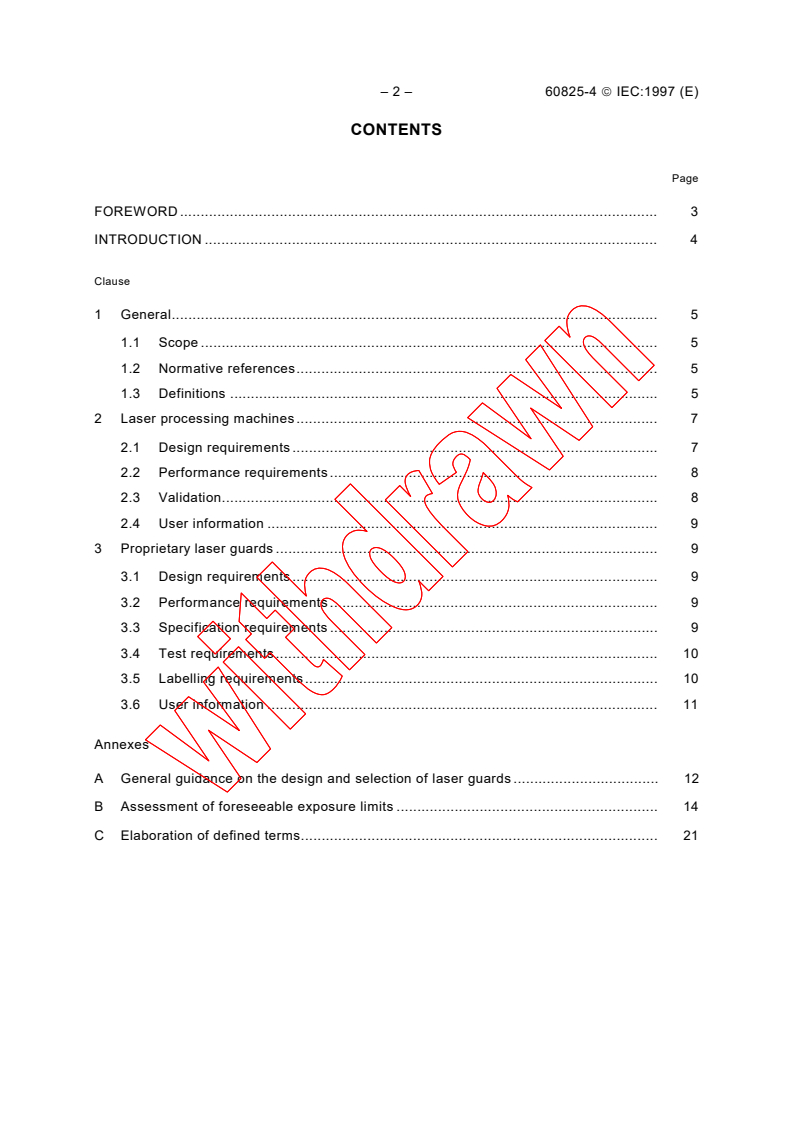
– 2 – 60825-4 IEC:1997 (E)
CONTENTS
Page
FOREWORD . 3
INTRODUCTION . 4
Clause
1 General. 5
1.1 Scope . 5
1.2 Normative references. 5
1.3 Definitions . 5
2 Laser processing machines . 7
2.1 Design requirements . 7
2.2 Performance requirements . 8
2.3 Validation. 8
2.4 User information . 9
3 Proprietary laser guards . 9
3.1 Design requirements . 9
3.2 Performance requirements . 9
3.3 Specification requirements . 9
3.4 Test requirements. 10
3.5 Labelling requirements. 10
3.6 User information . 11
Annexes
A General guidance on the design and selection of laser guards . 12
B Assessment of foreseeable exposure limits . 14
C Elaboration of defined terms. 21
60825-4 IEC:1997 (E) – 3 –
INTERNATIONAL ELECTROTECHNICAL COMMISSION
___________
SAFETY OF LASER PRODUCTS –
Part 4: Laser guards
FOREWORD
1) The IEC (International Electrotechnical Commission) is a worldwide organization for standardization comprising
all national electrotechnical committees (IEC National Committees). The object of the IEC is to promote
international co-operation on all questions concerning standardization in the electrical and electronic fields. To
this end and in addition to other activities, the IEC publishes International Standards. Their preparation is
entrusted to technical committees; any IEC National Committee interested in the subject dealt with may
participate in this preparatory work. International, governmental and non-governmental organizations liaising
with the IEC also participate in this preparation. The IEC collaborates closely with the International Organization
for Standardization (ISO) in accordance with conditions determined by agreement between the two
organizations.
2) The formal decisions or agreements of the IEC on technical matters express, as nearly as possible, an
international consensus of opinion on the relevant subjects since each technical committee has representation
from all interested National Committees.
3) The documents produced have the form of recommendations for international use and are published in the form
of standards, technical reports or guides and they are accepted by the National Committees in that sense.
4) In order to promote international unification, IEC National Committees undertake to apply IEC International
Standards transparently to the maximum extent possible in their national and regional standards. Any
divergence between the IEC Standard and the corresponding national or regional standard shall be clearly
indicated in the latter.
5) The IEC provides no marking procedure to indicate its approval and cannot be rendered responsible for any
equipment declared to be in conformity with one of its standards.
6) Attention is drawn to the possibility that some of the elements of this International Standard may be the subject
of patent rights. The IEC shall not be held responsible for identifying any or all such patent rights.
International Standard IEC 60825-4 has been prepared by IEC technical committee 76: Optical
radiation safety and laser equipment.
The text of this standard is based on the following documents:
FDIS Report on voting
76/159/FDIS 76/168/RVD
Full information on the voting for the approval of this standard can be found in the report on
voting indicated in the above table.
Annexes A, B and C are for information only.
The French version of this standard will be issued separately.
– 4 – 60825-4 IEC:1997 (E)
INTRODUCTION
At low levels of irradiance or radiant exposure, the selection of material and thickness for
shielding against laser radiation is determined primarily by a need to provide sufficient optical
attenuation. However, at higher levels, an additional consideration is the ability of the laser
radiation to remove guard material – typically by melting, oxidation or ablation; processes that
could lead to laser radiation penetrating a normally opaque material.
IEC 60825-1 deals with basic issues concerning laser guards, including human access,
interlocking and labelling, and gives general guidance on the design of protective housings and
enclosures for high-power lasers.
This part of IEC 60825 deals with protection against laser radiation only. Hazards from
secondary radiation that may arise during material processing are not addressed.
Laser guards may also comply with standards for laser protective eyewear, but such
compliance is not necessarily sufficient to satisfy the requirements of this standard.
Where the term “irradiance” is used, the expression “irradiance or radiant exposure, as
appropriate” is implied.
60825-4 IEC:1997 (E) – 5 –
SAFETY OF LASER PRODUCTS –
Part 4: Laser guards
1 General
1.1 Scope
This part of IEC 60825 specifies the requirements for laser guards, permanent and temporary
(for example for service), that enclose the process zone of a laser processing machine, and
specifications for proprietary laser guards.
This standard applies to all component parts of a guard including clear (visibly transmitting)
screens and viewing windows, panels, laser curtains and walls. Requirements for beam path
components, beam stops and those other parts of a protective housing of a laser product which
do not enclose the process zone are contained in IEC 60825-1.
In addition this part of IEC 60825 indicates:
a) how to assess and specify the protective properties of a laser guard; and
b) how to select a laser guard.
1.2 Normative references
The following normative documents contain provisions which, through reference in this text,
constitute provisions of this part of IEC 60825. At the time of publication, the editions indicated
were valid. All normative documents are subject to revision, and parties to agreements based
on this part of IEC 60825 are encouraged to investigate the possibility of applying the most
recent editions of the normative documents indicated below. Members of IEC and ISO maintain
registers of currently valid International Standards.
IEC 60825-1: 1993, Safety of laser products – Part 1: Equipment classification, requirements
and user’s guide
ISO/TR12100-1: 1992, Safety of machinery – Basic concepts, general principles for design –
Part 1: Basic terminology, methodology
ISO/TR12100-2: 1992, Safety of machinery – Basic concepts, general principles for design –
Part 2: Technical principles and specifications
ISO 11553: 1996, Safety of machinery – Laser processing machines – Safety requirements
1.3 Definitions
For the purpose of this part of IEC 60825, the following definitions apply in addition to the
definitions given in IEC 60825-1.
1.3.1
active guard protection time
for a given laser exposure of the front surface of an active laser guard, the minimum time,
measured from the issue of an active guard termination signal, for which the active laser guard can
safely prevent laser radiation accessible at its rear surface from exceeding the class 1 AEL.
– 6 – 60825-4 IEC:1997 (E)
1.3.2
active guard termination signal
the signal issued by an active guard in response to an excess exposure of its front surface to
laser radiation and which is intended to lead to automatic termination of the laser radiation
NOTE – The action of a safety interlock becoming open circuit is considered a "signal" in this context.
1.3.3
active laser guard
a laser guard which is part of a safety-related control system. The control system generates an
active guard termination signal in response to the effect of laser radiation on the front surface
of the laser guard
1.3.4
foreseeable exposure limit (FEL)
the maximum laser exposure on the front surface of the laser guard, within the maintenance
inspection interval, assessed under normal and reasonably foreseeable fault conditions
1.3.5
front surface
the face of the laser guard intended for exposure to laser radiation
1.3.6
laser guard:
a physical barrier which limits the extent of a danger zone by preventing laser radiation
accessible at its rear surface from exceeding the class 1 AEL
1.3.7
laser processing machine
a machine which uses a laser to process materials and is within the scope of ISO 11553
1.3.8
laser termination time
the maximum time taken, from generation of an active guard termination signal, for the laser
radiation to be terminated
NOTE – Laser termination time does not refer to the response of an active laser guard but to the response of the
laser processing machine, in particular the laser safety shutter.
1.3.9
maintenance inspection interval
the time between successive safety maintenance inspections of a laser guard
1.3.10
passive laser guard
a laser guard which relies for its operation on its physical properties only
1.3.11
process zone
the zone where the laser beam interacts with the material to be processed
1.3.12
proprietary laser guard
a passive or active laser guard, offered by its manufacturer as a guard with a specified
protective exposure limit
60825-4 IEC:1997 (E) – 7 –
1.3.13
protective exposure limit (PEL):
the maximum laser exposure of the front surface of a laser guard which is specified to prevent
laser radiation accessible at its rear surface from exceeding the class 1 AEL
NOTE 1 – In practice, there may be more than one maximum exposure.
NOTE 2 – Different PELs may be assigned to different regions of a laser guard if these regions are clearly
identifiable (for example a viewing window forming an integral part of a laser guard).
1.3.14
rear surface
any surface of a laser guard that is remote from the associated laser radiation and usually
accessible to the user
1.3.15
reasonably foreseeable
an event (or condition) when it is credible and its likelihood of occurrence (or existence) cannot
be disregarded
1.3.16
safety maintenance inspection
documented inspection performed in accordance with manufacturer’s instructions
1.3.17
temporary laser guard
a substitute or supplementary active or passive laser guard intended to limit the extent of the
danger zone during some service operations of the laser processing machine
2 Laser processing machines
This clause specifies the requirements for laser guards that enclose the process zone and are
supplied by the laser processing machine manufacturer.
2.1 Design requirements
A laser guard shall satisfy ISO/TR12100-2 with respect to the general requirements for guards
and also the more specific requirements with regard to its location and method of fixture. In
addition, the following specific laser requirements shall be met.
2.1.1 General requirements
A laser guard, in its intended location, shall not give rise to any associated hazard at or beyond
its rear surface when exposed to laser radiation up to the foreseeable exposure limit.
NOTE 1 – Examples of associated hazards include: high temperature, the release of toxic materials, fire, explosion,
electricity.
NOTE 2 – See annex B for assessment of foreseeable exposure limit.
2.1.2 Consumable parts of laser guards
Provision shall be made for the replacement of parts of a laser guard prone to damage by laser
radiation.
NOTE – An example of such a part would be a sacrificial or interchangeable screen.
– 8 – 60825-4 IEC:1997 (E)
2.2 Performance requirements
2.2.1 General
When the front surface of a laser guard is subjected to exposure to laser radiation at the
foreseeable exposure limit, the laser guard shall prevent laser radiation accessible at its rear
surface from exceeding the class 1 AEL at any time over the period of the maintenance
inspection interval. For automated laser processing machines, the minimum value of the
maintenance inspection interval shall be 8 h.
This requirement shall be satisfied over the intended lifetime of the laser guard under expected
conditions of operation.
NOTE 1 – This requirement implies both low transmission of laser radiation and resistance to laser-induced
damage.
NOTE 2 – Some materials may lose their protective properties due to ageing, exposure to ultraviolet radiation,
certain gases, temperature, humidity and other environmental conditions. Additionally, some materials will transmit
laser radiation under high-intensity laser exposure, even though there may be no visible damage (i.e. reversible
bleaching).
2.2.2 Active laser guards
a) The active guard protection time shall exceed the laser termination time up to the
foreseeable exposure limits.
b) The generation of an active guard termination signal shall give rise to a visible or audible
warning. A manual reset is required before laser emission can recommence.
NOTE – See annex C.2 for an elaboration of terms.
2.3 Validation
If the laser processing machine manufacturer chooses to make a laser guard, the manufacturer
shall confirm that the guard complies with the design requirements of 2.1 and can satisfy the
performance requirements set out in 2.2.
NOTE – See annex A for guidance on the design and selection of laser guards.
2.3.1 Validation of performance
2.3.1.1 The complete laser guard, or an appropriate sample of the material of construction of
the laser guard, shall be tested at each FEL identified.
NOTE 1 – A table of predetermined PELs for common combinations of lasers and guarding materials, together with
suitable testing procedures shall be issued as an informative annex in a future amendment to this standard. This
could provide a simple alternative to direct testing for the majority of cases.
NOTE 2 – See annex B for the assessment of FEL.
2.3.1.2 For testing purposes, the FEL exposure shall be achieved either:
a) by calculating or measuring the exposure and reproducing the conditions; or
b) without quantifying the FEL, by creating the machine conditions under which the FEL is
produced.
The condition of the laser guard or sample shall be such as to replicate those physical
conditions of the front surface permitted within the scope of the routine inspection instructions
and within the service life of the guard, which minimize the laser radiation protective properties
of the laser guard (for example wear and tear and surface contamination) (see 2.4.2).
60825-4 IEC:1997 (E) – 9 –
2.4 User information
2.4.1 The manufacturer shall document and provide to the user the maintenance inspection
interval for the laser guard, and details of inspection and test procedures, cleaning,
replacement or repair of damaged parts, together with any restrictions of use.
2.4.2 The manufacturer shall document and provide to the user instructions that after any
actuation of the safety control system of an active guard, the cause shall be investigated,
checks shall be made for damage, and the necessary remedial action to be taken before
resetting the control system.
3 Proprietary laser guards
This clause specifies the requirements to be satisfied by suppliers of proprietary laser guards.
3.1 Design requirements
A proprietary laser guard shall not create any associated hazard at or beyond its rear surface
when exposed to laser radiation up to the specified PEL when used as specified in the user
information (see 3.6).
3.2 Performance requirements
The accessible laser radiation at the rear surface of the laser guard shall not exceed the
class 1 AEL when its front surface is subjected to laser radiation at the specified PEL. For an
active laser guard, this requirement shall apply to laser radiation accessible over the period of
the active guard protection time, measured from the moment an active guard termination signal
is issued.
This requirement shall be satisfied over the intended lifetime of the guard under expected
service conditions.
3.3 Specification requirements
The full specification of a PEL shall include the following information:
a) the magnitude and variation with time of irradiance or radiant exposure at the front surface
–2 –2
of the laser guard (in units of Wm or Jm respectively), specifying any upper limit to the
area of exposure;
b) the overall duration of exposure under these conditions;
c) the wavelength for which this PEL applies;
d) the angle of incidence and (if relevant) the polarization of the incident laser radiation;
e) any minimum dimensions to the irradiated area (for example as might apply to an active
laser guard with discrete sensor elements so that a small diameter laser beam could pass
through the guard undetected);
f) for an active laser guard, the active guard protection time.
NOTE 1 – See clause B.1 for an elaboration of terms.
NOTE 2 – In all cases, a range or set of values can be stated rather than a single value.
NOTE 3 – A graphical form of presentation (for example irradiance vs. duration with all other parameters constant).
– 10 – 60825-4 IEC:1997 (E)
3.4 Test requirements
3.4.1 General
Testing shall be performed using the complete laser guard or an appropriate sample of the
material used to construct the guard. In either case, the condition of the guard or sample shall
be such as to replicate or exceed the worst permissible physical condition of the front surface,
including reduced surface reflection and damage permitted within the scope of the routine
maintenance instructions (see 3.6).
The front surface irradiation shall be either as specified by the PEL or, in the case of sample
testing, as specified in 3.4.2 below.
When the front surface is subjected to the PEL exposure conditions, the accessible laser
radiation measured at the rear surface of the laser guard shall not exceed the class 1 AEL
(tests as prescribed in clause 8 of 60825-1). This requirement applies over the exposure
duration specified in the PEL or, in the case of an active guard, over the specified active guard
protection time measured from the moment an active guard termination signal is issued.
NOTE – In cases where materials opaque at the laser wavelength(s) are used (for example metals), the transmitted
radiation will only rise to the class 1 AEL when complete (or almost complete) physical removal of material along a
path through to the rear surface has been achieved. In such cases, the rise from zero transmission to a value
greatly in excess of the class 1 AEL will therefore be rapid, and sensitive radiation
...
INTERNATIONAL IEC
STANDARD 60825-4
Edition 1.2
2003-10
Edition 1:1997 consolidated with amendments 1:2002 and 2:2003
Safety of laser products –
Part 4:
Laser guards
Sécurité des appareils à laser –
Partie 4:
Barrières laser
Reference number
Publication numbering
As from 1 January 1997 all IEC publications are issued with a designation in the
60000 series. For example, IEC 34-1 is now referred to as IEC 60034-1.
Consolidated editions
The IEC is now publishing consolidated versions of its publications. For example,
edition numbers 1.0, 1.1 and 1.2 refer, respectively, to the base publication, the
base publication incorporating amendment 1 and the base publication incorporating
amendments 1 and 2.
Further information on IEC publications
The technical content of IEC publications is kept under constant review by the IEC,
thus ensuring that the content reflects current technology. Information relating to
this publication, including its validity, is available in the IEC Catalogue of
publications (see below) in addition to new editions, amendments and corrigenda.
Information on the subjects under consideration and work in progress undertaken
by the technical committee which has prepared this publication, as well as the list
of publications issued, is also available from the following:
• IEC Web Site (www.iec.ch)
• Catalogue of IEC publications
The on-line catalogue on the IEC web site (www.iec.ch/searchpub) enables you to
search by a variety of criteria including text searches, technical committees
and date of publication. On-line information is also available on recently issued
publications, withdrawn and replaced publications, as well as corrigenda.
• IEC Just Published
This summary of recently issued publications (www.iec.ch/online_news/ justpub)
is also available by email. Please contact the Customer Service Centre (see
below) for further information.
• Customer Service Centre
If you have any questions regarding this publication or need further assistance,
please contact the Customer Service Centre:
Email: custserv@iec.ch
Tel: +41 22 919 02 11
Fax: +41 22 919 03 00
INTERNATIONAL IEC
STANDARD
60825-4
Edition 1.2
2003-10
Edition 1:1997 consolidated with amendments 1:2002 and 2:2003
Safety of laser products –
Part 4:
Laser guards
Sécurité des appareils à laser –
Partie 4:
Barrières laser
IEC 2003 Copyright - all rights reserved
No part of this publication may be reproduced or utilized in any form or by any means, electronic or
mechanical, including photocopying and microfilm, without permission in writing from the publisher.
International Electrotechnical Commission, 3, rue de Varembé, PO Box 131, CH-1211 Geneva 20, Switzerland
Telephone: +41 22 919 02 11 Telefax: +41 22 919 03 00 E-mail: inmail@iec.ch Web: www.iec.ch
PRICE CODE W
Commission Electrotechnique Internationale
International Electrotechnical Commission
Международная Электротехническая Комиссия
For price, see current catalogue
– 2 – 60825-4 IEC:1997+A1:2002+A2:2003(E)
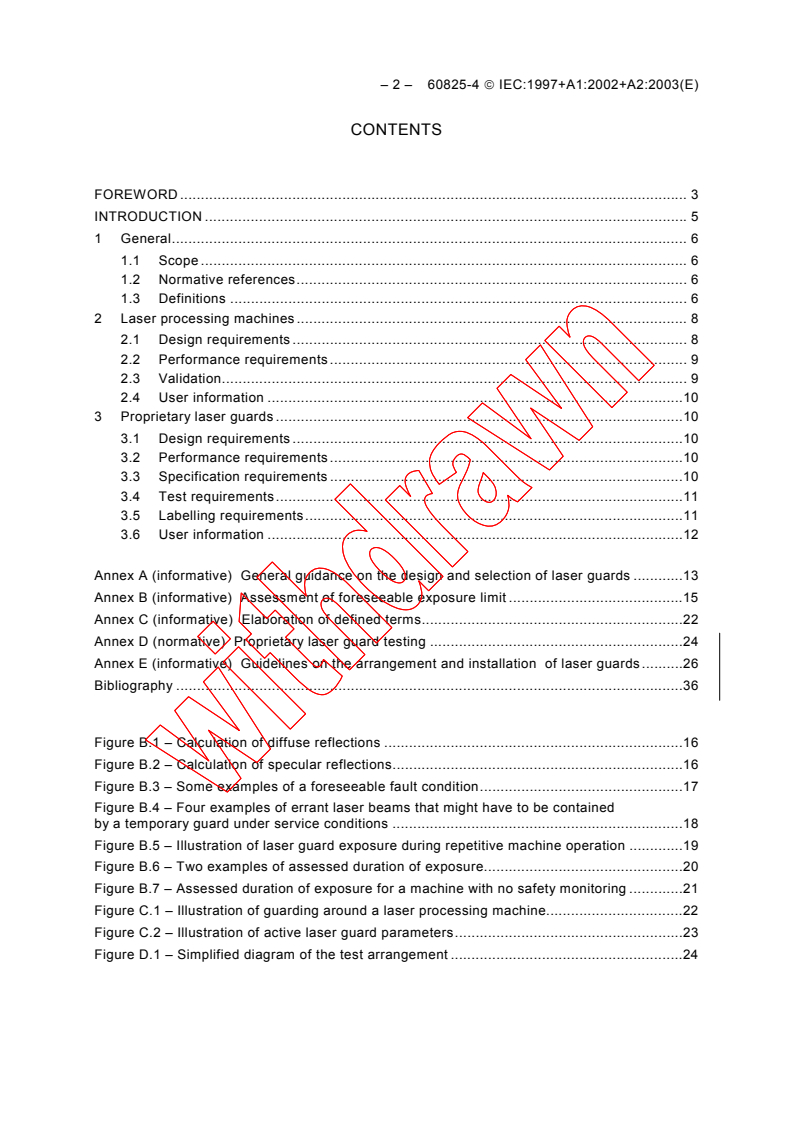
CONTENTS
FOREWORD . 3
INTRODUCTION .5
1 General. 6
1.1 Scope . 6
1.2 Normative references. 6
1.3 Definitions . 6
2 Laser processing machines . 8
2.1 Design requirements . 8
2.2 Performance requirements . 9
2.3 Validation. 9
2.4 User information .10
3 Proprietary laser guards .10
3.1 Design requirements .10
3.2 Performance requirements .10
3.3 Specification requirements .10
3.4 Test requirements.11
3.5 Labelling requirements.11
3.6 User information .12
Annex A (informative) General guidance on the design and selection of laser guards .13
Annex B (informative) Assessment of foreseeable exposure limit .15
Annex C (informative) Elaboration of defined terms.22
Annex D (normative) Proprietary laser guard testing .24
Annex E (informative) Guidelines on the arrangement and installation of laser guards.26
Bibliography .36
Figure B.1 – Calculation of diffuse reflections .16
Figure B.2 – Calculation of specular reflections.16
Figure B.3 – Some examples of a foreseeable fault condition.17
Figure B.4 – Four examples of errant laser beams that might have to be contained
by a temporary guard under service conditions .18
Figure B.5 – Illustration of laser guard exposure during repetitive machine operation .19
Figure B.6 – Two examples of assessed duration of exposure.20
Figure B.7 – Assessed duration of exposure for a machine with no safety monitoring .21
Figure C.1 – Illustration of guarding around a laser processing machine.22
Figure C.2 – Illustration of active laser guard parameters.23
Figure D.1 – Simplified diagram of the test arrangement .24
60825-4 IEC:1997+A1:2002+A2:2003(E) – 3 –
INTERNATIONAL ELECTROTECHNICAL COMMISSION
___________
SAFETY OF LASER PRODUCTS –
Part 4: Laser guards
FOREWORD
1) The International Electrotechnical Commission (IEC) is a worldwide organization for standardization comprising
all national electrotechnical committees (IEC National Committees). The object of IEC is to promote
international co-operation on all questions concerning standardization in the electrical and electronic fields. To
this end and in addition to other activities, IEC publishes International Standards, Technical Specifications,
Technical Reports, Publicly Available Specifications (PAS) and Guides (hereafter referred to as “IEC
Publication(s)”). Their preparation is entrusted to technical committees; any IEC National Committee interested
in the subject dealt with may participate in this preparatory work. International, governmental and non-
governmental organizations liaising with the IEC also participate in this preparation. IEC collaborates closely
with the International Organization for Standardization (ISO) in accordance with conditions determined by
agreement between the two organizations.
2) The formal decisions or agreements of IEC on technical matters express, as nearly as possible, an international
consensus of opinion on the relevant subjects since each technical committee has representation from all
interested IEC National Committees.
3) IEC Publications have the form of recommendations for international use and are accepted by IEC National
Committees in that sense. While all reasonable efforts are made to ensure that the technical content of IEC
Publications is accurate, IEC cannot be held responsible for the way in which they are used or for any
misinterpretation by any end user.
4) In order to promote international uniformity, IEC National Committees undertake to apply IEC Publications
transparently to the maximum extent possible in their national and regional publications. Any divergence
between any IEC Publication and the corresponding national or regional publication shall be clearly indicated in
the latter.
5) IEC provides no marking procedure to indicate its approval and cannot be rendered responsible for any
equipment declared to be in conformity with an IEC Publication.
6) All users should ensure that they have the latest edition of this publication.
7) No liability shall attach to IEC or its directors, employees, servants or agents including individual experts and
members of its technical committees and IEC National Committees for any personal injury, property damage or
other damage of any nature whatsoever, whether direct or indirect, or for costs (including legal fees) and
expenses arising out of the publication, use of, or reliance upon, this IEC Publication or any other IEC
Publications.
8) Attention is drawn to the Normative references cited in this publication. Use of the referenced publications is
indispensable for the correct application of this publication.
9) Attention is drawn to the possibility that some of the elements of this IEC Publication may be the subject of
patent rights. IEC shall not be held responsible for identifying any or all such patent rights.
International Standard IEC 60825-4 has been prepared by IEC technical committee 76: Optical
radiation safety and laser equipment.
This consolidated version of IEC 60825-4 is based on the first edition (1997) [documents
76/159/FDIS and 76/168/RVD], its amendment 1 (2002) [documents 76/242/FDIS and
76/252/RVD] and its amendment 2 (2003) [documents 76/263/FDIS and 76/273/RVD].
It bears the edition number 1.2.
A vertical line in the margin shows where the base publication has been modified by
amendments 1 and 2.
Annex D forms an integral part of this standard.
Annexes A, B, C and E are for information only.
– 4 – 60825-4 IEC:1997+A1:2002+A2:2003(E)
The French version of this standard will be issued separately.
The committee has decided that the contents of this publication will remain unchanged until
2005. At this date, the publication will be
• reconfirmed;
• withdrawn;
• replaced by a revised edition, or
• amended.
60825-4 IEC:1997+A1:2002+A2:2003(E) – 5 –
INTRODUCTION
At low levels of irradiance or radiant exposure, the selection of material and thickness for
shielding against laser radiation is determined primarily by a need to provide sufficient optical
attenuation. However, at higher levels, an additional consideration is the ability of the laser
radiation to remove guard material – typically by melting, oxidation or ablation; processes that
could lead to laser radiation penetrating a normally opaque material.
IEC 60825-1 deals with basic issues concerning laser guards, including human access,
interlocking and labelling, and gives general guidance on the design of protective housings and
enclosures for high-power lasers.
This part of IEC 60825 deals with protection against laser radiation only. Hazards from
secondary radiation that may arise during material processing are not addressed.
Laser guards may also comply with standards for laser protective eyewear, but such
compliance is not necessarily sufficient to satisfy the requirements of this standard.
Where the term “irradiance” is used, the expression “irradiance or radiant exposure, as
appropriate” is implied.
– 6 – 60825-4 IEC:1997+A1:2002+A2:2003(E)
SAFETY OF LASER PRODUCTS –
Part 4: Laser guards
1 General
1.1 Scope
This part of IEC 60825 specifies the requirements for laser guards, permanent and temporary
(for example for service), that enclose the process zone of a laser processing machine, and
specifications for proprietary laser guards.
This standard applies to all component parts of a guard including clear (visibly transmitting)
screens and viewing windows, panels, laser curtains and walls. Requirements for beam path
components, beam stops and those other parts of a protective housing of a laser product which
do not enclose the process zone are contained in IEC 60825-1.
In addition this part of IEC 60825 indicates:
a) how to assess and specify the protective properties of a laser guard; and
b) how to select a laser guard.
1.2 Normative references
The following referenced documents are indispensable for the application of this document. For
dated references, only the edition cited applies. For undated references, the latest edition of
the referenced document (including any amendments) applies.
IEC 60825-1: 1993, Safety of laser products – Part 1: Equipment classification, requirements
and user’s guide
ISO/TR12100-1: 1992, Safety of machinery – Basic concepts, general principles for design –
Part 1: Basic terminology, methodology
ISO/TR12100-2: 1992, Safety of machinery – Basic concepts, general principles for design –
Part 2: Technical principles and specifications
ISO 11553: 1996, Safety of machinery – Laser processing machines – Safety requirements
1.3 Definitions
For the purpose of this part of IEC 60825, the following definitions apply in addition to the
definitions given in IEC 60825-1.
1.3.1
active guard protection time
for a given laser exposure of the front surface of an active laser guard, the minimum time,
measured from the issue of an active guard termination signal, for which the active laser guard can
safely prevent laser radiation accessible at its rear surface from exceeding the class 1 AEL.
60825-4 IEC:1997+A1:2002+A2:2003(E) – 7 –
1.3.2
active guard termination signal
the signal issued by an active guard in response to an excess exposure of its front surface to
laser radiation and which is intended to lead to automatic termination of the laser radiation
NOTE The action of a safety interlock becoming open circuit is considered a "signal" in this context.
1.3.3
active laser guard
a laser guard which is part of a safety-related control system. The control system generates an
active guard termination signal in response to the effect of laser radiation on the front surface
of the laser guard
1.3.4
foreseeable exposure limit (FEL)
the maximum laser exposure on the front surface of the laser guard, within the maintenance
inspection interval, assessed under normal and reasonably foreseeable fault conditions
1.3.5
front surface
the face of the laser guard intended for exposure to laser radiation
1.3.6
laser guard
a physical barrier which limits the extent of a danger zone by preventing laser radiation
accessible at its rear surface from exceeding the class 1 AEL
1.3.7
laser processing machine
a machine which uses a laser to process materials and is within the scope of ISO 11553
1.3.8
laser termination time
the maximum time taken, from generation of an active guard termination signal, for the laser
radiation to be terminated
NOTE Laser termination time does not refer to the response of an active laser guard but to the response of the
laser processing machine, in particular the laser safety shutter.
1.3.9
maintenance inspection interval
the time between successive safety maintenance inspections of a laser guard
1.3.10
passive laser guard
a laser guard which relies for its operation on its physical properties only
1.3.11
process zone
the zone where the laser beam interacts with the material to be processed
1.3.12
proprietary laser guard
a passive or active laser guard, offered by its manufacturer as a guard with a specified
protective exposure limit
– 8 – 60825-4 IEC:1997+A1:2002+A2:2003(E)
1.3.13
protective exposure limit (PEL)
the maximum laser exposure of the front surface of a laser guard which is specified to prevent
laser radiation accessible at its rear surface from exceeding the class 1 AEL
NOTE 1 In practice, there may be more than one maximum exposure.
NOTE 2 Different PELs may be assigned to different regions of a laser guard if these regions are clearly
identifiable (for example a viewing window forming an integral part of a laser guard).
1.3.14
rear surface
any surface of a laser guard that is remote from the associated laser radiation and usually
accessible to the user
1.3.15
reasonably foreseeable
an event (or condition) when it is credible and its likelihood of occurrence (or existence) cannot
be disregarded
1.3.16
safety maintenance inspection
documented inspection performed in accordance with manufacturer’s instructions
1.3.17
temporary laser guard
a substitute or supplementary active or passive laser guard intended to limit the extent of the
danger zone during some service operations of the laser processing machine
2 Laser processing machines
This clause specifies the requirements for laser guards that enclose the process zone and are
supplied by the laser processing machine manufacturer.
2.1 Design requirements
A laser guard shall satisfy ISO/TR12100-2 with respect to the general requirements for guards
and also the more specific requirements with regard to its location and method of fixture. In
addition, the following specific laser requirements shall be met.
2.1.1 General requirements
A laser guard, in its intended location, shall not give rise to any associated hazard at or beyond
its rear surface when exposed to laser radiation up to the foreseeable exposure limit.
NOTE 1 Examples of associated hazards include: high temperature, the release of toxic materials, fire, explosion,
electricity.
NOTE 2 See annex B for assessment of foreseeable exposure limit.
2.1.2 Consumable parts of laser guards
Provision shall be made for the replacement of parts of a laser guard prone to damage by laser
radiation.
NOTE An example of such a part would be a sacrificial or interchangeable screen.
60825-4 IEC:1997+A1:2002+A2:2003(E) – 9 –
2.2 Performance requirements
2.2.1 General
When the front surface of a laser guard is subjected to exposure to laser radiation at the
foreseeable exposure limit, the laser guard shall prevent laser radiation accessible at its rear
surface from exceeding the class 1 AEL at any time over the period of the maintenance
inspection interval. For automated laser processing machines, the minimum value of the
maintenance inspection interval shall be 8 h.
This requirement shall be satisfied over the intended lifetime of the laser guard under expected
conditions of operation.
NOTE 1 This requirement implies both low transmission of laser radiation and resistance to laser-induced
damage.
NOTE 2 Some materials may lose their protective properties due to ageing, exposure to ultraviolet radiation,
certain gases, temperature, humidity and other environmental conditions. Additionally, some materials will transmit
laser radiation under high-intensity laser exposure, even though there may be no visible damage (i.e. reversible
bleaching).
2.2.2 Active laser guards
a) The active guard protection time shall exceed the laser termination time up to the
foreseeable exposure limits.
b) The generation of an active guard termination signal shall give rise to a visible or audible
warning. A manual reset is required before laser emission can recommence.
NOTE See annex C.2 for an elaboration of terms.
2.3 Validation
If the laser processing machine manufacturer chooses to make a laser guard, the manufacturer
shall confirm that the guard complies with the design requirements of 2.1 and can satisfy the
performance requirements set out in 2.2.
NOTE See annex A for guidance on the design and selection of laser guards.
2.3.1 Validation of performance
2.3.1.1 The complete laser guard, or an appropriate sample of the material of construction of
the laser guard, shall be tested at each FEL identified.
NOTE 1 A table of predetermined PELs for common combinations of lasers and guarding materials, together with
suitable testing procedures shall be issued as an informative annex in a future amendment to this standard. This
could provide a simple alternative to direct testing for the majority of cases.
NOTE 2 See annex B for the assessment of FEL.
2.3.1.2 For testing purposes, the FEL exposure shall be achieved either:
a) by calculating or measuring the exposure and reproducing the conditions; or
b) without quantifying the FEL, by creating the machine conditions under which the FEL is
produced.
The condition of the laser guard or sample shall be such as to replicate those physical
conditions of the front surface permitted within the scope of the routine inspection instructions
and within the service life of the guard, which minimize the laser radiation protective properties
of the laser guard (for example wear and tear and surface contamination) (see 2.4.2).
– 10 – 60825-4 IEC:1997+A1:2002+A2:2003(E)
2.4 User information
2.4.1 The manufacturer shall document and provide to the user the maintenance inspection
interval for the laser guard, and details of inspection and test procedures, cleaning,
replacement or repair of damaged parts, together with any restrictions of use.
2.4.2 The manufacturer shall document and provide to the user instructions that after any
actuation of the safety control system of an active guard, the cause shall be investigated,
checks shall be made for damage, and the necessary remedial action to be taken before
resetting the control system.
3 Proprietary laser guards
This clause specifies the requirements to be satisfied by suppliers of proprietary laser guards.
3.1 Design requirements
A proprietary laser guard shall not create any associated hazard at or beyond its rear surface
when exposed to laser radiation up to the specified PEL when used as specified in the user
information (see 3.6).
3.2 Performance requirements
The accessible laser radiation at the rear surface of the laser guard shall not exceed the
class 1 AEL when its front surface is subjected to laser radiation at the specified PEL. For an
active laser guard, this requirement shall apply to laser radiation accessible over the period of
the active guard protection time, measured from the moment an active guard termination signal
is issued.
This requirement shall be satisfied over the intended lifetime of the guard under expected
service conditions.
3.3 Specification requirements
The full specification of a PEL shall include the following information:
a) the magnitude and variation with time of irradiance or radiant exposure at the front surface
–2 –2
of the laser guard (in units of Wm or Jm respectively), specifying any upper limit to the
area of exposure;
b) the overall duration of exposure under these conditions;
c) the wavelength for which this PEL applies;
d) the angle of incidence and (if relevant) the polarization of the incident laser radiation;
e) any minimum dimensions to the irradiated area (for example as might apply to an active
laser guard with discrete sensor elements so that a small diameter laser beam could pass
through the guard undetected);
f) for an active laser guard, the active guard protection time.
NOTE 1 See clause B.1 for an elaboration of terms.
NOTE 2 In all cases, a range or set of values can be stated rather than a single value.
NOTE 3 A graphical form of presentation (for example irradiance vs. duration with all other parameters constant).
60825-4 IEC:1997+A1:2002+A2:2003(E) – 11 –
3.4 Test requirements
3.4.1 General
Testing shall be performed using the complete laser guard or an appropriate sample of the
material used to construct the guard. In either case, the condition of the guard or sample shall
be such as to replicate or exceed the worst permissible physical condition of the front surface,
including reduced surface reflection and damage permitted within the scope of the routine
maintenance instructions (see 3.6).
The front surface irradiation shall be either as specified by the PEL or, in the case of sample
testing, as specified in 3.4.2 below.
When the front surface is subjected to the PEL exposure conditions, the accessible laser
radiation measured at the rear surface of the laser guard shall not exceed the class 1 AEL
(tests as prescribed in clause 8 of 60825-1). This requirement applies over the exposure
duration specified in the PEL or, in the case of an active guard, over the specified active guard
protection time measured from the moment an active guard termination signal is issued.
NOTE In cases where materials opaque at the laser wavelength(s) are used (for example metals), the transmitted
radiation will only rise to the class 1 AEL when complete (or almost complete) physical removal of material along a
path through to the rear surface has been achieved. In such cases, the rise from zero transmission to a value
greatly in excess of the class 1 AEL will therefore be rapid, and sensitive radiation detectors will not be required.
3.4.2 Sample testing
Sample guard testing shall be performed by irradiating the front surface of the guard material
using the procedure and methodology as specified in Annex D.
3.5 Labelling requirements
3.5.1 All labelling shall be placed on the rear surface of the guard.
3.5.2 The rear surface of the guard shall be clearly identified if the orientation of the guard is
important.
3.5.3 If only part of the front surface of the guard is a laser guard, this area shall be clearly
identified by a bold coloured outline and words to indicate the outer boundary of the laser
guard.
3.5.4 The labelling shall state the full PEL specification.
3.5.5 The manufacturer’s name, the date and place of manufacture according to ISO 11553,
and a statement of compliance with this standard shall be provided.
– 12 – 60825-4 IEC:1997+A1:2002+A2:2003(E)
3.6 User information
In addition to the specifications listed in 3.3, the following information shall be supplied to the
user by the manufacturer of a proprietary laser guard:
a) a description of the permitted uses of the laser guard;
b) a description of the form of mounting and connection of the laser guard;
c) information on the installation of the laser guard – for active laser guards this shall include
interface and supply requirements for the guard;
d) maintenance requirements, including for example details of inspection and test procedures,
cleaning, replacement or repair of damaged parts;
e) instructions, that after any actuation of the safety control system of an active guard, the
cause shall be investigated, checks shall be made for damage, and the necessary remedial
action to be taken before resetting the control system;
f) the labels in 3.5 and their locations. If only part of the front surface of the guard is a laser
guard, this area shall be identified;
g) a statement of compliance with this standard.
60825-4 IEC:1997+A1:2002+A2:2003(E) – 13 –
Annex A
(informative)
General guidance on the design and selection of laser guards
A.1 Design of laser guards
A.1.1 Passive laser guards
Examples of a passive laser guard include the following.
a) A metal panel relying on thermal conduction, if necessary enhanced by forced air or water
cooling, to maintain the surface temperature below its melting point under normal and
reasonably foreseeable fault conditions.
b) A transparent sheet, opaque at the laser wavelength, which is unaffected by low value of
laser exposure under normal operation of the laser processing machine.
A.1.2 Active laser guards
Examples of an active laser guards include the following.
a) A guard, with discrete embedded thermal sensors, which detects overheating.
NOTE The spacing between sensors should be considered in relation to the minimum dimensions of an errant
laser beam.
b) A laser guard comprising two panels between which is contained a pressurized liquid or
gaseous medium in combination with a pressure-sensing device capable of detecting the
pressure drop following perforation of the front surface.
A.1.3 Hazard indication (passive guards)
Visible indication of exposure of the laser guard to hazardous amounts of laser radiation should
be provided where feasible (for example by adding a layer of an appropriate paint on both sides
of the laser guard).
A.1.4 Power supply (active guards)
If power is required for the proper functioning of an active guard, its supply should be arranged
so that laser operation is not possible in the absence of such power.
A.2 Selection of laser guards
A simple selection process is as follows:
a) identify the preferred position for the laser guard and estimate the FEL at this position.
Annex B gives guidance on the estimation of FEL values;
b) if necessary, minimize the FEL under fault conditions, preferably by including automatic
monitoring in the machine which will detect the fault conditions and limit the exposure time.
Examples of alternatives include the following:
– ensure that the laser guard is sufficiently far away from beam focus produced by
focusing optics;
– install vulnerable parts of laser guard (such as viewing windows) away from regions that
could be exposed to high irradiance;
– 14 – 60825-4 IEC:1997+A1:2002+A2:2003(E)
– move the laser guard farther away from the laser process zone;
– required in the essential servicing documentation for temporary laser guards, additions
such as:
• one or more persons to be present to supervize the condition of the front surface of
the laser guard, to reduce the assessed exposure duration of a passive guard;
• a hold-to-operate controller to be used by the person(s) supervising the condition of
the front surface of the laser guard, to reduce the assessed exposure duration of a
passive guard;
• additional local temporary guarding, apertures and beam dumps to be employed, to
absorb any powerful errant laser beams;
• the danger zone to be bounded by errant beam warning devices and the guard
placed beyond this zone to reduce the assessed exposure duration;
– incorporate in the design of the machine, when using temporary laser guards, beam
control features to facilitate improved laser beam control during servicing operations,
such as:
• holders for precise location of additional beam forming components (for example
turning mirrors) required during servicing;
• mounts which allow only limited scope for beam steering.
Three options then follow. The order below does not indicate a preference.
A.2.1 Option 1: passive laser guard
This is the simplest option.
NOTE Design and quality control are particularly important considerations where the absorption at the laser
wavelength is dominated by a minority additive, such as a dye in a plastic. In such cases, where the manufacturer
of the material does not specify the concentration of the absorber or the material optical attenuation at the laser
wavelength, samples from the same batch of the material should first be tested as described in 2.3.1.
A.2.2 Option 2: active laser guard
If the FEL cannot be reduced to a value where common guarding materials provide adequate
protection in the form of a passive laser guard, an active laser guard can always be used.
A.2.3 Option 3: proprietary laser guard
A proprietary laser guard can be used if the assessed FEL values are less than the PEL values
quoted by the laser guard manufacturer.
60825-4 IEC:1997+A1:2002+A2:2003(E) – 15 –
Annex B
(informative)
Assessment of foreseeable exposure limit
B.1 General
FEL values may be assessed either by measurement or by calculation (see below).
The standard prEN 1050 provides a general methodology for risk assessment. The assessment
should include consideration of cumulative exposure in normal operation (for example during
each part processing cycle of the machine) over the maintenance inspection interval.
From this assessment, the most demanding combinations of irradiation, area of exposure and
exposure duration should be identified. It is quite likely that several FELs will be identified;
for example one condition may maximize the duration of exposure at a relatively low irradiance,
while another may maximize the irradiance over a shorter duration of exposure.
The full specification of an FEL comprises the following information.
a) The maximum irradiance at the front surface of the laser guard.
NOTE Irradiance is expressed as the total power or energy divided by the area of the front surface of the guard, or
specified limited area, as appropriate.
b) Any upper limit to the area of exposure of the front surface at this level of irradiance.
NOTE No limit to the area would be appropriate for protection against scattered laser radiation while an upper limit
to the exposed area would be appropriate for direct exposure to laser beams.
c) The temporal characteristics of the exposure, i.e. whether continuous wave or pulsed laser
radiation, and if the latter, then the pulse duration and pulse repetition frequency.
d) The full duration of exposure.
NOTE See clause B.4 for an elaboration of this term.
e) The wavelength of the radiation.
f) The angle of incidence and (if relevant) the polarization of the radiation.
NOTE 1 Stipulation of angle of incidence is particularly important for laser guards exploiting interference layers to
reflect impinging laser radiation.
NOTE 2 CAUTION: At Brewster's angle of incidence "p" polarized radiation is strongly coupled into the surface of
the guard.
g) Any minimum dimensions to the irradiated area (for example as might apply to an active
laser guard with discrete sensor elements so that a small diameter laser beam could pass
through the laser guard undetected).
h) For an active laser guard, the active guard protection time.
– 16 – 60825-4 IEC:1997+A1:2002+A2:2003(E)
B.2 Reflection of laser radiation
B.2.1 Diffuse reflections
Laser guard
Assuming a Lambertian reflector with 100 %
reflectivity Irradiance E
P
A
o
ϕ
P cosθ
o
E = ⋅⋅ cosϕ
A
π
R
R
θ
IEC 1 465797
Figure B.1 – Calculation of
diffuse reflections
B.2.2 Specular reflections
It is difficult to generalize for the case of specular
reflections.
For a circularly symmetric laser beam with a
A
Gaussian distribution, power P and diameter d
o 63
at the focusing lens, focal length f, the maximum
irradiance (at the centre of the Gaussian P
o
distribution) in a normal plane distance R from the
focus is:
R
A’
4P ρ
f
o
E =
AA'
θ
R
πd
Laser guard
where ρ is the reflectivity of the workpiece
surface.
IEC 1 466/97
CAUTION: Certain curved surfaces may increase
the reflection hazard.
Figure B.2 – Calculation of
specular reflections
60825-4 IEC:1997+A1:2002+A2:2003(E) – 17 –
B.3 Examples of assessment conditions
FELs should be assessed for the worst reasonably foreseeable combination(s) of available
laser parameters, workpiece materials, geometry and processes likely to be encountered
during normal operation (annex E of IEC 60825-1 provides a list of common fault conditions).
Laser guard
IEC 1 467/97
Figure B.3a – Software failure
Laser guard
IEC 1 468/97
Figure B.3b – Workpiece bends or is inadequately clamped
Laser guard
IEC 1 469/97
Figure B.3c – Workpiece missing
Figure B.3 – Some examples of a foreseeable fault condition
– 18 – 60825-4 IEC:1997+A1:2002+A2:2003(E)
Errant laser beam
Mirror missing
IEC 1 470/97
Figure B.4a – Laser is operated with turning mirror missing
Mirror
Errant laser beam
IEC 1 471/97
Figure B.4b – Beam displaced off mirror during alignment procedure
Errant laser
beams
Beam expander out of
adjustment
IEC 1 472/97
Figure B.4c – Beam expands beyond range of optics
Reflective object
enters beam path
IEC 1 473/97
Figure B.4d – Reflective objects intercept laser beam
Figure B.4 – Four examples of errant laser beams that might have to be contained
by a temporary guard under service conditions
60825-4 IEC:1997+A1:2002+A2:2003(E) – 19 –
B.4 Exposure duration
B.4.1 Normal operation
The exposure of a guard to laser radiation during fault-free operation may comprise exposures
to low levels of reflected, scattered and transmitted radiation which are repeated on each
machine cycle. In this case, the assessed FEL for fault-free operation would encompass the
variation in irradiance of the guard during the cycle, repeated for the maximum number of
machine cycles within a safety maintenance inspection interval.
Laser irradiance
-2
of the guard (Wm )
8 h protection
Ø
Time
Scattered radiation during
processing of a single piece
Automated processing of several pieces
A possible value of irradiance
The characteristics of the
specified in the FEL
radiation (i.e. pulsed or
continuous wave) also form
part of the FEL
IEC 1 474/97
Figure B.5 – Illustration of laser guard exposure during repetitive machine operation
– 20 – 60825-4 IEC:1997+A1:2002+A2:2003(E)
B.4.2 Fault Conditions
A safety control system involving some form of machine monitoring can reduce the time for
which the guard must safely contain the radiation hazard under fault conditions. Two examples
are given below.
Assessed duration of exposure
Laser irradiance
-2
of the guard (Wm )
Onset of fault A
On-line process monitoring detects fault A during
processing
Laser safety shutter closes
Time
IEC 1 475/97
Figure B.6a – Shut-down with on-line machine safety monitoring
Assessed exposure duration
Laser irradiance
-2
of the guard (Wm )
Time
Fault B occurs
Machine shut down
before next piece is
Post-treatment inspection during the following
processed
machine cycle reveals that fault B occurred
IEC 1 476/97
Figure B.6b – Shut-down with off-line machine safety monitoring
Figure B.6 – Two examples of assessed duration of exposure
60825-4 IEC:1997+A1:2002+A2:2003(E) – 21 –
For reasonably foreseeable fault conditions which are not detected by some safety-related
control system, the assessed duration of exposure is the full safety maintenance inspection
interval.
Laser irradiance
-2
of the guard (Wm )
Assessed exposure duration = maintenance inspection interval
∫∫∫∫∫∫∫∫
Time
Onset of undetected fault Safety maintenance inspection
reveals damage to guard
IEC 1 477/97
Figure B.7 – Assessed duration of exposure for a machine with no safety monitoring
B.4.3 Servicing operations
The factors which directly affect the time to laser termination measured from the onset of
exposure of a temporary guard during servicing operations include:
– the use of a pre-set laser-on time;
– the degree of control over fault conditions;
– provision of persons to supervize the condition of the guard (passive guards);
– provision of a hold-to-operate controller;
– degree of warning provided by the response of the guard to excessive laser exposure
(passive guards);
– degree of concealment of the front surface of the guard (passive guards);
– total area of guard to be supervized (passive guards);
– degree of training of service personnel.
A risk assessment should be performed to identify hazardous situations and to assess the
foreseeable exposure level. Where human intervention is required to limit the duration of
exposure of a temporary guard, a value of not less than 10 s should be used. All reasonably
practicable engineering and administrative control measures should be implemented to reduce
reliance on temporary screens to provide protection.
B.5 Reference document
prEN 1050: 1993, Safety of machines – Risk assessment
– 22 – 60825-4 IEC:1997+A1:2002+A2:2003(E)
Annex C
(informative)
Elaboration of defined terms
C.1 Distinction between FEL and PEL
Maximum reasonably foreseeable
exposure at the front surface of the
laser guard is the FEL
Laser
Protective exposure
limit (PEL)
Laser guard
Process zone
Laser processing machine
IEC 1 478/97
Figure C.1 – Illustration of guarding around a laser processing machine
The foreseeable exposure limit (FEL) at a particular location where a laser guard is to be sited
is the maximum exposure estimated by the manufacturer of the laser processing machine,
assessed under normal and reasonably foreseeable fault conditions. The FEL value defines the
minimum value of the protective exposure limit (PEL) of a laser guard that can be used at that
location.
The PEL indicates the capability of a laser guard to protect against incident laser radiation. The
manufacturer of the laser processing machine shall perform tests to confirm the adequacy of
the laser guards. This can be accomplished by direct testing, or by determining the PEL of the
guard, or by purchasing a proprietary laser guard for which the PEL is specified.
C.2 Active guard parameters
An active guard has two essential components:
a) a physical barrier, highly attenuating at the laser wavelength, to act as a passive laser
guard for low levels of laser radiation (for example diffusely scattered radiation) and to
resist the penetration of hazardous levels of incident radiation for a limited (short) time only;
60825-4 IEC:1997+A1:2002+A2:2003(E) – 23 –
b) a safety control system which incorporates a sensor that detects hazardous levels of
incident laser radiation either directly or indirectly (for example by measuring temperature
or by detecting some other effect induced by the laser radiation on some part of the laser
guard) and then issues a signal to terminate laser emission (for example by breaking the
safety interlock chain, thus switching off the laser source, or by closing a safety shutter).
Laser guards will frequently be subject to low values of laser irradiance during normal
operation of a laser processing machine. Since the guard is not threatened by such radiation,
the sensor should not react. Instead, the sensor should be set to react only to incident laser
radiation that exceeds a threshold value at which the integrity of the laser guard is threatened.
There is a time delay between the incident laser radiation exposure exceeding the threshold
value and the moment when an active guard termination signal is produc
...