

IEC 60545:2021
(Main)Guidelines for commissioning and operation of hydraulic turbines, pump-turbines and storage pumps
General Information
- Abstract
The purpose of IEC 60545:2021 is to establish, in a general way, suitable procedures for commissioning and operation of hydraulic machines and associated equipment, and to indicate how such machines and equipment should be commissioned and operated. Commissioning and operation of the associated equipment are not described in detail in this document but is considered in the commissioning and operation procedure as a separate step. Machines of up to about 15 MW and reference diameters of about 3 m are generally covered by IEC 62006. It is understood that a guideline of this type will be binding only if the contracting parties have agreed upon it. The guidelines exclude matters of purely commercial interest, except those inextricably connected with the conduct of commissioning and operation. The guidelines are not concerned with waterways, gates, drainage pumps, cooling-water equipment, generators, motor-generators, electrical equipment (e.g. circuit breakers, transformers) etc., except where they cannot be separated from the hydraulic machinery and its equipment. Wherever the guidelines specify that documents, drawings or information are supplied by a supplier (or by suppliers), each individual supplier should furnish the appropriate information for its own supply only. This second edition cancels and replaces the first edition published in 1976 and the first edition of IEC 60805 published in 1985. This edition constitutes a technical revision. This edition includes the following significant technical changes with respect to the previous edition:
a) the focus is on the commissioning and operation of the hydraulic machine. Interfaces to the electric machine are mentioned only for a better understanding of the context;
b) the definitions of tests for commissioning and adjustable speed are updated to state of the art;
c) the record sheets ‘measurements during erection’ are excluded (see IEC 63132 (all parts));
d) the maintenance is excluded (see IEC 62256).
- Status
- Published
- Publication Date
- 22-Jun-2021
- Technical Committee
- TC 4 - Hydraulic turbines
- Drafting Committee
- MT 34 - TC 4/MT 34
- Current Stage
- PPUB - Publication issued
- Start Date
- 23-Jun-2021
- Completion Date
- 23-Jul-2021
Overview
IEC 60545:2021 - Guidelines for Commissioning and Operation of Hydraulic Turbines, Pump-Turbines and Storage Pumps is an internationally recognized standard published by the International Electrotechnical Commission (IEC). This standard provides comprehensive procedures and best practices for the commissioning and operational phases of hydraulic machinery, specifically focusing on hydraulic turbines, pump-turbines, and storage pumps used in hydroelectric and pumped storage power plants. While associated equipment such as generators and electrical components are generally outside the direct scope, the standard considers them where they interact directly with the hydraulic machinery.
The guidance outlined in IEC 60545:2021 is intended for use by equipment suppliers, operators, designers, and contractors engaged in the installation, testing, and operation of hydraulic machines. Adherence to these guidelines helps ensure safety, performance, and contractual compliance through all steps of commissioning and operation.
Key Topics
IEC 60545:2021 covers several critical aspects relevant to hydraulic machine commissioning and operation:
- Definitions and Scope: Clear terminology for machines, equipment, tests, and operational periods.
- Commissioning Procedures: Requirements for pre-start tests, initial runs, synchronization, and test operations to evaluate machine readiness and compliance with specifications.
- Information and Documentation: Guidelines for ensuring operators receive complete and accurate technical information, including operation diagrams, safety instructions, and operational limits.
- Operational Guidance: Recommendations for safe operation and transitions between operating modes, including variable-speed operations and response to electrical or mechanical faults.
- Health and Safety: Emphasis on safety measures and coordination among stakeholders during commissioning.
- Responsibilities and Record-Keeping: Expectation for clear assignment of duties, with detailed records of tests, results, and modifications.
The standard specifically excludes maintenance details and commercial matters unless directly relevant. It also removes certain topics now addressed in other standards such as measurements during erection and maintenance procedures.
Applications
The IEC 60545:2021 standard is highly relevant for:
- Hydroelectric power plant developers and operators: Ensuring safe and efficient commissioning and operation of new or rehabilitated hydraulic units.
- Equipment suppliers and contractors: Providing clear requirements for information delivery, documentation, and testing prior to handover of machinery.
- System integrators: Coordinating interfaces between hydraulic equipment and associated systems where separation is not possible.
- Project management teams: Guiding contractual agreements regarding acceptance criteria and operational handover.
- Training and development: Structuring operational training programs based on validated international best practices.
Typical applications include the introduction of major new installations, the rehabilitation of existing units, and the operational verification of pump-turbines or storage pumps in pumped storage plants.
Related Standards
IEC 60545:2021 references and aligns with several other standards to provide a comprehensive framework:
- IEC 62006: Focused on hydraulic machines up to about 15 MW and 3 m reference diameters.
- IEC 62256: Covers aspects of maintenance for hydraulic turbines, which are excluded from IEC 60545.
- IEC 63132 (all parts): Provides information on measurements during erection.
- IEC 60308: Contains terms related to hydro turbine governing systems.
- IEC TR 61364 and IEC 60204-1: Referenced for definitions and clarifications within the document.
For safe, accountable, and reliably documented commissioning and operation of hydraulic machines, IEC 60545:2021 acts as a crucial reference point within the broader landscape of international electrotechnical standards. Stakeholders can rely on its guidelines to help ensure compliance, safety, and optimal performance in hydroelectric and pumped storage projects.
Get Certified
Connect with accredited certification bodies for this standard

Institut za varilstvo d.o.o. (Welding Institute)
Slovenia's leading welding institute since 1952. ISO 3834, EN 1090, pressure equipment certification, NDT personnel, welder qualification. Only IIW Au
Sponsored listings
Frequently Asked Questions
IEC 60545:2021 is a standard published by the International Electrotechnical Commission (IEC). Its full title is "Guidelines for commissioning and operation of hydraulic turbines, pump-turbines and storage pumps". This standard covers: The purpose of IEC 60545:2021 is to establish, in a general way, suitable procedures for commissioning and operation of hydraulic machines and associated equipment, and to indicate how such machines and equipment should be commissioned and operated. Commissioning and operation of the associated equipment are not described in detail in this document but is considered in the commissioning and operation procedure as a separate step. Machines of up to about 15 MW and reference diameters of about 3 m are generally covered by IEC 62006. It is understood that a guideline of this type will be binding only if the contracting parties have agreed upon it. The guidelines exclude matters of purely commercial interest, except those inextricably connected with the conduct of commissioning and operation. The guidelines are not concerned with waterways, gates, drainage pumps, cooling-water equipment, generators, motor-generators, electrical equipment (e.g. circuit breakers, transformers) etc., except where they cannot be separated from the hydraulic machinery and its equipment. Wherever the guidelines specify that documents, drawings or information are supplied by a supplier (or by suppliers), each individual supplier should furnish the appropriate information for its own supply only. This second edition cancels and replaces the first edition published in 1976 and the first edition of IEC 60805 published in 1985. This edition constitutes a technical revision. This edition includes the following significant technical changes with respect to the previous edition: a) the focus is on the commissioning and operation of the hydraulic machine. Interfaces to the electric machine are mentioned only for a better understanding of the context; b) the definitions of tests for commissioning and adjustable speed are updated to state of the art; c) the record sheets ‘measurements during erection’ are excluded (see IEC 63132 (all parts)); d) the maintenance is excluded (see IEC 62256).
The purpose of IEC 60545:2021 is to establish, in a general way, suitable procedures for commissioning and operation of hydraulic machines and associated equipment, and to indicate how such machines and equipment should be commissioned and operated. Commissioning and operation of the associated equipment are not described in detail in this document but is considered in the commissioning and operation procedure as a separate step. Machines of up to about 15 MW and reference diameters of about 3 m are generally covered by IEC 62006. It is understood that a guideline of this type will be binding only if the contracting parties have agreed upon it. The guidelines exclude matters of purely commercial interest, except those inextricably connected with the conduct of commissioning and operation. The guidelines are not concerned with waterways, gates, drainage pumps, cooling-water equipment, generators, motor-generators, electrical equipment (e.g. circuit breakers, transformers) etc., except where they cannot be separated from the hydraulic machinery and its equipment. Wherever the guidelines specify that documents, drawings or information are supplied by a supplier (or by suppliers), each individual supplier should furnish the appropriate information for its own supply only. This second edition cancels and replaces the first edition published in 1976 and the first edition of IEC 60805 published in 1985. This edition constitutes a technical revision. This edition includes the following significant technical changes with respect to the previous edition: a) the focus is on the commissioning and operation of the hydraulic machine. Interfaces to the electric machine are mentioned only for a better understanding of the context; b) the definitions of tests for commissioning and adjustable speed are updated to state of the art; c) the record sheets ‘measurements during erection’ are excluded (see IEC 63132 (all parts)); d) the maintenance is excluded (see IEC 62256).
IEC 60545:2021 is classified under the following ICS (International Classification for Standards) categories: 23.100.10 - Pumps and motors. The ICS classification helps identify the subject area and facilitates finding related standards.
IEC 60545:2021 is available in PDF format for immediate download after purchase. The document can be added to your cart and obtained through the secure checkout process. Digital delivery ensures instant access to the complete standard document.
Standards Content (Sample)
IEC 60545 ®
Edition 2.0 2021-06
INTERNATIONAL
STANDARD
NORME
INTERNATIONALE
colour
inside
Guidelines for commissioning and operation of hydraulic turbines,
pump-turbines and storage pumps
Lignes directrices pour la mise en service et l’exploitation des turbines
hydrauliques, des pompes-turbines et des pompes d’accumulation
All rights reserved. Unless otherwise specified, no part of this publication may be reproduced or utilized in any form
or by any means, electronic or mechanical, including photocopying and microfilm, without permission in writing from
either IEC or IEC's member National Committee in the country of the requester. If you have any questions about IEC
copyright or have an enquiry about obtaining additional rights to this publication, please contact the address below or
your local IEC member National Committee for further information.
Droits de reproduction réservés. Sauf indication contraire, aucune partie de cette publication ne peut être reproduite
ni utilisée sous quelque forme que ce soit et par aucun procédé, électronique ou mécanique, y compris la photocopie
et les microfilms, sans l'accord écrit de l'IEC ou du Comité national de l'IEC du pays du demandeur. Si vous avez des
questions sur le copyright de l'IEC ou si vous désirez obtenir des droits supplémentaires sur cette publication, utilisez
les coordonnées ci-après ou contactez le Comité national de l'IEC de votre pays de résidence.
IEC Central Office Tel.: +41 22 919 02 11
3, rue de Varembé info@iec.ch
CH-1211 Geneva 20 www.iec.ch
Switzerland
About the IEC
The International Electrotechnical Commission (IEC) is the leading global organization that prepares and publishes
International Standards for all electrical, electronic and related technologies.
About IEC publications
The technical content of IEC publications is kept under constant review by the IEC. Please make sure that you have the
latest edition, a corrigendum or an amendment might have been published.
IEC publications search - webstore.iec.ch/advsearchform IEC online collection - oc.iec.ch
The advanced search enables to find IEC publications by a Discover our powerful search engine and read freely all the
variety of criteria (reference number, text, technical publications previews. With a subscription you will always
committee, …). It also gives information on projects, replaced have access to up to date content tailored to your needs.
and withdrawn publications.
Electropedia - www.electropedia.org
IEC Just Published - webstore.iec.ch/justpublished
The world's leading online dictionary on electrotechnology,
Stay up to date on all new IEC publications. Just Published
containing more than 22 000 terminological entries in English
details all new publications released. Available online and
and French, with equivalent terms in 18 additional languages.
once a month by email.
Also known as the International Electrotechnical Vocabulary
(IEV) online.
IEC Customer Service Centre - webstore.iec.ch/csc
If you wish to give us your feedback on this publication or
need further assistance, please contact the Customer Service
Centre: sales@iec.ch.
A propos de l'IEC
La Commission Electrotechnique Internationale (IEC) est la première organisation mondiale qui élabore et publie des
Normes internationales pour tout ce qui a trait à l'électricité, à l'électronique et aux technologies apparentées.
A propos des publications IEC
Le contenu technique des publications IEC est constamment revu. Veuillez vous assurer que vous possédez l’édition la
plus récente, un corrigendum ou amendement peut avoir été publié.
Recherche de publications IEC - IEC online collection - oc.iec.ch
webstore.iec.ch/advsearchform Découvrez notre puissant moteur de recherche et consultez
La recherche avancée permet de trouver des publications IEC gratuitement tous les aperçus des publications. Avec un
en utilisant différents critères (numéro de référence, texte, abonnement, vous aurez toujours accès à un contenu à jour
comité d’études, …). Elle donne aussi des informations sur adapté à vos besoins.
les projets et les publications remplacées ou retirées.
Electropedia - www.electropedia.org
IEC Just Published - webstore.iec.ch/justpublished
Le premier dictionnaire d'électrotechnologie en ligne au
Restez informé sur les nouvelles publications IEC. Just
monde, avec plus de 22 000 articles terminologiques en
Published détaille les nouvelles publications parues.
anglais et en français, ainsi que les termes équivalents dans
Disponible en ligne et une fois par mois par email.
16 langues additionnelles. Egalement appelé Vocabulaire
Electrotechnique International (IEV) en ligne.
Service Clients - webstore.iec.ch/csc
Si vous désirez nous donner des commentaires sur cette
publication ou si vous avez des questions contactez-nous:
sales@iec.ch.
IEC 60545 ®
Edition 2.0 2021-06
INTERNATIONAL
STANDARD
NORME
INTERNATIONALE
colour
inside
Guidelines for commissioning and operation of hydraulic turbines,
pump-turbines and storage pumps
Lignes directrices pour la mise en service et l’exploitation des turbines
hydrauliques, des pompes-turbines et des pompes d’accumulation
INTERNATIONAL
ELECTROTECHNICAL
COMMISSION
COMMISSION
ELECTROTECHNIQUE
INTERNATIONALE
ICS 23.100.10 ISBN 978-2-8322-9923-4
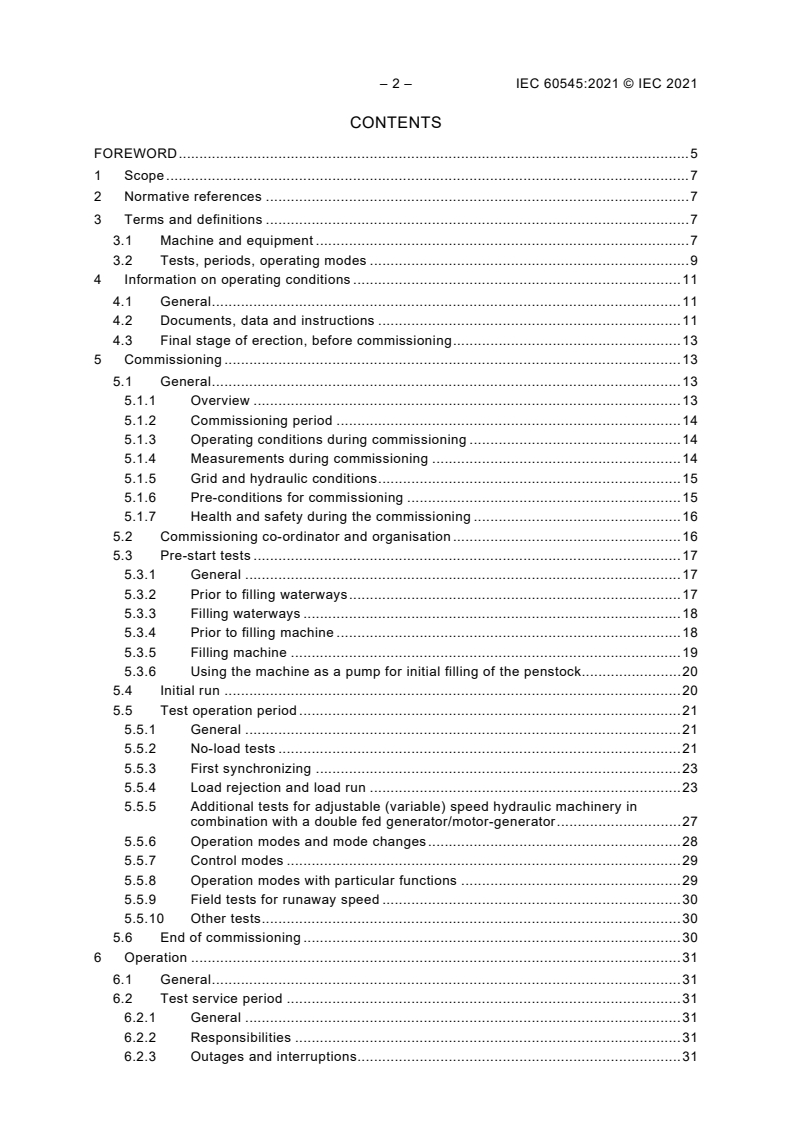
– 2 – IEC 60545:2021 © IEC 2021
CONTENTS
FOREWORD . 5
1 Scope . 7
2 Normative references . 7
3 Terms and definitions . 7
3.1 Machine and equipment . 7
3.2 Tests, periods, operating modes . 9
4 Information on operating conditions . 11
4.1 General . 11
4.2 Documents, data and instructions . 11
4.3 Final stage of erection, before commissioning . 13
5 Commissioning . 13
5.1 General . 13
5.1.1 Overview . 13
5.1.2 Commissioning period . 14
5.1.3 Operating conditions during commissioning . 14
5.1.4 Measurements during commissioning . 14
5.1.5 Grid and hydraulic conditions . 15
5.1.6 Pre-conditions for commissioning . 15
5.1.7 Health and safety during the commissioning . 16
5.2 Commissioning co-ordinator and organisation . 16
5.3 Pre-start tests . 17
5.3.1 General . 17
5.3.2 Prior to filling waterways . 17
5.3.3 Filling waterways . 18
5.3.4 Prior to filling machine . 18
5.3.5 Filling machine . 19
5.3.6 Using the machine as a pump for initial filling of the penstock. 20
5.4 Initial run . 20
5.5 Test operation period . 21
5.5.1 General . 21
5.5.2 No-load tests . 21
5.5.3 First synchronizing . 23
5.5.4 Load rejection and load run . 23
5.5.5 Additional tests for adjustable (variable) speed hydraulic machinery in
combination with a double fed generator/motor-generator . 27
5.5.6 Operation modes and mode changes . 28
5.5.7 Control modes . 29
5.5.8 Operation modes with particular functions . 29
5.5.9 Field tests for runaway speed . 30
5.5.10 Other tests . 30
5.6 End of commissioning . 30
6 Operation . 31
6.1 General . 31
6.2 Test service period . 31
6.2.1 General . 31
6.2.2 Responsibilities . 31
6.2.3 Outages and interruptions . 31
6.2.4 Observations and records . 31
6.2.5 End of test service period . 32
6.3 Commercial service . 32
6.3.1 Guarantee period . 32
6.3.2 Post guarantee period . 34
6.3.3 Special operating conditions . 34
Annex A (informative) Description of different modes of operation of a reversible
pump-turbine . 39
A.1 General . 39
A.2 From standstill (ready to operate) to standstill (auxiliary systems in
operation) (01 and 10) . 39
A.3 From standstill (auxiliary systems in operation) to no-load (synchronized) (12) . 39
A.4 From no-load (synchronized) to standstill (21). 39
A.5 From no-load to turbine operation (23) . 40
A.6 From turbine operation to no-load (synchronized) (32) . 40
A.7 From no-load to synchronous condenser operation (turbine direction) (24) . 40
A.8 From synchronous condenser operation (turbine direction) to no-load (42) . 41
A.9 From synchronous condenser operation (turbine direction) to turbine
operation (43:= 42 and 23) . 41
A.10 From turbine operation to synchronous condenser operation (turbine
direction) (34:= 32 and 24) . 41
A.11 From standstill (auxiliary systems in operation) to synchronous condenser
operation (turbine direction) 14 or (12 and 24) . 41
A.12 From synchronous condenser operation (turbine direction) to standstill (41) . 41
A.13 From standstill (auxiliary system in operation) to SCO (pump direction) (15) . 42
A.14 From synchronous condenser operation (pump direction) to pump operation (56) . 42
A.15 From pump operation to synchronous condenser operation (pump direction) (65) . 42
A.16 From synchronous condenser operation (pump direction) to standstill (51) . 42
A.17 From operation (pump direction) to standstill (61) . 42
A.18 From standstill to pump operation (16) . 42
A.19 From turbine – full load to pump operation (36) . 43
A.20 From pump operation to turbine full load – quick change over (63) . 43
A.21 Hydraulic short circuit . 43
Annex B (informative) Tests for adjustable (variable) speed hydraulic machinery in
combination with a double fed generator/motor-generator . 44
B.1 Operating zone and test condition . 44
B.1.1 General . 44
B.1.2 Pumping operation . 44
B.1.3 Generation operation . 44
B.1.4 Test conditions . 45
B.2 Test items . 45
B.2.1 Step response test by power setter . 45
B.2.2 Guide vane opening vs. power characteristic measurement in pump and
turbine operation . 45
B.2.3 Confirmation of preventive control of the speed deviation from the
defined speed range . 46
B.2.4 Load (input/output) rejection test . 46
Annex C (informative) Commissioning program . 47
Bibliography . 48
– 4 – IEC 60545:2021 © IEC 2021
Figure 1 – Commissioning procedure . 14
Figure 2 – Example of organisation chart for commissioning . 17
Figure 3 – Modes of operation of a reversible pump-turbine . 29
Figure B.1 – Pumping operation zone . 44
Figure B.2 – Generation operation zone . 45
Table C.1 – Example for a commissioning procedure programme . 47
INTERNATIONAL ELECTROTECHNICAL COMMISSION
____________
GUIDELINES FOR COMMISSIONING AND OPERATION OF HYDRAULIC
TURBINES, PUMP-TURBINES AND STORAGE PUMPS
FOREWORD
1) The International Electrotechnical Commission (IEC) is a worldwide organization for standardization comprising
all national electrotechnical committees (IEC National Committees). The object of IEC is to promote international
co-operation on all questions concerning standardization in the electrical and electronic fields. To this end and
in addition to other activities, IEC publishes International Standards, Technical Specifications, Technical Reports,
Publicly Available Specifications (PAS) and Guides (hereafter referred to as “IEC Publication(s)”). Their
preparation is entrusted to technical committees; any IEC National Committee interested in the subject dealt with
may participate in this preparatory work. International, governmental and non-governmental organizations liaising
with the IEC also participate in this preparation. IEC collaborates closely with the International Organization for
Standardization (ISO) in accordance with conditions determined by agreement between the two organizations.
2) The formal decisions or agreements of IEC on technical matters express, as nearly as possible, an international
consensus of opinion on the relevant subjects since each technical committee has representation from all
interested IEC National Committees.
3) IEC Publications have the form of recommendations for international use and are accepted by IEC National
Committees in that sense. While all reasonable efforts are made to ensure that the technical content of IEC
Publications is accurate, IEC cannot be held responsible for the way in which they are used or for any
misinterpretation by any end user.
4) In order to promote international uniformity, IEC National Committees undertake to apply IEC Publications
transparently to the maximum extent possible in their national and regional publications. Any divergence between
any IEC Publication and the corresponding national or regional publication shall be clearly indicated in the latter.
5) IEC itself does not provide any attestation of conformity. Independent certification bodies provide conformity
assessment services and, in some areas, access to IEC marks of conformity. IEC is not responsible for any
services carried out by independent certification bodies.
6) All users should ensure that they have the latest edition of this publication.
7) No liability shall attach to IEC or its directors, employees, servants or agents including individual experts and
members of its technical committees and IEC National Committees for any personal injury, property damage or
other damage of any nature whatsoever, whether direct or indirect, or for costs (including legal fees) and
expenses arising out of the publication, use of, or reliance upon, this IEC Publication or any other IEC
Publications.
8) Attention is drawn to the Normative references cited in this publication. Use of the referenced publications is
indispensable for the correct application of this publication.
9) Attention is drawn to the possibility that some of the elements of this IEC Publication may be the subject of patent
rights. IEC shall not be held responsible for identifying any or all such patent rights.
International Standard IEC 60545 has been prepared by IEC technical committee 4: Hydraulic
turbines.
This second edition cancels and replaces the first edition published in 1976 and the first edition
of IEC 60805 published in 1985. This edition constitutes a technical revision.
This edition includes the following significant technical changes with respect to the previous
edition:
a) the focus is on the commissioning and operation of the hydraulic machine. Interfaces to the
electric machine are mentioned only for a better understanding of the context;
b) the definitions of tests for commissioning and adjustable speed are updated to state of the
art;
c) the record sheets ‘measurements during erection’ are excluded (see IEC 63132 (all parts);
d) the maintenance is excluded (see IEC 62256).
– 6 – IEC 60545:2021 © IEC 2021
The text of this International Standard is based on the following documents:
FDIS Report on voting
4/407/FDIS 4/420/RVD
Full information on the voting for its approval can be found in the report on voting indicated in
the above table.
The language used for the development of this International Standard is English.
This document was drafted in accordance with ISO/IEC Directives, Part 2, and developed in
accordance with ISO/IEC Directives, Part 1 and ISO/IEC Directives, IEC Supplement, available
at www.iec.ch/members_experts/refdocs. The main document types developed by IEC are
described in greater detail at www.iec.ch/standardsdev/publications.
The committee has decided that the contents of this document will remain unchanged until the
stability date indicated on the IEC website under webstore.iec.ch in the data related to the
specific document. At this date, the document will be
• reconfirmed,
• withdrawn,
• replaced by a revised edition, or
• amended.
IMPORTANT – The "colour inside" logo on the cover page of this document indicates
that it contains colours which are considered to be useful for the correct understanding
of its contents. Users should therefore print this document using a colour printer.
GUIDELINES FOR COMMISSIONING AND OPERATION OF HYDRAULIC
TURBINES, PUMP-TURBINES AND STORAGE PUMPS
1 Scope
The purpose of this document is to establish, in a general way, suitable procedures for
commissioning and operation of hydraulic machines and associated equipment, and to indicate
how such machines and equipment should be commissioned and operated.
Commissioning and operation of the associated equipment are not described in detail in this
document but is considered in the commissioning and operation procedure as a separate step.
Machines of up to about 15 MW and reference diameters of about 3 m are generally covered
by IEC 62006.
It is understood that a guideline of this type will be binding only if the contracting parties have
agreed upon it.
The guidelines exclude matters of purely commercial interest, except those inextricably
connected with the conduct of commissioning and operation.
The guidelines are not concerned with waterways, gates, drainage pumps, cooling-water
equipment, generators, motor-generators, electrical equipment (e.g. circuit breakers,
transformers) etc., except where they cannot be separated from the hydraulic machinery and
its equipment.
Wherever the guidelines specify that documents, drawings or information are supplied by a
supplier (or by suppliers), each individual supplier should furnish the appropriate information
for its own supply only.
2 Normative references
There are no normative references in this document.
3 Terms and definitions
For the purposes of this document, the following terms and definitions apply.
ISO and IEC maintain terminological databases for use in standardization at the following
addresses:
• IEC Electropedia: available at http://www.electropedia.org/
• ISO Online browsing platform: available at http://www.iso.org/obp
3.1 Machine and equipment
3.1.1
hydraulic machinery
turbines, storage pumps, pump-turbines, valves, guide and thrust bearings used in hydroelectric
power and pumped storage stations
Note 1 to entry: The term hydraulic machinery includes hydraulic torque converter and all type of main inlet valves.
– 8 – IEC 60545:2021 © IEC 2021
Note 2 to entry: Terms related to hydro turbine governing systems are not included; refer to IEC 60308.
[SOURCE: IEC TR 61364:1999, 3.1, modified – Addition of Note 1 to entry.]
3.1.2
hydraulic machine
hydraulic impulse and reaction turbines, storage pumps and pump-turbines
[SOURCE: IEC TR 61364:1999, 3.1]
3.1.3
turbine
machine for transforming hydraulic energy into mechanical energy
Note 1 to entry: The term turbine includes a pump-turbine functioning as a turbine.
Note 2 to entry: The term turbine does not include the inlet or outlet valves nor the associated generator or governor.
[SOURCE: IEC TR 61364:1999, 4.1, modified – Addition of Note 1 to entry.]
3.1.4
pump
machine for transforming mechanical energy into hydraulic energy in order to store water that
will be used later on to produce electric energy
Note 1 to entry: The term pump includes a storage pump and a pump-turbine functioning as a pump.
Note 2 to entry: The term pump does not include the inlet or outlet valves nor the associated motor.
[SOURCE: IEC TR 61364:1999, 4.1, modified – Replacement of "storage pump" with "pump" in
the main term, and addition of Note 1 to entry.]
3.1.5
starting device
starting equipment for a motor-generator or motor
EXAMPLE 1 pony motor
EXAMPLE 2 starting turbine
EXAMPLE 3 frequency converter
EXAMPLE 4 hydraulic torque converter
EXAMPLE 5 back to back
Note 1 to entry: Each example is representing a different method to start the hydraulic machine functioning as a
pump.
3.1.6
opening device
guide vanes or the turbine needle of impulse turbines and its driving components (governing
systems)
3.1.7
electrical machine
generators and motor-generators of synchronous type including the excitation equipment as
well as of the asynchronous type
3.1.8
associated equipment
all additional machinery which is necessary to allow operation of the hydraulic machine (if
applicable)
EXAMPLE 1 inlet and outlet gates or valves, draft tube gates, cylindrical valves (ring gates)
EXAMPLE 2 pressure relief valves
EXAMPLE 3 couplings
EXAMPLE 4 gear drives
EXAMPLE 5 brake system
EXAMPLE 6 water depression system
EXAMPLE 7 air supply system
EXAMPLE 8 cooling-water systems
EXAMPLE 9 drainage systems
EXAMPLE 10 dewatering systems
EXAMPLE 11 oil supply systems
3.2 Tests, periods, operating modes
3.2.1
commissioning
testing of new or rehabilitated equipment to check its conformity with contractual specifications,
as well as operation of the equipment until formally accepted by the purchaser
3.2.2
operation
utilization of the equipment to convert energy, or a state of readiness for such production
3.2.3
maintenance
activity performed on equipment in order to keep it in a state of optimum operating condition
3.2.4
pre-start test
test between completion of erection of the equipment and initial run
3.2.5
initial run
first movement of rotating parts after erection
3.2.6
test run
operation to obtain one set of data for a specific test
3.2.7
test operation
utilization of the equipment for testing purposes
– 10 – IEC 60545:2021 © IEC 2021
3.2.8
test operation period
test period following initial run and followed by test service
Note 1 to entry: It includes no-load runs for checking power plant equipment, as well as load runs in turbine and
pumping operation, load rejections and energy supply interruption pump-turbine tests.
3.2.9
no-load test
operation of the machine without connection to the electrical grid
3.2.10
no-discharge test
operation of the machine in pump-mode with the high pressure side valve closed
3.2.11
test service period
operation of the equipment for an agreed period
Note 1 to entry: During this test, the supplier is generally responsible.
3.2.12
commercial service
operation of the equipment, under the operator’s responsibility
3.2.13
commercial service period
period starting after acceptance and including service periods, as well as periods when the
equipment can be out of operation for maintenance, inspection, repairs, etc.
3.2.14
guarantee period
time, extending through an agreed part of the commercial service period, during which the
supplier has commercial obligations to correct defects in his equipment in order to bring it into
conformity with the contract
Note 1 to entry: For this purpose, tests in accordance with the appropriate parts of 6.3.1.5 are performed.
3.2.15
inspection
check on the condition of equipment
3.2.16
repair
restoration after wear or damage
3.2.17
modification
change intended to improve performance
3.2.18
rehabilitation
restoration of equipment capacity and/or equipment efficiency to near to “as-new” levels;
extension of equipment life by re-establishing mechanical integrity
[SOURCE: IEC 62256:2017, Clause 3]
3.2.19
supplier
entity (for example manufacturer, contractor, installer, integrator) who provides equipment or
services associated with the machine
Note 1 to entry: The user organization can also act in the capacity of a supplier to itself.
[SOURCE: IEC 60204-1:2016, 3.1.62, modified – Addition of Note 1 to entry.]
3.2.20
operator
entity (for example owner of the equipment or entity contracted by him) who is responsible for
operation of the equipment
4 Information on operating conditions
4.1 General
This clause describes the information which should be given by the supplier(s) to the operator.
A fundamental requirement for proper operation and maintenance is a satisfactory knowledge
of the machine and its accessories by the operator.
The supplier shall deliver to the operator all necessary documents, instructions and information.
They shall include as a minimum:
– general drawings (e.g. general arrangement of the hydraulic machine, power house, …);
– material lists, descriptions and test certificates for main parts;
– function diagrams;
– instructions for operation (especially the range of operation), inspection and maintenance
of the supplied equipment;
– assembly and dismantling instructions;
– safety instructions;
– list of spare parts, as stated in the contract;
– constraints.
These documents, even not final (but updated and finalised after test period), shall be given to
the operator as soon as required and, in any case, before the initial run to be reviewed by the
operator.
The operator shall define additional constraints (e.g. regarding shipping on rivers, slope
stability, public safety, …).
4.2 Documents, data and instructions
The documents submitted by the supplier shall include the following data, some of which can
be amended according to experience gathered during commissioning:
1) The characteristic diagrams relating to heads, flow, power, opening (e.g. guide vane or
needle), speed, tailwater elevations, and operating limits; also, where applicable, runner
blade or deflector position. Examples of such diagrams are the pump characteristic and the
turbine hill chart.
2) Statement of similitude of model and prototype, depending on the contract.
3) Operation and safety instructions on inlet and outlet gates or valves of the machine and
pressure relief valves. The interlocking between the valves and gates shall be considered.
– 12 – IEC 60545:2021 © IEC 2021
4) Detailed sequential diagrams, illustrating ordinary changes from one mode of operation to
another (generating, pumping, synchronous condenser operation, standby) as well as
actions due to various electrical or mechanical faults.
5) Guide vane opening (or needle opening of impulse turbines) for no-load, starting and
cavitation limits, as functions of head and tailwater levels also, where appropriate, runner
blade or deflector position.
6) Transient calculations (model presentation, input data, design criteria/admissible value,
load cases and descriptions of maximum and minimum values for pressure, speed, flow,
safety margin, references), depending on the contract.
NOTE 1 Closing and opening times of main valve sealings are considered.
7) Governor and servomotor characteristics (e.g. relationship between guide vane angle and
servomotor stroke, cam relationship if applicable).
8) If applicable, description of the water-depression-system or de-watering and refilling
system of the runner, data for compressed air tanks (including capacity of air tanks, control
pressure, etc.), compressors, valves, automatic control devices (both for de-watering
system and air leakage supplement system), maximum and minimum water level in the
draft tube, etc.
9) Adjustment of overspeed protection device, information of set value (shutdown value).
10) If applicable, description of the coupling type between the hydraulic machine shaft and
motor-generator shaft and of the synchronizing arrangement.
11) Characteristics of the fluids for the governing system. Filter specifications and information
on purification frequency and method.
12) Control and servo systems. Description of type and control system of the main valve, the
distributor and the movable blade of the runner (as applicable) as well as closing and
opening laws for the main valve, the guide vanes and runner blades.
13) Maximum steady state runaway speed and maximum transient speed and pressure
variations at some specific operating heads (maximum/minimum/rated water head).
NOTE 2 The speed value is below the maximum speed for machine safety.
14) Minimum continuous operating speed (depending on design of thrust bearing and other
bearings).
15) Minimum operating water head for initial run.
16) Description of lubrication systems, stating amount and characteristics of lubricants and
frequency of replacement.
17) If applicable, data on high pressure lifting oil injection system for rotating parts.
18) Speed or time limits below which operation of the thrust bearing high pressure lifting oil
injection system is necessary.
19) If applicable, maximum and minimum speeds for mechanical and electrical brake operation.
20) Intermediate oil levels and pressures at which pumps and compressors should be started
or alarms given; also data for automatic signalling and emergency devices.
21) Maximum and minimum temperatures in bearings, seals and in the oil or fluid pressure
circuits (alarm and shutdown values).
22) Maximum and minimum pressures, flows and levels in oil or fluid pressure systems and
bearings (alarm and shutdown values).
23) If applicable, maximum and minimum temperatures and pressures in oil head (alarm and
shutdown values).
24) Maximum acceptable load of thrust bearing, if required.
25) Design values and tolerances for machine erection (bearings and seals clearances,
inclination, circularities, concentricities).
26) Maximum and minimum pressures and flows in coolers (alarm and shutdown values).
27) Maximum water levels in drainage pits (alarm and shutdown values).
28) Data on electric motors, pumps and other accessories.
29) Safety instructions for test and operating staff.
30) Other data of importance which are considered necessary by either operator or supplier for
safe operation of the equipment or for instruction of personnel (e.g. axial hydraulic thrust,
weight force of the rotating parts of the turbine/pump-turbine and the generator/motor-
generator.
4.3 Final stage of erection, before commissioning
During the final stage of erection, the supplier shall give appropriate instructions to the operator
and provide the information stated in 4.2 on operating the equipment.
During the final stage of erection, the start, the test runs and test service period, the operator
shall make his staff available to the supplier for instruction and training in order for them to be
properly capable of operating the machine and associated equipment.
After first filling of bearing and governor oil tanks, it is recommended to take oil samples that
should be kept as reference of the oil at the beginning of commissioning.
After first filling of “water-filled” Kaplan runners, it is recommended to take samples of the filling
(water plus some additives) that should be kept as reference at the beginning of commissioning.
It is recommended that critical spare parts are available (e.g. parts with long delivery time).
5 Commissioning
5.1 General
5.1.1 Overview
This clause deals with the commissioning of hydraulic machinery. It describes and gives advice
and recommendations about (pre-) conditions, measurements, health and safety, organization.
Tests during commissioning and final documents are suggested.
In the lifetime of the hydraulic machine, the commissioning period is the time in which the
supplier shall demonstrate to the operator (owner) that the equipment fulfils the requested
characteristics and is ready to run in commercial operation. As the equipment is exposed to the
actual loads for the first time, the commissioning procedure shall be carried out with the
necessary care and coordination between the parties.
The process chart in Figure 1 shows different steps for a typical commissioning procedure.
– 14 – IEC 60545:2021 © IEC 2021
Figure 1 – Commissioning procedure
5.1.2 Commissioning period
The commissioning period starts after finishing of erection of a new unit and ends with the
beginning of the test service period. Similar procedures can also be utilized with or without
formal acceptance after repair or rehabilitation.
5.1.3 Operating conditions during commissioning
The operating requirements given in Clause 4 shall be complied with during commissioning. If
the operating conditions of the power station prevent commissioning within these requirements,
the operator and supplier shall define acceptable conditions and agree on the commissioning
procedure.
5.1.4 Measurements during commissioning
For correct interpretation and determination of the causes of any unexpected phenomena, it is
advantageous to make simultaneous recordings of significant parameters (such as the pressure
in the spiral casing and draft tube, openings of control mechanisms, speed, displacement of
shaft and vibration of bearings, guide vanes and covers, and possibly power, loads and
temperatures on bearings, pressures in servomotors, etc.) on recording instruments. These
should be in operation during the initial run and thereafter. Each recording shall have an
identification of the test, unit number and a time and date registration.
5.1.5 Grid and hydraulic conditions
It is the operator’s responsibility to obtain from all the authorities concerned agreements on the
specified conditions (grid, head, flow, etc.) for test operation.
5.1.6 Pre-conditions for commissioning
5.1.6.1 General
Before starting the commissioning, all activities which belong to the erection and which are
necessary to carry out the commissioning safely shall be finalized and recorded. The start of
commissioning shall be agreed between the operator and the supplier and certified in a protocol
“ready for commissioning”.
5.1.6.2 Administrative and organizational
– The commissioning co-ordinator shall be defined.
– The commissioning committee with members of all parties (commissioning engineers of the
different suppliers) clarifies the roles of all participants in the commissioning organization
and their respective obligations.
– The commissioning committee establishes a work permit system to ensure safe working
(locking and tagging system).
– A time schedule for the planned activities shall be worked out and agreed between the
parties.
– The commissioning programme (e.g. see Table C.1).
5.1.6.3 Available documents
– All relevant final erection protocols (e.g. records of gaps between stationary and rotating
parts).
– All relevant protocols “Ready for commissioning” from the different suppliers.
– All relevant commissioning instructions and commissioning protocols.
5.1.6.4 Available equipment
In the case of any unforeseen events during commissioning, the water ingress into the
powerhouse shall be stopped (as well as the water flow in the waterways and the hydraulic
machine). The following equipment if applicable shall be ready for emergency closure:
– intake gates;
– outlet gates;
– inlet and outlet valves;
– stop logs designed to close under discharge.
5.1.6.5 Available systems
– Main power supply and emergency power supply
– Station AC and DC supply
– Auxiliary power supply
– Common auxiliaries such as pumps, coolers, heaters
– Drainage
– Dewatering
– Cooling
– Compressed air
– Monitoring turbine
– Monitoring generator
– 16 – IEC 60545:2021 © IEC 2021
– Excitation
– All protection systems for the unit
– Electrical protection for gas insulated switchgear (GIS), bus bars and feeders
– Main transformer including protection and monitoring devices
– Transformer auxiliaries, such as fans and water pumps
– Synchronizing system
– Communication
– Automation
– Lighting
– Fire detection and fire fighting
– Heating, ventilation, air conditioning (HVAC)
– Earthing
and other applicable systems of the power plant.
5.1.7 Health and safety during the commissioning
As a part of test and commissioning, the facilities are put into live conditions (pressurised,
energized, equipment in the vicinity are in normal operation, etc.) and risk awareness shall be
emphasized. All personnel involved in the commissioning activities should be informed and
trained in the valid health and safety regulations. It is recommended to practice procedures for
fire protection, evacuation, first aid service, etc. Extra pushbuttons for fire protection and
emergency shutdown might be installed temporarily during commissioning. The area around the
facilities which are being commissioned should be marked with some kind of barrier and should
be cleaned before commissioning. In order to restrict the number of persons in the area, only
authorised personnel taking part of the commissioning should have access.
5.2 Commissioning co-ordinator and organisation
A commissioning co-ordinator shall be appointed by agreement between the operator, the main
contractors and the suppliers. The commissioning co-ordinator shall be in charge of the
commissioning activities and prepare a program which describes the commissioning activities,
including relevant activities from the contractors/suppliers detailed programmes. The program
can be designed as a step by step program that can be signed off. This program shall be
checked and approved by the operator, the main suppliers and contractors before and during
the tests if changes appear to be n
...