


IEC 60364-8-2:2018
(Main)Low-voltage electrical installations - Part 8-2: Prosumer's low-voltage electrical installations
General Information
- Abstract
IEC 60364-8-2:2018 provides additional requirements, measures and recommendations for design, erection and verification of all types of low-voltage electrical installation according to IEC 60364-1:2005, Clause 11, including local production and/or storage of energy in order to ensure compatibility with the existing and future ways to deliver electrical energy to current-using equipment or to the public network by means of local sources. Such electrical installations are designated as prosumer’s electrical installations (PEIs).
This document also provides requirements for proper behaviour and actions of PEIs in order to efficiently obtain sustainable and safe operations of these installations when integrated into smart grids.
These requirements and recommendations apply, within the scope of IEC 60364 (all parts), for new installations and modification of existing installations.
- Status
- Replaced
- Publication Date
- 09-Oct-2018
- Technical Committee
- TC 64 - Electrical installations and protection against electric shock
- Drafting Committee
- JWG 44 - TC 64/JWG 44
- Current Stage
- DELPUB - Deleted Publication
- Start Date
- 20-Oct-2022
- Completion Date
- 30-Apr-2021
Relations
- Effective Date
- 05-Sep-2023
- Effective Date
- 25-Aug-2026
- Effective Date
- 25-Aug-2026
- Effective Date
- 25-Feb-2026
Get Certified
Connect with accredited certification bodies for this standard

DIBt (Deutsches Institut für Bautechnik)
German Institute for Building Technology.
DIN CERTCO
DIN Group product certification.

Aboma Certification B.V.
Specialized in construction, metal, and transport sectors.
Sponsored listings
Frequently Asked Questions
IEC 60364-8-2:2018 is a standard published by the International Electrotechnical Commission (IEC). Its full title is "Low-voltage electrical installations - Part 8-2: Prosumer's low-voltage electrical installations". This standard covers: IEC 60364-8-2:2018 provides additional requirements, measures and recommendations for design, erection and verification of all types of low-voltage electrical installation according to IEC 60364-1:2005, Clause 11, including local production and/or storage of energy in order to ensure compatibility with the existing and future ways to deliver electrical energy to current-using equipment or to the public network by means of local sources. Such electrical installations are designated as prosumer’s electrical installations (PEIs). This document also provides requirements for proper behaviour and actions of PEIs in order to efficiently obtain sustainable and safe operations of these installations when integrated into smart grids. These requirements and recommendations apply, within the scope of IEC 60364 (all parts), for new installations and modification of existing installations.
IEC 60364-8-2:2018 provides additional requirements, measures and recommendations for design, erection and verification of all types of low-voltage electrical installation according to IEC 60364-1:2005, Clause 11, including local production and/or storage of energy in order to ensure compatibility with the existing and future ways to deliver electrical energy to current-using equipment or to the public network by means of local sources. Such electrical installations are designated as prosumer’s electrical installations (PEIs). This document also provides requirements for proper behaviour and actions of PEIs in order to efficiently obtain sustainable and safe operations of these installations when integrated into smart grids. These requirements and recommendations apply, within the scope of IEC 60364 (all parts), for new installations and modification of existing installations.
IEC 60364-8-2:2018 is classified under the following ICS (International Classification for Standards) categories: 01 - GENERALITIES. TERMINOLOGY. STANDARDIZATION. DOCUMENTATION; 91.140.50 - Electricity supply systems. The ICS classification helps identify the subject area and facilitates finding related standards.
IEC 60364-8-2:2018 has the following relationships with other standards: It is inter standard links to IEC 60364-8-82:2022, EN 12255-12:2024, EN 378-3:2016+A1:2020, EN 1473:2021. Understanding these relationships helps ensure you are using the most current and applicable version of the standard.
IEC 60364-8-2:2018 is available in PDF format for immediate download after purchase. The document can be added to your cart and obtained through the secure checkout process. Digital delivery ensures instant access to the complete standard document.
Standards Content (Sample)
IEC 60364-8-2 ®
Edition 1.0 2018-10
INTERNATIONAL
STANDARD
NORME
INTERNATIONALE
colour
inside
Low-voltage electrical installations –
Part 8-2: Prosumer’s low-voltage electrical installations
Installations électriques à basse tension –
Partie 8-2: Installations électriques à basse tension du prosommateur
All rights reserved. Unless otherwise specified, no part of this publication may be reproduced or utilized in any form
or by any means, electronic or mechanical, including photocopying and microfilm, without permission in writing from
either IEC or IEC's member National Committee in the country of the requester. If you have any questions about IEC
copyright or have an enquiry about obtaining additional rights to this publication, please contact the address below or
your local IEC member National Committee for further information.
Droits de reproduction réservés. Sauf indication contraire, aucune partie de cette publication ne peut être reproduite
ni utilisée sous quelque forme que ce soit et par aucun procédé, électronique ou mécanique, y compris la photocopie
et les microfilms, sans l'accord écrit de l'IEC ou du Comité national de l'IEC du pays du demandeur. Si vous avez des
questions sur le copyright de l'IEC ou si vous désirez obtenir des droits supplémentaires sur cette publication, utilisez
les coordonnées ci-après ou contactez le Comité national de l'IEC de votre pays de résidence.
IEC Central Office Tel.: +41 22 919 02 11
3, rue de Varembé info@iec.ch
CH-1211 Geneva 20 www.iec.ch
Switzerland
About the IEC
The International Electrotechnical Commission (IEC) is the leading global organization that prepares and publishes
International Standards for all electrical, electronic and related technologies.
About IEC publications
The technical content of IEC publications is kept under constant review by the IEC. Please make sure that you have the
latest edition, a corrigenda or an amendment might have been published.
IEC Catalogue - webstore.iec.ch/catalogue Electropedia - www.electropedia.org
The stand-alone application for consulting the entire The world's leading online dictionary of electronic and
bibliographical information on IEC International Standards, electrical terms containing 21 000 terms and definitions in
Technical Specifications, Technical Reports and other English and French, with equivalent terms in 16 additional
documents. Available for PC, Mac OS, Android Tablets and languages. Also known as the International Electrotechnical
iPad. Vocabulary (IEV) online.
IEC publications search - webstore.iec.ch/advsearchform IEC Glossary - std.iec.ch/glossary
The advanced search enables to find IEC publications by a 67 000 electrotechnical terminology entries in English and
variety of criteria (reference number, text, technical French extracted from the Terms and Definitions clause of
committee,…). It also gives information on projects, replaced IEC publications issued since 2002. Some entries have been
and withdrawn publications. collected from earlier publications of IEC TC 37, 77, 86 and
CISPR.
IEC Just Published - webstore.iec.ch/justpublished
Stay up to date on all new IEC publications. Just Published IEC Customer Service Centre - webstore.iec.ch/csc
details all new publications released. Available online and If you wish to give us your feedback on this publication or
also once a month by email. need further assistance, please contact the Customer Service
Centre: sales@iec.ch.
A propos de l'IEC
La Commission Electrotechnique Internationale (IEC) est la première organisation mondiale qui élabore et publie des
Normes internationales pour tout ce qui a trait à l'électricité, à l'électronique et aux technologies apparentées.
A propos des publications IEC
Le contenu technique des publications IEC est constamment revu. Veuillez vous assurer que vous possédez l’édition la
plus récente, un corrigendum ou amendement peut avoir été publié.
Catalogue IEC - webstore.iec.ch/catalogue Electropedia - www.electropedia.org
Application autonome pour consulter tous les renseignements
Le premier dictionnaire en ligne de termes électroniques et
bibliographiques sur les Normes internationales,
électriques. Il contient 21 000 termes et définitions en anglais
Spécifications techniques, Rapports techniques et autres
et en français, ainsi que les termes équivalents dans 16
documents de l'IEC. Disponible pour PC, Mac OS, tablettes
langues additionnelles. Egalement appelé Vocabulaire
Android et iPad.
Electrotechnique International (IEV) en ligne.
Recherche de publications IEC -
Glossaire IEC - std.iec.ch/glossary
webstore.iec.ch/advsearchform
67 000 entrées terminologiques électrotechniques, en anglais
La recherche avancée permet de trouver des publications IEC et en français, extraites des articles Termes et Définitions des
en utilisant différents critères (numéro de référence, texte, publications IEC parues depuis 2002. Plus certaines entrées
comité d’études,…). Elle donne aussi des informations sur les antérieures extraites des publications des CE 37, 77, 86 et
projets et les publications remplacées ou retirées. CISPR de l'IEC.
IEC Just Published - webstore.iec.ch/justpublished Service Clients - webstore.iec.ch/csc
Restez informé sur les nouvelles publications IEC. Just Si vous désirez nous donner des commentaires sur cette
Published détaille les nouvelles publications parues. publication ou si vous avez des questions contactez-nous:
Disponible en ligne et aussi une fois par mois par email. sales@iec.ch.
IEC 60364-8-2 ®
Edition 1.0 2018-10
INTERNATIONAL
STANDARD
NORME
INTERNATIONALE
colour
inside
Low-voltage electrical installations –
Part 8-2: Prosumer’s low-voltage electrical installations
Installations électriques à basse tension –
Partie 8-2: Installations électriques à basse tension du prosommateur
INTERNATIONAL
ELECTROTECHNICAL
COMMISSION
COMMISSION
ELECTROTECHNIQUE
INTERNATIONALE
ICS 91.140.50 ISBN 978-2-8322-6074-6
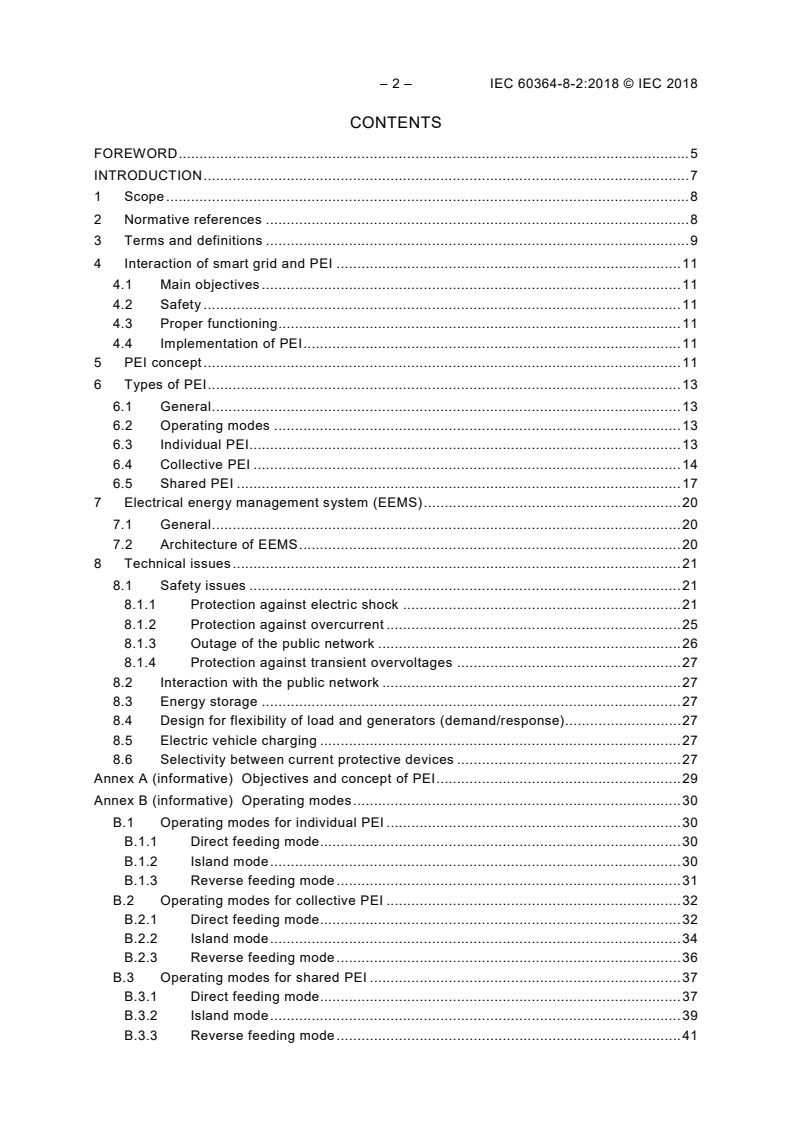
– 2 – IEC 60364-8-2:2018 © IEC 2018
CONTENTS
FOREWORD . 5
INTRODUCTION . 7
1 Scope . 8
2 Normative references . 8
3 Terms and definitions . 9
4 Interaction of smart grid and PEI . 11
4.1 Main objectives . 11
4.2 Safety . 11
4.3 Proper functioning . 11
4.4 Implementation of PEI . 11
5 PEI concept . 11
6 Types of PEI . 13
6.1 General . 13
6.2 Operating modes . 13
6.3 Individual PEI. 13
6.4 Collective PEI . 14
6.5 Shared PEI . 17
7 Electrical energy management system (EEMS) . 20
7.1 General . 20
7.2 Architecture of EEMS . 20
8 Technical issues . 21
8.1 Safety issues . 21
8.1.1 Protection against electric shock . 21
8.1.2 Protection against overcurrent . 25
8.1.3 Outage of the public network . 26
8.1.4 Protection against transient overvoltages . 27
8.2 Interaction with the public network . 27
8.3 Energy storage . 27
8.4 Design for flexibility of load and generators (demand/response) . 27
8.5 Electric vehicle charging . 27
8.6 Selectivity between current protective devices . 27
Annex A (informative) Objectives and concept of PEI . 29
Annex B (informative) Operating modes . 30
B.1 Operating modes for individual PEI . 30
B.1.1 Direct feeding mode. 30
B.1.2 Island mode . 30
B.1.3 Reverse feeding mode . 31
B.2 Operating modes for collective PEI . 32
B.2.1 Direct feeding mode. 32
B.2.2 Island mode . 34
B.2.3 Reverse feeding mode . 36
B.3 Operating modes for shared PEI . 37
B.3.1 Direct feeding mode. 37
B.3.2 Island mode . 39
B.3.3 Reverse feeding mode . 41
Annex C (informative) Interaction with the public network . 43
C.1 General . 43
C.2 National grid codes compliance with active and reactive power control . 43
C.3 Voltage control . 43
C.4 Frequency control . 43
C.5 Load shedding programme . 43
Annex D (informative) Architecture of PEI . 44
D.1 Architecture of individual PEI . 44
D.2 Architecture of collective PEI . 44
D.3 Architecture of shared PEI . 46
Annex E (informative) List of notes concerning certain countries . 47
Bibliography . 48
Figure 1 – Example of prosumer’s low-voltage electrical installation . 12
Figure 2 – Example of electrical design of individual PEI . 14
Figure 3 – Example of electrical design of collective PEI using DSO distribution system . 14
Figure 4 – Example of electrical design of collective PEI with distribution system within PEI . 15
Figure 5 – Example of electrical design of collective PEI with distribution system within
PEI in parallel with DSO distribution system . 16
Figure 6 – Example of electrical design of shared PEI using DSO distribution system . 17
Figure 7 – Example of electrical design of shared PEI with distribution system within PEI . 18
Figure 8 – Example of electrical design of shared PEI with distribution system within
PEI in parallel with DSO distribution system . 19
Figure 9 – Connection to the local earthing arrangement (TN, TT and IT system) . 23
Figure 10 – Estimation of the minimum earth fault current according to the operating
mode (connected and island) . 24
Figure 11 – Example of double short-circuit protection for the same circuit . 26
Figure 12 – Example of selectivity with various power supplies . 28
Figure B.1 – Example of electrical design of individual PEI operating in direct feeding
mode . 30
Figure B.2 – Example of electrical design of individual PEI operating in island mode . 31
Figure B.3 – Example of electrical design of individual PEI operating in reverse
feeding mode . 32
Figure B.4 – Example of electrical design of collective PEI operating in direct feeding
mode with one single electrical installation. 33
Figure B.5 – Example of electrical design of collective PEI operating in direct feeding
mode with several electrical installations . 34
Figure B.6 – Example of electrical design of collective PEI operating in island mode
with one single electrical installation . 35
Figure B.7 – Example of electrical design of collective PEI operating in island mode
with several electrical installations . 35
Figure B.8 – Example of electrical design of collective PEI operating in reverse
feeding mode with one single electrical installation . 36
Figure B.9 – Example of electrical design of collective PEI operating in reverse
feeding mode with several electrical installations . 37
Figure B.10 – Example of electrical design of shared PEI operating in direct feeding
mode with one single electrical installation. 38
– 4 – IEC 60364-8-2:2018 © IEC 2018
Figure B.11 – Example of electrical design of shared PEI operating in direct feeding
mode with several electrical installations . 39
Figure B.12 – Example of electrical design of shared PEI operating in island mode
with one single electrical installation . 40
Figure B.13 – Example of electrical design of shared PEI operating in island mode
with several electrical installations . 41
Figure B.14 – Example of electrical design of shared PEI operating in reverse feeding
mode . 42
Figure D.1 – Example of type of architecture of individual PEI . 44
Figure D.2 – Example of type of architecture of collective PEI . 45
Figure D.3 – Example of type of architecture of shared PEI . 46
INTERNATIONAL ELECTROTECHNICAL COMMISSION
____________
LOW-VOLTAGE ELECTRICAL INSTALLATIONS –
Part 8-2: Prosumer’s low-voltage electrical installations
FOREWORD
1) The International Electrotechnical Commission (IEC) is a worldwide organization for standardization comprising
all national electrotechnical committees (IEC National Committees). The object of IEC is to promote
international co-operation on all questions concerning standardization in the electrical and electronic fields. To
this end and in addition to other activities, IEC publishes International Standards, Technical Specifications,
Technical Reports, Publicly Available Specifications (PAS) and Guides (hereafter referred to as “IEC
Publication(s)”). Their preparation is entrusted to technical committees; any IEC National Committee interested
in the subject dealt with may participate in this preparatory work. International, governmental and non-
governmental organizations liaising with the IEC also participate in this preparation. IEC collaborates closely
with the International Organization for Standardization (ISO) in accordance with conditions determined by
agreement between the two organizations.
2) The formal decisions or agreements of IEC on technical matters express, as nearly as possible, an international
consensus of opinion on the relevant subjects since each technical committee has representation from all
interested IEC National Committees.
3) IEC Publications have the form of recommendations for international use and are accepted by IEC National
Committees in that sense. While all reasonable efforts are made to ensure that the technical content of IEC
Publications is accurate, IEC cannot be held responsible for the way in which they are used or for any
misinterpretation by any end user.
4) In order to promote international uniformity, IEC National Committees undertake to apply IEC Publications
transparently to the maximum extent possible in their national and regional publications. Any divergence
between any IEC Publication and the corresponding national or regional publication shall be clearly indicated in
the latter.
5) IEC itself does not provide any attestation of conformity. Independent certification bodies provide conformity
assessment services and, in some areas, access to IEC marks of conformity. IEC is not responsible for any
services carried out by independent certification bodies.
6) All users should ensure that they have the latest edition of this publication.
7) No liability shall attach to IEC or its directors, employees, servants or agents including individual experts and
members of its technical committees and IEC National Committees for any personal injury, property damage or
other damage of any nature whatsoever, whether direct or indirect, or for costs (including legal fees) and
expenses arising out of the publication, use of, or reliance upon, this IEC Publication or any other IEC
Publications.
8) Attention is drawn to the Normative references cited in this publication. Use of the referenced publications is
indispensable for the correct application of this publication.
9) Attention is drawn to the possibility that some of the elements of this IEC Publication may be the subject of
patent rights. IEC shall not be held responsible for identifying any or all such patent rights.
International Standard IEC 60364-8-2 has been prepared by IEC technical committee 64:
Electrical installations and protection against electric shock.
The text of this International Standard is based on the following documents:
FDIS Report on voting
64/2298/FDIS 64/2335/RVD
Full information on the voting for the approval of this International Standard can be found in
the report on voting indicated in the above table.
This document has been drafted in accordance with the ISO/IEC Directives, Part 2.
A list of all parts in the IEC 60364 series, published under the general title Low-voltage
electrical installations, can be found on the IEC website.
– 6 – IEC 60364-8-2:2018 © IEC 2018
The reader's attention is drawn to the fact that Annex E lists all of the “in-some-country”
clauses on differing practices of a less permanent nature relating to the subject of this
standard.
The committee has decided that the contents of this document will remain unchanged until the
stability date indicated on the IEC website under "http://webstore.iec.ch" in the data related to
the specific document. At this date, the document will be
• reconfirmed,
• withdrawn,
• replaced by a revised edition, or
• amended.
IMPORTANT – The 'colour inside' logo on the cover page of this publication indicates
that it contains colours which are considered to be useful for the correct
understanding of its contents. Users should therefore print this document using a
colour printer.
INTRODUCTION
Historically, utilities were managing the public transmission and distribution network from the
point of view of having a central production adapted to demand variation, a top-down energy
flow, a production/consumption balance done by integrated utility companies and with rather
passive users.
The following key factors are pushing the public electricity network to change:
• the increasing number of electronic devices used daily and the growing needs as well as
future needs (e.g. charging electric vehicles) will result in the structural growing of
electricity consumption;
• the mediated pressure on climate change results in pressure on CO emissions reduction;
• the electricity market is also quickly changing due mainly to its unbundling and
deregulation, and to the greater number of intermittent renewable energy sources (global
and local);
• users’ expectations are also evolving as a result of an increasing need for better public
networks reliability and quality, the search for better economic performance and the
willingness to pro-actively manage their energy;
• technological evolution should also be considered as information and communication
technology (ICT) is affordable and new energy storage solutions are emerging.
All stakeholders directly involved in the electricity generation, transmission, distribution and
consumption have new expectations:
• customers are willing to reduce electrical energy costs in order to meet environment
targets (renewable energy, energy efficiency) but also wish to benefit from the quality of
electricity supply;
• suppliers wish to limit customer churn rate with price and service management;
• producers expect to maximize their yield of assets, to optimize their investments and to
take profit from energy trading;
• the aggregator wants to create conditions suitable for new market emergence;
• the transmission system operator (TSO) aspires to a robust transmission public network
and to meet regulation objectives (price and level of services), while the distribution
system operator (DSO) wants to meet regulation objectives (price and level of services), to
reduce costs by productivity (including meter) and to have a flexible network;
• finally, governments and regulators are willing to create a competitive and sustainable
energy market.
The objective of this document is to ensure that the low-voltage electrical installation is
compatible with the current and future ways to deliver safely and functionally the electrical
energy to current-using equipment either from the public network or from other local sources.
This document is not intended to influence all stakeholders of electricity supply on how the
electrical energy should be sold and delivered.
– 8 – IEC 60364-8-2:2018 © IEC 2018
LOW-VOLTAGE ELECTRICAL INSTALLATIONS –
Part 8-2: Prosumer’s low-voltage electrical installations
1 Scope
This part of IEC 60364 provides additional requirements, measures and recommendations for
design, erection and verification of all types of low-voltage electrical installation according to
IEC 60364-1:2005, Clause 11, including local production and/or storage of energy in order to
ensure compatibility with the existing and future ways to deliver electrical energy to current-
using equipment or to the public network by means of local sources. Such electrical
installations are designated as prosumer’s electrical installations (PEIs).
This document also provides requirements for proper behaviour and actions of PEIs in order
to efficiently obtain sustainable and safe operations of these installations when integrated into
smart grids.
These requirements and recommendations apply, within the scope of IEC 60364 (all parts),
for new installations and modification of existing installations.
NOTE Electrical sources for safety services including associated electrical installations and standby electrical
supply systems for a secure continuity of supply, which are operated only occasionally and for short periods (e.g.
monthly one hour) in parallel with the distribution grid for testing purposes, are outside the scope of this document.
2 Normative references
The following documents are referred to in the text in such a way that some or all of their
content constitutes requirements of this document. For dated references, only the edition
cited applies. For undated references, the latest edition of the referenced document (including
any amendments) applies.
IEC 60364-4-41:2005, Low-voltage electrical installations – Part 4-41: Protection for safety –
Protection against electric shock
IEC 60364-4-41/AMD1:2017
IEC 60364-4-43:2008, Low-voltage electrical installations – Part 4-43: Protection for safety –
Protection against overcurrent
IEC 60364-5-53:2001, Electrical installations of buildings – Part 5-53: Selection and erection
of electrical equipment – Isolation, switching and control
IEC 60364-5-53:2001/AMD1:2002
IEC 60364-5-53:2001/AMD2:2015
IEC 60364-5-55:2011, Electrical installations of buildings – Part 5-55: Selection and erection
of electrical equipment – Other equipment
IEC 60364-5-55:2011/AMD1:2012
IEC 60364-5-55:2011/AMD2:2016
IEC 60364-7-712, Low-voltage electrical installations – Part 7-712: Requirements for special
installations or locations – Solar photovoltaic (PV) power supply systems
IEC 60364-8-1:2014, Low-voltage electrical installations – Part 8-1: Energy efficiency
3 Terms and definitions
For the purposes of this document, the following terms and definitions apply.
ISO and IEC maintain terminological databases for use in standardization at the following
addresses:
• IEC Electropedia: available at http://www.electropedia.org/
• ISO Online browsing platform: available at http://www.iso.org/obp
3.1
smart grid
electric power system that utilizes information exchange and control technologies, distributed
computing and associated sensors and actuators, for purposes such as:
• to integrate the behaviour and actions of the network users and other stakeholders,
• to efficiently deliver sustainable, economic and secure electricity supplies
[SOURCE: IEC 60050-617:2011, 617-04-13]
3.2
prosumer’s electrical installation
PEI
low-voltage electrical installation connected or not to a public distribution network able to
operate:
• with local power supplies, and/or
• with local storage units,
and that monitors and controls the energy from the connected sources delivering it to:
• current-using equipment, and/or
• local storage units, and/or
• public distribution network
3.3
individual PEI
single consuming and/or producing electrical installation
3.4
collective PEI
several consuming electrical installations connected to the same public distribution network
and sharing one common set of local power supplies and energy storage equipment
3.5
shared PEI
several consuming and/or producing electrical installations similar to an individual PEI
connected to the same low-voltage public distribution network and sharing their individual
power supplies and energy storage equipment between themselves
3.6
prosumer
entity or party which can be both a producer and a consumer of electrical energy
3.7
producer
party generating electrical energy
[SOURCE: IEC 60050-617:2009, 617-02-01]
– 10 – IEC 60364-8-2:2018 © IEC 2018
3.8
consumer
entity or party which uses electricity for its own needs
3.9
electrical energy management system
EEMS
system comprising different equipment and devices in the installation for the purpose of
energy management
Note 1 to entry: This equipment can be stand-alone or integrated in other larger equipment such as a home and
building electronic system.
[SOURCE: IEC 60364-8-1:2014, 3.2.2, modified – “efficiency” has been deleted and Note 1 to
entry has been added.]
3.10
distribution system operator
DSO
party operating a distribution system
3.11
operating mode
operation of an installation with respect to the different sources of electrical energy and to
energy flow
3.12
direct feeding mode
operating mode in which the public network supplies the PEI
Note 1 to entry: Local storage units can supply current-using equipment or be charged by local power supplies
and/or the public distribution network.
3.13
reverse feeding mode
operating mode in which the PEI supplies the public network
Note 1 to entry: Local storage units can supply current-using equipment and/or the public distribution network or
be charged by local power supplies.
3.14
connected mode
operating mode which needs connection to the public network (direct feeding mode and
reverse feeding mode)
3.15
island mode
operating mode in which the PEI is disconnected from the public distribution system, but
remains energized
Note 1 to entry: An island can be either the result of the action of automatic protections or the result of a
deliberate action.
[SOURCE: IEC 60050-617:2009, 617-04-12, modified – The definition has been adapted to
the PEI.]
4 Interaction of smart grid and PEI
4.1 Main objectives
Both smart grid and electrical installations interact. A dynamic power demand/response
concept should be implemented.
The smart grid has an impact on the electrical installations on the following aspects:
• the consideration of the user’s needs taking into account the constraint of the public
network;
• the design and configuration of the installation that shall allow load shedding (according to
IEC 60364-8-1) and source selection by the EEMS.
The user should be able to give different inputs to the EEMS, depending on the contract with
the DSO.
The consumption and production of energy from the renewable sources such as PV or wind
turbines are intermittent and it is suggested to install storage capacity within the PEI if
availability in island mode or isolated mode is needed, or to maximize the self-consumption in
connected mode.
4.2 Safety
The implementation of the requirements provided in this document shall not impair the safety
of the PEI, as required by other parts of the IEC 60364 series. In case of change from any
energy supply configuration (e.g. from network supply to local power supplies) all protective
measures shall continue to be operational or shall be automatically replaced by other
standardized protective measures providing an equivalent level of safety.
4.3 Proper functioning
It is essential for the operation of the smart grid that the electrical installation remains reliable
and available for the maximum possible time while the power quality parameters are also
maximized by using appropriate protection measures and other good installation practices.
These requirements are important for the use of the island mode. It is essential for the PEI to
comply with similar requirements on stability, availability and quality in island mode as for the
connected mode.
4.4 Implementation of PEI
The electrical installations shall consider both the constraints from the DSO/electricity
supplier and the needs expressed by the end user. An EEMS shall be implemented to
combine information and/or data, from/to the DSO/electricity supplier, the availability of
energy by the local sources and the user's needs.
5 PEI concept
Any low-voltage PEI is to be considered as a set of electrical equipment having the following
functions (see Figure 1):
• supply (e.g. connection to public power supply, local generator, photovoltaic systems,
wind turbines, batteries);
• distribution (e.g. distribution panel, wiring systems);
• consumption (e.g. motors, heating systems, lighting, lifts);
• energy management (e.g. load shedding equipment, monitoring device).
NOTE A battery can be considered as a generator and as a load.
– 12 – IEC 60364-8-2:2018 © IEC 2018
An uninterruptible power supply (UPS) is not to be considered as a prosumer when the
purpose of this UPS is only to supply downstream critical loads and not to have a reverse
feeding mode to supply the public network and/or current-using equipment in the upstream
part of the electrical installation.
The general principles of the PEI are described in Annex A.
1 1
G
7 8 9 10
2 3 4 5 6
IEC
Key
1 Public network 9 Other generators
2 Home appliances and electronic devices 10 Electric storage
3 Motors 11 EEMS
6 Lightings 12 Origin of installation
5 Heaters 13 Local distribution
6 Electric vehicles 14 Local generation
7 Solar inverter 15 Local consumption
8 Wind inverter 16 Management signals
Figure 1 – Example of prosumer’s low-voltage electrical installation
In a PEI, an installation owner may consider independently the supervision and the control of
different power supplies connected to the low-voltage electrical installation in order to supply
in efficient and cost-effective ways all the electrical loads connected to this low-voltage
electrical installation. Connection of all power supplies shall comply with IEC 60364-5-55:
2011, Clause 551 and with IEC 60364-7-712 for photovoltaic systems.
Local production of electricity may be used locally or may be sent back through the public
network. In such a case the local consumer is to be considered as a traditional consumer of
electrical energy and as a producer of electrical energy (prosumer).
Interaction with the public network is described in Annex C.
6 Types of PEI
6.1 General
There are different types of PEI:
• individual (see 3.3);
• collective (see 3.4);
• shared (see 3.5).
Each type of PEI can be arranged in the different operating modes defined in 6.2.
6.2 Operating modes
The main operating modes presented in this document may be adopted for each type of PEI
(individual, collective or shared). They are the following:
• direct feeding mode (see 3.12);
• reverse feeding mode (see 3.13);
• island mode (see 3.15).
Storage units can supply current-using equipment or be charged by local power supplies or by
the public network, except in island mode.
Local power supplies can supply current-using equipment or local storage units or the public
network, except in island mode.
Transfer from/to the direct feeding mode to island mode and vice versa can be achieved by
operating the switching device for islanding; this can be either directly controlled (manually or
remotely) or automatically controlled.
Switching from one mode to another can be done if the generators and/or converters are
synchronized with the network (see IEC 60364-5-55:2011, Clause 551).
See Annex B for examples of operating modes.
Selection of the possible operating modes may depend on the contract with the DSO or
according to the national legislation.
Technical requirements for the design of the PEI according to the selected operating mode
are provided in Clause 8.
6.3 Individual PEI
An individual PEI is characterized by one electrical installation having the possibility to both
consume and produce electrical energy, and with a management system for its operation.
The installation manager may decide, through the EEMS and according to the contract with
the DSO, when local production of energy is to be made available, for local storage, local use
or for transfer to the public network.
An example of individual PEI is provided in Figure 2.
– 14 – IEC 60364-8-2:2018 © IEC 2018
2 3 4
) )
* *
IEC
Key
1 Public network
2 Power supplies
3 Loads
4 Storage units
*) Optional (at least, one of them shall be present)
Figure 2 – Example of electrical design of individual PEI
NOTE When delivered to the DSO, the electricity produced locally will be covered by the contract signed between
the prosumer and the DSO.
6.4 Collective PEI
The different power supplies may supply all involved prosumers through either the distribution
system within the PEI or the DSO distribution system, if agreed by the DSO.
A group of prosumers (e.g. a group of single private houses, flats in a building, shops in a
mall) may co-operate and coordinate their resources to erect common electrical power
supplies such as in the example provided in Figure 3. In this case, all private electrical
installations are considered as consumers. Only one separate unit producing electrical energy
is managed for the community of consumers.
2 4
3-1 3-2 3-3
5-1 5-2 5-3
IEC
Key
1 Public network
2 Power supplies
3-1 Loads 1
3-2 Loads 2
3-3 Loads 3
4 Storage units
5-1 Consumer 1
5-2 Consumer 2
5-3 Consumer 3
6 Producer
Figure 3 – Example of electrical design of collective PEI using DSO distribution system
In the case where connection between all involved prosumers is using a distribution system
within the PEI, then the aggregation of all prosumers installations corresponds to one single
PEI seen by the DSO (see Figure 4).
2 4
3-1 3-2 3-3
5-1 5-2 5-3
IEC
Key
1 Public network
2 Power supplies
3-1 Load 1
3-2 Load 2
3-3 Load 3
4 Storage units
5-1 Consumer 1
5-2 Consumer 2
5-3 Consumer 3
6 Producer
7 Origin of the distribution system within PEI
8 Distribution system within PEI
Figure 4 – Example of electrical design of collective PEI
with distribution system within PEI
In the other case where connection between all involved consumers is using the public
distribution network in combination with a distribution system within the PEI, the origin of the
PEI for each consumer corresponds to the incoming service of each individual prosumer (see
Figure 5).
– 16 – IEC 60364-8-2:2018 © IEC 2018
3-1
8-1
5-1
3-2
8-2
5-2
3-3
8-3
5-3
IEC
Key
1 Public network
2 Power supplies
3-1 Load 1
3-2 Load 2
3-3 Load 3
4 Storage units
5-1 Consumer 1
5-2 Consumer 2
5-3 Consumer 3
6 Producer
8-1 Origin of installation 1
8-2 Origin of installation 2
8-3 Origin of installation 3
Figure 5 – Example of electrical design of collective PEI with distribution system within
PEI in parallel with DSO distribution system
For the collective PEI, each electrical installation is considered as a consumer unit, while a
common set of local production is considered as a producer unit. Consumer and producer
shall be considered as separate.
6.5 Shared PEI
The different power supplies may supply all involved prosumers through a distribution system
within the PEI or through the DSO distribution system, if agreed by the DSO.
Individual premises, such as a residential estate or business park may group their interests in
accepting to share their supply with their neighbours from their own local production. Each
building owner may have installed private renewable energy power sources which can either
supply the private electrical installation or supply the group of private electrical installations.
Such a system is named shared PEI. Examples of shared PEI are provided in Figure 6 and in
Figure 7.
2-1 3-1 4-1 2-2 3-2 4-2 3-3 4-3
2-3
7-1 7-2 7-3
IEC
Key
1 Public network
2-1 Power supply 1
2-2 Power supply 2
2-3 Power supply 3
3-1 Load 1
3-2 Load 2
3-3 Load 3
4-1 Storage unit 1
4-2 Storage unit 2
4-3 Storage unit 3
7-1 Prosumer 1
7-2 Prosumer 2
7-3 Prosumer 3
Figure 6 – Example of electrical design of shared PEI using DSO distribution system
– 18 – IEC 60364-8-2:2018 © IEC 2018
2-1 3-1 4-1 2-2 3-2 4-2 3-3 4-3
2-3
7-1 7-2 7-3
IEC
Key
1 Public network
2-1 Power supply 1
2-2 Power supply 2
2-3 Power supply 3
3-1 Load 1
3-2 Load 2
3-3 Load 3
4-1 Storage unit 1
4-2 Storage unit 2
4-3 Storage unit 3
7-1 Prosumer 1
7-2 Prosumer 2
7-3 Prosumer 3
8 Origin of shared PEI
9 Shared electrical installation within PEI
Figure 7 – Example of electrical design of shared PEI
with distribution system within PEI
In the other case where connection between all involved prosumers is using the DSO
distribution system in combination with the distribution system within the PEI, the origin of the
PEI for each prosumer corresponds to the entrance of each individual prosumer
(see Figure 8).
3-1 4-1
2-1
8-1
7-1
3-2 4-2
2-2
8-2
7-2
2-3
...