


CISPR 16-1:1999/AMD2:2003
(Amendment)Amendment 2 - Specification for radio disturbance and immunity measuring apparatus and methods - Part 1: Radio disturbance and immunity measuring apparatus
General Information
- Abstract
- Status
- Replaced
- Publication Date
- 15-Apr-2003
- Technical Committee
- CIS/A - Radio-interference measurements and statistical methods
- Current Stage
- DELPUB - Deleted Publication
- Start Date
- 20-Nov-2003
- Completion Date
- 28-Aug-2026
Buy Documents
CISPR 16-1:1999/AMD2:2003 - Amendment 2 - Specification for radio disturbance and immunity measuring apparatus and methods - Part 1: Radio disturbance and immunity measuring apparatus Released:4/16/2003
Relations
- Effective Date
- 05-Sep-2023
- Effective Date
- 05-Sep-2023
- Effective Date
- 05-Sep-2023
- Effective Date
- 05-Sep-2023
- Effective Date
- 05-Sep-2023
- Effective Date
- 05-Sep-2023
Buy Documents
CISPR 16-1:1999/AMD2:2003 - Amendment 2 - Specification for radio disturbance and immunity measuring apparatus and methods - Part 1: Radio disturbance and immunity measuring apparatus Released:4/16/2003
Get Certified
Connect with accredited certification bodies for this standard

ANCE
Mexican certification and testing association.

Intertek Slovenia
Intertek testing, inspection, and certification services in Slovenia.

LNE (Laboratoire National de Métrologie et d'Essais)
French national laboratory for metrology and testing.
Sponsored listings
Frequently Asked Questions
CISPR 16-1:1999/AMD2:2003 is a standard published by the International Electrotechnical Commission (IEC). Its full title is "Amendment 2 - Specification for radio disturbance and immunity measuring apparatus and methods - Part 1: Radio disturbance and immunity measuring apparatus". This standard covers: Amendment 2 - Specification for radio disturbance and immunity measuring apparatus and methods - Part 1: Radio disturbance and immunity measuring apparatus
Amendment 2 - Specification for radio disturbance and immunity measuring apparatus and methods - Part 1: Radio disturbance and immunity measuring apparatus
CISPR 16-1:1999/AMD2:2003 is classified under the following ICS (International Classification for Standards) categories: 33.100.10 - Emission; 33.100.20 - Immunity. The ICS classification helps identify the subject area and facilitates finding related standards.
CISPR 16-1:1999/AMD2:2003 has the following relationships with other standards: It is inter standard links to CISPR 16-1-4:2003, CISPR 16-1-5:2003, CISPR 16-1-1:2003, CISPR 16-1-2:2003, CISPR 16-1-3:2003, CISPR 16-1:1999. Understanding these relationships helps ensure you are using the most current and applicable version of the standard.
CISPR 16-1:1999/AMD2:2003 is available in PDF format for immediate download after purchase. The document can be added to your cart and obtained through the secure checkout process. Digital delivery ensures instant access to the complete standard document.
Standards Content (Sample)
INTERNATIONAL
CISPR
ELECTROTECHNICAL
16-1
COMMISSION
AMENDMENT 2
2003-04
INTERNATIONAL SPECIAL COMMITTEE ON RADIO INTERFERENCE
Amendment 2
Specification for radio disturbance and
immunity measuring apparatus and methods –
Part 1:
Radio disturbance and immunity
measuring apparatus
Amendement 2
Spécifications des méthodes et des appareils
de mesure des perturbations radioélectriques et
de l'immunité aux perturbations radioélectriques –
Partie 1:
Appareils de mesure des perturbations
radioélectriques et de l'immunité aux
perturbations radioélectriques
IEC 2003 Droits de reproduction réservés Copyright - all rights reserved
International Electrotechnical Commission, 3, rue de Varembé, PO Box 131, CH-1211 Geneva 20, Switzerland
Telephone: +41 22 919 02 11 Telefax: +41 22 919 03 00 E-mail: inmail@iec.ch Web: www.iec.ch
CODE PRIX
U
Commission Electrotechnique Internationale PRICE CODE
International Electrotechnical Commission
Международная Электротехническая Комиссия
Pour prix, voir catalogue en vigueur
For price, see current catalogue
– 2 – CISPR 16-1 Amend. 2 IEC:2003(E)
FOREWORD
This amendment has been prepared by CISPR subcommittee A: Radio-interference
measurements and statistical methods.
The text of this amendment is based on the following documents:
FDIS Report on voting
CISPR/A/434/FDIS CISPR/A/441/RVD
Full information on the voting for the approval of this amendment can be found in the report on
voting indicated in the above table.
The committee has decided that the contents of the base publication and its amendments will
remain unchanged until 2004. At this date, the publication will be
• reconfirmed;
• withdrawn;
• replaced by a revised edition, or
• amended.
Page 3
CONTENTS
Replace, on page 5, the existing title of Annex Q by the following new title:
Annex Q (normative) Example and measurement of the parameters of an asymmetric artificial
network (AAN)
Add, on page 5, the titles of Annex Y and Annex Z as follows:
Annex Y (normative) Performance check of the exceptions from the definitions of a click
according to 4.2.3 of CISPR 14-1
Annex Z (normative) Example and measurement of the parameters of the AN for coaxial and
other screened cables
Page 15
2 Normative references
Insert, in the existing list, the title of the following standard:
CISPR 14-1:2000, Electromagnetic compatibility – Requirements for household appliances,
electric tools and similar apparatus – Part 1: Emission
CISPR 16-1 Amend. 2 IEC:2003(E) – 3 –
Page 17
3 Definitions
Add, on page 23, the following definitions:
3.20
asymmetric artificial network (AAN)
network used to measure (or inject) asymmetric (common mode) voltages on unshielded
symmetric signal (e.g. telecommunication) lines while rejecting the symmetric (differential
mode) signal
NOTE The term “Y-network” is a synonym for AAN.
3.21
impedance stabilization network (ISN)
generally an artificial network that provides a stabilized impedance to the EUT; often (e.g. in
CISPR 22) used as a synonym for AAN
3.22
coupling/decoupling network (CDN)
artificial network for the measurement or injection of signals on one circuit while preventing
signals from being measured or injected on another circuit
3.23
longitudinal conversion loss (LCL)
in a one- or two-port network, a measure (a ratio expressed in dB) of the degree of unwanted
transverse (symmetric mode) signal produced at the terminals of the network due to the
presence of a longitudinal (asymmetric mode) signal on the connecting leads
1)
(definition from ITU-T Recommendation O.9 )
Page 65
5.4 Disturbance analyzers
Replace the existing text of 5.4 and its subclauses by the following:
Disturbance analyzers are used for the automatic assessment of amplitude, rate and duration
of discontinuous disturbances (clicks).
A ‘click’ has the following characteristics:
a) the QP amplitude exceeds the quasi-peak limit of continuous disturbance,
b) the duration is not longer than 200 ms,
c) and the spacing from a preceding or subsequent disturbance is equal to or more than
200 ms.
A series of short pulses shall be treated as a click when its duration, measured from
the start of the first to the end of the last pulse, is not longer than 200 ms and conditions a)
and c) are fulfilled.
The time parameters are determined from the signal which exceeds the IF reference level of
the measuring receiver.
___________
)
ITU-T Recommendation O.9, Measuring arrangements to assess the degree of unbalance about earth.
– 4 – CISPR 16-1 Amend. 2 IEC:2003(E)
NOTE 1 Definition and assessment of clicks are in compliance with CISPR 14-1:2000.
NOTE 2 Current analyzers are designed to be used with a quasi-peak measuring receiver of the type which works
with a limited internal signal level. As a result, such analyzers may not interface correctly with all receivers.
5.4.1 Fundamental characteristics
a) The analyzer shall be equipped with a channel to measure the duration and spacing of
discontinuous disturbances; the input of this channel shall be connected to the IF output
of the measuring receiver. For these measurements, only the part of the disturbance has to
be considered which exceeds the IF reference level of the receiver. The accuracy of
duration measurements shall be not worse than ±5 %.
NOTE 1 The IF reference level is the corresponding value in the IF output of the measuring receiver to an
unmodulated sinusoidal signal, which produces a quasi-peak indication equal to the limit for continuous
disturbances.
b) The analyzer shall be equipped with a channel to assess the quasi-peak amplitude of a
disturbance.
c) The amplitude in the quasi-peak channel shall be measured 250 ms after the last falling
edge in the IF channel.
d) The combination of both channels shall comply in all respects with the requirements of 4.1.
e) The analyzer shall be capable of indicating the following information:
– the number of clicks of duration equal to or less than 200 ms;
– the duration of the test in minutes;
– the click rate;
– the incidence of disturbances other than clicks which exceed the QP limit of continuous
disturbance.
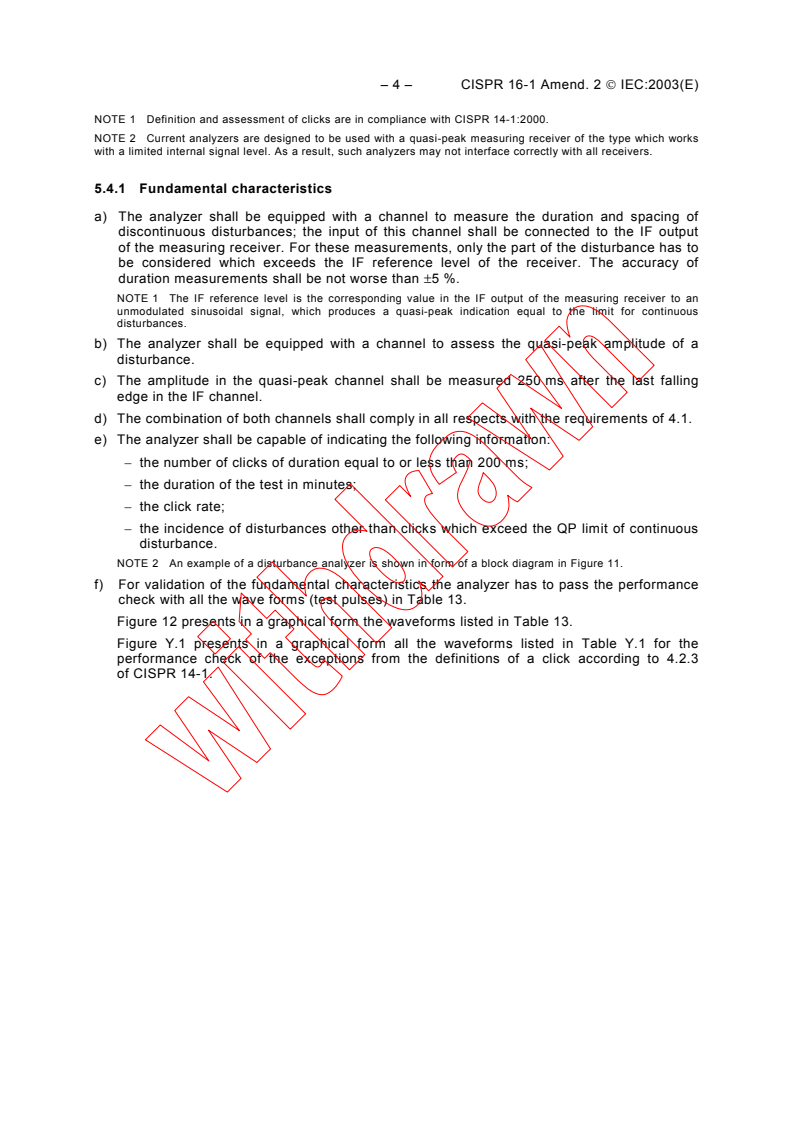
NOTE 2 An example of a disturbance analyzer is shown in form of a block diagram in Figure 11.
f) For validation of the fundamental characteristics the analyzer has to pass the performance
check with all the wave forms (test pulses) in Table 13.
Figure 12 presents in a graphical form the waveforms listed in Table 13.
Figure Y.1 presents in a graphical form all the waveforms listed in Table Y.1 for the
performance check of the exceptions from the definitions of a click according to 4.2.3
of CISPR 14-1.
CISPR 16-1 Amend. 2 IEC:2003(E) – 5 –
Table 13 – Disturbance analyzer performance test –
Test signals used for the check against the definition of a click
Test signal parameters
12 3 4 5
QP amplitude of Duration
f
impulses adjusted of impulses
individually adjusted in the Graphical presentation of
Separation
relative to QP intermediate the test signal measured
of impulses
reference frequency output in the IF-output and
Evaluation by
or periodicity
the associated QP signal
indication of the of the
the analyzer
(IF-output)
measurement measurement relative to the reference
receiver receiver indication of the measurement
ms
receiver
dB ms
Pulse 1 Pulse 2 Pulse 1 Pulse 2
1 1 0,11 1 click
0 100 200 300 400 500 600 700 800 900 100
1 s
a
2 1 9,5 1 click
0 04 08 12 16 2 22
2,2 s
a
3 1 190 1 click
0 04 08 12 16 2 22
2,2 s
b
4 1 1 333 Other than click
0 02 04 06 08 1 12 14 16 18 2
2 s
Test No.
– 6 – CISPR 16-1 Amend. 2 IEC:2003(E)
Table 13 (continued)
Test signal parameters
12 3 4 5
QP amplitude of Duration
f
impulses adjusted of impulses
individually adjusted in the Graphical presentation of
Separation
the test signal measured
relative to QP intermediate
of impulses
reference frequency output in the IF-output and
Evaluation by
or periodicity
the associated QP signal
indication of the of the
the analyzer
(IF-output)
measurement measurement relative to the reference
receiver receiver indication of the measurement
ms
receiver
dB ms
Pulse 1 Pulse 2 Pulse 1 Pulse 2
5 1 210 Other than click
(210 ms)
0 100 200 300 400 500 600 700 800 900 1000
1 s
6 5 5 30 30 180 Other than click
(240 ms)
0 100 200 300 400 500 600 700 800 900 1000
1 s
7 5 5 30 30 130 1 click
0 100 200 300 400 500 600 700 800 900 10
1 s
8 5 5 30 30 210 2 clicks
0 100 200 300 400 500 600 700 800 900 1000
1 s
Test No.
CISPR 16-1 Amend. 2 IEC:2003(E) – 7 –
Table 13 (continued)
Test signal parameters
12 3 4 5
QP amplitude of Duration
f
impulses adjusted of impulses
individually adjusted in the Graphical presentation of
Separation
the test signal measured
relative to QP intermediate
of impulses
reference frequency output in the IF-output and
Evaluation by
or periodicity
indication of the of the the associated QP signal
the analyzer
(IF-output)
measurement measurement relative to the reference
receiver receiver indication of the measurement
ms
receiver
dB ms
Pulse 1 Pulse 2 Pulse 1 Pulse 2
9 1 0,11 Periodicity 10, Other than click
min. 21 pulses
0 100 200 300 400 500 600 700 800 900 100
1 s
10 –2,5 25 30 30 265 1 click
0 100 200 300 400 500 600 700 800 900 1000
1s
c e d
11 25 –2,5 190 30 1 034 2 clicks
0 02 04 06 08 1 12 14 16 18 2
2 s
c e
12 25 –2,5 190 30 1 166 1 click
0 02 04 06 08 1 12 14 16 18 2
2 s
Test No.
– 8 – CISPR 16-1 Amend. 2 IEC:2003(E)
Table 13 (continued)
a
To be performed with background noise consisting of 200 Hz CISPR pulses at a level 2,5 dB below the quasi-
peak threshold level. These pulses should be present commencing at least 1 s before the test pulse and lasting
until at least 1 s after the test pulse.
Observations:
1) The graphical representation is done with peak measurements of a very short hold time (<1 ms) of the test
receiver which show the 200-Hz pulse. When the pulse-modulated sine wave arrives, the 200-Hz-pulse is no
longer visible (as seen in the graph for test no. 3) but still present during the event of the click disturbance
2) The very narrow responses at the origin in the graphs are due to a firmware imperfection.
b
The 1,333 s impulse checks the threshold of the analyzer for impulses, which are only 1 dB above the quasi-
peak threshold level.
c
These lower levels shall be set such that the intermediate frequency threshold is exceeded but the quasi-peak
threshold is not exceeded
d
If these two pulses were to be measured as separate disturbances, only one click would be registered.
e
The correspondent values for the frequency range above 30 MHz are under consideration and will be revised
after further investigations.
f
The rise times of the pulses shall not be longer than 40 μs.
CISPR 16-1 Amend. 2 IEC:2003(E) – 9 –
Evaluation by
Test
Test signal
the analyzer
No.
0,11ms/1 dB 1 click
9,5 ms/1 dB
+1 s
−1 s
1 click
Background: noise or CISPR pulses, 200 Hz: −2,5 dB (QP)
190 ms/1 dB
−1 s +1 s
1 click
Background: noise or CISPR pulses, 200 Hz: –2,5 dB (QP)
Other than click
1 333 ms/1 dB
210 ms/1 dB
Other than click
30 ms/5 dB 30 ms/5 dB
Other than click
6 180 ms
30 ms/5 dB 30 ms/5 dB
130 ms
1 click
30 ms/5 dB 30 ms/5 dB
210 ms
8 2 clicks
Other than click
Min. 21 pulses/0,11 ms/periodicity 10 ms/1 dB
30 ms/25 dB
1 click
265 ms
30 ms/−2,5 dB
190 ms/25 dB
Band B: 1034 ms/Band C: under consideration
2 clicks
190 ms/25 dB
30 ms/−2,5 dB/2 dB IF
Band B: 1 166 ms/Band C: under consideration
1 click
30 ms/–2,5 dB/2 dB IF
IEC 1115/03
Figure 12 – A graphical presentation of test signals used in the test of the analyzer for
the performance check against the definition of a click according to Table 13
– 10 – CISPR 16-1 Amend. 2 IEC:2003(E)
5.4.2 Test method for the validation of the performance check for the click analyzer
5.4.2.1 Basic requirements
The disturbance analyzer is connected to the quasi-peak measuring receiver and tuned to a
convenient frequency.
A CW signal and a pulsed CW signal both at the tuned frequency of the receiver are required.
A signal generated by CISPR pulse generator, as defined in Annex B, with a 200 Hz PRF
covering the receiver bandwidth at the tuned frequency is also required for tests No. 2 and 3.
The pulsed CW signal source shall provide two independently variable pulses. The rise time of
the pulses shall be not longer than 40 μs. The pulse duration shall be variable between 110 μs
and 1,3 s and the amplitudes variable over a 44 dB range. Any background noise of the pulsed
CW signal source shall be at least 20 dB below the reference level used in step a) in the test
measured on the receiver’s quasi-peak meter.
The test procedure is as follows:
a) The CW signal is connected to the input of the measuring receiver used in conjunction
with the disturbance analyzer. The amplitude of the CW signal is adjusted to bring the
meter indication to the reference (zero) point on the meter scale of the measuring receiver
equal to a value identical to the QP-limit for continuous disturbance. The receiver RF
sensitivity (attenuator) control is adjusted to a level above the receiver noise but below the
limit for continuous disturbance used as threshold in the IF channel. The corresponding
level of the CW signal at the IF output of the receiver constitutes the IF reference level.
b) The pulsed CW signal is connected to the input of the measuring receiver. For test number
2 and 3 the signal from the CISPR pulse generator is added to the pulsed CW signal. The
parameters of the signal are given in Table 13. The amplitudes of the pulses shown in
column 1 of Table 13 are adjusted individually relative to the indication of the limit (QP) for
continuous disturbance used as threshold in the IF channel. The levels shall be relative
to the respective RF and IF reference levels established in the previous paragraph.
5.4.2.2 Additional requirements
The test method is identical to the one described in 5.4.2.1.
The parameters of the signal are given in Table Y.1.
Page 73
5.5.3.2 Magnetic antenna
Add, after the existing paragraph, the following new paragraph:
Tuned electrically balanced loop antennas may be used to make measurements at lower field
strengths than untuned electrically-screened loop antennas.
Page 75
Replace subclause 5.5.4.2 by the following new subclause:
CISPR 16-1 Amend. 2 IEC:2003(E) – 11 –
5.5.4.2 Balance of antenna
5.5.4.2.1 Introduction
In radiated emission measurements, common-mode (CM) currents may be present on the
cable attached to the receiving antenna (the antenna cable). In turn, these CM currents create
EM fields which may be picked up by the receiving antenna. Consequently, the radiated
emission measuring results may be influenced.
The major contributions to the antenna cable CM currents stem from
a) the electric field generated by the EUT, if that field has a component parallel to the antenna
cable, and
b) the conversion of the differential mode (DM) antenna signal (the desired signal) into a CM
signal by the imperfection of the balun of the receiving antenna.
This subclause considers the balun contribution. Contribution a) is under consideration (see
last sentence of NOTE 1 of 5.5.4.2.2).
In general, log-periodic dipole array antennas do not exhibit significant DM/CM conversion and
the following check applies to dipoles, biconical antennas and bicone/log hybrid antennas.
5.5.4.2.2 Balun DM/CM conversion check
The following method describes the measurement of two voltages, U and U , in the frequency
1 2
range for which the receiving antenna is to be used. The ratio of these voltages, both
expressed in identical units (e.g., dBµV), is a measure for the DM/CM conversion.
1) Set the receiving antenna under test vertically polarized with its centre at a height of 1,5 m
above the ground plane. Lay the cable horizontally for 1,5 m ± 0,1 m behind the rear active
element of the antenna and then drop it vertically by a height of at least 1.5 m to the ground
plane.
2) Place a second (transmitting) antenna vertically polarized at a horizontal distance of 10 m
from the centre of the antenna under test with its tip 0,10 m from the ground plane. If the
range of the site used for emission testing is 3 m, do this check using a distance of 3 m (if
the conversion check has already been made at 10 m distance and shows a change of less
than ±0,5 dB, it is not necessary to take a separate measurement at 3 m). The specification
of the transmitting antenna shall include the frequency range of the antenna under test.
3) Connect the transmitting antenna to a signal source, for example, a tracking generator, set
the level of that generator in such a way that, over the frequency range of interest, the
signal-to-ambient noise at the receiver is larger than 10 dB.
4) Record the voltage U at the receiver over the frequency range of interest.
5) Invert the receiving antenna (rotate that antenna through 180°) without changing anything
else in the set-up, in particular the receiving antenna cable, and without changing the
setting of the signal source.
6) Record the voltage U at the receiver over the frequency range.
7) The DM/CM conversion is sufficiently low if 20 log (U /U )<1 dB.
1 2
NOTE 1 If the DM/CM conversion criterion is not met, ferrite rings around the antenna cable may reduce the
DM/CM conversion. The addition of ferrites on the antenna cable may also be used to verify whether contribution a)
has a non-negligible effect. Repeat the test with four ferrites spaced approximately 20 cm apart. If the criterion is
met by using these rings, they shall be present in the actual emission measurement. Likewise, the interaction with
the cable can be reduced by extending the cable several metres behind the antenna before dropping to ground.
NOTE 2 If the receiving antenna is to be used in a fully anechoic chamber, the DM/CM check may be performed in
that room with the receiving antenna at its usual location and the transmitting antenna in the centre of the test
volume of that room. The room must comply with the ±4 dB criterion
NOTE 3 The measuring site of which the ground plane forms a part, or the fully anechoic room, should comply
with their respective NSA requirements.
– 12 – CISPR 16-1 Amend. 2 IEC:2003(E)
NOTE 4 The horizontal distance of 1,5 m over which the antenna cable runs horizontally behind the centre of the
antenna shall be kept as a minimum during actual vertically polarized radiated emissions measurements.
NOTE 5 It is not necessary to define a test set-up strictly because this effect is in large part due to the interaction
of the antenna and the part of input cable that lies parallel to the antenna elements. There is a much smaller effect
which is dependent on the uniformity of the field incident on the antenna in normal EMC set-ups on an OATS or in
a fully anechoic room.
NOTE 6 For baluns which have the receive cable connector mounted on the side (90° to the antenna boom),
a right angle connector should be used to reduce the movement of the cable.
Add the following new subclause 5.5.4.3:
5.5.4.3 Cross-polar performance of antenna
When an antenna is placed in a plane-polarized electromagnetic field, the terminal voltage
when the antenna and field are cross-polarized shall be at least 20 dB below the terminal
voltage when they are co-polarized. It is intended that this test apply to log-periodic dipole array
(LPDA) antennas for which the two halves of each dipole are in echelon. The majority of testing
with such antennas is above 200 MHz, but the requirement applies below 200 MHz. This test is
not intended for in-line dipole and biconical antennas because a cross-polar rejection greater
than 20 dB is intrinsic to their symmetrical design. Such antennas and horn antennas must
have a cross-polar rejection greater than 20 dB and a type test by the manufacturer should
confirm this.
In order to achieve quasi-free space conditions, a high-quality anechoic chamber or towers of
sufficient height above ground on an outdoor range can be used. To minimize ground
reflections set the antennas vertically polarized. A plane wave shall be set up at the antenna
under test. The separation between the centre of the antenna under test and the source
antenna shall be greater than one wavelength.
NOTE 1 A good-quality site is needed to set up a plane wave at the antenna under test. The cross-polar
discrimination afforded by the plane wave can be proven by transmitting between a pair of horn antennas or open-
ended waveguides and checking that the combination of site error and inherent cross-polar performance of one
horn antenna yields a suppression of the horizontal component by more than 30 dB. If the site errors are very low
and if the horn antennas have identical performance, the cross-polar performance of one horn is approximately 6 dB
lower than the combined cross-polar coupling of the pair of horns.
An interfering signal 20 dB lower in level than the desired signal gives a maximum error on the
desired signal of ±0,9 dB. The maximum error occurs when the cross-polar signal is in phase
with the co-polar signal. If the cross-polar response of the LPDA is worse than 20 dB, the
operator must calculate the uncertainty and declare it with the result, for example a cross-polar
level of 14 dB implies a maximum uncertainty of +1,6 dB to −1,9 dB. Take the larger value and
assume a U-shaped distribution when calculating the standard uncertainty.
To add a signal of 0 dB to another of –14 dB, first convert to relative voltages by dividing by 20
and taking the anti-log. Then add the smaller signal to the unity signal. Take the log and
multiply by 20. The result is the positive decibel error. Repeat, but subtracting the smaller
signal from the unity signal to give the negative decibel error.
For the purpose of calculating the uncertainty of the result of a radiated emission, if the signal
level measured in one polarization exceeds the signal measured in the orthogonal polarization
by 6 dB or more, then an LPDA whose cross-polar discrimination is only 14 dB will have been
deemed to have met the specification of 20 dB. If the difference between the VP and HP signal
levels is less than 6 dB, additional uncertainty must be calculated if the sum of this difference
and the cross-polarization is less than 20 dB.
CISPR 16-1 Amend. 2 IEC:2003(E) – 13 –
Page 101
5.10 Coupling devices for measuring signal lines
Replace the existing text of this subclause by the following new text:
The interference potential (and immunity) of signal lines may be assessed by measurement (or
injection) of the conducted disturbance voltage or current. For this purpose coupling devices
are needed to measure the disturbance component while rejecting the intentional signal on
the line. The devices included are to measure the electromagnetic emission and immunity
(common and differential mode, current and voltage). Typical devices for these kinds of
measurements are current probes and asymmetric artificial networks (AANs or Y-networks).
2)
NOTE 1 Requirements for AANs for conducted immunity tests on signal lines may be found in IEC 61000-4-6
(AANs are special versions of “coupling and decoupling devices” [so called coupling/decoupling networks (CDNs)]).
An AAN which meets the requirement for emission measurements may also meet the requirements for immunity
testing.
NOTE 2 Signal lines include telecommunication lines and terminals of equipment intended to be connected to
these lines.
NOTE 3 The terms “asymmetric voltage” and “common mode voltage” as well as “symmetric voltage” and
“differential mode voltage” are synonyms, as defined in Clause 3.
NOTE 4 The term “asymmetric artificial network (AAN)” is used as synonym for “Y-network”, which is in contrast to
V-networks and Δ-networks. The T-network is a special version of the Y-network.
When a current probe is used and the limit value is specified in volts, the voltage value must be
divided by the impedance of the signal line or termination impedance as specified by the
detailed measurement procedure, to obtain the limit value for the current. This impedance may
be common mode as required by the detailed measurement procedure.
Subclause 5.10.1 states the specification for asymmetric (common mode) artificial networks
(AANs). The differential mode to common mode rejection (V /V ) is crucial to the useability
dm cm
of the AAN. This parameter is related to the longitudinal conversion loss (LCL). An example of
asymmetric artificial networks and the required test and calibration procedures are given in
Annex Q.
5.10.1 Requirements for asymmetric artificial networks (AANs or Y-networks)
Asymmetric artificial networks (AANs) are used to measure (or inject) asymmetric (common
mode) voltages on unshielded symmetric signal (e.g. telecommunication) lines while rejecting
the symmetric (differential mode) signal.
NOTE In CISPR 22 this type of network is called impedance stabilization network (ISN).
Figure 52a shows the general circuit diagram of an asymmetric artificial network.
The characteristics of the AAN for the measurement of asymmetric (common mode)
disturbances shall be covering the frequency range of the asymmetric disturbance voltages as
well as the frequency range used for the transmission of the intentional signal. These
characteristics are given in Table 18.
___________
2)
IEC 61000-4-6, Electromagnetic compatibility (EMC) – Part 4: Testing and measurement techniques – Section 6:
Immunity to conducted disturbances, induced by radio-frequency fields
– 14 – CISPR 16-1 Amend. 2 IEC:2003(E)
Table 18 – Characteristics of the asymmetric artificial network for
the measurement of asymmetric disturbance voltage
a. Termination impedance of basic network for asymmetric disturbance
a
voltage
• magnitude 150 Ω ± 20 Ω
• phase
0° ± 20°
b
b. Longitudinal conversion loss (LCL) at the EUT port of the network (9 kHz to 150 kHz: to be defined)
0,15 MHz to 30 MHz: defined
by the relevant product standard,
c
e.g. as shown in Figure 52b
c. Decoupling attenuation for asymmetric signals between AE port and (9 kHz to 150 kHz: to be defined)
EUT port. 0,15 MHz to 1,5 MHz:
>35 dB to 55 dB increasing
linearly with the log. of frequency
>1,5 MHz: > 55 dB
d
d. Insertion loss of the symmetric circuit between EUT and AE ports <3 dB
e
e. Voltage division factor of the asymmetric circuit between EUT and Typically 9,5 dB
measuring receiver ports, to be added to the reading of the measuring
receiver.
f
f. Symmetric load impedance of the network t.b.d.
g
g. Transmission bandwidth for the intentional signal (analog or digital) t.b.d.
h
h. (0,009) 0,15 MHz to 30 MHz
Frequency range (1) Emission
(2) Immunity See e.g. IEC 61000-4-6
a
The asymmetric impedance of the AAN will normally be influenced by the addition of an unbalanced ne
...