

IEC 61975:2010
(Main)High-voltage direct current (HVDC) installations - System tests
General Information
- Abstract
IEC 61975:2010 applies to system tests for high-voltage direct current (HVDC) installations which consist of a sending terminal and a receiving terminal, each connected to an a.c. system. The tests specified in this standard are based on bidirectional and bipolar high-voltage direct current (HVDC) installations which consist of a sending terminal and a receiving terminal, each connected to an a.c. system. The test requirements and acceptance criteria should be agreed for back-to-back installations, while multi-terminal systems and voltage sourced converters are not included in this standard. For monopolar HVDC installations, the standard applies except for bipolar tests. This standard only serves as a guideline to system tests for high-voltage direct current (HVDC) installations. The standard gives potential users guidance, regarding how to plan commissioning activities. The tests described in the guide may not be applicable to all projects, but represent a range of possible tests which should be considered. This edition cancels and replaces IEC/PAS 61975 published jointly in 2004 by IEC and CIGRÉ. It constitutes a technical revision incorporating engineering experience.
- Status
- Published
- Publication Date
- 23-Oct-2022
- Drafting Committee
- WG 17 - TC 22/SC 22F/WG 17
- Current Stage
- PPUB - Publication issued
- Start Date
- 29-Jul-2010
- Completion Date
- 31-Aug-2010
Buy Documents
IEC 61975:2010 - High-voltage direct current (HVDC) installations - System tests Released:7/29/2010
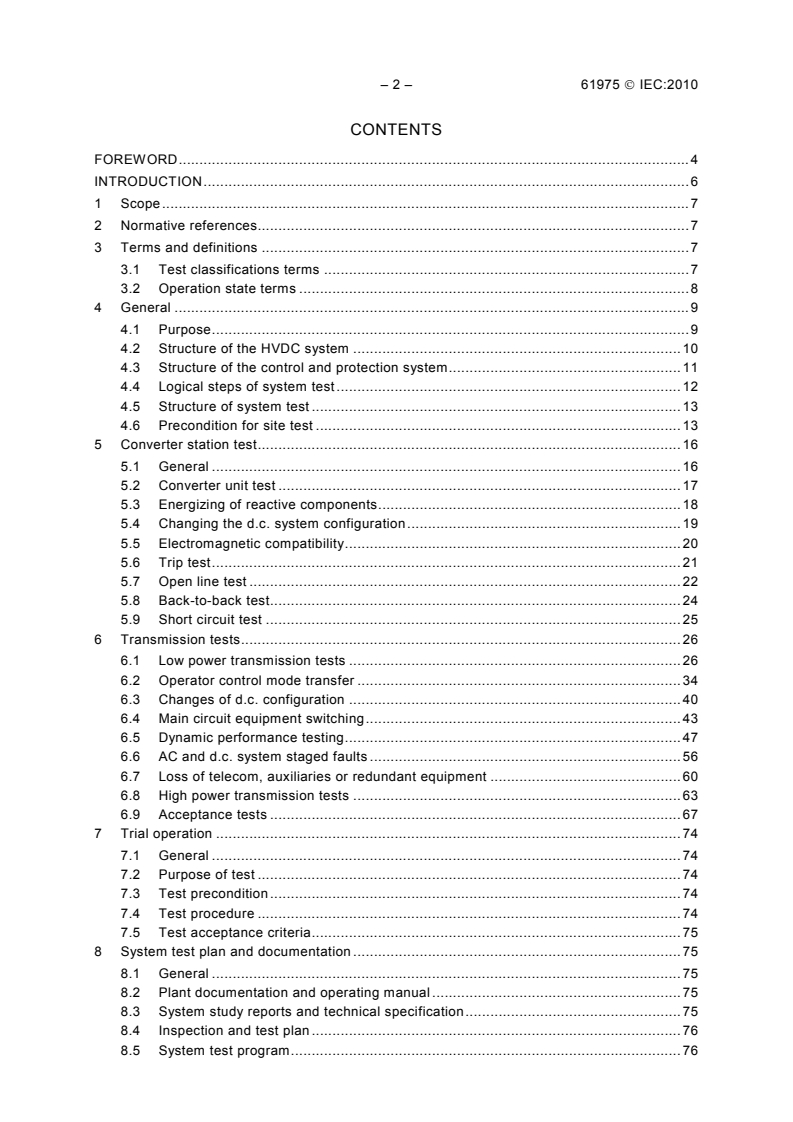
IEC 61975:2010 - High-voltage direct current (HVDC) installations - System tests Released:7/29/2010

IEC 61975:2010+AMD1:2016+AMD2:2022 CSV - High-voltage direct current (HVDC) installations - System tests Released:10/24/2022

IEC 61975:2010+AMD1:2016 CSV - High-voltage direct current (HVDC) installations - System tests Released:9/12/2016
Overview
IEC 61975:2010, developed by the International Electrotechnical Commission (IEC), specifies guidelines for system tests of high-voltage direct current (HVDC) installations. These installations are comprised of a sending terminal and a receiving terminal, each connected to an alternating current (AC) system. This standard provides comprehensive guidance for planning and performing system tests in HVDC projects, particularly for bidirectional and bipolar configurations. While it outlines essential test procedures and acceptance criteria, IEC 61975 serves as a flexible guideline rather than a prescriptive set of mandatory requirements, encouraging users to adapt its recommendations for specific project needs.
Key Topics
Scope and Applicability
IEC 61975 applies to system tests for HVDC installations with a sending and a receiving terminal, each interfacing with an AC system. It is primarily intended for monopolar and bipolar HVDC systems and can also be adapted to back-to-back installations through mutual agreement on test requirements and acceptance criteria.
Multi-terminal HVDC links and voltage-sourced converters are outside its current scope. However, for monopolar systems, all recommendations stand except those related to bipolar testing.Classification of HVDC System Tests
- Converter Station Tests: Verifying functionality and performance of individual converter station equipment under energized conditions.
- System (End-to-End) Tests: Assessing the overall HVDC system's functionality, including its interaction with connected AC networks.
- Transmission Tests: Confirming correct power transmission between terminals, including dynamic and steady-state performance.
- On-site vs. Off-site Tests: On-site tests occur at the installation location, while off-site testing, such as factory acceptance, may take place beforehand.
Testing Objectives
System tests are designed to confirm equipment performance, system coordination, and compliance with contractual and operational requirements. They provide assurance for project stakeholders, enabling a smooth transition from commissioning to commercial operation.Test Planning and Documentation
The standard emphasizes thorough planning, documentation, and coordination among suppliers, users, and other stakeholders. This includes establishing clear test schedules, acceptance criteria, and robust reporting practices.
Applications
Project Commissioning
IEC 61975 assists utilities, contractors, and manufacturers in planning comprehensive HVDC system commissioning, from initial subsystem checks to integrated operation.Performance Validation
The standard helps verify that HVDC installations meet targeted operational criteria, including steady-state, dynamic, and fault-response performance.Ensuring System Interoperability and Safety
Detailed test procedures evaluate the HVDC system's interaction with interconnected AC networks, environmental impacts, and safety protocols for personnel and equipment.Guidance for Back-to-Back and Custom Installations
While primarily focused on two-terminal (point-to-point) HVDC links, the guideline approach allows for adaptation to specific project requirements, especially in unique or back-to-back installation scenarios.
Related Standards
For optimal HVDC system performance and compatibility, IEC 61975 should be used alongside related IEC standards, including:
IEC 60633: Terminology for High-Voltage Direct Current (HVDC) Power Transmission – Vocabulary
Provides the unified terminology required for clear test planning and communication.IEC/TR 60919-2: Performance of High-Voltage Direct Current (HVDC) Systems with Line Commutated Converters – Part 2: Faults and Switching
Offers detailed insights into fault management and switching, complementing the commissioning and testing phases defined in IEC 61975.
Practical Value
Implementing the system tests outlined in IEC 61975:2010 enables reliable HVDC operation, maximizes availability, and reduces operational risks. By fostering thorough test planning, clear stakeholder responsibilities, and robust documentation, organizations can ensure safe, efficient integration of HVDC technologies into broader power grids. This standard is an indispensable resource for HVDC project managers, engineers, and operators looking to optimize commissioning and achieve consistent, validated performance.
Relations
- Effective Date
- 05-Sep-2023
- Effective Date
- 05-Sep-2023
- Effective Date
- 05-Sep-2023
Buy Documents
IEC 61975:2010 - High-voltage direct current (HVDC) installations - System tests Released:7/29/2010
IEC 61975:2010 - High-voltage direct current (HVDC) installations - System tests Released:7/29/2010
IEC 61975:2010+AMD1:2016+AMD2:2022 CSV - High-voltage direct current (HVDC) installations - System tests Released:10/24/2022
IEC 61975:2010+AMD1:2016 CSV - High-voltage direct current (HVDC) installations - System tests Released:9/12/2016
Get Certified
Connect with accredited certification bodies for this standard

IMQ S.p.A. (Certification)
Italian electrical product certification.

SLG Prüf- und Zertifizierungs GmbH
German testing and certification body.

UL Solutions
Global safety science company with testing, inspection and certification.
Sponsored listings
Frequently Asked Questions
IEC 61975:2010 is a standard published by the International Electrotechnical Commission (IEC). Its full title is "High-voltage direct current (HVDC) installations - System tests". This standard covers: IEC 61975:2010 applies to system tests for high-voltage direct current (HVDC) installations which consist of a sending terminal and a receiving terminal, each connected to an a.c. system. The tests specified in this standard are based on bidirectional and bipolar high-voltage direct current (HVDC) installations which consist of a sending terminal and a receiving terminal, each connected to an a.c. system. The test requirements and acceptance criteria should be agreed for back-to-back installations, while multi-terminal systems and voltage sourced converters are not included in this standard. For monopolar HVDC installations, the standard applies except for bipolar tests. This standard only serves as a guideline to system tests for high-voltage direct current (HVDC) installations. The standard gives potential users guidance, regarding how to plan commissioning activities. The tests described in the guide may not be applicable to all projects, but represent a range of possible tests which should be considered. This edition cancels and replaces IEC/PAS 61975 published jointly in 2004 by IEC and CIGRÉ. It constitutes a technical revision incorporating engineering experience.
IEC 61975:2010 applies to system tests for high-voltage direct current (HVDC) installations which consist of a sending terminal and a receiving terminal, each connected to an a.c. system. The tests specified in this standard are based on bidirectional and bipolar high-voltage direct current (HVDC) installations which consist of a sending terminal and a receiving terminal, each connected to an a.c. system. The test requirements and acceptance criteria should be agreed for back-to-back installations, while multi-terminal systems and voltage sourced converters are not included in this standard. For monopolar HVDC installations, the standard applies except for bipolar tests. This standard only serves as a guideline to system tests for high-voltage direct current (HVDC) installations. The standard gives potential users guidance, regarding how to plan commissioning activities. The tests described in the guide may not be applicable to all projects, but represent a range of possible tests which should be considered. This edition cancels and replaces IEC/PAS 61975 published jointly in 2004 by IEC and CIGRÉ. It constitutes a technical revision incorporating engineering experience.
IEC 61975:2010 is classified under the following ICS (International Classification for Standards) categories: 29.130.10 - High voltage switchgear and controlgear; 31.080.01 - Semiconductor devices in general. The ICS classification helps identify the subject area and facilitates finding related standards.
IEC 61975:2010 has the following relationships with other standards: It is inter standard links to IEC PAS 61975:2004, IEC 61975:2010/AMD2:2022, IEC 61975:2010/AMD1:2016. Understanding these relationships helps ensure you are using the most current and applicable version of the standard.
IEC 61975:2010 is available in PDF format for immediate download after purchase. The document can be added to your cart and obtained through the secure checkout process. Digital delivery ensures instant access to the complete standard document.
Standards Content (Sample)
IEC 61975 ®
Edition 1.0 2010-07
INTERNATIONAL
STANDARD
High-voltage direct current (HVDC) installations – System tests
All rights reserved. Unless otherwise specified, no part of this publication may be reproduced or utilized in any form
or by any means, electronic or mechanical, including photocopying and microfilm, without permission in writing from
either IEC or IEC's member National Committee in the country of the requester.
If you have any questions about IEC copyright or have an enquiry about obtaining additional rights to this publication,
please contact the address below or your local IEC member National Committee for further information.
IEC Central Office
3, rue de Varembé
CH-1211 Geneva 20
Switzerland
Email: inmail@iec.ch
Web: www.iec.ch
About the IEC
The International Electrotechnical Commission (IEC) is the leading global organization that prepares and publishes
International Standards for all electrical, electronic and related technologies.
About IEC publications
The technical content of IEC publications is kept under constant review by the IEC. Please make sure that you have the
latest edition, a corrigenda or an amendment might have been published.
ƒ Catalogue of IEC publications: www.iec.ch/searchpub
The IEC on-line Catalogue enables you to search by a variety of criteria (reference number, text, technical committee,…).
It also gives information on projects, withdrawn and replaced publications.
ƒ IEC Just Published: www.iec.ch/online_news/justpub
Stay up to date on all new IEC publications. Just Published details twice a month all new publications released. Available
on-line and also by email.
ƒ Electropedia: www.electropedia.org
The world's leading online dictionary of electronic and electrical terms containing more than 20 000 terms and definitions
in English and French, with equivalent terms in additional languages. Also known as the International Electrotechnical
Vocabulary online.
ƒ Customer Service Centre: www.iec.ch/webstore/custserv
If you wish to give us your feedback on this publication or need further assistance, please visit the Customer Service
Centre FAQ or contact us:
Email: csc@iec.ch
Tel.: +41 22 919 02 11
Fax: +41 22 919 03 00
IEC 61975 ®
Edition 1.0 2010-07
INTERNATIONAL
STANDARD
High-voltage direct current (HVDC) installations – System tests
INTERNATIONAL
ELECTROTECHNICAL
COMMISSION
PRICE CODE
XC
ICS 29.130.10; 31.080.01 ISBN 978-2-88912-100-7
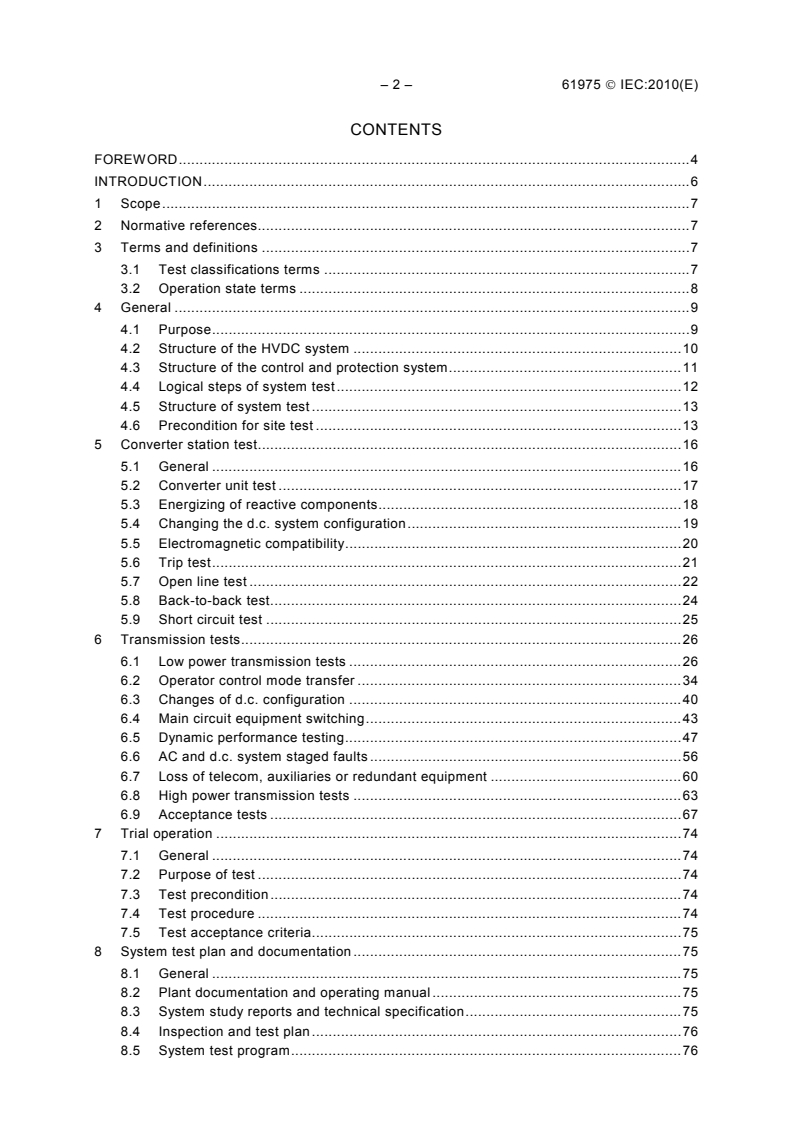
– 2 – 61975 © IEC:2010(E)
CONTENTS
FOREWORD.4
INTRODUCTION.6
1 Scope.7
2 Normative references.7
3 Terms and definitions .7
3.1 Test classifications terms .7
3.2 Operation state terms .8
4 General .9
4.1 Purpose.9
4.2 Structure of the HVDC system .10
4.3 Structure of the control and protection system.11
4.4 Logical steps of system test.12
4.5 Structure of system test .13
4.6 Precondition for site test .13
5 Converter station test.16
5.1 General .16
5.2 Converter unit test .17
5.3 Energizing of reactive components.18
5.4 Changing the d.c. system configuration.19
5.5 Electromagnetic compatibility.20
5.6 Trip test.21
5.7 Open line test .22
5.8 Back-to-back test.24
5.9 Short circuit test .25
6 Transmission tests.26
6.1 Low power transmission tests .26
6.2 Operator control mode transfer .34
6.3 Changes of d.c. configuration .40
6.4 Main circuit equipment switching.43
6.5 Dynamic performance testing.47
6.6 AC and d.c. system staged faults .56
6.7 Loss of telecom, auxiliaries or redundant equipment .60
6.8 High power transmission tests .63
6.9 Acceptance tests .67
7 Trial operation .74
7.1 General .74
7.2 Purpose of test .74
7.3 Test precondition.74
7.4 Test procedure .74
7.5 Test acceptance criteria.75
8 System test plan and documentation .75
8.1 General .75
8.2 Plant documentation and operating manual.75
8.3 System study reports and technical specification.75
8.4 Inspection and test plan.76
8.5 System test program.76
61975 © IEC:2010(E) – 3 –
8.6 Test procedure for each test .77
8.7 Documentation of system test results.77
8.8 Deviation report .78
Bibliography .79
Figure 1 – Relation among five major aspects of system test .10
Figure 2 – Structure of the HVDC system .11
Figure 3 – Structure of the HVDC control and protection.11
Figure 4 – Structure of system test .15
Figure 5 – Sequence for low power transmission tests.28
Figure 6 – Step response test of current control at the rectifier .49
Figure 7 – Step response test of extinction angle control at the inverter .50
Figure 8 – Step response test of d.c. voltage control at the inverter .50
Figure 9 – Step response test of current control at the inverter .51
Figure 10 – Step response test of power control at the rectifier .51
– 4 – 61975 © IEC:2010(E)
INTERNATIONAL ELECTROTECHNICAL COMMISSION
____________
HIGH-VOLTAGE DIRECT CURRENT (HVDC) INSTALLATIONS –
SYSTEM TESTS
FOREWORD
1) The International Electrotechnical Commission (IEC) is a worldwide organization for standardization comprising
all national electrotechnical committees (IEC National Committees). The object of IEC is to promote
international co-operation on all questions concerning standardization in the electrical and electronic fields. To
this end and in addition to other activities, IEC publishes International Standards, Technical Specifications,
Technical Reports, Publicly Available Specifications (PAS) and Guides (hereafter referred to as “IEC
Publication(s)”). Their preparation is entrusted to technical committees; any IEC National Committee interested
in the subject dealt with may participate in this preparatory work. International, governmental and non-
governmental organizations liaising with the IEC also participate in this preparation. IEC collaborates closely
with the International Organization for Standardization (ISO) in accordance with conditions determined by
agreement between the two organizations.
2) The formal decisions or agreements of IEC on technical matters express, as nearly as possible, an international
consensus of opinion on the relevant subjects since each technical committee has representation from all
interested IEC National Committees.
3) IEC Publications have the form of recommendations for international use and are accepted by IEC National
Committees in that sense. While all reasonable efforts are made to ensure that the technical content of IEC
Publications is accurate, IEC cannot be held responsible for the way in which they are used or for any
misinterpretation by any end user.
4) In order to promote international uniformity, IEC National Committees undertake to apply IEC Publications
transparently to the maximum extent possible in their national and regional publications. Any divergence
between any IEC Publication and the corresponding national or regional publication shall be clearly indicated in
the latter.
5) IEC itself does not provide any attestation of conformity. Independent certification bodies provide conformity
assessment services and, in some areas, access to IEC marks of conformity. IEC is not responsible for any
services carried out by independent certification bodies.
6) All users should ensure that they have the latest edition of this publication.
7) No liability shall attach to IEC or its directors, employees, servants or agents including individual experts and
members of its technical committees and IEC National Committees for any personal injury, property damage or
other damage of any nature whatsoever, whether direct or indirect, or for costs (including legal fees) and
expenses arising out of the publication, use of, or reliance upon, this IEC Publication or any other IEC
Publications.
8) Attention is drawn to the Normative references cited in this publication. Use of the referenced publications is
indispensable for the correct application of this publication.
9) Attention is drawn to the possibility that some of the elements of this IEC Publication may be the subject of
patent rights. IEC shall not be held responsible for identifying any or all such patent rights.
International Standard IEC 61975 has been prepared by subcommittee 22F: Power electronics
for electrical transmission and distribution systems, of IEC technical committee 22: Power
electronic systems and equipment.
This first version of IEC 61975 cancels and replaces IEC/PAS 61975 published jointly in 2004
by IEC and CIGRÉ. It constitutes a technical revision incorporating engineering experience.
The text of this standard is based on the following documents:
FDIS Report on voting
22F/221/FDIS 22F/227/RVD
Full information on the voting for the approval of this standard can be found in the report on
voting indicated in the above table.
This publication has been drafted in accordance with the ISO/IEC Directives, Part 2.
61975 © IEC:2010(E) – 5 –
The committee has decided that the contents of this publication will remain unchanged until the
stability date indicated on the IEC web site under "http://webstore.iec.ch" in the data related to
the specific publication. At this date, the publication will be
• reconfirmed,
• withdrawn,
• replaced by a revised edition, or
• amended.
A bilingual version may be issued at a later date.
– 6 – 61975 © IEC:2010(E)
INTRODUCTION
The standard is structured in eight clauses:
a) Clause 1 – Scope
b) Clause 2 – Normative references
c) Clause 3 – Definitions
d) Clause 4 – General
e) This clause addresses the purpose of this standard, the HVDC system structure, the
control and protection structure, the logical steps of commissioning, the structure of the
system test and that of the system commissioning standard.
f) Clause 5 – Converter station test
g) This clause addresses the commissioning of converter units and verifies the steady state
performance of units as well as switching tests.
h) Clause 6 – Power transmission tests
i) This clause concerns the commissioning of the transmission system, and verifies station
coordination, steady-state and dynamic performance, interference, as well as interaction
between the d.c. and a.c. systems.
j) Clause 7 – Trial operation
k) After completion of the system test, the period of trial operation is normally specified to
verify the normal transmission.
l) Clause 8 – System test plan and documentation
Clauses 5 to 7 comprise individual sections providing an introduction and covering objects,
preconditions and procedures and general acceptance criteria as well as detailed descriptions
of the individual tests.
61975 © IEC:2010(E) – 7 –
HIGH-VOLTAGE DIRECT CURRENT (HVDC) INSTALLATIONS –
SYSTEM TESTS
1 Scope
This International Standard applies to system tests for high-voltage direct current (HVDC)
installations which consist of a sending terminal and a receiving terminal, each connected to an
a.c. system.
The tests specified in this standard are based on bidirectional and bipolar high-voltage direct
current (HVDC) installations which consist of a sending terminal and a receiving terminal, each
connected to an a.c. system. The test requirements and acceptance criteria should be agreed
for back-to-back installations, while multi-terminal systems and voltage sourced converters are
not included in this standard. For monopolar HVDC installations, the standard applies except
for bipolar tests.
For the special functions or performances that are claimed by specific projects, some extra test
items not included in this standard should be added according to the technical specification
requirements.
This standard only serves as a guideline to system tests for high-voltage direct current (HVDC)
installations. The standard gives potential users guidance, regarding how to plan
commissioning activities. The tests described in the guide may not be applicable to all projects,
but represent a range of possible tests which should be considered.
Therefore, it is preferable that the project organization establishes the individual test program
based on this standard and in advance assigns responsibilities for various tasks/tests between
involved organisations (e.g. user, supplier, manufacturer, operator, purchaser etc.) for each
specific project.
2 Normative references
The following referenced documents are indispensable for the application of this document. For
dated references, only the edition cited applies. For updated references, the latest edition of
the referenced document (including any amendments) applies.
IEC 60633:1998, Terminology for high-voltage direct current (HVDC) power transmission
IEC/TR 60919-2:2008, Performance of high-voltage direct current (HVDC) systems with line
commutated converters – Part 2: Faults and switching
3 Terms and definitions
For the purposes of this document, the terms and definitions given in IEC 60633 as well as the
following terms and definitions apply.
3.1 Test classifications terms
3.1.1
station test
converter system test including items which verify the function of individual equipment of the
converter staton in energized state
– 8 – 61975 © IEC:2010(E)
3.1.2
system test
test verifying functions and performances of HVDC system as a whole as well as the interaction
with adjacent a.c. systems
3.1.3
transmission tests
test verifying functions and performances of HVDC system when transmitting power between
both terminals
NOTE It is also referred to as an “end to end test”.
3.2 Operation state terms
In the d.c. system, there are 5 defined states: earthed, stopped, standby, blocked, de-blocked.
3.2.1
earthed
state in which the pole or converter is isolated and earthed on the a.c. and d.c. sides and no
energizing of the pole or converter equipment is possible
NOTE The earthed state provides the necessary safety for carrying out maintenance work, and is the only one that
permits the pole or converter maintenance. In this state maintenance work is possible on the converter transformers,
the isolated and earthed part of the a.c. high voltage bus equipment, d.c. and valve hall installed equipment of this
pole or converter.
3.2.2
stopped/isolated
state in which the pole or converter is isolated from the a.c. and d.c. side, but all the earthing
switches are open
NOTE In this state the d.c. yard can be prepared for power transmission (earth electrode line, pole and d.c. line
connect).
3.2.3
standby
state which is to be used when the d.c. system is not being utilized but is ready for power
transmission
NOTE In this state the converter transformer is to be ready; tap-changer is automatically brought to the start
position, which ensures that the transformer will be energized with minimum voltage to minimize the inrush current.
The disconnector of the a.c. bay should be closed, but the circuit breakers in the feeding bay of the converter
transformer should be open. In this state the d.c. configuration can still be changed (earth electrode line, pole and
d.c. line connect).
3.2.4
blocked
state in which the pole is prepared to transmit power at a moment’s notice
NOTE The converter transformer is connected to the energized a.c. bus by means of closing of the respective
circuit breaker. The valve cooling system is ready for operation if the cooling water conductivity, flow and
temperature are within the specified limits. A defined d.c. configuration shall have been established. Further
changes are not possible in this state. The thyristor pre-check is carried out after the converter transformer has
been energized. The pre-check is considered as passed when in every valve the redundancy is not lost. To change
the blocked state, the states stopped, standby and de-blocked are selectable.
3.2.5
de-blocked
state representing the following two operating modes: power transmission and open line test
NOTE Power transmission is the normal operating mode. In the de-blocked status the pole transmits power in
normal operating mode if both terminals are in the deblocked stage and there is a voltage difference between the
terminals. A minimum number of a.c. filters should be available.
61975 © IEC:2010(E) – 9 –
3.2.6
off-site tests
tests which are performed before on-site testing
4 General
4.1 Purpose
System test completes the commissioning of an HVDC system.
The supplier can verify the suitability of the station equipment installed and the functional
completeness of the system. Moreover, adjustments and optimizations can be made.
It is shown for the user that the requirements and stipulations in the contract are met and that
there is correlation with studies and previous off-site tests.
For the user, the completion of system test marks the beginning of commercial operation of the
HVDC system.
When adapting the HVDC system to the connected a.c. systems, there may be various
constraints which require coordination within the economic schedules of the a.c. system
operators. System tests prove to the public that tolerable values of phenomena concerning the
public interest are not exceeded.
Five major aspects are subject to system tests:
a) HVDC station equipment and d.c. line/cable/bus including earth electrode, if any;
b) HVDC control and protection equipment and their settings;
c) environmental considerations;
d) a.c./d.c. system interaction;
e) system performance when jointly operated with a connected a.c. system.
The interrelation between these aspects is shown in Figure 1.
– 10 – 61975 © IEC:2010(E)
IEC 1895/10
Figure 1 – Relation among five major aspects of system test
Thorough and complete system test of the above components can be achieved with the tests
described in the standard.
Acceptance tests shall be defined between supplier and user in advance and may be
performed at an appropriate time during the test schedule.
System tests may affect more than the actual contract parties. Those parties shall be informed
in time.
The complexity and the diversified areas concerned during system test require thorough
planning and scheduling, cooperation of all involved parties, as well as complete and organized
documentation.
NOTE The suggested “Test Procedures” are recommendations and alternative test procedures may be used
subject to the agreement between supplier and user.
4.2 Structure of the HVDC system
From a functional point of view an HVDC system consists of a sending terminal and a receiving
terminal, each connected to an a.c. system. The two terminals have one or several converters
connected in series on the d.c. side and in parallel on the a.c. side. The terminals are
connected by a transmission line or cable or a short piece of busbar (back-to-back station).
Multi-terminal systems are not addressed in this standard.
The structure of the HVDC system is shown in Figure 2.
61975 © IEC:2010(E) – 11 –
IEC 1896/10
Figure 2 – Structure of the HVDC system
4.3 Structure of the control and protection system
Each of the converter units can be controlled individually. To make the system function
correctly as a power transmission system, the converter units should be controlled in a
coordinated way by a higher level of the control system. Coordinated controls and protection
are essential for the proper functioning of HVDC systems.
The structure of the HVDC control and protection is shown in Figure 3:
IEC 1897/10
Figure 3 – Structure of the HVDC control and protection
– 12 – 61975 © IEC:2010(E)
4.4 Logical steps of system test
To ensure proper functioning, the type test and functional performance test should be
conducted in factory in order to debug and test the control system before the site test.
In order to provide the power grid data and help to compile the system test plan, the off-line
digital simulation should be conducted before and during the simulation test, especially
analysis on the power flow, stability and overvoltage.
Considering the complexity of the HVDC system, all limiting design cases may be conducted on
the digital simulator in a similar way to those done on site.
Commissioning an HVDC system may affect more than the actual contract parties. The
complexity and the diversified areas concerned during system test require thorough planning
and scheduling, cooperation of all involved parties and complete and structured documentation.
Before a system test can begin on site, the following preconditions should be fulfilled
concerning subsystem tests, operator training and safety instructions, system test plan and test
procedures, and all necessary test equipment.
a) All subsystems should have been tested and commissioned, including a.c. filters and the
converter transformers with special attention to possible transformer or a.c. filter resonance
during energizing.
b) Operating personnel should be sufficiently trained.
c) Operating instructions for the station should be available.
d) Personnel, plant safety and security instructions should be available.
e) System test plan and documentation (Part 8) should be available and agreed upon.
f) AC/d.c. power profiles should have been agreed for each test.
g) Any a.c./d.c. system operating restrictions should have been identified.
h) Operator voice communications should be available
i) All necessary test equipment should have been calibrated and in service.
j) Procedures for the preparation and evaluation of test results should have been agreed
upon.
Site system tests should follow the structure of the HVDC system, starting from the smallest,
least complex operational unit, usually a 12-pulse converter, and shall end with the total system
in operation. The test sequence should be scheduled starting at the local level with simple tests
before involving additional locations and the transmission system and more complex tests.
After all preconditions are fulfilled, converter station tests should be conducted and begin from
the converter unit test, including energizing of a.c. filter and d.c. yard, electrical magnetic
interference,trip test, changing the d.c. system configuration, open line test, and so on.
The power transmission (also called end-to-end) test should start on a monopolar basis, with
bipolar operation, with full power being the final step.
Having the complete system running properly, performance of the steady state can be verified.
With normal operating ramp settings and automatic switching sequences in place, the effect of
a number of disturbances on the d.c. side of the system as well as in the a.c. systems may be
checked, and the transient and fault recovery performances may be verified.
Acceptance tests shall be defined between supplier and user in advance and may be
performed at an appropriate time during the test schedule.
The acceptance tests necessary to verify whether acceptance criteria have been met, may
have been performed wholly or in part during the commissioning period. To avoid unnecessary
61975 © IEC:2010(E) – 13 –
duplication of such tests, careful consideration should be given in advance as to when ac-
ceptance tests are carried out.
If acceptance tests are still outstanding or acceptance tests have to be repeated due to
modifications, they should be performed during the transmission testing, or following trial
operation, if appropriate.
Correct operation of the HVDC system over an extended period of time is checked during the
trial operation.
Complete and organized documentation of the system tests, which benefit both the supplier
and the user, shall form part of the project documentation and contain all necessary data
records, logs, etc, and if necessary a commentary and references.
After all the above HVDC system tests have been completed, all functions have been verified
and the HVDC system can be handed over to the users.
4.5 Structure of system test
The structure of the system test is shown in Figure 4.
4.6 Precondition for site test
4.6.1 Factory system test
This subclause describes site tests and the commissioning of the HVDC controls at the factory,
including real-time simulation test.
Subsequent to the routine test of the HVDC system control and protection equipment, it is
normal practice to check the function of the HVDC control and protection equipment in a
factory system test (= FST) prior to being shipped to site.
The factory system test provides the opportunity to set up the parameters of the control
systems and to obtain a proof on the performance of the equipment relative to the specified
requirements.
Performance of the protective functions of the converter, during various simulated faults, can
also be checked. This enables the equipment to be partly commissioned off-site. It also
provides the opportunity to detect and correct hardware and software errors or deficiencies in
the control and protection systems.
The factory system test may use a real-time simulator and/or software models.
In the factory system test the complete control system shall be tested. Fault recorders and
sequence of event recorders in case they are "stand alone equipment" may be excluded. If
these recorders are not part of the factory system test, the validity of output signals to these
equipment would be checked during the tests.
Finding and correcting hardware and software errors in the control system is an important
function of the off-site test. Such faults are easier to find and correct off-site rather than during
site tests and commissioning. Correcting such faults reduces the probability of disturbing the
customer power system during the site system test.
4.6.2 Additional simulation test before site system test
If the a.c. network condition in commissioning stage is different from that in the HVDC design
stage, the additional simulation test should be conducted, if specified by the user.
– 14 – 61975 © IEC:2010(E)
Off-line simulation software can be used to analyse short circuit capacity, overvoltage and
power flow, while the real-time simulator may be used for the complete functional performance
tests of the control system.
The additional simulations provide opportunities to:
a) set up the parameters of the control systems and obtain a preliminary check on the
performance of the equipment relative to the specified requirements;
b) check performance of the protective functions of the converter during various simulated
faults;
c) find and correct hardware and software errors in the control system which are easier to find
and correct off-site rather than during site tests and commissioning, and can reduce the
probability of disturbing the customer power system during site system tests.
61975 © IEC:2010(E) – 15 –
Tests Configuration
Converter station test
Converter
terminal
1) Converter unit test
2) Energizing of reactive components
Converter unit
• A.c. filters
• Capacitor banks
• Reactors
3) Changing the d.c. system configuration
4) Electromagnetic compatibility
5) Trip test
6) Open line test
7) Back-to-back test
8) Short circuit test
Converter unit
NOTE Tests in Italic are special load tests as per
5.1.2.5.
IEC 1898/10
Power transmission test
1) Basic operation
• Start and stop sequences and steady state
operation
Pole 1
• Protective blocking and tripping sequences
• Power and current ramping A B
2) Operator control mode transfer
Pole 2
• Control location
• Control mode
• Reactive power control mode
IEC 1899/10
• Operation voltage
• D.c. power automatic control
Configuration
3) Changes of d.c. configuration
4) Switching of primary equipment
• Transformers and tap changers
• A.c. filters and the reactive power compensation
Monopole
devices
Bipole
(earth or metallic return)
• D.c. filters
5) Dynamic performance testing
6) A.c. and d.c. system staged faults
7) Loss of telecom, auxiliaries or redundant equipment Pole 1 Pole 2 Pole 1/2
8) Steady state performance
• The measurement of the system parameters
• Reactive power control end performance
A>B B>A A>B B>A A>B B>A
• Overload/Temperature rise
• Harmonic performance and filter components
IEC 1900/10
rating
• Audible noise
• Loading tests
• Electromagnetic interference test
• Earth electrode test
Trial operation
Figure 4 – Structure of system test
– 16 – 61975 © IEC:2010(E)
5 Converter station test
5.1 General
5.1.1 Environmental specifications
This clause describes the test of each converter station as a unit and the verification of the
HVDC transmission line prior to transmitting power. This group of tests precedes the end-to-
end test.
During the test program, conformance with environmental specifications should be included
where applicable. Preliminary observations of audible noise, radio and PLC interference levels
may be made, and temperature rise of major equipment can be monitored as described in
Clause 6. However, the actual measurement of the above mentioned quantities should be
conducted during end-to-end operation.
5.1.2 General purpose
5.1.2.1 General
The converter station test verifies the correct operation of an individual converter station and
the proper insulation of all main circuit equipment before starting the power transmission tests.
The converter station tests may be divided into low voltage energizing, high voltage energizing,
open line test and load tests.
5.1.2.2 Low voltage energizing / Phasing verification
In order to verify the phasing, the converter main circuit connections and the converter firing
control a low voltage energizing test could be conducted prior to high voltage energizing. The
test verifies the electrical phasing through the main circuit and the control system.
5.1.2.3 High voltage energizing
The high voltage energizing verifies that proper voltage insulation is achieved in the a.c. and
d.c. main circuit equipment.
5.1.2.4 Open line test
The open line tests of the d.c. switchyard and d.c. transmission circuit verify that proper
insulation voltage withstand has been achieved and that the converter firing control and the
valve base electronics function properly.
5.1.2.5 Special load test
A load test (back-to-back or short circuit test) may be conducted, if specifically specified by the
user, to get a provisional verification of the control system, the valve cooling capability and the
main circuit with respect to temperature rise, audible noise and radio interference. Final
verification will be made during power transmission test.
5.1.3 General precondition
Before beginning the converter test, the following equipment shall be verified off voltage and be
available:
a) a.c. switchgear;
b) a.c. filters, capacitor banks and shunt reactors;
c) d.c. filters and switchgear;
61975 © IEC:2010(E) – 17 –
d) converter transformers;
e) thyristor valves and cooling system;
f) station auxiliary service;
g) fire protection system;
h) a.c. and d.c. protection systems;
i) control system;
j) d.c. line or cable (for open line test);
k) sequence of event recorder;
l) alarm system;
m) transient fault recorders.
Prior to the converter tests, detailed procedures and plans should be prepared. As the tests
may involve some disturbance or increased risk to the connected a.c. systems, the operators of
the systems should be consulted.
5.2 Converter unit test
5.2.1 Purpose of test
The test verifies that at the first energization of the converter unit the insulation voltage
withstand is achieved, and checks that the electrical phasing is correct.
5.2.2 Test precondition
Test preconditions are the following:
a) All controls and protections associated with the high voltage equipment shall be verified
and in service. A trip test shall be made shortly before high voltage energizing (see 5.6).
b) Monitoring instrumentation shall be connected and ready.
c) All clamp joints shall have been tightened and the insulators wiped clean.
d) The HVDC transmission line disconnect switch shall be opened and locked.
e) All safety procedures shall have been carried out.
f) A final visual inspection of the high voltage equipment shall be performed and the arrester
counter numbers shall be recorded.
g) The low voltage side of the valves shall be earthed.
5.2.3 Test procedure
5.2.3.1 Low voltage energizing
Test conditions are the following:
a) During the test, all the internal reference voltages in the controls and the firing pulses of the
valve control unit (=VCU) are monitored.
b) The test may be performed by applying 0,5 to 10 kV to the primary side or to the valve side
of the converter transformers with all thyristors short-circuited except one or more thyristors
in each valve.
c) An appropriate resistor or reactor may serve as a load on the d.c. side.
d) Each single valve is represented by a single thyristor level. During the low voltage
energizing test, the valves are de-blocked and the converter is operating in normal or open
line test mode.
NOTE An alternative approach to verify the phasing of the converter main circuit connections and the
interconnections to the converter transformers is a thorough visual inspection of the interconnection scheme and
– 18 – 61975 © IEC:2010(E)
comparison with the relevant documentation. This will however include verification that the control sends out a firing
pulse to the correct thyristor.
5.2.3.2 High voltage energizing
Test conditions are the following:
a) Energize the converter transformer with the valves blocked and check the electrical phasing
through the control system.
b) Ensure that the converter transformer tap changers initially at highest position (lowest
valve side voltage) and then are stepped to rated voltage.
c) Keep the transformer energized for a minimum of 6 h.
d) Record a.c. voltage, steady-state and inrush-current, and inspect the equipment for
abnormal sounds and corona discharge during the test.
5.2.3.3 Test acceptance criteria
The test acceptance criteria are the following:
a) No abnormal sound or corona discharge shall occur in the energized equipment.
b) No protection shall operate improperly.
c) Parameters, such as voltage, should be as expected.
5.3 Energizing of reactive components
5.3.1 Individual energizing of reactive components
Reactive components, such as a.c. filters, capacitor banks and shunt reactors are energized
for the first time individually. Combined switching of these elements is described in Clause 6.
5.3.2 Purpose of test
Purposes of the test are the following:
a) to verify that proper voltage insulation is achieved;
b) to verify that the a.c. filters, capacitor banks and shunt reactors are balanced between the
three phases;
c) to confirm the no-load currents and voltages of the protections, if any.
5.3.3 Test precondition
Test preconditions are the following:
a) All controls and protections (main and backup) associated with the high voltage equipment
shall be verified and in service. A trip test shall be made shortly before high voltage
energizing.
b) AC filter tuning shall be completed.
c) AC filters and shunt capacitors shall have been balanced.
d) All clamp joints shall have been tightened and the insulators wiped clean.
e) All safety procedures shall have been carried out.
f) A final visual inspection of the high voltage equipment shall be performed, and the arrester
counter numbers shall be recorded.
5.3.4 Test procedure
Test procedure is the following:
a) Energize the a.c. filters, capacitor banks and shunt reactors one by one.
61975 © IEC:2010(E) – 19 –
b) Keep each a.c. filter, capacitor bank and shunt reactor energized for a minimum of 2 h.
c) Record a.c. voltage, steady-state and inrush current, and inspect the equipment for
abnormal sounds and corona discharge during the test.
5.3.5 Test acceptance criteria
The test acceptance criteria are the following:
a) No abnormal sound or corona discharge shall occur in the energized equipment.
b) No protection shall operate improperly.
c) The a.c. filters and capacitor banks shall be balanced within design tolerances.
5.4 Changing the d.c. system configuration
5.4.1 General
Changing the d.c. system configuration can be relatively simple in an end to end or point to
point system which has a single converter per pole. The switching operations become more
complicated if the station poles have parallel or series converters. This test demonstrates that
equipment, breakers, disconnectors or earthing switches are operated in the correct sequence
and, are properly interlocked. Changing the d.c. system configuration on load is described in
Clause 6.
Transfers between different d.c. system configurations can be initiated automatically and jointly
or manually from local control or from a remote dispatch centre. In manual or separate control,
the operators need to coordinate these actions via voice communication.
5.4.2 Purpose of test
The test verifies that the d.c. system configuration can be safely changed as specified prior to
transmitting power for the first time.
5.4.3 Test precondition
Test preconditions are the following:
a) Off-site tests verifying d.c. system configuration change shall have been completed.
b) All necessary a.c. and d.c. switching equipment shall be in service.
c) Operator instructions and test procedures shall be available.
5.4.4 Test procedure
The transfer between specified d.c. system configurations shall be demonstrated. The changes
of configuration should be performed from the initial conditions defined below:
– monopolar earth return;
– monopolar metallic return;
– bipolar operation;
– integration of parallel or series converters.
The tests shall first be performed with telecommunication out of service, and then with
telecommunication in service.
a) Establish voice communication with the operators of the other terminal.
b) Switch off the telecommunication.
c) Reset all alarms.
– 20 – 61975 © IEC:2010(E)
d) Select the initial d.c. system configuration in accordance with the operating instructions.
The procedure will have to be done in steps involving operators at each terminal.
e) Verify the appropriate switching action on the operator control interface and sequence of
events recorder. Simulate failures in the switching sequence.
f) Repeat the test for all applicable d.c. system configurations.
g) Restore telecommunication.
h) Repeat the tests, in auto
...
IEC 61975 ®
Edition 1.0 2010-07
INTERNATIONAL
STANDARD
NORME
INTERNATIONALE
High-voltage direct current (HVDC) installations – System tests
Installations en courant continu à haute tension (CCHT) – Essais systèmes
All rights reserved. Unless otherwise specified, no part of this publication may be reproduced or utilized in any form
or by any means, electronic or mechanical, including photocopying and microfilm, without permission in writing from
either IEC or IEC's member National Committee in the country of the requester.
If you have any questions about IEC copyright or have an enquiry about obtaining additional rights to this publication,
please contact the address below or your local IEC member National Committee for further information.
Droits de reproduction réservés. Sauf indication contraire, aucune partie de cette publication ne peut être reproduite ni
utilisée sous quelque forme que ce soit et par aucun procédé, électronique ou mécanique, y compris la photocopie et les
microfilms, sans l'accord écrit de la CEI ou du Comité national de la CEI du pays du demandeur.
Si vous avez des questions sur le copyright de la CEI ou si vous désirez obtenir des droits supplémentaires sur cette
publication, utilisez les coordonnées ci-après ou contactez le Comité national de la CEI de votre pays de résidence.
IEC Central Office Tel.: +41 22 919 02 11
3, rue de Varembé Fax: +41 22 919 03 00
CH-1211 Geneva 20 info@iec.ch
Switzerland www.iec.ch
About the IEC
The International Electrotechnical Commission (IEC) is the leading global organization that prepares and publishes
International Standards for all electrical, electronic and related technologies.
About IEC publications
The technical content of IEC publications is kept under constant review by the IEC. Please make sure that you have the
latest edition, a corrigenda or an amendment might have been published.
Useful links:
IEC publications search - www.iec.ch/searchpub Electropedia - www.electropedia.org
The advanced search enables you to find IEC publications The world's leading online dictionary of electronic and
by a variety of criteria (reference number, text, technical electrical terms containing more than 30 000 terms and
committee,…). definitions in English and French, with equivalent terms in
It also gives information on projects, replaced and additional languages. Also known as the International
withdrawn publications. Electrotechnical Vocabulary (IEV) on-line.
IEC Just Published - webstore.iec.ch/justpublished Customer Service Centre - webstore.iec.ch/csc
Stay up to date on all new IEC publications. Just Published If you wish to give us your feedback on this publication
details all new publications released. Available on-line and or need further assistance, please contact the
also once a month by email. Customer Service Centre: csc@iec.ch.
A propos de la CEI
La Commission Electrotechnique Internationale (CEI) est la première organisation mondiale qui élabore et publie des
Normes internationales pour tout ce qui a trait à l'électricité, à l'électronique et aux technologies apparentées.
A propos des publications CEI
Le contenu technique des publications de la CEI est constamment revu. Veuillez vous assurer que vous possédez
l’édition la plus récente, un corrigendum ou amendement peut avoir été publié.
Liens utiles:
Recherche de publications CEI - www.iec.ch/searchpub Electropedia - www.electropedia.org
La recherche avancée vous permet de trouver des Le premier dictionnaire en ligne au monde de termes
publications CEI en utilisant différents critères (numéro de électroniques et électriques. Il contient plus de 30 000
référence, texte, comité d’études,…). termes et définitions en anglais et en français, ainsi que
Elle donne aussi des informations sur les projets et les les termes équivalents dans les langues additionnelles.
publications remplacées ou retirées. Egalement appelé Vocabulaire Electrotechnique
International (VEI) en ligne.
Just Published CEI - webstore.iec.ch/justpublished
Service Clients - webstore.iec.ch/csc
Restez informé sur les nouvelles publications de la CEI.
Just Published détaille les nouvelles publications parues. Si vous désirez nous donner des commentaires sur
Disponible en ligne et aussi une fois par mois par email. cette publication ou si vous avez des questions
contactez-nous: csc@iec.ch.
IEC 61975 ®
Edition 1.0 2010-07
INTERNATIONAL
STANDARD
NORME
INTERNATIONALE
High-voltage direct current (HVDC) installations – System tests
Installations en courant continu à haute tension (CCHT) – Essais systèmes
INTERNATIONAL
ELECTROTECHNICAL
COMMISSION
COMMISSION
ELECTROTECHNIQUE
PRICE CODE
INTERNATIONALE
CODE PRIX XC
ICS 29.130.10; 31.080.01 ISBN 978-2-83220-371-2
– 2 – 61975 IEC:2010
CONTENTS
FOREWORD . 4
INTRODUCTION . 6
1 Scope . 7
2 Normative references. 7
3 Terms and definitions . 7
3.1 Test classifications terms . 7
3.2 Operation state terms . 8
4 General . 9
4.1 Purpose . 9
4.2 Structure of the HVDC system . 10
4.3 Structure of the control and protection system . 11
4.4 Logical steps of system test . 12
4.5 Structure of system test . 13
4.6 Precondition for site test . 13
5 Converter station test . 16
5.1 General . 16
5.2 Converter unit test . 17
5.3 Energizing of reactive components . 18
5.4 Changing the d.c. system configuration . 19
5.5 Electromagnetic compatibility . 20
5.6 Trip test . 21
5.7 Open line test . 22
5.8 Back-to-back test . 24
5.9 Short circuit test . 25
6 Transmission tests . 26
6.1 Low power transmission tests . 26
6.2 Operator control mode transfer . 34
6.3 Changes of d.c. configuration . 40
6.4 Main circuit equipment switching . 43
6.5 Dynamic performance testing . 47
6.6 AC and d.c. system staged faults . 56
6.7 Loss of telecom, auxiliaries or redundant equipment . 60
6.8 High power transmission tests . 63
6.9 Acceptance tests . 67
7 Trial operation . 74
7.1 General . 74
7.2 Purpose of test . 74
7.3 Test precondition . 74
7.4 Test procedure . 74
7.5 Test acceptance criteria . 75
8 System test plan and documentation . 75
8.1 General . 75
8.2 Plant documentation and operating manual . 75
8.3 System study reports and technical specification . 75
8.4 Inspection and test plan . 76
8.5 System test program . 76
61975 IEC:2010 – 3 –
8.6 Test procedure for each test . 77
8.7 Documentation of system test results . 77
8.8 Deviation report . 78
Bibliography . 79
Figure 1 – Relation among five major aspects of system test . 10
Figure 2 – Structure of the HVDC system . 11
Figure 3 – Structure of the HVDC control and protection . 11
Figure 4 – Structure of system test . 15
Figure 5 – Sequence for low power transmission tests . 28
Figure 6 – Step response test of current control at the rectifier . 49
Figure 7 – Step response test of extinction angle control at the inverter . 50
Figure 8 – Step response test of d.c. voltage control at the inverter . 50
Figure 9 – Step response test of current control at the inverter . 51
Figure 10 – Step response test of power control at the rectifier . 51
– 4 – 61975 IEC:2010
INTERNATIONAL ELECTROTECHNICAL COMMISSION
____________
HIGH-VOLTAGE DIRECT CURRENT (HVDC) INSTALLATIONS –
SYSTEM TESTS
FOREWORD
1) The International Electrotechnical Commission (IEC) is a worldwide organization for standardization comprising
all national electrotechnical committees (IEC National Committees). The object of IEC is to promote
international co-operation on all questions concerning standardization in the electrical and electronic fields. To
this end and in addition to other activities, IEC publishes International Standards, Technical Specifications,
Technical Reports, Publicly Available Specifications (PAS) and Guides (hereafter referred to as “IEC
Publication(s)”). Their preparation is entrusted to technical committees; any IEC National Committee interested
in the subject dealt with may participate in this preparatory work. International, governmental and non-
governmental organizations liaising with the IEC also participate in this preparation. IEC collaborates closely
with the International Organization for Standardization (ISO) in accordance with conditions determined by
agreement between the two organizations.
2) The formal decisions or agreements of IEC on technical matters express, as nearly as possible, an international
consensus of opinion on the relevant subjects since each technical committee has representation from all
interested IEC National Committees.
3) IEC Publications have the form of recommendations for international use and are accepted by IEC National
Committees in that sense. While all reasonable efforts are made to ensure that the technical content of IEC
Publications is accurate, IEC cannot be held responsible for the way in which they are used or for any
misinterpretation by any end user.
4) In order to promote international uniformity, IEC National Committees undertake to apply IEC Publications
transparently to the maximum extent possible in their national and regional publications. Any divergence
between any IEC Publication and the corresponding national or regional publication shall be clearly indicated in
the latter.
5) IEC itself does not provide any attestation of conformity. Independent certification bodies provide conformity
assessment services and, in some areas, access to IEC marks of conformity. IEC is not responsible for any
services carried out by independent certification bodies.
6) All users should ensure that they have the latest edition of this publication.
7) No liability shall attach to IEC or its directors, employees, servants or agents including individual experts and
members of its technical committees and IEC National Committees for any personal injury, property damage or
other damage of any nature whatsoever, whether direct or indirect, or for costs (including legal fees) and
expenses arising out of the publication, use of, or reliance upon, this IEC Publication or any other IEC
Publications.
8) Attention is drawn to the Normative references cited in this publication. Use of the referenced publications is
indispensable for the correct application of this publication.
9) Attention is drawn to the possibility that some of the elements of this IEC Publication may be the subject of
patent rights. IEC shall not be held responsible for identifying any or all such patent rights.
International Standard IEC 61975 has been prepared by subcommittee 22F: Power electronics
for electrical transmission and distribution systems, of IEC technical committee 22: Power
electronic systems and equipment.
This first version of IEC 61975 cancels and replaces IEC/PAS 61975 published jointly in 2004
by IEC and CIGRÉ. It constitutes a technical revision incorporating engineering experience.
This bilingual version (2012-09) corresponds to the monolingual English version, published in
2010-07.
The text of this standard is based on the following documents:
FDIS Report on voting
22F/221/FDIS 22F/227/RVD
Full information on the voting for the approval of this standard can be found in the report on
voting indicated in the above table.
61975 IEC:2010 – 5 –
The French version of this standard has not been voted upon.
This publication has been drafted in accordance with the ISO/IEC Directives, Part 2.
The committee has decided that the contents of this publication will remain unchanged until the
stability date indicated on the IEC web site under "http://webstore.iec.ch" in the data related to
the specific publication. At this date, the publication will be
• reconfirmed,
• withdrawn,
• replaced by a revised edition, or
• amended.
– 6 – 61975 IEC:2010
INTRODUCTION
The standard is structured in eight clauses:
a) Clause 1 – Scope
b) Clause 2 – Normative references
c) Clause 3 – Definitions
d) Clause 4 – General
e) This clause addresses the purpose of this standard, the HVDC system structure, the
control and protection structure, the logical steps of commissioning, the structure of the
system test and that of the system commissioning standard.
f) Clause 5 – Converter station test
g) This clause addresses the commissioning of converter units and verifies the steady state
performance of units as well as switching tests.
h) Clause 6 – Power transmission tests
i) This clause concerns the commissioning of the transmission system, and verifies station
coordination, steady-state and dynamic performance, interference, as well as interaction
between the d.c. and a.c. systems.
j) Clause 7 – Trial operation
k) After completion of the system test, the period of trial operation is normally specified to
verify the normal transmission.
l) Clause 8 – System test plan and documentation
Clauses 5 to 7 comprise individual sections providing an introduction and covering objects,
preconditions and procedures and general acceptance criteria as well as detailed descriptions
of the individual tests.
61975 IEC:2010 – 7 –
HIGH-VOLTAGE DIRECT CURRENT (HVDC) INSTALLATIONS –
SYSTEM TESTS
1 Scope
This International Standard applies to system tests for high-voltage direct current (HVDC)
installations which consist of a sending terminal and a receiving terminal, each connected to an
a.c. system.
The tests specified in this standard are based on bidirectional and bipolar high-voltage direct
current (HVDC) installations which consist of a sending terminal and a receiving terminal, each
connected to an a.c. system. The test requirements and acceptance criteria should be agreed
for back-to-back installations, while multi-terminal systems and voltage sourced converters are
not included in this standard. For monopolar HVDC installations, the standard applies except
for bipolar tests.
For the special functions or performances that are claimed by specific projects, some extra test
items not included in this standard should be added according to the technical specification
requirements.
This standard only serves as a guideline to system tests for high-voltage direct current (HVDC)
installations. The standard gives potential users guidance, regarding how to plan
commissioning activities. The tests described in the guide may not be applicable to all projects,
but represent a range of possible tests which should be considered.
Therefore, it is preferable that the project organization establishes the individual test program
based on this standard and in advance assigns responsibilities for various tasks/tests between
involved organisations (e.g. user, supplier, manufacturer, operator, purchaser etc.) for each
specific project.
2 Normative references
The following referenced documents are indispensable for the application of this document. For
dated references, only the edition cited applies. For updated references, the latest edition of
the referenced document (including any amendments) applies.
IEC 60633:1998, Terminology for high-voltage direct current (HVDC) power transmission
IEC/TR 60919-2:2008, Performance of high-voltage direct current (HVDC) systems with line
commutated converters – Part 2: Faults and switching
3 Terms and definitions
For the purposes of this document, the terms and definitions given in IEC 60633 as well as the
following terms and definitions apply.
3.1 Test classifications terms
3.1.1
station test
converter system test including items which verify the function of individual equipment of the
converter staton in energized state
– 8 – 61975 IEC:2010
3.1.2
system test
test verifying functions and performances of HVDC system as a whole as well as the interaction
with adjacent a.c. systems
3.1.3
transmission tests
test verifying functions and performances of HVDC system when transmitting power between
both terminals
NOTE It is also referred to as an “end to end test”.
3.2 Operation state terms
In the d.c. system, there are 5 defined states: earthed, stopped, standby, blocked, de-blocked.
3.2.1
earthed
state in which the pole or converter is isolated and earthed on the a.c. and d.c. sides and no
energizing of the pole or converter equipment is possible
NOTE The earthed state provides the necessary safety for carrying out maintenance work, and is the only one that
permits the pole or converter maintenance. In this state maintenance work is possible on the converter transformers,
the isolated and earthed part of the a.c. high voltage bus equipment, d.c. and valve hall installed equipment of this
pole or converter.
3.2.2
stopped/isolated
state in which the pole or converter is isolated from the a.c. and d.c. side, but all the earthing
switches are open
NOTE In this state the d.c. yard can be prepared for power transmission (earth electrode line, pole and d.c. line
connect).
3.2.3
standby
state which is to be used when the d.c. system is not being utilized but is ready for power
transmission
NOTE In this state the converter transformer is to be ready; tap-changer is automatically brought to the start
position, which ensures that the transformer will be energized with minimum voltage to minimize the inrush current.
The disconnector of the a.c. bay should be closed, but the circuit breakers in the feeding bay of the converter
transformer should be open. In this state the d.c. configuration can still be changed (earth electrode line, pole and
d.c. line connect).
3.2.4
blocked
state in which the pole is prepared to transmit power at a moment’s notice
NOTE The converter transformer is connected to the energized a.c. bus by means of closing of the respective
circuit breaker. The valve cooling system is ready for operation if the cooling water conductivity, flow and
temperature are within the specified limits. A defined d.c. configuration shall have been established. Further
changes are not possible in this state. The thyristor pre-check is carried out after the converter transformer has
been energized. The pre-check is considered as passed when in every valve the redundancy is not lost. To change
the blocked state, the states stopped, standby and de-blocked are selectable.
3.2.5
de-blocked
state representing the following two operating modes: power transmission and open line test
NOTE Power transmission is the normal operating mode. In the de-blocked status the pole transmits power in
normal operating mode if both terminals are in the deblocked stage and there is a voltage difference between the
terminals. A minimum number of a.c. filters should be available.
61975 IEC:2010 – 9 –
3.2.6
off-site tests
tests which are performed before on-site testing
4 General
4.1 Purpose
System test completes the commissioning of an HVDC system.
The supplier can verify the suitability of the station equipment installed and the functional
completeness of the system. Moreover, adjustments and optimizations can be made.
It is shown for the user that the requirements and stipulations in the contract are met and that
there is correlation with studies and previous off-site tests.
For the user, the completion of system test marks the beginning of commercial operation of the
HVDC system.
When adapting the HVDC system to the connected a.c. systems, there may be various
constraints which require coordination within the economic schedules of the a.c. system
operators. System tests prove to the public that tolerable values of phenomena concerning the
public interest are not exceeded.
Five major aspects are subject to system tests:
a) HVDC station equipment and d.c. line/cable/bus including earth electrode, if any;
b) HVDC control and protection equipment and their settings;
c) environmental considerations;
d) a.c./d.c. system interaction;
e) system performance when jointly operated with a connected a.c. system.
The interrelation between these aspects is shown in Figure 1.
– 10 – 61975 IEC:2010
HVDC equipment HVDC Environmental
DC line/cable/bus Control and protection consideration
Sequence
Setting
AC/DC system interactions:
a) steady state performance;
b) transient performance
System performance:
a) acceptance tests;
b) trial operation
IEC 1895/10
Figure 1 – Relation among five major aspects of system test
Thorough and complete system test of the above components can be achieved with the tests
described in the standard.
Acceptance tests shall be defined between supplier and user in advance and may be
performed at an appropriate time during the test schedule.
System tests may affect more than the actual contract parties. Those parties shall be informed
in time.
The complexity and the diversified areas concerned during system test require thorough
planning and scheduling, cooperation of all involved parties, as well as complete and organized
documentation.
NOTE The suggested “Test Procedures” are recommendations and alternative test procedures may be used
subject to the agreement between supplier and user.
4.2 Structure of the HVDC system
From a functional point of view an HVDC system consists of a sending terminal and a receiving
terminal, each connected to an a.c. system. The two terminals have one or several converters
connected in series on the d.c. side and in parallel on the a.c. side. The terminals are
connected by a transmission line or cable or a short piece of busbar (back-to-back station).
Multi-terminal systems are not addressed in this standard.
The structure of the HVDC system is shown in Figure 2.
61975 IEC:2010 – 11 –
Converter DC line/cable/bus Converter
terminal terminal
Pole
Bipole
Pole
IEC 1896/10
Figure 2 – Structure of the HVDC system
4.3 Structure of the control and protection system
Each of the converter units can be controlled individually. To make the system function
correctly as a power transmission system, the converter units should be controlled in a
coordinated way by a higher level of the control system. Coordinated controls and protection
are essential for the proper functioning of HVDC systems.
The structure of the HVDC control and protection is shown in Figure 3:
Communication
HVDC system controls
Operation and monitoring
AC and DC
Substation control
Alarm and fault
protection
recording
Bipole/Pole/Converter
control
IEC 1897/10
Figure 3 – Structure of the HVDC control and protection
– 12 – 61975 IEC:2010
4.4 Logical steps of system test
To ensure proper functioning, the type test and functional performance test should be
conducted in factory in order to debug and test the control system before the site test.
In order to provide the power grid data and help to compile the system test plan, the off-line
digital simulation should be conducted before and during the simulation test, especially
analysis on the power flow, stability and overvoltage.
Considering the complexity of the HVDC system, all limiting design cases may be conducted on
the digital simulator in a similar way to those done on site.
Commissioning an HVDC system may affect more than the actual contract parties. The
complexity and the diversified areas concerned during system test require thorough planning
and scheduling, cooperation of all involved parties and complete and structured documentation.
Before a system test can begin on site, the following preconditions should be fulfilled
concerning subsystem tests, operator training and safety instructions, system test plan and test
procedures, and all necessary test equipment.
a) All subsystems should have been tested and commissioned, including a.c. filters and the
converter transformers with special attention to possible transformer or a.c. filter resonance
during energizing.
b) Operating personnel should be sufficiently trained.
c) Operating instructions for the station should be available.
d) Personnel, plant safety and security instructions should be available.
e) System test plan and documentation (Part 8) should be available and agreed upon.
f) AC/d.c. power profiles should have been agreed for each test.
g) Any a.c./d.c. system operating restrictions should have been identified.
h) Operator voice communications should be available
i) All necessary test equipment should have been calibrated and in service.
j) Procedures for the preparation and evaluation of test results should have been agreed
upon.
Site system tests should follow the structure of the HVDC system, starting from the smallest,
least complex operational unit, usually a 12-pulse converter, and shall end with the total system
in operation. The test sequence should be scheduled starting at the local level with simple tests
before involving additional locations and the transmission system and more complex tests.
After all preconditions are fulfilled, converter station tests should be conducted and begin from
the converter unit test, including energizing of a.c. filter and d.c. yard, electrical magnetic
interference,trip test, changing the d.c. system configuration, open line test, and so on.
The power transmission (also called end-to-end) test should start on a monopolar basis, with
bipolar operation, with full power being the final step.
Having the complete system running properly, performance of the steady state can be verified.
With normal operating ramp settings and automatic switching sequences in place, the effect of
a number of disturbances on the d.c. side of the system as well as in the a.c. systems may be
checked, and the transient and fault recovery performances may be verified.
Acceptance tests shall be defined between supplier and user in advance and may be
performed at an appropriate time during the test schedule.
The acceptance tests necessary to verify whether acceptance criteria have been met, may
have been performed wholly or in part during the commissioning period. To avoid unnecessary
61975 IEC:2010 – 13 –
duplication of such tests, careful consideration should be given in advance as to when ac-
ceptance tests are carried out.
If acceptance tests are still outstanding or acceptance tests have to be repeated due to
modifications, they should be performed during the transmission testing, or following trial
operation, if appropriate.
Correct operation of the HVDC system over an extended period of time is checked during the
trial operation.
Complete and organized documentation of the system tests, which benefit both the supplier
and the user, shall form part of the project documentation and contain all necessary data
records, logs, etc, and if necessary a commentary and references.
After all the above HVDC system tests have been completed, all functions have been verified
and the HVDC system can be handed over to the users.
4.5 Structure of system test
The structure of the system test is shown in Figure 4.
4.6 Precondition for site test
4.6.1 Factory system test
This subclause describes site tests and the commissioning of the HVDC controls at the factory,
including real-time simulation test.
Subsequent to the routine test of the HVDC system control and protection equipment, it is
normal practice to check the function of the HVDC control and protection equipment in a
factory system test (= FST) prior to being shipped to site.
The factory system test provides the opportunity to set up the parameters of the control
systems and to obtain a proof on the performance of the equipment relative to the specified
requirements.
Performance of the protective functions of the converter, during various simulated faults, can
also be checked. This enables the equipment to be partly commissioned off-site. It also
provides the opportunity to detect and correct hardware and software errors or deficiencies in
the control and protection systems.
The factory system test may use a real-time simulator and/or software models.
In the factory system test the complete control system shall be tested. Fault recorders and
sequence of event recorders in case they are "stand alone equipment" may be excluded. If
these recorders are not part of the factory system test, the validity of output signals to these
equipment would be checked during the tests.
Finding and correcting hardware and software errors in the control system is an important
function of the off-site test. Such faults are easier to find and correct off-site rather than during
site tests and commissioning. Correcting such faults reduces the probability of disturbing the
customer power system during the site system test.
4.6.2 Additional simulation test before site system test
If the a.c. network condition in commissioning stage is different from that in the HVDC design
stage, the additional simulation test should be conducted, if specified by the user.
– 14 – 61975 IEC:2010
Off-line simulation software can be used to analyse short circuit capacity, overvoltage and
power flow, while the real-time simulator may be used for the complete functional performance
tests of the control system.
The additional simulations provide opportunities to:
a) set up the parameters of the control systems and obtain a preliminary check on the
performance of the equipment relative to the specified requirements;
b) check performance of the protective functions of the converter during various simulated
faults;
c) find and correct hardware and software errors in the control system which are easier to find
and correct off-site rather than during site tests and commissioning, and can reduce the
probability of disturbing the customer power system during site system tests.
61975 IEC:2010 – 15 –
Tests Configuration
Converter station test
Converter
terminal
1) Converter unit test
2) Energizing of reactive components
Converter unit
• A.c. filters
• Capacitor banks
• Reactors
3) Changing the d.c. system configuration
4) Electromagnetic compatibility
5) Trip test
6) Open line test
7) Back-to-back test
8) Short circuit test
Converter unit
NOTE Tests in Italic are special load tests as per
5.1.2.5.
IEC 1898/10
Power transmission test
1) Basic operation
• Start and stop sequences and steady state
operation
Pole 1
• Protective blocking and tripping sequences
• Power and current ramping A B
2) Operator control mode transfer
Pole 2
• Control location
• Control mode
• Reactive power control mode
IEC 1899/10
• Operation voltage
• D.c. power automatic control
Configuration
3) Changes of d.c. configuration
4) Switching of primary equipment
• Transformers and tap changers
• A.c. filters and the reactive power compensation
Monopole
devices
Bipole
(earth or metallic return)
• D.c. filters
5) Dynamic performance testing
6) A.c. and d.c. system staged faults
7) Loss of telecom, auxiliaries or redundant equipment Pole 1 Pole 2 Pole 1/2
8) Steady state performance
• The measurement of the system parameters
• Reactive power control end performance
A>B B>A A>B B>A A>B B>A
• Overload/Temperature rise
• Harmonic performance and filter components
IEC 1900/10
rating
• Audible noise
• Loading tests
• Electromagnetic interference test
• Earth electrode test
Trial operation
Figure 4 – Structure of system test
– 16 – 61975 IEC:2010
5 Converter station test
5.1 General
5.1.1 Environmental specifications
This clause describes the test of each converter station as a unit and the verification of the
HVDC transmission line prior to transmitting power. This group of tests precedes the end-to-
end test.
During the test program, conformance with environmental specifications should be included
where applicable. Preliminary observations of audible noise, radio and PLC interference levels
may be made, and temperature rise of major equipment can be monitored as described in
Clause 6. However, the actual measurement of the above mentioned quantities should be
conducted during end-to-end operation.
5.1.2 General purpose
5.1.2.1 General
The converter station test verifies the correct operation of an individual converter station and
the proper insulation of all main circuit equipment before starting the power transmission tests.
The converter station tests may be divided into low voltage energizing, high voltage energizing,
open line test and load tests.
5.1.2.2 Low voltage energizing / Phasing verification
In order to verify the phasing, the converter main circuit connections and the converter firing
control a low voltage energizing test could be conducted prior to high voltage energizing. The
test verifies the electrical phasing through the main circuit and the control system.
5.1.2.3 High voltage energizing
The high voltage energizing verifies that proper voltage insulation is achieved in the a.c. and
d.c. main circuit equipment.
5.1.2.4 Open line test
The open line tests of the d.c. switchyard and d.c. transmission circuit verify that proper
insulation voltage withstand has been achieved and that the converter firing control and the
valve base electronics function properly.
5.1.2.5 Special load test
A load test (back-to-back or short circuit test) may be conducted, if specifically specified by the
user, to get a provisional verification of the control system, the valve cooling capability and the
main circuit with respect to temperature rise, audible noise and radio interference. Final
verification will be made during power transmission test.
5.1.3 General precondition
Before beginning the converter test, the following equipment shall be verified off voltage and be
available:
a) a.c. switchgear;
b) a.c. filters, capacitor banks and shunt reactors;
c) d.c. filters and switchgear;
61975 IEC:2010 – 17 –
d) converter transformers;
e) thyristor valves and cooling system;
f) station auxiliary service;
g) fire protection system;
h) a.c. and d.c. protection systems;
i) control system;
j) d.c. line or cable (for open line test);
k) sequence of event recorder;
l) alarm system;
m) transient fault recorders.
Prior to the converter tests, detailed procedures and plans should be prepared. As the tests
may involve some disturbance or increased risk to the connected a.c. systems, the operators of
the systems should be consulted.
5.2 Converter unit test
5.2.1 Purpose of test
The test verifies that at the first energization of the converter unit the insulation voltage
withstand is achieved, and checks that the electrical phasing is correct.
5.2.2 Test precondition
Test preconditions are the following:
a) All controls and protections associated with the high voltage equipment shall be verified
and in service. A trip test shall be made shortly before high voltage energizing (see 5.6).
b) Monitoring instrumentation shall be connected and ready.
c) All clamp joints shall have been tightened and the insulators wiped clean.
d) The HVDC transmission line disconnect switch shall be opened and locked.
e) All safety procedures shall have been carried out.
f) A final visual inspection of the high voltage equipment shall be performed and the arrester
counter numbers shall be recorded.
g) The low voltage side of the valves shall be earthed.
5.2.3 Test procedure
5.2.3.1 Low voltage energizing
Test conditions are the following:
a) During the test, all the internal reference voltages in the controls and the firing pulses of the
valve control unit (=VCU) are monitored.
b) The test may be performed by applying 0,5 to 10 kV to the primary side or to the valve side
of the converter transformers with all thyristors short-circuited except one or more thyristors
in each valve.
c) An appropriate resistor or reactor may serve as a load on the d.c. side.
d) Each single valve is represented by a single thyristor level. During the low voltage
energizing test, the valves are de-blocked and the converter is operating in normal or open
line test mode.
NOTE An alternative approach to verify the phasing of the converter main circuit connections and the
interconnections to the converter transformers is a thorough visual inspection of the interconnection scheme and
– 18 – 61975 IEC:2010
comparison with the relevant documentation. This will however include verification that the control sends out a firing
pulse to the correct thyristor.
5.2.3.2 High voltage energizing
Test conditions are the following:
a) Energize the converter transformer with the valves blocked and check the electrical phasing
through the control system.
b) Ensure that the converter transformer tap changers initially at highest position (lowest
valve side voltage) and then are stepped to rated voltage.
c) Keep the transformer energized for a minimum of 6 h.
d) Record a.c. voltage, steady-state and inrush-current, and inspect the equipment for
abnormal sounds and corona discharge during the test.
5.2.3.3 Test acceptance criteria
The test acceptance criteria are the following:
a) No abnormal sound or corona discharge shall occur in the energized equipment.
b) No protection shall operate improperly.
c) Parameters, such as voltage, should be as expected.
5.3 Energizing of reactive components
5.3.1 Individual energizing of reactive components
Reactive components, such as a.c. filters, capacitor banks and shunt reactors are energized
for the first time individually. Combined switching of these elements is described in Clause 6.
5.3.2 Purpose of test
Purposes of the test are the following:
a) to verify that proper voltage insulation is achieved;
b) to verify that the a.c. filters, capacitor banks and shunt reactors are balanced between the
three phases;
c) to confirm the no-load currents and voltages of the protections, if any.
5.3.3 Test precondition
Test preconditions are the following:
a) All controls and protections (main and backup) associated with the high voltage equipment
shall be verified and in service. A trip test shall be made shortly before high voltage
energizing.
b) AC filter tuning shall be completed.
c) AC filters and shunt capacitors shall have been balanced.
d) All clamp joints shall have been tightened and the in
...
IEC 61975 ®
Edition 1.2 2022-10
CONSOLIDATED VERSION
INTERNATIONAL
STANDARD
NORME
INTERNATIONALE
colour
inside
High-voltage direct current (HVDC) installations – System tests
Installations en courant continu à haute tension (CCHT) – Essais systèmes
All rights reserved. Unless otherwise specified, no part of this publication may be reproduced or utilized in any form
or by any means, electronic or mechanical, including photocopying and microfilm, without permission in writing from
either IEC or IEC's member National Committee in the country of the requester. If you have any questions about IEC
copyright or have an enquiry about obtaining additional rights to this publication, please contact the address below or
your local IEC member National Committee for further information.
Droits de reproduction réservés. Sauf indication contraire, aucune partie de cette publication ne peut être reproduite
ni utilisée sous quelque forme que ce soit et par aucun procédé, électronique ou mécanique, y compris la photocopie
et les microfilms, sans l'accord écrit de l'IEC ou du Comité national de l'IEC du pays du demandeur. Si vous avez des
questions sur le copyright de l'IEC ou si vous désirez obtenir des droits supplémentaires sur cette publication, utilisez
les coordonnées ci-après ou contactez le Comité national de l'IEC de votre pays de résidence.
IEC Secretariat Tel.: +41 22 919 02 11
3, rue de Varembé info@iec.ch
CH-1211 Geneva 20 www.iec.ch
Switzerland
About the IEC
The International Electrotechnical Commission (IEC) is the leading global organization that prepares and publishes
International Standards for all electrical, electronic and related technologies.
About IEC publications
The technical content of IEC publications is kept under constant review by the IEC. Please make sure that you have the
latest edition, a corrigendum or an amendment might have been published.
IEC publications search - webstore.iec.ch/advsearchform IEC Products & Services Portal - products.iec.ch
The advanced search enables to find IEC publications by a Discover our powerful search engine and read freely all the
variety of criteria (reference number, text, technical publications previews. With a subscription you will always
committee, …). It also gives information on projects, replaced have access to up to date content tailored to your needs.
and withdrawn publications.
Electropedia - www.electropedia.org
IEC Just Published - webstore.iec.ch/justpublished
The world's leading online dictionary on electrotechnology,
Stay up to date on all new IEC publications. Just Published
containing more than 22 300 terminological entries in English
details all new publications released. Available online and
and French, with equivalent terms in 19 additional languages.
once a month by email.
Also known as the International Electrotechnical Vocabulary
(IEV) online.
IEC Customer Service Centre - webstore.iec.ch/csc
If you wish to give us your feedback on this publication or
need further assistance, please contact the Customer Service
Centre: sales@iec.ch.
A propos de l'IEC
La Commission Electrotechnique Internationale (IEC) est la première organisation mondiale qui élabore et publie des
Normes internationales pour tout ce qui a trait à l'électricité, à l'électronique et aux technologies apparentées.
A propos des publications IEC
Le contenu technique des publications IEC est constamment revu. Veuillez vous assurer que vous possédez l’édition la
plus récente, un corrigendum ou amendement peut avoir été publié.
Recherche de publications IEC - IEC Products & Services Portal - products.iec.ch
webstore.iec.ch/advsearchform Découvrez notre puissant moteur de recherche et consultez
La recherche avancée permet de trouver des publications IEC gratuitement tous les aperçus des publications. Avec un
en utilisant différents critères (numéro de référence, texte, abonnement, vous aurez toujours accès à un contenu à jour
comité d’études, …). Elle donne aussi des informations sur adapté à vos besoins.
les projets et les publications remplacées ou retirées.
Electropedia - www.electropedia.org
IEC Just Published - webstore.iec.ch/justpublished
Le premier dictionnaire d'électrotechnologie en ligne au
Restez informé sur les nouvelles publications IEC. Just
monde, avec plus de 22 300 articles terminologiques en
Published détaille les nouvelles publications parues.
anglais et en français, ainsi que les termes équivalents dans
Disponible en ligne et une fois par mois par email.
19 langues additionnelles. Egalement appelé Vocabulaire
Electrotechnique International (IEV) en ligne.
Service Clients - webstore.iec.ch/csc
Si vous désirez nous donner des commentaires sur cette
publication ou si vous avez des questions contactez-nous:
sales@iec.ch.
IEC 61975 ®
Edition 1.2 2022-10
CONSOLIDATED VERSION
INTERNATIONAL
STANDARD
NORME
INTERNATIONALE
colour
inside
High-voltage direct current (HVDC) installations – System tests
Installations en courant continu à haute tension (CCHT) – Essais systèmes
INTERNATIONAL
ELECTROTECHNICAL
COMMISSION
COMMISSION
ELECTROTECHNIQUE
INTERNATIONALE
ICS 29.130.10; 31.080.01 ISBN 978-2-8322-5982-5
IEC 61975 ®
Edition 1.2 2022-10
CONSOLIDATED VERSION
REDLINE VERSION
VERSION REDLINE
colour
inside
High-voltage direct current (HVDC) installations – System tests
Installations en courant continu à haute tension (CCHT) – Essais systèmes
– 2 – IEC 61975:2010+AMD1:2016
+AMD2:2022 CSV IEC 2022
CONTENTS
FOREWORD . 4
INTRODUCTION . 6
1 Scope . 7
2 Normative references . 7
3 Terms and definitions . 7
3.1 Test classifications terms . 7
3.2 Operation state terms . 8
4 General Objectives of system tests . 9
4.1 Purpose Categories of system tests . 9
4.2 Structure of the HVDC system . 10
4.3 Structure of the control and protection system . 12
4.4 Logical steps of system test . 13
4.5 Structure of system test . 14
4.6 Precondition for on-site test . 14
4.7 Acceptance tests . 15
5 Converter station test . 17
5.1 General . 17
5.2 Converter unit test . 18
5.3 Energizing Energization of reactive components . 19
5.4 Changing the d.c DC system configuration . 20
5.5 Electromagnetic compatibility . 21
5.6 Trip test . 22
5.7 Open line test . 23
5.8 Back-to-back test . 25
5.9 Short circuit test . 27
6 Transmission tests . 28
6.1 Low power transmission tests . 28
6.2 Operator control mode transfer . 36
6.3 Changes of d.c DC configuration . 43
6.4 Main circuit equipment switching . 45
6.5 Dynamic performance testing . 49
6.6 AC and d.c DC system staged faults . 60
6.7 Loss of telecom, auxiliaries or redundant equipment . 63
6.8 High power transmission tests . 66
6.9 Final acceptance tests . 71
7 Trial operation . 78
7.1 General . 78
7.2 Purpose of test . 78
7.3 Test precondition . 78
7.4 Test procedure . 78
7.5 Test acceptance criteria . 79
8 System test plan and documentation . 79
8.1 General . 79
8.2 Plant documentation and operating manual . 79
8.3 System study reports and technical specification . 79
+AMD2:2022 CSV IEC 2022
8.4 Inspection and test plan . 79
8.5 System test program . 80
8.6 Test procedure for each test . 81
8.7 Documentation of system test results . 81
8.8 Deviation report .
Bibliography . 83
Figure 1 – Relation among five major aspects of system test . 10
Figure 2 – Structure of the HVDC system . 12
Figure 3 – Structure of the HVDC control and protection . 13
Figure 4 – Structure of system test . 16
Figure 5 – Sequence for low power transmission tests . 30
Figure 6 – Step response test of current control at the rectifier . 52
Figure 7 – Step response test of extinction angle control at the inverter . 53
Figure 8 – Step response test of d.c. DC voltage control at the inverter . 53
Figure 9 – Step response test of current control at the inverter . 54
Figure 10 – Step response test of power control at the rectifier . 55
– 4 – IEC 61975:2010+AMD1:2016
+AMD2:2022 CSV IEC 2022
INTERNATIONAL ELECTROTECHNICAL COMMISSION
____________
HIGH-VOLTAGE DIRECT CURRENT (HVDC) INSTALLATIONS –
SYSTEM TESTS
FOREWORD
1) The International Electrotechnical Commission (IEC) is a worldwide organization for standardization comprising
all national electrotechnical committees (IEC National Committees). The object of IEC is to promote
international co-operation on all questions concerning standardization in the electrical and electronic fields. To
this end and in addition to other activities, IEC publishes International Standards, Technical Specifications,
Technical Reports, Publicly Available Specifications (PAS) and Guides (hereafter referred to as “IEC
Publication(s)”). Their preparation is entrusted to technical committees; any IEC National Committee interested
in the subject dealt with may participate in this preparatory work. International, governmental and non-
governmental organizations liaising with the IEC also participate in this preparation. IEC collaborates closely
with the International Organization for Standardization (ISO) in accordance with conditions determined by
agreement between the two organizations.
2) The formal decisions or agreements of IEC on technical matters express, as nearly as possible, an international
consensus of opinion on the relevant subjects since each technical committee has representation from all
interested IEC National Committees.
3) IEC Publications have the form of recommendations for international use and are accepted by IEC National
Committees in that sense. While all reasonable efforts are made to ensure that the technical content of IEC
Publications is accurate, IEC cannot be held responsible for the way in which they are used or for any
misinterpretation by any end user.
4) In order to promote international uniformity, IEC National Committees undertake to apply IEC Publications
transparently to the maximum extent possible in their national and regional publications. Any divergence
between any IEC Publication and the corresponding national or regional publication shall be clearly indicated in
the latter.
5) IEC itself does not provide any attestation of conformity. Independent certification bodies provide conformity
assessment services and, in some areas, access to IEC marks of conformity. IEC is not responsible for any
services carried out by independent certification bodies.
6) All users should ensure that they have the latest edition of this publication.
7) No liability shall attach to IEC or its directors, employees, servants or agents including individual experts and
members of its technical committees and IEC National Committees for any personal injury, property damage or
other damage of any nature whatsoever, whether direct or indirect, or for costs (including legal fees) and
expenses arising out of the publication, use of, or reliance upon, this IEC Publication or any other IEC
Publications.
8) Attention is drawn to the Normative references cited in this publication. Use of the referenced publications is
indispensable for the correct application of this publication.
9) Attention is drawn to the possibility that some of the elements of this IEC Publication may be the subject of
patent rights. IEC shall not be held responsible for identifying any or all such patent rights.
This consolidated version of the official IEC Standard and its amendments has been
prepared for user convenience.
IEC 61975 edition 1.2 contains the first edition (2010-07) [documents 22F/221/FDIS and
22F/227/RVD], its amendment 1 (2016-09) [documents 22F/375/CDV and 22F/394A/RVC]
and its amendment 2 (2022-10) [documents 22F/670/CDV and 22F/691/RVC].
In this Redline version, a vertical line in the margin shows where the technical content
is modified by amendments 1 and 2. Additions are in green text, deletions are in
strikethrough red text. A separate Final version with all changes accepted is available
in this publication.
International Standard IEC 61975 has been prepared by subcommittee 22F: Power
electronics for electrical transmission and distribution systems, of IEC technical committee 22:
Power electronic systems and equipment.
+AMD2:2022 CSV IEC 2022
This version constitutes a technical revision incorporating engineering experience.
This publication has been drafted in accordance with the ISO/IEC Directives, Part 2.
The committee has decided that the contents of the base publication and its amendments will
remain unchanged until the stability date indicated on the IEC web site under webstore.iec.ch
in the data related to the specific publication. At this date, the publication will be
• reconfirmed,
• withdrawn,
• replaced by a revised edition, or
• amended.
IMPORTANT – The 'colour inside' logo on the cover page of this publication indicates
that it contains colours which are considered to be useful for the correct
understanding of its contents. Users should therefore print this document using a
colour printer.
– 6 – IEC 61975:2010+AMD1:2016
+AMD2:2022 CSV IEC 2022
INTRODUCTION
The standard is structured in eight clauses:
a) Clause 1 – Scope
b) Clause 2 – Normative references
c) Clause 3 – Terms and definitions
d) Clause 4 – General Objectives of system tests
e) This clause addresses the purpose of this standard, the HVDC system structure, the
control and protection structure, the logical steps of commissioning, the structure of the
system test and that of the system commissioning standard.
f) Clause 5 – Converter station test
g) This clause addresses the commissioning of converter units and verifies the steady state
performance of units as well as switching tests.
h) Clause 6 – Power Transmission tests
i) This clause concerns the commissioning of the transmission system, and verifies station
coordination, steady-state and dynamic performance, interference, as well as interaction
between the d.c. DC and a.c. AC systems.
j) Clause 7 – Trial operation
k) After completion of the system test, the period of trial operation is normally specified to
verify the normal transmission.
l) Clause 8 – System test plan and documentation
Clauses 5 to 7 comprise individual sections providing an introduction and covering objects
objectives, preconditions and procedures and general acceptance criteria as well as detailed
descriptions of the individual tests.
+AMD2:2022 CSV IEC 2022
HIGH-VOLTAGE DIRECT CURRENT (HVDC) INSTALLATIONS –
SYSTEM TESTS
1 Scope
This International Standard applies to system tests for high-voltage direct current (HVDC)
installations which consist of a sending terminal and a receiving terminal, each connected to
an a.c. AC system.
The tests specified in this standard are based on bidirectional monopolar and bipolar high-
voltage direct current (HVDC) installations which consist of a sending terminal and a receiving
terminal, each connected to an a.c. AC system. The test requirements and acceptance criteria
should be agreed for back-to-back installations, while multi-terminal systems and voltage
sourced converters are not included in this standard. For monopolar HVDC installations, the
standard applies except for bipolar tests.
For the special functions or performances that are claimed by specific projects, some extra
test items not included in this standard should be added according to the technical
specification requirements.
This standard only serves as a guideline to system tests for high-voltage direct current (HVDC)
installations. The standard gives potential users guidance, regarding how to plan
commissioning activities. The tests described in the guide may not be applicable to all
projects, but represent a range of possible tests which should be considered.
Therefore, it is preferable that the project organization establishes the individual test program
based on this standard and in advance assigns responsibilities for various tasks/tests
between involved organisations (e.g. user, supplier, manufacturer, operator, purchaser etc.)
for each specific project.
2 Normative references
The following referenced documents are indispensable for the application of this document.
For dated references, only the edition cited applies. For updated undated references, the
latest edition of the referenced document (including any amendments) applies.
IEC 60633:19982019, Terminology for High-voltage direct current (HVDC) power transmission
– Vocabulary
IEC/TR 60919-2:2008, Performance of high-voltage direct current (HVDC) systems with line
commutated converters – Part 2: Faults and switching
3 Terms and definitions
For the purposes of this document, the terms and definitions given in IEC 60633 as well as
the following terms and definitions apply.
3.1 Test classifications terms
3.1.1
converter station tests
converter station system test including items which verify the function of individual equipment
of the converter staton in energized state
– 8 – IEC 61975:2010+AMD1:2016
+AMD2:2022 CSV IEC 2022
3.1.2
system test
test verifying functions and performances of HVDC system as a whole as well as the
interaction with adjacent a.c. AC systems
3.1.3
transmission tests
test verifying functions and performances of HVDC system when transmitting power between
both terminals
NOTE It is also referred to as an “end to end test”.
3.1.4
on-site tests
tests which are performed at the final construction site consisting of converter station test and
transmission test
3.2 Operation state terms
NOTE There are five defined states in the HVDC system: earthed, stopped, standby, blocked, de-blocked.
3.2.1
earthed
state in which the pole or converter is isolated and earthed on the a.c. AC and d.c. DC sides
and no energizing of the pole or converter equipment is possible
NOTE The earthed state provides the necessary safety for carrying out maintenance work, and is the only one
that permits the pole or converter maintenance. In this state maintenance work is possible on the converter
transformers, the isolated and earthed part of the a.c. AC high voltage bus equipment, d.c. DC and valve hall
installed equipment of this pole or converter.
3.2.2
stopped/isolated
state in which the pole or converter is isolated from the a.c. AC and d.c. DC side, but all the
earthing switches are open
NOTE In this state the d.c. DC yard can be prepared for power transmission (earth electrode line, pole and d.c.
DC line connect).
3.2.3
standby
state which is to be used when the d.c. HVDC system is not being utilized but is ready for
power transmission
NOTE In this state the converter transformer is to be ready; tap-changer is automatically brought to the start
position, which ensures that the transformer will be energized with minimum voltage to minimize the inrush current.
The disconnector of the a.c. AC bay should be closed, but the circuit breakers in the feeding bay of the converter
transformer should be open. In this state the d.c. DC configuration can still be changed (earth electrode line, pole
and d.c. DC line connect). The standby state is also referred to as "Ready for energization".
3.2.4
blocked
state in which the pole is prepared to transmit power at a moment’s notice
NOTE The converter transformer is connected to the energized a.c. AC bus by means of closing of the respective
circuit breaker. The valve cooling system is ready for in operation if, and the cooling water conductivity, flow rate
and water temperature are within the specified limits. A defined d.c. DC configuration shall have been established.
Further changes are not possible in this state. The thyristor pre-check is carried out after the converter transformer
has been energized. The pre-check is considered as passed when in every valve the redundancy is not lost. To
change the blocked state, the states stopped, standby and de-blocked are selectable. The blocked state is also
referred to as "Ready for operation".
+AMD2:2022 CSV IEC 2022
3.2.5
de-blocked
state representing the following two operating modes: power transmission and open line test
NOTE Power transmission is the normal operating mode. In the de-blocked status the pole transmits power in
normal operating mode if both terminals are in the deblocked stage and there is a voltage difference between the
terminals. A minimum number of a.c. AC filters should be available.
3.2.6
off-site tests
tests which are performed before on-site testing
EXAMPLE Routine and type tests performed at the suppliers’ factory.
4 General Objectives of system tests
4.1 Purpose Categories of system tests
System test completes the commissioning of an HVDC system.
The supplier can verify the suitability of the station equipment installed and the functional
completeness of the system. Moreover, adjustments and optimizations can be made.
It is shown for the user that the requirements and stipulations in the contract are met and that
there is correlation with studies and previous off-site tests.
For the user, the completion of system testing marks the beginning of commercial operation of
the HVDC system.
When adapting the HVDC system to the connected a.c. AC systems, there may be various
constraints which require coordination within the economic schedules of the a.c. AC system
operators. System tests prove to the public that tolerable values of phenomena concerning
the public interest are not exceeded.
Five major aspects are subject to system tests:
a) HVDC station equipment and d.c. DC line/cable/bus including earth electrode, if any;
b) HVDC control and protection equipment and their settings;
c) environmental considerations;
d) a.c./d.c. AC/DC system interaction;
e) system performance when jointly operated with a connected a.c. AC system.
The interrelation between these aspects is shown in Figure 1.
– 10 – IEC 61975:2010+AMD1:2016
+AMD2:2022 CSV IEC 2022
HVDC equipment HVDC Environmental
DC line/cable/bus Control and protection consideration
Sequence
Setting
AC/DC system interactions:
a) steady state performance;
b) transient performance
System performance:
a) acceptance tests;
b) trial operation
IEC 1895/10
Figure 1 – Relation among five major aspects of system test
Thorough and complete system test of the above components can be achieved with the tests
described in the standard.
Acceptance tests are the acceptance requirements for a successful completion of works and a
basis for the final acceptance of the HVDC system by its users. Acceptance tests shall be
defined between supplier and user in advance and may be performed at an appropriate time
during the test schedule.
System tests may affect more than the actual contract parties. Those parties shall be
informed in time.
The complexity and the diversified areas concerned during system test require thorough
planning and scheduling, cooperation of all involved parties, as well as complete and
organized documentation.
NOTE The suggested “Test Procedures” are recommendations and alternative test procedures may be used
subject to the agreement between supplier and user.
4.2 Structure of the HVDC system
From a functional point of view an HVDC system consists of a sending terminal and a
receiving terminal, each connected to an a.c. AC system. The two terminals have one or
several converters units connected in series on the d.c. DC side and in parallel on the a.c. AC
side. The terminals are connected by a transmission line or cable or a short piece of busbar
(back-to-back station). Two terminals in connection constitute a HVDC system. If the
configuration comprises a single pole, it is defined as a monopolar HVDC system. If the
configuration comprises two poles of opposite polarities with respect to earth, it is called a
bipolar HVDC system. Multi-terminal systems are not addressed in this standard.
The structure of the HVDC system is shown in Figure 2.
+AMD2:2022 CSV IEC 2022
Converter DC line/cable/bus Converter
terminal terminal
Pole
Bipole
Pole
IEC 1896/10
– 12 – IEC 61975:2010+AMD1:2016
+AMD2:2022 CSV IEC 2022
Converter Converter
DC line/cable/bus
terminal terminal
Pole
Bipole
Pole
IEC
Figure 2 – Structure of the HVDC system
4.3 Structure of the control and protection system
Each of the converter units can be controlled individually. To make the system function
correctly as a power transmission system, the converter units should be controlled in a
coordinated way by a higher level of the control system. Coordinated controls and protection
are essential for the proper functioning of HVDC systems.
The structure of the HVDC control and protection is shown in Figure 3:
+AMD2:2022 CSV IEC 2022
Communication
HVDC system controls
Operation and monitoring
AC and DC
Substation control
Alarm and fault
protection
recording
Bipole/Pole/Converter
control
IEC 1897/10
Figure 3 – Structure of the HVDC control and protection
4.4 Logical steps of system test
To ensure proper functioning, the type test and functional performance test should shall be
conducted in factory in order to debug and test the control system before the site test.
In order to provide the power grid data and help to compile the system test plan, the off-line
digital simulation should shall be conducted before and during the simulation test, especially
analysis on the power flow, stability and overvoltage.
Considering the complexity of the HVDC system, all limiting design cases may be conducted
on the digital simulator in a similar way to those done on site.
Commissioning an HVDC system may affect more than the actual contract parties. The
complexity and the diversified areas concerned during system testing require thorough
planning and scheduling, cooperation of all involved parties and complete and structured
documentation. Before a system test can begin on site, the following preconditions should
shall be fulfilled concerning subsystem tests, operator training and safety instructions, system
test plan and test procedures, and all necessary test equipment.
a) All subsystems should shall have been tested and commissioned, including a.c. AC filters
and the converter transformers with special attention to possible transformer or a.c. filter
resonance during energizing.
b) Operating personnel should shall be sufficiently trained.
c) Operating instructions for the station should shall be available.
d) Personnel, plant safety and security instructions should shall be available.
e) System test plan and documentation (Part 8) should shall be available and agreed upon.
f) AC/d.c. AC/DC power profiles should shall have been agreed for each test.
g) Any a.c./d.c. AC/DC system operating restrictions should shall have been identified.
h) Operator voice communications should shall be available
i) All necessary test equipment should shall have been calibrated and in service.
j) Procedures for the preparation and evaluation of test results should shall have been
agreed upon.
Site system tests should shall follow the structure of the HVDC system, starting from the
smallest, least complex operational unit, usually a 12-pulse converter, and shall end with the
total system in operation. The test sequence should shall be scheduled starting at the local
– 14 – IEC 61975:2010+AMD1:2016
+AMD2:2022 CSV IEC 2022
level with simple tests before involving additional locations and the transmission system and
more complex tests.
After all preconditions are fulfilled, converter station tests should shall be conducted and
begin from the converter unit test, including energizing the energization of a.c. AC filter and
d.c. DC yard, changing the d.c. DC system configuration, electrical magnetic electromagnetic
interference,trip test, open line test, and so on etc.
The power transmission (also called end-to-end) test should shall start on a monopolar basis,
with bipolar operation, with full power transmission being the final step.
Having the complete system running properly, performance of the steady state can be verified.
With normal operating ramp settings and automatic switching sequences in place, the effect of
a number of disturbances on the d.c. DC side of the system as well as in the a.c. AC systems
may be checked, and the transient and fault recovery performances may be verified.
Acceptance tests shall be defined between supplier and user in advance and may be
performed at an appropriate time during the test schedule.
The acceptance tests necessary to verify whether acceptance criteria have been met, may
have been performed wholly or in part during the commissioning period. To avoid
unnecessary duplication of such tests, careful consideration should be given in advance as to
when acceptance tests are carried out.
If acceptance tests are still outstanding or acceptance tests have to be repeated due to
modifications, they should be performed during the transmission testing, or following trial
operation, if appropriate.
Correct operation of the HVDC system over an extended period of time is checked during the
trial operation.
Complete and organized documentation of the system tests, which benefit both the supplier
and the user, shall form part of the project documentation and contain all necessary data
records, logs, etc, and if necessary a commentary and references.
After all the above HVDC system tests have been completed, all functions have been verified
and the HVDC system can be handed over to the users.
4.5 Structure of system test
The overall structure of the system tests is shown in Figure 4.
4.6 Precondition for on-site test
4.6.1 Factory system test
This subclause describes the off-site tests and the partial commissioning of the HVDC
controls at the factory, including real-time simulation test.
Subsequent to the routine test of the HVDC system control and protection equipment, it is
normal practice to check the function of the HVDC control and protection equipment in a
factory system test (= FST) prior to being shipped to site.
The factory system test provides the opportunity to set up the parameters of the control
systems and to obtain a proof on the performance of the equipment relative to the specified
requirements.
+AMD2:2022 CSV IEC 2022
Performance of the protective functions of the converter, during various simulated faults, can
also be checked. This enables the equipment to be partly commissioned off-site. It also
provides the opportunity to detect and correct hardware and software errors or deficiencies in
the control and protection systems.
The factory system test may use a real-time simulator and/or software models. Off-line
simulation software can be used to analyse short circuit capacity, overvoltage and power flow,
while the real-time simulator may be used for the complete functional performance tests of the
control system.
In the factory system test the complete control and protection system shall be tested. Fault
recorders and sequence of event recorders in case they are "stand alone equipment" may be
excluded. If these recorders are not part of the factory system test, the validity of output
signals to these equipment would be checked during the tests.
Finding and correcting hardware and software errors in the control and protection system is
an important function of the off-site test. Such faults are easier to find and correct off-site
rather than during site tests and commissioning. Correcting such faults reduces the probability
of disturbing the customer power system during the site system test.
4.6.2 Additional simulation test before site system test
If the a.c. AC network conditions in commissioning stage is are different from that in the
HVDC design stage, the any additional simulation tests should shall be conducted, if specified
by the user if agreed upon between supplier and user.
Off-line simulation software can be used to analyse short circuit capacity, overvoltage and
power flow, while the real-time simulator may be used for the complete functional
performance tests of the control system.
The additional simulations provide opportunities to:
a) set up the parameters of the control systems and obtain a preliminary check on the
performance of the equipment relative to the specified requirements;
b) check performance of the protective functions of the converter during various simulated
faults;
c) find and correct hardware and software errors in the control and protection system which
are easier to find and correct off-site rather than during site tests and commissioning, and
can reduce the probability of disturbing the customer power system during site system
tests.
4.7 Acceptance tests
The acceptance tests necessary to verify whether acceptance criteria have been met may
have been performed wholly or in part during the commissioning period. To avoid
unnecessary duplication of such tests, careful consideration shall be given in advance as to
when acceptance tests are carried out. If acceptance tests are still outstanding or have to be
repeated due to modifications, they shall be performed during the transmission test, or
following trial operation, if appropriate.
– 16 – IEC 61975:2010+AMD1:2016
+AMD2:2022 CSV IEC 2022
Tests Configuration
Converter station test
Converter
terminal
1) Converter unit test
2) Energizing of reactive components
Converter unit
• A.c. AC filters
• Capacitor banks
• Reactors
3) Changing the d.c. DC system configuration
4) Electromagnetic compatibility
5) Trip test
6) Open line test
7) Back-to-back test
8) Short circuit test
Converter unit
NOTE Tests in Italic are special load tests as per
5.1.2.5.
IEC 1898/10
Power transmission test
1) Basic operation
• Start and stop sequences and steady state
operation
Pole 1
• Protective blocking and tripping sequences
• Power and current ramping A B
2) Operator control mode transfer
Pole 2
• Control location
• Control mode
• Reactive power control mode
IEC 1899/10
• Operation voltage
• D.c. DC power automatic control
Configuration
3) Changes of d.c. DC configuration
4) Switching of primary equipment
• Transformers and tap changers
• A.c. AC filters and the reactive power
Monopole
compensation devices Bipole
(earth or metallic return)
• D.c. DC filters
5) Dynamic performance testing
6) A.c. AC and d.c. DC system staged faults
Pole 1 Pole 2 Pole 1/2
7) Loss of telecom, auxiliaries or redundant equipment
8) Steady state performance
• The measurement of the system parameters
A>B B>A A>B B>A A>B B>A
• Reactive power control end performance
• Overload/Temperature rise conditions
IEC 1900/10
• Rated load temperature rise
• Harmonic performance and filter components
rating
• Audible noise
• Loading tests
• Electromagnetic interference test
• Earth electrode test
Trial operation
Figure 4 – Structure of system test
+AMD2:2022 CSV IEC 2022
5 Converter station test
5.1 General
5.1.1 Environmental specifications
This clause describes the test of each converter station as a unit and the verification of the
HVDC transmission line prior to transmitting power. This group of tests precedes the end-to-
end test.
During the test program, conformance with environmental specifications should be included
where applicable. Preliminary observations of audible noise, radio and PLC interference
levels may be made, and temperature rise of major equipment can be monitored as described
in Clause 6. However, the actual measurement of the above mentioned quantities should be
conducted during end-to-end operation.
5.1.2 General purpose
5.1.2.1 General
The converter station test verifies the correct operation of an individual converter station and
the proper insulation of all main circuit equipment before starting the power transmission tests.
The converter station tests may be divided into trip tests, low voltage energizing energization,
high voltage energizing, open line test and load tests.
5.1.2.2 Low voltage energizing energization / Phasing verification
In order to verify the phasing, the converter main circuit connections and the converter firing
control a low voltage energizing test could be conducted prior to high voltage energizing. The
test verifies the electrical phasing through the main circuit and the control system.
5.1.2.3 High voltage energizing energization
The high voltage energizing verifies that proper voltage insulation is achieved in the a.c. AC
and d.c. DC main circuit equipment.
5.1.2.4 Open line test
The open line tests of the d.c. DC switchyard and d.c. DC transmission circuit verify that
proper insulation voltage withstand has been achieved and that the converter firing control
and the valve base electronics function properly.
5.1.2.5 Special load test
A load test (back-to-back or short circuit test) may be conducted, if specifically specified by
the user, to get a provisional verification of the control system, the valve cooling capability
and the main circuit with respect to temperature rise, audible noise and radio interference.
Final verification will be made during power transmission test.
5.1.3 General precondition
Before beginning the converter station test, the following equipment shall be verified off
voltage and be available:
a) a.c. AC switchgear;
b) a.c. AC filters, capacitor banks and shunt reactors;
c) d.c. DC filters and switchgear;
– 18 – IEC 61975:2010+AMD1:2016
+AMD2:2022 CSV IEC 2022
d) converter transformers;
e) thyristor valves and cooling system;
f) station auxiliary service;
g) fire protection system;
h) a.c. AC and d.c. DC protection systems;
i) control system;
j) d.c. DC line or cable (for open line test);
k) sequence of event recorder;
l) alarm syste
...
IEC 61975 ®
Edition 1.1 2016-09
CONSOLIDATED VERSION
INTERNATIONAL
STANDARD
NORME
INTERNATIONALE
colour
inside
High-voltage direct current (HVDC) installations – System tests
Installations en courant continu à haute tension (CCHT) – Essais systèmes
All rights reserved. Unless otherwise specified, no part of this publication may be reproduced or utilized in any form
or by any means, electronic or mechanical, including photocopying and microfilm, without permission in writing from
either IEC or IEC's member National Committee in the country of the requester. If you have any questions about IEC
copyright or have an enquiry about obtaining additional rights to this publication, please contact the address below or
your local IEC member National Committee for further information.
Droits de reproduction réservés. Sauf indication contraire, aucune partie de cette publication ne peut être reproduite
ni utilisée sous quelque forme que ce soit et par aucun procédé, électronique ou mécanique, y compris la photocopie
et les microfilms, sans l'accord écrit de l'IEC ou du Comité national de l'IEC du pays du demandeur. Si vous avez des
questions sur le copyright de l'IEC ou si vous désirez obtenir des droits supplémentaires sur cette publication, utilisez
les coordonnées ci-après ou contactez le Comité national de l'IEC de votre pays de résidence.
IEC Central Office Tel.: +41 22 919 02 11
3, rue de Varembé Fax: +41 22 919 03 00
CH-1211 Geneva 20 info@iec.ch
Switzerland www.iec.ch
About the IEC
The International Electrotechnical Commission (IEC) is the leading global organization that prepares and publishes
International Standards for all electrical, electronic and related technologies.
About IEC publications
The technical content of IEC publications is kept under constant review by the IEC. Please make sure that you have the
latest edition, a corrigenda or an amendment might have been published.
IEC Catalogue - webstore.iec.ch/catalogue Electropedia - www.electropedia.org
The stand-alone application for consulting the entire The world's leading online dictionary of electronic and
bibliographical information on IEC International Standards, electrical terms containing 20 000 terms and definitions in
Technical Specifications, Technical Reports and other English and French, with equivalent terms in 15 additional
documents. Available for PC, Mac OS, Android Tablets and languages. Also known as the International Electrotechnical
iPad. Vocabulary (IEV) online.
IEC publications search - www.iec.ch/searchpub IEC Glossary - std.iec.ch/glossary
The advanced search enables to find IEC publications by a 65 000 electrotechnical terminology entries in English and
variety of criteria (reference number, text, technical French extracted from the Terms and Definitions clause of
committee,…). It also gives information on projects, replaced IEC publications issued since 2002. Some entries have been
and withdrawn publications. collected from earlier publications of IEC TC 37, 77, 86 and
CISPR.
IEC Just Published - webstore.iec.ch/justpublished
Stay up to date on all new IEC publications. Just Published IEC Customer Service Centre - webstore.iec.ch/csc
details all new publications released. Available online and If you wish to give us your feedback on this publication or
also once a month by email. need further assistance, please contact the Customer Service
Centre: csc@iec.ch.
A propos de l'IEC
La Commission Electrotechnique Internationale (IEC) est la première organisation mondiale qui élabore et publie des
Normes internationales pour tout ce qui a trait à l'électricité, à l'électronique et aux technologies apparentées.
A propos des publications IEC
Le contenu technique des publications IEC est constamment revu. Veuillez vous assurer que vous possédez l’édition la
plus récente, un corrigendum ou amendement peut avoir été publié.
Catalogue IEC - webstore.iec.ch/catalogue Electropedia - www.electropedia.org
Application autonome pour consulter tous les renseignements
Le premier dictionnaire en ligne de termes électroniques et
bibliographiques sur les Normes internationales,
électriques. Il contient 20 000 termes et définitions en anglais
Spécifications techniques, Rapports techniques et autres
et en français, ainsi que les termes équivalents dans 15
documents de l'IEC. Disponible pour PC, Mac OS, tablettes
langues additionnelles. Egalement appelé Vocabulaire
Android et iPad.
Electrotechnique International (IEV) en ligne.
Recherche de publications IEC - www.iec.ch/searchpub
Glossaire IEC - std.iec.ch/glossary
La recherche avancée permet de trouver des publications IEC
65 000 entrées terminologiques électrotechniques, en anglais
en utilisant différents critères (numéro de référence, texte,
et en français, extraites des articles Termes et Définitions des
comité d’études,…). Elle donne aussi des informations sur les
publications IEC parues depuis 2002. Plus certaines entrées
projets et les publications remplacées ou retirées.
antérieures extraites des publications des CE 37, 77, 86 et
CISPR de l'IEC.
IEC Just Published - webstore.iec.ch/justpublished
Restez informé sur les nouvelles publications IEC. Just Service Clients - webstore.iec.ch/csc
Published détaille les nouvelles publications parues. Si vous désirez nous donner des commentaires sur cette
Disponible en ligne et aussi une fois par mois par email. publication ou si vous avez des questions contactez-nous:
csc@iec.ch.
IEC 61975 ®
Edition 1.1 2016-09
CONSOLIDATED VERSION
INTERNATIONAL
STANDARD
NORME
INTERNATIONALE
colour
inside
High-voltage direct current (HVDC) installations – System tests
Installations en courant continu à haute tension (CCHT) – Essais systèmes
INTERNATIONAL
ELECTROTECHNICAL
COMMISSION
COMMISSION
ELECTROTECHNIQUE
INTERNATIONALE
ICS 29.130.10; 31.080.01 ISBN 978-2-8322-3631-4
IEC 61975 ®
Edition 1.1 2016-09
CONSOLIDATED VERSION
REDLINE VERSION
VERSION REDLINE
colour
inside
High-voltage direct current (HVDC) installations – System tests
Installations en courant continu à haute tension (CCHT) – Essais systèmes
– 2 – IEC 61975:2010+AMD1:2016 CSV
IEC 2016
CONTENTS
FOREWORD . 4
INTRODUCTION . 6
1 Scope . 7
2 Normative references . 7
3 Terms and definitions . 7
3.1 Test classifications terms . 7
3.2 Operation state terms . 8
4 General Objectives of system tests . 9
4.1 Purpose Categories of system tests . 9
4.2 Structure of the HVDC system . 10
4.3 Structure of the control and protection system . 12
4.4 Logical steps of system test . 13
4.5 Structure of system test . 14
4.6 Precondition for on-site test . 14
4.7 Acceptance tests . 15
5 Converter station test . 17
5.1 General . 17
5.2 Converter unit test . 18
5.3 Energizing Energization of reactive components . 19
5.4 Changing the d.c DC system configuration . 20
5.5 Electromagnetic compatibility . 21
5.6 Trip test . 22
5.7 Open line test . 23
5.8 Back-to-back test . 25
5.9 Short circuit test . 27
6 Transmission tests . 28
6.1 Low power transmission tests . 28
6.2 Operator control mode transfer . 36
6.3 Changes of d.c DC configuration . 42
6.4 Main circuit equipment switching . 45
6.5 Dynamic performance testing . 49
6.6 AC and d.c DC system staged faults . 59
6.7 Loss of telecom, auxiliaries or redundant equipment . 62
6.8 High power transmission tests . 66
6.9 Final acceptance tests . 70
7 Trial operation . 77
7.1 General . 77
7.2 Purpose of test . 77
7.3 Test precondition . 77
7.4 Test procedure . 77
7.5 Test acceptance criteria . 78
8 System test plan and documentation . 78
8.1 General . 78
8.2 Plant documentation and operating manual . 78
8.3 System study reports and technical specification . 78
IEC 2016
8.4 Inspection and test plan . 78
8.5 System test program . 79
8.6 Test procedure for each test . 80
8.7 Documentation of system test results . 80
8.8 Deviation report .
Bibliography . 82
Figure 1 – Relation among five major aspects of system test . 10
Figure 2 – Structure of the HVDC system . 12
Figure 3 – Structure of the HVDC control and protection . 13
Figure 4 – Structure of system test . 16
Figure 5 – Sequence for low power transmission tests . 30
Figure 6 – Step response test of current control at the rectifier . 52
Figure 7 – Step response test of extinction angle control at the inverter . 52
Figure 8 – Step response test of d.c. DC voltage control at the inverter . 53
Figure 9 – Step response test of current control at the inverter . 53
Figure 10 – Step response test of power control at the rectifier . 54
– 4 – IEC 61975:2010+AMD1:2016 CSV
IEC 2016
INTERNATIONAL ELECTROTECHNICAL COMMISSION
____________
HIGH-VOLTAGE DIRECT CURRENT (HVDC) INSTALLATIONS –
SYSTEM TESTS
FOREWORD
1) The International Electrotechnical Commission (IEC) is a worldwide organization for standardization comprising
all national electrotechnical committees (IEC National Committees). The object of IEC is to promote
international co-operation on all questions concerning standardization in the electrical and electronic fields. To
this end and in addition to other activities, IEC publishes International Standards, Technical Specifications,
Technical Reports, Publicly Available Specifications (PAS) and Guides (hereafter referred to as “IEC
Publication(s)”). Their preparation is entrusted to technical committees; any IEC National Committee interested
in the subject dealt with may participate in this preparatory work. International, governmental and non-
governmental organizations liaising with the IEC also participate in this preparation. IEC collaborates closely
with the International Organization for Standardization (ISO) in accordance with conditions determined by
agreement between the two organizations.
2) The formal decisions or agreements of IEC on technical matters express, as nearly as possible, an
international consensus of opinion on the relevant subjects since each technical committee has representation
from all interested IEC National Committees.
3) IEC Publications have the form of recommendations for international use and are accepted by IEC National
Committees in that sense. While all reasonable efforts are made to ensure that the technical content of IEC
Publications is accurate, IEC cannot be held responsible for the way in which they are used or for any
misinterpretation by any end user.
4) In order to promote international uniformity, IEC National Committees undertake to apply IEC Publications
transparently to the maximum extent possible in their national and regional publications. Any divergence
between any IEC Publication and the corresponding national or regional publication shall be clearly indicated in
the latter.
5) IEC itself does not provide any attestation of conformity. Independent certification bodies provide conformity
assessment services and, in some areas, access to IEC marks of conformity. IEC is not responsible for any
services carried out by independent certification bodies.
6) All users should ensure that they have the latest edition of this publication.
7) No liability shall attach to IEC or its directors, employees, servants or agents including individual experts and
members of its technical committees and IEC National Committees for any personal injury, property damage or
other damage of any nature whatsoever, whether direct or indirect, or for costs (including legal fees) and
expenses arising out of the publication, use of, or reliance upon, this IEC Publication or any other IEC
Publications.
8) Attention is drawn to the Normative references cited in this publication. Use of the referenced publications is
indispensable for the correct application of this publication.
9) Attention is drawn to the possibility that some of the elements of this IEC Publication may be the subject of
patent rights. IEC shall not be held responsible for identifying any or all such patent rights.
This consolidated version of the official IEC Standard and its amendment has been prepared
for user convenience.
IEC 61975 edition 1.1 contains the first edition (2010-07) [documents 22F/221/FDIS and 22F/227/
RVD] and its amendment 1 (2016-09) [documents 22F/375/CDV and 22F/394A/RVC].
In this Redline version, a vertical line in the margin shows where the technical content
is modified by amendment 1. Additions are in green text, deletions are in
strikethrough red text. A separate Final version with all changes accepted is
available in this publication.
IEC 2016
International Standard IEC 61975 has been prepared by subcommittee 22F: Power
electronics for electrical transmission and distribution systems, of IEC technical committee 22:
Power electronic systems and equipment.
This version constitutes a technical revision incorporating engineering experience.
The French version of this standard has not been voted upon.
This publication has been drafted in accordance with the ISO/IEC Directives, Part 2.
The committee has decided that the contents of the base publication and its amendment will
remain unchanged until the stability date indicated on the IEC web site under
"http://webstore.iec.ch" in the data related to the specific publication. At this date, the
publication will be
• reconfirmed,
• withdrawn,
• replaced by a revised edition, or
• amended.
IMPORTANT – The 'colour inside' logo on the cover page of this publication indicates
that it contains colours which are considered to be useful for the correct
understanding of its contents. Users should therefore print this document using a
colour printer.
– 6 – IEC 61975:2010+AMD1:2016 CSV
IEC 2016
INTRODUCTION
The standard is structured in eight clauses:
a) Clause 1 – Scope
b) Clause 2 – Normative references
c) Clause 3 – Terms and definitions
d) Clause 4 – General Objectives of system tests
e) This clause addresses the purpose of this standard, the HVDC system structure, the
control and protection structure, the logical steps of commissioning, the structure of the
system test and that of the system commissioning standard.
f) Clause 5 – Converter station test
g) This clause addresses the commissioning of converter units and verifies the steady state
performance of units as well as switching tests.
h) Clause 6 – Power Transmission tests
i) This clause concerns the commissioning of the transmission system, and verifies station
coordination, steady-state and dynamic performance, interference, as well as interaction
between the d.c. DC and a.c. AC systems.
j) Clause 7 – Trial operation
k) After completion of the system test, the period of trial operation is normally specified to
verify the normal transmission.
l) Clause 8 – System test plan and documentation
Clauses 5 to 7 comprise individual sections providing an introduction and covering objects
objectives, preconditions and procedures and general acceptance criteria as well as detailed
descriptions of the individual tests.
IEC 2016
HIGH-VOLTAGE DIRECT CURRENT (HVDC) INSTALLATIONS –
SYSTEM TESTS
1 Scope
This International Standard applies to system tests for high-voltage direct current (HVDC)
installations which consist of a sending terminal and a receiving terminal, each connected to
an a.c. AC system.
The tests specified in this standard are based on bidirectional monopolar and bipolar high-
voltage direct current (HVDC) installations which consist of a sending terminal and a
receiving terminal, each connected to an a.c. AC system. The test requirements and
acceptance criteria should be agreed for back-to-back installations, while multi-terminal
systems and voltage sourced converters are not included in this standard. For monopolar
HVDC installations, the standard applies except for bipolar tests.
For the special functions or performances that are claimed by specific projects, some extra
test items not included in this standard should be added according to the technical
specification requirements.
This standard only serves as a guideline to system tests for high-voltage direct current
(HVDC) installations. The standard gives potential users guidance, regarding how to plan
commissioning activities. The tests described in the guide may not be applicable to all
projects, but represent a range of possible tests which should be considered.
Therefore, it is preferable that the project organization establishes the individual test program
based on this standard and in advance assigns responsibilities for various tasks/tests
between involved organisations (e.g. user, supplier, manufacturer, operator, purchaser etc.)
for each specific project.
2 Normative references
The following referenced documents are indispensable for the application of this document.
For dated references, only the edition cited applies. For updated undated references, the
latest edition of the referenced document (including any amendments) applies.
IEC 60633:1998, Terminology for high-voltage direct current (HVDC) power transmission
IEC/TR 60919-2:2008, Performance of high-voltage direct current (HVDC) systems with line
commutated converters – Part 2: Faults and switching
3 Terms and definitions
For the purposes of this document, the terms and definitions given in IEC 60633 as well as
the following terms and definitions apply.
3.1 Test classifications terms
3.1.1
converter station tests
converter station system test including items which verify the function of individual equipment
of the converter staton in energized state
– 8 – IEC 61975:2010+AMD1:2016 CSV
IEC 2016
3.1.2
system test
test verifying functions and performances of HVDC system as a whole as well as the
interaction with adjacent a.c. AC systems
3.1.3
transmission tests
test verifying functions and performances of HVDC system when transmitting power between
both terminals
NOTE It is also referred to as an “end to end test”.
3.1.4
on-site tests
tests which are performed at the final construction site consisting of converter station test
and transmission test
3.2 Operation state terms
NOTE There are five defined states in the HVDC system: earthed, stopped, standby, blocked, de-blocked.
3.2.1
earthed
state in which the pole or converter is isolated and earthed on the a.c. AC and d.c. DC sides
and no energizing of the pole or converter equipment is possible
NOTE The earthed state provides the necessary safety for carrying out maintenance work, and is the only one
that permits the pole or converter maintenance. In this state maintenance work is possible on the converter
transformers, the isolated and earthed part of the a.c. AC high voltage bus equipment, d.c. DC and valve hall
installed equipment of this pole or converter.
3.2.2
stopped/isolated
state in which the pole or converter is isolated from the a.c. AC and d.c. DC side, but all the
earthing switches are open
NOTE In this state the d.c. DC yard can be prepared for power transmission (earth electrode line, pole and d.c.
DC line connect).
3.2.3
standby
state which is to be used when the d.c. HVDC system is not being utilized but is ready for
power transmission
NOTE In this state the converter transformer is to be ready; tap-changer is automatically brought to the start
position, which ensures that the transformer will be energized with minimum voltage to minimize the inrush current.
The disconnector of the a.c. AC bay should be closed, but the circuit breakers in the feeding bay of the converter
transformer should be open. In this state the d.c. DC configuration can still be changed (earth electrode line, pole
and d.c. DC line connect). The standby state is also referred to as "Ready for energization".
3.2.4
blocked
state in which the pole is prepared to transmit power at a moment’s notice
NOTE The converter transformer is connected to the energized a.c. AC bus by means of closing of the respective
circuit breaker. The valve cooling system is ready for in operation if, and the cooling water conductivity, flow rate
and water temperature are within the specified limits. A defined d.c. DC configuration shall have been established.
Further changes are not possible in this state. The thyristor pre-check is carried out after the converter transformer
has been energized. The pre-check is considered as passed when in every valve the redundancy is not lost. To
change the blocked state, the states stopped, standby and de-blocked are selectable. The blocked state is also
referred to as "Ready for operation".
IEC 2016
3.2.5
de-blocked
state representing the following two operating modes: power transmission and open line test
NOTE Power transmission is the normal operating mode. In the de-blocked status the pole transmits power in
normal operating mode if both terminals are in the deblocked stage and there is a voltage difference between the
terminals. A minimum number of a.c. AC filters should be available.
3.2.6
off-site tests
tests which are performed before on-site testing
EXAMPLE Routine and type tests performed at the suppliers’ factory.
4 General Objectives of system tests
4.1 Purpose Categories of system tests
System test completes the commissioning of an HVDC system.
The supplier can verify the suitability of the station equipment installed and the functional
completeness of the system. Moreover, adjustments and optimizations can be made.
It is shown for the user that the requirements and stipulations in the contract are met and that
there is correlation with studies and previous off-site tests.
For the user, the completion of system testing marks the beginning of commercial operation
of the HVDC system.
When adapting the HVDC system to the connected a.c. AC systems, there may be various
constraints which require coordination within the economic schedules of the a.c. AC system
operators. System tests prove to the public that tolerable values of phenomena concerning
the public interest are not exceeded.
Five major aspects are subject to system tests:
a) HVDC station equipment and d.c. DC line/cable/bus including earth electrode, if any;
b) HVDC control and protection equipment and their settings;
c) environmental considerations;
d) a.c./d.c. AC/DC system interaction;
e) system performance when jointly operated with a connected a.c. AC system.
The interrelation between these aspects is shown in Figure 1.
– 10 – IEC 61975:2010+AMD1:2016 CSV
IEC 2016
HVDC equipment HVDC Environmental
DC line/cable/bus Control and protection consideration
Sequence
Setting
AC/DC system interactions:
a) steady state performance;
b) transient performance
System performance:
a) acceptance tests;
b) trial operation
IEC 1895/10
Figure 1 – Relation among five major aspects of system test
Thorough and complete system test of the above components can be achieved with the tests
described in the standard.
Acceptance tests are the acceptance requirements for a successful completion of works and
a basis for the final acceptance of the HVDC system by its users. Acceptance tests shall be
defined between supplier and user in advance and may be performed at an appropriate time
during the test schedule.
System tests may affect more than the actual contract parties. Those parties shall be
informed in time.
The complexity and the diversified areas concerned during system test require thorough
planning and scheduling, cooperation of all involved parties, as well as complete and
organized documentation.
NOTE The suggested “Test Procedures” are recommendations and alternative test procedures may be used
subject to the agreement between supplier and user.
4.2 Structure of the HVDC system
From a functional point of view an HVDC system consists of a sending terminal and a
receiving terminal, each connected to an a.c. AC system. The two terminals have one or
several converters units connected in series on the d.c. DC side and in parallel on the a.c.
AC side. The terminals are connected by a transmission line or cable or a short piece of
busbar (back-to-back station). Two terminals in connection constitute a HVDC system. If the
configuration comprises a single pole, it is defined as a monopolar HVDC system. If the
configuration comprises two poles of opposite polarities with respect to earth, it is called a
bipolar HVDC system. Multi-terminal systems are not addressed in this standard.
The structure of the HVDC system is shown in Figure 2.
IEC 2016
Converter DC line/cable/bus Converter
terminal terminal
Pole
Bipole
Pole
IEC 1896/10
– 12 – IEC 61975:2010+AMD1:2016 CSV
IEC 2016
Converter Converter
DC line/cable/bus
terminal terminal
Pole
Bipole
Pole
IEC
Figure 2 – Structure of the HVDC system
4.3 Structure of the control and protection system
Each of the converter units can be controlled individually. To make the system function
correctly as a power transmission system, the converter units should be controlled in a
coordinated way by a higher level of the control system. Coordinated controls and protection
are essential for the proper functioning of HVDC systems.
The structure of the HVDC control and protection is shown in Figure 3:
IEC 2016
Communication
HVDC system controls
Operation and monitoring
AC and DC
Substation control
Alarm and fault
protection
recording
Bipole/Pole/Converter
control
IEC 1897/10
Figure 3 – Structure of the HVDC control and protection
4.4 Logical steps of system test
To ensure proper functioning, the type test and functional performance test should shall be
conducted in factory in order to debug and test the control system before the site test.
In order to provide the power grid data and help to compile the system test plan, the off-line
digital simulation should shall be conducted before and during the simulation test, especially
analysis on the power flow, stability and overvoltage.
Considering the complexity of the HVDC system, all limiting design cases may be conducted
on the digital simulator in a similar way to those done on site.
Commissioning an HVDC system may affect more than the actual contract parties. The
complexity and the diversified areas concerned during system testing require thorough
planning and scheduling, cooperation of all involved parties and complete and structured
documentation. Before a system test can begin on site, the following preconditions should
shall be fulfilled concerning subsystem tests, operator training and safety instructions,
system test plan and test procedures, and all necessary test equipment.
a) All subsystems should shall have been tested and commissioned, including a.c. AC filters
and the converter transformers with special attention to possible transformer or a.c. filter
resonance during energizing.
b) Operating personnel should shall be sufficiently trained.
c) Operating instructions for the station should shall be available.
d) Personnel, plant safety and security instructions should shall be available.
e) System test plan and documentation (Part 8) should shall be available and agreed upon.
f) AC/d.c. AC/DC power profiles should shall have been agreed for each test.
g) Any a.c./d.c. AC/DC system operating restrictions should shall have been identified.
h) Operator voice communications should shall be available
i) All necessary test equipment should shall have been calibrated and in service.
j) Procedures for the preparation and evaluation of test results should shall have been
agreed upon.
Site system tests should shall follow the structure of the HVDC system, starting from the
smallest, least complex operational unit, usually a 12-pulse converter, and shall end with the
total system in operation. The test sequence should shall be scheduled starting at the local
– 14 – IEC 61975:2010+AMD1:2016 CSV
IEC 2016
level with simple tests before involving additional locations and the transmission system and
more complex tests.
After all preconditions are fulfilled, converter station tests should shall be conducted and
begin from the converter unit test, including energizing the energization of a.c. AC filter and
d.c. DC yard, changing the d.c. DC system configuration, electrical magnetic electromagnetic
interference,trip test, open line test, and so on etc.
The power transmission (also called end-to-end) test should shall start on a monopolar basis,
with bipolar operation, with full power transmission being the final step.
Having the complete system running properly, performance of the steady state can be
verified. With normal operating ramp settings and automatic switching sequences in place,
the effect of a number of disturbances on the d.c. DC side of the system as well as in the a.c.
AC systems may be checked, and the transient and fault recovery performances may be
verified.
Acceptance tests shall be defined between supplier and user in advance and may be
performed at an appropriate time during the test schedule.
The acceptance tests necessary to verify whether acceptance criteria have been met, may
have been performed wholly or in part during the commissioning period. To avoid
unnecessary duplication of such tests, careful consideration should be given in advance as to
when acceptance tests are carried out.
If acceptance tests are still outstanding or acceptance tests have to be repeated due to
modifications, they should be performed during the transmission testing, or following trial
operation, if appropriate.
Correct operation of the HVDC system over an extended period of time is checked during the
trial operation.
Complete and organized documentation of the system tests, which benefit both the supplier
and the user, shall form part of the project documentation and contain all necessary data
records, logs, etc, and if necessary a commentary and references.
After all the above HVDC system tests have been completed, all functions have been verified
and the HVDC system can be handed over to the users.
4.5 Structure of system test
The overall structure of the system tests is shown in Figure 4.
4.6 Precondition for on-site test
4.6.1 Factory system test
This subclause describes the off-site tests and the partial commissioning of the HVDC
controls at the factory, including real-time simulation test.
Subsequent to the routine test of the HVDC system control and protection equipment, it is
normal practice to check the function of the HVDC control and protection equipment in a
factory system test (= FST) prior to being shipped to site.
The factory system test provides the opportunity to set up the parameters of the control
systems and to obtain a proof on the performance of the equipment relative to the specified
requirements.
IEC 2016
Performance of the protective functions of the converter, during various simulated faults, can
also be checked. This enables the equipment to be partly commissioned off-site. It also
provides the opportunity to detect and correct hardware and software errors or deficiencies in
the control and protection systems.
The factory system test may use a real-time simulator and/or software models. Off-line
simulation software can be used to analyse short circuit capacity, overvoltage and power flow,
while the real-time simulator may be used for the complete functional performance tests of
the control system.
In the factory system test the complete control and protection system shall be tested. Fault
recorders and sequence of event recorders in case they are "stand alone equipment" may be
excluded. If these recorders are not part of the factory system test, the validity of output
signals to these equipment would be checked during the tests.
Finding and correcting hardware and software errors in the control system is an important
function of the off-site test. Such faults are easier to find and correct off-site rather than
during site tests and commissioning. Correcting such faults reduces the probability of
disturbing the customer power system during the site system test.
4.6.2 Additional simulation test before site system test
If the a.c. AC network conditions in commissioning stage is are different from that in the
HVDC design stage, the additional simulation test should shall be conducted, if specified by
the user.
Off-line simulation software can be used to analyse short circuit capacity, overvoltage and
power flow, while the real-time simulator may be used for the complete functional
performance tests of the control system.
The additional simulations provide opportunities to:
a) set up the parameters of the control systems and obtain a preliminary check on the
performance of the equipment relative to the specified requirements;
b) check performance of the protective functions of the converter during various simulated
faults;
c) find and correct hardware and software errors in the control system which are easier to
find and correct off-site rather than during site tests and commissioning, and can reduce
the probability of disturbing the customer power system during site system tests.
4.7 Acceptance tests
The acceptance tests necessary to verify whether acceptance criteria have been met may
have been performed wholly or in part during the commissioning period. To avoid
unnecessary duplication of such tests, careful consideration shall be given in advance as to
when acceptance tests are carried out. If acceptance tests are still outstanding or have to be
repeated due to modifications, they shall be performed during the transmission test, or
following trial operation, if appropriate.
– 16 – IEC 61975:2010+AMD1:2016 CSV
IEC 2016
Tests Configuration
Converter station test
Converter
terminal
1) Converter unit test
2) Energizing of reactive components
Converter unit
• A.c. AC filters
• Capacitor banks
• Reactors
3) Changing the d.c. DC system configuration
4) Electromagnetic compatibility
5) Trip test
6) Open line test
7) Back-to-back test
8) Short circuit test
Converter unit
NOTE Tests in Italic are special load tests as per
5.1.2.5.
IEC 1898/10
Power transmission test
1) Basic operation
• Start and stop sequences and steady state
operation
Pole 1
• Protective blocking and tripping sequences
• Power and current ramping A B
2) Operator control mode transfer
Pole 2
• Control location
• Control mode
• Reactive power control mode
IEC 1899/10
• Operation voltage
• D.c. DC power automatic control
Configuration
3) Changes of d.c. DC configuration
4) Switching of primary equipment
• Transformers and tap changers
• A.c. AC filters and the reactive power
Monopole
compensation devices Bipole
(earth or metallic return)
• D.c. DC filters
5) Dynamic performance testing
6) A.c. AC and d.c. DC system staged faults
Pole 1 Pole 2 Pole 1/2
7) Loss of telecom, auxiliaries or redundant equipment
8) Steady state performance
• The measurement of the system parameters
A>B B>A A>B B>A A>B B>A
• Reactive power control end performance
• Overload/Temperature rise
IEC 1900/10
• Harmonic performance and filter components
rating
• Audible noise
• Loading tests
• Electromagnetic interference test
• Earth electrode test
Trial operation
Figure 4 – Structure of system test
IEC 2016
5 Converter station test
5.1 General
5.1.1 Environmental specifications
This clause describes the test of each converter station as a unit and the verification of the
HVDC transmission line prior to transmitting power. This group of tests precedes the end-to-
end test.
During the test program, conformance with environmental specifications should be included
where applicable. Preliminary observations of audible noise, radio and PLC interference
levels may be made, and temperature rise of major equipment can be monitored as described
in Clause 6. However, the actual measurement of the above mentioned quantities should be
conducted during end-to-end operation.
5.1.2 General purpose
5.1.2.1 General
The converter station test verifies the correct operation of an individual converter station and
the proper insulation of all main circuit equipment before starting the power transmission
tests.
The converter station tests may be divided into trip tests, low voltage energizing energization,
high voltage energizing, open line test and load tests.
5.1.2.2 Low voltage energizing energization / Phasing verification
In order to verify the phasing, the converter main circuit connections and the converter firing
control a low voltage energizing test could be conducted prior to high voltage energizing. The
test verifies the electrical phasing through the main circuit and the control system.
5.1.2.3 High voltage energizing energization
The high voltage energizing verifies that proper voltage insulation is achieved in the a.c. AC
and d.c. DC main circuit equipment.
5.1.2.4 Open line test
The open line tests of the d.c. DC switchyard and d.c. DC transmission circuit verify that
proper insulation voltage withstand has been achieved and that the converter firing control
and the valve base electronics function properly.
5.1.2.5 Special load test
A load test (back-to-back or short circuit test) may be conducted, if specifically specified by
the user, to get a provisional verification of the control system, the valve cooling capability
and the main circuit with respect to temperature rise, audible noise and radio interference.
Final verification will be made during power transmission test.
5.1.3 General precondition
Before beginning the converter station test, the following equipment shall be verified off
voltage and be available:
a) a.c. AC switchgear;
b) a.c. AC filters, capacitor banks and shunt reactors;
c) d.c. DC filters and switchgear;
– 18 – IEC 6197
...