

IEC 60309-1:1999
(Main)Plugs, socket-outlets and couplers for industrial purposes - Part 1: General requirements
General Information
- Abstract
Applies to plugs and socket-outlets, cable couplers and appliance couplers, with a rated operating voltage not exceeding 690 V d.c. or a.c, 500 Hz a.c. and a rated current not exceeding 250 A, primarily intended for industrial use, either indoors or outdoors when the ambient temperature does not normally exceed 40°C.
This publication is of high relevance for Smart Grid.
- Status
- Published
- Publication Date
- 07-Jun-2012
- Technical Committee
- SC 23H - Plugs, Socket-outlets and Couplers for industrial and similar applications, and for Electric Vehicles
- Drafting Committee
- MT 7 - TC 23/SC 23H/MT 7
- Current Stage
- DELPUB - Deleted Publication
- Start Date
- 18-Jun-2021
- Completion Date
- 31-Jul-2017
Buy Documents
IEC 60309-1:1999+AMD1:2005 CSV - Plugs, socket-outlets and couplers for industrial purposes - Part 1: General requirements Released:12/8/2005

IEC 60309-1:1999+AMD1:2005 CSV - Prises de courant pour usages industriels - Partie 1: Regles générales Released:12/8/2005
IEC 60309-1:1999 - Plugs, socket-outlets and couplers for industrial purposes - Part 1: General requirements Released:2/26/1999
IEC 60309-1:1999+AMD1:2005 CSV - Plugs, socket-outlets and couplers for industrial purposes - Part 1: General requirements Released:12/8/2005
IEC 60309-1:1999+AMD1:2005+AMD2:2012 CSV - Plugs, socket-outlets and couplers for industrial purposes - Part 1: General requirements Released:6/8/2012
Overview
IEC 60309-1:1999 + A1:2005 (Edition 4.1) - Part 1 of the IEC 60309 series sets the general requirements for industrial plugs, socket‑outlets and couplers. The standard applies to accessories (plugs, socket‑outlets, cable couplers and appliance couplers) with a rated operating voltage up to 690 V (d.c. or a.c.) and 500 Hz a.c., and rated currents up to 250 A, intended for industrial indoor or outdoor use where ambient temperature normally ranges from −25 °C to +40 °C.
This consolidated edition (1999 with 2005 amendment) establishes definitions, ratings, classification, test methods and construction/marking requirements that ensure safety, interchangeability and performance of industrial connectors - important for sectors such as manufacturing, energy distribution and Smart Grid deployments.
Key Topics and Technical Requirements
- Scope & Definitions: Clear coverage of plugs, socket‑outlets, cable couplers and appliance couplers; definitions for plug, connector, socket‑outlet and appliance inlet.
- Standard Ratings & Classification: Rated voltages, currents (up to 250 A) and environmental ratings for industrial use.
- Materials & Construction: Requirements for materials, resistance to ageing, heat, fire and corrosion; construction rules for plugs, socket‑outlets and inlets.
- Protection & Earthing: Protection against electric shock and mandatory provisions for earthing/grounding.
- Terminals & Connections: Rules for terminals, including applicability to screwless and insulation‑piercing terminals (up to 16 A for Series I and 20 A for Series II).
- Dimensions & Marking: Standardized dimensions and marking requirements to ensure compatibility and traceability.
- Performance Tests: Insulation resistance, dielectric strength, breaking capacity, temperature rise, mechanical strength, short‑circuit withstand, and electromagnetic compatibility (EMC) tests.
- Degrees of Protection: Requirements related to environmental sealing and ingress protection suitable for outdoor industrial use.
- Annexes: Normative guidance on test apparatus and informative lists of clauses requiring re‑testing.
Applications
- Industrial power distribution and temporary power systems
- Outdoor and indoor equipment connections in factories, construction sites and utilities
- Infrastructure components in Smart Grid installations where robust, standardized connectors are required for reliable power delivery and interoperability
- Use in extra‑low voltage installations and equipment in commercial/agricultural settings (where applicable)
Who Uses This Standard
- Manufacturers of industrial plugs, socket‑outlets and couplers
- Electrical designers and system integrators (including Smart Grid engineers)
- Test laboratories and conformity assessment bodies
- Procurement and compliance officers ensuring international interoperability and safety
Related Standards
- Other parts of the IEC 60309 series (particular requirements for specific types)
- Relevant IEC standards referenced for testing methods and safety principles (see normative references in IEC 60309‑1)
Keywords: IEC 60309-1, industrial plugs, socket‑outlets, couplers, rated voltage 690 V, rated current 250 A, Smart Grid, cable couplers, appliance couplers, industrial connectors.
Relations
- Effective Date
- 25-Aug-2026
- Effective Date
- 25-Aug-2026
- Effective Date
- 05-Sep-2023
- Effective Date
- 05-Sep-2023
- Effective Date
- 05-Sep-2023
- Effective Date
- 05-Sep-2023
Buy Documents
IEC 60309-1:1999+AMD1:2005 CSV - Plugs, socket-outlets and couplers for industrial purposes - Part 1: General requirements Released:12/8/2005
IEC 60309-1:1999+AMD1:2005 CSV - Prises de courant pour usages industriels - Partie 1: Regles générales Released:12/8/2005
IEC 60309-1:1999 - Plugs, socket-outlets and couplers for industrial purposes - Part 1: General requirements Released:2/26/1999
IEC 60309-1:1999+AMD1:2005 CSV - Plugs, socket-outlets and couplers for industrial purposes - Part 1: General requirements Released:12/8/2005
IEC 60309-1:1999+AMD1:2005+AMD2:2012 CSV - Plugs, socket-outlets and couplers for industrial purposes - Part 1: General requirements Released:6/8/2012
Get Certified
Connect with accredited certification bodies for this standard

IMQ S.p.A. (Certification)
Italian electrical product certification.

SLG Prüf- und Zertifizierungs GmbH
German testing and certification body.

UL Solutions
Global safety science company with testing, inspection and certification.
Sponsored listings
Frequently Asked Questions
IEC 60309-1:1999 is a standard published by the International Electrotechnical Commission (IEC). Its full title is "Plugs, socket-outlets and couplers for industrial purposes - Part 1: General requirements". This standard covers: Applies to plugs and socket-outlets, cable couplers and appliance couplers, with a rated operating voltage not exceeding 690 V d.c. or a.c, 500 Hz a.c. and a rated current not exceeding 250 A, primarily intended for industrial use, either indoors or outdoors when the ambient temperature does not normally exceed 40°C. This publication is of high relevance for Smart Grid.
Applies to plugs and socket-outlets, cable couplers and appliance couplers, with a rated operating voltage not exceeding 690 V d.c. or a.c, 500 Hz a.c. and a rated current not exceeding 250 A, primarily intended for industrial use, either indoors or outdoors when the ambient temperature does not normally exceed 40°C. This publication is of high relevance for Smart Grid.
IEC 60309-1:1999 is classified under the following ICS (International Classification for Standards) categories: 29.120.30 - Plugs, socket-outlets, couplers. The ICS classification helps identify the subject area and facilitates finding related standards.
IEC 60309-1:1999 has the following relationships with other standards: It is inter standard links to EN ISO 17409:2017, EN 609-1:2017, IEC 60309-1:1999/AMD2:2012, IEC 60309-1:1999/AMD1:2005, IEC 60309-1:1997, IEC 60309-1:2021. Understanding these relationships helps ensure you are using the most current and applicable version of the standard.
IEC 60309-1:1999 is available in PDF format for immediate download after purchase. The document can be added to your cart and obtained through the secure checkout process. Digital delivery ensures instant access to the complete standard document.
Standards Content (Sample)
INTERNATIONAL IEC
STANDARD 60309-1
Edition 4.1
2005-12
Edition 4:1999 consolidated with amendment 1:2005
Plugs, socket-outlets and couplers
for industrial purposes –
Part 1:
General requirements
This English-language version is derived from the original
bilingual publication by leaving out all French-language
pages. Missing page numbers correspond to the French-
language pages.
Reference number
Publication numbering
As from 1 January 1997 all IEC publications are issued with a designation in the
60000 series. For example, IEC 34-1 is now referred to as IEC 60034-1.
Consolidated editions
The IEC is now publishing consolidated versions of its publications. For example,
edition numbers 1.0, 1.1 and 1.2 refer, respectively, to the base publication, the
base publication incorporating amendment 1 and the base publication incorporating
amendments 1 and 2.
Further information on IEC publications
The technical content of IEC publications is kept under constant review by the IEC,
thus ensuring that the content reflects current technology. Information relating to
this publication, including its validity, is available in the IEC Catalogue of
publications (see below) in addition to new editions, amendments and corrigenda.
Information on the subjects under consideration and work in progress undertaken
by the technical committee which has prepared this publication, as well as the list
of publications issued, is also available from the following:
• IEC Web Site (www.iec.ch)
• Catalogue of IEC publications
The on-line catalogue on the IEC web site (www.iec.ch/searchpub) enables you to
search by a variety of criteria including text searches, technical committees
and date of publication. On-line information is also available on recently issued
publications, withdrawn and replaced publications, as well as corrigenda.
• IEC Just Published
This summary of recently issued publications (www.iec.ch/online_news/ justpub)
is also available by email. Please contact the Customer Service Centre (see
below) for further information.
• Customer Service Centre
If you have any questions regarding this publication or need further assistance,
please contact the Customer Service Centre:
Email: custserv@iec.ch
Tel: +41 22 919 02 11
Fax: +41 22 919 03 00
INTERNATIONAL IEC
STANDARD 60309-1
Edition 4.1
2005-12
Edition 4:1999 consolidated with amendment 1:2005
Plugs, socket-outlets and couplers
for industrial purposes –
Part 1:
General requirements
IEC 2005 Copyright - all rights reserved
No part of this publication may be reproduced or utilized in any form or by any means, electronic or mechanical,
including photocopying and microfilm, without permission in writing from the publisher.
International Electrotechnical Commission, 3, rue de Varembé, PO Box 131, CH-1211 Geneva 20, Switzerland
Telephone: +41 22 919 02 11 Telefax: +41 22 919 03 00 E-mail: inmail@iec.ch Web: www.iec.ch
PRICE CODE
CT
Commission Electrotechnique Internationale
International Electrotechnical Commission
МеждународнаяЭлектротехническаяКомиссия
For price, see current catalogue
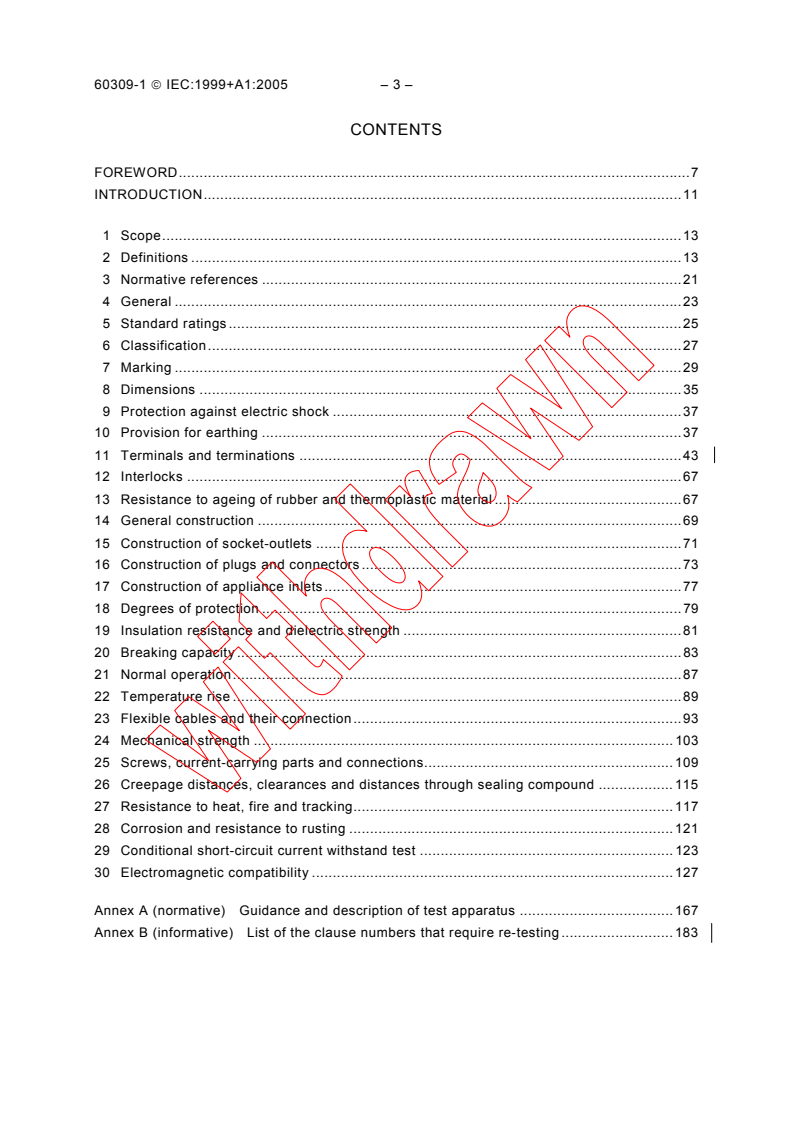
60309-1 IEC:1999+A1:2005 – 3 –
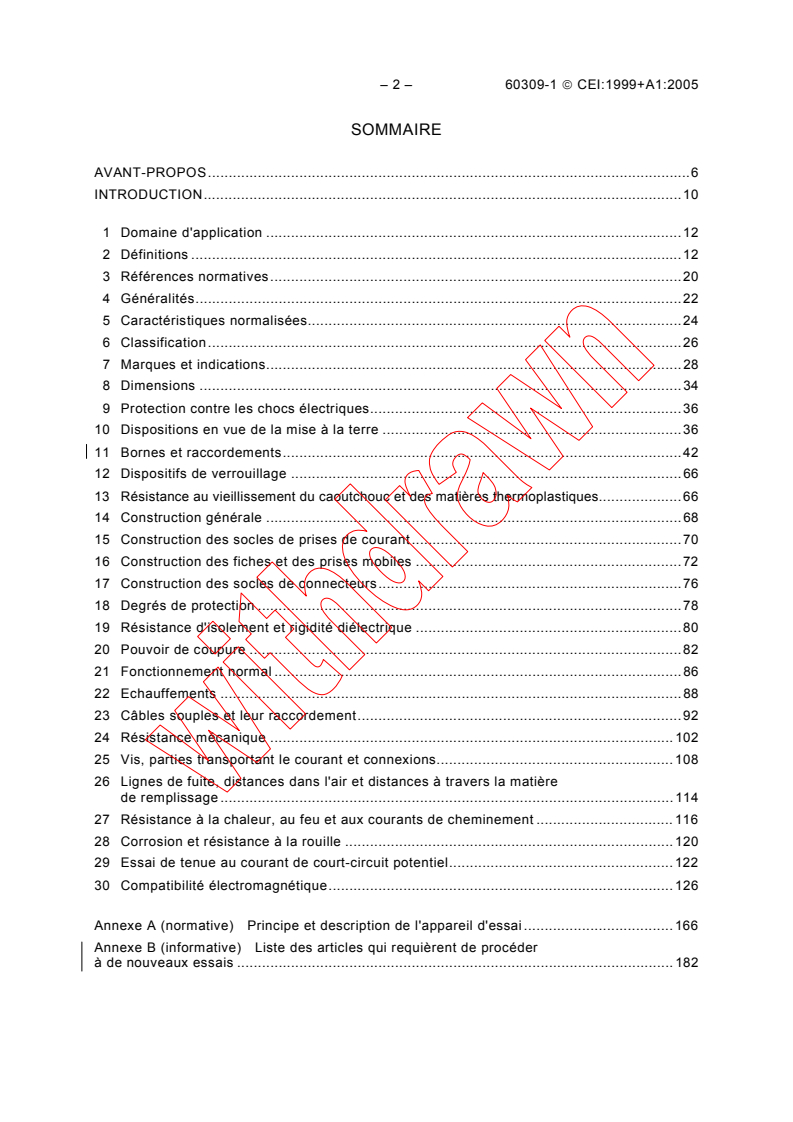
CONTENTS
FOREWORD.7
INTRODUCTION.11
1 Scope.13
2 Definitions .13
3 Normative references .21
4 General .23
5 Standard ratings .25
6 Classification.27
7 Marking .29
8 Dimensions .35
9 Protection against electric shock .37
10 Provision for earthing .37
11 Terminals and terminations .43
12 Interlocks .67
13 Resistance to ageing of rubber and thermoplastic material .67
14 General construction .69
15 Construction of socket-outlets .71
16 Construction of plugs and connectors .73
17 Construction of appliance inlets.77
18 Degrees of protection .79
19 Insulation resistance and dielectric strength .81
20 Breaking capacity .83
21 Normal operation.87
22 Temperature rise .89
23 Flexible cables and their connection.93
24 Mechanical strength .103
25 Screws, current-carrying parts and connections.109
26 Creepage distances, clearances and distances through sealing compound .115
27 Resistance to heat, fire and tracking.117
28 Corrosion and resistance to rusting .121
29 Conditional short-circuit current withstand test .123
30 Electromagnetic compatibility .127
Annex A (normative) Guidance and description of test apparatus .167
Annex B (informative) List of the clause numbers that require re-testing .183
60309-1 IEC:1999+A1:2005 – 5 –
Figure 1 – Diagram showing the use of the accessories.129
Figure 2 – Standard test finger.131
Figure 3 – Spray apparatus.133
Figure 4 – Splash apparatus .135
Figure 5 – Circuit diagrams for breaking capacity and normal operation tests .137
Figure 6 – Apparatus for testing the cable anchorage .139
Figure 7 – Impact-test apparatus .141
Figure 8 – Arrangement for mechanical strength test for plugs and connectors .141
Figure 9 – Apparatus for flexing test .143
Figure 10 – Ball-pressure apparatus .143
Figure 11a – Test apparatus (example).145
Figure 11b – Glow-wire and position of the thermocouple .147
Figure 12 – Arrangement and dimensions of the electrodes for the tracking test .149
Figure 13 – Gauges for testing insertability of round unprepared conductors having
the maximum specified cross-section.151
Figure 14 – Examples of terminals .153
Figure 15 – Equipment test arrangement .157
Figure 16 – Diagram of the test circuit for the verification of short-circuit current
withstand of a two-pole equipment on a single-phase a.c. or d.c. .159
Figure 17 – Diagram of the test circuit for the verification of short-circuit current
withstand of a three-pole equipment .161
Figure 18 – Diagram of the test circuit for the verification of short-circuit current
withstand of a four-pole equipment .163
Figure 19 – Information for the bending test.165
Figure A.1 – Impact test fixture – Pendulum assembly .171
Figure A.2 – Impact test fixture – Pendulum masses – Quantity: 4 .175
Figure A.3 – Impact test fixture – Pendulum shaft end .177
Figure A.4 – Impact test fixture – Pendulum anvil .177
Figure A.5 – Impact test fixture – Pendulum shaft .179
Figure A.6 – Impact text fixture – Pendulum pivot .179
Figure A.7 – Impact test apparatus – Back and mounting plates .181
60309-1 © IEC:1999+A1:2005 – 7 –
INTERNATIONAL ELECTROTECHNICAL COMMISSION
____________
PLUGS, SOCKET-OUTLETS AND COUPLERS
FOR INDUSTRIAL PURPOSES –
Part 1: General requirements
FOREWORD
1) The International Electrotechnical Commission (IEC) is a worldwide organization for standardization comprising
all national electrotechnical committees (IEC National Committees). The object of IEC is to promote
international co-operation on all questions concerning standardization in the electrical and electronic fields. To
this end and in addition to other activities, IEC publishes International Standards, Technical Specifications,
Technical Reports, Publicly Available Specifications (PAS) and Guides (hereafter referred to as “IEC
Publication(s)”). Their preparation is entrusted to technical committees; any IEC National Committee interested
in the subject dealt with may participate in this preparatory work. International, governmental and non-
governmental organizations liaising with the IEC also participate in this preparation. IEC collaborates closely
with the International Organization for Standardization (ISO) in accordance with conditions determined by
agreement between the two organizations.
2) The formal decisions or agreements of IEC on technical matters express, as nearly as possible, an international
consensus of opinion on the relevant subjects since each technical committee has representation from all
interested IEC National Committees.
3) IEC Publications have the form of recommendations for international use and are accepted by IEC National
Committees in that sense. While all reasonable efforts are made to ensure that the technical content of IEC
Publications is accurate, IEC cannot be held responsible for the way in which they are used or for any
misinterpretation by any end user.
4) In order to promote international uniformity, IEC National Committees undertake to apply IEC Publications
transparently to the maximum extent possible in their national and regional publications. Any divergence
between any IEC Publication and the corresponding national or regional publication shall be clearly indicated in
the latter.
5) IEC provides no marking procedure to indicate its approval and cannot be rendered responsible for any
equipment declared to be in conformity with an IEC Publication.
6) All users should ensure that they have the latest edition of this publication.
7) No liability shall attach to IEC or its directors, employees, servants or agents including individual experts and
members of its technical committees and IEC National Committees for any personal injury, property damage or
other damage of any nature whatsoever, whether direct or indirect, or for costs (including legal fees) and
expenses arising out of the publication, use of, or reliance upon, this IEC Publication or any other IEC
Publications.
8) Attention is drawn to the Normative references cited in this publication. Use of the referenced publications is
indispensable for the correct application of this publication.
9) Attention is drawn to the possibility that some of the elements of this IEC Publication may be the subject of
patent rights. IEC shall not be held responsible for identifying any or all such patent rights.
International Standard IEC 60309-1 has been prepared by subcommittee 23H: Industrial plugs
and socket-outlets, of IEC technical committee 23: Electrical accessories.
This consolidated version of IEC 60309-1 consists of the fourth (1999) [documents
23H/88/FDIS and 23H/91/RVD] and its amendment 1 (2005) [documents 23H/174/FDIS and
23H/182/RVD].
The technical content is therefore identical to the base edition and its amendment and has
been prepared for user convenience.
It bears the edition number 4.1.
A vertical line in the margin shows where the base publication has been modified by
amendment 1.
Annex A forms an integral part of this standard.
Annex B is for information only.
60309-1 IEC:1999+A1:2005 – 9 –
The committee has decided that the contents of the base publication and its amendments will
remain unchanged until the maintenance result date indicated on the IEC web site under
"http://webstore.iec.ch" in the data related to the specific publication. At this date,
the publication will be
• reconfirmed,
• withdrawn,
• replaced by a revised edition, or
• amended.
60309-1 IEC:1999+A1:2005 – 11 –
INTRODUCTION
International Standard IEC 60309 is divided into several parts:
Part 1: General requirements, comprising clauses of a general character.
Subsequent parts: Particular requirements dealing with particular types. The clauses of these
particular requirements supplement or modify the corresponding clauses in part 1. Where the
text of subsequent parts indicates an "addition" to or a "replacement" of the relevant
requirement, test specification or explanation of part 1, these changes are made to the
relevant text of part 1, which then becomes part of the standard. Where no change is
necessary, the words "This clause of part 1 is applicable" are used.
60309-1 IEC:1999+A1:2005 – 13 –
PLUGS, SOCKET-OUTLETS AND COUPLERS
FOR INDUSTRIAL PURPOSES –
Part 1: General requirements
1 Scope
This standard applies to plugs and socket-outlets, cable couplers and appliance couplers, with
a rated operating voltage not exceeding 690 V d.c. or a.c. and 500 Hz a.c., and a rated
current not exceeding 250 A, primarily intended for industrial use, either indoors or outdoors.
The list of preferred ratings is not intended to exclude other ratings.
This standard applies to plugs and socket-outlets, cable couplers and appliance couplers,
hereinafter referred to as accessories, for use when the ambient temperature is normally
within the range of –25 °C to +40 °C. These accessories are intended to be connected to
cables of copper or copper alloy only.
This standard applies to accessories with screwless type terminals or insulation piercing
terminals, with a rated current up to and including 16 A for Series I and 20 A for Series II.
The use of these accessories on building sites and for agricultural, commercial and domestic
applications is not precluded.
Socket-outlets or appliance inlets incorporated in or fixed to electrical equipment are within
the scope of this standard. This standard also applies to accessories intended to be used in
extra-low voltage installations.
This standard does not apply to accessories primarily intended for domestic and similar
general purposes.
In locations where special conditions prevail, for example on board ship or where explosions
are liable to occur, additional requirements may be necessary.
2 Definitions
Where the terms voltage and current are used, they imply the d.c. or the a.c. r.m.s. values.
For the purpose of this part of IEC 60309, the following definitions apply.
The application of accessories is shown in Figure 1.
2.1
plug and socket-outlet
a means enabling the connection at will of a flexible cable to fixed wiring. It consists of two
parts:
60309-1 IEC:1999+A1:2005 – 15 –
2.1.1
socket-outlet
the part intended to be installed with the fixed wiring or incorporated in equipment.
A socket-outlet may also be incorporated in the output circuit of an isolating transformer
2.1.2
plug
the part integral with or intended to be attached directly to one flexible cable connected to the
equipment or to a connector
2.2
cable coupler
a means enabling the connection at will of two flexible cables. It consists of two parts:
2.2.1
connector
the part integral with or intended to be attached to one flexible cable connected to the supply
NOTE In general, a connector has the same contact arrangement as a socket-outlet.
2.2.2
plug
the part integral with or intended to be attached to one flexible cable connected to the
equipment or to a connector
NOTE The plug of a cable coupler is identical to the plug of a "plug and socket-outlet".
2.3
appliance coupler
a means enabling the connection at will of a flexible cable to the equipment. It consists of two
parts:
2.3.1
connector
the part integral with, or intended to be attached to, one flexible cable connected to the supply
NOTE In general, the connector of an appliance coupler is identical to the connector of a cable coupler.
2.3.2
appliance inlet
the part incorporated in, or fixed to, the equipment or intended to be fixed to it
NOTE In general, an appliance inlet has the same contact arrangement as a plug.
2.4
rewirable plug or connector
an accessory so constructed that the flexible cable can be replaced
2.5
non-rewirable plug or connector
an accessory so constructed that the flexible cable cannot be separated from the accessory
without making it permanently useless
60309-1 IEC:1999+A1:2005 – 17 –
2.6
mechanical switching device
a switching device designed to close and open one or more electric circuits by means of
separable contacts
2.7
switched socket-outlet
a socket-outlet with an associated switching device to disconnect the supply from the socket-
outlet contacts
2.8
integral switching device
a mechanical switching device constructed as a part of an accessory covered by this standard
2.9
interlock
a device, either electrical or mechanical, which prevents the contacts of a plug from becoming
live before it is in proper engagement with a socket-outlet or connector, and which either
prevents the plug from being withdrawn while its contacts are live or makes the contacts dead
before separation
2.10
retaining device
a mechanical arrangement which holds a plug or connector in position when it is in proper
engagement, and prevents its unintentional withdrawal
2.11
rated current
the current assigned to the accessory by the manufacturer
2.12
insulation voltage
the voltage assigned to the accessory by the manufacturer and to which dielectric tests,
clearances and creepage distances are referred
2.13
rated operating voltage
the nominal voltage of the supply for which the accessory is intended to be used
2.14
basic insulation
the insulation necessary for the proper functioning of the accessory and for basic protection
against electric shock
2.15
supplementary insulation (protective insulation)
an independent insulation provided in addition to the basic insulation, in order to ensure
protection against electric shock in the event of a failure of the basic insulation
2.16
double insulation
insulation comprising both basic insulation and supplementary insulation
60309-1 IEC:1999+A1:2005 – 19 –
2.17
reinforced insulation
an improved basic insulation with such mechanical and electrical qualities that it provides the
same degree of protection against electric shock as double insulation
2.18
terminal
a conductive part provided for the connection of a conductor to an accessory
2.18.1
pillar terminal
a terminal in which the conductor is inserted into a hole or cavity, where it is clamped under
the shank of the screw or screws. The clamping pressure may be applied directly by the
shank of the screw or through an intermediate clamping member to which pressure is applied
by the shank of the screw (see Figure 14a)
2.18.2
screw terminal
a terminal in which the conductor is clamped under the head of the screw. The clamping
pressure may be applied directly by the head of the screw or through an intermediate part,
such as a washer, clamping plate or anti-spread device (see Figures 14b and 14c)
2.18.3
stud terminal
a terminal in which the conductor is clamped under a nut. The clamping pressure may be
applied directly by a suitably shaped nut or through an intermediate part, such as a washer,
clamping plate or anti-spread device (see Figure 14d)
2.18.4
saddle terminal
a terminal in which the conductor is clamped under a saddle by means of two or more screws
or nuts (see Figure 14e)
2.18.5
lug terminal
a screw terminal or a stud terminal, designed for clamping a cable lug or bar by means of a
screw or nut (see Figure 14f)
2.18.6
mantle terminal
a terminal in which the conductor is clamped against the base of a slot in a threaded stud by
means of a nut. The conductor is clamped against the base of the slot by a suitably shaped
washer under the nut, by a central peg if the nut is a cap nut, or by equally effective means
for transmitting the pressure from the nut to the conductor within the slot (see Figure 14g)
2.18.7
screwless type terminal
a terminal for the connection and subsequent disconnection of one or more conductors, the
connection being made, directly or indirectly, by other means than screws
NOTE Examples of screwless type terminals are given in Figure 14h.
60309-1 IEC:1999+A1:2005 – 21 –
2.18.8
insulation piercing terminal
IPT
a terminal for the connection and subsequent disconnection of one or more conductors, the
connection being made by piercing, boring through, cutting through, removing, displacing or
making ineffective in some other manner the insulation of the conductor(s) without previous
stripping
NOTE 1 The removal of the sheath of the cable, if necessary, is not considered as a previous stripping.
NOTE 2 Examples of IPT are given in Figure 14i.
2.19
clamping unit
the part of a terminal necessary for the clamping and the electrical connection of the
conductor
2.20
conditional short-circuit current
the prospective current that an accessory, protected by a specified short-circuit protective
device, can satisfactorily withstand for the total operating time of that device under specified
conditions of use and behaviour
NOTE This definition differs from IEV 441-17-20 by broadening the concept of current-limiting device into a short-
circuit protective device, the function of which is not only to limit the current.
2.21
cap
a part separated or attached, which may be used to provide the degree of protection of a plug
or appliance inlet when it is not engaged with a socket-outlet or connector
2.22
lid
a means to ensure the degree of protection on a socket-outlet or a connector
3 Normative references
The following referenced documents are indispensable for the application of this document.
For dated references, only the edition cited applies. For undated references, the latest edition
of the referenced document (including any amendments) applies.
IEC 60050-441:1984, International Electrotechnical Vocabulary (IEV) – Chapter 441:
Switchgear, controlgear and fuses
IEC 60083:1997, Plugs and socket-outlets for domestic and similar general use standardized
in member countries of IEC
IEC 60112:1979, Method for determining the comparative and the proof tracking indices of
solid insulating materials under moist conditions
IEC 60227, (all parts) Polyvinyl chloride insulated cables of rated voltages up to and including
450/750 V
IEC 60228:1978, Conductors of insulated cables
IEC 60245-4:1994, Rubber insulated cables – Rated voltages up to and including 450/750 V –
Part 4: Cords and flexible cables
60309-1 IEC:1999+A1:2005 – 23 –
IEC 60269-1:1986, Low-voltage fuses – Part 1: General requirements
IEC 60269-2:1986, Low-voltage fuses – Part 2: Supplementary requirements for fuses for use
by authorized persons (fuses mainly for industrial application) – Sections I to III
IEC 60320, (all parts) Appliance couplers for household and similar general purposes
IEC 60529:1989, Degrees of protection provided by enclosures (IP code)
IEC 60664-1:1992, Insulation coordination for equipment within low-voltage systems – Part 1:
Principles, requirements and tests
IEC 60695-2-1:1994, Fire hazard testing – Part 2: Test methods
IEC 60947-3:1990, Low-voltage switchgear and controlgear – Part 3: Switches, disconnectors,
switch-disconnectors and fuse-combination units
ISO 2081, Metallic coatings – Electroplated coatings of zinc on iron or steel
ISO 2093, Electroplated coatings of tin – Specification and test methods
ISO 1456, Metallic coatings – Electrodeposited coatings of nickel plus chromium and of
copper plus nickel plus chromium
4 General
4.1 General requirements
Accessories shall be so designed and constructed that in normal use their performance is
reliable and without danger to the user or surroundings.
Unless otherwise stated, the normal use environment in which the devices complying with this
standard are normally used is pollution degree 3 according to IEC 60664-1.
If other pollution degrees are needed, creepage and clearance distances have to be in
accordance with IEC 60664-1. The comparative tracking index (CTI) value shall be evaluated
in accordance with IEC 60112.
Combinations of plugs, socket-outlets, appliance inlets and connectors that are intended for
use together shall comply with the requirements of this standard and the relevant standard
sheet, if any.
In general, compliance is checked by carrying out all the tests specified.
4.2 General notes on tests
4.2.1 Tests according to this standard are type tests. If a part of an accessory has previously
passed tests for a given degree of severity, the relevant type tests shall not be repeated if the
severity is not greater. When a part or a component is incorporated in a device or accessory
according to IEC 60309 standard, and if this part or component meets an appropriate IEC
standard, then no further test(s) or requirement(s) shall be required for this part or
component, unless it is being used in a way significantly different from the intent of its own
standard.
60309-1 IEC:1999+A1:2005 – 25 –
4.2.2 Unless otherwise specified, the samples are tested as delivered and under normal
conditions of use, at an ambient temperature of (20 ± 5) °C; the tests are made at rated
frequency.
4.2.3 Unless otherwise specified, the tests are carried out in the order of the clauses of this
standard.
4.2.4 Three samples are subjected to all the tests, except if necessary for the tests of 11.1.4
and Clause 29 where, for each clause, one new set of samples is tested. If, however, the
tests of Clauses 20, 21 and 22 have to be made with both d.c. and a.c., the tests with a.c. are
made on three additional samples.
4.2.5 Accessories are deemed to comply with this standard if no sample fails in the complete
series of appropriate tests. If one sample fails in a test, that test and those preceding which
may have influenced the test result are repeated on another set of three samples, all of which
shall then pass the repeated tests.
NOTE In general, it will only be necessary to repeat the test which caused the failure, unless the sample fails in
one of the tests of clauses 21 and 22, in which case the tests are repeated from that of clause 20 onwards.
The applicant may submit, together with the first set of samples, the additional set which may be wanted should
one sample fail. The testing station will then, without further request, test the additional samples and will reject
only if a further failure occurs. If the additional set of samples is not submitted at the same time, the failure of one
sample will entail a rejection.
4.2.6 When the tests are carried out with conductors, they shall be copper and comply with
IEC 60227, IEC 60228 [clause 2, solid (class 1), stranded (class 2), flexible (class 5)] and
IEC 60245-4, as accessories according to this standard are intended to be connected to cables
with copper or copper-alloy conductors only.
5 Standard ratings
5.1 Preferred rated operating voltage ranges and voltages are:
20 V to 25 V 380 V to 415 V
40 V to 50 V 440 V to 460 V
100 V to 130 V 480 V to 500 V
200 V to 250 V 600 V to 690 V
277 V
5.2 Preferred rated currents are given in the following table:
Table 1
Series I Series II
A A
16 20
32 30
63 60
125 100
250 200
NOTE Ratings referred as “Other ratings” in this standard are given for test purpose only, when the manufacturer
has not used the preferred ratings.
60309-1 IEC:1999+A1:2005 – 27 –
6 Classification
6.1 Accessories are classified:
6.1.1 according to purpose: plugs, socket-outlets, connectors, appliance inlets;
6.1.2 according to degrees of protection in accordance with IEC 60529
NOTE According to IEC 60529, an accessory designated with second characteristic numeral 7 or 8 is only
suitable for immersion. For protection against exposure to water jets, additional testing is required according to
second characteristic numeral 5 or 6 and then the product should be marked accordingly.
6.1.3 according to earthing facilities:
– accessories without earthing contact;
– accessories with earthing contact;
6.1.4 according to the method of connecting the cable:
– rewirable plugs and connectors;
– non-rewirable plugs and connectors;
6.1.5 according to interlocking facilities:
– accessories without interlock, with or without integral switching device;
– accessories with mechanical interlock;
– accessories with electrical interlock.
6.1.6 according to the type of terminals
– with screw type terminals;
– with screwless type terminals;
– with insulation piercing terminals.
6.1.7 according to the type of conductors for screwless type and insulation piercing
terminals
– for solid conductors only;
– for rigid (both solid and stranded) conductors only;
– for flexible conductors only;
– for rigid (both solid and stranded) and flexible conductors.
60309-1 IEC:1999+A1:2005 – 29 –
7 Marking
7.1 Accessories shall be marked with:
– rated current(s) in amperes;
– rated operating voltage(s) or range(s) in volts;
– symbol for nature of supply, if the accessory is not intended for both a.c. and d.c., or is
intended for a.c. with frequencies other than 50 Hz or 60 Hz, or if the rating is different for
alternative current and direct current;
– rated frequency if exceeding 60 Hz;
– either the name or trade mark of the manufacturer or of the responsible vendor;
– type reference, which may be a catalogue number;
– symbol for degree of protection, as applicable;
– symbol indicating the position of the earthing contact or the means used for
interchangeability, if any.
NOTE Optionally, the insulation voltage may be marked.
Compliance is checked by inspection.
7.2 When symbols are used, they shall be as follows:
A . amperes
V . volts
Hz . hertz
.............................................. alternating current
.............................................. direct current
(preferred) or . earth
IPXX (relevant figures) . degree of protection according to IEC 60529
For IP codes, the two characteristic numerals (XX) shall be specified.
Marking of degree of protection on plugs and appliance inlets is only valid when in
engagement with a complementary accessory or with an attached cap, if any.
For the marking of rated current(s) and rated operating voltage(s) or range(s), figures may be
used alone.
The figure for d.c. rated operating voltage, if any, shall then be placed before the figure for
the a.c. rated operating voltage, and separated from it by a line or a dash.
Compliance is checked by inspection.
60309-1 IEC:1999+A1:2005 – 31 –
7.3 For socket-outlets and appliance inlets, the marking for rated current, nature of supply, if
necessary, and either the name or trade mark of the manufacturer or the responsible vendor
shall be on the main part, on the outside of the enclosure, or on the lid, if any, if the latter
cannot be removed without the aid of a tool.
Except for flush-type socket-outlets and appliance inlets, these markings shall be easily
discernible when the accessory is mounted and wired as in normal use, if necessary after it
has been removed from the enclosure. The marking, if any, for the insulation voltage shall be
on the main part; it shall not be visible when the accessory is mounted and wired as in normal
use.
The marking for rated operating voltage, type reference, the symbol for degree of protection,
if required, and the symbol indicating the position of the earthing contact or the means used
for interchangeability, if any, shall be on a place which is visible after installation of the
accessory, on the outside of enclosure or on the lid, if any, if the latter cannot be removed
without the aid of a tool.
With the exception of the type reference, these markings shall be easily discernible when the
accessory is mounted and wired as in normal use.
Compliance is checked by inspection.
NOTE The term "main part" of a socket-outlet or an appliance inlet means the part carrying the contacts.
The type reference may be marked on the main part.
The marking for rated current, nature of supply, rated operating voltage and the name or trade
mark of the manufacturer or the responsible vendor, may be repeated on the lid, if any.
7.4 For plugs and connectors, the marking specified in 7.1, with the exception of the marking
for insulation voltage, if any, shall be easily discernible when the accessory is wired ready for
use.
The marking for insulation voltage, if any, shall be on the main part; it shall not be visible
when the accessory is mounted and wired as in normal use.
NOTE The term "ready for use" does not imply that the plug or connector is in engagement with its
complementary accessory.
NOTE The term "main part" of a plug or a connector means the part carrying the contacts.
Compliance is checked by inspection.
7.5 For rewirable accessories, the contacts shall be indicated by the symbols:
– for three-phase, the symbols L1, L2, L3, or 1, 2, 3 for the phases, N for neutral, if any, and
the symbol or for earth;
– for two-pole, which may be used for both a.c. and d.c., one symbol for one of the live
poles and the symbol or for earth, if any;
– for a period of time the marking R1, S2, T3 may be used instead of L1, L2, L3.
60309-1 IEC:1999+A1:2005 – 33 –
These symbols shall be placed close to the relevant terminals; they shall not be placed on
screws, removable washers or other removable parts.
NOTE The terminals for pilot conductors are not required to be indicated.
The figures used with the letters may be written as an index. It is recommended that where practicable the
symbol , should be used.
Compliance is checked by inspection.
7.6 Marking shall be indelible and easily legible.
Compliance is checked by inspection and by the following test:
After the humidity treatment of clause 18, the marking is rubbed vigorously by hand for 15 s
with a piece of cloth soaked in water and again for 15 s with a piece of cloth soaked with
petroleum spirit.
Special attention is paid to the marking of the name or trade mark of the manufacturer or the
responsible vendor and to that of the nature of supply, if any.
NOTE A special test for checking the indelibility of these markings is under consideration.
7.7 If, in addition to the marking prescribed, the rated operating voltage is indicated by
means of a colour, the colour code shall be as shown in Table 2. An indicating colour, if
different from that of the enclosure, shall be used only if it can be easily distinguished.
Table 2
1) 2)
Rated operating voltage Colour
V
20 to 25 Violet
40 to 50 White
100 to 130 Yellow
200 to 250 Blue
380 to 480 Red
500 to 690 Black
1)
For frequencies over 60 Hz up to and including 500 Hz, the
colour green may be used, if necessary, in combination with the
colour for the rated operating voltage.
2)
In countries where accessories of series II current ratings are
used, the colour orange is reserved for 125/250 V a.c. and the
colour grey is reserved for 277 V a.c. accessories.
7.8 Accessories with screwless type terminals shall be marked with the length of insulation
to be removed before insertion of the conductor into the terminal.
7.9 Terminals according to 6.1.7 shall be marked as follows:
– terminals declared for solid conductors only with the letter(s) “s” or “sol”;
– terminals declared for rigid conductors only (both solid and stranded) with the letter “r”
– terminals declared for flexible conductors only with the letter “f”;
60309-1 IEC:1999+A1:2005 – 35 –
– terminals declared for rigid (both solid and stranded) and flexible conductors need not be
marked.
This marking shall appear where it is practical on the end product or on the smallest package
unit or in the manufacturer’s technical documentation and/or catalogues.
7.10 For terminals, the connection and disconnection procedures, if necessary, shall be
indicated on the product, on the smallest package unit or on the manufacturer’s
documentation.
8 Dimensions
8.1 Accessories shall comply with the appropriate standard sheets, if any. When standard
sheets do not exist, accessories shall comply with manufacturer’s specifications.
8.2 It shall not be possible to engage plugs or connectors with socket-outlets or appliance
inlets having different ratings, or having contact combinations allowing improper connection.
In addition, the design shall be such that improper connections shall not be possible between:
– the earth and/or pilot plug contact and a live socket-outlet contact, or a live plug contact
and the earth and/or pilot socket-outlet contact;
– the phase plug contacts and the neutral socket-outlet contact, if any;
– the neutral plug contact and a phase socket-outlet contact.
Connection of single-phase or three-phase plugs into three-phase + neutral socket-outlets are
permitted where the above conditions are met.
Compliance is checked by inspection.
8.3 It shall not be possible to make single-pole connections between plugs and socket-
outlets or connectors, or between appliance inlets and connectors or socket-outlets.
Plugs and appliance inlets shall not allow improper connections with socket-outlets complying
with IEC 60083 or with connectors complying with IEC 60320.
Socket-outlets and connectors shall not allow improper connections with plugs complying with
IEC 60083 or with appliance inlets complying with IEC 60320.
Improper connections include single-pole connections and other connections which do not
comply with the requirements for protection against electric shock.
Compliance is checked by inspection.
60309-1 IEC:1999+A1:2005 – 37 –
9 Protection against electric shock
9.1 Accessories shall be so designed that live parts of socket-outlets and connectors, when
they are wired as in normal use, and live parts of plugs and appliance inlets, when they are in
partial or complete engagement with the complementary accessories, are not accessible.
In addition, it shall not be possible to make contact between a contact of a plug or appliance
inlet and a contact of a socket-outlet or connector while any contact is accessible.
Compliance is checked by inspection and, if necessary, by a test on the sample wired as in
normal use.
The standard test finger shown in Figure 2 is applied in every possible position, an electrical
indicator, with a voltage not less than 40 V, being used to show contact with the relevant part.
NOTE The neutral contact and pilot contacts of socket-outlets and connectors are deemed to be live parts.
9.2 Accessories with earthing contact shall be so designed that:
– when inserting the plug or connector, the earth connection is made before the phase
connections and neutral, if any, are made;
– when withdrawing the plug or connector, the phase connections and neutral, if any, are
broken before the earth connection is broken.
9.3 It shall not be possible to inadvertently assemble the part carrying plug contacts into the
enclosure of a socket-outlet or connector.
Compliance is checked by manual test.
10 Provision for earthing
10.1 Accessories with earthing contact shall be provided with an earthing terminal. Metal-
clad fixed accessories with an internal earthing terminal can, in addition, be provided with an
external earthing terminal, which, except for flush type socket-outlets, shall be visible from the
outside.
Earthing contacts shall be directly and reliably connecte
...
NORME CEI
INTERNATIONALE 60309-1
Edition 4.1
2005-12
Edition 4:1999 consolidée par l’amendement 1:2005
Prises de courant pour usages industriels –
Partie 1:
Règles générales
Cette version française découle de la publication d’origine
bilingue dont les pages anglaises ont été supprimées.
Les numéros de page manquants sont ceux des pages
supprimées.
Numéro de référence
CEI 60309-1:1999+A1:2005(F)
Numérotation des publications
Depuis le 1er janvier 1997, les publications de la CEI sont numérotées à partir de
60000. Ainsi, la CEI 34-1 devient la CEI 60034-1.
Editions consolidées
Les versions consolidées de certaines publications de la CEI incorporant les
amendements sont disponibles. Par exemple, les numéros d’édition 1.0, 1.1 et 1.2
indiquent respectivement la publication de base, la publication de base incorporant
l’amendement 1, et la publication de base incorporant les amendements 1 et 2
Informations supplémentaires sur les publications de la CEI
Le contenu technique des publications de la CEI est constamment revu par la CEI
afin qu'il reflète l'état actuel de la technique. Des renseignements relatifs à cette
publication, y compris sa validité, sont disponibles dans le Catalogue des
publications de la CEI (voir ci-dessous) en plus des nouvelles éditions, amende-
ments et corrigenda. Des informations sur les sujets à l’étude et l’avancement des
travaux entrepris par le comité d’études qui a élaboré cette publication, ainsi que la
liste des publications parues, sont également disponibles par l’intermédiaire de:
• Site web de la CEI (www.iec.ch)
• Catalogue des publications de la CEI
Le catalogue en ligne sur le site web de la CEI (www.iec.ch/searchpub) vous permet
de faire des recherches en utilisant de nombreux critères, comprenant des
recherches textuelles, par comité d’études ou date de publication. Des informations
en ligne sont également disponibles sur les nouvelles publications, les publications
remplacées ou retirées, ainsi que sur les corrigenda.
• IEC Just Published
Ce résumé des dernières publications parues (www.iec.ch/online_news/justpub)
est aussi disponible par courrier électronique. Veuillez prendre contact avec le
Service client (voir ci-dessous) pour plus d’informations.
• Service clients
Si vous avez des questions au sujet de cette publication ou avez besoin de
renseignements supplémentaires, prenez contact avec le Service clients:
Email: custserv@iec.ch
Tél: +41 22 919 02 11
Fax: +41 22 919 03 00
NORME CEI
INTERNATIONALE 60309-1
Edition 4.1
2005-12
Edition 4:1999 consolidée par l’amendement 1:2005
Prises de courant pour usages industriels –
Partie 1:
Règles générales
IEC 2005 Droits de reproduction réservés
Aucune partie de cette publication ne peut être reproduite ni utilisée sous quelque forme que ce soit et par aucun
procédé, électronique ou mécanique, y compris la photocopie et les microfilms, sans l'accord écrit de l'éditeur.
International Electrotechnical Commission, 3, rue de Varembé, PO Box 131, CH-1211 Geneva 20, Switzerland
Telephone: +41 22 919 02 11 Telefax: +41 22 919 03 00 E-mail: inmail@iec.ch Web: www.iec.ch
CODE PRIX
CT
Commission Electrotechnique Internationale
International Electrotechnical Commission
МеждународнаяЭлектротехническаяКомиссия
Pour prix, voir catalogue en vigueur
– 2 – 60309-1 CEI:1999+A1:2005
SOMMAIRE
AVANT-PROPOS.6
INTRODUCTION.10
1 Domaine d'application .12
2 Définitions .12
3 Références normatives.20
4 Généralités.22
5 Caractéristiques normalisées.24
6 Classification.26
7 Marques et indications.28
8 Dimensions .34
9 Protection contre les chocs électriques.36
10 Dispositions en vue de la mise à la terre .36
11 Bornes et raccordements.42
12 Dispositifs de verrouillage .66
13 Résistance au vieillissement du caoutchouc et des matières thermoplastiques.66
14 Construction générale .68
15 Construction des socles de prises de courant.70
16 Construction des fiches et des prises mobiles .72
17 Construction des socles de connecteurs.76
18 Degrés de protection .78
19 Résistance d'isolement et rigidité diélectrique .80
20 Pouvoir de coupure .82
21 Fonctionnement normal .86
22 Echauffements .88
23 Câbles souples et leur raccordement.92
24 Résistance mécanique .102
25 Vis, parties transportant le courant et connexions.108
26 Lignes de fuite, distances dans l'air et distances à travers la matière
de remplissage .114
27 Résistance à la chaleur, au feu et aux courants de cheminement .116
28 Corrosion et résistance à la rouille .120
29 Essai de tenue au courant de court-circuit potentiel.122
30 Compatibilité électromagnétique.126
Annexe A (normative) Principe et description de l'appareil d'essai.166
Annexe B (informative) Liste des articles qui requièrent de procéder
à de nouveaux essais .182
– 4 – 60309-1 CEI:1999+A1:2005
Figure 1 – Schéma indiquant l'emploi des appareils.128
Figure 2 – Doigt d'épreuve.130
Figure 3 – Appareil d'arrosage .132
Figure 4 – Appareil d'éclaboussement .134
Figure 5 – Schémas du circuit pour les essais du pouvoir de coupure
et du fonctionnement normal.136
Figure 6 – Appareil d'essai du dispositif d'ancrage de câble.138
Figure 7 – Appareil d'essai de choc .140
Figure 8 – Dispositif pour l'essai de la résistance mécanique des fiches
et des prises mobiles .140
Figure 9 – Appareil d'essai de flexion .142
Figure 10 – Appareil pour l'essai à la bille.142
Figure 11a – Appareil d'essai (exemple) .144
Figure 11b – Fil incandescent et position du thermocouple .146
Figure 12 – Arrangement et dimensions des électrodes pour l'essai de résistance
aux courants de cheminement .148
Figure 13 – Calibres pour essayer la possibilité d'introduction des conducteurs
circulaires de la section maximale spécifiée sans préparation spéciale .150
Figure 14 – Exemples de bornes .152
Figure 15 – Disposition de l'appareillage d'essai.156
Figure 16 – Schéma d'essai pour la vérification de la résistance au courant
de court-circuit conditionnel d'un matériel bipolaire en courant monophasé
ou en courant continu .158
Figure 17 – Schéma d'essai pour la vérification de la résistance au courant
de court-circuit conditionnel d'un matériel tripolaire.160
Figure 18 – Schéma d'essai pour la vérification de la résistance au courant
de court-circuit conditionnel d'un matériel tétrapolaire.162
Figure 19 – Indications pour l'essai de déflexion .164
Figure A.1 – Appareil fixe pour essai d'impact – Assemblage du pendule .170
Figure A.2 – Appareil fixe pour essai d'impact – Masses du pendule – Quantité: 4.174
Figure A.3 – Appareil fixe pour essai d'impact – Queue d'arbre du pendule .176
Figure A.4 – Appareil fixe pour essai d'impact – Marteau du pendule.176
Figure A.5 – Appareil fixe pour essai d'impact – Queue d'arbre du pendule .178
Figure A.6 – Appareil fixe pour essai d'impact – Pivot du pendule.178
Figure A.7 – Appareil fixe pour essai d'impact – Plaques arrière et de montage.180
– 6 – 60309-1 © CEI:1999+A1:2005
COMMISSION ÉLECTROTECHNIQUE INTERNATIONALE
____________
PRISES DE COURANT POUR USAGES INDUSTRIELS –
Partie 1: Règles générales
AVANT-PROPOS
1) La Commission Electrotechnique Internationale (CEI) est une organisation mondiale de normalisation
composée de l'ensemble des comités électrotechniques nationaux (Comités nationaux de la CEI). La CEI a
pour objet de favoriser la coopération internationale pour toutes les questions de normalisation dans les
domaines de l'électricité et de l'électronique. A cet effet, la CEI – entre autres activités – publie des Normes
internationales, des Spécifications techniques, des Rapports techniques, des Spécifications accessibles au
public (PAS) et des Guides (ci-après dénommés "Publication(s) de la CEI"). Leur élaboration est confiée à des
comités d'études, aux travaux desquels tout Comité national intéressé par le sujet traité peut participer. Les
organisations internationales, gouvernementales et non gouvernementales, en liaison avec la CEI, participent
également aux travaux. La CEI collabore étroitement avec l'Organisation Internationale de Normalisation (ISO),
selon des conditions fixées par accord entre les deux organisations.
2) Les décisions ou accords officiels de la CEI concernant les questions techniques représentent, dans la mesure
du possible, un accord international sur les sujets étudiés, étant donné que les Comités nationaux de la CEI
intéressés sont représentés dans chaque comité d’études.
3) Les Publications de la CEI se présentent sous la forme de recommandations internationales et sont agréées
comme telles par les Comités nationaux de la CEI. Tous les efforts raisonnables sont entrepris afin que la CEI
s'assure de l'exactitude du contenu technique de ses publications; la CEI ne peut pas être tenue responsable
de l'éventuelle mauvaise utilisation ou interprétation qui en est faite par un quelconque utilisateur final.
4) Dans le but d'encourager l'uniformité internationale, les Comités nationaux de la CEI s'engagent, dans toute la
mesure possible, à appliquer de façon transparente les Publications de la CEI dans leurs publications
nationales et régionales. Toutes divergences entre toutes Publications de la CEI et toutes publications
nationales ou régionales correspondantes doivent être indiquées en termes clairs dans ces dernières.
5) La CEI n’a prévu aucune procédure de marquage valant indication d’approbation et n'engage pas sa
responsabilité pour les équipements déclarés conformes à une de ses Publications.
6) Tous les utilisateurs doivent s'assurer qu'ils sont en possession de la dernière édition de cette publication.
7) Aucune responsabilité ne doit être imputée à la CEI, à ses administrateurs, employés, auxiliaires ou
mandataires, y compris ses experts particuliers et les membres de ses comités d'études et des Comités
nationaux de la CEI, pour tout préjudice causé en cas de dommages corporels et matériels, ou de tout autre
dommage de quelque nature que ce soit, directe ou indirecte, ou pour supporter les coûts (y compris les frais
de justice) et les dépenses découlant de la publication ou de l'utilisation de cette Publication de la CEI ou de
toute autre Publication de la CEI, ou au crédit qui lui est accordé.
8) L'attention est attirée sur les références normatives citées dans cette publication. L'utilisation de publications
référencées est obligatoire pour une application correcte de la présente publication.
9) L’attention est attirée sur le fait que certains des éléments de la présente Publication de la CEI peuvent faire
l’objet de droits de propriété intellectuelle ou de droits analogues. La CEI ne saurait être tenue pour
responsable de ne pas avoir identifié de tels droits de propriété et de ne pas avoir signalé leur existence.
La Norme internationale CEI 60309-1 a été établie par le sous-comité 23H: Prises de courant
à usages industriels, du comité d'études 23 de la CEI: Petit appareillage.
La présente version consolidée de la CEI 60309-1 comprend la quatrième édition (1999)
[documents 23H/88/FDIS et 23H/91/RVD] et son amendement 1 (2005) [documents
23H/174/FDIS et 23H/182/RVD].
Le contenu technique de cette version consolidée est donc identique à celui de l'édition de
base et à son amendement; cette version a été préparée par commodité pour l'utilisateur.
Elle porte le numéro d'édition 4.1.
Une ligne verticale dans la marge indique où la publication de base a été modifiée par
l'amendement 1.
L'annexe A fait partie intégrante de cette norme.
L'annexe B est donnée uniquement à titre d'information.
– 8 – 60309-1 CEI:1999+A1:2005
Le comité a décidé que le contenu de la publication de base et de ses amendements ne sera
pas modifié avant la date de maintenance indiquée sur le site web de la CEI sous
"http://webstore.iec.ch" dans les données relatives à la publication recherchée. A cette date,
la publication sera
• reconduite,
• supprimée,
• remplacée par une édition révisée, ou
• amendée.
– 10 – 60309-1 CEI:1999+A1:2005
INTRODUCTION
La Norme internationale CEI 60309 est divisée en plusieurs parties:
Partie 1: Règles générales, qui comprend les articles de caractère général.
Parties suivantes: Règles particulières, traitant de types particuliers. Les articles de ces
règles particulières représentent des compléments ou modifications aux articles
correspondants de la première partie. Si le texte des parties subséquentes indique une
«addition» ou un «remplacement» des règles, essais ou commentaires pertinents de la
partie 1, ces changements sont introduits dans les passages pertinents de la partie 1, et ils
deviennent alors des parties de la norme. Lorsque aucune modification n'est nécessaire, les
mots «L'article de la partie 1 est applicable» sont utilisés.
– 12 – 60309-1 CEI:1999+A1:2005
PRISES DE COURANT POUR USAGES INDUSTRIELS –
Partie 1: Règles générales
1 Domaine d'application
La présente norme s'applique aux prises de courant, aux prolongateurs et aux connecteurs,
de tension nominale d'emploi ne dépassant pas 690 V en courant continu ou en courant
alternatif, de fréquence ne dépassant pas 500 Hz en courant alternatif, et de courant nominal
ne dépassant pas 250 A, destinés essentiellement aux usages industriels, à l'intérieur ou à
l'extérieur des bâtiments.
La liste des calibres préférentiels n'est pas destinée à exclure les autres calibres.
La présente norme s'applique aux prises de courant, aux prolongateurs et aux connecteurs,
désignés dans la suite du texte sous le nom d'appareils, pour usage dans une température
ambiante comprise dans une plage de –25 °C à +40 °C. Les appareils sont prévus pour être
connectés à des câbles en cuivre ou alliage de cuivre seulement.
La présente norme s'applique aux appareils équipés de bornes sans vis ou de bornes à
perçage d’isolant, de courant nominal ne dépassant pas 16 A pour la série I et 20 A pour la
série II.
L'usage de ces appareils dans des chantiers de construction et pour des applications
agricoles, commerciales et domestiques n'est pas exclu.
Les socles de prises de courant ou les socles de connecteurs incorporés ou fixés au matériel
électrique sont compris dans le domaine d'application de la présente norme. La présente
norme s'applique aussi aux appareils destinés à être utilisés dans les installations à très
basse tension.
La présente norme ne s'applique pas aux appareils destinés essentiellement aux usages
domestiques et analogues.
Pour l'emploi dans des locaux présentant des conditions particulières, par exemple à bord
des navires et dans les locaux présentant des dangers d'explosion, des prescriptions complé-
mentaires peuvent être nécessaires.
2 Définitions
Lorsque les termes tension et courant sont employés, ils impliquent les valeurs en courant
continu ou les valeurs efficaces en courant alternatif.
Pour les besoins de la présente partie de la CEI 60309, les définitions suivantes s'appliquent.
L'application des appareils est indiqué en Figure 1.
2.1
prise de courant
ensemble destiné à relier électriquement à volonté un câble souple à une canalisation fixe.
Elle se compose de deux parties:
– 14 – 60309-1 CEI:1999+A1:2005
2.1.1
socle de prise de courant
partie destinée à être installée avec la canalisation fixe ou à être incorporée au matériel.
Un socle de prise de courant peut aussi être incorporé dans le circuit secondaire d'un
transformateur de séparation des circuits
2.1.2
fiche
partie faisant corps avec le câble souple raccordé au matériel ou à une prise mobile ou
destinée à être reliée directement à un tel câble
2.2
prolongateur
ensemble destiné à relier électriquement à volonté deux câbles souples. Il se compose de
deux parties:
2.2.1
prise mobile
partie faisant corps avec le câble souple d'alimentation, ou destinée à être reliée à un tel
câble
NOTE En général, une prise mobile a les mêmes organes de contact qu'un socle de prise de courant.
2.2.2
fiche
partie faisant corps avec le câble souple raccordé au matériel ou à une prise mobile ou
destinée à être reliée à un tel câble
NOTE La fiche d'un prolongateur est identique à la fiche d'une prise de courant.
2.3
connecteur
ensemble destiné à relier électriquement à volonté un câble souple au matériel. Il se compose
de deux parties:
2.3.1
prise mobile
partie faisant corps avec le câble souple d'alimentation, ou destinée à être reliée à un tel
câble
NOTE En général, la prise mobile d'un connecteur est identique à la prise mobile d'un prolongateur.
2.3.2
socle de connecteur
partie incorporée ou fixée au matériel, ou destinée à y être fixée
NOTE En général, un socle de connecteur a les mêmes organes de contact qu'une fiche.
2.4
fiche démontable ou prise mobile démontable
appareil construit de façon que le câble souple puisse être remplacé
2.5
fiche non démontable ou prise mobile non démontable
appareil construit de façon que le câble souple ne puisse être séparé de l'appareil sans le
rendre définitivement inutilisable
– 16 – 60309-1 CEI:1999+A1:2005
2.6
dispositif mécanique d'interruption
dispositif d'interruption destiné à fermer et à ouvrir un ou plusieurs circuits électriques au
moyen de contacts séparables
2.7
socle interrupteur
socle comportant un dispositif de coupure associé, qui coupe l'alimentation des contacts du
socle
2.8
dispositif d'interruption incorporé
dispositif d'interruption construit comme partie intégrante d'un appareil couvert par la
présente norme
2.9
dispositif de verrouillage
ensemble, électrique ou mécanique, qui empêche la mise sous tension des contacts d'une
fiche avant qu'elle soit suffisamment engagée dans un socle de prise de courant ou dans une
prise mobile, et qui empêche l'extraction de la fiche tant que ses contacts sont sous tension
ou met hors tension les contacts avant séparation
2.10
dispositif de retenue
mécanisme qui maintient en place une fiche ou une prise mobile lorsqu'elle est suffisamment
engagée et qui empêche tout retrait involontaire
2.11
courant nominal
courant assigné à l'appareil par le fabricant
2.12
tension d'isolement
tension assignée à l'appareil par le fabricant et à laquelle se rapportent les essais
diélectriques, les distances dans l'air et les lignes de fuite
2.13
tension nominale d'emploi
tension nominale du réseau pour lequel l'appareil est destiné à être utilisé
2.14
isolation principale
isolation nécessaire pour assurer le fonctionnement convenable de l'appareil et la protection
fondamentale contre les chocs électriques
2.15
isolation suppIémentaire (isolation de protection)
isolation indépendante prévue en plus de l'isolation principale, en vue d'assurer la protection
principale
contre les chocs électriques en cas de défaut de l'isolation
2.16
double isolation
isolation comprenant à la fois une isolation principale et une isolation supplémentaire
– 18 – 60309-1 CEI:1999+A1:2005
2.17
isolation renforcée
isolation principale améliorée ayant des propriétés mécaniques et électriques telles qu'elle
procure le même degré de protection contre les chocs électriques qu'une double isolation
2.18
borne
partie conductrice destinée à raccorder un conducteur à un appareil
2.18.1
borne à trou
borne dans laquelle l'âme d'un conducteur est introduite dans un trou ou dans un logement,
où elle est serrée sous le corps de la vis ou des vis. La pression de serrage peut être
appliquée directement par le corps de la vis ou au moyen d'un organe de serrage
intermédiaire auquel la pression est appliquée par le corps de la vis (voir Figure 14a)
2.18.2
borne à serrage sous tête de vis
borne dans laquelle l'âme d'un conducteur est serrée sous la tête de la vis. La pression de
serrage peut être appliquée directement par la tête de la vis ou au moyen d'un organe
intermédiaire, tel qu'une rondelle, une plaquette ou un dispositif empêchant le conducteur ou
ses brins de s'échapper (voir Figures 14b et 14c)
2.18.3
borne à goujon fileté
borne dans laquelle l'âme d'un conducteur est serrée sous un écrou. La pression de serrage
peut être appliquée directement par un écrou de forme appropriée ou au moyen d'un organe
intermédiaire, tel qu'une rondelle, une plaquette ou un dispositif empêchant le conducteur ou
ses brins de s'échapper (voir Figure 14d)
2.18.4
borne à plaquette
borne dans laquelle l'âme d'un conducteur est serrée sous une plaquette au moyen de deux
ou plus de deux vis ou écrous (voir Figure 14e)
2.18.5
borne pour cosses et barres
borne à serrage sous tête de vis ou borne à goujon fileté prévue pour le serrage d'une cosse
ou d'une barre au moyen d'une vis ou d'un écrou (voir Figure 14f)
2.18.6
borne à capot taraudé
borne dans laquelle l'âme d'un conducteur est serrée au moyen d'un écrou contre le fond
d'une fente pratiquée dans un goujon fileté. L'âme est serrée contre le fond de la fente par
une rondelle de forme appropriée placée sous l'écrou, par un téton central si l'écrou est un
capot taraudé, ou par d'autres moyens aussi efficaces pour transmettre la pression de l'écrou
à l'âme à l'intérieur de la fente (voir Figure 14g)
2.18.7
borne sans vis
borne pour la connexion et la déconnexion d’un ou de plusieurs conducteurs, la connexion
étant réalisée directement ou indirectement par un moyen autre que par vis
NOTE Des exemples de bornes sans vis sont donnés dans la Figure 14h.
– 20 – 60309-1 CEI:1999+A1:2005
2.18.8
borne à perçage d’isolant
BPI
borne pour la connexion et la déconnexion d’un ou de plusieurs conducteurs, la connexion
étant réalisée par perçage, transpercement, découpage, enlèvement ou déplacement, ou en
rendant inopérante d’une autre façon l’isolation du ou des conducteurs sans dénudage
préalable
NOTE 1 L’enlèvement de la gaine du câble, si nécessaire, n’est pas considéré comme un dénudage préalable.
NOTE 2 Des exemples de BPI sont donnés dans la Figure 14i.
2.19
élément de serrage
partie de la borne indispensable pour le serrage et la connexion électrique du conducteur
2.20
courant de court-circuit potentiel
courant présumé qu'un appareil, protégé par un dispositif spécifié de protection contre les
courts-circuits, peut supporter de façon satisfaisante pendant la durée totale de fonction-
nement de ce dispositif dans les conditions spécifiées d'emploi et de comportement
NOTE Cette définition diffère de celle du VEI 441-17-20 en élargissant le concept de dispositif de limitation de
courant à un dispositif de protection contre les courts-circuits dont la fonction n'est pas uniquement de limiter le
courant.
2.21
bouchon
partie, séparée ou attachée, qui peut être utilisée pour procurer le degré de protection d'une
fiche ou d'un socle de connecteur lorsqu'elle n'est pas engagée sur un socle de prise de
courant ou une prise mobile
2.22
couvercle
dispositif pour assurer le degré de protection sur un socle de prise de courant ou une prise
mobile
3 Références normatives
Les documents de référence suivants sont indispensables pour l'application du présent
document. Pour les références datées, seule l'édition citée s'applique. Pour les références
non datées, la dernière édition du document de référence s'applique (y compris les éventuels
amendements).
CEI 60050-441:1984, Vocabulaire Electrotechnique International (VEI) – Chapitre 441:
Appareillage et fusible
CEI 60083:1997, Prises de courant pour usages domestique et analogue, normalisées par les pays
membres de la CEI
CEI 60112:1979, Méthode pour déterminer les indices de résistance et de tenue au
cheminement des matériaux isolants solides dans des conditions humides
CEI 60227, (toutes les parties) Conducteurs et câbles isolés au polychlorure de vinyle, de
tension nominale au plus égale à 450/750 V
CEI 60228:1978, Ames des câbles isolés
CEI 60245-4:1994, Conducteurs et câbles isolés au caoutchouc – Tension assignée au plus
égale à 450/750 V – Partie 4: Câbles souples
– 22 – 60309-1 CEI:1999+A1:2005
CEI 60269-1:1986, Fusibles basse tension – Partie 1: Règles générales
CEI 60269-2:1986, Fusibles basse tension – Partie 2: Règles supplémentaires pour les
fusibles destinés à être utilisés par des personnes habilitées (fusibles pour usages
essentiellement industriels) – Sections I à III
CEI 60320, (toutes les parties) Connecteurs pour usages domestiques et usages généraux
analogues
CEI 60529:1989, Degrés de protection procurés par les enveloppes (Code IP)
CEI 60664-1:1992, Coordination de l'isolement des matériels dans les systèmes (réseaux) à
basse tension – Partie 1: Principes, prescriptions et essais
CEI 60695-2-1:1994, Essais relatifs aux risques du feu – Partie 2: Méthodes d'essai
CEI 60947-3:1990, Appareillage à basse tension – Partie 3: Interrupteurs, sectionneurs,
interrupteurs-sectionneurs et combinés-fusibles
ISO 2081, Revêtements métalliques – Dépôts électrolytiques de zinc sur fer ou acier
ISO 2093, Dépôts électrolytiques d'étain – Spécifications et méthodes d'essai
ISO 1456, Revêtements métalliques – Dépôts électrolytiques de nickel plus chrome et de
cuivre plus nickel plus chrome
4 Généralités
4.1 Prescriptions générales
Les appareils doivent être prévus et construits de façon qu'en usage normal leur
fonctionnement soit sûr et que l'utilisateur ou l'entourage ne puissent pas être mis en danger.
Sauf indication contraire, l'environnement d'utilisation normale des appareils inclus dans le
domaine d'application est le degré de pollution 3, conformément à la CEI 60664-1.
Si d'autres degrés de pollution sont nécessaires, les lignes de fuites et distances dans l'air
doivent être conformes à la CEI 60664-1. L'indice de résistance au cheminement (IRC) doit
être conforme à la CEI 60112.
Les ensembles de prises de courant, prolongateurs et connecteurs destinés à être utilisés
ensemble doivent satisfaire aux exigences de cette norme et aux feuilles de norme les
concernant, si elles existent.
En général, la conformité est vérifiée en effectuant la totalité des essais prescrits.
4.2 Généralités sur les essais
4.2.1 Les essais mentionnés dans cette norme sont des essais de type. Dans le cas où une
partie d'un appareil a déjà satisfait à un essai pour un degré de sévérité donné, les essais de
type correspondants ne doivent pas être répétés si la sévérité des essais n'est pas plus
grande. Si une pièce ou un composant incorporé dans un appareil couvert par la CEI 60309
est lui-même conforme à une norme CEI, alors aucun test ou prescription complémentaire ne
sera requis de cette pièce ou de ce composant, à moins que son usage soit significativement
différent de celui prévu par la norme qui le concerne.
– 24 – 60309-1 CEI:1999+A1:2005
4.2.2 Sauf spécification contraire, Ies échantillons sont essayés en l'état de livraison et dans
les conditions normales d'emploi, la température ambiante étant de (20 ± 5) °C; les essais
sont effectués à la fréquence nominale.
4.2.3 Sauf spécification contraire, les essais sont effectués dans l'ordre des articles de la
présente norme.
4.2.4 Trois échantillons sont soumis à tous les essais. Si les essais de 11.1.4 et de l’Article
29 sont nécessaires, un seul échantillon neuf supplémentaire doit être soumis aux essais de
chaque article. Si les essais des Articles 20, 21 et 22 doivent être effectués à la fois en
courant continu et en courant alternatif, les essais en courant alternatif sont faits sur trois
échantillons supplémentaires.
4.2.5 Les appareils sont réputés conformes à la présente norme si aucune défaillance n'est
constatée au cours de l'ensemble des essais appropriés. Si un essai n'est pas subi avec
succès par l'un des échantillons, on le répète, ainsi que tous ceux qui le précèdent et qui
peuvent avoir exercé une influence sur son résultat, sur un nouveau lot de trois échantillons;
ces nouveaux échantillons doivent alors tous satisfaire aux essais recommencés.
NOTE En général, il suffira de répéter l'essai où est apparu le défaut, sauf s'il s'agit de l'un des essais des
articles 21 et 22, auquel cas il faut recommencer les essais qui précèdent à partir de celui de l'article 20.
Le demandeur a la possibilité de déposer, en même temps que le premier lot d'échantillons, le lot supplémentaire
qui peut être nécessaire en cas d'échec de l'un des échantillons. Le laboratoire essaiera alors sans autre avis, les
échantillons supplémentaires, le rejet ne pouvant intervenir qu'à la suite d'un nouvel échec. Si le lot
supplémentaire d'échantillons n'est pas fourni initialement, l'échec d'un des échantillons présentés motive le rejet.
4.2.6 Quand les essais sont effectués avec des conducteurs, ceux-ci doivent être en cuivre
et conformes à la CEI 60227, à la CEI 60228 [article 2, rigides (classe 1), câblés (classe 2),
souples (classe 5)] et à la CEI 60245-4, les appareils conformes à la présente norme étant
prévus pour être raccordés à des câbles avec conducteurs à âme de cuivre ou alliage de
cuivre seulement.
5 Caractéristiques normalisées
5.1 Les valeurs nominales recommandées des plages de tension et des tensions d'emploi sont:
20 V à 25 V 380 V à 415 V
40 V à 50 V 440 V à 460 V
100 V à 130 V 480 V à 500 V
200 V à 250 V 600 V à 690 V
277 V
5.2 Les valeurs nominales recommandées des courants sont:
Tableau 1
Série I Série II
A A
16 20
32 30
63 60
125 100
250 200
NOTE Les calibres appelés «Autres calibres» dans cette norme ne sont indiqués qu’à fin d’essais, lorsque le
fabricant n’a pas fait usage des calibres préférentiels.
– 26 – 60309-1 CEI:1999+A1:2005
6 Classification
6.1 Les appareils sont classés:
6.1.1 d'après la destination en: fiches, socles de prises de courant, prises mobiles, socles
de connecteurs;
6.1.2 suivant les degrés de protection conformément à la CEI 60529
NOTE Suivant la CEI 60529, un appareil dont le deuxième chiffre caractéristique est un 7 ou un 8 n’est protégé
que contre les effets de l’immersion. Pour la protection contre les jets d’eau, des essais supplémentaires sont
requis, correspondant au deuxième chiffre caractéristique 5 ou 6. Il convient que les produits soient alors marqués
conformément aux essais réalisés.
6.1.3 d'après la présence de contacts de terre en:
– appareils sans contact de terre;
– appareils avec contact de terre;
6.1.4 d'après le mode de raccordement du câble en:
– fiches et prises mobiles démontables;
– fiches et prises mobiles non démontables;
6.1.5 d'après la présence et le mode de verrouillage en:
– appareils sans verrouillage, avec ou sans dispositif d'interruption incorporé;
– appareils à verrouillage mécanique;
– appareils à verrouillage électrique.
6.1.6 suivant le type de bornes
– avec bornes à vis;
– avec bornes sans vis;
– avec bornes à perçage d’isolant.
6.1.7 suivant le type de conducteurs acceptés par les bornes sans vis et bornes à perçage
d’isolant
– pour conducteurs massifs uniquement;
– pour conducteurs rigides (massifs et câblés) uniquement;
– pour conducteurs souples uniquement;
– pour conducteurs rigides (massifs et câblés) et souples.
– 28 – 60309-1 CEI:1999+A1:2005
7 Marques et indications
7.1 Les appareils doivent porter les indications suivantes:
– le ou les courant(s) nominal(aux) en ampères;
– la ou les tension(s) nominale(s) d'emploi ou la ou les plage(s) en volts;
– le symbole pour la nature du courant, si l'appareil n'est pas destiné à la fois au courant
alternatif et au courant continu, ou si l'appareil est destiné à des fréquences autres que
50 Hz ou 60 Hz, ou si les caractéristiques nominales sont différentes pour le courant
alternatif et pour le courant continu;
– la fréquence nominale lorsque celle-ci est supérieure à 60 Hz;
– soit le nom, soit la marque de fabrique du fabricant ou du vendeur responsable;
– la référence du type, qui peut être un numéro de catalogue;
– le symbole du degré de protection, si applicable;
– le symbole indiquant la position du contact de terre ou les moyens utilisés pour assurer
l'interchangeabilité, si elle existe.
NOTE La tension d'isolement peut être marquée en option.
La conformité est vérifiée par examen.
7.2 Lorsqu'il est fait usage de symboles, ils doivent être comme suit:
A . pour ampères
V . pour volts
Hz . pour hertz
................................................ pour courant alternatif
.............................................. pour courant continu
(de préférence) ou . terre
IPXX (chiffres correspondants). degrés de protection selon la CEI 60529
Pour les degrés IP, les deux chiffres caractéristiques (XX) doivent être indiqués.
Le marquage du degré de protection sur les fiches ou socles de connecteurs est uniquement
valide quand l'appareil est engagé dans l'appareil complémentaire, ou lorsqu'il comporte un
bouchon fixé, s'il existe.
Pour l'indication du ou des courants nominalaux, de la ou des tensions nominales d'emploi,
ou de la ou des plages, les chiffres peuvent être employés seuls.
Le nombre indiquant la tension nominale d'emploi en courant continu, s'il y a lieu, doit alors
être placé avant le nombre indiquant la tension nominale d'emploi en courant alternatif et
séparé de celui-ci par une ligne ou un tiret.
La conformité est vérifiée par examen.
– 30 – 60309-1 CEI:1999+A1:2005
7.3 Pour les socles de prises de courant et les socles de connecteurs, I'indication du
courant nominal, de la nature du courant, éventuellement, et le nom ou la marque de fabrique
du fabricant ou le nom du vendeur responsable doivent être portés sur la partie principale, à
l'extérieur de l'enveloppe, ou sur le couvercle, s'il existe, et si celui-ci ne peut pas être enlevé
sans l'aide d'un outil.
Sauf pour les socles de prises de courant et les socles de connecteurs encastrés, ces indications
doivent pouvoir être distinguées facilement lorsque le socle est installé et équipé de ses
conducteurs comme en usage normal, si nécessaire après enlèvement de l'enveloppe. L'indication
de la tension d'isolement, si elle existe, doit être portée sur la partie principale; elle ne doit pas être
visible lorsque l'appareil est installé et équipé de ses conducteurs comme en usage normal.
L'indication de la tension nominale d'emploi, de la référence du type, du symbole pour le degré
de protection, si nécessaire, et du symbole indiquant la position du contact de terre ou des
moyens éventuels utilisés pour assurer l'interchangeabilité, si elle existe, doivent être portés en
un endroit visible après montage de l'appareil, sur la partie extérieure de l'enveloppe ou sur le
couvercle, s'il existe, si celui-ci ne peut pas être enlevé sans l'aide d'un outil.
La référence du type exceptée, ces indications doivent pouvoir être distinguées facilement
lorsque l'appareil est installé et équipé de ses conducteurs comme en usage normal.
La conformité est vérifiée par examen.
NOTE L'expression «partie principale» d'un socle de prise de courant ou d'un socle de connecteur désigne la
partie qui porte les contacts.
La référence du type peut être marquée sur la partie principale.
Le marquage du courant nominal, de la nature du courant, de la tension d'emploi nominale et
le nom du fabricant, ou sa marque commerciale, ou le nom du vendeur responsable peut être
répété sur le couvercle s'il existe.
7.4 Pour les fiches et les prises mobiles, les marques et indications spécifiées en 7.1, à
l'exception de l'indication de la tension d'isolement s'il y a lieu, doivent pouvoir être
distinguées facilement lorsque l'appareil est équipé de ses conducteurs et prêt à l'usage.
L'indication de la tension d'isolement, s'il y a lieu, doit être portée sur la partie principale; elle
ne doit pas être visible lorsque l'appareil est installé et équipé de ses conducteurs comme en
usage normal.
NOTE L'expression «prêt à l'emploi» n'implique pas qu'une fiche ou une prise mobile soit engagée dans l`appareil
complémentaire.
NOTE L'expression «partie principale» d'une fiche ou d'une prise mobile désigne la partie qui porte les contacts.
La conformité est vérifiée par examen.
7.5 Pour les appareils démontables, les contacts doivent être repérés par les symboles
suivants:
– pour le triphasé, les symboles L1, L2, L3, ou 1, 2, 3 pour les phases, N pour neutre, s'il
existe et le symbole ou pour la terre;
– pour le bipolaire, qui peut être utilisé soit en courant alternatif soit en courant continu, un
symbole pour l'un des pôles actifs et le symbole ou pour la terre, si elle existe;
– pendant un temps, les indications R1, S2, T3 peuvent être utilisées à la place de L1, L2, L3.
– 32 – 60309-1 CEI:1999+A1:2005
Ces symboles doivent être placés près des bornes correspondantes; ils ne doivent pas être
placés sur des vis, des rondelles amovibles ou d'autres parties amovibles.
NOTE Aucun repérage n'est requis pour les bornes des conducteurs pilotes.
Les chiffres utilisés avec des lettres peuvent être écrits en indices. Il est recommandé d'utiliser, si possible, le
symbole .
La conformité est vérifiée par examen.
7.6 Les marques et indications doivent être indélébiles et facilement lisibles.
La conformité est effectuée par examen, et par l'essai suivant:
Après l'épreuve hygroscopique de l'article 18, on essaie d'effacer les marques et indications
en les frottant énergiquement à la main pendant 15 s avec un chiffon imbibé d'eau et à
nouveau pendant 15 s avec un chiffon imbibé d'essence.
Une attention particulière est portée à l'indication du nom ou de la marque de fabrique du
fabricant ou du vendeur responsable et, éventuellement, à celle de la nature du courant.
NOTE Un essai spécial pour vérifier l'indélébilité de ces marquages est à l'étude.
7.7 Si, en plus du marquage prescrit, la tension nominale d'emploi est indiquée par une
couleur, le code de couleurs doit être celui indiqué dans le Tableau 2. Une couleur de
repérage, si elle est différente de celle de l'enveloppe, ne doit être utilisée que si elle peut
être facilement distinguée.
Tableau 2
1) 2)
Tension nominale d'emploi Couleur
V
20 à 25 Violet
40 à 50 Blanc
100 à 130 Jaune
200 à 250 Bleu
380 à 480 Rouge
500 à 690 Noir
1)
Pour les fréquences de 60 Hz à 500 Hz inclus, la couleur verte
peut être utilisée, si nécessaire, en combinaison avec la couleur
indiquant la tension nominale d'emploi.
2)
Dans les pays où sont employé les appareils de courant nominal
de la série II, la couleur orange est réservée aux appareils pour
125/250 V courant alternatif et la couleur grise aux appareils
pour 277 V courant alternatif.
7.8 Les appareils avec bornes sans vis doivent porter l’indication de la longueur d'isolation à
enlever avant insertion du cond
...
NORME CEI
INTERNATIONALE IEC
60309-1
INTERNATIONAL
Quatrième édition
STANDARD
Fourth edition
1999-02
Prises de courant pour usages industriels –
Partie 1:
Règles générales
Plugs, socket-outlets and couplers
for industrial purposes –
Part 1:
General requirements
Numéro de référence
Reference number
CEI/IEC 60309-1:1999
Numéros des publications Numbering
Depuis le 1er janvier 1997, les publications de la CEI As from 1 January 1997 all IEC publications are
sont numérotées à partir de 60000. issued with a designation in the 60000 series.
Publications consolidées Consolidated publications
Les versions consolidées de certaines publications de Consolidated versions of some IEC publications
la CEI incorporant les amendements sont disponibles. including amendments are available. For example,
Par exemple, les numéros d’édition 1.0, 1.1 et 1.2 edition numbers 1.0, 1.1 and 1.2 refer, respectively, to
indiquent respectivement la publication de base, la the base publication, the base publication incor-
publication de base incorporant l’amendement 1, et la porating amendment 1 and the base publication
publication de base incorporant les amendements 1 incorporating amendments 1 and 2.
et 2.
Validité de la présente publication Validity of this publication
Le contenu technique des publications de la CEI est The technical content of IEC publications is kept
constamment revu par la CEI afin qu'il reflète l'état under constant review by the IEC, thus ensuring that
actuel de la technique. the content reflects current technology.
Des renseignements relatifs à la date de reconfir- Information relating to the date of the reconfirmation
mation de la publication sont disponibles dans le of the publication is available in the IEC catalogue.
Catalogue de la CEI.
Les renseignements relatifs à des questions à l’étude et Information on the subjects under consideration and
des travaux en cours entrepris par le comité technique work in progress undertaken by the technical
qui a établi cette publication, ainsi que la liste des committee which has prepared this publication, as well
publications établies, se trouvent dans les documents ci- as the list of publications issued, is to be found at the
dessous: following IEC sources:
• «Site web» de la CEI* • IEC web site*
• Catalogue des publications de la CEI • Catalogue of IEC publications
Publié annuellement et mis à jour Published yearly with regular updates
régulièrement (On-line catalogue)*
(Catalogue en ligne)*
• IEC Bulletin
• Bulletin de la CEI Available both at the IEC web site* and
Disponible à la fois au «site web» de la CEI* as a printed periodical
et comme périodique imprimé
Terminology, graphical and letter
Terminologie, symboles graphiques
symbols
et littéraux
For general terminology, readers are referred to
En ce qui concerne la terminologie générale, le lecteur IEC 60050: International Electrotechnical Vocabulary
se reportera à la CEI 60050: Vocabulaire Electro- (IEV).
technique International (VEI).
For graphical symbols, and letter symbols and signs
Pour les symboles graphiques, les symboles littéraux approved by the IEC for general use, readers are
et les signes d'usage général approuvés par la CEI, le referred to publications IEC 60027: Letter symbols to
lecteur consultera la CEI 60027: Symboles littéraux à be used in electrical technology, IEC 60417: Graphical
utiliser en électrotechnique, la CEI 60417: Symboles symbols for use on equipment. Index, survey and
graphiques utilisables sur le matériel. Index, relevé et compilation of the single sheets and IEC 60617:
compilation des feuilles individuelles, et la CEI 60617: Graphical symbols for diagrams.
Symboles graphiques pour schémas.
* See web site address on title page.
* Voir adresse «site web» sur la page de titre.
NORME CEI
INTERNATIONALE IEC
60309-1
INTERNATIONAL
Quatrième édition
STANDARD
Fourth edition
1999-02
Prises de courant pour usages industriels –
Partie 1:
Règles générales
Plugs, socket-outlets and couplers
for industrial purposes –
Part 1:
General requirements
IEC 1999 Droits de reproduction réservés Copyright - all rights reserved
Aucune partie de cette publication ne peut être reproduite ni No part of this publication may be reproduced or utilized in
utilisée sous quelque forme que ce soit et par aucun procédé, any form or by any means, electronic or mechanical,
électronique ou mécanique, y compris la photo-copie et les including photocopying and microfilm, without permission in
microfilms, sans l'accord écrit de l'éditeur. writing from the publisher.
International Electrotechnical Commission 3, rue de Varembé Geneva, Switzerland
Telefax: +41 22 919 0300 e-mail: inmail@iec.ch IEC web site http://www.iec.ch
CODE PRIX
Commission Electrotechnique Internationale
XC
PRICE CODE
International Electrotechnical Commission
Pour prix, voir catalogue en vigueur
For price, see current catalogue
– 2 – 60309-1 CEI:1999
SOMMAIRE
Pages
AVANT-PROPOS . 4
INTRODUCTION .6
Articles
1 Domaine d'application . 8
2 Définitions. 8
3 Références normatives. 16
4 Généralités . 18
5 Caractéristiques normalisées . 20
6 Classification . 20
7 Marques et indications . 22
8 Dimensions . 28
9 Protection contre les chocs électriques. 28
10 Dispositions en vue de la mise à la terre. 30
11 Bornes . 32
12 Dispositifs de verrouillage . 42
13 Résistance au vieillissement du caoutchouc et des matières thermoplastiques. 44
14 Construction générale . 46
15 Construction des socles de prises de courant . 46
16 Construction des fiches et des prises mobiles. 50
17 Construction des socles de connecteurs. 52
18 Degrés de protection . 54
19 Résistance d'isolement et rigidité diélectrique. 58
20 Pouvoir de coupure . 60
21 Fonctionnement normal. 64
22 Echauffements . 66
23 Câbles souples et leur raccordement. 70
24 Résistance mécanique . 76
25 Vis, parties transportant le courant et connexions . 82
26 Lignes de fuite, distances dans l'air et distances à travers la matière de remplissage. 88
27 Résistance à la chaleur, au feu et aux courants de cheminement. 90
28 Corrosion et résistance à la rouille. 94
29 Tenue au courant de court-circuit potentiel . 96
30 Compatibilité électromagnétique. 100
Figures. 102
Annexe A – Principe et description de l'appareil d'essai . 138
60309-1 IEC:1999 – 3 –
CONTENTS
Page
FOREWORD . 5
INTRODUCTION .7
Clause
1 Scope . 9
2 Definitions. 9
3 Normative references . 17
4 General. 19
5 Standard ratings.21
6 Classification . 21
7 Marking. 23
8 Dimensions . 29
9 Protection against electric shock . 29
10 Provision for earthing . 31
11 Terminals. 33
12 Interlocks . 43
13 Resistance to ageing of rubber and thermoplastic material . 45
14 General construction . 47
15 Construction of socket-outlets . 47
16 Construction of plugs and connectors . 51
17 Construction of appliance inlets . 53
18 Degrees of protection . 55
19 Insulation resistance and dielectric strength. 59
20 Breaking capacity. 61
21 Normal operation. 65
22 Temperature rise. 67
23 Flexible cables and their connection . 71
24 Mechanical strength . 77
25 Screws, current-carrying parts and connections . 83
26 Creepage distances, clearances and distances through sealing compound . 89
27 Resistance to heat, fire and tracking. 91
28 Corrosion and resistance to rusting . 95
29 Conditional short-circuit current withstand test. 97
30 Electromagnetic compatibility . 101
Figures. 103
Annex A – Guidance and description of test apparatus. 139
– 4 – 60309-1 CEI:1999
COMMISSION ÉLECTROTECHNIQUE INTERNATIONALE
_________
PRISES DE COURANT POUR USAGES INDUSTRIELS –
Partie 1: Règles générales
AVANT-PROPOS
1) La CEI (Commission Electrotechnique Internationale) est une organisation mondiale de normalisation composée
de l'ensemble des comités électrotechniques nationaux (Comités nationaux de la CEI). La CEI a pour objet de
favoriser la coopération internationale pour toutes les questions de normalisation dans les domaines de
l'électricité et de l'électronique. A cet effet, la CEI, entre autres activités, publie des Normes Internationales.
Leur élaboration est confiée à des comités d'études, aux travaux desquels tout Comité national intéressé par le
sujet traité peut participer. Les organisations internationales, gouvernementales et non gouvernementales, en
liaison avec la CEI, participent également aux travaux. La CEI collabore étroitement avec l'Organisation
Internationale de Normalisation (ISO), selon des conditions fixées par accord entre les deux organisations.
2) Les décisions ou accords officiels de la CEI concernant les questions techniques, représentent, dans la mesure
du possible un accord international sur les sujets étudiés, étant donné que les Comités nationaux intéressés
sont représentés dans chaque comité d’études.
3) Les documents produits se présentent sous la forme de recommandations internationales. Ils sont publiés
comme normes, rapports techniques ou guides et agréés comme tels par les Comités nationaux.
4) Dans le but d'encourager l'unification internationale, les Comités nationaux de la CEI s'engagent à appliquer de
façon transparente, dans toute la mesure possible, les Normes internationales de la CEI dans leurs normes
nationales et régionales. Toute divergence entre la norme CEI et la norme nationale ou régionale
correspondante doit être indiquée en termes clairs dans cette dernière.
5) La CEI n’a fixé aucune procédure concernant le marquage comme indication d’approbation et sa responsabilité
n’est pas engagée quand un matériel est déclaré conforme à l’une de ses normes.
6) L’attention est attirée sur le fait que certains des éléments de la présente Norme internationale peuvent faire
l’objet de droits de propriété intellectuelle ou de droits analogues. La CEI ne saurait être tenue pour
responsable de ne pas avoir identifié de tels droits de propriété et de ne pas avoir signalé leur existence.
La Norme internationale CEI 60309-1 a été établie par le sous-comité 23H: Prises de courant à
usages industriels, du comité d'études 23 de la CEI: Petit appareillage.
Cette quatrième édition annule et remplace la troisième édition parue en 1997 et constitue une
révision technique.
Le texte de cette norme est issu des documents suivants:
FDIS Rapport de vote
23H/88/FDIS 23H/91/RVD
Le rapport de vote indiqué dans le tableau ci-dessus donne toute information sur le vote ayant
abouti à l'approbation de cette norme
L'annexe A fait partie intégrante de cette norme.
60309-1 IEC:1999 – 5 –
INTERNATIONAL ELECTROTECHNICAL COMMISSION
_________
PLUGS, SOCKET-OUTLETS AND COUPLERS FOR INDUSTRIAL PURPOSES –
Part 1: General requirements
FOREWORD
1) The IEC (International Electrotechnical Commission) is a worldwide organization for standardization comprising
all national electrotechnical committees (IEC National Committees). The object of the IEC is to promote
international co-operation on all questions concerning standardization in the electrical and electronic fields. To
this end and in addition to other activities, the IEC publishes International Standards. Their preparation is
entrusted to technical committees; any IEC National Committee interested in the subject dealt with may
participate in this preparatory work. International, governmental and non-governmental organizations liaising
with the IEC also participate in this preparation. The IEC collaborates closely with the International Organization
for Standardization (ISO) in accordance with conditions determined by agreement between the two
organizations.
2) The formal decisions or agreements of the IEC on technical matters express, as nearly as possible, an
international consensus of opinion on the relevant subjects since each technical committee has representation
from all interested National Committees.
3) The documents produced have the form of recommendations for international use and are published in the form
of standards, technical reports or guides and they are accepted by the National Committees in that sense.
4) In order to promote international unification, IEC National Committees undertake to apply IEC International
Standards transparently to the maximum extent possible in their national and regional standards. Any
divergence between the IEC Standard and the corresponding national or regional standard shall be clearly
indicated in the latter.
5) The IEC provides no marking procedure to indicate its approval and cannot be rendered responsible for any
equipment declared to be in conformity with one of its standards.
6) Attention is drawn to the possibility that some of the elements of this International Standard may be the subject
of patent rights. The IEC shall not be held responsible for identifying any or all such patent rights.
International Standard IEC 60309-1 has been prepared by subcommittee 23H: Industrial plugs
and socket-outlets, of IEC technical committee 23: Electrical accessories.
This fourth edition cancels and replaces the third edition published in 1997 and constitutes a
technical revision.
The text of this standard is based on the following documents:
FDIS Report on voting
23H/88/FDIS 23H/91/RVD
Full information on the voting for the approval of this standard can be found in the report on
voting indicated in the above table.
Annex A forms an integral part of this standard.
– 6 – 60309-1 CEI:1999
INTRODUCTION
La Norme internationale CEI 60309 est divisée en plusieurs parties:
Partie 1: Règles générales, qui comprend les articles de caractère général.
Parties suivantes: Règles particulières, traitant de types particuliers. Les articles de ces règles
particulières représentent des compléments ou modifications aux articles correspondants de la
première partie. Si le texte des parties subséquentes indique une «addition» ou un
«remplacement» des règles, essais ou commentaires pertinents de la partie 1, ces
changements sont introduits dans les passages pertinents de la partie 1, et ils deviennent alors
des parties de la norme. Lorsque aucune modification n'est nécessaire, les mots «L'article de
la partie 1 est applicable» sont utilisés.
60309-1 IEC:1999 – 7 –
INTRODUCTION
International Standard IEC 60309 is divided into several parts:
Part 1: General requirements, comprising clauses of a general character.
Subsequent parts: Particular requirements dealing with particular types. The clauses of these
particular requirements supplement or modify the corresponding clauses in part 1. Where the
text of subsequent parts indicates an "addition" to or a "replacement" of the relevant
requirement, test specification or explanation of part 1, these changes are made to the relevant
text of part 1, which then becomes part of the standard. Where no change is necessary, the
words "This clause of part 1 is applicable" are used.
– 8 – 60309-1 CEI:1999
PRISES DE COURANT POUR USAGES INDUSTRIELS –
Partie 1: Règles générales
1 Domaine d'application
La présente norme s'applique aux prises de courant, aux prolongateurs et aux connecteurs, de
tension nominale d'emploi ne dépassant pas 690 V en courant continu ou en courant alternatif,
de fréquence ne dépassant pas 500 Hz en courant alternatif, et de courant nominal ne
dépassant pas 250 A, destinés essentiellement aux usages industriels, à l'intérieur ou à
l'extérieur des bâtiments.
La liste des calibres préférentiels n'est pas destinée à exclure les autres calibres pour lesquels
les prescriptions correspondantes sont à l'étude.
La présente norme s'applique aux prises de courant, aux prolongateurs et aux connecteurs,
désignés dans la suite du texte sous le nom d'appareils, pour usage dans une température
ambiante comprise dans une plage de –25 °C à +40 °C. Les appareils sont prévus pour être
connectés à des câbles en cuivre ou alliage de cuivre seulement.
L'usage de ces appareils dans des chantiers de construction et pour des applications
agricoles, commerciales et domestiques n'est pas exclu.
Les socles de prises de courant ou les socles de connecteurs incorporés ou fixés au matériel
électrique sont compris dans le domaine d'application de la présente norme. La présente
norme s'applique aussi aux appareils destinés à être utilisés dans les installations à très basse
tension.
La présente norme ne s'applique pas aux appareils destinés essentiellement aux usages
domestiques et analogues.
Pour l'emploi dans des locaux présentant des conditions particulières, par exemple à bord des
navires et dans les locaux présentant des dangers d'explosion, des prescriptions complé-
mentaires peuvent être nécessaires.
2 Définitions
Lorsque les termes tension et courant sont employés, ils impliquent les valeurs en courant
continu ou les valeurs efficaces en courant alternatif.
Pour les besoins de la présente partie de la CEI 60309, les définitions suivantes s'appliquent.
L'application des appareils est indiqué en figure 1.
2.1
prise de courant
ensemble destiné à relier électriquement à volonté un câble souple à une canalisation fixe. Elle
se compose de deux parties:
60309-1 IEC:1999 – 9 –
PLUGS, SOCKET-OUTLETS AND COUPLERS FOR INDUSTRIAL PURPOSES –
Part 1: General requirements
1 Scope
This standard applies to plugs and socket-outlets, cable couplers and appliance couplers, with
a rated operating voltage not exceeding 690 V d.c. or a.c. and 500 Hz a.c., and a rated current
not exceeding 250 A, primarily intended for industrial use, either indoors or outdoors.
The list of preferred ratings is not intended to exclude other ratings, requirements for which are
under consideration.
This standard applies to plugs and socket-outlets, cable couplers and appliance couplers,
hereinafter referred to as accessories, for use when the ambient temperature is normally within
the range of –25 °C to +40 °C. These accessories are intended to be connected to cables of
copper or copper alloy only.
The use of these accessories on building sites and for agricultural, commercial and domestic
applications is not precluded.
Socket-outlets or appliance inlets incorporated in or fixed to electrical equipment are within the
scope of this standard. This standard also applies to accessories intended to be used in extra-
low voltage installations.
This standard does not apply to accessories primarily intended for domestic and similar general
purposes.
In locations where special conditions prevail, for example on board ship or where explosions
are liable to occur, additional requirements may be necessary.
2 Definitions
Where the terms voltage and current are used, they imply the d.c. or the a.c. r.m.s. values.
For the purpose of this part of IEC 60309, the following definitions apply.
The application of accessories is shown in figure 1.
2.1
plug and socket-outlet
a means enabling the connection at will of a flexible cable to fixed wiring. It consists of two
parts:
– 10 – 60309-1 CEI:1999
2.1.1
socle de prise de courant
partie destinée à être installée avec la canalisation fixe ou à être incorporée au matériel.
Un socle de prise de courant peut aussi être incorporé dans le circuit secondaire d'un
transformateur de séparation des circuits
2.1.2
fiche
partie faisant corps avec le câble souple raccordé au matériel ou à une prise mobile ou
destinée à être reliée directement à un tel câble
2.2
prolongateur
ensemble destiné à relier électriquement à volonté deux câbles souples. Il se compose de
deux parties:
2.2.1
prise mobile
partie faisant corps avec le câble souple d'alimentation, ou destinée à être reliée à un tel câble
NOTE – En général, une prise mobile a les mêmes organes de contact qu'un socle de prise de courant.
2.2.2
fiche
partie faisant corps avec le câble souple raccordé au matériel ou à une prise mobile ou
destinée à être reliée à un tel câble
NOTE – La fiche d'un prolongateur est identique à la fiche d'une prise de courant.
2.3
connecteur
ensemble destiné à relier électriquement à volonté un câble souple au matériel. Il se compose
de deux parties:
2.3.1
prise mobile
partie faisant corps avec le câble souple d'alimentation, ou destinée à être reliée à un tel câble
NOTE – En général, la prise mobile d'un connecteur est identique à la prise mobile d'un prolongateur.
2.3.2
socle de connecteur
partie incorporée ou fixée au matériel, ou destinée à y être fixée
NOTE – En général, un socle de connecteur a les mêmes organes de contact qu'une fiche.
2.4
fiche démontable ou prise mobile démontable
appareil construit de façon que le câble souple puisse être remplacé
2.5
fiche non démontable ou prise mobile non démontable
appareil construit de façon que le câble souple ne puisse être séparé de l'appareil sans le
rendre définitivement inutilisable
2.6
dispositif mécanique d'interruption
dispositif d'interruption destiné à fermer et à ouvrir un ou plusieurs circuits électriques au
moyen de contacts séparables
60309-1 IEC:1999 – 11 –
2.1.1
socket-outlet
the part intended to be installed with the fixed wiring or incorporated in equipment.
A socket-outlet may also be incorporated in the output circuit of an isolating transformer
2.1.2
plug
the part integral with or intended to be attached directly to one flexible cable connected to the
equipment or to a connector
2.2
cable coupler
a means enabling the connection at will of two flexible cables. It consists of two parts:
2.2.1
connector
the part integral with or intended to be attached to one flexible cable connected to the supply
NOTE – In general, a connector has the same contact arrangement as a socket-outlet.
2.2.2
plug
the part integral with or intended to be attached to one flexible cable connected to the
equipment or to a connector
NOTE – The plug of a cable coupler is identical to the plug of a "plug and socket-outlet".
2.3
appliance coupler
a means enabling the connection at will of a flexible cable to the equipment. It consists of two
parts:
2.3.1
connector
the part integral with, or intended to be attached to, one flexible cable connected to the supply
NOTE – In general, the connector of an appliance coupler is identical to the connector of a cable coupler.
2.3.2
appliance inlet
the part incorporated in, or fixed to, the equipment or intended to be fixed to it
NOTE – In general, an appliance inlet has the same contact arrangement as a plug.
2.4
rewirable plug or connector
an accessory so constructed that the flexible cable can be replaced
2.5
non-rewirable plug or connector
an accessory so constructed that the flexible cable cannot be separated from the accessory
without making it permanently useless
2.6
mechanical switching device
a switching device designed to close and open one or more electric circuits by means of
separable contacts
– 12 – 60309-1 CEI:1999
2.7
socle interrupteur
socle comportant un dispositif de coupure associé, qui coupe l'alimentation des contacts du
socle
2.8
dispositif d'interruption incorporé
dispositif d'interruption construit comme partie intégrante d'un appareil couvert par la présente
norme
2.9
dispositif de verrouillage
ensemble, électrique ou mécanique, qui empêche la mise sous tension des contacts d'une
fiche avant qu'elle soit suffisamment engagée dans un socle de prise de courant ou dans une
prise mobile, et qui empêche l'extraction de la fiche tant que ses contacts sont sous tension ou
met hors tension les contacts avant séparation
2.10
dispositif de retenue
mécanisme qui maintient en place une fiche ou une prise mobile lorsqu'elle est suffisamment
engagée et qui empêche tout retrait involontaire
2.11
courant nominal
courant assigné à l'appareil par le fabricant
2.12
tension d'isolement
tension assignée à l'appareil par le fabricant et à laquelle se rapportent les essais
diélectriques, les distances dans l'air et les lignes de fuite
2.13
tension nominale d'emploi
tension nominale du réseau pour lequel l'appareil est destiné à être utilisé
2.14
isolation principale
isolation nécessaire pour assurer le fonctionnement convenable de l'appareil et la protection
fondamentale contre les chocs électriques
2.15
isolation suppIémentaire (isolation de protection)
isolation indépendante prévue en plus de l'isolation principale, en vue d'assurer la protection
contre les chocs électriques en cas de défaut de l'isolation principale
2.16
double isolation
isolation comprenant à la fois une isolation principale et une isolation supplémentaire
2.17
isolation renforcée
isolation principale améliorée ayant des propriétés mécaniques et électriques telles qu'elle
procure le même degré de protection contre les chocs électriques qu'une double isolation
60309-1 IEC:1999 – 13 –
2.7
switched socket-outlet
a socket-outlet with an associated switching device to disconnect the supply from the socket-
outlet contacts
2.8
integral switching device
a mechanical switching device constructed as a part of an accessory covered by this standard
2.9
interlock
a device, either electrical or mechanical, which prevents the contacts of a plug from becoming
live before it is in proper engagement with a socket-outlet or connector, and which either
prevents the plug from being withdrawn while its contacts are live or makes the contacts dead
before separation
2.10
retaining device
a mechanical arrangement which holds a plug or connector in position when it is in proper
engagement, and prevents its unintentional withdrawal
2.11
rated current
the current assigned to the accessory by the manufacturer
2.12
insulation voltage
the voltage assigned to the accessory by the manufacturer and to which dielectric tests,
clearances and creepage distances are referred
2.13
rated operating voltage
the nominal voltage of the supply for which the accessory is intended to be used
2.14
basic insulation
the insulation necessary for the proper functioning of the accessory and for basic protection
against electric shock
2.15
supplementary insulation (protective insulation)
an independent insulation provided in addition to the basic insulation, in order to ensure
protection against electric shock in the event of a failure of the basic insulation
2.16
double insulation
insulation comprising both basic insulation and supplementary insulation
2.17
reinforced insulation
an improved basic insulation with such mechanical and electrical qualities that it provides the
same degree of protection against electric shock as double insulation
– 14 – 60309-1 CEI:1999
2.18
borne
partie conductrice destinée à raccorder un conducteur à un appareil
2.18.1
borne à trou
borne dans laquelle l'âme d'un conducteur est introduite dans un trou ou dans un logement, où
elle est serrée sous le corps de la vis ou des vis. La pression de serrage peut être appliquée
directement par le corps de la vis ou au moyen d'un organe de serrage intermédiaire auquel la
pression est appliquée par le corps de la vis (voir figure 14a)
2.18.2
borne à serrage sous tête de vis
borne dans laquelle l'âme d'un conducteur est serrée sous la tête de la vis. La pression de
serrage peut être appliquée directement par la tête de la vis ou au moyen d'un organe
intermédiaire, tel qu'une rondelle, une plaquette ou un dispositif empêchant le conducteur ou
ses brins de s'échapper (voir figures 14b et 14c)
2.18.3
borne à goujon fileté
borne dans laquelle l'âme d'un conducteur est serrée sous un écrou. La pression de serrage
peut être appliquée directement par un écrou de forme appropriée ou au moyen d'un organe
intermédiaire, tel qu'une rondelle, une plaquette ou un dispositif empêchant le conducteur ou
ses brins de s'échapper (voir figure 14d)
2.18.4
borne à plaquette
borne dans laquelle l'âme d'un conducteur est serrée sous une plaquette au moyen de deux ou
plus de deux vis ou écrous (voir figure 14e)
2.18.5
borne pour cosses et barres
borne à serrage sous tête de vis ou borne à goujon fileté prévue pour le serrage d'une cosse
ou d'une barre au moyen d'une vis ou d'un écrou (voir figure 14f)
2.18.6
borne à capot taraudé
borne dans laquelle l'âme d'un conducteur est serrée au moyen d'un écrou contre le fond d'une
fente pratiquée dans un goujon fileté. L'âme est serrée contre le fond de la fente par une
rondelle de forme appropriée placée sous l'écrou, par un téton central si l'écrou est un capot
taraudé, ou par d'autres moyens aussi efficaces pour transmettre la pression de l'écrou à l'âme
à l'intérieur de la fente (voir figure 14g)
2.19
élément de serrage
partie de la borne indispensable pour le serrage et la connexion électrique du conducteur
2.20
courant de court-circuit potentiel
courant présumé qu'un appareil, protégé par un dispositif spécifié de protection contre les
courts-circuits, peut supporter de façon satisfaisante pendant la durée totale de fonction-
nement de ce dispositif dans les conditions spécifiées d'emploi et de comportement
NOTE – Cette définition diffère de celle du VEI 441-17-20 en élargissant le concept de dispositif de limitation de
courant à un dispositif de protection contre les courts-circuits dont la fonction n'est pas uniquement de limiter le
courant.
60309-1 IEC:1999 – 15 –
2.18
terminal
a conductive part provided for the connection of a conductor to an accessory
2.18.1
pillar terminal
a terminal in which the conductor is inserted into a hole or cavity, where it is clamped under the
shank of the screw or screws. The clamping pressure may be applied directly by the shank of
the screw or through an intermediate clamping member to which pressure is applied by the
shank of the screw (see figure 14a)
2.18.2
screw terminal
a terminal in which the conductor is clamped under the head of the screw. The clamping
pressure may be applied directly by the head of the screw or through an intermediate part,
such as a washer, clamping plate or anti-spread device (see figures 14b and 14c)
2.18.3
stud terminal
a terminal in which the conductor is clamped under a nut. The clamping pressure may be
applied directly by a suitably shaped nut or through an intermediate part, such as a washer,
clamping plate or anti-spread device (see figure 14d)
2.18.4
saddle terminal
a terminal in which the conductor is clamped under a saddle by means of two or more screws
or nuts (see figure 14e)
2.18.5
lug terminal
a screw terminal or a stud terminal, designed for clamping a cable lug or bar by means of a
screw or nut (see figure 14f)
2.18.6
mantle terminal
a terminal in which the conductor is clamped against the base of a slot in a threaded stud by
means of a nut. The conductor is clamped against the base of the slot by a suitably shaped
washer under the nut, by a central peg if the nut is a cap nut, or by equally effective means for
transmitting the pressure from the nut to the conductor within the slot (see figure 14g)
2.19
clamping unit
the part of a terminal necessary for the clamping and the electrical connection of the conductor
2.20
conditional short-circuit current
the prospective current that an accessory, protected by a specified short-circuit protective
device, can satisfactorily withstand for the total operating time of that device under specified
conditions of use and behaviour
NOTE – This definition differs from IEV 441-17-20 by broadening the concept of current-limiting device into a short-
circuit protective device, the function of which is not only to limit the current.
– 16 – 60309-1 CEI:1999
2.21
bouchon
partie, séparée ou attachée, qui peut être utilisée pour procurer le degré de protection d'une
fiche ou d'un socle de connecteur lorsqu'elle n'est pas engagée sur un socle de prise de
courant ou une prise mobile
2.22
couvercle
dispositif pour assurer le degré de protection sur un socle de prise de courant ou une prise
mobile
3 Références normatives
Les documents normatifs suivants contiennent des dispositions qui, par suite de la référence
qui y est faite, constituent des dispositions valables pour la présente partie de la CEI 60309.
Pour les références datées, les amendements ultérieurs ou les révisions de ces publications ne
s’appliquent pas. Toutefois, les parties prenantes aux accords fondés sur la présente partie de
la CEI 60309 sont invitées à rechercher la possibilité d'appliquer les éditions les plus récentes
des documents normatifs indiqués ci-après. Pour les références non datées, la dernière édition
du document normatif en référence s’applique. Les membres de la CEI et de l'ISO possèdent
le registre des Normes internationales en vigueur.
CEI 60050-441:1984, Vocabulaire Electrotechnique International (VEI) – Chapitre 441:
Appareillage et fusible
CEI 60083:1997, Prises de courant pour usages domestique et analogue, normalisées par les pays
membres de la CEI
CEI 60112:1979, Méthode pour déterminer les indices de résistance et de tenue au
cheminement des matériaux isolants solides dans des conditions humides
CEI 60227, (toutes les parties) Conducteurs et câbles isolés au polychlorure de vinyle, de
tension nominale au plus égale à 450/750 V
CEI 60228:1978, Ames des câbles isolés
CEI 60245-4:1994, Conducteurs et câbles isolés au caoutchouc – Tension assignée au plus
égale à 450/750 V – Partie 4: Câbles souples
CEI 60269-1:1986, Fusibles basse tension – Partie 1: Règles générales
CEI 60269-2:1986, Fusibles basse tension – Partie 2: Règles supplémentaires pour les fusibles
destinés à être utilisés par des personnes habilitées (fusibles pour usages essentiellement
industriels) – Sections I à III
CEI 60320, (toutes les parties) Connecteurs pour usages domestiques et usages généraux
analogues
CEI 60529:1989, Degrés de protection procurés par les enveloppes (Code IP)
CEI 60664-1:1992, Coordination de l'isolement des matériels dans les systèmes (réseaux) à
basse tension – Partie 1: Principes, prescriptions et essais
CEI 60695-2-1:1994, Essais relatifs aux risques du feu – Partie 2: Méthodes d'essai
CEI 60947-3:1990, Appareillage à basse tension – Partie 3: Interrupteurs, sectionneurs,
interrupteurs-sectionneurs et combinés-fusibles
60309-1 IEC:1999 – 17 –
2.21
cap
a part separated or attached, which may be used to provide the degree of protection of a plug
or appliance inlet when it is not engaged with a socket-outlet or connector
2.22
lid
a means to ensure the degree of protection on a socket-outlet or a connector
3 Normative references
The following normative documents contain provisions which, through reference in this text,
constitute provisions of this part of IEC 60309. For dated references, subsequent amendments
to, or revisions of, any of these publications do not apply. However, parties to agreements
based on this part of IEC 60309 are encouraged to investigate the possibility of applying the
most recent editions of the normative documents indicated below. For undated references, the
latest edition of the normative document referred to applies. Members of IEC and ISO maintain
registers of currently valid International Standards.
IEC 60050-441:1984, International Electrotechnical Vocabulary (IEV) – Chapter 441:
Switchgear, controlgear and fuses
IEC 60083:1997, Plugs and socket-outlets for domestic and similar general use standardized in
member countries of IEC
IEC 60112:1979, Method for determining the comparative and the proof tracking indices of solid
insulating materials under moist conditions
IEC 60227, (all parts) Polyvinyl chloride insulated cables of rated voltages up to and including
450/750 V
IEC 60228:1978, Conductors of insulated cables
IEC 60245-4:1994, Rubber insulated cables – Rated voltages up to and including 450/750 V –
Part 4: Cords and flexible cables
IEC 60269-1:1986, Low-voltage fuses – Part 1: General requirements
IEC 60269-2:1986, Low-voltage fuses – Part 2: Supplementary requirements for fuses for use
by authorized persons (fuses mainly for industrial application) – Sections I to III
IEC 60320, (all parts) Appliance couplers for household and similar general purposes
IEC 60529:1989, Degrees of protection provided by enclosures (IP code)
IEC 60664-1:1992, Insulation coordination for equipment within low-voltage systems – Part 1:
Principles, requirements and tests
IEC 60695-2-1:1994, Fire hazard testing – Part 2: Test methods
IEC 60947-3:1990, Low-voltage switchgear and controlgear – Part 3: Switches, disconnectors,
switch-disconnectors and fuse-combination units
– 18 – 60309-1 CEI:1999
4 Généralités
4.1 Prescriptions générales
Les appareils doivent être prévus et construits de façon qu'en usage normal leur
fonctionnement soit sûr et que l'utilisateur ou l'entourage ne puissent pas être mis en danger.
Sauf indication contraire, l'environnement d'utilisation normale des appareils inclus dans le
domaine d'application est le degré de pollution 3, conformément à la CEI 60664-1.
Si d'autres degrés de pollution sont nécessaires, les lignes de fuites et distances dans l'air
doivent être conformes à la CEI 60664-1. L'indice de résistance au cheminement (IRC) doit
être conforme à la CEI 60112.
En général, la conformité est vérifiée en effectuant la totalité des essais prescrits.
4.2 Généralités sur les essais
4.2.1 Les essais mentionnés dans cette norme sont des essais de type. Dans le cas où une
partie d'un appareil a déjà satisfait à un essai pour un degré de sévérité donné, les essais de
type correspondants ne doivent pas être répétés si la sévérité des essais n'est pas plus
grande.
4.2.2 Sauf spécification contraire, Ies échantillons sont essayés en l'état de livraison et dans
les conditions normales d'emploi, la température ambiante étant de (20 ± 5) °C; les essais sont
effectués à la fréquence nominale.
Sauf spécification contraire, les essais sont effectués dans l'ordre des articles de la
4.2.3
présente norme.
4.2.4 Trois échantillons sont soumis à tous les essais à l'exception si nécessaire de l'essai de
l'article 29 où un seul échantillon neuf supplémentaire est essayé. Si, toutefois, les essais des
articles 20, 21 et 22 doivent être effectués à la fois en courant continu et en courant alternatif,
les essais en courant alternatif sont faits sur trois échantillons supplémentaires.
4.2.5 Les appareils sont réput
...
IEC 60309-1
Edition 4.1 2005-12
INTERNATIONAL
STANDARD
NORME
INTERNATIONALE
Plugs, socket-outlets and couplers for industrial purposes –
Part 1: General requirements
Prises de courant pour usages industriels –
Partie 1: Règles générales
All rights reserved. Unless otherwise specified, no part of this publication may be reproduced or utilized in any form or by
any means, electronic or mechanical, including photocopying and microfilm, without permission in writing from either IEC or
IEC's member National Committee in the country of the requester.
If you have any questions about IEC copyright or have an enquiry about obtaining additional rights to this publication,
please contact the address below or your local IEC member National Committee for further information.
Droits de reproduction réservés. Sauf indication contraire, aucune partie de cette publication ne peut être reproduite
ni utilisée sous quelque forme que ce soit et par aucun procédé, électronique ou mécanique, y compris la photocopie
et les microfilms, sans l'accord écrit de la CEI ou du Comité national de la CEI du pays du demandeur.
Si vous avez des questions sur le copyright de la CEI ou si vous désirez obtenir des droits supplémentaires sur cette
publication, utilisez les coordonnées ci-après ou contactez le Comité national de la CEI de votre pays de résidence.
IEC Central Office
3, rue de Varembé
CH-1211 Geneva 20
Switzerland
Email: inmail@iec.ch
Web: www.iec.ch
About the IEC
The International Electrotechnical Commission (IEC) is the leading global organization that prepares and publishes
International Standards for all electrical, electronic and related technologies.
About IEC publications
The technical content of IEC publications is kept under constant review by the IEC. Please make sure that you have the
latest edition, a corrigenda or an amendment might have been published.
ƒ Catalogue of IEC publications: www.iec.ch/searchpub
The IEC on-line Catalogue enables you to search by a variety of criteria (reference number, text, technical committee,…).
It also gives information on projects, withdrawn and replaced publications.
ƒ IEC Just Published: www.iec.ch/online_news/justpub
Stay up to date on all new IEC publications. Just Published details twice a month all new publications released. Available
on-line and also by email.
ƒ Electropedia: www.electropedia.org
The world's leading online dictionary of electronic and electrical terms containing more than 20 000 terms and definitions
in English and French, with equivalent terms in additional languages. Also known as the International Electrotechnical
Vocabulary online.
ƒ Customer Service Centre: www.iec.ch/webstore/custserv
If you wish to give us your feedback on this publication or need further assistance, please visit the Customer Service
Centre FAQ or contact us:
Email: csc@iec.ch
Tel.: +41 22 919 02 11
Fax: +41 22 919 03 00
A propos de la CEI
La Commission Electrotechnique Internationale (CEI) est la première organisation mondiale qui élabore et publie des
normes internationales pour tout ce qui a trait à l'électricité, à l'électronique et aux technologies apparentées.
A propos des publications CEI
Le contenu technique des publications de la CEI est constamment revu. Veuillez vous assurer que vous possédez
l’édition la plus récente, un corrigendum ou amendement peut avoir été publié.
ƒ Catalogue des publications de la CEI: www.iec.ch/searchpub/cur_fut-f.htm
Le Catalogue en-ligne de la CEI vous permet d’effectuer des recherches en utilisant différents critères (numéro de référence,
texte, comité d’études,…). Il donne aussi des informations sur les projets et les publications retirées ou remplacées.
ƒ Just Published CEI: www.iec.ch/online_news/justpub
Restez informé sur les nouvelles publications de la CEI. Just Published détaille deux fois par mois les nouvelles
publications parues. Disponible en-ligne et aussi par email.
ƒ Electropedia: www.electropedia.org
Le premier dictionnaire en ligne au monde de termes électroniques et électriques. Il contient plus de 20 000 termes et
définitions en anglais et en français, ainsi que les termes équivalents dans les langues additionnelles. Egalement appelé
Vocabulaire Electrotechnique International en ligne.
ƒ Service Clients: www.iec.ch/webstore/custserv/custserv_entry-f.htm
Si vous désirez nous donner des commentaires sur cette publication ou si vous avez des questions, visitez le FAQ du
Service clients ou contactez-nous:
Email: csc@iec.ch
Tél.: +41 22 919 02 11
Fax: +41 22 919 03 00
IEC 60309-1
Edition 4.1 2005-12
INTERNATIONAL
STANDARD
NORME
INTERNATIONALE
Plugs, socket-outlets and couplers for industrial purposes –
Part 1: General requirements
Prises de courant pour usages industriels –
Partie 1: Règles générales
INTERNATIONAL
ELECTROTECHNICAL
COMMISSION
COMMISSION
ELECTROTECHNIQUE
PRICE CODE
INTERNATIONALE
CT
CODE PRIX
ICS 29.120.39 ISBN 2-8318-8365-2
– 2 – 60309-1 CEI:1999+A1:2005
SOMMAIRE
AVANT-PROPOS.6
INTRODUCTION.10
1 Domaine d'application .12
2 Définitions .12
3 Références normatives.20
4 Généralités.22
5 Caractéristiques normalisées.24
6 Classification.26
7 Marques et indications.28
8 Dimensions .34
9 Protection contre les chocs électriques.36
10 Dispositions en vue de la mise à la terre .36
11 Bornes et raccordements.42
12 Dispositifs de verrouillage .66
13 Résistance au vieillissement du caoutchouc et des matières thermoplastiques.66
14 Construction générale .68
15 Construction des socles de prises de courant.70
16 Construction des fiches et des prises mobiles .72
17 Construction des socles de connecteurs.76
18 Degrés de protection .78
19 Résistance d'isolement et rigidité diélectrique .80
20 Pouvoir de coupure .82
21 Fonctionnement normal .86
22 Echauffements .88
23 Câbles souples et leur raccordement.92
24 Résistance mécanique .102
25 Vis, parties transportant le courant et connexions.108
26 Lignes de fuite, distances dans l'air et distances à travers la matière
de remplissage .114
27 Résistance à la chaleur, au feu et aux courants de cheminement .116
28 Corrosion et résistance à la rouille .120
29 Essai de tenue au courant de court-circuit potentiel.122
30 Compatibilité électromagnétique.126
Annexe A (normative) Principe et description de l'appareil d'essai.166
Annexe B (informative) Liste des articles qui requièrent de procéder
à de nouveaux essais .182
60309-1 IEC:1999+A1:2005 – 3 –
CONTENTS
FOREWORD.7
INTRODUCTION.11
1 Scope.13
2 Definitions .13
3 Normative references .21
4 General .23
5 Standard ratings .25
6 Classification.27
7 Marking .29
8 Dimensions .35
9 Protection against electric shock .37
10 Provision for earthing .37
11 Terminals and terminations .43
12 Interlocks .67
13 Resistance to ageing of rubber and thermoplastic material .67
14 General construction .69
15 Construction of socket-outlets .71
16 Construction of plugs and connectors .73
17 Construction of appliance inlets.77
18 Degrees of protection .79
19 Insulation resistance and dielectric strength .81
20 Breaking capacity .83
21 Normal operation.87
22 Temperature rise .89
23 Flexible cables and their connection.93
24 Mechanical strength .103
25 Screws, current-carrying parts and connections.109
26 Creepage distances, clearances and distances through sealing compound .115
27 Resistance to heat, fire and tracking.117
28 Corrosion and resistance to rusting .121
29 Conditional short-circuit current withstand test .123
30 Electromagnetic compatibility .127
Annex A (normative) Guidance and description of test apparatus .167
Annex B (informative) List of the clause numbers that require re-testing .183
– 4 – 60309-1 CEI:1999+A1:2005
Figure 1 – Schéma indiquant l'emploi des appareils.128
Figure 2 – Doigt d'épreuve.130
Figure 3 – Appareil d'arrosage .132
Figure 4 – Appareil d'éclaboussement .134
Figure 5 – Schémas du circuit pour les essais du pouvoir de coupure
et du fonctionnement normal.136
Figure 6 – Appareil d'essai du dispositif d'ancrage de câble.138
Figure 7 – Appareil d'essai de choc .140
Figure 8 – Dispositif pour l'essai de la résistance mécanique des fiches
et des prises mobiles .140
Figure 9 – Appareil d'essai de flexion .142
Figure 10 – Appareil pour l'essai à la bille.142
Figure 11a – Appareil d'essai (exemple) .144
Figure 11b – Fil incandescent et position du thermocouple .146
Figure 12 – Arrangement et dimensions des électrodes pour l'essai de résistance
aux courants de cheminement .148
Figure 13 – Calibres pour essayer la possibilité d'introduction des conducteurs
circulaires de la section maximale spécifiée sans préparation spéciale .150
Figure 14 – Exemples de bornes .152
Figure 15 – Disposition de l'appareillage d'essai.156
Figure 16 – Schéma d'essai pour la vérification de la résistance au courant
de court-circuit conditionnel d'un matériel bipolaire en courant monophasé
ou en courant continu .158
Figure 17 – Schéma d'essai pour la vérification de la résistance au courant
de court-circuit conditionnel d'un matériel tripolaire.160
Figure 18 – Schéma d'essai pour la vérification de la résistance au courant
de court-circuit conditionnel d'un matériel tétrapolaire.162
Figure 19 – Indications pour l'essai de déflexion .164
Figure A.1 – Appareil fixe pour essai d'impact – Assemblage du pendule .170
Figure A.2 – Appareil fixe pour essai d'impact – Masses du pendule – Quantité: 4.174
Figure A.3 – Appareil fixe pour essai d'impact – Queue d'arbre du pendule .176
Figure A.4 – Appareil fixe pour essai d'impact – Marteau du pendule.176
Figure A.5 – Appareil fixe pour essai d'impact – Queue d'arbre du pendule .178
Figure A.6 – Appareil fixe pour essai d'impact – Pivot du pendule.178
Figure A.7 – Appareil fixe pour essai d'impact – Plaques arrière et de montage.180
60309-1 IEC:1999+A1:2005 – 5 –
Figure 1 – Diagram showing the use of the accessories.129
Figure 2 – Standard test finger.131
Figure 3 – Spray apparatus.133
Figure 4 – Splash apparatus .135
Figure 5 – Circuit diagrams for breaking capacity and normal operation tests .137
Figure 6 – Apparatus for testing the cable anchorage .139
Figure 7 – Impact-test apparatus .141
Figure 8 – Arrangement for mechanical strength test for plugs and connectors .141
Figure 9 – Apparatus for flexing test .143
Figure 10 – Ball-pressure apparatus .143
Figure 11a – Test apparatus (example).145
Figure 11b – Glow-wire and position of the thermocouple .147
Figure 12 – Arrangement and dimensions of the electrodes for the tracking test .149
Figure 13 – Gauges for testing insertability of round unprepared conductors having
the maximum specified cross-section.151
Figure 14 – Examples of terminals .153
Figure 15 – Equipment test arrangement .157
Figure 16 – Diagram of the test circuit for the verification of short-circuit current
withstand of a two-pole equipment on a single-phase a.c. or d.c. .159
Figure 17 – Diagram of the test circuit for the verification of short-circuit current
withstand of a three-pole equipment .161
Figure 18 – Diagram of the test circuit for the verification of short-circuit current
withstand of a four-pole equipment .163
Figure 19 – Information for the bending test.165
Figure A.1 – Impact test fixture – Pendulum assembly .171
Figure A.2 – Impact test fixture – Pendulum masses – Quantity: 4 .175
Figure A.3 – Impact test fixture – Pendulum shaft end .177
Figure A.4 – Impact test fixture – Pendulum anvil .177
Figure A.5 – Impact test fixture – Pendulum shaft .179
Figure A.6 – Impact text fixture – Pendulum pivot .179
Figure A.7 – Impact test apparatus – Back and mounting plates .181
– 6 – 60309-1 © CEI:1999+A1:2005
COMMISSION ÉLECTROTECHNIQUE INTERNATIONALE
____________
PRISES DE COURANT POUR USAGES INDUSTRIELS –
Partie 1: Règles générales
AVANT-PROPOS
1) La Commission Electrotechnique Internationale (CEI) est une organisation mondiale de normalisation
composée de l'ensemble des comités électrotechniques nationaux (Comités nationaux de la CEI). La CEI a
pour objet de favoriser la coopération internationale pour toutes les questions de normalisation dans les
domaines de l'électricité et de l'électronique. A cet effet, la CEI – entre autres activités – publie des Normes
internationales, des Spécifications techniques, des Rapports techniques, des Spécifications accessibles au
public (PAS) et des Guides (ci-après dénommés "Publication(s) de la CEI"). Leur élaboration est confiée à des
comités d'études, aux travaux desquels tout Comité national intéressé par le sujet traité peut participer. Les
organisations internationales, gouvernementales et non gouvernementales, en liaison avec la CEI, participent
également aux travaux. La CEI collabore étroitement avec l'Organisation Internationale de Normalisation (ISO),
selon des conditions fixées par accord entre les deux organisations.
2) Les décisions ou accords officiels de la CEI concernant les questions techniques représentent, dans la mesure
du possible, un accord international sur les sujets étudiés, étant donné que les Comités nationaux de la CEI
intéressés sont représentés dans chaque comité d’études.
3) Les Publications de la CEI se présentent sous la forme de recommandations internationales et sont agréées
comme telles par les Comités nationaux de la CEI. Tous les efforts raisonnables sont entrepris afin que la CEI
s'assure de l'exactitude du contenu technique de ses publications; la CEI ne peut pas être tenue responsable
de l'éventuelle mauvaise utilisation ou interprétation qui en est faite par un quelconque utilisateur final.
4) Dans le but d'encourager l'uniformité internationale, les Comités nationaux de la CEI s'engagent, dans toute la
mesure possible, à appliquer de façon transparente les Publications de la CEI dans leurs publications
nationales et régionales. Toutes divergences entre toutes Publications de la CEI et toutes publications
nationales ou régionales correspondantes doivent être indiquées en termes clairs dans ces dernières.
5) La CEI n’a prévu aucune procédure de marquage valant indication d’approbation et n'engage pas sa
responsabilité pour les équipements déclarés conformes à une de ses Publications.
6) Tous les utilisateurs doivent s'assurer qu'ils sont en possession de la dernière édition de cette publication.
7) Aucune responsabilité ne doit être imputée à la CEI, à ses administrateurs, employés, auxiliaires ou
mandataires, y compris ses experts particuliers et les membres de ses comités d'études et des Comités
nationaux de la CEI, pour tout préjudice causé en cas de dommages corporels et matériels, ou de tout autre
dommage de quelque nature que ce soit, directe ou indirecte, ou pour supporter les coûts (y compris les frais
de justice) et les dépenses découlant de la publication ou de l'utilisation de cette Publication de la CEI ou de
toute autre Publication de la CEI, ou au crédit qui lui est accordé.
8) L'attention est attirée sur les références normatives citées dans cette publication. L'utilisation de publications
référencées est obligatoire pour une application correcte de la présente publication.
9) L’attention est attirée sur le fait que certains des éléments de la présente Publication de la CEI peuvent faire
l’objet de droits de propriété intellectuelle ou de droits analogues. La CEI ne saurait être tenue pour
responsable de ne pas avoir identifié de tels droits de propriété et de ne pas avoir signalé leur existence.
La Norme internationale CEI 60309-1 a été établie par le sous-comité 23H: Prises de courant
à usages industriels, du comité d'études 23 de la CEI: Petit appareillage.
La présente version consolidée de la CEI 60309-1 comprend la quatrième édition (1999)
[documents 23H/88/FDIS et 23H/91/RVD] et son amendement 1 (2005) [documents
23H/174/FDIS et 23H/182/RVD].
Le contenu technique de cette version consolidée est donc identique à celui de l'édition de
base et à son amendement; cette version a été préparée par commodité pour l'utilisateur.
Elle porte le numéro d'édition 4.1.
Une ligne verticale dans la marge indique où la publication de base a été modifiée par
l'amendement 1.
L'annexe A fait partie intégrante de cette norme.
L'annexe B est donnée uniquement à titre d'information.
60309-1 © IEC:1999+A1:2005 – 7 –
INTERNATIONAL ELECTROTECHNICAL COMMISSION
____________
PLUGS, SOCKET-OUTLETS AND COUPLERS
FOR INDUSTRIAL PURPOSES –
Part 1: General requirements
FOREWORD
1) The International Electrotechnical Commission (IEC) is a worldwide organization for standardization comprising
all national electrotechnical committees (IEC National Committees). The object of IEC is to promote
international co-operation on all questions concerning standardization in the electrical and electronic fields. To
this end and in addition to other activities, IEC publishes International Standards, Technical Specifications,
Technical Reports, Publicly Available Specifications (PAS) and Guides (hereafter referred to as “IEC
Publication(s)”). Their preparation is entrusted to technical committees; any IEC National Committee interested
in the subject dealt with may participate in this preparatory work. International, governmental and non-
governmental organizations liaising with the IEC also participate in this preparation. IEC collaborates closely
with the International Organization for Standardization (ISO) in accordance with conditions determined by
agreement between the two organizations.
2) The formal decisions or agreements of IEC on technical matters express, as nearly as possible, an international
consensus of opinion on the relevant subjects since each technical committee has representation from all
interested IEC National Committees.
3) IEC Publications have the form of recommendations for international use and are accepted by IEC National
Committees in that sense. While all reasonable efforts are made to ensure that the technical content of IEC
Publications is accurate, IEC cannot be held responsible for the way in which they are used or for any
misinterpretation by any end user.
4) In order to promote international uniformity, IEC National Committees undertake to apply IEC Publications
transparently to the maximum extent possible in their national and regional publications. Any divergence
between any IEC Publication and the corresponding national or regional publication shall be clearly indicated in
the latter.
5) IEC provides no marking procedure to indicate its approval and cannot be rendered responsible for any
equipment declared to be in conformity with an IEC Publication.
6) All users should ensure that they have the latest edition of this publication.
7) No liability shall attach to IEC or its directors, employees, servants or agents including individual experts and
members of its technical committees and IEC National Committees for any personal injury, property damage or
other damage of any nature whatsoever, whether direct or indirect, or for costs (including legal fees) and
expenses arising out of the publication, use of, or reliance upon, this IEC Publication or any other IEC
Publications.
8) Attention is drawn to the Normative references cited in this publication. Use of the referenced publications is
indispensable for the correct application of this publication.
9) Attention is drawn to the possibility that some of the elements of this IEC Publication may be the subject of
patent rights. IEC shall not be held responsible for identifying any or all such patent rights.
International Standard IEC 60309-1 has been prepared by subcommittee 23H: Industrial plugs
and socket-outlets, of IEC technical committee 23: Electrical accessories.
This consolidated version of IEC 60309-1 consists of the fourth (1999) [documents
23H/88/FDIS and 23H/91/RVD] and its amendment 1 (2005) [documents 23H/174/FDIS and
23H/182/RVD].
The technical content is therefore identical to the base edition and its amendment and has
been prepared for user convenience.
It bears the edition number 4.1.
A vertical line in the margin shows where the base publication has been modified by
amendment 1.
Annex A forms an integral part of this standard.
Annex B is for information only.
– 8 – 60309-1 CEI:1999+A1:2005
Le comité a décidé que le contenu de la publication de base et de ses amendements ne sera
pas modifié avant la date de maintenance indiquée sur le site web de la CEI sous
"http://webstore.iec.ch" dans les données relatives à la publication recherchée. A cette date,
la publication sera
• reconduite,
• supprimée,
• remplacée par une édition révisée, ou
• amendée.
Le contenu du corrigendum de mai 2014 a été pris en considération dans cet exemplaire.
60309-1 IEC:1999+A1:2005 – 9 –
The committee has decided that the contents of the base publication and its amendments will
remain unchanged until the maintenance result date indicated on the IEC web site under
"http://webstore.iec.ch" in the data related to the specific publication. At this date,
the publication will be
• reconfirmed,
• withdrawn,
• replaced by a revised edition, or
• amended.
The contents of the corrigendum of May 2014 have been included in this copy.
– 10 – 60309-1 CEI:1999+A1:2005
INTRODUCTION
La Norme internationale CEI 60309 est divisée en plusieurs parties:
Partie 1: Règles générales, qui comprend les articles de caractère général.
Parties suivantes: Règles particulières, traitant de types particuliers. Les articles de ces
règles particulières représentent des compléments ou modifications aux articles
correspondants de la première partie. Si le texte des parties subséquentes indique une
«addition» ou un «remplacement» des règles, essais ou commentaires pertinents de la
partie 1, ces changements sont introduits dans les passages pertinents de la partie 1, et ils
deviennent alors des parties de la norme. Lorsque aucune modification n'est nécessaire, les
mots «L'article de la partie 1 est applicable» sont utilisés.
60309-1 IEC:1999+A1:2005 – 11 –
INTRODUCTION
International Standard IEC 60309 is divided into several parts:
Part 1: General requirements, comprising clauses of a general character.
Subsequent parts: Particular requirements dealing with particular types. The clauses of these
particular requirements supplement or modify the corresponding clauses in part 1. Where the
text of subsequent parts indicates an "addition" to or a "replacement" of the relevant
requirement, test specification or explanation of part 1, these changes are made to the
relevant text of part 1, which then becomes part of the standard. Where no change is
necessary, the words "This clause of part 1 is applicable" are used.
– 12 – 60309-1 CEI:1999+A1:2005
PRISES DE COURANT POUR USAGES INDUSTRIELS –
Partie 1: Règles générales
1 Domaine d'application
La présente norme s'applique aux prises de courant, aux prolongateurs et aux connecteurs,
de tension nominale d'emploi ne dépassant pas 690 V en courant continu ou en courant
alternatif, de fréquence ne dépassant pas 500 Hz en courant alternatif, et de courant nominal
ne dépassant pas 250 A, destinés essentiellement aux usages industriels, à l'intérieur ou à
l'extérieur des bâtiments.
La liste des calibres préférentiels n'est pas destinée à exclure les autres calibres.
La présente norme s'applique aux prises de courant, aux prolongateurs et aux connecteurs,
désignés dans la suite du texte sous le nom d'appareils, pour usage dans une température
ambiante comprise dans une plage de –25 °C à +40 °C. Les appareils sont prévus pour être
connectés à des câbles en cuivre ou alliage de cuivre seulement.
La présente norme s'applique aux appareils équipés de bornes sans vis ou de bornes à
perçage d’isolant, de courant nominal ne dépassant pas 16 A pour la série I et 20 A pour la
série II.
L'usage de ces appareils dans des chantiers de construction et pour des applications
agricoles, commerciales et domestiques n'est pas exclu.
Les socles de prises de courant ou les socles de connecteurs incorporés ou fixés au matériel
électrique sont compris dans le domaine d'application de la présente norme. La présente
norme s'applique aussi aux appareils destinés à être utilisés dans les installations à très
basse tension.
La présente norme ne s'applique pas aux appareils destinés essentiellement aux usages
domestiques et analogues.
Pour l'emploi dans des locaux présentant des conditions particulières, par exemple à bord
des navires et dans les locaux présentant des dangers d'explosion, des prescriptions complé-
mentaires peuvent être nécessaires.
2 Définitions
Lorsque les termes tension et courant sont employés, ils impliquent les valeurs en courant
continu ou les valeurs efficaces en courant alternatif.
Pour les besoins de la présente partie de la CEI 60309, les définitions suivantes s'appliquent.
L'application des appareils est indiqué en Figure 1.
2.1
prise de courant
ensemble destiné à relier électriquement à volonté un câble souple à une canalisation fixe.
Elle se compose de deux parties:
60309-1 IEC:1999+A1:2005 – 13 –
PLUGS, SOCKET-OUTLETS AND COUPLERS
FOR INDUSTRIAL PURPOSES –
Part 1: General requirements
1 Scope
This standard applies to plugs and socket-outlets, cable couplers and appliance couplers, with
a rated operating voltage not exceeding 690 V d.c. or a.c. and 500 Hz a.c., and a rated
current not exceeding 250 A, primarily intended for industrial use, either indoors or outdoors.
The list of preferred ratings is not intended to exclude other ratings.
This standard applies to plugs and socket-outlets, cable couplers and appliance couplers,
hereinafter referred to as accessories, for use when the ambient temperature is normally
within the range of –25 °C to +40 °C. These accessories are intended to be connected to
cables of copper or copper alloy only.
This standard applies to accessories with screwless type terminals or insulation piercing
terminals, with a rated current up to and including 16 A for Series I and 20 A for Series II.
The use of these accessories on building sites and for agricultural, commercial and domestic
applications is not precluded.
Socket-outlets or appliance inlets incorporated in or fixed to electrical equipment are within
the scope of this standard. This standard also applies to accessories intended to be used in
extra-low voltage installations.
This standard does not apply to accessories primarily intended for domestic and similar
general purposes.
In locations where special conditions prevail, for example on board ship or where explosions
are liable to occur, additional requirements may be necessary.
2 Definitions
Where the terms voltage and current are used, they imply the d.c. or the a.c. r.m.s. values.
For the purpose of this part of IEC 60309, the following definitions apply.
The application of accessories is shown in Figure 1.
2.1
plug and socket-outlet
a means enabling the connection at will of a flexible cable to fixed wiring. It consists of two
parts:
– 14 – 60309-1 CEI:1999+A1:2005
2.1.1
socle de prise de courant
partie destinée à être installée avec la canalisation fixe ou à être incorporée au matériel.
Un socle de prise de courant peut aussi être incorporé dans le circuit secondaire d'un
transformateur de séparation des circuits
2.1.2
fiche
partie faisant corps avec le câble souple raccordé au matériel ou à une prise mobile ou
destinée à être reliée directement à un tel câble
2.2
prolongateur
ensemble destiné à relier électriquement à volonté deux câbles souples. Il se compose de
deux parties:
2.2.1
prise mobile
partie faisant corps avec le câble souple d'alimentation, ou destinée à être reliée à un tel
câble
NOTE En général, une prise mobile a les mêmes organes de contact qu'un socle de prise de courant.
2.2.2
fiche
partie faisant corps avec le câble souple raccordé au matériel ou à une prise mobile ou
destinée à être reliée à un tel câble
NOTE La fiche d'un prolongateur est identique à la fiche d'une prise de courant.
2.3
connecteur
ensemble destiné à relier électriquement à volonté un câble souple au matériel. Il se compose
de deux parties:
2.3.1
prise mobile
partie faisant corps avec le câble souple d'alimentation, ou destinée à être reliée à un tel
câble
NOTE En général, la prise mobile d'un connecteur est identique à la prise mobile d'un prolongateur.
2.3.2
socle de connecteur
partie incorporée ou fixée au matériel, ou destinée à y être fixée
NOTE En général, un socle de connecteur a les mêmes organes de contact qu'une fiche.
2.4
fiche démontable ou prise mobile démontable
appareil construit de façon que le câble souple puisse être remplacé
2.5
fiche non démontable ou prise mobile non démontable
appareil construit de façon que le câble souple ne puisse être séparé de l'appareil sans le
rendre définitivement inutilisable
60309-1 IEC:1999+A1:2005 – 15 –
2.1.1
socket-outlet
the part intended to be installed with the fixed wiring or incorporated in equipment.
A socket-outlet may also be incorporated in the output circuit of an isolating transformer
2.1.2
plug
the part integral with or intended to be attached directly to one flexible cable connected to the
equipment or to a connector
2.2
cable coupler
a means enabling the connection at will of two flexible cables. It consists of two parts:
2.2.1
connector
the part integral with or intended to be attached to one flexible cable connected to the supply
NOTE In general, a connector has the same contact arrangement as a socket-outlet.
2.2.2
plug
the part integral with or intended to be attached to one flexible cable connected to the
equipment or to a connector
NOTE The plug of a cable coupler is identical to the plug of a "plug and socket-outlet".
2.3
appliance coupler
a means enabling the connection at will of a flexible cable to the equipment. It consists of two
parts:
2.3.1
connector
the part integral with, or intended to be attached to, one flexible cable connected to the supply
NOTE In general, the connector of an appliance coupler is identical to the connector of a cable coupler.
2.3.2
appliance inlet
the part incorporated in, or fixed to, the equipment or intended to be fixed to it
NOTE In general, an appliance inlet has the same contact arrangement as a plug.
2.4
rewirable plug or connector
an accessory so constructed that the flexible cable can be replaced
2.5
non-rewirable plug or connector
an accessory so constructed that the flexible cable cannot be separated from the accessory
without making it permanently useless
– 16 – 60309-1 CEI:1999+A1:2005
2.6
dispositif mécanique d'interruption
dispositif d'interruption destiné à fermer et à ouvrir un ou plusieurs circuits électriques au
moyen de contacts séparables
2.7
socle interrupteur
socle comportant un dispositif de coupure associé, qui coupe l'alimentation des contacts du
socle
2.8
dispositif d'interruption incorporé
dispositif d'interruption construit comme partie intégrante d'un appareil couvert par la
présente norme
2.9
dispositif de verrouillage
ensemble, électrique ou mécanique, qui empêche la mise sous tension des contacts d'une
fiche avant qu'elle soit suffisamment engagée dans un socle de prise de courant ou dans une
prise mobile, et qui empêche l'extraction de la fiche tant que ses contacts sont sous tension
ou met hors tension les contacts avant séparation
2.10
dispositif de retenue
mécanisme qui maintient en place une fiche ou une prise mobile lorsqu'elle est suffisamment
engagée et qui empêche tout retrait involontaire
2.11
courant nominal
courant assigné à l'appareil par le fabricant
2.12
tension d'isolement
tension assignée à l'appareil par le fabricant et à laquelle se rapportent les essais
diélectriques, les distances dans l'air et les lignes de fuite
2.13
tension nominale d'emploi
tension nominale du réseau pour lequel l'appareil est destiné à être utilisé
2.14
isolation principale
isolation nécessaire pour assurer le fonctionnement convenable de l'appareil et la protection
fondamentale contre les chocs électriques
2.15
isolation suppIémentaire (isolation de protection)
isolation indépendante prévue en plus de l'isolation principale, en vue d'assurer la protection
principale
contre les chocs électriques en cas de défaut de l'isolation
2.16
double isolation
isolation comprenant à la fois une isolation principale et une isolation supplémentaire
60309-1 IEC:1999+A1:2005 – 17 –
2.6
mechanical switching device
a switching device designed to close and open one or more electric circuits by means of
separable contacts
2.7
switched socket-outlet
a socket-outlet with an associated switching device to disconnect the supply from the socket-
outlet contacts
2.8
integral switching device
a mechanical switching device constructed as a part of an accessory covered by this standard
2.9
interlock
a device, either electrical or mechanical, which prevents the contacts of a plug from becoming
live before it is in proper engagement with a socket-outlet or connector, and which either
prevents the plug from being withdrawn while its contacts are live or makes the contacts dead
before separation
2.10
retaining device
a mechanical arrangement which holds a plug or connector in position when it is in proper
engagement, and prevents its unintentional withdrawal
2.11
rated current
the current assigned to the accessory by the manufacturer
2.12
insulation voltage
the voltage assigned to the accessory by the manufacturer and to which dielectric tests,
clearances and creepage distances are referred
2.13
rated operating voltage
the nominal voltage of the supply for which the accessory is
...
IEC 60309-1 ®
Edition 4.2 2012-06
INTERNATIONAL
STANDARD
NORME
INTERNATIONALE
Plugs, socket-outlets and couplers for industrial purposes –
Part 1: General requirements
Prises de courant pour usages industriels –
Partie 1: Règles générales
All rights reserved. Unless otherwise specified, no part of this publication may be reproduced or utilized in any form
or by any means, electronic or mechanical, including photocopying and microfilm, without permission in writing from
either IEC or IEC's member National Committee in the country of the requester.
If you have any questions about IEC copyright or have an enquiry about obtaining additional rights to this publication,
please contact the address below or your local IEC member National Committee for further information.
Droits de reproduction réservés. Sauf indication contraire, aucune partie de cette publication ne peut être reproduite ni
utilisée sous quelque forme que ce soit et par aucun procédé, électronique ou mécanique, y compris la photocopie et les
microfilms, sans l'accord écrit de la CEI ou du Comité national de la CEI du pays du demandeur.
Si vous avez des questions sur le copyright de la CEI ou si vous désirez obtenir des droits supplémentaires sur cette
publication, utilisez les coordonnées ci-après ou contactez le Comité national de la CEI de votre pays de résidence.
IEC Central Office Tel.: +41 22 919 02 11
3, rue de Varembé Fax: +41 22 919 03 00
CH-1211 Geneva 20 info@iec.ch
Switzerland www.iec.ch
About the IEC
The International Electrotechnical Commission (IEC) is the leading global organization that prepares and publishes
International Standards for all electrical, electronic and related technologies.
About IEC publications
The technical content of IEC publications is kept under constant review by the IEC. Please make sure that you have the
latest edition, a corrigenda or an amendment might have been published.
Useful links:
IEC publications search - www.iec.ch/searchpub Electropedia - www.electropedia.org
The advanced search enables you to find IEC publications The world's leading online dictionary of electronic and
by a variety of criteria (reference number, text, technical electrical terms containing more than 30 000 terms and
committee,…). definitions in English and French, with equivalent terms in
It also gives information on projects, replaced and additional languages. Also known as the International
withdrawn publications. Electrotechnical Vocabulary (IEV) on-line.
IEC Just Published - webstore.iec.ch/justpublished Customer Service Centre - webstore.iec.ch/csc
Stay up to date on all new IEC publications. Just Published If you wish to give us your feedback on this publication
details all new publications released. Available on-line and or need further assistance, please contact the
also once a month by email. Customer Service Centre: csc@iec.ch.
A propos de la CEI
La Commission Electrotechnique Internationale (CEI) est la première organisation mondiale qui élabore et publie des
Normes internationales pour tout ce qui a trait à l'électricité, à l'électronique et aux technologies apparentées.
A propos des publications CEI
Le contenu technique des publications de la CEI est constamment revu. Veuillez vous assurer que vous possédez
l’édition la plus récente, un corrigendum ou amendement peut avoir été publié.
Liens utiles:
Recherche de publications CEI - www.iec.ch/searchpub Electropedia - www.electropedia.org
La recherche avancée vous permet de trouver des Le premier dictionnaire en ligne au monde de termes
publications CEI en utilisant différents critères (numéro de électroniques et électriques. Il contient plus de 30 000
référence, texte, comité d’études,…). termes et définitions en anglais et en français, ainsi que
Elle donne aussi des informations sur les projets et les les termes équivalents dans les langues additionnelles.
publications remplacées ou retirées. Egalement appelé Vocabulaire Electrotechnique
International (VEI) en ligne.
Just Published CEI - webstore.iec.ch/justpublished
Service Clients - webstore.iec.ch/csc
Restez informé sur les nouvelles publications de la CEI.
Just Published détaille les nouvelles publications parues. Si vous désirez nous donner des commentaires sur
Disponible en ligne et aussi une fois par mois par email. cette publication ou si vous avez des questions
contactez-nous: csc@iec.ch.
IEC 60309-1 ®
Edition 4.2 2012-06
INTERNATIONAL
STANDARD
NORME
INTERNATIONALE
Plugs, socket-outlets and couplers for industrial purposes –
Part 1: General requirements
Prises de courant pour usages industriels –
Partie 1: Règles générales
INTERNATIONAL
ELECTROTECHNICAL
COMMISSION
COMMISSION
ELECTROTECHNIQUE
PRICE CODE
INTERNATIONALE
CODE PRIX CU
ICS 29.120.30 ISBN 978-2-8322-0153-4
– 2 – 60309-1 IEC:1999+A1:2005+A2:2012
CONTENTS
FOREWORD . 5
INTRODUCTION . 7
1 Scope . 8
2 Definitions . 8
3 Normative references . 12
4 General . 13
5 Standard ratings . 14
6 Classification . 14
7 Marking . 15
8 Dimensions . 18
9 Protection against electric shock . 19
10 Provision for earthing . 19
11 Terminals and terminations . 22
12 Interlocks . 34
13 Resistance to ageing of rubber and thermoplastic material . 34
14 General construction . 34
15 Construction of socket-outlets . 35
16 Construction of plugs and connectors . 36
17 Construction of appliance inlets . 38
18 Degrees of protection . 38
19 Insulation resistance and dielectric strength . 40
20 Breaking capacity . 41
21 Normal operation . 42
22 Temperature rise . 44
23 Flexible cables and their connection . 46
24 Mechanical strength . 51
25 Screws, current-carrying parts and connections . 54
26 Creepage distances, clearances and distances through sealing compound . 57
27 Resistance to heat, to fire and to tracking . 58
28 Corrosion and resistance to rusting . 59
29 Conditional short-circuit current withstand test . 60
30 Electromagnetic compatibility . 61
Annex A (normative) Guidance and description of test apparatus . 76
Annex B (informative) List of the clause numbers that require re-testing . 84
60309-1 IEC:1999+A1:2005+A2:2012 – 3 –
Figure 1 – Diagram showing the use of the accessories . 62
Figure 2 – Standard test finger. 63
Figure 3 – Void . 64
Figure 4 – Void . 64
Figure 5 – Circuit diagrams for breaking capacity and normal operation tests . 64
Figure 6 – Apparatus for testing the cable anchorage . 65
Figure 7 – Impact-test apparatus (see also annex A) . 66
Figure 8 – Arrangement for mechanical strength test for plugs and connectors . 66
Figure 9 – Apparatus for flexing test . 67
Figure 10 – Void . 67
Figure 11a – Void . 67
Figure 11b – Void . 67
Figure 12 – Void . 67
Figure 13 – Gauges for testing insertability of round unprepared conductors having
the maximum specified cross-section . 68
Figure 14 – Examples of terminals . 69
Figure 15 – Equipment test arrangement . 71
Figure 16 – Diagram of the test circuit for the verification of short-circuit current
withstand of a two-pole equipment on a single-phase a.c. or d.c. . 72
Figure 17 – Diagram of the test circuit for the verification of short-circuit current
withstand of a three-pole equipment . 73
Figure 18 – Diagram of the test circuit for the verification of short-circuit current
withstand of a four-pole equipment . 74
Figure 19 – Information for the bending test . 75
Figure A.1 – Impact test fixture – Pendulum assembly . 78
Figure A.2 – Impact test fixture – Pendulum masses – Quantity: 4 . 80
Figure A.3 – Impact test fixture – Pendulum shaft end . 81
Figure A.4 – Impact test fixture – Pendulum anvil . 81
Figure A.5 – Impact test fixture – Pendulum shaft . 82
Figure A.6 – Impact text fixture – Pendulum pivot . 82
Figure A.7 – Impact test apparatus – Back and mounting plates . 83
Table 1 . 14
Table 2 . 18
Table 3 – Size for connectable conductors . 21
Table 4-1 – Deflection test forces . 27
Table 4-2 . 30
Table 4-3 . 31
Table 4-4 . 33
Table 5 . 40
Table 6 – Breaking capacity . 42
Table 7 – Normal operation . 44
Table 8 . 45
Table 9 . 47
Table 10 . 49
– 4 – 60309-1 IEC:1999+A1:2005+A2:2012
Table 11 . 50
Table 12 . 52
Table 13 . 53
Table 14 . 54
Table 15 . 55
Table 16 . 57
Table A.1 – Impact test release angles . 79
60309-1 IEC:1999+A1:2005+A2:2012 – 5 –
INTERNATIONAL ELECTROTECHNICAL COMMISSION
____________
PLUGS, SOCKET-OUTLETS AND COUPLERS
FOR INDUSTRIAL PURPOSES –
Part 1: General requirements
FOREWORD
1) The International Electrotechnical Commission (IEC) is a worldwide organization for standardization comprising
all national electrotechnical committees (IEC National Committees). The object of IEC is to promote
international co-operation on all questions concerning standardization in the electrical and electronic fields. To
this end and in addition to other activities, IEC publishes International Standards, Technical Specifications,
Technical Reports, Publicly Available Specifications (PAS) and Guides (hereafter referred to as “IEC
Publication(s)”). Their preparation is entrusted to technical committees; any IEC National Committee interested
in the subject dealt with may participate in this preparatory work. International, governmental and non-
governmental organizations liaising with the IEC also participate in this preparation. IEC collaborates closely
with the International Organization for Standardization (ISO) in accordance with conditions determined by
agreement between the two organizations.
2) The formal decisions or agreements of IEC on technical matters express, as nearly as possible, an international
consensus of opinion on the relevant subjects since each technical committee has representation from all
interested IEC National Committees.
3) IEC Publications have the form of recommendations for international use and are accepted by IEC National
Committees in that sense. While all reasonable efforts are made to ensure that the technical content of IEC
Publications is accurate, IEC cannot be held responsible for the way in which they are used or for any
misinterpretation by any end user.
4) In order to promote international uniformity, IEC National Committees undertake to apply IEC Publications
transparently to the maximum extent possible in their national and regional publications. Any divergence
between any IEC Publication and the corresponding national or regional publication shall be clearly indicated in
the latter.
5) IEC itself does not provide any attestation of conformity. Independent certification bodies provide conformity
assessment services and, in some areas, access to IEC marks of conformity. IEC is not responsible for any
services carried out by independent certification bodies.
6) All users should ensure that they have the latest edition of this publication.
7) No liability shall attach to IEC or its directors, employees, servants or agents including individual experts and
members of its technical committees and IEC National Committees for any personal injury, property damage or
other damage of any nature whatsoever, whether direct or indirect, or for costs (including legal fees) and
expenses arising out of the publication, use of, or reliance upon, this IEC Publication or any other IEC
Publications.
8) Attention is drawn to the Normative references cited in this publication. Use of the referenced publications is
indispensable for the correct application of this publication.
9) Attention is drawn to the possibility that some of the elements of this IEC Publication may be the subject of
patent rights. IEC shall not be held responsible for identifying any or all such patent rights.
International Standard IEC 60309-1 has been prepared by subcommittee 23H: Industrial plugs
and socket-outlets, of IEC technical committee 23: Electrical accessories.
This consolidated version of IEC 60309-1 consists of the fourth (1999) [documents
23H/88/FDIS and 23H/91/RVD], its amendment 1 (2005) [documents 23H/174/FDIS and
23H/182/RVD] and its amendment 2 (2012) [documents 23H/282/FDIS and 23H/285/RVD].
The technical content is therefore identical to the base edition and its amendments and has
been prepared for user convenience.
It bears the edition number 4.2.
A vertical line in the margin shows where the base publication has been modified by
amendments 1 and 2.
– 6 – 60309-1 IEC:1999+A1:2005+A2:2012
Annex A forms an integral part of this standard.
Annex B is for information only.
The committee has decided that the contents of the base publication and its amendments will
remain unchanged until the stability date indicated on the IEC web site under
"http://webstore.iec.ch" in the data related to the specific publication. At this date, the
publication will be
• reconfirmed,
• withdrawn,
• replaced by a revised edition, or
• amended.
The contents of the corrigendum of May 2014 have been included in this copy.
60309-1 IEC:1999+A1:2005+A2:2012 – 7 –
INTRODUCTION
International Standard IEC 60309 is divided into several parts:
Part 1: General requirements, comprising clauses of a general character.
Subsequent parts: Particular requirements dealing with particular types. The clauses of these
particular requirements supplement or modify the corresponding clauses in part 1. Where the
text of subsequent parts indicates an "addition" to or a "replacement" of the relevant
requirement, test specification or explanation of part 1, these changes are made to the
relevant text of part 1, which then becomes part of the standard. Where no change is
necessary, the words "This clause of part 1 is applicable" are used.
– 8 – 60309-1 IEC:1999+A1:2005+A2:2012
PLUGS, SOCKET-OUTLETS AND COUPLERS
FOR INDUSTRIAL PURPOSES –
Part 1: General requirements
1 Scope
This standard applies to plugs and socket-outlets, cable couplers and appliance couplers, with
a rated operating voltage not exceeding 1 000 V d.c. or a.c. and 500 Hz a.c., and a rated
current not exceeding 800 A, primarily intended for industrial use, either indoors or outdoors.
These accessories are intended to be installed by instructed persons (IEC 60050-195:1998,
Amendment 1:2001, 195-04-02) or skilled persons (IEC 60050-195:1998, Amendment 1:2001,
195-04-01) only.
The list of preferred ratings is not intended to exclude other ratings.
This standard applies to plugs and socket-outlets, cable couplers and appliance couplers,
hereinafter referred to as accessories, for use when the ambient temperature is normally
within the range of –25 °C to +40 °C. These accessories are intended to be connected to
cables of copper or copper alloy only.
This standard applies to accessories with screwless type terminals or insulation piercing
terminals, with a rated current up to and including 32 A for series I and 30 A for series II.
The use of these accessories on building sites and for agricultural, commercial and domestic
applications is not precluded.
Socket-outlets or appliance inlets incorporated in or fixed to electrical equipment are within
the scope of this standard. This standard also applies to accessories intended to be used in
extra-low voltage installations.
This standard does not apply to accessories primarily intended for domestic and similar
general purposes.
In locations where special conditions prevail, for example on board ship or where explosions
are liable to occur, additional requirements may be necessary.
2 Definitions
Where the terms voltage and current are used, they imply the d.c. or the a.c. r.m.s. values.
For the purpose of this part of IEC 60309, the following definitions apply.
The application of accessories is shown in Figure 1.
2.1
plug and socket-outlet
a means enabling the connection at will of a flexible cable to fixed wiring. It consists of two
parts:
60309-1 IEC:1999+A1:2005+A2:2012 – 9 –
2.1.1
socket-outlet
the part intended to be installed with the fixed wiring or incorporated in equipment.
A socket-outlet may also be incorporated in the output circuit of an isolating transformer
2.1.2
plug
the part integral with or intended to be attached directly to one flexible cable connected to the
equipment or to a connector
2.2
cable coupler
a means enabling the connection at will of two flexible cables. It consists of two parts:
2.2.1
connector
the part integral with or intended to be attached to one flexible cable connected to the supply
NOTE In general, a connector has the same contact arrangement as a socket-outlet.
2.2.2
plug
the part integral with or intended to be attached to one flexible cable connected to the
equipment or to a connector
NOTE The plug of a cable coupler is identical to the plug of a "plug and socket-outlet".
2.3
appliance coupler
a means enabling the connection at will of a flexible cable to the equipment. It consists of two
parts:
2.3.1
connector
the part integral with, or intended to be attached to, one flexible cable connected to the supply
NOTE In general, the connector of an appliance coupler is identical to the connector of a cable coupler.
2.3.2
appliance inlet
the part incorporated in, or fixed to, the equipment or intended to be fixed to it
NOTE In general, an appliance inlet has the same contact arrangement as a plug.
2.4
rewirable plug or connector
an accessory so constructed that the flexible cable can be replaced
2.5
non-rewirable plug or connector
an accessory so constructed that the flexible cable cannot be separated from the accessory
without making it permanently useless
2.6
mechanical switching device
a switching device designed to close and open one or more electric circuits by means of
separable contacts
– 10 – 60309-1 IEC:1999+A1:2005+A2:2012
2.7
switched socket-outlet
a socket-outlet with an associated switching device to disconnect the supply from the socket-
outlet contacts
2.8
integral switching device
a mechanical switching device constructed as a part of an accessory covered by this standard
2.9
interlock
a device, either electrical or mechanical, which prevents the contacts of a plug from becoming
live before it is in proper engagement with a socket-outlet or connector, and which either
prevents the plug from being withdrawn while its contacts are live or makes the contacts dead
before separation
2.10
retaining device
a mechanical arrangement which holds a plug or connector in position when it is in proper
engagement, and prevents its unintentional withdrawal
2.11
rated current
the current assigned to the accessory by the manufacturer
2.12
insulation voltage
the voltage assigned to the accessory by the manufacturer and to which dielectric tests,
clearances and creepage distances are referred
2.13
rated operating voltage
the nominal voltage of the supply for which the accessory is intended to be used
2.14
basic insulation
the insulation necessary for the proper functioning of the accessory and for basic protection
against electric shock
2.15
supplementary insulation (protective insulation)
an independent insulation provided in addition to the basic insulation, in order to ensure
protection against electric shock in the event of a failure of the basic insulation
2.16
double insulation
insulation comprising both basic insulation and supplementary insulation
2.17
reinforced insulation
an improved basic insulation with such mechanical and electrical qualities that it provides the
same degree of protection against electric shock as double insulation
2.18
terminal
a conductive part provided for the connection of a conductor to an accessory
60309-1 IEC:1999+A1:2005+A2:2012 – 11 –
2.18.1
pillar terminal
a terminal in which the conductor is inserted into a hole or cavity, where it is clamped under
the shank of the screw or screws. The clamping pressure may be applied directly by the
shank of the screw or through an intermediate clamping member to which pressure is applied
by the shank of the screw (see Figure 14a)
2.18.2
screw terminal
a terminal in which the conductor is clamped under the head of the screw. The clamping
pressure may be applied directly by the head of the screw or through an intermediate part,
such as a washer, clamping plate or anti-spread device (see Figures 14b and 14c)
2.18.3
stud terminal
a terminal in which the conductor is clamped under a nut. The clamping pressure may be
applied directly by a suitably shaped nut or through an intermediate part, such as a washer,
clamping plate or anti-spread device (see Figure 14d)
2.18.4
saddle terminal
a terminal in which the conductor is clamped under a saddle by means of two or more screws
or nuts (see Figure 14e)
2.18.5
lug terminal
a screw terminal or a stud terminal, designed for clamping a cable lug or bar by means of a
screw or nut (see Figure 14f)
2.18.6
mantle terminal
a terminal in which the conductor is clamped against the base of a slot in a threaded stud by
means of a nut. The conductor is clamped against the base of the slot by a suitably shaped
washer under the nut, by a central peg if the nut is a cap nut, or by equally effective means
for transmitting the pressure from the nut to the conductor within the slot (see Figure 14g)
2.18.7
screwless type terminal
a terminal for the connection and subsequent disconnection of one or more conductors, the
connection being made, directly or indirectly, by other means than screws
NOTE Examples of screwless type terminals are given in Figure 14h.
2.18.8
insulation piercing terminal
IPT
a terminal for the connection and subsequent disconnection of one or more conductors, the
connection being made by piercing, boring through, cutting through, removing, displacing or
making ineffective in some other manner the insulation of the conductor(s) without previous
stripping
NOTE 1 The removal of the sheath of the cable, if necessary, is not considered as a previous stripping.
NOTE 2 Examples of IPT are given in Figure 14i.
2.19
clamping unit
the part of a terminal necessary for the clamping and the electrical connection of the
conductor
– 12 – 60309-1 IEC:1999+A1:2005+A2:2012
2.20
conditional short-circuit current
the prospective current that an accessory, protected by a specified short-circuit protective
device, can satisfactorily withstand for the total operating time of that device under specified
conditions of use and behaviour
NOTE This definition differs from IEV 441-17-20 by broadening the concept of current-limiting device into a short-
circuit protective device, the function of which is not only to limit the current.
2.21
cap
a part separated or attached, which may be used to provide the degree of protection of a plug
or appliance inlet when it is not engaged with a socket-outlet or connector
2.22
lid
a means to ensure the degree of protection on a socket-outlet or a connector
3 Normative references
The following referenced documents are indispensable for the application of this document.
For dated references, only the edition cited applies. For undated references, the latest edition
of the referenced document (including any amendments) applies.
IEC 60050-441:1984, International Electrotechnical Vocabulary (IEV) – Chapter 441:
Switchgear, controlgear and fuses
IEC 60083:1997, Plugs and socket-outlets for domestic and similar general use standardized
in member countries of IEC
IEC 60112:1979, Method for determining the comparative and the proof tracking indices of
solid insulating materials under moist conditions
IEC 60227, (all parts) Polyvinyl chloride insulated cables of rated voltages up to and including
450/750 V
IEC 60228:1978, Conductors of insulated cables
IEC 60245-4:1994, Rubber insulated cables – Rated voltages up to and including 450/750 V –
Part 4: Cords and flexible cables
IEC 60269-1:1986, Low-voltage fuses – Part 1: General requirements
IEC 60269-2:1986, Low-voltage fuses – Part 2: Supplementary requirements for fuses for use
by authorized persons (fuses mainly for industrial application) – Sections I to III
IEC 60309-4, Plugs, socket-outlets and couplers for industrial purposes – Part 4: Switched
socket-outlets and connectors with or without interlock
IEC 60320, (all parts) Appliance couplers for household and similar general purposes
IEC 60529:1989, Degrees of protection provided by enclosures (IP code)
IEC 60664-1:1992, Insulation coordination for equipment within low-voltage systems – Part 1:
Principles, requirements and tests
IEC 60695-2-11, Fire hazard testing –Part 2-11: Glowing/hot-wire based test methods – Glow-
wire flammability test method for end-products
IEC 60695-10-2, Fire hazard testing – Part 10-2: Abnormal heat – Ball pressure test
60309-1 IEC:1999+A1:2005+A2:2012 – 13 –
IEC 60947-3:1990, Low-voltage switchgear and controlgear – Part 3: Switches, disconnectors,
switch-disconnectors and fuse-combination units
ISO 2081, Metallic coatings – Electroplated coatings of zinc on iron or steel
ISO 2093, Electroplated coatings of tin – Specification and test methods
ISO 1456, Metallic coatings – Electrodeposited coatings of nickel plus chromium and of
copper plus nickel plus chromium
4 General
4.1 General requirements
Accessories shall be so designed and constructed that in normal use their performance is
reliable and without danger to the user or surroundings.
Unless otherwise stated, the normal use environment in which the devices complying with this
standard are normally used is pollution degree 3 according to IEC 60664-1.
If other pollution degrees are needed, creepage and clearance distances have to be in
accordance with IEC 60664-1. The comparative tracking index (CTI) value shall be evaluated
in accordance with IEC 60112.
Accessories shall have a minimum degree of protection IP23 according to IEC 60529.
Combinations of plugs, socket-outlets, appliance inlets and connectors that are intended for
use together shall comply with the requirements of this standard and the relevant standard
sheet, if any.
In general, compliance is checked by carrying out all the tests specified.
4.2 General notes on tests
4.2.1 Tests according to this standard are type tests. If a part of an accessory has previously
passed tests for a given degree of severity, the relevant type tests shall not be repeated if the
severity is not greater. When a part or a component is incorporated in a device or accessory
according to IEC 60309 standard, and if this part or component meets an appropriate IEC
standard, then no further test(s) or requirement(s) shall be required for this part or
component, unless it is being used in a way significantly different from the intent of its own
standard.
4.2.2 Unless otherwise specified, the samples are tested as delivered and under normal
conditions of use, at an ambient temperature of (20 ± 5) °C; the tests are made at rated
frequency.
4.2.3 Unless otherwise specified, the tests are carried out in the order of the clauses of this
standard.
4.2.4 Three samples are subjected to all the tests, except if necessary for the tests of 11.1.4
and Clause 29 where, for each clause, one new set of samples is tested. If, however, the
tests of Clauses 20, 21 and 22 have to be made with both d.c. and a.c., the tests with a.c. are
made on three additional samples.
4.2.5 Accessories are deemed to comply with this standard if no sample fails in the complete
series of appropriate tests. If one sample fails in a test, that test and those preceding which
may have influenced the test result are repeated on another set of three samples, all of which
shall then pass the repeated tests.
– 14 – 60309-1 IEC:1999+A1:2005+A2:2012
NOTE In general, it will only be necessary to repeat the test which caused the failure, unless the sample fails in
one of the tests of clauses 21 and 22, in which case the tests are repeated from that of clause 20 onwards.
The applicant may submit, together with the first set of samples, the additional set which may be wanted should
one sample fail. The testing station will then, without further request, test the additional samples and will reject
only if a further failure occurs. If the additional set of samples is not submitted at the same time, the failure of one
sample will entail a rejection.
4.2.6 When the tests are carried out with conductors, they shall be copper and comply with
IEC 60227, IEC 60228 [clause 2, solid (class 1), stranded (class 2), flexible (class 5)] and
IEC 60245-4, as accessories according to this standard are intended to be connected to cables
with copper or copper-alloy conductors only.
5 Standard ratings
5.1 Preferred rated operating voltage ranges and voltages are:
20 V to 25 V 380 V to 415 V
40 V to 50 V 440 V to 460 V
100 V to 130 V 480 V to 500 V
200 V to 250 V 600 V to 690 V
277 V 750 V
1 000 V
5.2 Preferred rated currents are given in the following table:
Table 1
Series I Series II
A A
16 20
32 30
63 60
125 100
250 200
315 300
400 350
630 500
800 600
NOTE 1 Ratings referred as “Other ratings” in this standard are given for test purpose only, when the
manufacturer has not used the preferred ratings.
NOTE 2 This table does not provide correspondence between series I and series II values. It is only a list of
preferred ratings
6 Classification
6.1 Accessories are classified:
6.1.1 according to purpose: plugs, socket-outlets, connectors, appliance inlets;
6.1.2 according to degrees of protection in accordance with IEC 60529 (with a minimum
IP23, see 4.1)
60309-1 IEC:1999+A1:2005+A2:2012 – 15 –
6.1.3 according to earthing facilities:
– accessories without earthing contact;
– accessories with earthing contact;
6.1.4 according to the method of connecting the cable:
– rewirable plugs and connectors;
– non-rewirable plugs and connectors;
6.1.5 according to interlocking facilities:
– accessories without interlock, with or without integral switching device;
– accessories with mechanical interlock;
– accessories with electrical interlock.
6.1.6 according to the type of terminals
– with screw type terminals;
– with screwless type terminals;
– with insulation piercing terminals.
6.1.7 according to the type of conductors for screwless type and insulation piercing
terminals
– for solid conductors only;
– for rigid (both solid and stranded) conductors only;
– for flexible conductors only;
– for rigid (both solid and stranded) and flexible conductors.
6.1.8 according to accessibility to live parts:
– accessories providing for IPXXB
– accessories providing for IP2X
– accessories providing for IPXXD
– accessories providing for IP4X
7 Marking
7.1 Accessories shall be marked with:
– rated current(s) in amperes;
– rated operating voltage(s) or range(s) in volts;
– symbol for nature of supply, if the accessory is not intended for both a.c. and d.c., or is
intended for a.c. with frequencies other than 50 Hz or 60 Hz, or if the rating is different for
alternating current and direct current;
– rated frequency if exceeding 60 Hz;
– either the name or trade mark of the manufacturer or of the responsible vendor;
– type reference, which may be a catalogue number;
– degree of protection;
– symbol indicating the position of the earthing contact or the means used for
interchangeability, if any.
NOTE Optionally, the insulation voltage may be marked.
– 16 – 60309-1 IEC:1999+A1:2005+A2:2012
Compliance is checked by inspection.
7.2 When symbols are used, they shall be as follows:
A . amperes
V . volts
Hz . hertz
.............................................. alternating current
.............................................. direct current
(preferred) or . earth
IPXX (relevant figures) . degree of protection according to IEC 60529
For IP codes, the two characteristic numerals (XX) shall be specified.
Marking of degree(s) of protection on plugs and appliance inlets is only valid when those are
in engagement with a complementary accessory or with an attached cap, if any.
For the marking of rated current(s) and rated operating voltage(s) or range(s), figures may be
used alone.
The figure for d.c. rated operating voltage, if any, shall then be placed before the figure for
the a.c. rated operating voltage, and separated from it by a line or a dash.
Compliance is checked by inspection.
7.3 For socket-outlets and appliance inlets, the marking for rated current, nature of supply, if
necessary, and either the name or trade mark of the manufacturer or the responsible vendor
shall be on the main part, on the outside of the enclosure, or on the lid, if any, if the latter
cannot be removed without the aid of a tool.
Except for flush-type socket-outlets and appliance inlets, these markings shall be easily
discernible when the accessory is mounted and wired as in normal use, if necessary after it has
been removed from the enclosure. The marking, if any, for the insulation voltage shall be on the
main part; it shall not be visible when the accessory is mounted and wired as in normal use.
The marking for rated operating voltage, type reference, the degree of protection, and the
symbol indicating the position of the earthing contact or the means used for
interchangeability, if any, shall be on a place which is visible after installation of the
accessory, on the outside of enclosure or on the lid, if any, if the latter cannot be removed
without the aid of a tool.
With the exception of the type reference, these markings shall be easily discernible when the
accessory is mounted and wired as in normal use.
Compliance is checked by inspection.
NOTE The term "main part" of a socket-outlet or an appliance inlet means the part carrying the contacts.
The type reference may be marked on the main part.
The marking for rated current, nature of supply, rated operating voltage and the name or trade
mark of the manufacturer or the responsible vendor, may be repeated on the lid, if any.
60309-1 IEC:1999+A1:2005+A2:2012 – 17 –
7.4 For plugs and connectors, the marking specified in 7.1, with the exception of the marking
for insulation voltage, if any, shall be easily discernible when the accessory is wired ready for
use.
The marking for insulation voltage, if any, shall be on the main part; it shall not be visible
when the accessory is mounted and wired as in normal use.
NOTE The term "ready for use" does not imply that the plug or connector is in engagement with its
complementary accessory.
NOTE The term "main part" of a plug or a connector means the part carrying the contacts.
Compliance is checked by inspection.
7.5 For rewirable accessories, the contacts shall be indicated by the symbols:
– for three-phase, the symbols L1, L2, L3, or 1, 2, 3 for the phases, N for neutral, if any, and
or for earth;
the symbol
– for two-pole, which may be used for both a.c. and d.c., one symbol for one of the live
poles and the symbol or for earth, if any;
– for a period of time the marking R1, S2, T3 may be used instead of L1, L2, L3.
These symbols shall be placed close to the relevant terminals;
...