

IEC TS 63379:2026
(Main)Vehicle connector, vehicle inlet and cable assembly for megawatt DC charging
General Information
- Abstract
IEC TS 63379:2026 is applicable to vehicle couplers with pins and contact-tubes of standardized configuration, herein also referred to as "accessories", and to cable assemblies intended for use in electric vehicle conductive charging systems which incorporate control means, with rated operating voltage not exceeding 1 500 V DC and a rated current up to and including 3 000 A that employ:
a) thermal sensing, or
b) thermal transport and thermal sensing,
with the system architecture described in 4.100.
- Status
- Published
- Publication Date
- 27-Jan-2026
- Technical Committee
- SC 23H - Plugs, Socket-outlets and Couplers for industrial and similar applications, and for Electric Vehicles
- Drafting Committee
- PT 63379 - TC 23/SC 23H/PT 63379
- Current Stage
- PPUB - Publication issued
- Start Date
- 28-Jan-2026
- Completion Date
- 09-Jan-2026
Overview
IEC TS 63379:2026 specifies requirements and guidelines for vehicle connectors, vehicle inlets, and cable assemblies designed for megawatt DC charging systems. This technical specification applies to accessories with standardized pin and contact-tube configurations, used in electric vehicle (EV) conductive charging infrastructure. The standard covers devices operating at rated voltages up to 1,500 V DC and currents up to 3,000 A, incorporating thermal management measures such as thermal sensing or a combination of thermal sensing and thermal transport.
The specification supports the safe, reliable, and efficient transfer of high-power DC electricity, enabling rapid charging for heavy-duty vehicles, commercial fleets, and other applications requiring megawatt-level charging rates.
Key Topics
System Architecture:
- Covers configuration requirements for connectors, inlets, and cable assemblies, including integration of control means and thermal management.
- Describes standardized system architectures supporting both manual and automated docking.
Ratings and Performance:
- Defines voltage and current limits: up to 1,500 V DC and 3,000 A.
- Specifies ambient temperature ratings and maximum permissible temperature rise for components.
Thermal Management:
- Outlines the use of built-in thermal sensing and, where applicable, thermal transport solutions for cable assemblies and vehicle inlets.
- Addresses the testing of thermal devices under various operational configurations.
Safety and Protection:
- Details provisions for protection against electric shock, proper earthing, interlocks (electrical and mechanical), and marking.
- Sets rigorous requirements for resistance to ageing, heat, fire, corrosion, and mechanical stress.
Mechanical and Electrical Integrity:
- Specifies dimensions and classification for accessories, minimum cross-section of conductors, and robustness of sockets, plugs, and terminations.
- Includes guidance on insulation, dielectric strength, and load endurance testing.
Environmental and Durability Testing:
- Includes humidity exposure, thermal cycling, misalignment, and drive-over resilience.
- Addresses material compatibility, particularly for liquid cooling and other thermal management fluids.
- Covers electromagnetic compatibility and signal integrity requirements.
Applications
IEC TS 63379:2026 is critical for stakeholders involved in the design, manufacturing, and deployment of high-capacity DC charging systems for electric vehicles, especially:
- Heavy-duty EVs: Supports charging requirements for electric trucks, buses, and commercial transport vehicles.
- Commercial Charging Stations: Facilitates the development of safe, standardized high-power charging solutions for public and private infrastructure.
- Automotive OEMs and Component Suppliers: Provides a unified framework for developing interoperable vehicle connectors, inlets, and cables.
- Testing and Certification Bodies: Establishes test protocols for qualifying the safety and performance of megawatt DC charging accessories.
- Fleet Operators and Fleet Electrification: Enables efficient megawatt-level charging critical for minimizing vehicle downtime.
Related Standards
- IEC 61851 Series: Addresses conductive charging systems for EVs, including requirements for electric vehicle supply equipment.
- IEC 62196 Series: Covers plugs, socket-outlets, vehicle connectors, and vehicle inlets for EV conductive charging.
- ISO 15118: Defines communication interfaces for vehicle-to-grid and smart charging of electric vehicles.
- ISO 17409: Sets safety requirements for DC EV charging.
Adopting IEC TS 63379:2026 ensures compatibility, safety, and reliability in next-generation megawatt-level DC charging systems, supporting the accelerated adoption of electric mobility and the deployment of robust charging infrastructure globally.
Get Certified
Connect with accredited certification bodies for this standard

TÜV Rheinland
TÜV Rheinland is a leading international provider of technical services.

TÜV SÜD
TÜV SÜD is a trusted partner of choice for safety, security and sustainability solutions.

DEKRA Certification Inc.
DEKRA US certification services.
Sponsored listings
Frequently Asked Questions
IEC TS 63379:2026 is a technical specification published by the International Electrotechnical Commission (IEC). Its full title is "Vehicle connector, vehicle inlet and cable assembly for megawatt DC charging". This standard covers: IEC TS 63379:2026 is applicable to vehicle couplers with pins and contact-tubes of standardized configuration, herein also referred to as "accessories", and to cable assemblies intended for use in electric vehicle conductive charging systems which incorporate control means, with rated operating voltage not exceeding 1 500 V DC and a rated current up to and including 3 000 A that employ: a) thermal sensing, or b) thermal transport and thermal sensing, with the system architecture described in 4.100.
IEC TS 63379:2026 is applicable to vehicle couplers with pins and contact-tubes of standardized configuration, herein also referred to as "accessories", and to cable assemblies intended for use in electric vehicle conductive charging systems which incorporate control means, with rated operating voltage not exceeding 1 500 V DC and a rated current up to and including 3 000 A that employ: a) thermal sensing, or b) thermal transport and thermal sensing, with the system architecture described in 4.100.
IEC TS 63379:2026 is classified under the following ICS (International Classification for Standards) categories: 29.120.30 - Plugs, socket-outlets, couplers; 43.120 - Electric road vehicles. The ICS classification helps identify the subject area and facilitates finding related standards.
IEC TS 63379:2026 is available in PDF format for immediate download after purchase. The document can be added to your cart and obtained through the secure checkout process. Digital delivery ensures instant access to the complete standard document.
Standards Content (Sample)
IEC TS 63379 ®
Edition 1.0 2026-01
TECHNICAL
SPECIFICATION
Vehicle connector, vehicle inlet and cable assembly for megawatt DC charging
ICS 29.120.30; 43.120 ISBN 978-2-8327-1011-1
All rights reserved. Unless otherwise specified, no part of this publication may be reproduced or utilized in any form or
by any means, electronic or mechanical, including photocopying and microfilm, without permission in writing from either
IEC or IEC's member National Committee in the country of the requester. If you have any questions about IEC copyright
or have an enquiry about obtaining additional rights to this publication, please contact the address below or your local
IEC member National Committee for further information.
IEC Secretariat Tel.: +41 22 919 02 11
3, rue de Varembé info@iec.ch
CH-1211 Geneva 20 www.iec.ch
Switzerland
About the IEC
The International Electrotechnical Commission (IEC) is the leading global organization that prepares and publishes
International Standards for all electrical, electronic and related technologies.
About IEC publications
The technical content of IEC publications is kept under constant review by the IEC. Please make sure that you have the
latest edition, a corrigendum or an amendment might have been published.
IEC publications search - IEC Products & Services Portal - products.iec.ch
webstore.iec.ch/advsearchform Discover our powerful search engine and read freely all the
The advanced search enables to find IEC publications by a
publications previews, graphical symbols and the glossary.
variety of criteria (reference number, text, technical With a subscription you will always have access to up to date
committee, …). It also gives information on projects, content tailored to your needs.
replaced and withdrawn publications.
Electropedia - www.electropedia.org
IEC Just Published - webstore.iec.ch/justpublished The world's leading online dictionary on electrotechnology,
Stay up to date on all new IEC publications. Just Published containing more than 22 500 terminological entries in English
details all new publications released. Available online and and French, with equivalent terms in 25 additional languages.
once a month by email. Also known as the International Electrotechnical Vocabulary
(IEV) online.
IEC Customer Service Centre - webstore.iec.ch/csc
If you wish to give us your feedback on this publication or
need further assistance, please contact the Customer
Service Centre: sales@iec.ch.
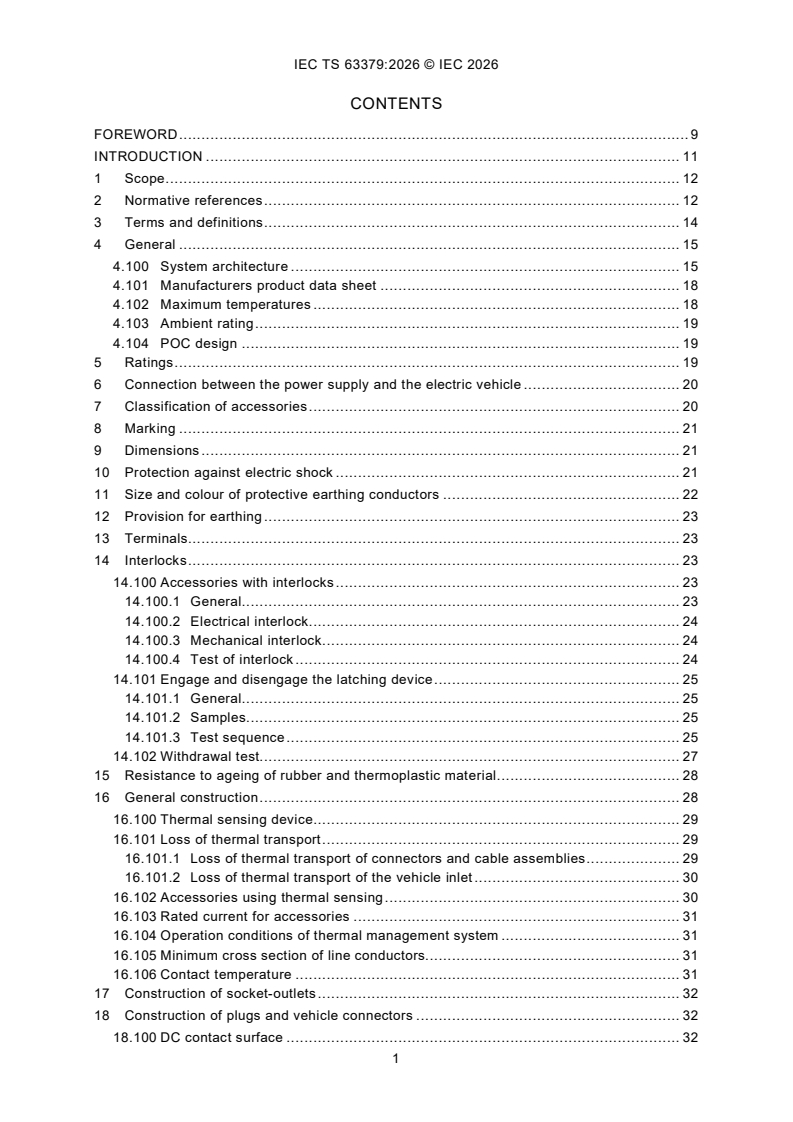
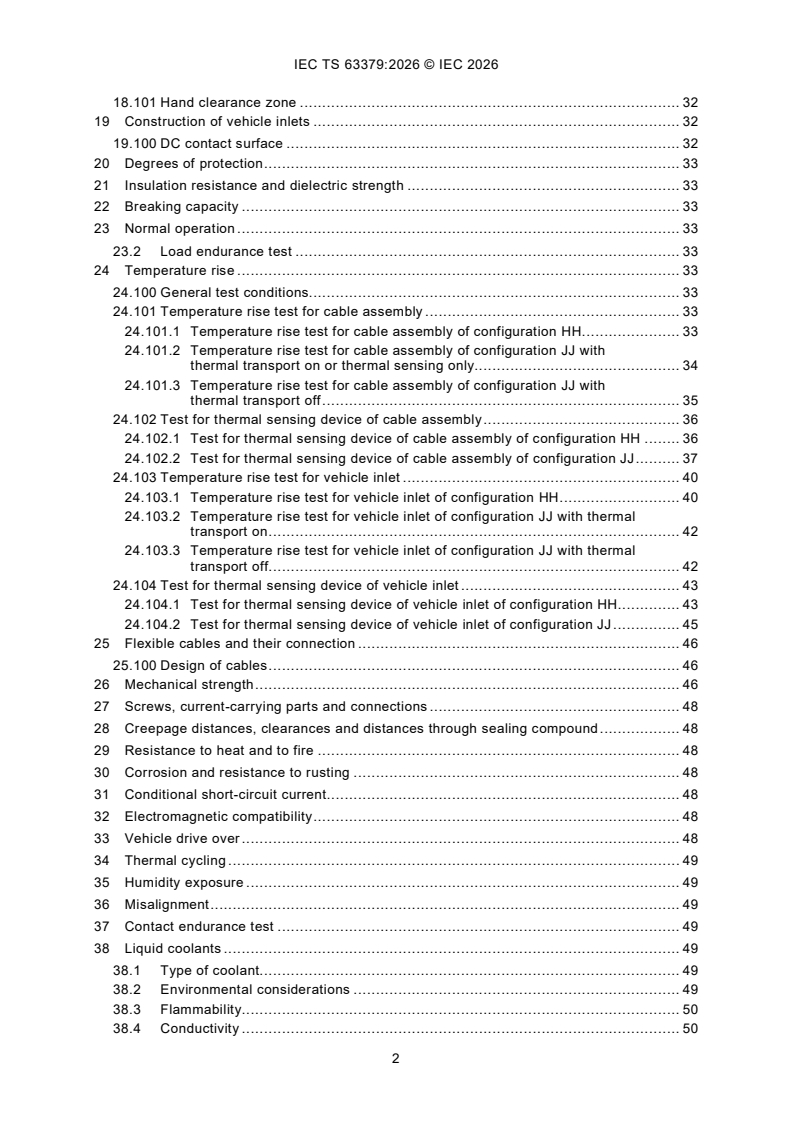
CONTENTS
FOREWORD . 9
INTRODUCTION . 11
1 Scope . 12
2 Normative references . 12
3 Terms and definitions . 14
4 General . 15
4.100 System architecture . 15
4.101 Manufacturers product data sheet . 18
4.102 Maximum temperatures . 18
4.103 Ambient rating . 19
4.104 POC design . 19
5 Ratings . 19
6 Connection between the power supply and the electric vehicle . 20
7 Classification of accessories . 20
8 Marking . 21
9 Dimensions . 21
10 Protection against electric shock . 21
11 Size and colour of protective earthing conductors . 22
12 Provision for earthing . 23
13 Terminals. 23
14 Interlocks . 23
14.100 Accessories with interlocks . 23
14.100.1 General. 23
14.100.2 Electrical interlock . 24
14.100.3 Mechanical interlock . 24
14.100.4 Test of interlock . 24
14.101 Engage and disengage the latching device . 25
14.101.1 General. 25
14.101.2 Samples. 25
14.101.3 Test sequence . 25
14.102 Withdrawal test. 27
15 Resistance to ageing of rubber and thermoplastic material . 28
16 General construction . 28
16.100 Thermal sensing device . 29
16.101 Loss of thermal transport . 29
16.101.1 Loss of thermal transport of connectors and cable assemblies . 29
16.101.2 Loss of thermal transport of the vehicle inlet . 30
16.102 Accessories using thermal sensing . 30
16.103 Rated current for accessories . 31
16.104 Operation conditions of thermal management system . 31
16.105 Minimum cross section of line conductors. 31
16.106 Contact temperature . 31
17 Construction of socket-outlets . 32
18 Construction of plugs and vehicle connectors . 32
18.100 DC contact surface . 32
18.101 Hand clearance zone . 32
19 Construction of vehicle inlets . 32
19.100 DC contact surface . 32
20 Degrees of protection . 33
21 Insulation resistance and dielectric strength . 33
22 Breaking capacity . 33
23 Normal operation . 33
23.2 Load endurance test . 33
24 Temperature rise . 33
24.100 General test conditions. 33
24.101 Temperature rise test for cable assembly . 33
24.101.1 Temperature rise test for cable assembly of configuration HH . 33
24.101.2 Temperature rise test for cable assembly of configuration JJ with
thermal transport on or thermal sensing only. 34
24.101.3 Temperature rise test for cable assembly of configuration JJ with
thermal transport off . 35
24.102 Test for thermal sensing device of cable assembly . 36
24.102.1 Test for thermal sensing device of cable assembly of configuration HH . 36
24.102.2 Test for thermal sensing device of cable assembly of configuration JJ . 37
24.103 Temperature rise test for vehicle inlet . 40
24.103.1 Temperature rise test for vehicle inlet of configuration HH . 40
24.103.2 Temperature rise test for vehicle inlet of configuration JJ with thermal
transport on . 42
24.103.3 Temperature rise test for vehicle inlet of configuration JJ with thermal
transport off. 42
24.104 Test for thermal sensing device of vehicle inlet . 43
24.104.1 Test for thermal sensing device of vehicle inlet of configuration HH . 43
24.104.2 Test for thermal sensing device of vehicle inlet of configuration JJ . 45
25 Flexible cables and their connection . 46
25.100 Design of cables . 46
26 Mechanical strength . 46
27 Screws, current-carrying parts and connections . 48
28 Creepage distances, clearances and distances through sealing compound . 48
29 Resistance to heat and to fire . 48
30 Corrosion and resistance to rusting . 48
31 Conditional short-circuit current. 48
32 Electromagnetic compatibility . 48
33 Vehicle drive over . 48
34 Thermal cycling . 49
35 Humidity exposure . 49
36 Misalignment . 49
37 Contact endurance test . 49
38 Liquid coolants . 49
38.1 Type of coolant. 49
38.2 Environmental considerations . 49
38.3 Flammability. 50
38.4 Conductivity . 50
38.5 Material compatibility . 50
38.6 Overpressure test . 50
39 Signal integrity . 51
Annex A (normative) Standard sheet of configuration HH: Vehicle coupler 1 500 V DC
and up to 3 000 A . 52
A.1 Vehicle inlet of configuration HH . 52
A.1.1 Vehicle inlet of configuration HH, Sheet 1 (see Figure A.1) . 52
A.1.2 Vehicle inlet of configuration HH, Sheet 2 (see Figure A.2) . 53
A.1.3 Vehicle inlet of configuration HH, Sheet 3 (see Figure A.3) . 54
A.1.4 Vehicle inlet of configuration HH, Sheet 4 (see Figure A.4) . 55
A.1.5 Vehicle inlet of configuration HH, Sheet 5 (see Figure A.5) . 56
A.1.6 Vehicle inlet of configuration HH, Sheet 6 (see Figure A.6) . 57
A.1.7 Vehicle inlet of configuration HH, Sheet 7 (see 7) . 58
A.1.8 Vehicle inlet of configuration HH, Sheet 8 (see Figure A.8) . 59
A.1.9 Vehicle inlet of configuration HH, Sheet 9 (see Figure A.9) . 60
A.1.10 Vehicle inlet of configuration HH, table of keys. 60
A.2 Vehicle connector of configuration HH . 61
A.2.1 Vehicle connector of configuration HH, Sheet 1 (see Figure A.10) . 61
A.2.2 Vehicle connector of configuration HH, Sheet 2 (see Figure A.11) . 62
A.2.3 Vehicle connector of configuration HH, Sheet 3 (see Figure A.12) . 63
A.2.4 Vehicle connector of configuration HH, Sheet 4 (see Figure A.13) . 64
A.2.5 Vehicle connector of configuration HH, Sheet 5 (see Figure A.14) . 65
A.2.6 Vehicle connector of configuration HH, Sheet 6 (see Figure A.15) . 66
A.2.7 Vehicle connector of configuration HH, Sheet 7 (see Figure A.16) . 67
A.2.8 Vehicle connector of configuration HH, Sheet 8 (see Figure A.17) . 68
A.2.9 Vehicle connector of configuration HH, Sheet 9 (see Figure A.18) . 69
A.2.10 Vehicle connector of configuration HH, Sheet 10 (see Figure A.19) . 70
A.2.11 Dimensions of vehicle connector body outline (see Figure A.20) . 71
A.2.12 Vehicle connector of configuration HH, table of keys . 71
A.3 Coordinate systems for automatic docking and undocking of
configuration HH . 72
A.3.1 General. 72
A.3.2 Coordinate system of vehicle inlet . 72
A.3.3 Coordinate system of vehicle connector . 72
A.3.4 Package space for automatic docking . 73
Annex B (normative) Standard sheets of configuration JJ : Vehicle coupler 1 500 V DC
and up to 1 600 A . 74
B.1 Vehicle inlet of configuration JJ with mechanical coding . 74
B.1.1 Vehicle inlet of configuration JJ with mechanical coding, Sheet 1 (see
Figure B.1) . 74
B.1.2 Vehicle inlet of configuration JJ with mechanical coding, Sheet 2 (see
Figure B.2) . 75
B.1.3 Vehicle inlet of configuration JJ with mechanical coding, Sheet 3 (see
Figure B.3) . 76
B.1.4 Vehicle inlet of configuration JJ with mechanical coding, Sheet 4 (see
Figure B.4) . 77
B.1.5 Vehicle inlet of configuration JJ with mechanical coding, Sheet 5 (see
Figure B.5) . 78
B.1.6 Vehicle inlet of configuration JJ with mechanical coding, table of keys. 78
B.2 Vehicle inlet of configuration JJ without mechanical coding . 79
B.2.1 Vehicle inlet of configuration JJ without mechanical coding, Sheet 1
(see Figure B.6) . 79
B.2.2 Vehicle inlet of configuration JJ without mechanical coding, Sheet 2
(see Figure B.7) . 80
B.2.3 Vehicle inlet of configuration JJ without mechanical coding, Sheet 3
(see Figure B.8) . 81
B.2.4 Vehicle inlet of configuration JJ without mechanical coding, Sheet 4
(see Figure B.9) . 82
B.2.5 Vehicle inlet of configuration JJ without mechanical coding, Sheet 5
(see Figure B.10) . 83
B.2.6 Vehicle inlet of configuration JJ without mechanical coding, table of
keys . 83
B.3 Vehicle connector of configuration JJ . 84
B.3.1 Vehicle connector of configuration JJ, Sheet 1 (see Figure B.11) . 84
B.3.2 Vehicle connector of configuration JJ, Sheet 2 (see Figure B.12) . 85
B.3.3 Vehicle connector of configuration JJ, Sheet 3 (see Figure B.13) . 86
B.3.4 Vehicle connector of configuration JJ, Sheet 4 (see Figure B.14) . 87
B.3.5 Vehicle connector of configuration JJ, Sheet 5 (see Figure B.15) . 88
B.3.6 Vehicle connector of configuration JJ, Sheet 6 (see Figure B.16) . 89
B.3.7 Vehicle connector of configuration JJ, table of keys . 89
Annex C (normative) Specific information for configuration HH . 90
C.1 General . 90
C.2 Test setups for temperature rise tests and temperature sensing test . 90
C.2.1 Test setups for temperature rise test and temperature sensing test of
cable assembly . 90
C.2.2 Test setups for temperature rise and temperature sensing test of
vehicle inlet . 91
C.3 Vehicle inlet reference device preparation . 92
C.3.1 Validation measurement of the vehicle inlet reference device . 92
C.3.2 Vehicle inlet reference device assembly . 93
C.3.3 Vehicle inlet reference device sub-assembly . 98
C.3.4 Vehicle inlet reference device components . 105
Annex D (normative) Specific information for configuration JJ . 131
D.1 General . 131
D.2 Reference devices and test setups for configuration JJ . 131
D.2.1 Reference device and test setups for temperature rise test and thermal
sensing device test of cable assembly (configuration JJ) . 131
D.2.2 Reference device and test setups for temperature rise test and thermal
sensing device test of vehicle inlet (configuration JJ) . 133
D.3 Test setup for configuration JJ . 135
D.4 Contacts for configuration JJ. 136
D.5 Other drawings . 136
D.5.1 Final assembly of the vehicle inlet reference device . 136
D.5.2 Final assembly of the vehicle connector reference device . 137
D.5.3 Sub-assembly of the vehicle inlet reference device . 138
D.5.4 Sub-assembly of the vehicle connector reference device . 139
D.5.5 Connector pin of vehicle connector reference device . 140
D.5.6 Contact tube of vehicle inlet reference device . 141
D.5.7 Contact clip of vehicle inlet reference device . 142
D.5.8 Copper busbar of vehicle inlet reference device . 143
D.5.9 Copper busbar of vehicle connector reference device . 144
D.5.10 Connector pin holder . 145
D.5.11 Connector pin fastening plate . 146
D.5.12 Drilling jig for DUT connector interface . 146
Annex E (informative) Overview about tests . 148
Annex F (normative) Data to be provided . 169
Bibliography . 171
Figure 1 – Example of system architecture of connector design 1 and inlet design 1. 16
Figure 2 – Example of system architecture of connector design 2 and inlet design 1. 17
Figure 3 – Example of system architecture of connector design 2 and inlet design 2. 18
Figure 4 – Verification of the latching device . 25
Figure 5 – Interlock test setup for checking latched position and unlatched position . 26
Figure 6 – Verification of the latching device . 28
Figure A.1 – Vehicle inlet of configuration HH, Sheet 1 . 52
Figure A.2 – Vehicle inlet of configuration HH, Sheet 2 . 53
Figure A.3 – Vehicle inlet of configuration HH, Sheet 3 . 54
Figure A.4 – Vehicle inlet of configuration HH, Sheet 4 . 55
Figure A.5 – Vehicle inlet of configuration HH, Sheet 5 . 56
Figure A.6 – Vehicle inlet of configuration HH, Sheet 6 . 57
Figure A.7 – Vehicle inlet of configuration HH, Sheet 7 . 58
Figure A.8 – Vehicle inlet of configuration HH, Sheet 8 . 59
Figure A.9 – Vehicle inlet of configuration HH, Sheet 9 . 60
Figure A.10 – Vehicle connector of configuration HH, Sheet 1 . 61
Figure A.11 – Vehicle connector of configuration HH, Sheet 2 . 62
Figure A.12 – Vehicle connector of configuration HH, Sheet 3 . 63
Figure A.13 – Vehicle connector of configuration HH, Sheet 4 . 64
Figure A.14 – Vehicle connector of configuration HH, Sheet 5 . 65
Figure A.15 – Vehicle connector of configuration HH, Sheet 6 . 66
Figure A.16 – Vehicle connector of configuration HH, Sheet 7 . 67
Figure A.17 – Vehicle connector of configuration HH, Sheet 8 . 68
Figure A.18 – Vehicle connector of configuration HH, Sheet 9 . 69
Figure A.19 – Vehicle connector of configuration HH, Sheet 10 . 70
Figure A.20 – Dimensions of vehicle connector body outline . 71
Figure A.21 ─ Vehicle inlet coordinate system of vehicle inlet according to
configuration HH . 72
Figure A.22 – Vehicle connector coordinate system of vehicle connector according to
Configuration HH . 73
Figure B.1 – Vehicle inlet of configuration JJ with mechanical coding, Sheet 1 . 74
Figure B.2 – Vehicle Inlet of configuration JJ with mechanical coding, Sheet 2 . 75
Figure B.3 – Vehicle inlet of configuration JJ with mechanical coding, Sheet 3 . 76
Figure B.4 – Vehicle inlet of configuration JJ with mechanical coding, Sheet 4 . 77
Figure B.5 – Vehicle inlet of configuration JJ with mechanical coding, Sheet 5 . 78
Figure B.6 – Vehicle inlet of configuration JJ without mechanical coding, Sheet 1 . 79
Figure B.7 – Vehicle inlet of configuration JJ without mechanical coding, Sheet 2 . 80
Figure B.8 – Vehicle inlet of configuration JJ without mechanical coding, Sheet 3 . 81
Figure B.9 – Vehicle inlet of configuration JJ without mechanical coding, Sheet 4 . 82
Figure B.10 – Vehicle inlet of configuration JJ without mechanical coding, Sheet 5 . 83
Figure B.11 – Vehicle connector of configuration JJ, Sheet 1 . 84
Figure B.12 – Vehicle connector of configuration JJ, Sheet 2 . 85
Figure B.13 – Vehicle connector of configuration JJ, Sheet 3 . 86
Figure B.14 – Vehicle connector of configuration JJ, Sheet 4 . 87
Figure B.15 – Vehicle connector of configuration JJ, Sheet 5 . 88
Figure B.16 – Vehicle connector of configuration JJ, Sheet 6 . 89
Figure C.1 – General test setup for cable assemblies . 91
Figure C.2 – General test setup for vehicle inlets . 92
Figure C.3 – Assembly of the vehicle inlet reference device for 1 000 A . 94
Figure C.4 – Assembly of the vehicle inlet reference device for 1 500 A . 95
Figure C.5 – Assembly of the vehicle inlet reference device for 2 000 A . 96
Figure C.6 – Assembly of the vehicle inlet reference device for 2 500 A . 97
Figure C.7 – Assembly of the vehicle inlet reference device for 3 000 A . 98
Figure C.8 – Configuration HH: Sub-assembly of the vehicle inlet reference device for
1 000 A . 100
Figure C.9 – Configuration HH: Sub-assembly of the vehicle inlet reference device for
1 500 A . 101
Figure C.10 – Configuration HH: Sub-assembly of the vehicle inlet reference device for
2 000 A . 102
Figure C.11 – Configuration HH: Sub-assembly of the vehicle inlet reference device for
2 500 A . 103
Figure C.12 – Configuration HH: Sub-assembly of the vehicle inlet reference device for
3 000 A . 104
Figure C.13 – Configuration HH: Drawing of DC-Pin for 1 000 A . 105
Figure C.14 – Configuration HH: Drawing of DC-Pin for 1 500 A . 106
Figure C.15 – Configuration HH: Drawing of DC-Pin for 3 000 A . 108
Figure C.16 – Configuration HH: Drawing of busbar for 1 000 A – basic structure. 109
Figure C.17 – Configuration HH: Drawing of busbar for 1 000 A – paintwork . 110
Figure C.18 – Configuration HH: Drawing of busbar for 1 000 A – temperature sensor . 111
Figure C.19 – Configuration HH: Drawing of busbar for 1 500 A – basic structure. 112
Figure C.20 – Configuration HH: Drawing of busbar for 1 500 A – paintwork . 113
Figure C.21 – Configuration HH: Drawing of busbar for 1 500 A – temperature sensor . 114
Figure C.22 – Configuration HH: Drawing of busbar for 2 000 A – basic structure. 115
Figure C.23 – Configuration HH: Drawing of busbar for 2 000 A – paintwork . 116
Figure C.24 – Configuration HH: Drawing of busbar for 2 000 A – temperature sensor . 117
Figure C.25 – Configuration HH: Drawing of busbar for 2 500 A – basic structure. 118
Figure C.26 – Configuration HH: Drawing of busbar for 2 500 A – paintwork . 119
Figure C.27 – Configuration HH: Drawing of busbar for 2 500 A – temperature sensor . 120
Figure C.28 – Configuration HH: Drawing of busbar for 3 000 A – basic structure. 121
Figure C.29 – Configuration HH: Drawing of busbar for 3 000 A – paintwork . 122
Figure C.30 – Configuration HH: Drawing of busbar for 3 000 A – temperature sensor . 123
Figure C.31 – Configuration HH: Drawing inlet contact holder for 1 000 A . 124
Figure C.32 – Configuration HH: Drawing inlet contact holder for 1 500 A . 125
Figure C.33 – Configuration HH: Drawing inlet contact holder for 3 000 A . 126
Figure C.34 – Configuration HH: Drawing fastening plate for 1 000 A . 127
Figure C.35 – Configuration HH: Drawing fastening plate for 1 500 A . 128
Figure C.36 – Configuration HH: Drawing fastening plate for 3 000 A . 129
Figure C.37 – Configuration HH: Drawing manual latching pin . 130
Figure D.1 – Vehicle inlet reference device JJ_0. 131
Figure D.2 – Test setup JJ_0 . 132
Figure D.3 – Vehicle connector reference device JJ_1 . 133
Figure D.4 – Test setup JJ_1 . 134
Figure D.5 – General test setup for temperature rise tests and thermal sensing device
tests (configuration JJ) . 135
Figure D.6 – General test setup for temperature rise tests and thermal sensing device
tests (configuration JJ) . 136
Figure D.7 – Final assembly of the vehicle inlet reference device . 137
Figure D.8 – Final assembly of the vehicle connector reference device . 138
Figure D.9 – Sub-assembly of the vehicle inlet reference device . 139
Figure D.10 – Sub-assembly of the vehicle connector reference device. 140
Figure D.11 – Connector pin of vehicle connector reference device . 141
Figure D.12 – Contact tube of vehicle inlet reference device . 142
Figure D.13 – Contact clip of vehicle inlet reference device . 143
Figure D.14 – Copper busbar of vehicle inlet reference device . 144
Figure D.15 – Copper busbar of vehicle inlet reference device . 145
Figure D.16 – Example of connector pin holder . 146
Figure D.17 – Example of connector pin fastening plate . 146
Figure D.18 – Drilling jig for cable assembly . 147
Table 1 – Overview of the DC vehicle interface . 20
Table 2 – Interface overview . 21
Table 3 – Protective earthing test parameters. 23
Table 4 – Withdrawal force . 24
Table 5 – Definition of interlock test numbers for checking latched position and
unlatched position . 26
Table 6 – Properties of DC accessory contact plating for pin . 32
Table 7 – Pull force and torque test values for cable anchorage . 46
Table 8 – Mechanical strength tests . 47
Table 9 – Impact energy for ball impact test . 47
Table C.1 – Vehicle inlet reference device ratings and electrical resistance . 93
Table D.1 – Dimensions of vehicle inlet reference device JJ_0 . 132
Table D.2 – Maximum contact resistances and dimensions of vehicle connector
reference device JJ_1 . 134
Table D.3 – Thickness dimensions of copper busbar of vehicle connector reference
device . 145
Table E.1 – Tests for cable assembly of configuration HH . 148
Table E.2 – Tests for cable assembly of configuration JJ . 151
Table E.3 – Tests for vehicle Inlets of configuration HH . 155
Table E.4 – Tests for vehicle Inlets of configuration JJ . 158
Table E.5 – Tests for cable assembly of configuration HH, test sequence A. 161
Table E.6 – Tests for cable assembly of configuration HH, test sequence B. 161
Table E.7 – Tests for cable assembly of configuration HH, test sequence C . 162
Table E.8 – Tests for cable assembly of configuration HH, test sequence D . 162
Table E.9 – Tests for cable assembly of configuration JJ, test sequence A . 163
Table E.10 – Tests for cable assembly of configuration JJ, test sequence B . 163
Table E.11 – Tests for cable assembly of configuration JJ, test sequence C . 164
Table E.12 – Tests for cable assembly of configuration JJ, test sequence D . 164
Table E.13 – Tests for vehicle inlets of configuration HH, test sequence A . 165
Table E.14 – Tests for vehicle inlets of configuration HH, test sequence B . 165
Table E.15 – Tests for vehicle inlets of configuration HH, test sequence C . 166
Table E.16 – Tests for vehicle inlets of configuration HH, test sequence D . 166
Table E.17 – Tests for vehicle inlets of configuration JJ, test sequence A. 167
Table E.18 – Tests for vehicle inlets of configuration JJ, test sequence B. 167
Table E.19 – Tests for vehicle inlets of configuration JJ, test sequence C . 168
Table E.20 – Tests for vehicle inlets of configuration JJ, test sequence D . 168
Table F.1 – Data provided in the PDS . 169
INTERNATIONAL ELECTROTECHNICAL COMMISSION
____________
Vehicle connector, vehicle inlet and cable assembly
for megawatt DC charging
FOREWORD
1) The International Electrotechnical Commission (IEC) is a worldwide organization for standardization comprising
all national electrotechnical committees (IEC National Committees). The object of IEC is to promote international
co-operation on all questions concerning standardization in the electrical and electronic fields. To this end and
in addition to other activities, IEC publishes International Standards, Technical Specifications, Technical Reports,
Publicly Available Specifications (PAS) and Guides (hereafter referred to as “IEC Publication(s)”). Their
preparation is entrusted to technical committees; any IEC National Committee interested in the subject dealt with
may participate in this preparatory work. International, governmental and non-governmental organizations liaising
with the IEC also participate in this preparation. IEC collaborates closely with the International Organization for
Standardization (ISO) in accordance with conditions determined by agreement between the two organizations.
2) The formal decisions or agreements of IEC on technical matters express, as nearly as possible, an international
consensus of opinion on the relevant subjects since each technical committee has representation from all
interested IEC National Committees.
3) IEC Publications have the form of recommendations for international use and are accepted by IEC National
Committees in that sense. While all reasonable efforts are made to ensure that the technical content of IEC
Publications is accurate, IEC cannot be held responsible for the way in which they are used or for any
misinterpretation by any end user.
4) In order to promote international uniformity, IEC National Committees undertake to apply IEC Publications
transparently to the maximum extent possible in their national and regional publications. Any divergence between
any IEC Publication and the corresponding national or regional publication shall be clearly indicated in the latter.
5) IEC itself does not provide any attestation of conformity. Independent certification bodies provide conformity
assessment services and, in some areas, access to IEC marks of conformity. IEC is not responsible for any
services carried out by independent certification bodies.
6) All users should ensure that they have the latest edition of this publication.
7) No liability shall attach to IEC or its directors, employees, servants or agents including individual experts and
members of its technical committees and IEC National Committees for any personal injury, property damage or
other damage of any nature whatsoever, whether direct or indirect, or for costs (including legal fees) and
expenses arising out of the publication, use of, or reliance upon, this IEC Publication or any other IEC
Publications.
8) Attention is drawn to the Normative references cited in this publication. Use of the referenced publications is
indispensable for the correct application of this publication.
9) IEC draws attention to the possibility that the implementation of this document may involve the use of (a)
patent(s). IEC takes no position concerning the evidence, validity or applicability of any claimed patent rights in
respect thereof. As of the date of publication of this document, IEC had not received notice of (a) patent(s), which
may be required to implement this document. However, implementers are cautioned that this may not represent
the latest information, which may be obtained from the patent database available at https://patents.iec.ch or
www.iso.org/patents. IEC shall not be held responsible for identifying any or all such patent rights.
IEC TS 63379 has been prepared by subcommittee 23H: Plugs, socket-outlets and couplers for
industrial and similar applications, and for electric vehicles, of IEC technical committee TC 23:
Electrical accessories. It is a Technical Specification.
The text of this Technical Specification is based on the following documents:
Draft Report on voting
23H/574/DTS 23H/590/RVDTS
Full information on the voting for its approval can be found in the report on voting indicated in
the above table.
The language used for the development of this Technical Specification is English.
This document was drafted in accordance with ISO/IEC Directives, Part 2, and developed in
accordance with ISO/IEC Directives, Part 1 and ISO/IEC Directives, IEC Supplement, available
at www.iec.ch/members_experts/refdocs. The main document types developed by IEC are
...