

IEC 62196-2:2025
(Main)Plugs, socket-outlets, vehicle connectors and vehicle inlets - Conductive charging of electric vehicles - Part 2: Dimensional compatibility requirements for AC pin and contact-tube accessories
General Information
- Abstract
IEC 62196-2:2025 applies to EV plugs, EV socket-outlets, vehicle connectors and vehicle inlets with pins and contact-tubes of standardized configurations, herein referred to as "accessories". These accessories have a nominal rated operating voltage not exceeding 480 V AC, 50 Hz to 60 Hz, and a rated current not exceeding 63 A three phase or 70 A single phase, for use in conductive charging of electric vehicles.
This fourth edition cancels and replaces the third edition published in 2022. This edition constitutes a technical revision.
This edition includes the following significant technical changes with respect to the previous edition:
a) addition of new tests for latching devices;
b) corrections to standard sheets.
- Status
- Published
- Publication Date
- 24-Nov-2025
- Technical Committee
- SC 23H - Plugs, Socket-outlets and Couplers for industrial and similar applications, and for Electric Vehicles
- Drafting Committee
- MT 8 - TC 23/SC 23H/MT 8
- Current Stage
- PPUB - Publication issued
- Start Date
- 25-Nov-2025
- Completion Date
- 28-Nov-2025
Buy Documents
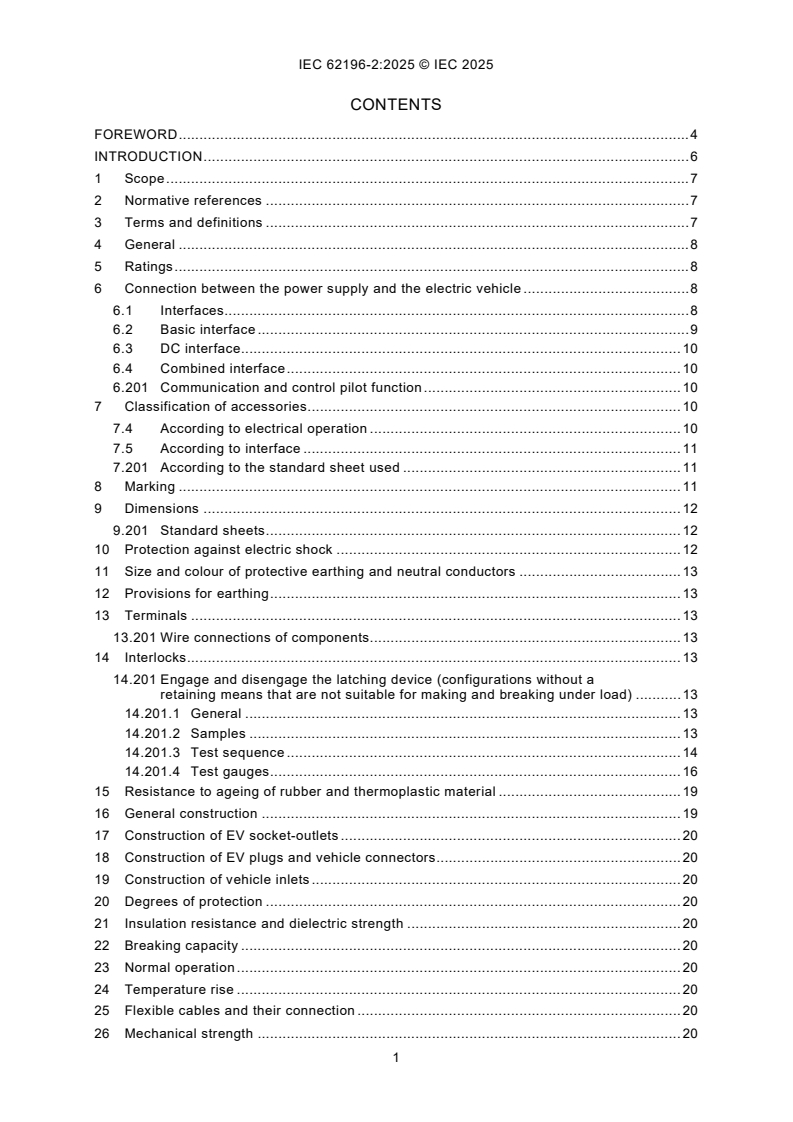
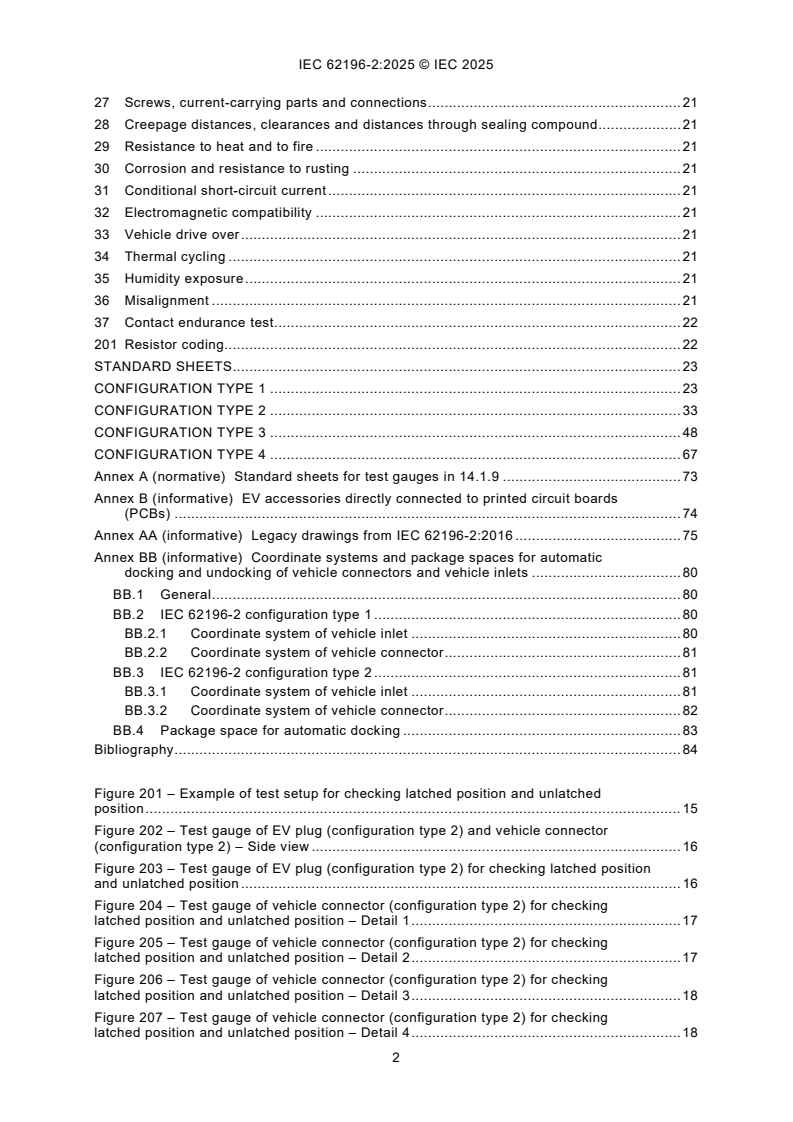
IEC 62196-2:2025 - Plugs, socket-outlets, vehicle connectors and vehicle inlets - Conductive charging of electric vehicles - Part 2: Dimensional compatibility requirements for AC pin and contact-tube accessories Released:11/25/2025
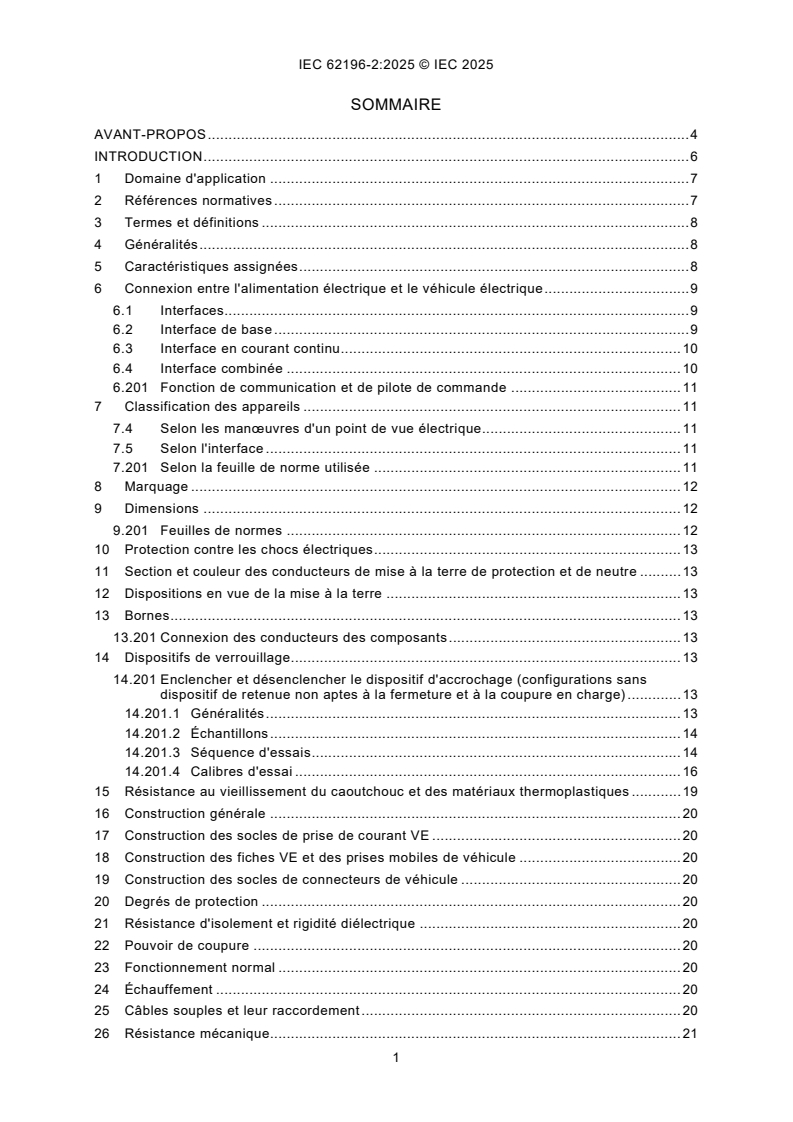
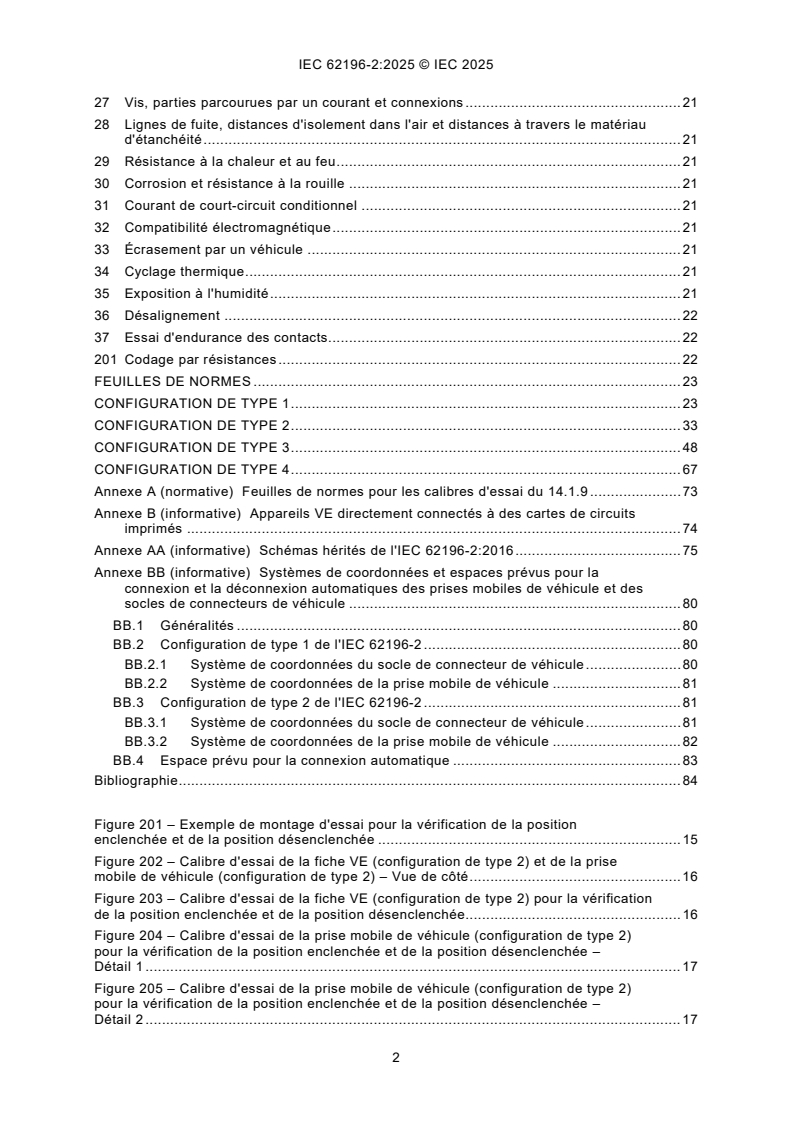
IEC 62196-2:2025 - Fiches, socles de prise de courant, prises mobiles de véhicule et socles de connecteurs de véhicule - Charge conductive des véhicules électriques - Partie 2: Exigences dimensionnelles de compatibilité pour les appareils a broches et alvéoles pour courant alternatif Released:11/25/2025
IEC 62196-2:2025 - Plugs, socket-outlets, vehicle connectors and vehicle inlets - Conductive charging of electric vehicles - Part 2: Dimensional compatibility requirements for AC pin and contact-tube accessories Released:11/25/2025
Overview
IEC 62196-2:2025 specifies dimensional compatibility requirements for AC pin and contact‑tube accessories used in conductive charging of electric vehicles (EVs). It applies to EV plugs, EV socket‑outlets, vehicle connectors and vehicle inlets with standardized pin/contact‑tube configurations, rated up to 480 V AC (50–60 Hz) and currents not exceeding 63 A three‑phase or 70 A single‑phase. This fourth edition (2025) cancels and replaces the 2022 edition and includes a technical revision with new latching‑device tests and corrections to standard sheets.
Key topics and technical requirements
- Dimensional compatibility: Standard sheets define geometry and tolerances for four configuration types (standard sheets for each configuration are included).
- Ratings and interfaces: Nominal voltage and current limits, interface definitions (basic/combined/DC interfaces are covered in the series).
- Mechanical and electrical construction: Requirements for terminals, connections, earthing, insulation, dielectric strength, breaking capacity and temperature rise.
- Interlocks and latching devices: New tests for latching devices and interlock sequences to verify latched/unlatched positions and retention behavior.
- Tests and endurance: Contact endurance, mechanical strength, thermal cycling, humidity exposure, corrosion resistance, vehicle drive‑over and misalignment tolerance.
- Safety provisions: Protection against electric shock, creepage/clearance, fire resistance and EMC considerations.
- Standard sheets and test gauges: Normative sheets and annexes provide test gauge definitions and coordinate/package spaces for automated docking and undocking (useful for robotic coupling).
- Marking and classification: Rules for marking, classification by electrical operation and interface type.
Practical applications
- Ensure interoperability between EVs and charging equipment by using standardized pin/contact dimensions.
- Provide prescriptive design criteria for connector and inlet manufacturers to meet mechanical and electrical compatibility.
- Support type‑approval and conformity testing performed by laboratories and certification bodies (including latching/interlock tests added in this edition).
- Inform procurement and installation specifications for charging station OEMs, fleet operators and EV manufacturers.
- Facilitate design of automated docking systems via coordinate and package‑space guidance in annexes.
Who should use this standard
- EV connector and inlet designers and manufacturers
- Charging station and socket‑outlet OEMs
- Test laboratories and certification bodies
- Automotive OEMs and EV system integrators
- Regulators, procurement teams and standards committees
Related standards
- Other parts of the IEC 62196 series (e.g., Part 1, Part 3) and complementary IEC/ISO standards on EV charging and connector safety - consult IEC for the latest cross‑references.
Keywords: IEC 62196-2:2025, electric vehicle charging, conductive charging, EV plugs, vehicle connectors, dimensional compatibility, AC pin, contact-tube accessories, latching device tests.
Relations
- Effective Date
- 05-Sep-2023
Buy Documents
IEC 62196-2:2025 - Plugs, socket-outlets, vehicle connectors and vehicle inlets - Conductive charging of electric vehicles - Part 2: Dimensional compatibility requirements for AC pin and contact-tube accessories Released:11/25/2025
IEC 62196-2:2025 - Fiches, socles de prise de courant, prises mobiles de véhicule et socles de connecteurs de véhicule - Charge conductive des véhicules électriques - Partie 2: Exigences dimensionnelles de compatibilité pour les appareils a broches et alvéoles pour courant alternatif Released:11/25/2025
IEC 62196-2:2025 - Plugs, socket-outlets, vehicle connectors and vehicle inlets - Conductive charging of electric vehicles - Part 2: Dimensional compatibility requirements for AC pin and contact-tube accessories Released:11/25/2025
Get Certified
Connect with accredited certification bodies for this standard

TÜV Rheinland
TÜV Rheinland is a leading international provider of technical services.

TÜV SÜD
TÜV SÜD is a trusted partner of choice for safety, security and sustainability solutions.

DEKRA Certification Inc.
DEKRA US certification services.
Sponsored listings
Frequently Asked Questions
IEC 62196-2:2025 is a standard published by the International Electrotechnical Commission (IEC). Its full title is "Plugs, socket-outlets, vehicle connectors and vehicle inlets - Conductive charging of electric vehicles - Part 2: Dimensional compatibility requirements for AC pin and contact-tube accessories". This standard covers: IEC 62196-2:2025 applies to EV plugs, EV socket-outlets, vehicle connectors and vehicle inlets with pins and contact-tubes of standardized configurations, herein referred to as "accessories". These accessories have a nominal rated operating voltage not exceeding 480 V AC, 50 Hz to 60 Hz, and a rated current not exceeding 63 A three phase or 70 A single phase, for use in conductive charging of electric vehicles. This fourth edition cancels and replaces the third edition published in 2022. This edition constitutes a technical revision. This edition includes the following significant technical changes with respect to the previous edition: a) addition of new tests for latching devices; b) corrections to standard sheets.
IEC 62196-2:2025 applies to EV plugs, EV socket-outlets, vehicle connectors and vehicle inlets with pins and contact-tubes of standardized configurations, herein referred to as "accessories". These accessories have a nominal rated operating voltage not exceeding 480 V AC, 50 Hz to 60 Hz, and a rated current not exceeding 63 A three phase or 70 A single phase, for use in conductive charging of electric vehicles. This fourth edition cancels and replaces the third edition published in 2022. This edition constitutes a technical revision. This edition includes the following significant technical changes with respect to the previous edition: a) addition of new tests for latching devices; b) corrections to standard sheets.
IEC 62196-2:2025 is classified under the following ICS (International Classification for Standards) categories: 29.120.30 - Plugs, socket-outlets, couplers; 43.120 - Electric road vehicles. The ICS classification helps identify the subject area and facilitates finding related standards.
IEC 62196-2:2025 has the following relationships with other standards: It is inter standard links to IEC 62196-2:2022. Understanding these relationships helps ensure you are using the most current and applicable version of the standard.
IEC 62196-2:2025 is available in PDF format for immediate download after purchase. The document can be added to your cart and obtained through the secure checkout process. Digital delivery ensures instant access to the complete standard document.
Standards Content (Sample)
IEC 62196-2 ®
Edition 4.0 2025-11
INTERNATIONAL
STANDARD
Plugs, socket-outlets, vehicle connectors and vehicle inlets - Conductive
charging of electric vehicles -
Part 2: Dimensional compatibility requirements for AC pin and contact-tube
accessories
ICS 29.120.30; 43.120 ISBN 978-2-8327-0827-9
All rights reserved. Unless otherwise specified, no part of this publication may be reproduced or utilized in any form or
by any means, electronic or mechanical, including photocopying and microfilm, without permission in writing from either
IEC or IEC's member National Committee in the country of the requester. If you have any questions about IEC copyright
or have an enquiry about obtaining additional rights to this publication, please contact the address below or your local
IEC member National Committee for further information.
IEC Secretariat Tel.: +41 22 919 02 11
3, rue de Varembé info@iec.ch
CH-1211 Geneva 20 www.iec.ch
Switzerland
About the IEC
The International Electrotechnical Commission (IEC) is the leading global organization that prepares and publishes
International Standards for all electrical, electronic and related technologies.
About IEC publications
The technical content of IEC publications is kept under constant review by the IEC. Please make sure that you have the
latest edition, a corrigendum or an amendment might have been published.
IEC publications search - IEC Products & Services Portal - products.iec.ch
webstore.iec.ch/advsearchform Discover our powerful search engine and read freely all the
The advanced search enables to find IEC publications by a publications previews, graphical symbols and the glossary.
variety of criteria (reference number, text, technical With a subscription you will always have access to up to date
committee, …). It also gives information on projects, content tailored to your needs.
replaced and withdrawn publications.
Electropedia - www.electropedia.org
The world's leading online dictionary on electrotechnology,
IEC Just Published - webstore.iec.ch/justpublished
Stay up to date on all new IEC publications. Just Published containing more than 22 500 terminological entries in English
details all new publications released. Available online and and French, with equivalent terms in 25 additional languages.
once a month by email. Also known as the International Electrotechnical Vocabulary
(IEV) online.
IEC Customer Service Centre - webstore.iec.ch/csc
If you wish to give us your feedback on this publication or
need further assistance, please contact the Customer
Service Centre: sales@iec.ch.
CONTENTS
FOREWORD . 4
INTRODUCTION . 6
1 Scope . 7
2 Normative references . 7
3 Terms and definitions . 7
4 General . 8
5 Ratings . 8
6 Connection between the power supply and the electric vehicle . 8
6.1 Interfaces. 8
6.2 Basic interface . 9
6.3 DC interface. 10
6.4 Combined interface . 10
6.201 Communication and control pilot function . 10
7 Classification of accessories. 10
7.4 According to electrical operation . 10
7.5 According to interface . 11
7.201 According to the standard sheet used . 11
8 Marking . 11
9 Dimensions . 12
9.201 Standard sheets . 12
10 Protection against electric shock . 12
11 Size and colour of protective earthing and neutral conductors . 13
12 Provisions for earthing . 13
13 Terminals . 13
13.201 Wire connections of components. 13
14 Interlocks. 13
14.201 Engage and disengage the latching device (configurations without a
retaining means that are not suitable for making and breaking under load) . 13
14.201.1 General . 13
14.201.2 Samples . 13
14.201.3 Test sequence . 14
14.201.4 Test gauges . 16
15 Resistance to ageing of rubber and thermoplastic material . 19
16 General construction . 19
17 Construction of EV socket-outlets . 20
18 Construction of EV plugs and vehicle connectors . 20
19 Construction of vehicle inlets . 20
20 Degrees of protection . 20
21 Insulation resistance and dielectric strength . 20
22 Breaking capacity . 20
23 Normal operation . 20
24 Temperature rise . 20
25 Flexible cables and their connection . 20
26 Mechanical strength . 20
27 Screws, current-carrying parts and connections . 21
28 Creepage distances, clearances and distances through sealing compound . 21
29 Resistance to heat and to fire . 21
30 Corrosion and resistance to rusting . 21
31 Conditional short-circuit current . 21
32 Electromagnetic compatibility . 21
33 Vehicle drive over . 21
34 Thermal cycling . 21
35 Humidity exposure . 21
36 Misalignment . 21
37 Contact endurance test . 22
201 Resistor coding. 22
STANDARD SHEETS. 23
CONFIGURATION TYPE 1 . 23
CONFIGURATION TYPE 2 . 33
CONFIGURATION TYPE 3 . 48
CONFIGURATION TYPE 4 . 67
Annex A (normative) Standard sheets for test gauges in 14.1.9 . 73
Annex B (informative) EV accessories directly connected to printed circuit boards
(PCBs) . 74
Annex AA (informative) Legacy drawings from IEC 62196-2:2016 . 75
Annex BB (informative) Coordinate systems and package spaces for automatic
docking and undocking of vehicle connectors and vehicle inlets . 80
BB.1 General . 80
BB.2 IEC 62196-2 configuration type 1 . 80
BB.2.1 Coordinate system of vehicle inlet . 80
BB.2.2 Coordinate system of vehicle connector . 81
BB.3 IEC 62196-2 configuration type 2 . 81
BB.3.1 Coordinate system of vehicle inlet . 81
BB.3.2 Coordinate system of vehicle connector . 82
BB.4 Package space for automatic docking . 83
Bibliography . 84
Figure 201 – Example of test setup for checking latched position and unlatched
position . 15
Figure 202 – Test gauge of EV plug (configuration type 2) and vehicle connector
(configuration type 2) – Side view . 16
Figure 203 – Test gauge of EV plug (configuration type 2) for checking latched position
and unlatched position . 16
Figure 204 – Test gauge of vehicle connector (configuration type 2) for checking
latched position and unlatched position – Detail 1 . 17
Figure 205 – Test gauge of vehicle connector (configuration type 2) for checking
latched position and unlatched position – Detail 2 . 17
Figure 206 – Test gauge of vehicle connector (configuration type 2) for checking
latched position and unlatched position – Detail 3 . 18
Figure 207 – Test gauge of vehicle connector (configuration type 2) for checking
latched position and unlatched position – Detail 4 . 18
Figure 208 – Test gauge of vehicle connector (configuration type 2) for checking
latched position and unlatched position – Detail 5 . 19
Figure 209 – Test gauge of vehicle connector (configuration type 2) for checking
latched position and unlatched position – Detail 6 . 19
Figure BB.201 – Vehicle inlet coordinate system of vehicle inlet according to
IEC 62196-2:2022, Standard Sheet 2-I, Sheet 1 . 80
Figure BB.202 – Vehicle connector coordinate system of vehicle connector according
to IEC 62196-2:2022, Standard Sheets 2-I, Sheet 2 . 81
Figure BB.203 – Vehicle inlet coordinate system of vehicle inlet according to
IEC 62196-2:2022, Standard Sheet 2-IIf . 82
Figure BB.204 – Vehicle connector coordinate system of vehicle connector according
to IEC 62196-2:2022, Standard Sheet 2-IIe . 83
Table 201 – Overview of the basic vehicle interface, configuration type 1, single phase . 9
Table 202 – Overview of the basic vehicle interface, configuration types 2, 3 and 4,
three phase or single phase . 10
Table 203 – Electrical operation of configurations based on current rating . 11
Table 204 – Configuration types and standard sheets . 12
Table 205 – Definition of interlock test numbers for checking latched position and
unlatched position . 14
Table 206 – Interoperation of configuration type 2 accessories . 33
INTERNATIONAL ELECTROTECHNICAL COMMISSION
____________
Plugs, socket-outlets, vehicle connectors and vehicle inlets -
Conductive charging of electric vehicles -
Part 2: Dimensional compatibility requirements
for AC pin and contact-tube accessories
FOREWORD
1) The International Electrotechnical Commission (IEC) is a worldwide organization for standardization comprising
all national electrotechnical committees (IEC National Committees). The object of IEC is to promote international
co-operation on all questions concerning standardization in the electrical and electronic fields. To this end and
in addition to other activities, IEC publishes International Standards, Technical Specifications, Technical Reports,
Publicly Available Specifications (PAS) and Guides (hereafter referred to as "IEC Publication(s)"). Their
preparation is entrusted to technical committees; any IEC National Committee interested in the subject dealt with
may participate in this preparatory work. International, governmental and non-governmental organizations liaising
with the IEC also participate in this preparation. IEC collaborates closely with the International Organization for
Standardization (ISO) in accordance with conditions determined by agreement between the two organizations.
2) The formal decisions or agreements of IEC on technical matters express, as nearly as possible, an international
consensus of opinion on the relevant subjects since each technical committee has representation from all
interested IEC National Committees.
3) IEC Publications have the form of recommendations for international use and are accepted by IEC National
Committees in that sense. While all reasonable efforts are made to ensure that the technical content of IEC
Publications is accurate, IEC cannot be held responsible for the way in which they are used or for any
misinterpretation by any end user.
4) In order to promote international uniformity, IEC National Committees undertake to apply IEC Publications
transparently to the maximum extent possible in their national and regional publications. Any divergence between
any IEC Publication and the corresponding national or regional publication shall be clearly indicated in the latter.
5) IEC itself does not provide any attestation of conformity. Independent certification bodies provide conformity
assessment services and, in some areas, access to IEC marks of conformity. IEC is not responsible for any
services carried out by independent certification bodies.
6) All users should ensure that they have the latest edition of this publication.
7) No liability shall attach to IEC or its directors, employees, servants or agents including individual experts and
members of its technical committees and IEC National Committees for any personal injury, property damage or
other damage of any nature whatsoever, whether direct or indirect, or for costs (including legal fees) and
expenses arising out of the publication, use of, or reliance upon, this IEC Publication or any other IEC
Publications.
8) Attention is drawn to the Normative references cited in this publication. Use of the referenced publications is
indispensable for the correct application of this publication.
9) IEC draws attention to the possibility that the implementation of this document may involve the use of (a)
patent(s). IEC takes no position concerning the evidence, validity or applicability of any claimed patent rights in
respect thereof. As of the date of publication of this document, IEC had not received notice of (a) patent(s), which
may be required to implement this document. However, implementers are cautioned that this may not represent
the latest information, which may be obtained from the patent database available at https://patents.iec.ch. IEC
shall not be held responsible for identifying any or all such patent rights.
IEC 62196-2 has been prepared by IEC subcommittee 23H: Plugs, socket-outlets and couplers
for industrial and similar applications, and for electric vehicles, of IEC technical committee 23:
Electrical accessories. It is an International Standard.
This fourth edition cancels and replaces the third edition published in 2022. This edition
constitutes a technical revision.
This edition includes the following significant technical changes with respect to the previous
edition:
a) addition of new tests for latching devices;
b) corrections to standard sheets.
The text of this International Standard is based on the following documents:
Draft Report on voting
23H/580/FDIS 23H/587/RVD
Full information on the voting for its approval can be found in the report on voting indicated in
the above table.
The language used for the development of this International Standard is English.
This document was drafted in accordance with ISO/IEC Directives, Part 2, and developed in
accordance with ISO/IEC Directives, Part 1 and ISO/IEC Directives, IEC Supplement, available
at www.iec.ch/members_experts/refdocs. The main document types developed by IEC are
described in greater detail at www.iec.ch/standardsdev/publications.
This document is to be read in conjunction with IEC 62196-1:2025. The clauses of the particular
requirements in this document supplement or modify the corresponding clauses in
IEC 62196-1:2025. Where the text indicates an "addition" to or a "replacement" of the relevant
requirement, test specification or explanation of IEC 62196-1:2025, these changes are made to
the relevant text of IEC 62196-1:2025, which then becomes part of this document. Where no
change is necessary, the words " IEC 62196-1:2025, Clause X, applies" are used.
Subclauses, figures, tables, or notes which are additional to those in IEC 62196-1:2025 are
numbered starting from 201. Additional annexes are lettered AA, BB, etc.
In this document, the following print types are used:
– requirements proper: in roman type;
– test specifications: in italic type;
notes: in smaller roman type.
–
A list of all the parts in the IEC 62196 series, published under the general title Plugs, socket-
outlets, vehicle connectors and vehicle inlets - Conductive charging of electric vehicles, can be
found on the IEC website.
The committee has decided that the contents of this document will remain unchanged until the
stability date indicated on the IEC website under webstore.iec.ch in the data related to the
specific document. At this date, the document will be
– reconfirmed,
– withdrawn, or
– revised.
INTRODUCTION
The IEC 61851 series specifies requirements for electric vehicle (EV) conductive supply
equipment.
The IEC 62196 series specifiy the requirements for plugs, socket-outlets, vehicle connectors,
vehicle inlets and cable assemblies as described in the IEC 61851 series and in IEC 62752.
Some charging using on-board vehicle chargers can be achieved by direct connection from an
electric vehicle to an AC supply network using common socket-outlets or by the use of
equipment incorporating control and communication circuits.
To support the connection of AC power for such vehicles, this document provides the standard
interface configurations of AC vehicle couplers and accessories to be used in conductive
charging of electric vehicles, taking the most frequent charging situations into consideration.
The IEC 62196 series consists of the following parts:
– IEC 62196-1: General requirements, comprising clauses of a general character;
– IEC 62196-2: Dimensional compatibility requirements for AC pin and contact-tube
accessories;
– IEC 62196-3: Dimensional compatibility requirements for DC and AC/DC pin and contact-
tube vehicle couplers;
– IEC TS 62196-4: Dimensional compatibility and interchangeability requirements for DC pin
and contact-tube accessories for class II or class III applications;
– IEC 62196-6: Dimensional compatibility requirements for DC pin and contact-tube vehicle
couplers intended to be used for DC EV supply equipment where protection relies on
electrical separation;
– IEC TS 62196-7 : Vehicle adapter.
___________
Under preparation. Stage at the time of publication: IEC TS/ADTS 62196-7:2025.
1 Scope
This part of IEC 62196 applies to EV plugs, EV socket-outlets, vehicle connectors and vehicle
inlets with pins and contact-tubes of standardized configurations, herein referred to as
"accessories". These accessories have a nominal rated operating voltage not exceeding
480 V AC, 50 Hz to 60 Hz, and a rated current not exceeding 63 A three phase or 70 A single
phase, for use in conductive charging of electric vehicles.
This document covers the basic interface accessories for vehicle supply as specified in
IEC 62196-1:2025.
NOTE 1 The term "electric road vehicles (EV)" comprises all road vehicles, including plug-in hybrid road vehicles
(PHEV) that derive all or part of their energy from the rechargeable energy storage systems (RESS).
These accessories are intended to be used for circuits specified in IEC 61851-1 and IEC 62752,
which operate at different voltages and frequencies, and which can include extra-low voltage
(ELV) and communication signals.
The use of these accessories for bidirectional power transfer is under consideration.
This document applies to accessories to be used in an ambient temperature between –30 °C
and +40 °C.
NOTE 2 In the following country, other requirements regarding the lower temperature can apply: NO.
NOTE 3 In the following country, −40 °C applies: SE.
These accessories are intended to be connected only to cables with copper or copper-alloy
conductors.
Vehicle inlets and vehicle connectors described in this document are intended to be used for
charging in modes 1, 2 and 3, cases B and C. The EV socket-outlets and EV plugs covered by
this document are intended to be used for charging mode 3 only, case A and B.
The modes and permissible connections are specified in IEC 61851-1.
2 Normative references
The following documents are referred to in the text in such a way that some or all of their content
constitutes requirements of this document. For dated references, only the edition cited applies.
For undated references, the latest edition of the referenced document (including any
amendments) applies.
IEC 61851-1:2017, Electric vehicle conductive charging system - Part 1: General requirements
IEC 62196-1:2025, Plugs, socket-outlets, vehicle connectors and vehicle inlets - Conductive
charging of electric vehicles - Part 1: General requirements
3 Terms and definitions
For the purposes of this document, the terms and definitions given in IEC 62196-1:2025 apply.
ISO and IEC maintain terminology databases for use in standardization at the following
addresses:
– IEC Electropedia: available at https://www.electropedia.org/
– ISO Online browsing platform: available at https://www.iso.org/obp
4 General
IEC 62196-1:2025, Clause 4, applies.
5 Ratings
IEC 62196-1:2025, Clause 5 applies, except as follows.
5.1 Preferred rated operating voltage ranges
Replacement:
5.1 Rated operating voltage ranges
Rated operating voltages are as follows:
– 30 V (signal or control purposes only);
– 250 V AC;
– 480 V AC.
5.2 Preferred rated currents
Replacement of the title "Preferred rated currents" with "Rated currents".
5.2.1 General
Replacement:
The rated currents are as follows:
– 10 A single phase;
– 13 A single phase;
– 16 A single and three phase;
– 20 A single and three phase;
– 30 A or 32 A single and three phase;
– 60 A or 63 A single and three phase;
– 70 A single phase only.
NOTE 1 In the following country, the branch circuit overcurrent protection device is based upon 125 % of the
accessory rating: US.
NOTE 2 Reference to "30 A or 32 A" and "60 A or 63 A" rating is made in accordance with national requirements.
6 Connection between the power supply and the electric vehicle
IEC 62196-1:2025, Clause 6 applies, except as follows.
6.1 Interfaces
Replacement:
This Clause 6 provides a description of the physical conductive electrical interface requirements
between the vehicle and the power supply, which allows the following design at the vehicle
interface: a basic interface that provides for current ratings up to 63 A AC three-phase and up
to 70 A AC single phase.
Different configuration types for the basic interface may allow different application of mode and
current ratings. See introduction to relevant standard sheets for more details.
6.2 Basic interface
Replacement:
There is one type of vehicle inlet: basic.
The basic interface may contain up to seven power or signal contacts, with unique physical
configurations of contact positions for single or three phases. The electrical ratings and their
function are described in Table 201 and Table 202. The electrical ratings and their function are
described in the standard sheets.
Each vehicle inlet shall only mate with the corresponding type of vehicle connector. Each EV
plug shall only mate with the corresponding type of EV socket-outlet.
The accessories, configuration types 1, 2, 3, or 4 are rated as follows:
– configuration type 1 vehicle coupler is rated maximum 250 V, and up to 32 A single phase;
– configuration type 2 vehicle coupler, EV socket-outlet and EV plug are rated:
• 250 V, 13 A or 20 A or 32 A or 63 A or 70 A single phase;
• 480 V, 13 A or 20 A or 32 A or 63 A, three phase;
– configuration type 3 vehicle coupler, EV socket-outlet and EV plug are rated:
• 250 V, 16 A or 32 A, single phase;
• 480 V, 32 A or 63 A three phase;
– configuration type 4 vehicle couplers are rated:
• 250 V, 10 A, 16 A, or 32 A single phase;
• 480 V, 16 A, 32 A, or 63 A three phase.
Table 201 – Overview of the basic vehicle interface,
configuration type 1, single phase
a c
AC
Position number Functions
b
1 L1 (mains 1)
250 V 32 A
2 250 V 32 A L2 (mains 2) / N (neutral)
3 Rated for fault PE (ground/earth)
4 30 V 2 A CP (control pilot)
5 30 V 2 A CS (connection switch)
a
The position number does not refer to the location and/or identification of the contact in the accessory.
b
In the following country, the branch circuit overcurrent protection is based upon 125 % of the device rating:
US.
c
For contacts 4 and 5, environmental conditions can demand larger conductor cross-sections.
Table 202 – Overview of the basic vehicle interface,
configuration types 2, 3 and 4, three phase or single phase
Three phase Single phase
U
max
a a
I I
max max
Position
Functions
f
number
V AC A A
b
Type 2 Type 3 Type 4 Type 2 Type 3 Type 4
b
1 480 63 70 63 32 L1 (mains 1)
c c c
2 480 63 L2 (mains 2)
- - -
c c c
3 480 63 L3 (mains 3)
- - -
b, e
4 480 63 70 63 32 N (neutral)
5 ― Rated for fault PE (ground/earth)
6 30 2 CP (control pilot)
d
PP (proximity) or
7 30 2
d
CS (connection switch)
a
In the following country, the branch circuit overcurrent protection is based upon 125 % of the device rating: US.
b
For single phase charging, contacts 1 and 4 shall be used.
c
Unused contacts need not be installed. Not provided for Standard Sheets 2-IIIa and 2-IIIb.
d
Not provided for Standard Sheet 2-IIIa.
e
For single phase system supply phase to phase, this contact can be used for L2 (mains 2).
f
Position number does not refer to the location and/or identification of the contact in the accessory.
6.3 DC interface
IEC 62196-1:2025, Clause 6.3, does not apply.
6.4 Combined interface
IEC 62196-1:2025, Clause 6.4, does not apply.
Additional subclause:
6.201 Communication and control pilot function
The control pilot and proximity detection or connection contacts are intended to be used in
accordance with IEC 61851-1.
7 Classification of accessories
IEC 62196-1:2025, Clause 7 applies, except as follows.
7.4 According to electrical operation
Replacement:
Table 203 shows the classification according to electrical operation.
Table 203 – Electrical operation of configurations based on current rating
Rating
Type
a a
10 13 16 20 70
32 63
1 A,B A,B A,B A,B A,B X X
2 X A X A A A A
3 X X B X B A X
4 A,B X A,B X A A X
Key:
A: Not suitable for make and break under load.
B: Suitable for make and break under load.
X: Not applicable.
NOTE For entries with both A and B, the suitability of the accessory to make and break under load is specified
by the manufacturer.
a
The rating of 32 A also applies for 30 A ratings; and the rating of 63 A also applies for 60 A ratings.
NOTE Communication circuits according to this document are deemed not to make or break load as a result of this
Subclause 7.4.
7.5 According to interface
Replacement:
Interface is specified in Clause 6: basic type.
Additional subclause:
7.201 According to the standard sheet used
– configuration type 1;
– configuration type 2;
– configuration type 3;
– configuration type 4.
8 Marking
IEC 62196-1:2025, Clause 8, applies.
9 Dimensions
IEC 62196-1:2025, Clause 9, applies, except as follows.
Additional subclause:
9.201 Standard sheets
Accessories shall comply with the relevant standard sheets as specified below and in Table 204:
– Configuration type 1
• 32 A, 250 V single-phase vehicle couplers: Standard Sheet 2-I.
• Optional latching system: Standard Sheet 2-Ia.
NOTE In the following countries, Standard Sheets 2-I and 2-Ia may be applied to vehicle couplers with rated
current up to 80 A: US, KR, JP.
– Configuration type 2
• 63 A, 480 V three-phase or 250 V, 70 A single-phase accessories: Standard Sheets 2-II,
IIa, IIb, IIc, IId, IIe, IIf, IIg and IIh, as specified in Table 206.
– Configuration type 3
• 16 A, 250 V single-phase accessories with one pilot: Standard Sheet 2-IIIa;
• 32 A, 250 V single-phase accessories with two pilots: Standard Sheet 2-IIIb;
• 63 A, 480 V three-phase accessories with two pilots: Standard Sheet 2-IIIc;
• Latching means and maximum dimensions of vehicle connector body outline: Standard
Sheet 2-IIId.
– Configuration type 4
• 32 A, 250 V single-phase accessories: Standard Sheet 2-IV;
• 63 A, 480 V three-phase accessories: Standard Sheet 2-IV.
Table 204 – Configuration types and standard sheets
Configuration Standard sheet Applicable Rated voltage Rated current Phase
type accessories V A
1 2-I Vehicle couplers 250 32 Single phase
250 70 Single phase
2 2-II Accessories
480 63 Three phase
250 16 Single phase
3 2-III Accessories 250 32 Single phase
480 63 Three phase
250 32 Single phase
4 2-IV Vehicle couplers
480 63 Three phase
10 Protection against electric shock
IEC 62196-1:2025, Clause 10, applies.
11 Size and colour of protective earthing and neutral conductors
Replacement:
The core connected to the earthing terminal shall be identified by the colour combination green-
and-yellow. The nominal cross-sectional area of the earthing conductor and of the neutral
conductor, if any, shall be at least equal to that of the phase conductors.
NOTE In the following countries, the colour green may be used to identify the earthing conductor: JP, US, CA, KR,
BR.
12 Provisions for earthing
IEC 62196-1:2025, Clause 12, applies.
13 Terminals
IEC 62196-1:2025, Clause 13, applies, except as follows.
Additional subclause:
13.201 Wire connections of components
Wire connection of components, for example coding resistors, may be rewireable or non-
rewireable.
14 Interlocks
IEC 62196-1:2025, Clause 14, applies, except as follows.
Additional subclauses:
14.201 Engage and disengage the latching device (configurations without a retaining
means that are not suitable for making and breaking under load)
14.201.1 General
Accessories should be so constructed that the latching device can be properly engaged and
disengaged while an external mechanical load is being applied to the vehicle connector or EV
plug during normal operation.
NOTE 1 In comparison, the tests of IEC 62196-1:2025, 14.1.5 and 14.1.6, already contain a latch position.
NOTE 2 One example of a latching device is an electromechanical actuator with a latching pin.
NOTE 3 This optional test of 14.201 is under consideration to become mandatory in the future.
Compliance is checked by carrying out the test in 14.201.3.
14.201.2 Samples
Vehicle inlets should be tested on three samples with the test gauge as specified in 14.201.4.
EV socket-outlets should be tested on three samples with the test gauge as specified in
14.201.4.
14.201.3 Test sequence
Part 1 – Engage latching device
1) Fully insert the test gauge into the vehicle inlet or EV socket-outlet until in the fully mated
position.
2) In the fully mated position, using a force gauge, apply, either manually or automatically, the
minimum load according to Table 205 as illustrated in Figure 201 in the defined direction.
3) Electrically activate the latching device.
4) Check the pass criterion by visual inspection. The latching device should be in the correct
latched position in accordance with the manufacturer’s data sheet.
5) Repeat steps 1) through 4) according to Table 205.
Table 205 – Definition of interlock test numbers for checking latched
position and unlatched position
Test number Load direction Minimum external load
N
1 0° 35
2 45° 35
3 90° 35
4 135° 35
5 180° 35
6 225° 35
7 270° 35
8 315° 35
Part 2 – Disengage latching device
6) Fully insert the test gauge into the vehicle inlet or EV socket-outlet until in the fully mated
position and check that the latching device is engaged.
7) In the latched position, using a force gauge, apply, either manually or automatically, the
minimum load according to Table 205 as illustrated in Figure 201 in the defined direction
until step 9).
8) Disengage the latching device.
9) Check the pass criterion by visual inspection: the test gauge should be released from the
vehicle inlet or from the EV socket-outlet.
10) Repeat steps 6) through 9) according to Table 205.
Dimensions in millimeters
Key
1 vehicle inlet (DUT) or EV socket-outlet (DUT)
2 test gauge
3 load application point
4 standard datum plane
Figure 201 – Example of test setup for checking latched position and unlatched position
With an EV socket-outlet of configuration type 2, the tests should be carried out
– with the test gauge in accordance with Figure 202 and Figure 203, and
– for all positions of the latching device specified by the EV socket-outlet manufacturer.
With a vehicle inlet of configuration type 2, the tests should be carried out
– with the test gauge in accordance with Figure 202, Figure 204 to Figure 209, and
– for all positions of the latching device specified by the vehicle inlet manufacturer.
14.201.4 Test gauges
Dimensions in millimetres
Key
1 mating face with contact interface, body material: peek
2 test gauge body material: aluminium
3 load application point: defined surface, detailed design according to the manufacturer
4 missing vehicle connector dimensions of configuration AC type 2, see Standard Sheets 2-IIe of this document.
Missing EV plug dimensions of configuration AC type 2, see Standard Sheets 2-IIb of of this document
5 datum axis PE
6 standard datum plane
Figure 202 – Test gauge of EV plug (configuration type 2)
and vehicle connector (configuration type 2) – Side view
Dimensions in millimetres
Figure 203 – Test gauge of EV plug (configuration type 2)
for checking latched position and unlatched position
Dimensions in millimetres
NOTE The dimensions represent the minimum material conditions for vehicle connector contour. For the other
vehicle connector dimensions, see Standard Sheets 2-IIe of this document.
Figure 204 – Test gauge of vehicle connector (configuration type 2) for checking
latched position and unlatched position – Detail 1
Dimensions in millimetres
NOTE The dimensions represent the minimum material conditions for vehicle connector contour. For the other
vehicle connector dimensions, see Standard Sheets 2-IIe of this document.
Figure 205 – Test gauge of vehicle connector (configuration type 2) for checking
latched position and unlatched position – Detail 2
Dimensions in millimetres
NOTE The dimensions represent the minimum material conditions for vehicle connector contour. For the other
vehicle connector dimensions, see Standard Sheets 2-IIe of this document.
Figure 206 – Test gauge of vehicle connector (configuration type 2)
for checking latched position and unlatched position – Detail 3
Dimensions in millimetres
NOTE The dimensions represent the minimum material conditions for vehicle connector contour. For the other
vehicle connector dimensions, see Standard Sheets 2-IIe of this document.
Figure 207 – Test gauge of vehicle connector (configuration type 2)
for checking latched position and unlatched position – Detail 4
Dimensions in millimetres
NOTE The dimensions represent the minimum material conditions for vehicle connector contour. For the other
vehicle connector dimensions, see Standard Sheets 2-IIe of this document.
Figure 208 – Test gauge of vehicle connector (configuration type 2)
for checking latched position and unlatched position – Detail 5
Dimensions in millimetres
NOTE The dimensions represent the minimum material conditions for vehicle connector contour. For the other
vehicle connector dimensions, see Standard Sheets 2-IIe of this document.
Figure 209 – Test gauge of vehicle connector (configuration type 2)
for checking latched position and unlatched position – Detail 6
15 Resistance to ageing of rubber and thermoplastic material
IEC 62196-1:2025, Clause 15, applies.
16 General construction
IEC 62196-1:2025, Clause 16, applies
17 Construction of EV socket-outlets
IEC 62196-1:2025, Clause 17, applies.
18 Construction of EV plugs and vehicle connectors
IEC 62196-1:2025, Clause 18, applies.
19 Construction of vehicle inlets
IEC 62196-1:2025, Clause 19, applies.
20 Degrees of protection
IEC 62196-1:2025, Clause 20, applies.
21 Insulation resistance and dielectric strength
IEC 62196-1:2025, Clause 21, applies.
22 Breaking capacity
IEC 62196-1:2025, Clause 22, applies.
23 Normal operation
IEC 62196-1:2025, Clause 23, applies.
24 Temperature rise
IEC 62196-1:2025, Clause 24, applies, except as follows.
24.1
Addition, after the eighth paragraph of the existing text, i.e., "Non-rewirable accessories are
tested as delivered.":
For accessories dependent upon a resistor coding to define the accessory’s assigned current
rating, the test shall be repeated using a set of three samples for each resistor coding value
and tested at the maximum current corresponding to that resistor coding value.
25 Flexible cables and their connection
IEC 62196-1:2025, Clause 25, applies.
26 Mechanical strength
IEC 62196-1:2025, Clause 26, applies.
27 Screws, current-carrying parts and connections
IEC 62196-1:2025, Clause 27, applies.
28 Creepage distances, clearances and distances through sealing compound
IEC 62196-1:2025, Clause 28, applies.
29 Resistance to heat and to fire
IEC 62196-1:2025, Clause 29, applies.
30 Corrosion and resistance to rusting
IEC 62196-1:2025, Clause 30, applies.
31 Conditional short-circuit current
IEC 62196-1:2025, Clause 31, applies.
32 Electromagnetic compatibility
IEC 62196-1:2025, Clause 32, applies.
33 Vehicle drive
...
IEC 62196-2 ®
Edition 4.0 2025-11
NORME
INTERNATIONALE
Fiches, socles de prise de courant, prises mobiles de véhicule et socles de
connecteurs de véhicule - Charge conductive des véhicules électriques -
Partie 2: Exigences dimensionnelles de compatibilité pour les appareils à
broches et alvéoles pour courant alternatif
ICS 29.120.30; 43.120 ISBN 978-2-8327-0827-9
Droits de reproduction réservés. Sauf indication contraire, aucune partie de cette publication ne peut être reproduite ni
utilisée sous quelque forme que ce soit et par aucun procédé, électronique ou mécanique, y compris la photocopie et
les microfilms, sans l'accord écrit de l'IEC ou du Comité national de l'IEC du pays du demandeur. Si vous avez des
questions sur le copyright de l'IEC ou si vous désirez obtenir des droits supplémentaires sur cette publication, utilisez
les coordonnées ci-après ou contactez le Comité national de l'IEC de votre pays de résidence.
IEC Secretariat Tel.: +41 22 919 02 11
3, rue de Varembé info@iec.ch
CH-1211 Geneva 20 www.iec.ch
Switzerland
A propos de l'IEC
La Commission Electrotechnique Internationale (IEC) est la première organisation mondiale qui élabore et publie des
Normes internationales pour tout ce qui a trait à l'électricité, à l'électronique et aux technologies apparentées.
A propos des publications IEC
Le contenu technique des publications IEC est constamment revu. Veuillez vous assurer que vous possédez l’édition la
plus récente, un corrigendum ou amendement peut avoir été publié.
Recherche de publications IEC - IEC Products & Services Portal - products.iec.ch
webstore.iec.ch/advsearchform Découvrez notre puissant moteur de recherche et consultez
La recherche avancée permet de trouver des publications gratuitement tous les aperçus des publications, symboles
IEC en utilisant différents critères (numéro de référence, graphiques et le glossaire. Avec un abonnement, vous aurez
texte, comité d’études, …). Elle donne aussi des toujours accès à un contenu à jour adapté à vos besoins.
informations sur les projets et les publications remplacées
ou retirées. Electropedia - www.electropedia.org
Le premier dictionnaire d'électrotechnologie en ligne au
IEC Just Published - webstore.iec.ch/justpublished monde, avec plus de 22 500 articles terminologiques en
Restez informé sur les nouvelles publications IEC. Just anglais et en français, ainsi que les termes équivalents
dans 25 langues additionnelles. Egalement appelé
Published détaille les nouvelles publications parues.
Disponible en ligne et une fois par mois par email. Vocabulaire Electrotechnique International (IEV) en ligne.
Service Clients - webstore.iec.ch/csc
Si vous désirez nous donner des commentaires sur cette
publication ou si vous avez des questions contactez-
nous: sales@iec.ch.
SOMMAIRE
AVANT-PROPOS . 4
INTRODUCTION . 6
1 Domaine d'application . 7
2 Références normatives . 7
3 Termes et définitions . 8
4 Généralités . 8
5 Caractéristiques assignées . 8
6 Connexion entre l'alimentation électrique et le véhicule électrique . 9
6.1 Interfaces. 9
6.2 Interface de base . 9
6.3 Interface en courant continu . 10
6.4 Interface combinée . 10
6.201 Fonction de communication et de pilote de commande . 11
7 Classification des appareils . 11
7.4 Selon les manœuvres d'un point de vue électrique . 11
7.5 Selon l'interface . 11
7.201 Selon la feuille de norme utilisée . 11
8 Marquage . 12
9 Dimensions . 12
9.201 Feuilles de normes . 12
10 Protection contre les chocs électriques . 13
11 Section et couleur des conducteurs de mise à la terre de protection et de neutre . 13
12 Dispositions en vue de la mise à la terre . 13
13 Bornes . 13
13.201 Connexion des conducteurs des composants . 13
14 Dispositifs de verrouillage. 13
14.201 Enclencher et désenclencher le dispositif d'accrochage (configurations sans
dispositif de retenue non aptes à la fermeture et à la coupure en charge) . 13
14.201.1 Généralités . 13
14.201.2 Échantillons . 14
14.201.3 Séquence d'essais . 14
14.201.4 Calibres d'essai . 16
15 Résistance au vieillissement du caoutchouc et des matériaux thermoplastiques . 19
16 Construction générale . 20
17 Construction des socles de prise de courant VE . 20
18 Construction des fiches VE et des prises mobiles de véhicule . 20
19 Construction des socles de connecteurs de véhicule . 20
20 Degrés de protection . 20
21 Résistance d'isolement et rigidité diélectrique . 20
22 Pouvoir de coupure . 20
23 Fonctionnement normal . 20
24 Échauffement . 20
25 Câbles souples et leur raccordement . 20
26 Résistance mécanique. 21
27 Vis, parties parcourues par un courant et connexions . 21
28 Lignes de fuite, distances d'isolement dans l'air et distances à travers le matériau
d'étanchéité . 21
29 Résistance à la chaleur et au feu . 21
30 Corrosion et résistance à la rouille . 21
31 Courant de court-circuit conditionnel . 21
32 Compatibilité électromagnétique . 21
33 Écrasement par un véhicule . 21
34 Cyclage thermique . 21
35 Exposition à l'humidité . 21
36 Désalignement . 22
37 Essai d'endurance des contacts. 22
201 Codage par résistances . 22
FEUILLES DE NORMES . 23
CONFIGURATION DE TYPE 1 . 23
CONFIGURATION DE TYPE 2 . 33
CONFIGURATION DE TYPE 3 . 48
CONFIGURATION DE TYPE 4 . 67
Annexe A (normative) Feuilles de normes pour les calibres d'essai du 14.1.9 . 73
Annexe B (informative) Appareils VE directement connectés à des cartes de circuits
imprimés . 74
Annexe AA (informative) Schémas hérités de l'IEC 62196-2:2016 . 75
Annexe BB (informative) Systèmes de coordonnées et espaces prévus pour la
connexion et la déconnexion automatiques des prises mobiles de véhicule et des
socles de connecteurs de véhicule . 80
BB.1 Généralités . 80
BB.2 Configuration de type 1 de l'IEC 62196-2 . 80
BB.2.1 Système de coordonnées du socle de connecteur de véhicule . 80
BB.2.2 Système de coordonnées de la prise mobile de véhicule . 81
BB.3 Configuration de type 2 de l'IEC 62196-2 . 81
BB.3.1 Système de coordonnées du socle de connecteur de véhicule . 81
BB.3.2 Système de coordonnées de la prise mobile de véhicule . 82
BB.4 Espace prévu pour la connexion automatique . 83
Bibliographie . 84
Figure 201 – Exemple de montage d'essai pour la vérification de la position
enclenchée et de la position désenclenchée . 15
Figure 202 – Calibre d'essai de la fiche VE (configuration de type 2) et de la prise
mobile de véhicule (configuration de type 2) – Vue de côté . 16
Figure 203 – Calibre d'essai de la fiche VE (configuration de type 2) pour la vérification
de la position enclenchée et de la position désenclenchée. 16
Figure 204 – Calibre d'essai de la prise mobile de véhicule (configuration de type 2)
pour la vérification de la position enclenchée et de la position désenclenchée –
Détail 1 . 17
Figure 205 – Calibre d'essai de la prise mobile de véhicule (configuration de type 2)
pour la vérification de la position enclenchée et de la position désenclenchée –
Détail 2 . 17
Figure 206 – Calibre d'essai de la prise mobile de véhicule (configuration de type 2)
pour la vérification de la position enclenchée et de la position désenclenchée –
Détail 3 . 18
Figure 207 – Calibre d'essai de la prise mobile de véhicule (configuration de type 2)
pour la vérification de la position enclenchée et de la position désenclenchée –
Détail 4 . 18
Figure 208 – Calibre d'essai de la prise mobile de véhicule (configuration de type 2)
pour la vérification de la position enclenchée et de la position désenclenchée –
Détail 5 . 19
Figure 209 – Calibre d'essai de la prise mobile de véhicule (configuration de type 2)
pour la vérification de la position enclenchée et de la position désenclenchée –
Détail 6 . 19
Figure BB.201 – Système de coordonnées du socle de connecteur de véhicule selon
l'IEC 62196-2:2022, Feuille de norme 2-I, Feuille 1 . 80
Figure BB.202 – Système de coordonnées de la prise mobile de véhicule selon
l'IEC 62196-2:2022, Feuilles de normes 2-I, Feuille 2 . 81
Figure BB.203 – Système de coordonnées du socle de connecteur de véhicule selon
l'IEC 62196-2:2022, Feuille de norme 2-IIf . 82
Figure BB.204 – Système de coordonnées de la prise mobile de véhicule selon
l'IEC 62196-2:2022, Feuille de norme 2-IIe . 83
Tableau 201 – Vue d'ensemble de l'interface de base pour véhicule, configuration de
type 1, monophasé . 10
Tableau 202 – Vue d'ensemble de l'interface de base pour véhicule, configurations de
type 2, 3 et 4, monophasé ou triphasé . 10
Tableau 203 – Fonctionnement électrique des configurations en fonction du courant
assigné . 11
Tableau 204 – Types de configurations et feuilles de normes . 12
Tableau 205 – Définition des numéros d'essai de verrouillage pour la vérification de la
position enclenchée et de la position désenclenchée . 14
Tableau 206 – Interopérabilité des appareils de configuration de type 2 . 33
COMMISSION ÉLECTROTECHNIQUE INTERNATIONALE
____________
Fiches, socles de prise de courant, prises mobiles de véhicule
et socles de connecteurs de véhicule -
Charge conductive des véhicules électriques -
Partie 2: Exigences dimensionnelles de compatibilité pour les
appareils à broches et alvéoles pour courant alternatif
AVANT-PROPOS
1) La Commission Électrotechnique Internationale (IEC) est une organisation mondiale de normalisation composée
de l'ensemble des comités électrotechniques nationaux (Comités nationaux de l'IEC). L'IEC a pour objet de
favoriser la coopération internationale pour toutes les questions de normalisation dans les domaines de
l'électricité et de l'électronique. À cet effet, l'IEC – entre autres activités – publie des Normes internationales,
des Spécifications techniques, des Rapports techniques, des Spécifications accessibles au public (PAS) et des
Guides (ci-après dénommés "Publication(s) de l'IEC"). Leur élaboration est confiée à des comités d'études, aux
travaux desquels tout Comité national intéressé par le sujet traité peut participer. Les organisations
internationales, gouvernementales et non gouvernementales, en liaison avec l'IEC, participent également aux
travaux. L'IEC collabore étroitement avec l'Organisation Internationale de Normalisation (ISO), selon des
conditions fixées par accord entre les deux organisations.
2) Les décisions ou accords officiels de l'IEC concernant les questions techniques représentent, dans la mesure du
possible, un accord international sur les sujets étudiés, étant donné que les Comités nationaux de l'IEC intéressés
sont représentés dans chaque comité d'études.
3) Les Publications de l'IEC se présentent sous la forme de recommandations internationales et sont agréées
comme telles par les Comités nationaux de l'IEC. Tous les efforts raisonnables sont entrepris afin que l'IEC
s'assure de l'exactitude du contenu technique de ses publications; l'IEC ne peut pas être tenue responsable de
l'éventuelle mauvaise utilisation ou interprétation qui en est faite par un quelconque utilisateur final.
4) Dans le but d'encourager l'uniformité internationale, les Comités nationaux de l'IEC s'engagent, dans toute la
mesure possible, à appliquer de façon transparente les Publications de l'IEC dans leurs publications nationales
et régionales. Toutes divergences entre toutes Publications de l'IEC et toutes publications nationales ou
régionales correspondantes doivent être indiquées en termes clairs dans ces dernières.
5) L'IEC elle-même ne fournit aucune attestation de conformité. Des organismes de certification indépendants
fournissent des services d'évaluation de conformité et, dans certains secteurs, accèdent aux marques de
conformité de l'IEC. L'IEC n'est responsable d'aucun des services effectués par les organismes de certification
indépendants.
6) Tous les utilisateurs doivent s'assurer qu'ils sont en possession de la dernière édition de cette publication.
7) Aucune responsabilité ne doit être imputée à l'IEC, à ses administrateurs, employés, auxiliaires ou mandataires,
y compris ses experts particuliers et les membres de ses comités d'études et des Comités nationaux de l'IEC,
pour tout préjudice causé en cas de dommages corporels et matériels, ou de tout autre dommage de quelque
nature que ce soit, directe ou indirecte, ou pour supporter les coûts (y compris les frais de justice) et les dépenses
découlant de la publication ou de l'utilisation de cette Publication de l'IEC ou de toute autre Publication de l'IEC,
ou au crédit qui lui est accordé.
8) L'attention est attirée sur les références normatives citées dans cette publication. L'utilisation de publications
référencées est obligatoire pour une application correcte de la présente publication.
9) L'IEC attire l'attention sur le fait que la mise en application du présent document peut entraîner l'utilisation d'un
ou de plusieurs brevets. L'IEC ne saurait être tenue pour responsable de ne pas avoir identifié de tels droits de
brevets. À la date de publication du présent document, l'IEC n'avait pas reçu notification qu'un ou plusieurs
brevets pouvaient être nécessaires à sa mise en application. Toutefois, il y a lieu d'avertir les responsables de
la mise en application du présent document que des informations plus récentes sont susceptibles de figurer dans
la base de données de brevets, disponible à l'adresse https://patents.iec.ch. L'IEC ne saurait être tenue pour
responsable de ne pas avoir identifié de tels droits de brevets.
L'IEC 62196-2 a été établie par le sous-comité 23H: Prises de courant pour usages industriels
et analogues, et pour Véhicules Électriques, du comité d'études 23 de l'IEC: Petit appareillage.
Il s'agit d'une Norme internationale.
Cette quatrième édition annule et remplace la troisième édition parue en 2022. Cette édition
constitue une révision technique.
Cette édition inclut les modifications techniques majeures suivantes par rapport à l'édition
précédente:
a) ajout de nouveaux essais pour les dispositifs d'accrochage;
b) corrections apportées aux feuilles de normes.
Le texte de cette Norme internationale est issu des documents suivants:
Projet Rapport de vote
23H/580/FDIS 23H/587/RVD
Le rapport de vote indiqué dans le tableau ci-dessus donne toute information sur le vote ayant
abouti à son approbation.
La langue employée pour l'élaboration de cette Norme internationale est l'anglais.
Ce document a été rédigé selon les Directives ISO/IEC, Partie 2, il a été développé selon les
Directives ISO/IEC, Partie 1 et les Directives ISO/IEC, Supplément IEC, disponibles sous
www.iec.ch/members_experts/refdocs. Les principaux types de documents développés par
l'IEC sont décrits plus en détail sous www.iec.ch/standardsdev/publications.
Le présent document doit être lu conjointement avec l'IEC 62196-1:2025. Les articles qui
spécifient les exigences particulières dans le présent document complètent ou modifient les
articles correspondants de l'IEC 62196-1:2025. Lorsque le texte indique un "ajout" ou un
"remplacement" d'exigence, de modalité d'essai ou d'explication de l'IEC 62196-1:2025, ces
modifications s'appliquent au texte correspondant de l'IEC 62196-1:2025, qui devient alors
partie du présent document. Lorsqu'aucune modification n'est nécessaire, la phrase "L'Article X
de l'IEC 62196-1:2025 s'applique" est utilisée.
Les paragraphes, figures, tableaux ou notes qui sont ajoutés à ceux de l'IEC 62196-1:2025 sont
numérotés à partir de 201. Les annexes qui sont ajoutées sont désignées AA, BB, etc.
Dans le présent document, les caractères d'imprimerie suivants sont utilisés:
– exigences proprement dites: caractères romains;
– modalités d'essais: caractères italiques;
– notes: petits caractères romains.
Une liste de toutes les parties de la série IEC 62196, publiées sous le titre général Fiches,
socles de prise de courant, prises mobiles de véhicule et socles de connecteurs de véhicule -
Charge conductive des véhicules électriques, se trouve sur le site web de l'IEC.
Le comité a décidé que le contenu de ce document ne sera pas modifié avant la date de stabilité
indiquée sur le site web de l'IEC sous webstore.iec.ch dans les données relatives au document
recherché. À cette date, le document sera
– reconduit,
– supprimé, ou
– révisé.
INTRODUCTION
La série IEC 61851 spécifie les exigences relatives aux systèmes d'alimentation conductive
pour véhicules électriques (VE).
La série IEC 62196 spécifie les exigences relatives aux fiches, socles de prise de courant,
prises mobiles de véhicule, socles de connecteurs de véhicule et câbles de charge, qui sont
décrits dans la série IEC 61851 et dans l'IEC 62752.
Une charge à l'aide de systèmes de charge pour véhicules embarqués peut être obtenue par le
raccordement direct d'un véhicule électrique à un réseau d'alimentation en courant alternatif à
l'aide de socles de prise de courant communs ou d'un système intégrant des circuits de
commande et de communication.
Pour permettre la connexion d'une alimentation en courant alternatif pour ce type de véhicule,
le présent document fournit les configurations d'interface normalisées des connecteurs de
véhicule électrique et des appareils pour courant alternatif à utiliser pour la charge conductive
des véhicules électriques, en tenant compte des situations de charge les plus fréquentes.
La série IEC 62196 comprend les parties suivantes:
– IEC 62196-1: Exigences générales, qui comprend les articles de caractère général;
– IEC 62196-2: Exigences dimensionnelles de compatibilité pour les appareils à broches et
alvéoles pour courant alternatif;
– IEC 62196-3: Exigences dimensionnelles de compatibilité pour les prises de courant de
véhicule à broches et alvéoles pour courant continu et pour courants alternatif et continu;
– IEC TS 62196-4: Exigences dimensionnelles de compatibilité et d'interchangeabilité pour
les appareils à broches et alvéoles en courant continu pour les applications de classe II ou
de classe III;
– IEC 62196-6: Exigences dimensionnelles de compatibilité pour les prises de courant de
véhicules à broches et alvéoles à courant continu pour système d'alimentation pour
véhicules électriques en courant continu lorsque la protection est réalisée par séparation
électrique;
– IEC TS 62196-7 : Adaptateur pour véhicule.
___________
En cours d'élaboration. Stade au moment de la publication: IEC TS/ADTS 62196-7:2025.
1 Domaine d'application
La présente partie de l'IEC 62196 s'applique aux fiches VE, aux socles de prise de courant VE,
aux prises mobiles de véhicule et aux socles de connecteurs de véhicule, à broches et alvéoles,
de configurations normalisées, ci-après dénommés "appareils". Ces appareils ont une tension
d'emploi assignée nominale qui ne dépasse pas 480 V en courant alternatif, de 50 Hz à 60 Hz,
et un courant assigné qui ne dépasse pas 63 A en triphasé ou 70 A en monophasé, et sont
destinés à la charge conductive des véhicules électriques.
Le présent document traite des appareils d'interface de base pour l'alimentation des véhicules
comme cela est spécifié dans l'IEC 62196-1:2025.
NOTE 1 Le terme "véhicules électriques routiers (VE)" comprend tous les véhicules routiers, y compris les véhicules
routiers hybrides rechargeables (PHEV), dont une partie ou la totalité de l'énergie provient du système de stockage
d'énergie rechargeable (RESS).
Ces appareils sont destinés à être utilisés pour les circuits spécifiés dans l'IEC 61851-1 et
l'IEC 62752, qui fonctionnent à différentes tensions et fréquences et qui peuvent inclure la très
basse tension (TBT) et les signaux de communication.
L'utilisation de ces appareils pour un transfert d'énergie bidirectionnel est actuellement à l'étude.
Le présent document s'applique aux appareils à utiliser à une température ambiante comprise
entre –30 °C et +40 °C.
NOTE 2 Dans le pays suivant, d'autres exigences relatives à la température inférieure peuvent s'appliquer: NO.
NOTE 3 Dans le pays suivant, la température de −40 °C s'applique: SE.
Ces appareils sont destinés à être connectés uniquement à des câbles qui présentent des
conducteurs en cuivre ou en alliage de cuivre.
Les socles de connecteurs de véhicule et les prises mobiles de véhicule décrits dans le présent
document sont destinés à être utilisés pour la charge en mode 1, en mode 2 et en mode 3,
scénarios B et C. Les socles de prise de courant VE et les fiches VE traités par le présent
document sont destinés à être utilisés pour la charge en mode 3 uniquement, scénarios A et B.
Les modes et les connexions admises sont spécifiés dans l'IEC 61851-1.
2 Références normatives
Les documents suivants sont cités dans le texte de sorte qu'ils constituent, pour tout ou partie
de leur contenu, des exigences du présent document. Pour les références datées, seule
l'édition citée s'applique. Pour les références non datées, la dernière édition du document de
référence s'applique (y compris les éventuels amendements).
IEC 61851-1:2017, Système de charge conductive pour véhicules électriques -
Partie 1: Exigences générales
IEC 62196-1:2025, Fiches, socles de prise de courant, prises mobiles de véhicule et socles de
connecteurs de véhicule - Charge conductive des véhicules électriques - Partie 1: Exigences
générales
3 Termes et définitions
Pour les besoins du présent document, les termes et définitions de l'IEC 62196-1:2025
s'appliquent.
L'ISO et l'IEC tiennent à jour des bases de données terminologiques destinées à être utilisées
en normalisation, consultables aux adresses suivantes:
– IEC Electropedia: disponible à l'adresse https://www.electropedia.org/
– ISO Online browsing platform: disponible à l'adresse https://www.iso.org/obp
4 Généralités
L'Article 4 de l'IEC 62196-1:2025 s'applique.
5 Caractéristiques assignées
L'Article 5 de l'IEC 62196-1:2025 s'applique, avec les exceptions suivantes.
5.1 Plages des tensions d'emploi assignées préférentielles
Remplacement:
5.1 Plages des tensions d'emploi assignées
Les tensions d'emploi assignées sont les suivantes:
– 30 V (signal ou commande uniquement);
– 250 V en courant alternatif;
– 480 V en courant alternatif.
5.2 Courants assignés préférentiels
Remplacement du titre "Courants assignés préférentiels" par "Courants assignés".
5.2.1 Généralités
Remplacement:
Les courants assignés sont les suivants:
– 10 A monophasé;
– 13 A monophasé;
– 16 A monophasé et triphasé;
– 20 A monophasé et triphasé;
– 30 A ou 32 A monophasé et triphasé;
– 60 A ou 63 A monophasé et triphasé;
– 70 A monophasé uniquement.
NOTE 1 Dans le pays suivant, le dispositif de protection contre les surintensités du circuit de dérivation est fondé
sur 125 % du courant assigné de l'appareil: US.
NOTE 2 La référence aux caractéristiques assignées de "30 A ou 32 A" et "60 A ou 63 A" est conforme aux
exigences nationales.
6 Connexion entre l'alimentation électrique et le véhicule électrique
L'Article 6 de l'IEC 62196-1:2025 s'applique, avec les exceptions suivantes.
6.1 Interfaces
Remplacement:
Le présent Article 6 décrit les exigences physiques relatives à l'interface électrique conductive
entre le véhicule et l'alimentation électrique et autorise la conception suivante pour cette
interface: une interface de base qui procure des courants alternatifs assignés jusqu'à 63 A en
triphasé et jusqu'à 70 A en monophasé.
Différents types de configurations pour l'interface de base peuvent permettre une application
différente du mode et des courants assignés. Voir l'introduction aux feuilles de normes
correspondantes pour plus d'informations.
6.2 Interface de base
Remplacement:
Il existe un type de socle de connecteur de véhicule: de base.
L'interface de base peut comporter jusqu'à sept contacts d'alimentation ou de signal, avec des
configurations physiques uniques pour la position des contacts en monophasé ou en triphasé.
Les caractéristiques électriques assignées et leur fonction sont décrites dans le Tableau 201
et le Tableau 202. Les caractéristiques électriques assignées et leur fonction sont décrites dans
les feuilles de normes.
Chaque socle de connecteur de véhicule ne doit s'accoupler qu'avec le type correspondant de
prise mobile de véhicule. Chaque fiche VE ne doit s'accoupler qu'avec le type correspondant
de socle de prise de courant VE.
Les appareils dont le type de configuration est 1, 2, 3 ou 4 présentent les caractéristiques
assignées suivantes:
– pour le connecteur de véhicule en configuration de type 1, 250 V au maximum, et jusqu'à
32 A monophasé;
– pour le connecteur de véhicule en configuration de type 2, le socle de prise de courant VE
et la fiche VE:
• 250 V, 13 A ou 20 A ou 32 A ou 63 A ou 70 A monophasé;
• 480 V, 13 A ou 20 A ou 32 A ou 63 A triphasé;
– pour le connecteur de véhicule en configuration de type 3, le socle de prise de courant VE
et la fiche VE:
• 250 V, 16 A ou 32 A monophasé;
• 480 V, 32 A ou 63 A triphasé;
– pour les connecteurs de véhicule en configuration de type 4:
• 250 V, 10 A, 16 A ou 32 A monophasé;
• 480 V, 16 A, 32 A ou 63 A triphasé.
Tableau 201 – Vue d'ensemble de l'interface de base pour véhicule,
configuration de type 1, monophasé
a c
Courant alternatif
Position n° Fonctions
b
1 L1 (réseau 1)
250 V 32 A
2 250 V 32 A L2 (réseau 2)/N (neutre)
3 Assigné en cas de défaut PE (masse/terre)
4 30 V 2 A CP (pilote de commande)
5 30 V 2 A CS (commutateur de connexion)
a
Le numéro de position ne renvoie pas à l'emplacement et/ou à l'identification du contact dans l'appareil.
b
Dans le pays suivant, la protection contre les surintensités du circuit de dérivation est fondée sur 125 % du
courant assigné du dispositif: US.
c
Pour les contacts 4 et 5, les conditions d'environnement peuvent exiger des sections de conducteur plus
grandes.
Tableau 202 – Vue d'ensemble de l'interface de base pour véhicule,
configurations de type 2, 3 et 4, monophasé ou triphasé
Triphasé Monophasé
U
max
a a
I I
max max
Position
Fonctions
f
n°
V c.a A A
b
Type 2 Type 3 Type 4 Type 2 Type 3 Type 4
b
1 480 63 70 63 32 L1 (réseau 1)
c c c
2 480 63 L2 (réseau 2)
- - -
c c c
3 480 63 L3 (réseau 3)
- - -
b, e
4 480 63 70 63 32 N (neutre)
5 ― Assigné en cas de défaut PE (masse/terre)
6 30 2 CP (pilote de commande)
d
PP (contact de proximité) ou
7 30 2 CS (commutateur de
d
connexion)
a
Dans le pays suivant, la protection contre les surintensités du circuit de dérivation est fondée sur 125 % du
courant assigné du dispositif: US.
b
Pour une charge en monophasé, les contacts 1 et 4 doivent être utilisés.
c
Les contacts non utilisés peuvent ne pas être installés. Non indiqué pour les Feuilles de normes 2-IIIa et 2-IIIb.
d
Non indiqué pour la Feuille de norme 2-IIIa.
e
Pour les alimentations monophasées entre phases, ce contact peut être utilisé pour L2 (réseau 2).
f
Le numéro de position ne renvoie pas à l'emplacement et/ou à l'identification du contact dans l'appareil.
6.3 Interface en courant continu
Le 6.3 de l'IEC 62196-1:2025 ne s'applique pas.
6.4 Interface combinée
Le 6.4 de l'IEC 62196-1:2025 ne s'applique pas.
Paragraphe supplémentaire:
6.201 Fonction de communication et de pilote de commande
Les contacts de pilote de commande et de connexion ou de détection de proximité sont destinés
à être utilisés conformément à l'IEC 61851-1.
7 Classification des appareils
L'Article 7 de l'IEC 62196-1:2025 s'applique, avec les exceptions suivantes.
7.4 Selon les manœuvres d'un point de vue électrique
Remplacement:
Tableau 203 indique la classification selon les manœuvres d'un point de vue électrique.
Tableau 203 – Fonctionnement électrique des configurations
en fonction du courant assigné
Courant assigné
Type
a a
10 13 16 20 70
32 63
1 A, B A, B A, B A, B A, B X X
2 X A X A A A A
3 X X B X B A X
4 A, B X A, B X A A X
Légende:
A: Non apte à la fermeture et à la coupure d'un circuit électrique en charge.
B: Apte à la fermeture et à la coupure d'un circuit électrique en charge.
X: Sans objet.
NOTE Pour les entrées avec à la fois A et B, l'aptitude de l'accessoire à la fermeture et à la coupure d'un circuit
électrique en charge est spécifiée par le fabricant.
a
La valeur assignée de 32 A s'applique également aux courants assignés de 30 A; et la valeur assignée de 63
A s'applique également aux courants assignés de 60 A.
NOTE Les circuits de communication décrits dans le présent document sont réputés ne pas fermer ni couper la
charge conformément au présent 7.4.
7.5 Selon l'interface
Remplacement:
L'interface est définie à l'Article 6: type de base.
Paragraphe supplémentaire:
7.201 Selon la feuille de norme utilisée
– configuration de type 1;
– configuration de type 2;
– configuration de type 3;
– configuration de type 4.
8 Marquage
L'Article 8 de l'IEC 62196-1:2025 s'applique.
9 Dimensions
L'Article 9 de l'IEC 62196-1:2025 s'applique, avec l'exception suivante.
Paragraphe supplémentaire:
9.201 Feuilles de normes
Les appareils doivent être conformes aux feuilles de normes correspondantes spécifiées ci-
dessous et dans le Tableau 204:
– Configuration de type 1
• connecteurs de véhicule 32 A, 250 V monophasé: feuille de norme 2-I;
• système d'accrochage facultatif: feuille de norme 2-Ia.
NOTE Dans les pays suivants, les Feuilles de normes 2-I et 2-Ia peuvent s'appliquer aux connecteurs de
véhicule avec un courant assigné jusqu'à 80 A: US, KR, JP.
– Configuration de type 2
• appareils 63 A, 480 V triphasé ou 250 V, 70 A monophasé: feuilles de normes 2-II, IIa,
IIb, IIc, IId, IIe, IIf, IIg et IIh, comme cela est spécifié dans le Tableau 206.
– Configuration de type 3
• appareils 16 A, 250 V monophasé avec un pilote: feuille de norme 2-IIIa;
• appareils 32 A, 250 V monophasé avec deux pilotes: feuille de norme 2-IIIb;
• appareils 63 A, 480 V triphasé avec deux pilotes: feuille de norme 2-IIIc;
• dispositif d'accrochage et dimensions maximales de l'encombrement du corps de la prise
mobile de véhicule: feuille de norme 2-IIId.
– Configuration de type 4
• appareils 32 A, 250 V monophasé: feuille de norme 2-IV;
• appareils 63 A, 480 V triphasé: feuille de norme 2-IV.
Tableau 204 – Types de configurations et feuilles de normes
Type de Feuille de Appareils Tension Courant assigné Phase
configuration norme applicables assignée A
V
Connecteurs de
1 2-I 250 32 Monophasé
véhicule
250 70 Monophasé
2 2-II Appareils
480 63 Triphasé
250 16 Monophasé
3 2-III Appareils 250 32 Monophasé
480 63 Triphasé
250 32 Monophasé
Connecteurs de
4 2-IV
véhicule
480 63 Triphasé
10 Protection contre les chocs électriques
L'Article 10 de l'IEC 62196-1:2025 s'applique.
11 Section et couleur des conducteurs de mise à la terre de protection et de
neutre
Remplacement:
L'âme reliée à la borne de terre doit être identifiée par la combinaison de couleurs vert et jaune.
La section nominale du conducteur de mise à la terre et du conducteur de neutre, le cas échéant,
doit être au moins égale à celle des conducteurs de phase.
NOTE Dans les pays suivants, la couleur verte peut être utilisée pour identifier le conducteur de mise à la terre:
JP, US, CA, KR, BR.
12 Dispositions en vue de la mise à la terre
L'Article 12 de l'IEC 62196-1:2025 s'applique.
13 Bornes
L'Article 13 de l'IEC 62196-1:2025 s'applique, avec l'exception suivante.
Paragraphe supplémentaire:
13.201 Connexion des conducteurs des composants
La connexion des conducteurs des composants, par exemple les résistances de codage, peut
être démontable ou non démontable.
14 Dispositifs de verrouillage
L'Article 14 de l'IEC 62196-1:2025 s'applique, avec les exceptions suivantes.
Paragraphes supplémentaires:
14.201 Enclencher et désenclencher le dispositif d'accrochage (configurations sans
dispositif de retenue non aptes à la fermeture et à la coupure en charge)
14.201.1 Généralités
Il convient de construire les appareils de sorte que le dispositif d'accrochage puisse être
correctement enclenché et désenclenché alors qu'une charge mécanique externe est appliquée
sur la prise mobile de véhicule ou sur la fiche VE en fonctionnement normal.
NOTE 1 En comparaison, les essais de l'IEC 62196-1:2025, 14.1.5 et 14.1.6, présentent déjà la position
enclenchée.
NOTE 2 Par exemple, un organe de commande électromécanique avec broche d'accrochage est un dispositif
d'accrochage.
NOTE 3 Cet essai facultatif du 14.201 est à l'étude en vue de devenir obligatoire à l'avenir.
La conformité est vérifiée par l'essai du 14.201.3.
14.201.2 Échantillons
Il convient de soumettre les socles de connecteurs de véhicule à l'essai sur trois échantillons
avec le calibre d'essai spécifié au 14.201.4.
Il convient de soumettre les socles de prise de courant VE à l'essai sur trois échantillons avec
le calibre d'essai spécifié au 14.201.4.
14.201.3 Séquence d'essais
Partie 1 – Enclencher le dispositif d'accrochage
1) Insérer intégralement le calibre d'essai dans le socle de connecteur de véhicule ou dans le
socle de prise de courant VE jusqu'à ce qu'il soit complètement engagé.
2) En position engagée, à l'aide d'un calibre de force, appliquer manuellement ou
automatiquement la charge minimale conformément au Tableau 205 comme cela est
représenté sur la Figure 201, dans la direction définie.
3) Activer électriquement le dispositif d'accrochage.
4) Vérifier le critère de réussite par examen visuel. Il convient que le dispositif d'accrochage
soit en position enclenchée conformément à la fiche technique du fabricant.
5) Répéter les étapes 1) à 4) conformément au Tableau 205.
Tableau 205 – Définition des numéros d'essai de verrouillage pour la vérification
de la position enclenchée et de la position désenclenchée
Numéro d'essai Direction de la charge Charge externe minimale
N
1 0° 35
2 45° 35
3 90° 35
4 135° 35
5 180° 35
6 225° 35
7 270° 35
8 315° 35
Partie 2 – Désenclencher le dispositif d'accrochage
6) Insérer intégralement le calibre d'essai dans le socle de connecteur de véhicule ou dans le
socle de prise de courant VE jusqu'à ce qu'il soit complètement engagé et vérifier que le
dispositif d'accrochage est enclenché.
7) En position enclenchée, à l'aide d'un calibre de force, appliquer manuellement ou
automatiquement la charge minimale conformément au Tableau 205 comme cela est
représenté sur la Figure 201, dans la direction définie, jusqu'à l'étape 9).
8) Désenclencher le dispositif d'accrochage.
9) Vérifier le critère de réussite par examen visuel: il convient que le calibre d'essai soit séparé
du socle de connecteur de véhicule ou du socle de prise de courant VE.
10) Répéter les étapes 6) à 9) conformément au Tableau 205.
Dimensions en millimètres
Légende
1 socle de connecteur de véhicule (dispositif à l'essai, DUT) ou socle de prise de courant VE (dispositif à l'essai,
DUT)
2 calibre d'essai
3 point d'application de la charge
4 plan de référence normalisé
Figure 201 – Exemple de montage d'essai pour la vérification de la position enclenchée
et de la position désenclenchée
Avec un socle de prise de courant VE en configuration de type 2, il convient d'effectuer les
essais
– avec le calibre d'essai conformément à la Figure 202 et à la Figure 203, et
– pour toutes les positions du dispositif d'accrochage spécifiées par le fabricant du socle de
prise de courant VE.
Avec un socle de connecteur de véhicule en configuration de type 2, il convient d'effectuer les
essais
– avec le calibre d'essai conformément à la Figure 202 et aux Figure 204 à Figure 209, et
– pour toutes les positions du dispositif d'accrochage spécifiées par le fabricant du socle de
connecteur de véhicule.
IEC 62196-2:2
...
IEC 62196-2 ®
Edition 4.0 2025-11
INTERNATIONAL
STANDARD
NORME
INTERNATIONALE
Plugs, socket-outlets, vehicle connectors and vehicle inlets - Conductive
charging of electric vehicles -
Part 2: Dimensional compatibility requirements for AC pin and contact-tube
accessories
Fiches, socles de prise de courant, prises mobiles de véhicule et socles de
connecteurs de véhicule - Charge conductive des véhicules électriques -
Partie 2: Exigences dimensionnelles de compatibilité pour les appareils à
broches et alvéoles pour courant alternatif
ICS 29.120.30, 43.120 ISBN 978-2-8327-0827-9
All rights reserved. Unless otherwise specified, no part of this publication may be reproduced or utilized in any form or
by any means, electronic or mechanical, including photocopying and microfilm, without permission in writing from either
IEC or IEC's member National Committee in the country of the requester. If you have any questions about IEC copyright
or have an enquiry about obtaining additional rights to this publication, please contact the address below or your local
IEC member National Committee for further information.
Droits de reproduction réservés. Sauf indication contraire, aucune partie de cette publication ne peut être reproduite ni
utilisée sous quelque forme que ce soit et par aucun procédé, électronique ou mécanique, y compris la photocopie et
les microfilms, sans l'accord écrit de l'IEC ou du Comité national de l'IEC du pays du demandeur. Si vous avez des
questions sur le copyright de l'IEC ou si vous désirez obtenir des droits supplémentaires sur cette publication, utilisez
les coordonnées ci-après ou contactez le Comité national de l'IEC de votre pays de résidence.
IEC Secretariat Tel.: +41 22 919 02 11
3, rue de Varembé info@iec.ch
CH-1211 Geneva 20 www.iec.ch
Switzerland
About the IEC
The International Electrotechnical Commission (IEC) is the leading global organization that prepares and publishes
International Standards for all electrical, electronic and related technologies.
About IEC publications
The technical content of IEC publications is kept under constant review by the IEC. Please make sure that you have the
latest edition, a corrigendum or an amendment might have been published.
IEC publications search - IEC Products & Services Portal - products.iec.ch
webstore.iec.ch/advsearchform Discover our powerful search engine and read freely all the
The advanced search enables to find IEC publications by a publications previews, graphical symbols and the glossary.
variety of criteria (reference number, text, technical With a subscription you will always have access to up to date
committee, …). It also gives information on projects, content tailored to your needs.
replaced and withdrawn publications.
Electropedia - www.electropedia.org
IEC Just Published - webstore.iec.ch/justpublished The world's leading online dictionary on electrotechnology,
Stay up to date on all new IEC publications. Just Published containing more than 22 500 terminological entries in English
details all new publications released. Available online and and French, with equivalent terms in 25 additional languages.
once a month by email. Also known as the International Electrotechnical Vocabulary
(IEV) online.
IEC Customer Service Centre - webstore.iec.ch/csc
If you wish to give us your feedback on this publication or
need further assistance, please contact the Customer
Service Centre: sales@iec.ch.
A propos de l'IEC
La Commission Electrotechnique Internationale (IEC) est la première organisation mondiale qui élabore et publie des
Normes internationales pour tout ce qui a trait à l'électricité, à l'électronique et aux technologies apparentées.
A propos des publications IEC
Le contenu technique des publications IEC est constamment revu. Veuillez vous assurer que vous possédez l’édition la
plus récente, un corrigendum ou amendement peut avoir été publié.
Recherche de publications IEC - IEC Products & Services Portal - products.iec.ch
webstore.iec.ch/advsearchform Découvrez notre puissant moteur de recherche et consultez
La recherche avancée permet de trouver des publications gratuitement tous les aperçus des publications, symboles
IEC en utilisant différents critères (numéro de référence, graphiques et le glossaire. Avec un abonnement, vous aurez
texte, comité d’études, …). Elle donne aussi des toujours accès à un contenu à jour adapté à vos besoins.
informations sur les projets et les publications remplacées
ou retirées. Electropedia - www.electropedia.org
Le premier dictionnaire d'électrotechnologie en ligne au
IEC Just Published - webstore.iec.ch/justpublished monde, avec plus de 22 500 articles terminologiques en
Restez informé sur les nouvelles publications IEC. Just anglais et en français, ainsi que les termes équivalents
Published détaille les nouvelles publications parues. dans 25 langues additionnelles. Egalement appelé
Disponible en ligne et une fois par mois par email. Vocabulaire Electrotechnique International (IEV) en ligne.
Service Clients - webstore.iec.ch/csc
Si vous désirez nous donner des commentaires sur cette
publication ou si vous avez des questions contactez-
nous: sales@iec.ch.
CONTENTS
FOREWORD . 4
INTRODUCTION . 6
1 Scope . 7
2 Normative references . 7
3 Terms and definitions . 7
4 General . 8
5 Ratings . 8
6 Connection between the power supply and the electric vehicle . 8
6.1 Interfaces. 8
6.2 Basic interface . 9
6.3 DC interface. 10
6.4 Combined interface . 10
6.201 Communication and control pilot function . 10
7 Classification of accessories. 10
7.4 According to electrical operation . 10
7.5 According to interface . 11
7.201 According to the standard sheet used . 11
8 Marking . 11
9 Dimensions . 12
9.201 Standard sheets . 12
10 Protection against electric shock . 12
11 Size and colour of protective earthing and neutral conductors . 13
12 Provisions for earthing . 13
13 Terminals . 13
13.201 Wire connections of components. 13
14 Interlocks. 13
14.201 Engage and disengage the latching device (configurations without a
retaining means that are not suitable for making and breaking under load) . 13
14.201.1 General . 13
14.201.2 Samples . 13
14.201.3 Test sequence . 14
14.201.4 Test gauges . 16
15 Resistance to ageing of rubber and thermoplastic material . 19
16 General construction . 19
17 Construction of EV socket-outlets . 20
18 Construction of EV plugs and vehicle connectors . 20
19 Construction of vehicle inlets . 20
20 Degrees of protection . 20
21 Insulation resistance and dielectric strength . 20
22 Breaking capacity . 20
23 Normal operation . 20
24 Temperature rise . 20
25 Flexible cables and their connection . 20
26 Mechanical strength . 20
27 Screws, current-carrying parts and connections . 21
28 Creepage distances, clearances and distances through sealing compound . 21
29 Resistance to heat and to fire . 21
30 Corrosion and resistance to rusting . 21
31 Conditional short-circuit current . 21
32 Electromagnetic compatibility . 21
33 Vehicle drive over . 21
34 Thermal cycling . 21
35 Humidity exposure . 21
36 Misalignment . 21
37 Contact endurance test . 22
201 Resistor coding. 22
STANDARD SHEETS. 23
CONFIGURATION TYPE 1 . 23
CONFIGURATION TYPE 2 . 33
CONFIGURATION TYPE 3 . 48
CONFIGURATION TYPE 4 . 67
Annex A (normative) Standard sheets for test gauges in 14.1.9 . 73
Annex B (informative) EV accessories directly connected to printed circuit boards
(PCBs) . 74
Annex AA (informative) Legacy drawings from IEC 62196-2:2016 . 75
Annex BB (informative) Coordinate systems and package spaces for automatic
docking and undocking of vehicle connectors and vehicle inlets . 80
BB.1 General . 80
BB.2 IEC 62196-2 configuration type 1 . 80
BB.2.1 Coordinate system of vehicle inlet . 80
BB.2.2 Coordinate system of vehicle connector . 81
BB.3 IEC 62196-2 configuration type 2 . 81
BB.3.1 Coordinate system of vehicle inlet . 81
BB.3.2 Coordinate system of vehicle connector . 82
BB.4 Package space for automatic docking . 83
Bibliography . 84
Figure 201 – Example of test setup for checking latched position and unlatched
position . 15
Figure 202 – Test gauge of EV plug (configuration type 2) and vehicle connector
(configuration type 2) – Side view . 16
Figure 203 – Test gauge of EV plug (configuration type 2) for checking latched position
and unlatched position . 16
Figure 204 – Test gauge of vehicle connector (configuration type 2) for checking
latched position and unlatched position – Detail 1 . 17
Figure 205 – Test gauge of vehicle connector (configuration type 2) for checking
latched position and unlatched position – Detail 2 . 17
Figure 206 – Test gauge of vehicle connector (configuration type 2) for checking
latched position and unlatched position – Detail 3 . 18
Figure 207 – Test gauge of vehicle connector (configuration type 2) for checking
latched position and unlatched position – Detail 4 . 18
Figure 208 – Test gauge of vehicle connector (configuration type 2) for checking
latched position and unlatched position – Detail 5 . 19
Figure 209 – Test gauge of vehicle connector (configuration type 2) for checking
latched position and unlatched position – Detail 6 . 19
Figure BB.201 – Vehicle inlet coordinate system of vehicle inlet according to
IEC 62196-2:2022, Standard Sheet 2-I, Sheet 1 . 80
Figure BB.202 – Vehicle connector coordinate system of vehicle connector according
to IEC 62196-2:2022, Standard Sheets 2-I, Sheet 2 . 81
Figure BB.203 – Vehicle inlet coordinate system of vehicle inlet according to
IEC 62196-2:2022, Standard Sheet 2-IIf . 82
Figure BB.204 – Vehicle connector coordinate system of vehicle connector according
to IEC 62196-2:2022, Standard Sheet 2-IIe . 83
Table 201 – Overview of the basic vehicle interface, configuration type 1, single phase . 9
Table 202 – Overview of the basic vehicle interface, configuration types 2, 3 and 4,
three phase or single phase . 10
Table 203 – Electrical operation of configurations based on current rating . 11
Table 204 – Configuration types and standard sheets . 12
Table 205 – Definition of interlock test numbers for checking latched position and
unlatched position . 14
Table 206 – Interoperation of configuration type 2 accessories . 33
INTERNATIONAL ELECTROTECHNICAL COMMISSION
____________
Plugs, socket-outlets, vehicle connectors and vehicle inlets -
Conductive charging of electric vehicles -
Part 2: Dimensional compatibility requirements
for AC pin and contact-tube accessories
FOREWORD
1) The International Electrotechnical Commission (IEC) is a worldwide organization for standardization comprising
all national electrotechnical committees (IEC National Committees). The object of IEC is to promote international
co-operation on all questions concerning standardization in the electrical and electronic fields. To this end and
in addition to other activities, IEC publishes International Standards, Technical Specifications, Technical Reports,
Publicly Available Specifications (PAS) and Guides (hereafter referred to as "IEC Publication(s)"). Their
preparation is entrusted to technical committees; any IEC National Committee interested in the subject dealt with
may participate in this preparatory work. International, governmental and non-governmental organizations liaising
with the IEC also participate in this preparation. IEC collaborates closely with the International Organization for
Standardization (ISO) in accordance with conditions determined by agreement between the two organizations.
2) The formal decisions or agreements of IEC on technical matters express, as nearly as possible, an international
consensus of opinion on the relevant subjects since each technical committee has representation from all
interested IEC National Committees.
3) IEC Publications have the form of recommendations for international use and are accepted by IEC National
Committees in that sense. While all reasonable efforts are made to ensure that the technical content of IEC
Publications is accurate, IEC cannot be held responsible for the way in which they are used or for any
misinterpretation by any end user.
4) In order to promote international uniformity, IEC National Committees undertake to apply IEC Publications
transparently to the maximum extent possible in their national and regional publications. Any divergence between
any IEC Publication and the corresponding national or regional publication shall be clearly indicated in the latter.
5) IEC itself does not provide any attestation of conformity. Independent certification bodies provide conformity
assessment services and, in some areas, access to IEC marks of conformity. IEC is not responsible for any
services carried out by independent certification bodies.
6) All users should ensure that they have the latest edition of this publication.
7) No liability shall attach to IEC or its directors, employees, servants or agents including individual experts and
members of its technical committees and IEC National Committees for any personal injury, property damage or
other damage of any nature whatsoever, whether direct or indirect, or for costs (including legal fees) and
expenses arising out of the publication, use of, or reliance upon, this IEC Publication or any other IEC
Publications.
8) Attention is drawn to the Normative references cited in this publication. Use of the referenced publications is
indispensable for the correct application of this publication.
9) IEC draws attention to the possibility that the implementation of this document may involve the use of (a)
patent(s). IEC takes no position concerning the evidence, validity or applicability of any claimed patent rights in
respect thereof. As of the date of publication of this document, IEC had not received notice of (a) patent(s), which
may be required to implement this document. However, implementers are cautioned that this may not represent
the latest information, which may be obtained from the patent database available at https://patents.iec.ch. IEC
shall not be held responsible for identifying any or all such patent rights.
IEC 62196-2 has been prepared by IEC subcommittee 23H: Plugs, socket-outlets and couplers
for industrial and similar applications, and for electric vehicles, of IEC technical committee 23:
Electrical accessories. It is an International Standard.
This fourth edition cancels and replaces the third edition published in 2022. This edition
constitutes a technical revision.
This edition includes the following significant technical changes with respect to the previous
edition:
a) addition of new tests for latching devices;
b) corrections to standard sheets.
The text of this International Standard is based on the following documents:
Draft Report on voting
23H/580/FDIS 23H/587/RVD
Full information on the voting for its approval can be found in the report on voting indicated in
the above table.
The language used for the development of this International Standard is English.
This document was drafted in accordance with ISO/IEC Directives, Part 2, and developed in
accordance with ISO/IEC Directives, Part 1 and ISO/IEC Directives, IEC Supplement, available
at www.iec.ch/members_experts/refdocs. The main document types developed by IEC are
described in greater detail at www.iec.ch/standardsdev/publications.
This document is to be read in conjunction with IEC 62196-1:2025. The clauses of the particular
requirements in this document supplement or modify the corresponding clauses in
IEC 62196-1:2025. Where the text indicates an "addition" to or a "replacement" of the relevant
requirement, test specification or explanation of IEC 62196-1:2025, these changes are made to
the relevant text of IEC 62196-1:2025, which then becomes part of this document. Where no
change is necessary, the words " IEC 62196-1:2025, Clause X, applies" are used.
Subclauses, figures, tables, or notes which are additional to those in IEC 62196-1:2025 are
numbered starting from 201. Additional annexes are lettered AA, BB, etc.
In this document, the following print types are used:
– requirements proper: in roman type;
– test specifications: in italic type;
notes: in smaller roman type.
–
A list of all the parts in the IEC 62196 series, published under the general title Plugs, socket-
outlets, vehicle connectors and vehicle inlets - Conductive charging of electric vehicles, can be
found on the IEC website.
The committee has decided that the contents of this document will remain unchanged until the
stability date indicated on the IEC website under webstore.iec.ch in the data related to the
specific document. At this date, the document will be
– reconfirmed,
– withdrawn, or
– revised.
INTRODUCTION
The IEC 61851 series specifies requirements for electric vehicle (EV) conductive supply
equipment.
The IEC 62196 series specifiy the requirements for plugs, socket-outlets, vehicle connectors,
vehicle inlets and cable assemblies as described in the IEC 61851 series and in IEC 62752.
Some charging using on-board vehicle chargers can be achieved by direct connection from an
electric vehicle to an AC supply network using common socket-outlets or by the use of
equipment incorporating control and communication circuits.
To support the connection of AC power for such vehicles, this document provides the standard
interface configurations of AC vehicle couplers and accessories to be used in conductive
charging of electric vehicles, taking the most frequent charging situations into consideration.
The IEC 62196 series consists of the following parts:
– IEC 62196-1: General requirements, comprising clauses of a general character;
– IEC 62196-2: Dimensional compatibility requirements for AC pin and contact-tube
accessories;
– IEC 62196-3: Dimensional compatibility requirements for DC and AC/DC pin and contact-
tube vehicle couplers;
– IEC TS 62196-4: Dimensional compatibility and interchangeability requirements for DC pin
and contact-tube accessories for class II or class III applications;
– IEC 62196-6: Dimensional compatibility requirements for DC pin and contact-tube vehicle
couplers intended to be used for DC EV supply equipment where protection relies on
electrical separation;
– IEC TS 62196-7 : Vehicle adapter.
___________
Under preparation. Stage at the time of publication: IEC TS/ADTS 62196-7:2025.
1 Scope
This part of IEC 62196 applies to EV plugs, EV socket-outlets, vehicle connectors and vehicle
inlets with pins and contact-tubes of standardized configurations, herein referred to as
"accessories". These accessories have a nominal rated operating voltage not exceeding
480 V AC, 50 Hz to 60 Hz, and a rated current not exceeding 63 A three phase or 70 A single
phase, for use in conductive charging of electric vehicles.
This document covers the basic interface accessories for vehicle supply as specified in
IEC 62196-1:2025.
NOTE 1 The term "electric road vehicles (EV)" comprises all road vehicles, including plug-in hybrid road vehicles
(PHEV) that derive all or part of their energy from the rechargeable energy storage systems (RESS).
These accessories are intended to be used for circuits specified in IEC 61851-1 and IEC 62752,
which operate at different voltages and frequencies, and which can include extra-low voltage
(ELV) and communication signals.
The use of these accessories for bidirectional power transfer is under consideration.
This document applies to accessories to be used in an ambient temperature between –30 °C
and +40 °C.
NOTE 2 In the following country, other requirements regarding the lower temperature can apply: NO.
NOTE 3 In the following country, −40 °C applies: SE.
These accessories are intended to be connected only to cables with copper or copper-alloy
conductors.
Vehicle inlets and vehicle connectors described in this document are intended to be used for
charging in modes 1, 2 and 3, cases B and C. The EV socket-outlets and EV plugs covered by
this document are intended to be used for charging mode 3 only, case A and B.
The modes and permissible connections are specified in IEC 61851-1.
2 Normative references
The following documents are referred to in the text in such a way that some or all of their content
constitutes requirements of this document. For dated references, only the edition cited applies.
For undated references, the latest edition of the referenced document (including any
amendments) applies.
IEC 61851-1:2017, Electric vehicle conductive charging system - Part 1: General requirements
IEC 62196-1:2025, Plugs, socket-outlets, vehicle connectors and vehicle inlets - Conductive
charging of electric vehicles - Part 1: General requirements
3 Terms and definitions
For the purposes of this document, the terms and definitions given in IEC 62196-1:2025 apply.
ISO and IEC maintain terminology databases for use in standardization at the following
addresses:
– IEC Electropedia: available at https://www.electropedia.org/
– ISO Online browsing platform: available at https://www.iso.org/obp
4 General
IEC 62196-1:2025, Clause 4, applies.
5 Ratings
IEC 62196-1:2025, Clause 5 applies, except as follows.
5.1 Preferred rated operating voltage ranges
Replacement:
5.1 Rated operating voltage ranges
Rated operating voltages are as follows:
– 30 V (signal or control purposes only);
– 250 V AC;
– 480 V AC.
5.2 Preferred rated currents
Replacement of the title "Preferred rated currents" with "Rated currents".
5.2.1 General
Replacement:
The rated currents are as follows:
– 10 A single phase;
– 13 A single phase;
– 16 A single and three phase;
– 20 A single and three phase;
– 30 A or 32 A single and three phase;
– 60 A or 63 A single and three phase;
– 70 A single phase only.
NOTE 1 In the following country, the branch circuit overcurrent protection device is based upon 125 % of the
accessory rating: US.
NOTE 2 Reference to "30 A or 32 A" and "60 A or 63 A" rating is made in accordance with national requirements.
6 Connection between the power supply and the electric vehicle
IEC 62196-1:2025, Clause 6 applies, except as follows.
6.1 Interfaces
Replacement:
This Clause 6 provides a description of the physical conductive electrical interface requirements
between the vehicle and the power supply, which allows the following design at the vehicle
interface: a basic interface that provides for current ratings up to 63 A AC three-phase and up
to 70 A AC single phase.
Different configuration types for the basic interface may allow different application of mode and
current ratings. See introduction to relevant standard sheets for more details.
6.2 Basic interface
Replacement:
There is one type of vehicle inlet: basic.
The basic interface may contain up to seven power or signal contacts, with unique physical
configurations of contact positions for single or three phases. The electrical ratings and their
function are described in Table 201 and Table 202. The electrical ratings and their function are
described in the standard sheets.
Each vehicle inlet shall only mate with the corresponding type of vehicle connector. Each EV
plug shall only mate with the corresponding type of EV socket-outlet.
The accessories, configuration types 1, 2, 3, or 4 are rated as follows:
– configuration type 1 vehicle coupler is rated maximum 250 V, and up to 32 A single phase;
– configuration type 2 vehicle coupler, EV socket-outlet and EV plug are rated:
• 250 V, 13 A or 20 A or 32 A or 63 A or 70 A single phase;
• 480 V, 13 A or 20 A or 32 A or 63 A, three phase;
– configuration type 3 vehicle coupler, EV socket-outlet and EV plug are rated:
• 250 V, 16 A or 32 A, single phase;
• 480 V, 32 A or 63 A three phase;
– configuration type 4 vehicle couplers are rated:
• 250 V, 10 A, 16 A, or 32 A single phase;
• 480 V, 16 A, 32 A, or 63 A three phase.
Table 201 – Overview of the basic vehicle interface,
configuration type 1, single phase
a c
AC
Position number Functions
b
1 L1 (mains 1)
250 V 32 A
2 250 V 32 A L2 (mains 2) / N (neutral)
3 Rated for fault PE (ground/earth)
4 30 V 2 A CP (control pilot)
5 30 V 2 A CS (connection switch)
a
The position number does not refer to the location and/or identification of the contact in the accessory.
b
In the following country, the branch circuit overcurrent protection is based upon 125 % of the device rating:
US.
c
For contacts 4 and 5, environmental conditions can demand larger conductor cross-sections.
Table 202 – Overview of the basic vehicle interface,
configuration types 2, 3 and 4, three phase or single phase
Three phase Single phase
U
max
a a
I I
max max
Position
Functions
f
number
V AC A A
b
Type 2 Type 3 Type 4 Type 2 Type 3 Type 4
b
1 480 63 70 63 32 L1 (mains 1)
c c c
2 480 63 L2 (mains 2)
- - -
c c c
3 480 63 L3 (mains 3)
- - -
b, e
4 480 63 70 63 32 N (neutral)
5 ― Rated for fault PE (ground/earth)
6 30 2 CP (control pilot)
d
PP (proximity) or
7 30 2
d
CS (connection switch)
a
In the following country, the branch circuit overcurrent protection is based upon 125 % of the device rating: US.
b
For single phase charging, contacts 1 and 4 shall be used.
c
Unused contacts need not be installed. Not provided for Standard Sheets 2-IIIa and 2-IIIb.
d
Not provided for Standard Sheet 2-IIIa.
e
For single phase system supply phase to phase, this contact can be used for L2 (mains 2).
f
Position number does not refer to the location and/or identification of the contact in the accessory.
6.3 DC interface
IEC 62196-1:2025, Clause 6.3, does not apply.
6.4 Combined interface
IEC 62196-1:2025, Clause 6.4, does not apply.
Additional subclause:
6.201 Communication and control pilot function
The control pilot and proximity detection or connection contacts are intended to be used in
accordance with IEC 61851-1.
7 Classification of accessories
IEC 62196-1:2025, Clause 7 applies, except as follows.
7.4 According to electrical operation
Replacement:
Table 203 shows the classification according to electrical operation.
Table 203 – Electrical operation of configurations based on current rating
Rating
Type
a a
10 13 16 20 70
32 63
1 A,B A,B A,B A,B A,B X X
2 X A X A A A A
3 X X B X B A X
4 A,B X A,B X A A X
Key:
A: Not suitable for make and break under load.
B: Suitable for make and break under load.
X: Not applicable.
NOTE For entries with both A and B, the suitability of the accessory to make and break under load is specified
by the manufacturer.
a
The rating of 32 A also applies for 30 A ratings; and the rating of 63 A also applies for 60 A ratings.
NOTE Communication circuits according to this document are deemed not to make or break load as a result of this
Subclause 7.4.
7.5 According to interface
Replacement:
Interface is specified in Clause 6: basic type.
Additional subclause:
7.201 According to the standard sheet used
– configuration type 1;
– configuration type 2;
– configuration type 3;
– configuration type 4.
8 Marking
IEC 62196-1:2025, Clause 8, applies.
9 Dimensions
IEC 62196-1:2025, Clause 9, applies, except as follows.
Additional subclause:
9.201 Standard sheets
Accessories shall comply with the relevant standard sheets as specified below and in Table 204:
– Configuration type 1
• 32 A, 250 V single-phase vehicle couplers: Standard Sheet 2-I.
• Optional latching system: Standard Sheet 2-Ia.
NOTE In the following countries, Standard Sheets 2-I and 2-Ia may be applied to vehicle couplers with rated
current up to 80 A: US, KR, JP.
– Configuration type 2
• 63 A, 480 V three-phase or 250 V, 70 A single-phase accessories: Standard Sheets 2-II,
IIa, IIb, IIc, IId, IIe, IIf, IIg and IIh, as specified in Table 206.
– Configuration type 3
• 16 A, 250 V single-phase accessories with one pilot: Standard Sheet 2-IIIa;
• 32 A, 250 V single-phase accessories with two pilots: Standard Sheet 2-IIIb;
• 63 A, 480 V three-phase accessories with two pilots: Standard Sheet 2-IIIc;
• Latching means and maximum dimensions of vehicle connector body outline: Standard
Sheet 2-IIId.
– Configuration type 4
• 32 A, 250 V single-phase accessories: Standard Sheet 2-IV;
• 63 A, 480 V three-phase accessories: Standard Sheet 2-IV.
Table 204 – Configuration types and standard sheets
Configuration Standard sheet Applicable Rated voltage Rated current Phase
type accessories V A
1 2-I Vehicle couplers 250 32 Single phase
250 70 Single phase
2 2-II Accessories
480 63 Three phase
250 16 Single phase
3 2-III Accessories 250 32 Single phase
480 63 Three phase
250 32 Single phase
4 2-IV Vehicle couplers
480 63 Three phase
10 Protection against electric shock
IEC 62196-1:2025, Clause 10, applies.
11 Size and colour of protective earthing and neutral conductors
Replacement:
The core connected to the earthing terminal shall be identified by the colour combination green-
and-yellow. The nominal cross-sectional area of the earthing conductor and of the neutral
conductor, if any, shall be at least equal to that of the phase conductors.
NOTE In the following countries, the colour green may be used to identify the earthing conductor: JP, US, CA, KR,
BR.
12 Provisions for earthing
IEC 62196-1:2025, Clause 12, applies.
13 Terminals
IEC 62196-1:2025, Clause 13, applies, except as follows.
Additional subclause:
13.201 Wire connections of components
Wire connection of components, for example coding resistors, may be rewireable or non-
rewireable.
14 Interlocks
IEC 62196-1:2025, Clause 14, applies, except as follows.
Additional subclauses:
14.201 Engage and disengage the latching device (configurations without a retaining
means that are not suitable for making and breaking under load)
14.201.1 General
Accessories should be so constructed that the latching device can be properly engaged and
disengaged while an external mechanical load is being applied to the vehicle connector or EV
plug during normal operation.
NOTE 1 In comparison, the tests of IEC 62196-1:2025, 14.1.5 and 14.1.6, already contain a latch position.
NOTE 2 One example of a latching device is an electromechanical actuator with a latching pin.
NOTE 3 This optional test of 14.201 is under consideration to become mandatory in the future.
Compliance is checked by carrying out the test in 14.201.3.
14.201.2 Samples
Vehicle inlets should be tested on three samples with the test gauge as specified in 14.201.4.
EV socket-outlets should be tested on three samples with the test gauge as specified in
14.201.4.
14.201.3 Test sequence
Part 1 – Engage latching device
1) Fully insert the test gauge into the vehicle inlet or EV socket-outlet until in the fully mated
position.
2) In the fully mated position, using a force gauge, apply, either manually or automatically, the
minimum load according to Table 205 as illustrated in Figure 201 in the defined direction.
3) Electrically activate the latching device.
4) Check the pass criterion by visual inspection. The latching device should be in the correct
latched position in accordance with the manufacturer’s data sheet.
5) Repeat steps 1) through 4) according to Table 205.
Table 205 – Definition of interlock test numbers for checking latched
position and unlatched position
Test number Load direction Minimum external load
N
1 0° 35
2 45° 35
3 90° 35
4 135° 35
5 180° 35
6 225° 35
7 270° 35
8 315° 35
Part 2 – Disengage latching device
6) Fully insert the test gauge into the vehicle inlet or EV socket-outlet until in the fully mated
position and check that the latching device is engaged.
7) In the latched position, using a force gauge, apply, either manually or automatically, the
minimum load according to Table 205 as illustrated in Figure 201 in the defined direction
until step 9).
8) Disengage the latching device.
9) Check the pass criterion by visual inspection: the test gauge should be released from the
vehicle inlet or from the EV socket-outlet.
10) Repeat steps 6) through 9) according to Table 205.
Dimensions in millimeters
Key
1 vehicle inlet (DUT) or EV socket-outlet (DUT)
2 test gauge
3 load application point
4 standard datum plane
Figure 201 – Example of test setup for checking latched position and unlatched position
With an EV socket-outlet of configuration type 2, the tests should be carried out
– with the test gauge in accordance with Figure 202 and Figure 203, and
– for all positions of the latching device specified by the EV socket-outlet manufacturer.
With a vehicle inlet of configuration type 2, the tests should be carried out
– with the test gauge in accordance with Figure 202, Figure 204 to Figure 209, and
– for all positions of the latching device specified by the vehicle inlet manufacturer.
14.201.4 Test gauges
Dimensions in millimetres
Key
1 mating face with contact interface, body material: peek
2 test gauge body material: aluminium
3 load application point: defined surface, detailed design according to the manufacturer
4 missing vehicle connector dimensions of configuration AC type 2, see Standard Sheets 2-IIe of this document.
Missing EV plug dimensions of configuration AC type 2, see Standard Sheets 2-IIb of of this document
5 datum axis PE
6 standard datum plane
Figure 202 – Test gauge of EV plug (configuration type 2)
and vehicle connector (configuration type 2) – Side view
Dimensions in millimetres
Figure 203 – Test gauge of EV plug (configuration type 2)
for checking latched position and unlatched position
Dimensions in millimetres
NOTE The dimensions represent the minimum material conditions for vehicle connector contour. For the other
vehicle connector dimensions, see Standard Sheets 2-IIe of this document.
Figure 204 – Test gauge of vehicle connector (configuration type 2) for checking
latched position and unlatched position – Detail 1
Dimensions in millimetres
NOTE The dimensions represent the minimum material conditions for vehicle connector contour. For the other
vehicle connector dimensions, see Standard Sheets 2-IIe of this document.
Figure 205 – Test gauge of vehicle connector (configuration type 2) for checking
latched position and unlatched position – Detail 2
Dimensions in millimetres
NOTE The dimensions represent the minimum material conditions for vehicle connector contour. For the other
vehicle connector dimensions, see Standard Sheets 2-IIe of this document.
Figure 206 – Test gauge of vehicle connector (configuration type 2)
for checking latched position and unlatched position – Detail 3
Dimensions in millimetres
NOTE The dimensions represent the minimum material conditions for vehicle connector contour. For the other
vehicle connector dimensions, see Standard Sheets 2-IIe of this document.
Figure 207 – Test gauge of vehicle connector (configuration type 2)
for checking latched position and unlatched position – Detail 4
...