

IEC 62361-100:2016
(Main)Power systems management and associated information exchange - Interoperability in the long term - Part 100: CIM profiles to XML schema mapping
General Information
- Abstract
IEC 62361-100:2016 describes a mapping from CIM profiles to W3C XML Schemas, intended to facilitate the exchange of information in the form of XML documents whose semantics are defined by the IEC CIM and whose syntax is defined by a W3C XML schema.
- Status
- Published
- Publication Date
- 14-Jun-2016
- Technical Committee
- TC 57 - Power systems management and associated information exchange
- Drafting Committee
- WG 19 - TC 57/WG 19
- Current Stage
- PPUB - Publication issued
- Start Date
- 15-Jun-2016
- Completion Date
- 31-Jul-2016
Buy Documents
IEC 62361-100:2016 - Power systems management and associated information exchange - Interoperability in the long term - Part 100: CIM profiles to XML schema mapping Released:6/15/2016
Overview
IEC 62361-100:2016 is an international standard developed by the International Electrotechnical Commission (IEC) focusing on power systems management and associated information exchange. This standard specifically addresses interoperability in the long term by defining a method to map Common Information Model (CIM) profiles to W3C XML Schema. This mapping facilitates the exchange of power system-related information as XML documents, where the data’s semantics are aligned with the IEC CIM and the syntax is governed by W3C standards.
By standardizing the mapping process between CIM profiles and XML schemas, IEC 62361-100:2016 enables consistent data representation, improved communication, and enhanced system interoperability across diverse power management and automation platforms. This aligns with ongoing efforts towards smarter, more integrated electrical grids worldwide.
Key Topics
CIM Profile Mapping
The standard elaborates on how CIM profiles-subsets of the IEC CIM representing specific power system concepts-are translated into XML Schema definitions. This helps system developers implement consistent XML message structures that accurately reflect the underlying CIM semantics.XML Schema Representation
The document outlines detailed specifications on constructing XML Schemas from CIM profiles, including the use of namespaces, data types, and complex structures to ensure accurate syntax and semantic preservation.Mapping Rules and Specifications
IEC 62361-100:2016 sets forth comprehensive mapping rules covering:- Compound and structured classes from CIM to XML complex types
- Basic and simple types conversion conforming to XML Schema data types
- Handling enumerations, code lists, and other specialized CIM constructs
- Naming conventions, documentation inclusion, and stereotype annotations
- Traceability between original CIM elements and their XML Schema counterparts
Profiling and Contextual Modeling
The standard introduces a profiling process and contextual modeling approach to tailor CIM subsets for targeted applications, supporting modular and scalable XML schema generation.Modular Schema Design
Annexes in the document discuss the use of dedicated XML schemas for data types, enumerations, and code lists to promote modularity and reuse, thereby reducing complexity in schema management.
Applications
Power Systems Interoperability
By enabling the direct translation of CIM profiles into XML schemas, IEC 62361-100:2016 facilitates interoperability among control centers, substations, and Distributed Energy Resource (DER) management systems. This consistency aids real-time data exchange and operational coordination.Data Integration & Exchange
The standardized XML document format supports seamless information sharing across utility systems, vendors, and regulatory bodies while preserving data meaning, enabling better analytics, reporting, and decision-making.AMI and Smart Grid Solutions
Mapping CIM to XML Schema is critical in Advanced Metering Infrastructure (AMI) and smart grid applications where diverse equipment and software must communicate efficiently using standardized data models.Software Development & Vendor Compliance
Software vendors can leverage these standardized mappings to develop compliant applications, reducing integration risks and accelerating deployment cycles in power system automation environments.
Related Standards
IEC 61970 and IEC 61968 Series
These standards define the core CIM specifications for power system management. IEC 62361-100 builds upon these to ensure long-term interoperability via XML representations.W3C XML Schema Specifications
As the syntax backbone, the W3C XML Schema standard governs the structural rules governing the XML documents resulting from the mapping process.IEC 62361 Series
The broader series addresses long-term interoperability concerns in power systems management and can include complementary parts related to CIM implementations and information exchange.
Keywords: IEC 62361-100, CIM profiles, XML Schema mapping, power systems interoperability, IEC CIM, W3C XML Schema, power systems data exchange, smart grid standards, power system information modeling, interoperability standard, IEC power systems management.
Buy Documents
IEC 62361-100:2016 - Power systems management and associated information exchange - Interoperability in the long term - Part 100: CIM profiles to XML schema mapping Released:6/15/2016
Get Certified
Connect with accredited certification bodies for this standard

ANCE
Mexican certification and testing association.

Intertek Slovenia
Intertek testing, inspection, and certification services in Slovenia.

LNE (Laboratoire National de Métrologie et d'Essais)
French national laboratory for metrology and testing.
Sponsored listings
Frequently Asked Questions
IEC 62361-100:2016 is a standard published by the International Electrotechnical Commission (IEC). Its full title is "Power systems management and associated information exchange - Interoperability in the long term - Part 100: CIM profiles to XML schema mapping". This standard covers: IEC 62361-100:2016 describes a mapping from CIM profiles to W3C XML Schemas, intended to facilitate the exchange of information in the form of XML documents whose semantics are defined by the IEC CIM and whose syntax is defined by a W3C XML schema.
IEC 62361-100:2016 describes a mapping from CIM profiles to W3C XML Schemas, intended to facilitate the exchange of information in the form of XML documents whose semantics are defined by the IEC CIM and whose syntax is defined by a W3C XML schema.
IEC 62361-100:2016 is classified under the following ICS (International Classification for Standards) categories: 01 - GENERALITIES. TERMINOLOGY. STANDARDIZATION. DOCUMENTATION; 33.200 - Telecontrol. Telemetering. The ICS classification helps identify the subject area and facilitates finding related standards.
IEC 62361-100:2016 is available in PDF format for immediate download after purchase. The document can be added to your cart and obtained through the secure checkout process. Digital delivery ensures instant access to the complete standard document.
Standards Content (Sample)
IEC 62361-100 ®
Edition 1.0 2016-06
INTERNATIONAL
STANDARD
NORME
INTERNATIONALE
colour
inside
Power systems management and associated information exchange –
Interoperability in the long term –
Part 100: CIM profiles to XML schema mapping
Gestion des systèmes de puissance et échanges d'informations associés –
Interopérabilité à long terme –
Partie 100: Mapping des profils CIM avec le schéma XML
All rights reserved. Unless otherwise specified, no part of this publication may be reproduced or utilized in any form
or by any means, electronic or mechanical, including photocopying and microfilm, without permission in writing from
either IEC or IEC's member National Committee in the country of the requester. If you have any questions about IEC
copyright or have an enquiry about obtaining additional rights to this publication, please contact the address below or
your local IEC member National Committee for further information.
Droits de reproduction réservés. Sauf indication contraire, aucune partie de cette publication ne peut être reproduite
ni utilisée sous quelque forme que ce soit et par aucun procédé, électronique ou mécanique, y compris la photocopie
et les microfilms, sans l'accord écrit de l'IEC ou du Comité national de l'IEC du pays du demandeur. Si vous avez des
questions sur le copyright de l'IEC ou si vous désirez obtenir des droits supplémentaires sur cette publication, utilisez
les coordonnées ci-après ou contactez le Comité national de l'IEC de votre pays de résidence.
IEC Central Office Tel.: +41 22 919 02 11
3, rue de Varembé Fax: +41 22 919 03 00
CH-1211 Geneva 20 info@iec.ch
Switzerland www.iec.ch
About the IEC
The International Electrotechnical Commission (IEC) is the leading global organization that prepares and publishes
International Standards for all electrical, electronic and related technologies.
About IEC publications
The technical content of IEC publications is kept under constant review by the IEC. Please make sure that you have the
latest edition, a corrigenda or an amendment might have been published.
IEC Catalogue - webstore.iec.ch/catalogue Electropedia - www.electropedia.org
The stand-alone application for consulting the entire The world's leading online dictionary of electronic and
bibliographical information on IEC International Standards, electrical terms containing 20 000 terms and definitions in
Technical Specifications, Technical Reports and other English and French, with equivalent terms in 15 additional
documents. Available for PC, Mac OS, Android Tablets and languages. Also known as the International Electrotechnical
iPad. Vocabulary (IEV) online.
IEC publications search - www.iec.ch/searchpub IEC Glossary - std.iec.ch/glossary
The advanced search enables to find IEC publications by a 65 000 electrotechnical terminology entries in English and
variety of criteria (reference number, text, technical French extracted from the Terms and Definitions clause of
committee,…). It also gives information on projects, replaced IEC publications issued since 2002. Some entries have been
and withdrawn publications. collected from earlier publications of IEC TC 37, 77, 86 and
CISPR.
IEC Just Published - webstore.iec.ch/justpublished
Stay up to date on all new IEC publications. Just Published IEC Customer Service Centre - webstore.iec.ch/csc
details all new publications released. Available online and If you wish to give us your feedback on this publication or
also once a month by email. need further assistance, please contact the Customer Service
Centre: csc@iec.ch.
A propos de l'IEC
La Commission Electrotechnique Internationale (IEC) est la première organisation mondiale qui élabore et publie des
Normes internationales pour tout ce qui a trait à l'électricité, à l'électronique et aux technologies apparentées.
A propos des publications IEC
Le contenu technique des publications IEC est constamment revu. Veuillez vous assurer que vous possédez l’édition la
plus récente, un corrigendum ou amendement peut avoir été publié.
Catalogue IEC - webstore.iec.ch/catalogue Electropedia - www.electropedia.org
Application autonome pour consulter tous les renseignements
Le premier dictionnaire en ligne de termes électroniques et
bibliographiques sur les Normes internationales,
électriques. Il contient 20 000 termes et définitions en anglais
Spécifications techniques, Rapports techniques et autres
et en français, ainsi que les termes équivalents dans 15
documents de l'IEC. Disponible pour PC, Mac OS, tablettes
langues additionnelles. Egalement appelé Vocabulaire
Android et iPad.
Electrotechnique International (IEV) en ligne.
Recherche de publications IEC - www.iec.ch/searchpub
Glossaire IEC - std.iec.ch/glossary
La recherche avancée permet de trouver des publications IEC 65 000 entrées terminologiques électrotechniques, en anglais
en utilisant différents critères (numéro de référence, texte, et en français, extraites des articles Termes et Définitions des
comité d’études,…). Elle donne aussi des informations sur les publications IEC parues depuis 2002. Plus certaines entrées
projets et les publications remplacées ou retirées. antérieures extraites des publications des CE 37, 77, 86 et
CISPR de l'IEC.
IEC Just Published - webstore.iec.ch/justpublished
Service Clients - webstore.iec.ch/csc
Restez informé sur les nouvelles publications IEC. Just
Published détaille les nouvelles publications parues. Si vous désirez nous donner des commentaires sur cette
Disponible en ligne et aussi une fois par mois par email. publication ou si vous avez des questions contactez-nous:
csc@iec.ch.
IEC 62361-100 ®
Edition 1.0 2016-06
INTERNATIONAL
STANDARD
NORME
INTERNATIONALE
colour
inside
Power systems management and associated information exchange –
Interoperability in the long term –
Part 100: CIM profiles to XML schema mapping
Gestion des systèmes de puissance et échanges d'informations associés –
Interopérabilité à long terme –
Partie 100: Mapping des profils CIM avec le schéma XML
INTERNATIONAL
ELECTROTECHNICAL
COMMISSION
COMMISSION
ELECTROTECHNIQUE
INTERNATIONALE
ICS 33.200 ISBN 978-2-8322-3454-9
– 2 – IEC 62361-100:2016 © IEC 2016
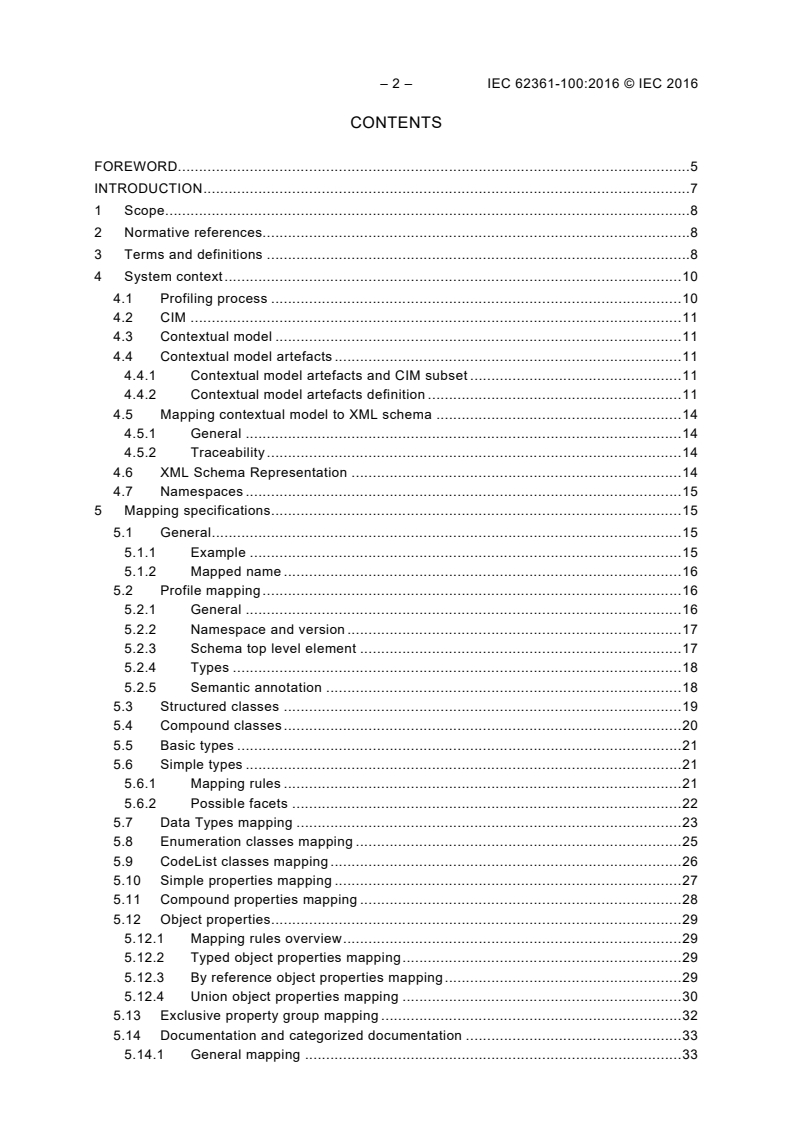
CONTENTS
FOREWORD . 5
INTRODUCTION . 7
1 Scope . 8
2 Normative references. 8
3 Terms and definitions . 8
4 System context . 10
4.1 Profiling process . 10
4.2 CIM . 11
4.3 Contextual model . 11
4.4 Contextual model artefacts . 11
4.4.1 Contextual model artefacts and CIM subset . 11
4.4.2 Contextual model artefacts definition . 11
4.5 Mapping contextual model to XML schema . 14
4.5.1 General . 14
4.5.2 Traceability . 14
4.6 XML Schema Representation . 14
4.7 Namespaces . 15
5 Mapping specifications . 15
5.1 General . 15
5.1.1 Example . 15
5.1.2 Mapped name . 16
5.2 Profile mapping . 16
5.2.1 General . 16
5.2.2 Namespace and version . 17
5.2.3 Schema top level element . 17
5.2.4 Types . 18
5.2.5 Semantic annotation . 18
5.3 Structured classes . 19
5.4 Compound classes . 20
5.5 Basic types . 21
5.6 Simple types . 21
5.6.1 Mapping rules . 21
5.6.2 Possible facets . 22
5.7 Data Types mapping . 23
5.8 Enumeration classes mapping . 25
5.9 CodeList classes mapping . 26
5.10 Simple properties mapping . 27
5.11 Compound properties mapping . 28
5.12 Object properties . 29
5.12.1 Mapping rules overview . 29
5.12.2 Typed object properties mapping . 29
5.12.3 By reference object properties mapping . 29
5.12.4 Union object properties mapping . 30
5.13 Exclusive property group mapping . 32
5.14 Documentation and categorized documentation . 33
5.14.1 General mapping . 33
5.14.2 Documentation mapping . 33
5.14.3 Categorized documentation mapping . 33
5.14.4 Stereotype mapping . 33
5.15 Names . 34
5.16 Mapping order . 34
5.16.1 General mapping order basis . 34
5.16.2 Alphabetical based mapping order . 35
5.16.3 Business context based mapping order . 36
5.17 Changing name rules . 36
Annex A (normative) Use of dedicated XML schemas for datatypes, enumerations
and codelists . 38
A.1 Context: . 38
A.2 Modular schema design and mapping: . 38
A.3 Artefact mapping . 39
A.3.1 General rule . 39
A.3.2 Datatype, enumeration or codelist mapping: . 39
A.3.3 Simple property mapping . 40
Annex B (informative) Contextual model representations . 41
Annex C (informative) Changing name rules examples . 42
C.1 Changing name rule context . 42
C.2 Changing name rules when using "union" super class . 42
C.2.1 General . 42
C.2.2 Changing name rule when CIM association end role name and CIM
super class name are the same . 42
C.2.3 Changing name rule when CIM association end role name is the CIM
super class name prefixed by a qualifier followed by an underscore . 43
C.2.4 Changing name rule when CIM association end role name and the CIM
super class name are completely different . 44
C.3 Changing name rules when using complex properties with the same name . 45
C.3.1 General . 45
C.3.2 Changing name rule when CIM association end role name and CIM
super class name are the same . 45
C.3.3 Changing name rule when CIM association end role name is the CIM
super class name prefixed by a qualifier followed by an underscore . 46
C.3.4 Changing name rule when CIM association end role name and the CIM
super class name are completely different . 48
Bibliography . 50
Figure 1 – Example XML Schema CIM-based profile . 16
Figure 2 – Example of alphabetical order . 34
Figure 3 – Example of business order . 34
Figure 4 – Example business context order of a schema . 36
Figure C.1 – Example of end role name matching super class name . 42
Figure C.2 – Contextual model end role name matching super class name . 43
Figure C.3 – Example of end role name with a qualifier . 43
Figure C.4 – Contextual model end role name with a qualifier . 44
Figure C.5 – End role name and super class name different . 44
Figure C.6 – Contextual model with end role name different from super class name . 45
– 4 – IEC 62361-100:2016 © IEC 2016
Figure C.7 – Example of end role name matching super class name . 46
Figure C.8 – Contextual model end role name matching super class name . 46
Figure C.9 – Example of end role name with a qualifier . 47
Figure C.10 – Contextual model end role name with a qualifier . 47
Figure C.11 – End role name and super class name different . 48
Figure C.12 – Contextual model with end role name different from super class name . 48
Table 1 – Contextual model artefacts . 12
Table 2 – Basic Types . 21
Table 3 – Facets . 23
Table B.1 – Contextual model representation . 41
INTERNATIONAL ELECTROTECHNICAL COMMISSION
____________
POWER SYSTEMS MANAGEMENT AND ASSOCIATED INFORMATION
EXCHANGE – INTEROPERABILITY IN THE LONG TERM –
Part 100: CIM profiles to XML schema mapping
FOREWORD
1) The International Electrotechnical Commission (IEC) is a worldwide organization for standardization comprising
all national electrotechnical committees (IEC National Committees). The object of IEC is to promote
international co-operation on all questions concerning standardization in the electrical and electronic fields. To
this end and in addition to other activities, IEC publishes International Standards, Technical Specifications,
Technical Reports, Publicly Available Specifications (PAS) and Guides (hereafter referred to as “IEC
Publication(s)”). Their preparation is entrusted to technical committees; any IEC National Committee interested
in the subject dealt with may participate in this preparatory work. International, governmental and non-
governmental organizations liaising with the IEC also participate in this preparation. IEC collaborates closely
with the International Organization for Standardization (ISO) in accordance with conditions determined by
agreement between the two organizations.
2) The formal decisions or agreements of IEC on technical matters express, as nearly as possible, an international
consensus of opinion on the relevant subjects since each technical committee has representation from all
interested IEC National Committees.
3) IEC Publications have the form of recommendations for international use and are accepted by IEC National
Committees in that sense. While all reasonable efforts are made to ensure that the technical content of IEC
Publications is accurate, IEC cannot be held responsible for the way in which they are used or for any
misinterpretation by any end user.
4) In order to promote international uniformity, IEC National Committees undertake to apply IEC Publications
transparently to the maximum extent possible in their national and regional publications. Any divergence
between any IEC Publication and the corresponding national or regional publication shall be clearly indicated in
the latter.
5) IEC itself does not provide any attestation of conformity. Independent certification bodies provide conformity
assessment services and, in some areas, access to IEC marks of conformity. IEC is not responsible for any
services carried out by independent certification bodies.
6) All users should ensure that they have the latest edition of this publication.
7) No liability shall attach to IEC or its directors, employees, servants or agents including individual experts and
members of its technical committees and IEC National Committees for any personal injury, property damage or
other damage of any nature whatsoever, whether direct or indirect, or for costs (including legal fees) and
expenses arising out of the publication, use of, or reliance upon, this IEC Publication or any other IEC
Publications.
8) Attention is drawn to the Normative references cited in this publication. Use of the referenced publications is
indispensable for the correct application of this publication.
9) Attention is drawn to the possibility that some of the elements of this IEC Publication may be the subject of
patent rights. IEC shall not be held responsible for identifying any or all such patent rights.
International Standard IEC 62361-100 has been prepared by IEC technical committee 57:
Power systems management and associated information exchange.
This is the first edition of the standard.
The text of this standard is based on the following documents:
FDIS Report on voting
57/1704/FDIS 57/1735/RVD
Full information on the voting for the approval of this standard can be found in the report on
voting indicated in the above table.
This publication has been drafted in accordance with the ISO/IEC Directives, Part 2.
– 6 – IEC 62361-100:2016 © IEC 2016
In this document, the following print types are used:
• Words printed in Arial Black apply to terms that are defined as contextual model artefacts
in 4.4.2,
• Words printed Courier New apply to terms that are used as XML Schema representation
(as defined in 4.6) or in XML examples,
• Words printed “between quotes” apply to terms that are used as tokens in the normative
clauses or that are defined as CIM artefacts.
A list of all parts of the IEC 62361 series, under the general title: Power systems management
and associated information exchange – Interoperability in the long term, can be found on the
IEC website.
The committee has decided that the contents of this publication will remain unchanged until
the stability date indicated on the IEC website under "http://webstore.iec.ch" in the data
related to the specific publication. At this date, the publication will be
• reconfirmed,
• withdrawn,
• replaced by a revised edition, or
• amended.
IMPORTANT – The 'colour inside' logo on the cover page of this publication indicates
that it contains colours which are considered to be useful for the correct
understanding of its contents. Users should therefore print this document using a
colour printer.
INTRODUCTION
The IEC 62361 series defines standards which address areas of interest that impact multiple
standards and provide consistency for implementations.
This part of the IEC 62361 series describes a mapping from CIM profiles to W3C XML
Schemas and defines the rules that CIM XML message payloads shall adhere to.
The principle objective of this part of IEC 62361 is to facilitate the exchange of information in
the form of XML documents whose semantics are defined by the IEC CIM and whose syntax
is defined by a W3C XML schema. This will facilitate the integration of all applications that
use the XML Schema message payloads developed by the WGs and implemented
independently by different vendors into their systems.
The common information model (CIM) specifies the basis for the semantics for message
payload exchanges defined by the IEC. The profile specifications, which are contained in
other parts of the IEC 62361 series, specify the content of the message payloads exchanged.
The format/syntax of those payloads is specified in this part of IEC 62361.
– 8 – IEC 62361-100:2016 © IEC 2016
POWER SYSTEMS MANAGEMENT AND ASSOCIATED INFORMATION
EXCHANGE – INTEROPERABILITY IN THE LONG TERM –
Part 100: CIM profiles to XML schema mapping
1 Scope
This part of IEC 62361 describes a mapping from CIM profiles to W3C XML Schemas.
The purpose of this mapping is to facilitate the exchange of information in the form of XML
documents whose semantics are defined by the IEC CIM and whose syntax is defined by a
W3C XML schema.
2 Normative references
The following documents, in whole or in part, are normatively referenced in this document and
are indispensable for its application. For dated references, only the edition cited applies. For
undated references, the latest edition of the referenced document (including any
amendments) applies.
IEC 61968-11, Application integration at electric utilities – System interfaces for distribution
management – Part 11: Common information model (CIM) extensions for distribution
IEC TS 61970-2, Energy management system application program interface (EMS-API) –
Part 2: Glossary
IEC 61970-301, Energy management system application program interface (EMS-API) –
Part 301: Common information model (CIM) base
IEC 62325-301, Framework for energy market communications – Part 301: Common
information model (CIM) extensions for markets
IEC 62325-450:2013, Framework for energy market communications – Part 450: Profile and
context modelling rules
XML Schema Part 1: Structures Second Edition W3C Recommendation 28 October 2004
IETF RFC 3986 Uniform Resource Identifier (URI): Generic Syntax January 2005
Semantic Annotations for WSDL and XML Schema W3C Recommendation 28 August 2007
3 Terms and definitions
For the purposes of this document, the terms and definitions of IEC TS 61970-2 apply, as well
as the following.
NOTE Refer to the International Electrotechnical Vocabulary, IEC 60050, for general glossary definitions.
3.1
artefact
element of a model that represents objects of a given domain and their characteristics
3.2
canonical model
abstract model that represents all the major objects of a given domain (energy, electricity…)
with artefacts
3.3
common information model
CIM
canonical model (abstract model) that represents all the major objects in an electric utility
enterprise typically needed to model the operational aspects of a utility
Note 1 to entry: CIM is defined in the IEC 61968, IEC 61970 and IEC 62325 series.
Note 2 to entry: This note applies to the French language only.
3.4
contextual model
restricted subset of CIM artefacts
3.5
extensible markup language
XML
markup language that defines a set of rules for encoding documents in a format that is both
human-readable and machine-readable
Note 1 to entry: This is defined in the XML Specification produced by the World Wide Web Consortium (W3C).
Note 2 to entry: This note applies to the French language only.
3.6
profile
uniquely named subset of CIM classes, associations and attributes needed to accomplish a
specific type of interface
Note 1 to entry: A profile, as used in this document, is defined in IEC 62325-450:2013 and IEC 62361-101 .
3.7
resource description format
RDF
family of World Wide Web Consortium (W3C) specifications originally designed as a metadata
data model
Note 1 to entry: This term has come to be used as a general method for conceptual description or modelling of
information that is implemented in web resources, using a variety of syntax formats.
Note 2 to entry: This note applies to the French language only.
3.8
semantic annotation for WSDL and XML Schema
SAWSDL
set of extension attributes for the Web Services Description Language (WSDL) and XML
Schema definition language
Note 1 to entry: This note applies to the French language only.
___________
Under consideration.
– 10 – IEC 62361-100:2016 © IEC 2016
3.9
unified modelling language
UML
formal and comprehensive descriptive language with diagramming techniques used to
represent software systems, from requirements analysis, through design and implementation,
to documentation
Note 1 to entry: UML is a standard defined by the Object Management Group (OMG). UML is used to describe
CIM.
Note 2 to entry: This note applies to the French language only.
3.10
uniform resource indicator
URI
string of characters used to identify a name or a resource, enabling interaction with
representations of the resource over a network (typically the World Wide Web) using specific
protocols
Note 1 to entry: Schemes specifying a concrete syntax and associated protocols define each URI.
Note 2 to entry: This note applies to the French language only.
3.11
XML Schema
family of World Wide Web Consortium (W3C) specifications, used to define the structure,
content, and semantics of eXtensible Markup Language (XML) files
Note 1 to entry: XML Schemas are generally found in files with an “xsd” extension. XSD files are used to define
inter-application messages.
3.12
Web Ontology Language
OWL
family of knowledge representation languages for authoring ontologies, characterised by
formal semantics and RDF/XML-based serializations for the Semantic Web
Note 1 to entry: OWL is endorsed by the World Wide Web Consortium (W3C).
Note 2 to entry: This note applies to the French language only.
4 System context
4.1 Profiling process
The profiling process aim is to define a syntactic model that will govern instance data that are
exchanged in a given business context and whose semantic is defined by a canonical model
(like CIM). The profiling process is in simple form a two steps process:
• Defining a contextual model that is a subset of the canonical model (subset that could
include some restrictions). In this document, there is no assumption about the rules that
are used to complete this step, but the contextual model artefacts are described in
Table 1.
• Generating a syntactic model in the form of an XML Schema with a defined mapping of
contextual model artefacts: this is the purpose of this standard IEC 62361-100.
IEC 62361-100 defines how a contextual model artefact is mapped to XML Schema artefacts
(like element, simple and complex types). It does not define a mapping from canonical
model artefacts to XML Schema ones, but it keeps the fact that there is relation between
these two artefacts.
4.2 CIM
CIM is a canonical model that represents all the major objects in an electric utility enterprise
typically needed to model the operational aspects of a utility. This model includes public
classes and attributes for these objects, as well as the relationships between them. Classes,
attributes, relationships and attribute types like "Primitive", "enumeration", "CIMdatatype" and
"Compound" are the main CIM artefacts.
CIM is defined by IEC standards IEC 61968-11, IEC 61970-301 and IEC 62325-301.
The CIM may be augmented with project or application-specific extensions. In that case, the
references to the CIM in this subclause can be read as CIM with extensions.
4.3 Contextual model
The concept of a contextual model is borrowed from the UN/CEFACT modelling approach and
may be used in CIM standards formation. The contextual model may be any one of several
formats including OWL or a UML subset package.
No specific contextual modelling language is assumed by this specification. However, the
artefacts defined in Table 1 are used in this document when referring to the contextual model
and are assumed to be capable of expression in whichever language is used.
The mapping specifications (see Clause 5) apply to these contextual model artefacts which
could be represented in a number of languages. Two possible representations are given in the
appendices.
4.4 Contextual model artefacts
4.4.1 Contextual model artefacts and CIM subset
In Table 1, contextual artefacts are defined in relation to CIM artefacts. Here, the term subset
is used: a contextual artefact is a subset of some CIM artefact. Subset means that a
contextual artefact could have the same characteristics as its CIM counterpart or a subset of
these characteristics. Examples:
• “IdentifiedObject” class in CIM has four attributes (“mRID”, “aliasName”, “name” and
“description”) and one association “Names”, i.e. its characteristics. “IdentifiedObject”
structured class in contextual model could have the same characteristics as its CIM
counterpart or just some of them: so “IdentifiedObject” contextual artefact is defined as a
subset of “IdentifiedObject” CIM artefact.
• “name” attribute of CIM “IdentifiedObject” class has two characteristics: a cardinality that
is optional and a type that is a string. In contextual model, “name” simple property of
“IdentifiedObject” structured class could have the same characteristics as its CIM
counterpart or some more restricted ones: example, cardinality of “name” could be
restricted to mandatory and/or string length could be defined. So “name” contextual
artefact is defined as a subset of “name” CIM artefact.
• “Names” association end role name of CIM “IdentifiedObject” has one characteristic: a
cardinality that is 0 to many. In contextual model, “Names” object property of
“IdentifiedObject” structured class could have the same characteristic as its CIM
counterpart or a more restricted one: example, cardinality of “Names” could be restricted
to 1 or 1 to many. So “Names” contextual artefact is defined as a subset of “Names” CIM
artefact.
4.4.2 Contextual model artefacts definition
Contextual model artefacts are listed and defined in Table 1.
– 12 – IEC 62361-100:2016 © IEC 2016
Table 1 – Contextual model artefacts
Contextual model Definition
artefact
subset of a CIM class not stereotyped with "enumeration", "Primitive", "CIMDatatype" or
Structured class
"Compound".
A structured class may have zero or more object properties, compound properties and
simple properties.
Any subclass of a structured class is also a structured class.
relative to a given structured class, a more general structured class whose extent is a
Superclass
superset of the given structured class.
relative to a given structured class, a more specific structured class whose extent is a
Subclass
subset of the given structured class.
structured class that may have standalone instances which are not the referent of any
Root class
object property.
A contextual model may assign cardinality bounds to a root class limiting the number of
standalone instances that may occur.
subset of a non-stereotyped CIM superclass defined as a union of (some of) its
Union class
subclasses.
Each member of the union is defined as a structured class. Each of these is a subclass of
a single, given CIM class.
An instance of a union is an instance of one of its constituent structured classes.
Example: in CIM, “RegisteredResource” is a super class of “RegisteredLoad”,
“RegisteredTie” and “RegisteredGenerator”. In contextual model, “RegisteredResource”
could be a super class of some of these subclasses. When defined as a union,
“RegisteredResource” defined the set of the subclasses (“RegisteredLoad”,
“RegisteredTie”…) that are going to be used as the referent classes for the
“RegisteredResource” object property that in this case will be a union object
property (see below).
Note: this feature is used to get all the elements representing subclasses instances in a
random order.
subset of a CIM class defined as "Compound" with additional restrictions.
Compound class
An instance of a compound class is a structured value. It has one or more properties, but
it has no identity distinct from the combination of its property values.
CIM class defined as a "Primitive" (include "Integer", "Decimal", "Boolean", "Duration",
Basic type
"DateTime", "Date", "Time", "Float", "String").
A subset of the CIM “Float” class defined as a “Primitive” and marked as
“Single” or "Double" precision.
A subset of the CIM “String” class defined as a “Primitive” and marked as “normalized”,
“token”, “NMTOKEN”, “Name”, “NCName” and “anyURI” .
A basic type may be used directly in a contextual model without further definition.
The value range of each basic type is assumed to be that of the XML Schema Part II
Datatype integer, decimal, boolean, duration, datetime, date, time,
float, double, string, normalizedString, token, MNTOKEN, Name,
NCName and anyURI respectively.
subset of a CIM class defined as “Primitive” with additional restrictions.
Simple type
As defined above, the value range of such a CIM class is assumed to be one of the XML
Schema Part II datatypes defined above.
The additional restrictions narrow this value range by defining one or more facets for that
datatype (example: “TwentyFourChar_String” is a string whose maximum length is 24
characters).
A simple type instance does not have simple properties or object properties and has no
identity distinct from its value.
Contextual model Definition
artefact
subset of a CIM class defined as "CIMDatatype" with additional restrictions.
Data type
A data type is a class whose instances carry a value and other properties that give
meaning to this value. Data type value and other data type properties could be restricted
by additional constraints.
An instance of a data type class is a structured value. It has one or more properties, but
it has no identity distinct from the combination of its property values.
subset of an "enumeration" CIM class.
Enumeration
class
subset of an "enumeration" CIM class and marked as "CodeList".
CodeList class
Each instance of the enumeration is associated to a “code” whose type is one of the
"Basic type".
Simple property subset of a CIM class attribute with additional restrictions. The type of a simple
property is a Simple type, a Basic type, a Data type or an Enumeration Class.
subset of a CIM class attribute whose referent is a class defined as a "Compound".
Compound
property
subset of a CIM association with additional restrictions and a specific direction from
Object property
referring class to referent class.
The referent of an object property is an instance of a structured class.
The restrictions may narrow the referring or referent classes or place bounds on the
cardinality of the object property.
By-reference subset of a CIM association, as per object property, defined as by-reference. The
object property referent of a by-reference object property is either an instance of a structured class
or an external instance.
An external instance is assumed to exist but is not described in the present message.
Pragmatically, a"by-reference object property is implemented by quoting the
referent's identifier (example "mRID").
Union object object property defined as union whose referent class is a super class or an object
property whose referent class is a union class.
property
In CIM, “ResourceCapacity” has an association with “RegisteredResource”, super class of
“RegisteredLoad”, “RegisteredTie” and “RegisteredGenerator”. The association has two
end role names: “ResourceCapacity” and “RegisteredResource”. In contextual model,
“ResourceCapacity” could have the object property “RegisteredResource” whose
referent class is “RegisteredResource”. If this object property is marked as union or if the
“RegisteredResource” referent class is marked as union, then the “RegisteredResource”
object property is a union object property.
Note: this feature is used to get all the elements representing subclasses instances in a
random order.
Exclusive restriction on a structured class with respects to a group of properties such that only
one of the properties may appear in a given instance of the class.
property group
BasedOn property relation between a contextual model artefact (like structured class, property,
simple type or data type) with its corresponding CIM artefact (like "class", "attribute",
"association", "Primitive", "enumeration", "CIMDatatype", "Compound").
prose description accompanying a definition in the CIM or the contextual model.
Documentation
prose description accompanying a definition in the CIM or in the contextual model together
Categorized
with some classifying properties which indicate the category and purpose of the
documentation
description.
– 14 – IEC 62361-100:2016 © IEC 2016
Contextual model Definition
artefact
identifier associated with a contextual model class or property that qualifies its usage or
Stereotype
semantics, but not its XML Schema mapping.
The meaning of each stereotype must be provided in documentation accompanying the
contextual model.
4.5 Mapping contextual model to XML schema
4.5.1 General
The mapping determines:
• a single, standalone XML schema for a given contextual model;
• the syntax of the instance XML documents to be exchanged;
• the relationship between definitions in the XML schema and definitions in the contextual
model;
• the relationship between elements in the XML documents exchanged and the definitions in
the CIM.
The mapping is applied at design time to map a CIM profile to a W3C XML schema.
In this mapping, a profile defines the semantics of a single type of message payload that will
be encoded in XML.
Therefore:
• The syntax or semantics of any headers that may be added to the instance documents
when they are exchanged is not specified.
• Both the contextual model and its mapped XML schema are design artefacts and are not
necessarily required at the time instance XML documents are exchanged. But the
corresponding XML schema must be agreed and shared before the exchange.
• The method used to exchange instance XML documents is not specified.
4.5.2 Traceability
In this mapping, the relationships, between elements in the XML documents exchanged and
the definitions in the canonical model of which the contextual model is a subset, are
expressed. To keep track of these relationships, the mapping uses semantic annotation as
defined in "Semantic Annotations for WSDL and XML Schema W3C Recommendation". The
mapping to these semantic annotations is done with the contextual model artefact "BasedOn"
property.
4.6 XML Schema Representation
The XML Schema mappings are presented using the “XML Representation Summary
Notation” used in the W3C specification: "XML Schema Part 1: Structures Second Edition".
The following example is abstracted from section 1.3 of this W3C specification:
count = integer
size = (large | medium | small): medium>
Content: (annotation, (all | any*))
The notation consists of an outline of an XML Schema construct with the following
conventions:
• Mandatory attributes are shown in bold, e.g. count
• Optional attributes are shown in standard, e.g. size
• Literal attribute values are shown in italics e.g. medium
• Alternatives attribute values are shown in brackets s
...