


IEC PAS 62408:2005
(Main)Real-time Ethernet Powerlink (EPL)
General Information
- Abstract
It extends Ethernet according to the IEEE 802.3/ISO/IEC 8802-3 standard with mechanisms to transfer data with predictable timing and precise synchronisation. The communication profile meets timing demands typical for high-performance automation and motion applications. It does not change basic principles of the Fast Ethernet Standard IEEE 802.3 but extends it towards RTE. Thus it is possible to leverage and continue to use any standard Ethernet silicon, infrastructure component or test and measurement equipment like a network analyzer.
- Status
- Replaced
- Publication Date
- 27-Jun-2005
- Technical Committee
- SC 65C - Industrial networks
- Drafting Committee
- WG 9 - TC 65/SC 65C/WG 9
- Current Stage
- DELPUB - Deleted Publication
- Start Date
- 14-Dec-2007
- Completion Date
- 28-Aug-2026
Relations
- Effective Date
- 05-Sep-2023
- Effective Date
- 05-Sep-2023
- Effective Date
- 05-Sep-2023
- Effective Date
- 05-Sep-2023
Get Certified
Connect with accredited certification bodies for this standard

BSI Group
BSI (British Standards Institution) is the business standards company that helps organizations make excellence a habit.

DVS-ZERT GmbH
German welding certification society.
CARES (UK Certification Authority for Reinforcing Steels)
UK certification for reinforcing steels and construction.
Sponsored listings
Frequently Asked Questions
IEC PAS 62408:2005 is a technical specification published by the International Electrotechnical Commission (IEC). Its full title is "Real-time Ethernet Powerlink (EPL)". This standard covers: It extends Ethernet according to the IEEE 802.3/ISO/IEC 8802-3 standard with mechanisms to transfer data with predictable timing and precise synchronisation. The communication profile meets timing demands typical for high-performance automation and motion applications. It does not change basic principles of the Fast Ethernet Standard IEEE 802.3 but extends it towards RTE. Thus it is possible to leverage and continue to use any standard Ethernet silicon, infrastructure component or test and measurement equipment like a network analyzer.
It extends Ethernet according to the IEEE 802.3/ISO/IEC 8802-3 standard with mechanisms to transfer data with predictable timing and precise synchronisation. The communication profile meets timing demands typical for high-performance automation and motion applications. It does not change basic principles of the Fast Ethernet Standard IEEE 802.3 but extends it towards RTE. Thus it is possible to leverage and continue to use any standard Ethernet silicon, infrastructure component or test and measurement equipment like a network analyzer.
IEC PAS 62408:2005 is classified under the following ICS (International Classification for Standards) categories: 25.040.40 - Industrial process measurement and control; 35.100.05 - Multilayer applications; 35.240.50 - IT applications in industry. The ICS classification helps identify the subject area and facilitates finding related standards.
IEC PAS 62408:2005 has the following relationships with other standards: It is inter standard links to IEC 61158-3-13:2007, IEC 61158-5-13:2007, IEC 61158-4-13:2007, IEC 61158-6-13:2007. Understanding these relationships helps ensure you are using the most current and applicable version of the standard.
IEC PAS 62408:2005 is available in PDF format for immediate download after purchase. The document can be added to your cart and obtained through the secure checkout process. Digital delivery ensures instant access to the complete standard document.
Standards Content (Sample)
PUBLICLY
IEC
AVAILABLE
PAS 62408
SPECIFICATION
First edition
2005-06
Real-time Ethernet Powerlink (EPL)
Reference number
IEC/PAS 62408:2005(E)
Publication numbering
As from 1 January 1997 all IEC publications are issued with a designation in the
60000 series. For example, IEC 34-1 is now referred to as IEC 60034-1.
Consolidated editions
The IEC is now publishing consolidated versions of its publications. For example,
edition numbers 1.0, 1.1 and 1.2 refer, respectively, to the base publication, the
base publication incorporating amendment 1 and the base publication incorporating
amendments 1 and 2.
Further information on IEC publications
The technical content of IEC publications is kept under constant review by the IEC,
thus ensuring that the content reflects current technology. Information relating to
this publication, including its validity, is available in the IEC Catalogue of
publications (see below) in addition to new editions, amendments and corrigenda.
Information on the subjects under consideration and work in progress undertaken
by the technical committee which has prepared this publication, as well as the list
of publications issued, is also available from the following:
• IEC Web Site (www.iec.ch)
• Catalogue of IEC publications
The on-line catalogue on the IEC web site (www.iec.ch/searchpub) enables you to
search by a variety of criteria including text searches, technical committees
and date of publication. On-line information is also available on recently issued
publications, withdrawn and replaced publications, as well as corrigenda.
• IEC Just Published
This summary of recently issued publications (www.iec.ch/online_news/ justpub)
is also available by email. Please contact the Customer Service Centre (see
below) for further information.
• Customer Service Centre
If you have any questions regarding this publication or need further assistance,
please contact the Customer Service Centre:
Email: custserv@iec.ch
Tel: +41 22 919 02 11
Fax: +41 22 919 03 00
PUBLICLY
IEC
AVAILABLE
PAS 62408
SPECIFICATION
First edition
2005-06
Real-time Ethernet Powerlink (EPL)
© IEC 2005 – Copyright - all rights reserved
No part of this publication may be reproduced or utilized in any form or by any means, electronic or
mechanical, including photocopying and microfilm, without permission in writing from the publisher.
International Electrotechnical Commission, 3, rue de Varembé, PO Box 131, CH-1211 Geneva 20, Switzerland
Telephone: +41 22 919 02 11 Telefax: +41 22 919 03 00 E-mail: inmail@iec.ch Web: www.iec.ch
PRICE CODE
Commission Electrotechnique Internationale
XH
International Electrotechnical Commission
Международная Электротехническая Комиссия
For price, see current catalogue
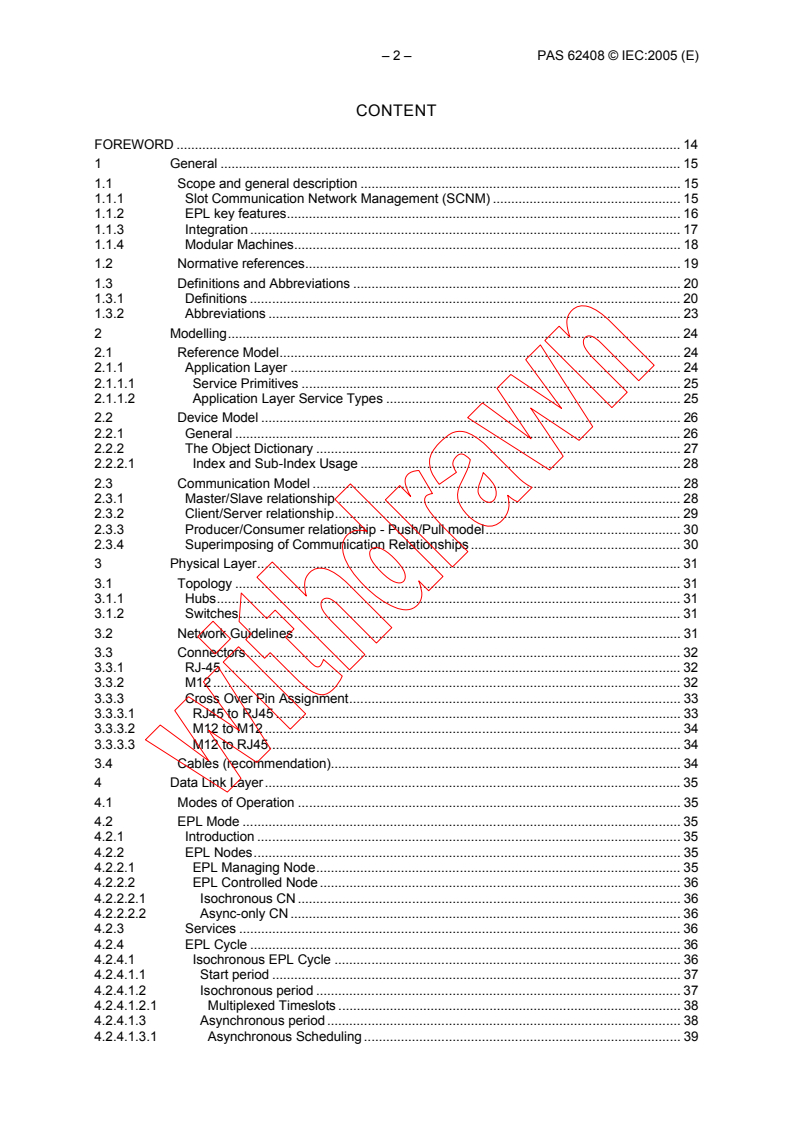
– 2 – PAS 62408 © IEC:2005 (E)
CONTENT
FOREWORD . 14
1 General . 15
1.1 Scope and general description . 15
1.1.1 Slot Communication Network Management (SCNM) . 15
1.1.2 EPL key features. 16
1.1.3 Integration .17
1.1.4 Modular Machines. 18
1.2 Normative references. 19
1.3 Definitions and Abbreviations . 20
1.3.1 Definitions .20
1.3.2 Abbreviations . 23
2 Modelling. 24
2.1 Reference Model. 24
2.1.1 Application Layer . 24
2.1.1.1 Service Primitives . 25
2.1.1.2 Application Layer Service Types . 25
2.2 Device Model . 26
2.2.1 General .26
2.2.2 The Object Dictionary . 27
2.2.2.1 Index and Sub-Index Usage . 28
2.3 Communication Model . 28
2.3.1 Master/Slave relationship . 28
2.3.2 Client/Server relationship. 29
2.3.3 Producer/Consumer relationship - Push/Pull model. 30
2.3.4 Superimposing of Communication Relationships . 30
3 Physical Layer. 31
3.1 Topology . 31
3.1.1 Hubs. 31
3.1.2 Switches.31
3.2 Network Guidelines. 31
3.3 Connectors.32
3.3.1 RJ-45 . 32
3.3.2 M12 . 32
3.3.3 Cross Over Pin Assignment. 33
3.3.3.1 RJ45 to RJ45 . 33
3.3.3.2 M12 to M12. 34
3.3.3.3 M12 to RJ45. 34
3.4 Cables (recommendation). 34
4 Data Link Layer.35
4.1 Modes of Operation . 35
4.2 EPL Mode . 35
4.2.1 Introduction . 35
4.2.2 EPL Nodes. 35
4.2.2.1 EPL Managing Node. 35
4.2.2.2 EPL Controlled Node . 36
4.2.2.2.1 Isochronous CN . 36
4.2.2.2.2 Async-only CN . 36
4.2.3 Services .36
4.2.4 EPL Cycle . 36
4.2.4.1 Isochronous EPL Cycle . 36
4.2.4.1.1 Start period . 37
4.2.4.1.2 Isochronous period . 37
4.2.4.1.2.1 Multiplexed Timeslots . 38
4.2.4.1.3 Asynchronous period. 38
4.2.4.1.3.1 Asynchronous Scheduling . 39
PAS 62408 © IEC:2005 (E) – 3 –
4.2.4.1.3.2 Asynchronous Transmit Priorities. 40
4.2.4.1.3.3 Distribution of the Asynchronous period. 40
4.2.4.1.4 Idle Period. 40
4.2.4.2 Reduced EPL Cycle. 40
4.2.4.3 EPL CN Cycle State Machine. 41
4.2.4.3.1 Overview. 41
4.2.4.3.2 States. 41
4.2.4.3.3 Events. 41
4.2.4.3.4 Usage of the the NMT_CS state by the DLL_CS . 42
4.2.4.3.4.1 State NMT_CS_OPERATIONAL, NMT_CS_PRE_OPERATIONAL_2,
NMT_CS_READY_TO_OPERATE . 42
4.2.4.3.4.1.1 Transitions . 43
4.2.4.3.4.2 Other States. 44
4.2.4.3.4.2.1 Transitions in other NMT states. 45
4.2.4.4 EPL MN Cycle State Machine . 45
4.2.4.4.1 Overview. 45
4.2.4.4.2 States. 45
4.2.4.4.3 Events. 45
4.2.4.4.4 Usage of the NMT_MS state by the DLL_MS . 46
4.2.4.4.4.1 State NMT_MS_OPERATIONAL . 46
4.2.4.4.4.1.1 Transitions . 48
4.2.4.4.4.2 Other Modes . 49
4.2.5 Recognizing Active Nodes. 49
4.3 Basic Ethernet Mode. 49
4.4 MAC Adressing . 50
4.4.1 MAC Unicast. 50
4.4.2 MAC Multicast. 50
4.4.3 MAC Broadcast. 50
4.5 EPL Addressing . 50
4.6 Frame Structures . 51
4.6.1 Integration with Ethernet. 51
4.6.1.1 EPL Frame. 51
4.6.1.1.1 EPL Basic Frame. 51
4.6.1.1.2 Start Of Cyclic (SoC) . 52
4.6.1.1.3 PollRequest (PReq) . 53
4.6.1.1.4 PollResponse (PRes) . 54
4.6.1.1.5 Start Of Asynchronous (SoA) . 55
4.6.1.1.5.1 RequestedServiceID s. 56
4.6.1.1.6 AsynchronousSend (ASnd) – EPL format . 57
4.6.1.1.6.1 ASnd ServiceID values. 58
4.6.1.2 Non-EPL Frames . 58
4.6.1.3 Transfer Protection . 58
4.7 Error Handling Data Link Layer (DLL) . 59
4.7.1 Possible Error Sources and Error Symptoms. 59
4.7.2 Error Handling Table for CN . 60
4.7.3 Error Handling Table for MN. 61
4.7.4 Error Handling Registration . 62
4.7.4.1 Threshold counters . 63
4.7.4.2 Cumulative Counter . 63
4.7.5 Physical Layer Error Sources . 63
4.7.5.1 Loss of Link. 63
4.7.5.2 Incorrect physical Ethernet operating modes . 64
4.7.6 Rx MAC buffer overflow / Tx MAC buffer underrun. 64
4.7.6.1 Transmission / CRC Errors. 65
4.7.7 Communication Error Symptoms detected by the MN . 65
4.7.7.1 Timing Violation . 65
4.7.7.1.1 Slot Time Exceeded. 65
4.7.7.1.1.1 Case 1-2 Frame received in time . 67
4.7.7.1.1.2 Case 3 Loss of PollResponse: Frame not received . 67
4.7.7.1.1.3 Case 4-6 Late PollResponse: Frame received in foreign slot (also collisions) . 67
– 4 – PAS 62408 © IEC:2005 (E)
4.7.7.2 Loss of PollResponse . 67
4.7.7.3 Late PollResponse. 68
4.7.7.4 Cycle Time Exceeded. 68
4.7.7.5 Collisions. 69
4.7.7.6 Invalid Formats . 70
4.7.7.7 EPL Address Conflicts . 71
4.7.7.8 Multiple MNs on a single EPL Network. 71
4.7.8 Communication Error Symptoms detected by the CN. 72
4.7.8.1 Collisions. 72
4.7.8.2 Invalid Formats . 72
4.7.8.3 Loss of Frames . 73
4.7.8.3.1 Loss of SoC . 73
4.7.8.3.2 Loss of SoA. 74
4.7.8.3.3 Loss of PollRequest. 74
4.7.8.4 SoC Jitter out of Range . 75
4.7.9 Error Handling Parameters . 75
4.7.9.1 Object 1C00 : DLL_MNCRCError_REC. 75
h
4.7.9.2 Object 1C01 : DLL_MNCollision_REC. 76
h
4.7.9.3 Object 1C02 : DLL_MNCycTimeExceed_REC . 78
h
4.7.9.4 Object 1C10 : DLL_CNLossOfLink_REC. 79
h
4.7.9.5 Object 1C04 : DLL_MNCNLatePResCumCnt_AU32. 80
h
4.7.9.6 Object 1C05 : DLL_MNCNLatePResThrCnt_AU32 . 81
h
4.7.9.7 Object 1C06 : DLL_MNCNLatePResThrLim_AU32. 82
h
4.7.9.8 Object 1C07 : DLL_MNCNLossPResCumCnt_AU32 . 83
h
4.7.9.9 Object 1C08 : DLL_MNCNLossPResThrCnt_AU32 . 84
h
4.7.9.10 Object 1C09 : DLL_MNCNLossPResThrLim_AU32 . 85
h
4.7.9.11 Object 1C0A : DLL_CNCollision_REC. 86
h
4.7.9.12 Object 1C0B : DLL_CNLossSoC_REC. 87
h
4.7.9.13 Object 1C0C : DLL_CNLossSoA_REC. 88
h
4.7.9.14 Object 1C0D : DLL_CNLossPReq_REC. 89
h
4.7.9.15 Object 1C0E : DLL_CNSoCJitter_REC. 90
h
4.7.9.16 Object 1C0F : DLL_CNCRCError_REC. 91
h
4.7.9.17 Object 1C10 : DLL_CNLossOfLink_REC. 92
h
4.7.9.18 Object 1C11 : DLL_MNAsyncSlotTimeout_U32 . 93
h
4.7.9.19 Object 1C12 : DLL_MNCycleSuspendNumber_U32 . 94
h
4.7.9.20 Object 1C13 : DLL_CNSoCJitterRange_U32. 94
h
5 Network / Transport Layer . 95
5.1 Internet Protocol (IP). 95
5.1.1 IP Host Requirements. 95
5.1.1.1 Nodes without IP Communication. 95
5.1.1.2 Minimum Requirements for SDO Communication. 95
5.1.1.2.1 IP Stack Requirements. 95
5.1.1.2.2 UDP Requirements. 95
5.1.1.3 Minimum Requirements for Standard IP Communication . 95
5.1.1.3.1 IP Stack Requirements. 95
5.1.2 IP Addressing. 96
5.1.3 Address Resolution. 96
5.1.4 .Hostname. 97
5.1.5 Object description . 97
5.1.5.1 Object 1E4B : NWL_IpGroup_REC. 97
h
5.1.5.2 Object 1E40 – 1E4F : NWL_IpAddrTable_Xh_REC. 98
h h
5.2 EPL conformant UDP/IP format. 100
5.3 EPL Sequence Layer. 100
6 Application Layer . 101
6.1 Data Types and Encoding Rules . 101
6.1.1 General Description of Data Types and Encoding Rules . 101
6.1.2 Data Type Definitions. 101
6.1.3 Bit Sequences. 102
6.1.3.1 Definition of Bit Sequences. 102
6.1.3.2 Transfer Syntax for Bit Sequences. 103
PAS 62408 © IEC:2005 (E) – 5 –
6.1.4 Basic Data Types. 103
6.1.4.1 NIL . 103
6.1.4.2 Boolean. 103
6.1.4.3 Void. 103
6.1.4.4 Unsigned Integer. 103
6.1.4.5 Signed Integer. 104
6.1.4.6 Floating-Point Numbers . 105
6.1.5 Compound Data Types. 105
6.1.6 Extended Data Types . 106
6.1.6.1 Octet String. 106
6.1.6.2 Visible String. 106
6.1.6.3 Unicode String . 106
6.1.6.4 Time of Day. 106
6.1.6.5 Time Difference. 106
6.1.6.6 Domain. 107
6.2 Object Dictionary. 107
6.3 Service Data (SDO) . 107
6.3.1 UDP Layer . 108
6.3.2 SDO EPL Message Type. 108
6.3.3 SDO Sequence Layer. 109
6.3.3.1 Asynchronous Sequence Layer. 109
6.3.3.1.1 Connection. 110
6.3.3.1.1.1 Initialization of Connection. 110
6.3.3.1.1.2 Closing a connection . 110
6.3.3.1.1.3 Normal Connection. 111
6.3.3.1.1.4 Connection with Delay. 113
6.3.3.1.1.5 Sender History Full . 114
6.3.3.1.2 Errors . 114
6.3.3.1.2.1 Error: Loss of Frame with Data. 114
6.3.3.1.2.2 Error: Loss of Acknowledge Frame . 115
6.3.3.1.2.3 Error: Duplication of Frame . 116
6.3.3.1.2.4 Error: Overtaking of Frames . 116
6.3.3.1.2.5 Broken Connection . 117
6.3.3.1.2.6 Error: Flooding with commands. 117
6.3.3.2 Embedded Sequence Layer for SDO in Cyclic Data. 118
6.3.3.2.1 Connection. 119
6.3.3.2.1.1 Initialization of Connection. 119
6.3.3.2.1.2 Normal Connection. 119
6.3.3.3 Errors . 121
6.3.3.3.1 Error: Request Lost. 121
6.3.3.3.2 Error: Response Lost. 122
6.3.3.4 Handling of Segmented Transfers. 123
6.3.3.4.1 Segmented Download from Client to Server . 123
6.3.3.4.2 Segmented Upload from Server to Client. 124
6.3.4 SDO Command Layer. 125
6.3.4.1 EPL Command Layer Protocol . 126
6.3.4.1.1 Download Protocol. 128
6.3.4.1.2 Upload Protocol . 128
6.3.4.1.3 Abort Transfer. 130
6.3.4.2 Commands. 131
6.3.4.2.1 SDO Protocol. 133
6.3.4.2.1.1 Command: Write by Index . 133
6.3.4.2.1.2 Command: Read by Index. 133
6.3.4.2.1.3 Command: Write All by Index . 134
6.3.4.2.1.4 Command: Read All by Index. 134
6.3.4.2.1.5 Command: Write by Name . 135
6.3.4.2.1.6 Command: Read by Name . 135
6.3.4.2.2 File Transfer. 136
6.3.4.2.2.1 Command: File Write. 136
6.3.4.2.2.2 Command: File Read. 137
6.3.4.2.3 Variable groups. 138
– 6 – PAS 62408 © IEC:2005 (E)
6.3.4.2.3.1 Command: Write Multiple Parameter by Index. 138
6.3.4.2.3.1.1 Write Multiple Parameter by Index Request. 138
6.3.4.2.3.1.2 Write Multiple Parameter by Index Response . 139
6.3.4.2.3.2 Command: Read Multiple Parameter by Index . 140
6.3.4.2.3.2.1 Read Multiple Parameter by Index Request. 140
6.3.4.2.3.2.2 Read Multiple Parameter by Index Response. 141
6.3.4.2.4 Parameter Services . 142
6.3.4.2.4.1 Command: Maximum Segment Size. 142
6.3.4.2.4.2 Command: Link Name to Index . 142
6.3.5 SDO Embedded in PDO . 143
6.3.6 Object Description. 144
6.3.6.1 Object 0422 : SDO_ParameterRecord_TYPE . 144
h
6.3.6.2 Object 1200 – 127F : SDO_ServerContainerParam_XXh_REC . 144
h h
6.3.6.3 Object 1280 – 12FF : SDO_ClientContainerParam_XXh_REC . 144
h h
6.4 Process Data Object (PDO). 145
6.4.1 PDO Mapping Version . 145
6.4.2 Container . 145
6.4.3 Multiplexed timeslots. 146
6.4.4 Transmit PDOs . 146
6.4.5 Receive PDOs . 147
6.4.5.1 PDO via PReq. 147
6.4.5.2 PDO via PRes. 147
6.4.6 PDO Error Handling. 148
6.4.6.1 Dynamic Errors . 148
6.4.6.2 Configuration Errors. 148
6.4.7 Object Description. 149
6.4.7.1 Object 0420 :PDO_CommParamRecord_TYPE. 149
h
6.4.7.2 Object 0421 :PDO_MappParamArray_TYPE. 150
h
6.4.7.3 Object 1400 – 14FF : PDO_RxCommParam_XXh_REC . 151
h h
6.4.7.4 Object 1600 – 16FF : PDO_RxMappParam_XXh_AU64. 153
h h
6.4.7.5 Object 1800 – 18FF : PDO_TxCommParam_XXh_REC . 154
h h
6.4.7.6 Object 1A00 – 1AFF : PDO_TxMappParam_XXh_AU64 . 156
h h
6.5 Synchronisation (SYNC). 157
6.6 Error Handling and Diagnostics . 157
6.6.1 Error Signalling . 157
6.6.1.1 Error Register. 158
6.6.1.2 Error History. 158
6.6.1.3 Error Signaling Bits . 160
6.6.1.4 Initialisation . 161
6.6.1.5 Error Signaling with RReq and PRes frames . 162
6.6.1.6 Error Signaling with Async-only CNs. 163
6.6.1.7 Format of StatusResponse Data . 164
6.6.1.7.1 Static Error Bit Field. 164
6.6.1.7.2 Status and History Entries . 164
6.6.1.8 Object descriptions . 165
6.6.1.8.1 Object 1001h : ERR_ErrorRegister_U8. 165
6.6.1.8.2 Object 1003h : ERR_History_ADOM. 166
6.7 Program Download . 167
6.7.1 EPL manager owned objects. 168
6.8 MN Configuration Manager. 168
6.8.1 DCF storage. 168
6.8.2 Concise configuration storage . 169
6.8.3 Check configuration process . 170
6.8.4 Request configuration. 170
6.8.5 „DEVICE DESCRIPTION FILE“ storage. 171
6.9 Input from a Programmable Device . 171
6.9.1 Basics . 171
6.9.2 Dynamic index assignment. 172
6.9.3 Object dictionary entries . 172
6.9.3.1 Object 1F70 : Process picture . 173
h
PAS 62408 © IEC:2005 (E) – 7 –
7 NMT . 174
7.1 NMT State Machine . 174
7.1.1 Overview . 174
7.1.2 Common Initialisation NMT State Machine . 175
7.1.2.1 States. 176
7.1.2.1.1 NMT_GS_POWERED . 176
7.1.2.1.1.1 NMT_GS_INITIALISATION . 176
7.1.2.1.1.1.1 Sub-states. 176
7.1.2.1.1.2 NMT_GS_COMMUNICATING . 177
7.1.2.2 Transitions . 177
7.1.3 MN NMT State Machine. 178
7.1.3.1 Overview. 178
7.1.3.2 States. 179
7.1.3.2.1 NMT_MS_NOT_ACTIVE. 179
7.1.3.2.2 NMT_MS_EPL_MODE. 180
7.1.3.2.2.1 NMT_MS_PRE_OPERATIONAL_1 . 180
7.1.3.2.2.1.1 NMT_MS_PRE_OPERATIONAL_2 . 180
7.1.3.2.2.1.2 NMT_MS_READY_TO_OPERATE. 180
7.1.3.2.2.1.3 NMT_MS_OPERATIONAL. 181
7.1.3.3 Transitions . 182
7.1.4 CN NMT State Machine. 183
7.1.4.1 States. 184
7.1.4.1.1 NMT_CS_NOT_ACTIVE . 184
7.1.4.1.1.1 NMT_CS_PRE_OPERATIONAL_1. 184
7.1.4.1.1.2 NMT_CS_PRE_OPERATIONAL_2. 184
7.1.4.1.1.3 NMT_CS_READY_TO_OPERATE . 185
7.1.4.1.1.4 NMT_CS_OPERATIONAL . 185
7.1.4.1.1.5 NMT_CS_STOPPED. 185
7.1.4.1.2 NMT_CS_BASIC_ETHERNET. 186
7.1.4.2 Transitions .
...