


IEC 61988-4-2:2012
(Main)Plasma display panels - Part 4-2: Environmental testing methods - Panel strength
General Information
- Abstract
IEC 61988-4-2:2012 defines testing methods for evaluating mechanical characteristics of plasma display modules (PDP modules) in the following areas:
a) Ball drop breaking strength of panels;
b) Partial heating strength of panels.
- Status
- Published
- Publication Date
- 26-Apr-2012
- Technical Committee
- TC 110 - Electronic displays
- Drafting Committee
- WG 4 - TC 110/WG 4
- Current Stage
- PPUB - Publication issued
- Start Date
- 27-Apr-2012
- Completion Date
- 15-May-2012
Overview
IEC 61988-4-2:2012 is an international standard developed by the International Electrotechnical Commission (IEC) that specifies environmental testing methods for determining the panel strength of plasma display panels (PDPs). Focused on mechanical properties, this standard details procedures for measuring the breaking strength of panels through ball drop impact and evaluating the panel's robustness under locally applied thermal stress. By standardizing these testing methods, IEC 61988-4-2:2012 helps manufacturers consistently evaluate the durability and reliability of PDP modules, ensuring product safety and quality in real-world use.
Key Topics
Ball Drop Breaking Strength
Defines a method for evaluating the impact resistance of plasma display panels using a steel ball dropped from calibrated heights onto specified points of the panel’s surface.Partial Heating Strength
Establishes procedures for assessing the mechanical strength of a PDP panel when exposed to localized thermal stress. This test simulates potential damage from uneven heating during operation by using a controlled rubber heater.Test Conditions and Equipment
Specifies the required environmental conditions-such as temperature, humidity, and pressure-for consistent testing, and outlines essential equipment requirements for accurate measurements.Measurement Points and Layouts
Provides guidance on the positioning of impact and heating applications, ensuring reproducibility and meaningful results.
Applications
IEC 61988-4-2:2012 is widely used across industries involved in the manufacturing, testing, and certification of plasma display panels. Its main applications include:
Product Development and Quality Assurance
Enables manufacturers to rigorously test new PDP designs for resistance to mechanical impact and thermal stress. This assists in identifying weaknesses early and continuously improving product durability.Regulatory Compliance and Certification
Provides recognized, standardized test methods required by supply chains and certification bodies, ensuring products meet global safety and reliability expectations.Comparative Performance Evaluation
Facilitates reliable comparison of panel strength across different PDP designs, materials, and production batches.Failure Analysis
Offers structured methodologies for identifying the root causes of in-field panel failures linked to impact or heat stress, supporting corrective action and future product improvements.
Implementing these testing protocols enhances PDP product safety, reduces warranty claims, and fosters consumer trust through more robust and reliable displays.
Related Standards
Organizations working with IEC 61988-4-2:2012 may also reference the following related international standards:
IEC 60068-1: Environmental testing - General and guidance
Foundational reference outlining environmental test parameters, often used alongside panel strength testing.IEC 61988-1: Plasma display panels - Terminology and letter symbols
Provides standardized definitions crucial for clear communication in PDP testing and documentation.IEC 61988-2-1: Plasma display panels - Measuring methods - Optical and optoelectrical
Defines measurement techniques for essential display characteristics, complementing mechanical testing.IEC 61988-4: Plasma display panels - Climatic and mechanical testing methods
Expands on various environmental tests relevant for PDP reliability beyond panel strength.IEC 61988-3-1: Plasma display panels - Mechanical interface
Deals with mechanical integration aspects relevant to panel installation and use.
By using IEC 61988-4-2:2012 in conjunction with these relevant standards, manufacturers and testers can ensure a comprehensive approach to plasma display panel safety, quality, and performance assessment.
Keywords: plasma display panel strength, PDP mechanical testing, IEC 61988-4-2, ball drop test, partial heating strength, PDP environmental testing, display panel durability, international standards.
Frequently Asked Questions
IEC 61988-4-2:2012 is a standard published by the International Electrotechnical Commission (IEC). Its full title is "Plasma display panels - Part 4-2: Environmental testing methods - Panel strength". This standard covers: IEC 61988-4-2:2012 defines testing methods for evaluating mechanical characteristics of plasma display modules (PDP modules) in the following areas: a) Ball drop breaking strength of panels; b) Partial heating strength of panels.
IEC 61988-4-2:2012 defines testing methods for evaluating mechanical characteristics of plasma display modules (PDP modules) in the following areas: a) Ball drop breaking strength of panels; b) Partial heating strength of panels.
IEC 61988-4-2:2012 is classified under the following ICS (International Classification for Standards) categories: 01 - GENERALITIES. TERMINOLOGY. STANDARDIZATION. DOCUMENTATION; 31.120 - Electronic display devices; 31.260 - Optoelectronics. Laser equipment. The ICS classification helps identify the subject area and facilitates finding related standards.
IEC 61988-4-2:2012 is available in PDF format for immediate download after purchase. The document can be added to your cart and obtained through the secure checkout process. Digital delivery ensures instant access to the complete standard document.
Standards Content (Sample)
IEC 61988-4-2 ®
Edition 1.0 2012-04
INTERNATIONAL
STANDARD
NORME
INTERNATIONALE
Plasma display panels –
Part 4-2: Environmental testing methods – Panel strength
Panneaux d’affichage à plasma –
Partie 4-2: Méthodes d'essais d'environnement – Résistance des panneaux
All rights reserved. Unless otherwise specified, no part of this publication may be reproduced or utilized in any form
or by any means, electronic or mechanical, including photocopying and microfilm, without permission in writing from
either IEC or IEC's member National Committee in the country of the requester.
If you have any questions about IEC copyright or have an enquiry about obtaining additional rights to this publication,
please contact the address below or your local IEC member National Committee for further information.
Droits de reproduction réservés. Sauf indication contraire, aucune partie de cette publication ne peut être reproduite ni
utilisée sous quelque forme que ce soit et par aucun procédé, électronique ou mécanique, y compris la photocopie et les
microfilms, sans l'accord écrit de la CEI ou du Comité national de la CEI du pays du demandeur.
Si vous avez des questions sur le copyright de la CEI ou si vous désirez obtenir des droits supplémentaires sur cette
publication, utilisez les coordonnées ci-après ou contactez le Comité national de la CEI de votre pays de résidence.
IEC Central Office Tel.: +41 22 919 02 11
3, rue de Varembé Fax: +41 22 919 03 00
CH-1211 Geneva 20 info@iec.ch
Switzerland www.iec.ch
About the IEC
The International Electrotechnical Commission (IEC) is the leading global organization that prepares and publishes
International Standards for all electrical, electronic and related technologies.
About IEC publications
The technical content of IEC publications is kept under constant review by the IEC. Please make sure that you have the
latest edition, a corrigenda or an amendment might have been published.
Useful links:
IEC publications search - www.iec.ch/searchpub Electropedia - www.electropedia.org
The advanced search enables you to find IEC publications The world's leading online dictionary of electronic and
by a variety of criteria (reference number, text, technical electrical terms containing more than 30 000 terms and
committee,…). definitions in English and French, with equivalent terms in
It also gives information on projects, replaced and additional languages. Also known as the International
withdrawn publications. Electrotechnical Vocabulary (IEV) on-line.
IEC Just Published - webstore.iec.ch/justpublished Customer Service Centre - webstore.iec.ch/csc
Stay up to date on all new IEC publications. Just Published If you wish to give us your feedback on this publication
details all new publications released. Available on-line and or need further assistance, please contact the
also once a month by email. Customer Service Centre: csc@iec.ch.
A propos de la CEI
La Commission Electrotechnique Internationale (CEI) est la première organisation mondiale qui élabore et publie des
Normes internationales pour tout ce qui a trait à l'électricité, à l'électronique et aux technologies apparentées.
A propos des publications CEI
Le contenu technique des publications de la CEI est constamment revu. Veuillez vous assurer que vous possédez
l’édition la plus récente, un corrigendum ou amendement peut avoir été publié.
Liens utiles:
Recherche de publications CEI - www.iec.ch/searchpub Electropedia - www.electropedia.org
La recherche avancée vous permet de trouver des Le premier dictionnaire en ligne au monde de termes
publications CEI en utilisant différents critères (numéro de électroniques et électriques. Il contient plus de 30 000
référence, texte, comité d’études,…). termes et définitions en anglais et en français, ainsi que
Elle donne aussi des informations sur les projets et les les termes équivalents dans les langues additionnelles.
publications remplacées ou retirées. Egalement appelé Vocabulaire Electrotechnique
International (VEI) en ligne.
Just Published CEI - webstore.iec.ch/justpublished
Service Clients - webstore.iec.ch/csc
Restez informé sur les nouvelles publications de la CEI.
Just Published détaille les nouvelles publications parues. Si vous désirez nous donner des commentaires sur
Disponible en ligne et aussi une fois par mois par email. cette publication ou si vous avez des questions
contactez-nous: csc@iec.ch.
IEC 61988-4-2 ®
Edition 1.0 2012-04
INTERNATIONAL
STANDARD
NORME
INTERNATIONALE
Plasma display panels –
Part 4-2: Environmental testing methods – Panel strength
Panneaux d’affichage à plasma –
Partie 4-2: Méthodes d'essais d'environnement – Résistance des panneaux
INTERNATIONAL
ELECTROTECHNICAL
COMMISSION
COMMISSION
ELECTROTECHNIQUE
PRICE CODE
INTERNATIONALE
CODE PRIX N
ICS 31.120; 31.260 ISBN 978-2-88912-049-9
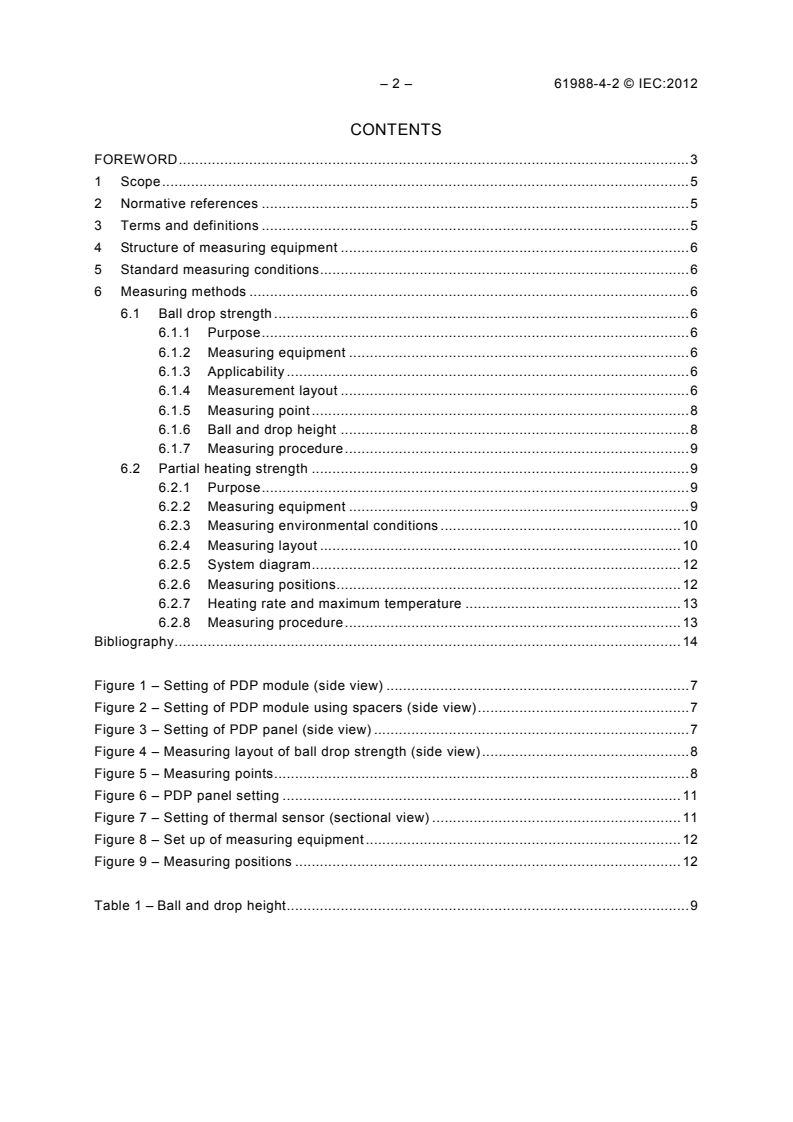
– 2 – 61988-4-2 © IEC:2012
CONTENTS
FOREWORD . 3
1 Scope . 5
2 Normative references . 5
3 Terms and definitions . 5
4 Structure of measuring equipment . 6
5 Standard measuring conditions . 6
6 Measuring methods . 6
6.1 Ball drop strength . 6
6.1.1 Purpose . 6
6.1.2 Measuring equipment . 6
6.1.3 Applicability . 6
6.1.4 Measurement layout . 6
6.1.5 Measuring point . 8
6.1.6 Ball and drop height . 8
6.1.7 Measuring procedure . 9
6.2 Partial heating strength . 9
6.2.1 Purpose . 9
6.2.2 Measuring equipment . 9
6.2.3 Measuring environmental conditions . 10
6.2.4 Measuring layout . 10
6.2.5 System diagram . 12
6.2.6 Measuring positions . 12
6.2.7 Heating rate and maximum temperature . 13
6.2.8 Measuring procedure . 13
Bibliography . 14
Figure 1 – Setting of PDP module (side view) . 7
Figure 2 – Setting of PDP module using spacers (side view) . 7
Figure 3 – Setting of PDP panel (side view) . 7
Figure 4 – Measuring layout of ball drop strength (side view) . 8
Figure 5 – Measuring points . 8
Figure 6 – PDP panel setting . 11
Figure 7 – Setting of thermal sensor (sectional view) . 11
Figure 8 – Set up of measuring equipment . 12
Figure 9 – Measuring positions . 12
Table 1 – Ball and drop height . 9
61988-4-2 © IEC:2012 – 3 –
INTERNATIONAL ELECTROTECHNICAL COMMISSION
____________
PLASMA DISPLAY PANELS –
Part 4-2: Environmental testing methods –
Panel strength
FOREWORD
1) The International Electrotechnical Commission (IEC) is a worldwide organization for standardization comprising
all national electrotechnical committees (IEC National Committees). The object of IEC is to promote
international co-operation on all questions concerning standardization in the electrical and electronic fields. To
this end and in addition to other activities, IEC publishes International Standards, Technical Specifications,
Technical Reports, Publicly Available Specifications (PAS) and Guides (hereafter referred to as “IEC
Publication(s)”). Their preparation is entrusted to technical committees; any IEC National Committee interested
in the subject dealt with may participate in this preparatory work. International, governmental and non-
governmental organizations liaising with the IEC also participate in this preparation. IEC collaborates closely
with the International Organization for Standardization (ISO) in accordance with conditions determined by
agreement between the two organizations.
2) The formal decisions or agreements of IEC on technical matters express, as nearly as possible, an international
consensus of opinion on the relevant subjects since each technical committee has representation from all
interested IEC National Committees.
3) IEC Publications have the form of recommendations for international use and are accepted by IEC National
Committees in that sense. While all reasonable efforts are made to ensure that the technical content of IEC
Publications is accurate, IEC cannot be held responsible for the way in which they are used or for any
misinterpretation by any end user.
4) In order to promote international uniformity, IEC National Committees undertake to apply IEC Publications
transparently to the maximum extent possible in their national and regional publications. Any divergence
between any IEC Publication and the corresponding national or regional publication shall be clearly indicated in
the latter.
5) IEC itself does not provide any attestation of conformity. Independent certification bodies provide conformity
assessment services and, in some areas, access to IEC marks of conformity. IEC is not responsible for any
services carried out by independent certification bodies.
6) All users should ensure that they have the latest edition of this publication.
7) No liability shall attach to IEC or its directors, employees, servants or agents including individual experts and
members of its technical committees and IEC National Committees for any personal injury, property damage or
other damage of any nature whatsoever, whether direct or indirect, or for costs (including legal fees) and
expenses arising out of the publication, use of, or reliance upon, this IEC Publication or any other IEC
Publications.
8) Attention is drawn to the Normative references cited in this publication. Use of the referenced publications is
indispensable for the correct application of this publication.
9) Attention is drawn to the possibility that some of the elements of this IEC Publication may be the subject of
patent rights. IEC shall not be held responsible for identifying any or all such patent rights.
International Standard IEC 61988-4-2 has been prepared by IEC technical committee 110:
Electronic display devices.
The text of this standard is based on the following documents:
FDIS Report on voting
110/354/FDIS 110/369/RVD
Full information on the voting for the approval of this standard can be found in the report on
voting indicated in the above table.
This publication has been drafted in accordance with the ISO/IEC Directives, Part 2.
A list of all the parts in the IEC 61988 series, published under the general title Plasma display
panels, can be found on the IEC website.
– 4 – 61988-4-2 © IEC:2012
Future Part 4-x standards in this series will include the new title component: Environmental
testing methods, as cited above. Titles of existing Part 4-x standards in this series will be
updated accordingly at the time of the next edition.
The committee has decided that the contents of this publication will remain unchanged until
the stability date indicated on the IEC web site under "http://webstore.iec.ch" in the data
related to the specific publication. At this date, the publication will be
• reconfirmed,
• withdrawn,
• replaced by a revised edition, or
• amended.
61988-4-2 © IEC:2012 – 5 –
PLASMA DISPLAY PANELS –
Part 4-2: Environmental testing methods –
Panel strength
1 Scope
This part of IEC 61988 defines testing methods for evaluating mechanical characteristics of
plasma display modules (PDP modules) in the following areas:
a) Ball drop breaking strength of panels;
b) Partial heating strength of panels.
2 Normative references
The following documents, in whole or in part, are normatively referenced in this document and
are indispensable for its application. For dated references, only the edition cited applies. For
undated references, the latest edition of the referenced document (including any
amendments) applies.
IEC 60068-1:1988, Environmental Testing – Part 1: General and guidance
IEC 61988-1, Plasma display panels – Part 1: Terminology and letter symbols
IEC 61988-2-1, Plasma display panels – Part 2-1: Measuring methods – Optical and
optoelectrical
IEC 61988-4, Plasma display panels – Part 4: Climatic and mechanical testing methods
3 Terms and definitions
For the purposes of this document, the terms and definitions given in IEC 60068-1 and
IEC 61988-1 and the following apply.
3.1
ball drop breaking strength
breaking strength against a ball drop impact measured as a breaking drop height using a ball
whose weight and material are previously determined
3.2
rubber heater
soft and flexible sheet (generally made from thermally conductive rubber) in which electric
heating element is molded
Note 1 to entry: Temperature uniformity of rubber heater is obtained by the layout of heating wire in the sheet and
its material.
3.3
partial heating strength
mechanical strength under a thermal stress caused by heating a limited area of panel
– 6 – 61988-4-2 © IEC:2012
Note 1 to entry: Still images including bright small part(s) located near screen edge surrounded by dark
background emulate significant partial heating at the bright part(s). In some cases, the thermal stress breaks the
panel. Luminous efficacy and heat radiation design affect the thermal stress.
4 Structure of measuring equipment
The system diagrams and/or driving conditions of the measuring equipment shall comply with
the structure specified in each item.
5 Standard measuring conditions
Measurements shall be carried out under the standard environmental conditions defined in
IEC 61988-2-1, i.e. at a temperature of 25 °C ± 3 °C, a relative humidity of 25 % to 85 % and
a pressure of 86 kPa to 106 kPa. PDP modules and PDP panels to be measured shall be kept
in off-state and in the environmental conditions until they reach the stable temperature. When
different conditions are used, these shall be noted on the report.
The standard reference atmosphere defined in IEC 61988-4, i.e. 25 °C and 101,3 kPa, is
applied.
6 Measuring methods
6.1 Ball drop strength
6.1.1 Purpose
The purpose of this method is to measure the impact strength of screen of a PDP module using
ball drop.
6.1.2 Measuring equipment
The following equipment shall be used:
a) ball;
NOTE 1 Three kinds of smooth steel balls with the weights of 5,6 g, 8,3 g and 533 g are used.
b) height scale; and
c) others when used.
NOTE 2 For example a drop guide, which is a straight plastic pipe, whose inner radius is larger than the radius of
ball, and has side holes at the drop heights, can be used.
6.1.3 Applicability
This measurement can be applied to PDP module and PDP panel. In the case that modules
use directly laminated filter, the modules should be measured with the directly laminated filter.
6.1.4 Measurement layout
The PDP module shall be set on a rigid table or a rigid floor with the screen upward and
horizontal avoiding free movement and vibration as shown in Figure 1, or Figure 2 by using
rigid spacers.
In the case of a PDP panel, the panel shall be set on a measurement base with the screen
upward and horizontal as shown in Figure 3, avoiding free movement and vibration. The
measurement base and the cushion sheets should be the chassis and the bonding
material(s)/adhesive sheets respectively, or well-defined ones. The details of the
measurement base and the sheets shall be noted on the report. Non-adhesive sheets may be
put on the adhesive sheets, avoiding free movement and vibration, when the sheets do not
61988-4-2 © IEC:2012 – 7 –
affect the measurement result. In the case of a panel on which a directly laminated optical
filter will be applied, the panel should be measured with the filter.
Hereafter in 6.1, the term “PDP module” means also PDP panel set on the measurement base
as shown in Figure 3.
A height scale shall be set to measure the drop height as shown in Figure 4. The measuring
layout applied shall be noted on the report with the details.
PDP module
Rigid table
Rigid floor
a) On rigid table
b) On rigid floor
IEC 651/12
NOTE The screen of PDP module is set in a horizontal plane and upward. In the case using direct laminated
optical filter, the module is measured with the filter.
Figure 1 – Setting of PDP module (side view)
PDP module
Spacer
Rigid table
Rigid floor
a) On rigid table
b) On rigid floor
IEC 652/12
NOTE The screen of PDP module is set in a horizontal plane and upward.
Figure 2 – Setting of PDP module using spacers (side view)
PDP panel
Cushion sheets, bonding material(s)
or adhesive sheets
Measurement base
Rigid table or floor
IEC 653/12
NOTE The screen of the PDP panel is set in a horizontal plane and upward. Non-adhesive sheets can be put on
the adhesive layer when the sheets do not affect the measurement result.
Figure 3 – Setting of PDP panel (side view)
– 8 – 61988-4-2 © IEC:2012
Height scale
Ball
h
Measuring point
PDP module
Rigid table or floor
IEC 654/12
Key
h drop height at which the ball is released
Figure 4 – Measuring layout of ball drop strength (side view)
6.1.5 Measuring point
The measurement shall be carried out at the specified 9 points or 5 points P (where i is 0 to 8
i
or 0 to 4) on the screen area as shown in Figure 5. The ball drop impact shall be applied in
the screen area and in the circle having a radius of 30 mm and a centre at each specified point.
When other measuring points are measured, it shall be noted on the report.
H/2
V/10
Screen area
P P P
1 5 2
r = 30 mm V/2
P P P
8 0 6
V
Impact area
V/10
P P P
7 3
H/10 H/10
H
IEC 655/12
NOTE P to P are measuring points. H and V are the horizontal and vertical width of the screen respectively.
0 8
Figure 5 – Measuring points
6.1.6 Ball and drop height
The weight of ball shall be selected from Table 1. The ball shall have a smooth and hard
surface made of steel. The weight of applied ball shall be noted on the report. Drop heights
for each ball are listed in Table 1.
The minimum drop height, at which no damage is expected, should be selected from the drop
height list in Table 1. When other kinds of ball and drop heights are applied, it shall be noted
Drop height
61988-4-2 © IEC:2012 – 9 –
on the report. When the drop height exceeds 1 m, a drop guide may be used. The drop guide
may be a straight plastic pipe, whose inner radius is larger than the radius of ball, and which
has side holes at the drop heights listed in Table 1. Some special protections from the
scattered broken glass pieces should be used especially near the maximum height.
Table 1 – Ball and drop height
Weight Diameter Drop height Maximum
mm height
φ
g mm
mm
5,58 11,1 100, 200, 300, 400, 500, 600, 700, 800, 900, 1 000, 1 100, 1 200, 1 500
1 300, 1 400 and 1 500
8,33 12,7 100, 150, 200, 250, 300, 350, 400, 450, 500, 550, 600, 650, 700, 1 500
750, 800, 850, 900, 950, 1 000, 1 100, 1 200, 1 300, 1 400 and
1 500
533 50,8 10, 20, 30, 40, 50, 60, 70, 80, 90, 100, 110, 120, 130, 140, 150, 200
160, 170, 180, 190 and 200
6.1.7 Measuring procedure
The PDP module shall be set in the standard measuring conditions. The measuring layout is
shown in Figure 4. The measurement shall be done as follows:
a) Set the drop-ball at the selected minimum drop height over the measuring point P .
b) Drop the ball in the circle at P from the drop height.
c) Catch the ball after the first impact, if possible, for preventing the second impact.
d) Observe the measuring point to find any damage by the impact.
1) When no damage is observed, repeat the measurement from a) increasing the drop
height until any damage is observed or the ball drop from the maximum height has
been done. When no breakage is occurred at the maximum height, it shall be noted on
the report e.g. “no breakage at maximum height 1 500 mm.”
2) When panel breakage occurs, record the breaking height on the report. The size of
broken area and the breakage shape should be recorded. Pictures of the broken area
may be included in the report.
e) Change the measuring point and repeat the measurement from a) until measurements of
all measuring points are finished. In the case that the size of broken area is large and/or
the drop impact is large, the panel strength of neighbouring area is usually decreased.
When the damage and/or the panel breakage affects the panel strength of next measuring
point, change to a new module and continue the measurement from the next measuring
point.
When another measuring procedure is applied, it shall be noted on the report.
6.2 Partial heating strength
6.2.1 Purpose
The purpose of this method is to measure the breaking thermal stress of a PDP panel by
partial heating.
6.2.2 Measuring equipment
6.2.2.1 List of measuring equipment
The following equipment shall be used:
a) rubber heater;
b) temperature control unit (including heater power source);
– 10 – 61988-4-2 © IEC:2012
c) thermometer;
d) thermal sensor (e.g. thermocouple); and
e) thermal insulators.
NOTE Paper cups are good thermal insulators for this measurement.
6.2.2.2 Rubber heater
A 200 mm × 200 mm sheet-type rubber heater is used for this measurement. The rubber
heater shall have properties as follows:
a) a square shape with the size of 200 mm × 200 mm;
b) a thickness below 10 mm;
c) good temperature uniformity;
d) maximum temperature limit of over 150 °C;
e) light weight; and
f) soft.
NOTE The rubber heater is usually made of silicone rubber.
The detail of applied rubber heater shall be noted on the report.
6.2.2.3 Temperature control unit, thermometer and thermal sensor
The temperature rise of rubber heater is controlled by the temperature control unit. The
temperature of the rubber heater shall be monitored by a built-in thermal sensor or a film-type
thermal sensor set on the heater. The variables of temperature control unit shall be preset for
smooth temperature rise in time of the heater.
The temperature of PDP panel should be measured using other film-type thermal sensor set
on the screen near the centre of the heating area or in the uniform temperature area as
shown in Figure 7. The connecting wire of the thermal sensor shall be thin enough not to
affect the temperature uniformity of the heating area. Unnecessary vibration and deformation
of the connecting wires shall be avoided for the stable measurement. As long as smooth
temperature rise is established, the thermal sensor set on the screen can be used also as the
temperature monitor of the control unit.
The accuracy of thermometer shall be checked before the measurement. The type of applied
thermal sensor shall be noted on the report with its detailed specification especially the
temperature accuracy.
6.2.3 Measuring environmental conditions
Standard measuring conditions shall be applied. Direct and/or fast air flow to the panel shall
be avoided. When other conditions are applied, they shall be noted on the report.
6.2.4 Measuring layout
The PDP panel shall be set on the thermal insulators with the screen upward and horizontal
as shown in Figure 6. The positions and the numbers of thermal insulators should be chosen
to avoid any obvious bend of the panel. The rubber heater shall be set at a side edge centre
of the screen of the panel, aligning the edge of the heater to the screen edge. One of the
thermal sensor s shall be set at a measuring position using heatproof adhesive tape, if
necessary, to fix the position of the thermal sensor for temperature measurement as shown in
Figure 7. If a rubber heater having no built-in thermal sensor is used, an external thermal
sensor should be mounted on the outer side of the heater for the temperature monitor of the
heater, using heatproof adhesive tape as shown in Figure 7. The position of the external
thermal sensor shall be determined to obtain smooth temperature rise. The connecting wire of
61988-4-2 © IEC:2012 – 11 –
the thermal sensor should be also fixed by heatproof adhesive tape. As long as smooth
temperature rise is established, the thermal sensor set on the screen can be used also as the
temperature monitor of the control unit. The applied measuring layout shall be noted on the
report.
Screen area
Rubber heater
Top view
PDP panel
Thermal insulators
Table
Side view
IEC 656/12
NOTE Paper cups can be used as the thermal insulators.
Figure 6 – PDP panel setting
Connecting wire to temperature
control unit
Thermal sensors
Connecting wire
to thermometer
Heatproof adhesive tape
PDP panel
Screen edge
Rubber heater IEC 657/12
NOTE The side edge of the rubber heater is set at the screen edge. Adhesive tape can be put on the edges of the
rubber heater and on the thermal sensors used to improve the thermal contact between the heater and the panel
and to prevent the free movement of the thermal sensors.
Figure 7 – Setting of thermal sensor (sectional view)
– 12 – 61988-4-2 © IEC:2012
6.2.5 System diagram
The set-up of the measuring equipment is shown in Figure 8.
Temperature monitor
Temperature
control unit
Heater power source
Thermo sensors
Thermometer
PDP panel
Rubber heater
IEC 658/12
Figure 8 – Set up of measuring equipment
6.2.6 Measuring positions
The centres of all the side edges of the PDP panel shall be measured as shown in Figure 9.
Four panels are used for a set of measurement. Broken panels shall not be used for the
measurement. For each measurement, an edge of the rubber heater is aligned to the screen
area edge. When the measurement at the screen corners are defined on the relevant
specification, this method shall be modified and applied. When other position is measured, it
shall be noted on the report.
NOTE 1 Heat stress is caused by discharging a large area of pixels which creates a temperature difference
between the heat generating area and other area, i.e. bright area and surrounding area. As the heat generating
area is in the screen area, so a heating source, i.e. the rubber heater, is set in the screen area. The worst
condition is usually occurred at the panel edge, so the heater is aligned to the screen edge.
NOTE 2 Panel breakage caused by heat stress usually occurs near the edges of panels. The mechanism is as
follows. A small crack, e.g. a scratch, near the panel edge grows larger by the heat stress. The size of the crack
reaches a threshold at which the mechanical strength of the panel is reduced to the level of applied stress. Then
the panel breakage occurs.
P
Screen area
P
P
PDP panel
Position of rubber heater
P
IEC 659/12
NOTE P to P are the measuring positions.
1 4
Figure 9 – Measuring positions
61988-4-2 © IEC:2012 – 13 –
6.2.7 Heating rate and maximum temperature
Heating rate shall be between 1 °C/min and 5 °C/min. A heating rate of 3 °C/min is
recommended. A period in which temperature of a PDP panel driven with a still image in a set
reaches its stable temperature is usually around 30 min. It takes around 25 min the measured
panel reaches 100 °C from room temperature by the heating rate of 3 °C/min. The maximum
temperature of 150 °C is sufficient for normal use. The applied heating rate and the maximum
temperature shall be noted on the report.
6.2.8 Measuring procedure
The PDP panel shall be set in the standard measuring conditions. The room temperature shall
be recorded on the report. The measuring layout and the system diagram are shown in
Figures 6, 7 and 8.
The measurement shall be done as follows:
a) Set the rubber heater at the measuring position P .
b) Set the temperature control unit at a constant heating speed between 1 °C/min and
5 °C/min, and start the temperature rise from the room temperature.
c) Observe the panel temperature of heating area and continue the temperature rise until
panel breakage occurs or the temperature reaches the maximum temperature.
d) When panel breakage occurs, stop the power input to the heater immediately to avoid
extra heating of the heater. Record the breakage temperature and the difference between
the breakage temperature and the room temperature on the report.
d’) When the temperature reaches the maximum temperature, stop the temperature rise and
record the no breakage result on the report.
e) If panel breakage occurs, then change the PDP panel, set the rubber heater at other
measuring position, start the temperature rise and repeat the measurement from b) until
all positions to be measured are d
...