

IEC TS 61944:2000
(Main)Integrated circuits - Manufacturing line approval - Demonstration vehicles
General Information
- Abstract
Establishes the characteristics of standard evaluation components (SEC) used for verifying capability and reliability.
- Status
- Published
- Publication Date
- 30-Jan-2000
- Technical Committee
- SC 47A - Integrated circuits
- Drafting Committee
- WG 6 - TC 47/SC 47A/WG 6
- Current Stage
- PPUB - Publication issued
- Start Date
- 31-Jan-2000
- Completion Date
- 30-Jun-2000
Overview
IEC TS 61944:2000 is a technical specification published by the International Electrotechnical Commission (IEC). This standard addresses the approval process for integrated circuit (IC) manufacturing lines by establishing the characteristics of standard evaluation components (SEC), which are used to verify the capability and reliability of manufacturing processes. It provides guidelines for using specially designed test components or commercial products to ensure that manufacturing lines consistently produce reliable, high-quality integrated circuits.
Key Topics
Standard Evaluation Components (SEC):
- SECs are either specially designed test specimens or commercial products from production.
- Used to verify manufacturing capability and reliability in accordance with the process manual.
- Two types:
- Type I: Custom-built to evaluate design rules and manufacturing processes.
- Type II: Commercial products taken directly from production.
- SECs must be documented, including design methods, software tools, functions, size, and performance simulations.
Technology Characterization Vehicle (TCV) Program:
- Contains test structures to characterize the technology's susceptibility to intrinsic reliability failure mechanisms, such as electromigration, time-dependent dielectric breakdown (TDDB), and hot carrier ageing.
- Structures are used for technology certification, reliability monitoring, and change control.
- Accelerated aging experiments estimate mean-time-to-failure (MTTF) and failure distribution for each mechanism.
Parametric Monitor (PM):
- Manufacturers must use parametric monitors to characterize the electrical performance of each wafer type.
- PM structures may be included within the die or in the wafer kerf to assess uniformity.
- Documentation must cover test structure design, measurement algorithms, and relationship to design and process rules.
- Monitors measure parameters such as sheet resistance, junction breakdown, contact resistance, and key characteristics of MOS and bipolar devices.
Applications
IEC TS 61944:2000 is essential for IC manufacturers who need to:
- Qualify and maintain approval of their semiconductor manufacturing lines.
- Demonstrate robust process control and reliability to customers and regulators.
- Continuously monitor and improve wafer fabrication through routine testing and statistical process control (SPC).
- Document and validate the capability of their manufacturing technology during product qualification and periodical reassessment.
Typical use cases include:
- Semiconductor foundries qualifying a new wafer fabrication line.
- Integrated circuit companies seeking to benchmark and certify process performance.
- Process engineers implementing technology characterization vehicles to monitor evolving wear-out mechanisms as IC technology advances.
Related Standards
Implementation of IEC TS 61944:2000 often relates to or is complemented by the following standards:
- IEC 60050: International Electrotechnical Vocabulary - provides essential terminology.
- IEC 60027: Letter symbols to be used in electrical technology.
- IEC 60417: Graphical symbols for use on equipment.
- IEC 60617: Graphical symbols for diagrams.
- Other process control and quality management standards relevant to integrated circuits and semiconductor manufacturing.
Practical Value
By adopting IEC TS 61944:2000, manufacturers can ensure:
- Consistent qualification of IC manufacturing lines based on globally recognized criteria.
- Reliable monitoring of process parameters and rapid identification of reliability risks.
- Alignment with international best practices for technology characterization, supporting both internal process improvements and external quality certifications.
- Enhanced customer confidence through adherence to a respected standard for manufacturing line approval in semiconductor production.
Keywords: IEC TS 61944, integrated circuits, manufacturing line approval, standard evaluation components, SEC, technology characterization vehicle, TCV, parametric monitor, PM, IC reliability, semiconductor manufacturing, process qualification, wafer fabrication, international standards, quality assurance, IEC standards, reliability testing.
Frequently Asked Questions
IEC TS 61944:2000 is a technical specification published by the International Electrotechnical Commission (IEC). Its full title is "Integrated circuits - Manufacturing line approval - Demonstration vehicles". This standard covers: Establishes the characteristics of standard evaluation components (SEC) used for verifying capability and reliability.
Establishes the characteristics of standard evaluation components (SEC) used for verifying capability and reliability.
IEC TS 61944:2000 is classified under the following ICS (International Classification for Standards) categories: 31.200 - Integrated circuits. Microelectronics. The ICS classification helps identify the subject area and facilitates finding related standards.
IEC TS 61944:2000 is available in PDF format for immediate download after purchase. The document can be added to your cart and obtained through the secure checkout process. Digital delivery ensures instant access to the complete standard document.
Standards Content (Sample)
SPÉCIFICATION CEI
TECHNIQUE IEC
TS 61944
TECHNICAL
Première édition
SPECIFICATION
First edition
2000-01
Circuits intégrés –
Agrément d'une ligne de fabrication –
Véhicules de démonstration
Integrated circuits –
Manufacturing line approval –
Demonstration vehicles
Numéro de référence
Reference number
IEC/TS 61944:2000
Numéros des publications Numbering
Depuis le 1er janvier 1997, les publications de la CEI As from 1 January 1997 all IEC publications are
sont numérotées à partir de 60000. issued with a designation in the 60000 series.
Publications consolidées Consolidated publications
Les versions consolidées de certaines publications de Consolidated versions of some IEC publications
la CEI incorporant les amendements sont disponibles. including amendments are available. For example,
Par exemple, les numéros d’édition 1.0, 1.1 et 1.2 edition numbers 1.0, 1.1 and 1.2 refer, respectively, to
indiquent respectivement la publication de base, la the base publication, the base publication incor-
publication de base incorporant l’amendement 1, et la porating amendment 1 and the base publication
publication de base incorporant les amendements 1 incorporating amendments 1 and 2.
et 2.
Validité de la présente publication Validity of this publication
Le contenu technique des publications de la CEI est The technical content of IEC publications is kept
constamment revu par la CEI afin qu'il reflète l'état under constant review by the IEC, thus ensuring that
actuel de la technique. the content reflects current technology.
Des renseignements relatifs à la date de reconfir- Information relating to the date of the reconfirmation
mation de la publication sont disponibles dans le of the publication is available in the IEC catalogue.
Catalogue de la CEI.
Les renseignements relatifs à des questions à l’étude et Information on the subjects under consideration and
des travaux en cours entrepris par le comité technique work in progress undertaken by the technical
qui a établi cette publication, ainsi que la liste des committee which has prepared this publication, as well
publications établies, se trouvent dans les documents ci- as the list of publications issued, is to be found at the
dessous: following IEC sources:
• «Site web» de la CEI* • IEC web site*
• Catalogue des publications de la CEI • Catalogue of IEC publications
Publié annuellement et mis à jour Published yearly with regular updates
régulièrement (On-line catalogue)*
(Catalogue en ligne)*
• Bulletin de la CEI
• IEC Bulletin
Disponible à la fois au «site web» de la CEI*
Available both at the IEC web site* and
et comme périodique imprimé
as a printed periodical
Terminologie, symboles graphiques
Terminology, graphical and letter
et littéraux
symbols
En ce qui concerne la terminologie générale, le lecteur
For general terminology, readers are referred to
se reportera à la CEI 60050: Vocabulaire Electro-
IEC 60050: International Electrotechnical Vocabulary
technique International (VEI).
(IEV).
Pour les symboles graphiques, les symboles littéraux
For graphical symbols, and letter symbols and signs
et les signes d'usage général approuvés par la CEI, le
approved by the IEC for general use, readers are
lecteur consultera la CEI 60027: Symboles littéraux à
referred to publications IEC 60027: Letter symbols to
utiliser en électrotechnique, la CEI 60417: Symboles
be used in electrical technology, IEC 60417: Graphical
graphiques utilisables sur le matériel. Index, relevé et
symbols for use on equipment. Index, survey and
compilation des feuilles individuelles, et la CEI 60617:
compilation of the single sheets and IEC 60617:
Symboles graphiques pour schémas.
Graphical symbols for diagrams.
* Voir adresse «site web» sur la page de titre.
* See web site address on title page.
SPÉCIFICATION CEI
TECHNIQUE IEC
TS 61944
TECHNICAL
Première édition
SPECIFICATION
First edition
2000-01
Circuits intégrés –
Agrément d'une ligne de fabrication –
Véhicules de démonstration
Integrated circuits –
Manufacturing line approval –
Demonstration vehicles
IEC 2000 Droits de reproduction réservés Copyright - all rights reserved
Aucune partie de cette publication ne peut être reproduite ni No part of this publication may be reproduced or utilized in
utilisée sous quelque forme que ce soit et par aucun procédé, any form or by any means, electronic or mechanical,
électronique ou mécanique, y compris la photocopie et les including photocopying and microfilm, without permission in
microfilms, sans l'accord écrit de l'éditeur. writing from the publisher.
International Electrotechnical Commission 3, rue de Varembé Geneva, Switzerland
Telefax: +41 22 919 0300 e-mail: inmail@iec.ch IEC web site http://www.iec.ch
CODE PRIX
Commission Electrotechnique Internationale
H
PRICE CODE
International Electrotechnical Commission
Pour prix, voir catalogue en vigueur
For price, see current catalogue
– 2 – TS 61944 CEI:2000
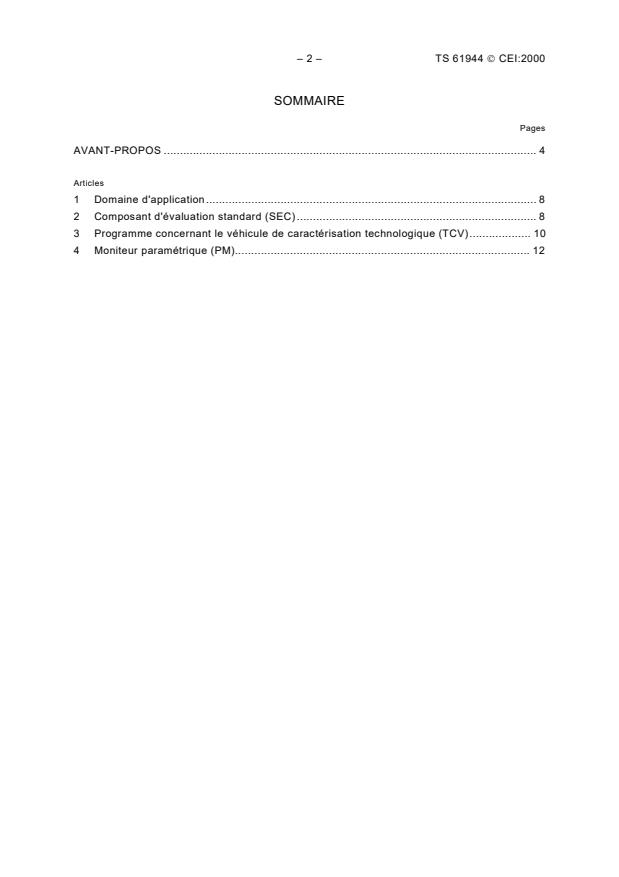
SOMMAIRE
Pages
AVANT-PROPOS . 4
Articles
1 Domaine d'application. 8
2 Composant d'évaluation standard (SEC) . 8
3 Programme concernant le véhicule de caractérisation technologique (TCV). 10
4 Moniteur paramétrique (PM). 12
TS 61944 IEC:2000 – 3 –
CONTENTS
Page
FOREWORD . 5
Clause
1 Scope . 9
2 Standard evaluation component (SEC). 9
3 Technology characterization vehicle (TCV) program . 11
4 Parametric monitor (PM) . 13
– 4 – TS 61944 CEI:2000
COMMISSION ÉLECTROTECHNIQUE INTERNATIONALE
___________
CIRCUITS INTÉGRÉS –
AGRÉMENT D’UNE LIGNE DE FABRICATION –
VÉHICULES DE DÉMONSTRATION
AVANT-PROPOS
1) La CEI (Commission Électrotechnique Internationale) est une organisation mondiale de normalisation
composée de l’ensemble des comités électrotechniques nationaux (Comités nationaux de la CEI). La CEI a
pour objet de favoriser la coopération internationale pour toutes les questions de normalisation dans les
domaines de l’électricité et de l’électronique. A cet effet, la CEI, entre autres activités, publie des Normes
internationales. Leur élaboration est confiée à des comités d’études, aux travaux desquels tout Comité national
intéressé par le sujet traité peut participer. Les organisations internationales, gouvernementales et non
gouvernementales, en liaison avec la CEI, participent également aux travaux. La CEI collabore étroitement
avec l’Organisation Internationale de Normalisation (ISO), selon des conditions fixées par accord entre les
deux organisations.
2) Les décisions ou accords officiels de la CEI concernant les questions techniques représentent, dans la mesure
du possible, un accord international sur les sujets étudiés, étant donné que les Comités nationaux intéressés
sont représentés dans chaque comité d‘études.
3) Les documents produits se présentent sous la forme de recommandations internationales. Ils sont publiés
comme normes, spécifications techniques, rapports techniques ou guides et agréés comme tels par les
Comités nationaux.
4) Dans le but d’encourager l’unification internationale, les Comités nationaux de la CEI s’engagent à appliquer de
façon transparente, dans toute la mesure possible, les Normes internationales de la CEI dans leurs normes
nationales et régionales. Toute divergence entre la norme de la CEI et la norme nationale ou régionale
correspondante doit être indiquée en termes clairs dans cette dernière.
5) La CEI n‘a fixé aucune procédure concernant le marquage comme indication d’approbation et sa responsabilité
n‘est pas engagée quand un matériel est déclaré conforme à l’une de ses normes.
6) L‘attention est attirée sur le fait que certains des éléments de la présente spécification technique peuvent faire
l’objet de droits de propriété intellectuelle ou de droits analogues. La CEI ne saurait être tenue pour
responsable de ne pas avoir identifié de tels droits de propriété et de ne pas avoir signalé leur existence.
La tâche principale des comités d‘études de la CEI est l’élaboration des Normes
internationales. Exceptionnellement, un comité d‘études peut proposer la publication d’une
spécification technique
• lorsqu'en dépit de maints efforts, l’accord requis ne peut être réalisé en faveur de la
publication d‘une Norme internationale, ou
• lorsque le sujet en question est encore en cours de développement technique ou quand,
pour une raison quelconque, la possibilité d‘un accord pour la publication d’une Norme
internationale peut être envisagée pour l‘avenir mais pas dans l’immédiat.
Les spécifications techniques font l'objet d’un nouvel examen trois ans au plus tard après leur
publication afin de décider éventuellement de leur transformation en Normes internationales.
La CEI 61944, qui est une spécification technique, a été établie par le sous-comité 47A:
Circuits intégrés, du comité d‘études 47 de la CEI: Dispositifs à semiconducteurs.
Le texte de cette spécification technique est issu des documents suivants:
Projet d'enquête Rapport de vote
47A/522/CDV 47A/554/RVC
Le rapport de vote indiqué dans le tableau ci-dessus donne toute information sur le vote ayant
abouti à l’approbation de cette spécification technique.
TS 61944 IEC:2000 – 5 –
INTERNATIONAL ELECTROTECHNICAL COMMISSION
____________
INTEGRATED CIRCUITS –
MANUFACTURING LINE APPROVAL –
DEMONSTRATION VEHICLES
FOREWORD
1) The IEC (International Electrotechnical Commission) is a worldwide organization for standardization comprising
all national electrotechnical committees (IEC National Committees). The object of the IEC is to promote
international co-operation on all questions concerning standardization in the electrical and electronic fields. To
this end and in addition to other activities, the IEC publishes International Standards. Their preparation is
entrusted to technical committees; any IEC National Committee interested in the subject dealt with may
participate in this preparatory work. International, governmental and non-governmental organizations liaising
with the IEC also participate in this preparation. The IEC collaborates closely with the International
Organization for Standardization (ISO) in accordance with conditions determined by agreement between the
two organizations.
2) The formal decisions or agreements of the IEC on technical matters express, as nearly as possible, an
international consensus of opinion on the relevant subjects since each technical committee has representation
from all interested National Committees.
3) The documents produced have the form of recommendations for international use and are published in the form
of standards, technical specifications, technical reports or guides and they are accepted by the National
Committees in that sense.
4) In order to promote international unification, IEC National Committees undertake to apply IEC International
Standards transparently to the maximum extent possible in their national and regional standards. Any
divergence between the IEC Standard and the corresponding national or regional standard shall be clearly
indicated in the latter.
5) The IEC provides no marking procedure to indicate its approval and cannot be rendered responsible for any
equipment declared to be in conformity with one of its standards.
6) Attention is drawn to the possibility that some of the elements of this technical specification may be the subject
of patent rights. The IEC shall not be held responsible for identifying any or all such patent rights.
The main task of IEC technical committees is to prepare International Standards. In
exceptional circumstances, a technical committee may propose the publication of a technical
specification when
• the required support cannot be obtained for the publication of an International Standard,
despite repeated efforts, or
• The subject is still under technical development or where, for any other reason, there is
the future but no immediate possibility of an agreement on an International Standard.
Technical specifications are subject to review within three years of publication to decide
whether they can be transformed into International Standards.
IEC 61944, which is a technical specification, has been prepared by subcommittee 47A:
Integrated circuits, of IEC technical committee 47: Semiconductor devices.
The text of this technical specification is based on the following documents:
Enquiry draft Report on voting
47A/522/CDV 47A/554/RVC
Full information on the voting for the approval of this technical specification can be found in
the report on voting indicated in the above table.
– 6 – TS 61944 CEI:2000
Cette publication a été rédigée selon les Directives ISO/CEI, Partie 3.
Le comité a décidé que le contenu de cette publication ne sera pas modifié avant 2003.
A cette date, la publication sera
• reconduite;
• supprimée;
• remplacée par une édition révisée, ou
• amendée.
TS 61944 IEC:2000 – 7 –
This publication has been drafted in accordance with the ISO/IEC Directives, Part 3.
The committee has decided that the contents of this publication will remain unchanged until
2003. At this date, the publication will be
• reconfirmed;
• withdrawn;
• replaced by a revised edition, or
• amended.
– 8 – TS 61944 CEI:2000
CIRCUITS INTÉGRÉS –
AGRÉMENT D’UNE LIGNE DE FABRICATION –
VÉHICULES DE DÉMONSTRATION
1 Domaine d'application
La présente spécification technique établit les caractéristiques des composants d'évaluation
standard (SEC) utilisés pour vérifier le savoir-faire et la fiabilité.
2 Composant d'évaluation standard (SEC)
Un composant d'évaluation standard (SEC) est un composant d’essai spécialement conçu ou
un produit commercial pris directement dans la production et utilisé pour vérifier le savoir-
faire (partiellement ou totalement) et la fiabilité en accord avec le manuel de procédé.
Les SEC sont utilisés dans le programme d’essai de la qualification pour définir le savoir-
faire.
Pour la maintenance, ces essais doivent démontrer les aspects qualité et soit toutes les
limites du savoir-faire soit les limites du savoir-faire relatives aux produits sortis lors de la
période la plus récente.
Deux types de composants peuvent être utilisés comme SEC:
Type I: Un composant spécialement conçu et fabriqué pour vérifier les règles de conception
et le procédé de fabrication.
Type II: Un produit commercial pris dans la production.
Il n'est généralement pas possible de couvrir toutes les limites et tous les aspects qualité du
savoir-faire avec un seul SEC. Un seul type ou une combinaison des deux types peuvent être
utilisés, et collectivement doivent permettre de vérifier les règles de conception pire cas, les
matériaux, les procédés de fabrication et les aspects qualité. Quand on prétend qu'un
élément diffusé/métallisé, ou un groupe d'éléments, peut mettre en oeuvre une ou plusieurs
limites, ces éléments ou groupes d'éléments doivent être mesurables séparément sans
influence d'autres éléments du composant.
Le SEC doit être documenté y compris sur la méthode de conception et les outils logiciels
utilisés, les fonctions qu'il doit réaliser, ses dimensions en termes de transistors utiles ou de
nombre de portes et les simulations de ses fonctionnalités.
Chaque SEC doit avoir une spécification particulière qui doit comporter les éléments suivants:
a) Complexité: la complexité d'au moins un des microcircuits SEC doit contenir, au minimum,
la moitié des transistors que l'on s'attend à trouver dans le microcircuit le plus important
fabriqué par la ligne de fabrication qualifiée.
b) Fonctionnalité: le SEC doit contenir des circuits parfaitement fonctionnels capables d'être
essayés et triés de la même manière que les microcircuits qualifiés.
TS 61944 IEC:2000 – 9 –
INTEGRATED CIRCUITS –
MANUFACTURING LINE APPROVAL –
DEMONSTRATION VEHICLES
1 Scope
This technical specification establishes the characteristics of standard evaluation components
(SEC) used for verifying capability and reliability.
2 Standard evaluation component (SEC)
A standard evaluation component (SEC) is a test specimen especially designed or a
commercial product taken from production and used for verifying capability (totally or partly)
and reliability in accordance with the Process Manual.
SECs are used in the qualification test programme to define capability.
For maintenance, the tests shall demonstrate the quality aspects and either all the limits of
the capability, or those limits of the capability used for products delivered during the most
recent period.
Two types of components may be used as a SEC:
Type I: A component especially designed and manufactured to assess the design rules and
the manufacturing process.
Type II: A commercial product taken from production.
Generally it is not possible to cover all limits and all quality aspects of the capability with a
single SEC. Either a single type or a combination of both types may be used, and collectively
they shall be adequate for assessing the complete worst case design rules, the materials,
manufacturing processes and the quality aspects. Where it is claimed that a diffused/
metallized element, or group of elements, can demonstrate one or more limits, such an
element or group of elements shall be measurable separately without being subject to
influence from other component elements.
The SEC shall be documented, including the design methodology and the software tools used
in the design, the functions it is to perform, its size in terms of utilized transistor or gate count
and simulations of its performance.
Every SEC shall have a detail specification comprising the following requirements:
a) Complexity: the complexity of at least one of the SEC types shall contain, as a minimum,
one half the number of transistors expected to be used in the largest microcircuit to be
built on the qualified manufacturing line.
b) Functionality: the SEC shall contain fully functional circuits capable of being tested and
screened in a manner identical to that of qualified microcircuits.
– 10 – TS 61944 CEI:2000
c) Conception: le SEC doit être utilisé pour cerner les règles de conception géométriques et
électriques minimales. Les conditions d’essai pour les transistors et les interconnexions
sur le SEC doivent être les conditions pire cas.
d) Fabrication: le SEC doit être fabriqué sur une ligne de fabrication prévue pour être
qualifiée ou déjà qualifiée.
e) Encapsulation: le SEC doit être mis dans des boîtiers qualifiés pour les domaines
...