

IEC 62504:2014
(Main)General lighting - Light emitting diode (LED) products and related equipment - Terms and definitions
General Information
- Abstract
IEC 62504:2014 is of assistance in the common understanding of terms and definitions, relevant for general lighting with LED technology. The terms included are those already available in IEC LED standards or used in manufacturers' literature. This standard provides descriptive terms (like "LED light sources") and measurable terms when modified from IEC 60050-845 (like "colour rendering index"). This first edition cancels and replaces the IEC TS 62504 published in 2011. The significant changes with respect to IEC TS 62504 are as follows:
a) Terms from the International Electrotechnical Vocabulary that have not been modified are deleted;
b) Alignment with the CIE has been done;
c) An introduction has been added.
- Status
- Published
- Publication Date
- 12-Mar-2018
- Technical Committee
- TC 34 - Lighting
- Drafting Committee
- MT 2 - TC 34/MT 2
- Current Stage
- PPUB - Publication issued
- Start Date
- 19-Jun-2014
- Completion Date
- 30-Jun-2014
Buy Documents
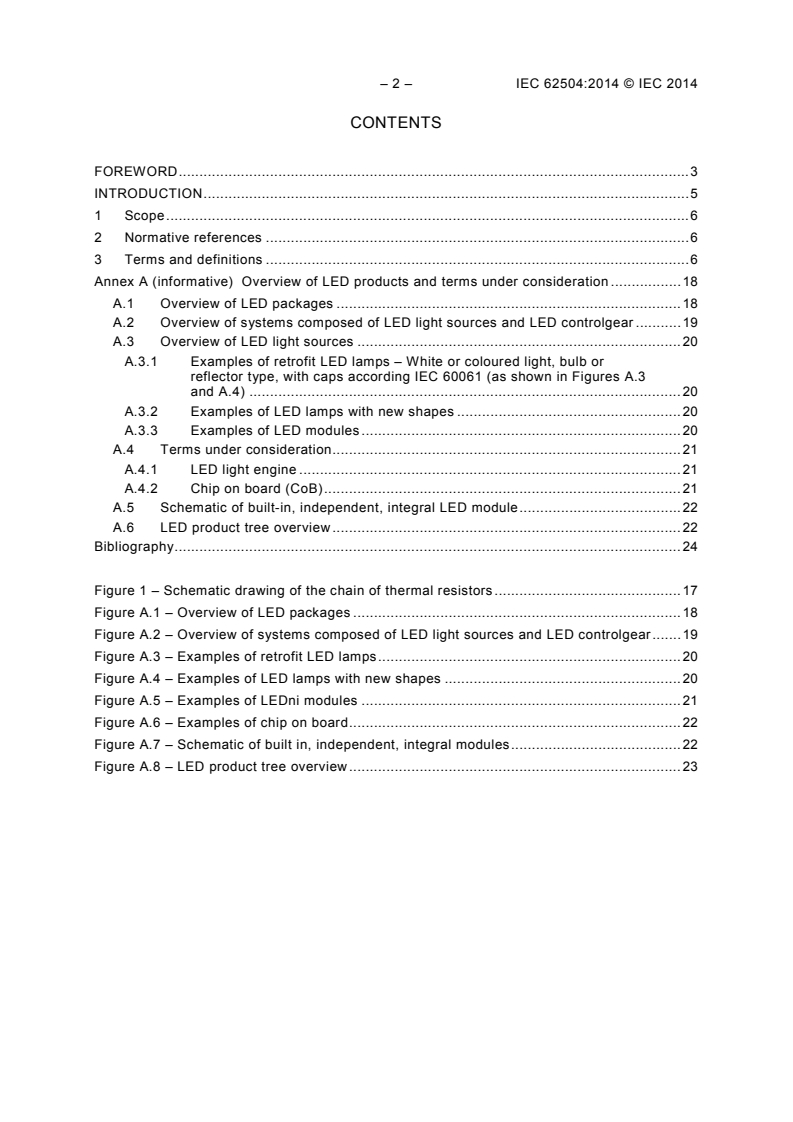
IEC 62504:2014 - General lighting - Light emitting diode (LED) products and related equipment - Terms and definitions Released:6/19/2014

IEC 62504:2014+AMD1:2018 CSV - General lighting - Light emitting diode (LED) products and related equipment - Terms and definitions Released:3/13/2018
Overview
IEC 62504:2014, titled General lighting – Light emitting diode (LED) products and related equipment – Terms and definitions, is an essential international standard developed by the International Electrotechnical Commission (IEC). This standard aims to establish a clear, unified terminology for LED technology used in general lighting applications. Its development supports industry-wide consistency, improves communication between manufacturers, regulators, and users, and facilitates interoperability of LED lighting products.
This edition supersedes the previous Technical Specification IEC TS 62504 of 2011 and introduces key updates such as alignment with the International Commission on Illumination (CIE) terminology and a more structured introduction. The standard focuses on providing descriptive and measurable terms related to LED lighting products and associated equipment.
Key Topics
IEC 62504:2014 covers critical terms and definitions to ensure a common understanding across the LED lighting sector:
- Terminology Scope: It consolidates terms already present in IEC LED standards and those frequently used in manufacturers’ literature, ensuring relevance and wide applicability.
- Descriptive Terms: Includes common LED lighting components like "LED light sources," "LED lamps," and "LED modules."
- Measurable Parameters: Covers terms modified from IEC 60050-845 such as "colour rendering index," crucial for specifying LED performance characteristics.
- Product Categorization: Defines the LED product tree from LED dies to complete LED luminaires, offering a structured overview of product components.
- Alignment with CIE: Ensures consistency with global lighting terminology, enhancing international collaboration and regulatory compliance.
- Important Definitions:
- Ageing: The preconditioning process of LED light sources before measurements are taken.
- Angular Subtense: The angle subtended by an apparent light source, used in beam profiling and visual performance analysis.
These terms provide clarity for manufacturers, engineers, and consumers when designing, evaluating, and applying LED lighting technologies.
Applications
IEC 62504:2014 is highly practical for diverse stakeholders in the LED lighting ecosystem:
- Manufacturers and Designers: Use the standard to align product specifications, design documentation, and manufacturing processes with global terminology standards.
- Regulatory Bodies: Develop clear regulations and standards by adopting consistent LED terminology, ensuring compliance and safety.
- Testing and Certification Laboratories: Employ standard terms to create reliable and reproducible testing protocols and performance reports.
- Lighting Engineers and Consultants: Benefit from unified definitions for effective communication in project planning and technical documentation.
- End Users & Specifiers: Gain confidence in product descriptions, enabling informed purchasing choices based on standardized technical terms.
Additionally, the annexes provide detailed overviews of LED packages, retrofit lamps, LED modules, and associated control gear-supporting application-specific understanding and system integration.
Related Standards
IEC 62504:2014 interfaces closely with other international and regional standards and normative references:
- IEC 60050 (International Electrotechnical Vocabulary): Forms the base for many definitions adopted and modified in this standard.
- CIE Technical Report 127 (Measurement of LEDs): Provides measurement guidelines adopted for LED characterization terms.
- IEC 60061 (Lamp Caps and Holders): Referenced for defining retrofit LED lamp types and shapes.
- ANSI RP16-10: Alignment considerations with this American National Standard improve cross-regional cohesiveness in LED terminologies.
- Other IEC LED-related standards for comprehensive guidance on LED product performance, safety, and testing.
By following IEC 62504 alongside these referenced standards, stakeholders can ensure robust technical communication, regulatory compliance, and product interoperability in the evolving LED lighting market.
Keywords: IEC 62504, LED lighting terms, LED product terminology, general lighting standards, LED definitions, IEC LED standards, CIE alignment, LED modules, colour rendering index, lighting terminology, LED manufacturers, LED test labs.
Relations
- Effective Date
- 05-Sep-2023
- Effective Date
- 05-Sep-2023
Buy Documents
IEC 62504:2014 - General lighting - Light emitting diode (LED) products and related equipment - Terms and definitions Released:6/19/2014
IEC 62504:2014+AMD1:2018 CSV - General lighting - Light emitting diode (LED) products and related equipment - Terms and definitions Released:3/13/2018
Get Certified
Connect with accredited certification bodies for this standard

IMQ S.p.A. (Certification)
Italian electrical product certification.

SLG Prüf- und Zertifizierungs GmbH
German testing and certification body.

UL Solutions
Global safety science company with testing, inspection and certification.
Sponsored listings
Frequently Asked Questions
IEC 62504:2014 is a standard published by the International Electrotechnical Commission (IEC). Its full title is "General lighting - Light emitting diode (LED) products and related equipment - Terms and definitions". This standard covers: IEC 62504:2014 is of assistance in the common understanding of terms and definitions, relevant for general lighting with LED technology. The terms included are those already available in IEC LED standards or used in manufacturers' literature. This standard provides descriptive terms (like "LED light sources") and measurable terms when modified from IEC 60050-845 (like "colour rendering index"). This first edition cancels and replaces the IEC TS 62504 published in 2011. The significant changes with respect to IEC TS 62504 are as follows: a) Terms from the International Electrotechnical Vocabulary that have not been modified are deleted; b) Alignment with the CIE has been done; c) An introduction has been added.
IEC 62504:2014 is of assistance in the common understanding of terms and definitions, relevant for general lighting with LED technology. The terms included are those already available in IEC LED standards or used in manufacturers' literature. This standard provides descriptive terms (like "LED light sources") and measurable terms when modified from IEC 60050-845 (like "colour rendering index"). This first edition cancels and replaces the IEC TS 62504 published in 2011. The significant changes with respect to IEC TS 62504 are as follows: a) Terms from the International Electrotechnical Vocabulary that have not been modified are deleted; b) Alignment with the CIE has been done; c) An introduction has been added.
IEC 62504:2014 is classified under the following ICS (International Classification for Standards) categories: 29.140.20 - Incandescent lamps. The ICS classification helps identify the subject area and facilitates finding related standards.
IEC 62504:2014 has the following relationships with other standards: It is inter standard links to IEC TS 62504:2011, IEC 62504:2014/AMD1:2018. Understanding these relationships helps ensure you are using the most current and applicable version of the standard.
IEC 62504:2014 is available in PDF format for immediate download after purchase. The document can be added to your cart and obtained through the secure checkout process. Digital delivery ensures instant access to the complete standard document.
Standards Content (Sample)
IEC 62504 ®
Edition 1.0 2014-06
INTERNATIONAL
STANDARD
NORME
INTERNATIONALE
colour
inside
General lighting – Light emitting diode (LED) products and related equipment –
Terms and definitions
Éclairage général – Produits à diode électroluminescente (LED) et équipements
associés – Termes et définitions
All rights reserved. Unless otherwise specified, no part of this publication may be reproduced or utilized in any form
or by any means, electronic or mechanical, including photocopying and microfilm, without permission in writing from
either IEC or IEC's member National Committee in the country of the requester. If you have any questions about IEC
copyright or have an enquiry about obtaining additional rights to this publication, please contact the address below or
your local IEC member National Committee for further information.
Droits de reproduction réservés. Sauf indication contraire, aucune partie de cette publication ne peut être reproduite
ni utilisée sous quelque forme que ce soit et par aucun procédé, électronique ou mécanique, y compris la photocopie
et les microfilms, sans l'accord écrit de l'IEC ou du Comité national de l'IEC du pays du demandeur. Si vous avez des
questions sur le copyright de l'IEC ou si vous désirez obtenir des droits supplémentaires sur cette publication, utilisez
les coordonnées ci-après ou contactez le Comité national de l'IEC de votre pays de résidence.
IEC Central Office Tel.: +41 22 919 02 11
3, rue de Varembé Fax: +41 22 919 03 00
CH-1211 Geneva 20 info@iec.ch
Switzerland www.iec.ch
About the IEC
The International Electrotechnical Commission (IEC) is the leading global organization that prepares and publishes
International Standards for all electrical, electronic and related technologies.
About IEC publications
The technical content of IEC publications is kept under constant review by the IEC. Please make sure that you have the
latest edition, a corrigenda or an amendment might have been published.
IEC Catalogue - webstore.iec.ch/catalogue Electropedia - www.electropedia.org
The stand-alone application for consulting the entire The world's leading online dictionary of electronic and
bibliographical information on IEC International Standards, electrical terms containing more than 30 000 terms and
Technical Specifications, Technical Reports and other definitions in English and French, with equivalent terms in 14
documents. Available for PC, Mac OS, Android Tablets and additional languages. Also known as the International
iPad. Electrotechnical Vocabulary (IEV) online.
IEC publications search - www.iec.ch/searchpub IEC Glossary - std.iec.ch/glossary
The advanced search enables to find IEC publications by a More than 55 000 electrotechnical terminology entries in
variety of criteria (reference number, text, technical English and French extracted from the Terms and Definitions
committee,…). It also gives information on projects, replaced clause of IEC publications issued since 2002. Some entries
and withdrawn publications. have been collected from earlier publications of IEC TC 37,
77, 86 and CISPR.
IEC Just Published - webstore.iec.ch/justpublished
Stay up to date on all new IEC publications. Just Published IEC Customer Service Centre - webstore.iec.ch/csc
details all new publications released. Available online and If you wish to give us your feedback on this publication or
also once a month by email. need further assistance, please contact the Customer Service
Centre: csc@iec.ch.
A propos de l'IEC
La Commission Electrotechnique Internationale (IEC) est la première organisation mondiale qui élabore et publie des
Normes internationales pour tout ce qui a trait à l'électricité, à l'électronique et aux technologies apparentées.
A propos des publications IEC
Le contenu technique des publications IEC est constamment revu. Veuillez vous assurer que vous possédez l’édition la
plus récente, un corrigendum ou amendement peut avoir été publié.
Catalogue IEC - webstore.iec.ch/catalogue Electropedia - www.electropedia.org
Application autonome pour consulter tous les renseignements
Le premier dictionnaire en ligne de termes électroniques et
bibliographiques sur les Normes internationales,
électriques. Il contient plus de 30 000 termes et définitions en
Spécifications techniques, Rapports techniques et autres
anglais et en français, ainsi que les termes équivalents dans
documents de l'IEC. Disponible pour PC, Mac OS, tablettes
14 langues additionnelles. Egalement appelé Vocabulaire
Android et iPad.
Electrotechnique International (IEV) en ligne.
Recherche de publications IEC - www.iec.ch/searchpub
Glossaire IEC - std.iec.ch/glossary
Plus de 55 000 entrées terminologiques électrotechniques, en
La recherche avancée permet de trouver des publications IEC
en utilisant différents critères (numéro de référence, texte, anglais et en français, extraites des articles Termes et
comité d’études,…). Elle donne aussi des informations sur les Définitions des publications IEC parues depuis 2002. Plus
projets et les publications remplacées ou retirées. certaines entrées antérieures extraites des publications des
CE 37, 77, 86 et CISPR de l'IEC.
IEC Just Published - webstore.iec.ch/justpublished
Service Clients - webstore.iec.ch/csc
Restez informé sur les nouvelles publications IEC. Just
Published détaille les nouvelles publications parues. Si vous désirez nous donner des commentaires sur cette
Disponible en ligne et aussi une fois par mois par email. publication ou si vous avez des questions contactez-nous:
csc@iec.ch.
IEC 62504 ®
Edition 1.0 2014-06
INTERNATIONAL
STANDARD
NORME
INTERNATIONALE
colour
inside
General lighting – Light emitting diode (LED) products and related equipment –
Terms and definitions
Éclairage général – Produits à diode électroluminescente (LED) et équipements
associés – Termes et définitions
INTERNATIONAL
ELECTROTECHNICAL
COMMISSION
COMMISSION
ELECTROTECHNIQUE
PRICE CODE
INTERNATIONALE
CODE PRIX T
ICS 29.140.20 ISBN 978-2-8322-1651-4
– 2 – IEC 62504:2014 © IEC 2014
CONTENTS
FOREWORD . 3
INTRODUCTION . 5
1 Scope . 6
2 Normative references . 6
3 Terms and definitions . 6
Annex A (informative) Overview of LED products and terms under consideration . 18
A.1 Overview of LED packages . 18
A.2 Overview of systems composed of LED light sources and LED controlgear . 19
A.3 Overview of LED light sources . 20
A.3.1 Examples of retrofit LED lamps – White or coloured light, bulb or
reflector type, with caps according IEC 60061 (as shown in Figures A.3
and A.4) . 20
A.3.2 Examples of LED lamps with new shapes . 20
A.3.3 Examples of LED modules . 20
A.4 Terms under consideration . 21
A.4.1 LED light engine . 21
A.4.2 Chip on board (CoB) . 21
A.5 Schematic of built-in, independent, integral LED module . 22
A.6 LED product tree overview . 22
Bibliography . 24
Figure 1 – Schematic drawing of the chain of thermal resistors . 17
Figure A.1 – Overview of LED packages . 18
Figure A.2 – Overview of systems composed of LED light sources and LED controlgear . 19
Figure A.3 – Examples of retrofit LED lamps . 20
Figure A.4 – Examples of LED lamps with new shapes . 20
Figure A.5 – Examples of LEDni modules . 21
Figure A.6 – Examples of chip on board . 22
Figure A.7 – Schematic of built in, independent, integral modules . 22
Figure A.8 – LED product tree overview . 23
INTERNATIONAL ELECTROTECHNICAL COMMISSION
____________
GENERAL LIGHTING – LIGHT EMITTING DIODE (LED) PRODUCTS
AND RELATED EQUIPMENT – TERMS AND DEFINITIONS
FOREWORD
1) The International Electrotechnical Commission (IEC) is a worldwide organization for standardization comprising
all national electrotechnical committees (IEC National Committees). The object of IEC is to promote
international co-operation on all questions concerning standardization in the electrical and electronic fields. To
this end and in addition to other activities, IEC publishes International Standards, Technical Specifications,
Technical Reports, Publicly Available Specifications (PAS) and Guides (hereafter referred to as “IEC
Publication(s)”). Their preparation is entrusted to technical committees; any IEC National Committee interested
in the subject dealt with may participate in this preparatory work. International, governmental and non-
governmental organizations liaising with the IEC also participate in this preparation. IEC collaborates closely
with the International Organization for Standardization (ISO) in accordance with conditions determined by
agreement between the two organizations.
2) The formal decisions or agreements of IEC on technical matters express, as nearly as possible, an international
consensus of opinion on the relevant subjects since each technical committee has representation from all
interested IEC National Committees.
3) IEC Publications have the form of recommendations for international use and are accepted by IEC National
Committees in that sense. While all reasonable efforts are made to ensure that the technical content of IEC
Publications is accurate, IEC cannot be held responsible for the way in which they are used or for any
misinterpretation by any end user.
4) In order to promote international uniformity, IEC National Committees undertake to apply IEC Publications
transparently to the maximum extent possible in their national and regional publications. Any divergence
between any IEC Publication and the corresponding national or regional publication shall be clearly indicated in
the latter.
5) IEC itself does not provide any attestation of conformity. Independent certification bodies provide conformity
assessment services and, in some areas, access to IEC marks of conformity. IEC is not responsible for any
services carried out by independent certification bodies.
6) All users should ensure that they have the latest edition of this publication.
7) No liability shall attach to IEC or its directors, employees, servants or agents including individual experts and
members of its technical committees and IEC National Committees for any personal injury, property damage or
other damage of any nature whatsoever, whether direct or indirect, or for costs (including legal fees) and
expenses arising out of the publication, use of, or reliance upon, this IEC Publication or any other IEC
Publications.
8) Attention is drawn to the Normative references cited in this publication. Use of the referenced publications is
indispensable for the correct application of this publication.
9) Attention is drawn to the possibility that some of the elements of this IEC Publication may be the subject of
patent rights. IEC shall not be held responsible for identifying any or all such patent rights.
International Standard IEC 62504 has been prepared by IEC technical committee 34: Lamps
and related equipment in collaboration with representatives from CIE.
This first edition cancels and replaces the IEC TS 62504 published in 2011.
The significant changes with respect to IEC TS 62504 are as follows:
a) Terms from the International Electrotechnical Vocabulary that have not been modified are
deleted.
b) Alignment with the CIE has been done.
c) An introduction has been added
– 4 – IEC 62504:2014 © IEC 2014
The text of this standard is based on the following documents:
FDIS Report on voting
34/200/FDIS 34/205/RVD
Full information on the voting for the approval of this standard can be found in the report on
voting indicated in the above table.
This publication has been drafted in accordance with the ISO/IEC Directives, Part 2.
The committee has decided that the contents of this publication will remain unchanged until
the stability date indicated on the IEC web site under "http://webstore.iec.ch" in the data
related to the specific publication. At this date, the publication will be
• reconfirmed,
• withdrawn,
• replaced by a revised edition, or
• amended.
IMPORTANT – The 'colour inside' logo on the cover page of this publication indicates
that it contains colours which are considered to be useful for the correct
understanding of its contents. Users should therefore print this document using a
colour printer.
INTRODUCTION
0.1 Principles of this International Standard
This document is based on IEC TS 62504:2011, General Lighting – LEDs and LED modules –
Terms and definitions, which was under the responsibility of SC 34A but this revision as
International Standard IEC 62504 transfers responsibility to TC 34.
The objective of this introduction is to help the reader to understand which terms are included
and to have an understanding of the LED product overview.
Compared with IEC TS 62504, the main changes are as follows.
0.2 Terms to include
General lighting terms in IEC 60050-845:1987, International Electrotechnical Vocabulary that
have not been modified will not be included in this standard.
Alignment with CIE is done. IEC will be the reference for products and related equipment and
CIE for lighting terminology. Alignment with ANSI RP16-10, Chapter 6.8 was also considered.
The terms included are as far as possible used in LED standards and manufacturers'
literature.,
Process to update IEC 60050-845:1987, the International Electrotechnical Vocabulary for
definitions that will be considered as relevant is underway in IEC TC34.
0.3 Alphabetic sequence
In order to find the term in a logical sequence, we have grouped similar terms of a product,
example:
LED lamp
– integrated LED lamp ,
– non-integrated LED lamp .
For each term, reference is made to the relevant standard if appropriate.
0.4 LED product tree:
The sequence from the first component, the LED die up to the LED luminaire is drawn.
The term LED does not represent a product, so no technical data can be linked to the term
LED.
– 6 – IEC 62504:2014 © IEC 2014
GENERAL LIGHTING – LIGHT EMITTING DIODE (LED) PRODUCTS
AND RELATED EQUIPMENT – TERMS AND DEFINITIONS
1 Scope
This International Standard IEC 62504 is of assistance in the common understanding of terms
and definitions, relevant for general lighting with LED technology. The terms included are
those already available in IEC LED standards or used in manufacturers' literature.
This standard provides descriptive terms (like “LED light sources”) and measurable terms
when modified from IEC 60050-845 (like “colour rendering index”).
NOTE Annex A gives overviews of LED package design and systems composed of LED light sources and
controlgear.
2 Normative references
The following documents, in whole or in part, are normatively referenced in this document and
are indispensable for its application. For dated references, only the edition cited applies. For
undated references, the latest edition of the referenced document (including any
amendments) applies.
IEC 60050 (all parts), International Electrotechnical Vocabulary (available at
).
CIE Technical Report 127:2007, Measurement of LEDs
3 Terms and definitions
For the purposes of this document, the terms and definitions given in IEC 60050-845, with the
exception of those modified below, and the following apply.
3.1
ageing
preconditioning period of the LED light source before initial values are taken
3.2
angular subtense
α
angle subtended by an apparent source as viewed from a point in space
Note 1 to entry: Angular subtense is expressed in radians (rad).
Note 2 to entry: The angle extension is determined by the observation distance, but at no distance smaller than
the minimum distance of accommodation of the eye.
Note 3 to entry: The location and angular subtense of the apparent source depends on the viewing position in the
beam.
Note 4 to entry: The angular subtense of an apparent source is only applicable in the wavelength range from
380 nm to1 400 nm.
Note 5 to entry: IEC TR 62778 gives additional information with regards to beam divergence.
[SOURCE: IEC 60825-1, 3.7, modified – Notes 1, 2 and 5 to entry are added and in the note 4
to entry the value of the wavelength range has been changed from '400 nm to 1 400 nm' to
'380 nm to 1 400 nm'; IEC 62471, 3.2, modified.]
3.3
apparent source
for a given evaluation location of the retinal hazard, the real or virtual object that forms the
smallest possible retinal image (considering the accommodation range of the human eye)
Note 1 to entry: The accommodation range of the eye is assumed to be variable from 100 mm to infinity. The
location of the apparent source for a given viewing position in the beam is that location to which the eye
accommodates to produce the most hazardous retinal irradiance condition.
Note 2 to entry: This definition is used to determine, for a given evaluation position, the location of the apparent
origin of laser radiation in the wavelength range of 380 nm to 1 400 nm. In the limit of vanishing divergence, i.e. in
the case of a well collimated beam, the location of the apparent source goes to infinity.
[SOURCE: IEC 60825-1, 3.10, modified – In the note 2 to entry the value of the wavelength
range is changed from '400 nm to 1 400 nm' to '380 nm to 1 400 nm'.]
3.4
beam angle
angle between two imaginary lines in a plane through the optical beam axis, such that these
lines pass through the centre of the front face of the lamp and through points at which the
luminous intensity is 50 % of the centre beam intensity
Note 1 to entry: Beam angle is expressed in degrees ( ° ).
Note 2 to entry: This angle is a full angle measure, not a half angle measure.
[SOURCE: IEC TR 61341, 2.4, modified, – The notes to entry are added.]
3.5
bin
restricted range of LED performance characteristics used to delimit a subset of LED dies or
LED packages near a nominal LED performance as identified by chromaticity, photometric,
radiometric and/or electrical characteristics
3.6 controlgear
3.6.1
controlgear for LED module
LED controlgear
unit inserted between the electrical supply and one or more LED modules, which serves to
supply the LED module(s) with its (their) rated voltage or rated current, and may consist of
one or more separate components and may include means for dimming, correcting the power
factor and suppressing radio interference, and further control functions
Note 1 to entry: The controlgear consists of a power supply and a control unit.
Note 2 to entry: The controlgear may be partly or totally integrated in the LED module.
Note 3 to entry: When no confusion is expected like when used in a LED standard for example, “controlgear” may
also be used. Both terms “controlgear” or “control gear” are acceptable.
[SOURCE: IEC 61347-2-13, 3.1, modified – The word 'electronic' is deleted from the term and
the words “further control functions” and the notes to entry are added.]
3.6.2
power supply of the controlgear
electronic device, being part of the controlgear, capable of controlling current, voltage or
power within design limits, containing no additional LED control capabilities
– 8 – IEC 62504:2014 © IEC 2014
Note 1 to entry: For LEDsi modules, the power supply of the controlgear is separate from the LED module on a
distant location.
Note 2 to entry: The energy source of a power supply can be either a battery or the electrical supply system.
3.6.3
control unit of the controlgear
electronic device, being part of the controlgear, responsible for controlling the electrical
energy to the LED light sources as well as colour mixing, response to depreciating luminous
flux and further performance features
Note 1 to entry: In LEDsi modules, the control unit of the controlgear is on board of the LED module and separate
from the power supply of the controlgear.
3.7
dominant wavelength
λ
d
wavelength of the monochromatic stimulus that, when additively mixed in suitable proportions
with the specified achromatic stimulus, matches the colour stimulus considered in the
CIE 1931 x,y chromaticity diagram
Note 1 to entry: Dominant wavelength is expressed in nanometres (nm).
Note 2 to entry: In the case of purple stimuli, the dominant wavelength is replaced by the complementary
wavelength.
Note 3 to entry: For characterising LED light sources the reference achromatic stimulus should be illuminant E
which has the chromaticity coordinates x = 0,3333, y = 0,3333.
E E
Note 4 to entry: A value for dominant wavelength should only be stated for LED light sources emitting coloured
light. For LED light sources emitting white light no meaningful value for dominant wavelength can be given.
Note 5 to entry: Figure 12 in CIE 127:2007 shows the relationship between chromaticity coordinate C of LED light
sources and value of dominant wavelength D. N is the chromaticity coordinate of achromatic stimulus E.
Note 6 to entry: Deviating from the peak wavelength, the dominant wavelength determines perceived colour.
[SOURCE: IEC 60050-845:1987, 845.03.44, modified – The words 'in the CIE 1931 x,y
chromaticity diagram' and the notes to entry 3 to 6 have been added; CIE S 017/E:2011, 17-
345, modified – The notes to entry 3 to 6 have been added.]
3.8
failure
termination of the ability of an item to perform a required function
Note 1 to entry: After failure the item has a fault.
Note 2 to entry: "Failure" is an event, as distinguished from "fault", which is a state.
Note 3 to entry: This concept as defined does not apply to items consisting of software only.
[SOURCE: IEC 60050-191, 191.04.01]
3.9
failure fraction
F
fraction of the population that lost the ability to perform a required function in a specified time
interval
Note 1 to entry: Failure fraction is dimensionless.
3.10
failure fraction at rated life
F
y
ratio y of failed LED products of the same type at their rated life to the test quantity
Note 1 to entry: The ratio is expressed in percent.
Note 2 to entry: This failure fraction expresses the combined effect of all components of a LED product including
mechanical, as far as the light output is concerned. The effect of the LED could either be less light than claimed or
no light at all.
Note 3 to entry: For LED products normally a failure fraction of 10% or/and 50% are being applied, indicated as
F and/or F .
10 50
3.11
family
group of LED light sources or LED luminaires, having the same characteristics and method of
control (integrated, semi-integrated, non integrated), the groups are distinguished by common
features of materials, components, and/or method of processing
3.12
forward direction
direction of current that results when the P-type semiconductor region connected to one
terminal is at positive potential relative to the N-type region connected to the other terminal
Note 1 to entry: If temperature compensation diodes are included, these are ignored in the determination of
forward direction.
[SOURCE: IEC 60050-521, 521.05.03, modified – The words 'connected to one terminal',
'potential' and 'connected to the other terminal' as well as note 1 to entry have been added.]
3.13
forward voltage
U
F
potential difference pertaining to the forward direction, dependent on the forward current at a
given temperature
Note 1 to entry: Forward voltage is expressed in Volts (V).
Note 2 to entry: Forward voltage for LED die is measured normally at 25 °C ambient temperature.
3.14
heat output to the luminaire
P
d
power to be transferred to the luminaire by means of heat-conduction in order to stay below
the t or t temperature
c p
Note 1 to entry: Heat output is expressed in Watts (W).
Note 2 to entry: P is below the rated power of a LED module.
d
Note 3 to entry: For LED modules which do not need heat-conduction to the luminaire for keeping t , P is equal
c d
to zero.
Note 4 to entry: A measurement method is under consideration.
3.15 LED lamp
LED light source provided with (a) cap(s) incorporating one or more LED module(s) and
possibly including one or more of the following; electrical, optical, mechanical, and thermal
components, interfaces and controlgear
Note 1 to entry: A LED lamp may be integrated (LEDi lamp) or semi-integrated (LEDsi lamp) or non-integrated
(LEDni lamp).
Note 2 to entry: Single and double-capped lamps are included.
Note 3 to entry: A LED lamp is designed so that it can be replaced by an ordinary person (as defined in
IEC 60050-826, 826.18.03).
– 10 – IEC 62504:2014 © IEC 2014
3.15.1
integrated LED lamp
LEDi lamp
LED lamp, incorporating controlgear, and any additional elements necessary for stable
operation of the light source, designed for direct connection to the supply voltage
3.15.2
non-integrated LED lamp
LEDni lamp
LED lamp which needs a separate controlgear to operate
3.15.3
retrofit LED lamp
LED lamp intended as a replacement of a non-LED lamp without requiring internal
modification of the luminaire
3.15.4
semi-integrated LED lamp
LEDsi lamp
LED lamp which carries the control unit of the controlgear, and is operated by the separated
power supply of the controlgear
3.16
LED light source
electrical light source based on LED technology
Note 1 to entry: A luminaire may include LED light sources but is not considered itself as a light source.
Note 2 to entry: LED light source(s) for a LED luminaire represents one or more LED lamp(s) or LED module(s).
3.17
LED luminaire
luminaire designed to incorporate one or more LED light source(s)
3.18
non-repairable, factory-sealed LED luminaire,
luminaire which cannot be dismantled without being permanently damaged, and incorporating
LED light source(s) and any additional elements necessary for starting and stable operation of
the light source
3.19 LED module
LED light source having no cap, incorporating one or more LED package(s) on a printed
circuit board, and possibly including one or more of the following: electrical, optical,
mechanical, and thermal components, interfaces and controlgear
Note 1 to entry: A LED module may be integrated (LEDi module, Type 1) or semi-integrated (LEDsi module,
Type 2) or non-integrated (LEDni module, Type 3).
Note 2 to entry: The LED module is usually designed to be part of a LED lamp or LED luminaire.
[SOURCE: IEC 62031, 3.2, modified – The definition is reworded and notes to entry are
added.]
3.19.1
built-in LED module
LED module, generally designed to form a replaceable part to be built into a luminaire, a box,
an enclosure or the like and not intended to be mounted outside a luminaire, etc. without
special precautions
[SOURCE: IEC 62031, 3.6, modified – The words ‘to be’ are added.]
3.19.2
independent LED module
LED module designed for mounting or placing separately from a luminaire, from an additional
box or enclosure or the like
Note 1 to entry: The independent LED module provides all the necessary protection with regard to safety
according to its classification and marking.
Note 2 to entry: An example of an independent LED module is a system where the LED module is connected via a
glass fibre with the luminaire head.
[SOURCE: IEC 62031, 3.8, modified – The second sentence in the definition as well as other
additional information are transferred into notes to entry replacing the original note.]
3.19.3
integral LED module
LED module, generally designed to form a non-replaceable part of a luminaire
[SOURCE: IEC 62031, 3.4]
3.19.4
integrated LED module
LEDi moduleLED module, incorporating controlgear and any additional elements necessary
for stable operation of the light source, designed for direct connection to the supply voltage
Note 1 to entry: LEDi modules are designated “Type 1”, see Annex A.
3.19.5
non-integrated LED module
LEDni module
LED module which needs a separate control circuitry or controlgear to operate
Note 1 to entry: LEDni modules are designated “Type 3”, see Annex A.
Note 2 to entry: One or more LED packages on a printed circuit board or substrate in a geometric structure are
regarded as a LED array. No further components are included like electrical, optical, mechanical, and thermal.
3.19.6
semi-integrated LED module
LEDsi module
LED module which carries the control unit of the controlgear, and is operated by the
separated power supply of the controlgear
Note 1 to entry: LED modules with control unit are designated “Type 2”, see Annex A.
3.20
LED package
single electrical component encapsulating principally one or more LED dies, possibly
including optical elements and thermal, mechanical, and electrical interfaces
Note 1 to entry: The component does not include the control unit of the controlgear, does not include a cap, and
is not connected directly to the supply voltage.
Note 2 to entry: A LED package is a discrete component and part of the LED module or LED lamp. For a
schematic built-up of a LED package, see Annex A.
3.21
luminous life time of LED package
L (t )
x j
time period at a specified junction temperature and forward current, determined by a minimum
level of x % of the measured initial luminous flux
Note 1 to entry: Luminous life time of LED package is expressed in hours (h).
– 12 – IEC 62504:2014 © IEC 2014
Note 2 to entry: t relates to LED die, but luminous life time of LED package are given with reference to t
j j
3.22
temperature
luminous life time of LED module related to t
p
L (t )
x p
time period at a specified performance temperature at which x % of the measured initial
luminous flux value is reached
Note 1 to entry: Luminous life time of LED module is expressed in hours (h).
Note 2 to entry: The use of forced cooling to achieve the specified t temperature should be stated.
p
3.23
light colour designation
three digit number, the first digit representing the first digit of the general colour rendering
index R [IEC 60050-845:1987, 845.02.63], and the second and third digit representing the
a
first two digits (thousands and hundreds) of the CCT of the light source
Note 1 to entry: The light colour designation is detailed in IEC TR 62732.
3.24
light emitting diode
LED
solid state device embodying a p-n junction, emitting incoherent optical radiation when excited
by an electric current
Note 1 to entry: This definition is independent from the existence of enclosure(s) and of terminals.
Note 2 to entry: The output is a function of its physical construction, material used and exciting current. The
optical emission may be in the ultraviolet, visible, or infrared wavelength regions.
Note 3 to entry: LED term normally represents the LED die (or chip), or LED package. It is also used as a generic
term representing the technology.
Note 4 to entry: LED term should not be used for reporting product performance (like luminous flux, colour
rendering, life time…) instead use for example “luminous flux of the LED module”
[SOURCE: IEC 60050-845:1987, 845.04.40, modified – The word 'incoherent' and the notes to
entry have been added and CIE S 017/E:2011 ILV, 17-662, modified.]
3.25
live part
conductive part which may cause an electric shock in normal use
Note 1 to entry: A process to align with IEC 61140 is underway and the definition will be designated by the term
“hazardous live part” in a future amendment.
3.26
luminous efficacy
η , η
V
quotient obtained when the emitted luminous flux is divided by the power consumed by the
source
–1
Note 1 to entry: Luminous efficacy is expressed in lm·W
Note 2 to entry: For LED applications, the source may be a LED package, module, lamp, luminaire etc.
[SOURCE: IEC 60050-845:1987, 845.01.55, modified – The words 'obtained when' and 'is
divided' and the notes to entry have been added and CIE S 017/E:2011 ILV, 17-730, modified]
3.27
luminous flux
Φ , Φ
V
quantity derived from radiant flux Φ by evaluating the radiation according to its action upon
e
the CIE standard photometric observer
Note 1 to entry: Luminous flux is expressed in lumen (lm).
Note 2 to entry: For photopic vision Φ = K ∫ (dΦ (λ )/dλ ) × V(λ )dλ where (dΦ (λ )/dλ) is the spectral
V m 360 e e
distribution of the radiant flux and V(λ ) is the spectral luminous efficiency.
Note 3 to entry: For the values of K (photopic vision) and K’ (scotopic vision), see IEC 60050-845, 845.01.56.
m m
Note 4 to entry: The luminous flux of LED dies is usually expressed in groups into which they are sorted.
[SOURCE: IEC 60050-845:1987, 845.01.25, modified – Second sentence become note 2 to
entry and note 4 to entry is added and CIE S 017/E:2011 ILV, 17-738, modified.]
3.28
luminous flux maintenance factor
lumen maintenance factor
ratio of the luminous flux emitted by the light source at a given time in its life to its initial
luminous flux emitted, the light source being operated under specified conditions
Note 1 to entry: This ratio is generally expressed in percent.
Note 2 to entry: The lumen maintenance factor of a LED light source is the effect of decrease of the luminous flux
output of the LED package or a combination of this with failure(s) of LED package if the LED light source contains
more than one LED package
[SOURCE: IEC 60050-845:1987, 845.07.65, modified – The words 'of a lamp' have been
replaced by 'emitted by the light source' and the notes to entry have been added and CIE S
017, 17-636, modified]
3.29
luminous intensity
I ; I
V
quotient of the luminous flux dΦ leaving the source and propagated in the element of solid
V
angle dΩ containing the given direction, by the element of solid angle
I = dΦ /dΩ
V V
–1
Note 1 to entry: Luminous intensity is expressed in candela, cd=lm·sr
Note 2 to entry: The definition holds strictly only for a point source.
Note 3 to entry: The luminous intensity of LED is reported according to CIE 127:2007 measurement procedure.
[SOURCE: IEC 60050-845:1987, 845.01.31 and CIE S 017/E:2011 ILV, 17-739, modified –
The notes to entry have been added.]
3.30
photometric code
under consideration
3.31
peak wavelength
λ
p
wavelength of radiation at the highest intensity of the spectral distribution
Note 1 to entry: Peak wavelength is expressed in nanometres (nm).
– 14 – IEC 62504:2014 © IEC 2014
[SOURCE: CIE 127, 7.2.1, modified – The definition has been simplified.]
3.32
rated life
length of time during which a population of LED light sources provides at least the claim for
maintained luminous flux percentage and at most the claim for failure fraction percentage F ,
y
as declared by the manufacturer or responsible vendor
Note 1 to entry: Rated life is expressed in hours (h).
3.33
rated value
value of a quantity used for specification purposes, established under standard test conditions
as declared by the manufacturer or responsible vendor
Note 1 to entry: The standard test conditions are given in the relevant standard.
[SOURCE: IEC 60050-151:2001, 151.16.08, modified – The text ‘for a specified set of
operating conditions of a component, device, equipment, or system’ has been replaced by
‘under standard test conditions as declared by the manufacturer or responsible vendor’ and
note 1 to entry has been added. ]
3.34
rated emergency lighting charging power
electrical power from the mains supply consumed by the charging circuit of emergency
luminaires
Note 1 to entry: Rated emergency lighting charging power is measured in Watts (W).
3.35
stabilisation time
time that is required for the LED light source or LED luminaire to obtain stable photometric
output and electrical power consumption with constant electrical input
3.36
standby power
electrical power consumed by the luminaire during the period when the light source(s) is(are)
not operating
Note 1 to entry: Standby power is expressed in Watts (W).
Note 2 to entry: For emergency lighting luminaires, this does not include the emergency lighting charging power.
3.37
supply voltage
voltage applied to the complete unit of LED light source or LED luminaire
[SOURCE: IEC 61347-1, 3.5, modified – The words 'circuit of lamp(s) and lamp controlgear'
have been replaced by 'unit of LED light source or LED luminaire'.]
3.38 temperature
3.38.1
ambient temperature
t
amb
temperature of air or another medium in the vicinity of the product under test
Note 1 to entry: Ambient temperature is expressed in degrees Celsius (°C).
Note 2 to entry: During the measurement of the ambient temperature, the measuring instrument/probe should be
shielded from draughts and radiant heating.
[SOURCE: IEC 60050-826, 826.10.03, modified – The word 'average' is omitted and the word
'equipment' is replaced by 'product under test' and 2.2.5 of CIE 127:2007.]
3.38.2
ambient performance temperature
ambient temperature related to the performance of the LED light source or LED luminaire
Note 1 to entry: Ambient performance temperature is expressed in degrees Celsius (°C).
3.38.3
board temperature
t
b
temperature of LED package or LED module between the printed circuit board and the thermal
interface
Note 1 to entry: Board temperature is expressed in degrees Celsius (°C).
3.38.4
heat transfer temperature
t
d
temperature occurring on a relevant part of the LED module (or any heat-conducting foil or
paste provided as for insertion if delivered with the LED module) (at the indicated position if
marked) which is intended for the passing of heat to the lampholder or to other parts of the
luminaire under normal operating conditions and at the rated voltage/current/power or the
maximum of the rated voltage/current/power range
Note 1 to entry: The temperature measured at the specified point gives information on the interface in which the
heat is to be transferred to the luminaire. An improper designed LED module does not pass the heat to the surface
where it should be transferred to the luminaire. As a result the t point will not stay below its maximum level and
c
the t point in the interface area remains cold.
d
Note 2 to entry: A measurement method is under consideration.
[SOURCE: IEC 62031, 3.11, modified – The word 'representative' is replaced by the word
'relevant' and the words 'provided' and 'which is' as well as the notes to entry have been
added'.]
3.38.5
junction temperature
t
j
temperature at the p-n junction
Note 1 to entry: Junction temperature is expressed in degrees Celsius (°C).
3.38.6
performance temperature
t
p
temperature related to performance of the LED module
Note 1 to entry: Performance temperature is expressed in degrees Celsius (°C).
Note 2 to entry: Temperature is measured at a given location t -point.
p
3.38.7
rated maximum performance ambient temperature
t
q,nn
highest ambient temperature around the luminaire related to a rated performance of the
luminaire under normal operating conditions, both as declared by the manufacturer or
responsible vendor
Note 1 to entry: Rated maximum performance ambient temperature is expressed in degrees Celsius (°C).
– 16 – IEC 62504:2014 © IEC 2014
Note 2 to entry: For a given life time, the t temperature is a fixed value, not a variable, where nn, the number
q,nn
in the suffix indicates the related lifetime claim in khours, example; t where nn = 60 represent 60 000 h lifetime
p,60
claim.
Note 3 to entry: There can be more than one t temperature, depending on the life time claim.
q,nn
3.38.8
rated maximum performance temperature
t
p,nn
highest temperature at t -point, related to a rated performance of the LED module, both as
p
declared by the manufacturer or responsible vendor
Note 1 to entry: Rated maximum performance temperature is expressed in degrees Celsius (°C).
Note 2 to entry: The location of t and t can be different.
p c
Note 3 to entry: For a given performance, the t temperature is a fixed value, not a variable, where nn, the
p,nn
number in the suffix indicates the related lifetime claim in khours, example; t where nn = 60 represent 60 000 h
p,60
lifetime claim.
Note 4 to entry: There can be more than one t , depending on the performance claim.
p,nn
3.38.9
rated maximum temperature
t
c
highest permissible safety related temperature which may occur on the outer surface of the
component (LED module or controlgear) (at the indicated position, if marked) under normal
operating conditions and at the rated voltage/current/power or the maximum of the rated
voltage/current/power range
Note 1 to entry: Rated maximum temperature is expressed in degrees Celsius (°C).
[SOURCE: IEC 61347-1, 3.16, modified and IEC 62031, 3.10, modified – Both definitions have
been combined]
3.38.10
storage temperature range
ambient temperature range within which a non-operated LED light source or LED luminaire
can be stored, when the claims of the specification are maintained
Note 1 to entry: Storage temperature range is expressed in degrees Celsius (°C).
3.38.11
temperature coefficient of the forward voltage
k
FV
change in forward voltage at a fixed current as a function of the junction temperature
–1
Note 1
...
IEC 62504 ®
Edition 1.1 2018-03
CONSOLIDATED VERSION
INTERNATIONAL
STANDARD
NORME
INTERNATIONALE
colour
inside
General lighting – Light emitting diode (LED) products and related equipment –
Terms and definitions
Éclairage général – Produits à diode électroluminescente (LED) et équipements
associés – Termes et définitions
All rights reserved. Unless otherwise specified, no part of this publication may be reproduced or utilized in any form
or by any means, electronic or mechanical, including photocopying and microfilm, without permission in writing from
either IEC or IEC's member National Committee in the country of the requester. If you have any questions about IEC
copyright or have an enquiry about obtaining additional rights to this publication, please contact the address below or
your local IEC member National Committee for further information.
Droits de reproduction réservés. Sauf indication contraire, aucune partie de cette publication ne peut être reproduite
ni utilisée sous quelque forme que ce soit et par aucun procédé, électronique ou mécanique, y compris la photocopie
et les microfilms, sans l'accord écrit de l'IEC ou du Comité national de l'IEC du pays du demandeur. Si vous avez des
questions sur le copyright de l'IEC ou si vous désirez obtenir des droits supplémentaires sur cette publication, utilisez
les coordonnées ci-après ou contactez le Comité national de l'IEC de votre pays de résidence.
IEC Central Office Tel.: +41 22 919 02 11
3, rue de Varembé info@iec.ch
CH-1211 Geneva 20 www.iec.ch
Switzerland
About the IEC
The International Electrotechnical Commission (IEC) is the leading global organization that prepares and publishes
International Standards for all electrical, electronic and related technologies.
About IEC publications
The technical content of IEC publications is kept under constant review by the IEC. Please make sure that you have the
latest edition, a corrigenda or an amendment might have been published.
IEC Catalogue - webstore.iec.ch/catalogue Electropedia - www.electropedia.org
The stand-alone application for consulting the entire The world's leading online dictionary of electronic and
bibliographical information on IEC International Standards, electrical terms containing 21 000 terms and definitions in
Technical Specifications, Technical Reports and other English and French, with equivalent terms in 16 additional
documents. Available for PC, Mac OS, Android Tablets and languages. Also known as the International Electrotechnical
iPad. Vocabulary (IEV) online.
IEC publications search - webstore.iec.ch/advsearchform IEC Glossary - std.iec.ch/glossary
The advanced search enables to find IEC publications by a 67 000 electrotechnical terminology entries in English and
variety of criteria (reference number, text, technical French extracted from the Terms and Definitions clause of
committee,…). It also gives information on projects, replaced IEC publications issued since 2002. Some entries have been
and withdrawn publications. collected from earlier publications of IEC TC 37, 77, 86 and
CISPR.
IEC Just Published - webstore.iec.ch/justpublished
Stay up to date on all new IEC publications. Just Published IEC Customer Service Centre - webstore.iec.ch/csc
details all new publications released. Available online and If you wish to give us your feedback on this publication or
also once a month by email. need further assistance, please contact the Customer Service
Centre: sales@iec.ch.
A propos de l'IEC
La Commission Electrotechnique Internationale (IEC) est la première organisation mondiale qui élabore et publie des
Normes internationales pour tout ce qui a trait à l'électricité, à l'électronique et aux technologies apparentées.
A propos des publications IEC
Le contenu technique des publications IEC est constamment revu. Veuillez vous assurer que vous possédez l’édition la
plus récente, un corrigendum ou amendement peut avoir été publié.
Catalogue IEC - webstore.iec.ch/catalogue Electropedia - www.electropedia.org
Application autonome pour consulter tous les renseignements
Le premier dictionnaire en ligne de termes électroniques et
bibliographiques sur les Normes internationales,
électriques. Il contient 21 000 termes et définitions en anglais
Spécifications techniques, Rapports techniques et autres
et en français, ainsi que les termes équivalents dans 16
documents de l'IEC. Disponible pour PC, Mac OS, tablettes
langues additionnelles. Egalement appelé Vocabulaire
Android et iPad.
Electrotechnique International (IEV) en ligne.
Recherche de publications IEC -
Glossaire IEC - std.iec.ch/glossary
webstore.iec.ch/advsearchform
67 000 entrées terminologiques électrotechniques, en anglais
La recherche avancée permet de trouver des publications IEC et en français, extraites des articles Termes et Définitions des
en utilisant différents critères (numéro de référence, texte, publications IEC parues depuis 2002. Plus certaines entrées
comité d’études,…). Elle donne aussi des informations sur les antérieures extraites des publications des CE 37, 77, 86 et
projets et les publications remplacées ou retirées. CISPR de l'IEC.
IEC Just Published - webstore.iec.ch/justpublished Service Clients - webstore.iec.ch/csc
Restez informé sur les nouvelles publications IEC. Just Si vous désirez nous donner des commentaires sur cette
Published détaille les nouvelles publications parues. publication ou si vous avez des questions contactez-nous:
Disponible en ligne et aussi une fois par mois par email. sales@iec.ch.
IEC 62504 ®
Edition 1.1 2018-03
CONSOLIDATED VERSION
INTERNATIONAL
STANDARD
NORME
INTERNATIONALE
colour
inside
General lighting – Light emitting diode (LED) products and related equipment –
Terms and definitions
Éclairage général – Produits à diode électroluminescente (LED) et équipements
associés – Termes et définitions
INTERNATIONAL
ELECTROTECHNICAL
COMMISSION
COMMISSION
ELECTROTECHNIQUE
INTERNATIONALE
ICS 29.140.20 ISBN 978-2-8322-5473-8
IEC 62504 ®
Edition 1.1 2018-03
CONSOLIDATED VERSION
REDLINE VERSION
VERSION REDLINE
colour
inside
General lighting – Light emitting diode (LED) products and related equipment –
Terms and definitions
Éclairage général – Produits à diode électroluminescente (LED) et équipements
associés – Termes et définitions
– 2 – IEC 62504:2014+AMD1:2018 CSV
© IEC 2018
CONTENTS
FOREWORD . 3
INTRODUCTION . 5
1 Scope . 6
2 Normative references . 6
3 Terms and definitions . 6
Annex A (informative) Overview of LED products and terms under consideration . 18
A.1 Overview of LED packages . 18
A.2 Overview of systems composed of LED light sources and LED controlgear . 19
A.3 Overview of LED light sources . 20
A.3.1 Examples of retrofit LED lamps – White or coloured light, bulb or
reflector type, with caps according IEC 60061 (as shown in Figures A.3
and A.4) . 20
A.3.2 Examples of LED lamps with new shapes . 20
A.3.3 Examples of LED modules . 20
A.4 Terms under consideration . 21
A.4.1 LED light engine .
A.4.2 Chip on board (CoB) .
A.5 Schematic of built-in, independent, integral LED module . 22
A.6 LED product tree overview . 23
Bibliography . 24
Figure 1 – Schematic drawing of the chain of thermal resistors . 17
Figure A.1 – Overview of LED packages . 18
Figure A.2 – Overview of systems composed of LED light sources and LED controlgear . 19
Figure A.3 – Examples of retrofit LED lamps . 20
Figure A.4 – Examples of LED lamps with new shapes . 20
Figure A.5 – Examples of LEDni modules . 21
Figure A.6 – Examples of chip on board .
Figure A.7 – Schematic of built in, independent, integral modules . 22
Figure A.8 – LED product tree overview . 23
© IEC 2018
INTERNATIONAL ELECTROTECHNICAL COMMISSION
____________
GENERAL LIGHTING – LIGHT EMITTING DIODE (LED) PRODUCTS
AND RELATED EQUIPMENT – TERMS AND DEFINITIONS
FOREWORD
1) The International Electrotechnical Commission (IEC) is a worldwide organization for standardization comprising
all national electrotechnical committees (IEC National Committees). The object of IEC is to promote
international co-operation on all questions concerning standardization in the electrical and electronic fields. To
this end and in addition to other activities, IEC publishes International Standards, Technical Specifications,
Technical Reports, Publicly Available Specifications (PAS) and Guides (hereafter referred to as “IEC
Publication(s)”). Their preparation is entrusted to technical committees; any IEC National Committee interested
in the subject dealt with may participate in this preparatory work. International, governmental and non-
governmental organizations liaising with the IEC also participate in this preparation. IEC collaborates closely
with the International Organization for Standardization (ISO) in accordance with conditions determined by
agreement between the two organizations.
2) The formal decisions or agreements of IEC on technical matters express, as nearly as possible, an international
consensus of opinion on the relevant subjects since each technical committee has representation from all
interested IEC National Committees.
3) IEC Publications have the form of recommendations for international use and are accepted by IEC National
Committees in that sense. While all reasonable efforts are made to ensure that the technical content of IEC
Publications is accurate, IEC cannot be held responsible for the way in which they are used or for any
misinterpretation by any end user.
4) In order to promote international uniformity, IEC National Committees undertake to apply IEC Publications
transparently to the maximum extent possible in their national and regional publications. Any divergence
between any IEC Publication and the corresponding national or regional publication shall be clearly indicated in
the latter.
5) IEC itself does not provide any attestation of conformity. Independent certification bodies provide conformity
assessment services and, in some areas, access to IEC marks of conformity. IEC is not responsible for any
services carried out by independent certification bodies.
6) All users should ensure that they have the latest edition of this publication.
7) No liability shall attach to IEC or its directors, employees, servants or agents including individual experts and
members of its technical committees and IEC National Committees for any personal injury, property damage or
other damage of any nature whatsoever, whether direct or indirect, or for costs (including legal fees) and
expenses arising out of the publication, use of, or reliance upon, this IEC Publication or any other IEC
Publications.
8) Attention is drawn to the Normative references cited in this publication. Use of the referenced publications is
indispensable for the correct application of this publication.
9) Attention is drawn to the possibility that some of the elements of this IEC Publication may be the subject of
patent rights. IEC shall not be held responsible for identifying any or all such patent rights.
This consolidated version of the official IEC Standard and its amendment has been prepared
for user convenience.
IEC 62504 edition 1.1 contains the first edition (2014-06) [documents 34/200/FDIS and 34/205/
RVD] and its amendment 1 (2018-03) [documents 34/476A/FDIS and 34/490/RVD].
In this Redline version, a vertical line in the margin shows where the technical content is
modified by amendment 1. Additions are in green text, deletions are in strikethrough red text.
A separate Final version with all changes accepted is available in this publication.
– 4 – IEC 62504:2014+AMD1:2018 CSV
© IEC 2018
International Standard IEC 62504 has been prepared by IEC technical committee 34: Lamps
and related equipment in collaboration with representatives from CIE.
The significant changes with respect to IEC TS 62504 are as follows:
a) Terms from the International Electrotechnical Vocabulary that have not been modified are
deleted.
b) Alignment with the CIE has been done.
c) An introduction has been added
This publication has been drafted in accordance with the ISO/IEC Directives, Part 2.
The committee has decided that the contents of the base publication and its amendment will
remain unchanged until the stability date indicated on the IEC web site under
"http://webstore.iec.ch" in the data related to the specific publication. At this date, the
publication will be
• reconfirmed,
• withdrawn,
• replaced by a revised edition, or
• amended.
IMPORTANT – The 'colour inside' logo on the cover page of this publication indicates
that it contains colours which are considered to be useful for the correct
understanding of its contents. Users should therefore print this document using a
colour printer.
© IEC 2018
INTRODUCTION
0.1 Principles of this International Standard
This document is based on IEC TS 62504:2011, General Lighting – LEDs and LED modules –
Terms and definitions, which was under the responsibility of SC 34A but this revision as
International Standard IEC 62504 transfers responsibility to TC 34.
The objective of this introduction is to help the reader to understand which terms are included
and to have an understanding of the LED product overview.
Compared with IEC TS 62504, the main changes are as follows.
0.2 Terms to include
General lighting terms in IEC 60050-845:1987, International Electrotechnical Vocabulary that
have not been modified will not be included in this standard.
Alignment with CIE is done. IEC will be the reference for products and related equipment and
CIE for lighting terminology. Alignment with ANSI RP16-10, Chapter 6.8 was also considered.
The terms included are as far as possible used in LED standards and manufacturers'
literature.,
Process to update IEC 60050-845:1987, the International Electrotechnical Vocabulary for
definitions that will be considered as relevant is underway in IEC TC34.
0.3 Alphabetic sequence
In order to find the term in a logical sequence, we have grouped similar terms of a product,
example:
LED lamp
– integrated LED lamp ,
– non-integrated LED lamp .
For each term, reference is made to the relevant standard if appropriate.
0.4 LED product tree:
The sequence from the first component, the LED die up to the LED luminaire is drawn.
The term LED does not represent a product, so no technical data can be linked to the term
LED.
– 6 – IEC 62504:2014+AMD1:2018 CSV
© IEC 2018
GENERAL LIGHTING – LIGHT EMITTING DIODE (LED) PRODUCTS
AND RELATED EQUIPMENT – TERMS AND DEFINITIONS
1 Scope
This International Standard IEC 62504 is of assistance in the common understanding of terms
and definitions, relevant for general lighting with LED technology. The terms included are
those already available in IEC LED standards or used in manufacturers' literature.
This standard provides descriptive terms (like “LED light sources”) and measurable terms
when modified from IEC 60050-845 (like “colour rendering index”).
NOTE Annex A gives overviews of LED package design and systems composed of LED light sources and
controlgear.
2 Normative references
The following documents, in whole or in part, are normatively referenced in this document and
are indispensable for its application. For dated references, only the edition cited applies. For
undated references, the latest edition of the referenced document (including any
amendments) applies.
IEC 60050 (all parts), International Electrotechnical Vocabulary (available at
).
CIE Technical Report 127:2007, Measurement of LEDs
3 Terms and definitions
For the purposes of this document, the terms and definitions given in IEC 60050-845, with the
exception of those modified below, and the following apply.
3.1
ageing
preconditioning period of the LED light source before initial values are taken
3.2
angular subtense
α
angle subtended by an apparent source as viewed from a point in space
Note 1 to entry: Angular subtense is expressed in radians (rad).
Note 2 to entry: The angle extension is determined by the observation distance, but at no distance smaller than
the minimum distance of accommodation of the eye.
Note 3 to entry: The location and angular subtense of the apparent source depends on the viewing position in the
beam.
Note 4 to entry: The angular subtense of an apparent source is only applicable in the wavelength range from
380 nm to1 400 nm.
Note 5 to entry: IEC TR 62778 gives additional information with regards to beam divergence.
© IEC 2018
[SOURCE: IEC 60825-1, 3.7, modified – Notes 1, 2 and 5 to entry are added and in the note 4
to entry the value of the wavelength range has been changed from '400 nm to 1 400 nm' to
'380 nm to 1 400 nm'; IEC 62471, 3.2, modified.]
3.3
apparent source
for a given evaluation location of the retinal hazard, the real or virtual object that forms the
smallest possible retinal image (considering the accommodation range of the human eye)
Note 1 to entry: The accommodation range of the eye is assumed to be variable from 100 mm to infinity. The
location of the apparent source for a given viewing position in the beam is that location to which the eye
accommodates to produce the most hazardous retinal irradiance condition.
Note 2 to entry: This definition is used to determine, for a given evaluation position, the location of the apparent
origin of laser radiation in the wavelength range of 380 nm to 1 400 nm. In the limit of vanishing divergence, i.e. in
the case of a well collimated beam, the location of the apparent source goes to infinity.
[SOURCE: IEC 60825-1, 3.10, modified – In the note 2 to entry the value of the wavelength
range is changed from '400 nm to 1 400 nm' to '380 nm to 1 400 nm'.]
3.4
beam angle
angle between two imaginary lines in a plane through the optical beam axis, such that these
lines pass through the centre of the front face of the lamp and through points at which the
luminous intensity is 50 % of the centre beam intensity
Note 1 to entry: Beam angle is expressed in degrees ( ° ).
Note 2 to entry: This angle is a full angle measure, not a half angle measure.
[SOURCE: IEC TR 61341, 2.4, modified, – The notes to entry are added.]
3.5
bin
restricted range of LED performance characteristics used to delimit a subset of LED dies or
LED packages near a nominal LED performance as identified by chromaticity, photometric,
radiometric and/or electrical characteristics
3.6 controlgear
3.6.1
controlgear for LED module
LED controlgear
unit inserted between the electrical supply and one or more LED modules, which serves to
supply the LED module(s) with its (their) rated voltage or rated current, and may consist of
one or more separate components and may include means for dimming, correcting the power
factor and suppressing radio interference, and further control functions
Note 1 to entry: The controlgear consists of a power supply and a control unit.
Note 2 to entry: The controlgear may be partly or totally integrated in the LED module.
Note 3 to entry: When no confusion is expected like when used in a LED standard for example, “controlgear” may
also be used. Both terms “controlgear” or “control gear” are acceptable.
[SOURCE: IEC 61347-2-13, 3.1, modified – The word 'electronic' is deleted from the term and
the words “further control functions” and the notes to entry are added.]
3.6.2
power supply of the controlgear
electronic device, being part of the controlgear, capable of controlling current, voltage or
power within design limits, containing no additional LED control capabilities
– 8 – IEC 62504:2014+AMD1:2018 CSV
© IEC 2018
Note 1 to entry: For LEDsi modules, the power supply of the controlgear is separate from the LED module on a
distant location.
Note 2 to entry: The energy source of a power supply can be either a battery or the electrical supply system.
3.6.3
control unit of the controlgear
electronic device, being part of the controlgear, responsible for controlling the electrical
energy to the LED light sources as well as colour mixing, response to depreciating luminous
flux and further performance features
Note 1 to entry: In LEDsi modules, the control unit of the controlgear is on board of the LED module and separate
from the power supply of the controlgear.
3.7
dominant wavelength
λ
d
wavelength of the monochromatic stimulus that, when additively mixed in suitable proportions
with the specified achromatic stimulus, matches the colour stimulus considered in the
CIE 1931 x,y chromaticity diagram
Note 1 to entry: Dominant wavelength is expressed in nanometres (nm).
Note 2 to entry: In the case of purple stimuli, the dominant wavelength is replaced by the complementary
wavelength.
Note 3 to entry: For characterising LED light sources the reference achromatic stimulus should be illuminant E
which has the chromaticity coordinates x = 0,3333, y = 0,3333.
E E
Note 4 to entry: A value for dominant wavelength should only be stated for LED light sources emitting coloured
light. For LED light sources emitting white light no meaningful value for dominant wavelength can be given.
Note 5 to entry: Figure 12 in CIE 127:2007 shows the relationship between chromaticity coordinate C of LED light
sources and value of dominant wavelength D. N is the chromaticity coordinate of achromatic stimulus E.
Note 6 to entry: Deviating from the peak wavelength, the dominant wavelength determines perceived colour.
[SOURCE: IEC 60050-845:1987, 845.03.44, modified – The words 'in the CIE 1931 x,y
chromaticity diagram' and the notes to entry 3 to 6 have been added; CIE S 017/E:2011, 17-
345, modified – The notes to entry 3 to 6 have been added.]
3.8
failure
termination of the ability of an item to perform a required function
Note 1 to entry: After failure the item has a fault.
Note 2 to entry: "Failure" is an event, as distinguished from "fault", which is a state.
Note 3 to entry: This concept as defined does not apply to items consisting of software only.
[SOURCE: IEC 60050-191, 191.04.01]
3.9
failure fraction
F
fraction of the population that lost the ability to perform a required function in a specified time
interval
Note 1 to entry: Failure fraction is dimensionless.
3.10
failure fraction at rated life
F
y
ratio y of failed LED products of the same type at their rated life to the test quantity
© IEC 2018
Note 1 to entry: The ratio is expressed in percent.
Note 2 to entry: This failure fraction expresses the combined effect of all components of a LED product including
mechanical, as far as the light output is concerned. The effect of the LED could either be less light than claimed or
no light at all.
Note 3 to entry: For LED products normally a failure fraction of 10% or/and 50% are being applied, indicated as
F and/or F .
10 50
3.11
family
group of LED light sources or LED luminaires, having the same characteristics and method of
control (integrated, semi-integrated, non integrated), the groups are distinguished by common
features of materials, components, and/or method of processing
3.12
forward direction
direction of current that results when the P-type semiconductor region connected to one
terminal is at positive potential relative to the N-type region connected to the other terminal
Note 1 to entry: If temperature compensation diodes are included, these are ignored in the determination of
forward direction.
[SOURCE: IEC 60050-521, 521.05.03, modified – The words 'connected to one terminal',
'potential' and 'connected to the other terminal' as well as note 1 to entry have been added.]
3.13
forward voltage
U
F
potential difference pertaining to the forward direction, dependent on the forward current at a
given temperature
Note 1 to entry: Forward voltage is expressed in Volts (V).
Note 2 to entry: Forward voltage for LED die is measured normally at 25 °C ambient temperature.
3.14
heat output to the luminaire
P
d
power to be transferred to the luminaire by means of heat-conduction in order to stay below
the t or t temperature
c p
Note 1 to entry: Heat output is expressed in Watts (W).
Note 2 to entry: P is below the rated power of a LED module.
d
Note 3 to entry: For LED modules which do not need heat-conduction to the luminaire for keeping t , P is equal
c d
to zero.
Note 4 to entry: A measurement method is under consideration.
3.15
LED lamp
LED light source provided with (a) cap(s) incorporating one or more LED module(s) and
possibly including one or more of the following; electrical, optical, mechanical, and thermal
components, interfaces and controlgear
electric lamp based on LED technology
Note 1 to entry: An LED lamp may can be integrated (LEDi lamp) or semi-integrated (LEDsi lamp) or non-
integrated (LEDni lamp).
Note 2 to entry: Single and double-capped lamps are included.
Note 2 to entry: An LED lamp can include at least one LED module.
– 10 – IEC 62504:2014+AMD1:2018 CSV
© IEC 2018
Note 3 to entry: A LED lamp is designed so that it can be replaced by an ordinary person (as defined in
IEC 60050-826, 826.18.03).
3.15.1
integrated LED lamp
LEDi lamp
LED lamp, incorporating controlgear, and any additional elements necessary for stable
operation of the light source, designed for direct connection to the supply voltage
3.15.2
non-integrated LED lamp
LEDni lamp
LED lamp which needs a separate controlgear to operate
3.15.3
retrofit LED lamp
LED lamp intended as a replacement of a non-LED lamp without requiring internal
modification of the luminaire
3.15.4
semi-integrated LED lamp
LEDsi lamp
LED lamp which carries the control unit of the controlgear, and is operated by the separated
power supply of the controlgear
3.16
LED light source
electrical light source based on LED technology
Note 1 to entry: A luminaire may include LED light sources but is not considered itself as a light source.
Note 2 to entry: LED light source(s) for a LED luminaire represents one or more LED lamp(s) or LED module(s).
3.17
LED luminaire
luminaire designed to incorporate one or more LED light source(s)
3.18
non-repairable, factory-sealed LED luminaire,
luminaire which cannot be dismantled without being permanently damaged, and incorporating
LED light source(s) and any additional elements necessary for starting and stable operation of
the light source
3.19
LED module
LED light source having either at least one PCB cap or no cap, and incorporating at least one
or more LED package(s) on a printed circuit board, and possibly including one or more of the
following: electrical, optical, mechanical, and thermal components, interfaces and controlgear
Note 1 to entry: A LED module may can be integrated (LEDi module, Type 1) or semi-integrated (LEDsi module,
Type 2) or non-integrated (LEDni module, Type 3).
Note 2 to entry: The An LED module is usually designed to be part of an LED lamp or an LED luminaire.
Note 3 to entry: An LED module can include one or more of the following: electric, optical, mechanical, and
thermal components, interfaces and controlgear.
[SOURCE: IEC 62031, 3.2, modified – The definition is reworded and notes to entry are
added.]
© IEC 2018
3.19.1
built-in LED module
LED module, generally designed to form a replaceable part to be built into a luminaire, a box,
an enclosure or the like and not intended to be mounted outside a luminaire, etc. without
special precautions
[SOURCE: IEC 62031, 3.6, modified – The words ‘to be’ are added.]
3.19.2
independent LED module
LED module designed for mounting or placing separately from a luminaire, from an additional
box or enclosure or the like
Note 1 to entry: The independent LED module provides all the necessary protection with regard to safety
according to its classification and marking.
Note 2 to entry: An example of an independent LED module is a system where the LED module is connected via a
glass fibre with the luminaire head.
[SOURCE: IEC 62031, 3.8, modified – The second sentence in the definition as well as other
additional information are transferred into notes to entry replacing the original note.]
3.19.3
integral LED module
LED module, generally designed to form a non-replaceable part of a luminaire
[SOURCE: IEC 62031, 3.4]
3.19.4
integrated LED module
LEDi moduleLED module, incorporating controlgear and any additional elements necessary
for stable operation of the light source, designed for direct connection to the supply voltage
Note 1 to entry: LEDi modules are designated “Type 1”, see Annex A.
3.19.5
non-integrated LED module
LEDni module
LED module which needs a separate control circuitry or controlgear to operate
Note 1 to entry: LEDni modules are designated “Type 3”, see Annex A.
Note 2 to entry: One or more LED packages on a printed circuit board or substrate in a geometric structure are
regarded as a LED array. No further components are included like electrical, optical, mechanical, and thermal.
3.19.6
semi-integrated LED module
LEDsi module
LED module which carries the control unit of the controlgear, and is operated by the
separated power supply of the controlgear
Note 1 to entry: LED modules with control unit are designated “Type 2”, see Annex A.
3.20
LED package
single electrical component encapsulating comprising principally at least one or more LED
dies, possibly including optical elements and thermal, mechanical, and electrical interfaces
Note 1 to entry: The component LED package does not include the control unit of the controlgear, does not
include a cap, is not connected directly to the supply voltage and does not include active electronic components.
– 12 – IEC 62504:2014+AMD1:2018 CSV
© IEC 2018
Note 2 to entry: An LED package is a discrete component and part of the LED module or LED lamp. For a
schematic built-up of an LED package, see Annex A.
Note 3 to entry: An LED package can include one or more of the following:
– optical elements;
– light converters (phosphors);
– thermal, mechanical, and electric interfaces;
– components to address ESD concerns.
3.21
luminous life time of LED package
L (t )
x j
time period at a specified junction temperature and forward current, determined by a minimum
level of x % of the measured initial luminous flux
Note 1 to entry: Luminous life time of LED package is expressed in hours (h).
Note 2 to entry: t relates to LED die, but luminous life time of LED package are given with reference to t
j j
3.22
luminous life time of LED module related to t temperature
p
L (t )
x p
time period at a specified performance temperature at which x % of the measured initial
luminous flux value is reached
Note 1 to entry: Luminous life time of LED module is expressed in hours (h).
Note 2 to entry: The use of forced cooling to achieve the specified t temperature should be stated.
p
3.23
light colour designation
three digit number, the first digit representing the first digit of the general colour rendering
index R [IEC 60050-845:1987, 845.02.63], and the second and third digit representing the
a
first two digits (thousands and hundreds) of the CCT of the light source
Note 1 to entry: The light colour designation is detailed in IEC TR 62732.
3.24
light emitting diode
LED
solid state device embodying a p-n junction, emitting incoherent optical radiation when excited
by an electric current
Note 1 to entry: This definition is independent from the existence of enclosure(s) and of terminals.
Note 2 to entry: The output is a function of its physical construction, material used and exciting current. The
optical emission may be in the ultraviolet, visible, or infrared wavelength regions.
Note 3 to entry: LED term normally represents the LED die (or chip), or LED package. It is also used as a generic
term representing the technology.
Note 4 to entry: LED term should not be used for reporting product performance (like luminous flux, colour
rendering, life time…) instead use for example “luminous flux of the LED module”
[SOURCE: IEC 60050-845:1987, 845.04.40, modified – The word 'incoherent' and the notes to
entry have been added and CIE S 017/E:2011 ILV, 17-662, modified.]
3.25
live part
conductive part which may cause an electric shock in normal use
Note 1 to entry: A process to align with IEC 61140 is underway and the definition will be designated by the term
“hazardous live part” in a future amendment.
© IEC 2018
3.26
luminous efficacy
η , η
V
quotient obtained when the emitted luminous flux is divided by the power consumed by the
source
–1
Note 1 to entry: Luminous efficacy is expressed in lm·W
Note 2 to entry: For LED applications, the source may be a LED package, module, lamp, luminaire etc.
[SOURCE: IEC 60050-845:1987, 845.01.55, modified – The words 'obtained when' and 'is
divided' and the notes to entry have been added and CIE S 017/E:2011 ILV, 17-730, modified]
3.27
luminous flux
Φ , Φ
V
quantity derived from radiant flux Φ by evaluating the radiation according to its action upon
e
the CIE standard photometric observer
Note 1 to entry: Luminous flux is expressed in lumen (lm).
Note 2 to entry: For photopic vision Φ = K ∫ (dΦ (λ )/dλ ) × V(λ )dλ where (dΦ (λ )/dλ) is the spectral
V m 360 e e
distribution of the radiant flux and V(λ ) is the spectral luminous efficiency.
Note 3 to entry: For the values of K (photopic vision) and K’ (scotopic vision), see IEC 60050-845, 845.01.56.
m m
Note 4 to entry: The luminous flux of LED dies is usually expressed in groups into which they are sorted.
[SOURCE: IEC 60050-845:1987, 845.01.25, modified – Second sentence become note 2 to
entry and note 4 to entry is added and CIE S 017/E:2011 ILV, 17-738, modified.]
3.28
luminous flux maintenance factor
lumen maintenance factor
ratio of the luminous flux emitted by the light source at a given time in its life to its initial
luminous flux emitted, the light source being operated under specified conditions
Note 1 to entry: This ratio is generally expressed in percent.
Note 2 to entry: The lumen maintenance factor of a LED light source is the effect of decrease of the luminous flux
output of the LED package or a combination of this with failure(s) of LED package if the LED light source contains
more than one LED package
[SOURCE: IEC 60050-845:1987, 845.07.65, modified – The words 'of a lamp' have been
replaced by 'emitted by the light source' and the notes to entry have been added and CIE S
017, 17-636, modified]
3.29
luminous intensity
I ; I
V
quotient of the luminous flux dΦ leaving the source and propagated in the element of solid
V
angle dΩ containing the given direction, by the element of solid angle
I = dΦ /dΩ
V V
–1
Note 1 to entry: Luminous intensity is expressed in candela, cd=lm·sr
Note 2 to entry: The definition holds strictly only for a point source.
Note 3 to entry: The luminous intensity of LED is reported according to CIE 127:2007 measurement procedure.
[SOURCE: IEC 60050-845:1987, 845.01.31 and CIE S 017/E:2011 ILV, 17-739, modified –
The notes to entry have been added.]
– 14 – IEC 62504:2014+AMD1:2018 CSV
© IEC 2018
3.30
photometric code
under consideration
3.31
peak wavelength
λ
p
wavelength of radiation at the highest intensity of the spectral distribution
Note 1 to entry: Peak wavelength is expressed in nanometres (nm).
[SOURCE: CIE 127, 7.2.1, modified – The definition has been simplified.]
3.32
rated life
length of time during which a population of LED light sources provides at least the claim for
maintained luminous flux percentage and at most the claim for failure fraction percentage F ,
y
as declared by the manufacturer or responsible vendor
Note 1 to entry: Rated life is expressed in hours (h).
3.33
rated value
value of a quantity used for specification purposes, established under standard test conditions
as declared by the manufacturer or responsible vendor
Note 1 to entry: The standard test conditions are given in the relevant standard.
[SOURCE: IEC 60050-151:2001, 151.16.08, modified – The text ‘for a specified set of
operating conditions of a component, device, equipment, or system’ has been replaced by
‘under standard test conditions as declared by the manufacturer or responsible vendor’ and
note 1 to entry has been added. ]
3.34
rated emergency lighting charging power
electrical power from the mains supply consumed by the charging circuit of emergency
luminaires
Note 1 to entry: Rated emergency lighting charging power is measured in Watts (W).
3.35
stabilisation time
time that is required for the LED light source or LED luminaire to obtain stable photometric
output and electrical power consumption with constant electrical input
3.36
standby power
electrical power consumed by the luminaire during the period when the light source(s) is(are)
not operating
Note 1 to entry: Standby power is expressed in Watts (W).
Note 2 to entry: For emergency lighting luminaires, this does not include the emergency lighting charging power.
3.37
supply voltage
voltage applied to the complete unit of LED light source or LED luminaire
[SOURCE: IEC 61347-1, 3.5, modified – The words 'circuit of lamp(s) and lamp controlgear'
have been replaced by 'unit of LED light source or LED luminaire'.]
© IEC 2018
3.38 temperature
3.38.1
ambient temperature
t
amb
temperature of air or another medium in the vicinity of the product under test
Note 1 to entry: Ambient temperature is expressed in degrees Celsius (°C).
Note 2 to entry: During the measurement of the ambient temperature, the measuring instrument/probe should be
shielded from draughts and radiant heating.
[SOURCE: IEC 60050-826, 826.10.03, modified – The word 'average' is omitted and the word
'equipment' is replaced by 'product under test' and 2.2.5 of CIE 127:2007.]
3.38.2
ambient performance temperature
ambient temperature related to the performance of the LED light source or LED luminaire
Note 1 to entry: Ambient performance temperature is expressed in degrees Celsius (°C).
3.38.3
board temperature
t
b
temperature of LED package or LED module between the printed circuit board and the thermal
interface
Note 1 to entry: Board temperature is expressed in degrees Celsius (°C).
3.38.4
heat transfer temperature
t
d
temperature occurring on a relevant part of the LED module (or any heat-conducting foil or
paste provided as for insertion if delivered with the LED module) (at the indicated position if
marked) which is intended for the passing of heat to the lampholder or to other parts of the
luminaire under normal operating conditions and at the rated voltage/current/power or the
maximum of the rated voltage/current/power range
Note 1 to entry: The temperature measured at the specified point gives information on the interface in which the
heat is to be transferred to the luminaire. An improper designed LED module does not pass the heat to the surface
where it should be transferred to the luminaire. As a result the t point will not stay below its maximum level and
c
the t point in the interface area remains cold.
d
Note 2 to entry: A measurement method is under consideration.
[SOURCE: IEC 62031, 3.11, modified – The word 'representative' is replaced by the word
'relevant' and the words 'provided' and 'which is' as well as the notes to entry have been
added'.]
3.38.5
junction temperature
t
j
temperature at the p-n junction
Note 1 to entry: Junction temperature is expressed in degrees Celsius (°C).
3.38.6
performance temperature
t
p
temperature related to performance of the LED module
Note 1 to entry: Performance temperature is expressed in degrees Celsius (°C).
Note 2 to entry: Temperature is measured at a given location t -point.
p
– 16 – IEC 62504:2014+AMD1:2018 CSV
© IEC 2018
3.38.7
rated maximum performance ambient temperature
t
q,nn
highest ambient temperature around the luminaire related to a rated performance of the
luminaire under normal operating conditions, both as declared by the manufacturer or
responsible vendor
Note 1 to entry: Rated maximum performance ambient temperature is expressed in degrees Celsius (°C).
Note 2 to entry: For a given life time, the t temperature is a fixed value, not a variable, where nn, the number
q,nn
in the suffix indicates the related lifetime claim in khours, example; t where nn = 60 represent 60 000 h lifetime
p,60
claim.
Note 3 to entry: There can be more than one t temperature, depending on the life time claim.
q,nn
3.38.8
rated maximum performance temperature
t
p,nn
highest temperature at t -point, related to a rated performance of the
...