

IEC TR 61547-1:2017
(Main)Equipment for general lighting purposes - EMC immunity requirements - Part 1: An objective light flickermeter and voltage fluctuation immunity test method
General Information
- Abstract
IEC TR 61547-1:2017(E) describes an objective light flickermeter, which can be applied for, amongst others, the following purposes:
- testing the intrinsic performance of all lighting equipment without voltage fluctuations;
- testing the immunity performance of lighting equipment against (unintentional) voltage fluctuation disturbance on the AC power port;
- testing the immunity performance of lighting equipment against intentional voltage fluctuation on the AC power port arising for example from ripple control systems.
This second edition cancels and replaces the first edition published in 2015. This edition constitutes a technical revision.
This edition includes the following significant technical changes with respect to the previous edition:
a. the title of Part 1 has been changed to reflect the more general application of the objective flickermeter;
b. the specific voltage fluctuation immunity test method has been extended for lighting equipment rated for 120 V AC and 230 V AC, 50 Hz and 60 Hz.
- Status
- Published
- Publication Date
- 18-Oct-2017
- Technical Committee
- TC 34 - Lighting
- Drafting Committee
- WG 5 - TC 34/WG 5
- Current Stage
- DELPUB - Deleted Publication
- Start Date
- 01-Jul-2020
- Completion Date
- 29-Mar-2019
Buy Documents

IEC TR 61547-1:2017 - Equipment for general lighting purposes - EMC immunity requirements - Part 1: An objective light flickermeter and voltage fluctuation immunity test method
IEC TR 61547-1:2017 - Equipment for general lighting purposes - EMC immunity requirements - Part 1: An objective light flickermeter and voltage fluctuation immunity test method Released:10/19/2017
Overview
IEC TR 61547-1:2017 sets out an objective method to assess the electromagnetic compatibility (EMC) immunity of lighting equipment to voltage fluctuations. Developed by the International Electrotechnical Commission (IEC), this technical report introduces a standardized “light flickermeter” and a corresponding test method for determining the immunity of lighting products-including lamps and luminaires-to both unintentional and intentional voltage disturbances in low voltage AC power systems. The standard references and builds upon the methodologies in IEC 61000-3-3 and IEC 61000-4-15, with expanded applicability for products rated at 120 V and 230 V, at both 50 Hz and 60 Hz.
By offering objective and repeatable criteria for flicker assessment, IEC TR 61547-1:2017 helps ensure lighting quality, reduce user discomfort, and support product compliance with EMC requirements around the world.
Key Topics
- Light Flickermeter Definition: The standard specifies a light flickermeter as an objective measurement tool for quantifying flicker in lighting equipment.
- Voltage Fluctuation Immunity: Outlines comprehensive testing protocols to evaluate how well lighting products resist flicker caused by typical and atypical voltage variations on the AC supply.
- Applicability: Methods are relevant for a broad array of lighting devices, such as LED, CFL, and other lamp technologies, as well as luminaires and drivers meant for low voltage supply.
- Test Methods:
- Measuring intrinsic flicker performance without voltage fluctuations.
- Testing immunity to unintentional voltage fluctuations (e.g., from other connected equipment).
- Assessing immunity to intentional fluctuations (such as ripple control signals).
- Test Levels and Environments: Specifies recommended test frequencies, voltage changes, and modulation types for systematic evaluation, ensuring repeatable and comparable results.
- Objective Criteria: Establishes quantifiable thresholds based on standardized metrics (e.g., short-term flicker indicator, Pst), thereby facilitating industry-wide alignment on flicker perception and acceptability.
Applications
- Product Compliance and Certification: Essential for manufacturers and testing laboratories seeking to demonstrate that lighting equipment meets international EMC flicker immunity requirements.
- Quality Assurance: Enables lighting producers to objectively verify and document product resistance to disturbing voltage fluctuations, supporting claims of stability and visual comfort.
- Design and Development: Informs R&D teams about critical test parameters, allowing for better design decisions to minimize flicker in lighting solutions, including LED and solid-state lighting.
- Market Access: Ensures compatibility with global voltage standards (120 V/230 V, 50 Hz/60 Hz), facilitating market entry in regions with different supply conditions.
- Policy and Standards Development: Provides a reference point for regulators and industry groups forming new or updated criteria for lighting quality and grid interaction.
Related Standards
- IEC 61000-3-3: Electromagnetic compatibility (EMC) – Limits for voltage changes, fluctuations, and flicker in public low-voltage supply systems.
- IEC 61000-4-15: EMC – Testing and measurement techniques – Flickermeter – Functional and design specifications.
- IEC 61547: Equipment for general lighting purposes – EMC immunity requirements.
These related IEC standards form a comprehensive framework for managing flicker and voltage fluctuation immunity in electrical and electronic lighting products.
Keywords: IEC TR 61547-1, EMC immunity, light flickermeter, voltage fluctuation immunity, lighting equipment, flicker testing, LED compliance, international lighting standards, IEC 61000-3-3, IEC 61000-4-15.
Relations
- Effective Date
- 05-Sep-2023
- Effective Date
- 05-Sep-2023
Buy Documents
IEC TR 61547-1:2017 - Equipment for general lighting purposes - EMC immunity requirements - Part 1: An objective light flickermeter and voltage fluctuation immunity test method
IEC TR 61547-1:2017 - Equipment for general lighting purposes - EMC immunity requirements - Part 1: An objective light flickermeter and voltage fluctuation immunity test method Released:10/19/2017
Get Certified
Connect with accredited certification bodies for this standard

IMQ S.p.A. (Certification)
Italian electrical product certification.

SLG Prüf- und Zertifizierungs GmbH
German testing and certification body.

UL Solutions
Global safety science company with testing, inspection and certification.
Sponsored listings
Frequently Asked Questions
IEC TR 61547-1:2017 is a technical report published by the International Electrotechnical Commission (IEC). Its full title is "Equipment for general lighting purposes - EMC immunity requirements - Part 1: An objective light flickermeter and voltage fluctuation immunity test method". This standard covers: IEC TR 61547-1:2017(E) describes an objective light flickermeter, which can be applied for, amongst others, the following purposes: - testing the intrinsic performance of all lighting equipment without voltage fluctuations; - testing the immunity performance of lighting equipment against (unintentional) voltage fluctuation disturbance on the AC power port; - testing the immunity performance of lighting equipment against intentional voltage fluctuation on the AC power port arising for example from ripple control systems. This second edition cancels and replaces the first edition published in 2015. This edition constitutes a technical revision. This edition includes the following significant technical changes with respect to the previous edition: a. the title of Part 1 has been changed to reflect the more general application of the objective flickermeter; b. the specific voltage fluctuation immunity test method has been extended for lighting equipment rated for 120 V AC and 230 V AC, 50 Hz and 60 Hz.
IEC TR 61547-1:2017(E) describes an objective light flickermeter, which can be applied for, amongst others, the following purposes: - testing the intrinsic performance of all lighting equipment without voltage fluctuations; - testing the immunity performance of lighting equipment against (unintentional) voltage fluctuation disturbance on the AC power port; - testing the immunity performance of lighting equipment against intentional voltage fluctuation on the AC power port arising for example from ripple control systems. This second edition cancels and replaces the first edition published in 2015. This edition constitutes a technical revision. This edition includes the following significant technical changes with respect to the previous edition: a. the title of Part 1 has been changed to reflect the more general application of the objective flickermeter; b. the specific voltage fluctuation immunity test method has been extended for lighting equipment rated for 120 V AC and 230 V AC, 50 Hz and 60 Hz.
IEC TR 61547-1:2017 is classified under the following ICS (International Classification for Standards) categories: 29.140.20 - Incandescent lamps. The ICS classification helps identify the subject area and facilitates finding related standards.
IEC TR 61547-1:2017 has the following relationships with other standards: It is inter standard links to IEC TR 61547-1:2020, IEC TR 61547-1:2015. Understanding these relationships helps ensure you are using the most current and applicable version of the standard.
IEC TR 61547-1:2017 is available in PDF format for immediate download after purchase. The document can be added to your cart and obtained through the secure checkout process. Digital delivery ensures instant access to the complete standard document.
Standards Content (Sample)
IEC TR 61547-1 ®
Edition 2.0 2017-10
TECHNICAL
REPORT
colour
inside
Equipment for general lighting purposes – EMC immunity requirements–
Part 1: An objective light flickermeter and voltage fluctuation immunity test
method
All rights reserved. Unless otherwise specified, no part of this publication may be reproduced or utilized in any form
or by any means, electronic or mechanical, including photocopying and microfilm, without permission in writing from
either IEC or IEC's member National Committee in the country of the requester. If you have any questions about IEC
copyright or have an enquiry about obtaining additional rights to this publication, please contact the address below or
your local IEC member National Committee for further information.
IEC Central Office Tel.: +41 22 919 02 11
3, rue de Varembé Fax: +41 22 919 03 00
CH-1211 Geneva 20 info@iec.ch
Switzerland www.iec.ch
About the IEC
The International Electrotechnical Commission (IEC) is the leading global organization that prepares and publishes
International Standards for all electrical, electronic and related technologies.
About IEC publications
The technical content of IEC publications is kept under constant review by the IEC. Please make sure that you have the
latest edition, a corrigenda or an amendment might have been published.
IEC Catalogue - webstore.iec.ch/catalogue Electropedia - www.electropedia.org
The stand-alone application for consulting the entire The world's leading online dictionary of electronic and
bibliographical information on IEC International Standards, electrical terms containing 20 000 terms and definitions in
Technical Specifications, Technical Reports and other English and French, with equivalent terms in 16 additional
documents. Available for PC, Mac OS, Android Tablets and languages. Also known as the International Electrotechnical
iPad. Vocabulary (IEV) online.
IEC publications search - www.iec.ch/searchpub IEC Glossary - std.iec.ch/glossary
The advanced search enables to find IEC publications by a 65 000 electrotechnical terminology entries in English and
variety of criteria (reference number, text, technical French extracted from the Terms and Definitions clause of
committee,…). It also gives information on projects, replaced IEC publications issued since 2002. Some entries have been
and withdrawn publications. collected from earlier publications of IEC TC 37, 77, 86 and
CISPR.
IEC Just Published - webstore.iec.ch/justpublished
Stay up to date on all new IEC publications. Just Published IEC Customer Service Centre - webstore.iec.ch/csc
details all new publications released. Available online and If you wish to give us your feedback on this publication or
also once a month by email. need further assistance, please contact the Customer Service
Centre: csc@iec.ch.
IEC TR 61547-1 ®
Edition 2.0 2017-10
TECHNICAL
REPORT
colour
inside
Equipment for general lighting purposes – EMC immunity requirements–
Part 1: An objective light flickermeter and voltage fluctuation immunity test
method
INTERNATIONAL
ELECTROTECHNICAL
COMMISSION
ICS 29.140.20 ISBN 978-2-8322-4904-8
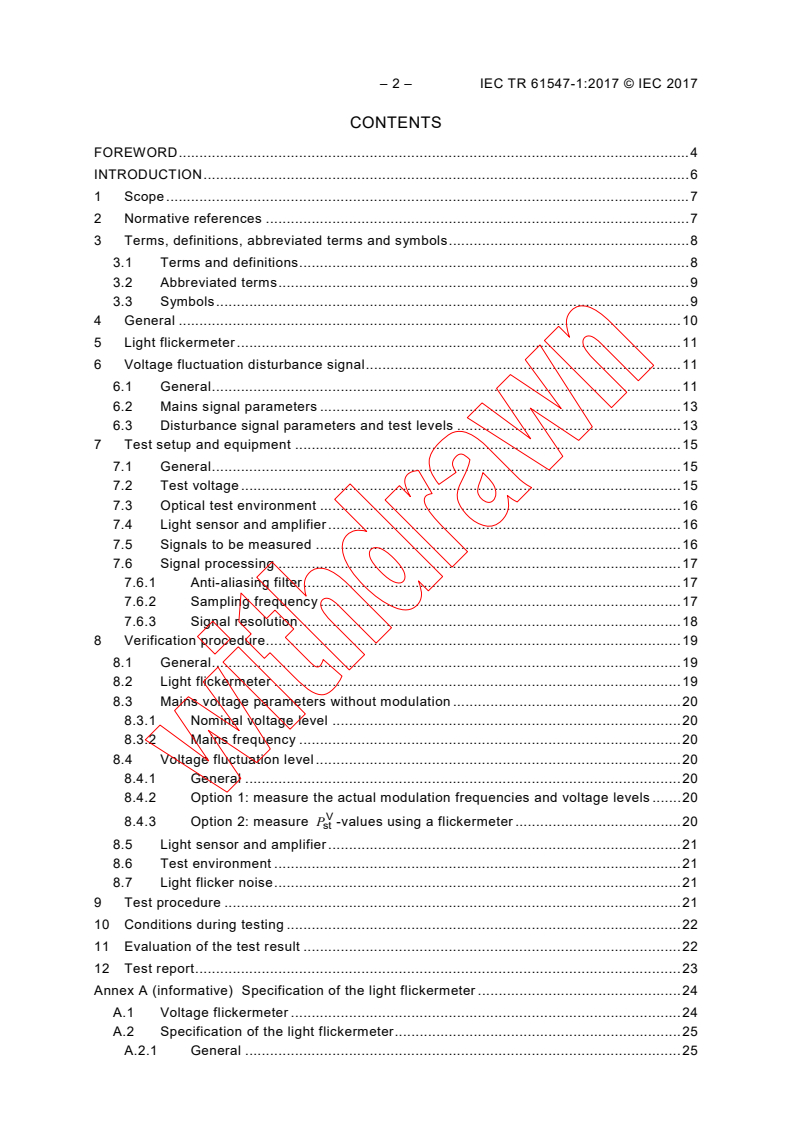
– 2 – IEC TR 61547-1:2017 © IEC 2017
CONTENTS
FOREWORD . 4
INTRODUCTION . 6
1 Scope . 7
2 Normative references . 7
3 Terms, definitions, abbreviated terms and symbols . 8
3.1 Terms and definitions . 8
3.2 Abbreviated terms . 9
3.3 Symbols . 9
4 General . 10
5 Light flickermeter . 11
6 Voltage fluctuation disturbance signal . 11
6.1 General . 11
6.2 Mains signal parameters . 13
6.3 Disturbance signal parameters and test levels . 13
7 Test setup and equipment . 15
7.1 General . 15
7.2 Test voltage . 15
7.3 Optical test environment . 16
7.4 Light sensor and amplifier . 16
7.5 Signals to be measured . 16
7.6 Signal processing . 17
7.6.1 Anti-aliasing filter . 17
7.6.2 Sampling frequency . 17
7.6.3 Signal resolution . 18
8 Verification procedure . 19
8.1 General . 19
8.2 Light flickermeter . 19
8.3 Mains voltage parameters without modulation . 20
8.3.1 Nominal voltage level . 20
8.3.2 Mains frequency . 20
8.4 Voltage fluctuation level . 20
8.4.1 General . 20
8.4.2 Option 1: measure the actual modulation frequencies and voltage levels . 20
V
8.4.3 Option 2: measure P -values using a flickermeter . 20
st
8.5 Light sensor and amplifier . 21
8.6 Test environment . 21
8.7 Light flicker noise . 21
9 Test procedure . 21
10 Conditions during testing . 22
11 Evaluation of the test result . 22
12 Test report . 23
Annex A (informative) Specification of the light flickermeter . 24
A.1 Voltage flickermeter . 24
A.2 Specification of the light flickermeter . 25
A.2.1 General . 25
A.2.2 Block a: illuminance adapter . 25
A.2.3 Block b: weighting filters . 25
A.2.4 Block c: squaring multiplier, sliding mean filter and scaling . 26
A.2.5 Block d: statistical analysis . 26
A.3 Verification of the light flickermeter . 27
LM ®
A.4 Example of P implementation in MATLAB . 27
st
Annex B (informative) Uncertainty considerations . 28
B.1 General . 28
B.2 General symbols . 28
B.3 Measurand . 28
B.4 Influence quantities . 28
B.5 Uncertainty budget . 30
Annex C (informative) Examples of test results of lighting equipment . 32
C.1 Test without voltage fluctuations . 32
C.2 Test with (intentional) voltage fluctuations . 32
C.3 Test under dimming conditions. 36
Bibliography . 38
Figure 1 – Full EMC approach for mains voltage fluctuations . 11
Figure 2 – Definition of the mains test signal including a rectangular modulated
voltage fluctuation (see Equation (1)) . 13
Figure 3 – Block diagram voltage-fluctuation immunity test . 15
Figure 4 – Example of a recorded mains voltage fluctuation and illuminance signal of a
60 W incandescent lamp . 19
Figure A.1 – Structure of the IEC 61000-4-15 flickermeter which uses voltage as input . 24
Figure A.2 – Structure of the light flickermeter . 24
LM
Figure C.1 – Graphical P results for three EUTs with rectangular modulation at five
st
V
frequencies ( P = 1) . 33
st
Figure C.2 – EUT1: recorded signals (no mains voltage modulation) . 34
Figure C.3 – EUT1: recorded signals (with modulation) . 35
Figure C.4 – EUT2: relative illuminance: mains voltage modulation d = 0,407 % at
V
13,5 Hz ( P = 1) . 36
st
Figure C.5 – EUT3: relative illuminance: mains voltage modulation d = 0,407 % at
V
13,5 Hz ( P = 1) . 36
st
LM
Figure C.6 – Graphical P results for four EUTs under dimming conditions . 37
st
Table 1 – Voltage fluctuations – Test specification of voltage fluctuations applied at
input AC power ports 120/230 V; 50/60 Hz . 14
Table A.1 – Test specification of illuminance fluctuations for lightmeter classifier . 27
Table B.1 – Influence quantities and their recommended tolerances . 29
Table B.2 – Uncertainty budget of the voltage fluctuation immunity test . 31
LM
Table C.1 – Numerical results calculations for three EUTs without voltage modulation . 32
P
st
LM
Table C.2 – Numerical results P calculations for three EUTs with voltage modulation . 32
st
Table C.3 – Numerical results P calculations for four EUTs under dimming conditions . 37
st
– 4 – IEC TR 61547-1:2017 © IEC 2017
INTERNATIONAL ELECTROTECHNICAL COMMISSION
____________
EQUIPMENT FOR GENERAL LIGHTING PURPOSES –
EMC IMMUNITY REQUIREMENTS–
Part 1: An objective light flickermeter and voltage fluctuation
immunity test method
FOREWORD
1) The International Electrotechnical Commission (IEC) is a worldwide organization for standardization comprising
all national electrotechnical committees (IEC National Committees). The object of IEC is to promote
international co-operation on all questions concerning standardization in the electrical and electronic fields. To
this end and in addition to other activities, IEC publishes International Standards, Technical Specifications,
Technical Reports, Publicly Available Specifications (PAS) and Guides (hereafter referred to as “IEC
Publication(s)”). Their preparation is entrusted to technical committees; any IEC National Committee interested
in the subject dealt with may participate in this preparatory work. International, governmental and non-
governmental organizations liaising with the IEC also participate in this preparation. IEC collaborates closely
with the International Organization for Standardization (ISO) in accordance with conditions determined by
agreement between the two organizations.
2) The formal decisions or agreements of IEC on technical matters express, as nearly as possible, an international
consensus of opinion on the relevant subjects since each technical committee has representation from all
interested IEC National Committees.
3) IEC Publications have the form of recommendations for international use and are accepted by IEC National
Committees in that sense. While all reasonable efforts are made to ensure that the technical content of IEC
Publications is accurate, IEC cannot be held responsible for the way in which they are used or for any
misinterpretation by any end user.
4) In order to promote international uniformity, IEC National Committees undertake to apply IEC Publications
transparently to the maximum extent possible in their national and regional publications. Any divergence
between any IEC Publication and the corresponding national or regional publication shall be clearly indicated in
the latter.
5) IEC itself does not provide any attestation of conformity. Independent certification bodies provide conformity
assessment services and, in some areas, access to IEC marks of conformity. IEC is not responsible for any
services carried out by independent certification bodies.
6) All users should ensure that they have the latest edition of this publication.
7) No liability shall attach to IEC or its directors, employees, servants or agents including individual experts and
members of its technical committees and IEC National Committees for any personal injury, property damage or
other damage of any nature whatsoever, whether direct or indirect, or for costs (including legal fees) and
expenses arising out of the publication, use of, or reliance upon, this IEC Publication or any other IEC
Publications.
8) Attention is drawn to the Normative references cited in this publication. Use of the referenced publications is
indispensable for the correct application of this publication.
9) Attention is drawn to the possibility that some of the elements of this IEC Publication may be the subject of
patent rights. IEC shall not be held responsible for identifying any or all such patent rights.
The main task of IEC technical committees is to prepare International Standards. However, a
technical committee may propose the publication of a Technical Report when it has collected
data of a different kind from that which is normally published as an International Standard, for
example "state of the art".
IEC TR 61547-1, which is a Technical Report, has been prepared by technical committee 34:
Lamps and related equipment.
This second edition cancels and replaces the first edition published in 2015. This edition
constitutes a technical revision.
This edition includes the following significant technical changes with respect to the previous
edition:
a) the title of Part 1 has been changed to reflect the more general application of the objective
flickermeter;
b) the specific voltage fluctuation immunity test method has been extended for lighting
equipment rated for 120 V AC and 230 V AC, 50 Hz and 60 Hz.
The text of this Technical Report is based on the following documents:
Draft TR Report on voting
34/387/DTR 34/398A/RVDTR
Full information on the voting for the approval of this Technical Report can be found in the
report on voting indicated in the above table.
This document has been drafted in accordance with the ISO/IEC Directives, Part 2.
A list of all parts in the IEC 61547 series, published under the general title Equipment for
general lighting purposes – EMC immunity requirements, can be found on the IEC website.
The committee has decided that the contents of this document will remain unchanged until the
stability date indicated on the IEC website under "http://webstore.iec.ch" in the data related to
the specific document. At this date, the document will be
• reconfirmed,
• withdrawn,
• replaced by a revised edition, or
• amended.
A bilingual version of this publication may be issued at a later date.
IMPORTANT – The 'colour inside' logo on the cover page of this publication indicates
that it contains colours which are considered to be useful for the correct
understanding of its contents. Users should therefore print this document using a
colour printer.
– 6 – IEC TR 61547-1:2017 © IEC 2017
INTRODUCTION
The fast rate at which solid state light (SSL) sources can change their intensity is one of the
main drivers behind the revolution in the lighting world and applications of lighting. Linked to
the fast rate of the intensity change is a direct transfer of the modulation of the driving
current, both intended and unintended, to a modulation of the luminous output. This light
modulation can give rise to changes in the perception of the environment. While in some very
specific entertainment, scientific or industrial applications, a change of perception due to light
modulation is desired, for most everyday applications and activities the change is detrimental
and undesired. The general term used for these changes in the perception of the environment
is “temporal light artefacts” (TLAs) and these can have a large influence on the judgment of
the light quality. Moreover, the visible modulation of light can lead to a decrease in
performance, increased fatigue as well as acute health problems like epileptic seizures and
migraine episodes [18][19] .
Different terms exist to describe the different types of TLAs that may be perceived by humans.
The term ‘flicker’ refers to light variation that may be directly perceived by an observer.
‘Stroboscopic effect’ is an effect which may become visible for an observer when a moving or
rotating object is illuminated (CIE TN 006:2016[22]).
Possible causes for light modulation of lighting equipment that may give rise to flicker or
stroboscopic effect are:
– AC supply combined with light source technology and its driver topology;
– dimming technology of externally applied dimmers or internal light level regulators;
– mains voltage fluctuations caused by electrical apparatus connected to the mains
(conducted electromagnetic disturbances) or intentionally applied for mains-signalling
purposes.
Lighting products that show unacceptable flicker or stroboscopic effect are considered as poor
quality lighting.
This document provides an objective light flickermeter and a method for testing the immunity
of lighting equipment against mains voltage fluctuations caused by electrical apparatus
connected to the mains at levels that are allowed through IEC 61000-3-3.
Flicker perception, as well as IEC 61000-3-3 and IEC 61000-4-15, the associated standards
for voltage fluctuations and flickermeter, are based on the 60 W incandescent lamp. As a
result of the phasing out of incandescent lamps and the widespread introduction of alternative
lighting equipment technologies, a new reference lamp was considered. It has been
demonstrated that new lighting technologies are in general less but sometimes also more
sensitive to supply voltage fluctuations than the current 60 W incandescent lamp. A CIGRE
working group has assessed the impact of new lighting technologies on the existing flicker
standards [17]. For the moment, the present flicker sensitivity curve of IEC 61000-3-3 remains
as the reference. However, because of the increased diversity of sensitivity of lighting
equipment to voltage fluctuations, there is a future need for a voltage-fluctuation immunity test
specifically for lighting equipment. In this way, the full EMC approach (Figure 1) is introduced
for flicker, i.e. with a view to limiting voltage fluctuations caused by equipment connected to
the grid, and in addition to establishing a minimum level of flicker immunity of lighting
equipment against these voltage fluctuations.
This document will allow the lighting industry to gain experience in flicker immunity test
methods. Results of actual tests will be reported in a separate IEC Technical Report. Based
on the experience gained on this immunity test method, the adoption of a similar test to be
applied for IEC 61547, the immunity standard for lighting equipment, will be considered.
___________
Numbers in square brackets refer to the Bibliography.
EQUIPMENT FOR GENERAL LIGHTING PURPOSES –
EMC IMMUNITY REQUIREMENTS –
Part 1: An objective light flickermeter and voltage fluctuation
immunity test method
1 Scope
This part of IEC 61547 describes an objective light flickermeter, which can be applied for,
amongst others, the following purposes:
– testing the intrinsic performance of all lighting equipment without voltage fluctuations;
– testing the immunity performance of lighting equipment against (unintentional) voltage
fluctuation disturbance on the AC power port;
– testing the immunity performance of lighting equipment against intentional voltage
fluctuation on the AC power port arising for example from ripple control systems.
The object of this document is to establish a common and objective reference for evaluating
the performance of lighting equipment in terms of illuminance flicker. Temporal changes in the
colour of light (chromatic flicker) are not considered in this test.
This method can be applied to lighting equipment which is within the scope of IEC technical
committee 34, such as lamps and luminaires, intended for connection to a low voltage
electricity supply. Independent auxiliaries such as drivers can also be tested by application of
a representative light source to that auxiliary.
The objective light flickermeter and voltage fluctuation immunity method described in this
document are based on the IEC 61000-3-3 standard for voltage fluctuation limits and the
flickermeter standard IEC 61000-4-15.
The objective light flickermeter described in this document can be applied to objectively
assess flicker of lighting equipment that is powered from any type of source, AC mains, DC
mains, battery fed or fed through an external dimmer. The specific voltage fluctuation
immunity test method described in this document applies to lighting equipment rated for 120 V
AC and 230 V AC, 50 Hz and 60 Hz.
NOTE The principle of the method can be applied for other nominal voltage and frequency ratings.
2 Normative references
The following documents are referred to in the text in such a way that some or all of their
content constitutes requirements of this document. For dated references, only the edition
cited applies. For undated references, the latest edition of the referenced document (including
any amendments) applies.
IEC 61000-3-3:2013, Electromagnetic compatibility (EMC) – Part 3-3: Limits – Limitation of
voltage changes, voltage fluctuations and flicker in public low-voltage supply systems, for
equipment with rated current ≤ 16 A per phase and not subject to conditional connection
IEC 61000-4-15:2010, Electromagnetic compatibility (EMC) – Part 4-15: Testing and
measurement techniques – Flickermeter – Functional and design specifications
– 8 – IEC TR 61547-1:2017 © IEC 2017
3 Terms, definitions, abbreviated terms and symbols
3.1 Terms and definitions
For the purposes of this document, the terms and definitions given in IEC 61000-3-3 and
IEC 61000-4-15 and the following apply.
ISO and IEC maintain terminological databases for use in standardization at the following
addresses:
• IEC Electropedia: available at http://www.electropedia.org/
• ISO Online browsing platform: available at http://www.iso.org/obp
3.1.1
flicker
impression of unsteadiness of visual sensation induced by a light stimulus whose luminance
or spectral distribution fluctuates with time
[SOURCE: IEC 60050-845:1987, 845-02-49]
3.1.2
flickermeter
instrument designed to measure any quantity representative of flicker
[SOURCE: IEC 60050-614:2016, 614-01-30]
3.1.3
voltage flickermeter
instrument as specified in IEC 61000-4-15 which is designed to measure any quantity
representative of flicker resulting from mains voltage fluctuations
3.1.4
illuminance
quotient of the luminous flux dΦ incident on an element of the surface containing the point,
v
by the area dA of that element
Equivalent definition. Integral, taken over the hemisphere visible from the given point, of the
expression L ·cos θ·dΩ where L is the luminance at the given point in the various directions
v v
of the incident elementary beams of solid angle dΩ, and θ is the angle between any of these
beams and the normal to the surface at the given point
dΦ
v
E = = L ⋅cosθ ⋅ dΩ
v v
∫
dA 2π sr
–2
Note 1 to entry: Illuminance is expressed in lx or lm·m
[SOURCE: IEC 60050-845:1987, 845-01-38]
3.1.5
light flickermeter
instrument designed to measure flicker resulting from temporal changes in the intensity of the
light in an objective way and based on the IEC 61000-4-15 specifications
3.1.6
threshold of flicker irritability
maximum value of a fluctuation of luminance or of spectral distribution which gives rise to a
flicker tolerated without discomfort by a specified sample of the population
[SOURCE: IEC 60050-161:1990, 161-08-16]
3.1.7
short-term flicker indicator
P
st
measure of flicker evaluated over a specified time interval of a relatively short duration
Note 1 to entry: The duration is typically 10 min, in accordance with IEC 61000-4-15.
Note 2 to entry: The alternative term "short term flicker severity" is used in IEC 61000-3-3 and IEC 61000-4-15.
[SOURCE: IEC 60050-161:1990, 161-08-18, modified — Note 2 has been added.]
3.2 Abbreviated terms
AC alternating current
AM amplitude modulation
CFL compact fluorescent lamp
CIE Commission Internationale de l'Éclairage
cpm changes per minute
DC direct current
EUT equipment under test
EMC electromagnetic compatibility
EMI electromagnetic interference
Hz hertz
IEEE Institute of Electrical and Electronics Engineers
kHz kilohertz
LED light emitting diode
LP low pass
ms millisecond
rect rectangular
RMS root mean square
SSL solid state lighting
TLAs temporal light artefacts
V voltage
W watt
3.3 Symbols
α
multiplication factor
C gain of the light amplifier
A
d relative voltage change
d relative change of the rectangular modulation of the illuminance
E
d relative change of the 100 Hz-illuminance ripple
r
∆u instantaneous total voltage variation after a voltage fluctuation
∆U total voltage variation of the half-period RMS value after a voltage fluctuation
f mains frequency (50 Hz)
f modulation frequency
m
m modulation index
– 10 – IEC TR 61547-1:2017 © IEC 2017
% percent
pp percentage point
P instantaneous flicker sensation
inst
P short-term flicker indicator
st
E
P
P -value of the standardized illuminance waveform E(t)
st
st
EUT
P
P -value of the illuminance of an EUT measured with a light flickermeter
st st
LM
flicker metric of the illuminance measured with a light flickermeter
P
st
V
P flicker metric of the supply voltage measured with a voltage flickermeter
st
LM
P light flicker noise level
st
noise
V
P mains flicker noise level
st
noise
s complex Laplace variable
ˆ
u amplitude of the mains voltage
u(t) mains voltage signal
u (t) output voltage of the light sensor amplifier
E
T modulation period
m
T period of time over which the illuminance is measured during application of the
test
voltage fluctuation
U half-period RMS value
4 General
The immunity of lighting equipment to voltage fluctuations may be tested by applying specific
types and levels of voltage fluctuations to the mains, in accordance with the short-term flicker
indicator P = 1 curve for the reference incandescent lamp of 60 W specified in
st
IEC 61000-3-3. In this way, the full EMC approach is applied for flicker, i.e. voltage
fluctuations caused by equipment connected to the grid are limited by the voltage fluctuation
emission test of IEC 61000-3-3, while the level of flicker immunity of lighting equipment
against these P = 1 voltage fluctuations is tested using the method specified in this
st
document (see Figure 1).
V
During the test, the supply voltage is modulated with P = 1 fluctuation (denoted as P )
st st
extracted from the threshold of the flicker irritability curve and the luminous intensity variation
of the lighting equipment is measured and recorded. A light flickermeter is applied to measure
LM
the value of the metric P (denoted as P ).
st st
Voltage flickermeter
voltage
Apply stable AC mains source via
U + ∆U
reference impedance
EUT
measure
V
60 W
P
st
inc. lamp
Eye-brain
(60 W incandescent
EUT = model
model
lamp)
Apparatus
IEC
a) Voltage fluctuation emission test in IEC 61000-3-3, using the IEC voltage
flickermeter in IEC 61000-4-15
Apply AC mains
Light flickermeter
voltage fluctuation
L + ∆L
EUT
corresponding to
light
𝑉
𝑃 =1
𝑠𝑠
Measure
(60 W incandescent Eye-brain
𝐿𝐿
𝑃 =1
lamp) model
𝑠𝑠
(for 60 W
EUT = Lighting
incandescent lamp)
equipment
IEC
60W
U + ∆U
V
P =1
st
b) Voltage fluctuation immunity test specified in this document
Figure 1 – Full EMC approach for mains voltage fluctuations
5 Light flickermeter
For objective assessment of flicker due to low-frequency light modulation, the flickermeter
specified in Annex A is used. Additional requirements for the light flickermeter are given in
7.3, 7.4, 7.5 and 7.6.
This light flickermeter can be applied to objectively assess the flicker of lighting equipment
that is powered from any type of source, AC mains, DC mains, battery powered or powered
through an external dimmer. In this document, specific mains voltage disturbance signals are
given in Clause 6 for 120 V AC and 230 V AC, 50 Hz and 60 Hz networks.
6 Voltage fluctuation disturbance signal
6.1 General
The immunity test against voltage fluctuations is carried out in accordance with the test
method specified in Clause 7. The disturbances are rectangular amplitude modulations that
are to be applied on the AC power port.
The mains signal is to be amplitude modulated with rectangular signals with frequencies
between approximately 0,05 Hz and 40 Hz. For the rectangular modulated mains signal u(t),
the following Equation (1) applies:
– 12 – IEC TR 61547-1:2017 © IEC 2017
ˆ
u(t) = u ⋅ sin(2πft) ⋅ {1+ m ⋅ signum (sin(2πf t))} (1)
m
where
ˆ
u is the amplitude of the mains voltage;
f is the mains frequency (50 Hz);
m is the modulation index;
signum(x) = the signum function, signum(x) = 1 for x > 0
signum(x) = 0 for x = 0
signum(x) = –1 for x < 0
is the modulation frequency = 1/T .
f
m m
Furthermore the half-period RMS value U of the unmodulated mains signal can be written as:
ˆ
U = u / 2 (2)
In IEC 61000-4-15, the parameter d is applied, which is the total relative voltage change:
ˆ
d = ∆u / u = ∆U /U , (3)
for rectangular AM modulation with modulation frequencies < f
where
∆u is the instantaneous total voltage variation after a voltage fluctuation;
∆U is the total voltage variation of the half-period RMS value after a voltage fluctuation.
For a rectangular modulated mains signal with modulation index m the relative voltage change
d is:
d = 2m. (4)
The relative voltage change (or voltage fluctuation) d is often expressed as a percentage.
An example of the parameters is shown in Figure 2.
Mains signal – rectangular amplitude modulation
ˆ
u
T
m
−100
u
(t)
−200
−300
230 V; 50 Hz; rectangular modulation 5 Hz; modulation index m = 0,1
−400
0 0,05 0,1 0,15 0,2 0,25 0,3 0,35 0,4 0,45 0,5
Time (s)
IEC
EXAMPLE Amplitude modulated mains signal (230 V; 50 Hz). Rectangular modulation; frequency 5 Hz (600 cpm);
T = 0,2 s; modulation index m = 0,1 (relative voltage change d = 20 %).
m
Figure 2 – Definition of the mains test signal including
a rectangular modulated voltage fluctuation (see Equation (1))
Voltage fluctuations frequencies are often expressed in terms of voltage changes per minute
(cpm). The relation between the voltage fluctuation frequency f (in Hz) and the cpm (one
m
cycle contains two changes) is:
f = cpm / 120. (5)
m
6.2 Mains signal parameters
The unmodulated test voltage level U should be set and maintained at the nominal value of
120 V or 230 V, with a tolerance of ±0,5 %.
The mains frequency f should be set and maintained with a tolerance of ±0,5 % of the nominal
value of 50 Hz or 60 Hz.
Residual fluctuations of the unmodulated test supply voltage during a test may give rise to
V V
that are not exactly zero. It is recommended to keep this -noise level below 0,2. See
P P
st st
Clause B.5 for the impact on the uncertainty of the test.
V
NOTE In IEC 61000-3-3, the P -noise level is specified to be less than 0,4 which can induce an uncertainty of
st
8 % in the IEC 61000-4-15 measurement. However, in this test protocol, there are many sources of uncertainty and
V
that is the reason to set a more strict -noise level tolerance.
P
st
6.3 Disturbance signal parameters and test levels
Specific test frequencies and types of modulation are specified in the IEC flickermeter
standard IEC 61000-4-15 for performance verification purposes. It is recommended to also
use the test frequencies and the rectangular modulation given in IEC 61000-4-15:2010,
Table 5 as test signals for voltage fluctuation immunity testing of lighting equipment.
The recommended specific levels of relative voltage changes and modulation frequencies to
be applied are given in Table 1. The test levels in this table are partly taken from the
flickermeter performance test specifications given in IEC 61000-4-15:2010, Table 5, and from
Magnitude (V)
∆u
– 14 – IEC TR 61547-1:2017 © IEC 2017
the test level at 8,8 Hz given in IEC 61000-4-15:2010, Table 2b. The latter frequency is the
most sensitive frequency over the frequency range of interest.
The rectangular modulation pattern should be applied with a duty cycle of
50 % ± 2 percentage point (pp), and the transition time from one voltage level to the next
should be less than 0,5 ms. All test frequency and level combinations will give a short-term
V
flicker value of P = 1 corresponding to the threshold of the flicker irritability curve.
st
The duration of the voltage fluctuation applied to the EUT should be minimally 180 s (see
footnote c of Table 1).
Table 1 – Voltage fluctuations – Test specification of voltage
fluctuations applied at input AC power ports 120/230 V; 50/60 Hz
a c d
Rectangular amplitude modulations with duty cycle of 50 %
Voltage changes Modulation Relative voltage fluctuation
per minute frequency d = ∆U/U
f
m
cpm %
Hz
120 V 120 V 230 V 230 V
50 Hz 60 Hz 50 Hz 60 Hz
39 0,325 0 1,045 1,040 0,894 0,895
110 0,916 7 0,844 0,844 0,722 0,723
b b b b
1 056 8,8 0,353 0,353 0,275 0,275
1 620 13,5 0,545 0,548 0,407 0,409
Test not Test not
e
4 000 33 1/3 3,426 required 2,343 required
Test not 4,837 Test not 3,263
e
4 800 40,0 required required
a
See Table 5 of IEC 61000-4-15:2010.
P
b inst
See Tables 2a and 2b of IEC 61000-4-15:2010 for = 1; the values of d = 0,252 % and d = 0,196 % are
P
st
increased to respectively 0,353 % and 0,275 % to give = 1.
c
The duration of the voltage fluctuation and recording of the illuminance is recommended to be minimally
180 s (60 s for the transient response of the flickermeter’s filters and 120 s for the duration of the statistical
evaluation of the flicker level in block d, see A.2.5). First of all, the transient response of the light
flickermeter’s filters shall be considered, which is dominated by the illuminance adapter (block a, see A.2.2).
The time constant of this filter is set at 10 s, reaching the 90 % of the value corresponding to the steady
state response at approximately 50 s. In addition, the evaluation period should contain an integer number of
voltage fluctuation periods. For the set of test modulation frequencies given in this table, the minimum
duration to achieve an integer number of voltage fluctuation periods in all the test cases is 120 s.
d
Recommended absolute tolerance for the duty cycle is ±2 pp, for the modulation frequency the
recommended tolerance is ±1 % and for the relative voltage fluctuation the recommended tolerance is ±5 %.
e
The 33 1/3 Hz and 40 Hz modulation frequencies should be synchronous with the supply frequency of
respectively 50 Hz and 60 Hz with a fixed phase angle as defined by Equation (1).
f
The light flicker specifications in this document are expanded such that it is aligned with the voltage flicker
specifications given in IEC 61000-4-15, which is limited to 120 V and 230 V, 50 Hz and 60 Hz. No voltage
fluctuation tests are yet available for 100 V, 200 V and 277 V. However, in practice, the test specifications
given in this table for 120 V and 230 V can be applied for 100 V and 200/277 V respectively for indicative
purposes.
7 Test setup and equipment
7.1 General
The block diagram of the test setup is shown in Figure 3. One can distinguish three parts in
the setup:
a) generation of the test voltage,
b) application of the test voltage to the EUT, photometric measurement of the EUT in an
optically shielded environment,
c) measurement and control equipment.
More details of the equipment properties are described below.
Photometric
measurement in
optically shielded
Generation of the test voltage:
environment
mains voltage including voltage fluctuation
Mains frequency +
Gain
modulation
EUT
Test waveform
Lamp/luminaire
Amplifier
generator
under test
Measurement equipment:
light flickermeter
Light sensor +
transimpedance
Computation of the flicker
Measurement of test
amplifier
voltage and relative
metrics ( , )
illuminance
Measurement relative
illuminance
Data processing
Data acquisition Anti-aliasing filter
IEC
Figure 3 – Block diagram voltage-fluctuation immunity test
7.2 Test voltage
The test voltage, which consists of the mains voltage with a rectangular amplitude modulation,
can be synthesized using a waveform generator and an amplifier. This may be implemented
also by using a separate waveform generator for the modulating signal that is applied to a
generator that makes the 50/60 Hz mains signal.
It is important that the equipment for generating the amplitude modulation is capable of
generating voltage fluctuations well below the lowest test level of d = 0,275 % at 8,8 Hz (see
Table 1).
Care should be taken that no other disturbing signals than the amplitude modulation are
present (see 6.2 and 8.4 for the verification).
– 16 – IEC TR 61547-1:2017 © IEC 2017
The characteristics of the test voltage should be verified by either measurement through an
oscilloscope or by direct application of an IEC 61000-4-15 flickermeter (see 8.3).
7.3 Optical test environment
The illuminance of the EUT is to be measured for processing by the light flickermeter. There
is no need for measuring the absolute value. Only the relative illuminance is to be determined.
The EUT and the light sensor are to be located in an optically shielded environment to avoid
disturbances from light sources other than the EUT.
The test environment should be also mechanically robust to avoid vibrations of the EUT and
light sensor that may give rise to unwanted variations in the illuminance.
It is recommended that the light output of the EUT is measured indirectly via a reflecting
surface. This is especially true for lighting equipment with a spatial distribution of light
sources (e.g. TL, TLED, 2D LED matrix).
An integrating sphere, like an Ulbricht sphere, may be applied. This may be convenient
because then the orientation and alignment of the EUT with respect to the light sensor is less
critical.
7.4 Light sensor and amplifier
A photodiode with a filter and an appropriate amplifier is to be applied for measuring the
illuminance (or more specific: the relative illuminance) of the EUT.
The photodiode, optical filter and amplifier combination should satisfy the following
characteristics:
a) the optical filter should match the photodiode to the eye sensitivity curve of CIE 1931
which is the CIE 1931 standard observer function specified in ISO 11664-1:2007 [3];
b) the cut-off frequency of the amplifier should enable measurement of all flicker-relevant
frequencies. A cut-off frequency of 2 kHz is recommended;
c) the output v
...
IEC TR 61547-1 ®
Edition 2.0 2017-10
TECHNICAL
REPORT
colour
inside
Equipment for general lighting purposes – EMC immunity requirements–
Part 1: An objective light flickermeter and voltage fluctuation immunity test
method
All rights reserved. Unless otherwise specified, no part of this publication may be reproduced or utilized in any form
or by any means, electronic or mechanical, including photocopying and microfilm, without permission in writing from
either IEC or IEC's member National Committee in the country of the requester. If you have any questions about IEC
copyright or have an enquiry about obtaining additional rights to this publication, please contact the address below or
your local IEC member National Committee for further information.
IEC Central Office Tel.: +41 22 919 02 11
3, rue de Varembé Fax: +41 22 919 03 00
CH-1211 Geneva 20 info@iec.ch
Switzerland www.iec.ch
About the IEC
The International Electrotechnical Commission (IEC) is the leading global organization that prepares and publishes
International Standards for all electrical, electronic and related technologies.
About IEC publications
The technical content of IEC publications is kept under constant review by the IEC. Please make sure that you have the
latest edition, a corrigenda or an amendment might have been published.
IEC Catalogue - webstore.iec.ch/catalogue Electropedia - www.electropedia.org
The stand-alone application for consulting the entire The world's leading online dictionary of electronic and
bibliographical information on IEC International Standards, electrical terms containing 20 000 terms and definitions in
Technical Specifications, Technical Reports and other English and French, with equivalent terms in 16 additional
documents. Available for PC, Mac OS, Android Tablets and languages. Also known as the International Electrotechnical
iPad. Vocabulary (IEV) online.
IEC publications search - www.iec.ch/searchpub IEC Glossary - std.iec.ch/glossary
The advanced search enables to find IEC publications by a 65 000 electrotechnical terminology entries in English and
variety of criteria (reference number, text, technical French extracted from the Terms and Definitions clause of
committee,…). It also gives information on projects, replaced IEC publications issued since 2002. Some entries have been
and withdrawn publications. collected from earlier publications of IEC TC 37, 77, 86 and
CISPR.
IEC Just Published - webstore.iec.ch/justpublished
Stay up to date on all new IEC publications. Just Published IEC Customer Service Centre - webstore.iec.ch/csc
details all new publications released. Available online and If you wish to give us your feedback on this publication or
also once a month by email. need further assistance, please contact the Customer Service
Centre: csc@iec.ch.
IEC TR 61547-1 ®
Edition 2.0 2017-10
TECHNICAL
REPORT
colour
inside
Equipment for general lighting purposes – EMC immunity requirements–
Part 1: An objective light flickermeter and voltage fluctuation immunity test
method
INTERNATIONAL
ELECTROTECHNICAL
COMMISSION
ICS 29.140.20 ISBN 978-2-8322-4904-8
– 2 – IEC TR 61547-1:2017 © IEC 2017
CONTENTS
FOREWORD . 4
INTRODUCTION . 6
1 Scope . 7
2 Normative references . 7
3 Terms, definitions, abbreviated terms and symbols . 8
3.1 Terms and definitions . 8
3.2 Abbreviated terms . 9
3.3 Symbols . 9
4 General . 10
5 Light flickermeter . 11
6 Voltage fluctuation disturbance signal . 11
6.1 General . 11
6.2 Mains signal parameters . 13
6.3 Disturbance signal parameters and test levels . 13
7 Test setup and equipment . 15
7.1 General . 15
7.2 Test voltage . 15
7.3 Optical test environment . 16
7.4 Light sensor and amplifier . 16
7.5 Signals to be measured . 16
7.6 Signal processing . 17
7.6.1 Anti-aliasing filter . 17
7.6.2 Sampling frequency . 17
7.6.3 Signal resolution . 18
8 Verification procedure . 19
8.1 General . 19
8.2 Light flickermeter . 19
8.3 Mains voltage parameters without modulation . 20
8.3.1 Nominal voltage level . 20
8.3.2 Mains frequency . 20
8.4 Voltage fluctuation level . 20
8.4.1 General . 20
8.4.2 Option 1: measure the actual modulation frequencies and voltage levels . 20
V
8.4.3 Option 2: measure P -values using a flickermeter . 20
st
8.5 Light sensor and amplifier . 21
8.6 Test environment . 21
8.7 Light flicker noise . 21
9 Test procedure . 21
10 Conditions during testing . 22
11 Evaluation of the test result . 22
12 Test report . 23
Annex A (informative) Specification of the light flickermeter . 24
A.1 Voltage flickermeter . 24
A.2 Specification of the light flickermeter . 25
A.2.1 General . 25
A.2.2 Block a: illuminance adapter . 25
A.2.3 Block b: weighting filters . 25
A.2.4 Block c: squaring multiplier, sliding mean filter and scaling . 26
A.2.5 Block d: statistical analysis . 26
A.3 Verification of the light flickermeter . 27
LM ®
A.4 Example of P implementation in MATLAB . 27
st
Annex B (informative) Uncertainty considerations . 28
B.1 General . 28
B.2 General symbols . 28
B.3 Measurand . 28
B.4 Influence quantities . 28
B.5 Uncertainty budget . 30
Annex C (informative) Examples of test results of lighting equipment . 32
C.1 Test without voltage fluctuations . 32
C.2 Test with (intentional) voltage fluctuations . 32
C.3 Test under dimming conditions. 36
Bibliography . 38
Figure 1 – Full EMC approach for mains voltage fluctuations . 11
Figure 2 – Definition of the mains test signal including a rectangular modulated
voltage fluctuation (see Equation (1)) . 13
Figure 3 – Block diagram voltage-fluctuation immunity test . 15
Figure 4 – Example of a recorded mains voltage fluctuation and illuminance signal of a
60 W incandescent lamp . 19
Figure A.1 – Structure of the IEC 61000-4-15 flickermeter which uses voltage as input . 24
Figure A.2 – Structure of the light flickermeter . 24
LM
Figure C.1 – Graphical P results for three EUTs with rectangular modulation at five
st
V
frequencies ( P = 1) . 33
st
Figure C.2 – EUT1: recorded signals (no mains voltage modulation) . 34
Figure C.3 – EUT1: recorded signals (with modulation) . 35
Figure C.4 – EUT2: relative illuminance: mains voltage modulation d = 0,407 % at
V
13,5 Hz ( P = 1) . 36
st
Figure C.5 – EUT3: relative illuminance: mains voltage modulation d = 0,407 % at
V
13,5 Hz ( P = 1) . 36
st
LM
Figure C.6 – Graphical P results for four EUTs under dimming conditions . 37
st
Table 1 – Voltage fluctuations – Test specification of voltage fluctuations applied at
input AC power ports 120/230 V; 50/60 Hz . 14
Table A.1 – Test specification of illuminance fluctuations for lightmeter classifier . 27
Table B.1 – Influence quantities and their recommended tolerances . 29
Table B.2 – Uncertainty budget of the voltage fluctuation immunity test . 31
LM
Table C.1 – Numerical results calculations for three EUTs without voltage modulation . 32
P
st
LM
Table C.2 – Numerical results P calculations for three EUTs with voltage modulation . 32
st
Table C.3 – Numerical results P calculations for four EUTs under dimming conditions . 37
st
– 4 – IEC TR 61547-1:2017 © IEC 2017
INTERNATIONAL ELECTROTECHNICAL COMMISSION
____________
EQUIPMENT FOR GENERAL LIGHTING PURPOSES –
EMC IMMUNITY REQUIREMENTS–
Part 1: An objective light flickermeter and voltage fluctuation
immunity test method
FOREWORD
1) The International Electrotechnical Commission (IEC) is a worldwide organization for standardization comprising
all national electrotechnical committees (IEC National Committees). The object of IEC is to promote
international co-operation on all questions concerning standardization in the electrical and electronic fields. To
this end and in addition to other activities, IEC publishes International Standards, Technical Specifications,
Technical Reports, Publicly Available Specifications (PAS) and Guides (hereafter referred to as “IEC
Publication(s)”). Their preparation is entrusted to technical committees; any IEC National Committee interested
in the subject dealt with may participate in this preparatory work. International, governmental and non-
governmental organizations liaising with the IEC also participate in this preparation. IEC collaborates closely
with the International Organization for Standardization (ISO) in accordance with conditions determined by
agreement between the two organizations.
2) The formal decisions or agreements of IEC on technical matters express, as nearly as possible, an international
consensus of opinion on the relevant subjects since each technical committee has representation from all
interested IEC National Committees.
3) IEC Publications have the form of recommendations for international use and are accepted by IEC National
Committees in that sense. While all reasonable efforts are made to ensure that the technical content of IEC
Publications is accurate, IEC cannot be held responsible for the way in which they are used or for any
misinterpretation by any end user.
4) In order to promote international uniformity, IEC National Committees undertake to apply IEC Publications
transparently to the maximum extent possible in their national and regional publications. Any divergence
between any IEC Publication and the corresponding national or regional publication shall be clearly indicated in
the latter.
5) IEC itself does not provide any attestation of conformity. Independent certification bodies provide conformity
assessment services and, in some areas, access to IEC marks of conformity. IEC is not responsible for any
services carried out by independent certification bodies.
6) All users should ensure that they have the latest edition of this publication.
7) No liability shall attach to IEC or its directors, employees, servants or agents including individual experts and
members of its technical committees and IEC National Committees for any personal injury, property damage or
other damage of any nature whatsoever, whether direct or indirect, or for costs (including legal fees) and
expenses arising out of the publication, use of, or reliance upon, this IEC Publication or any other IEC
Publications.
8) Attention is drawn to the Normative references cited in this publication. Use of the referenced publications is
indispensable for the correct application of this publication.
9) Attention is drawn to the possibility that some of the elements of this IEC Publication may be the subject of
patent rights. IEC shall not be held responsible for identifying any or all such patent rights.
The main task of IEC technical committees is to prepare International Standards. However, a
technical committee may propose the publication of a Technical Report when it has collected
data of a different kind from that which is normally published as an International Standard, for
example "state of the art".
IEC TR 61547-1, which is a Technical Report, has been prepared by technical committee 34:
Lamps and related equipment.
This second edition cancels and replaces the first edition published in 2015. This edition
constitutes a technical revision.
This edition includes the following significant technical changes with respect to the previous
edition:
a) the title of Part 1 has been changed to reflect the more general application of the objective
flickermeter;
b) the specific voltage fluctuation immunity test method has been extended for lighting
equipment rated for 120 V AC and 230 V AC, 50 Hz and 60 Hz.
The text of this Technical Report is based on the following documents:
Draft TR Report on voting
34/387/DTR 34/398A/RVDTR
Full information on the voting for the approval of this Technical Report can be found in the
report on voting indicated in the above table.
This document has been drafted in accordance with the ISO/IEC Directives, Part 2.
A list of all parts in the IEC 61547 series, published under the general title Equipment for
general lighting purposes – EMC immunity requirements, can be found on the IEC website.
The committee has decided that the contents of this document will remain unchanged until the
stability date indicated on the IEC website under "http://webstore.iec.ch" in the data related to
the specific document. At this date, the document will be
• reconfirmed,
• withdrawn,
• replaced by a revised edition, or
• amended.
A bilingual version of this publication may be issued at a later date.
IMPORTANT – The 'colour inside' logo on the cover page of this publication indicates
that it contains colours which are considered to be useful for the correct
understanding of its contents. Users should therefore print this document using a
colour printer.
– 6 – IEC TR 61547-1:2017 © IEC 2017
INTRODUCTION
The fast rate at which solid state light (SSL) sources can change their intensity is one of the
main drivers behind the revolution in the lighting world and applications of lighting. Linked to
the fast rate of the intensity change is a direct transfer of the modulation of the driving
current, both intended and unintended, to a modulation of the luminous output. This light
modulation can give rise to changes in the perception of the environment. While in some very
specific entertainment, scientific or industrial applications, a change of perception due to light
modulation is desired, for most everyday applications and activities the change is detrimental
and undesired. The general term used for these changes in the perception of the environment
is “temporal light artefacts” (TLAs) and these can have a large influence on the judgment of
the light quality. Moreover, the visible modulation of light can lead to a decrease in
performance, increased fatigue as well as acute health problems like epileptic seizures and
migraine episodes [18][19] .
Different terms exist to describe the different types of TLAs that may be perceived by humans.
The term ‘flicker’ refers to light variation that may be directly perceived by an observer.
‘Stroboscopic effect’ is an effect which may become visible for an observer when a moving or
rotating object is illuminated (CIE TN 006:2016[22]).
Possible causes for light modulation of lighting equipment that may give rise to flicker or
stroboscopic effect are:
– AC supply combined with light source technology and its driver topology;
– dimming technology of externally applied dimmers or internal light level regulators;
– mains voltage fluctuations caused by electrical apparatus connected to the mains
(conducted electromagnetic disturbances) or intentionally applied for mains-signalling
purposes.
Lighting products that show unacceptable flicker or stroboscopic effect are considered as poor
quality lighting.
This document provides an objective light flickermeter and a method for testing the immunity
of lighting equipment against mains voltage fluctuations caused by electrical apparatus
connected to the mains at levels that are allowed through IEC 61000-3-3.
Flicker perception, as well as IEC 61000-3-3 and IEC 61000-4-15, the associated standards
for voltage fluctuations and flickermeter, are based on the 60 W incandescent lamp. As a
result of the phasing out of incandescent lamps and the widespread introduction of alternative
lighting equipment technologies, a new reference lamp was considered. It has been
demonstrated that new lighting technologies are in general less but sometimes also more
sensitive to supply voltage fluctuations than the current 60 W incandescent lamp. A CIGRE
working group has assessed the impact of new lighting technologies on the existing flicker
standards [17]. For the moment, the present flicker sensitivity curve of IEC 61000-3-3 remains
as the reference. However, because of the increased diversity of sensitivity of lighting
equipment to voltage fluctuations, there is a future need for a voltage-fluctuation immunity test
specifically for lighting equipment. In this way, the full EMC approach (Figure 1) is introduced
for flicker, i.e. with a view to limiting voltage fluctuations caused by equipment connected to
the grid, and in addition to establishing a minimum level of flicker immunity of lighting
equipment against these voltage fluctuations.
This document will allow the lighting industry to gain experience in flicker immunity test
methods. Results of actual tests will be reported in a separate IEC Technical Report. Based
on the experience gained on this immunity test method, the adoption of a similar test to be
applied for IEC 61547, the immunity standard for lighting equipment, will be considered.
___________
Numbers in square brackets refer to the Bibliography.
EQUIPMENT FOR GENERAL LIGHTING PURPOSES –
EMC IMMUNITY REQUIREMENTS –
Part 1: An objective light flickermeter and voltage fluctuation
immunity test method
1 Scope
This part of IEC 61547 describes an objective light flickermeter, which can be applied for,
amongst others, the following purposes:
– testing the intrinsic performance of all lighting equipment without voltage fluctuations;
– testing the immunity performance of lighting equipment against (unintentional) voltage
fluctuation disturbance on the AC power port;
– testing the immunity performance of lighting equipment against intentional voltage
fluctuation on the AC power port arising for example from ripple control systems.
The object of this document is to establish a common and objective reference for evaluating
the performance of lighting equipment in terms of illuminance flicker. Temporal changes in the
colour of light (chromatic flicker) are not considered in this test.
This method can be applied to lighting equipment which is within the scope of IEC technical
committee 34, such as lamps and luminaires, intended for connection to a low voltage
electricity supply. Independent auxiliaries such as drivers can also be tested by application of
a representative light source to that auxiliary.
The objective light flickermeter and voltage fluctuation immunity method described in this
document are based on the IEC 61000-3-3 standard for voltage fluctuation limits and the
flickermeter standard IEC 61000-4-15.
The objective light flickermeter described in this document can be applied to objectively
assess flicker of lighting equipment that is powered from any type of source, AC mains, DC
mains, battery fed or fed through an external dimmer. The specific voltage fluctuation
immunity test method described in this document applies to lighting equipment rated for 120 V
AC and 230 V AC, 50 Hz and 60 Hz.
NOTE The principle of the method can be applied for other nominal voltage and frequency ratings.
2 Normative references
The following documents are referred to in the text in such a way that some or all of their
content constitutes requirements of this document. For dated references, only the edition
cited applies. For undated references, the latest edition of the referenced document (including
any amendments) applies.
IEC 61000-3-3:2013, Electromagnetic compatibility (EMC) – Part 3-3: Limits – Limitation of
voltage changes, voltage fluctuations and flicker in public low-voltage supply systems, for
equipment with rated current ≤ 16 A per phase and not subject to conditional connection
IEC 61000-4-15:2010, Electromagnetic compatibility (EMC) – Part 4-15: Testing and
measurement techniques – Flickermeter – Functional and design specifications
– 8 – IEC TR 61547-1:2017 © IEC 2017
3 Terms, definitions, abbreviated terms and symbols
3.1 Terms and definitions
For the purposes of this document, the terms and definitions given in IEC 61000-3-3 and
IEC 61000-4-15 and the following apply.
ISO and IEC maintain terminological databases for use in standardization at the following
addresses:
• IEC Electropedia: available at http://www.electropedia.org/
• ISO Online browsing platform: available at http://www.iso.org/obp
3.1.1
flicker
impression of unsteadiness of visual sensation induced by a light stimulus whose luminance
or spectral distribution fluctuates with time
[SOURCE: IEC 60050-845:1987, 845-02-49]
3.1.2
flickermeter
instrument designed to measure any quantity representative of flicker
[SOURCE: IEC 60050-614:2016, 614-01-30]
3.1.3
voltage flickermeter
instrument as specified in IEC 61000-4-15 which is designed to measure any quantity
representative of flicker resulting from mains voltage fluctuations
3.1.4
illuminance
quotient of the luminous flux dΦ incident on an element of the surface containing the point,
v
by the area dA of that element
Equivalent definition. Integral, taken over the hemisphere visible from the given point, of the
expression L ·cos θ·dΩ where L is the luminance at the given point in the various directions
v v
of the incident elementary beams of solid angle dΩ, and θ is the angle between any of these
beams and the normal to the surface at the given point
dΦ
v
E = = L ⋅cosθ ⋅ dΩ
v v
∫
dA 2π sr
–2
Note 1 to entry: Illuminance is expressed in lx or lm·m
[SOURCE: IEC 60050-845:1987, 845-01-38]
3.1.5
light flickermeter
instrument designed to measure flicker resulting from temporal changes in the intensity of the
light in an objective way and based on the IEC 61000-4-15 specifications
3.1.6
threshold of flicker irritability
maximum value of a fluctuation of luminance or of spectral distribution which gives rise to a
flicker tolerated without discomfort by a specified sample of the population
[SOURCE: IEC 60050-161:1990, 161-08-16]
3.1.7
short-term flicker indicator
P
st
measure of flicker evaluated over a specified time interval of a relatively short duration
Note 1 to entry: The duration is typically 10 min, in accordance with IEC 61000-4-15.
Note 2 to entry: The alternative term "short term flicker severity" is used in IEC 61000-3-3 and IEC 61000-4-15.
[SOURCE: IEC 60050-161:1990, 161-08-18, modified — Note 2 has been added.]
3.2 Abbreviated terms
AC alternating current
AM amplitude modulation
CFL compact fluorescent lamp
CIE Commission Internationale de l'Éclairage
cpm changes per minute
DC direct current
EUT equipment under test
EMC electromagnetic compatibility
EMI electromagnetic interference
Hz hertz
IEEE Institute of Electrical and Electronics Engineers
kHz kilohertz
LED light emitting diode
LP low pass
ms millisecond
rect rectangular
RMS root mean square
SSL solid state lighting
TLAs temporal light artefacts
V voltage
W watt
3.3 Symbols
α
multiplication factor
C gain of the light amplifier
A
d relative voltage change
d relative change of the rectangular modulation of the illuminance
E
d relative change of the 100 Hz-illuminance ripple
r
∆u instantaneous total voltage variation after a voltage fluctuation
∆U total voltage variation of the half-period RMS value after a voltage fluctuation
f mains frequency (50 Hz)
f modulation frequency
m
m modulation index
– 10 – IEC TR 61547-1:2017 © IEC 2017
% percent
pp percentage point
P instantaneous flicker sensation
inst
P short-term flicker indicator
st
E
P
P -value of the standardized illuminance waveform E(t)
st
st
EUT
P
P -value of the illuminance of an EUT measured with a light flickermeter
st st
LM
flicker metric of the illuminance measured with a light flickermeter
P
st
V
P flicker metric of the supply voltage measured with a voltage flickermeter
st
LM
P light flicker noise level
st
noise
V
P mains flicker noise level
st
noise
s complex Laplace variable
ˆ
u amplitude of the mains voltage
u(t) mains voltage signal
u (t) output voltage of the light sensor amplifier
E
T modulation period
m
T period of time over which the illuminance is measured during application of the
test
voltage fluctuation
U half-period RMS value
4 General
The immunity of lighting equipment to voltage fluctuations may be tested by applying specific
types and levels of voltage fluctuations to the mains, in accordance with the short-term flicker
indicator P = 1 curve for the reference incandescent lamp of 60 W specified in
st
IEC 61000-3-3. In this way, the full EMC approach is applied for flicker, i.e. voltage
fluctuations caused by equipment connected to the grid are limited by the voltage fluctuation
emission test of IEC 61000-3-3, while the level of flicker immunity of lighting equipment
against these P = 1 voltage fluctuations is tested using the method specified in this
st
document (see Figure 1).
V
During the test, the supply voltage is modulated with P = 1 fluctuation (denoted as P )
st st
extracted from the threshold of the flicker irritability curve and the luminous intensity variation
of the lighting equipment is measured and recorded. A light flickermeter is applied to measure
LM
the value of the metric P (denoted as P ).
st st
Voltage flickermeter
voltage
Apply stable AC mains source via
U + ∆U
reference impedance
EUT
measure
V
60 W
P
st
inc. lamp
Eye-brain
(60 W incandescent
EUT = model
model
lamp)
Apparatus
IEC
a) Voltage fluctuation emission test in IEC 61000-3-3, using the IEC voltage
flickermeter in IEC 61000-4-15
Apply AC mains
Light flickermeter
voltage fluctuation
L + ∆L
EUT
corresponding to
light
𝑉
𝑃 =1
𝑠𝑠
Measure
(60 W incandescent Eye-brain
𝐿𝐿
𝑃 =1
lamp) model
𝑠𝑠
(for 60 W
EUT = Lighting
incandescent lamp)
equipment
IEC
60W
U + ∆U
V
P =1
st
b) Voltage fluctuation immunity test specified in this document
Figure 1 – Full EMC approach for mains voltage fluctuations
5 Light flickermeter
For objective assessment of flicker due to low-frequency light modulation, the flickermeter
specified in Annex A is used. Additional requirements for the light flickermeter are given in
7.3, 7.4, 7.5 and 7.6.
This light flickermeter can be applied to objectively assess the flicker of lighting equipment
that is powered from any type of source, AC mains, DC mains, battery powered or powered
through an external dimmer. In this document, specific mains voltage disturbance signals are
given in Clause 6 for 120 V AC and 230 V AC, 50 Hz and 60 Hz networks.
6 Voltage fluctuation disturbance signal
6.1 General
The immunity test against voltage fluctuations is carried out in accordance with the test
method specified in Clause 7. The disturbances are rectangular amplitude modulations that
are to be applied on the AC power port.
The mains signal is to be amplitude modulated with rectangular signals with frequencies
between approximately 0,05 Hz and 40 Hz. For the rectangular modulated mains signal u(t),
the following Equation (1) applies:
– 12 – IEC TR 61547-1:2017 © IEC 2017
ˆ
u(t) = u ⋅ sin(2πft) ⋅ {1+ m ⋅ signum (sin(2πf t))} (1)
m
where
ˆ
u is the amplitude of the mains voltage;
f is the mains frequency (50 Hz);
m is the modulation index;
signum(x) = the signum function, signum(x) = 1 for x > 0
signum(x) = 0 for x = 0
signum(x) = –1 for x < 0
is the modulation frequency = 1/T .
f
m m
Furthermore the half-period RMS value U of the unmodulated mains signal can be written as:
ˆ
U = u / 2 (2)
In IEC 61000-4-15, the parameter d is applied, which is the total relative voltage change:
ˆ
d = ∆u / u = ∆U /U , (3)
for rectangular AM modulation with modulation frequencies < f
where
∆u is the instantaneous total voltage variation after a voltage fluctuation;
∆U is the total voltage variation of the half-period RMS value after a voltage fluctuation.
For a rectangular modulated mains signal with modulation index m the relative voltage change
d is:
d = 2m. (4)
The relative voltage change (or voltage fluctuation) d is often expressed as a percentage.
An example of the parameters is shown in Figure 2.
Mains signal – rectangular amplitude modulation
ˆ
u
T
m
−100
u
(t)
−200
−300
230 V; 50 Hz; rectangular modulation 5 Hz; modulation index m = 0,1
−400
0 0,05 0,1 0,15 0,2 0,25 0,3 0,35 0,4 0,45 0,5
Time (s)
IEC
EXAMPLE Amplitude modulated mains signal (230 V; 50 Hz). Rectangular modulation; frequency 5 Hz (600 cpm);
T = 0,2 s; modulation index m = 0,1 (relative voltage change d = 20 %).
m
Figure 2 – Definition of the mains test signal including
a rectangular modulated voltage fluctuation (see Equation (1))
Voltage fluctuations frequencies are often expressed in terms of voltage changes per minute
(cpm). The relation between the voltage fluctuation frequency f (in Hz) and the cpm (one
m
cycle contains two changes) is:
f = cpm / 120. (5)
m
6.2 Mains signal parameters
The unmodulated test voltage level U should be set and maintained at the nominal value of
120 V or 230 V, with a tolerance of ±0,5 %.
The mains frequency f should be set and maintained with a tolerance of ±0,5 % of the nominal
value of 50 Hz or 60 Hz.
Residual fluctuations of the unmodulated test supply voltage during a test may give rise to
V V
that are not exactly zero. It is recommended to keep this -noise level below 0,2. See
P P
st st
Clause B.5 for the impact on the uncertainty of the test.
V
NOTE In IEC 61000-3-3, the P -noise level is specified to be less than 0,4 which can induce an uncertainty of
st
8 % in the IEC 61000-4-15 measurement. However, in this test protocol, there are many sources of uncertainty and
V
that is the reason to set a more strict -noise level tolerance.
P
st
6.3 Disturbance signal parameters and test levels
Specific test frequencies and types of modulation are specified in the IEC flickermeter
standard IEC 61000-4-15 for performance verification purposes. It is recommended to also
use the test frequencies and the rectangular modulation given in IEC 61000-4-15:2010,
Table 5 as test signals for voltage fluctuation immunity testing of lighting equipment.
The recommended specific levels of relative voltage changes and modulation frequencies to
be applied are given in Table 1. The test levels in this table are partly taken from the
flickermeter performance test specifications given in IEC 61000-4-15:2010, Table 5, and from
Magnitude (V)
∆u
– 14 – IEC TR 61547-1:2017 © IEC 2017
the test level at 8,8 Hz given in IEC 61000-4-15:2010, Table 2b. The latter frequency is the
most sensitive frequency over the frequency range of interest.
The rectangular modulation pattern should be applied with a duty cycle of
50 % ± 2 percentage point (pp), and the transition time from one voltage level to the next
should be less than 0,5 ms. All test frequency and level combinations will give a short-term
V
flicker value of P = 1 corresponding to the threshold of the flicker irritability curve.
st
The duration of the voltage fluctuation applied to the EUT should be minimally 180 s (see
footnote c of Table 1).
Table 1 – Voltage fluctuations – Test specification of voltage
fluctuations applied at input AC power ports 120/230 V; 50/60 Hz
a c d
Rectangular amplitude modulations with duty cycle of 50 %
Voltage changes Modulation Relative voltage fluctuation
per minute frequency d = ∆U/U
f
m
cpm %
Hz
120 V 120 V 230 V 230 V
50 Hz 60 Hz 50 Hz 60 Hz
39 0,325 0 1,045 1,040 0,894 0,895
110 0,916 7 0,844 0,844 0,722 0,723
b b b b
1 056 8,8 0,353 0,353 0,275 0,275
1 620 13,5 0,545 0,548 0,407 0,409
Test not Test not
e
4 000 33 1/3 3,426 required 2,343 required
Test not 4,837 Test not 3,263
e
4 800 40,0 required required
a
See Table 5 of IEC 61000-4-15:2010.
P
b inst
See Tables 2a and 2b of IEC 61000-4-15:2010 for = 1; the values of d = 0,252 % and d = 0,196 % are
P
st
increased to respectively 0,353 % and 0,275 % to give = 1.
c
The duration of the voltage fluctuation and recording of the illuminance is recommended to be minimally
180 s (60 s for the transient response of the flickermeter’s filters and 120 s for the duration of the statistical
evaluation of the flicker level in block d, see A.2.5). First of all, the transient response of the light
flickermeter’s filters shall be considered, which is dominated by the illuminance adapter (block a, see A.2.2).
The time constant of this filter is set at 10 s, reaching the 90 % of the value corresponding to the steady
state response at approximately 50 s. In addition, the evaluation period should contain an integer number of
voltage fluctuation periods. For the set of test modulation frequencies given in this table, the minimum
duration to achieve an integer number of voltage fluctuation periods in all the test cases is 120 s.
d
Recommended absolute tolerance for the duty cycle is ±2 pp, for the modulation frequency the
recommended tolerance is ±1 % and for the relative voltage fluctuation the recommended tolerance is ±5 %.
e
The 33 1/3 Hz and 40 Hz modulation frequencies should be synchronous with the supply frequency of
respectively 50 Hz and 60 Hz with a fixed phase angle as defined by Equation (1).
f
The light flicker specifications in this document are expanded such that it is aligned with the voltage flicker
specifications given in IEC 61000-4-15, which is limited to 120 V and 230 V, 50 Hz and 60 Hz. No voltage
fluctuation tests are yet available for 100 V, 200 V and 277 V. However, in practice, the test specifications
given in this table for 120 V and 230 V can be applied for 100 V and 200/277 V respectively for indicative
purposes.
7 Test setup and equipment
7.1 General
The block diagram of the test setup is shown in Figure 3. One can distinguish three parts in
the setup:
a) generation of the test voltage,
b) application of the test voltage to the EUT, photometric measurement of the EUT in an
optically shielded environment,
c) measurement and control equipment.
More details of the equipment properties are described below.
Photometric
measurement in
optically shielded
Generation of the test voltage:
environment
mains voltage including voltage fluctuation
Mains frequency +
Gain
modulation
EUT
Test waveform
Lamp/luminaire
Amplifier
generator
under test
Measurement equipment:
light flickermeter
Light sensor +
transimpedance
Computation of the flicker
Measurement of test
amplifier
voltage and relative
metrics ( , )
illuminance
Measurement relative
illuminance
Data processing
Data acquisition Anti-aliasing filter
IEC
Figure 3 – Block diagram voltage-fluctuation immunity test
7.2 Test voltage
The test voltage, which consists of the mains voltage with a rectangular amplitude modulation,
can be synthesized using a waveform generator and an amplifier. This may be implemented
also by using a separate waveform generator for the modulating signal that is applied to a
generator that makes the 50/60 Hz mains signal.
It is important that the equipment for generating the amplitude modulation is capable of
generating voltage fluctuations well below the lowest test level of d = 0,275 % at 8,8 Hz (see
Table 1).
Care should be taken that no other disturbing signals than the amplitude modulation are
present (see 6.2 and 8.4 for the verification).
– 16 – IEC TR 61547-1:2017 © IEC 2017
The characteristics of the test voltage should be verified by either measurement through an
oscilloscope or by direct application of an IEC 61000-4-15 flickermeter (see 8.3).
7.3 Optical test environment
The illuminance of the EUT is to be measured for processing by the light flickermeter. There
is no need for measuring the absolute value. Only the relative illuminance is to be determined.
The EUT and the light sensor are to be located in an optically shielded environment to avoid
disturbances from light sources other than the EUT.
The test environment should be also mechanically robust to avoid vibrations of the EUT and
light sensor that may give rise to unwanted variations in the illuminance.
It is recommended that the light output of the EUT is measured indirectly via a reflecting
surface. This is especially true for lighting equipment with a spatial distribution of light
sources (e.g. TL, TLED, 2D LED matrix).
An integrating sphere, like an Ulbricht sphere, may be applied. This may be convenient
because then the orientation and alignment of the EUT with respect to the light sensor is less
critical.
7.4 Light sensor and amplifier
A photodiode with a filter and an appropriate amplifier is to be applied for measuring the
illuminance (or more specific: the relativ
...