

IEC 60034-18-21:1992/AMD2:1996
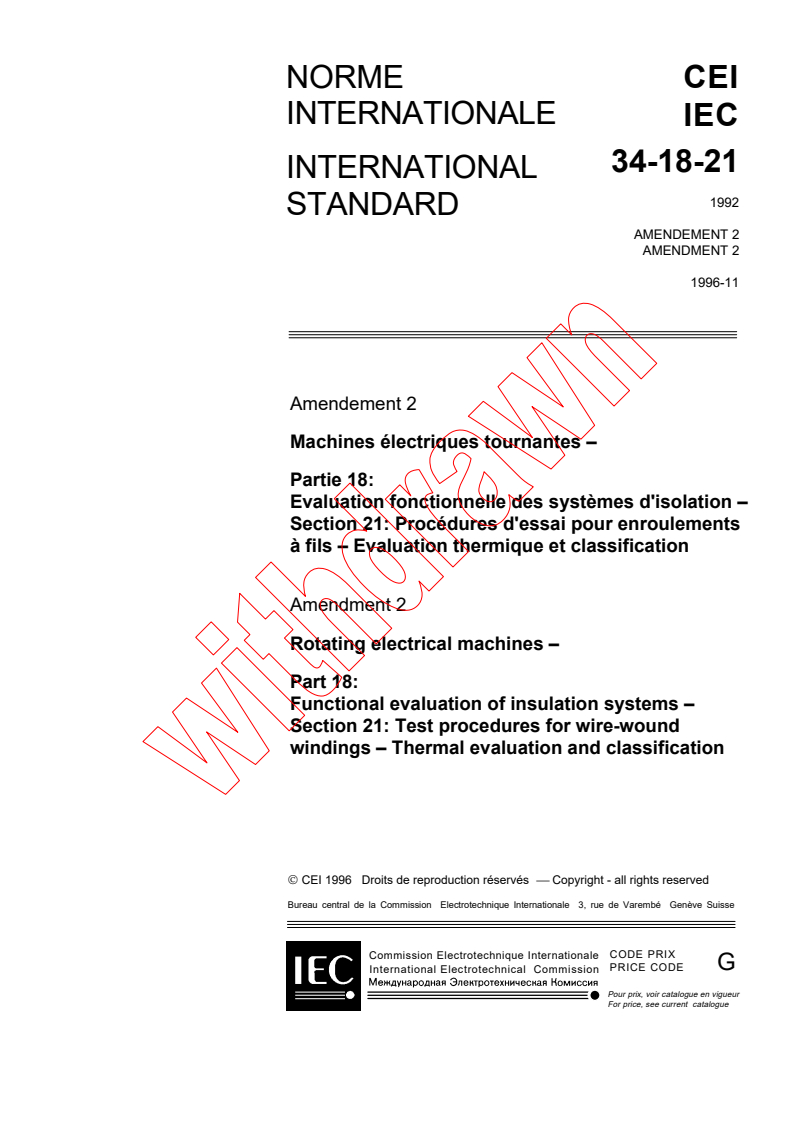
(Amendment)Amendment 2 - Rotating electrical machines - Part 18: Functional evaluation of insulation systems - Section 21: Test procedures for wire-wound windings - Thermal evaluation and classification
General Information
- Abstract
- Status
- Published
- Publication Date
- 27-Nov-1996
- Technical Committee
- TC 2 - Rotating machinery
- Current Stage
- DELPUB - Deleted Publication
- Start Date
- 19-Sep-2012
- Completion Date
- 28-Aug-2026
Buy Documents
IEC 60034-18-21:1992/AMD2:1996 - Amendment 2 - Rotating electrical machines - Part 18: Functional evaluation of insulation systems - Section 21: Test procedures for wire-wound windings - Thermal evaluation and classification Released:11/28/1996
Overview
IEC 60034-18-21:1992/AMD2:1996 is an amendment to the international standard focusing on the functional evaluation of insulation systems for rotating electrical machines, specifically targeting wire-wound windings. This amendment updates the test procedures related to the thermal evaluation and classification of insulation systems, which are critical to the reliability and lifespan of electric motors and generators.
This document, prepared by IEC Technical Committee 2, Subcommittee 2J, refines test methodologies to ensure consistent and accurate evaluation of insulation performance under thermal stress and operating conditions. It serves as a crucial reference for manufacturers, testing laboratories, and engineers in ensuring compliance with international insulation standards.
Key Topics
Test Procedures for Wire-Wound Windings:
Detailed methodologies for conducting thermal ageing and performance tests on wire-wound insulation systems, including the use of "motorette" type assemblies and actual motor tests.Thermal Ageing and Classification:
Guidelines on selecting ageing temperatures and subcycle durations to simulate realistic thermal stresses. Tests consider multiple temperature levels, typically separated by 20 K or more, or 10 K intervals for higher-resolution studies.Construction of Test Specimens:
Instructions on preparing test objects, including model coils, motorettes, and full-sized motor windings, ensuring specimens simulate real-world conditions. Emphasis is placed on consistent construction for interlaboratory comparability.Testing Conditions and Controls:
Protocols for mechanical stress application during thermal cycles, controlled heating methods, and start-stop or reversing operations during the testing cycle to replicate operational mechanical and thermal stresses.Moisture and Voltage Testing:
Procedures for moisture tests ensuring visible condensation on windings and subsequent voltage tests at rated voltages to detect insulation failure. Different moisture application methods are described for small and large motors.Number of Test Samples:
Recommendations for sample sizes, with at least 10 specimens per insulation system per temperature to ensure statistical relevance.Special Considerations:
- Treatment of commutator effects in DC machines and armatures;
- Use of alternative fixtures to isolate winding insulation performance;
- Handling of test object variations to simulate different operating environments.
Applications
This amendment is vital for:
Manufacturers of Rotating Electrical Machines:
To verify and classify insulation systems' thermal endurance and reliability, supporting product development and quality assurance.Testing Laboratories:
For designing and conducting standardized tests on wire-wound motor windings, facilitating reproducible and comparable data that meet international criteria.Engineering and Maintenance Teams:
To understand insulation aging behaviors and failure modes, enabling informed maintenance strategies to extend machine life and optimize operational safety.Product Certification Bodies:
To assess compliance with international insulation performance standards, ensuring that rotating machinery meets stringent safety and durability requirements.
Related Standards
IEC 60034 Series:
Comprehensive standards covering rotating electrical machines, including performance, testing, and insulation systems.IEC 60085:
Classification of electrical insulation - thermal evaluation and designation, which complements the thermal classification criteria outlined in this amendment.IEC 60216:
Electrical insulating materials - thermal endurance properties, providing foundational methods for thermal ageing tests applicable to insulation systems.IEC 60730:
Automatic electrical controls for household and similar use, relevant for motor control and operational conditions affecting insulation.
Practical Value
By adopting the IEC 60034-18-21 Amendment 2:
- Test laboratories can achieve greater consistency and reliability in insulation system evaluations.
- Insulation manufacturers benefit from a clear framework to demonstrate thermal endurance properties.
- Motor designers gain insights into the aging mechanisms and performance limits of winding insulation.
- Product safety and life expectancy are enhanced through rigorous thermal and mechanical stress testing reflective of real operating conditions.
This standard amendment ultimately contributes to improving the safety, performance, and longevity of rotating electrical machines worldwide.
Relations
- Effective Date
- 05-Sep-2023
Buy Documents
IEC 60034-18-21:1992/AMD2:1996 - Amendment 2 - Rotating electrical machines - Part 18: Functional evaluation of insulation systems - Section 21: Test procedures for wire-wound windings - Thermal evaluation and classification Released:11/28/1996
Get Certified
Connect with accredited certification bodies for this standard

IMQ S.p.A. (Certification)
Italian electrical product certification.

SLG Prüf- und Zertifizierungs GmbH
German testing and certification body.

UL Solutions
Global safety science company with testing, inspection and certification.
Sponsored listings
Frequently Asked Questions
IEC 60034-18-21:1992/AMD2:1996 is a standard published by the International Electrotechnical Commission (IEC). Its full title is "Amendment 2 - Rotating electrical machines - Part 18: Functional evaluation of insulation systems - Section 21: Test procedures for wire-wound windings - Thermal evaluation and classification". This standard covers: Amendment 2 - Rotating electrical machines - Part 18: Functional evaluation of insulation systems - Section 21: Test procedures for wire-wound windings - Thermal evaluation and classification
Amendment 2 - Rotating electrical machines - Part 18: Functional evaluation of insulation systems - Section 21: Test procedures for wire-wound windings - Thermal evaluation and classification
IEC 60034-18-21:1992/AMD2:1996 is classified under the following ICS (International Classification for Standards) categories: 29.080.01 - Electrical insulation in general; 29.160.01 - Rotating machinery in general. The ICS classification helps identify the subject area and facilitates finding related standards.
IEC 60034-18-21:1992/AMD2:1996 has the following relationships with other standards: It is inter standard links to IEC 60034-18-21:2012. Understanding these relationships helps ensure you are using the most current and applicable version of the standard.
IEC 60034-18-21:1992/AMD2:1996 is available in PDF format for immediate download after purchase. The document can be added to your cart and obtained through the secure checkout process. Digital delivery ensures instant access to the complete standard document.
Standards Content (Sample)
NORME
CEI
INTERNATIONALE
IEC
34-18-21
INTERNATIONAL
STANDARD
AMENDEMENT 2
AMENDMENT 2
1996-11
Amendement 2
Machines électriques tournantes –
Partie 18:
Evaluation fonctionnelle des systèmes d'isolation –
Section 21: Procédures d'essai pour enroulements
à fils – Evaluation thermique et classification
Amendment 2
Rotating electrical machines –
Part 18:
Functional evaluation of insulation systems –
Section 21: Test procedures for wire-wound
windings – Thermal evaluation and classification
CEI 1996 Droits de reproduction réservés Copyright - all rights reserved
Bureau central de la Commission Electrotechnique Internationale 3, rue de Varembé Genève Suisse
CODE PRIX
Commission Electrotechnique Internationale
G
International Electrotechnical Commission PRICE CODE
Pour prix, voir catalogue en vigueur
For price, see current catalogue
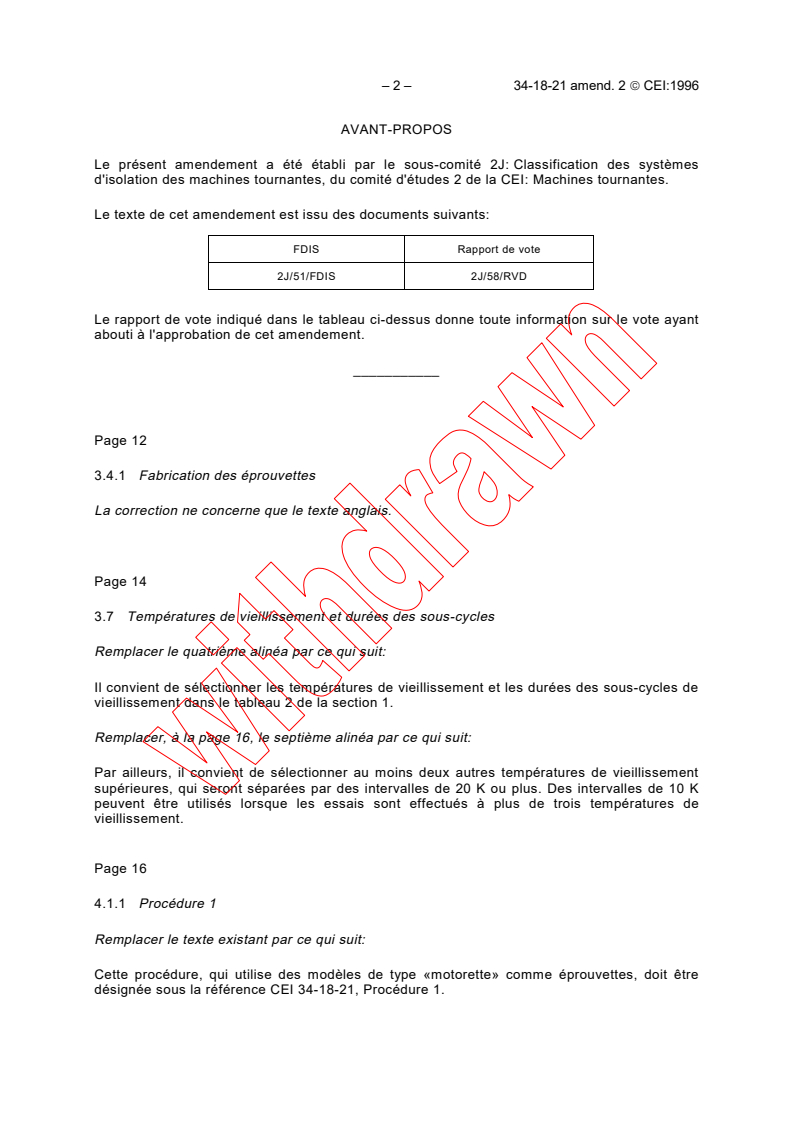
– 2 – 34-18-21 amend. 2 CEI:1996
AVANT-PROPOS
Le présent amendement a été établi par le sous-comité 2J: Classification des systèmes
d'isolation des machines tournantes, du comité d'études 2 de la CEI: Machines tournantes.
Le texte de cet amendement est issu des documents suivants:
FDIS Rapport de vote
2J/51/FDIS 2J/58/RVD
Le rapport de vote indiqué dans le tableau ci-dessus donne toute information sur le vote ayant
abouti à l'approbation de cet amendement.
___________
Page 12
3.4.1 Fabrication des éprouvettes
La correction ne concerne que le texte anglais.
Page 14
Températures de vieillissement et durées des sous-cycles
3.7
Remplacer le quatrième alinéa par ce qui suit:
Il convient de sélectionner les températures de vieillissement et les durées des sous-cycles de
vieillissement dans le tableau 2 de la section 1.
Remplacer, à la page 16, le septième alinéa par ce qui suit:
Par ailleurs, il convient de sélectionner au moins deux autres températures de vieillissement
supérieures, qui seront séparées par des intervalles de 20 K ou plus. Des intervalles de 10 K
peuvent être utilisés lorsque les essais sont effectués à plus de trois températures de
vieillissement.
Page 16
4.1.1 Procédure 1
Remplacer le texte existant par ce qui suit:
Cette procédure, qui utilise des modèles de type «motorette» comme éprouvettes, doit être
désignée sous la référence CEI 34-18-21, Procédure 1.
34-18-21 Amend. 2 IEC:1996 – 3 –
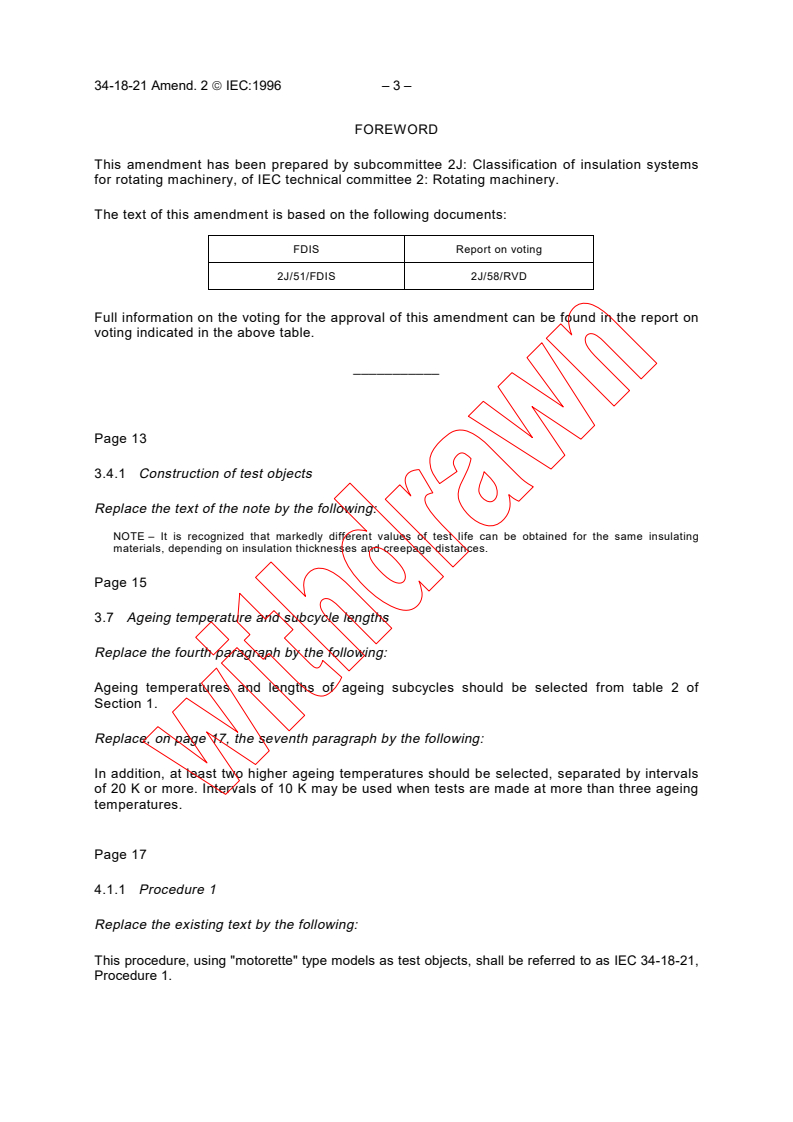
FOREWORD
This amendment has been prepared by subcommittee 2J: Classification of insulation systems
for rotating machinery, of IEC technical committee 2: Rotating machinery.
The text of this amendment is based on the following documents:
FDIS Report on voting
2J/51/FDIS 2J/58/RVD
Full information on the voting for the approval of this amendment can be found in the report on
voting indicated in the above table.
___________
Page 13
3.4.1 Construction of test objects
Replace the text of the note by the following:
NOTE – It is recognized that markedly different values of test life can be obtained for the same insulating
materials, depending on insulation thicknesses and creepage distances.
Page 15
3.7 Ageing temperature and subcycle lengths
Replace the fourth paragraph by the following:
Ageing temperatures and lengths of ageing subcycles should be selected from table 2 of
Section 1.
Replace, on page 17, the seventh paragraph by the following:
In addition, at least two higher ageing temperatures should be selected, separated by intervals
of 20 K or more. Intervals of 10 K may be used when tests are made at more than three ageing
temperatures.
Page 17
4.1.1 Procedure 1
Replace the existing text by the following:
This procedure, using "motorette" type models as test objects, shall be referred to as IEC 34-18-21,
Procedure 1.
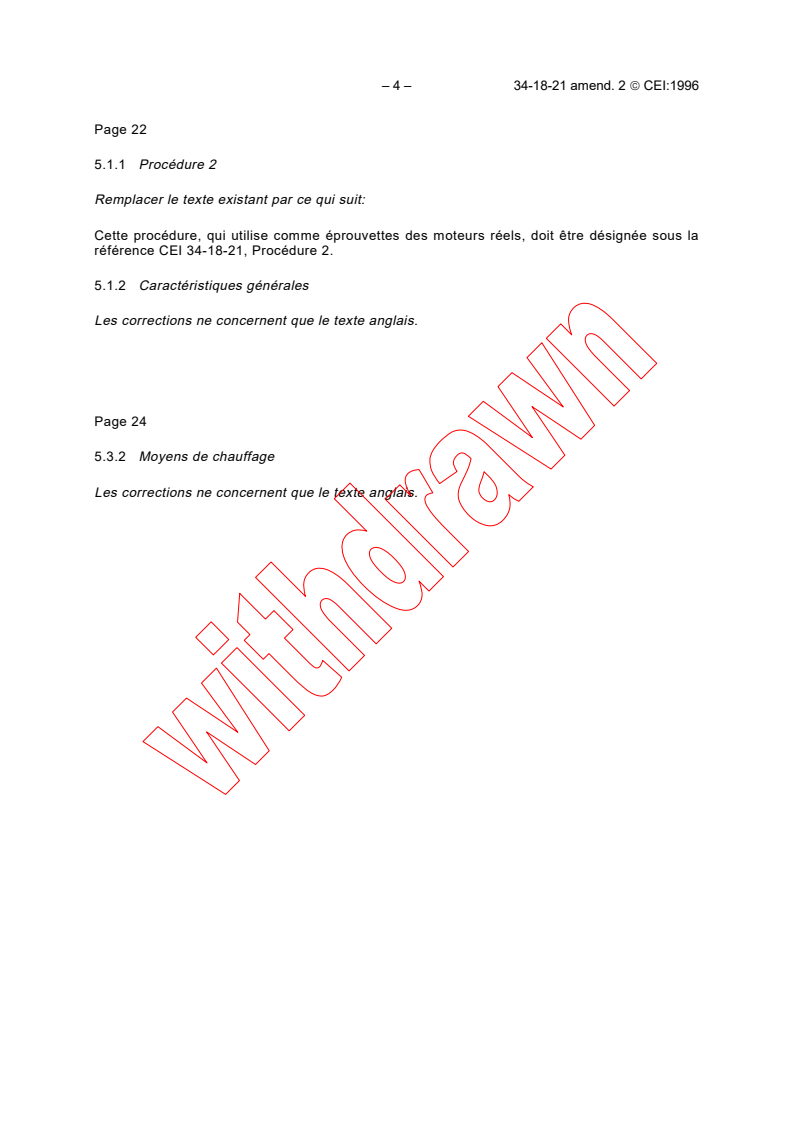
– 4 – 34-18-21 amend. 2 CEI:1996
Page 22
5.1.1 Procédure 2
Remplacer le texte existant par ce qui suit:
Cette procédure, qui utilise comme éprouvettes des moteurs réels, doit être désignée sous la
référence CEI 34-18-21, Procédure 2.
5.1.2 Caractéristiques générales
Les corrections ne concernent que le texte anglais.
Page 24
5.3.2 Moyens de chauffage
Les corrections ne concernent que le texte anglais.
34-18-21 Amend. 2 IEC:1996 – 5 –
Page 23
5.1.1 Procedure 2
Replace the existing text by the following:
This procedure, using actual motors as test objects, shall be referred to as IEC 34-18-21,
Procedure 2.
5.1.2 General features
Replace the fourth paragraph by the following:
Even though actual motors are tested, the results may not be used to determine endurance
time in actual service in an absolute sense. The tests may be used as a means of classification
only by comparing insulation systems.
Page 25
5.3.2 Means of heating
Replace the first paragraph by the following:
The mode of heat generation is dictated by the type of motor being used in the test and the
laboratory equipment available. Higher than normal winding temperatures can be obtained by
increasing motor losses by such means as enlarging the air gap, starting and reversing each
motor, superimposition of direct current on the normal alternating current, or by increasing the
temperature of the air surrounding the motor. For temperature regulation during the heat
ageing portion of the cycle, the motors may be run at normal voltage and frequency with an
electrical control which automatically starts and stops or reverses the direction of rotation of
the motors at intervals. Other acceptable means of temperature control include automatic
voltage variation, adjustment of the surrounding air temperature, or combinations thereof.
Replace the third paragraph by the following:
Single-phase motors shall have at least 250 start-stop operations each day of the heat ageing
portion of the cycle. The starting winding of a single-phase motor normally operates at a much
higher current density than the main winding during starting. During each start it can reach a
temperature of 10 K to 30 K higher than the main winding. In order to ensure that the correct
emphasis is placed on the main winding portion of the insulation system, a reasonable number
of starts should be employed.
Replace, on page 27, the fourth paragraph by the following:
Polyphase motors shall have at least 1000 starts or reversals each day of the heat ageing
portion of the cycle. Often the electrical loss during reversal is used to maintain the elevated
temperatures, in which case the number of reversals may greatly exceed 1000 per day. At the
highest temperature test the total time of exposure is relatively short which results in a
relatively low number of reversals during the life of the test. At the lowest temperature, the time
of exposure can be 16 to 20 times as long as that of the highest level. A wide variation in total
number of starts would affect the slope of the time-temperature curve within a cycle. Thus, it is
recommended that the number of reversals at the low temperature be no greater than twice
those at the high temperature. Ideally, an equal number of reversals at each temperature
should be sought.
– 6 – 34-18-21 amend. 2 CEI:1996
5.3.4 Contraintes mécaniques pendant le sous-cycle de vieillissement thermique
La correction ne concerne que le texte anglais.
5.4.1 Essai d'humidité
La correction au premier alinéa ne concerne que le texte anglais.
Remplacer, à la page 28, le second alinéa par ce qui suit:
Toutefois, les moteurs de grandes dimensions risquent d'être difficiles à déplacer et à placer
dans l'équipement utilisé pour les essais d'humidité, ou il se peut qu'un tel équipement n'existe
pas. Parmi les autres méthodes que l'on peut utiliser pour l'application d'humidité, on notera:
pose d'une enceinte autour du moteur, utilisation d'une chambre d'humidification classique ou
d'une chambre à brouillard.
5.4.2 Essai de tension
La correction ne concerne que le texte anglais.
34-18-21 Amend. 2 IEC:1996 – 7 –
5.3.4 Mechanical stresses during the thermal ageing subcycle
Replace the first paragraph by the following:
Mechanical stress is obtained in tests on actual motors by the normal vibration of the motor
running and with starts or reversals, or both. There is mechanical shock from starting or
reversing. The vibration amplitude at twice the line frequency can be increased by enlarging the
air gap. Larger forces are present in the windings as a result of the high currents during
starting and reversing of the motors. In a test, these mechanical forces occur at elevated
temperatures.
5.4.1 Moisture test
Replace the first paragraph by the following:
A moisture test of at least 48 h shall be used, except that for totally enclosed machines
(degrees of protection IP44 or more) and for d.c. machines a moisture test is not mandatory
because it can be impracticable. Moisture shall be visible on the windings as droplets, without
puddles, during the moisture test. To ensure visible condensation, the insulation system should
be at a lower temperature than the dew point of the surrounding moisture-laden atmosphere at
all times. The preferred method of meeting this requirement is by the use of a condensation
test chamber with cooled test objects described in clause C.2 of annex C.
Replace, on page 29, the second paragraph by the following:
However, larger motors can be difficult to move and difficult to support in equipment for
moisture test, or such equipment is not available. Other methods of applying moisture include:
placing an enclosing hood around the motor, or using a conventional humidity cabinet or a fog
chamber.
5.4.2 Voltage test
Replace the second paragraph by the following:
The motors should be started and run immediately after the moisture test while the windings
are still wet. For machines that have to be reassembled prior to running, a power-frequency
high potential test should be applied at the highest rated voltage from windings to frame for 10
min while wet before assembly. During at least part of the thermal ageing subcycle the motors
are to be run at their highest rated nameplate voltage. A power source earthed through a
current limiting impedance should be used and the motor frame should be earthed so that
voltage stresses are present during the entire thermal ageing portion of the cycle. A detection
circuit for current to frame should be used to detect when insulation to the frame has failed.
The end point of the motor
...