

IEC 62052-31:2024
(Main)Electricity metering equipment - General requirements, tests and test conditions - Part 31: Product safety requirements and tests
General Information
- Abstract
IEC 62052-31:2024 specifies general safety requirements and associated tests, with their appropriate conditions for type testing of directly connected, transformer-operated or transducer-operated AC and DC electricity meters and load control equipment. This document applies to electricity metering equipment designed to:
• measure and control electrical energy on electrical networks (mains) with voltage up to 1 000 V AC, or 1 500 V DC;
• have all functional elements, including add-on communication modules, enclosed in, or forming a single meter case with exception of indicating displays;
• operate with integrated displays (electromechanical or static meters);
• operate with detached indicating displays, or without an indicating display (static meters only);
• wall-mounted or to be installed in specified matching sockets or racks;
• optionally, provide additional functions other than those for measurement of electrical energy.
This document also applies to transducer-operated meters or meters designed for operation with Low Power Instrument Transformers (LPIT) or sensors (as defined in the IEC 61869 series).
When equipment in scope of this document is designed to be installed in a specified matching socket, then the requirements apply to, and the tests are performed on, equipment installed in its specified matching socket. However, requirements for sockets and inserting / removing the meters from the socket are outside the scope of this document.
This document is also applicable to auxiliary input and output circuits, operation indicators, and test outputs of equipment for electrical energy measurement.
Equipment used in conjunction with equipment for electrical energy measurement and control may need to comply with additional safety requirements. See also Clause 13.
This document does not apply to:
• meters rated to operate with voltage exceeding 1 000 V AC, or 1 500 V DC;
• metering systems comprising multiple devices physically remote from one another;
• portable meters;
• meters used in rolling stock, vehicles, ships and airplanes;
• laboratory and mobile meter test equipment;
• reference standard meters;
• conventional or low power instrument transformers;
• equipment with solid-state or other non-electromechanical supply and load control switches.
The safety requirements of this document are based on the following assumptions:
• metering equipment has been installed correctly;
• metering equipment is used generally by ordinary persons, including meter readers and consumers of electrical energy. In many cases, it is installed in a way that it is freely accessible. Its terminal covers cannot be removed, and its case cannot be opened without removing seals (if present) and using a tool;
• during normal use all terminal covers, covers and barriers providing protection against accessing hazardous live parts are in place;
• for installation, configuration, maintenance and repair it may be necessary to remove terminal cover(s), (a part of) the case or barriers so that hazardous live parts may become accessible. Such activities are performed by skilled persons, who have been suitably trained to be aware of working procedures necessary to ensure safety. Therefore, safety requirements covering these conditions are out of the Scope of this document.
This second edition cancels and replaces the first edition published in 2015. This edition constitutes a technical revision. Please see the foreword of IEC 62052-31 for more details
- Status
- Published
- Publication Date
- 24-Oct-2024
- Technical Committee
- TC 13 - Electrical energy measurement and control
- Drafting Committee
- WG 11 - TC 13/WG 11
- Current Stage
- PPUB - Publication issued
- Start Date
- 25-Oct-2024
- Completion Date
- 19-Jul-2024
Overview
IEC 62052-31:2024 is an international standard developed by the International Electrotechnical Commission (IEC). This standard specifies the general safety requirements, tests, and test conditions for type testing of electricity metering equipment. It applies to a wide range of devices, including directly connected, transformer-operated, and transducer-operated AC and DC electricity meters, as well as load control equipment. Designed to ensure product safety, IEC 62052-31 covers equipment used to measure and control electrical energy on networks with voltages up to 1,000 V AC or 1,500 V DC.
Compliance with IEC 62052-31 is key for manufacturers, utilities, and testing laboratories seeking to assure the safety, reliability, and proper installation of their metering devices in residential, commercial, and industrial environments.
Key Topics
Scope of Application
IEC 62052-31 applies to metering equipment designed to:- Measure and control electrical energy on low- and medium-voltage networks (up to 1,000 V AC or 1,500 V DC)
- Use integrated or detached displays
- Be wall-mounted or installed in specified sockets and racks
- Optionally include functionalities beyond energy measurement
Safety Requirements
The standard addresses:- General product safety for typical installation and operation
- Protective measures against electrical shock, mechanical hazards, fire, dust, water ingress, and other risks
- Installation assumptions, such as accessibility and the use of seals or tools for opening equipment
Testing and Verification
IEC 62052-31 defines type tests and test conditions, including:- Electrical, mechanical, environmental, and marking tests
- Test conditions for normal, extended, and extreme environments
- Requirements for dielectric testing, overcurrent protection, and insulation
Covered and Excluded Equipment
Included:- Directly connected and transformer-operated meters
- Transducer-operated meters and those compatible with Low Power Instrument Transformers (LPITs)
- Products with add-on communication modules, integrated displays, and load control functions
Excluded:
- Meters for voltages above 1,000 V AC or 1,500 V DC
- Portable, laboratory, or mobile test equipment
- Meters for rolling stock, vehicles, or marine/aviation use
- Reference standard meters and conventional instrument transformers
Applications
IEC 62052-31:2024 is essential for:
- Electricity Meter Manufacturers
Ensuring compliance with safety requirements during product development and type testing of AC and DC meters, including smart meters and advanced metering infrastructures. - Utilities and Grid Operators
Specifying standards for procurement of reliable and safe metering equipment for widespread field installation. - Testing and Certification Laboratories
Using standardized test methods and criteria when evaluating new meter designs or modifications for regulatory or market acceptance. - System Integrators and Installers
Confirming that only compliant and properly tested equipment is installed in substations, buildings, and industrial facilities.
Related Standards
- IEC 62052-11 - General requirements for electricity metering equipment
- IEC 62053 Series - Accuracy classes and performance tests for electricity meters
- IEC 61869 Series - Instrument transformers including Low Power Instrument Transformers (LPITs)
- IEC 61010-1 - General safety requirements for measuring, control, and laboratory equipment
- IEC 60529 - Ingress protection ratings (dust and water)
- IEC 60364 - Electrical installations of buildings (for reference to installation practices)
Summary
Adherence to IEC 62052-31:2024 ensures the safety and reliability of electricity metering equipment worldwide. By following the outlined requirements and test procedures, stakeholders can reduce electrical and mechanical hazards, maintain operational safety, and guarantee regulatory compliance in diverse installations. For manufacturers, utilities, and testing bodies, this standard is vital to delivering safe and high-quality metering solutions for modern energy networks.
Relations
- Effective Date
- 05-Sep-2023
- Effective Date
- 05-Sep-2023
Get Certified
Connect with accredited certification bodies for this standard

DIBt (Deutsches Institut für Bautechnik)
German Institute for Building Technology.
DIN CERTCO
DIN Group product certification.

Aboma Certification B.V.
Specialized in construction, metal, and transport sectors.
Sponsored listings
Frequently Asked Questions
IEC 62052-31:2024 is a standard published by the International Electrotechnical Commission (IEC). Its full title is "Electricity metering equipment - General requirements, tests and test conditions - Part 31: Product safety requirements and tests". This standard covers: IEC 62052-31:2024 specifies general safety requirements and associated tests, with their appropriate conditions for type testing of directly connected, transformer-operated or transducer-operated AC and DC electricity meters and load control equipment. This document applies to electricity metering equipment designed to: • measure and control electrical energy on electrical networks (mains) with voltage up to 1 000 V AC, or 1 500 V DC; • have all functional elements, including add-on communication modules, enclosed in, or forming a single meter case with exception of indicating displays; • operate with integrated displays (electromechanical or static meters); • operate with detached indicating displays, or without an indicating display (static meters only); • wall-mounted or to be installed in specified matching sockets or racks; • optionally, provide additional functions other than those for measurement of electrical energy. This document also applies to transducer-operated meters or meters designed for operation with Low Power Instrument Transformers (LPIT) or sensors (as defined in the IEC 61869 series). When equipment in scope of this document is designed to be installed in a specified matching socket, then the requirements apply to, and the tests are performed on, equipment installed in its specified matching socket. However, requirements for sockets and inserting / removing the meters from the socket are outside the scope of this document. This document is also applicable to auxiliary input and output circuits, operation indicators, and test outputs of equipment for electrical energy measurement. Equipment used in conjunction with equipment for electrical energy measurement and control may need to comply with additional safety requirements. See also Clause 13. This document does not apply to: • meters rated to operate with voltage exceeding 1 000 V AC, or 1 500 V DC; • metering systems comprising multiple devices physically remote from one another; • portable meters; • meters used in rolling stock, vehicles, ships and airplanes; • laboratory and mobile meter test equipment; • reference standard meters; • conventional or low power instrument transformers; • equipment with solid-state or other non-electromechanical supply and load control switches. The safety requirements of this document are based on the following assumptions: • metering equipment has been installed correctly; • metering equipment is used generally by ordinary persons, including meter readers and consumers of electrical energy. In many cases, it is installed in a way that it is freely accessible. Its terminal covers cannot be removed, and its case cannot be opened without removing seals (if present) and using a tool; • during normal use all terminal covers, covers and barriers providing protection against accessing hazardous live parts are in place; • for installation, configuration, maintenance and repair it may be necessary to remove terminal cover(s), (a part of) the case or barriers so that hazardous live parts may become accessible. Such activities are performed by skilled persons, who have been suitably trained to be aware of working procedures necessary to ensure safety. Therefore, safety requirements covering these conditions are out of the Scope of this document. This second edition cancels and replaces the first edition published in 2015. This edition constitutes a technical revision. Please see the foreword of IEC 62052-31 for more details
IEC 62052-31:2024 specifies general safety requirements and associated tests, with their appropriate conditions for type testing of directly connected, transformer-operated or transducer-operated AC and DC electricity meters and load control equipment. This document applies to electricity metering equipment designed to: • measure and control electrical energy on electrical networks (mains) with voltage up to 1 000 V AC, or 1 500 V DC; • have all functional elements, including add-on communication modules, enclosed in, or forming a single meter case with exception of indicating displays; • operate with integrated displays (electromechanical or static meters); • operate with detached indicating displays, or without an indicating display (static meters only); • wall-mounted or to be installed in specified matching sockets or racks; • optionally, provide additional functions other than those for measurement of electrical energy. This document also applies to transducer-operated meters or meters designed for operation with Low Power Instrument Transformers (LPIT) or sensors (as defined in the IEC 61869 series). When equipment in scope of this document is designed to be installed in a specified matching socket, then the requirements apply to, and the tests are performed on, equipment installed in its specified matching socket. However, requirements for sockets and inserting / removing the meters from the socket are outside the scope of this document. This document is also applicable to auxiliary input and output circuits, operation indicators, and test outputs of equipment for electrical energy measurement. Equipment used in conjunction with equipment for electrical energy measurement and control may need to comply with additional safety requirements. See also Clause 13. This document does not apply to: • meters rated to operate with voltage exceeding 1 000 V AC, or 1 500 V DC; • metering systems comprising multiple devices physically remote from one another; • portable meters; • meters used in rolling stock, vehicles, ships and airplanes; • laboratory and mobile meter test equipment; • reference standard meters; • conventional or low power instrument transformers; • equipment with solid-state or other non-electromechanical supply and load control switches. The safety requirements of this document are based on the following assumptions: • metering equipment has been installed correctly; • metering equipment is used generally by ordinary persons, including meter readers and consumers of electrical energy. In many cases, it is installed in a way that it is freely accessible. Its terminal covers cannot be removed, and its case cannot be opened without removing seals (if present) and using a tool; • during normal use all terminal covers, covers and barriers providing protection against accessing hazardous live parts are in place; • for installation, configuration, maintenance and repair it may be necessary to remove terminal cover(s), (a part of) the case or barriers so that hazardous live parts may become accessible. Such activities are performed by skilled persons, who have been suitably trained to be aware of working procedures necessary to ensure safety. Therefore, safety requirements covering these conditions are out of the Scope of this document. This second edition cancels and replaces the first edition published in 2015. This edition constitutes a technical revision. Please see the foreword of IEC 62052-31 for more details
IEC 62052-31:2024 is classified under the following ICS (International Classification for Standards) categories: 19.080 - Electrical and electronic testing; 91.140.50 - Electricity supply systems. The ICS classification helps identify the subject area and facilitates finding related standards.
IEC 62052-31:2024 has the following relationships with other standards: It is inter standard links to IEC 62052-31:2015/ISH1:2019, IEC 62052-31:2015. Understanding these relationships helps ensure you are using the most current and applicable version of the standard.
IEC 62052-31:2024 is available in PDF format for immediate download after purchase. The document can be added to your cart and obtained through the secure checkout process. Digital delivery ensures instant access to the complete standard document.
Standards Content (Sample)
IEC 62052-31 ®
Edition 2.0 2024-10
INTERNATIONAL
STANDARD
NORME
INTERNATIONALE
colour
inside
Electricity metering equipment – General requirements, tests and test
conditions –
Part 31: Product safety requirements and tests
Équipement de comptage de l'électricité – Exigences générales, essais et
conditions d'essai –
Partie 31: Exigences et essais sur la sécurité de produit
All rights reserved. Unless otherwise specified, no part of this publication may be reproduced or utilized in any form
or by any means, electronic or mechanical, including photocopying and microfilm, without permission in writing from
either IEC or IEC's member National Committee in the country of the requester. If you have any questions about IEC
copyright or have an enquiry about obtaining additional rights to this publication, please contact the address below or
your local IEC member National Committee for further information.
Droits de reproduction réservés. Sauf indication contraire, aucune partie de cette publication ne peut être reproduite ni
utilisée sous quelque forme que ce soit et par aucun procédé, électronique ou mécanique, y compris la photocopie et
les microfilms, sans l'accord écrit de l'IEC ou du Comité national de l'IEC du pays du demandeur. Si vous avez des
questions sur le copyright de l'IEC ou si vous désirez obtenir des droits supplémentaires sur cette publication, utilisez
les coordonnées ci-après ou contactez le Comité national de l'IEC de votre pays de résidence.
IEC Secretariat Tel.: +41 22 919 02 11
3, rue de Varembé info@iec.ch
CH-1211 Geneva 20 www.iec.ch
Switzerland
About the IEC
The International Electrotechnical Commission (IEC) is the leading global organization that prepares and publishes
International Standards for all electrical, electronic and related technologies.
About IEC publications
The technical content of IEC publications is kept under constant review by the IEC. Please make sure that you have the
latest edition, a corrigendum or an amendment might have been published.
IEC publications search - webstore.iec.ch/advsearchform IEC Products & Services Portal - products.iec.ch
The advanced search enables to find IEC publications by a Discover our powerful search engine and read freely all the
variety of criteria (reference number, text, technical publications previews, graphical symbols and the glossary.
committee, …). It also gives information on projects, replaced With a subscription you will always have access to up to date
and withdrawn publications. content tailored to your needs.
IEC Just Published - webstore.iec.ch/justpublished
Electropedia - www.electropedia.org
Stay up to date on all new IEC publications. Just Published
The world's leading online dictionary on electrotechnology,
details all new publications released. Available online and once
containing more than 22 500 terminological entries in English
a month by email.
and French, with equivalent terms in 25 additional languages.
Also known as the International Electrotechnical Vocabulary
IEC Customer Service Centre - webstore.iec.ch/csc
(IEV) online.
If you wish to give us your feedback on this publication or need
further assistance, please contact the Customer Service
Centre: sales@iec.ch.
A propos de l'IEC
La Commission Electrotechnique Internationale (IEC) est la première organisation mondiale qui élabore et publie des
Normes internationales pour tout ce qui a trait à l'électricité, à l'électronique et aux technologies apparentées.
A propos des publications IEC
Le contenu technique des publications IEC est constamment revu. Veuillez vous assurer que vous possédez l’édition la
plus récente, un corrigendum ou amendement peut avoir été publié.
Recherche de publications IEC - IEC Products & Services Portal - products.iec.ch
webstore.iec.ch/advsearchform Découvrez notre puissant moteur de recherche et consultez
La recherche avancée permet de trouver des publications IEC gratuitement tous les aperçus des publications, symboles
en utilisant différents critères (numéro de référence, texte, graphiques et le glossaire. Avec un abonnement, vous aurez
comité d’études, …). Elle donne aussi des informations sur les toujours accès à un contenu à jour adapté à vos besoins.
projets et les publications remplacées ou retirées.
Electropedia - www.electropedia.org
IEC Just Published - webstore.iec.ch/justpublished
Le premier dictionnaire d'électrotechnologie en ligne au monde,
Restez informé sur les nouvelles publications IEC. Just
avec plus de 22 500 articles terminologiques en anglais et en
Published détaille les nouvelles publications parues.
français, ainsi que les termes équivalents dans 25 langues
Disponible en ligne et une fois par mois par email.
additionnelles. Egalement appelé Vocabulaire
Electrotechnique International (IEV) en ligne.
Service Clients - webstore.iec.ch/csc
Si vous désirez nous donner des commentaires sur cette
publication ou si vous avez des questions contactez-nous:
sales@iec.ch.
IEC 62052-31 ®
Edition 2.0 2024-10
INTERNATIONAL
STANDARD
NORME
INTERNATIONALE
colour
inside
Electricity metering equipment – General requirements, tests and test
conditions –
Part 31: Product safety requirements and tests
Équipement de comptage de l'électricité – Exigences générales, essais et
conditions d'essai –
Partie 31: Exigences et essais sur la sécurité de produit
INTERNATIONAL
ELECTROTECHNICAL
COMMISSION
COMMISSION
ELECTROTECHNIQUE
INTERNATIONALE
ICS 19.080, 91.140.50 ISBN 978-2-8322-9302-7
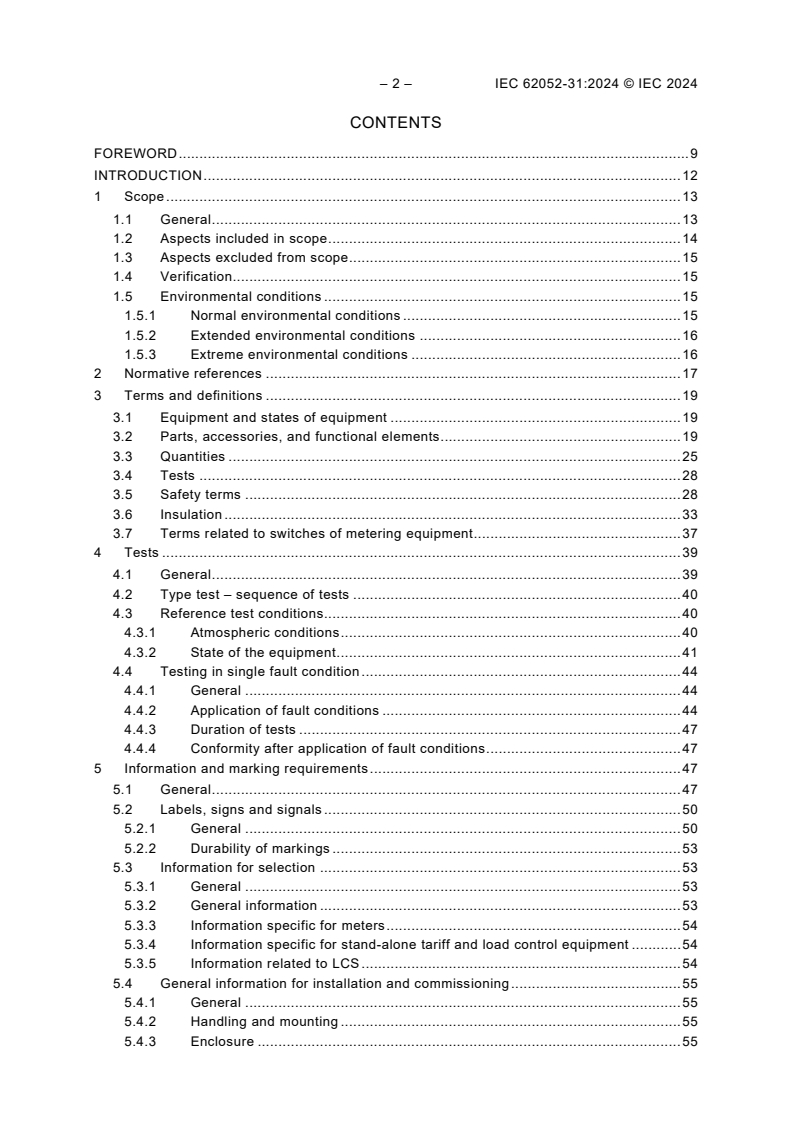
– 2 – IEC 62052-31:2024 © IEC 2024
CONTENTS
FOREWORD . 9
INTRODUCTION . 12
1 Scope . 13
1.1 General . 13
1.2 Aspects included in scope . 14
1.3 Aspects excluded from scope . 15
1.4 Verification. 15
1.5 Environmental conditions . 15
1.5.1 Normal environmental conditions . 15
1.5.2 Extended environmental conditions . 16
1.5.3 Extreme environmental conditions . 16
2 Normative references . 17
3 Terms and definitions . 19
3.1 Equipment and states of equipment . 19
3.2 Parts, accessories, and functional elements . 19
3.3 Quantities . 25
3.4 Tests . 28
3.5 Safety terms . 28
3.6 Insulation . 33
3.7 Terms related to switches of metering equipment . 37
4 Tests . 39
4.1 General . 39
4.2 Type test – sequence of tests . 40
4.3 Reference test conditions. 40
4.3.1 Atmospheric conditions . 40
4.3.2 State of the equipment . 41
4.4 Testing in single fault condition . 44
4.4.1 General . 44
4.4.2 Application of fault conditions . 44
4.4.3 Duration of tests . 47
4.4.4 Conformity after application of fault conditions . 47
5 Information and marking requirements . 47
5.1 General . 47
5.2 Labels, signs and signals . 50
5.2.1 General . 50
5.2.2 Durability of markings . 53
5.3 Information for selection . 53
5.3.1 General . 53
5.3.2 General information . 53
5.3.3 Information specific for meters . 54
5.3.4 Information specific for stand-alone tariff and load control equipment . 54
5.3.5 Information related to LCS . 54
5.4 General information for installation and commissioning . 55
5.4.1 General . 55
5.4.2 Handling and mounting . 55
5.4.3 Enclosure . 55
5.4.4 Connections . 56
5.4.5 Auxiliary power supply . 58
5.4.6 Supply for external devices . 58
5.4.7 Self-consumption . 59
5.4.8 Commissioning . 59
5.5 General information for use . 59
5.5.1 General . 59
5.5.2 Display, push buttons and other controls . 59
5.5.3 Switches . 60
5.5.4 Connection to user's equipment . 60
5.6 General information for maintenance . 60
5.6.1 Maintenance instructions . 60
5.6.2 Cleaning . 60
5.6.3 Batteries . 60
6 Protection against electrical shock . 61
6.1 General requirements . 61
6.2 Determination of accessible parts . 62
6.2.1 General . 62
6.2.2 Examination . 62
6.2.3 Openings above parts that are hazardous live . 63
6.2.4 Openings for pre-set controls . 63
6.2.5 Wiring terminals . 63
6.3 Limit values for accessible parts . 64
6.3.1 General . 64
6.3.2 Levels in normal condition . 64
6.3.3 Levels in single fault condition . 65
6.4 Primary means of protection (protection against direct contact) . 67
6.4.1 General . 67
6.4.2 Equipment case . 68
6.4.3 Basic insulation . 68
6.4.4 Impedance . 68
6.5 Additional means of protection in case of single fault conditions (protection
against indirect contact) . 68
6.5.1 General . 68
6.5.2 Protective bonding . 69
6.5.3 Supplementary insulation and reinforced insulation . 72
6.5.4 Protective impedance . 73
6.5.5 Automatic disconnection of the supply . 73
6.5.6 Current- or voltage-limiting device . 73
6.6 Connection to external circuits . 74
6.6.1 General . 74
6.6.2 Terminals for external circuits . 74
6.6.3 Terminals for stranded conductors . 74
6.7 Insulation requirements . 75
6.7.1 General – electric stresses, overvoltages and working voltages . 75
6.7.2 The nature of insulation . 78
6.7.3 Insulation requirements for mains circuits . 81
6.7.4 Insulation requirements for non-mains circuits . 90
– 4 – IEC 62052-31:2024 © IEC 2024
6.7.5 Insulation in circuits with special voltage values not addressed in 6.7.3
or 6.7.4 . 97
6.7.6 Reduction of transient overvoltages by the use of overvoltage limiting
devices . 104
6.7.7 Insulation requirements between circuits and parts . 104
6.8 Constructional requirements for protection against electric shock . 108
6.8.1 General . 108
6.8.2 Insulating materials . 108
6.8.3 Color coding . 108
6.8.4 Equipment case . 108
6.8.5 Terminal blocks . 109
6.8.6 Insulating materials of SCS and LCS . 109
6.8.7 Terminals . 110
6.8.8 Requirements for current circuits . 112
6.9 Safety related electrical tests . 119
6.9.1 Overview . 119
6.9.2 Test conditions . 121
6.9.3 Dielectric test methods . 123
6.9.4 Dielectric testing on complete equipment . 126
6.9.5 Dielectric tests on sub-assemblies . 132
6.9.6 Electrical tests on current circuits of directly connected meters without
SCS . 137
6.9.7 Electrical tests on current circuits of directly connected meters with
SCS . 137
6.9.8 Electrical tests on LCS . 144
6.9.9 Cemented joints test . 147
6.9.10 Thermal cycling . 148
7 Protection against mechanical hazards . 148
7.1 General . 148
7.2 Sharp edges . 148
7.3 Provisions for lifting and carrying . 149
7.4 Wall mounting . 149
8 Resistance to mechanical stresses . 150
8.1 General . 150
8.2 Spring hammer test . 150
9 Protection against spread of fire . 150
9.1 General . 150
9.2 Eliminating or reducing the sources of ignition within the equipment . 151
9.3 Containment of fire within the equipment, should it occur . 151
9.3.1 General . 151
9.3.2 Construction requirements . 152
9.4 Limited-energy circuit . 153
9.5 Overcurrent protection . 154
10 Equipment temperature limits and resistance to heat . 154
10.1 Surface temperature limits for protection against burns . 154
10.2 Temperature limits for terminals . 155
10.3 Temperatures of internal parts . 156
10.4 Temperature test . 158
10.5 Resistance to heat . 159
10.5.1 Non-metallic enclosures . 159
10.5.2 Insulating materials . 160
11 Protection against penetration of dust and water . 160
11.1 General . 160
11.2 Test for protection against ingress of dust and foreign objects . 161
11.3 Test for protection against ingress of water . 161
12 Protection against liberated gases and substances explosion and implosion . 162
12.1 Batteries and battery charging . 162
12.1.1 Mounting of batteries . 162
12.1.2 Battery circuits . 162
12.1.3 Tests related to batteries and charging circuits . 163
13 Components and sub-assemblies . 164
13.1 General . 164
13.2 Mains transformers tested outside equipment . 165
13.3 Printed wiring boards . 165
13.4 Components bridging insulation . 166
13.5 Surge protective devices (SPDs, transient overvoltage limiting circuits) . 166
13.5.1 General use of SPDs . 166
13.5.2 SPD overheating test . 167
13.6 Capacitors . 167
14 Hazards resulting from application – Reasonably foreseeable misuse . 168
15 Risk assessment . 168
Annex A (normative) Measuring circuits for touch current . 169
A.1 Measuring circuit for AC with frequencies up to 1 MHz and for DC . 169
A.2 Measuring circuits for sinusoidal AC with frequencies up to 100 Hz and for
DC . 170
A.3 Current measuring circuit for electrical burns at high frequencies . 170
A.4 Current measuring circuit for wet location . 171
Annex B (informative) Examples for insulation between parts . 173
B.1 General . 173
B.2 Example of a meter protected by reinforced insulation . 173
B.3 Example of a meter protected by double insulation . 175
Annex C (informative) Examples for directly connected meters equipped with SCS and
LCS . 177
Annex D (normative) Test circuit diagram for the test of long-term overvoltage
withstand . 179
Annex E (normative) Test circuit diagram for short current test on the current circuit of
directly connected meters . 180
Annex F (informative) Examples of voltage tests . 182
F.1 General . 182
F.2 Example of a directly connected meter with SCS . 182
F.3 Example of a transformer operated meter with auxiliary power supply . 186
F.4 Example of an LPCT-operated meter with direct voltage connections . 191
Annex G (normative) Additional AC voltage tests for electromechanical meters . 196
Annex H (normative) Test equipment for cable flexion and pull test . 197
Annex I (normative) Routine tests . 199
I.1 General . 199
I.2 Protective earth . 199
– 6 – IEC 62052-31:2024 © IEC 2024
I.3 High-voltage test for mains circuits . 199
I.4 Mains circuits with voltage-limiting devices . 200
Annex J (informative) Examples of battery protection . 201
Annex K (informative) Transient overvoltage requirements in TC 13 standards . 202
Annex L (informative) Electricity meters in LVDC systems . 203
Annex M (informative) Component standards . 205
Bibliography . 206
Figure 1 – Measurements through openings in enclosures . 63
Figure 2 – Capacitance level versus voltage in normal condition and single fault
condition (see 6.3.2c) and 6.3.3c)) . 66
Figure 3 – Maximum duration of short-term accessible voltages in single fault
condition (see 6.3.3a)) . 67
Figure 4 – Acceptable arrangements of protection means against electric shock . 69
Figure 5 – Examples of binding screw assemblies . 71
Figure 6 – Distance between conductors on an interface between two layers . 88
Figure 7 – Distance between adjacent conductors along an interface of an inner layer . 88
Figure 8 – Distance between adjacent conductors located between the same two
layers. 90
Figure 9 – Example of recurring peak voltage . 102
Figure 10 – Flowchart of safety related electrical tests – part 1 . 120
Figure 11 – Flowchart of safety related electrical tests – part 2 . 121
Figure 12 – Flowchart to explain the requirements for protection against the spread of fire . 151
Figure 13 – Flowchart for conformity options 13.1 a), b), c) and d) . 165
Figure A.1 – Measuring circuit for AC with frequencies up to 1 MHz and for DC . 169
Figure A.2 – Measuring circuits for sinusoidal AC with frequencies up to 100 Hz and for
DC . 170
Figure A.3 – Current measuring circuit for electrical burns . 171
Figure A.4 – Current measuring circuit for wet location . 172
Figure B.1 – Insulation between parts – example of a meter protected by reinforced
insulation . 174
Figure B.2 – Insulation between parts – example of a meter protected by double
insulation . 175
Figure C.1 – Single phase two wire meter with UC2 SCS and 25A LCS . 177
Figure C.2 – Three phase four wire meter with UC2 SCS and 2A ACS . 178
Figure D.1 – Circuit for three-phase four-wire meters to simulate long term
overvoltage, voltage moved to L3. 179
Figure D.2 – Voltages at the meter under test . 179
Figure E.1 – Test circuit for verification of short-time withstand current test on current
circuits with and without SCS (meter example is with SCS) . 180
Figure E.2 – Example of short-circuit carrying test record in the case of a single-pole
equipment on single-phase AC . 181
Figure F.1 – Example terminal arrangement of a directly connected meter with SCS . 182
Figure F.2 – Example terminal arrangement of a transformer operated meter with
auxiliary power supply . 186
Figure F.3 – Example terminal arrangement of a LPCT-operated meter with direct
voltage connections . 191
Figure H.1 – Test equipment for cable flexion and pull test (see 6.8.7.3) . 197
Figure J.1 – Non-rechargeable battery protection . 201
Figure J.2 – Rechargeable battery protection . 201
Figure L.1 – Unipolar, balanced and bipolar DC systems . 203
Table 1 – Test copper conductors for current and switch terminals . 43
Table 2 – Information requirements . 48
Table 3 – IEC 60417-DB-12M and ISO 7000:2019 symbols that may be used on
metering equipment . 52
Table 4 – Tightening torque for binding screw assemblies . 72
Table 5 – Multiplication factors for clearance for altitudes up to 5 000 m . 78
Table 6 – Overview of clauses specifying requirements for insulations . 81
Table 7 – Nominal / rated voltages and rated impulse voltages . 82
Table 8 – Clearances for mains circuits . 84
Table 9 – Creepage distances for mains circuits . 85
Table 10 – Test voltages for solid insulation in mains circuits . 86
Table 11 – Test voltages for testing long-term stress of solid insulation in mains circuits . 87
Table 12 – Minimum values for distance or thickness of solid insulation in mains circuits . 89
Table 13 – Clearances and test voltages for non-mains circuits derived from mains
circuits of overvoltage category III . 92
Table 14 – Creepage distances for non-mains circuits and functional insulation . 94
Table 15 – Minimum values for distance or thickness (see 6.7.4.4.2 to 6.7.4.4.4) . 96
Table 16 – Clearance values for the calculation of 6.7.5.2 . 99
Table 17 – Test voltages based on clearances . 100
Table 18 – Clearances for basic insulation in circuits having recurring peak voltages . 103
Table 19 – Isolation classes for non-mains circuits . 105
Table 20 – Insulation requirements between circuits . 106
Table 21 – Summary of requirements for current circuits of directly connected meters
without SCS . 115
Table 22 – Summary of requirements for current circuits of directly connected meters
with SCS . 116
Table 23 – Summary of requirements for LCS . 118
Table 24 – Correction factors according to test site altitude for test voltages for
clearances . 122
Table 25 – AC voltage test . 130
Table 26 – DC voltage test . 131
Table 27 – Voltage tests for verification of clearance in mains circuits . 133
Table 28 – Voltage tests for verification of clearance in non-mains circuits . 133
DC test voltages equal to the AC test voltages from Table 13 . 133
Table 29 – Voltage tests for verification of clearance in circuits with special voltage
values . 134
Table 30 – Voltage tests for verification of solid insulation in mains circuits . 135
Table 31 – Voltage tests for verification of solid insulation in non-mains circuits . 136
Table 32 – Voltage tests for verification of solid insulation in circuits with special
voltage values . 136
– 8 – IEC 62052-31:2024 © IEC 2024
Table 33 – Test sequence and sample plan for SCS . 138
Table 34 – Power factor ranges of the test circuit . 141
Table 35 – Test sequence and sample plan for LCS . 144
Table 36 – Limits for power sources without an overcurrent protective device . 153
Table 37 – Limits for power sources with an overcurrent protection device . 154
Table 38 – Surface temperature limits in normal condition . 155
Table 39 – Temperature limits for terminals . 156
Table 40 – Maximum measured temperatures for internal materials and components . 157
Table F.1 – Application of impulse test voltages according to 6.9.4.4 . 183
Table F.2 – Application of AC power frequency test voltages according to 6.9.4.5 or DC
test voltages according to 6.9.4.6 . 183
Table F.3 – Application of AC long-term overvoltage test voltages according to
6.9.4.3.2 . 184
Table F.4 – Application of surge test voltages according to 6.9.4.7 . 185
Table F.5 – Application of impulse test voltages according to 6.9.4.4 . 187
Table F.6 – Application of AC power frequency test voltages according to 6.9.4.5 or DC
test voltages according to 6.9.4.6 . 188
Table F.7 – Application of AC long-term overvoltage test voltages according to
6.9.4.3.2 . 189
Table F.8 – Application of surge test voltages according to 6.9.4.7 . 190
Table F.9 – Application of impulse test voltages according to 6.9.4.4 . 192
Table F.10 – Application of AC power frequency test voltages according to 6.9.4.5 or
DC test voltages according to 6.9.4.6. 193
Table F.11 – Application of AC long-term overvoltage test voltages according to
6.9.4.3.2 . 194
Table F.12 – Application of surge test voltages according to 6.9.4.7 . 195
Table G.1 – AC voltage tests of electromechanical meters . 196
Table H.1 – Test values for flexion and pull-out tests for round copper conductors . 198
Table L.1 – Voltage between lines (unipolar systems) or line and midpoint (bipolar
systems) for installation domain . 204
Table L.2 – Voltage between lines (unipolar systems) or line and midpoint (bipolar
systems) for distribution domain . 204
INTERNATIONAL ELECTROTECHNICAL COMMISSION
____________
ELECTRICITY METERING EQUIPMENT –
GENERAL REQUIREMENTS, TESTS AND TEST CONDITIONS –
Part 31: Product safety requirements and tests
FOREWORD
1) The International Electrotechnical Commission (IEC) is a worldwide organization for standardization comprising
all national electrotechnical committees (IEC National Committees). The object of IEC is to promote international
co-operation on all questions concerning standardization in the electrical and electronic fields. To this end and
in addition to other activities, IEC publishes International Standards, Technical Specifications, Technical Reports,
Publicly Available Specifications (PAS) and Guides (hereafter referred to as "IEC Publication(s)"). Their
preparation is entrusted to technical committees; any IEC National Committee interested in the subject dealt with
may participate in this preparatory work. International, governmental and non-governmental organizations liaising
with the IEC also participate in this preparation. IEC collaborates closely with the International Organization for
Standardization (ISO) in accordance with conditions determined by agreement between the two organizations.
2) The formal decisions or agreements of IEC on technical matters express, as nearly as possible, an international
consensus of opinion on the relevant subjects since each technical committee has representation from all
interested IEC National Committees.
3) IEC Publications have the form of recommendations for international use and are accepted by IEC National
Committees in that sense. While all reasonable efforts are made to ensure that the technical content of IEC
Publications is accurate, IEC cannot be held responsible for the way in which they are used or for any
misinterpretation by any end user.
4) In order to promote international uniformity, IEC National Committees undertake to apply IEC Publications
transparently to the maximum extent possible in their national and regional publications. Any divergence between
any IEC Publication and the corresponding national or regional publication shall be clearly indicated in the latter.
5) IEC itself does not provide any attestation of conformity. Independent certification bodies provi
...