


IEC 61192-5:2007
(Main)Workmanship requirements for soldered electronic assemblies - Part 5: Rework, modification and repair of soldered electronic assemblies
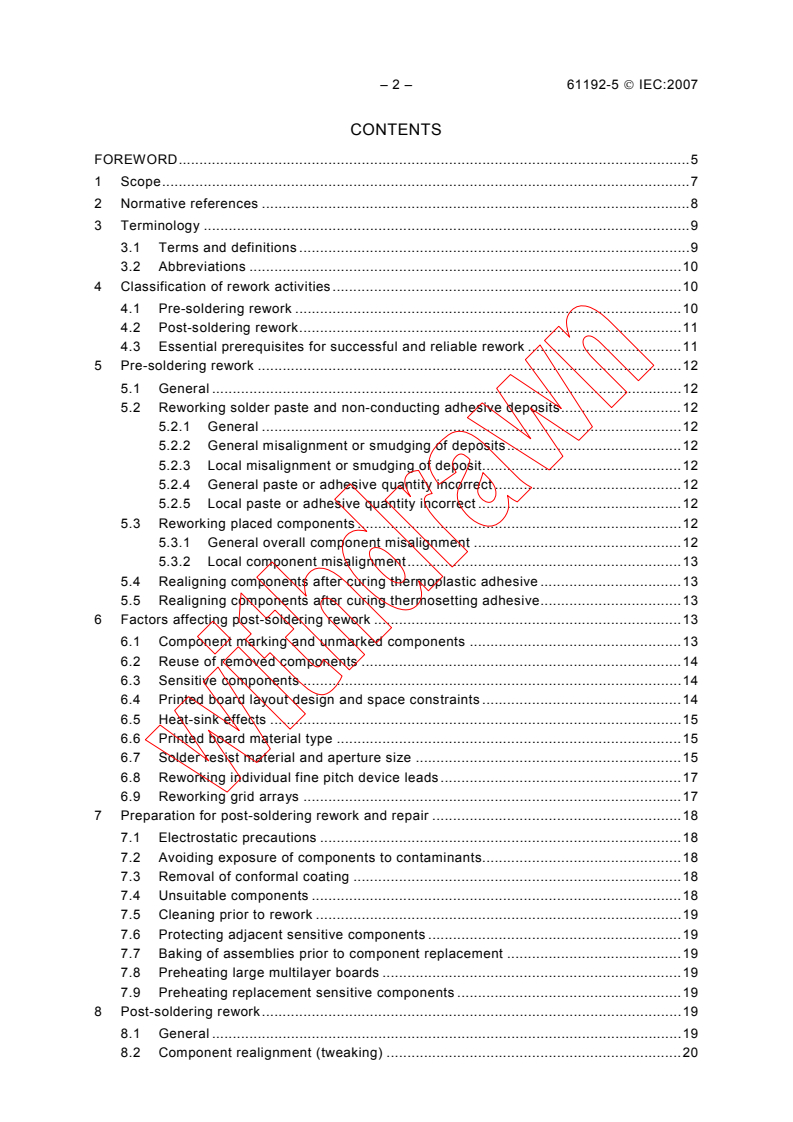
General Information
- Abstract
IEC 61192-5:2007 provides information and requirements that are applicable to modification, rework and repair procedures for soldered electronic assemblies. It is applicable to specific processes used to manufacture soldered electronic assemblies where components are attached to printed boards and to the relevant parts of resulting products. The standard is also applicable to activities that can form part of the work in assembling mixed technology products. It also contains guidance on design matters where they have relevance to rework.
- Status
- Withdrawn
- Publication Date
- 22-May-2007
- Withdrawal Date
- 29-Nov-2018
- Technical Committee
- TC 91 - Electronics assembly technology
- Drafting Committee
- WG 2 - TC 91/WG 2
- Current Stage
- WPUB - Publication withdrawn
- Start Date
- 30-Nov-2018
- Completion Date
- 30-Nov-2018
Buy Documents
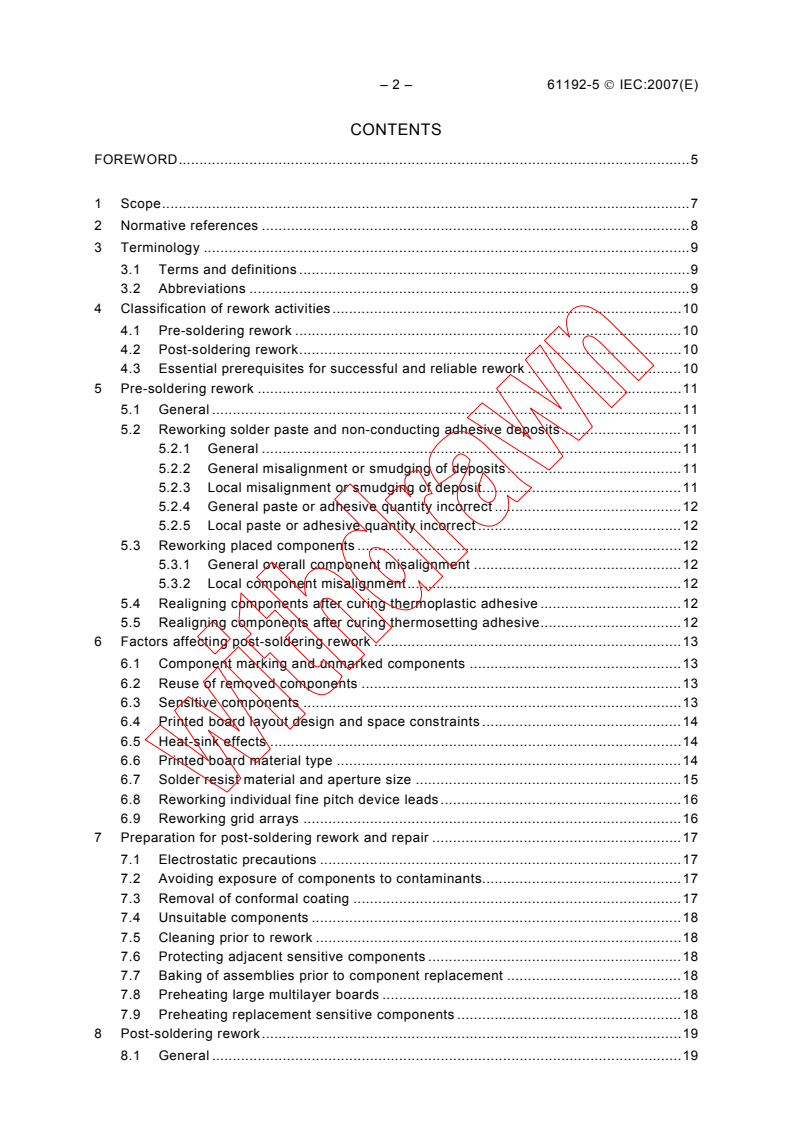
IEC 61192-5:2007 - Workmanship requirements for soldered electronic assemblies - Part 5: Rework, modification and repair of soldered electronic assemblies Released:5/23/2007
IEC 61192-5:2007 - Workmanship requirements for soldered electronic assemblies - Part 5: Rework, modification and repair of soldered electronic assemblies Released:5/23/2007
Buy Documents
IEC 61192-5:2007 - Workmanship requirements for soldered electronic assemblies - Part 5: Rework, modification and repair of soldered electronic assemblies Released:5/23/2007
IEC 61192-5:2007 - Workmanship requirements for soldered electronic assemblies - Part 5: Rework, modification and repair of soldered electronic assemblies Released:5/23/2007
Frequently Asked Questions
IEC 61192-5:2007 is a standard published by the International Electrotechnical Commission (IEC). Its full title is "Workmanship requirements for soldered electronic assemblies - Part 5: Rework, modification and repair of soldered electronic assemblies". This standard covers: IEC 61192-5:2007 provides information and requirements that are applicable to modification, rework and repair procedures for soldered electronic assemblies. It is applicable to specific processes used to manufacture soldered electronic assemblies where components are attached to printed boards and to the relevant parts of resulting products. The standard is also applicable to activities that can form part of the work in assembling mixed technology products. It also contains guidance on design matters where they have relevance to rework.
IEC 61192-5:2007 provides information and requirements that are applicable to modification, rework and repair procedures for soldered electronic assemblies. It is applicable to specific processes used to manufacture soldered electronic assemblies where components are attached to printed boards and to the relevant parts of resulting products. The standard is also applicable to activities that can form part of the work in assembling mixed technology products. It also contains guidance on design matters where they have relevance to rework.
IEC 61192-5:2007 is classified under the following ICS (International Classification for Standards) categories: 31.190 - Electronic component assemblies. The ICS classification helps identify the subject area and facilitates finding related standards.
IEC 61192-5:2007 is available in PDF format for immediate download after purchase. The document can be added to your cart and obtained through the secure checkout process. Digital delivery ensures instant access to the complete standard document.
Standards Content (Sample)
INTERNATIONAL IEC
STANDARD 61192-5
First edition
2007-05
Workmanship requirements
for soldered electronic assemblies –
Part 5:
Rework, modification and repair
of soldered electronic assemblies
Reference number
All rights reserved. Unless otherwise specified, no part of this publication may be reproduced or utilized in any form
or by any means, electronic or mechanical, including photocopying and microfilm, without permission in writing from
either IEC or IEC's member National Committee in the country of the requester.
If you have any questions about IEC copyright or have an enquiry about obtaining additional rights to this publication,
please contact the address below or your local IEC member National Committee for further information.
IEC Central Office
3, rue de Varembé
CH-1211 Geneva 20
Switzerland
Email: inmail@iec.ch
Web: www.iec.ch
About the IEC
The International Electrotechnical Commission (IEC) is the leading global organization that prepares and publishes
International Standards for all electrical, electronic and related technologies.
About IEC publications
The technical content of IEC publications is kept under constant review by the IEC. Please make sure that you have the
latest edition, a corrigenda or an amendment might have been published.
ƒ Catalogue of IEC publications: www.iec.ch/searchpub
The IEC on-line Catalogue enables you to search by a variety of criteria (reference number, text, technical committee,…).
It also gives information on projects, withdrawn and replaced publications.
ƒ IEC Just Published: www.iec.ch/online_news/justpub
Stay up to date on all new IEC publications. Just Published details twice a month all new publications released. Available
on-line and also by email.
ƒ Customer Service Centre: www.iec.ch/webstore/custserv
If you wish to give us your feedback on this publication or need further assistance, please visit the Customer Service
Centre FAQ or contact us:
Email: csc@iec.ch
Tel.: +41 22 919 02 11
Fax: +41 22 919 03 00
INTERNATIONAL IEC
STANDARD 61192-5
First edition
2007-05
Workmanship requirements
for soldered electronic assemblies –
Part 5:
Rework, modification and repair
of soldered electronic assemblies
PRICE CODE
Commission Electrotechnique Internationale W
International Electrotechnical Commission
МеждународнаяЭлектротехническаяКомиссия
For price, see current catalogue
– 2 – 61192-5 © IEC:2007(E)
CONTENTS
FOREWORD.5
1 Scope.7
2 Normative references .8
3 Terminology .9
3.1 Terms and definitions .9
3.2 Abbreviations .9
4 Classification of rework activities.10
4.1 Pre-soldering rework .10
4.2 Post-soldering rework.10
4.3 Essential prerequisites for successful and reliable rework .10
5 Pre-soldering rework .11
5.1 General .11
5.2 Reworking solder paste and non-conducting adhesive deposits.11
5.2.1 General .11
5.2.2 General misalignment or smudging of deposits.11
5.2.3 Local misalignment or smudging of deposit.11
5.2.4 General paste or adhesive quantity incorrect .12
5.2.5 Local paste or adhesive quantity incorrect .12
5.3 Reworking placed components .12
5.3.1 General overall component misalignment .12
5.3.2 Local component misalignment.12
5.4 Realigning components after curing thermoplastic adhesive .12
5.5 Realigning components after curing thermosetting adhesive.12
6 Factors affecting post-soldering rework .13
6.1 Component marking and unmarked components .13
6.2 Reuse of removed components .13
6.3 Sensitive components .13
6.4 Printed board layout design and space constraints .14
6.5 Heat-sink effects .14
6.6 Printed board material type .14
6.7 Solder resist material and aperture size .15
6.8 Reworking individual fine pitch device leads .16
6.9 Reworking grid arrays .16
7 Preparation for post-soldering rework and repair .17
7.1 Electrostatic precautions .17
7.2 Avoiding exposure of components to contaminants.17
7.3 Removal of conformal coating .17
7.4 Unsuitable components .18
7.5 Cleaning prior to rework .18
7.6 Protecting adjacent sensitive components .18
7.7 Baking of assemblies prior to component replacement .18
7.8 Preheating large multilayer boards .18
7.9 Preheating replacement sensitive components .18
8 Post-soldering rework.19
8.1 General .19
61192-5 © IEC:2007(E) – 3 –
8.2 Component realignment (tweaking) .19
8.3 Component removal .19
8.4 Removal of adjacent components .19
8.5 Reuse of components.19
8.6 Addition of flux and solder .20
8.7 Topping-up.20
8.8 Removal of excess solder from joints .21
8.9 Preparation of lands before component replacement .21
8.10 Component replacement.22
8.11 Cleaning (if required).22
8.12 Visual inspection and electrical testing .22
8.13 Checking thermal integrity of solder joints .22
8.14 Replacement of local conformal coating (if required) .22
9 Selection of rework equipment, tools and methods .22
9.1 General .22
9.2 Matching rework equipment to component and printed-board prerequisites .23
9.2.1 General .23
9.2.2 Selection based on component types on the printed board .24
9.2.3 Selection based on printed-board laminate material type .24
9.2.4 Selection based on assembly structure and soldering processes .24
10 Manual rework tools and methods .26
10.1 General .26
10.2 Miniature conventional (stored energy) soldering irons .26
10.3 Directly heated soldering irons .27
10.4 Hot air/gas pencils.28
10.5 Heated tweezers .28
10.6 Soldering irons with special tips .29
11 Mechanized and programmable rework machines.29
11.1 General .29
11.2 Hot air rework machines.29
11.3 Focused infrared (IR) equipment .30
11.4 Thermode (heated electrode) equipment .31
11.5 Laser equipment for de-soldering .32
12 Ancillary tools and equipment.33
12.1 Conventional soldering irons .33
12.2 Hotplates.33
12.3 Pneumatic dispensers .33
12.4 De-soldering tools, as used for through-hole assemblies .34
12.5 Tweezers and vacuum pencils.34
12.6 Solder pots.34
12.7 Copper braid .34
13 Rework recording procedures .34
13.1 General .34
13.2 Anomaly charts .34
13.3 Travelling documents .35
13.4 Rework status .36
14 Training of operators and inspectors .36
15 Field repair .37
– 4 – 61192-5 © IEC:2007(E)
Bibliography.38
Figure 1 – Typical in-process modification, rework or repair activities .7
Figure 2 – Gang mounting no solder mask between lands.15
Figure 3 – Conductor between lands on small pitch .15
Figure 4 – Optional solder-mask design for multiple termination component
attachment.16
Figure 5 – SOIC repair procedure example .23
Figure 6 – Comparing hot air/gas and infrared rework processes .26
Figure 7 – Miniature conventional soldering iron .27
Figure 8 – Hot air solder system .30
Figure 9 – Heated thermode reflow soldering.31
Figure 10 – Automated laser reflow equipment .33
Table 1 – Recommended tools for different component types .25
Table 2 – Electrical and electronic assembly defects .35
61192-5 © IEC:2007(E) – 5 –
INTERNATIONAL ELECTROTECHNICAL COMMISSION
___________
WORKMANSHIP REQUIREMENTS FOR
SOLDERED ELECTRONIC ASSEMBLIES –
Part 5: Rework, modification and repair of
soldered electronic assemblies
FOREWORD
1) The International Electrotechnical Commission (IEC) is a worldwide organization for standardization comprising
all national electrotechnical committees (IEC National Committees). The object of IEC is to promote
international co-operation on all questions concerning standardization in the electrical and electronic fields. To
this end and in addition to other activities, IEC publishes International Standards, Technical Specifications,
Technical Reports, Publicly Available Specifications (PAS) and Guides (hereafter referred to as “IEC
Publication(s)”). Their preparation is entrusted to technical committees; any IEC National Committee interested
in the subject dealt with may participate in this preparatory work. International, governmental and non-
governmental organizations liaising with the IEC also participate in this preparation. IEC collaborates closely
with the International Organization for Standardization (ISO) in accordance with conditions determined by
agreement between the two organizations.
2) The formal decisions or agreements of IEC on technical matters express, as nearly as possible, an international
consensus of opinion on the relevant subjects since each technical committee has representation from all
interested IEC National Committees.
3) IEC Publications have the form of recommendations for international use and are accepted by IEC National
Committees in that sense. While all reasonable efforts are made to ensure that the technical content of IEC
Publications is accurate, IEC cannot be held responsible for the way in which they are used or for any
misinterpretation by any end user.
4) In order to promote international uniformity, IEC National Committees undertake to apply IEC Publications
transparently to the maximum extent possible in their national and regional publications. Any divergence
between any IEC Publication and the corresponding national or regional publication shall be clearly indicated in
the latter.
5) IEC provides no marking procedure to indicate its approval and cannot be rendered responsible for any
equipment declared to be in conformity with an IEC Publication.
6) All users should ensure that they have the latest edition of this publication.
7) No liability shall attach to IEC or its directors, employees, servants or agents including individual experts and
members of its technical committees and IEC National Committees for any personal injury, property damage or
other damage of any nature whatsoever, whether direct or indirect, or for costs (including legal fees) and
expenses arising out of the publication, use of, or reliance upon, this IEC Publication or any other IEC
Publications.
8) Attention is drawn to the Normative references cited in this publication. Use of the referenced publications is
indispensable for the correct application of this publication.
9) Attention is drawn to the possibility that some of the elements of this IEC Publication may be the subject of
patent rights. IEC shall not be held responsible for identifying any or all such patent rights.
International Standard IEC 61192-5 has been prepared by IEC technical committee 91:
Electronics assembly technology.
The text of this standard is based on the following documents:
FDIS Report on voting
91/652/FDIS 91/686/RVD
Full information on the voting for the approval of this standard can be found in the report on
voting indicated in the above table.
This publication has been drafted in accordance with the ISO/IEC Directives, Part 2.
– 6 – 61192-5 © IEC:2007(E)
A list of all parts in the IEC 61192 series, under the general title Workmanship requirements
for soldered electronic assemblies, can be found on the IEC website.
The committee has decided that the contents of this publication will remain unchanged until
the maintenance result date indicated on the IEC web site under "http://webstore.iec.ch" in
the data related to the specific publication. At this date, the publication will be
• reconfirmed;
• withdrawn;
• replaced by a revised edition, or
• amended.
A bilingual version of this publication may be issued at a later date.
61192-5 © IEC:2007(E) – 7 –
WORKMANSHIP REQUIREMENTS FOR
SOLDERED ELECTRONIC ASSEMBLIES –
Part 5: Rework, modification and repair of
soldered electronic assemblies
1 Scope
This part of IEC 61192 provides information and requirements that are applicable to
modification, rework and repair procedures for soldered electronic assemblies. It is applicable
to specific processes used to manufacture soldered electronic assemblies where components
are attached to printed boards and to the relevant parts of resulting products. The standard is
also applicable to activities that can form part of the work in assembling mixed technology
products.
This part of IEC 61192 also contains guidance on design matters where they have relevance
to rework.
NOTE Typical in-process surface-mount rework activities to which this standard applies are shown in Figure 1.
After component preparation
After solder After adhesive
past deposition deposition
After component After component
placement placement
After adhesive
Pre-soldering
curing
After reflow After immersion
Post-soldering
soldering soldering
After individual component
placement and soldering
After visual
After cleaning
inspection
After visual After in-circuit
inspection testing
After in-circuit After functional
testing testing
After functional
testing
After final clean
IEC 824/07
Figure 1 – Typical in-process modification, rework or repair activities
– 8 – 61192-5 © IEC:2007(E)
2 Normative references
The following referenced documents are indispensable for the application of this document.
For dated references, only the edition cited applies. For undated references, the latest edition
of the referenced document (including any amendments) applies.
IEC 60194, Printed board design, manufacture and assembly – Terms and definitions
IEC 61190-1-1, Attachment materials for electronic assembly – Part 1-1: Requirements for
soldering fluxes for high-quality interconnections in electronics assembly
IEC 61190-1-2, Attachment materials for electronic assembly – Part 1-2: Requirements for
solder paste for high-quality interconnections in electronics assembly
IEC 61190-1-3, Attachment materials for electronics assembly – Part 1-3: Requirements for
electronic grade solder alloys and fluxed and non-fluxed solid solders for electronic soldering
applications
IEC 61191-1:1998, Printed board assemblies – Part 1: Generic specification – Requirements
for soldered electrical and electronic assemblies using surface mount and related assembly
technologies
IEC 61191-2:1998, Printed board assemblies – Part 2: Sectional specification – Requirements
for surface mount soldered assemblies
IEC 61191-3, Printed board assemblies – Part 3: Sectional specification – Requirements for
through-hole mount soldered assemblies
IEC 61191-4, Printed board assemblies – Part 4: Sectional specification – Requirements for
terminal soldered assemblies
IEC 61192-1, Workmanship requirements for soldered electronic assemblies – Part 1: General
IEC 61192-2, Workmanship requirements for soldered electronic assemblies – Part 2:
Surface-mount assemblies
IEC 61192-3, Workmanship requirements for soldered electronic assemblies – Part 3:
Through-hole mount assemblies
IEC 61192-4, Workmanship requirements for soldered electronic assemblies – Part 4:
Terminal assemblies
IEC 61193-1, Quality assessment systems – Part 1: Registration and analysis of defects on
printed board assemblies
IEC 61249 (all parts), Materials for printed boards and other interconnecting structures
61192-5 © IEC:2007(E) – 9 –
3 Terminology
3.1 Terms and definitions
For the purposes of this document, the terms and definitions given in IEC 60194, some of
which (marked with an asterisk) are repeated below for convenience, as well as the following,
apply.
3.1.1
rework*
act of reprocessing non-complying articles, through the use of original or alternate equivalent
processing, in a manner that assures compliance of the article with applicable drawings or
specifications
3.1.2
repair*
act of restoring the functional capability of a defective article in a manner that precludes
compliance of the article with applicable drawings or specifications
3.1.3
modification*
revision of the functional capability of a product in order to satisfy new acceptance criteria
3.1.4
anomaly chart
copy of an assembly drawing (or of an actual printed board assembly) that is used to record
the location of faults or process indicators used for process improvement analysis
3.1.5
added component
electronic component that is mounted on a printed board by soldering or other attachment
methods
3.1.6
embedded component
electronic component that is an integral part of a printed board, for example, embedded
resistors, capacitive layers, printed inductors
3.2 Abbreviations
The following abbreviations are commonly used in relation to printed board assemblies. Not
all of them are used in the text. Some are included for information only.
ASIC application-specific integrated circuit
BGA ball grid array
CLCC ceramic leaded chip carrier
CLLCC ceramic leadless chip carrier
LCCC leadless ceramic chip carrier
LED light-emitting diode
MELF metal electrode face-bonded component
PLCC plastic leaded chip carrier
PTFE polytetrafluoroethylene
QFP plastic quad flat package
– 10 – 61192-5 © IEC:2007(E)
RMA rosin, mildly active
SMD surface-mounted device
SMT surface-mount technology
SO small outline
SOD small outline diode
SOIC small outline integrated circuit
SOT small outline transistor
TSOP plastic thin small outline package
4 Classification of rework activities
4.1 Pre-soldering rework
This includes rework following:
a) component preparation;
b) deposition of solder (e.g. paste, preform, tinning);
c) deposition of adhesive;
d) component placement;
e) curing of adhesive.
NOTE In the context of this standard, the word “component” includes all added components, printed boards and
any components that are manufactured integrally with the printed board.
4.2 Post-soldering rework
Post-soldering rework activities, not necessarily occurring in the order given, include:
a) preparation prior to rework or repair, for example, removal of conformal coating,
preheating, baking, cleaning, removal of adjacent components and parts to enable access;
b) component realignment;
c) component removal;
d) addition of flux and solder to a joint;
e) removal of excess solder from a joint;
f) removal of excess solder or adhesive from the printed board prior to remounting a
component;
g) placement and soldering of a replacement component;
h) post-rework cleaning (if required);
i) visual, thermal, mechanical and dimensional inspection and electrical test of reworked
items.
4.3 Essential prerequisites for successful and reliable rework
The essential prerequisites for successful and reliable rework include the following:
a) suitable printed-board layout design to allow the preferred tool to be used for each
component type;
b) confirmation of the type of solder used for the interconnection and selection of the
appropriate process (tin/lead, lead free, other), and replacement material;
c) availability of the most efficient tool or equipment for the task plus antistatic protection;
61192-5 © IEC:2007(E) – 11 –
d) sufficient knowledge at operator or inspector level to enable correct judgement on whether
rework is necessary or will do more harm than good;
e) avoidance of rework processes that may create reliability hazards not detectable prior to
shipment, for example, excessive thermal shock, intermetallic growth at the copper-to-
solder interface;
f) appropriate operator skill level, particularly in rework or repair operations;
g) quality assurance conditions of printed boards, components and materials;
h) ergonomically designed rework /repair stations;
i) management of rework working conditions;
j) effective training and verification (certification);
k) documented rework, repair procedures;
l) control of safety and environmental aspects.
The wide range of component terminations and lead configurations in use, and their differing
resistance to thermal stress means that no single rework equipment is likely to be suitable for
all purposes.
5 Pre-soldering rework
5.1 General
In all cases, appropriate corrective action should ensure that the causes of non-conformity are
rectified. Further guidance is given in IEC 61192-1 and IEC 61192-2.
5.2 Reworking solder paste and non-conducting adhesive deposits
5.2.1 General
This should be carried out in accordance with 5.2.2 to 5.2.5. Further guidance is given in
IEC 61192-2.
5.2.2 General misalignment or smudging of deposits
All the paste or adhesive should be thoroughly cleaned off the printed board. The printed
board may be reused if it is cleaned properly, but paste and adhesive removed from boards
should be discarded.
a) Unpopulated PCB
The unpopulated PCB should be cleaned in the cleaning machine as soon as possible.
Only appropriate cleaning fluids should be used to clean the PCB.
b) Populated PCB
Before any cleaning, approval must be obtained from the process manager responsible for
the component and assembly release before a PCA is cleaned in a cleaning machine.
Usually localized cleaning will be permitted; however cleaning of the completed assembly
should take place shortly after reflow in order to remove any cleaning residue. Other
cleaning is not allowed as cleaning fluids could penetrate the component resulting in, as
well as other things, corrosion, which may significantly influence the operational
functionality of the component.
5.2.3 Local misalignment or smudging of deposit
If the defect is confined to one or a few sites and the required quantity of deposit and its
location can be sufficiently controlled using manual methods, the local or smudged material
can be removed and replaced using a syringe or other means of dispensing a single charge. If
this is not the case, the recommendations given in 5.2.2 should be followed.
– 12 – 61192-5 © IEC:2007(E)
5.2.4 General paste or adhesive quantity incorrect
Reworking should be carried out in accordance with 5.2.2.
5.2.5 Local paste or adhesive quantity incorrect
Reworking should be carried out in accordance with 5.2.3.
5.3 Reworking placed components
5.3.1 General overall component misalignment
All the added components should be removed from the printed board and all items thoroughly
cleaned. Care should be taken to identify the moisture level of the parts. The printed board
may be reused if its cleanliness requirements are met, but all paste and adhesive removed
from boards should be scrapped. If added components are to be reused (not recommended),
for example, as spares for rework activity, they should be checked for mechanical damage
(100 %) and retested electrically (100 %).
5.3.2 Local component misalignment
Immediately after placement is the best time to correct serious misalignment. During reflow of
surface-mount components, often there will be a realignment action due to surface tension
forces when the solder becomes molten. This action is more effective with small components
and ball grid arrays, but it should not be relied upon, as local differences in solderability and
temperature across the component terminations can bring counter-forces.
Where one or a few components are misaligned, they may be gently moved using tweezers
with conductive plastic tips. To avoid spreading the paste or adhesive, a slight lifting
movement should be applied before any horizontal realignment action, but care is needed to
avoid the component losing contact with the paste or adhesive.
NOTE If realignment is undertaken, a higher incidence of shorting/bridging is likely.
5.4 Realigning components after curing thermoplastic adhesive
It is better to correct misalignment after curing the adhesive rather than to wait until after
soldering. If it is clear that the component is outside the prescribed post-soldering positional
limits, the component should be removed and replaced, if necessary using additional
adhesive. Further guidance can be obtained from Clause 5 of IEC 61191-2.
If only a small corrective movement is needed, for example, 0,2 mm or 10° rotation, the
thermoplastic adhesive can be melted and the component gently moved using tweezers with
conductive plastic tips. Care is needed to avoid breaking contact between the component
body and the adhesive layer. Before attempting the task, the maximum allowable remelt
temperature should be checked with the adhesive manufacturer, and it should also be
checked that the material will provide adequate bond strength after remelt to avoid the risk of
the component falling into the solder bath. In this case, the component is not being taken off
the printed board and replaced, hence the method of applying heat should be appropriate to
the component type, for example, a soldering iron should not be used on a multilayer ceramic
capacitor. See also 6.3 and Table 1.
5.5 Realigning components after curing thermosetting adhesive
When a thermosetting adhesive is used, it is normal to leave the correction until after
soldering because there is no need to replace it. When the adhesive is also used to provide
additional strength during operational thermal cycling, it needs to be reapplied. In some cases
it may be acceptable to use a thermoplastic adhesive for the rework.
61192-5 © IEC:2007(E) – 13 –
If it is necessary to break the bond completely, for example, by rotating the heated component
with tweezers to fracture the adhesive bond before lifting it away from the printed board, the
replacement component should not be applied until after immersion soldering when adhesive
is no longer needed. Where it is essential to realign a component after soldering, this requires
simultaneously remelting the solder joints and softening the adhesive so that appropriate
corrective movement can be applied.
6 Factors affecting post-soldering rework
6.1 Component marking and unmarked components
With lack of marking on many components and the tendency to omit "identification" or
"legend" on printed boards, it is recommended that a full component layout diagram should be
supplied to each rework operator and/or inspector, together with a detailed component list.
To minimize the risk of confusion, any surplus or loose components without marking on their
bodies should be carefully identified as to value, type and batch number and stored in a
protected environment such as a rigid plastic vial or drypack, near the workplace. Where a
printed legend on the printed board is completely omitted, a coordinate grid system may be
needed to identify respective component positions.
To assure correct replacement, rework operators should be trained to note the polarity of all
defective diodes, electrolytic capacitors and integrated circuit packages before removing
them, even when incorrect polarity is the reason for the action.
6.2 Reuse of removed components
Basically, components should not be reused. In addition to the quality deterioration which has
already occurred, potential quality degradation may occur after the time lapse. Most
component manufacturers are unable to give effect to normal guarantees if their product has
been removed from a printed board and remounted. While there is always a risk of damage
arising, it is possible with some types to perform the removal and reuse operation
successfully.
Whether, as a result, the circuit suffers an early failure in the field, this is at the risk of the
person authorizing the work. However, it is reasonable to assume that some reduction in
reliability may occur. See also 7.9.
6.3 Sensitive components
Whichever rework method is applied, some components are more at risk than others, and the
choice of tool and the skill of the operator are both critical. The following components are
examples of those that can be especially sensitive to rework and their reuse is particularly
inadvisable:
– multilayer ceramic chip capacitors;
– LEDs;
– ASICs in PLCC or quadpack format;
– wave-soldered precision resistors;
– large SOICs (>16 leads);
– wave-soldered quadpacks;
– SOT23 and SO packages moulded in thermoplastic material;
– plastic-encapsulated BGAs;
– ceramic ball grid arrays (CBGA);
– ceramic column grid arrays (CCGA);
– 14 – 61192-5 © IEC:2007(E)
– opto-couplers;
– crystals and crystal filters.
Basically, components should not be reused. Especially, no component for which the data
sheet specifically disbars reuse should be reused. For these components, automatic rework
machines with control of times and temperatures and heating rates are preferred to manual
methods on reliability grounds.
6.4 Printed board layout design and space constraints
Many users adopt surface-mount technology because of its potential for cost-effective
miniaturization. However, the printed-board layout designer should reach a careful
compromise between the conflicting requirements of functional performance, reducing "real
estate", electrical test, ease of assembly and rework. Product reliability can be sensitive to the
latter items.
If components are too close, adjacent or replacement components can easily be damaged
during rework. Nearby solder could be melted a second time, leading to dewetting, reduced
mechanical attachment strength and the risk of dry joints. For those components that have
been attached with adhesive and wave-soldered, wherever possible sufficient clearance
should be allowed around the devices so that they can be rotated through 90° in one direction
(or 45° in two directions) to shear the adhesive while all the joints are molten.
Successful removal of large multi-lead integrated circuit packages involves the use of hot gas,
heated electrode or laser equipment. Sufficient clearance around the package to permit the
rework head to completely surround the device is important, as is sufficient space between
components to reduce the risk of reflowing adjacent joints.
6.5 Heat-sink effects
Where large ground planes or heat sinks are present in a printed-board substrate, these can
conduct heat away from the component being reworked. Extra heat for longer periods can
then be required which, in turn, can lead to damage to components or the printed board. The
fact that the solder joints may not reach reflow temperature is no guarantee that the
component (or the printed board) has not been overheated. This is a design problem to be
resolved at the printed-board layout stage. Wherever possible, any component termination
that can need rework, including leaded through-hole types, should be thermally isolated from
any ground plane or integral heat sink by a short length of copper conductor.
Where a heat sink has to be attached to a component, either it should be of a type which is
removable without disturbing or stressing the solder joints or, if not removable, it should not
impede access for the appropriate rework tool and should not itself act as a significant sink for
the heat applied by the rework tool. If an improper soldering tool is used, the likelihood of it
touching and damaging adjacent components can be high as well as the likelihood of
imparting thermal shock to the reworked device. If possible, be sure to detach the heat sink
before working on removing the electronic part.
Alternatively, it can sometimes be necessary to protect a component body from excess rework
temperature, for example, by clipping a local heat sink between the body and the solder joint.
A specially formed crocodile (alligator) clip can, for example, fulfil this function.
6.6 Printed board material type
To minimize the risk of conductor land detachment during rework, a woven glass-epoxide
base material conforming to an appropriate IEC 61249 series sectional specification or other
comparable material should be selected at the design stage. Some base materials in common
use have an inherently low copper-cladding peel strength, and their use will increase the
likelihood of land detachment during rework.
61192-5 © IEC:2007(E) – 15 –
To ensure minimum damage to the printed board during rework, the base laminate should be
qualified to accept modification, repair or rework procedures. The IEC 61249 series provides
the performance criterion of various laminate used in the production of different rigid printed-
board types. Rework procedures and test methods are identified to determine the board's
capability to sustain its characteristics through multiple exposures to assembly or rework
temperatures.
6.7 Solder resist material and aperture size
The adhesion properties of photo-imageable solder resists and the aspect ratios of resist
strips between adjacent lands can affect the choice of rework tool. Overheating such resists
can cause local lifting. Some dry film photo-imageable resists are more likely to exhibit lifting
and curling over conductor areas when overheated, making it necessary to apply a scalpel or
similar instrument to clear the land sites for replacement component leads. Thicker films may
be more prone to lifting. Multiple gang mounting is used without soldermask between lands as
shown in Figure 2.
Solder mask
Land
Gang
IEC 825/07
Figure 2 – Gang mounting no solder mask between lands
Conductors between lands at 1,0 mm pitch and below are not generally recommended due to
the high chance of damage during rework. Attempting to position lands, conductor, and two
clearances where the total pitch is only 1,0 mm requires a conductor width of 0,15 mm with
two clearances of 0,15 mm. This situation would accommodate lands that are 0,55 mm. See
Figure 3 for an example of this situation. The 0,15 mm conductor is the smallest that is
recommended when being covered with solder mask. Usually the solder mask is used to
protect a conductor that is positioned between two lands intended for surface-mounting an
electronic part. If the amount of overlap of that conductor (solder mask strip) is small (under
0,1 mm), it is more likely to lift due to the proximity of heat applied to an adjacent land.
Conductor
Pocket
IEC 826/07
Figure 3 – Conductor between lands on small pitch
– 16 – 61192-5 © IEC:2007(E)
Where the aperture in the resist is offset to overlap the copper land and protect an incoming
fine conductor track, lifting during component removal is more likely if the overlap is less than
0,125 mm. To minimize the risk of lifting, the location of narrow strips of resist between fine
pitch lands should be avoided. See Figure 4. This imposes the need for very close control of
accuracy when printing solder paste. Depending on film thickness, wet film photo-imageable
resists are generally more resistant to lifting but can be unsuitable when tenting of vias is
required.
Lands with solder-mask dam
separation for fine-pitch lead
frame packaged IC applications
IEC 827/07
Lands without solder-mask dam
separation for fine-pitch lead
frame packaged IC applications
IEC 828/07
Comparing solder mask off land
to mask on land for BGA
packaged IC applications
IEC 829/07
Figure 4 – Optional solder-mask design for multiple
termination component attachment
6.8 Reworking individual fine pitch device leads
Except for prototype assemblies where it is not planned to send the product into the field, it is
not considered prudent to attempt manual replacement of individual integrated circuit leads
having pitches at 0,5 mm and below. The best chance of success
...
IEC 61192-5
Edition 1.0 2007-05
INTERNATIONAL
STANDARD
NORME
INTERNATIONALE
Workmanship requirements for soldered electronic assemblies –
Part 5: Rework, modification and repair of soldered electronic assemblies
Exigences relatives à la qualité d’exécution des assemblages électroniques
brasés –
Partie 5: Retouche, modification et réparation des assemblages électroniques
brasés
All rights reserved. Unless otherwise specified, no part of this publication may be reproduced or utilized in any form or by
any means, electronic or mechanical, including photocopying and microfilm, without permission in writing from either IEC or
IEC's member National Committee in the country of the requester.
If you have any questions about IEC copyright or have an enquiry about obtaining additional rights to this publication,
please contact the address below or your local IEC member National Committee for further information.
Droits de reproduction réservés. Sauf indication contraire, aucune partie de cette publication ne peut être reproduite
ni utilisée sous quelque forme que ce soit et par aucun procédé, électronique ou mécanique, y compris la photocopie
et les microfilms, sans l'accord écrit de la CEI ou du Comité national de la CEI du pays du demandeur.
Si vous avez des questions sur le copyright de la CEI ou si vous désirez obtenir des droits supplémentaires sur cette
publication, utilisez les coordonnées ci-après ou contactez le Comité national de la CEI de votre pays de résidence.
IEC Central Office
3, rue de Varembé
CH-1211 Geneva 20
Switzerland
Email: inmail@iec.ch
Web: www.iec.ch
About the IEC
The International Electrotechnical Commission (IEC) is the leading global organization that prepares and publishes
International Standards for all electrical, electronic and related technologies.
About IEC publications
The technical content of IEC publications is kept under constant review by the IEC. Please make sure that you have the
latest edition, a corrigenda or an amendment might have been published.
ƒ Catalogue of IEC publications: www.iec.ch/searchpub
The IEC on-line Catalogue enables you to search by a variety of criteria (reference number, text, technical committee,…).
It also gives information on projects, withdrawn and replaced publications.
ƒ IEC Just Published: www.iec.ch/online_news/justpub
Stay up to date on all new IEC publications. Just Published details twice a month all new publications released. Available
on-line and also by email.
ƒ Electropedia: www.electropedia.org
The world's leading online dictionary of electronic and electrical terms containing more than 20 000 terms and definitions
in English and French, with equivalent terms in additional languages. Also known as the International Electrotechnical
Vocabulary online.
ƒ Customer Service Centre: www.iec.ch/webstore/custserv
If you wish to give us your feedback on this publication or need further assistance, please visit the Customer Service
Centre FAQ or contact us:
Email: csc@iec.ch
Tel.: +41 22 919 02 11
Fax: +41 22 919 03 00
A propos de la CEI
La Commission Electrotechnique Internationale (CEI) est la première organisation mondiale qui élabore et publie des
normes internationales pour tout ce qui a trait à l'électricité, à l'électronique et aux technologies apparentées.
A propos des publications CEI
Le contenu technique des publications de la CEI est constamment revu. Veuillez vous assurer que vous possédez
l’édition la plus récente, un corrigendum ou amendement peut avoir été publié.
ƒ Catalogue des publications de la CEI: www.iec.ch/searchpub/cur_fut-f.htm
Le Catalogue en-ligne de la CEI vous permet d’effectuer des recherches en utilisant différents critères (numéro de référence,
texte, comité d’études,…). Il donne aussi des informations sur les projets et les publications retirées ou remplacées.
ƒ Just Published CEI: www.iec.ch/online_news/justpub
Restez informé sur les nouvelles publications de la CEI. Just Published détaille deux fois par mois les nouvelles
publications parues. Disponible en-ligne et aussi par email.
ƒ Electropedia: www.electropedia.org
Le premier dictionnaire en ligne au monde de termes électroniques et électriques. Il contient plus de 20 000 termes et
définitions en anglais et en français, ainsi que les termes équivalents dans les langues additionnelles. Egalement appelé
Vocabulaire Electrotechnique International en ligne.
ƒ Service Clients: www.iec.ch/webstore/custserv/custserv_entry-f.htm
Si vous désirez nous donner des commentaires sur cette publication ou si vous avez des questions, visitez le FAQ du
Service clients ou contactez-nous:
Email: csc@iec.ch
Tél.: +41 22 919 02 11
Fax: +41 22 919 03 00
IEC 61192-5
Edition 1.0 2007-05
INTERNATIONAL
STANDARD
NORME
INTERNATIONALE
Workmanship requirements for soldered electronic assemblies –
Part 5: Rework, modification and repair of soldered electronic assemblies
Exigences relatives à la qualité d’exécution des assemblages électroniques
brasés –
Partie 5: Retouche, modification et réparation des assemblages électroniques
brasés
INTERNATIONAL
ELECTROTECHNICAL
COMMISSION
COMMISSION
ELECTROTECHNIQUE
PRICE CODE
INTERNATIONALE
W
CODE PRIX
ICS 31.190 ISBN 2-8318-9781-5
– 2 – 61192-5 © IEC:2007
CONTENTS
FOREWORD.5
1 Scope.7
2 Normative references .8
3 Terminology .9
3.1 Terms and definitions .9
3.2 Abbreviations .10
4 Classification of rework activities.10
4.1 Pre-soldering rework .10
4.2 Post-soldering rework.11
4.3 Essential prerequisites for successful and reliable rework .11
5 Pre-soldering rework .12
5.1 General .12
5.2 Reworking solder paste and non-conducting adhesive deposits.12
5.2.1 General .12
5.2.2 General misalignment or smudging of deposits.12
5.2.3 Local misalignment or smudging of deposit.12
5.2.4 General paste or adhesive quantity incorrect .12
5.2.5 Local paste or adhesive quantity incorrect .12
5.3 Reworking placed components .12
5.3.1 General overall component misalignment .12
5.3.2 Local component misalignment.13
5.4 Realigning components after curing thermoplastic adhesive .13
5.5 Realigning components after curing thermosetting adhesive.13
6 Factors affecting post-soldering rework .13
6.1 Component marking and unmarked components .13
6.2 Reuse of removed components .14
6.3 Sensitive components .14
6.4 Printed board layout design and space constraints .14
6.5 Heat-sink effects .15
6.6 Printed board material type .15
6.7 Solder resist material and aperture size .15
6.8 Reworking individual fine pitch device leads .17
6.9 Reworking grid arrays .17
7 Preparation for post-soldering rework and repair .18
7.1 Electrostatic precautions .18
7.2 Avoiding exposure of components to contaminants.18
7.3 Removal of conformal coating .18
7.4 Unsuitable components .18
7.5 Cleaning prior to rework .19
7.6 Protecting adjacent sensitive components .19
7.7 Baking of assemblies prior to component replacement .19
7.8 Preheating large multilayer boards .19
7.9 Preheating replacement sensitive components .19
8 Post-soldering rework.19
8.1 General .19
8.2 Component realignment (tweaking) .20
61192-5 © IEC:2007 – 3 –
8.3 Component removal .20
8.4 Removal of adjacent components .20
8.5 Reuse of components.20
8.6 Addition of flux and solder .20
8.7 Topping-up.21
8.8 Removal of excess solder from joints .22
8.9 Preparation of lands before component replacement .22
8.10 Component replacement.22
8.11 Cleaning (if required).23
8.12 Visual inspection and electrical testing .23
8.13 Checking thermal integrity of solder joints .23
8.14 Replacement of local conformal coating (if required) .23
9 Selection of rework equipment, tools and methods .23
9.1 General .23
9.2 Matching rework equipment to component and printed-board prerequisites .24
9.2.1 General .24
9.2.2 Selection based on component types on the printed board .24
9.2.3 Selection based on printed-board laminate material type .25
9.2.4 Selection based on assembly structure and soldering processes .25
10 Manual rework tools and methods .27
10.1 General .27
10.2 Miniature conventional (stored energy) soldering irons .27
10.3 Directly heated soldering irons .28
10.4 Hot air/gas pencils.29
10.5 Heated tweezers .29
10.6 Soldering irons with special tips .30
11 Mechanized and programmable rework machines.30
11.1 General .30
11.2 Hot air rework machines.30
11.3 Focused infrared (IR) equipment .31
11.4 Thermode (heated electrode) equipment .32
11.5 Laser equipment for de-soldering .33
12 Ancillary tools and equipment.34
12.1 Conventional soldering irons .34
12.2 Hotplates.34
12.3 Pneumatic dispensers .34
12.4 De-soldering tools, as used for through-hole assemblies .35
12.5 Tweezers and vacuum pencils.35
12.6 Solder pots.35
12.7 Copper braid .35
13 Rework recording procedures .35
13.1 General .35
13.2 Anomaly charts .35
13.3 Travelling documents .36
13.4 Rework status .37
14 Training of operators and inspectors .37
15 Field repair .38
Bibliography.39
– 4 – 61192-5 © IEC:2007
Figure 1 – Typical in-process modification, rework or repair activities .8
Figure 2 – Gang mounting no solder mask between lands.16
Figure 3 – Conductor between lands on small pitch .16
Figure 4 – Optional solder-mask design for multiple termination component
attachment.17
Figure 5 – SOIC repair procedure example .24
Figure 6 – Comparing hot air/gas and infrared rework processes .27
Figure 7 – Miniature conventional soldering iron .28
Figure 8 – Hot air solder system .31
Figure 9 – Heated thermode reflow soldering.32
Figure 10 – Automated laser reflow equipment .34
Table 1 – Recommended tools for different component types .26
Table 2 – Electrical and electronic assembly defects .36
61192-5 © IEC:2007 – 5 –
INTERNATIONAL ELECTROTECHNICAL COMMISSION
___________
WORKMANSHIP REQUIREMENTS FOR
SOLDERED ELECTRONIC ASSEMBLIES –
Part 5: Rework, modification and repair of
soldered electronic assemblies
FOREWORD
1) The International Electrotechnical Commission (IEC) is a worldwide organization for standardization comprising
all national electrotechnical committees (IEC National Committees). The object of IEC is to promote
international co-operation on all questions concerning standardization in the electrical and electronic fields. To
this end and in addition to other activities, IEC publishes International Standards, Technical Specifications,
Technical Reports, Publicly Available Specifications (PAS) and Guides (hereafter referred to as “IEC
Publication(s)”). Their preparation is entrusted to technical committees; any IEC National Committee interested
in the subject dealt with may participate in this preparatory work. International, governmental and non-
governmental organizations liaising with the IEC also participate in this preparation. IEC collaborates closely
with the International Organization for Standardization (ISO) in accordance with conditions determined by
agreement between the two organizations.
2) The formal decisions or agreements of IEC on technical matters express, as nearly as possible, an international
consensus of opinion on the relevant subjects since each technical committee has representation from all
interested IEC National Committees.
3) IEC Publications have the form of recommendations for international use and are accepted by IEC National
Committees in that sense. While all reasonable efforts are made to ensure that the technical content of IEC
Publications is accurate, IEC cannot be held responsible for the way in which they are used or for any
misinterpretation by any end user.
4) In order to promote international uniformity, IEC National Committees undertake to apply IEC Publications
transparently to the maximum extent possible in their national and regional publications. Any divergence
between any IEC Publication and the corresponding national or regional publication shall be clearly indicated in
the latter.
5) IEC provides no marking procedure to indicate its approval and cannot be rendered responsible for any
equipment declared to be in conformity with an IEC Publication.
6) All users should ensure that they have the latest edition of this publication.
7) No liability shall attach to IEC or its directors, employees, servants or agents including individual experts and
members of its technical committees and IEC National Committees for any personal injury, property damage or
other damage of any nature whatsoever, whether direct or indirect, or for costs (including legal fees) and
expenses arising out of the publication, use of, or reliance upon, this IEC Publication or any other IEC
Publications.
8) Attention is drawn to the Normative references cited in this publication. Use of the referenced publications is
indispensable for the correct application of this publication.
9) Attention is drawn to the possibility that some of the elements of this IEC Publication may be the subject of
patent rights. IEC shall not be held responsible for identifying any or all such patent rights.
International Standard IEC 61192-5 has been prepared by IEC technical committee 91:
Electronics assembly technology.
This bilingual version, published in 2008-05, corresponds to the English version.
The text of this standard is based on the following documents:
FDIS Report on voting
91/652/FDIS 91/686/RVD
Full information on the voting for the approval of this standard can be found in the report on
voting indicated in the above table.
The French version of this standard has not been voted upon.
– 6 – 61192-5 © IEC:2007
This publication has been drafted in accordance with the ISO/IEC Directives, Part 2.
A list of all parts in the IEC 61192 series, under the general title Workmanship requirements
for soldered electronic assemblies, can be found on the IEC website.
The committee has decided that the contents of this publication will remain unchanged until
the maintenance result date indicated on the IEC web site under "http://webstore.iec.ch" in
the data related to the specific publication. At this date, the publication will be
• reconfirmed;
• withdrawn;
• replaced by a revised edition, or
• amended.
61192-5 © IEC:2007 – 7 –
WORKMANSHIP REQUIREMENTS FOR
SOLDERED ELECTRONIC ASSEMBLIES –
Part 5: Rework, modification and repair of
soldered electronic assemblies
1 Scope
This part of IEC 61192 provides information and requirements that are applicable to
modification, rework and repair procedures for soldered electronic assemblies. It is applicable
to specific processes used to manufacture soldered electronic assemblies where components
are attached to printed boards and to the relevant parts of resulting products. The standard is
also applicable to activities that can form part of the work in assembling mixed technology
products.
This part of IEC 61192 also contains guidance on design matters where they have relevance
to rework.
NOTE Typical in-process surface-mount rework activities to which this standard applies are shown in Figure 1.
– 8 – 61192-5 © IEC:2007
After component preparation
After solder After adhesive
past deposition deposition
After component After component
placement placement
After adhesive
Pre-soldering
curing
After reflow After immersion
Post-soldering
soldering soldering
After individual component
placement and soldering
After visual
After cleaning
inspection
After visual After in-circuit
inspection testing
After in-circuit After functional
testing testing
After functional
testing
After final clean
IEC 824/07
Figure 1 – Typical in-process modification, rework or repair activities
2 Normative references
The following referenced documents are indispensable for the application of this document.
For dated references, only the edition cited applies. For undated references, the latest edition
of the referenced document (including any amendments) applies.
IEC 60194, Printed board design, manufacture and assembly – Terms and definitions (only
available in English)
IEC 61190-1-1, Attachment materials for electronic assembly – Part 1-1: Requirements for
soldering fluxes for high-quality interconnections in electronics assembly
IEC 61190-1-2, Attachment materials for electronic assembly – Part 1-2: Requirements for
soldering pastes for high-quality interconnects in electronics assembly (only available in
English)
61192-5 © IEC:2007 – 9 –
IEC 61190-1-3, Attachment materials for electronics assembly – Part 1-3: Requirements for
electronic grade solder alloys and fluxed and non-fluxed solid solders for electronic soldering
applications (only available in English)
IEC 61191-1:1998, Printed board assemblies – Part 1: Generic specification – Requirements
for soldered electrical and electronic assemblies using surface mount and related assembly
technologies
IEC 61191-2:1998, Printed board assemblies – Part 2: Sectional specification – Requirements
for surface mount soldered assemblies
IEC 61191-3, Printed board assemblies – Part 3: Sectional specification – Requirements for
through-hole mount soldered assemblies
IEC 61191-4, Printed board assemblies – Part 4: Sectional specification – Requirements for
terminal soldered assemblies
IEC 61192-1, Workmanship requirements for soldered electronic assemblies – Part 1: General
IEC 61192-2, Workmanship requirements for soldered electronic assemblies – Part 2:
Surface-mount assemblies
IEC 61192-3, Workmanship requirements for soldered electronic assemblies – Part 3:
Through-hole mount assemblies
IEC 61192-4, Workmanship requirements for soldered electronic assemblies – Part 4:
Terminal assemblies
IEC 61193-1, Quality assessment systems – Part 1: Registration and analysis of defects on
printed board assemblies
IEC 61249 (all parts), Materials for printed boards and other interconnecting structures
3 Terminology
3.1 Terms and definitions
For the purposes of this document, the terms and definitions given in IEC 60194, some of
which (marked with an asterisk) are repeated below for convenience, as well as the following,
apply.
3.1.1
rework*
act of reprocessing non-complying articles, through the use of original or alternate equivalent
processing, in a manner that assures compliance of the article with applicable drawings or
specifications
3.1.2
repair*
act of restoring the functional capability of a defective article in a manner that precludes
compliance of the article with applicable drawings or specifications
3.1.3
modification*
revision of the functional capability of a product in order to satisfy new acceptance criteria
– 10 – 61192-5 © IEC:2007
3.1.4
anomaly chart
copy of an assembly drawing (or of an actual printed board assembly) that is used to record
the location of faults or process indicators used for process improvement analysis
3.1.5
added component
electronic component that is mounted on a printed board by soldering or other attachment
methods
3.1.6
embedded component
electronic component that is an integral part of a printed board, for example, embedded
resistors, capacitive layers, printed inductors
3.2 Abbreviations
The following abbreviations are commonly used in relation to printed board assemblies. Not
all of them are used in the text. Some are included for information only.
ASIC application-specific integrated circuit
BGA ball grid array
CLCC ceramic leaded chip carrier
CLLCC ceramic leadless chip carrier
LCCC leadless ceramic chip carrier
LED light-emitting diode
MELF metal electrode face-bonded component
PLCC plastic leaded chip carrier
PTFE polytetrafluoroethylene
QFP plastic quad flat package
RMA rosin, mildly active
SMD surface-mounted device
SMT surface-mount technology
SO small outline
SOD small outline diode
SOIC small outline integrated circuit
SOT small outline transistor
TSOP plastic thin small outline package
4 Classification of rework activities
4.1 Pre-soldering rework
This includes rework following:
a) component preparation;
b) deposition of solder (e.g. paste, preform, tinning);
c) deposition of adhesive;
d) component placement;
61192-5 © IEC:2007 – 11 –
e) curing of adhesive.
NOTE In the context of this standard, the word “component” includes all added components, printed boards and
any components that are manufactured integrally with the printed board.
4.2 Post-soldering rework
Post-soldering rework activities, not necessarily occurring in the order given, include:
a) preparation prior to rework or repair, for example, removal of conformal coating,
preheating, baking, cleaning, removal of adjacent components and parts to enable access;
b) component realignment;
c) component removal;
d) addition of flux and solder to a joint;
e) removal of excess solder from a joint;
f) removal of excess solder or adhesive from the printed board prior to remounting a
component;
g) placement and soldering of a replacement component;
h) post-rework cleaning (if required);
i) visual, thermal, mechanical and dimensional inspection and electrical test of reworked
items.
4.3 Essential prerequisites for successful and reliable rework
The essential prerequisites for successful and reliable rework include the following:
a) suitable printed-board layout design to allow the preferred tool to be used for each
component type;
b) confirmation of the type of solder used for the interconnection and selection of the
appropriate process (tin/lead, lead free, other), and replacement material;
c) availability of the most efficient tool or equipment for the task plus antistatic protection;
d) sufficient knowledge at operator or inspector level to enable correct judgement on whether
rework is necessary or will do more harm than good;
e) avoidance of rework processes that may create reliability hazards not detectable prior to
shipment, for example, excessive thermal shock, intermetallic growth at the copper-to-
solder interface;
f) appropriate operator skill level, particularly in rework or repair operations;
g) quality assurance conditions of printed boards, components and materials;
h) ergonomically designed rework /repair stations;
i) management of rework working conditions;
j) effective training and verification (certification);
k) documented rework, repair procedures;
l) control of safety and environmental aspects.
The wide range of component terminations and lead configurations in use, and their differing
resistance to thermal stress means that no single rework equipment is likely to be suitable for
all purposes.
– 12 – 61192-5 © IEC:2007
5 Pre-soldering rework
5.1 General
In all cases, appropriate corrective action should ensure that the causes of non-conformity are
rectified. Further guidance is given in IEC 61192-1 and IEC 61192-2.
5.2 Reworking solder paste and non-conducting adhesive deposits
5.2.1 General
This should be carried out in accordance with 5.2.2 to 5.2.5. Further guidance is given in
IEC 61192-2.
5.2.2 General misalignment or smudging of deposits
All the paste or adhesive should be thoroughly cleaned off the printed board. The printed
board may be reused if it is cleaned properly, but paste and adhesive removed from boards
should be discarded.
a) Unpopulated PCB
The unpopulated PCB should be cleaned in the cleaning machine as soon as possible.
Only appropriate cleaning fluids should be used to clean the PCB.
b) Populated PCB
Before any cleaning, approval must be obtained from the process manager responsible for
the component and assembly release before a PCB is cleaned in a cleaning machine.
Usually localized cleaning will be permitted; however cleaning of the completed assembly
should take place shortly after reflow in order to remove any cleaning residue. Other
cleaning is not allowed as cleaning fluids could penetrate the component resulting in, as
well as other things, corrosion, which may significantly influence the operational
functionality of the component.
5.2.3 Local misalignment or smudging of deposit
If the defect is confined to one or a few sites and the required quantity of deposit and its
location can be sufficiently controlled using manual methods, the local or smudged material
can be removed and replaced using a syringe or other means of dispensing a single charge. If
this is not the case, the recommendations given in 5.2.2 should be followed.
5.2.4 General paste or adhesive quantity incorrect
Reworking should be carried out in accordance with 5.2.2.
5.2.5 Local paste or adhesive quantity incorrect
Reworking should be carried out in accordance with 5.2.3.
5.3 Reworking placed components
5.3.1 General overall component misalignment
All the added components should be removed from the printed board and all items thoroughly
cleaned. Care should be taken to identify the moisture level of the parts. The printed board
may be reused if its cleanliness requirements are met, but all paste and adhesive removed
from boards should be scrapped. If added components are to be reused (not recommended),
for example, as spares for rework activity, they should be checked for mechanical damage
(100 %) and retested electrically (100 %).
61192-5 © IEC:2007 – 13 –
5.3.2 Local component misalignment
Immediately after placement is the best time to correct serious misalignment. During reflow of
surface-mount components, often there will be a realignment action due to surface tension
forces when the solder becomes molten. This action is more effective with small components
and ball grid arrays, but it should not be relied upon, as local differences in solderability and
temperature across the component terminations can bring counter-forces.
Where one or a few components are misaligned, they may be gently moved using tweezers
with conductive plastic tips. To avoid spreading the paste or adhesive, a slight lifting
movement should be applied before any horizontal realignment action, but care is needed to
avoid the component losing contact with the paste or adhesive.
NOTE If realignment is undertaken, a higher incidence of shorting/bridging is likely.
5.4 Realigning components after curing thermoplastic adhesive
It is better to correct misalignment after curing the adhesive rather than to wait until after
soldering. If it is clear that the component is outside the prescribed post-soldering positional
limits, the component should be removed and replaced, if necessary using additional
adhesive. Further guidance can be obtained from Clause 5 of IEC 61191-2.
If only a small corrective movement is needed, for example, 0,2 mm or 10° rotation, the
thermoplastic adhesive can be melted and the component gently moved using tweezers with
conductive plastic tips. Care is needed to avoid breaking contact between the component
body and the adhesive layer. Before attempting the task, the maximum allowable remelt
temperature should be checked with the adhesive manufacturer, and it should also be
checked that the material will provide adequate bond strength after remelt to avoid the risk of
the component falling into the solder bath. In this case, the component is not being taken off
the printed board and replaced, hence the method of applying heat should be appropriate to
the component type, for example, a soldering iron should not be used on a multilayer ceramic
capacitor. See also 6.3 and Table 1.
5.5 Realigning components after curing thermosetting adhesive
When a thermosetting adhesive is used, it is normal to leave the correction until after
soldering because there is no need to replace it. When the adhesive is also used to provide
additional strength during operational thermal cycling, it needs to be reapplied. In some cases
it may be acceptable to use a thermoplastic adhesive for the rework.
If it is necessary to break the bond completely, for example, by rotating the heated component
with tweezers to fracture the adhesive bond before lifting it away from the printed board, the
replacement component should not be applied until after immersion soldering when adhesive
is no longer needed. Where it is essential to realign a component after soldering, this requires
simultaneously remelting the solder joints and softening the adhesive so that appropriate
corrective movement can be applied.
6 Factors affecting post-soldering rework
6.1 Component marking and unmarked components
With lack of marking on many components and the tendency to omit "identification" or
"legend" on printed boards, it is recommended that a full component layout diagram should be
supplied to each rework operator and/or inspector, together with a detailed component list.
To minimize the risk of confusion, any surplus or loose components without marking on their
bodies should be carefully identified as to value, type and batch number and stored in a
protected environment such as a rigid plastic vial or drypack, near the workplace. Where a
– 14 – 61192-5 © IEC:2007
printed legend on the printed board is completely omitted, a coordinate grid system may be
needed to identify respective component positions.
To assure correct replacement, rework operators should be trained to note the polarity of all
defective diodes, electrolytic capacitors and integrated circuit packages before removing
them, even when incorrect polarity is the reason for the action.
6.2 Reuse of removed components
Basically, components should not be reused. In addition to the quality deterioration which has
already occurred, potential quality degradation may occur after the time lapse. Most
component manufacturers are unable to give effect to normal guarantees if their product has
been removed from a printed board and remounted. While there is always a risk of damage
arising, it is possible with some types to perform the removal and reuse operation
successfully.
Whether, as a result, the circuit suffers an early failure in the field, this is at the risk of the
person authorizing the work. However, it is reasonable to assume that some reduction in
reliability may occur. See also 7.9.
6.3 Sensitive components
Whichever rework method is applied, some components are more at risk than others, and the
choice of tool and the skill of the operator are both critical. The following components are
examples of those that can be especially sensitive to rework and their reuse is particularly
inadvisable:
– multilayer ceramic chip capacitors;
– LEDs;
– ASICs in PLCC or quadpack format;
– wave-soldered precision resistors;
– large SOICs (>16 leads);
– wave-soldered quadpacks;
– SOT23 and SO packages moulded in thermoplastic material;
– plastic-encapsulated BGAs;
– ceramic ball grid arrays (CBGA);
– ceramic column grid arrays (CCGA);
– opto-couplers;
– crystals and crystal filters.
Basically, components should not be reused. Especially, no component for which the data
sheet specifically disbars reuse should be reused. For these components, automatic rework
machines with control of times and temperatures and heating rates are preferred to manual
methods on reliability grounds.
6.4 Printed board layout design and space constraints
Many users adopt surface-mount technology because of its potential for cost-effective
miniaturization. However, the printed-board layout designer should reach a careful
compromise between the conflicting requirements of functional performance, reducing "real
estate", electrical test, ease of assembly and rework. Product reliability can be sensitive to the
latter items.
If components are too close, adjacent or replacement components can easily be damaged
during rework. Nearby solder could be melted a second time, leading to dewetting, reduced
mechanical attachment strength and the risk of dry joints. For those components that have
61192-5 © IEC:2007 – 15 –
been attached with adhesive and wave-soldered, wherever possible sufficient clearance
should be allowed around the devices so that they can be rotated through 90° in one direction
(or 45° in two directions) to shear the adhesive while all the joints are molten.
Successful removal of large multi-lead integrated circuit packages involves the use of hot gas,
heated electrode or laser equipment. Sufficient clearance around the package to permit the
rework head to completely surround the device is important, as is sufficient space between
components to reduce the risk of reflowing adjacent joints.
6.5 Heat-sink effects
Where large ground planes or heat sinks are present in a printed-board substrate, these can
conduct heat away from the component being reworked. Extra heat for longer periods can
then be required which, in turn, can lead to damage to components or the printed board. The
fact that the solder joints may not reach reflow temperature is no guarantee that the
component (or the printed board) has not been overheated. This is a design problem to be
resolved at the printed-board layout stage. Wherever possible, any component termination
that can need rework, including leaded through-hole types, should be thermally isolated from
any ground plane or integral heat sink by a short length of copper conductor.
Where a heat sink has to be attached to a component, either it should be of a type which is
removable without disturbing or stressing the solder joints or, if not removable, it should not
impede access for the appropriate rework tool and should not itself act as a significant sink for
the heat applied by the rework tool. If an improper soldering tool is used, the likelihood of it
touching and damaging adjacent components can be high as well as the likelihood of
imparting thermal shock to the reworked device. If possible, be sure to detach the heat sink
before working on removing the electronic part.
Alternatively, it can sometimes be necessary to protect a component body from excess rework
temperature, for example, by clipping a local heat sink between the body and the solder joint.
A specially formed crocodile (alligator) clip can, for example, fulfil this function.
6.6 Printed board material type
To minimize the risk of conductor land detachment during rework, a woven glass-epoxide
base material conforming to an appropriate IEC 61249 series sectional specification or other
comparable material should be selected at the design stage. Some base materials in common
use have an inherently low copper-cladding peel strength, and their use will increase the
likelihood of land detachment during rework.
To ensure minimum damage to the printed board during rework, the base laminate should be
qualified to accept modification, repair or rework procedures. The IEC 61249 series provides
the performance criterion of various laminate used in the production of different rigid printed-
board types. Rework procedures and test methods are identified to determine the board's
capability to sustain its characteristics through multiple exposures to assembly or rework
temperatures.
6.7 Solder resist material and aperture size
The adhesion properties of photo-imageable solder resists and the aspect ratios of resist
strips between adjacent lands can affect the choice of rework tool. Overheating such resists
can cause local lifting. Some dry film photo-imageable resists are more likely to exhibit lifting
and curling over conductor ar
...