


IEC 61182-10:1999
(Main)Printed boards - Electronic data description and transfer - Part 10: Electronic data hierarchy
General Information
- Abstract
Specifies data file formats used to describe printed boards and printed board assembly products for tooling, manufacturing, assembly, and testing requirements. Useful when the manufacturing cycle includes computer-aided processes and numerically controlled machines, these formats may be used for transmitting information between a printed board designer and a manufacturing or assembly facility.
- Status
- Withdrawn
- Publication Date
- 21-Dec-1999
- Withdrawal Date
- 29-Dec-2016
- Technical Committee
- TC 91 - Electronics assembly technology
- Drafting Committee
- WG 11 - TC 91/WG 11
- Current Stage
- WPUB - Publication withdrawn
- Start Date
- 11-Jan-2017
- Completion Date
- 30-Dec-2016
Frequently Asked Questions
IEC 61182-10:1999 is a standard published by the International Electrotechnical Commission (IEC). Its full title is "Printed boards - Electronic data description and transfer - Part 10: Electronic data hierarchy". This standard covers: Specifies data file formats used to describe printed boards and printed board assembly products for tooling, manufacturing, assembly, and testing requirements. Useful when the manufacturing cycle includes computer-aided processes and numerically controlled machines, these formats may be used for transmitting information between a printed board designer and a manufacturing or assembly facility.
Specifies data file formats used to describe printed boards and printed board assembly products for tooling, manufacturing, assembly, and testing requirements. Useful when the manufacturing cycle includes computer-aided processes and numerically controlled machines, these formats may be used for transmitting information between a printed board designer and a manufacturing or assembly facility.
IEC 61182-10:1999 is classified under the following ICS (International Classification for Standards) categories: 31.180 - Printed circuits and boards. The ICS classification helps identify the subject area and facilitates finding related standards.
IEC 61182-10:1999 is available in PDF format for immediate download after purchase. The document can be added to your cart and obtained through the secure checkout process. Digital delivery ensures instant access to the complete standard document.
Standards Content (Sample)
INTERNATIONAL IEC
STANDARD
61182-10
First edition
1999-12
Printed boards –
Electronic data description and transfer –
Part 10:
Electronic data hierarchy
Cartes imprimées –
Description et transmission de données informatiques –
Partie 10:
Hiérarchie des données électroniques
Reference number
Numbering
As from 1 January 1997 all IEC publications are issued with a designation in the
60000 series.
Consolidated publications
Consolidated versions of some IEC publications including amendments are
available. For example, edition numbers 1.0, 1.1 and 1.2 refer, respectively, to the
base publication, the base publication incorporating amendment 1 and the base
publication incorporating amendments 1 and 2.
Validity of this publication
The technical content of IEC publications is kept under constant review by the IEC,
thus ensuring that the content reflects current technology.
Information relating to the date of the reconfirmation of the publication is available
in the IEC catalogue.
Information on the subjects under consideration and work in progress undertaken
by the technical committee which has prepared this publication, as well as the list
of publications issued, is to be found at the following IEC sources:
• IEC web site*
•
Catalogue of IEC publications
Published yearly with regular updates
(On-line catalogue)*
• IEC Bulletin
Available both at the IEC web site* and as a printed periodical
Terminology, graphical and letter symbols
For general terminology, readers are referred to IEC 60050: International
Electrotechnical Vocabulary (IEV).
For graphical symbols, and letter symbols and signs approved by the IEC for
general use, readers are referred to publications IEC 60027: Letter symbols to be
used in electrical technology, IEC 60417: Graphical symbols for use on equipment.
Index, survey and compilation of the single sheets and IEC 60617: Graphical symbols
for diagrams.
* See web site address on title page.
INTERNATIONAL IEC
STANDARD
61182-10
First edition
1999-12
Printed boards –
Electronic data description and transfer –
Part 10:
Electronic data hierarchy
Cartes imprimées –
Description et transmission de données informatiques –
Partie 10:
Hiérarchie des données électroniques
IEC 1999 Copyright - all rights reserved
No part of this publication may be reproduced or utilized in any form or by any means, electronic or
mechanical, including photocopying and microfilm, without permission in writing from the publisher.
International Electrotechnical Commission 3, rue de Varembé Geneva, Switzerland
Telefax: +41 22 919 0300 e-mail: inmail@iec.ch IEC web site http://www.iec.ch
Commission Electrotechnique Internationale
PRICE CODE
XC
International Electrotechnical Commission
For price, see current catalogue
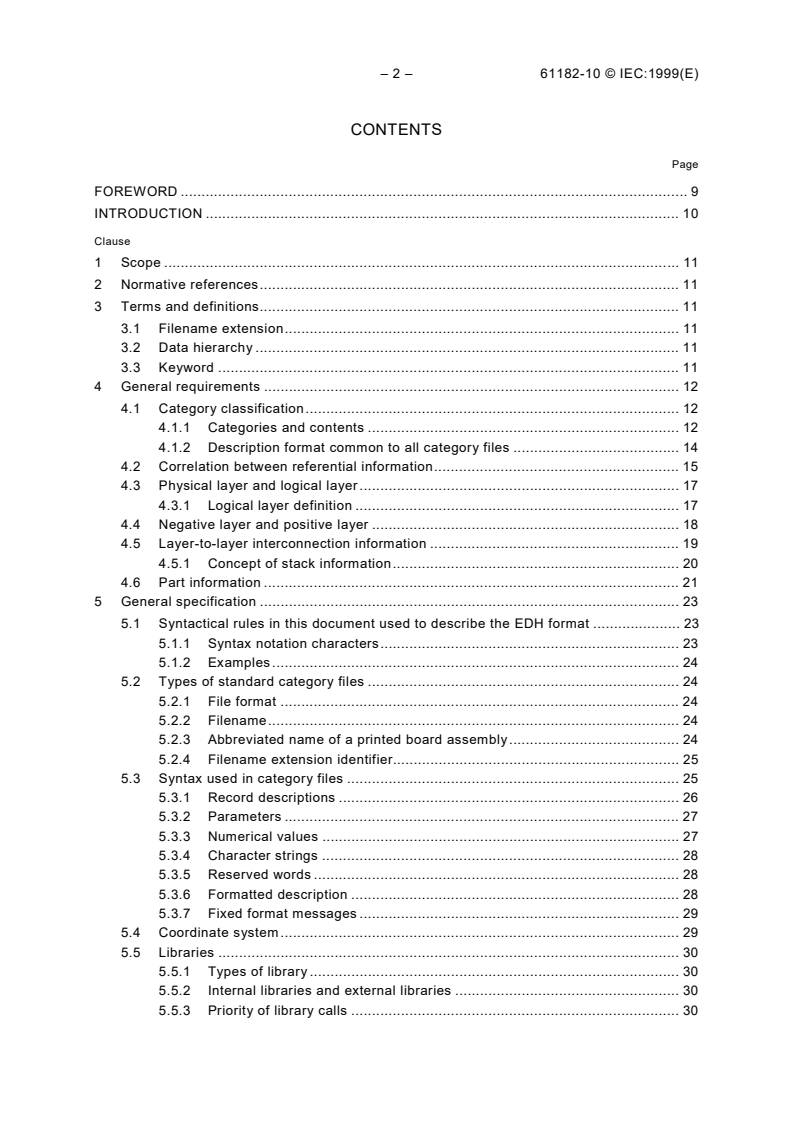
– 2 – 61182-10 © IEC:1999(E)
CONTENTS
Page
FOREWORD . 9
INTRODUCTION . 10
Clause
1 Scope . 11
2 Normative references. 11
3 Terms and definitions. 11
3.1 Filename extension. 11
3.2 Data hierarchy . 11
3.3 Keyword . 11
4 General requirements . 12
4.1 Category classification. 12
4.1.1 Categories and contents . 12
4.1.2 Description format common to all category files . 14
4.2 Correlation between referential information. 15
4.3 Physical layer and logical layer. 17
4.3.1 Logical layer definition . 17
4.4 Negative layer and positive layer . 18
4.5 Layer-to-layer interconnection information . 19
4.5.1 Concept of stack information. 20
4.6 Part information . 21
5 General specification . 23
5.1 Syntactical rules in this document used to describe the EDH format . 23
5.1.1 Syntax notation characters. 23
5.1.2 Examples . 24
5.2 Types of standard category files . 24
5.2.1 File format . 24
5.2.2 Filename. 24
5.2.3 Abbreviated name of a printed board assembly. 24
5.2.4 Filename extension identifier. 25
5.3 Syntax used in category files . 25
5.3.1 Record descriptions . 26
5.3.2 Parameters . 27
5.3.3 Numerical values . 27
5.3.4 Character strings . 28
5.3.5 Reserved words . 28
5.3.6 Formatted description . 28
5.3.7 Fixed format messages . 29
5.4 Coordinate system . 29
5.5 Libraries . 30
5.5.1 Types of library . 30
5.5.2 Internal libraries and external libraries . 30
5.5.3 Priority of library calls . 30
61182-10 © IEC:1999(E) – 3 –
Clause Page
5.6 General description format. 30
5.6.1 Types of statements. 30
5.6.2 "HEAD" statement. 31
5.6.3 "UNIT" statement . 31
5.6.4 "XCHAR" statement . 31
5.6.5 "COMMENT" statement. 31
5.6.6 "END" statement . 31
5.6.7 Description of comments. 32
5.6.8 "DEFOLD" statement . 32
5.6.9 "DEFATR" statement. 32
6 File for file control information (FIL) . 32
6.1 General information . 32
6.2 Types of statements. 32
6.2.1 "HEAD" statement. 33
6.2.2 "FORMAT" statement . 33
6.2.3 "LIMIT" statement . 33
6.2.4 "SYSTEM" statement . 34
6.2.5 "DATE" statement . 34
6.2.6 "AUTHOR" statement . 34
6.2.7 "FILE" statement . 34
6.2.8 "EXTERN" statement . 34
6.2.9 "NOSTD" statement . 34
6.2.10 "UNIT" statement . 34
6.2.11 "END" statement . 34
6.3 Example of file control information . 35
7 Management information file (MNG). 35
7.1 General information . 35
7.2 Types of statements. 35
7.2.1 "HEAD" statement. 36
7.2.2 "NAME" statement . 36
7.2.3 "DRAW" statement . 37
7.2.4 "EDITION" statement . 37
7.2.5 "DESIGNER" statement . 37
7.2.6 "OPERATOR" statement . 37
7.2.7 "END" statement . 37
7.3 Example of management information file. 37
8 Technology information file (TEC) . 38
8.1 General information . 38
8.2 Types of statements. 39
8.2.1 "HEAD" statement. 39
8.2.2 "VIEW" statement. 39
8.2.3 "BOARD" statement . 39
8.2.4 "LAYNO" statement. 39
8.2.5 "LAYER" statement . 40
8.2.6 "INTERL" statement . 40
8.2.7 "VIA" statement. 41
8.2.8 "GRID" statement. 41
– 4 – 61182-10 © IEC:1999(E)
Clause Page
8.2.9 "AREA" statement . 41
8.2.10 "CLEAR" statement. 41
8.2.11 "WIDTH" statement . 42
8.2.12 "UNIT" statement . 42
8.2.13 "END" statement . 42
9 Net information file (NET) . 42
9.1 General information . 42
9.1.1 Type of information . 43
9.1.2 Old and new NET data information. 43
9.1.3 Description of signal attributes . 43
9.2 Correlation between category files . 43
9.3 File format . 44
9.4 Types of statements. 44
9.5 Statement description format . 45
9.5.1 Net information . 45
9.5.2 Signal attributes. 46
9.6 Example of "NET" file. 52
10 Component information file (ELM) . 53
10.1 General information . 53
10.2 Correlation between category files . 53
10.3 File format . 53
10.4 Types of statements. 53
10.5 Record description format. 54
10.5.1 "ELMCMP" statement. 54
10.5.2 "XELMCMP" statement . 54
10.6 Example of "ELM" file . 55
11 Primitive figure libraries file (FLB) . 55
11.1 General information . 55
11.2 Correlation between category files . 55
11.3 Constituents of primitive figures libraries . 55
11.4 Types of statements. 56
11.5 Figure library central records. . 56
11.5.1 "HEAD" record . 56
11.5.2 "UNIT" record. 56
11.5.3 "CONTENTS" record . 57
11.5.4 "END" record . 57
11.6 Figure-shape library records . 57
11.6.1 Record sequence of figure-shape library . 57
11.6.2 "DEFFLIB" record. 57
11.6.3 "ENDFLIB" record . 57
11.6.4 Example of figure-shape library. 57
11.7 Hole library records . 58
11.7.1 Record sequence of hole library. 58
11.7.2 "DEFHLIB" record . 58
11.7.3 "DEFHOLE" record. 58
11.7.4 "ENDHOLE" record . 59
11.7.5 "ENDHLIB" record. 59
11.7.6 Example of hole library. 59
61182-10 © IEC:1999(E) – 5 –
Clause Page
11.8 Stack library records . 59
11.8.1 Record sequence of stack library . 59
11.8.2 "DEFSLIB" record . 60
11.8.3 "DEFSTK" record . 60
11.8.4 "STKFIG" record . 60
11.8.5 "STKHOLE" record. 60
11.8.6 "ENDSTK" record. 60
11.8.7 "ENDSLIB" record . 60
12 Part-shape library file (PRT) . 60
12.1 General information . 60
12.1.1 Rules for part-shape library definition. 60
12.2 Correlation between category files . 61
12.3 Elements included in part-shape library file. 61
12.4 Library items and contents . 61
12.5 Record sequence of part-shape library. 62
12.6 Record descriptions . 63
12.6.1 "DEFPLIB" record . 63
12.6.2 "DEFPRT" record . 63
12.6.3 "PRTDF1" record . 63
12.6.4 "PRTDF2" record . 64
12.6.5 "ENDPRT" record. 64
12.6.6 "ENDPLIB" record . 64
13 Component placement file (PLC). 64
13.1 General information . 64
13.2 Correlation between category files . 65
13.3 File format . 65
13.4 Type of statement . 65
13.5 Record description format. 65
13.5.1 Part placement data. 65
13.6 Example of "PLC" file. 66
14 Figure information file (FIG) . 66
14.1 File description concept . 66
14.1.1 List of keywords in "FIG" file . 66
14.1.2 Priority of land descriptions. 67
14.1.3 Component definitions . 67
14.1.4 Description of electrically connected figures. 68
14.1.5 Description of height limitations . 68
14.1.6 Priority of keywords . 68
14.1.7 Priority of overlapping positive/negative patterns . 68
14.1.8 Description of dimension lines. 68
14.1.9 Method for specifying default values of attributes. 69
14.2 Primitive figures. 69
14.2.1 Circle (see figure 24) . 69
14.2.2 Square (see figure 25) . 69
14.2.3 Rectangle (see figure 26). 70
14.2.4 Polygon (see figure 27) . 70
14.2.5 Line . 70
14.2.6 Text (see figure 28). 71
– 6 – 61182-10 © IEC:1999(E)
Clause Page
14.3 Attributes . 71
14.3.1 Color designation attributes . 71
14.3.2 Paint-in attributes (see figures 29 and 30) . 71
14.3.3 Line-width attribute (see figure 31) . 72
14.3.4 Line type attributes (see figure 32) . 72
14.3.5 Line end attributes (see figure 33) . 73
14.3.6 Text attributes (individually defined) (see figures 34 to 38) . 73
14.3.7 Text attribute (collectively defined) . 75
14.3.8 Rats-nest attributes . 75
14.3.9 Height description attributes . 75
14.3.10 Rotation description attribute . 75
14.3.11 Scale factor description attribute. 75
14.3.12 Line end modification attributes (see figure 39). 76
14.3.13 Conductive figure attributes . 76
14.4 Applicable attributes for each feature. 76
14.4.1 Line end attributes . 77
14.4.2 Scale and rotation. 77
14.5 Assignment of logical layer . 77
14.6 Grouping. 78
14.6.1 Grouping of primitive figures . 78
14.6.2 Grouping of electrically connected figures. 78
14.6.3 Grouping of attributes (referred by each figure statement). 78
14.6.4 Grouping of component information. 78
14.7 Calling of primitive figure libraries. 79
14.7.1 Figure-shape library. 79
14.7.2 Stack library. 79
14.7.3 Hole library . 79
14.8 Exchange of figures . 79
14.8.1 Exchange of registered figures. 79
14.8.2 Exchange of stack. 79
15 Back-annotation file (BAI) . 79
15.1 General information . 79
15.2 Correlation between category files . 80
15.3 File format . 80
15.4 Types of statements. 81
15.5 Statement description format . 81
15.5.1 Back-annotation information level 1 – component. 81
15.5.2 Back-annotation information level 2 – pin. 82
15.6 Description example of BAI file . 82
16 Summary EDH characteristics. 83
16.1 Column category file . 83
16.2 Column type . 83
16.3 Column key. 83
Bibliography . 89
61182-10 © IEC:1999(E) – 7 –
Figure 1 – EDH file structure . 13
Figure 2 – Correlation between referential category files . 15
Figure 3 – Correlation between figure-related files . 16
Figure 4 – Correlation between net-related files . 16
Figure 5 – Physical layer and logical layer. 17
Figure 6 – Physical layer numbering. 18
Figure 7 – Concept of negative layer and positive layer. 19
Figure 8 – Layer-to-layer interconnection . 20
Figure 9 – Registration of shapes. 21
Figure 10 – Registration of stacks . 21
Figure 11 – Part-shape specification . 22
Figure 12 – Registration of part shape. 23
Figure 13 – Format structure . 26
Figure 14 – Numbering convention . 27
Figure 15 – Coordinate positioning . 30
Figure 16 – Name statement . 36
Figure 17 – File correlation with net file. 44
Figure 18 – Component information file correlation. 53
Figure 19 – Primitive figure library file correlation. 55
Figure 20 – Example of the three library types. 56
Figure 21 – Part-shape library file correlation . 61
Figure 22 – Dip part-shape library example . 61
Figure 23 – Component placement file correlation . 65
Figure 24 – Circle. 69
Figure 25 – Square. 69
Figure 26 – Rectangle . 70
Figure 27 – Polygon .70
Figure 28 – Text. 71
Figure 29 – Paint-in designation . 71
Figure 30 – Paint-in mesh . 71
Figure 31 – Line width .72
Figure 32 – Line type attributes . 72
Figure 33 – Line end attributes. 73
Figure 34 – Text character height. 73
Figure 35 – Rotation angle . 73
Figure 36 – Character width adjustment . 74
Figure 37 – Horizontal space. 74
Figure 38 – Character string positioning . 75
Figure 39 – Line end modification attributes . 76
Figure 40 – Square line end attribute example . 77
Figure 41 – Back-annotation correlation . 80
Table 1 – EDH file descriptions . 12
Table 2 – EDH file name extension and content . 14
Table 3 – Format of category file name . 14
Table 4 – File structure .14
Table 5 – Statement format . 15
Table 6 – Key items which connect the related category files for figure information
interchange . 16
Table 7 – Key items which connect the related category files for net information
interchange . 17
Table 8 – Logical layer content. 18
– 8 – 61182-10 © IEC:1999(E)
Table 9 – Syntax notation characters for this document. 23
Table 10 – Standard category files and their extension identifiers . 25
Table 11 – Types of parameters . 27
Table 12 – Description of character strings – Example . 28
Table 13 – Statement types common for all category files . 31
Table 14 – Statement types permitted in file for file control information . 33
Table 15 – Example of file control information . 35
Table 16 – Statement types permitted in the management information file. 36
Table 17 – Management information file . 38
Table 18 – Statement types permitted in basic information files. 39
Table 19 – Types of logical layers . 40
Table 20 – Elements to which the clearance specification is applied. 42
Table 21 – Net file format order. 44
Table 22 – Type of statement . 45
Table 23 – ELM statement. 54
Table 24 – Library types. 55
Table 25 – Primitive figures library statements . 56
Table 26 – Example of figure-shape library. 58
Table 27 – Example of hole library . 59
Table 28 – Part-shape library items and contents . 62
Table 29 – Record sequence of part-shape library statements. 63
Table 30 – Component placement file – Type of statement. 65
Table 31 – Figure information keywords . 67
Table 32 – Attribute/Feature matrix . 77
Table 33 – Back-annotation file format . 80
Table 34 – Back-annotation file – Types of statements. 81
Table 35 – File and term summary . 83
61182-10 © IEC:1999(E) – 9 –
INTERNATIONAL ELECTROTECHNICAL COMMISSION
–––––––––––
PRINTED BOARDS –
ELECTRONIC DATA DESCRIPTION AND TRANSFER –
Part 10: Electronic data hierarchy
FOREWORD
1) The IEC (International Electrotechnical Commission) is a worldwide organization for standardization comprising
all national electrotechnical committees (IEC National Committees). The object of the IEC is to promote
international co-operation on all questions concerning standardization in the electrical and electronic fields. To
this end and in addition to other activities, the IEC publishes International Standards. Their preparation is
entrusted to technical committees; any IEC National Committee interested in the subject dealt with may
participate in this preparatory work. International, governmental and non-governmental organizations liaising
with the IEC also participate in this preparation. The IEC collaborates closely with the International
Organization for Standardization (ISO) in accordance with conditions determined by agreement between the
two organizations.
2) The formal decisions or agreements of the IEC on technical matters express, as nearly as possible, an
international consensus of opinion on the relevant subjects since each technical committee has representation
from all interested National Committees.
3) The documents produced have the form of recommendations for international use and are published in the form
of standards, technical specifications, technical reports or guides and they are accepted by the National
Committees in that sense.
4) In order to promote international unification, IEC National Committees undertake to apply IEC International
Standards transparently to the maximum extent possible in their national and regional standards. Any
divergence between the IEC Standard and the corresponding national or regional standard shall be clearly
indicated in the latter.
5) The IEC provides no marking procedure to indicate its approval and cannot be rendered responsible for any
equipment declared to be in conformity with one of its standards.
6) Attention is drawn to the possibility that some of the elements of this International Standard may be the subject
of patent rights. The IEC shall not be held responsible for identifying any or all such patent rights.
International Standard IEC 61182-10 has been prepared by IEC technical committee 52:
Printed circuits.
The text of this standard is based on the following documents:
FDIS Report on voting
52/831/FDIS 52/839/RVD
Full information on the voting for the approval of this standard can be found in the report on
voting indicated in the above table.
This publication has been drafted in accordance with the ISO/IEC Directives, Part 3.
A bilingual version of this standard may be issued at a later date.
The committee has decided that the contents of this publication will remain unchanged
until 2004. At this date, the publication will be
• reconfirmed;
• withdrawn;
• replaced by a revised edition, or
• amended.
– 10 – 61182-10 © IEC:1999(E)
INTRODUCTION
This standard is intended to provide information on a series of data files that contain
information, in an organized fashion, to convey the completed design description of a printed
board and a printed board assembly. The data may be exchanged between Computer-Aided
Design (CAD) Systems, Computer-Aided Engineering (CAE) Systems or Computer Aided
Manufacturing (CAM) Systems.
The information about the design is organized into specific category files, where each file has
a specific function and is independent of each other. Data exchange for a specific purpose is
possible only if the category file information has been prepared in the CAD system or if a user
desires to provide certain data to those outside the design function. The information about a
unique printed board or printed board assembly is contained in a single file which is headed
by “file control information” provided to identify those characteristics contained in the file.
Specific rules for syntax are described for each file category as are the methodologies for
organizing the information in a cohesive, unambiguous manner.
The format and syntax of EDH consists of statements that are prefaced by a unique “keyword”
followed by one or more parameters intended to provide the necessary information.
Parameters consist of numeric values and character strings, which maybe general character
strings, reserved words, formatted descriptions and/or fixed format messages. Although the
language for keywords and parameters is “English” using the ISO 7-bit coded character set
(ISO registration number 006), any character set may be used for informational purposes or
comment descriptions provided the language has a registration number according to
ISO/IEC 646.
EDH category files are a small subset of other neutral design formats. These larger formats
are intended to provide and define behavioral characteristics, design rules, simulation
parameters, drawing information, timing analysis, etc., some of which may be user
proprietary. The EDH category files bear a close relationship with design representation
formats such as EDIF (IEC 61690-2) and STEP (ISO 10303, Parts 201 and 210). It is intended
for this relationship to be maintained through continued surveillance by the originating
committees. Inter-operational ability between these formats is important so that information
content is mutually consistent. This coordination is necessary as technology changes require
reassessments of keywords and parameters.
...