


IEC 61215-1-4:2016
(Main)Terrestrial photovoltaic (PV) modules - Design qualification and type approval - Part 1-4: Special requirements for testing of thin-film Cu(In,GA)(S,Se)2 based photovoltaic (PV) modules
Terrestrial photovoltaic (PV) modules - Design qualification and type approval - Part 1-4: Special requirements for testing of thin-film Cu(In,GA)(S,Se)<sub>2</sub> based photovoltaic (PV) modules
IEC 61215-1-4:2016 lays down requirements for the design qualification and type approval of terrestrial photovoltaic modules suitable for long-term operation in general open-air climates, as defined in IEC 60721-2-1. This document is intended to apply to all thin-film Cu(In,Ga)(S,Se)2 based terrestrial flat plate modules. As such it addresses special requirements for testing of this technology supplementing IEC 61215-1:2016 and IEC 61215-2:2016 requirements for testing.
Modules photovoltaïques (PV) pour applications terrestres - Qualification de la conception et homologation - Partie 1-4: Exigences particulières d'essai des modules photovoltaïques (PV) au Cu(In,GA)(S,Se)<sub>2</sub> à couches minces
L'61215-1-4:2016 établit les exigences pour la qualification de la conception et l'homologation des modules photovoltaïques (PV) pour applications terrestres et pour une utilisation de longue durée dans les grandes zones climatiques à l'air libre, telles qu'elles sont définies dans l'IEC 60721-2-1. Le présent document est destiné à s'appliquer à tous les modules à plaque plane au Cu(In,Ga)(S,Se)2 à couches minces pour applications terrestres. A ce titre, il spécifie des exigences d'essai particulières à cette technologie en complément des exigences d'essai spécifiées dans
l'IEC 61215-1:2016 and l'IEC 61215-2:2016.
General Information
Relations
Overview
IEC 61215-1-4:2016 is an international standard developed by the International Electrotechnical Commission (IEC) focused on design qualification and type approval of terrestrial photovoltaic (PV) modules specifically based on thin-film Cu(In,Ga)(S,Se)2 technology. This standard supplements the general IEC 61215-1:2016 and IEC 61215-2:2016 standards by addressing special testing requirements that cater to this unique thin-film PV technology.
Designed for long-term operation in open-air climates, as defined by IEC 60721-2-1, IEC 61215-1-4:2016 targets terrestrial flat-plate PV modules. The standard excludes high-concentration photovoltaic modules but can be used for modules operating at low concentration levels (1 to 3 suns), adjusting the required testing conditions accordingly.
The primary objective of this standard is to verify the electrical and thermal characteristics of Cu(In,Ga)(S,Se)2 thin-film modules and confirm their ability to endure prolonged environmental exposure, assuring reliability and durability under various climate conditions.
Key Topics
Scope and Object
- Qualification and type approval of thin-film Cu(In,Ga)(S,Se)2 based terrestrial PV modules.
- Focus on long-term operation in general open-air climates.
- Applicable to flat-plate modules; excludes concentrated sunlight modules except low-concentration exceptions.
- Supplements IEC 61215 series standards with technology-specific testing requirements.
Testing and Procedures
IEC 61215-1-4:2016 outlines detailed testing methods, including but not limited to:
- Visual inspection (MQT 01) to identify manufacturing defects.
- Maximum power determination (MQT 02) to evaluate module performance.
- Insulation tests (MQT 03) ensuring electrical safety.
- Temperature coefficient and nominal operating temperature measurements (MQT 04, MQT 05) to analyze performance stability across temperature variations.
- Performance tests at Standard Test Conditions (STC) and Nominal Module Operating Temperature (NMOT) (MQT 06.1, MQT 06.2).
- Environmental endurance tests such as outdoor exposure (MQT 08), hot-spot endurance (MQT 09), UV preconditioning (MQT 10), thermal cycling (MQT 11), humidity-freeze (MQT 12), and damp heat (MQT 13).
- Mechanical robustness tests, including static mechanical load (MQT 16) and hail tests (MQT 17).
- Bypass diode testing (MQT 18) and stabilization procedures (MQT 19) tailored specifically for thin-film modules, ensuring power output consistency and identifying degradation modes.
Pass/Fail Criteria and Documentation
The standard specifies pass criteria for each test to ensure quality and reliability. It requires comprehensive marking and documentation to maintain traceability and regulatory compliance. Additionally, detailed test reports must be generated following the prescribed format to facilitate assessment and certification.
Applications
IEC 61215-1-4:2016 is essential for:
- Manufacturers of thin-film Cu(In,Ga)(S,Se)2 photovoltaic modules aiming for international market access.
- Certification bodies conducting design qualification and type approval for thin-film PV technologies.
- Project developers and installers seeking validated module performance and durability information to ensure project reliability.
- Research and development teams to benchmark thin-film module performance under standardized testing regimes.
- Quality assurance professionals monitoring photovoltaic module manufacturing and testing processes to meet stringent quality standards.
This standard is crucial in advancing thin-film PV technology with validated performance and reliability, supporting sustainable solar energy development worldwide.
Related Standards
IEC 61215-1-4:2016 complements and modifies requirements from several related IEC standards, including:
- IEC 61215-1:2016 – General design qualification and type approval tests for terrestrial PV modules.
- IEC 61215-2:2016 – Additional testing methods supplementing the design qualification process.
- IEC 60721-2-1 – Environmental classification for open-air climate conditions.
- IEC 61646 (superseded) – Former standard for thin-film terrestrial PV modules, replaced by IEC 61215-1-4:2016.
By harmonizing with these standards, IEC 61215-1-4 ensures a consistent and reliable framework tailored to the specific needs of thin-film Cu(In,Ga)(S,Se)2 photovoltaic modules.
Keywords: IEC 61215-1-4, thin-film photovoltaic modules, Cu(In,Ga)(S,Se)2, PV module testing, design qualification, type approval, terrestrial PV, IEC standards, photovoltaic module durability, module performance testing, thin-film solar technology, photovoltaic standards.
Frequently Asked Questions
IEC 61215-1-4:2016 is a standard published by the International Electrotechnical Commission (IEC). Its full title is "Terrestrial photovoltaic (PV) modules - Design qualification and type approval - Part 1-4: Special requirements for testing of thin-film Cu(In,GA)(S,Se)<sub>2</sub> based photovoltaic (PV) modules". This standard covers: IEC 61215-1-4:2016 lays down requirements for the design qualification and type approval of terrestrial photovoltaic modules suitable for long-term operation in general open-air climates, as defined in IEC 60721-2-1. This document is intended to apply to all thin-film Cu(In,Ga)(S,Se)2 based terrestrial flat plate modules. As such it addresses special requirements for testing of this technology supplementing IEC 61215-1:2016 and IEC 61215-2:2016 requirements for testing.
IEC 61215-1-4:2016 lays down requirements for the design qualification and type approval of terrestrial photovoltaic modules suitable for long-term operation in general open-air climates, as defined in IEC 60721-2-1. This document is intended to apply to all thin-film Cu(In,Ga)(S,Se)2 based terrestrial flat plate modules. As such it addresses special requirements for testing of this technology supplementing IEC 61215-1:2016 and IEC 61215-2:2016 requirements for testing.
IEC 61215-1-4:2016 is classified under the following ICS (International Classification for Standards) categories: 01 - GENERALITIES. TERMINOLOGY. STANDARDIZATION. DOCUMENTATION; 27.160 - Solar energy engineering. The ICS classification helps identify the subject area and facilitates finding related standards.
IEC 61215-1-4:2016 has the following relationships with other standards: It is inter standard links to IEC 61646:2008, IEC 61215-1-4:2021. Understanding these relationships helps ensure you are using the most current and applicable version of the standard.
You can purchase IEC 61215-1-4:2016 directly from iTeh Standards. The document is available in PDF format and is delivered instantly after payment. Add the standard to your cart and complete the secure checkout process. iTeh Standards is an authorized distributor of IEC standards.
Standards Content (Sample)
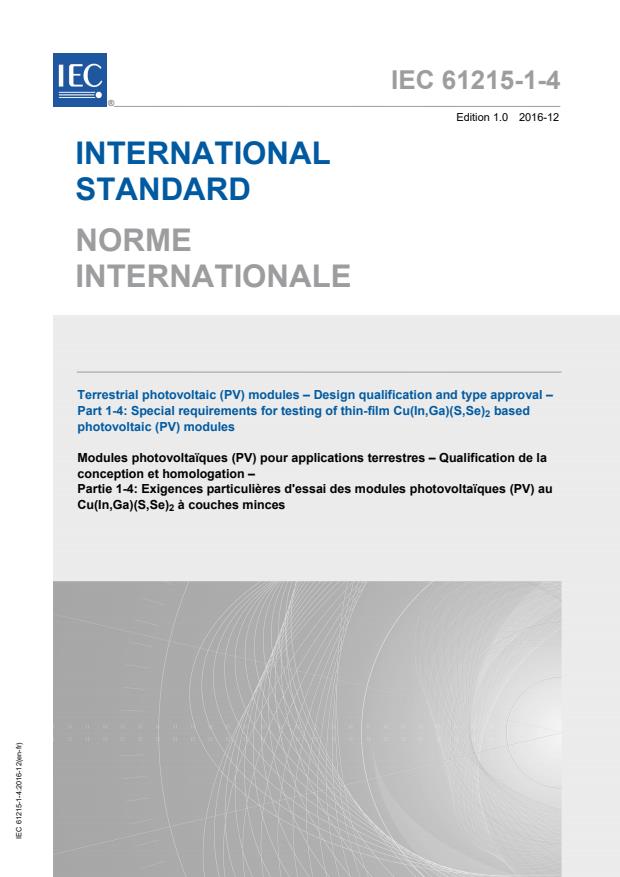
IEC 61215-1-4 ®
Edition 1.0 2016-12
INTERNATIONAL
STANDARD
NORME
INTERNATIONALE
Terrestrial photovoltaic (PV) modules – Design qualification and type approval –
Part 1-4: Special requirements for testing of thin-film Cu(In,Ga)(S,Se) based
photovoltaic (PV) modules
Modules photovoltaïques (PV) pour applications terrestres – Qualification de la
conception et homologation –
Partie 1-4: Exigences particulières d'essai des modules photovoltaïques (PV) au
Cu(In,Ga)(S,Se) à couches minces
All rights reserved. Unless otherwise specified, no part of this publication may be reproduced or utilized in any form
or by any means, electronic or mechanical, including photocopying and microfilm, without permission in writing from
either IEC or IEC's member National Committee in the country of the requester. If you have any questions about IEC
copyright or have an enquiry about obtaining additional rights to this publication, please contact the address below or
your local IEC member National Committee for further information.
Droits de reproduction réservés. Sauf indication contraire, aucune partie de cette publication ne peut être reproduite
ni utilisée sous quelque forme que ce soit et par aucun procédé, électronique ou mécanique, y compris la photocopie
et les microfilms, sans l'accord écrit de l'IEC ou du Comité national de l'IEC du pays du demandeur. Si vous avez des
questions sur le copyright de l'IEC ou si vous désirez obtenir des droits supplémentaires sur cette publication, utilisez
les coordonnées ci-après ou contactez le Comité national de l'IEC de votre pays de résidence.
IEC Central Office Tel.: +41 22 919 02 11
3, rue de Varembé Fax: +41 22 919 03 00
CH-1211 Geneva 20 info@iec.ch
Switzerland www.iec.ch
About the IEC
The International Electrotechnical Commission (IEC) is the leading global organization that prepares and publishes
International Standards for all electrical, electronic and related technologies.
About IEC publications
The technical content of IEC publications is kept under constant review by the IEC. Please make sure that you have the
latest edition, a corrigenda or an amendment might have been published.
IEC Catalogue - webstore.iec.ch/catalogue Electropedia - www.electropedia.org
The stand-alone application for consulting the entire The world's leading online dictionary of electronic and
bibliographical information on IEC International Standards, electrical terms containing 20 000 terms and definitions in
Technical Specifications, Technical Reports and other English and French, with equivalent terms in 15 additional
documents. Available for PC, Mac OS, Android Tablets and languages. Also known as the International Electrotechnical
iPad. Vocabulary (IEV) online.
IEC publications search - www.iec.ch/searchpub IEC Glossary - std.iec.ch/glossary
The advanced search enables to find IEC publications by a 65 000 electrotechnical terminology entries in English and
variety of criteria (reference number, text, technical French extracted from the Terms and Definitions clause of
committee,…). It also gives information on projects, replaced IEC publications issued since 2002. Some entries have been
and withdrawn publications. collected from earlier publications of IEC TC 37, 77, 86 and
CISPR.
IEC Just Published - webstore.iec.ch/justpublished
Stay up to date on all new IEC publications. Just Published IEC Customer Service Centre - webstore.iec.ch/csc
details all new publications released. Available online and If you wish to give us your feedback on this publication or
also once a month by email. need further assistance, please contact the Customer Service
Centre: csc@iec.ch.
A propos de l'IEC
La Commission Electrotechnique Internationale (IEC) est la première organisation mondiale qui élabore et publie des
Normes internationales pour tout ce qui a trait à l'électricité, à l'électronique et aux technologies apparentées.
A propos des publications IEC
Le contenu technique des publications IEC est constamment revu. Veuillez vous assurer que vous possédez l’édition la
plus récente, un corrigendum ou amendement peut avoir été publié.
Catalogue IEC - webstore.iec.ch/catalogue Electropedia - www.electropedia.org
Application autonome pour consulter tous les renseignements
Le premier dictionnaire en ligne de termes électroniques et
bibliographiques sur les Normes internationales,
électriques. Il contient 20 000 termes et définitions en anglais
Spécifications techniques, Rapports techniques et autres
et en français, ainsi que les termes équivalents dans 15
documents de l'IEC. Disponible pour PC, Mac OS, tablettes
langues additionnelles. Egalement appelé Vocabulaire
Android et iPad.
Electrotechnique International (IEV) en ligne.
Recherche de publications IEC - www.iec.ch/searchpub
Glossaire IEC - std.iec.ch/glossary
65 000 entrées terminologiques électrotechniques, en anglais
La recherche avancée permet de trouver des publications IEC
en utilisant différents critères (numéro de référence, texte, et en français, extraites des articles Termes et Définitions des
comité d’études,…). Elle donne aussi des informations sur les publications IEC parues depuis 2002. Plus certaines entrées
projets et les publications remplacées ou retirées. antérieures extraites des publications des CE 37, 77, 86 et
CISPR de l'IEC.
IEC Just Published - webstore.iec.ch/justpublished
Service Clients - webstore.iec.ch/csc
Restez informé sur les nouvelles publications IEC. Just
Published détaille les nouvelles publications parues. Si vous désirez nous donner des commentaires sur cette
Disponible en ligne et aussi une fois par mois par email. publication ou si vous avez des questions contactez-nous:
csc@iec.ch.
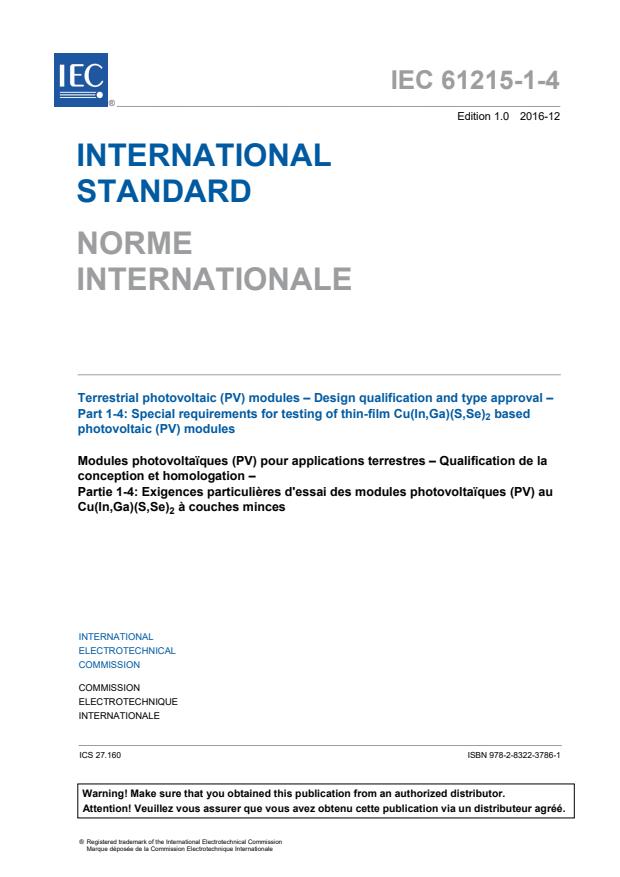
IEC 61215-1-4 ®
Edition 1.0 2016-12
INTERNATIONAL
STANDARD
NORME
INTERNATIONALE
Terrestrial photovoltaic (PV) modules – Design qualification and type approval –
Part 1-4: Special requirements for testing of thin-film Cu(In,Ga)(S,Se) based
photovoltaic (PV) modules
Modules photovoltaïques (PV) pour applications terrestres – Qualification de la
conception et homologation –
Partie 1-4: Exigences particulières d'essai des modules photovoltaïques (PV) au
Cu(In,Ga)(S,Se) à couches minces
INTERNATIONAL
ELECTROTECHNICAL
COMMISSION
COMMISSION
ELECTROTECHNIQUE
INTERNATIONALE
ICS 27.160 ISBN 978-2-8322-3786-1
– 2 – IEC 61215-1-4:2016 © IEC 2016
CONTENTS
FOREWORD . 3
1 Scope and object . 5
2 Normative references . 5
3 Terms and definitions . 5
4 Test samples . 5
5 Marking and documentation . 5
6 Testing . 5
7 Pass criteria . 6
8 Major visual defects . 6
9 Report . 6
10 Modifications . 6
11 Test flow and procedures . 6
11.1 Visual inspection (MQT 01) . 6
11.2 Maximum power determination (MQT 02) . 6
11.3 Insulation test (MQT 03) . 6
11.4 Measurement of temperature coefficients (MQT 04) . 6
11.5 Measurement of nominal module operating temperature (NMOT) (MQT 05) . 6
11.6 Performance at STC (MQT 06.1) and NMOT (MQT 06.2) . 6
11.7 Performance at low irradiance (MQT 07) . 6
11.8 Outdoor exposure test (MQT 08) . 7
11.9 Hot-spot endurance test (MQT 09) . 7
11.9.1 Purpose . 7
11.9.2 Hot-spot effect . 7
11.9.3 Classification of cell interconnection . 7
11.9.4 Apparatus . 7
11.9.5 Procedure . 7
11.9.6 Final measurements . 7
11.9.7 Requirements . 7
11.10 UV preconditioning test (MQT 10) . 7
11.11 Thermal cycling test (MQT 11) . 7
11.12 Humidity-freeze test (MQT 12) . 7
11.13 Damp heat test (MQT 13) . 8
11.13.1 Procedure . 8
11.14 Robustness of terminations test (MQT 14) . 8
11.15 Wet leakage current test (MQT 15) . 8
11.16 Static mechanical load test (MQT 16) . 8
11.17 Hail test (MQT 17) . 8
11.18 Bypass diode testing (MQT 18) . 8
11.19 Stabilization (MQT 19) . 8
11.19.1 Criterion definition for stabilization . 8
11.19.2 Light induced stabilization procedure . 9
11.19.3 Other stabilization procedures . 9
11.19.4 Initial stabilization (MQT 19.1) . 9
11.19.5 Final stabilization (MQT 19.2) . 9
INTERNATIONAL ELECTROTECHNICAL COMMISSION
____________
TERRESTRIAL PHOTOVOLTAIC (PV) MODULES –
DESIGN QUALIFICATION AND TYPE APPROVAL –
Part 1-4: Special requirements for testing of thin-film
Cu(In,Ga)(S,Se) based photovoltaic (PV) modules
FOREWORD
1) The International Electrotechnical Commission (IEC) is a worldwide organization for standardization comprising
all national electrotechnical committees (IEC National Committees). The object of IEC is to promote
international co-operation on all questions concerning standardization in the electrical and electronic fields. To
this end and in addition to other activities, IEC publishes International Standards, Technical Specifications,
Technical Reports, Publicly Available Specifications (PAS) and Guides (hereafter referred to as “IEC
Publication(s)”). Their preparation is entrusted to technical committees; any IEC National Committee interested
in the subject dealt with may participate in this preparatory work. International, governmental and non-
governmental organizations liaising with the IEC also participate in this preparation. IEC collaborates closely
with the International Organization for Standardization (ISO) in accordance with conditions determined by
agreement between the two organizations.
2) The formal decisions or agreements of IEC on technical matters express, as nearly as possible, an international
consensus of opinion on the relevant subjects since each technical committee has representation from all
interested IEC National Committees.
3) IEC Publications have the form of recommendations for international use and are accepted by IEC National
Committees in that sense. While all reasonable efforts are made to ensure that the technical content of IEC
Publications is accurate, IEC cannot be held responsible for the way in which they are used or for any
misinterpretation by any end user.
4) In order to promote international uniformity, IEC National Committees undertake to apply IEC Publications
transparently to the maximum extent possible in their national and regional publications. Any divergence
between any IEC Publication and the corresponding national or regional publication shall be clearly indicated in
the latter.
5) IEC itself does not provide any attestation of conformity. Independent certification bodies provide conformity
assessment services and, in some areas, access to IEC marks of conformity. IEC is not responsible for any
services carried out by independent certification bodies.
6) All users should ensure that they have the latest edition of this publication.
7) No liability shall attach to IEC or its directors, employees, servants or agents including individual experts and
members of its technical committees and IEC National Committees for any personal injury, property damage or
other damage of any nature whatsoever, whether direct or indirect, or for costs (including legal fees) and
expenses arising out of the publication, use of, or reliance upon, this IEC Publication or any other IEC
Publications.
8) Attention is drawn to the Normative references cited in this publication. Use of the referenced publications is
indispensable for the correct application of this publication.
9) Attention is drawn to the possibility that some of the elements of this IEC Publication may be the subject of
patent rights. IEC shall not be held responsible for identifying any or all such patent rights.
International Standard IEC 61215-1-4 has been prepared by IEC technical committee 82:
Solar photovoltaic energy systems.
This edition cancels and replaces the second edition of IEC 61646, issued in 2008, and
constitutes a technical revision.
It constitutes a technical revision for thin-film Cu(In,Ga)(S,Se) based terrestrial photovoltaic
modules.
This standard is to be read in conjunction with IEC 61215-1:2016 and IEC 61215-2:2016.
– 4 – IEC 61215-1-4:2016 © IEC 2016
The text of this standard is based on the following documents:
FDIS Report on voting
82/1184/FDIS 82/1208/RVD
Full information on the voting for the approval of this International Standard can be found in
the report on voting indicated in the above table.
This document has been drafted in accordance with the ISO/IEC Directives, Part 2.
A list of all parts in the IEC 61215 series, published under the general title Terrestrial
photovoltaic (PV) modules – Design qualification and type approval, can be found on the IEC
website.
The committee has decided that the contents of this document will remain unchanged until the
stability date indicated on the IEC website under "http://webstore.iec.ch" in the data related to
the specific document. At this date, the document will be
• reconfirmed,
• withdrawn,
• replaced by a revised edition, or
• amended.
TERRESTRIAL PHOTOVOLTAIC (PV) MODULES –
DESIGN QUALIFICATION AND TYPE APPROVAL –
Part 1-4: Special requirements for testing of thin-film
Cu(In,Ga)(S,Se) based photovoltaic (PV) modules
1 Scope and object
This part of IEC 61215 lays down IEC requirements for the design qualification and type
approval of terrestrial photovoltaic modules suitable for long-term operation in general open-
air climates, as defined in IEC 60721-2-1. This document is intended to apply to all thin-film
Cu(In,Ga)(S,Se) based terrestrial flat plate modules. As such it addresses special
requirements for testing of this technology supplementing IEC 61215-1:2016 and IEC 61215-
2:2016 requirements for testing.
This document does not apply to modules used with concentrated sunlight although it may be
utilized for low concentrator modules (1 to 3 suns). For low concentration modules, all tests
are performed using the current, voltage and power levels expected at the design
concentration.
The object of this test sequence is to determine the electrical and thermal characteristics of
the module and to show, as far as possible within reasonable constraints of cost and time,
that the module is capable of withstanding prolonged exposure in climates described in the
scope. The actual lifetime expectancy of modules so qualified will depend on their design,
their environment and the conditions under which they are operated.
This document defines PV technology dependent modifications to the testing procedures and
requirements per IEC 61215-1:2016 and IEC 61215-2:2016.
2 Normative references
The normative references of IEC 61215-1:2016 and IEC 61215-2:2016 are applicable without
modifications.
3 Terms and definitions
This clause of IEC 61215-1:2016 is applicable without modifications.
4 Test samples
This clause of IEC 61215-1:2016 is applicable without modifications.
5 Marking and documentation
This clause of IEC 61215-1:2016 is applicable without modifications.
6 Testing
This clause of IEC 61215-1:2016 is applicable with the following modifications:
– 6 – IEC 61215-1-4:2016 © IEC 2016
Special care has to be taken for stabilizing the power output of the module using MQT 19
procedure with specific requirements stated in 11.19 below.
7 Pass criteria
This clause of IEC 61215-1:2016 is applicable with the following modifications.
The maximum allowable value of reproducibility is set to r = 2,0 %.
8 Major visual defects
This clause of IEC 61215-1:2016 is applicable without modifications.
9 Report
This clause of IEC 61215-1:2016 is applicable without modifications.
10 Modifications
This clause of IEC 61215-1:2016 is applicable without modifications.
11 Test flow and procedures
The test flow from IEC 61215-1:2016 is applicable.
11.1 Visual inspection (MQT 01)
This test of IEC 61215-2:2016 is applicable without modifications.
11.2 Maximum power determination (MQT 02)
This test of IEC 61215-2:2016 is applicable without modifications.
11.3 Insulation test (MQT 03)
This test of IEC 61215-2:2016 is applicable without modifications.
11.4 Measurement of temperature coefficients (MQT 04)
This test of IEC 61215-2:2016 is applicable without modifications.
11.5 Measurement of nominal module operating temperature (NMOT) (MQT 05)
This test of IEC 61215-2:2016 is applicable without modifications.
11.6 Performance at STC (MQT 06.1) and NMOT (MQT 06.2)
This test of IEC 61215-2:2016 is applicable without modifications.
11.7 Performance at low irradiance (MQT 07)
This test of IEC 61215-2:2016 is applicable without modifications.
11.8 Outdoor exposure test (MQT 08)
This test of IEC 61215-2:2016 is applicable without modifications.
11.9 Hot-spot endurance test (MQT 09)
This test of IEC 61215-2:2016 is applicable with the following modifications:
Cu(In,Ga)(S,Se) thin-film modules may exhibit performance changes with extended time in
storage without light exposure (the “dark soak” effect). In order to minimize the influence of
this dark soak effect, limit the time delay between the outdoor exposure or stabilization and
the hot spot procedure to within 2 to 3 days; the modules are to be stored in the dark at
≤ 25 °C.
11.9.1 Purpose
This subclause of IEC 61215-2:2016, test MQT 09, is applicable without modifications.
11.9.2 Hot-spot effect
This subclause of IEC 61215-2:2016, test MQT 09, is applicable without modifications.
11.9.3 Classification of cell interconnection
This subclause of IEC 61215-2:2016, test MQT 09, is applicable without modifications.
11.9.4 Apparatus
This subclause of IEC 61215-2:2016, test MQT 09, is applicable without modifications.
11.9.5 Procedure
MQT 09.2 of IEC 61215-2:2016 shall be performed for any MLI module design.
If module is constructed by interconnection of cell-like substructures, MQT 09.1 of
IEC 61215-2:2016 may be applicable.
11.9.6 Final measurements
This subclause of IEC 61215-2:2016, test MQT 09, is applicable without modifications.
11.9.7 Requirements
This subclause of IEC 61215-2:2016, test MQT 09, is applicable without modifications.
11.10 UV preconditioning test (MQT 10)
This test of IEC 61215-2:2016 is applicable without modifications.
11.11 Thermal cycling test (MQT 11)
This test of IEC 61215-2:2016 is applicable with the following modifications:
The technology specific current which needs to be applied according to MQT 11 of
IEC 61215-2:2016 shall be equal to 0,1 × STC peak power current.
11.12 Humidity-freeze test (MQT 12)
This test of IEC 61215-2:2016 is applicable without modifications.
– 8 – IEC 61215-1-4:2016 © IEC 2016
11.13 Damp heat test (MQT 13)
This test of IEC 61215-2:2016 is applicable with the following modifications:
MQT 13 of IEC 61215-2:2016 can be conducted according to the following methods:
Method A) Perform MQT 13 as defined in IEC 61215-2:2016.
Method B) Perform MQT 13 as defined in IEC 61215-2:2016 with applied forward bias:
11.13.1 Procedure
a) Attach a suitable temperature sensor (see apparatus requirements of MQT 11) to the front
or back surface of the module(s) near the middle. If more than one module of the same
type is tested simultaneously, it will suffice to monitor the temperature of one
representative sample.
b) Connect the temperature-monitoring equipment to the temperature sensor(s). Connect
each module individually to the appropriate voltage supply by connecting the positive
terminal of the module to the positive terminal of the power supply and the second
terminal accordingly. During the damp-heat set the applied voltage to V ± 5 % at STC
mpp
taken from the data-sheet and limit the current of the power supply to less than 25 % of I
sc
at STC.
c) Throughout the test monitor the module’s applied voltage and current. Report I/V-trend. If
current limit is reached, applied voltage can drop below V ± 5 % at STC.
mpp
d) Set chamber temperature to achieve a module temperature of 85 °C ± 2 °C.
e) During cooling phase to ambient temperature (25 °C or less), the specified applied voltage
shall be maintained and shall be switched off when the module temperature reaches
25 °C ± 5 °C.
11.14 Robustness of terminations test (MQT 14)
This test of IEC 61215-2:2016 is applicable without modifications.
11.15 Wet leakage current test (MQT 15)
This test of IEC 61215-2:2016 is applicable without modifications.
11.16 Static mechanical load test (MQT 16)
This test of IEC 61215-2:2016 is applicable without modifications.
11.17 Hail test (MQT 17)
This test of IEC 61215-2:2016 is applicable without modifications.
11.18 Bypass diode testing (MQT 18)
This test of IEC 61215-2:2016 is applicable without modifications.
11.19 Stabilization (MQT 19)
This test of IEC 61215-2:2016 is applicable with the following modifications:
11.19.1 Criterion definition for stabilization
For the definition of stabilization as per MQT 19 of IEC 61215-2:2016, x = 0,02 shall be used.
Any kind of storage shall be done at temperature below 25 °C to avoid thermal activated
processes affecting MQT 06.1 of IEC 61215-2:2016 measurement.
11.19.2 Light induced stabilization procedure
This test of IEC 61215-2:2016 is applicable without modifications.
11.19.3 O
...
Questions, Comments and Discussion
Ask us and Technical Secretary will try to provide an answer. You can facilitate discussion about the standard in here.
Loading comments...