

IEC PAS 62257-10:2017
(Main)Recommendations for renewable energy and hybrid systems for rural electrification - Part 10: Silicon solar module visual inspection guide
General Information
- Abstract
IEC PAS 62257-10:2017(E) is designed to be used as a guide to visually inspect front-contact poly-crystalline and mono-crystalline silicon solar photovoltaic (PV) modules for major defects. The modules under consideration may be of any size or rated power, however some specific use-cases for solar modules may have different requirements and therefore adaption of this document is application and institution dependent (ex. labelling may not be present for a solar module sold as part of a small off-grid lighting kit). This document is meant to supplement and support rather than replace international testing standards such as IEC 61215.
- Status
- Published
- Publication Date
- 08-Aug-2017
- Technical Committee
- TC 82 - Solar photovoltaic energy systems
- Current Stage
- PPUB - Publication issued
- Start Date
- 09-Aug-2017
- Completion Date
- 21-Aug-2017
Buy Documents
IEC PAS 62257-10:2017 - Recommendations for renewable energy and hybrid systems for rural electrification - Part 10: Silicon solar module visual inspection guide Released:8/9/2017
Overview
IEC PAS 62257-10:2017 - Recommendations for renewable energy and hybrid systems for rural electrification - Part 10: Silicon solar module visual inspection guide - is a Publicly Available Specification from IEC that provides a practical, low-cost visual inspection method for front-contact poly‑crystalline and mono‑crystalline silicon PV modules. The document is intended as a screening tool to detect major visible defects (new and some in-service faults) and to help identify poor-quality or counterfeit solar modules commonly encountered in off‑grid and rural electrification markets. It is a supplement to full electrical and environmental test standards and does not replace formal testing such as IEC 61215.
Key Topics
- Scope and intent: Visual inspection of front‑contact silicon solar modules of any size or rated power; focused on defects observable at product start‑of‑life and selected ageing defects.
- Terminology and severity rating: Definitions and a simple severity classification to guide accept/reject decisions.
- Inspection procedure: Recommended order of inspection (back to front) and a practical checklist approach requiring no special test equipment.
- Catalogues of defects: Normative annexes listing common visible defects by component:
- Label, backsheet, junction box, wiring, frame, front glass, encapsulation, cells, cell metallization, and cell interconnection
- Separate catalogues for new and used modules (e.g., delamination, cracks, snail‑trails, burn marks, discolouration)
- Checklists and training: Ready‑to‑use checklists; intended to be teachable in a short training (typically under two days).
Practical Applications
- Quality control and incoming inspection for distributors and warehouses receiving PV modules.
- Procurement and acceptance testing for NGOs, rural electrification projects, and mini-grid developers to screen for counterfeit or substandard modules before deployment.
- Field inspection and maintenance teams assessing used or second‑hand modules for continued serviceability.
- Customs and market surveillance officers monitoring module imports for visual non‑conformities.
- Training material for technicians and inspectors learning basic PV module defect recognition.
Who Should Use This Standard
- Solar technicians, field inspectors, procurement officers, rural electrification project managers, NGOs, mini‑grid operators, distributors, and customs/market surveillance personnel who need a fast, low‑cost visual screening method for silicon PV modules.
Related Standards
- IEC 61215 - Environmental and performance testing protocol for crystalline silicon PV modules (IEC PAS 62257‑10 is explicitly a supplement, not a replacement).
- IEC technical committee: processed by IEC TC 82 (Solar photovoltaic energy systems).
Keywords: IEC PAS 62257-10:2017, silicon solar module visual inspection, visual inspection guide, PV module quality control, rural electrification, poly‑crystalline solar, mono‑crystalline solar, counterfeit solar modules.
Buy Documents
IEC PAS 62257-10:2017 - Recommendations for renewable energy and hybrid systems for rural electrification - Part 10: Silicon solar module visual inspection guide Released:8/9/2017
Get Certified
Connect with accredited certification bodies for this standard

DNV
DNV is an independent assurance and risk management provider.

Lloyd's Register
Lloyd's Register is a global professional services organisation specialising in engineering and technology.
DNV Energy Systems
Energy and renewable energy certification.
Sponsored listings
Frequently Asked Questions
IEC PAS 62257-10:2017 is a technical specification published by the International Electrotechnical Commission (IEC). Its full title is "Recommendations for renewable energy and hybrid systems for rural electrification - Part 10: Silicon solar module visual inspection guide". This standard covers: IEC PAS 62257-10:2017(E) is designed to be used as a guide to visually inspect front-contact poly-crystalline and mono-crystalline silicon solar photovoltaic (PV) modules for major defects. The modules under consideration may be of any size or rated power, however some specific use-cases for solar modules may have different requirements and therefore adaption of this document is application and institution dependent (ex. labelling may not be present for a solar module sold as part of a small off-grid lighting kit). This document is meant to supplement and support rather than replace international testing standards such as IEC 61215.
IEC PAS 62257-10:2017(E) is designed to be used as a guide to visually inspect front-contact poly-crystalline and mono-crystalline silicon solar photovoltaic (PV) modules for major defects. The modules under consideration may be of any size or rated power, however some specific use-cases for solar modules may have different requirements and therefore adaption of this document is application and institution dependent (ex. labelling may not be present for a solar module sold as part of a small off-grid lighting kit). This document is meant to supplement and support rather than replace international testing standards such as IEC 61215.
IEC PAS 62257-10:2017 is classified under the following ICS (International Classification for Standards) categories: 01 - GENERALITIES. TERMINOLOGY. STANDARDIZATION. DOCUMENTATION; 27.160 - Solar energy engineering. The ICS classification helps identify the subject area and facilitates finding related standards.
IEC PAS 62257-10:2017 is available in PDF format for immediate download after purchase. The document can be added to your cart and obtained through the secure checkout process. Digital delivery ensures instant access to the complete standard document.
Standards Content (Sample)
IEC PAS 62257-10 ®
Edition 1.0 2017-08
PUBLICLY AVAILABLE
SPECIFICATION
PRE-STANDARD
colour
inside
Recommendations for renewable energy and hybrid systems for rural
electrification –
Part 10: Silicon solar module visual inspection guide
All rights reserved. Unless otherwise specified, no part of this publication may be reproduced or utilized in any form
or by any means, electronic or mechanical, including photocopying and microfilm, without permission in writing from
either IEC or IEC's member National Committee in the country of the requester. If you have any questions about IEC
copyright or have an enquiry about obtaining additional rights to this publication, please contact the address below or
your local IEC member National Committee for further information.
IEC Central Office Tel.: +41 22 919 02 11
3, rue de Varembé Fax: +41 22 919 03 00
CH-1211 Geneva 20 info@iec.ch
Switzerland www.iec.ch
About the IEC
The International Electrotechnical Commission (IEC) is the leading global organization that prepares and publishes
International Standards for all electrical, electronic and related technologies.
About IEC publications
The technical content of IEC publications is kept under constant review by the IEC. Please make sure that you have the
latest edition, a corrigenda or an amendment might have been published.
IEC Catalogue - webstore.iec.ch/catalogue Electropedia - www.electropedia.org
The stand-alone application for consulting the entire The world's leading online dictionary of electronic and
bibliographical information on IEC International Standards, electrical terms containing 20 000 terms and definitions in
Technical Specifications, Technical Reports and other English and French, with equivalent terms in 16 additional
documents. Available for PC, Mac OS, Android Tablets and languages. Also known as the International Electrotechnical
iPad. Vocabulary (IEV) online.
IEC publications search - www.iec.ch/searchpub IEC Glossary - std.iec.ch/glossary
The advanced search enables to find IEC publications by a 65 000 electrotechnical terminology entries in English and
variety of criteria (reference number, text, technical French extracted from the Terms and Definitions clause of
committee,…). It also gives information on projects, replaced IEC publications issued since 2002. Some entries have been
and withdrawn publications. collected from earlier publications of IEC TC 37, 77, 86 and
CISPR.
IEC Just Published - webstore.iec.ch/justpublished
Stay up to date on all new IEC publications. Just Published IEC Customer Service Centre - webstore.iec.ch/csc
details all new publications released. Available online and If you wish to give us your feedback on this publication or
also once a month by email. need further assistance, please contact the Customer Service
Centre: csc@iec.ch.
IEC PAS 62257-10 ®
Edition 1.0 2017-08
PUBLICLY AVAILABLE
SPECIFICATION
PRE-STANDARD
colour
inside
Recommendations for renewable energy and hybrid systems for rural
electrification –
Part 10: Silicon solar module visual inspection guide
INTERNATIONAL
ELECTROTECHNICAL
COMMISSION
ICS 27.160 ISBN 978-2-8322-4643-6
– 2 – IEC PAS 62257-10:2017 © IEC 2017
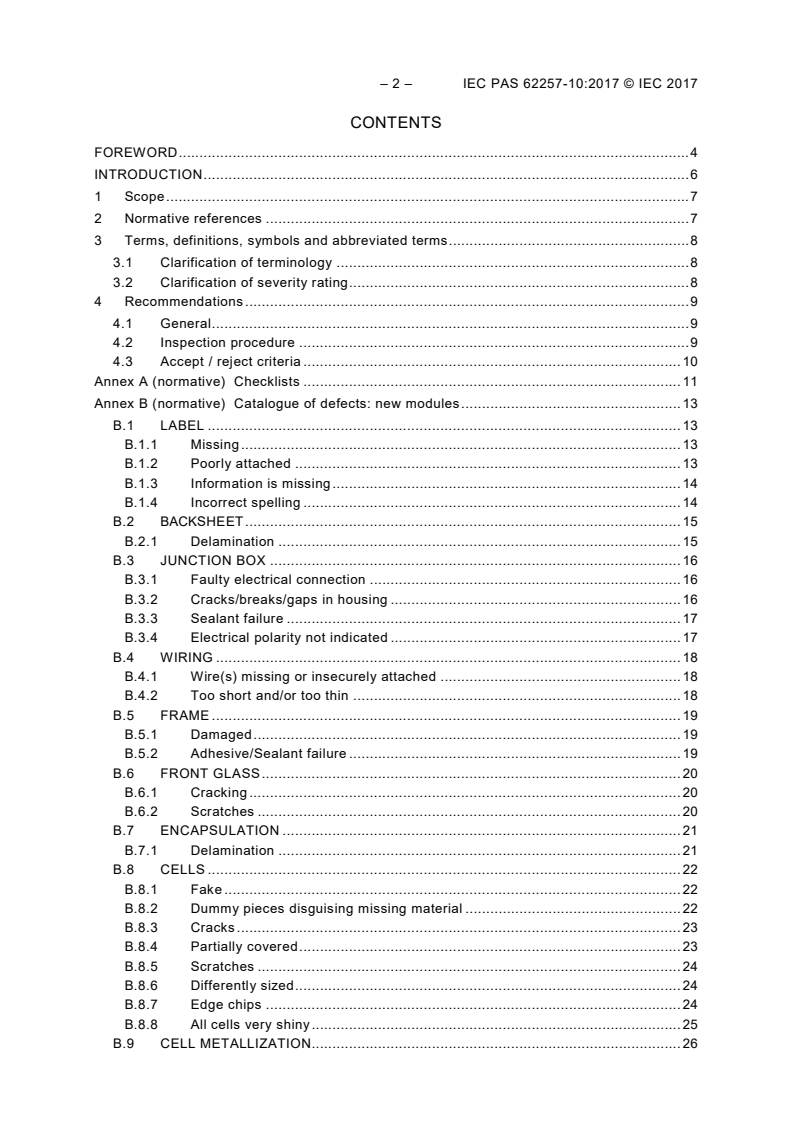
CONTENTS
FOREWORD . 4
INTRODUCTION . 6
1 Scope . 7
2 Normative references . 7
3 Terms, definitions, symbols and abbreviated terms . 8
3.1 Clarification of terminology . 8
3.2 Clarification of severity rating . 8
4 Recommendations . 9
4.1 General . 9
4.2 Inspection procedure . 9
4.3 Accept / reject criteria . 10
Annex A (normative) Checklists . 11
Annex B (normative) Catalogue of defects: new modules . 13
B.1 LABEL . 13
B.1.1 Missing . 13
B.1.2 Poorly attached . 13
B.1.3 Information is missing . 14
B.1.4 Incorrect spelling . 14
B.2 BACKSHEET . 15
B.2.1 Delamination . 15
B.3 JUNCTION BOX . 16
B.3.1 Faulty electrical connection . 16
B.3.2 Cracks/breaks/gaps in housing . 16
B.3.3 Sealant failure . 17
B.3.4 Electrical polarity not indicated . 17
B.4 WIRING . 18
B.4.1 Wire(s) missing or insecurely attached . 18
B.4.2 Too short and/or too thin . 18
B.5 FRAME . 19
B.5.1 Damaged . 19
B.5.2 Adhesive/Sealant failure . 19
B.6 FRONT GLASS . 20
B.6.1 Cracking . 20
B.6.2 Scratches . 20
B.7 ENCAPSULATION . 21
B.7.1 Delamination . 21
B.8 CELLS . 22
B.8.1 Fake . 22
B.8.2 Dummy pieces disguising missing material . 22
B.8.3 Cracks . 23
B.8.4 Partially covered . 23
B.8.5 Scratches . 24
B.8.6 Differently sized . 24
B.8.7 Edge chips . 24
B.8.8 All cells very shiny . 25
B.9 CELL METALLIZATION. 26
B.9.1 Fingers not connected to busbar . 26
B.9.2 Not the same pattern on all cells . 26
B.9.3 Fingers off of edge of corner of cells . 27
B.10 CELL INTERCONNECTION . 27
B.10.1 Interconnection is discontinuous . 27
B.10.2 Cells connected in parallel (counterfeit) . 28
B.10.3 Poorly aligned and/or soldered . 28
B.10.4 Cells connected in parallel (real cells) . 28
Annex C (normative) Catalogue of defects: used modules . 29
C.2 BACKSHEET . 29
C.2.1. Burn marks . 29
C.2.2. Discolouration . 29
C.4 WIRING . 30
C.4.1 Cracks or exposed metal. 30
C.7 ENCAPSULATION . 30
C.7.2 Discolouration . 30
C.8. CELLS . 31
C.8.9 “Snail trails” . 31
C.8.10 Shiny locally/significantly varying colour . 31
Bibliography . 32
– 4 – IEC PAS 62257-10:2017 © IEC 2017
INTERNATIONAL ELECTROTECHNICAL COMMISSION
____________
RECOMMENDATIONS FOR RENEWABLE ENERGY
AND HYBRID SYSTEMS FOR RURAL ELECTRIFICATION –
Part 10: Silicon solar module visual inspection guide
FOREWORD
1) The International Electrotechnical Commission (IEC) is a worldwide organization for standardization comprising
all national electrotechnical committees (IEC National Committees). The object of IEC is to promote
international co-operation on all questions concerning standardization in the electrical and electronic fields. To
this end and in addition to other activities, IEC publishes International Standards, Technical Specifications,
Technical Reports, Publicly Available Specifications (PAS) and Guides (hereafter referred to as “IEC
Publication(s)”). Their preparation is entrusted to technical committees; any IEC National Committee interested
in the subject dealt with may participate in this preparatory work. International, governmental and non-
governmental organizations liaising with the IEC also participate in this preparation. IEC collaborates closely
with the International Organization for Standardization (ISO) in accordance with conditions determined by
agreement between the two organizations.
2) The formal decisions or agreements of IEC on technical matters express, as nearly as possible, an international
consensus of opinion on the relevant subjects since each technical committee has representation from all
interested IEC National Committees.
3) IEC Publications have the form of recommendations for international use and are accepted by IEC National
Committees in that sense. While all reasonable efforts are made to ensure that the technical content of IEC
Publications is accurate, IEC cannot be held responsible for the way in which they are used or for any
misinterpretation by any end user.
4) In order to promote international uniformity, IEC National Committees undertake to apply IEC Publications
transparently to the maximum extent possible in their national and regional publications. Any divergence
between any IEC Publication and the corresponding national or regional publication shall be clearly indicated in
the latter.
5) IEC itself does not provide any attestation of conformity. Independent certification bodies provide conformity
assessment services and, in some areas, access to IEC marks of conformity. IEC is not responsible for any
services carried out by independent certification bodies.
6) All users should ensure that they have the latest edition of this publication.
7) No liability shall attach to IEC or its directors, employees, servants or agents including individual experts and
members of its technical committees and IEC National Committees for any personal injury, property damage or
other damage of any nature whatsoever, whether direct or indirect, or for costs (including legal fees) and
expenses arising out of the publication, use of, or reliance upon, this IEC Publication or any other IEC
Publications.
8) Attention is drawn to the Normative references cited in this publication. Use of the referenced publications is
indispensable for the correct application of this publication.
9) Attention is drawn to the possibility that some of the elements of this IEC Publication may be the subject of
patent rights. IEC shall not be held responsible for identifying any or all such patent rights.
A PAS is a technical specification not fulfilling the requirements for a standard, but made
available to the public.
This PAS is based on the document by Zayed Energy and Ecology Centre, Version 1.8,
2016-12-01, K. Sinclair and M. Sinclair.
IEC PAS 62257-10 has been processed by IEC technical committee 82: Solar photovoltaic
energy systems.
The text of this PAS is based on the This PAS was approved for
following document: publication by the P-members of the
committee concerned as indicated in
the following document
Draft PAS Report on voting
82/1274/DPAS 82/1312/RVDPAS
Following publication of this PAS, the technical committee or subcommittee concerned may
transform it into an International Standard.
This PAS shall remain valid for an initial maximum period of 2 years starting from the
publication date. The validity may be extended for a single period up to a maximum of
2 years, at the end of which it shall be published as another type of normative document, or
shall be withdrawn.
A bilingual version of this publication may be issued at a later date.
IMPORTANT – The 'colour inside' logo on the cover page of this publication indicates
that it contains colours which are considered to be useful for the correct
understanding of its contents. Users should therefore print this document using a
colour printer.
– 6 – IEC PAS 62257-10:2017 © IEC 2017
INTRODUCTION
This document is organized into a terminology section and a checklist, followed by a table
cataloguing and describing the defects to be visually inspected. The schematics in the
terminology section describe where each component is found on a common solar PV module.
A severity rating is also defined to give users guidelines on how concerning a particular defect
may be. In the checklist and the catalogue of defects, defects have been organized by the
component of the module on which they appear, followed by severity rating. The order in
which components are inspected goes from the back to the front of the module, following a
procedure developed elsewhere [3] . The catalogue of defects is subdivided into two sections:
the first referring to defects that might be found on new modules, and the second describing
defects that might appear over time. This document is principally focused on defects that are
observable at the beginning of product life. Selected significant defects that may appear over
time are also included for completeness and to address the second-hand market.
This document was developed as a response to observations of sub-standard quality and
counterfeit solar products present in developing world markets. Many consumers and retailers
are not aware of the presence of significant visually observable defects that may limit
performance and/or lead to premature product failure. Nor are they aware that good quality
PV modules should last 25 years or more. Note that no amount of visual inspection or
electrical product testing can guarantee that a module will perform reliably for 25 years.
Although visual inspection cannot catch all possible defects, it can be used as a screening
method to identify poor performing products and potential early failure modes. This document
was designed with the intention of being a quick tool that is inexpensive to implement, as it
does not require any test equipment. Although helpful, no prior knowledge of solar
photovoltaics is required to benefit from this guide, and an inspector should be able to be
trained in its use in two days or less.
__________
Numbers in square brackets refer to the Bibliography.
RECOMMENDATIONS FOR RENEWABLE ENERGY
AND HYBRID SYSTEMS FOR RURAL ELECTRIFICATION –
Part 10: Silicon solar module visual inspection guide
1 Scope
This document is designed to be used as a guide to visually inspect front-contact poly-
crystalline and mono-crystalline silicon solar photovoltaic (PV) modules for major defects
(less common types of PV modules such as back-contact silicon cells or thin film technologies
are not covered herein). The modules under consideration may be of any size or rated power,
however some specific use-cases for solar modules may have different requirements and
therefore adaption of this document is application and institution dependent (ex. labelling may
not be present for a solar module sold as part of a small off-grid lighting kit). This document is
meant to supplement and support rather than replace international testing standards (for
example IEC 61215 or UL 1703 [1], [2]). A lack of visually observable defects is necessary but
not sufficient to determine if a module would pass IEC 61215 testing.
Several applications could be envisioned for this document, including use by:
• border agents to inspect product shipments at ports of entry to a country. Standardized
rejection criteria could be used as grounds for barring defective products for import in
conjunction with an adopted IEC standard such as IEC 61215;
• standards agencies or regulatory authorities in search and seizure efforts. A tool that can
be used onsite to determine if defective or fraudulent products are found for sale in
markets;
• retailers/distributors to ensure they are receiving acceptable quality products from
manufacturers;
• installers/technicians when selecting product from retailers or distributors for customers;
• educators as a teaching tool for students of solar energy, for example when training
technicians;
• inspectors of already installed solar products to catalogue defects and attempt to trouble-
shoot failures.
However, as this guide deals primarily with new modules, alternative tools are recommended
for this task (see for example [3]).
2 Normative references
There are no normative references in this document.
– 8 – IEC PAS 62257-10:2017 © IEC 2017
3 Terms, definitions, symbols and abbreviated terms
3.1 Clarification of terminology
Encapsulation
(clear laminate material
Jonction box
between layers)
Label
Wires
Backsheet
Cell interconnect
(tabbing ribbon)
Frame
IEC
IEC
Rear side of silicon module Front side of silicon module
Busbars
(typically not visible when
properly covered by tabbing
ribbon)
IEC
Individual silicon solar cell
3.2 Clarification of severity rating
Efforts were made by the authors to provide a comparative rating of the severity of the
defects. The range of the scale indicates influence to performance and/or reliability, and is
given is from 1 (low severity) to 5 (high severity). A range is provided when the severity of a
defect can vary, for example with the size of the affected area. An additional icon is given if
the defect poses a potential safety risk to the installer or the end user. The authors assume
no liability for actions taken as a result of this document.
Grid fingers
Front glass
Cells
Colour and position
indicates severity rating
Scale range
Symbol indicates defect
impacts sefety
IEC
Key
S Symbol indicating a safety risk, separate from quantitative scale
1 The defect is an indicator of poor quality with no direct effect on performance or reliability
2 The defect has a minor impact on performance and/or reliability
3 The defect has a moderate impact on performance and/or reliability
4 The defect has a high impact on performance and/or reliability
5 The defect is indicative of a major quality issue, a critical failure, or a counterfeit panel
4 Recommendations
4.1 General
The following subclauses provide recommended guidelines for the use of this document. This
includes recommendations on an inspection procedure and accept/reject criteria.
Institutions may choose to adapt the checklist into a format unique to the needs of the given
application. A cover page could be used to accomplish this. For example, different
institutions/application might require specific administrative details to be recorded beyond the
fields of module ID, inspector and date that are currently included (ex. location, reason for
inspection, shipment, company, actions taken, comments, etc. ).
4.2 Inspection procedure
The following procedure should be followed for each product lot to be inspected (ex.
shipment, retail location, installation, etc.).
a) Identify and differentiate the different product types/sizes to be inspected within the lot.
b) Select a minimum of 8 samples of each size/type randomly for inspection (see IEC 61215
for sampling recommendations). Care should be taken to select samples from different
locations (boxes, containers, etc.) within a lot (for example do not simply select the first 8
samples that are seen). Depending on the application this may not be sufficient: for
example, if inspecting existing modules at a solar installation, it would likely be desirable
to inspect 100 % of samples.
c) The inspector should complete one checklist per sample, proceeding through the list of
defects in the order in which they are presented in order to ensure completeness.
1) For each defect in sequence complete the checklist with an indication of defect
presence, severity and whether or not the defect represents a potential safety risk.
2) Depending on the requirements and the resources of the institution, it may be of
interest to take photos of defects for inclusion in an inspection report, along with
overview photos of the front, back, and label of a module.
3) If further information or clarification is needed, refer to the detailed catalogue of
defects which includes a description of the affected component, defect photos, a
description of the defect, why it is important and guidelines on assessing defect
severity.
4) For used samples, both “new” and “used” checklists should be completed in this order.
– 10 – IEC PAS 62257-10:2017 © IEC 2017
Inspectors should be sufficiently familiar with defects unique to used modules such
they can be identified during the inspection of ostensibly new products.
d) Once the inspection checklist is complete the inspector can review the results to
determine whether the inspected module is acceptable for the intended application. The
accept/reject criteria for a single module and an entire lot may be based on the
recommendations below, or as per a standardized procedure determined by a given
institution.
4.3 Accept / reject criteria
Acceptance and rejection criteria may be application and end user dependent. For example;
small modules for off-grid applications may have slightly different quality requirements than
full sized modules for utility scale applications. The market for small off-grid module may
tolerate minor defects whereas the utility-scale market may not allow any visual defects which
might pose even a small risk to the reliability and therefore the long term economic viability of
the project.
Users of this document should make final accept/reject decisions based on a consistent,
standardized and documented process which is justified by the needs of the market being
served. The following provides a recommended set of guidelines for deciding on the
acceptability of modules under visual inspection.
A solar PV module sample will be considered to be rejected due to its observable quality
defects if any one of the following conditions are met:
a) If any single observed defect has been evaluated as a severity of 5. A severity of 5
indicates a major quality issue; a critical failure or a fraudulent module. This evaluation
alone is sufficient justification for the rejection of a sample.
b) If any single observed defect has been evaluated to pose a safety risk. Under no
conditions should a module that risks the safety of an installer or end user be con
...