


IEC 61646:2008
(Main)Thin-film terrestrial photovoltaic (PV) modules - Design qualification and type approval
General Information
- Abstract
IEC 61646:2008 lays down requirements for the design qualification and type approval of terrestrial, thin-film photovoltaic modules suitable for long-term operation in general open-air climates as defined in IEC 60721-2-1. This standard applies to all terrestrial flat plate module materials not covered by IEC 61215. The significant technical change with respect to the previous edition concerns the pass/fail criteria.
- Status
- Replaced
- Publication Date
- 13-May-2008
- Technical Committee
- TC 82 - Solar photovoltaic energy systems
- Drafting Committee
- WG 2 - TC 82/WG 2
- Current Stage
- WPUB - Publication withdrawn
- Start Date
- 07-Dec-2016
- Completion Date
- 28-Aug-2026
Relations
- Effective Date
- 05-Sep-2023
- Effective Date
- 05-Sep-2023
- Effective Date
- 05-Sep-2023
- Effective Date
- 05-Sep-2023
Get Certified
Connect with accredited certification bodies for this standard

DNV
DNV is an independent assurance and risk management provider.

Lloyd's Register
Lloyd's Register is a global professional services organisation specialising in engineering and technology.
DNV Energy Systems
Energy and renewable energy certification.
Sponsored listings
Frequently Asked Questions
IEC 61646:2008 is a standard published by the International Electrotechnical Commission (IEC). Its full title is "Thin-film terrestrial photovoltaic (PV) modules - Design qualification and type approval". This standard covers: IEC 61646:2008 lays down requirements for the design qualification and type approval of terrestrial, thin-film photovoltaic modules suitable for long-term operation in general open-air climates as defined in IEC 60721-2-1. This standard applies to all terrestrial flat plate module materials not covered by IEC 61215. The significant technical change with respect to the previous edition concerns the pass/fail criteria.
IEC 61646:2008 lays down requirements for the design qualification and type approval of terrestrial, thin-film photovoltaic modules suitable for long-term operation in general open-air climates as defined in IEC 60721-2-1. This standard applies to all terrestrial flat plate module materials not covered by IEC 61215. The significant technical change with respect to the previous edition concerns the pass/fail criteria.
IEC 61646:2008 is classified under the following ICS (International Classification for Standards) categories: 27.160 - Solar energy engineering. The ICS classification helps identify the subject area and facilitates finding related standards.
IEC 61646:2008 has the following relationships with other standards: It is inter standard links to IEC 61215-1-2:2016, IEC 61215-1-4:2016, IEC 61215-1-3:2016, IEC 61646:1996. Understanding these relationships helps ensure you are using the most current and applicable version of the standard.
IEC 61646:2008 is available in PDF format for immediate download after purchase. The document can be added to your cart and obtained through the secure checkout process. Digital delivery ensures instant access to the complete standard document.
Standards Content (Sample)
IEC 61646
Edition 2.0 2008-05
INTERNATIONAL
STANDARD
NORME
INTERNATIONALE
Thin-film terrestrial photovoltaic (PV) modules – Design qualification and type
approval
Modules photovoltaïques (PV) en couches minces pour application terrestre –
Qualification de la conception et homologation
All rights reserved. Unless otherwise specified, no part of this publication may be reproduced or utilized in any form or by
any means, electronic or mechanical, including photocopying and microfilm, without permission in writing from either IEC or
IEC's member National Committee in the country of the requester.
If you have any questions about IEC copyright or have an enquiry about obtaining additional rights to this publication,
please contact the address below or your local IEC member National Committee for further information.
Droits de reproduction réservés. Sauf indication contraire, aucune partie de cette publication ne peut être reproduite
ni utilisée sous quelque forme que ce soit et par aucun procédé, électronique ou mécanique, y compris la photocopie
et les microfilms, sans l'accord écrit de la CEI ou du Comité national de la CEI du pays du demandeur.
Si vous avez des questions sur le copyright de la CEI ou si vous désirez obtenir des droits supplémentaires sur cette
publication, utilisez les coordonnées ci-après ou contactez le Comité national de la CEI de votre pays de résidence.
IEC Central Office
3, rue de Varembé
CH-1211 Geneva 20
Switzerland
Email: inmail@iec.ch
Web: www.iec.ch
About the IEC
The International Electrotechnical Commission (IEC) is the leading global organization that prepares and publishes
International Standards for all electrical, electronic and related technologies.
About IEC publications
The technical content of IEC publications is kept under constant review by the IEC. Please make sure that you have the
latest edition, a corrigenda or an amendment might have been published.
ƒ Catalogue of IEC publications: www.iec.ch/searchpub
The IEC on-line Catalogue enables you to search by a variety of criteria (reference number, text, technical committee,…).
It also gives information on projects, withdrawn and replaced publications.
ƒ IEC Just Published: www.iec.ch/online_news/justpub
Stay up to date on all new IEC publications. Just Published details twice a month all new publications released. Available
on-line and also by email.
ƒ Electropedia: www.electropedia.org
The world's leading online dictionary of electronic and electrical terms containing more than 20 000 terms and definitions
in English and French, with equivalent terms in additional languages. Also known as the International Electrotechnical
Vocabulary online.
ƒ Customer Service Centre: www.iec.ch/webstore/custserv
If you wish to give us your feedback on this publication or need further assistance, please visit the Customer Service
Centre FAQ or contact us:
Email: csc@iec.ch
Tel.: +41 22 919 02 11
Fax: +41 22 919 03 00
A propos de la CEI
La Commission Electrotechnique Internationale (CEI) est la première organisation mondiale qui élabore et publie des
normes internationales pour tout ce qui a trait à l'électricité, à l'électronique et aux technologies apparentées.
A propos des publications CEI
Le contenu technique des publications de la CEI est constamment revu. Veuillez vous assurer que vous possédez
l’édition la plus récente, un corrigendum ou amendement peut avoir été publié.
ƒ Catalogue des publications de la CEI: www.iec.ch/searchpub/cur_fut-f.htm
Le Catalogue en-ligne de la CEI vous permet d’effectuer des recherches en utilisant différents critères (numéro de référence,
texte, comité d’études,…). Il donne aussi des informations sur les projets et les publications retirées ou remplacées.
ƒ Just Published CEI: www.iec.ch/online_news/justpub
Restez informé sur les nouvelles publications de la CEI. Just Published détaille deux fois par mois les nouvelles
publications parues. Disponible en-ligne et aussi par email.
ƒ Electropedia: www.electropedia.org
Le premier dictionnaire en ligne au monde de termes électroniques et électriques. Il contient plus de 20 000 termes et
définitions en anglais et en français, ainsi que les termes équivalents dans les langues additionnelles. Egalement appelé
Vocabulaire Electrotechnique International en ligne.
ƒ Service Clients: www.iec.ch/webstore/custserv/custserv_entry-f.htm
Si vous désirez nous donner des commentaires sur cette publication ou si vous avez des questions, visitez le FAQ du
Service clients ou contactez-nous:
Email: csc@iec.ch
Tél.: +41 22 919 02 11
Fax: +41 22 919 03 00
IEC 61646
Edition 2.0 2008-05
INTERNATIONAL
STANDARD
NORME
INTERNATIONALE
Thin-film terrestrial photovoltaic (PV) modules – Design qualification and type
approval
Modules photovoltaïques (PV) en couches minces pour application terrestre –
Qualification de la conception et homologation
INTERNATIONAL
ELECTROTECHNICAL
COMMISSION
COMMISSION
ELECTROTECHNIQUE
PRICE CODE
INTERNATIONALE
X
CODE PRIX
ICS 27.160 ISBN 2-8318-9746-7
– 2 – 61646 © IEC:2008
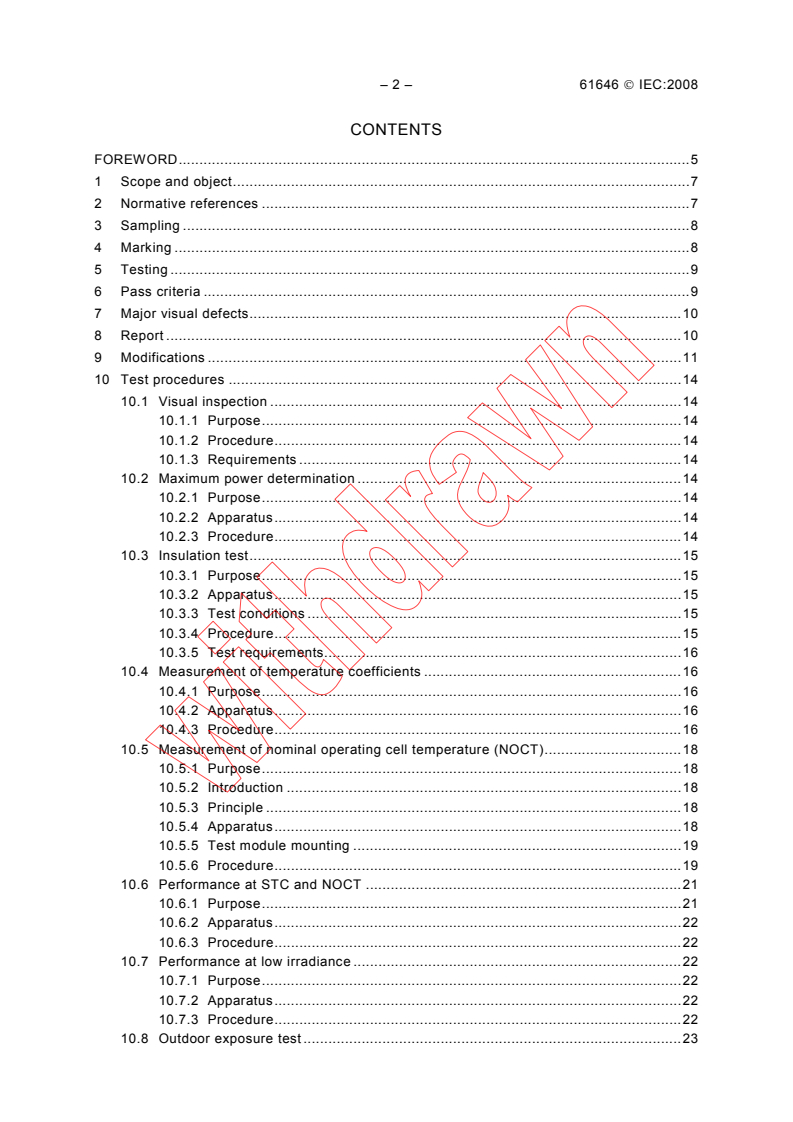
CONTENTS
FOREWORD.5
1 Scope and object.7
2 Normative references .7
3 Sampling .8
4 Marking .8
5 Testing .9
6 Pass criteria .9
7 Major visual defects.10
8 Report .10
9 Modifications .11
10 Test procedures .14
10.1 Visual inspection .14
10.1.1 Purpose.14
10.1.2 Procedure.14
10.1.3 Requirements .14
10.2 Maximum power determination .14
10.2.1 Purpose.14
10.2.2 Apparatus.14
10.2.3 Procedure.14
10.3 Insulation test.15
10.3.1 Purpose.15
10.3.2 Apparatus.15
10.3.3 Test conditions .15
10.3.4 Procedure.15
10.3.5 Test requirements.16
10.4 Measurement of temperature coefficients .16
10.4.1 Purpose.16
10.4.2 Apparatus.16
10.4.3 Procedure.16
10.5 Measurement of nominal operating cell temperature (NOCT).18
10.5.1 Purpose.18
10.5.2 Introduction .18
10.5.3 Principle .18
10.5.4 Apparatus.18
10.5.5 Test module mounting .19
10.5.6 Procedure.19
10.6 Performance at STC and NOCT .21
10.6.1 Purpose.21
10.6.2 Apparatus.22
10.6.3 Procedure.22
10.7 Performance at low irradiance .22
10.7.1 Purpose.22
10.7.2 Apparatus.22
10.7.3 Procedure.22
10.8 Outdoor exposure test .23
61646 © IEC:2008 – 3 –
10.8.1 Purpose.23
10.8.2 Apparatus.23
10.8.3 Procedure.23
10.8.4 Final measurements .23
10.8.5 Requirements .23
10.9 Hot-spot endurance test .23
10.9.1 Purpose.23
10.9.2 Hot-spot effect.23
10.9.3 Classification of cell interconnection .24
10.9.4 Apparatus.25
10.9.5 Procedure.25
10.9.6 Final measurements .26
10.9.7 Requirements .26
10.10 UV preconditioning test.27
10.10.1 Purpose .27
10.10.2 Apparatus .27
10.10.3 Procedure .27
10.10.4 Final measurements.27
10.10.5 Requirements .27
10.11 Thermal cycling test.27
10.11.1 Purpose .27
10.11.2 Apparatus .28
10.11.3 Procedure .28
10.11.4 Final measurements.28
10.11.5 Requirements .29
10.12 Humidity-freeze test.29
10.12.1 Purpose .29
10.12.2 Apparatus .29
10.12.3 Procedure .30
10.12.4 Final measurements.30
10.12.5 Requirements .30
10.13 Damp heat test .30
10.13.1 Purpose .30
10.13.2 Procedure .30
10.13.3 Final measurements.30
10.13.4 Requirements .30
10.14 Robustness of terminations test.31
10.14.1 Purpose .31
10.14.2 Types of terminations.31
10.14.3 Procedure .31
10.14.4 Final measurements.32
10.14.5 Requirements .32
10.15 Wet leakage current test.32
10.15.1 Purpose .32
10.15.2 Apparatus .32
10.15.3 Procedure .32
10.15.4 Requirements .32
10.16 Mechanical load test.33
10.16.1 Purpose .33
– 4 – 61646 © IEC:2008
10.16.2 Apparatus .33
10.16.3 Procedure .33
10.16.4 Final measurements.33
10.16.5 Requirements .33
10.17 Hail test .33
10.17.1 Purpose .33
10.17.2 Apparatus .33
10.17.3 Procedure .35
10.17.4 Final measurements.36
10.17.5 Requirements .36
10.18 Bypass diode thermal test.36
10.18.1 Purpose .36
10.18.2 Apparatus .37
10.18.3 Procedure 1 .37
10.18.4 Procedure 2 .38
10.18.5 Final Measurements.38
10.18.6 Requirements .39
10.19 Light-soaking .39
10.19.1 Purpose .39
10.19.2 Apparatus .39
10.19.3 Procedure .39
10.19.4 Final measurements.39
10.19.5 Requirements .39
Bibliography.40
Figure 1 – Qualification test sequence .12
Figure 2 – NOCT correction factor .21
Figure 3 – Hot-spot effect in a thin-film module with serially connected cells. Worst
case shading condition is shading of 4 cells at the same time.24
Figure 4 – Thermal cycling test .28
Figure 5 – Humidity-freeze cycle.29
Figure 6 – Hail test equipment .35
Figure 7 – Impact locations.36
Figure 8 – Bypass Diode Thermal Test .38
Table 1 – Summary of test levels .13
Table 2 – Ice ball masses and test velocities .34
Table 3 – Impact locations .36
61646 © IEC:2008 – 5 –
INTERNATIONAL ELECTROTECHNICAL COMMISSION
___________
THIN-FILM TERRESTRIAL PHOTOVOLTAIC (PV) MODULES –
DESIGN QUALIFICATION AND TYPE APPROVAL
FOREWORD
1) The International Electrotechnical Commission (IEC) is a worldwide organization for standardization comprising
all national electrotechnical committees (IEC National Committees). The object of IEC is to promote
international co-operation on all questions concerning standardization in the electrical and electronic fields. To
this end and in addition to other activities, IEC publishes International Standards, Technical Specifications,
Technical Reports, Publicly Available Specifications (PAS) and Guides (hereafter referred to as “IEC
Publication(s)”). Their preparation is entrusted to technical committees; any IEC National Committee interested
in the subject dealt with may participate in this preparatory work. International, governmental and non-
governmental organizations liaising with the IEC also participate in this preparation. IEC collaborates closely
with the International Organization for Standardization (ISO) in accordance with conditions determined by
agreement between the two organizations.
2) The formal decisions or agreements of IEC on technical matters express, as nearly as possible, an international
consensus of opinion on the relevant subjects since each technical committee has representation from all
interested IEC National Committees.
3) IEC Publications have the form of recommendations for international use and are accepted by IEC National
Committees in that sense. While all reasonable efforts are made to ensure that the technical content of IEC
Publications is accurate, IEC cannot be held responsible for the way in which they are used or for any
misinterpretation by any end user.
4) In order to promote international uniformity, IEC National Committees undertake to apply IEC Publications
transparently to the maximum extent possible in their national and regional publications. Any divergence
between any IEC Publication and the corresponding national or regional publication shall be clearly indicated in
the latter.
5) IEC provides no marking procedure to indicate its approval and cannot be rendered responsible for any
equipment declared to be in conformity with an IEC Publication.
6) All users should ensure that they have the latest edition of this publication.
7) No liability shall attach to IEC or its directors, employees, servants or agents including individual experts and
members of its technical committees and IEC National Committees for any personal injury, property damage or
other damage of any nature whatsoever, whether direct or indirect, or for costs (including legal fees) and
expenses arising out of the publication, use of, or reliance upon, this IEC Publication or any other IEC
Publications.
8) Attention is drawn to the Normative references cited in this publication. Use of the referenced publications is
indispensable for the correct application of this publication.
9) Attention is drawn to the possibility that some of the elements of this IEC Publication may be the subject of
patent rights. IEC shall not be held responsible for identifying any or all such patent rights.
International Standard IEC 61646 has been prepared by IEC technical committee 82: Solar
photovoltaic energy systems.
This second edition cancels and replaces the first edition published in 1996. This edition
constitutes a technical revision.
This edition includes the following significant technical changes with respect to the previous
edition:
The major change is in the pass/fail criteria. It no longer relies on meeting a plus/minus
criterion before and after each test, but rather on meeting the rated power after all of the tests
have been completed and the modules have been light-soaked. This was done to eliminate
the technology-specific preconditioning necessary to accurately measure the changes caused
by the test. (Some modules lose power in light while others lose power during dark heat.)
Since all modules must work after exposure to light, this seemed liked a good approach and
will streamline the test procedure, hopefully reducing the testing cost.
• Updated Normative references.
• Added a definition of “minimum value of maximum output power”.
– 6 – 61646 © IEC:2008
• Modified the wording in Major visual defects to allow some bending and misalignment
without failure.
• Added requirements to the report from ISO/IEC 17025.
• Removed the “Twist Test” as was done from IEC 61215, since no one has ever failed this
test.
• Made the pass/fail criteria for insulation resistance and wet leakage current dependent on
the module area.
• Added the temperature coefficient of power (δ) to the required measurements.
• Modified temperature coefficient section to allow for measurements under natural sunlight
or a solar simulator.
• Deleted reference plate method from NOCT.
• Added apparatus sections to those test procedures that did not have apparatus sections in
edition 1.
• Rewrote the hot-spot test.
• Eliminated edge dip method from wet leakage current test.
• Changed mechanical load test to 3 cycles to be consistent with other standards.
• Added bypass diode thermal test.
The text of this standard is based on the following documents:
FDIS Report on voting
82/512/FDIS 82/528/RVD
Full information on the voting for the approval of this standard can be found in the report on
voting indicated in the above table.
This publication has been drafted in accordance with the ISO/IEC Directives, Part 2.
The committee has decided that the contents of this publication will remain unchanged until
the maintenance result date indicated on the IEC web site under "http://webstore.iec.ch" in
the data related to the specific publication. At this date, the publication will be
• reconfirmed,
• withdrawn,
• replaced by a revised edition, or
• amended.
61646 © IEC:2008 – 7 –
THIN-FILM TERRESTRIAL PHOTOVOLTAIC (PV) MODULES –
DESIGN QUALIFICATION AND TYPE APPROVAL
1 Scope and object
This International Standard lays down requirements for the design qualification and type
approval of terrestrial, thin-film photovoltaic modules suitable for long-term operation in
general open-air climates as defined in IEC 60721-2-1. This standard is intended to apply to
all terrestrial flat plate module materials not covered by IEC 61215.
The test sequence is derived from IEC 61215 for the design qualification and type approval of
terrestrial crystalline silicon PV modules. However, it no longer relies on meeting a plus/minus
criterion before and after each test, but rather on meeting a specified percentage of the rated
minimum power after all of the tests have been completed and the modules have been light-
soaked. This eliminates the technology-specific preconditioning necessary to accurately
measure the changes caused by the test.
This standard does not apply to modules used with concentrators.
The object of this test sequence is to determine the electrical and thermal characteristics of
the module and to show, as far as possible within reasonable constraints of cost and time,
that the module is capable of withstanding prolonged exposure in climates described in the
scope. The actual life expectancy of modules so qualified will depend on their design, their
environment and the conditions under which they are operated.
2 Normative references
The following referenced documents are indispensable for the application of this document.
For dated references, only the edition cited applies. For undated references, the latest edition
of the referenced document (including any amendments) applies.
IEC 60068-1: Environmental testing – Part 1: General and guidance
IEC 60068-2-21: Environmental testing – Part 2-21: Tests – Test U: Robustness of
terminations and integral mounting devices
IEC 60068-2-78:2001, Environmental testing – Part 2-78: Tests – Test Cab: Damp heat,
steady state
IEC 60410, Sampling plans and procedures for inspection by attributes
IEC 60721-2-1, Classification of environmental conditions – Part 2-1: Environmental
conditions appearing in nature – Temperature and humidity
IEC 60891, Procedures for temperature and irradiance corrections to measured I-V
characteristics of crystalline silicon photovoltaic (PV) devices
IEC 60904-1:2006, Photovoltaic devices – Part 1: Measurements of photovoltaic current-
voltage characteristics
IEC 60904-2, Photovoltaic devices – Part 2: Requirements for reference solar devices
– 8 – 61646 © IEC:2008
IEC 60904-3, Photovoltaic devices – Part 3: Measurement principles for terrestrial
photovoltaic (PV) solar devices with reference spectral irradiance data
IEC 60904-7, Photovoltaic devices – Part 7: Computation of spectral mismatch error
introduced in the testing of a photovoltaic device
IEC 60904-9, Photovoltaic devices – Part 9: Solar simulator performance requirements
IEC 60904-10, Photovoltaic devices – Part 10: Methods of linearity measurements
IEC 61215, Crystalline silicon terrestrial photovoltaic (PV) modules – Design qualification
and type approval
ISO/IEC 17025, General requirements for the competence of testing and calibration
laboratories.
3 Sampling
Eight modules for qualification testing (plus spares as desired) shall be taken at random from
a production batch or batches, in accordance with the procedure given in IEC 60410. The
modules shall have been manufactured from specified materials and components in
accordance with the relevant drawings and process sheets and shall have been subjected to
the manufacturer's normal inspection, quality control and production acceptance procedures.
The modules shall be complete in every detail and shall be accompanied by the
manufacturer's handling, mounting and connection instructions, including the maximum
permissible system voltage.
If the bypass diodes are not accessible in the standard modules, a special sample can be
prepared for the bypass diode thermal test (see 10.18). The bypass diode should be mounted
physically as it would be in a standard module, with a thermal sensor placed on the diode as
required in 10.18.2. This sample does not have to go through the other tests in the sequence.
When the modules to be tested are prototypes of a new design and not from production, this
fact shall be noted in the test report (see Clause 8).
4 Marking
Each module shall carry the following clear and indelible markings:
• name, monogram or symbol of manufacturer;
• type or model number;
• serial number;
• polarity of terminals or leads (colour coding is permissible);
• maximum system voltage for which the module is suitable;
• nominal and minimum values of maximum output power at STC, as specified by the
manufacturer for the product type.
The minimum value of maximum output power refers to the lowest stabilized power that the
manufacturer specifies for the product type (for example after any light induced degradation
or recovery).
NOTE If the modules to be tested are prototypes of a new design and not from production, the results of this test
sequence may be used to establish the module minimum power rating.
61646 © IEC:2008 – 9 –
The date and place of manufacture shall be marked on the module or be traceable from the
serial number.
5 Testing
The modules shall be divided into groups and subjected to the qualification test sequences in
Figure 1, carried out in the order laid down. Each box refers to the corresponding subclause
in this standard. Test procedures and severities, including initial and final measurements
where necessary, are detailed in Clause 10. However, with regard to the tests of 10.2, 10.4,
10.6 and 10.7, it should be noted that the procedures laid down in IEC 60891 for temperature
and irradiance corrections to measured I-V characteristics apply only to linear modules. Use
IEC 60904-10 to assess linearity. If the module is non-linear, these tests shall be carried out
within ±5 % of the specified irradiance and within ±2 °C of the specified temperature.
NOTE 1 Where the final measurements for one test serve as the initial measurements for the next test in the
sequence, they need not be repeated. In these cases, the initial measurements are omitted from the test.
For diagnostic purposes, intermediate measurements of maximum power (10.2) may be undertaken before and
after individual tests.
NOTE 2 The control module should be stored in accordance with the manufacturer’s recommendation.
Any single test, executed independently of a test sequence, shall be preceeded by the initial
tests of 10.1, 10.2 and 10.3.
In carrying out the tests, the tester shall strictly observe the manufacturer's handling,
mounting and connection instructions. Tests given in 10.4, 10.5, 10.6 and 10.7 may be
omitted if future IEC 61853 has been or is scheduled to be run on this module type.
Thin film technologies can have different stabilization characteristics. It is impossible to define
a single stabilisation procedure applicable to all thin film technologies. This procedure tests
the modules “as received“ and attempts to reach a stabilised condition before final test.
Test conditions are summarized in Table 1.
NOTE 3 The test levels in Table 1 are the minimum levels required for qualification. If the laboratory and the
module manufacturer agree, the tests may be performed with increased severities.
6 Pass criteria
A module design shall be judged to have passed the qualification tests, and therefore, to be
IEC type approved, if each test sample meets all the following criteria:
a) after the final light soaking, the maximum output power at STC is not less than 90 % of the
minimum value specified by the manufacturer in Clause 4;
NOTE The pass/fail criteria must consider the laboratory uncertainty of the measurement. As an example, if
the laboratory extended uncertainty, 2 sigma of the STC measurement, is ±5 %, then a maximum power
measurement greater than 85,5 % of the minimum specified value would be the pass criteria.
b) no sample has exhibited any open-circuit during the tests;
c) there is no visual evidence of a major defect, as defined in Clause 7;
d) the insulation test requirements are met after the tests;
e) the wet leakage current test requirements are met at the beginning and the end of each
sequence and after the damp heat test;
f) specific requirements of the individual tests are met.
If two or more modules do not meet these test criteria, the design shall be deemed not to
have met the qualification requirements. Should one module fail any test, another two
modules meeting the requirements of Clause 3 shall be subjected to the whole of the relevant
– 10 – 61646 © IEC:2008
test sequence from the beginning. If one or both of these modules also fail, the design shall
be deemed not to have met the qualification requirements. If, however, both modules pass the
test sequence, the design shall be judged to have met the qualification requirements.
7 Major visual defects
For the purposes of design qualification and type approval, the following are considered to be
major visual defects:
a) broken, cracked, or torn external surfaces, including superstrates, substrates, frames and
junction boxes;
b) bent or misaligned external surfaces, including superstrates, substrates, frames and
junction boxes to the extent that the installation and/or operation of the module would be
impaired;
c) voids in, or visible corrosion of any of the thin film layers of the active circuitry of the
module, extending over more than 10 % of any cell;
d) bubbles or delaminations forming a continuous path between any part of the electrical
circuit and the edge of the module;
e) loss of mechanical integrity, to the extent that the installation and/or operation of the
module would be impaired;
f) Module markings (label) is no longer attached or the information is unreadable.
8 Report
Following type approval, a certified report of the qualification tests, with measured
performance characteristics and details of any failures and re-tests, shall be prepared by the
test agency in accordance with ISO/IEC 17025. Each certificate or test report shall include at
least the following information.
a) A title.
b) Name and address of the test laboratory and location where the tests were carried out.
c) Unique identification of the certification or report and of each page.
d) Name and address of client, where appropriate.
e) Description and identification of the item tested.
f) Characterization and condition of the test item.
g) Date of receipt of test item and date(s) of test, where appropriate.
h) Identification of test method used.
i) Reference to sampling procedure, where relevant.
j) Any deviations from, additions to or exclusions from the test method, and any other
information relevant to a specific tests, such as environmental conditions.
k) Measurements, examinations and derived results supported by tables, graphs, sketches
and photographs as appropriate including temperature coefficients of short circuit current,
open circuit voltage and peak power, NOCT, power at NOCT, STC and low irradiance, the
maximum shaded cell temperature observed during the hot-spot test, spectrum of the lamp
used for the UV prescreening test, minimum power observed after light soaking and any
failures observed. If the maximum power loss observed after each of the tests has been
measured it should also be reported.
l) A statement of the estimated uncertainty of the test results (where relevant).
m) A signature and title, or equivalent identification of the person(s) accepting responsibility
for the content of the certificate or report, and the date of issue.
n) Where relevant, a statement to the effect that the results relate only to the items tested.
61646 © IEC:2008 – 11 –
o) A statement that the certificate or report shall not be reproduced except in full, without the
written approval of the laboratory.
A copy of this report shall be kept by the laboratory and manufacturer for reference purposes.
9 Modifications
Any change in the design, materials, components or processing of the module may require a
repetition of some or all of the qualification tests to maintain type approval.
– 12 – 61646 © IEC:2008
8 Modules
10.1
Visual inspection
10.2
Max power determination
10.3
Insulation test
10.15
Wet leakage current test
1 Module 1 Module 2 Modules 2 Modules
2 Modules
10.11
10.8 10.10
10.13
Thermal cycling test
Outdoor exposure test UV precondition test
Damp heat test
2 2
200 cycles
60 kWh/m 15 kWh/m 1 000 h
–40 °C to 85 °C
85 °C
85 % RH
10.4
10.11
Measurement of
Thermal cycling test
temperature coefficients
50 cycles
(see Note 1)
–40 °C to 85 °C
10.5
NOCT
10.12
(see Note 2)
Humidity freeze test
10 cycles
–40 °C to 85 °C
10.6
C
85 % RH 1 Module 1 Module
Performance at
o
STC and NOCT (see Note 1)
n
t
1 Module
r
10.7
1 Module 10.16
10.17
o
Performance at
Mechanical
Hail test
l
low irradiance (see Note 1)
load test
10.14
Robustness of
10.18
terminations test
Bypass diode
thermal test
(see Note 3)
10.9
Hot-spot
endurance test
10.15
Wet leakage
current test
10.19
Light soaking
10.15
Wet leakage
current test
IEC 587/08
NOTE 1 May be omitted if future IEC 61853 has been performed.
NOTE 2 In the case of modules not designed for open-rack mounting, the NOCT may be replaced by the
equilibrium mean solar cell junction temperature in the standard reference environment, with the module mounted
as recommended by the manufacturer.
NOTE 3 If the bypass diodes are not accessible in the standard modules, a special sample can be prepared for
the bypass diode thermal test (10.18). The bypass diode should be mounted physically as it would be in a standard
module, with a thermal sensor placed on the diode as required in 10.18.2. This sample does not have to go through
the other tests in the sequence.
NOTE 4 For diagnostic purposes intermediate measurements of maximum power (10.2) may be undertaken
before and after individual tests. If the control module is used for these measurements make sure it has been pre-
conditioned per the manufacturers recommendation.
Figure 1 – Qualification test sequence
61646 © IEC:2008 – 13 –
Table 1 – Summary of test levels
Test Title Test conditions
10.1 Visual inspection See detailed inspection list in 10.1.2
10.2 Maximum Power Determination See IEC 60904-1
Dielectric withstand at 1 000 V d.c. + twice the maximum
system voltage for 1 min. For modules with an area less than
0,1 m the insulation resistance shall not be less than 400 MΩ.
10.3 Insulation test For modules with an area larger than 0,1 m , the measured
insulation resistance times the area of the module shall not be
less than 40 MΩ⋅m . Measured at 500 V or maximum system
voltage, whichever is greater.
See detail in 10.4
10.4 Measurement of temperature coefficients
See IEC 60904-10 for guidance.
–2
Total solar irradiance: 800 W⋅m
10.5 Measurement of NOCT Ambient temperature: 20 °C
–1
Wind speed: 1 m⋅s
Cell temperature: 25 °C and NOCT
–2
10.6 Performance at STC and NOCT Irradiance: 1 000 and 800 W⋅m with IEC 60904-3 reference
solar spectral irradiance distribution
Cell temperature: 25 °C
–2
10.7 Performance at low irradiance
Irradiance: 200 W⋅m with IEC 60904-3 reference
solar spectral irradiance distribution
–2
10.8 Outdoor exposure test 60 kWh⋅m total solar irradiation under resistive load
–2
One hour exposure to 1 000 W⋅m irradiance
10.9 Hot-spot endurance test
in worst-case hot-spot condition
–2
15 kWh⋅m total UV irradiation in the wavelength range from
–2
10.10 UV Preconditioning
280 nm to 385 nm with 5 kWh⋅m UV irradiation in the
wavelength range from 280 to 320 nm under resistive load.
10.11 Thermal cycling test 50 and 200 cycles from – 40 °C to +85 °C
10.12 Humidity freeze test 10 cycles from +85 °C, 85 % RH to –40 °C
10.13 Damp heat test 1 000 h at +85 °C, 85 % RH
10.14 Robustness of terminations test As in IEC 60068-2-21
See detail in 10.15
Test performed at test voltage 500 V or maximum systems
voltage, whichever is higher for 1 min. For modules with an
10.15 Wet leakage current test 2
area less than 0,1 m the insulation resistance shall not be
less than 400 MΩ. For modules with an area larger than 0,1 m
the measured insulation resistance times the area of the
module shall not be less than 40 MΩ⋅m .
Three cycles of 2 400 Pa uniform load, applied for 1 h to front
10.16 Mechanical load test and back surfaces in turn. Optional snow load of 5 400 Pa
during last front cycle.
–1
25 mm diameter ice ball at 23,0 m⋅s , directed at 11 impact
10.17 Hail test
locations
One hour at I and 75 °C
sc
10.18 Bypass diode thermal test
One hour at 1,25 times I and 75 °C
sc
–2 –2
Light exposure of 800 W⋅m to 1 000 W⋅m under resistive
10.19 Light-soaking
load until P is stable within 2 %.
max
– 14 – 61646 © IEC:2008
10 Test procedures
10.1 Visual inspection
10.1.1 Purpose
To detect any visual defects in the module.
10.1.2 Procedure
Carefully inspect each module under an illumination of not less than 1 000 lux for the
following conditions:
– cracked, bent, misaligned or torn external surfaces;
– faulty interconn
...