

IEC 63372:2026
(Main)Quantification and communication of carbon footprint, GHG emission reductions and avoided emissions from electric and electronic products and systems - Principles, methodologies, requirements and guidance
General Information
- Abstract
IEC 63372:2026 describes principles and methodologies, specifies requirements and provides guidance for quantification and communication of carbon footprint a product (CFP), emission reductions and avoided emissions from electric and electronic (EE) products and systems. This document is also applicable to product-related GHG projects.
The GHG quantification such as CFP is based on life cycle assessment (LCA) methods.
This document is a basic environment horizontal publication focusing on essential requirements and is primarily intended for use by committees in the preparation of publications within the area of environment in accordance with the principles laid down in IEC Guide 123. Wherever applicable, it is the responsibility of committees to make use of environment basic publications in the preparation of their environment group and product publications. Committees can apply this document directly to products when they do not develop a product publication in the area of environment.
This first edition of IEC 63372 cancels and replaces IEC TR 62725:2013 and IEC TR 62726:2014, which have been technically revised.
This edition includes the following significant technical changes with respect to the previous edition:
a) updating and enhancing content related to carbon footprint of a product to align with new or updated reference standards;
b) including product and system in quantification of GHG emission reductions;
c) adding the content related to avoided emissions including use cases in Annex D.
- Status
- Published
- Publication Date
- 19-Jan-2026
- Technical Committee
- TC 111 - Environmental standardization for electrical and electronic products and systems
- Drafting Committee
- WG 17 - TC 111/WG 17
- Current Stage
- PPUB - Publication issued
- Start Date
- 20-Jan-2026
- Completion Date
- 23-Jan-2026
Buy Documents
IEC 63372:2026 - Quantification and communication of carbon footprint, GHG emission reductions and avoided emissions from electric and electronic products and systems - Principles, methodologies, requirements and guidance Released:1/20/2026
IEC 63372:2026 - Quantification et communication de l'empreinte carbone, des reductions d'émissions de GES et des émissions évitées des produits et systems électriques et électroniques - Principes, méthodologies, exigences et recommandations Released:1/20/2026
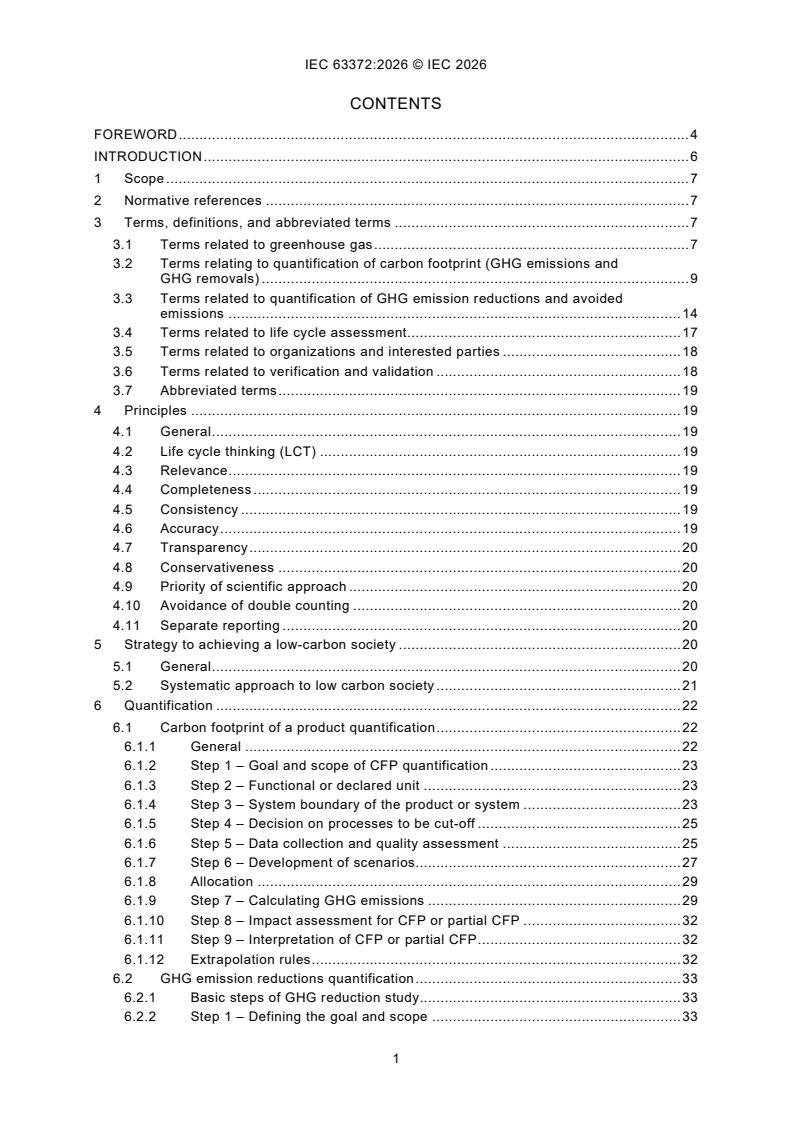
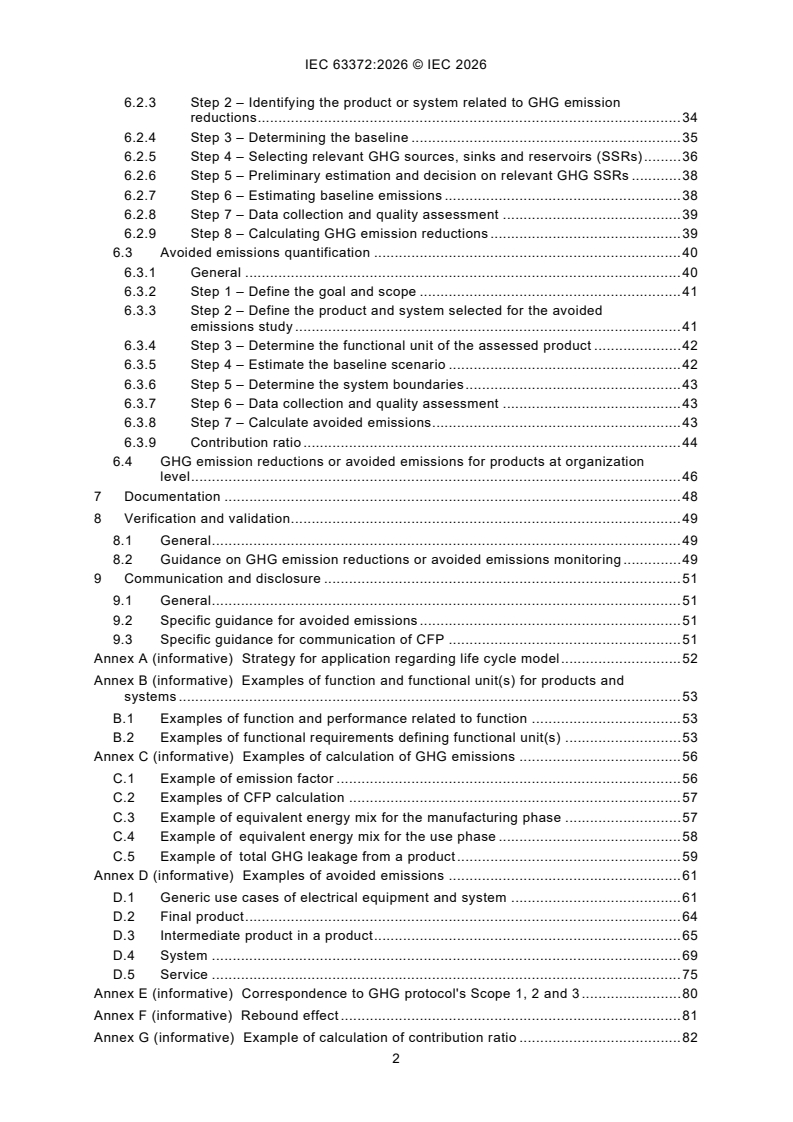
IEC 63372:2026 - Quantification and communication of carbon footprint, GHG emission reductions and avoided emissions from electric and electronic products and systems - Principles, methodologies, requirements and guidance Released:1/20/2026
Overview
IEC 63372:2026 is an international standard developed by the International Electrotechnical Commission (IEC) to support sustainability efforts in the electric and electronic (EE) sector. This standard provides the principles, methodologies, requirements, and guidance for the quantification and communication of carbon footprint (CFP), greenhouse gas (GHG) emission reductions, and avoided emissions from EE products and systems. It also covers GHG project-related aspects at the product level and aligns its methodologies with established life cycle assessment (LCA) standards, ensuring globally recognized environmental reporting.
This first edition revises and replaces IEC TR 62725:2013 and IEC TR 62726:2014. The aim is to ensure accuracy, completeness, and transparency in carbon footprint calculations, helping organizations in the EE sector demonstrate their commitment to climate action and low-carbon innovation.
Key Topics
IEC 63372:2026 covers a broad set of essential areas, including:
- Principles: Includes relevance, completeness, consistency, accuracy, transparency, conservativeness, and scientific prioritization in carbon reporting.
- Life Cycle Assessment: Utilizes LCA methods to assess CFP, GHG emission reductions, and avoided emissions over the entire product or system life cycle.
- Quantification Methodologies: Provides structured steps for CFP quantification, GHG emission reductions, and evaluation of avoided emissions including baseline scenario definition, system boundary setting, data collection, and emission calculations.
- Product and System Scope: Applies to both final and intermediate EE products and broader system-level assessments.
- Documentation and Verification: Outlines requirements for recordkeeping, third-party verification, and validation to increase the credibility of disclosed results.
- Communication Guidance: Recommends approaches for transparent and comparable communication of CFPs and GHG benefits to stakeholders and the market.
- Avoided Emissions: Offers examples and use cases, guiding organizations in quantifying the avoided emissions from key technologies and services.
Applications
IEC 63372:2026 has direct and practical applications for:
- Manufacturers and Developers: Assisting in robust CFP and GHG emission reduction calculations for product development, design improvements, and market communication.
- Regulatory Compliance: Providing a recognized methodology to meet global climate and environmental reporting obligations.
- Sustainability Reporting: Enabling companies to credibly quantify and communicate their efforts on emission reductions and sustainability initiatives.
- Product Innovation: Supporting the R&D departments in identifying opportunities for environmental improvement throughout the product life cycle.
- Procurement and Supply Chain: Facilitating consistent communication of GHG performance across complex supply chains.
- Product Ecolabeling: Supplying the technical foundation for product-related claims, environmental product declarations (EPDs), and eco-label schemes.
- Project Assessment: Applying LCA-based methodologies to product-related GHG projects, including upgrades, retrofitting, or new technology adoption.
- Industry Committees: Guiding IEC and other standards development committees to integrate environmental criteria into product and group standards.
Related Standards
IEC 63372:2026 builds upon and is meant to be used in conjunction with several established international guidelines and standards, such as:
- IEC Guide 123: Foundational environmental publication principles for standards development.
- Previous IEC Technical Reports: Replaces IEC TR 62725:2013 and IEC TR 62726:2014.
- Life Cycle Assessment Standards: Aligns with recognized LCA frameworks from both IEC and ISO.
- GHG Protocols: Provides correspondence for GHG protocol's scopes 1, 2, and 3, supporting organizational alignment with international reporting practices.
Summary
IEC 63372:2026 serves as a key reference for the accurate quantification and transparent communication of carbon footprints and GHG emission achievements in the electric and electronic industry. It empowers organizations to meet the increasing demand for credible sustainability data, enhance product innovation, and contribute to global environmental goals.
Relations
- Effective Date
- 23-Jan-2026
- Effective Date
- 23-Jan-2026
Buy Documents
IEC 63372:2026 - Quantification and communication of carbon footprint, GHG emission reductions and avoided emissions from electric and electronic products and systems - Principles, methodologies, requirements and guidance Released:1/20/2026
IEC 63372:2026 - Quantification et communication de l'empreinte carbone, des reductions d'émissions de GES et des émissions évitées des produits et systems électriques et électroniques - Principes, méthodologies, exigences et recommandations Released:1/20/2026
IEC 63372:2026 - Quantification and communication of carbon footprint, GHG emission reductions and avoided emissions from electric and electronic products and systems - Principles, methodologies, requirements and guidance Released:1/20/2026
Get Certified
Connect with accredited certification bodies for this standard

BSI Group
BSI (British Standards Institution) is the business standards company that helps organizations make excellence a habit.

Bureau Veritas
Bureau Veritas is a world leader in laboratory testing, inspection and certification services.

DNV
DNV is an independent assurance and risk management provider.
Sponsored listings
Frequently Asked Questions
IEC 63372:2026 is a standard published by the International Electrotechnical Commission (IEC). Its full title is "Quantification and communication of carbon footprint, GHG emission reductions and avoided emissions from electric and electronic products and systems - Principles, methodologies, requirements and guidance". This standard covers: IEC 63372:2026 describes principles and methodologies, specifies requirements and provides guidance for quantification and communication of carbon footprint a product (CFP), emission reductions and avoided emissions from electric and electronic (EE) products and systems. This document is also applicable to product-related GHG projects. The GHG quantification such as CFP is based on life cycle assessment (LCA) methods. This document is a basic environment horizontal publication focusing on essential requirements and is primarily intended for use by committees in the preparation of publications within the area of environment in accordance with the principles laid down in IEC Guide 123. Wherever applicable, it is the responsibility of committees to make use of environment basic publications in the preparation of their environment group and product publications. Committees can apply this document directly to products when they do not develop a product publication in the area of environment. This first edition of IEC 63372 cancels and replaces IEC TR 62725:2013 and IEC TR 62726:2014, which have been technically revised. This edition includes the following significant technical changes with respect to the previous edition: a) updating and enhancing content related to carbon footprint of a product to align with new or updated reference standards; b) including product and system in quantification of GHG emission reductions; c) adding the content related to avoided emissions including use cases in Annex D.
IEC 63372:2026 describes principles and methodologies, specifies requirements and provides guidance for quantification and communication of carbon footprint a product (CFP), emission reductions and avoided emissions from electric and electronic (EE) products and systems. This document is also applicable to product-related GHG projects. The GHG quantification such as CFP is based on life cycle assessment (LCA) methods. This document is a basic environment horizontal publication focusing on essential requirements and is primarily intended for use by committees in the preparation of publications within the area of environment in accordance with the principles laid down in IEC Guide 123. Wherever applicable, it is the responsibility of committees to make use of environment basic publications in the preparation of their environment group and product publications. Committees can apply this document directly to products when they do not develop a product publication in the area of environment. This first edition of IEC 63372 cancels and replaces IEC TR 62725:2013 and IEC TR 62726:2014, which have been technically revised. This edition includes the following significant technical changes with respect to the previous edition: a) updating and enhancing content related to carbon footprint of a product to align with new or updated reference standards; b) including product and system in quantification of GHG emission reductions; c) adding the content related to avoided emissions including use cases in Annex D.
IEC 63372:2026 is classified under the following ICS (International Classification for Standards) categories: 13.020.01 - Environment and environmental protection in general; 29.100 - Components for electrical equipment. The ICS classification helps identify the subject area and facilitates finding related standards.
IEC 63372:2026 has the following relationships with other standards: It is inter standard links to IEC TR 62725:2013, IEC TR 62726:2014. Understanding these relationships helps ensure you are using the most current and applicable version of the standard.
IEC 63372:2026 is available in PDF format for immediate download after purchase. The document can be added to your cart and obtained through the secure checkout process. Digital delivery ensures instant access to the complete standard document.
Standards Content (Sample)
IEC 63372 ®
Edition 1.0 2026-01
INTERNATIONAL
STANDARD
Quantification and communication of carbon footprint, GHG emission
reductions and avoided emissions from electric and electronic products and
systems - Principles, methodologies, requirements and guidance
ICS 13.020.01; 29.100 ISBN 978-2-8327-0998-6
All rights reserved. Unless otherwise specified, no part of this publication may be reproduced or utilized in any form or
by any means, electronic or mechanical, including photocopying and microfilm, without permission in writing from either
IEC or IEC's member National Committee in the country of the requester. If you have any questions about IEC copyright
or have an enquiry about obtaining additional rights to this publication, please contact the address below or your local
IEC member National Committee for further information.
IEC Secretariat Tel.: +41 22 919 02 11
3, rue de Varembé info@iec.ch
CH-1211 Geneva 20 www.iec.ch
Switzerland
About the IEC
The International Electrotechnical Commission (IEC) is the leading global organization that prepares and publishes
International Standards for all electrical, electronic and related technologies.
About IEC publications
The technical content of IEC publications is kept under constant review by the IEC. Please make sure that you have the
latest edition, a corrigendum or an amendment might have been published.
IEC publications search - IEC Products & Services Portal - products.iec.ch
webstore.iec.ch/advsearchform Discover our powerful search engine and read freely all the
The advanced search enables to find IEC publications by a publications previews, graphical symbols and the glossary.
variety of criteria (reference number, text, technical With a subscription you will always have access to up to date
committee, …). It also gives information on projects, content tailored to your needs.
replaced and withdrawn publications.
Electropedia - www.electropedia.org
The world's leading online dictionary on electrotechnology,
IEC Just Published - webstore.iec.ch/justpublished
Stay up to date on all new IEC publications. Just Published containing more than 22 500 terminological entries in English
details all new publications released. Available online and and French, with equivalent terms in 25 additional languages.
once a month by email. Also known as the International Electrotechnical Vocabulary
(IEV) online.
IEC Customer Service Centre - webstore.iec.ch/csc
If you wish to give us your feedback on this publication or
need further assistance, please contact the Customer
Service Centre: sales@iec.ch.
CONTENTS
FOREWORD . 4
INTRODUCTION . 6
1 Scope . 7
2 Normative references . 7
3 Terms, definitions, and abbreviated terms . 7
3.1 Terms related to greenhouse gas . 7
3.2 Terms relating to quantification of carbon footprint (GHG emissions and
GHG removals) . 9
3.3 Terms related to quantification of GHG emission reductions and avoided
emissions . 14
3.4 Terms related to life cycle assessment. 17
3.5 Terms related to organizations and interested parties . 18
3.6 Terms related to verification and validation . 18
3.7 Abbreviated terms . 19
4 Principles . 19
4.1 General . 19
4.2 Life cycle thinking (LCT) . 19
4.3 Relevance . 19
4.4 Completeness . 19
4.5 Consistency . 19
4.6 Accuracy . 19
4.7 Transparency . 20
4.8 Conservativeness . 20
4.9 Priority of scientific approach . 20
4.10 Avoidance of double counting . 20
4.11 Separate reporting . 20
5 Strategy to achieving a low-carbon society . 20
5.1 General . 20
5.2 Systematic approach to low carbon society . 21
6 Quantification . 22
6.1 Carbon footprint of a product quantification . 22
6.1.1 General . 22
6.1.2 Step 1 – Goal and scope of CFP quantification . 23
6.1.3 Step 2 – Functional or declared unit . 23
6.1.4 Step 3 – System boundary of the product or system . 23
6.1.5 Step 4 – Decision on processes to be cut-off . 25
6.1.6 Step 5 – Data collection and quality assessment . 25
6.1.7 Step 6 – Development of scenarios. 27
6.1.8 Allocation . 29
6.1.9 Step 7 – Calculating GHG emissions . 29
6.1.10 Step 8 – Impact assessment for CFP or partial CFP . 32
6.1.11 Step 9 – Interpretation of CFP or partial CFP . 32
6.1.12 Extrapolation rules . 32
6.2 GHG emission reductions quantification . 33
6.2.1 Basic steps of GHG reduction study. 33
6.2.2 Step 1 – Defining the goal and scope . 33
6.2.3 Step 2 – Identifying the product or system related to GHG emission
reductions . 34
6.2.4 Step 3 – Determining the baseline . 35
6.2.5 Step 4 – Selecting relevant GHG sources, sinks and reservoirs (SSRs) . 36
6.2.6 Step 5 – Preliminary estimation and decision on relevant GHG SSRs . 38
6.2.7 Step 6 – Estimating baseline emissions . 38
6.2.8 Step 7 – Data collection and quality assessment . 39
6.2.9 Step 8 – Calculating GHG emission reductions . 39
6.3 Avoided emissions quantification . 40
6.3.1 General . 40
6.3.2 Step 1 – Define the goal and scope . 41
6.3.3 Step 2 – Define the product and system selected for the avoided
emissions study . 41
6.3.4 Step 3 – Determine the functional unit of the assessed product . 42
6.3.5 Step 4 – Estimate the baseline scenario . 42
6.3.6 Step 5 – Determine the system boundaries . 43
6.3.7 Step 6 – Data collection and quality assessment . 43
6.3.8 Step 7 – Calculate avoided emissions . 43
6.3.9 Contribution ratio . 44
6.4 GHG emission reductions or avoided emissions for products at organization
level . 46
7 Documentation . 48
8 Verification and validation . 49
8.1 General . 49
8.2 Guidance on GHG emission reductions or avoided emissions monitoring . 49
9 Communication and disclosure . 51
9.1 General . 51
9.2 Specific guidance for avoided emissions . 51
9.3 Specific guidance for communication of CFP . 51
Annex A (informative) Strategy for application regarding life cycle model . 52
Annex B (informative) Examples of function and functional unit(s) for products and
systems . 53
B.1 Examples of function and performance related to function . 53
B.2 Examples of functional requirements defining functional unit(s) . 53
Annex C (informative) Examples of calculation of GHG emissions . 56
C.1 Example of emission factor . 56
C.2 Examples of CFP calculation . 57
C.3 Example of equivalent energy mix for the manufacturing phase . 57
C.4 Example of equivalent energy mix for the use phase . 58
C.5 Example of total GHG leakage from a product . 59
Annex D (informative) Examples of avoided emissions . 61
D.1 Generic use cases of electrical equipment and system . 61
D.2 Final product . 64
D.3 Intermediate product in a product . 65
D.4 System . 69
D.5 Service . 75
Annex E (informative) Correspondence to GHG protocol's Scope 1, 2 and 3 . 80
Annex F (informative) Rebound effect . 81
Annex G (informative) Example of calculation of contribution ratio . 82
Bibliography . 83
Figure 1 – GHG emission reductions and avoided emissions . 22
Figure 2 – Illustration of GHG emission reductions relative to the baseline . 35
Figure 3 – Example contribution ratio of avoided emissions among different target
products within a product portfolio . 45
Figure 4 – Example of avoided emission allocation . 45
Figure 5 – Two options for accumulation . 48
Figure A.1 – Life cycle model with some of the possible progressions . 52
Figure C.1 – Example of CFP calculation . 57
Figure D.1 – Continuous comparison of avoided emissions with lifetime extension . 62
Figure D.2 – Avoided emissions of a new product after the replacement . 63
Table 1 – Example of applicable data types . 26
Table 2 – Example of applicable emission factors for activities related to life cycle
stages . 30
Table C.1 – Example of SF leakage from a switchgear . 60
Table D.1 – Example of avoided emissions of electrical equipment . 61
Table D.2 – Example of avoided emissions of electrical equipment in a system . 63
Table D.3 – Avoided emissions of heat pump (HP) heaters . 65
Table D.4 – Example of avoided emissions of DC-DC converter for an EV . 66
Table D.5 – Example of avoided emissions of EV battery . 67
Table D.6 – Example of avoided emissions of a power electronic drive system (PDS)
using an electric motor driven by a variable speed drive . 68
Table D.7 – Example of avoided emissions of insulation products for house . 69
Table D.8 – Example of avoided emissions of storage hybrid cloud solutions . 71
Table D.9 – Example of avoided emissions of renewable energy installation with HVDC
system . 72
Table D.10 – Examples of avoided emissions for cooling technologies for radio base
station (RBS) . 73
Table D.11 – Examples of avoided emissions from energy management systems (EMS)
of buildings with solar energy (PV) and storage of electrical energy . 73
Table D.12 – Example of avoided emissions for image-based infrastructure structure
inspection services . 75
Table D.13 – Example of avoided emissions of virtual desktop services for telework . 76
Table D.14 – Example of avoided emissions of healthcare consultation . 78
Table D.15 – Example of avoided emissions of virtual power purchase agreements
(VPPAs) . 79
Table E.1 – GHG emissions corresponding to GHG protocol's Scope 1, 2 and 3 . 80
Table E.2 – Relationship between CFP and GHG protocol's Scope 1, 2 and 3 . 80
INTERNATIONAL ELECTROTECHNICAL COMMISSION
____________
Quantification and communication of carbon footprint, GHG emission
reductions and avoided emissions from electric and electronic products
and systems - Principles, methodologies, requirements and guidance
FOREWORD
1) The International Electrotechnical Commission (IEC) is a worldwide organization for standardization comprising
all national electrotechnical committees (IEC National Committees). The object of IEC is to promote international
co-operation on all questions concerning standardization in the electrical and electronic fields. To this end and
in addition to other activities, IEC publishes International Standards, Technical Specifications, Technical Reports,
Publicly Available Specifications (PAS) and Guides (hereafter referred to as “IEC Publication(s)”). Their
preparation is entrusted to technical committees; any IEC National Committee interested in the subject dealt with
may participate in this preparatory work. International, governmental and non-governmental organizations liaising
with the IEC also participate in this preparation. IEC collaborates closely with the International Organization for
Standardization (ISO) in accordance with conditions determined by agreement between the two organizations.
2) The formal decisions or agreements of IEC on technical matters express, as nearly as possible, an international
consensus of opinion on the relevant subjects since each technical committee has representation from all
interested IEC National Committees.
3) IEC Publications have the form of recommendations for international use and are accepted by IEC National
Committees in that sense. While all reasonable efforts are made to ensure that the technical content of IEC
Publications is accurate, IEC cannot be held responsible for the way in which they are used or for any
misinterpretation by any end user.
4) In order to promote international uniformity, IEC National Committees undertake to apply IEC Publications
transparently to the maximum extent possible in their national and regional publications. Any divergence between
any IEC Publication and the corresponding national or regional publication shall be clearly indicated in the latter.
5) IEC itself does not provide any attestation of conformity. Independent certification bodies provide conformity
assessment services and, in some areas, access to IEC marks of conformity. IEC is not responsible for any
services carried out by independent certification bodies.
6) All users should ensure that they have the latest edition of this publication.
7) No liability shall attach to IEC or its directors, employees, servants or agents including individual experts and
members of its technical committees and IEC National Committees for any personal injury, property damage or
other damage of any nature whatsoever, whether direct or indirect, or for costs (including legal fees) and
expenses arising out of the publication, use of, or reliance upon, this IEC Publication or any other IEC
Publications.
8) Attention is drawn to the Normative references cited in this publication. Use of the referenced publications is
indispensable for the correct application of this publication.
9) IEC draws attention to the possibility that the implementation of this document may involve the use of (a)
patent(s). IEC takes no position concerning the evidence, validity or applicability of any claimed patent rights in
respect thereof. As of the date of publication of this document, IEC had not received notice of (a) patent(s), which
may be required to implement this document. However, implementers are cautioned that this may not represent
the latest information, which may be obtained from the patent database available at https://patents.iec.ch. IEC
shall not be held responsible for identifying any or all such patent rights.
IEC 63372 has been prepared by IEC technical committee 111: Environmental standardization
for electrical and electronic products and systems. It is an International Standard.
This document has been given the status of a horizontal document in accordance with the
ISO/IEC Directives, Part 1.
This first edition of IEC 63372 cancels and replaces IEC TR 62725:2013 and
IEC TR 62726:2014, which have been technically revised.
This edition includes the following significant technical changes with respect to the previous
edition:
a) updating and enhancing content related to carbon footprint of a product to align with new or
updated reference standards;
b) including product and system in quantification of GHG emission reductions;
c) adding the content related to avoided emissions including use cases in Annex D.
The text of this International Standard is based on the following documents:
Draft Report on voting
111/857/FDIS 111/865/RVD
Full information on the voting for its approval can be found in the report on voting indicated in
the above table.
The language used for the development of this International Standard is English.
This document was drafted in accordance with ISO/IEC Directives, Part 2, and developed in
accordance with ISO/IEC Directives, Part 1 and ISO/IEC Directives, IEC Supplement, available
at www.iec.ch/members_experts/refdocs. The main document types developed by IEC are
described in greater detail at www.iec.ch/publications.
The committee has decided that the contents of this document will remain unchanged until the
stability date indicated on the IEC website under webstore.iec.ch in the data related to the
specific document. At this date, the document will be
• reconfirmed,
• withdrawn, or
• revised.
INTRODUCTION
There is a broad understanding that greenhouse gas (GHG) emissions must be reduced
significantly from current levels in order to keep global warming within acceptable levels.
Electrical and electronic (EE) products and systems play an important part in this by enabling
a transition to more energy-efficient products and systems. However, even though EE products
and systems can contribute to reducing GHG emissions, they lead to GHG emissions.
This document describes methods for quantifying and communicating the GHG emissions
related to products. It covers three related topics: carbon footprint of a product (CFP), emission
reductions, and avoided emissions.
Many governments and intergovernmental organizations are introducing, for example, carbon
taxes or similar carbon pricing to incentivize reducing emissions. In this context, it is important
that there is a horizontal standard to guide the calculating, in a consistent way, of the CFP of
different kinds of products and systems.
Emission reductions is the difference in emissions between a baseline and a target situation,
product, system, or product-related GHG project. The baseline can, for example, be a previous
version of the product. In that case, the emission reductions allow the organization to quantify
how they are contributing to reaching policy goals.
Avoided emissions, finally, are a special case of emission reductions. Frequently, a product or
system produced by one organization can enable another to emit less GHG than it would
otherwise have done. Additionally, it is possible that many EE businesses will increase their
total emissions as a consequence of them expanding to meet future decarbonization needs (in
contrast to, for example, a fossil fuel business that is scaling down and showing reduced
emissions), and many new products will be manufactured, creating emissions that did not exist
before. The concept of avoided emissions provides a way for an EE business to show that it is
still contributing to a net improvement of society, even though the emission reductions occur
outside of its organization and its own emissions are increasing.
Furthermore, the organization operating an EE business needs robust and reliable calculation
methods to establish the amount of avoided emissions achieved by its products and systems.
An important purpose of this document is to define methodologies to assess avoided emissions
from the use of new technologies in a reproducible, repeatable, unambiguous, and transparent
manner.
Nevertheless, avoided emissions are reported separately from GHG emissions and are not
subtracted from the total GHG emissions. Moreover, avoided emissions do not offset the direct
and indirect GHG emissions of an organization.
Through the information disclosure based on this document, an EE business can claim that its
products and systems can reduce or avoid emissions and contribute to solving climate issues
directly or indirectly linked with United Nations Sustainable Development Goal 13 (UN SDG 13):
Climate Action.
1 Scope
This document describes principles and methodologies, specifies requirements and provides
guidance for quantification and communication of carbon footprint a product (CFP), emission
reductions and avoided emissions from electric and electronic (EE) products and systems. This
document is also applicable to product-related GHG projects.
The GHG quantification such as CFP is based on life cycle assessment (LCA) methods.
This document is a basic environment horizontal publication focusing on essential requirements
and is primarily intended for use by committees in the preparation of publications within the
area of environment in accordance with the principles laid down in IEC Guide 123. Wherever
applicable, it is the responsibility of committees to make use of environment basic publications
in the preparation of their environment group and product publications. Committees can apply
this document directly to products when they do not develop a product publication in the area
of environment.
2 Normative references
The following documents are referred to in the text in such a way that some or all of their content
constitutes requirements of this document. For dated references, only the edition cited applies.
For undated references, the latest edition of the referenced document (including any
amendments) applies.
IEC 63366:2025, Product category rules for life cycle assessment of electrical and electronic
products and systems
ISO 14067:2018, Greenhouse gases - Carbon footprint of products - Requirements and
guidelines for quantification
3 Terms, definitions, and abbreviated terms
For the purposes of this document, the following terms and definitions apply.
ISO and IEC maintain terminology databases for use in standardization at the following
addresses:
– IEC Electropedia: available at https://www.electropedia.org/
– ISO Online browsing platform: available at https://www.iso.org/obp
3.1 Terms related to greenhouse gas
3.1.1
CO equivalent
CO e
unit for comparing the radiative forcing of a GHG to that of carbon dioxide
Note 1 to entry: Mass of a GHG is converted into CO equivalents by multiplying the mass of the GHG by the
corresponding GWP or GTP of that gas.
Note 2 to entry: In the case of GTP, CO equivalent is the unit for comparing the change in global mean surface
temperature caused by a GHG to the temperature change caused by CO .
[SOURCE: ISO 14067:2018, 3.1.2.2, modified – The term "carbon dioxide equivalent" has been
deleted.]
3.1.2
global warming potential
GWP
index, based on radiative properties of GHGs, measuring the radiative forcing following a pulse
emission of a unit mass of a given GHG in the present-day atmosphere integrated over a chosen
time horizon, relative to that of carbon dioxide (CO )
Note 1 to entry: "Index" as used in this document is a "characterization factor" as defined in ISO 14040:2006, 3.37.
Note 2 to entry: A "pulse emission" is an emission at one point in time.
Note 3 to entry: The GWP values of GHG follow those in the latest IPCC assessment report.
[SOURCE: ISO 14067:2018, 3.1.2.4, modified – Note 3 to entry has been added.]
3.1.3
greenhouse gas
GHG
gaseous constituent of the atmosphere, both natural and anthropogenic, that absorbs and emits
radiation at specific wavelengths within the spectrum of infrared radiation emitted by the earth's
surface, the atmosphere, and clouds
Note 1 to entry: For a list of GHGs, see the latest IPCC Assessment Report.
Note 2 to entry: Water vapour and ozone, which are anthropogenic as well as natural GHGs, are not included in the
CFP and partial CFP.
Note 3 to entry: The focus of this document is limited to long-lived GHGs, it therefore excludes climate effects due
to changes in surface reflectivity (albedo) and short-lived radiative forcing agents (e.g. black carbon and aerosols).
[SOURCE: ISO 14067:2018, 3.1.2.1]
3.1.4
greenhouse gas emission
GHG emission
release of a GHG into the atmosphere
[SOURCE: ISO 14067:2018, 3.1.2.5]
3.1.5
GHG emission factor
coefficient relating activity data with the GHG emission
Note 1 to entry: Activity data is quantitative measure of activity that results in a greenhouse gas emissions or
greenhouse gas removal.
[SOURCE: ISO 14067:2018, 3.1.2.7, modified – The term "greenhouse gas emission factor"
has been deleted.]
3.1.6
GHG removal
withdrawal of a GHG from the atmosphere
Note 1 to entry: Examples of ways in which GHG removals can be achieved include carbon sequestration in soils,
direct air capture, carbon capture and storage.
[SOURCE: ISO 14067:2018, 3.1.2.6, modified – The term "greenhouse gas removal" has been
deleted.]
3.2 Terms relating to quantification of carbon footprint (GHG emissions and GHG
removals)
3.2.1
allocation
partitioning the input or output flows of a process or a product system, and assigning of the
parts amongst constituent sub-systems
[SOURCE: ISO 14050:2020 3.6.16 modified – In the definition, "flows" has been added and
"between the product system under study and one or more other product systems" has been
replaced with ", and assigning of the parts amongst constituent sub-systems".]
3.2.2
carbon emission intensity
metric expressing the CO equivalent emissions from a specific reference unit
Note 1 to entry: Carbon emission intensity can, for example, be expressed as CO e emissions per kilowatt-hour.
Note 2 to entry: Carbon emission intensity can vary between different activities or locations.
Note 3 to entry: Carbon emission intensity of energy use can be related to electricity generation (renewable energy
production such as photovoltaic, wind turbine) or consumption (electrical loads).
3.2.3
carbon footprint of a product
CFP
sum of GHG emissions and GHG removals in a product system, expressed as CO equivalents
and based on a life cycle assessment using the single impact category of climate change
Note 1 to entry: A CFP can be disaggregated into a set of figures identifying specific GHG emissions and GHG
removals. A CFP can also be disaggregated into the stages of the life cycle.
Note 2 to entry: The results of the quantification of the CFP are documented in the CFP study report expressed in
mass of CO e per functional unit.
[SOURCE: ISO 14067:2018, 3.1.1.1]
3.2.4
CFP-PCR
set of specific rules, requirements and guidelines for CFP or partial CFP quantification and
communication for one or more product categories
Note 1 to entry: CFP–PCR include quantification rules conforming to ISO 14044.
[SOURCE: ISO 14067:2018, 3.1.1.10, modified – The term "carbon footprint of a product –
product category rules" and Note 2 to entry have been deleted.]
3.2.5
CFP study
set of all activities that are necessary to quantify and report a CFP or a partial CFP
[SOURCE: ISO 14067:2018, 3.1.1.4, modified – "set of" has been added at the start of the
definition.]
3.2.6
CFP study report
report that documents the CFP study, presents the CFP or partial CFP, and shows the decisions
taken within the study
Note 1 to entry: The CFP study report demonstrates that the provisions of this document are met.
[SOURCE: ISO 14067:2018, 3.1.1.5, modified – The term "carbon footprint of a product study
report" has been deleted.]
3.2.7
declared unit
quantity of a product for use as a reference unit in the quantification of a partial CFP
EXAMPLE Mass (1 kg of primary steel), volume (1 m of crude oil).
[SOURCE: ISO 14067:2020, 3.1.3.8]
3.2.8
direct GHG emission
greenhouse gas emission from greenhouse gas sources owned or controlled by an organization
[SOURCE: ISO 14050:2020, 3.9.9, modified – The term "direct greenhouse gas emission" has
been deleted.]
3.2.9
energy indirect GHG emission
greenhouse gas emission from the generation of imported electricity, heat, or steam consumed
by an organization
[SOURCE: ISO 14050:2020, 3.9.11, modified – The term "energy indirect greenhouse gas
emission" has been deleted.]
3.2.10
other indirect GHG emission
greenhouse gas emission, other than energy indirect GHG emissions, that is a consequence of
an organization's activities, but arises from greenhouse gas sources that are owned or
controlled by other organizations
[SOURCE: ISO 14050:2020, 3.9.12, modified – The term "other indirect greenhouse gas
emission" has been deleted.]
3.2.11
embodied emissions
life cycle(s) emissions from the following life cycle stages: raw material acquisition, production,
and end-of-life treatment, i.e. all life cycle stages other than the use stage
[SOURCE: Rec. ITU-T L.1410 (11/2024), 3.2.10, modified – In the term and definition,
"environmental impact" has been replaced with "emissions". "i.e. all life cycle stages other than
the use stage" has been added to the definition. Notes 1 and 2 have been deleted.]
3.2.12
functional unit
LCA functional unit
description of main function(s) and associated quantified performance of a product system for
use as a reference unit
Note 1 to entry: As the CFP treats information on a product basis, an additional calculation based on a declared unit
can be presented.
[SOURCE: ISO 14067:2018, 3.1.3.7, modified – In the definition, "description of main
function(s) and associated" has been added.]
3.2.13
reference flow
measure of the outputs from processes in a given product system required to fulfil the function
expressed by the functional unit
Note 1 to entry: The reference flows translate the abstract functional unit into specific product systems needed to
fulfil the required function with a required level of performance.
[SOURCE: IEC 63366:2025, 3.1.37]
3.2.14
partial CFP
sum of GHG emissions and GHG removals of one or more selected process(es) in a product
system, expressed as CO equivalents and based on the selected stages or processes within
the life cycle
Note 1 to entry: A partial CFP is based on or compiled from data related to (a) specific process(es) or footprint
information modules, which is (are) part of a product system and can form the basis for quantification of a CFP. More
detailed information on information modules is given in ISO 14025:2006, 5.4.
Note 2 to entry: "Footprint information module" is defined in ISO 14026:2017, 3.1.4: compilation of data to be used
as a basis for a footprint, covering a unit process or a combination of unit processes that are part of the life cycle of
a product.
Note 3 to entry: The results of the quantification of the partial CFP are documented in the CFP study report
expressed in mass of CO e per declared unit.
[SOURCE: ISO 14067:2018, 3.1.1.2, modified – The term "partial carbon footprint of a product"
has been deleted.]
3.2.15
primary data
quantified value of a process or an activity obtained from a direct measurement or a calculation
based on direct measurements
Note 1 to entry: There is no need for primary data to originate from the product system under study because primary
data can relate to a different but comparable product system to that being studied.
Note 2 to entry: Primary data can include GHG emission factors or GHG activity data (defined in ISO 14064-1:2006,
2.11) or both.
[SOURCE: ISO 14067:2018, 3.1.6.1, modified – Editorial corrections have been made in the
Notes to entry.]
3.2.16
process
set of interrelated or interacting activities which transform inputs into outputs
[SOURCE: IEC 60050-904:2015, 904-01-05, modified – Note 1 to entry and Note 2 to entry
have been deleted.]
3.2.17
product
goods or service
Note 1 to entry: The product can be categorized as follows:
– service (e.g. transport, implementation of events);
– software (e.g. computer programme);
– hardware (e.g. engine mechanical part);
– processed material (e.g. lubricant, ore, fuel); and
– unprocessed material (e.g. agricultural product).
Note 2 to entry: Services have tangible and intangible elements. Offering a service can include, among other things,
the following:
– an activity performed on a customer-supplied tangible product (e.g. automobile to be repaired);
– an activity performed on a customer-supplied intangible product (e.g. the income statement needed to prepare
a tax return);
– the delivery of an intangible product (e.g. the delivery of information in the context of knowledge transmission);
– the creation of ambience for the customer (e.g. in hotels and restaurants).
[SOURCE: ISO 14067:2018, 3.1.3.1, modified – In Note 2 to entry, “Provision of a service can
involve, for example, the following:” has been replaced with “Offering a service can include,
among other things, the following:” has been added.]
3.2.18
intermediate product
goods, semi-finished product, system or software product of the development process that is
used as inputs to other stages of the development process or in the production of other product
including final products
[SOURCE: ISO/IEC 25041:2012, 4.10, modified – In the definition, "goods, semi-finished
product" and "or in the production of other product including final products" have been added.]
3.2.19
product category
group of products that can fulfil equivalent functions
Note 1 to entry: "Product category" is defined by a set of product families.
[SOURCE: ISO 14067:2018, 3.1.1.8, modified – Note 1 to entry has been added.]
3.2.20
product category rules
PCR
set of specific rules, requirements, and guidelines for developing Type III environmental
declarations and footprint communications for one or more product categories
Note 1 to entry: PCR include quantification rules conforming to ISO 14044.
Note 2 to entry: ISO/TS 14027 describes the development of PCR applicable to this document.
Note 3 to entry: “Footprint communication” is defined in ISO 14026:2017, 3.1.1.
[SOURCE: ISO 14067:2018, 3.1.1.9]
3.2.21
product family
set of products or services sharing explicitly defined and managed common and variable
features and relying on the same domain architecture to meet the common and variable needs
of specific markets
Note 1 to entry: "Product families" are defined by product standards and can need product-specific rules (PSRs);
"product ranges" are defined by organizations.
[SOURCE: ISO/IEC 26550:2015, 3.16, modified – The preferred term "product line" has been
deleted. In the definition, "and/or" has been replaced by "or". Note 1 to entry has been added.]
3.2.22
homogeneous product family
subgroup of a product family based on the underlying technology or build where the environmental
impacts can reasonably be expected to be similar and therefore scalable over the group through a
function of certain physical characteristics, for example, power or weight
[SOURCE: IEC 63366:2025, 3.1.15]
3.2.23
product-specific rules
PSR
set of specific rules, requirements and guidelines for developing Type III environmental
declarations for a product category
Note 1 to entry: Product-specific rules are developed based upon and complementing the PCR.
Note 2 to entry: PCR and PSR are comparable concepts. To ensure consistency in IEC community, PCR refers to
rules at EE products and systems level, and PSR refers to rules at product committee level.
[SOURCE: IEC 63366:2025, 3.1.33]
3.2.24
product system
collection of unit processes with elementary flows and product flows, performing one or more
defined functions and which models the life cycle of a product
Note 1 to entry: "Product flow" is defined in ISO 14040:2006, 3.27.
[SOURCE: ISO 14067:2018, 3.1.3.2]
3.2.25
reference service life
RSL
representative time period where a product in use meets or exceeds the performance
requirements
[SOURCE: ISO 14067:2018, 3.1.3.11 modified – In the term, “reference” has been added; in
the definition, “representative” has been added.]
3.2.26
secondary data
data which do not fulfil the requirements for primary data
Note 1 to entry: Secondary data can include data from databases and published literature, default emission factors
from national and regional inventories, calculated data, estimates or other representative data, validated by
competent authorities.
Note 2 to entry: Secondary data can include data obtained from proxy processes or estimates.
[SOURCE: ISO 14067:2018, 3.1.6.3, modified – In Note 1 to entry, “and regional” has been
added.]
3.2.27
system boundary
boundary based on a set of criteria representing which unit processes are a part of the system
under study
Note 1 to entry: The system boundary is closely related to the product system and cut-off. The system boundary
defines the wider system (e.g. the Internet) in which the studied product system (e.g. a specific radio access network)
exists. The cut-off is made from the studied product system.
Note 2 to entry: The system boundary enables operational boundary - and thus corresponding emissions associated
with its operations – to be identified, categorizing them as direct GHG emissions and indirect GHG emissions.
[SOURCE: ISO 14067:2018, 3.1.3.4, modified – Note 1 to entry and Note 2 to entry have been
added.]
3.2.28
uncertainty
parameter associated with the result of quantific
...
IEC 63372 ®
Edition 1.0 2026-01
NORME
INTERNATIONALE
Quantification et communication de l'empreinte carbone, des réductions
d'émissions de GES et des émissions évitées des produits et systèmes
électriques et électroniques - Principes, méthodologies, exigences et
recommandations
ICS 13.020.01; 29.100 ISBN 978-2-8327-0998-6
Droits de reproduction réservés. Sauf indication contraire, aucune partie de cette publication ne peut être reproduite ni
utilisée sous quelque forme que ce soit et par aucun procédé, électronique ou mécanique, y compris la photocopie et
les microfilms, sans l'accord écrit de l'IEC ou du Comité national de l'IEC du pays du demandeur. Si vous avez des
questions sur le copyright de l'IEC ou si vous désirez obtenir des droits supplémentaires sur cette publication, utilisez
les coordonnées ci-après ou contactez le Comité national de l'IEC de votre pays de résidence.
IEC Secretariat Tel.: +41 22 919 02 11
3, rue de Varembé info@iec.ch
CH-1211 Geneva 20 www.iec.ch
Switzerland
A propos de l'IEC
La Commission Electrotechnique Internationale (IEC) est la première organisation mondiale qui élabore et publie des
Normes internationales pour tout ce qui a trait à l'électricité, à l'électronique et aux technologies apparentées.
A propos des publications IEC
Le contenu technique des publications IEC est constamment revu. Veuillez vous assurer que vous possédez l’édition la
plus récente, un corrigendum ou amendement peut avoir été publié.
Recherche de publications IEC - IEC Products & Services Portal - products.iec.ch
webstore.iec.ch/advsearchform Découvrez notre puissant moteur de recherche et consultez
La recherche avancée permet de trouver des publications gratuitement tous les aperçus des publications, symboles
IEC en utilisant différents critères (numéro de référence, graphiques et le glossaire. Avec un abonnement, vous aurez
texte, comité d’études, …). Elle donne aussi des toujours accès à un contenu à jour adapté à vos besoins.
informations sur les projets et les publications remplacées
ou retirées. Electropedia - www.electropedia.org
Le premier dictionnaire d'électrotechnologie en ligne au
IEC Just Published - webstore.iec.ch/justpublished monde, avec plus de 22 500 articles terminologiques en
Restez informé sur les nouvelles publications IEC. Just anglais et en français, ainsi que les termes équivalents
dans 25 langues additionnelles. Egalement appelé
Published détaille les nouvelles publications parues.
Disponible en ligne et une fois par mois par email. Vocabulaire Electrotechnique International (IEV) en ligne.
Service Clients - webstore.iec.ch/csc
Si vous désirez nous donner des commentaires sur cette
publication ou si vous avez des questions contactez-
nous: sales@iec.ch.
SOMMAIRE
AVANT-PROPOS . 5
INTRODUCTION . 7
1 Domaine d'application . 8
2 Références normatives . 8
3 Termes, définitions et abréviations . 8
3.1 Termes relatifs aux gaz à effet de serre . 8
3.2 Termes relatifs à la quantification de l'empreinte carbone (émissions de GES
et captations de GES) . 10
3.3 Termes relatifs à la quantification des réductions d'émissions de GES et des
émissions évitées . 15
3.4 Termes relatifs à l'analyse du cycle de vie . 18
3.5 Termes relatifs aux organismes et aux parties intéressées . 20
3.6 Termes relatifs à la vérification et à la validation . 20
3.7 Abréviations . 21
4 Principes . 21
4.1 Généralités . 21
4.2 Pensée cycle de vie (PCV) . 21
4.3 Pertinence . 21
4.4 Complétude . 21
4.5 Cohérence . 21
4.6 Exactitude . 22
4.7 Transparence . 22
4.8 Prudence . 22
4.9 Priorité de l'approche scientifique . 22
4.10 Évitement du double comptage . 22
4.11 Déclarations séparées . 22
5 Stratégie de transition vers une société à faibles émissions de carbone . 22
5.1 Généralités . 22
5.2 Approche systématique de transition vers une société à faibles émissions de
carbone . 23
6 Quantification . 24
6.1 Quantification de l'empreinte carbone d'un produit . 24
6.1.1 Généralités . 24
6.1.2 Étape 1 – Définir l'objectif et le domaine d'application de quantification
de l'ECP . 25
6.1.3 Étape 2 – Unité fonctionnelle ou déclarée . 26
6.1.4 Étape 3 – Paramétrage des frontières du système, d'un produit ou d'un
système . 26
6.1.5 Étape 4 – Décision sur les processus à couper . 27
6.1.6 Étape 5 – Compilation des données et évaluation de la qualité . 27
6.1.7 Étape 6 – Élaboration des scénarios . 31
6.1.8 Affectation . 33
6.1.9 Étape 7 – Calcul des émissions de GES . 33
6.1.10 Étape 8 – Évaluation de l'impact de l'ECP ou de l'ECP partielle . 36
6.1.11 Étape 9 – Interprétation de l'ECP ou de l'ECP partielle . 36
6.1.12 Règles d'extrapolation . 37
6.2 Quantification des réductions d'émissions de GES . 37
IEC 63372 © IEC 2026
6.2.1 Étapes fondamentales de l'étude de réduction des GES . 37
6.2.2 Étape 1 – Définition de l'objectif et du domaine d'application . 38
6.2.3 Étape 2 – Identification du produit ou système associé aux réductions
d'émissions de GES . 38
6.2.4 Étape 3 – Détermination de la situation de référence . 40
6.2.5 Étape 4 – Sélection des sources, puits et réservoirs de GES (SPR de
GES) pertinents . 41
6.2.6 Étape 5 – Estimation préliminaire et décision sur les SPR de GES
pertinents . 43
6.2.7 Étape 6 – Estimation des émissions de la situation de référence . 43
6.2.8 Étape 7 – Compilation des données et évaluation de la qualité . 44
6.2.9 Étape 8 – Calcul des réductions d'émissions de GES . 45
6.3 Quantification des émissions évitées . 46
6.3.1 Généralités . 46
6.3.2 Étape 1 – Définition de l'objectif et du domaine d'application . 46
6.3.3 Étape 2 – Définition du produit ou système choisi pour l'étude des
émissions évitées . 47
6.3.4 Étape 3 – Détermination de l'unité fonctionnelle du produit évalué . 47
6.3.5 Étape 4 – Estimation du scénario de référence . 47
6.3.6 Étape 5 – Détermination des frontières du système . 49
6.3.7 Étape 6 – Compilation des données et évaluation de la qualité . 49
6.3.8 Étape 7 – Calcul des émissions évitées . 49
6.3.9 Rapport de contribution . 50
6.4 Réductions d'émissions de GES ou émissions évitées pour les produits au
niveau de l'organisme . 52
7 Documentation . 55
8 Vérification et validation . 55
8.1 Généralités . 55
8.2 Recommandations pour la surveillance des réductions d'émissions de GES
et des émissions évitées . 56
9 Communication et divulgation . 58
9.1 Généralités . 58
9.2 Recommandations particulières pour les émissions évitées . 58
9.3 Recommandations particulières pour la communication de l'ECP . 58
Annex A (informative) Stratégie d'application relative au modèle de cycle de vie . 59
Annex B (informative) Exemples de fonctions et d'unités fonctionnelles pour les
produits et systèmes . 60
B.1 Exemples de fonctions et de performances liées aux fonctions . 60
B.2 Exemples d'exigences fonctionnelles définissant l'unité fonctionnelle ou les
unités fonctionnelles . 60
Annex C (informative) Exemples de calculs des émissions de GES . 63
C.1 Exemple de facteur d'émission . 63
C.2 Exemples de calculs de l'ECP . 64
C.3 Exemple de mix énergétique équivalent pour la phase de fabrication . 64
C.4 Exemple de mix énergétique équivalent pour la phase d'utilisation . 65
C.5 Exemple de fuite totale de GES d'un produit . 66
Annex D (informative) Exemples d'émissions évitées . 68
D.1 Cas d'utilisation générique d'équipements et de systèmes électriques . 68
D.2 Produit final . 71
D.3 Produit intermédiaire dans un produit . 72
D.4 Système. 77
D.5 Service . 84
Annex E (informative) Correspondance avec les périmètres 1, 2 et 3 du protocole des
GES . 90
Annex F (informative) Effets de rebond . 91
Annex G (informative) Exemple de calcul du rapport de contribution . 92
Bibliographie . 93
Figure 1 – Réductions d'émissions de GES et émissions évitées . 24
Figure 2 – Illustration des réductions d'émissions de GES par rapport à la situation de
référence . 40
Figure 3 – Exemple de rapport de contribution des émissions évitées entre différents
produits cibles d'un portefeuille de produits . 51
Figure 4 – Exemple d'affectation des émissions évitées . 52
Figure 5 – Deux options de cumul . 54
Figure A.1 – Modèle de cycle de vie avec certaines des progressions possibles . 59
Figure C.1 – Exemple de calcul de l'ECP . 64
Figure D.1 – Comparaison continuelle des émissions évitées avec un allongement de
la durée de vie . 69
Figure D.2 – Émissions évitées d'un nouveau produit après le remplacement . 70
Tableau 1 – Exemple de types de données applicables . 30
Tableau 2 – Exemples de facteurs d'émission applicables pour les activités liées aux
étapes du cycle de vie . 34
Tableau C.1 – Exemple de fuite de SF d'un appareillage de connexion . 67
Tableau D.1 – Exemple d'émissions évitées d'équipements électriques . 68
Tableau D.2 – Exemple d'émissions évitées d'équipements électriques dans un
système . 70
Tableau D.3 – Émissions évitées des chauffages de pompes à chaleur (HP) . 72
Tableau D.4 – Exemple d'émissions évitées dues au convertisseur continu-continu
d'un véhicule électrique . 73
Tableau D.5 – Exemple d'émissions évitées d'une batterie de véhicule électrique . 75
Tableau D.6 – Exemple d'émissions évitées d'un système d'entraînement électronique
de puissance (PDS) utilisant un moteur électrique entraîné par un entraînement à
vitesse variable . 76
Tableau D.7 – Exemple d'émissions évitées de produits d'isolation pour la maison . 77
Tableau D.8 – Exemple d'émissions évitées de solutions de stockage cloud hybride . 79
Tableau D.9 – Exemple d'émissions évitées d'une installation d'énergie renouvelable
avec un système CCHT . 80
Tableau D.10 – Exemples d'émissions évitées pour les technologies de
refroidissement de stations de base (RBS) . 82
Tableau D.11 – Exemples d'émissions évitées par les systèmes de management de
l'énergie (SMÉ) de bâtiments à énergie solaire (PV) et stockage d'énergie électrique . 83
Tableau D.12 – Exemple d'émissions évitées pour les services d'inspection
structurelle d'infrastructure par imagerie . 84
Tableau D.13 – Exemple d'émissions évitées de services de bureau virtuel pour le
télétravail . 86
IEC 63372 © IEC 2026
Tableau D.14 – Exemple d'émissions évitées des consultations de santé . 88
Tableau D.15 – Exemple d'émissions évitées des contrats d'achat d'électricité virtuelle
(VPPA) . 89
Tableau E.1 – Émissions de GES correspondant aux périmètres 1, 2 et 3 du protocole
des GES . 90
Tableau E.2 – Relation entre l'ECP et les périmètres 1, 2 et 3 du protocole des GES . 90
COMMISSION ÉLECTROTECHNIQUE INTERNATIONALE
____________
Quantification et communication de l'empreinte carbone, des réductions
d'émissions de GES et des émissions évitées des produits et systèmes
électriques et électroniques – Principes, méthodologies, exigences et
recommandations
AVANT-PROPOS
1) La Commission Électrotechnique Internationale (IEC) est une organisation mondiale de normalisation composée
de l'ensemble des comités électrotechniques nationaux (Comités nationaux de l'IEC). L'IEC a pour objet de
favoriser la coopération internationale pour toutes les questions de normalisation dans les domaines de
l'électricité et de l'électronique. À cet effet, l'IEC – entre autres activités – publie des Normes internationales,
des Spécifications techniques, des Rapports techniques, des Spécifications accessibles au public (PAS) et des
Guides (ci-après dénommés "Publication(s) de l'IEC"). Leur élaboration est confiée à des comités d'études, aux
travaux desquels tout Comité national intéressé par le sujet traité peut participer. Les organisations
internationales, gouvernementales et non gouvernementales, en liaison avec l'IEC, participent également aux
travaux. L'IEC collabore étroitement avec l'Organisation Internationale de Normalisation (ISO), selon des
conditions fixées par accord entre les deux organisations.
2) Les décisions ou accords officiels de l'IEC concernant les questions techniques représentent, dans la mesure du
possible, un accord international sur les sujets étudiés, étant donné que les Comités nationaux de l'IEC intéressés
sont représentés dans chaque comité d'études.
3) Les Publications de l'IEC se présentent sous la forme de recommandations internationales et sont agréées
comme telles par les Comités nationaux de l'IEC. Tous les efforts raisonnables sont entrepris afin que l'IEC
s'assure de l'exactitude du contenu technique de ses publications; l'IEC ne peut pas être tenue responsable de
l'éventuelle mauvaise utilisation ou interprétation qui en est faite par un quelconque utilisateur final.
4) Dans le but d'encourager l'uniformité internationale, les Comités nationaux de l'IEC s'engagent, dans toute la
mesure possible, à appliquer de façon transparente les Publications de l'IEC dans leurs publications nationales
et régionales. Toutes divergences entre toutes Publications de l'IEC et toutes publications nationales ou
régionales correspondantes doivent être indiquées en termes clairs dans ces dernières.
5) L'IEC elle-même ne fournit aucune attestation de conformité. Des organismes de certification indépendants
fournissent des services d'évaluation de conformité et, dans certains secteurs, accèdent aux marques de
conformité de l'IEC. L'IEC n'est responsable d'aucun des services effectués par les organismes de certification
indépendants.
6) Tous les utilisateurs doivent s'assurer qu'ils sont en possession de la dernière édition de cette publication.
7) Aucune responsabilité ne doit être imputée à l'IEC, à ses administrateurs, employés, auxiliaires ou mandataires,
y compris ses experts particuliers et les membres de ses comités d'études et des Comités nationaux de l'IEC,
pour tout préjudice causé en cas de dommages corporels et matériels, ou de tout autre dommage de quelque
nature que ce soit, directe ou indirecte, ou pour supporter les coûts (y compris les frais de justice) et les dépenses
découlant de la publication ou de l'utilisation de cette Publication de l'IEC ou de toute autre Publication de l'IEC,
ou au crédit qui lui est accordé.
8) L'attention est attirée sur les références normatives citées dans cette publication. L'utilisation de publications
référencées est obligatoire pour une application correcte de la présente publication.
9) L'IEC attire l'attention sur le fait que la mise en application du présent document peut entraîner l'utilisation d'un
ou de plusieurs brevets. L'IEC ne prend pas position quant à la preuve, à la validité et à l'applicabilité de tout
droit de brevet revendiqué à cet égard. À la date de publication du présent document, l'IEC n'avait pas reçu
notification qu'un ou plusieurs brevets pouvaient être nécessaires à sa mise en application. Toutefois, il y a lieu
d'avertir les responsables de la mise en application du présent document que des informations plus récentes
sont susceptibles de figurer dans la base de données de brevets, disponible à l'adresse https://patents.iec.ch.
L'IEC ne saurait être tenue pour responsable de ne pas avoir identifié de tels droits de brevets.
L'IEC 63372 a été établie par le comité d'études 111 de l'IEC: Normalisation environnementale
pour les produits et les systèmes électriques et électroniques. Il s'agit d'une Norme
internationale.
Le présent document a obtenu le statut de publication horizontale conformément aux
Directives ISO/IEC, Partie 1.
Cette première édition de l'IEC 63372 annule et remplace l'IEC TR 62725:2013 et
l'IEC TR 62726:2014, qui ont fait l'objet d'une révision technique.
IEC 63372 © IEC 2026
Cette édition inclut les modifications techniques majeures suivantes par rapport à l'édition
précédente:
a) mise à jour et amélioration du contenu relatif à l'empreinte carbone d'un produit pour des
raisons d'homogénéité avec les normes de référence nouvelles ou mises à jour;
b) intégration du produit et du système dans la quantification des réductions d'émissions de
GES;
c) ajout du contenu relatif aux émissions évitées, y compris les cas d'utilisation, à l'Annex D.
Le texte de cette Norme internationale est issu des documents suivants:
Projet Rapport de vote
111/857/FDIS 111/865/RVD
Le rapport de vote indiqué dans le tableau ci-dessus donne toute information sur le vote ayant
abouti à son approbation.
La langue employée pour l'élaboration de cette Norme internationale est l'anglais.
La version française de la norme n’a pas été soumise au vote.
Ce document a été rédigé selon les Directives ISO/IEC, Partie 2, il a été développé selon les
Directives ISO/IEC, Partie 1 et les Directives ISO/IEC, Supplément IEC, disponibles sous
www.iec.ch/members_experts/refdocs. Les principaux types de documents développés par
l'IEC sont décrits plus en détail sous www.iec.ch/publications.
Le comité a décidé que le contenu de ce document ne sera pas modifié avant la date de stabilité
indiquée sur le site web de l'IEC sous webstore.iec.ch dans les données relatives au document
recherché. À cette date, le document sera
• reconduit,
• supprimé, ou
• révisé.
INTRODUCTION
Il est largement admis que les émissions de gaz à effet de serre (GES) doivent être réduites de
manière significative par rapport aux niveaux actuels afin de maintenir le réchauffement global
à des niveaux acceptables. Les produits et systèmes électriques et électroniques (EE) jouent
un rôle important en permettant une transition vers des produits et systèmes plus économes en
énergie. Toutefois, même si les produits et systèmes EE peuvent contribuer à réduire les
émissions de GES, ils entraînent des émissions de GES.
Le présent document décrit les méthodes de quantification et de communication des émissions
de GES liées aux produits. Il couvre trois sujets connexes: l'empreinte carbone d'un produit
(ECP), les réductions d'émissions et les émissions évitées.
Pour encourager la réduction des émissions, de nombreux gouvernements et organismes
intergouvernementaux mettent en œuvre des politiques, par exemple des taxes carbone ou des
tarifications du carbone similaires. Dans ce contexte, il est important d'élaborer une norme
horizontale pour guider le calcul, de manière cohérente, de l'ECP des différents types de
produits et systèmes.
Les réductions d'émissions sont la différence d'émissions entre une situation de référence et
une situation, un produit, un système cible, ou un projet de réduction d'émissions de GES liées
à des produits. La situation de référence peut, par exemple, être une version précédente du
produit. Dans ce cas, les réductions d'émissions permettent à l'organisme de quantifier la
manière dont elle contribue à la réalisation des objectifs de la politique.
Enfin, les émissions évitées constituent un cas particulier de réductions d'émissions. Souvent,
un produit ou un système fabriqué par un organisme peut permettre à un autre organisme
d'émettre moins de GES qu'il ne l'aurait fait autrement. En outre, il est possible que de
nombreuses entreprises de la filière EE soient appelées à augmenter leurs émissions totales
en raison de leur expansion visant à répondre aux futurs besoins de décarbonation (par rapport
à une activité fondée sur l'utilisation de combustibles fossiles qui tend à diminuer et dont les
émissions se réduisent) et à fabriquer de nombreux nouveaux produits, ce qui produira des
émissions jusqu'alors inexistantes. Le concept d'émissions évitées fournit aux entreprises de
la filière EE un moyen de démontrer qu'elles contribuent toujours à une amélioration nette de
la société, même si les réductions d'émissions se produisent en dehors de son organisme et
que ses propres émissions augmentent.
En outre, un organisme de la filière EE a besoin de méthodes de calcul robustes et fiables pour
déterminer la quantité d'émissions évitées associées à ses produits et systèmes. Un objectif
important du présent document est de définir des méthodologies pour évaluer de manière
reproductible, répétable, claire et transparente, les émissions évitées par l'adoption de
nouvelles technologies.
Néanmoins, les émissions évitées sont déclarées séparément des émissions de GES et ne sont
pas soustraites des émissions de GES totales. En outre, les émissions évitées ne compensent
pas les émissions directes et indirectes de GES d'un organisme.
Avec la divulgation des informations selon le présent document, une entreprise de la filière EE
peut prétendre que ses produits et systèmes peuvent réduire ou éviter les émissions et peuvent
contribuer à la résolution des problèmes climatiques directement ou indirectement par rapport
à l'Objectif de développement durable 13 des Nations Unies (ODD 13 de l'ONU): "Mesures
relatives à la lutte contre les changements climatiques".
IEC 63372 © IEC 2026
1 Domaine d'application
Le présent document décrit les principes et les méthodologies, spécifie les exigences et fournit
des recommandations pour la quantification et la communication de l'empreinte carbone d'un
produit (ECP), des réductions d'émissions et des émissions évitées des produits et systèmes
électriques et électroniques (EE). Le présent document s'applique également aux projets de
réduction d'émissions de GES liées à des produits.
La quantification des GES, comme l'ECP, est fondée sur des méthodes d'analyse du cycle de
vie (ACV).
Le présent document est une publication horizontale environnementale fondamentale qui met
l'accent sur les exigences essentielles et est principalement destiné à être utilisé par les
comités pour l'élaboration de publications relevant du domaine de l'environnement,
conformément aux principes énoncés dans le Guide 123 de l'IEC. Le cas échéant, il incombe
aux comités d'utiliser les publications environnementales fondamentales dans le cadre de
l'élaboration de leurs publications environnementales et leurs publications de produits. Les
comités peuvent appliquer le présent document directement aux produits lorsqu'ils n'élaborent
pas de publication de produit dans le domaine de l'environnement.
2 Références normatives
Les documents suivants sont cités dans le texte de sorte qu'ils constituent, pour tout ou partie
de leur contenu, des exigences du présent document. Pour les références datées, seule
l'édition citée s'applique. Pour les références non datées, la dernière édition du document de
référence s'applique (y compris les éventuels amendements).
IEC 63366:2025, Règles de définition des catégories de produits pour l'analyse du cycle de vie
des produits et systèmes électriques et électroniques
ISO 14067:2018, Gaz à effet de serre - Empreinte carbone des produits - Exigences et lignes
directrices pour la quantification
3 Termes, définitions et abréviations
Pour les besoins du présent document, les termes et définitions suivants s'appliquent.
L'ISO et l'IEC tiennent à jour des bases de données terminologiques destinées à être utilisées
en normalisation, consultables aux adresses suivantes:
– IEC Electropedia: disponible à l'adresse https://www.electropedia.org/
– ISO Online browsing platform: disponible à l'adresse https://www.iso.org/obp
3.1 Termes relatifs aux gaz à effet de serre
3.1.1
équivalent CO
CO e
unité permettant de comparer le forçage radiatif d'un GES à celui du dioxyde de carbone
Note 1 à l'article: La quantité d'équivalent-dioxyde de carbone est calculée en multipliant la masse d'un GES donné
par le PRG ou par le GTP correspondants dudit gaz.
Note 2 à l'article: Dans le cas du GTP, l'équivalent CO est l'unité de comparaison du changement de la température
de surface moyenne globale causée par un GES par rapport au changement de température causé par le CO .
[SOURCE: ISO 14067:2018, 3.1.2.2, modifié — Le terme "équivalent dioxyde de carbone" a été
supprimé.]
3.1.2
potentiel de réchauffement global
PRG
indice basé sur les propriétés radiatives des GES, mesurant le forçage radiatif suivant
l'émission spontanée d'une unité massique d'un GES donné dans l'atmosphère actuelle répartie
sur un horizon temporel choisi, par rapport à celui du dioxyde de carbone (CO )
Note 1 à l'article: L'"indice" utilisé dans le présent document est un "facteur de caractérisation" tel que défini dans
l'ISO 14040:2006, 3.37.
Note 2 à l'article: Une "émission spontanée" est une émission à un point donné dans le temps.
Note 3 à l'article: Les valeurs de PRG des GES suivent celles du dernier rapport d'évaluation du GIEC.
[SOURCE: ISO 14067:2018, 3.1.2.4, modifié — La Note 3 à l'article a été ajoutée.]
3.1.3
gaz à effet de serre
GES
constituant gazeux de l'atmosphère, naturel ou anthropogène, qui absorbe et émet le
rayonnement d'une longueur d'onde spécifique du spectre du rayonnement infrarouge émis par
la surface de la Terre, l'atmosphère et les nuages
Note 1 à l'article: En ce qui concerne la liste des GES, consulter le dernier rapport d'évaluation du GIEC.
Note 2 à l'article: La vapeur d'eau et l'ozone qui sont des GES qui peuvent être aussi bien d'origine anthropique
que naturelle, ne sont pas inclus dans l'ECP et l'ECP partielle.
Note 3 à l'article: Le présent document porte principalement sur les GES à longue durée de vie et il exclut par
conséquent les effets climatiques dus aux changements de réflectivité de la surface (albédo) et les agents de forçage
radiatif (par exemple, le carbone noir et les aérosols).
[SOURCE: ISO 14067:2018, 3.1.2.1]
3.1.4
émission de gaz à effet de serre
émission de GES
libération dans l'atmosphère d'un GES
[SOURCE: ISO 14067:2018, 3.1.2.5]
3.1.5
facteur d'émission de GES
facteur rapportant les données d'activité aux émissions de GES
Note 1 à l'article: Les données d'activité sont les mesures quantitatives d'une activité qui entraîne des émissions
de gaz à effet de serre ou une captation d'un gaz à effet de serre.
[SOURCE: ISO 14067:2018, 3.1.2.7, modifié — Le terme "facteur d'émission de gaz à effet de
serre" a été supprimé.]
IEC 63372 © IEC 2026
3.1.6
captation de GES
retrait d'un GES de l'atmosphère
Note 1 à l'article: Le piégeage du carbone dans les sols, l'extraction directe dans l'air, et le captage et le stockage
du carbone sont des exemples de processus pouvant être utilisés pour la captation de GES.
[SOURCE: ISO 14067:2018, 3.1.2.6, modifié — Le terme "captation d'un gaz à effet de serre"
a été supprimé.]
3.2 Termes relatifs à la quantification de l'empreinte carbone (émissions de GES et
captations de GES)
3.2.1
affectation
imputation des flux entrant ou sortant d'un processus ou d'un système de produits, et répartition
des parties entre les sous-systèmes constitutifs
[SOURCE: ISO 14050:2020, 3.6.16, modifiée — Dans la définition, "entre le système de
produits étudié et un ou plusieurs autres systèmes de produits" a été remplacé par ", et
répartition des parties entre les sous-systèmes constitutifs".]
3.2.2
intensité d'émission de carbone
paramètre exprimant les émissions équivalentes de CO d'une unité de référence spécifique
Note 1 à l'article: L'intensité d'émission de carbone peut, par exemple, être exprimée en émissions de CO e par
kilowattheure.
Note 2 à l'article: L'intensité d'émission de carbone peut varier selon les activités ou les emplacements.
Note 3 à l'article: L'intensité d'émission de carbone de la consommation d'énergie peut être liée à la production
d'électricité (production d'énergie renouvelable, comme l'énergie photovoltaïque ou éolienne) ou la consommation
(charges électriques).
3.2.3
empreinte carbone d'un produit
ECP
somme des émissions et des captations de GES dans un système de produits, exprimée en
équivalent CO et fondée sur une analyse du cycle de vie prenant pour seule catégorie d'impact
le changement climatique
Note 1 à l'article: Une ECP peut être ventilée en un ensemble de données statistiques identifiant les émissions et
les captations spécifiques de GES. Une ECP peut également être ventilée entre les étapes du cycle de vie.
Note 2 à l'article: Les résultats de la quantification de l'ECP sont consignés dans le détail dans le rapport d'étude
d'ECP: ils sont exprimés en masse de CO e par unité fonctionnelle.
[SOURCE: ISO 14067:2018, 3.1.1.1]
3.2.4
PCR-ECP
ensemble de règles, d'exigences et de lignes directrices spécifiques prévues pour la
quantification et la communication de l'ECP ou de l'ECP partielle pour une ou plusieurs
catégories de produits
Note 1 à l'article: Les PCR-ECP comprennent des règles de quantification conformes à l'ISO 14044.
[SOURCE: ISO 14067:2018, 3.1.1.10, modifié — Le terme "règles spécifiques des catégories
de produits relatives à l'empreinte carbone des produits" et la Note 2 à l'article ont été
supprimés.]
3.2.5
étude d'ECP
ensemble de toutes les activités qui sont nécessaires pour quantifier et rendre compte de l'ECP
ou d'une ECP partielle
[SOURCE: ISO 14067:2018, 3.1.1.4, modifié — "ensemble des activités" a été remplacé par
"ensemble de toutes les activités" au début de la définition.]
3.2.6
rapport d'étude d'ECP
rapport qui étaye l'étude d'ECP, rend compte de l'ECP ou d'une ECP partielle et expose les
décisions prises au sein de l'étude
Note 1 à l'article: Le rapport d'étude d'ECP démontre que les dispositions du présent document ont été respectées.
[SOURCE: ISO 14067:2018, 3.1.1.5, modifié — Le terme "rapport d'étude d'empreinte carbone
d'un produit" a été supprimé.]
3.2.7
unité déclarée
quantité d'un produit destinée à être utilisée comme unité de référence dans la quantification
d'une ECP partielle
EXEMPLE Masse (1 kg d'acier primaire), volume (1 m de pétrole brut).
[SOURCE: ISO 14067:2020, 3.1.3.8]
3.2.8
émission directe de GES
émission de gaz à effet de serre de sources de gaz à effet de serre appartenant ou étant sous
le contrôle de l'organisme
[SOURCE: ISO 14050:2020, 3.9.9, modifié — Le terme "émission directe de gaz à effet de
serre" a été supprimé.]
3.2.9
émission indirecte de GES liée à l'énergie
émission de gaz à effet de serre provenant de la production de l'électricité, de la chaleur ou de
la vapeur importée et consommée par l'organisme
[SOURCE: ISO 14050:2020, 3.9.11, modifié — Le terme "émission indirecte de gaz à effet de
serre liée à l'énergie" a été supprimé.]
3.2.10
autre émission indirecte de GES
émission de gaz à effet de serre, autre que les émissions indirectes de gaz à effet de serre
liées à l'énergie, qui est une conséquence des activités d'un organisme, mais qui provient de
sources de gaz à effet de serre appartenant à ou contrôlées par d'autres organismes
[SOURCE: ISO 14050:2020, 3.9.12, modifié — Le terme "autres émissions indirectes de gaz à
effet de serre" a été supprimé.]
3.2.11
émissions incorporées
émissions générées au cours d'un ou plusieurs cycles de vie, résultant des étapes du cycle de
vie suivantes: acquisition des matières premières, production et traitement en fin de vie,
c'est-à-dire toutes les étapes du cycle de vie autres que l'étape d'utilisation
IEC 63372 © IEC 2026
[SOURCE: Rec. ITU-T L.1410 (11/2024), 3.2.10, modifié — Les modifications ne concernent
que le texte anglais. Les Notes 1 et 2 ont été supprimées.]
3.2.12
unité fonctionnelle
unité fonctionnelle d'ACV
description de la ou des fonctions principales et performance quantifiée associée d'un système
de produits, destinées à être utilisées comme unité de référence
Note 1 à l'article: L'ECP traitant des informations fondées sur un produit, un calcul supplémentaire basé sur une
unité déclarée peut être présenté.
[SOURCE: ISO 14067:2018, 3.1.3.7, modifié — Dans la définition, "performance quantifiée" a
été remplacé par "description de la ou des fonctions principales et performance quantifiée
associée" et "destinée à être utilisée comme unité de référence" a été remplacé par "destinées
à être utilisées comme unité de référence".]
3.2.13
flux de référence
mesure des extrants des processus, dans un système de produits donné, nécessaire pour
remplir la fonction telle qu'elle est exprimée par l'unité fonctionnelle
Note 1 à l'article: Les flux de référence convertissent l'unité fonctionnelle abstraite en systèmes de produits
spécifiques nécessaires pour remplir la fonction exigée avec un niveau de performance exigé.
[SOURCE: IEC 63366:2025, 3.1.37]
3.2.14
ECP partielle
somme des émissions et des captations (de GES d'un ou de plusieurs processus sélectionné(s)
dans un système de produits, exprimée en équivalent CO et fondée sur les étapes ou
processus sélectionné(e)s du cycle de vie
Note 1 à l'article: L'empreinte carbone partielle d'un produit est fondée sur ou compilée à partir de données relatives
à un ou plusieurs processus spécifiques ou de modules d'information relatives aux empreintes qui font partie d'un
système de produits et peuvent constituer la base de quantification de l'ECP. L'ISO 14025:2006, 5.4, fournit des
informations plus détaillées sur les modules d'information.
Note 2 à l'article: "Module d'information relatives aux empreintes" est défini dans l'ISO 14026:2017, 3.1.4:
compilation de données servant de base à une empreinte, couvrant un procédé type ou un ensemble de procédés
type faisant partie du cycle de vie d’un produit.
Note 3 à l'article: Les résultats de la quantification de l'ECP partielle sont consignés dans le détail dans le rapport
d'étude d'ECP: ils sont exprimés en masse de CO e par unité déclarée.
[SOURCE: ISO 14067:2018, 3.1.1.2, modifié — Le terme "empreinte carbone d'un produit
partielle" a été supprimé.]
3.2.15
données primaires
valeur quantifiée d'un processus ou d'une activité, issue d'un processus de mesure direct ou
d'un calcul fondé sur des mesurages directs
Note 1 à l'article: Il n'est pas nécessaire que les données primaires proviennent du système de produits à l'étude
puisque les données primaires peuvent concerner un système de produits différent, mais comparable au système à
l'étude.
Note 2 à l'article: Les données primaires peuvent inclure des facteurs d'émission de GES ou des données d'activité
des GES (défini dans l'ISO 14064-1:2006, 2.11), ou les deux.
[SOURCE: ISO 14067:2018, 3.1.6.1, modifiée — Des corrections rédactionnelles ont été
apportées aux Notes à l'article.]
3.2.16
processus
ensemble d'activités corrélées ou interactives qui transforme des éléments entrants en
éléments sortants
[SOURCE: IEC 60050-904:2015, 904-01-05, modifié — La Note 1 à l'article et la Note 2 à
l'article ont été supprimées.]
3.2.17
produit
bien ou service
Note 1 à l'article: Les produits peuvent être classés comme suit:
– les services (par exemple, transport, organisation d'événements);
– les logiciels ("software") (par exemple, programme informatique);
– les produits finis matériels (par exemple, une pièce mécanique de moteur);
– les produits issus de processus industriels (par exemple, lubrifiant, minerai, carburant); et
– les produits non issus de processus industriels (par exemple, produits agricoles).
Note 2 à l'article: Les services représentent des éléments matériels et immatériels. La prestation d'un service peut
inclure, notamment:
– une activité réalisée sur un produit matériel fourni par un client (par exemple, réparation d'une voiture);
– une activité réalisé
...
IEC 63372 ®
Edition 1.0 2026-01
INTERNATIONAL
STANDARD
NORME
INTERNATIONALE
Quantification and communication of carbon footprint, GHG emission
reductions and avoided emissions from electric and electronic products and
systems - Principles, methodologies, requirements and guidance
Quantification et communication de l'empreinte carbone, des réductions
d'émissions de GES et des émissions évitées des produits et systèmes
électriques et électroniques - Principes, méthodologies, exigences et
recommandations
ICS 13.020.01, 29.100 ISBN 978-2-8327-0998-6
All rights reserved. Unless otherwise specified, no part of this publication may be reproduced or utilized in any form or
by any means, electronic or mechanical, including photocopying and microfilm, without permission in writing from either
IEC or IEC's member National Committee in the country of the requester. If you have any questions about IEC copyright
or have an enquiry about obtaining additional rights to this publication, please contact the address below or your local
IEC member National Committee for further information.
Droits de reproduction réservés. Sauf indication contraire, aucune partie de cette publication ne peut être reproduite ni
utilisée sous quelque forme que ce soit et par aucun procédé, électronique ou mécanique, y compris la photocopie et
les microfilms, sans l'accord écrit de l'IEC ou du Comité national de l'IEC du pays du demandeur. Si vous avez des
questions sur le copyright de l'IEC ou si vous désirez obtenir des droits supplémentaires sur cette publication, utilisez
les coordonnées ci-après ou contactez le Comité national de l'IEC de votre pays de résidence.
IEC Secretariat Tel.: +41 22 919 02 11
3, rue de Varembé info@iec.ch
CH-1211 Geneva 20 www.iec.ch
Switzerland
About the IEC
The International Electrotechnical Commission (IEC) is the leading global organization that prepares and publishes
International Standards for all electrical, electronic and related technologies.
About IEC publications
The technical content of IEC publications is kept under constant review by the IEC. Please make sure that you have the
latest edition, a corrigendum or an amendment might have been published.
IEC publications search - IEC Products & Services Portal - products.iec.ch
webstore.iec.ch/advsearchform Discover our powerful search engine and read freely all the
The advanced search enables to find IEC publications by a publications previews, graphical symbols and the glossary.
variety of criteria (reference number, text, technical With a subscription you will always have access to up to date
committee, …). It also gives information on projects, content tailored to your needs.
replaced and withdrawn publications.
Electropedia - www.electropedia.org
IEC Just Published - webstore.iec.ch/justpublished The world's leading online dictionary on electrotechnology,
Stay up to date on all new IEC publications. Just Published containing more than 22 500 terminological entries in English
details all new publications released. Available online and and French, with equivalent terms in 25 additional languages.
once a month by email. Also known as the International Electrotechnical Vocabulary
(IEV) online.
IEC Customer Service Centre - webstore.iec.ch/csc
If you wish to give us your feedback on this publication or
need further assistance, please contact the Customer
Service Centre: sales@iec.ch.
A propos de l'IEC
La Commission Electrotechnique Internationale (IEC) est la première organisation mondiale qui élabore et publie des
Normes internationales pour tout ce qui a trait à l'électricité, à l'électronique et aux technologies apparentées.
A propos des publications IEC
Le contenu technique des publications IEC est constamment revu. Veuillez vous assurer que vous possédez l’édition la
plus récente, un corrigendum ou amendement peut avoir été publié.
Recherche de publications IEC - IEC Products & Services Portal - products.iec.ch
webstore.iec.ch/advsearchform Découvrez notre puissant moteur de recherche et consultez
La recherche avancée permet de trouver des publications gratuitement tous les aperçus des publications, symboles
IEC en utilisant différents critères (numéro de référence, graphiques et le glossaire. Avec un abonnement, vous aurez
texte, comité d’études, …). Elle donne aussi des toujours accès à un contenu à jour adapté à vos besoins.
informations sur les projets et les publications remplacées
ou retirées. Electropedia - www.electropedia.org
Le premier dictionnaire d'électrotechnologie en ligne au
IEC Just Published - webstore.iec.ch/justpublished monde, avec plus de 22 500 articles terminologiques en
Restez informé sur les nouvelles publications IEC. Just anglais et en français, ainsi que les termes équivalents
Published détaille les nouvelles publications parues. dans 25 langues additionnelles. Egalement appelé
Disponible en ligne et une fois par mois par email. Vocabulaire Electrotechnique International (IEV) en ligne.
Service Clients - webstore.iec.ch/csc
Si vous désirez nous donner des commentaires sur cette
publication ou si vous avez des questions contactez-
nous: sales@iec.ch.
CONTENTS
FOREWORD . 4
INTRODUCTION . 6
1 Scope . 7
2 Normative references . 7
3 Terms, definitions, and abbreviated terms . 7
3.1 Terms related to greenhouse gas . 7
3.2 Terms relating to quantification of carbon footprint (GHG emissions and
GHG removals) . 9
3.3 Terms related to quantification of GHG emission reductions and avoided
emissions . 14
3.4 Terms related to life cycle assessment. 17
3.5 Terms related to organizations and interested parties . 18
3.6 Terms related to verification and validation . 18
3.7 Abbreviated terms . 19
4 Principles . 19
4.1 General . 19
4.2 Life cycle thinking (LCT) . 19
4.3 Relevance . 19
4.4 Completeness . 19
4.5 Consistency . 19
4.6 Accuracy . 19
4.7 Transparency . 20
4.8 Conservativeness . 20
4.9 Priority of scientific approach . 20
4.10 Avoidance of double counting . 20
4.11 Separate reporting . 20
5 Strategy to achieving a low-carbon society . 20
5.1 General . 20
5.2 Systematic approach to low carbon society . 21
6 Quantification . 22
6.1 Carbon footprint of a product quantification . 22
6.1.1 General . 22
6.1.2 Step 1 – Goal and scope of CFP quantification . 23
6.1.3 Step 2 – Functional or declared unit . 23
6.1.4 Step 3 – System boundary of the product or system . 23
6.1.5 Step 4 – Decision on processes to be cut-off . 25
6.1.6 Step 5 – Data collection and quality assessment . 25
6.1.7 Step 6 – Development of scenarios. 27
6.1.8 Allocation . 29
6.1.9 Step 7 – Calculating GHG emissions . 29
6.1.10 Step 8 – Impact assessment for CFP or partial CFP . 32
6.1.11 Step 9 – Interpretation of CFP or partial CFP . 32
6.1.12 Extrapolation rules . 32
6.2 GHG emission reductions quantification . 33
6.2.1 Basic steps of GHG reduction study. 33
6.2.2 Step 1 – Defining the goal and scope . 33
6.2.3 Step 2 – Identifying the product or system related to GHG emission
reductions . 34
6.2.4 Step 3 – Determining the baseline . 35
6.2.5 Step 4 – Selecting relevant GHG sources, sinks and reservoirs (SSRs) . 36
6.2.6 Step 5 – Preliminary estimation and decision on relevant GHG SSRs . 38
6.2.7 Step 6 – Estimating baseline emissions . 38
6.2.8 Step 7 – Data collection and quality assessment . 39
6.2.9 Step 8 – Calculating GHG emission reductions . 39
6.3 Avoided emissions quantification . 40
6.3.1 General . 40
6.3.2 Step 1 – Define the goal and scope . 41
6.3.3 Step 2 – Define the product and system selected for the avoided
emissions study . 41
6.3.4 Step 3 – Determine the functional unit of the assessed product . 42
6.3.5 Step 4 – Estimate the baseline scenario . 42
6.3.6 Step 5 – Determine the system boundaries . 43
6.3.7 Step 6 – Data collection and quality assessment . 43
6.3.8 Step 7 – Calculate avoided emissions . 43
6.3.9 Contribution ratio . 44
6.4 GHG emission reductions or avoided emissions for products at organization
level . 46
7 Documentation . 48
8 Verification and validation . 49
8.1 General . 49
8.2 Guidance on GHG emission reductions or avoided emissions monitoring . 49
9 Communication and disclosure . 51
9.1 General . 51
9.2 Specific guidance for avoided emissions . 51
9.3 Specific guidance for communication of CFP . 51
Annex A (informative) Strategy for application regarding life cycle model . 52
Annex B (informative) Examples of function and functional unit(s) for products and
systems . 53
B.1 Examples of function and performance related to function . 53
B.2 Examples of functional requirements defining functional unit(s) . 53
Annex C (informative) Examples of calculation of GHG emissions . 56
C.1 Example of emission factor . 56
C.2 Examples of CFP calculation . 57
C.3 Example of equivalent energy mix for the manufacturing phase . 57
C.4 Example of equivalent energy mix for the use phase . 58
C.5 Example of total GHG leakage from a product . 59
Annex D (informative) Examples of avoided emissions . 61
D.1 Generic use cases of electrical equipment and system . 61
D.2 Final product . 64
D.3 Intermediate product in a product . 65
D.4 System . 69
D.5 Service . 75
Annex E (informative) Correspondence to GHG protocol's Scope 1, 2 and 3 . 80
Annex F (informative) Rebound effect . 81
Annex G (informative) Example of calculation of contribution ratio . 82
Bibliography . 83
Figure 1 – GHG emission reductions and avoided emissions . 22
Figure 2 – Illustration of GHG emission reductions relative to the baseline . 35
Figure 3 – Example contribution ratio of avoided emissions among different target
products within a product portfolio . 45
Figure 4 – Example of avoided emission allocation . 45
Figure 5 – Two options for accumulation . 48
Figure A.1 – Life cycle model with some of the possible progressions . 52
Figure C.1 – Example of CFP calculation . 57
Figure D.1 – Continuous comparison of avoided emissions with lifetime extension . 62
Figure D.2 – Avoided emissions of a new product after the replacement . 63
Table 1 – Example of applicable data types . 26
Table 2 – Example of applicable emission factors for activities related to life cycle
stages . 30
Table C.1 – Example of SF leakage from a switchgear . 60
Table D.1 – Example of avoided emissions of electrical equipment . 61
Table D.2 – Example of avoided emissions of electrical equipment in a system . 63
Table D.3 – Avoided emissions of heat pump (HP) heaters . 65
Table D.4 – Example of avoided emissions of DC-DC converter for an EV . 66
Table D.5 – Example of avoided emissions of EV battery . 67
Table D.6 – Example of avoided emissions of a power electronic drive system (PDS)
using an electric motor driven by a variable speed drive . 68
Table D.7 – Example of avoided emissions of insulation products for house . 69
Table D.8 – Example of avoided emissions of storage hybrid cloud solutions . 71
Table D.9 – Example of avoided emissions of renewable energy installation with HVDC
system . 72
Table D.10 – Examples of avoided emissions for cooling technologies for radio base
station (RBS) . 73
Table D.11 – Examples of avoided emissions from energy management systems (EMS)
of buildings with solar energy (PV) and storage of electrical energy . 73
Table D.12 – Example of avoided emissions for image-based infrastructure structure
inspection services . 75
Table D.13 – Example of avoided emissions of virtual desktop services for telework . 76
Table D.14 – Example of avoided emissions of healthcare consultation . 78
Table D.15 – Example of avoided emissions of virtual power purchase agreements
(VPPAs) . 79
Table E.1 – GHG emissions corresponding to GHG protocol's Scope 1, 2 and 3 . 80
Table E.2 – Relationship between CFP and GHG protocol's Scope 1, 2 and 3 . 80
INTERNATIONAL ELECTROTECHNICAL COMMISSION
____________
Quantification and communication of carbon footprint, GHG emission
reductions and avoided emissions from electric and electronic products
and systems - Principles, methodologies, requirements and guidance
FOREWORD
1) The International Electrotechnical Commission (IEC) is a worldwide organization for standardization comprising
all national electrotechnical committees (IEC National Committees). The object of IEC is to promote international
co-operation on all questions concerning standardization in the electrical and electronic fields. To this end and
in addition to other activities, IEC publishes International Standards, Technical Specifications, Technical Reports,
Publicly Available Specifications (PAS) and Guides (hereafter referred to as “IEC Publication(s)”). Their
preparation is entrusted to technical committees; any IEC National Committee interested in the subject dealt with
may participate in this preparatory work. International, governmental and non-governmental organizations liaising
with the IEC also participate in this preparation. IEC collaborates closely with the International Organization for
Standardization (ISO) in accordance with conditions determined by agreement between the two organizations.
2) The formal decisions or agreements of IEC on technical matters express, as nearly as possible, an international
consensus of opinion on the relevant subjects since each technical committee has representation from all
interested IEC National Committees.
3) IEC Publications have the form of recommendations for international use and are accepted by IEC National
Committees in that sense. While all reasonable efforts are made to ensure that the technical content of IEC
Publications is accurate, IEC cannot be held responsible for the way in which they are used or for any
misinterpretation by any end user.
4) In order to promote international uniformity, IEC National Committees undertake to apply IEC Publications
transparently to the maximum extent possible in their national and regional publications. Any divergence between
any IEC Publication and the corresponding national or regional publication shall be clearly indicated in the latter.
5) IEC itself does not provide any attestation of conformity. Independent certification bodies provide conformity
assessment services and, in some areas, access to IEC marks of conformity. IEC is not responsible for any
services carried out by independent certification bodies.
6) All users should ensure that they have the latest edition of this publication.
7) No liability shall attach to IEC or its directors, employees, servants or agents including individual experts and
members of its technical committees and IEC National Committees for any personal injury, property damage or
other damage of any nature whatsoever, whether direct or indirect, or for costs (including legal fees) and
expenses arising out of the publication, use of, or reliance upon, this IEC Publication or any other IEC
Publications.
8) Attention is drawn to the Normative references cited in this publication. Use of the referenced publications is
indispensable for the correct application of this publication.
9) IEC draws attention to the possibility that the implementation of this document may involve the use of (a)
patent(s). IEC takes no position concerning the evidence, validity or applicability of any claimed patent rights in
respect thereof. As of the date of publication of this document, IEC had not received notice of (a) patent(s), which
may be required to implement this document. However, implementers are cautioned that this may not represent
the latest information, which may be obtained from the patent database available at https://patents.iec.ch. IEC
shall not be held responsible for identifying any or all such patent rights.
IEC 63372 has been prepared by IEC technical committee 111: Environmental standardization
for electrical and electronic products and systems. It is an International Standard.
This document has been given the status of a horizontal document in accordance with the
ISO/IEC Directives, Part 1.
This first edition of IEC 63372 cancels and replaces IEC TR 62725:2013 and
IEC TR 62726:2014, which have been technically revised.
This edition includes the following significant technical changes with respect to the previous
edition:
a) updating and enhancing content related to carbon footprint of a product to align with new or
updated reference standards;
b) including product and system in quantification of GHG emission reductions;
c) adding the content related to avoided emissions including use cases in Annex D.
The text of this International Standard is based on the following documents:
Draft Report on voting
111/857/FDIS 111/865/RVD
Full information on the voting for its approval can be found in the report on voting indicated in
the above table.
The language used for the development of this International Standard is English.
This document was drafted in accordance with ISO/IEC Directives, Part 2, and developed in
accordance with ISO/IEC Directives, Part 1 and ISO/IEC Directives, IEC Supplement, available
at www.iec.ch/members_experts/refdocs. The main document types developed by IEC are
described in greater detail at www.iec.ch/publications.
The committee has decided that the contents of this document will remain unchanged until the
stability date indicated on the IEC website under webstore.iec.ch in the data related to the
specific document. At this date, the document will be
• reconfirmed,
• withdrawn, or
• revised.
INTRODUCTION
There is a broad understanding that greenhouse gas (GHG) emissions must be reduced
significantly from current levels in order to keep global warming within acceptable levels.
Electrical and electronic (EE) products and systems play an important part in this by enabling
a transition to more energy-efficient products and systems. However, even though EE products
and systems can contribute to reducing GHG emissions, they lead to GHG emissions.
This document describes methods for quantifying and communicating the GHG emissions
related to products. It covers three related topics: carbon footprint of a product (CFP), emission
reductions, and avoided emissions.
Many governments and intergovernmental organizations are introducing, for example, carbon
taxes or similar carbon pricing to incentivize reducing emissions. In this context, it is important
that there is a horizontal standard to guide the calculating, in a consistent way, of the CFP of
different kinds of products and systems.
Emission reductions is the difference in emissions between a baseline and a target situation,
product, system, or product-related GHG project. The baseline can, for example, be a previous
version of the product. In that case, the emission reductions allow the organization to quantify
how they are contributing to reaching policy goals.
Avoided emissions, finally, are a special case of emission reductions. Frequently, a product or
system produced by one organization can enable another to emit less GHG than it would
otherwise have done. Additionally, it is possible that many EE businesses will increase their
total emissions as a consequence of them expanding to meet future decarbonization needs (in
contrast to, for example, a fossil fuel business that is scaling down and showing reduced
emissions), and many new products will be manufactured, creating emissions that did not exist
before. The concept of avoided emissions provides a way for an EE business to show that it is
still contributing to a net improvement of society, even though the emission reductions occur
outside of its organization and its own emissions are increasing.
Furthermore, the organization operating an EE business needs robust and reliable calculation
methods to establish the amount of avoided emissions achieved by its products and systems.
An important purpose of this document is to define methodologies to assess avoided emissions
from the use of new technologies in a reproducible, repeatable, unambiguous, and transparent
manner.
Nevertheless, avoided emissions are reported separately from GHG emissions and are not
subtracted from the total GHG emissions. Moreover, avoided emissions do not offset the direct
and indirect GHG emissions of an organization.
Through the information disclosure based on this document, an EE business can claim that its
products and systems can reduce or avoid emissions and contribute to solving climate issues
directly or indirectly linked with United Nations Sustainable Development Goal 13 (UN SDG 13):
Climate Action.
1 Scope
This document describes principles and methodologies, specifies requirements and provides
guidance for quantification and communication of carbon footprint a product (CFP), emission
reductions and avoided emissions from electric and electronic (EE) products and systems. This
document is also applicable to product-related GHG projects.
The GHG quantification such as CFP is based on life cycle assessment (LCA) methods.
This document is a basic environment horizontal publication focusing on essential requirements
and is primarily intended for use by committees in the preparation of publications within the
area of environment in accordance with the principles laid down in IEC Guide 123. Wherever
applicable, it is the responsibility of committees to make use of environment basic publications
in the preparation of their environment group and product publications. Committees can apply
this document directly to products when they do not develop a product publication in the area
of environment.
2 Normative references
The following documents are referred to in the text in such a way that some or all of their content
constitutes requirements of this document. For dated references, only the edition cited applies.
For undated references, the latest edition of the referenced document (including any
amendments) applies.
IEC 63366:2025, Product category rules for life cycle assessment of electrical and electronic
products and systems
ISO 14067:2018, Greenhouse gases - Carbon footprint of products - Requirements and
guidelines for quantification
3 Terms, definitions, and abbreviated terms
For the purposes of this document, the following terms and definitions apply.
ISO and IEC maintain terminology databases for use in standardization at the following
addresses:
– IEC Electropedia: available at https://www.electropedia.org/
– ISO Online browsing platform: available at https://www.iso.org/obp
3.1 Terms related to greenhouse gas
3.1.1
CO equivalent
CO e
unit for comparing the radiative forcing of a GHG to that of carbon dioxide
Note 1 to entry: Mass of a GHG is converted into CO equivalents by multiplying the mass of the GHG by the
corresponding GWP or GTP of that gas.
Note 2 to entry: In the case of GTP, CO equivalent is the unit for comparing the change in global mean surface
temperature caused by a GHG to the temperature change caused by CO .
[SOURCE: ISO 14067:2018, 3.1.2.2, modified – The term "carbon dioxide equivalent" has been
deleted.]
3.1.2
global warming potential
GWP
index, based on radiative properties of GHGs, measuring the radiative forcing following a pulse
emission of a unit mass of a given GHG in the present-day atmosphere integrated over a chosen
time horizon, relative to that of carbon dioxide (CO )
Note 1 to entry: "Index" as used in this document is a "characterization factor" as defined in ISO 14040:2006, 3.37.
Note 2 to entry: A "pulse emission" is an emission at one point in time.
Note 3 to entry: The GWP values of GHG follow those in the latest IPCC assessment report.
[SOURCE: ISO 14067:2018, 3.1.2.4, modified – Note 3 to entry has been added.]
3.1.3
greenhouse gas
GHG
gaseous constituent of the atmosphere, both natural and anthropogenic, that absorbs and emits
radiation at specific wavelengths within the spectrum of infrared radiation emitted by the earth's
surface, the atmosphere, and clouds
Note 1 to entry: For a list of GHGs, see the latest IPCC Assessment Report.
Note 2 to entry: Water vapour and ozone, which are anthropogenic as well as natural GHGs, are not included in the
CFP and partial CFP.
Note 3 to entry: The focus of this document is limited to long-lived GHGs, it therefore excludes climate effects due
to changes in surface reflectivity (albedo) and short-lived radiative forcing agents (e.g. black carbon and aerosols).
[SOURCE: ISO 14067:2018, 3.1.2.1]
3.1.4
greenhouse gas emission
GHG emission
release of a GHG into the atmosphere
[SOURCE: ISO 14067:2018, 3.1.2.5]
3.1.5
GHG emission factor
coefficient relating activity data with the GHG emission
Note 1 to entry: Activity data is quantitative measure of activity that results in a greenhouse gas emissions or
greenhouse gas removal.
[SOURCE: ISO 14067:2018, 3.1.2.7, modified – The term "greenhouse gas emission factor"
has been deleted.]
3.1.6
GHG removal
withdrawal of a GHG from the atmosphere
Note 1 to entry: Examples of ways in which GHG removals can be achieved include carbon sequestration in soils,
direct air capture, carbon capture and storage.
[SOURCE: ISO 14067:2018, 3.1.2.6, modified – The term "greenhouse gas removal" has been
deleted.]
3.2 Terms relating to quantification of carbon footprint (GHG emissions and GHG
removals)
3.2.1
allocation
partitioning the input or output flows of a process or a product system, and assigning of the
parts amongst constituent sub-systems
[SOURCE: ISO 14050:2020 3.6.16 modified – In the definition, "flows" has been added and
"between the product system under study and one or more other product systems" has been
replaced with ", and assigning of the parts amongst constituent sub-systems".]
3.2.2
carbon emission intensity
metric expressing the CO equivalent emissions from a specific reference unit
Note 1 to entry: Carbon emission intensity can, for example, be expressed as CO e emissions per kilowatt-hour.
Note 2 to entry: Carbon emission intensity can vary between different activities or locations.
Note 3 to entry: Carbon emission intensity of energy use can be related to electricity generation (renewable energy
production such as photovoltaic, wind turbine) or consumption (electrical loads).
3.2.3
carbon footprint of a product
CFP
sum of GHG emissions and GHG removals in a product system, expressed as CO equivalents
and based on a life cycle assessment using the single impact category of climate change
Note 1 to entry: A CFP can be disaggregated into a set of figures identifying specific GHG emissions and GHG
removals. A CFP can also be disaggregated into the stages of the life cycle.
Note 2 to entry: The results of the quantification of the CFP are documented in the CFP study report expressed in
mass of CO e per functional unit.
[SOURCE: ISO 14067:2018, 3.1.1.1]
3.2.4
CFP-PCR
set of specific rules, requirements and guidelines for CFP or partial CFP quantification and
communication for one or more product categories
Note 1 to entry: CFP–PCR include quantification rules conforming to ISO 14044.
[SOURCE: ISO 14067:2018, 3.1.1.10, modified – The term "carbon footprint of a product –
product category rules" and Note 2 to entry have been deleted.]
3.2.5
CFP study
set of all activities that are necessary to quantify and report a CFP or a partial CFP
[SOURCE: ISO 14067:2018, 3.1.1.4, modified – "set of" has been added at the start of the
definition.]
3.2.6
CFP study report
report that documents the CFP study, presents the CFP or partial CFP, and shows the decisions
taken within the study
Note 1 to entry: The CFP study report demonstrates that the provisions of this document are met.
[SOURCE: ISO 14067:2018, 3.1.1.5, modified – The term "carbon footprint of a product study
report" has been deleted.]
3.2.7
declared unit
quantity of a product for use as a reference unit in the quantification of a partial CFP
EXAMPLE Mass (1 kg of primary steel), volume (1 m of crude oil).
[SOURCE: ISO 14067:2020, 3.1.3.8]
3.2.8
direct GHG emission
greenhouse gas emission from greenhouse gas sources owned or controlled by an organization
[SOURCE: ISO 14050:2020, 3.9.9, modified – The term "direct greenhouse gas emission" has
been deleted.]
3.2.9
energy indirect GHG emission
greenhouse gas emission from the generation of imported electricity, heat, or steam consumed
by an organization
[SOURCE: ISO 14050:2020, 3.9.11, modified – The term "energy indirect greenhouse gas
emission" has been deleted.]
3.2.10
other indirect GHG emission
greenhouse gas emission, other than energy indirect GHG emissions, that is a consequence of
an organization's activities, but arises from greenhouse gas sources that are owned or
controlled by other organizations
[SOURCE: ISO 14050:2020, 3.9.12, modified – The term "other indirect greenhouse gas
emission" has been deleted.]
3.2.11
embodied emissions
life cycle(s) emissions from the following life cycle stages: raw material acquisition, production,
and end-of-life treatment, i.e. all life cycle stages other than the use stage
[SOURCE: Rec. ITU-T L.1410 (11/2024), 3.2.10, modified – In the term and definition,
"environmental impact" has been replaced with "emissions". "i.e. all life cycle stages other than
the use stage" has been added to the definition. Notes 1 and 2 have been deleted.]
3.2.12
functional unit
LCA functional unit
description of main function(s) and associated quantified performance of a product system for
use as a reference unit
Note 1 to entry: As the CFP treats information on a product basis, an additional calculation based on a declared unit
can be presented.
[SOURCE: ISO 14067:2018, 3.1.3.7, modified – In the definition, "description of main
function(s) and associated" has been added.]
3.2.13
reference flow
measure of the outputs from processes in a given product system required to fulfil the function
expressed by the functional unit
Note 1 to entry: The reference flows translate the abstract functional unit into specific product systems needed to
fulfil the required function with a required level of performance.
[SOURCE: IEC 63366:2025, 3.1.37]
3.2.14
partial CFP
sum of GHG emissions and GHG removals of one or more selected process(es) in a product
system, expressed as CO equivalents and based on the selected stages or processes within
the life cycle
Note 1 to entry: A partial CFP is based on or compiled from data related to (a) specific process(es) or footprint
information modules, which is (are) part of a product system and can form the basis for quantification of a CFP. More
detailed information on information modules is given in ISO 14025:2006, 5.4.
Note 2 to entry: "Footprint information module" is defined in ISO 14026:2017, 3.1.4: compilation of data to be used
as a basis for a footprint, covering a unit process or a combination of unit processes that are part of the life cycle of
a product.
Note 3 to entry: The results of the quantification of the partial CFP are documented in the CFP study report
expressed in mass of CO e per declared unit.
[SOURCE: ISO 14067:2018, 3.1.1.2, modified – The term "partial carbon footprint of a product"
has been deleted.]
3.2.15
primary data
quantified value of a process or an activity obtained from a direct measurement or a calculation
based on direct measurements
Note 1 to entry: There is no need for primary data to originate from the product system under study because primary
data can relate to a different but comparable product system to that being studied.
Note 2 to entry: Primary data can include GHG emission factors or GHG activity data (defined in ISO 14064-1:2006,
2.11) or both.
[SOURCE: ISO 14067:2018, 3.1.6.1, modified – Editorial corrections have been made in the
Notes to entry.]
3.2.16
process
set of interrelated or interacting activities which transform inputs into outputs
[SOURCE: IEC 60050-904:2015, 904-01-05, modified – Note 1 to entry and Note 2 to entry
have been deleted.]
3.2.17
product
goods or service
Note 1 to entry: The product can be categorized as follows:
– service (e.g. transport, implementation of events);
– software (e.g. computer programme);
– hardware (e.g. engine mechanical part);
– processed material (e.g. lubricant, ore, fuel); and
– unprocessed material (e.g. agricultural product).
Note 2 to entry: Services have tangible and intangible elements. Offering a service can include, among other things,
the following:
– an activity performed on a customer-supplied tangible product (e.g. automobile to be repaired);
– an activity performed on a customer-supplied intangible product (e.g. the income statement needed to prepare
a tax return);
– the delivery of an intangible product (e.g. the delivery of information in the context of knowledge transmission);
– the creation of ambience for the customer (e.g. in hotels and restaurants).
[SOURCE: ISO 14067:2018, 3.1.3.1, modified – In Note 2 to entry, “Provision of a service can
involve, for example, the following:” has been replaced with “Offering a service can include,
among other things, the following:” has been added.]
3.2.18
intermediate product
goods, semi-finished product, system or software product of the development process that is
used as inputs to other stages of the development process or in the production of other product
including final products
[SOURCE: ISO/IEC 25041:2012, 4.10, modified – In the definition, "goods, semi-finished
product" and "or in the production of other product including final products" have been added.]
3.2.19
product category
group of products that can fulfil equivalent functions
Note 1 to entry: "Product category" is defined by a set of product families.
[SOURCE: ISO 14067:2018, 3.1.1.8, modified – Note 1 to entry has been added.]
3.2.20
product category rules
PCR
set of specific rules, requirements, and guidelines for developing Type III environmental
declarations and footprint communications for one or more product categories
Note 1 to entry: PCR include quantification rules conforming to ISO 14044.
Note 2 to entry: ISO/TS 14027 describes the development of PCR applicable to this document.
Note 3 to entry: “Footprint communication” is defined in ISO 14026:2017, 3.1.1.
[SOURCE: ISO 14067:2018, 3.1.1.9]
3.2.21
product family
set of products or services sharing explicitly defined and managed common and variable
features and relying on the same domain architecture to meet the common and variable needs
of specific markets
Note 1 to entry: "Product families" are defined by product standards and can need product-specific rules (PSRs);
"product ranges" are defined by organizations.
[SOURCE: ISO/IEC 26550:2015, 3.16, modified – The preferred term "product line" has been
deleted. In the definition, "and/or" has been replaced by "or". Note 1 to entry has been added.]
3.2.22
homogeneous product family
subgroup of a product family based on the underlying technology or build where the environmental
impacts can reasonably be expected to be similar and therefore scalable over the group through a
f
...