

IEC 80416-3:2002
(Main)Basic principles for graphical symbols for use on equipment - Part 3: Guidelines for the application of graphical symbols
General Information
- Abstract
Provides guidelines for the application of graphical symbols for use on equipment in order to maintain visual clarity and overall consistency when such graphical symbols are applied. It stipulates the permissible extent by which a symbol original may be modified in reproduction for actual use on equipment
- Status
- Published
- Publication Date
- 17-Oct-2011
- Technical Committee
- SC 3C - Graphical symbols for use on equipment
- Drafting Committee
- JWG 11 - TC 3/SC 3C/JWG 11
- Current Stage
- PPUB - Publication issued
- Start Date
- 19-Jul-2002
- Completion Date
- 15-Sep-2002
Buy Documents
IEC 80416-3:2002 - Basic principles for graphical symbols for use on equipment - Part 3: Guidelines for the application of graphical symbols Released:7/19/2002
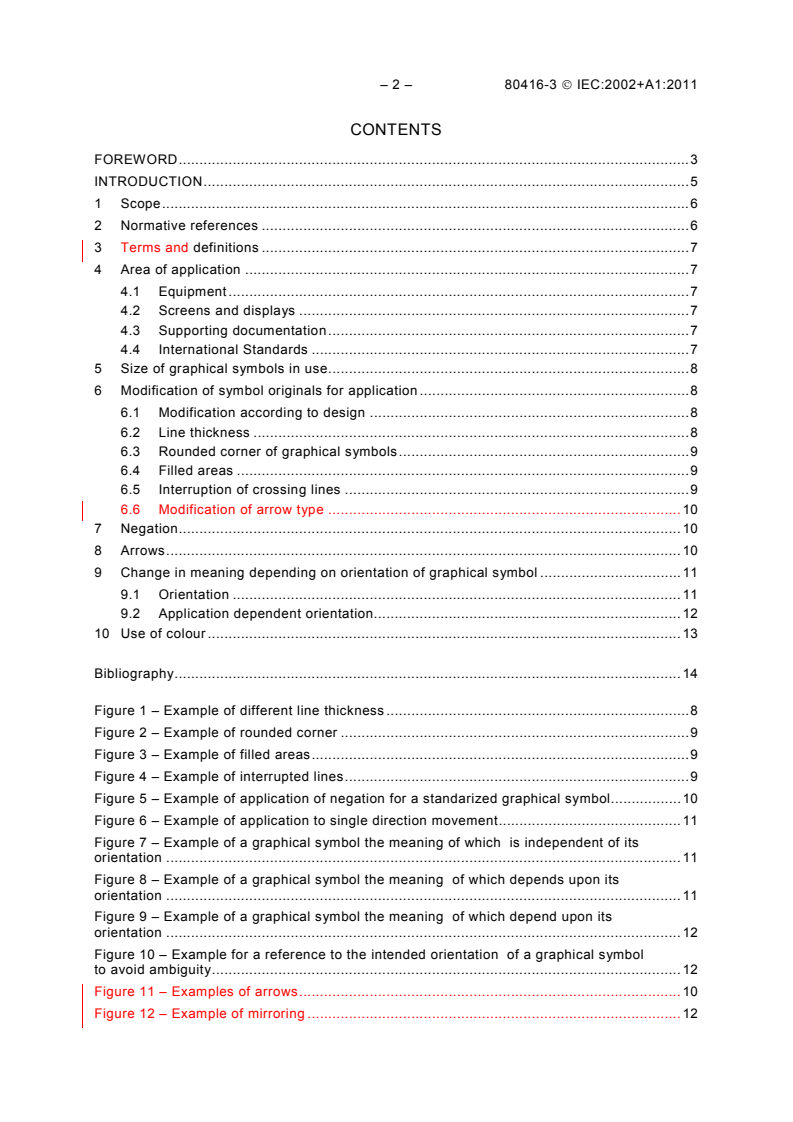
IEC 80416-3:2002+AMD1:2011 CSV - Basic principles for graphical symbols for use on equipment - Part 3: Guidelines for the application of graphical symbols Released:10/18/2011
Overview
IEC 80416-3:2002, titled Basic principles for graphical symbols for use on equipment - Part 3: Guidelines for the application of graphical symbols, is an international standard published by the International Electrotechnical Commission (IEC). It provides comprehensive guidelines for applying graphical symbols on equipment, focusing on maintaining visual clarity, consistency, and recognition. This standard governs the permissible modifications allowed when adapting original graphical symbols for real-world use on various equipment types. It is part of the IEC 80416 series, aligning with ISO standards to ensure global harmonization of graphical symbol usage.
Key Topics
Application Scope: IEC 80416-3 addresses graphical symbols used on equipment surfaces, screens, displays, and associated supporting documentation, ensuring universal applicability across different contexts.
Modification Rules: The standard specifies how original graphical symbols may be modified in terms of:
- Line thickness adjustments
- Rounded corners for improved aesthetics and legibility
- Filled areas within symbols to enhance visibility
- Interruption of crossing lines to avoid confusion
- Modifications to arrow types and their orientation
These modifications must preserve the symbol’s essential meaning and legibility.
Negation and Arrows: Guidelines include proper use of negation elements and arrows within symbols to avoid misinterpretation. Arrow directionality is standardized to indicate movement or flow clearly.
Orientation Impact: The document highlights how a graphical symbol’s meaning may change depending on its orientation and provides rules to avoid ambiguity by indicating intended orientation.
Use of Colour: While colour can help in symbol interpretation, IEC 80416-3 recommends careful use to support clarity without relying solely on colour for meaning.
Applications
Electrotechnical Equipment Labelling: Ensures safe, clear communication of information through standardized symbols across a wide range of electrical and electronic equipment.
User Interface Design: Vital for designing screens and displays where symbols serve as intuitive icons or indicators.
Technical Documentation: Supports technical manuals and user guides by providing consistent, recognizable graphical representations.
International Compliance: Assists manufacturers and designers in meeting global standards for symbol use, improving user comprehension and safety worldwide.
Product Design and Manufacturing: Helps create equipment with consistent and legible markings, facilitating better user experience and reducing errors.
Related Standards
IEC 80416-1:2001 – Creation of symbol originals: Defines basic rules for designing graphical symbols.
IEC 80416-2:2001 – Form and use of arrows: Details arrow design and application principles.
Future IEC 80416-4 – Supplementary guidelines for adapting symbols on screens and displays (icons).
ISO 7000 / IEC 60417 – Databases of standardized graphical symbols, which apply the principles outlined in IEC 80416 series.
ISO/IEC Directives, Part 3 – Guidelines governing the preparation of international standards including graphical symbols.
Practical Value
IEC 80416-3:2002 is essential for professionals involved in electrical and electronic equipment design, user interface engineering, and documentation. By following this standard, designers can:
Achieve consistency across symbol sets, enhancing user safety and operational understanding.
Adapt symbols with confidence, knowing which design elements may be altered without compromising meaning.
Ensure symbols remain legible even at small sizes or when printed on varying materials.
Minimize misinterpretation risks caused by orientation changes or improper negation use.
Meet international regulatory expectations and improve product acceptance in global markets.
Keywords: IEC 80416-3, graphical symbols, equipment symbols, symbol application guidelines, visual clarity, symbol modification, electrotechnical symbols, standardization, IEC graphical symbols, equipment labelling, user interface icons, symbol orientation, symbol negation, symbol design principles.
Relations
- Effective Date
- 10-Jun-2026
- Effective Date
- 05-Sep-2023
Buy Documents
IEC 80416-3:2002 - Basic principles for graphical symbols for use on equipment - Part 3: Guidelines for the application of graphical symbols Released:7/19/2002
IEC 80416-3:2002+AMD1:2011 CSV - Basic principles for graphical symbols for use on equipment - Part 3: Guidelines for the application of graphical symbols Released:10/18/2011
Frequently Asked Questions
IEC 80416-3:2002 is a standard published by the International Electrotechnical Commission (IEC). Its full title is "Basic principles for graphical symbols for use on equipment - Part 3: Guidelines for the application of graphical symbols". This standard covers: Provides guidelines for the application of graphical symbols for use on equipment in order to maintain visual clarity and overall consistency when such graphical symbols are applied. It stipulates the permissible extent by which a symbol original may be modified in reproduction for actual use on equipment
Provides guidelines for the application of graphical symbols for use on equipment in order to maintain visual clarity and overall consistency when such graphical symbols are applied. It stipulates the permissible extent by which a symbol original may be modified in reproduction for actual use on equipment
IEC 80416-3:2002 is classified under the following ICS (International Classification for Standards) categories: 01.080.20 - Graphical symbols for use on specific equipment. The ICS classification helps identify the subject area and facilitates finding related standards.
IEC 80416-3:2002 has the following relationships with other standards: It is inter standard links to EN 15429-4:2015, IEC 80416-3:2002/AMD1:2011. Understanding these relationships helps ensure you are using the most current and applicable version of the standard.
IEC 80416-3:2002 is available in PDF format for immediate download after purchase. The document can be added to your cart and obtained through the secure checkout process. Digital delivery ensures instant access to the complete standard document.
Standards Content (Sample)
NORME CEI
INTERNATIONALE IEC
80416-3
INTERNATIONAL
Première édition
STANDARD
First edition
2002-07
Principes élémentaires pour les symboles
graphiques utilisables sur le matériel –
Partie 3:
Guide pour l’application des symboles graphiques
Basic principles for graphical symbols
for use on equipment –
Part 3:
Guidelines for the application of graphical symbols
Numéro de référence
Reference number
CEI/IEC 80416-3:2002
Numérotation des publications Publication numbering
Depuis le 1er janvier 1997, les publications de la CEI As from 1 January 1997 all IEC publications are
sont numérotées à partir de 60000. Ainsi, la CEI 34-1 issued with a designation in the 60000 series. For
devient la CEI 60034-1. example, IEC 34-1 is now referred to as IEC 60034-1.
Editions consolidées Consolidated editions
Les versions consolidées de certaines publications de la The IEC is now publishing consolidated versions of its
CEI incorporant les amendements sont disponibles. Par publications. For example, edition numbers 1.0, 1.1
exemple, les numéros d’édition 1.0, 1.1 et 1.2 indiquent and 1.2 refer, respectively, to the base publication,
respectivement la publication de base, la publication de the base publication incorporating amendment 1 and
base incorporant l’amendement 1, et la publication de the base publication incorporating amendments 1
base incorporant les amendements 1 et 2. and 2.
Informations supplémentaires Further information on IEC publications
sur les publications de la CEI
Le contenu technique des publications de la CEI est The technical content of IEC publications is kept
constamment revu par la CEI afin qu'il reflète l'état under constant review by the IEC, thus ensuring that
actuel de la technique. Des renseignements relatifs à the content reflects current technology. Information
cette publication, y compris sa validité, sont dispo- relating to this publication, including its validity, is
nibles dans le Catalogue des publications de la CEI available in the IEC Catalogue of publications
(voir ci-dessous) en plus des nouvelles éditions, (see below) in addition to new editions, amendments
amendements et corrigenda. Des informations sur les and corrigenda. Information on the subjects under
sujets à l’étude et l’avancement des travaux entrepris consideration and work in progress undertaken by the
par le comité d’études qui a élaboré cette publication, technical committee which has prepared this
ainsi que la liste des publications parues, sont publication, as well as the list of publications issued,
également disponibles par l’intermédiaire de: is also available from the following:
• Site web de la CEI (www.iec.ch) • IEC Web Site (www.iec.ch)
• Catalogue des publications de la CEI • Catalogue of IEC publications
Le catalogue en ligne sur le site web de la CEI The on-line catalogue on the IEC web site
(www.iec.ch/catlg-f.htm) vous permet de faire des (www.iec.ch/catlg-e.htm) enables you to search
recherches en utilisant de nombreux critères, by a variety of criteria including text searches,
comprenant des recherches textuelles, par comité technical committees and date of publication. On-
d’études ou date de publication. Des informations line information is also available on recently
en ligne sont également disponibles sur les issued publications, withdrawn and replaced
nouvelles publications, les publications rempla- publications, as well as corrigenda.
cées ou retirées, ainsi que sur les corrigenda.
• IEC Just Published
• IEC Just Published
Ce résumé des dernières publications parues
This summary of recently issued publications
(www.iec.ch/JP.htm) est aussi disponible par
(www.iec.ch/JP.htm) is also available by email.
courrier électronique. Veuillez prendre contact
Please contact the Customer Service Centre (see
avec le Service client (voir ci-dessous) pour plus
below) for further information.
d’informations.
• Service clients
• Customer Service Centre
Si vous avez des questions au sujet de cette
If you have any questions regarding this
publication ou avez besoin de renseignements
publication or need further assistance, please
supplémentaires, prenez contact avec le Service
contact the Customer Service Centre:
clients:
Email: custserv@iec.ch
Email: custserv@iec.ch
Tél: +41 22 919 02 11
Tel: +41 22 919 02 11
Fax: +41 22 919 03 00
Fax: +41 22 919 03 00
.
NORME CEI
INTERNATIONALE IEC
80416-3
INTERNATIONAL
Première édition
STANDARD
First edition
2002-07
Principes élémentaires pour les symboles
graphiques utilisables sur le matériel –
Partie 3:
Guide pour l’application des symboles graphiques
Basic principles for graphical symbols
for use on equipment –
Part 3:
Guidelines for the application of graphical
symbols
IEC 2002 Droits de reproduction réservés Copyright - all rights reserved
Aucune partie de cette publication ne peut être reproduite ni No part of this publication may be reproduced or utilized in any
utilisée sous quelque forme que ce soit et par aucun procédé, form or by any means, electronic or mechanical, including
électronique ou mécanique, y compris la photocopie et les photocopying and microfilm, without permission in writing from
microfilms, sans l'accord écrit de l'éditeur. the publisher.
International Electrotechnical Commission, 3, rue de Varembé, PO Box 131, CH-1211 Geneva 20, Switzerland
Telephone: +41 22 919 02 11 Telefax: +41 22 919 03 00 E-mail: inmail@iec.ch Web: www.iec.ch
CODE PRIX
G
PRICE CODE
Pour prix, voir catalogue en vigueur
For price, see current catalogue
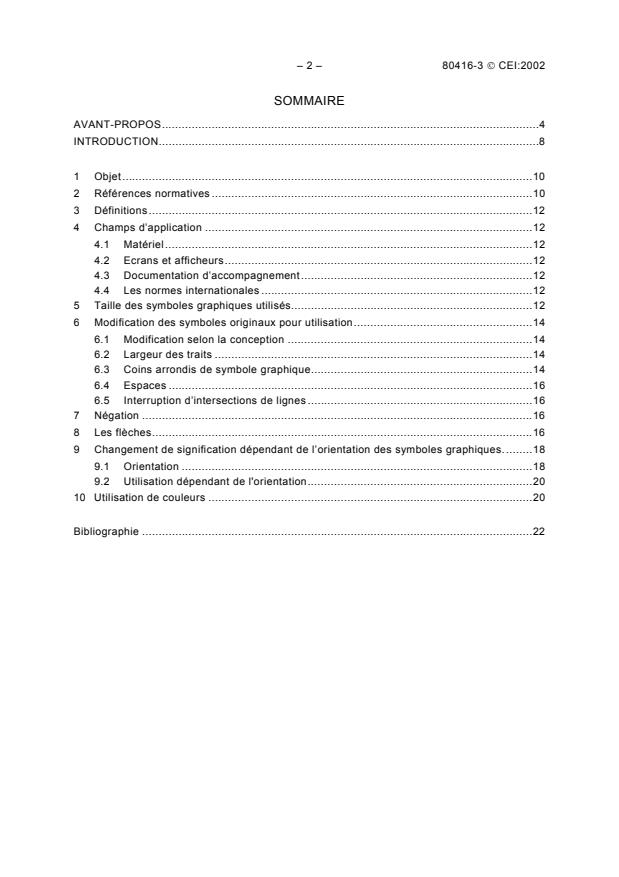
– 2 – 80416-3 CEI:2002
SOMMAIRE
AVANT-PROPOS.4
INTRODUCTION.8
1 Objet.10
2 Références normatives.10
3 Définitions.12
4 Champs d’application.12
4.1 Matériel.12
4.2 Ecrans et afficheurs.12
4.3 Documentation d’accompagnement.12
4.4 Les normes internationales .12
5 Taille des symboles graphiques utilisés.12
6 Modification des symboles originaux pour utilisation.14
6.1 Modification selon la conception .14
6.2 Largeur des traits .14
6.3 Coins arrondis de symbole graphique.14
6.4 Espaces.16
6.5 Interruption d’intersections de lignes .16
7 Négation.16
8 Les flèches.16
9 Changement de signification dépendant de l’orientation des symboles graphiques.18
9.1 Orientation.18
9.2 Utilisation dépendant de l'orientation.20
10 Utilisation de couleurs .20
Bibliographie .22
80416-3 IEC:2002 – 3 –
CONTENTS
FOREWORD . 5
INTRODUCTION .9
1 Scope .11
2 Normative references.11
3 Definitions .13
4 Area of application.13
4.1 Equipment .13
4.2 Screens and displays.13
4.3 Supporting documentation .13
4.4 International Standards.13
5 Size of graphical symbols in use.13
6 Modification of symbol originals for application .15
6.1 Modification according to design.15
6.2 Line thickness.15
6.3 Rounded corner of graphical symbols .15
6.4 Filled areas.17
6.5 Interruption of crossing lines.17
7 Negation .17
8 Arrows .17
9 Change in meaning depending on orientation of graphical symbol .19
9.1 Orientation.19
9.2 Application dependent orientation.21
10 Use of colour .21
Bibliography.23
– 4 – 80416-3 CEI:2002
COMMISSION ÉLECTROTECHNIQUE INTERNATIONALE
____________
PRINCIPES ÉLÉMENTAIRES POUR LES SYMBOLES GRAPHIQUES
UTILISABLES SUR LE MATÉRIEL –
Partie 3: Guide pour l’application des symboles graphiques
AVANT-PROPOS
1) La CEI (Commission Électrotechnique Internationale) est une organisation mondiale de normalisation
composée de l'ensemble des comités électrotechniques nationaux (Comités nationaux de la CEI). La CEI a
pour objet de favoriser la coopération internationale pour toutes les questions de normalisation dans les
domaines de l'électricité et de l'électronique. A cet effet, la CEI, entre autres activités, publie des Normes
internationales. Leur élaboration est confiée à des comités d'études, aux travaux desquels tout Comité national
intéressé par le sujet traité peut participer. Les organisations internationales, gouvernementales et non
gouvernementales, en liaison avec la CEI, participent également aux travaux. La CEI collabore étroitement
avec l'Organisation Internationale de Normalisation (ISO), selon des conditions fixées par accord entre les
deux organisations.
2) Les décisions ou accords officiels de la CEI concernant les questions techniques représentent, dans la mesure
du possible, un accord international sur les sujets étudiés, étant donné que les Comités nationaux intéressés
sont représentés dans chaque comité d’études.
3) Les documents produits se présentent sous la forme de recommandations internationales. Ils sont publiés
comme normes, spécifications techniques, rapports techniques ou guides et agréés comme tels par les
Comités nationaux.
4) Dans le but d'encourager l'unification internationale, les Comités nationaux de la CEI s'engagent à appliquer de
façon transparente, dans toute la mesure possible, les Normes internationales de la CEI dans leurs normes
nationales et régionales. Toute divergence entre la norme de la CEI et la norme nationale ou régionale
correspondante doit être indiquée en termes clairs dans cette dernière.
5) La CEI n’a fixé aucune procédure concernant le marquage comme indication d’approbation et sa responsabilité
n’est pas engagée quand un matériel est déclaré conforme à l’une de ses normes.
6) L’attention est attirée sur le fait que certains des éléments de la présente Norme internationale peuvent faire
l’objet de droits de propriété intellectuelle ou de droits analogues. La CEI ne saurait être tenue pour
responsable de ne pas avoir identifié de tels droits de propriété et de ne pas avoir signalé leur existence.
La Norme internationale CEI 80416-3 a été établie par le sous-comité 3C: Symboles graphiques
utilisables sur le matériel, du comité d'études 3: Structures d’informations, documentation et
symboles graphiques.
Cette norme internationale a été élaborée en collaboration avec le TC 145 de l’ISO.
Le texte de cette norme est issu des documents suivants:
FDIS Rapport de vote
3C/917/FDIS 3C/988/RVD
Le rapport de vote indiqué dans le tableau ci-dessus donne toute information sur le vote ayant
abouti à l'approbation de cette norme.
Dans le but de rassembler dans une même série toutes les prescriptions concernant les
principes de base applicables, le comité technique 145: Symboles graphiques de l’ISO et le
comité d’études 3 de la CEI se sont mis d’accord pour publier toutes les parties de la
présente norme internationale dans la série 80416. Le Bureau de Gestion Technique de l’ISO
et le Comité d’Action de la CEI ont décidé qu’une des deux organisations serait choisie
comme responsable pour chacune des parties de la série. Les comités techniques concernés
ont accepté de n’apporter aucune modification à l’une des parties de la norme internationale
80416 sans accord mutuel.
80416-3 IEC:2002 – 5 –
INTERNATIONAL ELECTROTECHNICAL COMMISSION
____________
BASIC PRINCIPLES FOR GRAPHICAL SYMBOLS
FOR USE ON EQUIPMENT –
Part 3: Guidelines for the application of graphical symbols
FOREWORD
1) The IEC (International Electrotechnical Commission) is a worldwide organization for standardization comprising
all national electrotechnical committees (IEC National Committees). The object of the IEC is to promote
international co-operation on all questions concerning standardization in the electrical and electronic fields. To
this end and in addition to other activities, the IEC publishes International Standards. Their preparation is
entrusted to technical committees; any IEC National Committee interested in the subject dealt with may
participate in this preparatory work. International, governmental and non-governmental organizations liaising
with the IEC also participate in this preparation. The IEC collaborates closely with the International
Organization for Standardization (ISO) in accordance with conditions determined by agreement between the
two organizations.
2) The formal decisions or agreements of the IEC on technical matters express, as nearly as possible, an
international consensus of opinion on the relevant subjects since each technical committee has representation
from all interested National Committees.
3) The documents produced have the form of recommendations for international use and are published in the form
of standards, technical specifications, technical reports or guides and they are accepted by the National
Committees in that sense.
4) In order to promote international unification, IEC National Committees undertake to apply IEC International
Standards transparently to the maximum extent possible in their national and regional standards. Any
divergence between the IEC Standard and the corresponding national or regional standard shall be clearly
indicated in the latter.
5) The IEC provides no marking procedure to indicate its approval and cannot be rendered responsible for any
equipment declared to be in conformity with one of its standards.
6) Attention is drawn to the possibility that some of the elements of this International Standard may be the subject
of patent rights. The IEC shall not be held responsible for identifying any or all such patent rights.
International Standard IEC 80416-3 has been prepared by IEC subcommittee 3C: Graphical
symbols for use on equipment, of IEC technical committee 3: Information structures,
documentation and graphical symbols.
This International Standard has been prepared in co-operation with ISO/TC 145.
The text of this standard is based on the following documents:
FDIS Report on voting
3C/917/FDIS 3C/988/RVD
Full information on the voting for the approval of this standard can be found in the report on
voting indicated in the above table.
In order to collect all requirements concerning relevant basic principles within one single
numerical series, ISO technical committee 145: Graphical symbols and IEC technical
committee 3 agreed to publish all parts of this International Standard within the 80416 series.
The Technical Management Board of ISO and the Committee of Action of IEC have decided
that, for each part of this series, one organization shall be chosen responsible. The technical
committees involved have agreed not to change any part of International Standard 80416
without mutual agreement.
– 6 – 80416-3 CEI:2002
Cette publication a été mise en forme conformément aux Directives ISO/CEI, Partie 2.
La norme internationale 80416 est constituée des parties suivantes sous le titre général
Principes de base pour les symboles graphiques utilisables sur le matériel:
Partie 1: 2001, Création des dessins originaux de symboles (publiée par la CEI)
Partie 2: 2001, Forme et utilisation des flèches (publiée par l’ISO)
Partie 3: Guide pour l’application des symboles graphiques (publiée par la CEI)
Partie 4: Indications supplémentaires pour l’adaptation des symboles utilisés
sur les écrans et les dispositifs de visualisation (icônes)
(à l’étude et à publier par l'ISO )
Le comité a décidé que cette publication ne sera pas modifiée avant 2005. A cette date,
conformément aux décisions du comité, la publication sera
• reconfirmée;
• retirée;
• remplacée par une édition révisée ou
• amendée.
80416-3 IEC:2002 – 7 –
This publication has been drafted in accordance with the ISO/IEC Directives, Part 3.
International Standard 80416 consists of the following parts, under the general title Basic
principles for graphical symbols for use on equipment:
Part 1: 2001, Creation of symbol originals (published by IEC)
Part 2: 2001, Form and use of arrows (published by ISO)
Part 3: Guidelines for the application of graphical symbols (published by IEC)
Part 4: Supplementary guidelines for the adaptation of graphical symbols on
screen and displays (icons) (under consideration, and to be published
by ISO)
The committee has decided that the contents of this publication will remain unchanged until
2005. At this date, the publication will be
• reconfirmed;
• withdrawn;
• replaced by a revised edition, or
• amended.
– 8 – 80416-3 CEI:2002
INTRODUCTION
Un symbole graphique est un dessin reconnaissable visuellement utilisé pour transmettre des
informations indépendamment de la langue. Les symboles graphiques sont utilisés sur le
matériel pour une large gamme de fonctions. De tels symboles, correspondant à la conception
de familles de symboles utilisées dans un seul emplacement ou pour un matériel identique,
constituent un objectif important. La clarté des symboles est aussi importante lorsqu’on les
réduits à de petites dimensions. Donc, il y a un besoin de normaliser les principes de création
de symboles graphiques utilisables sur le matériel pour assurer une clarté visuelle, pour
maintenir une cohérence et par là même pour améliorer la reconnaissance.
Cette norme à parties multiples s’adresse aux règles élémentaires utilisées pour créer des
symboles graphiques utilisables sur le matériel, comportant des largeurs de trait, la forme et
l’utilisation de flèches, éléments de négation, et utilisation d’un motif élémentaire qui sert
comme mode d’emploi pour dessiner. On exige que ces principes de conception soient
utilisés pour tous les symboles graphiques utilisables sur les matériels qui sont normalisés
dans l’ISO 7000 et la CEI 60417.
La CEI 80416-3 a été produite pour fournir les modes d’emploi exigés lorsqu’on utilise des
symboles graphiques utilisables sur le matériel dans un contexte spécifique, pour illustrer de
la documentation et pour d’autres normes internationales.
80416-3 IEC:2002 – 9 –
INTRODUCTION
A graphical symbol is a visually perceptible figure used to transmit information independently
of language. Graphical symbols are used on equipment for a wide range of purposes. For
such symbols, consistency in the design of families of symbols used in one location or on
similar equipment is an important issue. Equally important is the legibility of symbols when
they are reduced to small dimensions. Thus, there is a need to standardize the principles for
creating graphical symbols for use on equipment to ensure visual clarity and consistency, and
thereby to improve recogni
...
IEC 80416-3
Edition 1.1 2011-10
CONSOLIDATED VERSION
INTERNATIONAL
STANDARD
NORME
INTERNATIONALE
colour
inside
Basic principles for graphical symbols for use on equipment –
Part 3: Guidelines for the application of graphical symbols
Principes élémentaires pour les symboles graphiques utilisables sur le matériel –
Partie 3: Guide pour l’application des symboles graphiques
All rights reserved. Unless otherwise specified, no part of this publication may be reproduced or utilized in any form
or by any means, electronic or mechanical, including photocopying and microfilm, without permission in writing from
either IEC or IEC's member National Committee in the country of the requester. If you have any questions about IEC
copyright or have an enquiry about obtaining additional rights to this publication, please contact the address below or
your local IEC member National Committee for further information.
Droits de reproduction réservés. Sauf indication contraire, aucune partie de cette publication ne peut être reproduite
ni utilisée sous quelque forme que ce soit et par aucun procédé, électronique ou mécanique, y compris la photocopie
et les microfilms, sans l'accord écrit de l'IEC ou du Comité national de l'IEC du pays du demandeur. Si vous avez des
questions sur le copyright de l'IEC ou si vous désirez obtenir des droits supplémentaires sur cette publication, utilisez
les coordonnées ci-après ou contactez le Comité national de l'IEC de votre pays de résidence.
IEC Central Office Tel.: +41 22 919 02 11
3, rue de Varembé info@iec.ch
CH-1211 Geneva 20 www.iec.ch
Switzerland
About the IEC
The International Electrotechnical Commission (IEC) is the leading global organization that prepares and publishes
International Standards for all electrical, electronic and related technologies.
About IEC publications
The technical content of IEC publications is kept under constant review by the IEC. Please make sure that you have the
latest edition, a corrigendum or an amendment might have been published.
IEC publications search - webstore.iec.ch/advsearchform Electropedia - www.electropedia.org
The advanced search enables to find IEC publications by a The world's leading online dictionary on electrotechnology,
variety of criteria (reference number, text, technical containing more than 22 000 terminological entries in English
committee,…). It also gives information on projects, replaced and French, with equivalent terms in 16 additional languages.
and withdrawn publications. Also known as the International Electrotechnical Vocabulary
(IEV) online.
IEC Just Published - webstore.iec.ch/justpublished
Stay up to date on all new IEC publications. Just Published IEC Glossary - std.iec.ch/glossary
details all new publications released. Available online and 67 000 electrotechnical terminology entries in English and
once a month by email. French extracted from the Terms and definitions clause of
IEC publications issued between 2002 and 2015. Some
IEC Customer Service Centre - webstore.iec.ch/csc entries have been collected from earlier publications of IEC
If you wish to give us your feedback on this publication or TC 37, 77, 86 and CISPR.
need further assistance, please contact the Customer Service
Centre: sales@iec.ch.
A propos de l'IEC
La Commission Electrotechnique Internationale (IEC) est la première organisation mondiale qui élabore et publie des
Normes internationales pour tout ce qui a trait à l'électricité, à l'électronique et aux technologies apparentées.
A propos des publications IEC
Le contenu technique des publications IEC est constamment revu. Veuillez vous assurer que vous possédez l’édition la
plus récente, un corrigendum ou amendement peut avoir été publié.
Recherche de publications IEC - Electropedia - www.electropedia.org
webstore.iec.ch/advsearchform Le premier dictionnaire d'électrotechnologie en ligne au
La recherche avancée permet de trouver des publications IEC monde, avec plus de 22 000 articles terminologiques en
en utilisant différents critères (numéro de référence, texte, anglais et en français, ainsi que les termes équivalents dans
comité d’études,…). Elle donne aussi des informations sur les 16 langues additionnelles. Egalement appelé Vocabulaire
projets et les publications remplacées ou retirées. Electrotechnique International (IEV) en ligne.
IEC Just Published - webstore.iec.ch/justpublished Glossaire IEC - std.iec.ch/glossary
Restez informé sur les nouvelles publications IEC. Just 67 000 entrées terminologiques électrotechniques, en anglais
Published détaille les nouvelles publications parues. et en français, extraites des articles Termes et définitions des
Disponible en ligne et une fois par mois par email. publications IEC parues entre 2002 et 2015. Plus certaines
entrées antérieures extraites des publications des CE 37, 77,
Service Clients - webstore.iec.ch/csc 86 et CISPR de l'IEC.
Si vous désirez nous donner des commentaires sur cette
publication ou si vous avez des questions contactez-nous:
sales@iec.ch.
IEC 80416-3
Edition 1.1 2011-10
CONSOLIDATED VERSION
INTERNATIONAL
STANDARD
NORME
INTERNATIONALE
colour
inside
Basic principles for graphical symbols for use on equipment –
Part 3: Guidelines for the application of graphical symbols
Principes élémentaires pour les symboles graphiques utilisables sur le matériel
–
Partie 3: Guide pour l’application des symboles graphiques
INTERNATIONAL
ELECTROTECHNICAL
COMMISSION
COMMISSION
ELECTROTECHNIQUE
INTERNATIONALE
ICS 01.080.20 ISBN 978-2-8891-2721-4
– 2 – 80416-3 IEC:2002+A1:2011
CONTENTS
FOREWORD . 3
INTRODUCTION . 5
1 Scope . 6
2 Normative references . 6
3 Terms and definitions . 7
4 Area of application . 7
4.1 Equipment . 7
4.2 Screens and displays . 7
4.3 Supporting documentation . 7
4.4 International Standards . 7
5 Size of graphical symbols in use . 8
6 Modification of symbol originals for application . 8
6.1 Modification according to design . 8
6.2 Line thickness . 8
6.3 Rounded corner of graphical symbols . 9
6.4 Filled areas . 9
6.5 Interruption of crossing lines . 9
6.6 Modification of arrow type . 10
7 Negation . 10
8 Arrows . 10
9 Change in meaning depending on orientation of graphical symbol . 11
9.1 Orientation . 11
9.2 Application dependent orientation. 12
10 Use of colour . 13
Bibliography . 14
Figure 1 – Example of different line thickness . 8
Figure 2 – Example of rounded corner . 9
Figure 3 – Example of filled areas . 9
Figure 4 – Example of interrupted lines . 9
Figure 5 – Example of application of negation for a standarized graphical symbol. 10
Figure 6 – Example of application to single direction movement . 11
Figure 7 – Example of a graphical symbol the meaning of which is independent of its
orientation . 11
Figure 8 – Example of a graphical symbol the meaning of which depends upon its
orientation . 11
Figure 9 – Example of a graphical symbol the meaning of which depend upon its
orientation . 12
Figure 10 – Example for a reference to the intended orientation of a graphical symbol
to avoid ambiguity . 12
Figure 11 – Examples of arrows . 10
Figure 12 – Example of mirroring . 12
80416-3 IEC:2002+A1:2011 – 3 –
INTERNATIONAL ELECTROTECHNICAL COMMISSION
____________
BASIC PRINCIPLES FOR GRAPHICAL SYMBOLS
FOR USE ON EQUIPMENT –
Part 3: Guidelines for the application of graphical symbols
FOREWORD
1) The International Electrotechnical Commission (IEC) is a worldwide organization for standardization comprising
all national electrotechnical committees (IEC National Committees). The object of IEC is to promote
international co-operation on all questions concerning standardization in the electrical and electronic fields. To
this end and in addition to other activities, IEC publishes International Standards, Technical Specifications,
Technical Reports, Publicly Available Specifications (PAS) and Guides (hereafter referred to as “IEC
Publication(s)”). Their preparation is entrusted to technical committees; any IEC National Committee interested
in the subject dealt with may participate in this preparatory work. International, governmental and non-
governmental organizations liaising with the IEC also participate in this preparation. IEC collaborates closely
with the International Organization for Standardization (ISO) in accordance with conditions determined by
agreement between the two organizations.
2) The formal decisions or agreements of IEC on technical matters express, as nearly as possible, an international
consensus of opinion on the relevant subjects since each technical committee has representation from all
interested IEC National Committees.
3) IEC Publications have the form of recommendations for international use and are accepted by IEC National
Committees in that sense. While all reasonable efforts are made to ensure that the technical content of IEC
Publications is accurate, IEC cannot be held responsible for the way in which they are used or for any
misinterpretation by any end user.
4) In order to promote international uniformity, IEC National Committees undertake to apply IEC Publications
transparently to the maximum extent possible in their national and regional publications. Any divergence
between any IEC Publication and the corresponding national or regional publication shall be clearly indicated in
the latter.
5) IEC itself does not provide any attestation of conformity. Independent certification bodies provide conformity
assessment services and, in some areas, access to IEC marks of conformity. IEC is not responsible for any
services carried out by independent certification bodies.
6) All users should ensure that they have the latest edition of this publication.
7) No liability shall attach to IEC or its directors, employees, servants or agents including individual experts and
members of its technical committees and IEC National Committees for any personal injury, property damage or
other damage of any nature whatsoever, whether direct or indirect, or for costs (including legal fees) and
expenses arising out of the publication, use of, or reliance upon, this IEC Publication or any other IEC
Publications.
8) Attention is drawn to the Normative references cited in this publication. Use of the referenced publications is
indispensable for the correct application of this publication.
9) Attention is drawn to the possibility that some of the elements of this IEC Publication may be the subject of
patent rights. IEC shall not be held responsible for identifying any or all such patent rights.
This consolidated version of the official IEC Standard and its amendment has been prepared
for user convenience.
IEC 80416-3 edition 1.1 contains the first edition (2002) [documents 3C/917/FDIS and 3C/988/
RVD] and its amendment 1 (2011) [documents 3C/1687/CDV and 3C/1711/RVC].
A vertical line in the margin shows where the base publication has been modified by
amendment 1. Additions and deletions are displayed in red, with deletions being struck
through.
– 4 – 80416-3 IEC:2002+A1:2011
International Standard IEC 80416-3 has been prepared by IEC subcommittee 3C: Graphical
symbols for use on equipment, of IEC technical committee 3: Information structures,
documentation and graphical symbols.
This International Standard has been prepared in co-operation with ISO/TC 145.
In order to collect all requirements concerning relevant basic principles within one single
numerical series, ISO technical committee 145: Graphical symbols and IEC technical
committee 3 agreed to publish all parts of this International Standard within the 80416 series.
The Technical Management Board of ISO and the Committee of Action of IEC have decided
that, for each part of this series, one organization shall be chosen responsible. The technical
committees involved have agreed not to change any part of International Standard 80416
without mutual agreement.
This publication has been drafted in accordance with the ISO/IEC Directives, Part 3.
International Standard 80416 consists of the following parts, under the general title Basic
principles for graphical symbols for use on equipment:
Part 1: 2001, Creation of symbol originals (published by IEC)
Part 2: 2001, Form and use of arrows (published by ISO)
Part 3: Guidelines for the application of graphical symbols (published by IEC)
Part 4: Supplementary guidelines for the adaptation of graphical symbols on
screen and displays (icons) (under consideration, and to be published
by ISO)
The committee has decided that the contents of the base publication and its amendments will
remain unchanged until the stability date indicated on the IEC web site under
"http://webstore.iec.ch" in the data related to the specific publication. At this date, the
publication will be
• reconfirmed,
• withdrawn,
• replaced by a revised edition, or
• amended.
IMPORTANT – The “colour inside” logo on the cover page of this publication indicates
that it contains colours which are considered to be useful for the correct understanding
of its contents. Users should therefore print this publication using a colour printer.
80416-3 IEC:2002+A1:2011 – 5 –
INTRODUCTION
A graphical symbol is a visually perceptible figure used to transmit information independently
of language. Graphical symbols are used on equipment for a wide range of purposes. For
such symbols, consistency in the design of families of symbols used in one location or on
similar equipment is an important issue. Equally important is the legibility of symbols when
they are reduced to small dimensions. Thus, there is a need to standardize the principles for
creating graphical symbols for use on equipment to ensure visual clarity and consistency, and
thereby to improve recognition.
This multi-part standard addresses the basic rules used to create graphical symbols for use
on equipment, including line thickness, form and use of arrows, negation elements, and use of
the basic pattern which serves as a guideline for drawing. These design principles are
required to be used for all graphical symbols for use on equipment which are standardized in
ISO 7000 and IEC 60417.
A graphical symbol is defined as a visually perceptible figure with a particular meaning used
to transmit information independently of language. Graphical symbols are used on equipment
for a wide range of purposes. The understanding of such symbols can be improved by
consistent design. This is particularly important where families of symbols are used in one
location or on similar equipment. Good design also helps to maintain the legibility of symbols
when they are reduced to small dimensions for application. Thus, there is a need to
standardize the principles for creating graphical symbols for use on equipment to ensure
visual clarity, to maintain consistency and thereby to improve recognition.
The IEC 80416 series is a multi-part international standard which provides basic principles
and guidelines for the creation of graphical symbols for use on equipment (Parts 1 and 2) and
also principles and guidelines for adapting registered graphical symbols for use in practice
(Parts 3 and 4).
IEC 80416-3 has been produced to provide the guidelines required when graphical symbols
are applied on equipment for use in a specific context, for supporting documentation and for
other International Standards.
– 6 – 80416-3 IEC:2002+A1:2011
BASIC PRINCIPLES FOR GRAPHICAL SYMBOLS
FOR USE ON EQUIPMENT –
Part 3: Guidelines for the application of graphical symbols
1 Scope
International Standard 80416 is a multi-part standard which provides principles and guidelines
for the creation and application of graphical symbols for use on equipment.
This part of IEC 80416 provides guidelines for the application of graphical symbols for use on
equipment in order to maintain visual clarity and overall consistency when such graphical
symbols are applied. It stipulates the permissible extent by which a symbol original may be
modified in reproduction for actual use on equipment.
2 Normative references
The following referenced documents are indispensable for the application of this document.
For dated references, only the edition cited applies. For undated references, the latest edition
of the referenced document (including any amendments) applies.
IEC 80416-1:2008, Basic principles for graphical symbols for use on equipment – Part 1:
Creation of graphical symbols originals for registration
ISO 80416-2, Basic principles for graphical symbols for use on equipment – Part 2: Form and
use of arrows
ISO/FDIS 3864-1:2001, Graphical symbols – Safety colours and safety signs – Part 1: Design
principles for safety signs in workplaces and public areas
ISO 3864-1, Graphical symbols – Safety colours and safety signs – Part 1: Design principles
for safety signs and safety markings
ISO 3864-2, Graphical symbols – Safety colours and safety signs – Part 2: Design principles
for product safety labels
IEC 60073, Basic and safety principles for man-machine interface, marking and identification –
Coding principles for indication devices and actuators
ISO/DIS 7010:2001, Graphical symbols – Safety signs in workplaces and public areas
ISO 7010, Graphical symbols – Safety colours and safety signs – Safety signs used in
workplaces and public areas
ISO 7000, Graphical symbols for use on equipment – Index and synopsis
———————
New edition to be published.
The ISO 7000 collection of graphical symbols for use on equipment is also available online, either separately or
jointly with the IEC 60417 collection of graphical symbols for use on equipment. ISO Catalogue provides further
information on this regard.
80416-3 IEC:2002+A1:2011 – 7 –
ISO 80416-4, Basic principles for graphical symbols for use on equipment – Part 4:
Guidelines for the adaptation of graphical symbols for use on screens and displays (icons)
IEC 60417 (all parts), Graphical symbols for use on equipment
3 Terms and definitions
For the purposes of this part of IEC 80416, the following definitions apply together with
the terms defined in IEC 80416-1:
3.1
nominal size
50 mm; the lateral dimension of the basic square 2 as shown in the basic pattern in
IEC 80416-1
3.2
symbol original
drawing of a graphical symbol, prepared in accordance with IEC 80416-1, used for reference
or reproduction purposes
4 Area of application
4.1 Equipment
Graphical symbols may, for example, be printed, engraved, embossed, or moulded on the
equipment. The technology used to reproduce a graphical symbol and apply it to a piece of
equipment may have an influence on its size and appearance. There may be a need to modify
the symbol original in order to ensure visual clarity provided that the original meaning is
retained.
4.2 Screens and displays
Symbol originals may need to be modified to take into account restrictions imposed by
appearing on a screen or display. In this application, ISO 80416-4 shall be taken into
consideration.
NOTE 1 ISO 80416-4 (under consideration) gives supplementary guidelines for the adaptation of graphical
symbols for use on screens and displays (icons)
NOTE 2 IEC 60073 gives basic and safety principles for man-machine interface on screens and displays.
4.3 Supporting documentation
Graphical symbols reproduced in supporting documentation shall convey the same graphical
impression as those used on the equipment.
4.4 International Standards
If International Standards prepared by technical committees contain standardized graphical
symbols or suitably modified graphical symbols for specific applications, the graphical symbol
shall be illustrated together with the registration number and title obtained from either
ISO 7000 or IEC 60417.
In cases where modified graphical symbols in accordance with this part of IEC 80416 are
adopted, the text "modified" shall be shown under the registration number.
NOTE International standards may also contain graphical symbols for diagrams. In such cases, IEC 60617
database and ISO/FDIS 14617 should be consulted.
– 8 – 80416-3 IEC:2002+A1:2011
5 Size of graphical symbols in use
Symbol originals created on the basis of IEC 80416-1 and ISO 80416-2 and standardized in
IEC 60417 and ISO 7000 have a visual impression of size corresponding to the nominal size
50 mm. The symbol original to be applied on equipment may therefore be reduced or enlarged
to obtain a graphical symbol in a desired size.
The minimum reduced or enlarged size S (mm), corresponding to the nominal size (50 mm),
of a reproduced graphical symbol in relation to the intended viewing distance L (mm) may be
determined by the following equation to ensure visual clarity.
S= L
6 Modification of symbol originals for application
6.1 Modification according to design
To coordinate with the design requirements of equipment, it may be necessary and is allowed:
a) to change the line thickness;
b) to round the corners;
c) to fill areas;
d) to interrupt crossing lines.
a) to change the line width;
b) to round the corners;
c) to fill areas;
d) to interrupt crossing lines;
e) to adapt distances between graphical elements;
f) to adapt the relative proportions of graphical elements;
g) to modify the type of arrow.
If several graphical symbols are applied together, it can be necessary and it is permitted to
adjust their relative sizes and positions in order to achieve a balanced appearance on the
equipment.
These changes shall only be made to the extent that the basic communicative characteristics
of the graphical symbol remain unchanged.
6.2 Line thickness
The thickness of the lines may be changed as in the example in figure 1.
IEC 60417-5009: IEC 60417-5009 applied with
Stand-by different line thickness
Figure 1 – Example of different line thickness
80416-3 IEC:2002+A1:2011 – 9 –
6.3 Rounded corner of graphical symbols
Rounded corners are permitted as in the example in figure 2.
IEC 60417-5399: IEC 60417-5399 applied with
Patient support, rotation about rounded corners
an orthogonal axis
Figure 2 – Example of rounded corner
6.4 Filled areas
White areas may be filled as in the example in figure 3.
IEC 60417-5459: Eject IEC 60417-5459 applied
with filled areas
Figure 3 – Example of filled areas
6.5 Interruption of crossing lines
Crossing lines may be interrupted as in the example in figure 4.
IEC 60417-5530: IEC 60417-5530 applied with
Colour video output interrupted line
Figure 4 – Example of interrupted lines
– 10 – 80416-3 IEC:2002+A1:2011
6.6 Modification of arrow type
The arrow type may be modified as in the examples given in Figure 11.
(a) IEC 60417-5964 (b) IEC 60417-5964 (c) IEC 60417-5964
(2005-06): applied with closed arrow applied with filled arrows
X-ray source, heads and no arrow shafts
longitudinal movement
Figure 11 – Examples of arrows
7 Negation
The meaning of a graphical symbol may be negated using a cross of line thickness 2 mm
formed by two diagonal bars at right angles as defined in 6.9 of IEC 80416-1. The bars of
the negation cross shall be continuous. An example is shown in figure 5. As an exception,
for purpose of visual clarity only, the angle at which the diagonal bars meet may deviate
from 90-degree.
The meaning of graphical symbols registered in ISO 7000 and IEC 60417 may also be
negated when they are applied. The method and the meaning of negation should be in
agreement with IEC 80416-1:2008, 7.9.
ISO 7000-0793: ISO 7000-0793 applied with
Print out negation cross for “Print out,
cancel”
Figure 5 – Example of application of negation for a standarized graphical symbol
The red circle with the red negation bar as defined in ISO/FDIS 3864-1:2001 for safety
applications shall not be used for negation of graphical symbols for use on equipment.
An application of a circle with a diagonal bar defined in ISO 3864-1 to graphical symbols
denotes a ‘prohibition’. Therefore, a circle combined with a diagonal bar, in any colour
including black and white, shall not be used for other meaning than prohibition.
8 Arrows
Where two arrowheads are used in the symbol original to indicate direction of movement in
opposite directions, one of the arrowheads may be omitted in order to indicate a single
direction of movement as shown in the example in figure 6.
80416-3 IEC:2002+A1:2011 – 11 –
IEC 60417-5395: IEC 60417-5395 applied to refer IEC 60417-5395 applied to refer
Patient support, orthogonal to single direction movement to single direction movement
movement to its plane meaning “Patient support, meaning “Patient support,
vertical movement, up” vertical movement, down”
Figure 6 – Example of application to single direction movement
Alternative forms of arrow may be used in line with the principles of ISO 80416-2.
9 Change in meaning depending on orientation of graphical symbol
9.1 Orientation
Graphical symbols should normally be used in the orientation specified in the symbol original.
However, graphical symbols may be used in any orientation providing that the original
meaning is retained.
If there is no conflict of meaning, the orientation may be changed to take account of the
requirements of the equipment or the given reference system as shown in the example in
figure 7.
If there is no conflict of meaning, the orientation may be changed or the graphical symbol or
part of it may be presented in a mirrored position in order to take the equipment or the given
reference system into account, as shown in the examples in Figures 7 and 12.
IEC 60417-5657: IEC 60417-5657 rotated for
Mixing of substances mixing of substances
Figure 7 – Example of a graphical symbol the meaning of which
is independent of its orientation
Where the description of the graphical symbol states that the specified orientation is critical to
the meaning, the graphical symbol shall only be used in this orientation, as shown in figure 8.
IEC 60417-5006: IEC 60417-5007:
Minus; negative polarity “ON” (power)
Figure 8 – Example of a graphical symbol the meaning
of which depends upon its orientation
– 12 – 80416-3 IEC:2002+A1:2011
ISO 7000-2674 (2008-10): ISO 7000-2674, applied
Glare prevention, exterior mirrored for right hand side
mirror, horizontal mirror
Figure 12 – Example of mirroring
In certain cases, the orientation may be changed to indicate a variation of meaning, as shown
in figure 9 in which IEC 60417-5108 is used as for “fast run forward” and for “fast run rewind”
depending on its orientation.
IEC 60417-5108B: IEC 60417-5108B applied to
Fast run; fast speed refer to “Fast run, rewind”
Figure 9 – Example of a graphical symbol the meaning
of which depend upon its orientation
9.2 Application dependent orientation
The meaning of each graphical symbol may depend upon its orientation in a particular context
of use and care should be taken to avoid ambiguity The meaning of a graphical symbol can
depend upon its orientation in a particular context of use and care should be taken to avoid
ambiguity. For example, the graphical symbols in figure 10 could be misinterpreted when they
are applied on equipment with no fixed orientation or on rotating
...