

IEC 63455:2025
(Main)Multimedia systems and equipment - Multimedia signal transmission - Dependable line code with error correction
General Information
- Abstract
IEC 63455:2025 specifies the 4b/10b line code with error correction for dependable multimedia data transmission, especially for real-time communications even in noisy environments, such as IoT devices, wearable devices, sensor networks, robotics, and spacecraft. This document corresponds to the functions specified in layer 1 to layer 2 of the OSI reference model (ISO/IEC 7498).
This document aims to facilitate the usage of the 4b/10b line code in complex systems by providing the 4b/10b line code protocol. This document defines the 4b/10b line code protocol for interconnections in complex systems, mainly distributed real-time systems such as embedded systems, control systems, IoT devices, wearable devices, sensor networks, amusement systems, robot systems, and spacecraft. Specifically, the 4b/10b line code is the line code that realizes embedded clock, DC balance, error detection, and error correction at the same time, whose functions are not satisfied by a conventional single line code so that the 4b/10b line code can achieve highly reliable digital communications. The most significant feature of the 4b/10b line code is that it is a line code with error correction capability. Therefore, there is no need for error correction in the upper layers, and communication can be performed using only the 4b/10b line code in noisy environments.
- Status
- Published
- Publication Date
- 01-May-2025
- Technical Committee
- TA 18 - Multimedia home systems and applications for end-user networks
- Drafting Committee
- PT 63455 - TC 100/TA 18/PT 63455
- Current Stage
- PPUB - Publication issued
- Start Date
- 02-May-2025
- Completion Date
- 23-May-2025
Overview
IEC 63455:2025, published by the International Electrotechnical Commission (IEC), is the definitive international standard for dependable multimedia signal transmission using the 4b/10b line code with built-in error correction. This standard targets reliable real-time communication across multimedia systems, especially in noisy environments such as Internet of Things (IoT) devices, wearable technology, sensor networks, robotics, and spacecraft communication systems.
The 4b/10b line code specified in IEC 63455:2025 operates at the physical (layer 1) and data link (layer 2) layers of the OSI model. It integrates multiple key functions necessary for dependable communication: embedded clock recovery, DC balance, real-time error detection, and unique forward error correction capabilities. Unlike conventional line codes, which typically lack inherent error correction and rely on retransmission, the 4b/10b line code enables error correction on the physical layer itself-ensuring low latency and reliability even in harsh, noisy transmission conditions.
Key Topics
4b/10b Line Code Architecture: The standard defines the encoding and decoding schemes where every 4-bit data nibble or control character is converted into a 10-bit code word. This conversion ensures DC balance and embeds the clock, stabilizing transmissions and facilitating synchronization.
Embedded Clock and DC Balance: The line code guarantees a balanced number of 0s and 1s over time, preventing baseline wander and ensuring accurate clock recovery at the receiver end. This is critical for maintaining signal integrity in physical media.
Error Detection and Correction: IEC 63455 mandates the use of a 4b/10b code that not only identifies bit errors but also corrects up to two-bit errors within each 10-bit code word. This embedded error correction reduces or eliminates the need for retransmission protocols in upper communication layers, critical for real-time systems where latency constraints are strict.
Real-Time Multimedia Communications: The standard supports distributed real-time processing systems such as sensor networks and wearable devices, which require timely and accurate data exchange without delays caused by retransmissions.
Compatibility and Integration: The 4b/10b line code defined in IEC 63455 is designed to be fully backward-compatible with the widely used 8b/10b line code, providing a migration path for existing systems requiring enhanced reliability.
Applications
IEC 63455:2025 is ideally suited for a variety of applications demanding reliable and timely multimedia data transmission including:
IoT and Wearable Devices: Ensures dependable sensor data propagation and control signals in smart environments, healthcare monitors, and consumer electronics under noisy conditions.
Sensor Networks: Enables fault-tolerant communication among distributed sensors in industrial automation, environmental monitoring, and smart homes.
Robotics and Control Systems: Facilitates low-latency control signal exchanges in robotics and automated manufacturing processes where real-time response is critical.
Amusement Systems: Enhances communication reliability in complex multimedia entertainment systems requiring synchronized multimedia streams.
Spacecraft and Aerospace Communications: Provides robust line coding resistant to high noise and interference prevalent in space and aerospace environments.
Related Standards
ISO/IEC 7498 OSI Reference Model: IEC 63455 functions correspond to layers 1 (Physical) and 2 (Data Link) as defined in the OSI model, supporting interoperable networking frameworks.
IEEE 802.3 (Ethernet Physical Layer) and USB 3.0, Serial ATA, PCI Express 2.0: These standards utilize 8b/10b coding; IEC 63455 offers enhanced error correction while maintaining compatibility with such protocols.
Error Correction Codes: While block-level codes like Reed-Solomon (RS) are used in upper layers, IEC 63455 provides line-level error correction reducing communication latency and overhead.
Keywords: IEC 63455, 4b/10b line code, multimedia signal transmission, error correction, real-time communication, embedded clock, DC balance, IoT devices, wearable devices, sensor networks, robotics, dependable communication, OSI model, physical layer, data link layer, reliable multimedia systems, low-latency transmission, noise-resistant communication.
Get Certified
Connect with accredited certification bodies for this standard

BSI Group
BSI (British Standards Institution) is the business standards company that helps organizations make excellence a habit.

NYCE
Mexican standards and certification body.

ANCE
Mexican certification and testing association.
Sponsored listings
Frequently Asked Questions
IEC 63455:2025 is a standard published by the International Electrotechnical Commission (IEC). Its full title is "Multimedia systems and equipment - Multimedia signal transmission - Dependable line code with error correction". This standard covers: IEC 63455:2025 specifies the 4b/10b line code with error correction for dependable multimedia data transmission, especially for real-time communications even in noisy environments, such as IoT devices, wearable devices, sensor networks, robotics, and spacecraft. This document corresponds to the functions specified in layer 1 to layer 2 of the OSI reference model (ISO/IEC 7498). This document aims to facilitate the usage of the 4b/10b line code in complex systems by providing the 4b/10b line code protocol. This document defines the 4b/10b line code protocol for interconnections in complex systems, mainly distributed real-time systems such as embedded systems, control systems, IoT devices, wearable devices, sensor networks, amusement systems, robot systems, and spacecraft. Specifically, the 4b/10b line code is the line code that realizes embedded clock, DC balance, error detection, and error correction at the same time, whose functions are not satisfied by a conventional single line code so that the 4b/10b line code can achieve highly reliable digital communications. The most significant feature of the 4b/10b line code is that it is a line code with error correction capability. Therefore, there is no need for error correction in the upper layers, and communication can be performed using only the 4b/10b line code in noisy environments.
IEC 63455:2025 specifies the 4b/10b line code with error correction for dependable multimedia data transmission, especially for real-time communications even in noisy environments, such as IoT devices, wearable devices, sensor networks, robotics, and spacecraft. This document corresponds to the functions specified in layer 1 to layer 2 of the OSI reference model (ISO/IEC 7498). This document aims to facilitate the usage of the 4b/10b line code in complex systems by providing the 4b/10b line code protocol. This document defines the 4b/10b line code protocol for interconnections in complex systems, mainly distributed real-time systems such as embedded systems, control systems, IoT devices, wearable devices, sensor networks, amusement systems, robot systems, and spacecraft. Specifically, the 4b/10b line code is the line code that realizes embedded clock, DC balance, error detection, and error correction at the same time, whose functions are not satisfied by a conventional single line code so that the 4b/10b line code can achieve highly reliable digital communications. The most significant feature of the 4b/10b line code is that it is a line code with error correction capability. Therefore, there is no need for error correction in the upper layers, and communication can be performed using only the 4b/10b line code in noisy environments.
IEC 63455:2025 is classified under the following ICS (International Classification for Standards) categories: 33.160.60 - Multimedia systems and teleconferencing equipment; 35.110 - Networking. The ICS classification helps identify the subject area and facilitates finding related standards.
IEC 63455:2025 is available in PDF format for immediate download after purchase. The document can be added to your cart and obtained through the secure checkout process. Digital delivery ensures instant access to the complete standard document.
Standards Content (Sample)
IEC 63455 ®
Edition 1.0 2025-05
INTERNATIONAL
STANDARD
NORME
INTERNATIONALE
Multimedia systems and equipment – Multimedia signal transmission –
Dependable line code with error correction
Systèmes et équipements multimédias – Transmission de signaux multimédias –
Code en ligne fiable avec capacité de correction d'erreurs
ICS 33.160.60, 35.110 ISBN 978-2-8327-0384-7
All rights reserved. Unless otherwise specified, no part of this publication may be reproduced or utilized in any form or
by any means, electronic or mechanical, including photocopying and microfilm, without permission in writing from either
IEC or IEC's member National Committee in the country of the requester. If you have any questions about IEC copyright
or have an enquiry about obtaining additional rights to this publication, please contact the address below or your local
IEC member National Committee for further information.
Droits de reproduction réservés. Sauf indication contraire, aucune partie de cette publication ne peut être reproduite ni
utilisée sous quelque forme que ce soit et par aucun procédé, électronique ou mécanique, y compris la photocopie et
les microfilms, sans l'accord écrit de l'IEC ou du Comité national de l'IEC du pays du demandeur. Si vous avez des
questions sur le copyright de l'IEC ou si vous désirez obtenir des droits supplémentaires sur cette publication, utilisez
les coordonnées ci-après ou contactez le Comité national de l'IEC de votre pays de résidence.
IEC Secretariat Tel.: +41 22 919 02 11
3, rue de Varembé info@iec.ch
CH-1211 Geneva 20 www.iec.ch
Switzerland
About the IEC
The International Electrotechnical Commission (IEC) is the leading global organization that prepares and publishes
International Standards for all electrical, electronic and related technologies.
About IEC publications
The technical content of IEC publications is kept under constant review by the IEC. Please make sure that you have the
latest edition, a corrigendum or an amendment might have been published.
IEC publications search - IEC Products & Services Portal - products.iec.ch
webstore.iec.ch/advsearchform Discover our powerful search engine and read freely all the
The advanced search enables to find IEC publications by a publications previews, graphical symbols and the glossary.
variety of criteria (reference number, text, technical With a subscription you will always have access to up to date
committee, …). It also gives information on projects, content tailored to your needs.
replaced and withdrawn publications.
Electropedia - www.electropedia.org
IEC Just Published - webstore.iec.ch/justpublished The world's leading online dictionary on electrotechnology,
Stay up to date on all new IEC publications. Just Published containing more than 22 500 terminological entries in English
details all new publications released. Available online and and French, with equivalent terms in 25 additional languages.
once a month by email. Also known as the International Electrotechnical Vocabulary
(IEV) online.
IEC Customer Service Centre - webstore.iec.ch/csc
If you wish to give us your feedback on this publication or
need further assistance, please contact the Customer
Service Centre: sales@iec.ch.
A propos de l'IEC
La Commission Electrotechnique Internationale (IEC) est la première organisation mondiale qui élabore et publie des
Normes internationales pour tout ce qui a trait à l'électricité, à l'électronique et aux technologies apparentées.
A propos des publications IEC
Le contenu technique des publications IEC est constamment revu. Veuillez vous assurer que vous possédez l’édition la
plus récente, un corrigendum ou amendement peut avoir été publié.
Recherche de publications IEC - IEC Products & Services Portal - products.iec.ch
webstore.iec.ch/advsearchform Découvrez notre puissant moteur de recherche et consultez
La recherche avancée permet de trouver des publications gratuitement tous les aperçus des publications, symboles
IEC en utilisant différents critères (numéro de référence, graphiques et le glossaire. Avec un abonnement, vous aurez
texte, comité d’études, …). Elle donne aussi des toujours accès à un contenu à jour adapté à vos besoins.
informations sur les projets et les publications remplacées
ou retirées. Electropedia - www.electropedia.org
Le premier dictionnaire d'électrotechnologie en ligne au
IEC Just Published - webstore.iec.ch/justpublished monde, avec plus de 22 500 articles terminologiques en
Restez informé sur les nouvelles publications IEC. Just anglais et en français, ainsi que les termes équivalents
Published détaille les nouvelles publications parues. dans 25 langues additionnelles. Egalement appelé
Disponible en ligne et une fois par mois par email. Vocabulaire Electrotechnique International (IEV) en ligne.
Service Clients - webstore.iec.ch/csc
Si vous désirez nous donner des commentaires sur cette
publication ou si vous avez des questions contactez-
nous: sales@iec.ch.
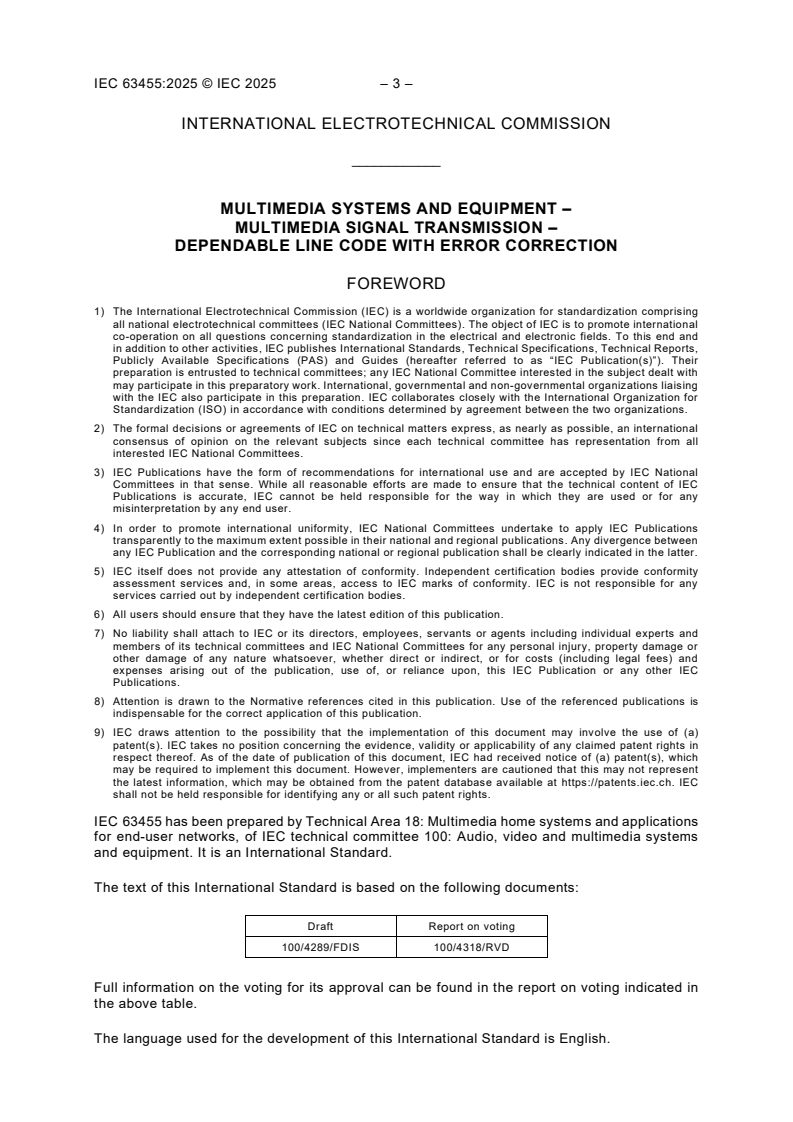
– 2 – IEC 63455:2025 © IEC 2025
CONTENTS
FOREWORD . 3
INTRODUCTION . 5
1 Scope . 7
2 Normative references . 7
3 Terms, definitions and abbreviated terms . 7
3.1 Terms and definitions . 7
3.2 Abbreviated terms. 8
4 4b/10b line code . 8
4.1 Overview . 8
4.2 Embedded clock . 9
4.3 DC balance . 9
4.4 Error detection and error correction . 9
4.5 4b/10b data coding . 10
4.6 4b/10b control code coding . 10
4.7 4b/10b coding . 11
4.8 Decoding and error handling . 11
4.8.1 Decoding scheme . 11
4.8.2 No error . 11
4.8.3 1-bit error . 11
4.8.4 2-bit error . 11
4.8.5 Over 3-bit errors . 11
4.8.6 Decoder . 12
Annex A (informative) Characteristics of embedded clock . 13
Annex B (informative) Characteristics of DC balance . 14
Annex C (informative) An example implementation of a decoder . 15
Annex D (informative) Examples of K codes usage . 21
Bibliography . 22
Figure 1 – Communications among sensor networks and wearable devices . 6
Table 1 – The 4b/10b coding table . 10
Table A.1 – An example of the length of consecutive 0s or 1s in case of a 1-bit error . 13
Table B.1 – An example of the equality of the number of 0s and 1s in a consecutive
10-bit window . 14
Table C.1 – An example of decoding in the case of no error . 16
Table C.2 – An example of decoding in the case of a 1-bit error . 17
Table C.3 – An example of decoding in the case of a 2-bit error . 18
Table C.4 – An example of decoding in the case of a 3-bit error . 19
INTERNATIONAL ELECTROTECHNICAL COMMISSION
____________
MULTIMEDIA SYSTEMS AND EQUIPMENT –
MULTIMEDIA SIGNAL TRANSMISSION –
DEPENDABLE LINE CODE WITH ERROR CORRECTION
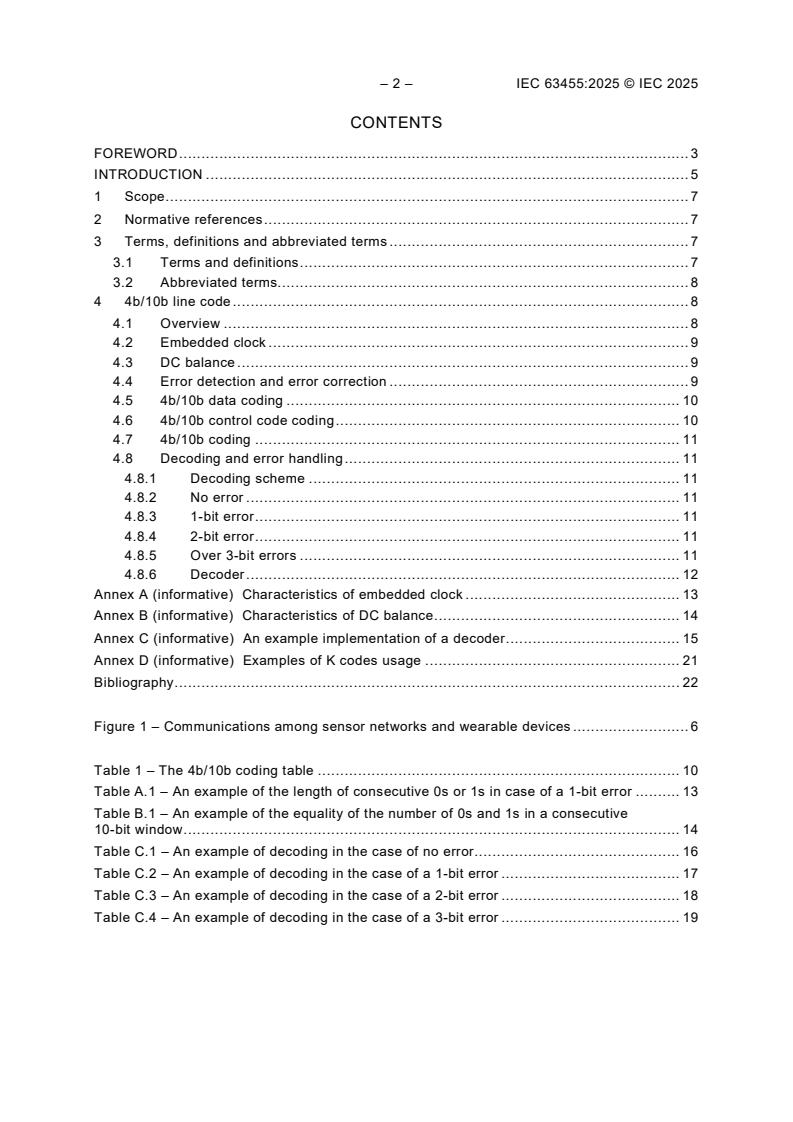
FOREWORD
1) The International Electrotechnical Commission (IEC) is a worldwide organization for standardization comprising
all national electrotechnical committees (IEC National Committees). The object of IEC is to promote international
co-operation on all questions concerning standardization in the electrical and electronic fields. To this end and
in addition to other activities, IEC publishes International Standards, Technical Specifications, Technical Reports,
Publicly Available Specifications (PAS) and Guides (hereafter referred to as “IEC Publication(s)”). Their
preparation is entrusted to technical committees; any IEC National Committee interested in the subject dealt with
may participate in this preparatory work. International, governmental and non-governmental organizations liaising
with the IEC also participate in this preparation. IEC collaborates closely with the International Organization for
Standardization (ISO) in accordance with conditions determined by agreement between the two organizations.
2) The formal decisions or agreements of IEC on technical matters express, as nearly as possible, an international
consensus of opinion on the relevant subjects since each technical committee has representation from all
interested IEC National Committees.
3) IEC Publications have the form of recommendations for international use and are accepted by IEC National
Committees in that sense. While all reasonable efforts are made to ensure that the technical content of IEC
Publications is accurate, IEC cannot be held responsible for the way in which they are used or for any
misinterpretation by any end user.
4) In order to promote international uniformity, IEC National Committees undertake to apply IEC Publications
transparently to the maximum extent possible in their national and regional publications. Any divergence between
any IEC Publication and the corresponding national or regional publication shall be clearly indicated in the latter.
5) IEC itself does not provide any attestation of conformity. Independent certification bodies provide conformity
assessment services and, in some areas, access to IEC marks of conformity. IEC is not responsible for any
services carried out by independent certification bodies.
6) All users should ensure that they have the latest edition of this publication.
7) No liability shall attach to IEC or its directors, employees, servants or agents including individual experts and
members of its technical committees and IEC National Committees for any personal injury, property damage or
other damage of any nature whatsoever, whether direct or indirect, or for costs (including legal fees) and
expenses arising out of the publication, use of, or reliance upon, this IEC Publication or any other IEC
Publications.
8) Attention is drawn to the Normative references cited in this publication. Use of the referenced publications is
indispensable for the correct application of this publication.
9) IEC draws attention to the possibility that the implementation of this document may involve the use of (a)
patent(s). IEC takes no position concerning the evidence, validity or applicability of any claimed patent rights in
respect thereof. As of the date of publication of this document, IEC had received notice of (a) patent(s), which
may be required to implement this document. However, implementers are cautioned that this may not represent
the latest information, which may be obtained from the patent database available at https://patents.iec.ch. IEC
shall not be held responsible for identifying any or all such patent rights.
IEC 63455 has been prepared by Technical Area 18: Multimedia home systems and applications
for end-user networks, of IEC technical committee 100: Audio, video and multimedia systems
and equipment. It is an International Standard.
The text of this International Standard is based on the following documents:
Draft Report on voting
100/4289/FDIS 100/4318/RVD
Full information on the voting for its approval can be found in the report on voting indicated in
the above table.
The language used for the development of this International Standard is English.
– 4 – IEC 63455:2025 © IEC 2025
This document was drafted in accordance with ISO/IEC Directives, Part 2, and developed in
accordance with ISO/IEC Directives, Part 1 and ISO/IEC Directives, IEC Supplement, available
at www.iec.ch/members_experts/refdocs. The main document types developed by IEC are
described in greater detail at www.iec.ch/publications.
In this document, the following print types are used:
• bold type: error bits.
The committee has decided that the contents of this document will remain unchanged until the
stability date indicated on the IEC website under webstore.iec.ch in the data related to the
specific document. At this date, the document will be
• reconfirmed,
• withdrawn, or
• revised.
INTRODUCTION
This document defines a line code with error correction to ensure dependable communication.
Several complex machines, such as IoT devices, wearable devices, sensor networks, robotics,
and spacecraft, have a growing demand for distributed processing. In addition, modernizing
facilities such as factories, offices, schools, and homes creates a ubiquitous and multimedia
computing environment. Unlike conventional PC applications for documentation and Internet
applications that exchange texts without time constraints, these types of cooperative computing
require reliable real-time responses to physical events occurring in the real world that can be
noisy. For distributed nodes to cooperate in real-time, an interconnecting network realizes
dependable real-time communication without re-transmission in noisy environments. As a
dependable line code with error correction for such reliable real-time communications, the
4b/10b provides an embedded clock, DC (direct current) balance, error detection, and error
correction capabilities at a time.
"Real-time" means that the exactness of the system, including computation and communication,
depends not only on the result but also on the time taken to achieve the result. In a narrow
sense, "real-time" means that the time constraints, including deadlines or periods, are met. A
line code is the lowest-level communication protocol on a communication line. Most current line
codes have typical functions, including the embedded clock, DC balance, and basic error
detection. The 8b/10b line code [1] is a major example, which is used for USB 3.0 [2], Serial
ATA [3], and PCI Express 2.0 [4]. However, no conventional line code has an error correction
capability. In the case of the 8b/10b line code, when one bit of an encoded code (a 10b code)
is inverted during communication, the multi bits of the decoded code (the 8b code) are inverted.
In other words, when a single-bit error occurs in an encoded 10-bit code, the decoded 8-bit
code (a byte) is completely corrupted.
When the decoder detects an error, the corrupted data is generally re-transmitted under an
upper-level communication protocol. However, the re-transmission scheme is unsuitable for
real-time communication because the WCRT cannot be obtained. Therefore, the forward error
correction scheme against the bit error is required for real-time communication. However, even
if a one-bit error occurs in the encoded line code, multiple bits of the decoded code are inverted
at the receiver, so it is difficult to use a bit-error correction code, such as Hamming code or
BCH code, as an error correction code.
To correct an error at the receiver side, it has been necessary to use a block-level error
correction code such as RS (Reed Solomon) code in a large block unit at the subsequent stage.
In this scheme, error correction can only be performed if all packets are received, and latency
becomes long. Therefore, this scheme is also unsuitable for real-time communication. The line
code with error correction is desirable for reliable and low-latency real-time communication.
The 4b/10b line code is designed so that the following functions necessary for dependable real-
time communication, which could not be performed at a time by conventional line codes, can
be achieved by a single line code:
a) embedded clock,
b) DC balance,
c) error detection, and
d) error correction
___________
Numbers in square brackets refer to the Bibliography.
– 6 – IEC 63455:2025 © IEC 2025
The 4b/10b line code is designed for highly reliable digital communications among sensor
networks, wearable devices, robots, etc. Even in extremely noisy environments where
communication cannot be performed by a conventional line code, such as the 8b/10b line code,
communication can be performed using the 4b/10b line code. Since communication errors can
be corrected per hop by hop using the 4b/10b line code and error correction latency becomes
short, the 4b/10b line code is suitable for reliable real-time communications.
Moreover, the 4b/10b line code is designed to have high affinity with the 8b/10b line code, which
is one of the most popular line codes. All 10b codes of the 4b/10b line code are fully included
in the 10b codes of the 8b/10b line code. For example, more reliable communication can be
achieved by changing the line code from 8b/10b to 4b/10b.
Sensor networks and wearable device communications are typical target applications, as shown
in Figure 1, since the 4b/10b line code is specially designed for reliable real-time
communications in noisy environments. Many sensors, actuators, and IoT devices are
connected via sensor networks, whose cables are inexpensive and affected by external noises.
Error-free real-time communications are required to realize these distributed real-time systems.
Although the 4b/10b line code has error detection and error correction functions, it can be
implemented by small-scale hardware. Since re-transmission at the upper communication layer
is unnecessary, communication latency becomes short, which is especially suitable for
wearable devices and sensor networks.
Figure 1 – Communications among sensor networks and wearable devices
MULTIMEDIA SYSTEMS AND EQUIPMENT –
MULTIMEDIA SIGNAL TRANSMISSION –
DEPENDABLE LINE CODE WITH ERROR CORRECTION
1 Scope
This document specifies the 4b/10b line code with error correction for dependable multimedia
data transmission, especially for real-time communications even in noisy environments, such
as IoT devices, wearable devices, sensor networks, robotics, and spacecraft. This document
corresponds to the functions specified in layer 1 to layer 2 of the OSI reference model
(ISO/IEC 7498).
This document aims to facilitate the usage of the 4b/10b line code in complex systems by
providing the 4b/10b line code protocol. This document defines the 4b/10b line code protocol
for interconnections in complex systems, mainly distributed real-time systems such as
embedded systems, control systems, IoT devices, wearable devices, sensor networks,
amusement systems, robot systems, and spacecraft. Specifically, the 4b/10b line code is the
line code that realizes embedded clock, DC balance, error detection, and error correction at the
same time, whose functions are not satisfied by a conventional single line code so that the
4b/10b line code can achieve highly reliable digital communications. The most significant
feature of the 4b/10b line code is that it is a line code with error correction capability. Therefore,
there is no need for error correction in the upper layers, and communication can be performed
using only the 4b/10b line code in noisy environments.
2 Normative references
The following documents are referred to in the text in such a way that some or all of their content
constitutes requirements of this document. For dated references, only the edition cited applies.
For undated references, the latest edition of the referenced document (including any
amendments) applies.
ISO/IEC 7498-1:1994, Information technology – Open Systems Interconnection – Basic
Reference Model: The Basic Model – Part 1
ISO/IEC 24740:2008, Information technology – Responsive Link (RL)
3 Terms, definitions and abbreviated terms
For the purposes of this document, the following terms and definitions apply.
ISO and IEC maintain terminology databases for use in standardization at the following
addresses:
• IEC Electropedia: available at https://www.electropedia.org/
• ISO Online browsing platform: available at https://www.iso.org/obp
3.1 Terms and definitions
3.1.1
byte
B
group of eight bits
– 8 – IEC 63455:2025 © IEC 2025
3.1.2
half-byte
HB
group of four bits
3.1.3
4b
original half-byte (4-bit) data
3.1.4
8b
original byte (8-bit) data
3.1.5
10b
encoded 10-bit data for transmitting
3.1.6
symbol
unit for encoding
Note 1 to entry: The size of a symbol is 10 bits.
3.1.7
frame
unit for transmitting. The size of a frame is 10 bits.
3.2 Abbreviated terms
DC direct current
ECC error correction code
WCET worst case execution time
WCRT worst case response time
4 4b/10b line code
4.1 Overview
The 4b/10b line code shall encode 4-bit digits to a 10-bit symbol for dependable communication
to perform the following functions simultaneously:
• embedded clock,
• DC balance,
• error detection,
• error correction.
The original 4-bit digits shall be encoded into a 10-bit symbol using the look-up table shown in
Table 1. A byte (8b) is divided into two half-bytes. A half-byte (4b) is encoded to a symbol (10b).
A frame consists of a symbol.
A transmitter transmits a 10-bit frame (10b) to the communication line. A receiver receives the
10-bit frame and decodes the frame (10b) to the corresponding 4-bit digits (4b).
4.2 Embedded clock
The clock signal must be embedded in the line code to achieve high-speed digital
communication without a dedicated clock line. Therefore, the clock signals shall be embedded
in the 4b/10b line code so that the consecutive 0s or 1s shall be within three bits.
Since the 4b/10b line code has 1-bit error correction capability, even if a 1-bit error/symbol
occurs, consecutive 0s or 1s shall be within five bits.
The consecutive 0s or 1s shall be within three bits in the inside symbol digits. Even if a 1-bit
error/symbol occurs inside symbol digits, consecutive 0s or 1s shall be within five bits in the
10-bit symbol.
In the case of inter-symbol digits, the consecutive 0s or 1s in the joint part shall be within three
bits. When one bit in each symbol is inverted, the consecutive 0s or 1s in the joint part (inter-
symbol digits) between symbols should be within five bits. However, this condition is hard to
satisfy completely, so the condition is relaxed as follows. When each symbol has a 1-bit
error/symbol, if the distance of the error bits is greater than four bits, the consecutive 0s or 1s
shall be within five bits in the joint part of the symbols.
In the case of two-bit errors, discontinuity of digits is not guaranteed.
Specific examples are shown in Annex A.
4.3 DC balance
The numbers 0 and 1 in a symbol shall be identical so that no current flows through the
communication cable for stable and low-power communication.
The number of 0s in any 10-bit symbol shall be five bits.
The number of 1s in any 10-bit symbol shall be five bits.
DC balance between consecutive symbols is not considered. This means that the equality of 0s
and 1s in any connecting 10-bit window between symbols is not guaranteed. However, the
equality of 0s and 1s within a symbol is fully guaranteed, so communication quality is fine.
Specific examples are shown in Annex B.
4.4 Error detection and error correction
As the 4b/10b line code should provide error-free transmission for dependable real-time
communications, the 4b/10b should have the line-code-level forward error correction (FEC)
capability in addition to error detection capability. An original half-byte data (4b) is encoded to
a 10-bit symbol (10b) with the embedded clock, DC balance, and error detection and correction
capabilities so that the Hamming distance between any 10b symbols shall be longer than or
equal to 4 to achieve 2-bit/symbol error detection and 1-bit/symbol error correction capabilities.
– 10 – IEC 63455:2025 © IEC 2025
4.5 4b/10b data coding
The 4b/10b line code that satisfies the three conditions of the embedded clock as described in
4.2, DC balance as described in 4.3, and error detection and correction as described in 4.4 are
shown in Table 1, which shall be used for both encoding and decoding. Specifically, the original
4-bit data (4b) is encoded into the corresponding 10-bit symbol (10b) using the data (D) portions
of the 4b/10b coding table. The numbers that can be represented by four bits are 16 numbers
from 0 to 15 in decimal and can be represented by a single hexadecimal digit from 0x0 to 0xF.
The 4b/10b coding table is used to convert 4-bit data into 10-bit symbols, where the X of D.X in
the data (D-code) represents the hexadecimal numbers 0x0 to 0xF, 4b (data) represents the
binary number corresponding to that hexadecimal digit, and 10b (symbol) represents the
encoded 10-bit symbol.
Table 1 – The 4b/10b coding table
Data(D)/ Symbol number
4b (data/control D ) 10b (symbol C )
D/K code
i i
Control(K) i (hex)
Data(D) 0 D.0 0000 0010110110
Data(D) 1 D.1 0001 0011001101
Data(D) 2 D.2 0010 0011010011
Data(D) 3 D.3 0011 0011101010
Data(D) 4 D.4 0100 0100110011
Data(D) 5 D.5 0101 0101010101
Data(D) 6 D.6 0110 0101011010
Data(D) 7 D.7 0111 0101100110
Data(D) 8 D.8 1000 0101101001
Data(D) 9 D.9 1001 0110001110
Data(D) A D.A 1010 0110011001
Data(D) B D.B 1011 0110100101
Data(D) C D.C 1100 1000101110
Data(D) D D.D 1101 1000111001
Data(D) E D.E 1110 1001001011
Data(D) F D.F 1111 1001010110
Control(K) 11 K.1 0001 1001100101
Control(K) 12 K.2 0010 1010010101
Control(K) 14 K.4 0100 1010011010
Control(K) 18 K.8 1000 1010100011
4.6 4b/10b control code coding
In general, several control codes are required in addition to communication data to control
communication equipment and create communication protocols. These control codes are called
K codes. As with data transmission, the transmission of K codes shall satisfy the three
conditions of the embedded clock, DC balance, and error detection and correction. Four K codes
are available for the 4b/10b line code, as shown in Table 1. The Y of K.Y in the K code
represents the hexadecimal numbers 0x1, 0x2, 0x4, and 0x8, 4b (control code) represents the
binary number corresponding to this hexadecimal number, and 10b (symbol) represents the
encoded 10-bit symbol.
Examples of the K codes’ usage are shown in Annex D.
4.7 4b/10b coding
The 4b/10b coding table shall be used for data transmission and control code transmission,
satisfying the three conditions of the embedded clock, DC balance, and error detection and
correction. The 4b/10b line code consists of 16 data (D) codes and four control (K) codes, as
shown in Table 1. The symbol number i (hex) represents 16 hexadecimal numbers from 0x0 to
0xF as D codes and four hexadecimal numbers 0x11, 0x12, 0x14, and 0x18 as K codes, where
the X of D.X and the Y of K.Y in D/K codes represent the hexadecimal numbers 0x0 to 0xF and
the hexadecimal numbers 0x1, 0x2, 0x4, and 0x8 respectively, with 4b (data/control)
representing the corresponding binary numbers and 10b (symbol C ) representing the encoded
i
10-bit symbol.
The 4b/10b coding table shown in Table 1 shall be looked up and used to encode and decode
the data and control codes.
The 4b/10b line code has a high affinity with the 8b/10b line code, which is among the most
popular. All 10b symbols are fully included in the 10b symbols of the 8b/10b line code. For
example, changing the line code from the 8b/10b line code to the 4b/10b line code can result
in more reliable communication, although throughput will be reduced.
4.8 Decoding and error handling
4.8.1 Decoding scheme
Decoding is based on the shortest distance decoding scheme of the Hamming distance. The
received frame is compared to all 10b symbols in the 4b/10b coding table shown in Table 1,
and the D/K code of the matching entry is selected. Finally, the corresponding 4b data is
decoded.
4.8.2 No error
If no error occurs, the decoder decodes the received 10b frame into the corresponding 4b data
based on the Hamming distance. In the case of no error, the shortest Hamming distance is zero,
and all received 10b bits are fully matched to one of the 10b symbols.
4.8.3 1-bit error
If a 1-bit error/symbol occurs, the decoder can detect the correctable error and decode the
received 10b frame into the normal 4b data based on the Hamming distance. In the case of the
1-bit error/symbol, the shortest Hamming distance is one.
4.8.4 2-bit error
If a 2-bit error/symbol occurs, the decoder can detect the uncorrectable fatal error based on the
Hamming distance. Regarding the 2-bit error/symbol, the shortest Hamming distance is two. If
a fatal error is detected in a frame, the decoder should not attempt to correct the received 10b
frame and should inform the fatal error to the upper layer.
4.8.5 Over 3-bit errors
If a 3-bit error/symbol occurs, the decoder cannot detect the occurrence of the fatal error, even
though the probability of this case is very low. This error is indistinguishable from other
correctable 1-bit errors, so the decoder incompletely corrected the received frame. This
situation allows erroneous data transmission and is highly undesirable. Therefore, if, for
example, 1-bit errors are corrected in two consecutive frames, or if the probability of the
corrected frames becomes higher than a threshold, the decoder should consider this situation
as a fatal error that cannot be corrected and treat the frame in the same way as the 2-bit error.
– 12 – IEC 63455:2025 © IEC 2025
4.8.6 Decoder
There are a few implementation schemes for the 4b/10b decoder. For ease of understanding,
an example implementation of a decoder is shown in Annex C. Based on the example decoding
scheme, Table C.1 shows an example decoding in the case of no error. Table C.2 shows an
example of decoding in the case of a 1-bit error. Table C.3 shows an example of decoding in
the case of a 2-bit error. Table C.4 shows an example of decoding in the case of a 3-bit error.
Annex A
(informative)
Characteristics of embedded clock
The 4b/10b line code ensures that consecutive 0s or 1s shall be within three bits, as shown in
Table 1. Even if a 1-bit error/symbol occurs, the 4b/10b line code ensures that consecutive 0s
or 1s shall be within five bits.
In the case of inside symbol digits, consecutive 0s or 1s shall be within five bits if a 1-bit
error/symbol occurs. For example, if a 1-bit error occurs in the D.1 (0010110110) symbol,
consecutive 0s or 1s are within five bits, as shown in Table A.1.
Table A.1 – An example of the length of consecutive 0s or 1s in case of a 1-bit error
The number of errors Line code (D.0) The maximum length of
consecutive 0s or 1s
0 (original) 0010110110 2
1 0010110111 3
1 0010110100 2
1 0010110010 2
1 0010111110 5
1 0010100110 2
1 0010010110 2
1 0011110110 4
1 0000110110 4
1 0110110110 2
1 1010110110 2
In the case of any inter-symbol digits, consecutive 0s or 1s shall be within three bits. For
example, inter-symbol consecutive 0s or 1s of the 0010110110 0011001101 (D.0, D.1) symbols
are within three bits.
When each symbol has a 1-bit error, if the distance of error bits is greater than four bits, the
consecutive 0s or 1s are within five bits as follows.
• Original two consecutive frames (D.0, D.0): 00101101100010110110
• 1-bit error/symbol with the bit error distance of 4: 00101101000000110110
The length of consecutive 0s is 6, which is greater than 5.
• 1-bit error/symbol with the bit error distance of 5: 00101101000011110110
The length of consecutive 0s is 4, which is less than or equal to 5.
In the case of two-bit errors, discontinuity of digits is not guaranteed.
– 14 – IEC 63455:2025 © IEC 2025
Annex B
(informative)
Characteristics of DC balance
For the 4b/10b line code not to allow a current to flow in the communication cable, the numbers
of 0s and 1s in a symbol shall be the same. However, the DC balance between consecutive
symbols is optional. In other words, the equality of the number of 0s and 1s inside a symbol is
guaranteed. However, the equality of 0s and 1s in any connecting 10-bit window, which is
unnecessary for communication quality, is not guaranteed, as shown in Table B.1.
Table B.1 – An example of the equality of the number
of 0s and 1s in a consecutive 10-bit window
Window number 10-bit window The number of 1s
0 0010110110 0011001101 5
1 0010110110 0011001101 5
2 0010110110 0011001101 5
3 0010110110 0011001101 5
4 0010110110 0011001101 6
5 0010110110 0011001101 5
6 0010110110 0011001101 4
7 0010110110 0011001101 5
8 0010110110 0011001101 5
9 0010110110 0011001101 4
If an error occurs, bit-level DC balance is not guaranteed between nearest neighbouring error
symbols.
Annex C
(informative)
An example implementation of a decoder
Although it is customary not to define the implementation method of a decoder in the
standardization of a particular codec in general, since the 4b/10b line code is a little bit complex
code that includes error detection and error correction, an example of a decoder is shown for
easy understanding. Several implementation methods could be other than those shown in the
following example.
The 10b symbol C is decoded to the corresponding 4b D code (D.X) or K code (K.Y) as follows.
Each Hamming distance HD between a received 10b frame and each symbol C shown in
i i
Table 1, shall be calculated.
The minimum value of the Hamming distance HD is calculated by the following equation:
min
• HD = min{ HD }.
min i
• When HD is equal to HD , the 10b C is decoded to the 4b D.X in the case of D code.
X min X
• When HD is equal to HD , the 10b C is decoded to the 4b K.Y in the case of K code.
1Y min 1Y
• If HD equals 0, the 10b C is successfully decoded to the 4b D.X/K.Y without error.
min X/1Y
• If HD equals 1, the 10b C is decoded to the 4b D.X/K.Y. In this case, the 1-bit error
min X/1Y
is corrected, and the corrected error should be informed to the upper layer.
• If HD equals 2, the 10b C is decoded to all 0s. In this case, the 2-bit error is detected,
min i
and the fatal error should be informed to the upper layer. The decoded 4b code (all 0) is
broken.
• If HD is greater than 2, the 10b C is decoded to all 0s. In this case, the multi-bit error is
min i
detected, and the fatal error should be informed to the upper layer. The decoded 4b code
(all 0s) is broken.
Since the number of codes is as small as 20, the Hamming distance can be obtained by simply
XORing the 10-bit received frame with the 20 codes (10 bits × 20 = 200 bits) simultaneously
and calculating the number of 1s. This method is easy to implement, and a small, fast decoder
can be implemented.
If a 3-bit error/symbol occurs, the decoder cannot detect the occurrence of the fatal error, even
if the probability of this case is very low. This error is indistinguishable from other correctable
1-bit errors, so the decoder incompletely corrected the received frame. This situation allows
erroneous data transmission and is highly undesirable. Therefore, if, for example, 1-bit errors
are corrected in two consecutive frames, or if the probability of the corrected frames becomes
higher than a threshold, the decoder should consider this situation as a fatal error that cannot
be corrected and treat the frame in the same way as the 2-bit error.
– 16 – IEC 63455:2025 © IEC 2025
Table C.1 – An example of decoding in the case of no error
D/K code 4b (data) 10b (symbol) Hamming Distance
0010110110 6
D.0 0000
0011001101 6
D.1 0001
0011010011 4
D.2 0010
0011101010 4
D.3 0011
0100110011 4
D.4 0100
0101010101 4
D.5 0101
0101011010 0
D.6 0110
0101100110 4
D.7 0111
0101101001 4
D.8 1000
0110001110 4
D.9 1001
0110011001 4
D.A 1010
0110100101 8
D.B 1011
1000101110 6
D.C 1100
1000111001 6
D.D 1101
1001001011 4
D.E 1110
1001010110 4
D.F 1111
1001100101 8
K.1 0001
1010010101 8
K.2 0010
1010011010 4
K.4 0100
1010100011 8
K.8 1000
Assume that the original 10b symbol (frame) is D.6 (0101011010) and the received 10b frame
is 0101011010. The received frame is compared to all the 10b symbols in the 4b/10b coding
table to obtain the Hamming distance. In this case, the Hamming distance of D.6 is zero, and
the received frame perfectly matches the D.6 symbol. The Hamming distances except D.6 are
greater than or equal to four. Therefore, D.6 is selected without error, and the corresponding
6 (0110) is decoded.
Table C.2 – An example of decoding in the case of a 1-bit error
D/K code 4b (data) 10b (symbol) Hamming Distance
0010110110 7
D.0 0000
0011001101 5
D.1 0001
0011010011 3
D.2 0010
0011101010 5
D.3 0011
0100110011 3
D.4 0100
0101010101 3
D.5 0101
0101011010 1
D.6 0110
0101100110 5
D.7 0111
0101101001 3
D.8 1000
0110001110 5
D.9 1001
0110011001 3
D.A 1010
0110100101 7
D.B 1011
1000101110 7
D.C 1100
1000111001 5
D.D 1101
1001001011 3
D.E 1110
1001010110 5
D.F 1111
1001100101 7
K.1 0001
1010010101 7
K.2 0010
1010011010 5
K.4 0100
1010100011 7
K.8 1000
– 18 – IEC 63455:2025 © IEC 2025
Assume that the original 10b symbol (frame) is D.6 (0101011010) and the received 10b frame
is 0101011011. The received 10b frame is compared to all the 10b symbols in the 4b/10b coding
table to obtain the Hamming distance. In this case, the Hamming distance of D.6 becomes only
one, and the received frame differs from the D.6 symbol by one bit. The Hamming distances
except D.6 are greater than or equal to three. Therefore, 1-bit error correction is performed, D.6
is selected, and the corresponding 6 (0110) is decoded.
Table C.3 – An example of decoding in the case of a 2-bit error
D/K code 4b (data) 10b (symbol) Hamming Distance
0010110110 8
D.0 0000
0011001101 4
D.1 0001
0011010011 4
D.2 0010
0011101010 6
D.3 0011
0100110011 4
D.4 0100
0101010101 2
D.5 0101
0101011010 2
D.6 0110
0101100110 6
D.7 0111
0101101001 2
D.8 1000
0110001110 6
D.9 1001
0110011001 2
D.A 1010
0110100101 6
D.B 1011
1000101110 8
D.C 1100
1000111001 4
D.D 1101
1001001011 4
D.E 1110
1001010110 6
D.F 1111
1001100101 6
K.1 0001
1010010101 6
K.2 0010
1010011010 6
K.4 0100
1010100011 8
K.8 1000
Assume that the original 10b symbol (frame) is D.6 (0101011010) and the received 10b frame
is 0101011001. The received frame is compared to all the 10b symbols in the 4b/10b coding
table to obtain the Hamming distance. In this case, the Hamming distance of D.5, D.6, D.8, and
D.A is two, and the received frame differs by two bits from those four symbols. One of the three
symbols cannot be selected as the correct answer. In the case of a 2-bit error, only error
detection is possible.
Table C.4 – An example of decoding in the case of a 3-bit error
D/K code 4b (data) 10b (symbol) Hamming Distance
D.0
D.1
D.2
D.3
D.4
D.5
D.6
D.7
D.8
D.9
D.A
D.B
D.C
D.D
D.E
D.F
K.1
K.2
K.4
K.8 1000
– 20 – IEC 63455:2025 © IEC 2025
Assume that the original 10b symbol (frame) is D.6 (0101011010) and the received 10b frame
is 0101011101. The received frame is compared to all the 10b symbols in the 4b/10b coding
table to obtain the Hamming distance. In this case, the Hamming distance of D.5 becomes only
1, and 1-bit error correction is erroneously performed. The D.5 symbol is selected, and the
corresponding 5 (0101) is incorrectly decoded. If a 3-bit or more error occurs, this kind of wrong
error correction may be performed, so this situation should be avoided.
Annex D
(informative)
Examples of K codes usage
The 4b/10b line code has an error correction function and satisfies the four conditions (clock
embedding, DC balance, error detection, and error correction) at the same time, so there cannot
be a pattern of consecutive 0s and 1s, and there is no alignment code like the co
...