

IEC 61189-5-4:2015
(Main)Test methods for electrical materials, printed boards and other interconnection structures and assemblies - Part 5-4: General test methods for materials and assemblies - Solder alloys and fluxed and non-fluxed solid wire for printed board assemblies
General Information
- Abstract
IEC 61189-5-4:2015 is a catalogue of test methods representing methodologies and procedures that can be applied to test printed board assemblies. This part of IEC 61189 focuses on test methods for solder alloys, fluxed and non-fluxed solid wire, based on existing IEC 61189-5 and IEC 61189-6. In addition, it includes test methods for solder alloys, fluxed and non-fluxed solid wire, and for lead free soldering.
This publication is to be read in conjunction with IEC 61189-1:1997, IEC 61189-2:2006 and IEC 61189-3:2007.
- Status
- Published
- Publication Date
- 07-Jan-2015
- Technical Committee
- TC 91 - Electronics assembly technology
- Drafting Committee
- WG 3 - TC 91/WG 3
- Current Stage
- PPUB - Publication issued
- Start Date
- 08-Jan-2015
- Completion Date
- 15-Jan-2015
Buy Documents
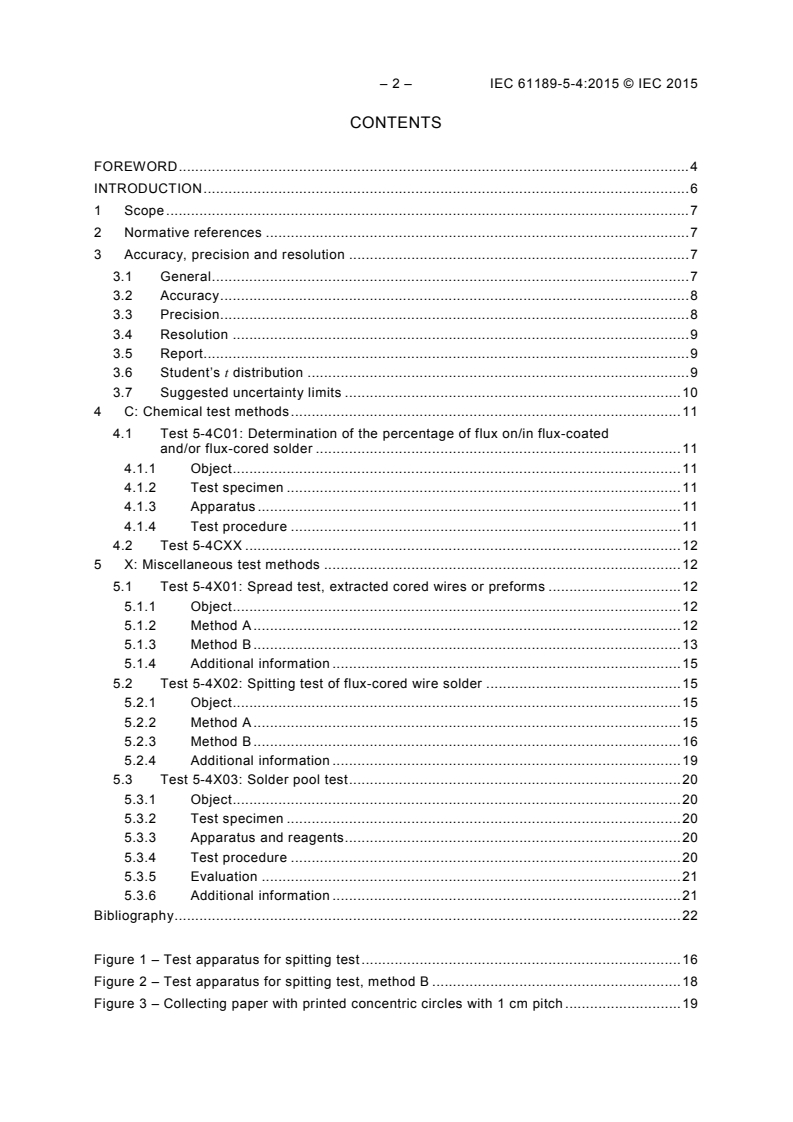
IEC 61189-5-4:2015 - Test methods for electrical materials, printed boards and other interconnection structures and assemblies - Part 5-4: General test methods for materials and assemblies - Solder alloys and fluxed and non-fluxed solid wire for printed board assemblies Released:1/8/2015
Overview
IEC 61189-5-4:2015 is an international standard published by the International Electrotechnical Commission (IEC) that specifies general test methods for solder alloys and fluxed and non-fluxed solid wire used in printed board assemblies. This standard forms part 5-4 within the broader IEC 61189 series, which focuses on test methods for electrical materials, printed boards, and interconnection structures and assemblies. The 2015 edition provides detailed testing procedures for evaluating the quality, reliability, and performance of solder materials in printed circuit board (PCB) assemblies, including both traditional and lead-free solder alloys.
Designed to be used in conjunction with IEC 61189-1:1997, IEC 61189-2:2006, and IEC 61189-3:2007, this document offers standardized methodologies that ensure uniformity, reproducibility, and accuracy in material testing. It targets designers, test engineers, and quality assurance professionals involved in electronics manufacturing and assembly.
Key Topics
Test Methodologies for Solder Alloys and Wires
The standard outlines test procedures for both fluxed and non-fluxed solder wires and alloys used in PCB assembly. These methodologies help determine solder composition, flux content, and physical behaviors under controlled conditions.Chemical Testing for Flux Content
The document specifies chemical test methods such as the determination of flux percentage in flux-coated or flux-cored solder wires to ensure accurate flux levels critical for solder quality.Miscellaneous Mechanical Tests
Tests like the spread test, spitting test, and solder pool test evaluate solder material behavior during reflow or melting processes. These tests assess the consistency and quality of solder spread, potential spitting of flux-cored wire, and solder joint formation.Accuracy and Precision Guidelines
IEC 61189-5-4 provides statistical techniques and uncertainty limits to ensure reliable test results, including directives on precision, resolution, and appropriate reporting practices.Standardized Reporting
The standard encourages comprehensive test reporting with documented parameters and outcomes, facilitating conformance verification and troubleshooting.
Applications
Printed Circuit Board (PCB) Assembly Quality Control
Manufacturers of PCBs and electronic assemblies use these standardized test methods to verify solder alloy quality and process parameters, minimizing defects in manufacturing.Solder Material Specification and Evaluation
Solder alloy suppliers and component manufacturers apply the defined tests to certify their products meet industry requirements, including lead-free soldering compliance.R&D and Process Development
Research and development teams utilize these tests to develop new solder materials or improve assembly processes with robust and repeatable evaluation protocols.Compliance and Certification
Electronics producers incorporate IEC 61189-5-4 test methods within their quality management systems to comply with international norms and to assure customers of product reliability.
Related Standards
IEC 61189 Series
This part 5-4 standard is one component within the extensive IEC 61189 series:- IEC 61189-1:1997 – General overview and definitions of test methods.
- IEC 61189-2:2006 – Methods related to printed boards.
- IEC 61189-3:2007 – Other interconnection structures and assemblies.
Further IEC Standards on Electronics Assembly
The IEC 61189-5-4 standard complements other IEC documents and may reference test methods developed by other technical committees such as TC 104, ensuring comprehensive coverage of materials testing.ISO/IEC Directives
The preparation of IEC 61189-5-4 adheres to ISO/IEC directives, providing globally harmonized test method frameworks.
Keywords: IEC 61189-5-4, solder alloys, fluxed solid wire, non-fluxed solid wire, printed board assemblies, PCB test methods, electronics assembly standards, lead-free soldering, solder testing, electrical materials test, IEC standards, quality control in electronics manufacturing, solder material evaluation.
Buy Documents
IEC 61189-5-4:2015 - Test methods for electrical materials, printed boards and other interconnection structures and assemblies - Part 5-4: General test methods for materials and assemblies - Solder alloys and fluxed and non-fluxed solid wire for printed board assemblies Released:1/8/2015
Frequently Asked Questions
IEC 61189-5-4:2015 is a standard published by the International Electrotechnical Commission (IEC). Its full title is "Test methods for electrical materials, printed boards and other interconnection structures and assemblies - Part 5-4: General test methods for materials and assemblies - Solder alloys and fluxed and non-fluxed solid wire for printed board assemblies". This standard covers: IEC 61189-5-4:2015 is a catalogue of test methods representing methodologies and procedures that can be applied to test printed board assemblies. This part of IEC 61189 focuses on test methods for solder alloys, fluxed and non-fluxed solid wire, based on existing IEC 61189-5 and IEC 61189-6. In addition, it includes test methods for solder alloys, fluxed and non-fluxed solid wire, and for lead free soldering. This publication is to be read in conjunction with IEC 61189-1:1997, IEC 61189-2:2006 and IEC 61189-3:2007.
IEC 61189-5-4:2015 is a catalogue of test methods representing methodologies and procedures that can be applied to test printed board assemblies. This part of IEC 61189 focuses on test methods for solder alloys, fluxed and non-fluxed solid wire, based on existing IEC 61189-5 and IEC 61189-6. In addition, it includes test methods for solder alloys, fluxed and non-fluxed solid wire, and for lead free soldering. This publication is to be read in conjunction with IEC 61189-1:1997, IEC 61189-2:2006 and IEC 61189-3:2007.
IEC 61189-5-4:2015 is classified under the following ICS (International Classification for Standards) categories: 31.180 - Printed circuits and boards. The ICS classification helps identify the subject area and facilitates finding related standards.
IEC 61189-5-4:2015 is available in PDF format for immediate download after purchase. The document can be added to your cart and obtained through the secure checkout process. Digital delivery ensures instant access to the complete standard document.
Standards Content (Sample)
IEC 61189-5-4 ®
Edition 1.0 2015-01
INTERNATIONAL
STANDARD
NORME
INTERNATIONALE
Test methods for electrical materials, printed boards and other interconnection
structures and assemblies –
Part 5-4: General test methods for materials and assemblies – Solder alloys and
fluxed and non-fluxed solid wire for printed board assemblies
Méthodes d'essai pour les matériaux électriques, les cartes imprimées et autres
structures d'interconnexion et ensembles –
Partie 5-4: Méthodes d'essai générales pour les matériaux et les assemblages –
Alliages à braser et brasages solides fluxés et non fluxés pour les assemblages
de cartes imprimées
All rights reserved. Unless otherwise specified, no part of this publication may be reproduced or utilized in any form
or by any means, electronic or mechanical, including photocopying and microfilm, without permission in writing from
either IEC or IEC's member National Committee in the country of the requester. If you have any questions about IEC
copyright or have an enquiry about obtaining additional rights to this publication, please contact the address below or
your local IEC member National Committee for further information.
Droits de reproduction réservés. Sauf indication contraire, aucune partie de cette publication ne peut être reproduite
ni utilisée sous quelque forme que ce soit et par aucun procédé, électronique ou mécanique, y compris la photocopie
et les microfilms, sans l'accord écrit de l'IEC ou du Comité national de l'IEC du pays du demandeur. Si vous avez des
questions sur le copyright de l'IEC ou si vous désirez obtenir des droits supplémentaires sur cette publication, utilisez
les coordonnées ci-après ou contactez le Comité national de l'IEC de votre pays de résidence.
IEC Central Office Tel.: +41 22 919 02 11
3, rue de Varembé Fax: +41 22 919 03 00
CH-1211 Geneva 20 info@iec.ch
Switzerland www.iec.ch
About the IEC
The International Electrotechnical Commission (IEC) is the leading global organization that prepares and publishes
International Standards for all electrical, electronic and related technologies.
About IEC publications
The technical content of IEC publications is kept under constant review by the IEC. Please make sure that you have the
latest edition, a corrigenda or an amendment might have been published.
IEC Catalogue - webstore.iec.ch/catalogue Electropedia - www.electropedia.org
The stand-alone application for consulting the entire The world's leading online dictionary of electronic and
bibliographical information on IEC International Standards, electrical terms containing more than 30 000 terms and
Technical Specifications, Technical Reports and other definitions in English and French, with equivalent terms in 15
documents. Available for PC, Mac OS, Android Tablets and additional languages. Also known as the International
iPad. Electrotechnical Vocabulary (IEV) online.
IEC publications search - www.iec.ch/searchpub IEC Glossary - std.iec.ch/glossary
The advanced search enables to find IEC publications by a More than 60 000 electrotechnical terminology entries in
variety of criteria (reference number, text, technical English and French extracted from the Terms and Definitions
committee,…). It also gives information on projects, replaced clause of IEC publications issued since 2002. Some entries
and withdrawn publications. have been collected from earlier publications of IEC TC 37,
77, 86 and CISPR.
IEC Just Published - webstore.iec.ch/justpublished
Stay up to date on all new IEC publications. Just Published IEC Customer Service Centre - webstore.iec.ch/csc
details all new publications released. Available online and If you wish to give us your feedback on this publication or
also once a month by email. need further assistance, please contact the Customer Service
Centre: csc@iec.ch.
A propos de l'IEC
La Commission Electrotechnique Internationale (IEC) est la première organisation mondiale qui élabore et publie des
Normes internationales pour tout ce qui a trait à l'électricité, à l'électronique et aux technologies apparentées.
A propos des publications IEC
Le contenu technique des publications IEC est constamment revu. Veuillez vous assurer que vous possédez l’édition la
plus récente, un corrigendum ou amendement peut avoir été publié.
Catalogue IEC - webstore.iec.ch/catalogue Electropedia - www.electropedia.org
Application autonome pour consulter tous les renseignements
Le premier dictionnaire en ligne de termes électroniques et
bibliographiques sur les Normes internationales,
électriques. Il contient plus de 30 000 termes et définitions en
Spécifications techniques, Rapports techniques et autres
anglais et en français, ainsi que les termes équivalents dans
documents de l'IEC. Disponible pour PC, Mac OS, tablettes
15 langues additionnelles. Egalement appelé Vocabulaire
Android et iPad.
Electrotechnique International (IEV) en ligne.
Recherche de publications IEC - www.iec.ch/searchpub
Glossaire IEC - std.iec.ch/glossary
Plus de 60 000 entrées terminologiques électrotechniques, en
La recherche avancée permet de trouver des publications IEC
en utilisant différents critères (numéro de référence, texte, anglais et en français, extraites des articles Termes et
comité d’études,…). Elle donne aussi des informations sur les Définitions des publications IEC parues depuis 2002. Plus
projets et les publications remplacées ou retirées. certaines entrées antérieures extraites des publications des
CE 37, 77, 86 et CISPR de l'IEC.
IEC Just Published - webstore.iec.ch/justpublished
Service Clients - webstore.iec.ch/csc
Restez informé sur les nouvelles publications IEC. Just
Published détaille les nouvelles publications parues. Si vous désirez nous donner des commentaires sur cette
Disponible en ligne et aussi une fois par mois par email. publication ou si vous avez des questions contactez-nous:
csc@iec.ch.
IEC 61189-5-4 ®
Edition 1.0 2015-01
INTERNATIONAL
STANDARD
NORME
INTERNATIONALE
Test methods for electrical materials, printed boards and other interconnection
structures and assemblies –
Part 5-4: General test methods for materials and assemblies – Solder alloys and
fluxed and non-fluxed solid wire for printed board assemblies
Méthodes d'essai pour les matériaux électriques, les cartes imprimées et autres
structures d'interconnexion et ensembles –
Partie 5-4: Méthodes d'essai générales pour les matériaux et les assemblages –
Alliages à braser et brasages solides fluxés et non fluxés pour les assemblages
de cartes imprimées
INTERNATIONAL
ELECTROTECHNICAL
COMMISSION
COMMISSION
ELECTROTECHNIQUE
INTERNATIONALE
ICS 31.180 ISBN 978-2-8322-1999-7
– 2 – IEC 61189-5-4:2015 © IEC 2015
CONTENTS
FOREWORD . 4
INTRODUCTION . 6
1 Scope . 7
2 Normative references . 7
3 Accuracy, precision and resolution . 7
3.1 General . 7
3.2 Accuracy . 8
3.3 Precision . 8
3.4 Resolution . 9
3.5 Report. 9
3.6 Student’s t distribution . 9
3.7 Suggested uncertainty limits . 10
4 C: Chemical test methods . 11
4.1 Test 5-4C01: Determination of the percentage of flux on/in flux-coated
and/or flux-cored solder . 11
4.1.1 Object . 11
4.1.2 Test specimen . 11
4.1.3 Apparatus . 11
4.1.4 Test procedure . 11
4.2 Test 5-4CXX . 12
5 X: Miscellaneous test methods . 12
5.1 Test 5-4X01: Spread test, extracted cored wires or preforms . 12
5.1.1 Object . 12
5.1.2 Method A . 12
5.1.3 Method B . 13
5.1.4 Additional information . 15
5.2 Test 5-4X02: Spitting test of flux-cored wire solder . 15
5.2.1 Object . 15
5.2.2 Method A . 15
5.2.3 Method B . 16
5.2.4 Additional information . 19
5.3 Test 5-4X03: Solder pool test . 20
5.3.1 Object . 20
5.3.2 Test specimen . 20
5.3.3 Apparatus and reagents . 20
5.3.4 Test procedure . 20
5.3.5 Evaluation . 21
5.3.6 Additional information . 21
Bibliography . 22
Figure 1 – Test apparatus for spitting test . 16
Figure 2 – Test apparatus for spitting test, method B . 18
Figure 3 – Collecting paper with printed concentric circles with 1 cm pitch . 19
Table 1 – Student’s t distribution . 10
Table 2 – Typical spread areas defined in mm . 13
Table 3 – Example of a test report – Spitting of flux-cored wire . 19
– 4 – IEC 61189-5-4:2015 © IEC 2015
INTERNATIONAL ELECTROTECHNICAL COMMISSION
____________
TEST METHODS FOR ELECTRICAL MATERIALS,
PRINTED BOARDS AND OTHER INTERCONNECTION
STRUCTURES AND ASSEMBLIES –
Part 5-4: General test methods for materials and assemblies –
Solder alloys and fluxed and non-fluxed solid wire for
printed board assemblies
FOREWORD
1) The International Electrotechnical Commission (IEC) is a worldwide organization for standardization comprising
all national electrotechnical committees (IEC National Committees). The object of IEC is to promote
international co-operation on all questions concerning standardization in the electrical and electronic fields. To
this end and in addition to other activities, IEC publishes International Standards, Technical Specifications,
Technical Reports, Publicly Available Specifications (PAS) and Guides (hereafter referred to as “IEC
Publication(s)”). Their preparation is entrusted to technical committees; any IEC National Committee interested
in the subject dealt with may participate in this preparatory work. International, governmental and non-
governmental organizations liaising with the IEC also participate in this preparation. IEC collaborates closely
with the International Organization for Standardization (ISO) in accordance with conditions determined by
agreement between the two organizations.
2) The formal decisions or agreements of IEC on technical matters express, as nearly as possible, an international
consensus of opinion on the relevant subjects since each technical committee has representation from all
interested IEC National Committees.
3) IEC Publications have the form of recommendations for international use and are accepted by IEC National
Committees in that sense. While all reasonable efforts are made to ensure that the technical content of IEC
Publications is accurate, IEC cannot be held responsible for the way in which they are used or for any
misinterpretation by any end user.
4) In order to promote international uniformity, IEC National Committees undertake to apply IEC Publications
transparently to the maximum extent possible in their national and regional publications. Any divergence
between any IEC Publication and the corresponding national or regional publication shall be clearly indicated in
the latter.
5) IEC itself does not provide any attestation of conformity. Independent certification bodies provide conformity
assessment services and, in some areas, access to IEC marks of conformity. IEC is not responsible for any
services carried out by independent certification bodies.
6) All users should ensure that they have the latest edition of this publication.
7) No liability shall attach to IEC or its directors, employees, servants or agents including individual experts and
members of its technical committees and IEC National Committees for any personal injury, property damage or
other damage of any nature whatsoever, whether direct or indirect, or for costs (including legal fees) and
expenses arising out of the publication, use of, or reliance upon, this IEC Publication or any other IEC
Publications.
8) Attention is drawn to the Normative references cited in this publication. Use of the referenced publications is
indispensable for the correct application of this publication.
9) Attention is drawn to the possibility that some of the elements of this IEC Publication may be the subject of
patent rights. IEC shall not be held responsible for identifying any or all such patent rights.
International Standard IEC 61189-5-4 has been prepared by IEC technical committee 91:
Electronics assembly technology.
The text of this standard is based on the following documents:
FDIS Report on voting
91/1212/FDIS 91/1225/RVD
Full information on the voting for the approval of this standard can be found in the report on
voting indicated in the above table.
This publication has been drafted in accordance with the ISO/IEC Directives, Part 2.
This International Standard is used in conjunction with IEC 61189-1:1997, IEC 61189-2:2006,
IEC 61189-3:2007.
A list of all parts in the IEC 61189 series, published under the general title Test methods for
electrical materials, printed boards and other interconnection structures and assemblies, can
be found on the IEC website.
The committee has decided that the contents of this publication will remain unchanged until
the stability date indicated on the IEC website under "http://webstore.iec.ch" in the data
related to the specific publication. At this date, the publication will be
• reconfirmed,
• withdrawn,
• replaced by a revised edition, or
• amended.
– 6 – IEC 61189-5-4:2015 © IEC 2015
INTRODUCTION
IEC 61189 relates to test methods for materials or component robustness for printed board
assemblies, irrespective of their method of manufacture.
The standard is divided into separate parts, covering information for the designer and the test
methodology engineer or technician. Each part has a specific focus; methods are grouped
according to their application and numbered sequentially as they are developed and released.
In some instances test methods developed by other TCs (for example, TC 104) have been
reproduced from existing IEC standards in order to provide the reader with a comprehensive
set of test methods. When this situation occurs, it will be noted on the specific test method; if
the test method is reproduced with minor revision, those paragraphs that are different are
identified.
This part of IEC 61189 contains test methods for evaluating robustness of materials or
component for printed board assemblies. The methods are self-contained, with sufficient
detail and description so as to achieve uniformity and reproducibility in the procedures and
test methodologies.
The tests shown in this standard are grouped according to the following principles:
P: preparation/conditioning methods
V: visual test methods
D: dimensional test methods
C: chemical test methods
M: mechanical test methods
E: electrical test methods
N: environmental test methods
X: miscellaneous test methods
To facilitate reference to the tests, to retain consistency of presentation, and to provide for
future expansion, each test is identified by a number (assigned sequentially) added to the
prefix (group code) letter showing the group to which the test method belongs.
The test method numbers have no significance with respect to a possible test sequence; that
responsibility rests with the relevant specification that calls for the method being performed.
The relevant specification, in most instances, also describes pass/fail criteria.
The letter and number combinations are for reference purposes to be used by the relevant
specification. Thus "5-4C01" represents the first chemical test method described in
IEC 61189-5-4.
In short, in this example, 5-4 is the number of the part of IEC 61189, C is the group of
methods, and 01 is the test number.
TEST METHODS FOR ELECTRICAL MATERIALS,
PRINTED BOARDS AND OTHER INTERCONNECTION
STRUCTURES AND ASSEMBLIES –
Part 5-4: General test methods for materials and assemblies –
Solder alloys and fluxed and non-fluxed solid wire for
printed board assemblies
1 Scope
This part of IEC 61189 is a catalogue of test methods representing methodologies and
procedures that can be applied to test printed board assemblies.
This part of IEC 61189 focuses on test methods for solder alloys, fluxed and non-fluxed solid
wire, based on existing IEC 61189-5 and IEC 61189-6. In addition, it includes test methods for
solder alloys, fluxed and non-fluxed solid wire, and for lead free soldering.
2 Normative references
The following documents, in whole or in part, are normatively referenced in this document and
are indispensable for its application. For dated references, only the edition cited applies. For
undated references, the latest edition of the referenced document (including any
amendments) applies.
IEC 61189-5, Test methods for electrical materials, interconnection structures and assemblies
– Part 5: Test methods for printed board assemblies
IEC 61189-6, Test methods for electrical materials, interconnection structures and assemblies
– Part 6: Test methods for materials used in manufacturing electronic assemblies
IEC 61190-1-3, Attachment materials for electronic assembly – Part 1-3: Requirements for
electronic grade solder alloys and fluxed and non-fluxed solid solders for electronic soldering
applications
3 Accuracy, precision and resolution
3.1 General
Errors and uncertainties are inherent in all measurement processes. The information given
below enables valid estimates of the amount of error and uncertainty to be taken into account.
Test data serve a number of purposes which include
– monitoring of a process;
– enhancing of confidence in quality conformance;
– arbitration between customer and supplier.
In any of these circumstances, it is essential that confidence can be placed upon the test data
in terms of
– accuracy: calibration of the test instruments and/or system;
– precision: the repeatability and uncertainty of the measurement;
– 8 – IEC 61189-5-4:2015 © IEC 2015
– resolution: the suitability of the test instrument and/or system.
3.2 Accuracy
The regime by which routine calibration of the test equipment is undertaken shall be clearly
stated in the quality documentation of the supplier or agency conducting the test and should
meet the requirements of ISO 9001.
The calibration shall be conducted by an agency having accreditation to a national or
international measurement standard institute. There should be an uninterrupted chain of
calibration to a national or international standard.
Where calibration to a national or international standard is not possible, round-robin
techniques may be used and documented to enhance confidence in measurement accuracy.
The calibration interval shall normally be one year. Equipment consistently found to be
outside acceptable limits of accuracy shall be subject to shortened calibration intervals.
Equipment consistently found to be well within acceptable limits may be subject to relaxed
calibration intervals.
A record of the calibration and maintenance history shall be maintained for each instrument.
These records should state the uncertainty of the calibration technique (in ± % deviation) in
order that uncertainties of measurement can be aggregated and determined.
A procedure shall be implemented to resolve any situation where an instrument is found to be
outside calibration limits.
3.3 Precision
The uncertainty budget of any measurement technique is made up of both systematic and
random uncertainties. All estimates shall be based upon a single confidence level, the
minimum being 95 %.
Systematic uncertainties are usually the predominant contributor and will include all
uncertainties not subject to random fluctuation. These include
– calibration uncertainties,
– errors due to the use of an instrument under conditions which differ from those under
which it was calibrated,
– errors in the graduation of a scale of an analogue meter (scale shape error).
Random uncertainties result from numerous sources but can be deduced from a repeated
measurement of a standard item. Therefore, it is not necessary to isolate the individual
contributions. These may include
– random fluctuations such as those due to the variation of an influence parameter.
Typically, changes in atmospheric conditions reduce the repeatability of a measurement,
– uncertainty in discrimination, such as setting a pointer to a fiducial mark or interpolating
between graduations on an analogue scale.
Aggregation of uncertainties: Geometric addition (root-sum-square) of uncertainties may be
used in most cases. Interpolation error is normally added separately and may be accepted as
being 20 % of the difference between the finest graduations of the scale of the instrument.
2 2
U = ± (U + U ) + U
t s r i
where
U is the total uncertainty;
t
U is the systematic uncertainty;
s
U is the random uncertainty;
r
U is the interpolation error.
i
Determination of random uncertainties: Random uncertainty can be determined by repeated
measurement of a parameter and subsequent statistical manipulation of the measured data.
The technique assumes that the data exhibits a normal (Gaussian) distribution.
t ×σ
U =
r
n
where
U is the random uncertainty;
r
n is the sample size;
t is the percentage point of the t distribution as shown in Table 1;
σ is the standard deviation (σ ).
n–1
3.4 Resolution
It is paramount that the test equipment used is capable of sufficient resolution. Measurement
systems used should be capable of resolving 10 % (or better) of the test limit tolerance.
It is accepted that some technologies will place a physical limitation upon resolution (for
example, optical resolution).
3.5 Report
In addition to requirements detailed in the test specification, the report shall detail:
a) the test method used;
b) the identity of the sample(s);
c) the test instrumentation;
d) the specified limit(s);
e) an estimate of measurement uncertainty and resultant working limit(s) for the test;
f) the detailed test results;
g) the test date and operators’ signature.
3.6 Student’s t distribution
Table 1 gives values of the factor t for 95 % and 99 % confidence levels, as a function of the
number of measurements.
– 10 – IEC 61189-5-4:2015 © IEC 2015
Table 1 – Student’s t distribution
Sample t value t value Sample t value t value
size 95 % 99 % size 95 % 99 %
2 12,7 63,7 14 2,16 3,01
3 4,3 9,92 15 2,14 2,98
4 3,18 5,84 16 2,13 2,95
5 2,78 4,6 17 2,12 2,92
6 2,57 4,03 18 2,11 2,9
7 2,45 3,71 19 2,1 2,88
8 2,36 3,5 20 2,09 2,86
9 2,31 3,36 21 2,08 2,83
10 2,26 3,25 22 2,075 2,82
11 2,23 3,17 23 2,07 2,81
12 2,2 3,11 24 2,065 2,8
13 2,18 3,05 25 2,06 2,79
3.7 Suggested uncertainty limits
The following target uncertainties are suggested:
a) Voltage <1 kV: ±1,5 %
b) Voltage >1 kV: ±2,5 %
c) Current <20 A: ±1,5 %
d) Current >20 A: ±2,5 %
Resistance
e) Earth and continuity: ±10 %
f) Insulation: ±10 %
g) Frequency: ±0,2 %
Time
h) Interval <60 s: ±1 s
i) Interval >60 s: ±2 %
j) Mass <10 g: ±0,5 %
k) Mass 10 g to 100 g: ±1 %
l) Mass >100 g: ±2 %
m) Force: ±2 %
n) Dimension <25 mm: ±0,5 %
o) Dimension >25 mm: ±0,1 mm
p) Temperature <100 °C: ±1,5 %
q) Temperature >100 °C: ±3,5 %
r) Humidity (30 to 75) % RH: ±5 % RH
Plating thicknesses
s) Backscatter method: ±10 %
t) Microsection: ±2 μm
u) Ionic contamination: ±10 %
4 C: Chemical test methods
4.1 Test 5-4C01: Determination of the percentage of flux on/in flux-coated and/or
flux-cored solder
4.1.1 Object
This test method provides a procedure for determining the flux percentage on flux-coated
and/or in flux-cored solder.
4.1.2 Test specimen
For test A, use approximately 200 g of flux-coated and/or flux-cored solder; for test B, use
approximately 30 g of flux-coated and/or flux-cored solder. For solders whose flux percentage
is expected to be 1 % or more, the test specimen may be approximately 100 g. For solders
whose flux percentage is expected to be 2 % or more, the test specimen may be
approximately 50 g.
4.1.3 Apparatus
+5
a) One hot plate capable of being set to ( ) °C above the liquidus temperature of the
solder specimen alloy.
b) One suitably sized pyrex or equivalent beaker.
4.1.4 Test procedure
4.1.4.1 Test procedure A
a) Determine the liquidus temperature of the solder alloy from IEC 61190-1-3.
b) Weigh the solder specimen to the nearest 0,01 g (W1).
c) Carefully pack the solder specimen as tightly as possible in the bottom of the beaker.
Weigh the beaker and solder specimen to the nearest 0,01 g (W2).
+5
d) Preheat the hot plate to ( 50 ) °C above the liquidus temperature of the solder specimen
alloy.
e) Place the beaker with the solder specimen on the hot plate. Remove the beaker as soon
as all of the solder has melted and allow it to cool at room temperature for about 30 min.
f) Using highly pure propan-2-ol, or other suitable solvent recommended by the solder
manufacturer, some slight agitation, and gentle heat, thoroughly extract the flux residues
from the beaker. Decant the extraction solution through coarse filter paper, taking care
that no solder escapes the beaker. Repeat the extraction procedure as necessary to
remove all traces of flux residue. Evaporate the remaining solvent from the beaker by
warming under a gentle stream of air until the residue in the beaker is completely dry.
g) Weigh the beaker and melted solder metal to the nearest 0,01 g (W3).
h) Repeat the flux residue extraction procedure until a constant final weight W3 is obtained.
4.1.4.2 Test procedure B
a) Clean the specimen of the flux cored solder wire under test with a tissue soaked in the
degreasing solvent.
b) Using the balance weigh 30 g of the cleaned wire to the nearest 0,01 g. Place the
specimen into the glycerine. Heat to (50 ± 5) °C above the liquidus temperature of the wire
under test.
– 12 – IEC 61189-5-4:2015 © IEC 2015
c) Remove the flux from the resin flux cored wire completely. Allow the flux to cool and
solidify.
d) Remove the solidified solder pellet and wash it in water. Immerse the pellet in alcohol for
approximately 5 min. Re-wash the pellet in water and allow it to dry at room temperature.
e) Using the balance, measure the mass of the pellet to constant weight, to the nearest
0,01 g.
4.1.4.3 Evaluation
Calculate the flux content F of the specimen as percentage by mass for procedure A from
A
the following formula:
F (%) = 100 × (W3 – W2) / W1
A
Calculate the flux content F of the specimen as percentage by mass for procedure B from
B
the following formula.
m − m
1 2
F (%) = × 100 = % (mass)
B
m
where
m is the mass, in g, of the flux cored solder wire used in the test;
m is the mass, in g, of the solder pellet.
4.2 Test 5-4CXX
Under consideration.
5 X: Miscellaneous test methods
5.1 Test 5-4X01: Spread test, extracted cored wires or preforms
5.1.1 Object
This test method gives an indication of activity of cored solder or preform fluxes. The test
method offers two methods.
Method A measures the solder spread area.
Method B measures the solder spread ratio.
5.1.2 Method A
5.1.2.1 Test specimen
a) 10 ml of the extracted material.
b) Vacant.
5.1.2.2 Apparatus and reagents
a) Five replicates 0,25 mm thick 70/30 brass of a size of approximately 40 mm × 75 mm.
b) Degreased very fine steel wool (for example, #00).
c) Solder wire from Sn63Pb37A, or Sn96.5Ag3Cu0.5, or any other solder alloy wire agreed
between user and supplier according to IEC 61190-1-3 with a diameter with 1,5 mm.
d) A solder pot not less than 25 mm in depth containing at least 2 kg solder.
5.1.2.3 Test specimen preparation
a) Clean five brass coupons with steel wool.
b) Flatten the brass coupon by bending the opposite sides of the coupon. The two bends
should be parallel to the curve of the metal coil in which the brass was provided in order
to stiffen and flatten the test specimen.
c) Cut a 30 mm length of solid wire solder.
d) Wrap the cut length of solder around a 3 mm mandrel.
e) Cut the coil into individual rings to make a preform of the solder.
f) Adjust 25 mass % test solution with propan-2-ol or suitable solvent and measure and take
(0,05 ± 0,005) ml by using micro syringe or micro pipet.
5.1.2.4 Test
a) Maintain the solder bath at (260 ± 3) °C for Sn60Pb40, or at (255 ± 3) °C for
Sn96.5Ag3Cu0.5, or at (35 ± 3) °C higher than the liquidus temperature for any other
solder alloy agreed between the user and the supplier.
b) Place the preformed solder in the centre of the test specimen.
c) Place one drop (0,05 ml) of flux in the centre of the preform of the test specimen.
d) Carefully place the coupon on the surface of the solder bath for 15 s.
e) Remove the coupon in a horizontal position and place on a flat surface allowing the
adhered solder to solidify undisturbed.
f) Remove all flux residue with a suitable solvent.
5.1.2.5 Evaluation
Measure the solder spread area by comparing to circles (pre-drawn) with areas similar to
those listed in Table 2. The mean of the spread of all five specimens tested shall be reported.
Table 2 is intended as an aid in defining areas in mm .
Table 2 – Typical spread areas defined in mm
Diameter Area
mm mm
10,00 78,54
10,70 90,00
11,28 100,00
5.1.3 Method B
5.1.3.1 Test specimen
a) Extracted flux from cored wire or preforms
b) For solid flux, 25 mass % propan-2-ol or other appropriate solvent solution.
c) Solder wire of Sn63Pb37, or Sn96.5Ag3Cu0.5, or any other solder alloy agreed between
the user and the supplier specified in IEC 61190-1-3 shall be wrapped on a ring bar with a
diameter of 3,3 mm.
5.1.3.2 Apparatus and reagents
a) Solder bath: A solder bath with a depth of not less than 30 mm, 100 mm × 150 mm or
more in width and length, provided with a temperature controller up to (50 ± 2) °C above
the liquidus temperature of the tested solder.
b) Dryer: An air convection oven with a temperature controller up to (150 ± 3) °C and
capable of maintaining the temperature.
– 14 – IEC 61189-5-4:2015 © IEC 2015
c) Tongue of other proper tool suitable to lift up the test piece from the solder bath.
d) Scrubber: Suitable to remove easily the oxidized film of solder in the bath.
e) Spatula.
f) Metal mask: Thickness of 2,5 mm with a hole of 6 mm diameter.
g) Micrometer: Measurable to 0,001 mm.
h) Micro syringe or micro pipet: Measurable of 0,05 ml.
i) General experimental device: All-glass device.
j) Abrasive paper (waterproof).
k) Alcohol: Ethyl alcohol (reagent grade).
l) Propan-2-ol (reagent grade).
m) Washing solvent: Proper solvent to remove the flux residue after soldering.
n) Copper plate: A plate of 50 mm × 50 mm × 0,5 mm dimensions of dephosphate copper (to
prevent surface oxidation).
o) Solder: Sn63Pb37, or Sn96.5Ag3Cu0.5, or any other solder alloy agreed between the user
and the supplier specified in IEC 61190-1-3 as reference specimen.
5.1.3.3 Test specimen preparation
5.1.3.3.1 Procedure of test
a) Preparation of an oxidated copper plate: The surface shall be cleaned with alcohol. One
side of the plate shall be polished by abrasive paper, cleaned with alcohol, and dried
thoroughly at room temperature. Put this plate into a dryer set at (150 ± 3) °C for 1 h and
oxidate the plate. Four corners of the plate could be bent for easy application of a tongue.
b) Test specimen shall be one bar of 3,2 mm diameter on which wire solder of Sn63Pb37, or
Sn96.5Ag3Cu0.5, or any other solder alloy agreed between the user and the supplier with
1,6 mm diameter is wound.
c) Resin/rosin flux cored solder. The product itself shall be used.
5.1.3.3.2 Preparation of test piece
a) Resin/rosin flux cored solder: After washing the face with acetone and rinsing with
deionized water and then with propan-2-ol, measure and cut off (0,30 ± 0,03) g of
specimen, swirl it, and place it at the centre of the copper plate. Five test specimens shall
be prepared.
b) Extracted flux from cored solder or preforms: Adjust 25 mass % test solution with propan-
2-ol or suitable solvent and measure and take (0,05 ± 0,005) ml by using a micro syringe
or micro pipet, and drop it into the centre of the copper plate. Place the solder piece on it.
Five test specimens shall be prepared.
5.1.3.4 Test
a) The test piece shall be heated while floating on a solder bath kept at (233 ± 3) °C for
Sn63Pb37, or at (255 ± 3) °C for Sn96.5Ag3Cu0.5, or at (35 ± 3) °C higher than the
liquidus temperature for any other solder alloy agreed between the user and the supplier,
and kept at this temperature for 30 s after having fused.
b) Lift the test piece from the bath and cool it down.
c) Remove the flux residue by proper solvent.
5.1.3.5 Evaluation
The height of the spread solder fused shall be measured by a micrometer or other proper
equipment. From this height, the spreading ratio shall be calculated from the formula shown
below.
This procedure shall be repeated on five of the test pieces and a mean value shall be
obtained, giving this as the spreading ratio of the flux representing solder under test.
S = 100 × (D – H)/D
R
where
S is the spreading ratio (%);
R
H is the height of the spread solder (mm);
1/3
D is the diameter of the solder (mm), when it is assumed to be a sphere (mm) (D = 1,24 V );
V is the mass/density of the tested solder.
In the case of resin flux cored solder and solder paste, the mass of solder used for the test
shall be the mass of the specimen subtracting the flux contained.
5.1.4 Additional information
Safety: Observe all appropriate precautions on material safety data sheets (MSDS) for
chemicals involved in this test method.
ASTM B-36 brass plate, sheet, strip, and rolled bar (according to ASTM-B-36 C2600 HO2) [3]
5.2 Test 5-4X02: Spitting test of flux-cored wire solder
5.2.1 Object
This test method provides a measurement of the spitting characteristics of flux-cored wire and
ribbon solder.
5.2.2 Method A
5.2.2.1 Test specimen
The test specimen shall consist of a 5 m length of flux-cored wire or ribbon solder (may be cut
into several smaller lengths for convenient handling).
5.2.2.2 Apparatus
a) One laboratory stand with a soldering iron support clamp and metal support ring or tray
with a suitable hole in its centre.
b) One 20 cm × 20 cm piece of aluminium foil with a (11 ± 0,5) mm diameter hole in its
centre.
c) One small metal tray with a suitable hole in its centre, to catch molten solder running
down from the soldering iron tip.
d) One soldering iron with a clean chisel point which has been coated with solder and wiped
clean.
5.2.2.3 Test procedure
5.2.2.3.1 Preparation of test
a) Using additional pieces of solder identical to the test specimen, determine the flux content
of the flux cored solder in accordance with IEC 61189-5-4, Test 5-4C01, and expressed in
percentage units (F, see 4.1.4.3).
b) Set up test configuration as shown in Figure 1. The soldering iron should be positioned so
that its tip extends approximately 6 mm through the aluminium foil.
c) Weigh the aluminium foil (P1) and place it on the laboratory stand tray/ring so that the
11 mm hole is centred around the tip of the soldering iron.
d) Weigh the solder sample (W1).
– 16 – IEC 61189-5-4:2015 © IEC 2015
e) Turn on the soldering iron and allow the tip temperature to stabilize.
Flux cored solder wire
45°
Aluminum foil
Hole 11 mm in diameter
Metal tray
Metal tray to collect solder
Soldering iron
Stand
IEC
Figure 1 – Test apparatus for spitting test
5.2.2.3.2 Test
Apply the solder sample to the heated soldering iron tip at an even rate, approximately 1 cm
at a time, keeping the soldering iron tip temperature steady.
5.2.2.3.3 Evaluation
a) Weigh the stub(s) of the solder specimen not melted in the test (W2).
b) Weigh the aluminum foil containing the spattered flux (P2).
c) Calculate the weight in percentage of the spattered flux as follows:
(P2 − P1)
Percent by weight of the spattered flux =
F ×(W1−W 2)
5.2.3 Method B
5.2.3.1 Test specimen
Three lengths of 50 cm of the flux cored solder wire or ribbon solder (may be cut into several
smaller lengths for convenient handling).
5.2.3.2 Apparatus
a) One laboratory stand with a soldering iron support clamp and a metal support tray with a
suitable hole in its centre.
b) One A4 or letter size collecting paper with a (9,5 ± 0,5) mm diameter hole in its centre and
printed concentric circles with 1 cm pitch. (See Figure 3).
c) One small metal tray under the metal tray to catch molten solder running down from the
soldering iron tip.
d) One soldering iron with a clean chisel point which has been coated with solder and wiped
clean.
5.2.3.3 Preparation for test
a) Using additional pieces of solder identical to the test specimen, determine the flux content
of the flux cored solder in accordance with IEC 61189-5-4, Test 5-4C01 and expressed in
percentage units (%F).
b) Set up test configuration as shown in Figure 2.
c) The soldering iron should be positioned so that the flux cored solder wire is fed to it at
approximately 7 mm higher than the collecting paper. Angle of soldering iron and/or flux
cored solder wire against the collecting paper can be changed if the customer and supplier
agree.
d) Place the collecting paper on the metal tray.
e) Turn on the soldering iron and allow the tip temperature to stabilize. The test temperature
shall be at 350 °C, or at any other temperature as agreed upon between the customer and
the supplier.
– 18 – IEC 61189-5-4:2015 © IEC 2015
Soldering iron
Flux cored solder wire
Collecting paper
approximately 77 mmmm
Metal tray
Metal tray/pot
Stand
IEC
Figure 2 – Test apparatus for spitting test, method B
IEC
NOTE See Table 1,
Figure 3 – Collecting paper with printed concentric circles with 1 cm pitch
5.2.3.4 Test
Apply 30 cm of the solder sample to the heated soldering iron tip approximately at an even
rate, 1 cm at a time, keeping the soldering iron tip temperature steady.
5.2.3.5 Evaluation
a) Count the number of spitting of flux and solder with eyes.
b) Record the results in Table 3.
5.2.4 Additional information
Safety: Observe all appropriate safety precautions.
Table 3 – Example of a test report – Spitting of flux-cored wire
Date
Sample name
Diameter (mm)
Flux content (%)
Test temperature (°C)
Spitting (pcs)
mm Flux Solder
10 to 20
20 to 30
30 to 40
40 to 50
50 to 60
60 to 70
70 to 80
80 to 90
90 to 100
– 20 – IEC 61189-5-4:2015 © IEC 2015
5.3 Test 5-4X03: Solder pool test
5.3.1 Object
This solder pool test method provides a measurement of wetting characteristics of flux on/in
flux-coated and/or flux-cored solder.
5.3.2 Test specimen
a) Three pieces of flux-cored wire solder, approximately 30 mm in length and 1,5 mm in
diameter, three pieces of flux-coated, flux-cored, or flux-coated and flux-cored ribbon
solder, weighing approximately 2 g each, or three flux-coated, flux-cored, or flux-coated
and flux-cored solder preforms, also weighing approximately 2 g each.
b) Approximately
...