

IEC 63281-3-1:2024
(Main)E-Transporters - Part 3-1: Performance test method for the total run time of an e-scooter with consideration of temperature conditions of actual use
General Information
- Abstract
IEC 63281-3-1:2024 specifies the test method for the total run time of an e-scooter for single-person transportation with consideration of the temperature conditions of actual use when the e-scooter is operated by the user in various temperatures for use on the road or in public spaces.
This document does not cover e-scooters for persons with disabilities or elderly persons. Also, this document excludes cargo e-scooters.
- Status
- Published
- Publication Date
- 11-Apr-2024
- Technical Committee
- TC 125 - e-Transporters
- Drafting Committee
- WG 4 - TC 125/WG 4
- Current Stage
- PPUB - Publication issued
- Start Date
- 12-Apr-2024
- Completion Date
- 03-May-2024
Buy Documents
IEC 63281-3-1:2024 - E-Transporters - Part 3-1: Performance test method for the total run time of an e-scooter with consideration of temperature conditions of actual use Released:4/12/2024
Overview
IEC 63281-3-1:2024 establishes a standardized performance test method to determine the total run time of an e-scooter for single-person transportation. This international standard specifically considers the effect of temperature conditions reflecting real-world use, ensuring accurate and reliable assessment of e-scooter battery performance for use on roads and in public spaces.
The scope of IEC 63281-3-1:2024 is limited to e-scooters intended for a single user and excludes models designed for persons with disabilities, elderly persons, or cargo transport. By providing a uniform approach where operating temperature variables are addressed, this document supports manufacturers, testing laboratories, and regulatory bodies in evaluating and comparing e-scooter run time under various environmental conditions.
Key Topics
- Performance Testing: The standard details the procedures for measuring the total run time (from full charge to battery depletion) of e-scooters.
- Temperature Considerations: Test methods incorporate different temperature scenarios (high, normal, and low) that closely simulate actual use conditions.
- Test Equipment & Setup:
- Use of a roller test rig to replicate operational conditions.
- Application of a standardized load representing a typical user.
- Real-time monitoring using power analyzers and data monitoring systems.
- Test Procedure:
- Battery charging protocols as per manufacturer instructions.
- Speed and load settings as specified by the manufacturer.
- Discharge of the battery to the specified end-of-discharge voltage.
- Validation and Reporting:
- All relevant test parameters-such as model identification, battery capacity, temperature, and speed-must be recorded in the test report.
- Requirements for at least three test specimens to ensure result accuracy.
Applications
For Manufacturers
- Ensures consistency in performance evaluation, enabling accurate comparisons within a product range or against competitors.
- Provides critical data to support product claims related to battery run time and e-scooter reliability in varying climates.
For Testing Laboratories
- Offers a standardized, repeatable methodology for certifying e-scooter performance under specified conditions.
- Facilitates clear and detailed test reporting crucial for regulatory compliance and consumer transparency.
For Regulatory Bodies and Market Surveillance
- Supports the verification of manufacturer's claims in a fair and reproducible manner, bolstering safety and consumer trust in e-mobility solutions.
- Assists in aligning market requirements with internationally recognized test standards.
For Procurement and Fleet Operators
- Informs purchasing decisions by providing objective data on run time performance across temperature ranges, ensuring suitability for intended operational contexts.
Related Standards
- IEC 62301: Measurement of standby power for household electrical appliances, relevant for energy analysis.
- IEC 60068-1:2013: Environmental testing - General and guidance, forming the basis for atmospheric and temperature test conditions.
- IEC 60068-2-1 / IEC 60068-2-2: Procedures for cold and dry heat testing, respectively, referenced for temperature chamber requirements.
- ISO 28981: Mopeds – Methods for setting the running resistance on a chassis dynamometer, relevant for calibration practices.
Leveraging IEC 63281-3-1:2024 aligns e-scooter performance testing with robust international standards, ultimately supporting consistent product quality, safer e-transport deployment, and the growth of sustainable transportation networks.
Buy Documents
IEC 63281-3-1:2024 - E-Transporters - Part 3-1: Performance test method for the total run time of an e-scooter with consideration of temperature conditions of actual use Released:4/12/2024
Get Certified
Connect with accredited certification bodies for this standard

TÜV Rheinland
TÜV Rheinland is a leading international provider of technical services.

TÜV SÜD
TÜV SÜD is a trusted partner of choice for safety, security and sustainability solutions.

DEKRA Certification Inc.
DEKRA US certification services.
Sponsored listings
Frequently Asked Questions
IEC 63281-3-1:2024 is a standard published by the International Electrotechnical Commission (IEC). Its full title is "E-Transporters - Part 3-1: Performance test method for the total run time of an e-scooter with consideration of temperature conditions of actual use". This standard covers: IEC 63281-3-1:2024 specifies the test method for the total run time of an e-scooter for single-person transportation with consideration of the temperature conditions of actual use when the e-scooter is operated by the user in various temperatures for use on the road or in public spaces. This document does not cover e-scooters for persons with disabilities or elderly persons. Also, this document excludes cargo e-scooters.
IEC 63281-3-1:2024 specifies the test method for the total run time of an e-scooter for single-person transportation with consideration of the temperature conditions of actual use when the e-scooter is operated by the user in various temperatures for use on the road or in public spaces. This document does not cover e-scooters for persons with disabilities or elderly persons. Also, this document excludes cargo e-scooters.
IEC 63281-3-1:2024 is classified under the following ICS (International Classification for Standards) categories: 43.120 - Electric road vehicles. The ICS classification helps identify the subject area and facilitates finding related standards.
IEC 63281-3-1:2024 is available in PDF format for immediate download after purchase. The document can be added to your cart and obtained through the secure checkout process. Digital delivery ensures instant access to the complete standard document.
Standards Content (Sample)
IEC 63281-3-1 ®
Edition 1.0 2024-04
INTERNATIONAL
STANDARD
NORME
INTERNATIONALE
E- Transporters –
Part 3-1: Performance test method for the total run time of an e-scooter with
consideration of temperature conditions of actual use
E- Transporteurs –
Partie 3-1: Méthode d’essai de performance du temps de fonctionnement total
d’une trottinette électrique en prenant en considération les conditions de
température correspondant à une utilisation réelle
All rights reserved. Unless otherwise specified, no part of this publication may be reproduced or utilized in any form
or by any means, electronic or mechanical, including photocopying and microfilm, without permission in writing from
either IEC or IEC's member National Committee in the country of the requester. If you have any questions about IEC
copyright or have an enquiry about obtaining additional rights to this publication, please contact the address below or
your local IEC member National Committee for further information.
Droits de reproduction réservés. Sauf indication contraire, aucune partie de cette publication ne peut être reproduite ni
utilisée sous quelque forme que ce soit et par aucun procédé, électronique ou mécanique, y compris la photocopie et
les microfilms, sans l'accord écrit de l'IEC ou du Comité national de l'IEC du pays du demandeur. Si vous avez des
questions sur le copyright de l'IEC ou si vous désirez obtenir des droits supplémentaires sur cette publication, utilisez
les coordonnées ci-après ou contactez le Comité national de l'IEC de votre pays de résidence.
IEC Secretariat Tel.: +41 22 919 02 11
3, rue de Varembé info@iec.ch
CH-1211 Geneva 20 www.iec.ch
Switzerland
About the IEC
The International Electrotechnical Commission (IEC) is the leading global organization that prepares and publishes
International Standards for all electrical, electronic and related technologies.
About IEC publications
The technical content of IEC publications is kept under constant review by the IEC. Please make sure that you have the
latest edition, a corrigendum or an amendment might have been published.
IEC publications search - webstore.iec.ch/advsearchform IEC Products & Services Portal - products.iec.ch
The advanced search enables to find IEC publications by a Discover our powerful search engine and read freely all the
variety of criteria (reference number, text, technical publications previews, graphical symbols and the glossary.
committee, …). It also gives information on projects, replaced With a subscription you will always have access to up to date
and withdrawn publications. content tailored to your needs.
IEC Just Published - webstore.iec.ch/justpublished
Electropedia - www.electropedia.org
Stay up to date on all new IEC publications. Just Published
The world's leading online dictionary on electrotechnology,
details all new publications released. Available online and once
containing more than 22 500 terminological entries in English
a month by email.
and French, with equivalent terms in 25 additional languages.
Also known as the International Electrotechnical Vocabulary
IEC Customer Service Centre - webstore.iec.ch/csc
(IEV) online.
If you wish to give us your feedback on this publication or need
further assistance, please contact the Customer Service
Centre: sales@iec.ch.
A propos de l'IEC
La Commission Electrotechnique Internationale (IEC) est la première organisation mondiale qui élabore et publie des
Normes internationales pour tout ce qui a trait à l'électricité, à l'électronique et aux technologies apparentées.
A propos des publications IEC
Le contenu technique des publications IEC est constamment revu. Veuillez vous assurer que vous possédez l’édition la
plus récente, un corrigendum ou amendement peut avoir été publié.
Recherche de publications IEC - IEC Products & Services Portal - products.iec.ch
webstore.iec.ch/advsearchform Découvrez notre puissant moteur de recherche et consultez
La recherche avancée permet de trouver des publications IEC gratuitement tous les aperçus des publications, symboles
en utilisant différents critères (numéro de référence, texte, graphiques et le glossaire. Avec un abonnement, vous aurez
comité d’études, …). Elle donne aussi des informations sur les toujours accès à un contenu à jour adapté à vos besoins.
projets et les publications remplacées ou retirées.
Electropedia - www.electropedia.org
IEC Just Published - webstore.iec.ch/justpublished
Le premier dictionnaire d'électrotechnologie en ligne au monde,
Restez informé sur les nouvelles publications IEC. Just
avec plus de 22 500 articles terminologiques en anglais et en
Published détaille les nouvelles publications parues.
français, ainsi que les termes équivalents dans 25 langues
Disponible en ligne et une fois par mois par email.
additionnelles. Egalement appelé Vocabulaire
Electrotechnique International (IEV) en ligne.
Service Clients - webstore.iec.ch/csc
Si vous désirez nous donner des commentaires sur cette
publication ou si vous avez des questions contactez-nous:
sales@iec.ch.
IEC 63281-3-1 ®
Edition 1.0 2024-04
INTERNATIONAL
STANDARD
NORME
INTERNATIONALE
E- Transporters –
Part 3-1: Performance test method for the total run time of an e-scooter with
consideration of temperature conditions of actual use
E- Transporteurs –
Partie 3-1: Méthode d’essai de performance du temps de fonctionnement total
d’une trottinette électrique en prenant en considération les conditions de
température correspondant à une utilisation réelle
INTERNATIONAL
ELECTROTECHNICAL
COMMISSION
COMMISSION
ELECTROTECHNIQUE
INTERNATIONALE
ICS 43.120 ISBN 978-2-8322-8698-2
– 2 – IEC 63281-3-1:2024 © IEC 2024
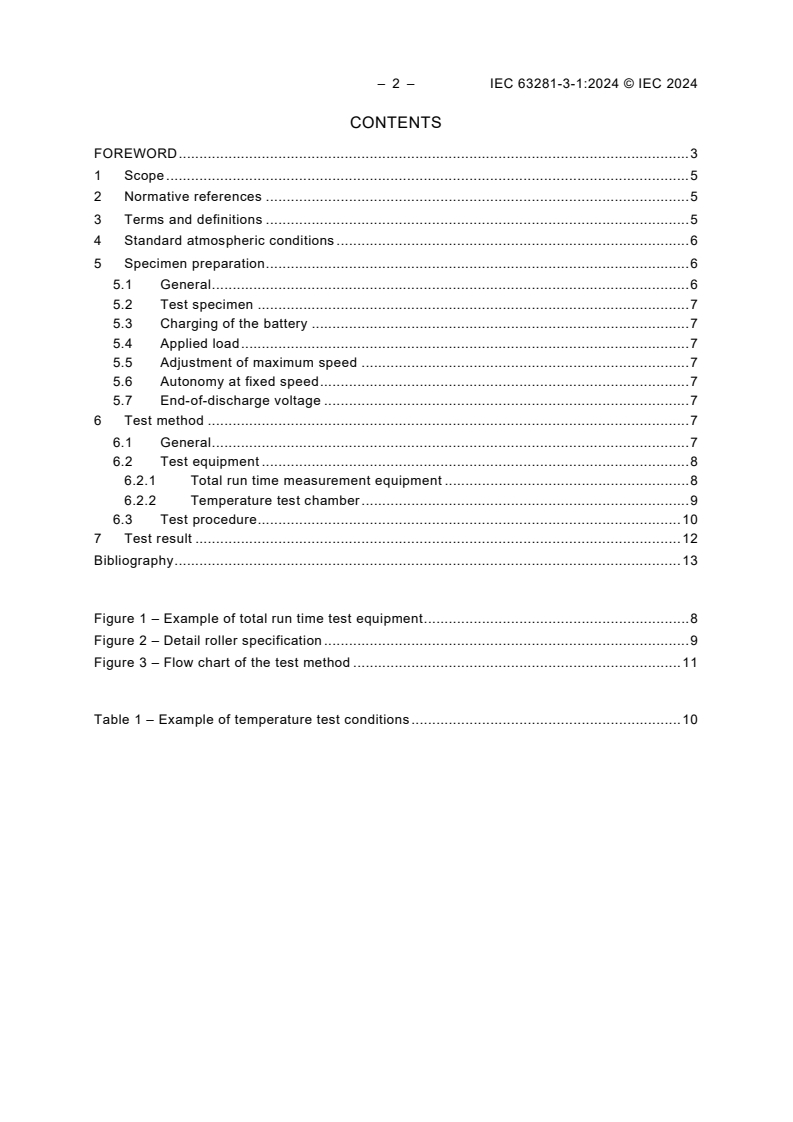
CONTENTS
FOREWORD . 3
1 Scope . 5
2 Normative references . 5
3 Terms and definitions . 5
4 Standard atmospheric conditions . 6
5 Specimen preparation . 6
5.1 General . 6
5.2 Test specimen . 7
5.3 Charging of the battery . 7
5.4 Applied load . 7
5.5 Adjustment of maximum speed . 7
5.6 Autonomy at fixed speed . 7
5.7 End-of-discharge voltage . 7
6 Test method . 7
6.1 General . 7
6.2 Test equipment . 8
6.2.1 Total run time measurement equipment . 8
6.2.2 Temperature test chamber . 9
6.3 Test procedure . 10
7 Test result . 12
Bibliography . 13
Figure 1 – Example of total run time test equipment . 8
Figure 2 – Detail roller specification . 9
Figure 3 – Flow chart of the test method . 11
Table 1 – Example of temperature test conditions . 10
INTERNATIONAL ELECTROTECHNICAL COMMISSION
____________
E-TRANSPORTERS –
Part 3-1: Performance test method for the total run time of an e-scooter
with consideration of temperature conditions of actual use
FOREWORD
1) The International Electrotechnical Commission (IEC) is a worldwide organization for standardization comprising
all national electrotechnical committees (IEC National Committees). The object of IEC is to promote international
co-operation on all questions concerning standardization in the electrical and electronic fields. To this end and
in addition to other activities, IEC publishes International Standards, Technical Specifications, Technical Reports,
Publicly Available Specifications (PAS) and Guides (hereafter referred to as “IEC Publication(s)”). Their
preparation is entrusted to technical committees; any IEC National Committee interested in the subject dealt with
may participate in this preparatory work. International, governmental and non-governmental organizations liaising
with the IEC also participate in this preparation. IEC collaborates closely with the International Organization for
Standardization (ISO) in accordance with conditions determined by agreement between the two organizations.
2) The formal decisions or agreements of IEC on technical matters express, as nearly as possible, an international
consensus of opinion on the relevant subjects since each technical committee has representation from all
interested IEC National Committees.
3) IEC Publications have the form of recommendations for international use and are accepted by IEC National
Committees in that sense. While all reasonable efforts are made to ensure that the technical content of IEC
Publications is accurate, IEC cannot be held responsible for the way in which they are used or for any
misinterpretation by any end user.
4) In order to promote international uniformity, IEC National Committees undertake to apply IEC Publications
transparently to the maximum extent possible in their national and regional publications. Any divergence between
any IEC Publication and the corresponding national or regional publication shall be clearly indicated in the latter.
5) IEC itself does not provide any attestation of conformity. Independent certification bodies provide conformity
assessment services and, in some areas, access to IEC marks of conformity. IEC is not responsible for any
services carried out by independent certification bodies.
6) All users should ensure that they have the latest edition of this publication.
7) No liability shall attach to IEC or its directors, employees, servants or agents including individual experts and
members of its technical committees and IEC National Committees for any personal injury, property damage or
other damage of any nature whatsoever, whether direct or indirect, or for costs (including legal fees) and
expenses arising out of the publication, use of, or reliance upon, this IEC Publication or any other IEC
Publications.
8) Attention is drawn to the Normative references cited in this publication. Use of the referenced publications is
indispensable for the correct application of this publication.
9) IEC draws attention to the possibility that the implementation of this document may involve the use of (a)
patent(s). IEC takes no position concerning the evidence, validity or applicability of any claimed patent rights in
respect thereof. As of the date of publication of this document, IEC had not received notice of (a) patent(s), which
may be required to implement this document. However, implementers are cautioned that this may not represent
the latest information, which may be obtained from the patent database available at https://patents.iec.ch. IEC
shall not be held responsible for identifying any or all such patent rights.
IEC 63281-3 has been prepared by IEC technical committee 125: e-Transporters. It is an
International Standard.
The text of this International Standard is based on the following documents:
Draft Report on voting
125/92/FDIS 125/99/RVD
Full information on the voting for its approval can be found in the report on voting indicated in
the above table.
The language used for the development of this International Standard is English.
– 4 – IEC 63281-3-1:2024 © IEC 2024
This document was drafted in accordance with ISO/IEC Directives, Part 2, and developed in
accordance with ISO/IEC Directives, Part 1 and ISO/IEC Directives, IEC Supplement, available
at www.iec.ch/members_experts/refdocs. The main document types developed by IEC are
described in greater detail at www.iec.ch/publications.
A list of all parts in the IEC 63281 series, published under the general title e-Transporters, can
be found on the IEC website.
The committee has decided that the contents of this document will remain unchanged until the
stability date indicated on the IEC website under webstore.iec.ch in the data related to the
specific document. At this date, the document will be
• reconfirmed,
• withdrawn, or
• revised.
E-TRANSPORTERS –
Part 3-1: Performance test method for the total run time of an e-scooter
with consideration of temperature conditions of actual use
1 Scope
This document specifies the test method for the total run time of an e-scooter for single-person
transportation with consideration of the temperature conditions of actual use when the e-scooter
is operated by the user in various temperatures for use on the road or in public spaces.
This document does not cover e-scooters for persons with disabilities or elderly persons. Also,
this document excludes cargo e-scooters.
2 Normative references
The following documents are referred to in the text in such a way that some or all of their content
constitutes requirements of this document. For dated references, only the edition cited applies.
For undated references, the latest edition of the referenced document (including any
amendments) applies.
IEC 62301, Household electrical appliances – Measurement of standby power
IEC 60068-1:2013, Environmental testing – Part 1: General and guidance
IEC 60068-2-1, Environmental testing – Part 2-1: Tests – Test A: Cold
IEC 60068-2-2, Environmental testing – Part 2-2: Tests – Test B: Dry heat
3 Terms and definitions
For the purposes of this document, the following terms and definitions apply.
ISO and IEC maintain terminology databases for use in standardization at the following
addresses:
• IEC Electropedia: available at https://www.electropedia.org/
• ISO Online browsing platform: available at https://www.iso.org/obp
3.1
e-scooter
electrically powered device for single-person transportation, consisting of a footboard mounted
on two aligned wheels, a steering handlebar, and no seat
3.2
battery
one or more cells fitted with devices necessary for use, for example case, terminals, marking
and protective devices
[SOURCE: IEC 60050-482:2004, 482-01-04]
– 6 – IEC 63281-3-1:2024 © IEC 2024
3.3
end-of-discharge voltage
specified voltage of a battery at which the battery discharge is terminated
[SOURCE: IEC 60050-482:2004, 482-03-30, modified – Synonyms "final voltage", "cut-off
voltage" and "end-point voltage" have been omitted.]
3.4
end-of-charge voltage
voltage attained at the end of a charging step, at a specified constant current
Note 1 to entry: The end-of-charge voltage may be used to initiate the termination of the charge process.
[SOURCE: IEC 60050-482:2004, 482-05-55]
3.5
speed control device
device that sets the speed and/or the motion according to the user's intention
3.6
data monitoring system
test device used for measuring total run time of an e-scooter by recording the amount of power
measured using a power analyser to run time
3.7
single charge run time
continuous run time of an electrically powered device starting from a fully charged battery until
the battery reaches discharged status resulting in non-operation of the device
3.8
load box
box designed to apply load to the centre of the footboard of the e-scooter
3.9
roller test rig
test rig installed with rollers to conduct driving test of e-scooter which is fixed to the rig
3.10
steering column
bar with a handle mounted on top of the front wheel at a determined caster angle to steer the
front wheel of the e-scooter
4 Standard atmospheric conditions
The test shall be conducted in the standard atmospheric conditions of IEC 60068-1:2013, 4.3
unless otherwise agreed by the manufacturer and test provider. If there is a change in
atmospheric conditions, the relevant information shall be recorded in the test report.
5 Specimen preparation
5.1 General
The test specimen shall be prepared with the following considerations to measure the total
single charge run time of the e-scooter.
5.2 Test specimen
The test specimen shall be tested in accordance with the manufacturer's user manual as a
completely assembled product or in its original form as provided by the manufacturer. If changes
are made to the specimen, consultation with the manufacturer is required before conducting the
test. To obtain reliable test data, it is recommended to test with at least three test specimens.
Additional tests may be conducted for higher accuracy as required. However, if the test
specimen is not sufficient, proceed with the test and indicate the number of test specimens
used.
5.3 Charging of the battery
The battery shall be charged to the end-of-charge voltage in accordance with the manufacturer's
instructions.
5.4 Applied load
The mass used for the test should be the rated load announced by the manufacturer (75 ± 2) kg,
which is the assumed weight of the driver riding the e-scooter. However, the mass may be
adjusted for the test by consultation and agreement with the manufacturer. If there is a change
in load mass, the relevant information shall be recorded in the test report.
5.5 Adjustment of maximum speed
The test specimen is evaluated based on the maximum rated speed provided by the
manufacturer, as the run time of the e-scooter can be the shortest when operated at maximum
speed. The speed control device shall be adjusted to keep the speed controller at its maximum
position. If necessary, the maximum speed for the test may be determined through consultation
with the manufacturer. The speed for the test shall be specified on the test protocol and
recorded speed over the run time. Set to maximum speed, and allow the speed to reduce due
to low battery.
5.6 Autonomy at fixed speed
The test specimen is evaluated based on the fixed speed at (15 ± 1,5) km/h. The speed control
device shall be used to maintain this speed until the e-scooter battery has discharged or until
the above speed drops to below 90 % of the initial value. The speed for the test shall be
recorded over the run time.
5.7 End-of-discharge voltage
The e-scooter shall be discharged to that specified voltage of a battery at which the battery
discharge is terminated.
6 Test method
6.1 General
This test method aims to determine the amount of time the e-scooter can be used by the driver.
E-scooters are used under various temperature conditions, which are factors that affect the
total run time. The test method for measuring the total run time of the e-scooter shall meet the
specified temperature conditions as set out in 6.2 due to the fact that the total run time may
vary depending on such conditions.
– 8 – IEC 63281-3-1:2024 © IEC 2024
6.2 Test equipment
6.2.1 Total run time measurement equipment
The following characteristics of the test bench can be used as an informative example. The
specifications of the equipment for measuring driving power consumption of the e-scooter up to
50 V are as follows:
• As shown in Figure 1, the measurement equipment can be composed of a roller test rig
equipped with fixation clamps, load box, speed control device, power analyser and data
monitoring system.
• The roller test rig can be installed with rollers for the fixed driving test of an e-scooter with
an approximate wheelbase (distance between the front and rear axles) of 1 200 mm and a
height of 1 200 mm.
• The roller test rig can be made of non-flammable, corrosion-resistant metal material and
height adjustable so that the steering column of the e-scooter is fixed horizontally to the rig.
• The roller may be of a metal material (e.g., SUS304) of not less than 113 mm in diameter,
(7,2 ± 0,2) kg in weight, and approximately 300 mm in length, and two rollers can be used
to prevent dislocation of the e-scooter. The distance between the central axes of the two
rollers is 180 mm and may be changed according to the wheel size of the e-scooter to be
tested. See Figure 2 for details of roller specification. The roller test rig can be equipped
with fixation clamps that do not affect the load and that fix the e-scooter onto the rig.
• The roller test rig can be equipped with a load box and fixation clamps capable of loading
and fixing a vertical load of (75 ± 2) kg to the centre of the footboard of the e-scooter.
• For the initial driving of an e-scooter, one roller needs a drive mechanism and a controller,
including a clutch that is disconnected from the motor after driving, connected to a motor of
300 W or more.
• The roller test rig can be equipped with a sub-motor and controller to operate the accelerator
on the steering column to start the e-scooter and continue its operation.
• A power analyser in accordance with IEC 62301 shall be used to measure battery power
consumption and run time in real time.
• A data monitoring system shall be connected to the power analyser to store data on run
time.
Figure 1 – Example of total run time test equipment
Figure 2 – Detail roller specification
• If necessary, the test bench can be calibrated in the manner specified in ISO 28981 to
eliminate losses (rolling resistance, coefficient of inertia, etc.) caused by friction on the
bench.
6.2.2 Temperature test chamber
The specifications of the temperature chamber in which to test the e-scooter in the necessary
temperature conditions are as follows:
• The temperature test chamber shall meet the requirements of IEC 60068-2-1 and
IEC 60068-2-2.
• The size of the temperature test chamber shall be large enough for the total run time
measurement equipment.
• A wiring connector shall be used to connect the battery test probe of the e-scooter to an
external voltmeter.
• The chamber shall be made of non-flammable and corrosion-resistant material and it shall
be isolated.
• The chamber shall be equipped with an air intake and exhaust system that is connected to
the fire detection sensor, so that smoke can be discharged in case of fire.
• The chamber shall be equipped with a data monitoring system that can measure the internal
temperature of the chamber in real time with an accuracy of ±2 °C.
• The chamber shall be equipped such that under standard atmospheric conditions for
measurements and test (see IEC 60068-1) with an air velocity less than 0,2 m/s, the
specimen shall be electrically loaded as specified for the low and high temperatures at which
the test is to be carried out.
– 10 – IEC 63281-3-1:2024 © IEC 2024
• The chamber shall be equipped such that three categories of temperature, namely high,
normal and low temperatures, may be set and maintained based on the e-scooter user
temperature as shown as an example in Table 1. Temperature test conditions may be
changed depending on each country's environment and the request by the manufacturer,
and unless there is any special requirement, Table 1 shall be followed.
• If there is a change in temperature test conditions, the relevant information shall be recorded
in the test report.
Table 1 – Example of temperature test conditions
Condition High Normal Low
Temperature (40 ± 2) °C (23 ± 2) °C (−20 ± 2) °C
6.3 Test procedure
Prepare and perform the test according to the following procedure, referring to Figure 3.
Assemble all operating devices and components according to the user manual provided by the
e-scooter manufacturer. Check whether each function of the e-scooter operates normally
without any problems.
After verifying that the test specimen is functioning without any problems, turn off the power of
the product and start charging it according to the user manual provided by the manufacturer.
The specimen shall be charged at (23 ± 5) °C. The charger provided by the manufacturer shall
be used, and no other charger shall be used. As the voltage value of a fully charged battery
differs by product, the voltage value for full charge cannot be predetermined. The specimen
shall be deemed fully charged when the voltage value measured using the data monitoring
system becomes stable without variation.
Determine which temperature testing conditions shall be applied based on the temperature
presented by the manufacturer as the temperature for actual use of the e-scooter. If the
temperature presented by the manufacturer complies with the three categories given as an
example in Table 1, conduct all three tests. If necessary, the test may be performed in
conditions determined by the manufacturer. The chamber shall be operated according to the
conditions set out within ± 2 °C, to prepare for the test.
Fix the e-scooter to the run time measurement equipment using ropes and bolts so that the
e-scooter is not displaced during the test.
Install the load box on to the e-scooter and place the determined load by adding load weights.
The applied load should be (75 ± 2) kg, and the applied load may vary depending on the
manufacturer's request. If there is a change in load mass, the relevant information shall be
recorded in the test report.
Place the run time measurement equipment with the e-scooter fixed to the equipment into the
chamber. Then operate the chamber until the target temperature is reached to check whether
the desired temperature has been reached, and check the voltage value of the fully charged
battery using the data monitoring system. After checking whether the temperature is maintained
for the test, determine the initial voltage value and record the voltage value and time.
Use the speed control device to set the speed at the maximum speed specified by the
manufacturer, and operate the e-scooter, while monitoring the time (T ). Maintain the speed
s
and operate the e-scooter until the battery is discharged (e-scooter is at complete stop). Record
the voltage values during the test using the data monitoring system.
When the battery is discharged, the test is completed, and the time of the battery discharge is
recorded (T ). The time of starting and completing the test shall be recorded using the data
e
monitoring system. Calculate the total run time using the following equation (R).
RT= –T
(1)
es
where
R is the total run time at which the specimen is operated temperature test condition, in
seconds (s)
T is the time at which the specimen is completely discharged, in seconds (s);
e
T is the time at which the specimen is fully charged and the t
...