

IEC 63281-3-2:2024
(Main)E-Transporters - Part 3-2: Performance test methods for mobility of cargo e-Transporters
General Information
- Abstract
IEC 63281-3-2:2024 is applicable to electrically powered transport devices for use on public roads or in public spaces and which are primarily designed for transporting cargo ("cargo e Transporters"). The typical application environment of cargo e-Transporters includes the following: for the purposes of hotels, restaurants, office buildings, hospitals, industrial/recreational parks, public roads, etc.
This document specifies performance criteria and evaluation methods for the mobility of cargo e-Transporters.
This document does not include safety and performance requirements.
- Status
- Published
- Publication Date
- 07-May-2024
- Technical Committee
- TC 125 - e-Transporters
- Drafting Committee
- WG 4 - TC 125/WG 4
- Current Stage
- PPUB - Publication issued
- Start Date
- 08-May-2024
- Completion Date
- 10-May-2024
Overview
IEC 63281-3-2:2024 is an international standard developed by the International Electrotechnical Commission (IEC) focusing on performance test methods for the mobility of cargo e-Transporters. These electrically powered transport devices are designed primarily for transporting cargo on public roads or in public spaces, including environments like hotels, restaurants, office buildings, hospitals, industrial and recreational parks.
This standard specifies detailed performance criteria and evaluation procedures to assess the mobility attributes of cargo e-Transporters. It is a critical reference for manufacturers, testing laboratories, and stakeholders aiming to ensure reliable and consistent mobility performance of cargo e-Transporters, although it does not address safety or other operational requirements.
Key Topics
- Scope and Definitions: Clear description of cargo e-Transporters and their operating environments.
- Test Conditions: Guidelines on environmental factors, surface conditions, and test equipment setups to standardize mobility testing.
- Performance Test Methods:
- Maximum speed measurement
- Maximum climbing angle and climbing speed assessments
- Turning characteristics including U-turn, three-point, and L-turn tests
- Gap detection capability
- Assessment of the narrowest passing width
- Specific object detection performance
- Typical object detecting distance tests
- Result Recording: Structured tables and formats to log test outcomes systematically.
These topics ensure comprehensive evaluation of mobility features ensuring that cargo e-Transporters perform effectively across diverse real-world conditions.
Applications
IEC 63281-3-2:2024 is essential for:
- Manufacturers who design and produce cargo e-Transporters to validate mobility capabilities before market introduction.
- Testing Laboratories engaged in certification and conformity assessment to provide reliable mobility performance data.
- Facility and Fleet Managers deploying cargo e-Transporters in complex environments such as hospitals, industrial parks, or restaurants, ensuring devices meet operational mobility expectations.
- Regulatory Bodies and Standardization Organizations developing regional or national guidelines referencing international standards for electric cargo carriers.
The standard's test methods directly support the enhancement of cargo handling efficiency, operational reliability, and maneuverability of e-Transporters in public and private spaces.
Related Standards
While IEC 63281-3-2:2024 focuses on mobility performance testing, it should be used alongside:
- Other parts of the IEC 63281 series addressing additional aspects such as cargo e-Transporter safety, durability, and electrical requirements.
- Applicable ISO/IEC directives governing test method development and documentation best practices.
- National and regional transportation and safety regulations relevant to electrically powered cargo transport devices.
- Standards covering object detection, obstacle avoidance, and sensor performance, which complement mobility tests by addressing navigation and safety capabilities.
Ensuring the combined application of IEC 63281-3-2 and related standards promotes thorough evaluation and compliance of cargo e-Transporters within the smart mobility ecosystem.
Keywords: IEC 63281-3-2, cargo e-Transporters, mobility performance test, electric transport devices, maximum speed test, climbing angle, turning characteristics, gap detection, object detection, electrically powered cargo transporters, public space transport standard, IEC standards for e-Transporters, performance evaluation methods.
Get Certified
Connect with accredited certification bodies for this standard

TÜV Rheinland
TÜV Rheinland is a leading international provider of technical services.

TÜV SÜD
TÜV SÜD is a trusted partner of choice for safety, security and sustainability solutions.

DEKRA Certification Inc.
DEKRA US certification services.
Sponsored listings
Frequently Asked Questions
IEC 63281-3-2:2024 is a standard published by the International Electrotechnical Commission (IEC). Its full title is "E-Transporters - Part 3-2: Performance test methods for mobility of cargo e-Transporters". This standard covers: IEC 63281-3-2:2024 is applicable to electrically powered transport devices for use on public roads or in public spaces and which are primarily designed for transporting cargo ("cargo e Transporters"). The typical application environment of cargo e-Transporters includes the following: for the purposes of hotels, restaurants, office buildings, hospitals, industrial/recreational parks, public roads, etc. This document specifies performance criteria and evaluation methods for the mobility of cargo e-Transporters. This document does not include safety and performance requirements.
IEC 63281-3-2:2024 is applicable to electrically powered transport devices for use on public roads or in public spaces and which are primarily designed for transporting cargo ("cargo e Transporters"). The typical application environment of cargo e-Transporters includes the following: for the purposes of hotels, restaurants, office buildings, hospitals, industrial/recreational parks, public roads, etc. This document specifies performance criteria and evaluation methods for the mobility of cargo e-Transporters. This document does not include safety and performance requirements.
IEC 63281-3-2:2024 is classified under the following ICS (International Classification for Standards) categories: 43.120 - Electric road vehicles. The ICS classification helps identify the subject area and facilitates finding related standards.
IEC 63281-3-2:2024 is available in PDF format for immediate download after purchase. The document can be added to your cart and obtained through the secure checkout process. Digital delivery ensures instant access to the complete standard document.
Standards Content (Sample)
IEC 63281-3-2 ®
Edition 1.0 2024-05
INTERNATIONAL
STANDARD
NORME
INTERNATIONALE
E-Transporters –
Part 3-2: Performance test methods for mobility of cargo e-Transporters
e-Transporteurs –
Partie 3-2: Méthodes d’essai de performances pour la mobilité des e-
Transporteurs de marchandises
All rights reserved. Unless otherwise specified, no part of this publication may be reproduced or utilized in any form
or by any means, electronic or mechanical, including photocopying and microfilm, without permission in writing from
either IEC or IEC's member National Committee in the country of the requester. If you have any questions about IEC
copyright or have an enquiry about obtaining additional rights to this publication, please contact the address below or
your local IEC member National Committee for further information.
Droits de reproduction réservés. Sauf indication contraire, aucune partie de cette publication ne peut être reproduite ni
utilisée sous quelque forme que ce soit et par aucun procédé, électronique ou mécanique, y compris la photocopie et
les microfilms, sans l'accord écrit de l'IEC ou du Comité national de l'IEC du pays du demandeur. Si vous avez des
questions sur le copyright de l'IEC ou si vous désirez obtenir des droits supplémentaires sur cette publication, utilisez
les coordonnées ci-après ou contactez le Comité national de l'IEC de votre pays de résidence.
IEC Secretariat Tel.: +41 22 919 02 11
3, rue de Varembé info@iec.ch
CH-1211 Geneva 20 www.iec.ch
Switzerland
About the IEC
The International Electrotechnical Commission (IEC) is the leading global organization that prepares and publishes
International Standards for all electrical, electronic and related technologies.
About IEC publications
The technical content of IEC publications is kept under constant review by the IEC. Please make sure that you have the
latest edition, a corrigendum or an amendment might have been published.
IEC publications search - webstore.iec.ch/advsearchform IEC Products & Services Portal - products.iec.ch
The advanced search enables to find IEC publications by a Discover our powerful search engine and read freely all the
variety of criteria (reference number, text, technical publications previews, graphical symbols and the glossary.
committee, …). It also gives information on projects, replaced With a subscription you will always have access to up to date
and withdrawn publications. content tailored to your needs.
IEC Just Published - webstore.iec.ch/justpublished
Electropedia - www.electropedia.org
Stay up to date on all new IEC publications. Just Published
The world's leading online dictionary on electrotechnology,
details all new publications released. Available online and once
containing more than 22 500 terminological entries in English
a month by email.
and French, with equivalent terms in 25 additional languages.
Also known as the International Electrotechnical Vocabulary
IEC Customer Service Centre - webstore.iec.ch/csc
(IEV) online.
If you wish to give us your feedback on this publication or need
further assistance, please contact the Customer Service
Centre: sales@iec.ch.
A propos de l'IEC
La Commission Electrotechnique Internationale (IEC) est la première organisation mondiale qui élabore et publie des
Normes internationales pour tout ce qui a trait à l'électricité, à l'électronique et aux technologies apparentées.
A propos des publications IEC
Le contenu technique des publications IEC est constamment revu. Veuillez vous assurer que vous possédez l’édition la
plus récente, un corrigendum ou amendement peut avoir été publié.
Recherche de publications IEC - IEC Products & Services Portal - products.iec.ch
webstore.iec.ch/advsearchform Découvrez notre puissant moteur de recherche et consultez
La recherche avancée permet de trouver des publications IEC gratuitement tous les aperçus des publications, symboles
en utilisant différents critères (numéro de référence, texte, graphiques et le glossaire. Avec un abonnement, vous aurez
comité d’études, …). Elle donne aussi des informations sur les toujours accès à un contenu à jour adapté à vos besoins.
projets et les publications remplacées ou retirées.
Electropedia - www.electropedia.org
IEC Just Published - webstore.iec.ch/justpublished
Le premier dictionnaire d'électrotechnologie en ligne au monde,
Restez informé sur les nouvelles publications IEC. Just
avec plus de 22 500 articles terminologiques en anglais et en
Published détaille les nouvelles publications parues.
français, ainsi que les termes équivalents dans 25 langues
Disponible en ligne et une fois par mois par email.
additionnelles. Egalement appelé Vocabulaire
Electrotechnique International (IEV) en ligne.
Service Clients - webstore.iec.ch/csc
Si vous désirez nous donner des commentaires sur cette
publication ou si vous avez des questions contactez-nous:
sales@iec.ch.
IEC 63281-3-2 ®
Edition 1.0 2024-05
INTERNATIONAL
STANDARD
NORME
INTERNATIONALE
E-Transporters –
Part 3-2: Performance test methods for mobility of cargo e-Transporters
e-Transporteurs –
Partie 3-2: Méthodes d’essai de performances pour la mobilité des e-
Transporteurs de marchandises
INTERNATIONAL
ELECTROTECHNICAL
COMMISSION
COMMISSION
ELECTROTECHNIQUE
INTERNATIONALE
ICS 43.120 ISBN 978-2-8322-8832-0
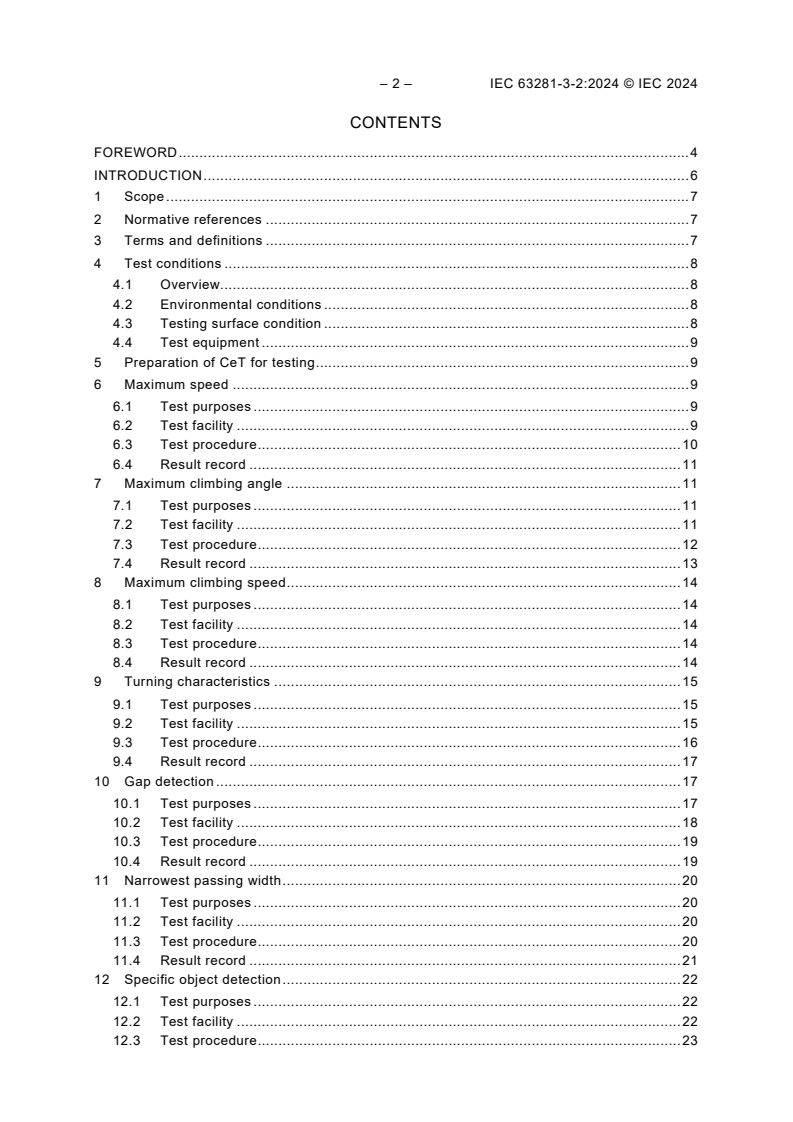
– 2 – IEC 63281-3-2:2024 © IEC 2024
CONTENTS
FOREWORD . 4
INTRODUCTION . 6
1 Scope . 7
2 Normative references . 7
3 Terms and definitions . 7
4 Test conditions . 8
4.1 Overview. 8
4.2 Environmental conditions . 8
4.3 Testing surface condition . 8
4.4 Test equipment . 9
5 Preparation of CeT for testing . 9
6 Maximum speed . 9
6.1 Test purposes . 9
6.2 Test facility . 9
6.3 Test procedure . 10
6.4 Result record . 11
7 Maximum climbing angle . 11
7.1 Test purposes . 11
7.2 Test facility . 11
7.3 Test procedure . 12
7.4 Result record . 13
8 Maximum climbing speed . 14
8.1 Test purposes . 14
8.2 Test facility . 14
8.3 Test procedure . 14
8.4 Result record . 14
9 Turning characteristics . 15
9.1 Test purposes . 15
9.2 Test facility . 15
9.3 Test procedure . 16
9.4 Result record . 17
10 Gap detection . 17
10.1 Test purposes . 17
10.2 Test facility . 18
10.3 Test procedure . 19
10.4 Result record . 19
11 Narrowest passing width . 20
11.1 Test purposes . 20
11.2 Test facility . 20
11.3 Test procedure . 20
11.4 Result record . 21
12 Specific object detection . 22
12.1 Test purposes . 22
12.2 Test facility . 22
12.3 Test procedure . 23
12.4 Result record . 25
13 Typical object-detection distance . 25
13.1 Test purposes . 25
13.2 Test facility . 25
13.3 Test procedure . 26
13.4 Result record . 26
Bibliography . 28
Figure 1 – Maximum speed test . 10
Figure 2 – Maximum climbing angle test . 12
Figure 3 –U-turn test . 15
Figure 4 – Three-point navigation test . 16
Figure 5 – L-turn test . 16
Figure 6 – Gap detection test . 18
Figure 7 –The narrowest passing width test . 20
Figure 8 –Specific object detection test . 23
Figure 9 – Typical object detecting distance test . 26
Table 1 – Maximum speed test record table . 11
Table 2 – Maximum climbing angle test configuration . 13
Table 3 – Maximum climbing angle test record table . 13
Table 4 – Maximum climbing speed test record table . 14
Table 5 – Turning characteristics test record table . 17
Table 6 – Gap detection test record table . 19
Table 7 – Narrowest passing width test record table . 21
Table 8 – Specific objects . 22
Table 9 – Object detection test configuration . 24
Table 10 – Specific object detection test record table . 25
Table 11 – Typical object detecting distance test record table . 27
– 4 – IEC 63281-3-2:2024 © IEC 2024
INTERNATIONAL ELECTROTECHNICAL COMMISSION
____________
E-TRANSPORTERS –
Part 3-2: Performance test methods for mobility of cargo e-Transporters
FOREWORD
1) The International Electrotechnical Commission (IEC) is a worldwide organization for standardization comprising
all national electrotechnical committees (IEC National Committees). The object of IEC is to promote international
co-operation on all questions concerning standardization in the electrical and electronic fields. To this end and
in addition to other activities, IEC publishes International Standards, Technical Specifications, Technical Reports,
Publicly Available Specifications (PAS) and Guides (hereafter referred to as "IEC Publication(s)"). Their
preparation is entrusted to technical committees; any IEC National Committee interested in the subject dealt with
may participate in this preparatory work. International, governmental and non-governmental organizations liaising
with the IEC also participate in this preparation. IEC collaborates closely with the International Organization for
Standardization (ISO) in accordance with conditions determined by agreement between the two organizations.
2) The formal decisions or agreements of IEC on technical matters express, as nearly as possible, an international
consensus of opinion on the relevant subjects since each technical committee has representation from all
interested IEC National Committees.
3) IEC Publications have the form of recommendations for international use and are accepted by IEC National
Committees in that sense. While all reasonable efforts are made to ensure that the technical content of IEC
Publications is accurate, IEC cannot be held responsible for the way in which they are used or for any
misinterpretation by any end user.
4) In order to promote international uniformity, IEC National Committees undertake to apply IEC Publications
transparently to the maximum extent possible in their national and regional publications. Any divergence between
any IEC Publication and the corresponding national or regional publication shall be clearly indicated in the latter.
5) IEC itself does not provide any attestation of conformity. Independent certification bodies provide conformity
assessment services and, in some areas, access to IEC marks of conformity. IEC is not responsible for any
services carried out by independent certification bodies.
6) All users should ensure that they have the latest edition of this publication.
7) No liability shall attach to IEC or its directors, employees, servants or agents including individual experts and
members of its technical committees and IEC National Committees for any personal injury, property damage or
other damage of any nature whatsoever, whether direct or indirect, or for costs (including legal fees) and
expenses arising out of the publication, use of, or reliance upon, this IEC Publication or any other IEC
Publications.
8) Attention is drawn to the Normative references cited in this publication. Use of the referenced publications is
indispensable for the correct application of this publication.
9) IEC draws attention to the possibility that the implementation of this document may involve the use of (a)
patent(s). IEC takes no position concerning the evidence, validity or applicability of any claimed patent rights in
respect thereof. As of the date of publication of this document, IEC had not received notice of (a) patent(s), which
may be required to implement this document. However, implementers are cautioned that this may not represent
the latest information, which may be obtained from the patent database available at https://patents.iec.ch. IEC
shall not be held responsible for identifying any or all such patent rights.
IEC 63281-3-2 has been prepared by IEC technical committee 125: e-Transporters. It is an
International Standard.
The text of this International Standard is based on the following documents:
Draft Report on voting
125/95/FDIS 125/100/RVD
Full information on the voting for its approval can be found in the report on voting indicated in
the above table.
The language used for the development of this International Standard is English.
This document was drafted in accordance with ISO/IEC Directives, Part 2, and developed in
accordance with ISO/IEC Directives, Part 1 and ISO/IEC Directives, IEC Supplement, available
at www.iec.ch/members_experts/refdocs. The main document types developed by IEC are
described in greater detail at www.iec.ch/publications.
A list of all parts in the IEC 63281 series, published under the general title e-Transporters, can
be found on the IEC website.
The committee has decided that the contents of this document will remain unchanged until the
stability date indicated on the IEC website under webstore.iec.ch in the data related to the
specific document. At this date, the document will be
• reconfirmed,
• withdrawn, or
• revised.
IMPORTANT – The "colour inside" logo on the cover page of this document indicates
that it contains colours which are considered to be useful for the correct understanding
of its contents. Users should therefore print this document using a colour printer.
– 6 – IEC 63281-3-2:2024 © IEC 2024
INTRODUCTION
At the time of writing of this document, the global market scale of cargo e-Transporters is about
US $ 30 billion, with a wide range of application scenarios, which can meet the needs for
short-distance distribution, low-carbon and environmental protection.
However, there is currently no international standard for this kind of product. The mobility of
cargo e-Transporters is the key index of their performance, including their maximum speed,
maximum climbing angle, maximum climbing speed, turning characteristics, gap detection,
narrowest passing width, specific object detection, and typical object detecting distance.
This document specifies the performance criteria and related test methods for cargo
e-Transporters.
E-TRANSPORTERS –
Part 3-2: Performance test methods for mobility of cargo e-Transporters
1 Scope
This document is applicable to electrically powered transport devices for use on public roads or
in public spaces and which are primarily designed for transporting cargo ("cargo
e-Transporters"). The typical application environment of cargo e-Transporters includes the
following: for the purposes of hotels, restaurants, office buildings, hospitals,
industrial/recreational parks, public roads, etc.
This document specifies performance criteria and evaluation methods for the mobility of cargo
e-Transporters.
This document does not include safety and performance requirements.
2 Normative references
The following documents are referred to in the text in such a way that some or all of their content
constitutes requirements of this document. For dated references, only the edition cited applies.
For undated references, the latest edition of the referenced document (including any
amendments) applies.
IEC 63281-1:2023, E-Transporters – Part 1: Terminology and classification
3 Terms and definitions
For the purposes of this document, the terms and definitions given in IEC 63281-1 and the
following apply.
ISO and IEC maintain terminology databases for use in standardization at the following
addresses:
• IEC Electropedia: available at https://www.electropedia.org/
• ISO Online browsing platform: available at https://www.iso.org/obp
3.1
cargo e-Transporter
CeT
e-Transporter that is primarily designed for transporting cargo or goods, or both
[SOURCE: IEC 63281-1:2023, 3.4]
3.2
rated speed
speed that the CeT can achieve in normal operating conditions with rated load without any
degradation of performance according to the specification
– 8 – IEC 63281-3-2:2024 © IEC 2024
3.3
rated load
maximum allowed weight of cargo(s) transported by the CeT, as defined by the manufacturer
[SOURCE: IEC 63281-1:2023, 3.14, modified – Replaced the term "e-Transporter" with "CeT"
and deleted the content about the person.]
3.4
localization
process of identifying or distinguishing the position of the CeT on the environment map
[SOURCE: IEC 63281-1:2023, 3.21, modified – Replaced the term "e-Transporter" with "CeT".]
3.5
trial
single instance of a performance measurement that can be carried out under identical
conditions and be repeated multiple times
4 Test conditions
4.1 Overview
Before testing, the CeT shall be set up and properly warmed up.
The CeT shall be in normal working condition to ensure intended operation during the whole
test process.
Unless otherwise specified, the CeT shall be tested at rated speed under rated load.
NOTE "Normal working condition" means the operating condition intended by the manufacturer.
4.2 Environmental conditions
Unless otherwise specified by the manufacturer, all tests shall be performed under the following
environmental conditions:
– Relative humidity: (20 to 60) %;
– Temperature: (10 to 30) °C;
– Atmospheric pressure: (86 to 106) kPa;
– Illumination: > 200 lx;
– Wind speed: The average wind speed measured 0,7 m above the ground shall be less than
3 m/s, and the maximum speed of gusts shall be less than 5 m/s.
For the repeatability and reproducibility of tests, avoid changing the environmental conditions
during the test and record them in the test results.
4.3 Testing surface condition
In principle, select the severest test ground or slope surface according to the expected use
scenario so that it can reflect the most unfavourable condition (such as wooden, ceramic tile
floor, concrete or asphalt surface, etc.), and usually the kinetic friction coefficient should be
0,75 to 1,0, unless specified otherwise by the manufacturer.
NOTE The kinetic friction coefficient is in accordance with ISO 7176-13.
4.4 Test equipment
Relative to the specified value or actual value, the accuracy of all control values or measured
values should be within the following tolerance range:
a) Voltage: ±0,2 %;
b) Current: ±1 %;
c) Temperature: ±2 °C;
d) Position resolution ≤ 1 cm;
e) Position accuracy ≤ 1 cm;
f) Angle resolution ≤ 3°;
g) Angle accuracy ≤ 5°;
h) Data sampling frequency ≥ 30 Hz;
i) Time resolution ≤ 0,01 s;
j) Time accuracy ≤ 0,02 s.
5 Preparation of CeT for testing
The testing of the CeT shall be as follows:
a) Adjust CeT to the typical configuration specified by the manufacturer;
b) Function inspection of the CeT shall be carried out before testing to ensure normal
operation;
c) Before testing the CeT, the battery shall complete at least one charge-discharge cycle. The
operation of discharge limit defined by the manufacturer shall be carried out under normal
operation according to the manufacturer's instructions;
d) Before the test of the CeT, the battery shall be fully charged as specified by the
manufacturer;
e) The rated load shall be reasonably and evenly distributed when tested under rated load
conditions.
6 Maximum speed
6.1 Test purposes
This test evaluates the maximum allowable driving speed of the CeT under the rated load.
6.2 Test facility
The test shall be conducted on a long straight flat concrete or asphalt surface.
The demonstration of maximum speed test is shown in Figure 1. The length of the measurement
section is not less than 5 m, and the width of the measurement section should ensure that the
CeT can pass normally. Sufficient space should be reserved at each end of the measurement
section for acceleration and deceleration of the CeT.
– 10 – IEC 63281-3-2:2024 © IEC 2024
Key:
A: initial start point (+)
B: initial start point (−)
1: measurement start line (+)/measurement stop line (−)
2: measurement stop line (−)/measurement start line (+)
3: central line
a: acceleration section (+)/deceleration section (−)
b: measurement section
c: deceleration section (+)/acceleration section (−)
Figure 1 – Maximum speed test
6.3 Test procedure
The test steps are as follows:
1) select an initial point in the positive direction and record the length of the measurement
section;
2) place the CeT with rated load at the initial point;
3) the CeT moves from the initial point and shall accelerate to stable speed before reaching
the start line;
4) the CeT moves along the central line from the start line to the stop line. Record the time of
the CeT passing through the measurement section;
5) after passing through the stop line, the CeT decelerates to stop. The average speed is
calculated according to Formula (1) and is then recorded:
S
V=
(1)
t
where
V is the average speed for each trial, in metres per second (m/s);
S is the length of the measurement section, in metres (m);
t is the passing time for each trial, in seconds (s).
6) repeat steps 2) to 5) for three trials. A trial is regarded as a failure and is terminated in
advance if the CeT does not reach the stop line or if it deviates from the central line by more
than 10 % of the length of the measurement section;
7) after three successful trials, select an initial point in the negative direction and repeat the
test procedure in steps 2) to 6).
8) after three successful trials, the test is terminated. Take the minimum value of average
speed in both positive and negative directions as the maximum speed.
6.4 Result record
After the test, fill in the test result in Table 1. The test results shall include information such as
the conditions of the concrete or asphalt surface (surface material, kinetic friction coefficient,
etc.), and the loading weight of the CeT.
Table 1 – Maximum speed test record table
Length of the
Loading weight
measurement section
(kg)
(m)
Operated by the human pilot
Operating condition
Autonomous driving without human intervention
Conditions of the
concrete or surface
T t t t t t
Passing time
1+ 2+ 3+ 1- 2- 3-
(s)
V V V V V V
Average speed
1+ 2+ 3+ 1- 2- 3-
(m/s)
Maximum speed
(m/s)
7 Maximum climbing angle
7.1 Test purposes
This test evaluates the maximum climbing angle of a CeT in a specific direction of movement
under no load and at rated load.
7.2 Test facility
The test shall be conducted on a slope with adjustable slope angles.
The demonstration of maximum climbing angle test is shown in Figure 2. A straight flat concrete
or asphalt surface shall be set before and after the slope. The accuracy of angle adjustment
shall be within ±0,5°. The length of the slope is usually not less than 5 times the length of the
CeT to ensure its normal travelling. The width of the slope shall be wide enough such that the
CeT can travel laterally on the slope for more than 1 m. Safety guardrails or barriers shall be
added on both sides of the slope to prevent the CeT from falling down the slope.
– 12 – IEC 63281-3-2:2024 © IEC 2024
Key:
A to B: a linear path along the length of the slope, connecting the midpoints of the slope on the width of the slope.
C to D: a lateral path along the width of the slope, connecting the midpoints of the slope on the length of the slope.
Parking point: a location on the slope at which the CeT is to be parked during each trial. ln principle, it is located at
the centre of the slope. If a parking point other than the centre location is selected, its location relative to the slope
shall be recorded in the test report.
Figure 2 – Maximum climbing angle test
7.3 Test procedure
The test steps are as follows:
1) select one of the test configurations as specified in Table 2. The initial angle of the test is
usually the allowable climbing angle declared by the manufacturer. For test configuration 1,
2, 3 and 4, the initial point is selected on the straight flat concrete or asphalt surface (uphill
or downhill, depending on the travelling path), and shall be close to the transition line such
that the CeT will not rush uphill or downhill due to inertia. For test configurations 5 and 6,
the initial point is selected on the lateral path;
2) place the CeT with evenly distributed rated load at the initial point;
3) according to the selected test configuration, the CeT moves from the initial point to the
parking point following the travelling path and moving direction as in Figure 2;
4) after reaching the parking point, the CeT shall be able to park on the slope for at least 30 s;
5) the CeT moves along the same travelling path, moving from the parking point to the target
point;
6) repeat steps 2) to 5) for three trials. In each trial, the CeT shall be able to stop stably after
reaching the target point. A trial is regarded as a failure and terminated in advance if the
CeT becomes physically unstable (e.g. toppling, tipping over, sliding) or deviates from the
travelling path by more than 20 % of the length of the travelling path;
7) place the CeT with no load at the initial point and repeat test procedure in steps 3) to 5);
8) if the first three trials for the selected slope angle under no load and rated load are all
successful, record the selected slope angle. Then increase the slope angle by 1° and repeat
the test procedure in steps 2) to 7). Otherwise, decrease the slope angle by 1° and repeat
test procedure in steps 2) to 7).
9) if the slope angle after adjustment is covered by previous trials, the test under the selected
test configuration is terminated. Record the maximum angle under the selected test
configuration. Select another test configuration in Table 2 and repeat the test procedure in
steps 2) to 8).
10) if all the test configurations in Table 2 have been conducted, the test is terminated. Take
the minimum value of maximum angles under all test configurations as the maximum
climbing angle.
Table 2 – Maximum climbing angle test configuration
Test Travelling path of the CeT relative to the
Moving direction of the CeT
configuration slope
1 Uphill (A to B) Forward
2 Uphill (A to B) Backward
3 Downhill (B to A) Forward
4 Downhill (B to A) Backward
5 Lateral (C to D) Forward
6 Lateral (C to D) Backward
If backward travelling is not applicable due to the motion strategy of the CeT as declared by the manufacturer,
then it is not necessary for the CeT to be tested under the associated test configurations (i.e., test configurations 2,
4, 6).
7.4 Result record
After the test of 7.3, fill in the test result in Table 3. The test results shall include the information
which determines climbing ability, such as the conditions of the concrete or asphalt surface and
of the slope (surface material, kinetic friction coefficient, etc.), and the loading weight of the
CeT.
Table 3 – Maximum climbing angle test record table
Slope angle for each test configuration (°)
Trial No.
A to B A to B B to A B to A C to D C to D
forward backward forward backward forward backward
…
Maximum slope
angle
Loading weight
Conditions of the concrete or
asphalt surface
(kg)
Operated by the human pilot
Operating condition
Autonomous driving without human intervention
Maximum climbing angle (°)
– 14 – IEC 63281-3-2:2024 © IEC 2024
8 Maximum climbing speed
8.1 Test purposes
This test is to verify the maximum climbing speed of the CeT under the expected use scenario
or the maximum climbing angle declared by the manufacturer. The test in this Clause 8 shall be
carried out after the test of Clause 7.
8.2 Test facility
The test shall be conducted on a slope.
The demonstration of maximum climbing speed test is shown in Figure 2. A straight flat concrete
or asphalt surface with enough length shall be set before and after the slope to ensure that the
CeT can accelerate from static to rated speed and decelerate from rated speed to static. The
length of the slope shall not be less than 5 m. Safety guardrails or barriers should be added on
both sides of the slope to prevent the CeT from falling down the slope.
8.3 Test procedure
The test steps are as follows:
1) select an initial point on the straight flat concrete or asphalt surface at the downhill position;
2) place the CeT with evenly distributed rated load at the initial point;
3) the CeT moves from the initial point to the slope and shall accelerate to its rated speed
before reaching the transition line of downhill;
4) the CeT moves from downhill to uphill. Record the maximum speed during the climbing
process;
5) after passing the transition line of uphill, the CeT decelerates to stop;
6) repeat steps 2) to 5) for three trials. Take the minimum value of the three trials as the
maximum climbing speed.
8.4 Result record
After the test of 8.3, fill in the test result in Table 4. The test results shall include information
such as the conditions of the concrete or asphalt surface and of the slope (surface material,
kinetic friction coefficient, etc.), the angle of the slope, the approach speed and the loading
weight of the CeT, the behaviour on the slope (passing the slope smoothly or not), and the
climbing speed.
Table 4 – Maximum climbing speed test record table
Trial Description of
Approach speed Maximum speed during climbing Angle of the slope
No. test conditions
(m/s) (m/s) (°)
Loading weight
Conditions of the concrete
or asphalt surface
(kg)
Operated by the human pilot
Operating condition
Autonomous driving without human intervention
Maximum climbing speed
(m/s)
9 Turning characteristics
9.1 Test purposes
This test is to verify the turning width of the CeT declared by the manufacturer at the specified
turning type.
9.2 Test facility
The test shall be conducted on a flat concrete or asphalt surface.
There are three types of turn specified in this test, as follows:
– U-turn, as shown in Figure 3.
– Three-point navigation, as shown in Figure 4.
– L-turn, as shown in Figure 5.
The boundary should be higher than the CeT. If the CeT has an obstacle avoidance system, it
should be turned on.
Key:
1: start line/stop line which is 2 m away from the line at the centre of the CeT's turning radius
2: the line at the centre of the CeT's turning radius
Figure 3 –U-turn test
– 16 – IEC 63281-3-2:2024 © IEC 2024
Key:
1: start line/stop line which is more than 1 m from the line where CeT starts to turn
2: the line where CeT starts to turn
Figure 4 – Three-point navigation test
a) Left turning b) Right turning
Key:
1: start line which is 1 m or one length of the CeT before arriving the turning point
2: stop line which is 1 m or one length of the CeT after passing the turning point
Figure 5 – L-turn test
9.3 Test procedure
The test steps are as follows:
1) select a turning type and the corresponding parameter W (width of the road) according to
the manufacturer's declaration;
2) set the start line and stop line for recording the turning time, as shown in Figure 3 to
Figure 5;
3) select an initial point far enough from the turning point to ensure that the CeT has
accelerated to its rated speed before reaching the start line;
4) place the CeT with rated load at the initial point;
5) the CeT moves from the initial point to the turning point and accelerates to its rated speed.
Record the time when the CeT reaches the start line;
6) the CeT starts to turn;
7) after passing the turn, record the time when the CeT reaches the stop line. During the
turning process, the CeT shall not hit the boundary and the turning time shall not be too
long, such as over 10 min;
8) place the CeT with no load in the initial point and repeat the test procedure 5) to 7);
9) select another turning type and repeat test procedure in steps 1) to 8) until all the turning
types have been conducted, the test is then terminated.
For CeTs that rotate in situ, it is not necessary to do a U-turn test. The turning width is twice
the maximum distance from the centre of motion to the product enclosure.
9.4 Result record
After the test of 9.3, fill in the test result in Table 5. The test results shall include information
such as the conditions of the concrete or asphalt surface (surface material, kinetic friction
coefficient, etc.), the type of the turn, the turning speed and time, the loading weight and
approach speed of the CeT, the behaviour when turning (turning smoothly or not).
Table 5 – Turning characteristics test record table
Approach Turning Turning Ground Turning Turning
Turning type
speed width speed friction time smoothly
(m/s) (m) (m/s) (s) (Yes or no)
U-turn
Three-point
navigation
L-turn
Loading weight
Conditions of the concrete or
asphalt surface
(kg)
Operated by the human pilot
Operating condition
Autonomous driving without human intervention
10 Gap detection
10.1 Test purposes
This test evaluates the capability of the CeT to detect an open edge on its travelling surface
and to create a new by-pass route by moving itself through the open edge autonomously.
If the CeT is not fitted with such a function, then this test is not required. Record this observation
in the test report.
– 18 – IEC 63281-3-2:2024 © IEC 2024
10.2 Test facility
The test shall be conducted on a flat concrete or asphalt surface with a vertical drop.
The demonstration of gap detection test is shown in Figure 6. The height of the vertical drop H
d
shall be sufficiently high so that the difference in height can be detected by the surface edge
detection function and it should be higher than 1/2 of the diameter of the largest wheel of the
CeT, D . The width of the vertical drop W shall be sufficiently wide so that the CeT will not
max d
simply travel over the vertical drop and it should be greater than D . The length of the vertical
max
drop L shall be at least three times the length of the CeT. The distance between the surface
d
edge and the target point d shall be at least the length of the CeT.
e
The travel surface should be a flat surface, and there shall be no guardrails, objects or the like
added within or around it to ensure that the obstacle avoidance function is not triggered.
However, assistive test equipment may be added for normal activation of the CeT's surface
edge-detection function.
It is understood that some edge-detection technologies require additional accommodations of
facility in the operating environment, e.g., landmarks. Therefore, if those types of technology
are clearly indicated in the CeT's technical document, then additional accommodations of the
test facility are permitted.
(a) side view of the test facility (b) top view of the test facility layout for surface edge detection
layout for surface edge detection
Key:
H height of vertical drop
d
width of vertical drop
W
d
L length of vertical drop
d
d distance between the target point and the surface edge
e
Figure 6 – Gap detection test
10.3 Test procedure
The test steps are as follows:
1) select an initial point on the travel surface along the commanded path which is the
perpendicular bisector of the vertical drop and a target point on the opposite of the vertical
drop as indicated in Figure 6 b));
2) place the CeT with rated load at the initial point;
3) the CeT moves along the commanded path from the initial point to the target point and shall
accelerate to the speed defined by the manufacturer before detecting the surface edge.
Record the time when the CeT starts moving;
NOTE Permitted speeds can vary due to different safety policies (e.g., speed limits) of the operating
environment.
4) the CeT shall detect the surface edge and then reach the target point within 5 min by
adjusting the path autonomously or calling the manual control.
5) Repeat steps 2) to 4) for three trials. For each trial, the CeT shall retreat and/or change its
travelling direction when approaching the surface edge. A trial is regarded as a failure and
terminated in advance if the CeT becomes physically unstable (e.g. dropping from the edge,
floating of wheels from the edge, hanging over the gap);
6) if the first three trials are all successful, the test is considered to pass; otherwise, the test
is considered failed. If the CeT is also fitted with a backward driving mode, t
...