

IEC 63281-2-1:2024
(Main)E-Transporters - Part 2-1: Safety requirements and test methods for personal e-Transporters
General Information
- Abstract
IEC 63281-2-1:2024 specifies safety requirements and test methods for personal e-Transporters.
This document is applicable to electrically powered personal e-Transporters (PeTs) which are used in private and public areas, where the speed control and/or the steering control is electric/electronic.
The PeT can have provisions for transport of cargo and can be for private or commercial (including sharing service) use.
This document is not applicable for electric vehicles (EVs), such as electrically power assisted cycles (EPACs), e-bikes, mopeds, motorcycles and passenger cars.
This document does not apply to:
- PeTs that are considered as toys;
- PeTs that are intended for competition;
- PeTs that are intended for medical care;
- PeTs that have a rated voltage of more than 100 V DC or 240 V AC;
- PeTs without an on-board driving operator.
- Status
- Published
- Publication Date
- 07-Feb-2024
- Technical Committee
- TC 125 - e-Transporters
- Drafting Committee
- WG 1 - TC 125/WG 1
- Current Stage
- PPUB - Publication issued
- Start Date
- 08-Feb-2024
- Completion Date
- 08-Mar-2024
Overview
IEC 63281-2-1:2024 is an international standard published by the International Electrotechnical Commission (IEC) that specifies safety requirements and test methods for personal e-Transporters (PeTs). This document aims to ensure that PeTs used in both private and public spaces, including shared mobility services and cargo applications, adhere to consistent safety and performance criteria. It covers vehicles with electric or electronic speed and steering control, ensuring their safe operation for both users and third parties. Notably, this standard excludes electric vehicles such as e-bikes, EPACs, mopeds, motorcycles, passenger cars, toys, competition devices, medical care mobility equipment, PeTs exceeding 100V DC or 240V AC, and units without an on-board driver.
Key Topics
- Scope and Applicability: Targets electrically powered PeTs for personal transportation, including cargo and commercial fleet use.
- Exclusions: Devices deemed toys, competition or medical devices, high-voltage or remotely operated PeTs, and standard EVs are not covered.
- General Safety: Requirements for non-metallic and metallic material selection, enclosure design (to prevent tampering or accidental opening), and avoidance of sharp edges or hazardous protrusions.
- Mechanical and Electrical Safety: Focus on crash and crush prevention, strength of core components, and safe operation under common environmental conditions.
- Warning Systems: Mandates clear user indicators (visual, audible, tactile) for safety status and fault detection, as well as lighting and reflectors to enhance visibility to third parties.
- Risk Assessment: Iterative hazard analysis following ISO 12100, ensuring all new risks are identified and mitigated for new or unique device configurations.
- Testing Methods: Conditions for test environments, driver requirements, and detailed procedures for evaluating material resistance, battery safety, braking performance, foldable mechanisms, and environmental endurance.
- Marking and Instructions: Requirements for clear, durable labeling, safety warnings, and comprehensive user instructions.
Applications
- Urban and Shared Mobility: The standard directly supports safe deployment of e-scooters, self-balancing scooters, and other PeTs popular in city and campus sharing fleets. Adhering to IEC 63281-2-1:2024 gives stakeholders confidence in the safety and reliability of these vehicles.
- Commercial Use: Applies to cargo-carrying PeTs, particularly relevant for last-mile delivery and logistics companies adopting electric micro-mobility solutions.
- Private Use: Ensures consumer-level devices meet the same rigorous safety, lighting, and testing requirements, reducing risks associated with personal micro-mobility.
- Compliance and Certification: Manufacturers and testing organizations can use this standard as a benchmark for conformity assessment, supporting regulatory approval and market entry.
Related Standards
IEC 63281-2-1:2024 is part of a broader suite of standards designed for electric transport devices. Key references include:
- IEC 63281-1: General definitions and classifications for e-Transporters.
- IEC 60335-2-114: Safety for personal e-Transporters.
- EN 17128:2020: European requirements for personal light electric vehicles (PLEVs).
- ISO 12100: General risk assessment methodology.
- IEC 60068 series: Environmental and mechanical testing for electrical products.
- ISO 6742 series: Lighting and reflector requirements.
Adherence to these related standards ensures comprehensive coverage of safety, environmental, and operational aspects for PeTs, facilitating acceptance in international markets and supporting best practices in micro-mobility development.
Keywords: IEC 63281-2-1, personal e-Transporters, PeTs, electric micro-mobility, e-scooter safety, international standard, test methods, e-Transporter compliance, shared mobility, cargo electric vehicles, safety requirements, IEC standards for personal e-transporters.
Get Certified
Connect with accredited certification bodies for this standard

TÜV Rheinland
TÜV Rheinland is a leading international provider of technical services.

TÜV SÜD
TÜV SÜD is a trusted partner of choice for safety, security and sustainability solutions.

DEKRA Certification Inc.
DEKRA US certification services.
Sponsored listings
Frequently Asked Questions
IEC 63281-2-1:2024 is a standard published by the International Electrotechnical Commission (IEC). Its full title is "E-Transporters - Part 2-1: Safety requirements and test methods for personal e-Transporters". This standard covers: IEC 63281-2-1:2024 specifies safety requirements and test methods for personal e-Transporters. This document is applicable to electrically powered personal e-Transporters (PeTs) which are used in private and public areas, where the speed control and/or the steering control is electric/electronic. The PeT can have provisions for transport of cargo and can be for private or commercial (including sharing service) use. This document is not applicable for electric vehicles (EVs), such as electrically power assisted cycles (EPACs), e-bikes, mopeds, motorcycles and passenger cars. This document does not apply to: - PeTs that are considered as toys; - PeTs that are intended for competition; - PeTs that are intended for medical care; - PeTs that have a rated voltage of more than 100 V DC or 240 V AC; - PeTs without an on-board driving operator.
IEC 63281-2-1:2024 specifies safety requirements and test methods for personal e-Transporters. This document is applicable to electrically powered personal e-Transporters (PeTs) which are used in private and public areas, where the speed control and/or the steering control is electric/electronic. The PeT can have provisions for transport of cargo and can be for private or commercial (including sharing service) use. This document is not applicable for electric vehicles (EVs), such as electrically power assisted cycles (EPACs), e-bikes, mopeds, motorcycles and passenger cars. This document does not apply to: - PeTs that are considered as toys; - PeTs that are intended for competition; - PeTs that are intended for medical care; - PeTs that have a rated voltage of more than 100 V DC or 240 V AC; - PeTs without an on-board driving operator.
IEC 63281-2-1:2024 is classified under the following ICS (International Classification for Standards) categories: 43.120 - Electric road vehicles. The ICS classification helps identify the subject area and facilitates finding related standards.
IEC 63281-2-1:2024 is available in PDF format for immediate download after purchase. The document can be added to your cart and obtained through the secure checkout process. Digital delivery ensures instant access to the complete standard document.
Standards Content (Sample)
IEC 63281-2-1 ®
Edition 1.0 2024-02
INTERNATIONAL
STANDARD
NORME
INTERNATIONALE
e-Transporters –
Part 2-1: Safety requirements and test methods for personal e-Transporters
e-Transporteurs –
Partie 2-1: Exigences de sécurité et méthodes d’essai relatives aux
e-Transporteurs de personnes
All rights reserved. Unless otherwise specified, no part of this publication may be reproduced or utilized in any form
or by any means, electronic or mechanical, including photocopying and microfilm, without permission in writing from
either IEC or IEC's member National Committee in the country of the requester. If you have any questions about IEC
copyright or have an enquiry about obtaining additional rights to this publication, please contact the address below or
your local IEC member National Committee for further information.
Droits de reproduction réservés. Sauf indication contraire, aucune partie de cette publication ne peut être reproduite ni
utilisée sous quelque forme que ce soit et par aucun procédé, électronique ou mécanique, y compris la photocopie et
les microfilms, sans l'accord écrit de l'IEC ou du Comité national de l'IEC du pays du demandeur. Si vous avez des
questions sur le copyright de l'IEC ou si vous désirez obtenir des droits supplémentaires sur cette publication, utilisez
les coordonnées ci-après ou contactez le Comité national de l'IEC de votre pays de résidence.
IEC Secretariat Tel.: +41 22 919 02 11
3, rue de Varembé info@iec.ch
CH-1211 Geneva 20 www.iec.ch
Switzerland
About the IEC
The International Electrotechnical Commission (IEC) is the leading global organization that prepares and publishes
International Standards for all electrical, electronic and related technologies.
About IEC publications
The technical content of IEC publications is kept under constant review by the IEC. Please make sure that you have the
latest edition, a corrigendum or an amendment might have been published.
IEC publications search - webstore.iec.ch/advsearchform IEC Products & Services Portal - products.iec.ch
The advanced search enables to find IEC publications by a Discover our powerful search engine and read freely all the
variety of criteria (reference number, text, technical publications previews, graphical symbols and the glossary.
committee, …). It also gives information on projects, replaced With a subscription you will always have access to up to date
and withdrawn publications. content tailored to your needs.
IEC Just Published - webstore.iec.ch/justpublished
Electropedia - www.electropedia.org
Stay up to date on all new IEC publications. Just Published
The world's leading online dictionary on electrotechnology,
details all new publications released. Available online and once
containing more than 22 500 terminological entries in English
a month by email.
and French, with equivalent terms in 25 additional languages.
Also known as the International Electrotechnical Vocabulary
IEC Customer Service Centre - webstore.iec.ch/csc
(IEV) online.
If you wish to give us your feedback on this publication or need
further assistance, please contact the Customer Service
Centre: sales@iec.ch.
A propos de l'IEC
La Commission Electrotechnique Internationale (IEC) est la première organisation mondiale qui élabore et publie des
Normes internationales pour tout ce qui a trait à l'électricité, à l'électronique et aux technologies apparentées.
A propos des publications IEC
Le contenu technique des publications IEC est constamment revu. Veuillez vous assurer que vous possédez l’édition la
plus récente, un corrigendum ou amendement peut avoir été publié.
Recherche de publications IEC - IEC Products & Services Portal - products.iec.ch
webstore.iec.ch/advsearchform Découvrez notre puissant moteur de recherche et consultez
La recherche avancée permet de trouver des publications IEC gratuitement tous les aperçus des publications, symboles
en utilisant différents critères (numéro de référence, texte, graphiques et le glossaire. Avec un abonnement, vous aurez
comité d’études, …). Elle donne aussi des informations sur les toujours accès à un contenu à jour adapté à vos besoins.
projets et les publications remplacées ou retirées.
Electropedia - www.electropedia.org
IEC Just Published - webstore.iec.ch/justpublished
Le premier dictionnaire d'électrotechnologie en ligne au monde,
Restez informé sur les nouvelles publications IEC. Just
avec plus de 22 500 articles terminologiques en anglais et en
Published détaille les nouvelles publications parues.
français, ainsi que les termes équivalents dans 25 langues
Disponible en ligne et une fois par mois par email.
additionnelles. Egalement appelé Vocabulaire
Electrotechnique International (IEV) en ligne.
Service Clients - webstore.iec.ch/csc
Si vous désirez nous donner des commentaires sur cette
publication ou si vous avez des questions contactez-nous:
sales@iec.ch.
IEC 63281-2-1 ®
Edition 1.0 2024-02
INTERNATIONAL
STANDARD
NORME
INTERNATIONALE
e-Transporters –
Part 2-1: Safety requirements and test methods for personal e-Transporters
e-Transporteurs –
Partie 2-1: Exigences de sécurité et méthodes d’essai relatives aux
e-Transporteurs de personnes
INTERNATIONAL
ELECTROTECHNICAL
COMMISSION
COMMISSION
ELECTROTECHNIQUE
INTERNATIONALE
ICS 43.120 ISBN 978-2-8322-8192-5
– 2 – IEC 63281-2-1:2024 © IEC 2024
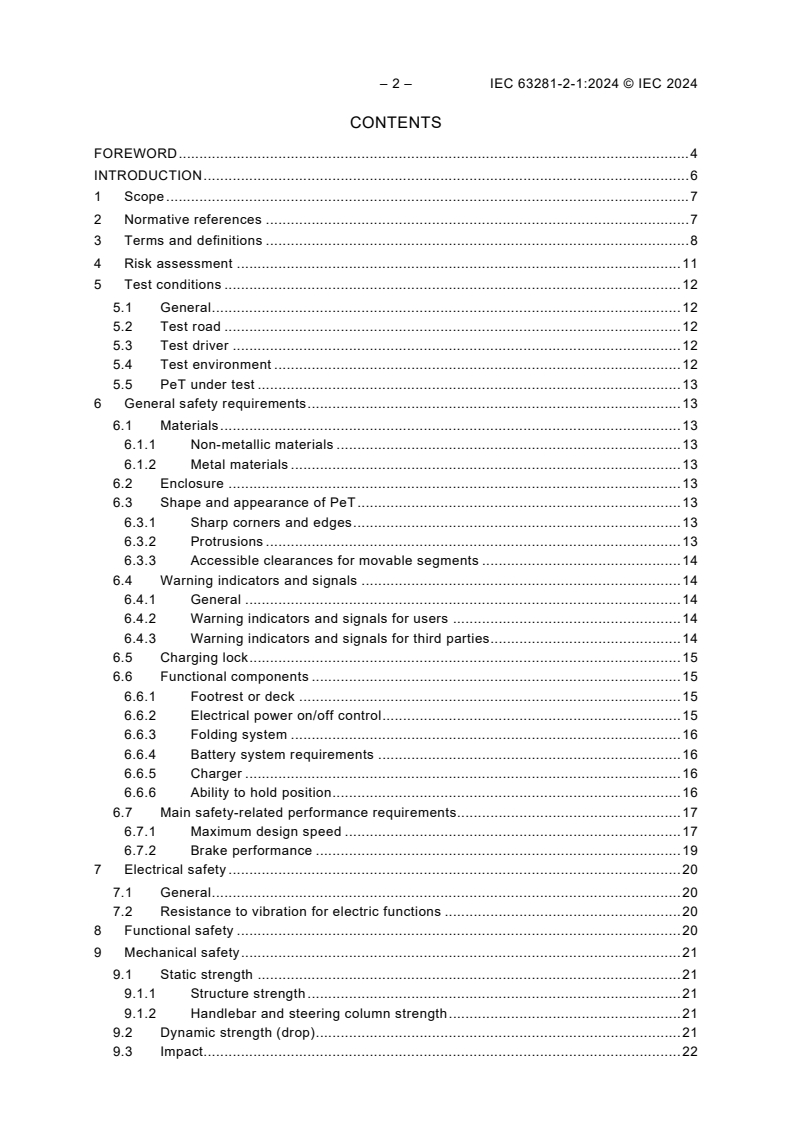
CONTENTS
FOREWORD . 4
INTRODUCTION . 6
1 Scope . 7
2 Normative references . 7
3 Terms and definitions . 8
4 Risk assessment . 11
5 Test conditions . 12
5.1 General . 12
5.2 Test road . 12
5.3 Test driver . 12
5.4 Test environment . 12
5.5 PeT under test . 13
6 General safety requirements . 13
6.1 Materials . 13
6.1.1 Non-metallic materials . 13
6.1.2 Metal materials . 13
6.2 Enclosure . 13
6.3 Shape and appearance of PeT . 13
6.3.1 Sharp corners and edges . 13
6.3.2 Protrusions . 13
6.3.3 Accessible clearances for movable segments . 14
6.4 Warning indicators and signals . 14
6.4.1 General . 14
6.4.2 Warning indicators and signals for users . 14
6.4.3 Warning indicators and signals for third parties . 14
6.5 Charging lock . 15
6.6 Functional components . 15
6.6.1 Footrest or deck . 15
6.6.2 Electrical power on/off control . 15
6.6.3 Folding system . 16
6.6.4 Battery system requirements . 16
6.6.5 Charger . 16
6.6.6 Ability to hold position . 16
6.7 Main safety-related performance requirements. 17
6.7.1 Maximum design speed . 17
6.7.2 Brake performance . 19
7 Electrical safety . 20
7.1 General . 20
7.2 Resistance to vibration for electric functions . 20
8 Functional safety . 20
9 Mechanical safety . 21
9.1 Static strength . 21
9.1.1 Structure strength . 21
9.1.2 Handlebar and steering column strength . 21
9.2 Dynamic strength (drop) . 21
9.3 Impact. 22
10 Environmental tests . 22
10.1 Enclosure protection class . 22
10.2 Partial water immersion . 22
10.3 Salt spray resistance . 23
10.4 Change of temperature . 23
10.5 Low and high temperature operation . 24
10.5.1 General . 24
10.5.2 Low temperature operation test . 24
10.5.3 High temperature and high humidity operation test . 24
11 Anti-tempering measure. 24
12 Marking and instruction . 25
12.1 General . 25
12.2 Product nameplate . 25
12.2.1 Nameplate information . 25
12.2.2 Durability . 25
12.3 Safety and warning signs . 26
12.4 Instructions . 26
Annex A (informative) List of significant hazards for the PeT . 27
Annex B (normative) Light, warning device, and on-off symbols . 29
Bibliography . 30
Figure 1 – Placement method for the inclined surface test . 17
Figure 2 – Road test example . 18
Figure 3 – Temperature change of the thermal chamber . 23
Figure B.1 – Power On/Off symbol (IEC 60417-5009:2015-03) . 29
Figure B.2 – Light symbol (ISO 7000-0083:2004-01) . 29
Figure B.3 – Electric horn symbol (ISO 7000-0244:2004-01) . 29
Table 1 – Safety functions related to defined hazards . 20
Table A.1 – Hazard list for the PeT . 28
– 4 – IEC 63281-2-1:2024 © IEC 2024
INTERNATIONAL ELECTROTECHNICAL COMMISSION
____________
E-TRANSPORTERS –
Part 2-1: Safety requirements and test methods for
personal e-Transporters
FOREWORD
1) The International Electrotechnical Commission (IEC) is a worldwide organization for standardization comprising
all national electrotechnical committees (IEC National Committees). The object of IEC is to promote international
co-operation on all questions concerning standardization in the electrical and electronic fields. To this end and
in addition to other activities, IEC publishes International Standards, Technical Specifications, Technical Reports,
Publicly Available Specifications (PAS) and Guides (hereafter referred to as “IEC Publication(s)”). Their
preparation is entrusted to technical committees; any IEC National Committee interested in the subject dealt with
may participate in this preparatory work. International, governmental and non-governmental organizations liaising
with the IEC also participate in this preparation. IEC collaborates closely with the International Organization for
Standardization (ISO) in accordance with conditions determined by agreement between the two organizations.
2) The formal decisions or agreements of IEC on technical matters express, as nearly as possible, an international
consensus of opinion on the relevant subjects since each technical committee has representation from all
interested IEC National Committees.
3) IEC Publications have the form of recommendations for international use and are accepted by IEC National
Committees in that sense. While all reasonable efforts are made to ensure that the technical content of IEC
Publications is accurate, IEC cannot be held responsible for the way in which they are used or for any
misinterpretation by any end user.
4) In order to promote international uniformity, IEC National Committees undertake to apply IEC Publications
transparently to the maximum extent possible in their national and regional publications. Any divergence between
any IEC Publication and the corresponding national or regional publication shall be clearly indicated in the latter.
5) IEC itself does not provide any attestation of conformity. Independent certification bodies provide conformity
assessment services and, in some areas, access to IEC marks of conformity. IEC is not responsible for any
services carried out by independent certification bodies.
6) All users should ensure that they have the latest edition of this publication.
7) No liability shall attach to IEC or its directors, employees, servants or agents including individual experts and
members of its technical committees and IEC National Committees for any personal injury, property damage or
other damage of any nature whatsoever, whether direct or indirect, or for costs (including legal fees) and
expenses arising out of the publication, use of, or reliance upon, this IEC Publication or any other IEC
Publications.
8) Attention is drawn to the Normative references cited in this publication. Use of the referenced publications is
indispensable for the correct application of this publication.
9) IEC draws attention to the possibility that the implementation of this document may involve the use of (a)
patent(s). IEC takes no position concerning the evidence, validity or applicability of any claimed patent rights in
respect thereof. As of the date of publication of this document, IEC had not received notice of (a) patent(s), which
may be required to implement this document. However, implementers are cautioned that this may not represent
the latest information, which may be obtained from the patent database available at https://patents.iec.ch. IEC
shall not be held responsible for identifying any or all such patent rights.
IEC 63281-2-1 has been prepared by IEC technical committee 125: e-Transporters. It is an
International Standard.
The text of this International Standard is based on the following documents:
Draft Report on voting
125/91/FDIS 125/93/RVD
Full information on the voting for its approval can be found in the report on voting indicated in
the above table.
The language used for the development of this International Standard is English.
This document was drafted in accordance with ISO/IEC Directives, Part 2, and developed in
accordance with ISO/IEC Directives, Part 1 and ISO/IEC Directives, IEC Supplement, available
at www.iec.ch/members_experts/refdocs. The main document types developed by IEC are
described in greater detail at www.iec.ch/publications.
A list of all parts in the IEC 63281 series, published under the general title e-Transporters, can
be found on the IEC website.
The committee has decided that the contents of this document will remain unchanged until the
stability date indicated on the IEC website under webstore.iec.ch in the data related to the
specific document. At this date, the document will be
• reconfirmed,
• withdrawn, or
• revised.
– 6 – IEC 63281-2-1:2024 © IEC 2024
INTRODUCTION
This document has been developed to cope with the rapidly evolving personal e-Transporters.
Personal e-Transporters have become common in public spaces and roads, some of which can
reach speeds of 25 km/h or even higher, and the applications and global market size are
expected to grow significantly. In order to protect the safety of persons and public facilities,
besides basic safety requirements, comprehensive safety requirements and test methods such
as riding safety for people and for e-Transporters are also considered. At the time of writing,
this document provides general safety requirements and corresponding test methods for
personal e-Transporters, which are convenient for manufacturers and test departments to use.
Standardization of electrically powered transport devices covered by the following TCs are
excluded from this document:
• IEC TC 69,
• ISO TC 149,
• ISO TC 22.
E-TRANSPORTERS –
Part 2-1: Safety requirements and test methods for
personal e-Transporters
1 Scope
This document specifies safety requirements and test methods for personal e-Transporters.
This document is applicable to electrically powered personal e-Transporters (PeTs) which are
used in private and public areas, where the speed control and/or the steering control is
electric/electronic.
The PeT can have provisions for transport of cargo and can be for private or commercial
(including sharing service) use.
This document is not applicable for electric vehicles (EVs), such as electrically power assisted
cycles (EPACs), e-bikes, mopeds, motorcycles and passenger cars.
This document does not apply to:
• PeTs that are considered as toys;
• PeTs that are intended for competition;
• PeTs that are intended for medical care;
• PeTs that have a rated voltage of more than 100 V DC or 240 V AC;
• PeTs without an on-board driving operator.
2 Normative references
The following documents are referred to in the text in such a way that some or all of their content
constitutes requirements of this document. For dated references, only the edition cited applies.
For undated references, the latest edition of the referenced document (including any
amendments) applies.
IEC 60068-2-1, Environmental testing – Part 2-1: Tests – Test A: Cold
IEC 60068-2-2, Environmental testing – Part 2-2: Tests – Test B: Dry heat
IEC 60068-2-11, Environmental testing – Part 2-11: Tests – Test Ka: Salt mist
IEC 60068-2-14:2023, Environmental testing – Part 2-14: Tests – Test N: Change of
temperature
IEC 60068-2-75, Environmental testing – Part 2-75: Tests – Test Eh: Hammer tests
IEC 60335-2-29, Household and similar electrical appliances – Safety – Part 2-29: Particular
requirements for battery chargers
IEC 60335-2-114:2022, Household and similar electrical appliances – Safety – Part 2-114:
Particular requirements for personal e-Transporters
– 8 – IEC 63281-2-1:2024 © IEC 2024
IEC 60529, Degrees of protection provided by enclosures (IP Code)
IEC 60695-11-10, Fire hazard testing – Part 11-10: Test flames – 50 W horizontal and vertical
flame test methods
ISO 2248, Packaging – Complete, filled transport packages – Vertical impact test by dropping
ISO 6742-1, Cycles – Lighting and retro-reflective devices – Part 1: Lighting and light signalling
devices
ISO 6742-2, Cycles – Lighting and retro-reflective devices – Part 2: Retro-reflective devices
ISO 12100:2010, Safety of machinery – General principles for design – Risk assessment and
risk reduction
ISO 13849-1, Safety of machinery – Safety-related parts of control systems – Part 1: General
principles for design
ISO 14878:2015, Cycles – Audible warning devices – Technical specification and test methods
EN 17128:2020, Light motorized vehicles for the transportation of persons and goods and
related facilities and not subject to type-approval for on-road use – Personal light electric
vehicles (PLEV) – Requirements and test methods
3 Terms and definitions
For the purposes of this document, the following terms and definitions apply.
ISO and IEC maintain terminology databases for use in standardization at the following
addresses:
• IEC Electropedia: available at https://www.electropedia.org/
• ISO Online browsing platform: available at https://www.iso.org/obp
3.1
audible warning device
AWD
device designed for the purpose to warn people by an audible signal
Note 1 to entry: Including all types of technologies (i.e. bells, horns, electronic audible warning device).
[SOURCE: ISO 14878:2015, 3.3]
3.2
battery pack
energy storage device that includes cells or cell assemblies normally connected with cell
electronics, power supply circuits and overcurrent shut-off device, including electrical
interconnections, interfaces for external systems
Note 1 to entry: See A.2 of ISO 12405-4:2018 for further explanations.
Note 2 to entry: Examples of external systems are cooling, voltage class B, auxiliary voltage class A and
communication.
[SOURCE: ISO 12405-4:2018, 3.2]
3.3
battery system
energy storage device that includes cells or cell assemblies or battery pack(s) as well as
electrical circuits and electronics
Note 1 to entry: See A.3.2 and A.3.3 of ISO 12405-4:2018 for further explanations. Battery system components can
also be distributed in different devices within the vehicle.
Note 2 to entry: Examples of electronics are the BCU and contactors.
[SOURCE: ISO 12405-4:2018, 3.3]
3.4
brake
part of the braking system where the forces opposing the movement of the e-Transporter are
developed
[SOURCE: IEC 63281-1:2023, 3.16]
3.5
braking system
combination of parts consisting of the control, transmission, and brake, whose function it is to
progressively reduce the speed of a moving e-Transporter, bringing it to a halt
Note 1 to entry: The braking system can have the function to keep the e-transporter stationary when halted.
Note 2 to entry: The electric motor can be a part of the system.
[SOURCE: IEC 63281-1:2023, 3.17]
3.6
charging of a battery
operation during which a secondary cell or battery is supplied with electric energy from an
external circuit which results in chemical changes within the cell and thus the storage of energy
as chemical energy
[SOURCE: IEC 60050-482:2004, 482-05-27]
3.7
deck
platform supporting the mass of the user standing during use
[SOURCE: EN 17128:2020, 3.40]
3.8
enclosure
housing affording the type and degree of protection suitable for the intended application
[SOURCE: IEC 60050-195:2021, 195-02-35]
3.9
electrically power assisted cycle
EPAC
cycle, equipped with pedals and an auxiliary electric motor, which cannot be propelled
exclusively by means of this auxiliary electric motor, except in the walk assistance mode
[SOURCE: ISO/TS 4210-10:2020, 3.2]
– 10 – IEC 63281-2-1:2024 © IEC 2024
3.10
e-Transporter
electrically powered transport device for use on public roads or in public spaces which provides
solutions for transporting either passengers or goods, or both
Note 1 to entry: The device can be manually controlled, have automated functions, or be autonomous.
[SOURCE: IEC 63281-1:2023, 3.2]
3.11
folding system
electrical or mechanical system enabling the e-Transporter to be folded in order to change from
the configuration of use (unfolded) to the configuration of storage (folded)
[SOURCE: IEC 63281-1:2023, 3.8]
3.12
footrest
surface provided to support the feet during a seating intended use
[SOURCE: EN 17128:2020, 3.41]
3.13
intended use
use of a PeT in accordance with the information for use provided in the instructions
[SOURCE: ISO 12100:2010, 3.23, modified – For the purposes of a PeT, original "machine" has
been deleted and "PeT" has been added.]
3.14
leakage
escape of liquid or gas except for venting
[SOURCE: ISO 6469-1:2019, 3.15]
3.15
locking device
mechanical component that maintains part(s) of the vehicle erected in the position of use or
storage (e.g., latch(es), hooks, over centre lock.) which could be deactivated or activated by
action(s) on the operating device
[SOURCE: EN 17128:2020, 3.13]
3.16
locking mechanism
assembly of components consisting of one or more locking device(s) and one or more operating
device(s)
[SOURCE: EN 17128:2020, 3.12]
3.17
operating device
part of the locking mechanism(s) designed to be activated by the user through one or several
intentional action(s)
[SOURCE: EN 17128:2020, 3.14, modified – "positive" has been deleted and "intentional" has
been added.]
3.18
passenger car
vehicle designed and constructed primarily for the carriage of persons and their luggage, their
goods, or both, having not more than a seating capacity of eight, in addition to the driver, and
without space for standing passengers
[SOURCE: ISO 26262-1:2018, 3.107]
3.19
personal e-Transporter
PeT
e-Transporter that is primarily designed for transporting person(s)
Note 1 to entry: Household appliances are excluded.
[SOURCE: IEC 63281-1:2023, 3.3, modified – Note 1 to entry has been added.]
3.20
public space
place that is accessible to the public whether it is in the public domain or privately owned
Note 1 to entry: Examples are roads, cycle tracks, sidewalks, public squares, parks, stations, airports, hotels,
hospitals, restaurants, etc.
[SOURCE: IEC 63281-1:2023, 3.1]
3.21
self-balancing personal e-Transporter
inherently unstable personal e-Transporter that dynamically stabilizes itself in at least one
direction (pitch) using a control system
[SOURCE: IEC 63281-1:2023, 3.6, modified – The word "personal" has been added to the term
and to the definition.]
3.22
warning indicators and signals
visual or audible device to
a) inform users of the safety status of the e-Transporter
b) alert third parties to the presence of the e-Transporter
Note 1 to entry: Examples of a visual or audible device to inform users of the safety status of the e-Transporter
include lights or beeping sounds to indicate a function is working correctly, or lights or beeping sounds which operate
to indicate a malfunction or condition which may become serious or which is immediately serious.
Note 2 to entry: Examples of a visual or audible device to alert third parties to the presence of the e-Transporter
include, lights or reflectors which make the e‑Transporter more easily visible, or an audible device to alert third
parties to the presence of the e‑Transporter.
[SOURCE: IEC 63281-1:2023, 3.15]
4 Risk assessment
If examination of the PeT shows that hazards not fully addressed in Clause 6 to Clause 10 in
this document can arise, then a risk assessment is required. It shall be carried out and
documented to achieve at least a tolerable risk by an iterative process described in the Clause 4
of ISO 12100:2010.
– 12 – IEC 63281-2-1:2024 © IEC 2024
For the risk assessment of PeTs all requirements of ISO 12100 applying for various use cases
(e.g., such as private owned use, public sharing use) shall apply. Clause 4 of ISO 12100:2010
provides requirements and guidance in performing risk assessment, including risk analysis
based on hazard identification. In performing the risk assessment, the decision as to whether a
risk is acceptable or not depends on the application and the intended use of the PeT.
Where appropriate, use restrictions for the PeT may be used as a means of risk reduction in
the risk assessment for specific hazards.
NOTE Annex A contains a list of significant hazards that can be present as regards a PeT.
5 Test conditions
5.1 General
Unless otherwise stated in this document, all tests are conducted under the conditions stated
in 5.2 to 5.5.
5.2 Test road
The test is carried out on cement or asphalt roads the surface of which shall be smooth, dry
and obstacle-free with a good adhesion coefficient; the inspection road section shall be as level
as possible, and any gradient greater than 0,5 % shall be documented.
The test area shall be arranged on the test road, and the width of test channel in the test area
shall not be less than 1 m. The two ends of this test area shall have a traveling supporting area
that is long enough and an auxiliary area for ensuring safe stopping and shall be able to support
travel in both directions.
In the event that the test road is not available, a test bench or a stand that keeps the
motor-driven wheel free of the ground can be used to conduct relevant tests.
5.3 Test driver
The driver shall be proficient in driving and familiar with test methods.
The driver shall be equipped with necessary protective equipment such as a helmet, knee pads
and elbow pads.
The driver shall use the PeT according to the instructions specified by the manufacturer and
shall keep the driving posture without significant change throughout the whole test process and
avoid any operation prohibited by the manufacturer.
If the rated load of the PeT is greater than or equal to 75 kg, the total mass of the driver and
equipment (e.g., helmet) shall not be less than 75 kg, otherwise, a counterweight shall be used;
if the rated load of the PeT is less than 75 kg, the total mass of the driver and equipment shall
be the rated load.
5.4 Test environment
The temperature shall be within the working temperature range of the PeTs; unless otherwise
specified in this document, the ambient temperature specified in this document is (25 ± 5) °C.
Indoor tests should be conducted at a relative humidity of 75 % or lower, while the relative
humidity may exceed 75 % for outdoor tests and in that case, shall be recorded in the test report.
Outdoor tests shall not be conducted during rain or snow.
Atmospheric pressure: (86 to 106) kPa.
During the test, the average wind speed shall not be greater than 3 m/s, and the instantaneous
wind speed not greater than 5 m/s.
5.5 PeT under test
The PeT under test shall be in the state of normal driving condition and the battery system shall
be fully charged according to the manufacturer's instructions.
The influence of test instruments installed on the PeT shall be minimized.
6 General safety requirements
6.1 Materials
6.1.1 Non-metallic materials
Non-metallic materials used in non-metallic body parts of PeTs not related to electrical circuitry
shall be classified at least V-2, in accordance with IEC 60695-11-10.
Compliance is checked by inspection in accordance with IEC 60695-11-10.
This requirement is not applicable to decorative parts or to other parts that cannot be ignited or
that are unlikely to spread flames generated in the equipment.
6.1.2 Metal materials
The metal enclosure of PeTs shall be corrosion-resistant, and the corrosion resistance may be
achieved by appropriate electroplating or coating treatment.
Compliance is checked by verifying that after the tests of 10.2, the metal enclosure shall show
no sign of corrosion.
6.2 Enclosure
The enclosure of the PeT shall be designed to be opened only by tools such as pliers,
screwdrivers, etc.
Compliance is checked by inspection.
6.3 Shape and appearance of PeT
6.3.1 Sharp corners and edges
To avoid sharp corners and edges that could create a potential safety hazard to persons or
equipment, during the design and manufacturing of components and parts, ensure the radius
or chamfer of accessible components and parts is at least 0,3 mm (radius or chamfer of more
than 0,5 mm is preferred).
Compliance is checked by inspection, or measurement in case of doubt.
6.3.2 Protrusions
Tubes and rigid components in the form of projections which constitute a puncture hazard to
the user and third parties shall be protected. These requirements are intended to address the
hazards associated with the users and third parties falling on projections or rigid components
(e.g., handlebars and levers) on PeTs possibly causing internal injury or skin puncture.
– 14 – IEC 63281-2-1:2024 © IEC 2024
NOTE As an example, screw threads which constitute a puncture/cut hazard are required to be limited to a
protrusion length of one major diameter of the screw beyond the internally threaded mating part.
Compliance is checked by inspection.
6.3.3 Accessible clearances for movable segments
To prevent crushing of fingers, the distance separating accessible moving parts from other
moving parts or from fixed parts of the PeT shall either be less than 5 mm, or greater than
18 mm in any position.
This requirement does not apply to the wheel with its support systems, the clearance between
the wheel and its guard, and the braking system.
Compliance is checked by inspection, or measurement in case of doubt.
6.4 Warning indicators and signals
6.4.1 General
PeTs shall have appropriate warning indicators and signals to:
a) inform users of the safety status of the PeT, and
b) notify and/or alert third parties to the presence of the PeT.
Depending on the function of the intended purpose, visual, audible, and tactile (or vibrating)
measures shall be used independently or combined, in accordance with 6.4.2 and 6.4.3, to
realize the intended purpose.
6.4.2 Warning indicators and signals for users
PeTs shall have appropriate warning indicators and signals that use visual, audible, or tactile
(or vibrating) measures solely or combined, to inform users of the safety status of the PeT.
NOTE Examples of the status information of the PeT (such as power on/off) and informing of malfunction and/or
notification of a failure sign (including battery power loss).
If there are any warning indicators and signals to indicate whether a function is working correctly
or in the event of a malfunction, they shall be clearly distinguishable for the different status
(e.g., minor error, battery power loss signal).
If there are any visual warning indicators and signals, they shall be placed in a conspicuous
position on the PeT that can be easily observed by the user during normal operation.
Compliance is checked by inspection.
6.4.3 Warning indicators and signals for third parties
6.4.3.1 Lightings and reflectors
PeTs that can move faster than 6 km/h shall be fitted and configured with active front and rear
lights according to ISO 6742-1, and the controls for lighting shall be marked in accordance with
the symbol in Figure B.2 that is shown in Annex B of this document.
PeTs on public roads shall be fitted and configured with front, side and rear retroreflectors,
reflective materials, ambient lights, or flashing lights. If retroreflectors are used, they shall meet
the requirements of ISO 6742-2.
NOTE An example of reflective materials is reflective tape.
Compliance is checked by inspection, and in accordance with ISO 6742-1, and with ISO 6742-2,
and Annex B of this document.
6.4.3.2 Audible warning devices
PeTs that can move faster than 6 km/h shall be able to notify their presence to third parties by
being equipped with the audible warning device, which can produce a sound pressure level
from 75 dB to 85 dB in accordance with ISO 14878 Class II.
The audible warning device shall only be activated by the user. The user can either directly
operate the audible warning device or indirectly control it via a remote-control. If the
remote-control is the only method to control the audible warning devices, the PeT shall only be
able to drive if the remote-control is connected either physically and/or via wireless.
The control for the audible warning device shall be marked with the symbol in Figure B.3 that
is shown in Annex B of this document.
Compliance is checked by inspection and in accordance with ISO 14878 and Annex B of this
document.
6.5 Charging lock
Protective measures shall be provided to prevent the PeT from driving during the charging of a
battery.
NOTE An example of the protective measures is cutting off the driving power of the wheels while charging.
Compliance is checked by the following test.
Check the PeT to ensure that it can be turned on and driven normally. Turn off the PeT and
charge it following the manufacturer's instructions. During the charging of a battery, turn on the
PeT three times; if it cannot be turned on, the test ends; if it can be turned on, check whether
it can be driven.
6.6 Functional components
6.6.1 Footrest or deck
The footrest or deck of the PeT shall comply with 15.1 of EN 17128:2020.
6.6.2 Electrical power on/off control
A control for turning the driving power on and off shall be installed. This control shall be easily
noticeable, within convenient reach of the user, and clearly distinguishable. The user shall be
able to activate this control voluntarily to initiate the driving power. When the user enables the
driving power, the system shall prevent any error case and unintentional drive power output
from the PeT.
The positioning of the electrical power on/off control shall allow the user to easily reach it,
accompanied by the proper symbol given in Figure B.1.
If the PeT is only equipped with the electric brake, the PeT shall not be able to be powered off
while driving.
NOTE The electrical power on/off system can be achieved mechanically such as using physical keys and locks, or
electronically such as keyless start/stop using wireless technologies.
Compliance is checked by inspection, or measurement in case of doubt based on the design
documentation.
– 16 – IEC 63281-2-1:2024 © IEC 2024
6.6.3 Folding system
6.6.3.1 General
This requirement only applies to PeTs equipped with a folding system.
The folding system's design shall facilitate the locking of the PeT in a manner that is both simple
and secure for use, ensuring stability and safety. The folding process shall not result in any
damage to the cables.
PeTs designed for foldable storage or transportation shall incorporate one or more locking
mechanism(s). These locking mechanism(s) shall adhere to the stipulations outlined in 6.6.3.3
of this document. The locking device's functionality shall remain unimpaired following testing in
accordance with 7.2 of this document.
The locking mechanism shall not touch the wheels or tyres while being ridden, and the locking
mechanism shall not be loosened or unlocked by unintentional contact of the user or a
safety-related obstacle (e.g., contact with an extended body part of a pedestrian around the
PeT) during riding.
6.6.3.2 Incomplete deployment
This requirement applies only to the PeT equipped with a folding system.
To avoid hazards due to incomplete deployment of the folding system, the PeT shall not be able
to be driven if the folding system has not been properly locked.
Compliance is checked by inspection.
If it is necessary to observe the locking mechanism of the PeT by damaging it, an additional
PeT sample shall be utilized for the remaining tests specified in this document.
6.6.3.3 Unintentional release of locking mechanism(s)
Unintentional release of locking mechanism(s) shall comply with 14.3.2 of EN 17128:2020.
6.6.3.4 Unintentional release of the locking mechanism by one single action
Unintentional release of the locking mechanism by one single action shall comply with 14.3.1.3
of EN 17128:2020.
6.6.4 Battery system requirements
This clause is reserved for future use.
6.6.5 Charger
The charger of the PeT shall meet the requirements of IEC 60335-2-29.
Compliance is checked in accordance with IEC 60335-2-29.
6.6.6 Ability to hold position
Self-balancing PeTs are excluded from the requirement of 6.6.6.
PeTs with inherently unstable design (e.g
...