

ISO 80369-1:2025
(Main)Small-bore connectors for liquids and gases in healthcare applications - Part 1: General requirements
General Information
- Abstract
This document specifies general interface requirements for small-bore connectors that form part of a medical device or accessory that conveys liquids or gases to a patient. This document also identifies the applications for which these small-bore connectors are intended to be used, which include, but are not limited to:
- respiratory;
- enteral;
- limb cuff inflation;
- neural;
- intravascular or hypodermic;
- other use cases utilizing an ISO 80369-7 small-bore connector.
This document provides the methodology to assess non-interconnectable characteristics of small-bore connectors based on their inherent design in order to reduce the risk of misconnections between medical devices or between accessories for different applications as specified in this document as well as those that can be developed under future parts of the ISO and IEC 80369 series.
NOTE Clause A.2 contains guidance or rationale for this Clause.
- Status
- Published
- Publication Date
- 09-Oct-2025
- Technical Committee
- SC 62D - Particular medical equipment, software, and systems
- Drafting Committee
- JWG 10 - TC 62/SC 62D/JWG 10
- Current Stage
- PPUB - Publication issued
- Start Date
- 13-Oct-2025
- Completion Date
- 17-Dec-2025
Buy Documents

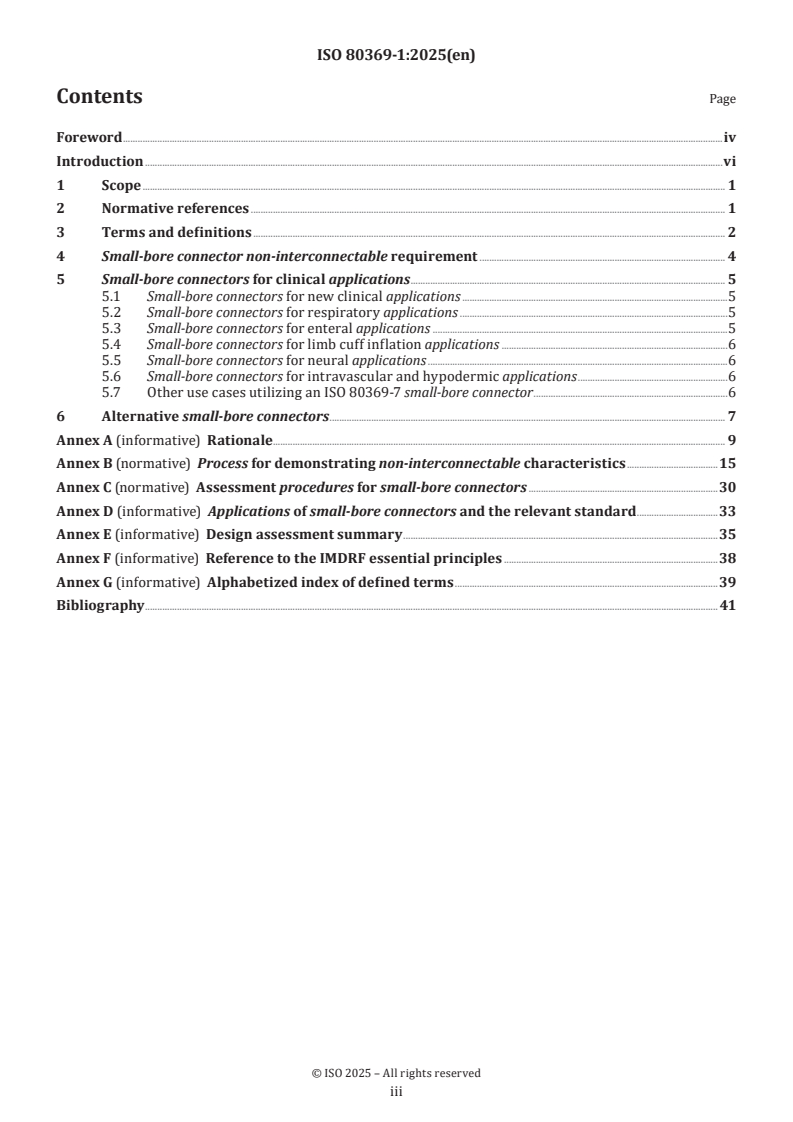

ISO 80369-1:2025 - Small-bore connectors for liquids and gases in healthcare applications - Part 1: General requirements Released:10/10/2025

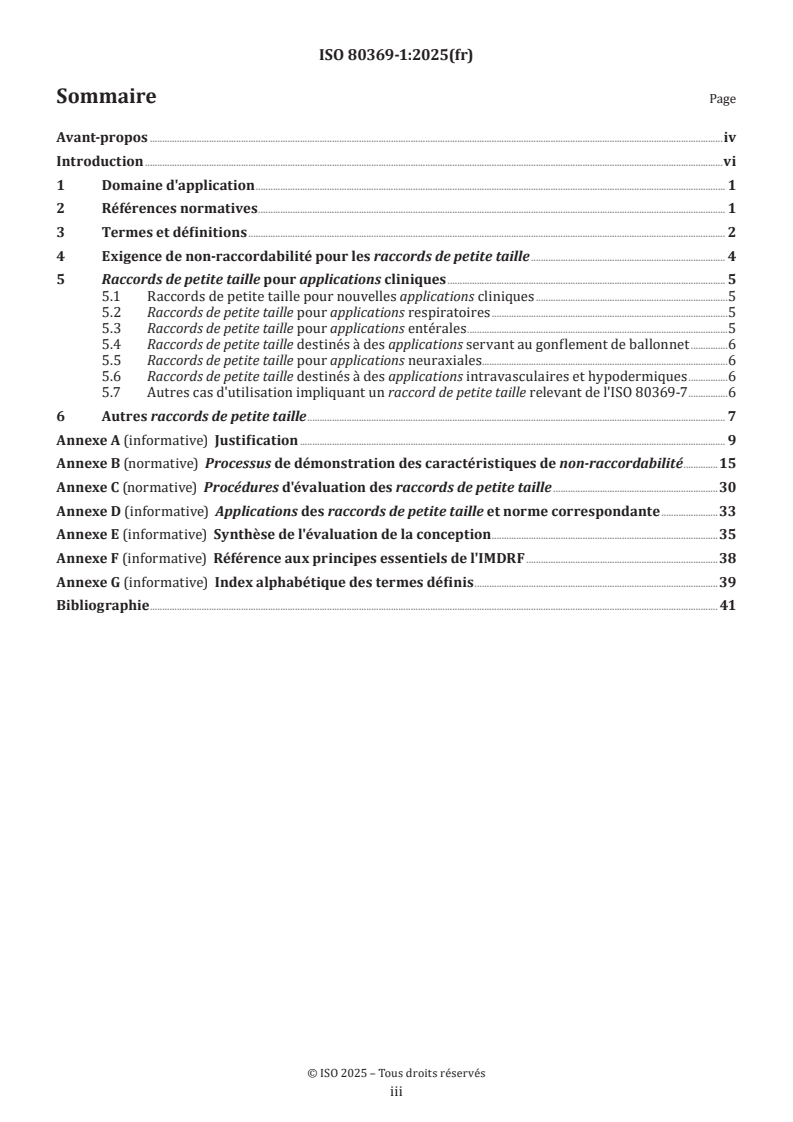

ISO 80369-1:2025 - Raccords de petite taille pour liquides et gaz utilisés dans le domaine de la santé - Partie 1: Exigences générales
Overview
ISO 80369-1:2025 - "Small-bore connectors for liquids and gases in healthcare applications - Part 1: General requirements" defines the general interface and risk-reduction framework for small-bore connectors used in medical devices and accessories that convey liquids or gases to patients. The standard sets out application scope (respiratory, enteral, limb cuff inflation, neural, intravascular/hypodermic and other use cases using ISO 80369-7) and a methodology to demonstrate non-interconnectable characteristics to reduce misconnections and wrong-route administration.
Key topics and requirements
- General interface requirements for small-bore connectors forming part of medical devices or accessories.
- Non-interconnectable requirement: criteria and process to ensure connectors intended for different clinical applications cannot be mistakenly mated.
- Methodology for assessment: normative processes (including Annex B and Annex C) for demonstrating and testing non-interconnectability and performance.
- Application-specific listings: identification of clinical use-cases (respiratory, enteral, limb cuff inflation, neural, intravascular/hypodermic, etc.) and guidance on which connector families are intended for each.
- Risk management alignment: references to ISO 14971 and IMDRF essential principles for risk control, emphasizing safe design to eliminate or reduce misconnection hazards.
- Supporting normative and informative annexes: rationale, test procedures, design-assessment summaries and references to common test methods used across the ISO/IEC 80369 series.
Applications and who uses this standard
- Medical device manufacturers and designers - to develop connector interfaces that are application-specific and demonstrably non-interconnectable with other connector types.
- Regulatory bodies and conformity assessors - to evaluate connector safety claims, test evidence and compliance with international risk-management expectations.
- Clinical engineers, procurement teams and hospital safety officers - to specify or source compatible, safer connector systems to reduce wrong-route errors.
- Standards committees and test laboratories - to implement the assessment procedures and harmonize connector specifications across products.
Practical benefits include reduced risk of misconnections, clearer device labelling and harmonized requirements for connector design across respiratory, enteral, neural, intravascular and other clinical applications.
Related standards
- ISO 80369 series (Parts 2, 3, 5, 6, 7, 20, etc.) - application-specific connector dimensions, material and performance requirements.
- ISO 14971 - medical device risk management.
- ISO 20417 - manufacturer information requirements.
- Relevant IEC 80369 parts and IMDRF guidance referenced for regulatory alignment.
Keywords: ISO 80369-1:2025, small-bore connectors, non-interconnectable, misconnections, Luer replacement, medical device connectors, respiratory connectors, enteral connectors, risk management.
Relations
- Effective Date
- 05-Sep-2023
Buy Documents
ISO 80369-1:2025 - Small-bore connectors for liquids and gases in healthcare applications - Part 1: General requirements Released:10/10/2025
ISO 80369-1:2025 - Raccords de petite taille pour liquides et gaz utilisés dans le domaine de la santé - Partie 1: Exigences générales
Get Certified
Connect with accredited certification bodies for this standard

BSI Group
BSI (British Standards Institution) is the business standards company that helps organizations make excellence a habit.

TÜV Rheinland
TÜV Rheinland is a leading international provider of technical services.

TÜV SÜD
TÜV SÜD is a trusted partner of choice for safety, security and sustainability solutions.
Sponsored listings
Frequently Asked Questions
ISO 80369-1:2025 is a standard published by the International Electrotechnical Commission (IEC). Its full title is "Small-bore connectors for liquids and gases in healthcare applications - Part 1: General requirements". This standard covers: This document specifies general interface requirements for small-bore connectors that form part of a medical device or accessory that conveys liquids or gases to a patient. This document also identifies the applications for which these small-bore connectors are intended to be used, which include, but are not limited to: - respiratory; - enteral; - limb cuff inflation; - neural; - intravascular or hypodermic; - other use cases utilizing an ISO 80369-7 small-bore connector. This document provides the methodology to assess non-interconnectable characteristics of small-bore connectors based on their inherent design in order to reduce the risk of misconnections between medical devices or between accessories for different applications as specified in this document as well as those that can be developed under future parts of the ISO and IEC 80369 series. NOTE Clause A.2 contains guidance or rationale for this Clause.
This document specifies general interface requirements for small-bore connectors that form part of a medical device or accessory that conveys liquids or gases to a patient. This document also identifies the applications for which these small-bore connectors are intended to be used, which include, but are not limited to: - respiratory; - enteral; - limb cuff inflation; - neural; - intravascular or hypodermic; - other use cases utilizing an ISO 80369-7 small-bore connector. This document provides the methodology to assess non-interconnectable characteristics of small-bore connectors based on their inherent design in order to reduce the risk of misconnections between medical devices or between accessories for different applications as specified in this document as well as those that can be developed under future parts of the ISO and IEC 80369 series. NOTE Clause A.2 contains guidance or rationale for this Clause.
ISO 80369-1:2025 is classified under the following ICS (International Classification for Standards) categories: 11.040.10 - Anaesthetic, respiratory and reanimation equipment; 11.040.20 - Transfusion, infusion and injection equipment. The ICS classification helps identify the subject area and facilitates finding related standards.
ISO 80369-1:2025 has the following relationships with other standards: It is inter standard links to ISO 80369-1:2018. Understanding these relationships helps ensure you are using the most current and applicable version of the standard.
ISO 80369-1:2025 is available in PDF format for immediate download after purchase. The document can be added to your cart and obtained through the secure checkout process. Digital delivery ensures instant access to the complete standard document.
Standards Content (Sample)
International
Standard
ISO 80369-1
Third edition
Small-bore connectors for
2025-10
liquids and gases in healthcare
applications —
Part 1:
General requirements
Raccords de petite taille pour liquides et gaz utilisés dans le
domaine de la santé —
Partie 1: Exigences générales
Reference number
© ISO 2025
All rights reserved. Unless otherwise specified, or required in the context of its implementation, no part of this publication may
be reproduced or utilized otherwise in any form or by any means, electronic or mechanical, including photocopying, or posting on
the internet or an intranet, without prior written permission. Permission can be requested from either ISO at the address below
or ISO’s member body in the country of the requester.
ISO copyright office
CP 401 • Ch. de Blandonnet 8
CH-1214 Vernier, Geneva
Phone: +41 22 749 01 11
Email: copyright@iso.org
Website: www.iso.org
Published in Switzerland
ii
Contents Page
Foreword .iv
Introduction .vi
1 Scope . 1
2 Normative references . 1
3 Terms and definitions . 2
4 Small-bore connector non-interconnectable requirement . 4
5 Small-bore connectors for clinical applications . 5
5.1 Small-bore connectors for new clinical applications .5
5.2 Small-bore connectors for respiratory applications .5
5.3 Small-bore connectors for enteral applications .5
5.4 Small-bore connectors for limb cuff inflation applications .6
5.5 Small-bore connectors for neural applications .6
5.6 Small-bore connectors for intravascular and hypodermic applications .6
5.7 Other use cases utilizing an ISO 80369-7 small-bore connector .6
6 Alternative small-bore connectors . . 7
Annex A (informative) Rationale . 9
Annex B (normative) Process for demonstrating non-interconnectable characteristics .15
Annex C (normative) Assessment procedures for small-bore connectors .30
Annex D (informative) Applications of small-bore connectors and the relevant standard .33
Annex E (informative) Design assessment summary .35
Annex F (informative) Reference to the IMDRF essential principles .38
Annex G (informative) Alphabetized index of defined terms .39
Bibliography . 41
iii
Foreword
ISO (the International Organization for Standardization) is a worldwide federation of national standards
bodies (ISO member bodies). The work of preparing International Standards is normally carried out through
ISO technical committees. Each member body interested in a subject for which a technical committee
has been established has the right to be represented on that committee. International organizations,
governmental and non-governmental, in liaison with ISO, also take part in the work. ISO collaborates closely
with the International Electrotechnical Commission (IEC) on all matters of electrotechnical standardization.
The procedures used to develop this document and those intended for its further maintenance are described
in the ISO/IEC Directives, Part 1. In particular, the different approval criteria needed for the different types
of ISO documents should be noted. This document was drafted in accordance with the editorial rules of the
ISO/IEC Directives, Part 2 (see www.iso.org/directives).
ISO draws attention to the possibility that the implementation of this document may involve the use of (a)
patent(s). ISO takes no position concerning the evidence, validity or applicability of any claimed patent
rights in respect thereof. As of the date of publication of this document, ISO had not received notice of (a)
patent(s) which may be required to implement this document. However, implementers are cautioned that
this may not represent the latest information, which may be obtained from the patent database available at
www.iso.org/patents. ISO shall not be held responsible for identifying any or all such patent rights.
Any trade name used in this document is information given for the convenience of users and does not
constitute an endorsement.
For an explanation of the voluntary nature of standards, the meaning of ISO specific terms and expressions
related to conformity assessment, as well as information about ISO's adherence to the World Trade
Organization (WTO) principles in the Technical Barriers to Trade (TBT), see www.iso.org/iso/foreword.html.
This document was prepared by Technical Committee ISO/TC 210, Quality management and corresponding
general aspects for products with a health purpose including medical devices, in collaboration with Technical
Committee IEC/SC 62D, Particular medical equipment, software, and systems, and with the European
Committee for Standardization (CEN) Technical Committee CEN/CLC/JTC 3, Quality management and
corresponding general aspects for medical devices, in accordance with the Agreement on technical cooperation
between ISO and CEN (Vienna Agreement).
This third edition cancels and replaces the second edition (ISO 80369-1:2018), which has been technically
revised.
The main changes are as follows:
— update of normative references;
— update of the document according to ISO/IEC Directives, Part 2;
— addition of respiratory applications;
— addition of interference test part, misconnection and unintended connection definitions;
— deletion of Clause 4 for materials requirements, as those requirements are or will be placed in the
individual connector parts of the series and normative Annex B describes the analysis and testing
processes for determining non-interconnectable characteristics;
— revision of Annex B by summarising process description and adding figure, editorial changes and adding
the dimensional analysis case “potential misconnection”;
— deletion of the original Annex C, replaced with normative reference to parts of ISO 20417;
— addition of Annex E summarizing the design assessments of the application parts of this series of
documents;
— replacement of contents of Annex F by referencing the relevant essential principles and labelling guidance
of the International Regulators Forum (IMDRF);
iv
— extension of the use of the ISO 80369-7 connector to medical devices and accessories beyond intravascular
and hypodermic applications where the risk is acceptable.
A list of all parts in the ISO and IEC 80369 series can be found on the ISO website.
Any feedback or questions on this document should be directed to the user’s national standards body. A
complete listing of these bodies can be found at www.iso.org/members.html.
v
Introduction
In the 1990s, concern grew regarding the proliferation of medical devices fitted with Luer connectors
[1]
as specified in the ISO 594 series and the reports of patient death or injury arising from unintended
connections that resulted in the inappropriate delivery of fluids and gases via incorrect routes. In addition to
clinical and workplace protocols and warnings, attention was turned to engineering solutions to reduce the
probability of wrong route administration of liquids and gases.
Concerns regarding the use of Luer connectors with enteral feeding tubes and gas sampling and gas delivery
systems were raised with CEN Bureau Technique (CEN/BT) and the European Commission. In November
1997, the newly created CEN Healthcare Forum (CHeF) steering group set up a Forum Task Group (FTG) to
consider the problem.
[9]
The FTG produced CEN Report, CEN/CR 13825, in which they concluded that there is a problem arising
from the use of a single connector design to several different applications. In a coronary care unit, there could
be as many as 40 Luer connectors on the medical devices used with a single patient until the use of connectors
defined in the ISO and IEC 80369 documents started to be established. Therefore, it is not surprising that
unintended connections were made.
Medical devices have, for many years, followed the established principle of “safety under single fault
conditions.” Simply stated, this means that a single fault should not result in an unacceptable risk. This
[6]
principle is embodied in the requirements of numerous medical device standards. Extending this principle
to the use of Luer connectors (i.e. that an unintended connection should not result in an unacceptable risk to
a patient) the FTG recommended that the Luer connector should be restricted to medical devices intended
to be connected to the vascular system or a hypodermic syringe. In addition, the FTG recommended that
new designs of small-bore connectors should be developed for other applications, and these should be non-
interconnectable with Luer connectors and each other.
[10]
International medical device regulators forum (IMDRF), GRRP N47:2024, Essential Principle 5.1.3,
addresses this type of problem:
Risk control measures adopted by manufacturers for the design and manufacture of the medical device
and IVD medical device should conform to safety principles, taking account of the generally acknowledged
state of the art. When risk reduction is required, manufacturers should control risks so that the residual
risk associated with each hazard as well as the overall residual risk is judged acceptable. In selecting the
most appropriate solutions, manufacturers should, in the following order of priority:
a) eliminate or appropriately reduce risks through safe design and manufacture;
b) where appropriate, take adequate protection measures, including alarms if necessary, in relation to
risks that cannot be eliminated;
c) provide information for safety (warnings/precautions/contra-indications) and, where appropriate,
training to users.
It is understood that small-bore connector systems cannot be designed to overcome all chances of unintended
connections with the potential for wrong route administration or to eliminate deliberate misuse. With
these application-specific connectors now available, the risk of unintended connections and wrong route
administration is greatly reduced thereby improving patient safety. Introduction of medical devices and
accessories utilizing these small-bore connectors is progressing albeit slowly.
The risks associated with unintended connections and subsequent wrong route administration of liquids and
gases cannot be fully assessed until these small-bore connectors are part of a medical device or accessory.
Therefore, the intended applications specified are recommendations. It is expected that particular medical
device standards will reference the connectors from the relevant parts of the ISO and IEC 80369 series if
considered appropriate.
This document contains the general requirements to reduce connections between small-bore connectors used
in different applications as well as specifying those applications.
vi
It specifies the general requirements and test methods for assessing the non-interconnectable characteristics
of small-bore connectors within the ISO and IEC 80369 series.
The Luer connector as originally defined in the withdrawn ISO 594 series has been widely used on many
medical devices and accessories and in a wide range of clinical applications for many years. The clinical
applications that present the highest risk to a patient from wrong route administration of liquids and
gases have been identified and are those included in the application parts of the ISO and IEC 80369 series.
ISO 80369-7, which replaces the ISO 594 series (i.e. the Luer connector), is intended for use with intravascular
or hypodermic applications.
However, there are currently medical devices and accessories which incorporate a Luer connector, but do not
fall into any of the applications specified by the ISO and IEC 80369 series. There are also some medical devices
and accessories within the applications of the ISO and IEC 80369 series applications that incorporate a Luer
connector. Those that present no unacceptable risk to the patient from an unintended connection to a medical
device or accessory within intravascular or hypodermic application are suitable for consideration for the use
of the Luer connector as specified in ISO 80369-7.
ISO 80369-20 specifies the common test methods for assessing the basic performance requirements specified
in ISO 80369-2, ISO 80369-3, IEC 80369-5, ISO 80369-6 and ISO 80369-7 for small-bore connectors.
ISO 80369-2, ISO 80369-3, IEC 80369-5, ISO 80369-6 and ISO 80369-7 specify the material requirements,
dimensional requirements for the interfaces of the connectors and the specific performance requirements
for assessing the interconnectability of the mating connectors.
The designs and dimensions of small-bore connectors specified in ISO 80369-2, ISO 80369-3, IEC 80369-5,
ISO 80369-6 and ISO 80369-7 have been successfully assessed according to the requirements of this
document (i.e. have been proven to be acceptable with regard to the risk of misconnection with the other
connectors of this series).
The risks of changing to these new small-bore connectors should be assessed before these small-bore
connectors are incorporated into medical devices as they will when the relevant particular medical device
standards are revised.
In this document, the conjunctive “or” is used as an “inclusive or” so a statement is true if any combination of
the conditions is true.
In this document the following verbal forms are used.
— “Shall” indicates requirements.
— “Should” indicates recommendations.
— “May” indicates permissions.
— "Can" indicates possibility or capability.
This document uses italic type to distinguish defined terms from the rest of the text. It is important for the
correct understanding of this document that those defined terms are identifiable throughout the text of this
document. A list of the defined terms used in italics in this document is given in Annex G.
Requirements in this document have been broken down so that each requirement is clearly delineated and
listed individually. This has been done to support the common practice of automatic tracking of requirements
and automatic verification of the requirements of this document.
Annex A contains guidance and rationale on specific subclauses in this document.
vii
International Standard ISO 80369-1:2025(en)
Small-bore connectors for liquids and gases in healthcare
applications —
Part 1:
General requirements
1 Scope
NOTE Clause A.2 contains guidance or rationale for this Clause.
This document specifies general interface requirements for small-bore connectors that form part of a medical
device or accessory that conveys liquids or gases to a patient.
This document also identifies the applications for which these small-bore connectors are intended to be used,
which include, but are not limited to:
— respiratory;
— enteral;
— limb cuff inflation;
— neural;
— intravascular or hypodermic;
— other use cases utilizing an ISO 80369-7 small-bore connector.
This document provides the methodology to assess non-interconnectable characteristics of small-bore
connectors based on their inherent design in order to reduce the risk of misconnections between medical
devices or between accessories for different applications as specified in this document as well as those that
can be developed under future parts of the ISO and IEC 80369 series.
2 Normative references
The following documents are referred to in the text in such a way that some or all of their content constitutes
requirements of this document. For dated references, only the edition cited applies. For undated references,
the latest edition of the referenced document (including any amendments) applies.
ISO 14971, Medical devices — Application of risk management to medical devices
ISO 20417:2021, Medical devices — Information to be supplied by the manufacturer
ISO 80369-2, Small-bore connectors for liquids and gases in healthcare applications — Part 2: Connectors for
respiratory applications
ISO 80369-3, Small-bore connectors for liquids and gases in healthcare applications — Part 3: Connectors for
enteral applications
IEC 80369-5, Small-bore connectors for liquids and gases in healthcare applications — Part 5: Connectors for
limb cuff inflation applications
ISO 80369-6, Small bore connectors for liquids and gases in healthcare applications — Part 6: Connectors for
neuraxial applications
ISO 80369-7, Small-bore connectors for liquids and gases in healthcare applications — Part 7: Connectors for
intravascular or hypodermic applications
IEC 62366-1:2015+AMD1:2020, Medical devices — Part 1: Application of usability engineering to medical devices
3 Terms and definitions
For the purposes of this document, the terms and definitions given in ISO 14971, IEC 62366-1 and the
following apply.
ISO and IEC maintain terminology databases for use in standardization at the following addresses:
— ISO Online browsing platform: available at https:// www .iso .org/ obp
— IEC Electropedia: available at https:// www .electropedia .org/
NOTE For convenience, the sources of all defined terms that appear in italics in this document are given in
Annex G.
3.1
accessory
additional part(s) for use with a medical device in order to:
— achieve the intended use;
— adapt it to some special use;
— facilitate its use;
— enhance its performance; or
— enable its functions to be integrated with those of other medical devices
[SOURCE: IEC 60601-1:2005+AMD1:2012+AMD2:2020, 3.3, modified — Replaced “equipment” with “a
medical device”.]
3.2
application
specific healthcare use
Note 1 to entry: Annex D lists examples of uses of the applications of small-bore (3.17) connectors (3.5).
3.3
cone
connector (3.5) with external sealing surface
Note 1 to entry: The sealing surface need not be conical.
Note 2 to entry: This type of connector (3.5) was previously referred to as male.
3.4
connection
union or joining of two connectors (3.5)
3.5
connector
part of a medical device, consisting of one of two mating halves and designed to join a conduit to convey
liquids or gases
3.6
contactable surface
any surface on a connector (3.5) that has an interaction potential in which physical contact occurs with any
other surface on an opposing connector
Note 1 to entry: Contactable surfaces may include, but are not limited to, sealing surfaces as intended by design, crest
geometry of external or internal threads, faces, shrouds, grips. These are surfaces on a connector that can possibly
interact with another connector.
3.7
information for safety
information provided to the user or responsible organization as a risk control measure
EXAMPLE 1 Warnings, precautions or contraindications.
EXAMPLE 2 Instructions for the use of a medical device or accessory (3.1) to prevent use error or avoid a hazardous
situation.
EXAMPLE 3 Explanation of a safety feature of a medical device.
Note 1 to entry: Information for safety can be found in any or all types of information supplied by the manufacturer.
Note 2 to entry: Information for safety can be located on the display of a medical device.
[SOURCE: ISO 20417:2021, 3.9]
3.8
instructions for use
portion of the accompanying information that is essential for the safe and effective use of a medical device or
accessory (3.1) directed to the user of the medical device
Note 1 to entry: For the purposes of this document, a user can be either a lay user or professional user with relevant
specialized training.
[SOURCE: ISO 20417:2021, 3.11, modified — Deleted admitted term “package insert”; deleted Notes 2 to 5
to entry.]
3.9
interference test part
component that physically represents a small-bore (3.17) connector (3.5) or connector feature
Note 1 to entry: An interference test part is used to evaluate whether or not a contactable surface (3.6) can misconnect.
3.10
least material condition
LMC
condition in which a feature contains the least amount of material within the stated tolerance
EXAMPLE Maximum hole diameter, minimum shaft diameter.
3.11
Luer connector
small-bore (3.17) connector (3.5) that contains a conical mating surface with a 6 % (Luer) taper intended for
use in intravascular or hypodermic applications (3.2) of medical devices and related accessories (3.1)
Note 1 to entry: A Luer connector can be either a Luer slip connector or a Luer lock connector.
[SOURCE: ISO 80369-7:2021, 3.2, modified — Deleted Note 2 to entry.]
3.12
marking
information, in text or graphical format, durably affixed, printed, etched (or equivalent) to a medical device
or accessory (3.1)
Note 1 to entry: For the purposes of this document, the term marked is used to designate the corresponding act.
Note 2 to entry: For the purposes of this document, marking is different from ‘direct marking’ as commonly described
in unique device identification (UDI) standards and regulations. A UDI ‘direct marking’ is a type of marking.
[SOURCE: ISO 20417:2021, 3.16, modified — Deleted Note 3 to entry.]
3.13
maximum material condition
MMC
condition in which a feature contains the maximum amount of material within the stated tolerance
EXAMPLE Minimum hole diameter, maximum shaft diameter.
3.14
misconnection
connection (3.4) between two connectors (3.5) of a different type
3.15
non-interconnectable
having characteristics which incorporate geometries or other features that prevent different connectors
(3.5) from making a connection (3.4)
3.16
patient
person undergoing a medical, surgical or dental procedure
[SOURCE: IEC 60601-1:2005+A1:2012, 3.76, modified — Replaced “living being (person or animal)” with
“person”; deleted the note.]
3.17
small-bore
inner-fluid pathway of a connection (3.4) with a diameter less than 8,5 mm
Note 1 to entry: For the purposes of this document, the 8,5 mm cone (3.3) and socket (3.18) specified in ISO 5356-1 is
not considered a small-bore (3.17) connector (3.5).
3.18
socket
connector (3.5) with internal sealing surface
Note 1 to entry: This type of connector (3.5) was previously referred to as female.
3.19
test method
definitive procedure for evaluating connectors (3.5) that produces a test result
3.20
unintended connection
connection (3.4) between two connectors (3.5) of the same type for different use cases
4 Small-bore connector non-interconnectable requirement
NOTE 1 A.2.3 contains guidance and rationale for this Clause.
Small-bore connectors of each application category specified in this document shall be non-interconnectable
with any of the small-bore connectors of every other application category unless otherwise indicated within
the ISO and IEC 80369 series.
Check conformity by confirming that objective evidence demonstrates that the acceptability criteria specified
in Annex B are met.
The use of a connector specified by the ISO and IEC 80369 series is considered as objective evidence that the
acceptability criteria specified in Annex B are met.
NOTE 2 For the purpose of this document, dimensional conformity and modulus of elasticity conformity with the
requirements of the various application parts of the ISO and IEC 80369 series is considered sufficient objective evidence
of non-interconnectable characteristics.
5 Small-bore connectors for clinical applications
NOTE 1 A.2.4 contains guidance and rationale for this Clause.
NOTE 2 Annex D lists examples of the sort of medical devices or accessories for which the small-bore connectors
within each application are intended.
NOTE 3 Annex E summarizes the assessments of the designs of the small-bore connectors of this series of documents.
NOTE 4 This document has been prepared to address the relevant essential principles and labelling guidances of
the International Regulators Forum (IMDRF) as indicated in Annex F.
5.1 Small-bore connectors for new clinical applications
Designs of small-bore connectors for applications other than those specified in 5.2 to 5.6, for inclusion in the
ISO and IEC 80369 series, and used in medical devices or accessories intended for use with a patient, shall
meet the requirements of Annex C.
Check conformity by application of Annex C.
5.2 Small-bore connectors for respiratory applications
Small-bore connectors intended to be used for connections in the respiratory application shall conform to
a) ISO 80369-2, unless the use of these connectors creates an unacceptable risk for a specific medical device
or accessory, or
b) Clause 6.
Check conformity by inspection of the documentation demonstrating that the small-bore connector conforms
to the requirements of ISO 80369-2 or, in case of alternative connectors as per Clause 6, by applying the
performance tests of ISO 80369-2 using appropriate reference connectors for the alternative design.
5.3 Small-bore connectors for enteral applications
Small-bore connectors intended to be used for connections in the enteral application shall conform to
a) ISO 80369-3, unless the use of these connectors creates an unacceptable risk for a specific medical device
or accessory, or
b) Clause 6.
Check conformity by inspection of the documentation demonstrating that the small-bore connector conforms
to the requirements of ISO 80369-3 or, in case of alternative connectors as per Clause 6, by applying the
performance tests of ISO 80369-3 using appropriate reference connectors for the alternative design.
5.4 Small-bore connectors for limb cuff inflation applications
Small-bore connectors intended to be used for connections in limb cuff inflation application shall conform to
a) IEC 80369-5, unless the use of these connectors creates an unacceptable risk for a specific medical device
or accessory, or
b) Clause 6.
Check conformity by inspection of the documentation demonstrating that the small-bore connector conforms
to the requirements of IEC 80369-5 or, in case of alternative connectors as per Clause 6, by applying the
performance tests of IEC 80369-5 using appropriate reference connectors for the alternative design.
5.5 Small-bore connectors for neural applications
Small-bore connectors intended to be used for connections in neural application shall conform to
a) ISO 80369-6, unless the use of these connectors creates an unacceptable risk for a specific medical device
or accessory, or
b) Clause 6.
Check conformity by inspection of the documentation demonstrating that the small-bore connector conforms
to the requirements of ISO 80369-6 or, in case of alternative connectors as per Clause 6, by applying the
performance tests of ISO 80369-6 using appropriate reference connectors for the alternative design.
5.6 Small-bore connectors for intravascular and hypodermic applications
Small-bore connectors intended to be used for connections in intravascular or hypodermic applications shall
conform to
a) ISO 80369-7, unless the use of these connectors creates an unacceptable risk for a specific medical device
or accessory, or
b) Clause 6.
Check conformity by inspection of the documentation demonstrating that the small-bore connector conforms
to the requirements of ISO 80369-7 or, in case of alternative connectors as per Clause 6, by applying the
performance tests of ISO 80369-7 using appropriate reference connectors for the alternative design.
5.7 Other use cases utilizing an ISO 80369-7 small-bore connector
NOTE 1 A.2.5 contains guidance and rationale for this subclause.
a) Small-bore connectors intended to be used for connections other than those falling into the applications of
5.2, 5.3, 5.4, 5.5 and 5.6 of medical devices and accessories may conform to ISO 80369-7 unless the use of
these connectors creates an unacceptable risk for the specific medical device or accessory.
b) Such a connector shall conform to ISO 80369-7.
c) A medical device or accessory using an ISO 80369-7 connector for such use cases shall meet the following
requirements:
1) The risk of unintended connections with any reasonably foreseeable medical devices or accessories using
the ISO 80369-7 connector shall be:
i) evaluated using ISO 14971;
ii) determined to be an acceptable risk.
NOTE 2 A.2.6 contains guidance and rationale for this requirement.
NOTE 3 See also the N1 cone to L2 cone misconnection in Table E.1.
In determining acceptable risk, the manufacturer shall evaluate the severity of the potential harm
associated with the potential unintended connection with flow in both directions of the connection.
2) Such a medical device or accessory shall be marked in accordance with ISO 20417:2021, 6.1.5.
3) If acceptable risk is achieved by providing information for safety, the medical device or accessory shall
include in its instructions for use a statement to the effect that “As this [insert name of medical device
or accessory here] uses an ISO 80369-7 small-bore connector for other than its intended application,
there is a possibility that an inadvertent connection can occur between this [insert name of medical
device or accessory here] and another medical device or accessory using this connector, which can
result in a hazardous situation causing harm to the patient. Special measures need be taken by the
user to mitigate these reasonably foreseeable risks."
4) It is recommended that the manufacturer of such a medical device or accessory that utilizes a small-bore
connector of the ISO 80369-7 for other than its intended application notify their national standards
body of their utilization.
The notification should include a description of:
i) the connector used;
ii) the medical device or accessory using the connector;
iii) the clinical procedure;
iv) the fluid being used.
Check conformity for a medical device or accessory using a small-bore connector of ISO 80369-7 for other than
the intravascular and hypodermic application by:
— inspection of the documentation demonstrating that the small-bore connector conforms to the
requirements of ISO 80369-7;
— inspection of the risk management file of the medical device or accessory using the connector and confirming
that the risk of any unintended connection is acceptable;
— inspection of the marking;
— inspection of the instructions for use.
6 Alternative small-bore connectors
NOTE A.2.7 contains guidance and rationale for this Clause.
a) Alternative designs of small-bore connectors to those specified in Clause 5 may be used in a medical
device or accessory, and if used, they shall:
1) be evaluated according to Annex B for non-interconnectable characteristics, with the exception of a
connector within the same application to which it is intended to connect;
2) not create an unacceptable risk for a specific medical device or accessory;
3) be evaluated according to the engineering analysis of Clause C.3.
b) The medical device or accessory, which incorporates an alternative design small-bore connector, shall:
1) be marked in accordance with ISO 20417:2021, 6.1.5;
2) if acceptable risk is achieved by providing information for safety, include in its instructions for use
a statement to the effect that “As this [insert name of medical device or accessory here] uses an
alternative small-bore connector design different from those specified in the ISO and IEC 80369
series, there is a possibility that an inadvertent connection can occur between this [insert name of
medical device or accessory here] and a medical device or accessory using a different alternative
small-bore connector, or that compatibility with other alternative small-bore connectors can be
impaired, which can result in a hazardous situation causing harm to the patient. Special measures
need be taken by the user to mitigate these reasonably foreseeable risks.”.
c) An alternative design small-bore connector that conforms with this clause:
1) shall not make generic claims of conformity with the ISO and IEC 80369 series;
2) shall not claim conformity with specific parts of the ISO and IEC 80369 series other than this
document;
3) may claim conformance with this document.
Check conformity by inspection of the risk management file and the instructions for use of the medical device
or accessory using the connector and confirming that the risk of any unintended connection is acceptable.
Confirm conformity with Annex B and the specified portions of Annex C.
Annex A
(informative)
Rationale
A.1 General
This annex provides rationale for important requirements of this document and is intended for those
who are familiar with the subject of this document but who have not participated in its development. An
understanding of the reasons for the requirements is considered essential for its proper application.
Furthermore, as clinical practice and technology change, it is believed that rationale for the present
requirements will facilitate any revision of this document necessitated by those developments.
A.2 Rationale for particular clauses and subclauses
A.2.1 General
The numbering of the following rationales corresponds to the numbering of the clauses and subclauses in
this document. The numbering is, therefore, not consecutive.
A.2.2 Clause 1 Scope
Advances in medicine have led to a significant rise in the number of medical devices attached to patients.
Many of these medical devices fall into the categories of monitoring medical devices, diagnostic medical
devices and drug delivery medical devices.
Such medical devices perform a variety of similar, but not interchangeable, functions. Examples include
intravenous fluid delivery, enteral feeding, respiratory gas sampling, non-invasive blood pressure
measurement and injection of intrathecal medication. Despite the varied nature of the functions performed,
many of these medical devices used a universal system of small-bore connectors based on the Luer connector
(6 % tapered) as formerly specified in the withdrawn ISO 594 series.
The universal nature of the Luer connectors used with medical devices or accessories for different applications
and the proximity of numerous Luer connectors around a single patient increases the potential for unintended
connections and risk of wrong route administration of liquids and gases. The consequences of such wrong
[12][13][14][15][16]
route administration vary, but a significant number have caused patient harm including death .
Serious and often fatal wrong route administration as a consequence of unintended connections include
intravenous injection of air, intravenous injection of enteral feeds and intrathecal injection of vincristine.
Less disastrous wrong route administration from unintended connections, such as enteral administration
of intravenous fluids, might not directly harm the patient but can result in a failure of the intended
administration.
Comité Européen de Normalisation / Bureau Technique / Task Force 123 (CEN BT TF 123) carried out an
extensive risk analysis of possible unintended connections that can result when the same connector is used in
different applications. Reducing the identified unacceptable risks is the basis of the ISO and IEC 80369 series.
Introducing a series of non-interconnectable small-bore connectors for medical devices used for different
applications will help reduce the likelihood of unintended connections, reduce the risk of wrong route
administration and improve patient safety. It was important that the ISO and IEC 80369 series included the
Luer connector, although the first edition of ISO 80369-1 specified the intended usage of ISO 80369-7 for
intravascular or hypodermic applications. In this edition of this document, it was decided to specify, under
specific conditions, the intended usage of ISO 80369-7 for medical devices and accessories where it can be
shown that such usage does not present an unacceptable risk.
Originally, it was hoped that the small-bore connectors included in the ISO and IEC 80369 series could be
designed so that they did not misconnect with other connectors commonly used within similar environments
[8]
and covered by ISO or EN documents (e.g. the nipples in EN 13544-2, the conical connectors in ISO 5356-1,
and the temperature sensor ports specified in ISO 80601-2-74). Since the introduction of the ISO and
IEC 80369 series, these other documents have been updated. EN 13544-2 is being replaced by ISO 17256 and
the dimensions of the nipple connector has been fully specified as have the dimensions of the temperature
sensor ports in ISO 80601-2-74 probe.
During the computer-assisted design (CAD) analysis, it became evident that the dimensions contained
within these documents were not specified in a manner that allows for evaluation of non-interconnectable
characteristics between these connectors and the connectors specified in the ISO and IEC 80369 series.
These connectors were, therefore, not part of the CAD verification/validation or the non-interconnectable
characteristics testing and they can misconnect with the small-bore connectors described in the ISO and
IEC 80369 series.
In the ISO and IEC 80369 series, for clarity, different language is used to describe the two different kinds of
undesirable connections. There are misconnections, which are connections made between two connectors that
are not supposed to physically connect by design (i.e. between different connectors for different applications
in the ISO and IEC 80369 series). There are also unintended connections, which are connections that can be
made unintentionally between medical devices or accessories using the same connector type (i.e. the Luer
connector of an intravenous syringe connected to the Luer connector of an epidural catheter port).
A.2.3 Clause 4 Small-bore connector non-interconnectable requirement
The threshold of the modulus of elasticity greater than 700 MPa was chosen to ensure that connectors
are sufficiently stiff and resistant to deformation under mechanical stress, such as during connection,
disconnection or accidental bending. The higher modulus ensures connectors maintain their precise shape
and dimensions, which is critical for preventing misconnections between incompatible medical devices ‒ a
key safety goal of the ISO and IEC 80369 series.
Although it was the intent of the ISO and IEC 80369 series to create designs of small-bore connectors
that were completely non-interconnectable, this proved to be nearly impossible. There are a few cases of
misconnections between the small-bore connectors specified in the ISO and IEC 80369 series. Each of these
misconnections has been carefully analysed and determined to be an acceptable risk. The risk analysis is
documented in Annex E. Figure A.1 illustrates design space utilized by each of the small-bore connectors of
the ISO and IEC 80369 series. This concept and the drawing were developed by ISO/TC 210/JWG4 experts.
The colours used in Figure A.1 correspond with the colours used in Table E.1.
Key
1 inside diameter
2 outside diameter
ISO 80369-2
ISO 80369-2
ISO 80369-3
IEC 80369-5
ISO 80369-6
ISO 80369-7
Figure A.1 — Illustration of the small-bore connector design space
A.2.4 Clause 5 Small-bore connectors for clinical applications
National regulatory bodies, hospital accreditation organizations, and independent public health
organizations recognize wrong route administration of liquids and gases, resulting from connections
between medical devices of different applications, as a persistent problem with potential consequences of
patient harm. Warnings have been issued and strategies have been developed for healthcare organizations
to reduce risks and for manufacturers to redesign connectors to prevent unintended connections. The ability of
connectors to interconnect is identified as a root cause of unintended connections.
[9]
CEN Report, CEN/CR 13825, identifies possible unintended connections between medical devices involving
the conveyance of a gas or liquid for the different application categories and classifies each according to
the severity of the harm that can occur if wrong route administration of liquids and gases occurs. The
report confirms that the application categories specified in this document are incompatible, i.e. unintended
connections among these application categories can cause seri
...
Norme
internationale
ISO 80369-1
Troisième édition
Raccords de petite taille pour
2025-10
liquides et gaz utilisés dans le
domaine de la santé —
Partie 1:
Exigences générales
Small-bore connectors for liquids and gases in healthcare
applications —
Part 1: General requirements
Numéro de référence
DOCUMENT PROTÉGÉ PAR COPYRIGHT
© ISO 2025
Tous droits réservés. Sauf prescription différente ou nécessité dans le contexte de sa mise en œuvre, aucune partie de cette
publication ne peut être reproduite ni utilisée sous quelque forme que ce soit et par aucun procédé, électronique ou mécanique,
y compris la photocopie, ou la diffusion sur l’internet ou sur un intranet, sans autorisation écrite préalable. Une autorisation peut
être demandée à l’ISO à l’adresse ci-après ou au comité membre de l’ISO dans le pays du demandeur.
ISO copyright office
Case postale 401 • Ch. de Blandonnet 8
CH-1214 Vernier, Genève
Tél.: +41 22 749 01 11
E-mail: copyright@iso.org
Web: www.iso.org
Publié en Suisse
ii
Sommaire Page
Avant-propos .iv
Introduction .vi
1 Domaine d'application . 1
2 Références normatives . 1
3 Termes et définitions . 2
4 Exigence de non-raccordabilité pour les raccords de petite taille . 4
5 Raccords de petite taille pour applications cliniques . 5
5.1 Raccords de petite taille pour nouvelles applications cliniques .5
5.2 Raccords de petite taille pour applications respiratoires .5
5.3 Raccords de petite taille pour applications entérales .5
5.4 Raccords de petite taille destinés à des applications servant au gonflement de ballonnet .6
5.5 Raccords de petite taille pour applications neuraxiales.6
5.6 Raccords de petite taille destinés à des applications intravasculaires et hypodermiques .6
5.7 Autres cas d'utilisation impliquant un raccord de petite taille relevant de l'ISO 80369-7 .6
6 Autres raccords de petite taille . 7
Annexe A (informative) Justification . 9
Annexe B (normative) Processus de démonstration des caractéristiques de non-raccordabilité .15
Annexe C (normative) Procédures d'évaluation des raccords de petite taille .30
Annexe D (informative) Applications des raccords de petite taille et norme correspondante .33
Annexe E (informative) Synthèse de l'évaluation de la conception .35
Annexe F (informative) Référence aux principes essentiels de l'IMDRF .38
Annexe G (informative) Index alphabétique des termes définis .39
Bibliographie . 41
iii
Avant-propos
L'ISO (Organisation internationale de normalisation) est une fédération mondiale d'organismes nationaux
de normalisation (comités membres de l'ISO). L'élaboration des Normes internationales est en général
confiée aux comités techniques de l'ISO. Chaque comité membre intéressé par une étude a le droit de faire
partie du comité technique créé à cet effet. Les organisations internationales, gouvernementales et non
gouvernementales, en liaison avec l'ISO participent également aux travaux. L'ISO collabore étroitement avec
la Commission électrotechnique internationale (IEC) en ce qui concerne la normalisation électrotechnique.
Les procédures utilisées pour élaborer le présent document et celles destinées à sa mise à jour sont
décrites dans les Directives ISO/IEC, Partie 1. Il convient, en particulier, de prendre note des différents
critères d'approbation requis pour les différents types de documents ISO. Le présent document
a été rédigé conformément aux règles de rédaction données dans les Directives ISO/IEC, Partie 2
(voir www.iso.org/directives).
L'ISO attire l'attention sur le fait que la mise en application du présent document peut entraîner l'utilisation
d'un ou de plusieurs brevets. L'ISO ne prend pas position quant à la preuve, à la validité et à l'applicabilité
de tout droit de propriété revendiqué à cet égard. À la date de publication du présent document, l'ISO
n'avait pas reçu notification qu'un ou plusieurs brevets pouvaient être nécessaires à sa mise en application.
Toutefois, il y a lieu d'avertir les responsables de la mise en application du présent document que des
informations plus récentes sont susceptibles de figurer dans la base de données de brevets, disponible à
l'adresse www.iso.org/brevets. L'ISO ne saurait être tenue pour responsable de ne pas avoir identifié tout ou
partie de tels droits de brevet.
Les appellations commerciales éventuellement mentionnées dans le présent document sont données pour
information, par souci de commodité, à l'intention des utilisateurs et ne sauraient constituer un engagement.
Pour une explication de la nature volontaire des normes, la signification des termes et expressions
spécifiques de l'ISO liés à l'évaluation de la conformité, ou pour toute information au sujet de l'adhésion de
l'ISO aux principes de l'Organisation mondiale du commerce (OMC) concernant les obstacles techniques au
commerce (OTC), voir www.iso.org/avant-propos.
Le présent document a été élaboré par le comité technique ISO/TC 210, Management de la qualité et aspects
généraux correspondants des dispositifs médicaux, en collaboration avec le comité technique IEC/SC 62D,
Équipement médical, logiciels et systèmes médicaux, et avec le comité technique CEN/CLC/JTC 3, Management
de la qualité et aspects généraux correspondants relatifs aux dispositifs médicaux, du Comité européen de
normalisation (CEN), conformément à l'Accord de coopération technique entre l'ISO et le CEN (Accord de
Vienne).
Cette troisième édition annule et remplace la deuxième édition (ISO 80369-1:2018), qui a fait l'objet d'une
révision technique.
Les principales modifications sont les suivantes:
— mise à jour des références normatives;
— mise à jour du présent document conformément aux Directives ISO/IEC, Partie 2;
— ajout des applications respiratoires;
— ajout des définitions des termes «pièce pour essai d'interférence», «erreur de raccordement» et
«raccordement non intentionnel»;
— suppression de l’Article 4 relatif aux exigences de matériaux, étant donné que ces exigences sont ou
seront placées dans les différentes parties connecteurs de la série et que l'Annexe B, normative, décrit les
processus d'analyse et d'essai pour déterminer les caractéristiques de non-raccordabilité;
— révision de l'Annexe B en résumant la description du processus et en ajoutant une figure, modifications
rédactionnelles et ajout du cas d'analyse dimensionnelle de l’«erreur potentielle de raccordement»;
iv
— suppression de l'Annexe C d'origine, remplacée par une référence normative à certaines parties de
l'ISO 20417;
— ajout de l'Annexe E résumant les évaluations de la conception des parties de cette série de documents
consacrées à l'application;
— remplacement du contenu de l'Annexe F par une référence aux principes essentiels et aux recommandations
en matière de marquage de l'International Medical Device Regulators Forum (IMDRF) pertinents;
— extension de l'utilisation du raccordISO 80369-7 aux dispositifs médicaux et accessoires autres que ceux
destinés aux applications intravasculaires et hypodermiques, pour lesquelles le risque est acceptable.
Une liste de toutes les parties des séries ISO et IEC 80369 se trouve sur le site web de l'ISO.
Il convient que l'utilisateur adresse tout retour d'information ou toute question concernant le présent
document à l'organisme national de normalisation de son pays. Une liste exhaustive desdits organismes se
trouve à l'adresse www.iso.org/fr/members.html.
v
Introduction
Dans les années 1990, la multiplication des dispositifs médicaux équipés de raccords Luer, tels que spécifiés
[1]
dans la série ISO 594, et les rapports faisant état de décès ou de dommages corporels aux patients dus à des
raccordements non intentionnels ayant entraîné l'administration inappropriée de liquides et de gaz par des
voies inappropriées ont suscité des inquiétudes croissantes. Outre les protocoles cliniques, et les protocoles
et avertissements applicables sur le lieu de travail, l'attention a été portée sur les solutions d'ingénierie
visant à réduire la probabilité d'une administration de liquides et de gaz par une voie inappropriée.
Le Bureau Technique du CEN (CEN/BT) et la Commission européenne ont exprimé leur inquiétude concernant
l'utilisation de raccords Luer pour les sondes d'alimentation entérale et les systèmes de prélèvement et de
distribution de gaz. En novembre 1997, le groupe pilote CEN Healthcare Forum (CHeF), nouvellement créé, a
fondé un groupe d'étude du forum (FTG) pour se pencher sur le problème.
[9]
Le FTG a rédigé le rapport CEN/CR 13825, qui conclut à l'existence d'un problème lié à l'utilisation d'un
même modèle de raccord pour plusieurs applications différentes. Dans une unité de soins intensifs de
cardiologie, il pouvait y avoir jusqu'à 40 raccords Luer sur les dispositifs médicaux utilisés pour un seul patient
avant que l'utilisation des raccords définie dans les normes ISO et IEC 80369 ne commence à s'imposer. Dans
ces conditions, il n'est pas étonnant qu'il y ait eu des raccordements non intentionnels.
Depuis de nombreuses années, les dispositifs médicaux fonctionnent selon le principe établi de la «sécurité en
conditions de premier défaut». En clair, cela signifie qu'il convient qu'une seule erreur n'entraîne pas de risque
[6]
inacceptable. Ce principe sous-tend les exigences de nombreuses normes relatives aux dispositifs médicaux .
En étendant ce principe à l'utilisation de raccords Luer (selon lequel il convient qu'un raccordement non
intentionnel n'entraîne pas de risque inacceptable pour un patient), le FTG a recommandé que l'usage du
raccord Luer soit limité aux dispositifs médicaux destinés à être raccordés au système vasculaire ou à une
seringue hypodermique. En outre, il a été recommandé par le FTG que de nouveaux modèles de raccords de
petite taille soient développés pour d'autres applications, et que ces nouveaux modèles soient non raccordables
aux raccords Luer et non raccordables entre eux.
[10]
Le Principe essentiel 5.1.3 de l'International medical device regulators forum (IMDRF), GRRP N47:2024
traite de ce type de problème:
Il convient que les mesures de maîtrise des risques adoptées par les fabricants pour la conception et la
fabrication du dispositif médical et du dispositif médical DIV soient conformes aux principes de sécurité,
compte tenu de l'état de la technique généralement reconnu. Lorsque la réduction des risques se révèle
nécessaire, il convient que les fabricants maîtrisent les risques de manière que le risque résiduel lié à
chaque phénomène dangereux et le risque résiduel global soit jugé acceptable. Lorsqu'ils sélectionnent
les solutions les plus appropriées, il convient que les fabricants procèdent à plusieurs étapes, dans l'ordre
de priorité suivant:
a) éliminer ou réduire les risques de manière appropriée au moyen d'une conception et d'une fabrica-
tion sûres;
b) le cas échéant, prendre des mesures de protection adéquates (y compris des alarmes, si nécessaire)
pour les risques qui ne peuvent pas être éliminés;
c) fournir des informations sur la sécurité (avertissements/précautions/contre-indications) et, le cas
échéant, une formation aux utilisateurs.
Il est admis que des systèmes de raccords de petite taille permettant d'éviter tout risque de raccordements
non intentionnels avec potentielle administration par voie inappropriée ou permettant d'empêcher des
mésusages délibérés ne peuvent pas être conçus. Grâce à ces raccords spécifiques à différentes applications,
le risque de raccordements non intentionnels et d'administration par voie inappropriée est considérablement
réduit, ce qui améliore la sécurité des patients. Bien que lent, le déploiement de dispositifs médicaux et
d'accessoires utilisant ces raccords de petite taille progresse.
Les risques associés aux raccordements non intentionnels et à l'administration qui s'ensuit de liquides et
de gaz par voie inappropriée ne peuvent être entièrement évalués tant que ces raccords de petite taille ne
sont pas installés sur un dispositif médical ou un accessoire. C'est pourquoi les spécifications relatives aux
vi
applications prévues sont des recommandations. Il est attendu que les normes relatives à des dispositifs
médicaux particuliers fassent référence, le cas échéant, aux raccords traités dans les parties correspondantes
des séries ISO et IEC 80369.
Le présent document contient les exigences générales visant à limiter les raccordements entre les raccords de
petite taille utilisés dans différentes applications, ainsi que les spécifications applicables à ces applications.
Il spécifie les exigences générales et les méthodes d'essai permettant d'évaluer les caractéristiques de non-
raccordabilité des raccords de petite taille traités dans les séries ISO et IEC 80369.
Le raccord Luer, tel que défini initialement dans la série ISO 594 qui a été retirée, est largement utilisé dans
de nombreux dispositifs médicaux et accessoires ainsi que dans un large éventail d'applications cliniques,
depuis de nombreuses années. Les applications cliniques présentant le risque le plus élevé pour les patients
en cas d'administration de liquides et de gaz par voie inappropriée ont été identifiées et sont incluses dans
les parties relatives aux applications des séries ISO et IEC 80369. L'ISO 80369-7, qui remplace la série ISO 594
(traitant du raccord Luer), est destinée aux applications intravasculaires ou hypodermiques.
Toutefois, il existe actuellement des dispositifs médicaux et des accessoires qui incluent un raccord Luer,
mais qui n'entrent dans aucune des applications couvertes par les séries ISO et IEC 80369. Il y a également
certains dispositifs médicaux et accessoires relevant d'applications des séries ISO et IEC 80369 qui comportent
un raccord Luer. Ceux qui ne présentent pas de risque inacceptable pour le patient en cas de raccordement
non intentionnel à un dispositif médical ou à un accessoire dans le cadre d'une application intravasculaire ou
hypodermique peuvent être pris en considération pour l'utilisation du raccord Luer, tel que spécifié dans
l'ISO 80369-7.
L'ISO 80369-20 spécifie les méthodes d'essai communes servant à évaluer les exigences de performance de
base spécifiées dans les normes ISO 80369-2, ISO 80369-3, IEC 80369-5, ISO 80369-6 et ISO 80369-7 pour les
raccords de petite taille.
Les normes ISO 80369-2, ISO 80369-3, IEC 80369-5, ISO 80369-6 et ISO 80369-7 spécifient les exigences
relatives aux matériaux, les exigences dimensionnelles des interfaces des raccords et les exigences de
performance spécifiques pour l'évaluation de la raccordabilité des éléments du raccord à coupler.
Les modèles et dimensions des raccords de petite taille spécifiés dans les normes ISO 80369-2, ISO 80369-3,
IEC 80369-5, ISO 80369-6 et ISO 80369-7 ont obtenu des résultats satisfaisants à l'évaluation à laquelle ils ont
été soumis selon les exigences du présent document (c'est-à-dire qu'il a été démontré qu'ils sont acceptables
au regard du risque d'erreur de raccordement avec les autres raccords de cette série).
Il convient que les risques liés au passage à ces nouveaux raccords de petite taille soient évalués avant que
ces raccords de petite taille ne soient intégrés aux dispositifs médicaux comme ils le seront lorsque les normes
relatives aux dispositifs médicaux particuliers pertinents seront révisées.
Dans le présent document, la conjonction «ou» est utilisée comme un «ou inclusif»; une affirmation est donc
vraie si une combinaison quelconque des conditions est vraie.
Dans le présent document, les formes verbales suivantes sont utilisées:
— «doit» («shall») est utilisé pour exprimer les exigences;
— «il convient de» («should») est utilisé pour exprimer les recommandations;
— «peut» («may») est utilisé pour exprimer les permissions;
— «peut» («can») est utilisé pour exprimer une possibilité ou une capacité.
Le présent document utilise des caractères italiques pour distinguer les termes définis du reste du texte. Pour
la bonne compréhension du présent document, il est important que ces termes définis soient identifiables
dans l'ensemble du texte. La liste des termes définis utilisés en italique dans le présent document est fournie
à l'Annexe G.
vii
Les exigences du présent document ont été morcelées de manière à ce que chacune d'elles soit clairement
délimitée et listée individuellement. Cela avait pour objectif de faciliter la pratique courante du suivi
automatique des exigences et de la vérification automatique des exigences du présent document.
L'Annexe A contient des recommandations et des justifications concernant les paragraphes spécifiques du
présent document.
viii
Norme internationale ISO 80369-1:2025(fr)
Raccords de petite taille pour liquides et gaz utilisés dans le
domaine de la santé —
Partie 1:
Exigences générales
1 Domaine d'application
NOTE L'Article A.2 contient des recommandations ou justifications concernant le présent article.
Le présent document spécifie les exigences générales d'interface applicables aux raccords de petite taille
faisant partie d'un dispositif médical ou d'un accessoire qui délivre des liquides ou des gaz à un patient.
Le présent document identifie également les applications dans le cadre desquelles ces raccords de petite taille
sont destinés à être utilisés, ce qui inclut, entre autres:
— les applications respiratoires;
— les applications entérales;
— les applications au gonflement de ballonnet;
— les applications neuraxiales;
— les applications intravasculaires ou hypodermiques;
— les autres cas d'utilisation impliquant un raccord de petite taille relevant de l'ISO 80369-7.
Le présent document indique la méthodologie à suivre pour évaluer les caractéristiques de non-raccordabilité
des raccords de petite taille en s'appuyant sur leur conception intrinsèque, afin de réduire le risque d'erreurs
de raccordement entre des dispositifs médicaux ou entre des accessoires destinés à différentes applications
qui sont spécifiées dans le présent document ou qui peuvent être développées dans les futures parties des
séries ISO et IEC 80369.
2 Références normatives
Les documents suivants sont cités dans le texte de sorte qu'ils constituent, pour tout ou partie de leur
contenu, des exigences du présent document. Pour les références datées, seule l'édition citée s'applique. Pour
les références non datées, la dernière édition du document de référence s'applique (y compris les éventuels
amendements).
ISO 14971, Dispositifs médicaux — Application de la gestion des risques aux dispositifs médicaux
ISO 20417:2021, Dispositifs médicaux — Informations à fournir par le fabricant
ISO 80369-2, Raccords de petite taille pour liquides et gaz utilisés dans le domaine de la santé — Partie 2:
Raccords destinés à des applications respiratoires
ISO 80369-3, Raccords de petite taille pour liquides et gaz utilisés dans le domaine de la santé — Partie 3:
Raccords destinés à des applications entérales
IEC 80369-5, Raccords de petite taille pour liquides et gaz utilisés dans le domaine de la santé — Partie 5:
Raccords destinés à des applications au gonflement de ballonnet
ISO 80369-6, Raccords de petite taille pour liquides et gaz utilisés dans le domaine de la santé — Partie 6:
Raccords destinés à des applications en contact avec le système nerveux (neuraxiales)
ISO 80369-7, Raccords de petite taille pour liquides et gaz utilisés dans le domaine de la santé — Partie 7:
Connecteurs pour les applications intravasculaires ou hypodermiques
IEC 62366-1:2015+AMD1:2020, Dispositifs médicaux — Partie 1: Application de l’ingénierie de l’aptitude à
l’utilisation aux dispositifs médicaux
3 Termes et définitions
Pour les besoins du présent document, les termes et les définitions de l'ISO 14971, de l'IEC 62366-1 ainsi que
les suivants s'appliquent.
L'ISO et l'IEC tiennent à jour des bases de données terminologiques destinées à être utilisées en normalisation,
consultables aux adresses suivantes:
— ISO Online browsing platform: disponible à l'adresse https:// www .iso .org/ obp
— IEC Electropedia: disponible à l'adresse https:// www .electropedia .org/
NOTE Pour des raisons pratiques, les sources de tous les termes définis figurant en italique dans le présent
document sont données à l'Annexe G.
3.1
accessoire
composant additionnel destiné à être utilisé avec un dispositif médical de manière à:
— assurer son utilisation prévue;
— l'adapter à une utilisation spécifique;
— faciliter son utilisation;
— accroître ses performances; ou
— permettre l'intégration de ses fonctions à celles d'autres dispositifs médicaux
[SOURCE: IEC 60601-1:2005+AMD1:2012+AMD2:2020, 3.3, modifié — remplacement de «l'appareil» par «un
dispositif médical».]
3.2
application
utilisation spécifique dans le domaine des soins de santé
Note 1 à l'article: L'Annexe D propose des exemples d'applications de raccords (3.5) de petite taille (3.17).
3.3
cône
raccord (3.5) caractérisé par une surface d'étanchéité externe
Note 1 à l'article: La surface d'étanchéité peut ne pas être conique.
Note 2 à l'article: Ce type de raccord (3.5) était auparavant qualifié de «mâle».
3.4
raccordement
assemblage ou jonction de deux raccords (3.5)
3.5
raccord
partie d'un dispositif médical composée de deux éléments qui peuvent être couplés, et conçue pour relier un
conduit de transfert de liquide ou de gaz
3.6
surface raccordable
toute surface d'un raccord (3.5) susceptible de présenter une interaction avec contact physique avec toute
autre surface d'un raccord opposé
Note 1 à l'article: Les surfaces raccordables peuvent inclure, sans toutefois s'y limiter, les surfaces d'étanchéité prévues
par la conception, la géométrie au sommet des filetages extérieurs ou intérieurs, les faces, les coiffes et les faces
d'engagement. Il s'agit des surfaces d'un raccord qui peuvent présenter une interaction avec un autre raccord.
3.7
informations de sécurité
informations fournies à l'utilisateur ou à l'organisme responsable comme une mesure de maîtrise des risques
EXEMPLE 1 Avertissements, précautions ou contre-indications.
EXEMPLE 2 Instructions d'utilisation d'un dispositif médical ou d'un accessoire (3.1) pour empêcher une erreur
d'utilisation ou éviter une situation dangereuse.
EXEMPLE 3 Explication concernant une fonction de sécurité d'un dispositif médical.
Note 1 à l'article: Les informations de sécurité peuvent se trouver dans un ou tous les types d'informations fournies par
le fabricant.
Note 2 à l'article: Les informations de sécurité peuvent être situées sur l'affichage d'un dispositif médical.
[SOURCE: ISO 20417:2021, 3.9]
3.8
instructions d'utilisation
partie des informations d'accompagnement qui est essentielle pour l'utilisation sûre et efficace d'un dispositif
médical ou d'un accessoire (3.1) et qui est destinée à l'utilisateur du dispositif médical
Note 1 à l'article: Pour les besoins du présent document, un utilisateur peut être soit un utilisateur profane, soit un
utilisateur professionnel ayant reçu une formation spécialisée appropriée.
[SOURCE: ISO 20417:2021, 3.11, modifié — Suppression du terme admis «notice»; suppression des Notes 2
à 5 à l'entrée]
3.9
pièce pour essai d'interférence
composant représentant physiquement un raccord (3.5) de petite taille (3.17) ou un élément de raccord
Note 1 à l'article: Une pièce pour essai d'interférence est utilisée pour évaluer si une surface raccordable (3.6) peut ou
non faire l'objet d'une erreur de raccordement.
3.10
condition de minimum de matière
LMC (least material condition)
condition dans laquelle une caractéristique comprend la plus petite quantité de matière dans les limites de
tolérance indiquées
EXEMPLE Diamètre maximal d'un alésage, diamètre minimal d'un arbre.
3.11
raccord Luer
raccord (3.5) de petite taille (3.17) comportant une surface de raccordement conique à 6 % (Luer), destiné
à être utilisé dans des applications (3.2) intravasculaires ou hypodermiques de dispositifs médicaux et
d'accessoires (3.1) correspondants
Note 1 à l'article: Le terme raccord Luer est susceptible de désigner soit un raccord Luer à glissement, soit un raccord
Luer à verrouillage.
[SOURCE: ISO 80369-7:2021, 3.2, modifié — Suppression de la Note 2 à l'article.]
3.12
marquage
informations, sous forme textuelle ou graphique, fixées, imprimées, gravées (ou équivalent) de manière
durable sur un dispositif médical ou un accessoire (3.1)
Note 1 à l'article: Pour les besoins du présent document, le terme marqué est utilisé pour désigner l'action
correspondante.
Note 2 à l'article: Pour les besoins du présent document, un marquage est différent d'un «marquage direct» tel que
décrit communément dans les normes et les réglementations relatives à l'identifiant unique de dispositif (IUD). Un
«marquage direct» IUD est un type de marquage.
[SOURCE: ISO 20417:2021, 3.16, modifié — Suppression de la Note 3 à l'article.]
3.13
condition de maximum de matière
MMC (maximum material condition)
condition dans laquelle une caractéristique comprend la quantité maximale de matière dans les limites de
tolérance indiquées
EXEMPLE Diamètre minimal d'un alésage, diamètre maximal d'un arbre.
3.14
erreur de raccordement
raccordement (3.4) entre deux raccords (3.5) de type différent
3.15
non raccordable
qui présente des caractéristiques, géométriques ou autres, empêchant le raccordement (3.4) de raccords
(3.5) différents
3.16
patient
personne soumise à une procédure de nature médicale, chirurgicale ou dentaire
[SOURCE: IEC 60601-1:2005+A1:2012, 3.76, modifié — remplacement de «être vivant (personne ou animal)»
par «personne»; suppression de la note.]
3.17
de petite taille
voie de passage du fluide à l'intérieur d'un raccordement (3.4) dont le diamètre est inférieur à 8,5 mm
Note 1 à l'article: Pour les besoins du présent document, les cônes (3.3) et les embases (3.18) de 8,5 mm spécifiés dans
l'ISO 5356-1 ne sont pas considérés comme des raccords (3.5) de petite taille (3.17).
3.18
embase
raccord (3.5) caractérisé par une surface d'étanchéité interne
Note 1 à l'article: Ce type de raccord (3.5) était auparavant qualifié de «femelle».
3.19
méthode d'essai
procédure définie d'évaluation des raccords (3.5), qui permet d'obtenir un résultat d'essai
3.20
raccordement non intentionnel
raccordement (3.4) entre deux raccords (3.5) de même type pour des cas d'utilisation différents
4 Exigence de non-raccordabilité pour les raccords de petite taille
NOTE 1 Le paragraphe A.2.3 contient des recommandations et des justifications concernant le présent article.
Sauf indication contraire dans les séries ISO et IEC 80369, les raccords de petite taille de chaque catégorie
d'applications spécifiée dans le présent document doivent être non raccordables avec chacun des raccords de
petite taille de toutes les autres catégories d'applications.
Vérifier la conformité en confirmant qu'une preuve objective atteste que les critères d'acceptabilité spécifiés
à l'Annexe B sont remplis.
L'utilisation d'un raccord spécifié par la série ISO et IEC 80369 est considérée comme une preuve objective
que les critères d'acceptabilité spécifiés à l'Annexe B sont respectés.
NOTE 2 Pour les besoins du présent document, la conformité des dimensions et du module d'élasticité aux exigences
des différentes parties relatives aux applications des séries ISO et IEC 80369 est considérée comme une preuve objective
suffisante des caractéristiques de non-raccordabilité.
5 Raccords de petite taille pour applications cliniques
NOTE 1 Le paragraphe A.2.4 contient des recommandations et des justifications concernant le présent article.
NOTE 2 L'Annexe D fournit une liste d'exemples de types de dispositifs médicaux ou d'accessoires auxquels sont
destinés les raccords de petite taille dans le cadre de chaque application.
NOTE 3 L'Annexe E résume les évaluations des conceptions des raccords de petite taille de cette série de documents.
NOTE 4 Le présent document a été préparé de sorte à tenir compte des principes essentiels et des recommandations
de marquage de l'International Regulators Forum (IMDRF) pertinents, comme indiqué dans l'Annexe F.
5.1 Raccords de petite taille pour nouvelles applications cliniques
Les modèles de raccords de petite taille pour des applications différents de ceux spécifiés de 5.2 à 5.6, prévus
pour être intégrés aux séries ISO et IEC 80369 et utilisés dans des dispositifs médicaux ou des accessoires
destinés à être employés sur un patient, doivent satisfaire aux exigences de l'Annexe C.
Vérifier la conformité en appliquant l'Annexe C.
5.2 Raccords de petite taille pour applications respiratoires
Les raccords de petite taille destinés à être utilisés pour des raccordements dans des applications respiratoires
doivent être conformes à:
a) l'ISO 80369-2, à moins que l'emploi de ces raccords ne crée un risque inacceptable pour un dispositif
médical ou un accessoire spécifique; ou
b) Article 6.
Vérifier la conformité en consultant la documentation montrant que le raccord de petite taille satisfait aux
exigences de l'ISO 80369-2 ou, dans le cas des autres raccords de l'Article 6, en les soumettant aux essais de
performance de l'ISO 80369-2 au moyen de raccords de référence appropriés.
5.3 Raccords de petite taille pour applications entérales
Les raccords de petite taille destinés à être utilisés pour des raccordements dans des applications entérales
doivent être conformes à:
a) l'ISO 80369-3, à moins que l'emploi de ces raccords ne crée un risque inacceptable pour un dispositif
médical ou un accessoire spécifique; ou
b) Article 6.
Vérifier la conformité en consultant la documentation montrant que le raccord de petite taille satisfait aux
exigences de l'ISO 80369-3 ou, dans le cas des autres raccords de l'Article 6, en les soumettant aux essais de
performance de l'ISO 80369-3 au moyen de raccords de référence appropriés.
5.4 Raccords de petite taille destinés à des applications servant au gonflement de ballonnet
Les raccords de petite taille destinés à être utilisés pour des raccordements dans des applications servant au
gonflement de ballonnet doivent être conformes à:
a) l'IEC 80369-5, à moins que l'emploi de ces raccords ne crée un risque inacceptable pour un dispositif
médical ou un accessoire spécifique; ou
b) Article 6.
Vérifier la conformité en consultant la documentation attestant que le raccord de petite taille est conforme
aux exigences de l'IEC 80369-5 ou, dans le cas des autres raccords de l'Article 6, en les soumettant aux essais
de performance de l'IEC 80369-5 au moyen de raccords de référence appropriés.
5.5 Raccords de petite taille pour applications neuraxiales
Les raccords de petite taille destinés à être utilisés pour des raccordements dans des applications neuraxiales
doivent être conformes à:
a) l'ISO 80369-6, à moins que l'emploi de ces raccords ne crée un risque inacceptable pour un dispositif
médical ou un accessoire spécifique; ou
b) Article 6.
Vérifier la conformité en consultant la documentation montrant que le raccord de petite taille satisfait aux
exigences de l'ISO 80369-6 ou, dans le cas des autres raccords de l'Article 6, en les soumettant aux essais de
performance de l'ISO 80369-6 au moyen de raccords de référence appropriés.
5.6 Raccords de petite taille destinés à des applications intravasculaires et hypodermiques
Les raccords de petite taille destinés à être utilisés pour des raccordements dans des applications
intravasculaires ou hypodermiques doivent être conformes à:
a) l'ISO 80369-7, à moins que l'emploi de ces raccords ne crée un risque inacceptable pour un dispositif
médical ou un accessoire spécifique; ou
b) Article 6.
Vérifier la conformité en consultant la documentation montrant que le raccord de petite taille satisfait aux
exigences de l'ISO 80369-7 ou, dans le cas des autres raccords de l'Article 6, en les soumettant aux essais de
performance de l'ISO 80369-7 au moyen de raccords de référence appropriés.
5.7 Autres cas d'utilisation impliquant un raccord de petite taille relevant de l'ISO 80369-7
NOTE 1 Le paragraphe A.2.5 contient des recommandations et des justifications concernant le présent paragraphe.
a) Les raccords de petite taille destinés à être utilisés, dans le cadre de dispositifs médicaux et d'accessoires,
pour des raccordements autres que ceux relevant des applications décrites en 5.2, 5.3, 5.4, 5.5 et 5.6 peuvent
être conformes à l'ISO 80369-7, à moins que l'emploi de ces raccords ne crée un risque inacceptable pour
le dispositif médical ou l'accessoire spécifique.
b) Un tel raccord doit être conforme à l'ISO 80369-7.
c) Un dispositif médical ou un accessoire utilisant un raccordISO 80369-7 pour de tels cas d'utilisation doit
satisfaire aux exigences suivantes:
1) le risque de raccordements non intentionnels avec un quelconque dispositif médical ou accessoire rai-
sonnablement envisageable utilisant le raccordISO 80369-7 doit être:
i) évalué sur la base de l'ISO 14971;
ii) déterminé comme étant un risque acceptable.
NOTE 2 Le paragraphe A.2.6 contient des recommandations et des justifications concernant la
présente exigence.
NOTE 3 Voir également l'erreur de raccordement du cône N1 avec le cône L2 dans le Tableau E.1.
Pour déterminer le risque acceptable, le fabricant doit évaluer la gravité du dommage potentiel
associé à l'éventuel raccordement non intentionnel, en tenant compte de la bidirectionnalité de
l'écoulement au niveau du raccordement.
2) Un tel dispositif médical ou accessoire doit être marqué conformément à l'ISO 20417:2021, 6.1.5.
3) Si les informations de sécurité fournies permettent d'obtenir un risque acceptable, le dispositif médical
ou l'accessoire doit inclure dans ses instructions d'utilisation une mention indiquant ce qui suit: «Étant
donné que ce [insérer le nom du dispositif médical ou de l'accessoire ici] utilise un raccord de petite
taille relevant de l'ISO 80369-7 pour une application autre que celle pour laquelle il a été prévu, il est
possible qu'un raccordement par inadvertance se produise entre ce [insérer le nom du dispositif médi-
cal ou de l'accessoire ici] et un autre dispositif médical ou accessoire utilisant ce raccord, ce qui peut
entraîner une situation dangereuse causant un dommage au patient. Des mesures spéciales doivent
être prises par l'utilisateur pour atténuer ces risques raisonnablement prévisibles.»
4) Il est recommandé que le fabricant d'un tel dispositif médical ou accessoire qui utilise un raccord de petite
taille relevant de l'ISO 80369-7, pour une application autre que celle prévue, notifie cette utilisation à
son organisme national de normalisation.
Il convient que la notification comporte une description:
i) du raccord utilisé;
ii) du dispositif médical ou de l'accessoire utilisant le raccord;
iii) de la procédure clinique;
iv) du fluide utilisé.
Vérifier la conformité d'un dispositif médical ou d'un accessoire utilisant un raccord de petite taille de
l'ISO 80369-7 destiné à un usage autre qu'une application intravasculaire et hypodermique en procédant
comme suit:
— inspection de la documentation attestant que le raccord de petite taille est conforme aux exigences de
l'ISO 80369-7;
— inspection du dossier de gestion des risques du dispositif médical ou de l'accessoire utilisant le raccord et
confirmation du caractère acceptable du risque de tout raccordement non intentionnel;
— inspection du marquage;
— inspection des instructions d'utilisation.
6 Autres raccords de petite taille
NOTE Le paragraphe A.2.7 contient des recommandations et des justifications concernant le présent article.
a) Il est admis que des modèles de raccords de petite taille différents de ceux spécifiés à l'Article 5 soient
utilisés sur un dispositif médical ou un accessoire. Dans ce cas, ces raccords doivent:
1) être évalués selon l'Annexe B pour les caractéristiques de non-raccordabilité, exception faite des
raccords relevant de la même application auxquels ils sont destinés à être raccordés;
2) ne pas créer de risque inacceptable pour un dispositif médical ou un accessoire spécifique;
3) être évalués selon l'analyse d'ingénierie de l'Article C.3.
b) Le dispositif médical ou l'accessoire sur lequel un modèle de raccord de petite taille différent est installé, doit:
1) être marqué conformément à l'ISO 20417:2021, 6.1.5;
2) si les informations de sécurité fournies permettent d'obtenir un risque acceptable, inclure dans ses
instructions d'utilisation une mention indiquant ce qui suit: «Étant donné que ce [insérer le nom du
dispositif médical ou de l'accessoire ici] utilise un autre modèle de raccord de petite taille, différent
des modèles spécifiés dans les séries ISO et IEC 80369, il est possible qu'un raccordement par
inadvertance se produise entre ce [insérer le nom du dispositif médical ou de l'accessoire ici] et un
autre dispositif médical ou accessoire utilisant un autre raccord de petite taille différent, ou que
la compatibilité avec d'autres modèles de raccords de petite taille ne soit compromise, ce qui peut
entraîner une situation dangereuse causant un dommage au patient. Des mesures spéciales doivent
être prises par l'utilisateur pour atténuer ces risques raisonnablement prévisibles.»
c) Un modèle de raccord de petite taille différent, dans la mesure où il est conforme au présent article:
1) ne doit pas faire de déclaration générique en matière de conformité avec les séries ISO et IEC 80369;
2) ne doit pas revendiquer de conformité avec des parties spécifiques des séries ISO et IEC 80369
autres que celles du présent document;
3) peut faire valoir sa conformité au présent document.
Vérifier la conformité par inspection du dossier de gestion des risques et des instructions d'utilisation du
dispositif médical ou de l'accessoire utilisant le raccord et en confirmant que le risque de tout raccordement
non intentionnel est acceptable. Confirmer la conformité à l'Annexe B et aux parties spécifiées de l'Annexe C.
Annexe A
(informative)
Justification
A.1 Généralités
La présente annexe fournit un exposé des motifs des principales exigences du présent document. Elle est
destinée à ceux qui sont familiarisés avec l'objet du présent document, mais qui n'ont pas participé à son
élaboration. La compréhension des motifs qui sous-tendent ces exigences est considérée comme essentielle
pour leur application correcte. En outre, comme les pratiques cliniques et la technologie évoluent, on
considère qu'un exposé des motifs des exigences actuelles facilitera une révision éventuelle du présent
document en fonction de ces changements.
A.2 Exposé des motifs d'articles et de paragraphes particuliers
A.2.1 Généralités
La numérotation des justifications suivantes correspond à la numérotation des articles et paragraphes du
présent document. Leur numérotation n'est donc pas consécutive.
A.2.2 Article 1 Domaine d'application
Les progrès de la médecine ont entraîné une augmentation importante du nombre de dispositifs médicaux
reliés aux patients. Nombre de ces dispositifs médicaux entrent dans les catégories des dispositifs médicaux de
surveillance, de diagnostic ou d'administration de médicaments.
Ces dispositifs médicaux remplissent diverses fonctions qui sont similaires, mais pas interchangeables:
par exemple, administration de liquides par voie intraveineuse, nutrition entérale, prélèvement de
gaz respiratoires, mesure non invasive de la pression artérielle et injection de médicaments par voie
intrathécale. Malgré la diversité des fonctions assurées, nombre de ces dispositifs médicaux utilisaient un
système universel de raccords de petite taille qui reposait sur le raccord Luer conique (à 6 %), auparavant
spécifié dans la série ISO 594, qui a été retirée.
L'universalité des raccords Luer utilisés avec des dispositifs médicaux ou des accessoires pour différentes
applications ainsi que la proximité de nombreux raccords Luer sur un même patient augmentent la probabilité
de raccordements non intentionnels et le risque d'administration de liquides et de gaz par voie inappropriée.
Les conséquences de ces erreurs d'administration par voie inappropriée varient, mais un grand nombre
[12][13][14][15][16]
d'entre elles ont causé des dommages aux patients, y compris des décès .
Parmi les erreurs graves, et généralement fatales, d'administration par voie inappropriée dues à des
raccordements non intentionnels, on peut citer l'injection d'air par voie intraveineuse, l'injection de liquides
de nutrition entérale par voie intraveineuse et l'injection de vincristine par voie intrathécale. Même si moins
désastreuses, les erreurs d'administration par voie in
...