

IEC 61788-22-1:2017
(Main)Superconductivity - Part 22-1: Superconducting electronic devices - Generic specification for sensors and detectors
General Information
- Abstract
IEC 61788-22-1:2017 describes general items concerning the specifications for superconducting sensors and detectors, which are the basis for specifications given in other parts of IEC 61788 for various types of sensors and detectors. The sensors and detectors described are basically made of superconducting materials and depend on superconducting phenomena or related phenomena. The objects to be measured (measurands) include magnetic fields, electromagnetic waves, photons of various energies, electrons, ions, a‑particles, and others.
- Status
- Published
- Publication Date
- 26-Jul-2017
- Technical Committee
- TC 90 - Superconductivity
- Drafting Committee
- WG 14 - TC 90/WG 14
- Current Stage
- PPUB - Publication issued
- Start Date
- 27-Jul-2017
- Completion Date
- 11-Aug-2017
Buy Documents
IEC 61788-22-1:2017 - Superconductivity - Part 22-1: Superconducting electronic devices - Generic specification for sensors and detectors Released:7/27/2017
IEC 61788-22-1:2017 - Superconductivity - Part 22-1: Superconducting electronic devices - Generic specification for sensors and detectors Released:8/29/2019
Overview - IEC 61788-22-1:2017 (Superconducting sensors and detectors)
IEC 61788-22-1:2017 is the international generic specification for superconducting electronic devices used as sensors and detectors. This Part 22-1 of the IEC 61788 series defines common terminology, classification, symbols and baseline requirements that underpin more specific sensor/detector standards in the series. It covers devices made from superconducting materials and based on superconducting phenomena used to measure measurands such as magnetic fields, electromagnetic waves, photons (across energies), electrons, ions and α‑particles. The edition is 1.0 (2017-07).
Key topics and technical requirements
- Terminology and classification: standardized names, acronyms and classes for superconducting sensors and detectors to reduce inconsistent usage across industry and research.
- Measurands and detection principles: lists and classifies measurands (fields, particles, photons) and detection approaches (coherent vs direct detection).
- Cryogenic operation conditions: general requirements for devices that operate at low temperatures (cryogenic sensors).
- Marking and packing: device identification and packaging recommendations for superconducting components.
- Test and measurement procedures: baseline test approaches and measurement considerations to assess performance, noise, energy resolution and time response.
- Graphical symbols: normative graphical symbols for diagrams and equipment (Annex C) to standardize schematics of superconducting regions, Josephson junctions, and normal–superconducting boundaries.
- Informative device examples: descriptive annexes showing common device types and architectures, including:
- SHEB (superconducting hot electron bolometer)
- STJ (superconducting tunnel junction)
- SQUID (superconducting quantum interference device)
- MMC (metallic magnetic calorimeter)
- MKI (microwave kinetic inductance) type
- SS (superconducting strip)
- TES (transition edge sensor)
Applications and who uses IEC 61788-22-1
This generic standard is intended for:
- Manufacturers of superconducting sensors and detectors seeking consistent product specifications and labelling.
- Test laboratories and QA teams developing test plans and measurement methods for cryogenic detectors.
- System integrators and instrument designers in fields such as astronomy, medical imaging, telecommunications, mineral exploration, quantum information, and analytical instrumentation.
- Researchers and standards committees harmonizing terminology and symbols across publications.
Practical value: it helps ensure consistent device classification, clear schematics using standardized graphical symbols, repeatable test procedures, and interoperable product information for cryogenic superconducting sensors and detectors.
Related standards
- IEC 61788 series (Superconductivity)
- IEC 60050-815 (vocabulary - superconductivity)
- IEC 60417 / IEC 60617 (graphical symbols for equipment and diagrams)
- ISO 1000 (SI units) and ISO 7000 (registered graphical symbols)
Keywords: IEC 61788-22-1, superconducting sensors, superconducting detectors, SQUID, TES, MKI, STJ, cryogenic sensors, superconductivity standard, graphical symbols, test procedures.
Buy Documents
IEC 61788-22-1:2017 - Superconductivity - Part 22-1: Superconducting electronic devices - Generic specification for sensors and detectors Released:7/27/2017
IEC 61788-22-1:2017 - Superconductivity - Part 22-1: Superconducting electronic devices - Generic specification for sensors and detectors Released:8/29/2019
Get Certified
Connect with accredited certification bodies for this standard

IMQ S.p.A. (Certification)
Italian electrical product certification.

SLG Prüf- und Zertifizierungs GmbH
German testing and certification body.

UL Solutions
Global safety science company with testing, inspection and certification.
Sponsored listings
Frequently Asked Questions
IEC 61788-22-1:2017 is a standard published by the International Electrotechnical Commission (IEC). Its full title is "Superconductivity - Part 22-1: Superconducting electronic devices - Generic specification for sensors and detectors". This standard covers: IEC 61788-22-1:2017 describes general items concerning the specifications for superconducting sensors and detectors, which are the basis for specifications given in other parts of IEC 61788 for various types of sensors and detectors. The sensors and detectors described are basically made of superconducting materials and depend on superconducting phenomena or related phenomena. The objects to be measured (measurands) include magnetic fields, electromagnetic waves, photons of various energies, electrons, ions, a‑particles, and others.
IEC 61788-22-1:2017 describes general items concerning the specifications for superconducting sensors and detectors, which are the basis for specifications given in other parts of IEC 61788 for various types of sensors and detectors. The sensors and detectors described are basically made of superconducting materials and depend on superconducting phenomena or related phenomena. The objects to be measured (measurands) include magnetic fields, electromagnetic waves, photons of various energies, electrons, ions, a‑particles, and others.
IEC 61788-22-1:2017 is classified under the following ICS (International Classification for Standards) categories: 17.220 - Electricity. Magnetism. Electrical and magnetic measurements; 29.050 - Superconductivity and conducting materials. The ICS classification helps identify the subject area and facilitates finding related standards.
IEC 61788-22-1:2017 is available in PDF format for immediate download after purchase. The document can be added to your cart and obtained through the secure checkout process. Digital delivery ensures instant access to the complete standard document.
Standards Content (Sample)
IEC 61788-22-1 ®
Edition 1.0 2017-07
INTERNATIONAL
STANDARD
Superconductivity –
Part 22-1: Superconducting electronic devices – Generic specification for
sensors and detectors
All rights reserved. Unless otherwise specified, no part of this publication may be reproduced or utilized in any form
or by any means, electronic or mechanical, including photocopying and microfilm, without permission in writing from
either IEC or IEC's member National Committee in the country of the requester. If you have any questions about IEC
copyright or have an enquiry about obtaining additional rights to this publication, please contact the address below or
your local IEC member National Committee for further information.
IEC Central Office Tel.: +41 22 919 02 11
3, rue de Varembé Fax: +41 22 919 03 00
CH-1211 Geneva 20 info@iec.ch
Switzerland www.iec.ch
About the IEC
The International Electrotechnical Commission (IEC) is the leading global organization that prepares and publishes
International Standards for all electrical, electronic and related technologies.
About IEC publications
The technical content of IEC publications is kept under constant review by the IEC. Please make sure that you have the
latest edition, a corrigenda or an amendment might have been published.
IEC Catalogue - webstore.iec.ch/catalogue Electropedia - www.electropedia.org
The stand-alone application for consulting the entire The world's leading online dictionary of electronic and
bibliographical information on IEC International Standards, electrical terms containing 20 000 terms and definitions in
Technical Specifications, Technical Reports and other English and French, with equivalent terms in 16 additional
documents. Available for PC, Mac OS, Android Tablets and languages. Also known as the International Electrotechnical
iPad. Vocabulary (IEV) online.
IEC publications search - www.iec.ch/searchpub IEC Glossary - std.iec.ch/glossary
The advanced search enables to find IEC publications by a 65 000 electrotechnical terminology entries in English and
variety of criteria (reference number, text, technical French extracted from the Terms and Definitions clause of
committee,…). It also gives information on projects, replaced IEC publications issued since 2002. Some entries have been
and withdrawn publications. collected from earlier publications of IEC TC 37, 77, 86 and
CISPR.
IEC Just Published - webstore.iec.ch/justpublished
Stay up to date on all new IEC publications. Just Published IEC Customer Service Centre - webstore.iec.ch/csc
details all new publications released. Available online and If you wish to give us your feedback on this publication or
also once a month by email. need further assistance, please contact the Customer Service
Centre: csc@iec.ch.
IEC 61788-22-1 ®
Edition 1.0 2017-07
INTERNATIONAL
STANDARD
Superconductivity –
Part 22-1: Superconducting electronic devices – Generic specification for
sensors and detectors
INTERNATIONAL
ELECTROTECHNICAL
COMMISSION
ICS 17.220; 29.050 ISBN 978-2-8322-4586-6
– 2 – IEC 61788-22-1:2017 © IEC 2017
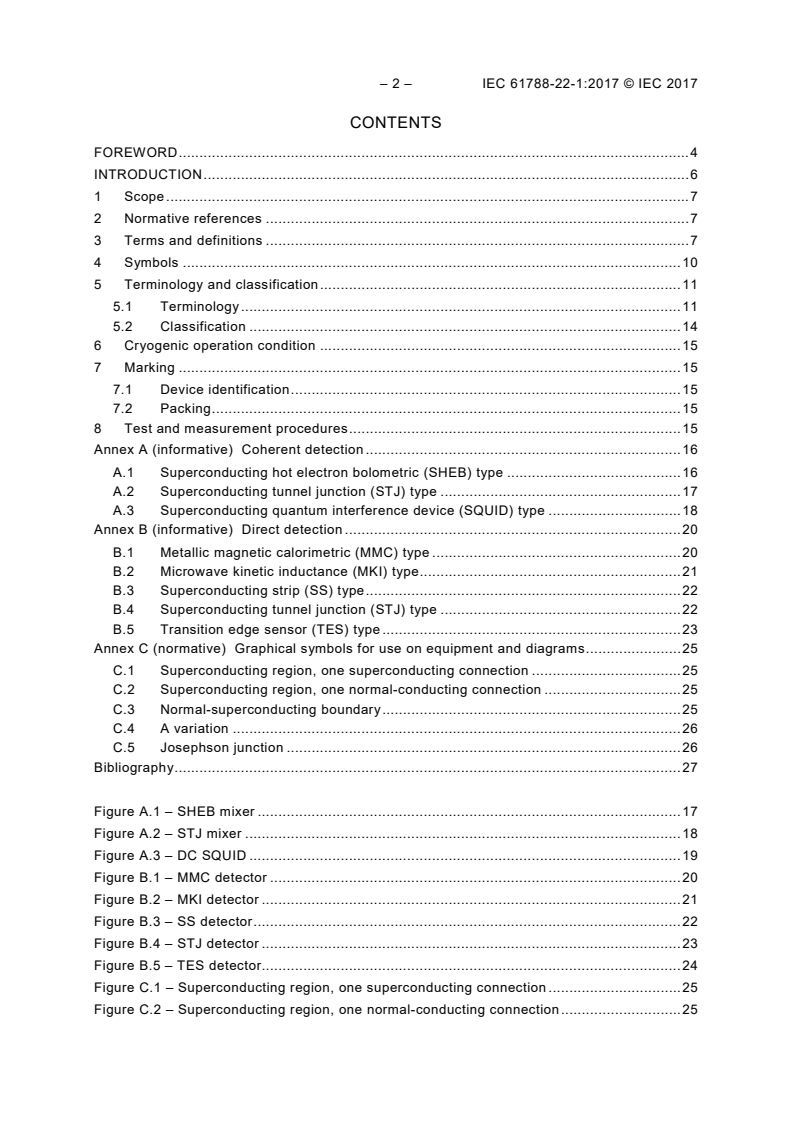
CONTENTS
FOREWORD . 4
INTRODUCTION . 6
1 Scope . 7
2 Normative references . 7
3 Terms and definitions . 7
4 Symbols . 10
5 Terminology and classification . 11
5.1 Terminology . 11
5.2 Classification . 14
6 Cryogenic operation condition . 15
7 Marking . 15
7.1 Device identification . 15
7.2 Packing . 15
8 Test and measurement procedures . 15
Annex A (informative) Coherent detection . 16
A.1 Superconducting hot electron bolometric (SHEB) type . 16
A.2 Superconducting tunnel junction (STJ) type . 17
A.3 Superconducting quantum interference device (SQUID) type . 18
Annex B (informative) Direct detection . 20
B.1 Metallic magnetic calorimetric (MMC) type . 20
B.2 Microwave kinetic inductance (MKI) type . 21
B.3 Superconducting strip (SS) type . 22
B.4 Superconducting tunnel junction (STJ) type . 22
B.5 Transition edge sensor (TES) type . 23
Annex C (normative) Graphical symbols for use on equipment and diagrams . 25
C.1 Superconducting region, one superconducting connection . 25
C.2 Superconducting region, one normal-conducting connection . 25
C.3 Normal-superconducting boundary . 25
C.4 A variation . 26
C.5 Josephson junction . 26
Bibliography . 27
Figure A.1 – SHEB mixer . 17
Figure A.2 – STJ mixer . 18
Figure A.3 – DC SQUID . 19
Figure B.1 – MMC detector . 20
Figure B.2 – MKI detector . 21
Figure B.3 – SS detector . 22
Figure B.4 – STJ detector . 23
Figure B.5 – TES detector . 24
Figure C.1 – Superconducting region, one superconducting connection . 25
Figure C.2 – Superconducting region, one normal-conducting connection . 25
Figure C.3 – Superconducting region, one superconducting connection, and one
normal-conducting connection (normal-superconducting boundary, IEC 60417-
6370:2016-09) . 25
Figure C.4 – Series connection . 26
Figure C.5 – Superconducting region, two superconducting connections with extremely
small non-superconducting region (Josephson junction, IEC 60417-6371:2016-09) . 26
Table 1 – Measurands . 12
Table 2 – Classification of measurands . 12
Table 3 – Nomenclature of superconducting sensors and detectors: type, full names,
and acronym examples . 13
Table 4 – Classification of detection principles . 14
– 4 – IEC 61788-22-1:2017 © IEC 2017
INTERNATIONAL ELECTROTECHNICAL COMMISSION
____________
SUPERCONDUCTIVITY –
Part 22-1: Superconducting electronic devices –
Generic specification for sensors and detectors
FOREWORD
1) The International Electrotechnical Commission (IEC) is a worldwide organization for standardization comprising
all national electrotechnical committees (IEC National Committees). The object of IEC is to promote
international co-operation on all questions concerning standardization in the electrical and electronic fields. To
this end and in addition to other activities, IEC publishes International Standards, Technical Specifications,
Technical Reports, Publicly Available Specifications (PAS) and Guides (hereafter referred to as "IEC
Publication(s)"). Their preparation is entrusted to technical committees; any IEC National Committee interested
in the subject dealt with may participate in this preparatory work. International, governmental and non-
governmental organizations liaising with the IEC also participate in this preparation. IEC collaborates closely
with the International Organization for Standardization (ISO) in accordance with conditions determined by
agreement between the two organizations.
2) The formal decisions or agreements of IEC on technical matters express, as nearly as possible, an international
consensus of opinion on the relevant subjects since each technical committee has representation from all
interested IEC National Committees.
3) IEC Publications have the form of recommendations for international use and are accepted by IEC National
Committees in that sense. While all reasonable efforts are made to ensure that the technical content of IEC
Publications is accurate, IEC cannot be held responsible for the way in which they are used or for any
misinterpretation by any end user.
4) In order to promote international uniformity, IEC National Committees undertake to apply IEC Publications
transparently to the maximum extent possible in their national and regional publications. Any divergence
between any IEC Publication and the corresponding national or regional publication shall be clearly indicated in
the latter.
5) IEC itself does not provide any attestation of conformity. Independent certification bodies provide conformity
assessment services and, in some areas, access to IEC marks of conformity. IEC is not responsible for any
services carried out by independent certification bodies.
6) All users should ensure that they have the latest edition of this publication.
7) No liability shall attach to IEC or its directors, employees, servants or agents including individual experts and
members of its technical committees and IEC National Committees for any personal injury, property damage or
other damage of any nature whatsoever, whether direct or indirect, or for costs (including legal fees) and
expenses arising out of the publication, use of, or reliance upon, this IEC Publication or any other IEC
Publications.
8) Attention is drawn to the Normative references cited in this publication. Use of the referenced publications is
indispensable for the correct application of this publication.
9) Attention is drawn to the possibility that some of the elements of this IEC Publication may be the subject of
patent rights. IEC shall not be held responsible for identifying any or all such patent rights.
International Standard IEC 61788-22-1 has been prepared by IEC technical committee 90:
Superconductivity.
The text of this standard is based on the following documents:
FDIS Report on voting
90/388/FDIS 90/391/RVD
Full information on the voting for the approval of this International Standard can be found in
the report on voting indicated in the above table.
This document has been drafted in accordance with the ISO/IEC Directives, Part 2.
A list of all parts in the IEC 61788 series, published under the general title Superconductivity,
can be found on the IEC website.
The committee has decided that the contents of this document will remain unchanged until the
stability date indicated on the IEC website under "http://webstore.iec.ch" in the data related to
the specific document. At this date, the document will be
• reconfirmed,
• withdrawn,
• replaced by a revised edition, or
• amended.
A bilingual version of this publication may be issued at a later date.
– 6 – IEC 61788-22-1:2017 © IEC 2017
INTRODUCTION
Superconductivity offers various possibilities for the realization of sensing and detection of a
variety of measurands. Several sensors and detectors have been developed, exploiting
features like superconducting energy gaps, sharp normal-superconducting transition,
nonlinear I–V characteristics, superconducting coherent states, and quantization of magnetic
flux. All these properties can be influenced by the interaction with electromagnetic fields,
photons, ions, etc. Superconducting sensors and detectors have extremely high performance
for energy resolution, time response, and low noise, most of which cannot be realized by any
other phenomena.
The word "sensor" is normally used for measuring stationary or slowly changing
electromagnetic fields, physical quantities such as current and temperature. On the other
hand, the word "detector" is normally used for single quanta such as photons from infrared to
γ-rays and individual particles. However, the boundary between "sensor" and "detector" is
ambiguous. In this document, therefore, both "sensor" and "detector" are used. Additionally, a
detector using a sensor is possible, for example, X-ray detector using transition edge sensor
(TES) that measures temperature rise due to the deposition of measurand energy. In this
document, for example, the terminology "transition edge sensor X-ray detector" is used for X-
ray detection using TES.
Superconducting sensors and detectors have been applied to a variety of fields including
medical diagnosis, telecommunications, mineral exploration, astronomical instruments,
quantum information processing, and analytical instruments. For users, IEC standardization is
necessary because there is confusing terminology, there are no graphical symbols for
diagrams, and no test methods.
SUPERCONDUCTIVITY –
Part 22-1: Superconducting electronic devices –
Generic specification for sensors and detectors
1 Scope
This part of IEC 61788-22-1 describes general items concerning the specifications for
superconducting sensors and detectors, which are the basis for specifications given in other
parts of IEC 61788 for various types of sensors and detectors. The sensors and detectors
described are basically made of superconducting materials and depend on superconducting
phenomena or related phenomena. The objects to be measured (measurands) include
magnetic fields, electromagnetic waves, photons of various energies, electrons, ions,
α-particles, and others.
2 Normative references
The following documents are referred to in the text in such a way that some or all of their
content constitutes requirements of this document. For dated references, only the edition
cited applies. For undated references, the latest edition of the referenced document (including
any amendments) applies.
IEC 60027 (all parts), Letter symbols to be used in electrical technology
IEC 60050-815, International Electrotechnical Vocabulary – Part 815: Superconductivity
IEC 60417, Graphical symbols for use on equipment (available at: http://www.graphical-
symbols.info)
IEC 60617, Graphical symbols for diagrams (available at: http://std.iec.ch/iec60617)
ISO 1000, SI units and recommendations for the use of their multiples and of certain other
units
ISO 7000, Graphical symbols for use on equipment – Registered symbols (available at:
http://www.graphical-symbols.info)
3 Terms and definitions
For the purposes of this document, the terms and definitions given in IEC 60050-815 and the
following apply.
ISO and IEC maintain terminological databases for use in standardization at the following
addresses:
• IEC Electropedia: available at http://www.electropedia.org/
• ISO Online browsing platform: available at http://www.iso.org/obp
– 8 – IEC 61788-22-1:2017 © IEC 2017
3.1
additional positive feedback
APF
method enhancing voltage-flux transformation ratio by using resistance and coupling coil to
SQUID ring
3.2
critical current modulation parameter
β
L
parameter defined by 2LI /Φ , where L is the SQUID washer inductance, I is the critical
c 0 c
current of a Josephson junction, for DC SQUIDs, and a parameter defined by 2πLI /Φ for RF
c 0
SQUIDs
Note 1 to entry: The term "shielding parameter" can also be used.
3.3
Stewart-McCumber parameter
β
C
parameter defined by 2πI R C/Φ , where R is the normal state resistance of a Josephson
c n 0 n
junction, and C is the capacitance of a Josephson junction
3.4
bridge junction
junction formed from two superconductors connected by a superconducting bridge of small
section
Note 1 to entry: The term "microbridge" can also be used.
3.5
critical current
I
c
maximum direct current that can be regarded as flowing through a Josephson junction without
resistance
3.6
critical current density
J
c
critical current divided by the cross-section of the conductor or the junction area of the
Josephson junction
3.7
feedback coil
coil that is inductively coupled to a SQUID operated in the flux locked loop (FLL) mode
3.8
flux locked loop
FLL
method that improves linearity and dynamic range of a SQUID by using negative feedback to
keep the constant flux number in the SQUID ring
3.9
gradiometer
configuration of superconducting loops coupled to a SQUID magnetometer, or of multiple
SQUID magnetometers that are arranged so as to be insensitive to homogenous magnetic
fields or to be sensitive to magnetic field gradients
3.10
metallic magnetic calorimetric detector
type of superconducting device that the temperature increase of a metallic absorber is
measured by sensing the magnetization change of the absorber because of measurand
energy deposition
3.11
microwave kinetic inductance detector
type of superconducting device that uses the microwave surface impedance change of a
superconducting strip because of measurand energy deposition
3.12
normal state resistance
resistance of a superconductor or a Josephson junction at a normal state
Note 1 to entry: In a superconductor or a TES, it is the resistance at a temperature just above the
superconducting transition.
Note 2 to entry: In a Josephson junction, it is the tunnelling resistance at a bias voltage well above 2∆/e.
3.13
planar gradiometer
kind of configuration of the flux pickup loop that measures a magnetic field gradient in the
plane of the flux pickup loop coupled to a SQUID
3.14
quasiparticle
excitation combining properties of an electron and a hole that is created by breaking a Cooper
pair in a superconductor
3.15
superconducting hot electron bolometric mixer
type of superconducting device that uses heterodyne mixing with the resistive transition from
the superconducting state to the normal state in a superconducting microbridge because of
measurand energy deposition
3.16
superconducting quantum interference device sensor
SQUID sensor
type of superconducting device that uses quantum interference occurring in a closed electrical
circuit containing one or more Josephson junctions
Note 1 to entry: Every measurand, for example magnetic fields or electric currents, that is transformed into a
change of magnetic flux threading the superconducting structure can be sensed by a SQUID.
3.17
SQUID array
SQA
device consisting of series and/or parallel arrays of multiple SQUIDs
3.18
nano-SQUID
device whose largest loop dimension is less than 500 nm
3.19
SQUID ring
multiply superconducting structure that contains one or more Josephson junctions
Note 1 to entry: The term "SQUID loop" can also be used.
– 10 – IEC 61788-22-1:2017 © IEC 2017
3.20
SQUID amplifier
current–voltage converter using a single SQUID, SQUID array or other SQUID-based current
sensor circuits
3.21
subgap region
lower branch of the hysteretic I–V characteristic of a tunnel junction where the voltage is less
than 2∆
3.22
subgap current
quasiparticle tunnelling current in the subgap region of a tunnel junction
Note 1 to entry: In Josephson tunnel junctions, the whole subgap region is observable when the DC Josephson
effect is suppressed by applying a magnetic field parallel to the plane of the junction area.
3.23
superconducting strip detector
type of superconducting device that uses the local resistive change in a long superconducting
strip because of measurand energy deposition
Note 1 to entry: The name for a photon detector, superconducting nanowire photon detector, is not recommended
for most cases, since the dimensions of superconductors are often in discord with the current definition of
"nanowire" in ISO/TS 80004-2:2015, in which "nanowire" or "nanofibre" is defined as nano-objects with two external
dimensions in the nanoscale that are approximately 1 nm to 100 nm, and the third dimensions significantly larger.
The dimensions of the superconducting strip type meet the definition of "nanoribbon" or "nanotape" in most cases.
Note 2 to entry: The terms "nanoribbon" and "nanotape" have one external dimension in the nanoscale and the
other two external dimensions significantly larger (typically by more than 3 times). In addition, the two larger
dimensions significantly differ from each other. "Nanostrip" is preferable to "nanoribbon" and "nanotape" for
superconducting sensors and detectors.
Note 3 to entry: An example of the superconducting nanowires is the strip with the dimensions of 10 nm × 30 nm
× 10 µm. The difference between the thickness and width is approximately less than 3 times. That superconductor
can be called "superconducting nanowire photon detector".
3.24
superconducting tunnel junction detector
type of superconducting device that uses the change of electron tunnelling between two
superconductors or a superconductor and a normal conductor separated by tunnelling barrier
because of measurand energy deposition
3.25
temperature sensitivity
superconducting transition edge steepness that is defined by dlnR/dlnT where R is the
resistance and T is the temperature of TES
3.26
transition edge sensor detector
type of superconducting device that uses the resistive change within a sharp normal-to-
superconducting transition as a temperature sensor because of measurand energy deposition
4 Symbols
Units, graphical and letter symbols shall be taken from the following standards:
• IEC 60027 (all parts);
• IEC 60417;
• IEC 60617;
• ISO 1000;
• ISO 7000.
Graphical symbols for use on equipment and diagrams, such as superconducting region,
normal connection, superconducting connection, normal-superconducting boundary,
Josephson junction, are defined in Annex C, and IEC 60417 and IEC 60617. Graphical
symbols specific to other sensors or detectors are defined in other parts of IEC 61788.
5 Terminology and classification
5.1 Terminology
Table 1 lists the measurands which are defined as categories, objects, or physical quantities
that induce enegy deposition and are to be sensed or detected by superconducting sensors
and detectors. The measurands, arranged in alphabetical order, are: atoms and molecules,
elementary particles, physical quantities, and radiations. Each entry in Table 1 not only
represents the measurand itself, but also its temporal or spatial distribution.
Any other terminology peculiar to one of the devices covered by this document shall be taken
from the relevant IEC or ISO standards.
– 12 – IEC 61788-22-1:2017 © IEC 2017
Table 1 – Measurands
Category Object Physical quantity
Atoms and molecules Atoms Count, energy, flux, time
Organic molecules Count, energy, flux, time
Nonorganic molecules Count, energy, flux, time
Other (specify)
Elementary particles Dark matters Count, energy, flux, time
Electrons Count, energy, flux, time
Neutrinos Count, energy, flux, time
Neutrons Count, energy, flux, time
Photons Count, energy, flux, time
Protons Count, energy, flux, time
Positrons Count, energy, flux, time
Other (specify)
Physical quantities Capacitance Amplitude
Current Amplitude
Inductance Amplitude
Magnetic field Strength, distribution
Magnetic flux Density, distribution
Magnetic susceptibility Amplitude
Polarization Amplitude
Resistance Amplitude
Voltage Amplitude
Other (specify)
Radiations Alpha-particles Count, energy, flux
Beta-particles Count, energy, flux
Electromagnetic waves Amplitude
Gamma-rays Count, energy, flux
Optical radiation Count, energy, flux
X-rays Count, energy, flux
Other (specify)
The objects for measurands fall into two classes: fields and physical quantities, and particles,
as listed in Table 2. Based on these classes, detection mechanisms are classified into
coherent detection for fields and physical quantities, and direct detection for particles.
Table 2 – Classification of measurands
Classification Measurand category
Field and physical quantities Physical quantities
Radiations (electromagnetic waves)
Particles Atoms and molecules
Elementary particles
Radiations (individual electromagnetic radiation
quanta)
Table 3 lists the various types of sensors and detectors (alphabetical order). The sensors and
detectors convert measurands to electronic signals. The word "sensor" tends to be used for
devices that measure fields and physical quantities, while the word "detector" tends to be
used for devices that measure single particles. When naming sensors or detectors, the
following word order should be used for nomenclature: device structure or function;
measurand; and a word of detector, magnetometer, mixer, sensor, or other words. Examples
of full names and corresponding acronyms are also listed.
Table 3 – Nomenclature of superconducting sensors and detectors:
type, full names, and acronym examples
Type Full names and acronym example
Metallic Magnetic Calorimetric (MMC) type Metallic Magnetic Calorimetric α-ray Detector
(MMC α-ray detector or MMCAD)
Metallic Magnetic Calorimetric γ-ray Detector
(MMC γ-ray detector or MMCGD)
Metallic Magnetic Calorimetric X-ray Detector
(MMC X-ray detector or MMCXD)
Microwave Kinetic Inductance (MKI) type Microwave Kinetic Inductance Photon Detector
(MKI photon detector or MKIPD)
Microwave Kinetic Inductance X-ray Detector
(MKI X-ray detector or MKIXD)
Superconducting Hot Electron Bolometric (SHEB) type
Superconducting Hot Electron Bolometric Photon
Detector
(SHED photon detector or SHEBPD)
Superconducting Hot Electron Bolometric Terahertz
Mixer
(SHEB terahertz mixer or SHEBTM)
Superconducting Quantum Interference Device Superconducting Quantum Interference Device
(SQUID) type Amplifier
(SQUID amplifier or SQUIDA)
Superconducting Quantum Interference Device
Current Sensor
(SQUID current sensor or SQUIDCS)
Superconducting Quantum Interference Device
Gradiometer
(SQUID gradiometer or SQUIDG)
Superconducting Quantum Interference Device
Magnetometer
(SQUID magnetometer or SQUIDM)
Superconducting Quantum Interference Filter
Magnetometer
(SQIF magnetometer of SQIFM)
Superconducting Quantum Interference Device Array
Magnetometer
(SQUID array magnetometer or SQUIDAM)
Superconducting Strip (SS) type Superconducting Strip Electron Detector
(SS electron detector or SSED)
Superconducting Strip Ion Detector
(SS ion detector or SSID)
Superconducting Strip Particle Detector
(SS particle detector or SSPD)
Superconducting Strip Photon Detector
(SS photon detector or SSPD)
– 14 – IEC 61788-22-1:2017 © IEC 2017
Type Full names and acronym example
Superconducting NanoStrip Photon Detector
(SNS photon detector of SNSPD)
Superconducting Tunnel Junction (STJ) type Superconducting Tunnel Junction Ion Detector
(STJ ion detector or STJID)
Superconducting Tunnel Junction Terahertz Mixer
(STJ terahertz mixer or STJTM)
Superconducting Tunnel Junction Photon Detector
...
IEC 61788-22-1 ®
Edition 1.0 2017-07
INTERNATIONAL
STANDARD
NORME
INTERNATIONALE
Superconductivity –
Part 22-1: Superconducting electronic devices – Generic specification for
sensors and detectors
Supraconductivité –
Partie 22-1: Dispositifs électroniques supraconducteurs – Spécification
générique pour les capteurs et détecteurs
All rights reserved. Unless otherwise specified, no part of this publication may be reproduced or utilized in any form
or by any means, electronic or mechanical, including photocopying and microfilm, without permission in writing from
either IEC or IEC's member National Committee in the country of the requester. If you have any questions about IEC
copyright or have an enquiry about obtaining additional rights to this publication, please contact the address below or
your local IEC member National Committee for further information.
Droits de reproduction réservés. Sauf indication contraire, aucune partie de cette publication ne peut être reproduite
ni utilisée sous quelque forme que ce soit et par aucun procédé, électronique ou mécanique, y compris la photocopie
et les microfilms, sans l'accord écrit de l'IEC ou du Comité national de l'IEC du pays du demandeur. Si vous avez des
questions sur le copyright de l'IEC ou si vous désirez obtenir des droits supplémentaires sur cette publication, utilisez
les coordonnées ci-après ou contactez le Comité national de l'IEC de votre pays de résidence.
IEC Central Office Tel.: +41 22 919 02 11
3, rue de Varembé info@iec.ch
CH-1211 Geneva 20 www.iec.ch
Switzerland
About the IEC
The International Electrotechnical Commission (IEC) is the leading global organization that prepares and publishes
International Standards for all electrical, electronic and related technologies.
About IEC publications
The technical content of IEC publications is kept under constant review by the IEC. Please make sure that you have the
latest edition, a corrigendum or an amendment might have been published.
IEC publications search - webstore.iec.ch/advsearchform Electropedia - www.electropedia.org
The advanced search enables to find IEC publications by a The world's leading online dictionary on electrotechnology,
variety of criteria (reference number, text, technical containing more than 22 000 terminological entries in English
committee,…). It also gives information on projects, replaced and French, with equivalent terms in 16 additional languages.
and withdrawn publications. Also known as the International Electrotechnical Vocabulary
(IEV) online.
IEC Just Published - webstore.iec.ch/justpublished
Stay up to date on all new IEC publications. Just Published IEC Glossary - std.iec.ch/glossary
details all new publications released. Available online and 67 000 electrotechnical terminology entries in English and
once a month by email. French extracted from the Terms and Definitions clause of
IEC publications issued since 2002. Some entries have been
IEC Customer Service Centre - webstore.iec.ch/csc collected from earlier publications of IEC TC 37, 77, 86 and
If you wish to give us your feedback on this publication or CISPR.
need further assistance, please contact the Customer Service
Centre: sales@iec.ch.
A propos de l'IEC
La Commission Electrotechnique Internationale (IEC) est la première organisation mondiale qui élabore et publie des
Normes internationales pour tout ce qui a trait à l'électricité, à l'électronique et aux technologies apparentées.
A propos des publications IEC
Le contenu technique des publications IEC est constamment revu. Veuillez vous assurer que vous possédez l’édition la
plus récente, un corrigendum ou amendement peut avoir été publié.
Recherche de publications IEC - Electropedia - www.electropedia.org
webstore.iec.ch/advsearchform Le premier dictionnaire d'électrotechnologie en ligne au
La recherche avancée permet de trouver des publications IEC monde, avec plus de 22 000 articles terminologiques en
en utilisant différents critères (numéro de référence, texte, anglais et en français, ainsi que les termes équivalents dans
comité d’études,…). Elle donne aussi des informations sur les 16 langues additionnelles. Egalement appelé Vocabulaire
projets et les publications remplacées ou retirées. Electrotechnique International (IEV) en ligne.
IEC Just Published - webstore.iec.ch/justpublished Glossaire IEC - std.iec.ch/glossary
Restez informé sur les nouvelles publications IEC. Just 67 000 entrées terminologiques électrotechniques, en anglais
Published détaille les nouvelles publications parues. et en français, extraites des articles Termes et Définitions des
Disponible en ligne et une fois par mois par email. publications IEC parues depuis 2002. Plus certaines entrées
antérieures extraites des publications des CE 37, 77, 86 et
Service Clients - webstore.iec.ch/csc CISPR de l'IEC.
Si vous désirez nous donner des commentaires sur cette
publication ou si vous avez des questions contactez-nous:
sales@iec.ch.
IEC 61788-22-1 ®
Edition 1.0 2017-07
INTERNATIONAL
STANDARD
NORME
INTERNATIONALE
Superconductivity –
Part 22-1: Superconducting electronic devices – Generic specification for
sensors and detectors
Supraconductivité –
Partie 22-1: Dispositifs électroniques supraconducteurs – Spécification
générique pour les capteurs et détecteurs
INTERNATIONAL
ELECTROTECHNICAL
COMMISSION
COMMISSION
ELECTROTECHNIQUE
INTERNATIONALE
ICS 17.220; 29.050 ISBN 978-2-8322-7308-1
– 2 – IEC 61788-22-1:2017 © IEC 2017
CONTENTS
CONTENTS . 2
FOREWORD . 4
INTRODUCTION . 6
1 Scope . 7
2 Normative references . 7
3 Terms and definitions . 7
4 Symbols . 10
5 Terminology and classification . 11
5.1 Terminology . 11
5.2 Classification . 14
6 Cryogenic operation condition . 15
7 Marking . 15
7.1 Device identification . 15
7.2 Packing . 15
8 Test and measurement procedures . 15
(informative) Coherent detection . 16
A.1 Superconducting hot electron bolometric (SHEB) type . 16
A.2 Superconducting tunnel junction (STJ) type . 17
A.3 Superconducting quantum interference device (SQUID) type . 18
(informative) Direct detection . 20
B.1 Metallic magnetic calorimetric (MMC) type . 20
B.2 Microwave kinetic inductance (MKI) type . 21
B.3 Superconducting strip (SS) type . 22
B.4 Superconducting tunnel junction (STJ) type . 22
B.5 Transition edge sensor (TES) type . 23
(normative) Graphical symbols for use on equipment and diagrams . 25
C.1 Superconducting region, one superconducting connection . 25
C.2 Superconducting region, one normal-conducting connection . 25
C.3 Normal-superconducting boundary . 25
C.4 A variation . 26
C.5 Josephson junction . 26
Bibliography . 27
Figure A.1 – SHEB mixer . 17
Figure A.2 – STJ mixer . 18
Figure A.3 – DC SQUID . 19
Figure B.1 – MMC detector . 20
Figure B.2 – MKI detector . 21
Figure B.3 – SS detector . 22
Figure B.4 – STJ detector . 23
Figure B.5 – TES detector . 24
Figure C.1 – Superconducting region, one superconducting connection . 25
Figure C.2 – Superconducting region, one normal-conducting connection . 25
Figure C.3 – Superconducting region, one superconducting connection, and one
normal-conducting connection (normal-superconducting boundary, IEC 60417-
6370:2016-09) . 25
Figure C.4 – Series connection . 26
Figure C.5 – Superconducting region, two superconducting connections with extremely
small non-superconducting region (Josephson junction, IEC 60417-6371:2016-09) . 26
Table 1 – Measurands . 12
Table 2 – Classification of measurands . 12
Table 3 – Nomenclature of superconducting sensors and detectors: type, full names,
and acronym examples . 13
Table 4 – Classification of detection principles . 14
– 4 – IEC 61788-22-1:2017 © IEC 2017
INTERNATIONAL ELECTROTECHNICAL COMMISSION
____________
SUPERCONDUCTIVITY –
Part 22-1: Superconducting electronic devices –
Generic specification for sensors and detectors
FOREWORD
1) The International Electrotechnical Commission (IEC) is a worldwide organization for standardization comprising
all national electrotechnical committees (IEC National Committees). The object of IEC is to promote
international co-operation on all questions concerning standardization in the electrical and electronic fields. To
this end and in addition to other activities, IEC publishes International Standards, Technical Specifications,
Technical Reports, Publicly Available Specifications (PAS) and Guides (hereafter referred to as "IEC
Publication(s)"). Their preparation is entrusted to technical committees; any IEC National Committee interested
in the subject dealt with may participate in this preparatory work. International, governmental and non-
governmental organizations liaising with the IEC also participate in this preparation. IEC collaborates closely
with the International Organization for Standardization (ISO) in accordance with conditions determined by
agreement between the two organizations.
2) The formal decisions or agreements of IEC on technical matters express, as nearly as possible, an international
consensus of opinion on the relevant subjects since each technical committee has representation from all
interested IEC National Committees.
3) IEC Publications have the form of recommendations for international use and are accepted by IEC National
Committees in that sense. While all reasonable efforts are made to ensure that the technical content of IEC
Publications is accurate, IEC cannot be held responsible for the way in which they are used or for any
misinterpretation by any end user.
4) In order to promote international uniformity, IEC National Committees undertake to apply IEC Publications
transparently to the maximum extent possible in their national and regional publications. Any divergence
between any IEC Publication and the corresponding national or regional publication shall be clearly indicated in
the latter.
5) IEC itself does not provide any attestation of conformity. Independent certification bodies provide conformity
assessment services and, in some areas, access to IEC marks of conformity. IEC is not responsible for any
services carried out by independent certification bodies.
6) All users should ensure that they have the latest edition of this publication.
7) No liability shall attach to IEC or its directors, employees, servants or agents including individual experts and
members of its technical committees and IEC National Committees for any personal injury, property damage or
other damage of any nature whatsoever, whether direct or indirect, or for costs (including legal fees) and
expenses arising out of the publication, use of, or reliance upon, this IEC Publication or any other IEC
Publications.
8) Attention is drawn to the Normative references cited in this publication. Use of the referenced publications is
indispensable for the correct application of this publication.
9) Attention is drawn to the possibility that some of the elements of this IEC Publication may be the subject of
patent rights. IEC shall not be held responsible for identifying any or all such patent rights.
International Standard IEC 61788-22-1 has been prepared by IEC technical committee 90:
Superconductivity.
This bilingual version (2019-08) corresponds to the monolingual English version, published in
2017-07.
The text of this standard is based on the following documents:
FDIS Report on voting
90/388/FDIS 90/391/RVD
Full information on the voting for the approval of this International Standard can be found in
the report on voting indicated in the above table.
The French version of this standard has not been voted upon.
This document has been drafted in accordance with the ISO/IEC Directives, Part 2.
A list of all parts in the IEC 61788 series, published under the general title Superconductivity,
can be found on the IEC website.
The committee has decided that the contents of this document will remain unchanged until the
stability date indicated on the IEC website under "http://webstore.iec.ch" in the data related to
the specific document. At this date, the document will be
• reconfirmed,
• withdrawn,
• replaced by a revised edition, or
• amended.
– 6 – IEC 61788-22-1:2017 © IEC 2017
INTRODUCTION
Superconductivity offers various possibilities for the realization of sensing and detection of a
variety of measurands. Several sensors and detectors have been developed, exploiting
features like superconducting energy gaps, sharp normal-superconducting transition,
nonlinear I–V characteristics, superconducting coherent states, and quantization of magnetic
flux. All these properties can be influenced by the interaction with electromagnetic fields,
photons, ions, etc. Superconducting sensors and detectors have extremely high performance
for energy resolution, time response, and low noise, most of which cannot be realized by any
other phenomena.
The word "sensor" is normally used for measuring stationary or slowly changing
electromagnetic fields, physical quantities such as current and temperature. On the other
hand, the word "detector" is normally used for single quanta such as photons from infrared to
γ-rays and individual particles. However, the boundary between "sensor" and "detector" is
ambiguous. In this document, therefore, both "sensor" and "detector" are used. Additionally, a
detector using a sensor is possible, for example, X-ray detector using transition edge sensor
(TES) that measures temperature rise due to the deposition of measurand energy. In this
document, for example, the terminology "transition edge sensor X-ray detector" is used for X-
ray detection using TES.
Superconducting sensors and detectors have been applied to a variety of fields including
medical diagnosis, telecommunications, mineral exploration, astronomical instruments,
quantum information processing, and analytical instruments. For users, IEC standardization is
necessary because there is confusing terminology, there are no graphical symbols for
diagrams, and no test methods.
SUPERCONDUCTIVITY –
Part 22-1: Superconducting electronic devices –
Generic specification for sensors and detectors
1 Scope
This part of IEC 61788-22-1 describes general items concerning the specifications for
superconducting sensors and detectors, which are the basis for specifications given in other
parts of IEC 61788 for various types of sensors and detectors. The sensors and detectors
described are basically made of superconducting materials and depend on superconducting
phenomena or related phenomena. The objects to be measured (measurands) include
magnetic fields, electromagnetic waves, photons of various energies, electrons, ions,
α-particles, and others.
2 Normative references
The following documents are referred to in the text in such a way that some or all of their
content constitutes requirements of this document. For dated references, only the edition
cited applies. For undated references, the latest edition of the referenced document (including
any amendments) applies.
IEC 60027 (all parts), Letter symbols to be used in electrical technology
IEC 60050-815, International Electrotechnical Vocabulary – Part 815: Superconductivity
IEC 60417, Graphical symbols for use on equipment (available at: http://www.graphical-
symbols.info)
IEC 60617, Graphical symbols for diagrams (available at: http://std.iec.ch/iec60617)
ISO 1000, SI units and recommendations for the use of their multiples and of certain other
units
ISO 7000, Graphical symbols for use on equipment – Registered symbols (available at:
http://www.graphical-symbols.info)
3 Terms and definitions
For the purposes of this document, the terms and definitions given in IEC 60050-815 and the
following apply.
ISO and IEC maintain terminological databases for use in standardization at the following
addresses:
• IEC Electropedia: available at http://www.electropedia.org/
• ISO Online browsing platform: available at http://www.iso.org/obp
– 8 – IEC 61788-22-1:2017 © IEC 2017
3.1
additional positive feedback
APF
method enhancing voltage-flux transformation ratio by using resistance and coupling coil to
SQUID ring
3.2
critical current modulation parameter
β
L
parameter defined by 2LI /Φ , where L is the SQUID washer inductance, I is the critical
c 0 c
current of a Josephson junction, for DC SQUIDs, and a parameter defined by 2πLI /Φ for RF
c 0
SQUIDs
Note 1 to entry: The term "shielding parameter" can also be used.
3.3
Stewart-McCumber parameter
β
C
parameter defined by 2πI R C/Φ , where R is the normal state resistance of a Josephson
c n 0 n
junction, and C is the capacitance of a Josephson junction
3.4
bridge junction
junction formed from two superconductors connected by a superconducting bridge of small
section
Note 1 to entry: The term "microbridge" can also be used.
3.5
critical current
I
c
maximum direct current that can be regarded as flowing through a Josephson junction without
resistance
3.6
critical current density
J
c
critical current divided by the cross-section of the conductor or the junction area of the
Josephson junction
3.7
feedback coil
coil that is inductively coupled to a SQUID operated in the flux locked loop (FLL) mode
3.8
flux locked loop
FLL
method that improves linearity and dynamic range of a SQUID by using negative feedback to
keep the constant flux number in the SQUID ring
3.9
gradiometer
configuration of superconducting loops coupled to a SQUID magnetometer, or of multiple
SQUID magnetometers that are arranged so as to be insensitive to homogenous magnetic
fields or to be sensitive to magnetic field gradients
3.10
metallic magnetic calorimetric detector
type of superconducting device that the temperature increase of a metallic absorber is
measured by sensing the magnetization change of the absorber because of measurand
energy deposition
3.11
microwave kinetic inductance detector
type of superconducting device that uses the microwave surface impedance change of a
superconducting strip because of measurand energy deposition
3.12
normal state resistance
resistance of a superconductor or a Josephson junction at a normal state
Note 1 to entry: In a superconductor or a TES, it is the resistance at a temperature just above the
superconducting transition.
Note 2 to entry: In a Josephson junction, it is the tunnelling resistance at a bias voltage well above 2∆/e.
3.13
planar gradiometer
kind of configuration of the flux pickup loop that measures a magnetic field gradient in the
plane of the flux pickup loop coupled to a SQUID
3.14
quasiparticle
excitation combining properties of an electron and a hole that is created by breaking a Cooper
pair in a superconductor
3.15
superconducting hot electron bolometric mixer
type of superconducting device that uses heterodyne mixing with the resistive transition from
the superconducting state to the normal state in a superconducting microbridge because of
measurand energy deposition
3.16
superconducting quantum interference device sensor
SQUID sensor
type of superconducting device that uses quantum interference occurring in a closed electrical
circuit containing one or more Josephson junctions
Note 1 to entry: Every measurand, for example magnetic fields or electric currents, that is transformed into a
change of magnetic flux threading the superconducting structure can be sensed by a SQUID.
3.17
SQUID array
SQA
device consisting of series and/or parallel arrays of multiple SQUIDs
3.18
nano-SQUID
device whose largest loop dimension is less than 500 nm
3.19
SQUID ring
multiply superconducting structure that contains one or more Josephson junctions
Note 1 to entry: The term "SQUID loop" can also be used.
– 10 – IEC 61788-22-1:2017 © IEC 2017
3.20
SQUID amplifier
current–voltage converter using a single SQUID, SQUID array or other SQUID-based current
sensor circuits
3.21
subgap region
lower branch of the hysteretic I–V characteristic of a tunnel junction where the voltage is less
than 2∆
3.22
subgap current
quasiparticle tunnelling current in the subgap region of a tunnel junction
Note 1 to entry: In Josephson tunnel junctions, the whole subgap region is observable when the DC Josephson
effect is suppressed by applying a magnetic field parallel to the plane of the junction area.
3.23
superconducting strip detector
type of superconducting device that uses the local resistive change in a long superconducting
strip because of measurand energy deposition
Note 1 to entry: The name for a photon detector, superconducting nanowire photon detector, is not recommended
for most cases, since the dimensions of superconductors are often in discord with the current definition of
"nanowire" in ISO/TS 80004-2:2015, in which "nanowire" or "nanofibre" is defined as nano-objects with two external
dimensions in the nanoscale that are approximately 1 nm to 100 nm, and the third dimensions significantly larger.
The dimensions of the superconducting strip type meet the definition of "nanoribbon" or "nanotape" in most cases.
Note 2 to entry: The terms "nanoribbon" and "nanotape" have one external dimension in the nanoscale and the
other two external dimensions significantly larger (typically by more than 3 times). In addition, the two larger
dimensions significantly differ from each other. "Nanostrip" is preferable to "nanoribbon" and "nanotape" for
superconducting sensors and detectors.
Note 3 to entry: An example of the superconducting nanowires is the strip with the dimensions of 10 nm × 30 nm
× 10 µm. The difference between the thickness and width is approximately less than 3 times. That superconductor
can be called "superconducting nanowire photon detector".
3.24
superconducting tunnel junction detector
type of superconducting device that uses the change of electron tunnelling between two
superconductors or a superconductor and a normal conductor separated by tunnelling barrier
because of measurand energy deposition
3.25
temperature sensitivity
superconducting transition edge steepness that is defined by dlnR/dlnT where R is the
resistance and T is the temperature of TES
3.26
transition edge sensor detector
type of superconducting device that uses the resistive change within a sharp normal-to-
superconducting transition as a temperature sensor because of measurand energy deposition
4 Symbols
Units, graphical and letter symbols shall be taken from the following standards:
• IEC 60027 (all parts);
• IEC 60417;
• IEC 60617;
• ISO 1000;
• ISO 7000.
Graphical symbols for use on equipment and diagrams, such as superconducting region,
normal connection, superconducting connection, normal-superconducting boundary,
Josephson junction, are defined in Annex C, and IEC 60417 and IEC 60617. Graphical
symbols specific to other sensors or detectors are defined in other parts of IEC 61788.
5 Terminology and classification
5.1 Terminology
Table 1 lists the measurands which are defined as categories, objects, or physical quantities
that induce enegy deposition and are to be sensed or detected by superconducting sensors
and detectors. The measurands, arranged in alphabetical order, are: atoms and molecules,
elementary particles, physical quantities, and radiations. Each entry in Table 1 not only
represents the measurand itself, but also its temporal or spatial distribution.
Any other terminology peculiar to one of the devices covered by this document shall be taken
from the relevant IEC or ISO standards.
– 12 – IEC 61788-22-1:2017 © IEC 2017
Table 1 – Measurands
Category Object Physical quantity
Atoms and molecules Atoms Count, energy, flux, time
Organic molecules Count, energy, flux, time
Nonorganic molecules Count, energy, flux, time
Other (specify)
Elementary particles Dark matters Count, energy, flux, time
Electrons Count, energy, flux, time
Neutrinos Count, energy, flux, time
Neutrons Count, energy, flux, time
Photons Count, energy, flux, time
Protons Count, energy, flux, time
Positrons Count, energy, flux, time
Other (specify)
Physical quantities Capacitance Amplitude
Current Amplitude
Inductance Amplitude
Magnetic field Strength, distribution
Magnetic flux Density, distribution
Magnetic susceptibility Amplitude
Polarization Amplitude
Resistance Amplitude
Voltage Amplitude
Other (specify)
Radiations Alpha-particles Count, energy, flux
Beta-particles Count, energy, flux
Electromagnetic waves Amplitude
Gamma-rays Count, energy, flux
Optical radiation Count, energy, flux
X-rays Count, energy, flux
Other (specify)
The objects for measurands fall into two classes: fields and physical quantities, and particles,
as listed in Table 2. Based on these classes, detection mechanisms are classified into
coherent detection for fields and physical quantities, and direct detection for particles.
Table 2 – Classification of measurands
Classification Measurand category
Field and physical quantities Physical quantities
Radiations (electromagnetic waves)
Particles Atoms and molecules
Elementary particles
Radiations (individual electromagnetic radiation
quanta)
Table 3 lists the various types of sensors and detectors (alphabetical order). The sensors and
detectors convert measurands to electronic signals. The word "sensor" tends to be used for
devices that measure fields and physical quantities, while the word "detector" tends to be
used for devices that measure single particles. When naming sensors or detectors, the
following word order should be used for nomenclature: device structure or function;
measurand; and a word of detector, magnetometer, mixer, sensor, or other words. Examples
of full names and corresponding acronyms are also listed.
Table 3 – Nomenclature of superconducting sensors and detectors:
type, full names, and acronym examples
Type Full names and acronym example
Metallic Magnetic Calorimetric (MMC) type Metallic Magnetic Calorimetric α-ray Detector
(MMC α-ray detector or MMCAD)
Metallic Magnetic Calorimetric γ-ray Detector
(MMC γ-ray detector or MMCGD)
Metallic Magnetic Calorimetric X-ray Detector
(MMC X-ray detector or MMCXD)
Microwave Kinetic Inductance (MKI) type Microwave Kinetic Inductance Photon Detector
(MKI photon detector or MKIPD)
Microwave Kinetic Inductance X-ray Detector
(MKI X-ray detector or MKIXD)
Superconducting Hot Electron Bolometric (SHEB) type Superconducting Hot Electron Bolometric Photon
Detector
(SHED photon detector or SHEBPD)
Superconducting Hot Electron Bolometric Terahertz
Mixer
(SHEB terahertz mixer or SHEBTM)
Superconducting Quantum Interference Device Superconducting Quantum Interference Device
(SQUID) type Amplifier
(SQUID amplifier or SQUIDA)
Superconducting Quantum Interference Device
Current Sensor
(SQUID current sensor or SQUIDCS)
Superconducting Quantum Interference Device
Gradiometer
(SQUID gradiometer or SQUIDG)
Superconducting Quantum Interference Device
Magnetometer
(SQUID magnetometer or SQUIDM)
Superconducting Quantum Interference Filter
Magnetometer
(SQIF magnetometer of SQIFM)
Superconducting Quantum Interference Device Array
Magnetometer
(SQUID array magnetometer or SQUIDAM)
Superconducting Strip (SS) type Superconducting Strip Electron Detector
(SS electron detector or SSED)
Superconducting Strip Ion Detector
(SS ion detector or SSID)
Superconducting Strip Particle Detector
(SS particle detector or SSPD)
Superconducting Strip Photon Detector
(SS photon detector or SSPD)
– 14 – IEC 61788-22-1:2017 © IEC 2017
Type Full names and acronym example
Superconducting NanoStrip Photon Detector
(SNS photon detector of SNSPD)
Superconducting Tunnel Junction (STJ) type Superconducting Tunnel Junction Ion Detector
(STJ ion detector or STJID)
Superconducting Tunnel Junction Terahertz Mixer
(STJ terahertz mixer or STJTM)
Superconducting Tunnel Junction Photon Detector
(STJ photon detector or STJPD)
Superconducting Tunnel Junction X-ray Detector
(STJ X-ray detector or STJXD)
Superconductor Insulator Superconductor Terahertz
Mixer
(SIS terahertz mixer or SISTM that is equivalent to
STJTM)
Superconductor Normal-conductor Superconductor
Mixer
(SNS mixer or SNSM)
Transition Edge Sensor (TES) type
Transition Edge Sensor α-ray Detector
(TES α-ray detector or TESAD)
Transition Edge Sensor γ-ray Detector
(TES γ-ray detector or TESGD)
Transition Edge Sensor Photon Detector
(TES photon detector or TESPD)
Transition Edge Sensor X-ray detector
(TES X-ray detector or TESXD)
Other Specify
NOTE The nomenclature has the word order of (device structure or function) – (a measurand) – (a word of
detector, magnetometer, mixer, sensor, or other words). The term "nanowire" can be used only for a special case
that superconducting strips have two external dimensions in the nanoscale that is approximately 1 nm to 100 nm;
the difference between the first and second external dimensions is typically less than 3 times; and the third
dimension significantly larger: for example a nanowire with 10 nm × 30 nm × 1 µm. In IEC 61788-22, it is called
"nanostrip" or "strip" because of a difference of considerably larger than 3 times in most cases, although nanotape
or nanoribbon is possible. See also the ISO Online browsing platform: available at https://www.iso.org/obp/ui#home.
5.2 Classification
The operation of the sensors and detectors is classified into two categories: coherent
detection and direct detection (Table 4). The devices used in the category of coherent
detection include bolometers, sensors or mixers, while the devices used in the category of
direct detection include calorimeters or detectors. For operating principles, see Annex A
(coherent detection) and Annex B (direct detection).
Table 4 – Classification of detection principles
Detection principle Type
Coherent detection for fields and physical quantities SHEB, SQUID, STJ
Direct detection for particles MMC, MKI, SS, STJ, TES
It should be noted that direct detectors have a sensitivity for single particles, and they can
also measure a flux of particles. The issue is a difference between time response of
superconducting devices and time interval of energy absorption of individual particles. For the
superconducting sensors and detectors that use temperature rise because of measurand
energy absorption, they are called "bolometer" or "calorimeter" depending on the time
response. When the interval of absorption events is much shorter than the time response, the
term "bolometer" is appropriate for flux measurement. On the other hand, when it is much
longer than the time response, the term "calorimeter" is appropriate for particle counting.
6 Cryogenic operation condition
The superconducting sensors and detectors operate in cryogenic temperatures lower than T
c
or the middle of normal-superconducting transition in order to hold a superconducting state or
to use a sharp normal-superconducting transition for sensing or detecting measurands. The
operation temperature range depends on the types. Specific cryogenic operation condition for
each sensor or detector should be described in other parts of IEC 61788-22 for various types
of sensors and detectors.
The cryogenic temperature can be obtained by liquid helium or other cryogens, Gifford-
McMahon (GM) coolers, pulse tube coolers, adiabatic demagnetization refrigerators (ADR),
3 4 3
He refrigerators, He- He dilution refrigerators, and other cryocoolers.
Performance of sensors and detectors is influenced by both cryogenic environment and
implementation. The cryogenic environment and implementation should be specified in a
standard for each sensor or detector and other separate standards.
7 Marking
7.1 Device identification
The marking on the device or on the packing shall enable clear identification of the device.
The device shall be provided with a traceability code which enables back-tracing of the device
to a certain production or inspection lot.
7.2 Packing
Marking on the packing shall state the following:
a) the device identification code;
b) the measurand, type, name, detection principle, and other informative information in
Tables 1, 2, 3, and 4;
c) the number of enclosed devices;
d) the operating temperature range;
e) the additional specification;
f) the required precautions, if any.
8 Test and measurement procedures
The test and measurement methods should be described in a standard for each sensor or
detector and other separate standards.
– 16 – IEC 61788-22-1:2017 © IEC 2017
(informative)
Coherent detection
A.1 Superconducting hot electron bolometric (SHEB) type
The SHEB type enables detection of sub-millimetre and far-IR radiation (0,3 THz to 10 THz).
SHEBs are more often used as indirect (i.e. coherent or mixing) detectors, although direct
detection is possible. In mixers, the electromagnetic field of the signal photons (ω ) is mixed
s
with a locally generated electromagnetic field at ω frequency (called the local oscillator, LO).
The result is a signal at the difference, or intermediate frequency, ω , where ω = ω − ω .
IF IF 0 s
The original signal in the sub-millimetre band is therefore down-converted into the microwave
band, where more conventional low-noise electronics can amplify and process the signal. A
SHEB is composed by a superconducting microbridge with nanometre or submicron
dimensions, contacted by thick metallic pads. Sub-millimetre radiation signals are coupled
into the microbridge through a lens and an on-chip antenna. The heterodyne mixing process
makes use of the resistive transition between the superconducting state and the normal state
of the superconducting bridge, induced by the heating of radiation signals. This transition
produces a hot-spot. Two types of hot-spot relaxation are used as a detection mechanism: in
the diffusion cooled SHEB the hot electrons diffuse to the surrounding thermal reservoir, while
in the phonon cooled SHEB, the hot electrons are cooled through fast electron–phonon
interaction.
Bolometers are electronic devices that convert measurands into heat, which can then be
detected by a thermometer. Although conventional bolometers usually have antenna-shaped
absorber, thermometer, heat sink, and thermal link as separate elements, in the SHEB type
these various elements are combined. The thermal resistance R = 1/G with the thermal
conductance G provides the coefficient linking incident power P and change in temperature ∆T,
such that ∆T = PR. An important consideration in designing bolometers is the time taken for it
to recover, given by τ = RC, where C is the heat capacity. In SHEB, at a low temperature, the
electron system in materials becomes decoupled from the phonon system, leading to a large
R, while C of the electrons becomes small and proportional to T.
From the physics of device operation, the SHEB type can be categorized as a kind of TES. In
general TES, temperature of both lattice and electron increase due to the incident photon or
electromagnetic wave, while only the electron temperature does for SHEB type. Since the
heat capacity C of the electron is not bigger than C of the lattice except for extremely low
temperature, SHEB type can respond more quickly to the incident signal than general TES.
Electromagnetic
wave
–
e
–
e
Diffusion
Phonon
cool
Normal Normal
cool
electrode electrode
Lattice
(heat bath) (heat bath)
Superconducting
Hot spot
Lattice bridge
Substrate
IEC
IEC
Two pads are connected by microbridge. The signal and local oscillator powers and joule heating due to
The size of normal conducting hot spot DC bias produce a hot spot whose length oscillates at | ω − ω |
0 s
region changes depending on absorbed in the superconducting bridge.
energy.
a) SHEB type mixer concept b) Schematic of a hot electron bolometer
Figure A.1 – SHEB mixer
An example of the SHEB type is a device that consists of two thick metal pads that are
connected or bridged by a small superconducting microbridge of NbN with a thickness of
3,5 nm, a width of 400 nm, and a length of 4 µm (see Figure A.1 a) and A.1 b). Other material
Cu O .
examples are Nb, NbTiN, Al, and YBa
2 3 x
An advantage of the SHEB type is that it operates at very high speeds through either fast
phonon or electron diffusion cooling, which enables heterodyne detection of radiation with a
frequency above about 1 000 GHz that the STJ mixers cannot receive efficiently because of
quasiparticle excitation above a superconducting energy gap. SHEBs can also be used for
direct detection, but their main application is heterodyne detection.
A.2 Superconducting tunnel junction (STJ) type
The STJ structure is exactly the same as that of Josephson tunnel junctions (Figure A.2 a)),
but the Josephson effect needs to be suppressed by a magnetic field applied in parallel to the
junction surface. The STJ type enables coherent detection based on heterodyne mixing of
measurand of electromagnetic waves in millimetre- and submillimetre-wave bands and a local
oscillator frequency in order to downconvert frequencies into the microwave band by using
strong non-linear I–V curves (Figure A.2 b)). The STJ mixers are frequently called
superconductor insulator superconductor (SIS) mixers due to their sandwiched structure. STJ
mixers operating at a cryogenic temperature (e.g. 4 K) are indispensable for frequencies less
than about 1 000 GHz, in which there are no low-noise amplifiers. At the downconverted
frequencies that are normally in the microwave frequency band, low-noise semiconductor-
based amplifiers are available.
– 18 – IEC 61788-22-1:2017 © IEC 2017
Anodic layer
AIO / AI
x
(Nb O )
2 5
Wire Nb
SiO
Top Nb
Base Nb
Quartz substrate
Base Nb: 200 nm Wire Nb: 600 nm AI: ≈ 10 nm
Top Nb: 100 nm SiO : 300 nm Nb O : 100 nm
V (mV)
2 2 5
IEC
IEC
a) Typical structure of a Nb/Al/AlO /Nb STJ b) I–V curves: without local oscillator power
x
(solid line) and with local oscillator power
(dashed line)
Figure A.2 – STJ mixer
/Nb junction, shown in Figure A.2 b). The size and critical
An example of STJ is a Nb/Al/AlO
x
current density decreases and increases, respectively, as the signal frequency increases so
as to keep the normal resistance approximately constant. The typical size and critical current
density of a junction at 500 GHz (0,6 mm in wavelength) are approximately 1 µm and
6 2
100 × 10 A/m at 4,2K, respectively.
An advantage of STJ mixers is very high spectral resolution compared with direct detection of
photons, although STJ mixers have a disadvantage in sensitivity.
A.3
...