

IEC TR 62357-1:2016
(Main)Power systems management and associated information exchange - Part 1: Reference architecture
General Information
- Abstract
IEC TR 62357-1:2016(E) provides a clear and comprehensive map of all standards which are contributing to support interactions, in an open and interoperable way, between actors, components and systems in the field of electricity grids from generation to consumers, including transmission and distribution. The document also brings the vision of the path which will be followed by the concerned IEC technical committees and working groups in the coming years, to improve the global efficiency, market relevancy and coverage of this series of standards. This second edition includes the following significant technical changes with respect to the previous edition:
- it provides updates and defines layered Reference Architecture to help direct longer term goals and activities, specifically to ensure compatibility of all new standards developed in the IEC by benefitting from lessons learned during development of the current standards and their application to actual utility projects as well as through application of other internationally recognized architecture standards.
- It reflects the most recent editions of the IEC standards relating to power systems management and associated information exchange, including the IEC 61850 series and the IEC 61968, IEC 61970 and IEC 62325 Common Information Model (CIM) standards.
- Status
- Published
- Publication Date
- 17-Nov-2016
- Technical Committee
- TC 57 - Power systems management and associated information exchange
- Drafting Committee
- WG 19 - TC 57/WG 19
- Current Stage
- PPUB - Publication issued
- Start Date
- 18-Nov-2016
- Completion Date
- 28-Feb-2017
Overview
IEC TR 62357-1:2016 - "Power systems management and associated information exchange - Part 1: Reference architecture" defines a layered reference architecture and road map for standards that enable open, interoperable interactions across the electricity value chain (generation, transmission, distribution, DER, and consumers). This second edition updates the architecture model and aligns the IEC portfolio - notably the IEC 61850 series and the CIM family (IEC 61968, IEC 61970, IEC 62325) - to improve global efficiency, interoperability and applicability to real utility projects.
Key topics and technical requirements
- Layered Reference Architecture: A structured, SGAM-based (Smart Grid Architecture Model) approach with levels of abstraction to guide consistent design and future standards development.
- Architectural methodology: Use-case driven mapping, SGAM plane, and profile/message modeling to ensure consistent interfaces across systems.
- Data modelling and harmonization: Guidance to align information models (CIM and IEC 61850 data modelling) and define clear profiles for message exchange and data transformation.
- Interoperability: Interface Reference Models (IRM) and profiles that promote vendor-neutral integration between substations, control centres, DERs and market systems.
- Security landscape: Overview of security requirements and relationships with IEC security standards (including IEC 62351 family), resilience measures and mapping security controls to system domains.
- Telecommunication applicability: Applicability statements for communications technologies across Smart Grid sub-networks and recommendations for OT/IT separation and design.
- Standards road map and future work: Prioritized areas such as digitalization, data harmonization and further standard coverage.
Practical applications and who uses it
IEC TR 62357-1 is a strategic guidance document for:
- Utilities and grid operators planning interoperable system upgrades (substation automation, control centre integration, DER connection).
- System integrators and vendors designing compliant devices, profiles or message formats.
- Architects and enterprise IT/OT teams developing model-driven or TOGAF-based enterprise architectures for power systems.
- Regulators and standards bodies seeking a harmonized roadmap and alignment of IEC standards.
- Project managers mapping use cases to standard-based implementations to reduce integration cost and vendor lock-in.
Practical uses include interoperability planning between IEC 61850 devices and CIM-based enterprise systems, secure telecontrol designs, DER integration patterns, and mapping present architectures to the IEC reference model.
Related standards
- IEC 61850 (substation automation, device models)
- IEC 61970 / IEC 61968 / IEC 62325 (CIM - network model, distribution, market interfaces)
- IEC 62351 (security for power system communications)
- SGAM (Smart Grid Architecture Model) and model-driven architecture approaches referenced for implementation guidance
Keywords: IEC TR 62357-1:2016, reference architecture, power systems management, information exchange, IEC 61850, CIM, interoperability, SGAM, IEC 62351, DER integration.
Relations
- Effective Date
- 05-Sep-2023
Get Certified
Connect with accredited certification bodies for this standard

ANCE
Mexican certification and testing association.

Intertek Slovenia
Intertek testing, inspection, and certification services in Slovenia.

LNE (Laboratoire National de Métrologie et d'Essais)
French national laboratory for metrology and testing.
Sponsored listings
Frequently Asked Questions
IEC TR 62357-1:2016 is a technical report published by the International Electrotechnical Commission (IEC). Its full title is "Power systems management and associated information exchange - Part 1: Reference architecture". This standard covers: IEC TR 62357-1:2016(E) provides a clear and comprehensive map of all standards which are contributing to support interactions, in an open and interoperable way, between actors, components and systems in the field of electricity grids from generation to consumers, including transmission and distribution. The document also brings the vision of the path which will be followed by the concerned IEC technical committees and working groups in the coming years, to improve the global efficiency, market relevancy and coverage of this series of standards. This second edition includes the following significant technical changes with respect to the previous edition: - it provides updates and defines layered Reference Architecture to help direct longer term goals and activities, specifically to ensure compatibility of all new standards developed in the IEC by benefitting from lessons learned during development of the current standards and their application to actual utility projects as well as through application of other internationally recognized architecture standards. - It reflects the most recent editions of the IEC standards relating to power systems management and associated information exchange, including the IEC 61850 series and the IEC 61968, IEC 61970 and IEC 62325 Common Information Model (CIM) standards.
IEC TR 62357-1:2016(E) provides a clear and comprehensive map of all standards which are contributing to support interactions, in an open and interoperable way, between actors, components and systems in the field of electricity grids from generation to consumers, including transmission and distribution. The document also brings the vision of the path which will be followed by the concerned IEC technical committees and working groups in the coming years, to improve the global efficiency, market relevancy and coverage of this series of standards. This second edition includes the following significant technical changes with respect to the previous edition: - it provides updates and defines layered Reference Architecture to help direct longer term goals and activities, specifically to ensure compatibility of all new standards developed in the IEC by benefitting from lessons learned during development of the current standards and their application to actual utility projects as well as through application of other internationally recognized architecture standards. - It reflects the most recent editions of the IEC standards relating to power systems management and associated information exchange, including the IEC 61850 series and the IEC 61968, IEC 61970 and IEC 62325 Common Information Model (CIM) standards.
IEC TR 62357-1:2016 is classified under the following ICS (International Classification for Standards) categories: 31.220.10 - Plug-and-socket devices. Connectors; 33.200 - Telecontrol. Telemetering. The ICS classification helps identify the subject area and facilitates finding related standards.
IEC TR 62357-1:2016 has the following relationships with other standards: It is inter standard links to IEC TR 62357-1:2012. Understanding these relationships helps ensure you are using the most current and applicable version of the standard.
IEC TR 62357-1:2016 is available in PDF format for immediate download after purchase. The document can be added to your cart and obtained through the secure checkout process. Digital delivery ensures instant access to the complete standard document.
Standards Content (Sample)
IEC TR 62357-1 ®
Edition 2.0 2016-11
TECHNICAL
REPORT
colour
inside
Power systems management and associated information exchange –
Part 1: Reference architecture
All rights reserved. Unless otherwise specified, no part of this publication may be reproduced or utilized in any form
or by any means, electronic or mechanical, including photocopying and microfilm, without permission in writing from
either IEC or IEC's member National Committee in the country of the requester. If you have any questions about IEC
copyright or have an enquiry about obtaining additional rights to this publication, please contact the address below or
your local IEC member National Committee for further information.
IEC Central Office Tel.: +41 22 919 02 11
3, rue de Varembé Fax: +41 22 919 03 00
CH-1211 Geneva 20 info@iec.ch
Switzerland www.iec.ch
About the IEC
The International Electrotechnical Commission (IEC) is the leading global organization that prepares and publishes
International Standards for all electrical, electronic and related technologies.
About IEC publications
The technical content of IEC publications is kept under constant review by the IEC. Please make sure that you have the
latest edition, a corrigenda or an amendment might have been published.
IEC Catalogue - webstore.iec.ch/catalogue Electropedia - www.electropedia.org
The stand-alone application for consulting the entire The world's leading online dictionary of electronic and
bibliographical information on IEC International Standards, electrical terms containing 20 000 terms and definitions in
Technical Specifications, Technical Reports and other English and French, with equivalent terms in 15 additional
documents. Available for PC, Mac OS, Android Tablets and languages. Also known as the International Electrotechnical
iPad. Vocabulary (IEV) online.
IEC publications search - www.iec.ch/searchpub IEC Glossary - std.iec.ch/glossary
The advanced search enables to find IEC publications by a 65 000 electrotechnical terminology entries in English and
variety of criteria (reference number, text, technical French extracted from the Terms and Definitions clause of
committee,…). It also gives information on projects, replaced IEC publications issued since 2002. Some entries have been
and withdrawn publications. collected from earlier publications of IEC TC 37, 77, 86 and
CISPR.
IEC Just Published - webstore.iec.ch/justpublished
Stay up to date on all new IEC publications. Just Published IEC Customer Service Centre - webstore.iec.ch/csc
details all new publications released. Available online and If you wish to give us your feedback on this publication or
also once a month by email. need further assistance, please contact the Customer Service
Centre: csc@iec.ch.
IEC TR 62357-1 ®
Edition 2.0 2016-11
TECHNICAL
REPORT
colour
inside
Power systems management and associated information exchange –
Part 1: Reference architecture
INTERNATIONAL
ELECTROTECHNICAL
COMMISSION
ICS 33.200 ISBN 978-2-8322-3764-9
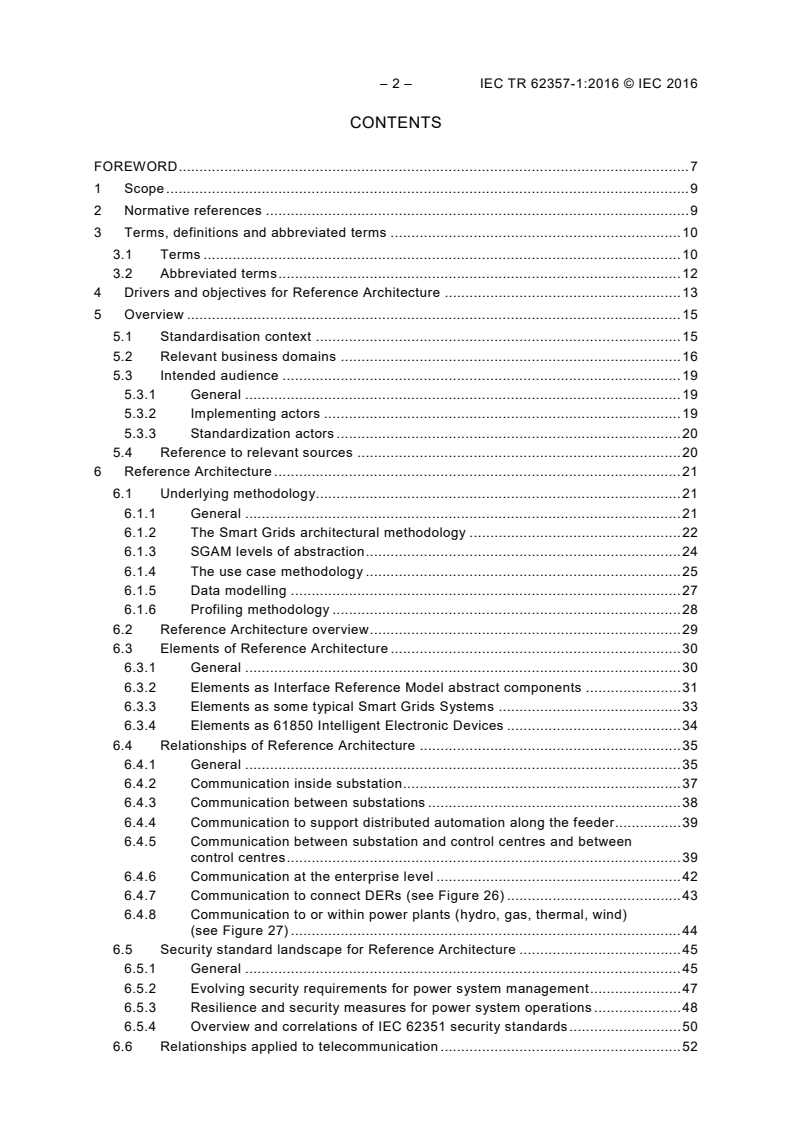
– 2 – IEC TR 62357-1:2016 © IEC 2016
CONTENTS
FOREWORD . 7
1 Scope . 9
2 Normative references . 9
3 Terms, definitions and abbreviated terms . 10
3.1 Terms . 10
3.2 Abbreviated terms . 12
4 Drivers and objectives for Reference Architecture . 13
5 Overview . 15
5.1 Standardisation context . 15
5.2 Relevant business domains . 16
5.3 Intended audience . 19
5.3.1 General . 19
5.3.2 Implementing actors . 19
5.3.3 Standardization actors . 20
5.4 Reference to relevant sources . 20
6 Reference Architecture . 21
6.1 Underlying methodology. 21
6.1.1 General . 21
6.1.2 The Smart Grids architectural methodology . 22
6.1.3 SGAM levels of abstraction . 24
6.1.4 The use case methodology . 25
6.1.5 Data modelling . 27
6.1.6 Profiling methodology . 28
6.2 Reference Architecture overview . 29
6.3 Elements of Reference Architecture . 30
6.3.1 General . 30
6.3.2 Elements as Interface Reference Model abstract components . 31
6.3.3 Elements as some typical Smart Grids Systems . 33
6.3.4 Elements as 61850 Intelligent Electronic Devices . 34
6.4 Relationships of Reference Architecture . 35
6.4.1 General . 35
6.4.2 Communication inside substation . 37
6.4.3 Communication between substations . 38
6.4.4 Communication to support distributed automation along the feeder. 39
6.4.5 Communication between substation and control centres and between
control centres . 39
6.4.6 Communication at the enterprise level . 42
6.4.7 Communication to connect DERs (see Figure 26) . 43
6.4.8 Communication to or within power plants (hydro, gas, thermal, wind)
(see Figure 27) . 44
6.5 Security standard landscape for Reference Architecture . 45
6.5.1 General . 45
6.5.2 Evolving security requirements for power system management . 47
6.5.3 Resilience and security measures for power system operations . 48
6.5.4 Overview and correlations of IEC 62351 security standards . 50
6.6 Relationships applied to telecommunication . 52
6.6.1 General . 52
6.6.2 Applicability statement of communication technologies to the Smart
Grids sub-networks . 54
6.7 Interoperability . 56
7 Use of Reference Architecture . 56
7.1 General . 56
7.2 Development of Enterprise Architecture . 56
7.2.1 General . 56
7.2.2 Model Driven Architecture . 57
7.2.3 The Open Group Architecture Framework . 57
7.3 How to evolve from a Present User Architecture to Reference Architecture . 58
7.4 Example: how to map a use case using Reference Architecture . 58
7.5 Development of information exchange specification . 67
7.6 Integrating security in Reference Architecture . 68
7.6.1 General . 68
7.6.2 Identification of security requirements . 69
7.6.3 Mapping of security to power system domains . 70
7.6.4 Security controls . 71
8 Main areas of future standardisation work. 73
8.1 General . 73
8.2 Increase standard usage efficiency through digitalisation . 73
8.3 Harmonise data modelling . 73
8.4 Other future topics . 74
9 Conclusion . 74
Annex A (informative) SGAM Layer description . 75
Annex B (informative) Elements examples . 76
B.1 Example of control centre distribution systems . 76
B.2 Example of a system, the case of network model management system . 76
B.3 Example of a power flow component . 77
Annex C (informative) Relationship examples . 79
C.1 General . 79
C.2 Data transformation via gateways and adapters . 79
C.3 Example of a Message Exchange . 80
Annex D (informative) TC 57 standards descriptions and roadmaps . 84
D.1 TC 57 Working Group 03 . 84
D.2 TC 57 Working Group 10 . 85
D.2.1 General . 85
D.2.2 IEC 61850 standard overview . 85
D.3 TC 57 Working Group 13 . 87
D.3.1 General . 87
D.3.2 IEC 61970 standard overview . 87
D.4 TC 57 Working Group 14 . 89
D.4.1 General . 89
D.4.2 IEC 61968 standard overview . 89
D.5 TC 57 Working Group 15 . 91
D.5.1 General . 91
D.5.2 IEC 62351 standard overview . 91
D.6 TC 57 Working Group 16 . 100
– 4 – IEC TR 62357-1:2016 © IEC 2016
D.6.1 General . 100
D.6.2 IEC 62325 standard overview . 100
D.7 TC 57 Working Group 17 . 105
D.8 TC 57 Working Group 18 . 105
D.9 TC 57 Working Group 19 . 106
D.9.1 General . 106
D.9.2 IEC 62357 and IEC 62361 related standard overview . 106
D.10 TC 57 Working Group 20 . 107
D.11 TC 57 Working Group 21 . 108
D.11.1 General . 108
D.11.2 IEC 62746 related standard overview . 108
D.12 Supplemental standards developed by the IEC and other bodies . 109
Bibliography . 110
Figure 1 – Core domain of Reference Architecture . 16
Figure 2 – IEC TS 62913 conceptual model . 17
Figure 3 – Two infrastructures (OT/IT) must be designed, operated, and secured . 18
Figure 4 – Relevant sources for IEC TR 62357-1:2016 . 21
Figure 5 – SGAM plane . 22
Figure 6 – SGAM Model . 23
Figure 7 – SGAM levels of abstraction . 24
Figure 8 – Interactions between the Business and Function layers . 27
Figure 9 – Data modelling and harmonization work mapping . 28
Figure 10 – Information Models, Profiles and Messages . 29
Figure 11 – Reference Architecture . 30
Figure 12 – Power systems information related standards. 31
Figure 13 – Distribution IRM Model . 32
Figure 14 – Flexibility for assignment of element “Volt/Var Control” to SGAM segments
(M490 C-Reference Architecture) . 33
Figure 15 – SGCG/M490 Smart Grids systems on SGAM Plane . 34
Figure 16 – IEC 61850 Data Modelling . 35
Figure 17 – Functions of a substation automation system allocated logically on three
different levels (station, bay/unit, or process) . 36
Figure 18 – IEC 61850 related standards . 37
Figure 19 – Communication inside substation . 38
Figure 20 – Communication between substations . 38
Figure 21 – IEC 61850 Telecontrol and control equipment and systems related
standards . 40
Figure 22 – Communication between substation and control centres . 41
Figure 23 – Communication between control centre . 41
Figure 24 – CIM Communication layer standards . 42
Figure 25 – Communication from control centre / trading system to a market place . 43
Figure 26 – Communication to connect DER . 44
Figure 27 – Communication to/or within power plants . 44
Figure 28 – Generic security architecture . 45
Figure 29 – Architecture of key power system management security standards and
guidelines . 46
Figure 30 – Typical cyber security requirements, threats, and possible attack
techniques . 48
Figure 31 – Interrelationships between IEC communication standards and IEC 62351
security standards. 51
Figure 32 – Mapping of communication networks on SGAM . 54
Figure 33 – Use of Reference Architecture in TOGAF . 58
Figure 34 – CIM circuit breaker application view . 59
Figure 35 – Real world devices . 61
Figure 36 – Operate a circuit breaker with IEC 61850 . 62
Figure 37 – SCL for LNs . 63
Figure 38 – SCL POS attribute . 64
Figure 39 – ACSI service example . 65
Figure 40 – Mapping of an ACSI service . 66
Figure 41 – Hierarchical model for a circuit breaker . 66
Figure 42 – SGAM analysis for the function “Monitoring inside the distribution grid” . 67
Figure 43 – IEC mapping tool . 68
Figure 44 – Security assessment types supporting Security Architecture design . 69
Figure 45 – Security requirements and tasks per SGAM Layer depending on the
abstraction layer . 71
Figure 46 – Security Controls . 72
Figure 47 – Addressing security requirements with security means of different strength . 72
Figure 48 – RA through time . 73
Figure A.1 – SGAM layer description . 75
Figure B.1 – Example of control centre distribution system and relationships with other
typical distribution systems . 76
Figure B.2 – Network Model Management and other involved systems . 77
Figure B.3 – Parts of a CIM network case . 78
Figure C.1 – SCADA data interfaces . 80
Figure C.2 – IEC 61968 associated communication technologies . 81
Figure C.3 – XMPP architecture concept . 82
Figure C.4 – Use of XMPP example . 83
Figure D.1 – IEC 61850 standard series . 85
Figure D.2 – IEC 61970 standard series . 88
Figure D.3 – IEC 61968 standard series . 90
Figure D.4 – NSM object models . 94
Figure D.5 – RBAC concepts in IEC TS 62351-8 . 95
Figure D.6 – Architecture of IEC information exchange standards . 96
Figure D.7 – Hierarchical architecture of DER system operations . 98
Figure D.8 – IEC 62325 standard series . 101
Figure D.9 – MADES overview . 102
Figure D.10 – MADES scope . 102
Figure D.11 – Interface Reference Model or the North American Style ISO/RTO market
operations . 104
– 6 – IEC TR 62357-1:2016 © IEC 2016
Figure D.12 – IEC 62361, IEC 62357 standard series . 107
Figure D.13 – IEC 62746 standard series . 109
Table 1 – Business and System Use Case . 26
Table 2 – Standards Guidelines . 47
Table 3 – Overview of IEC 62351 standards . 50
Table 4 – Technologies covered by SDOs in function of SGAM Communications Sub-
Networks . 55
Table 5 – Message types . 60
Table 6 – Information assets and their relation to system security . 70
INTERNATIONAL ELECTROTECHNICAL COMMISSION
____________
POWER SYSTEMS MANAGEMENT AND
ASSOCIATED INFORMATION EXCHANGE –
Part 1: Reference architecture
FOREWORD
1) The International Electrotechnical Commission (IEC) is a worldwide organization for standardization comprising
all national electrotechnical committees (IEC National Committees). The object of IEC is to promote
international co-operation on all questions concerning standardization in the electrical and electronic fields. To
this end and in addition to other activities, IEC publishes International Standards, Technical Specifications,
Technical Reports, Publicly Available Specifications (PAS) and Guides (hereafter referred to as “IEC
Publication(s)”). Their preparation is entrusted to technical committees; any IEC National Committee interested
in the subject dealt with may participate in this preparatory work. International, governmental and non-
governmental organizations liaising with the IEC also participate in this preparation. IEC collaborates closely
with the International Organization for Standardization (ISO) in accordance with conditions determined by
agreement between the two organizations.
2) The formal decisions or agreements of IEC on technical matters express, as nearly as possible, an international
consensus of opinion on the relevant subjects since each technical committee has representation from all
interested IEC National Committees.
3) IEC Publications have the form of recommendations for international use and are accepted by IEC National
Committees in that sense. While all reasonable efforts are made to ensure that the technical content of IEC
Publications is accurate, IEC cannot be held responsible for the way in which they are used or for any
misinterpretation by any end user.
4) In order to promote international uniformity, IEC National Committees undertake to apply IEC Publications
transparently to the maximum extent possible in their national and regional publications. Any divergence
between any IEC Publication and the corresponding national or regional publication shall be clearly indicated in
the latter.
5) IEC itself does not provide any attestation of conformity. Independent certification bodies provide conformity
assessment services and, in some areas, access to IEC marks of conformity. IEC is not responsible for any
services carried out by independent certification bodies.
6) All users should ensure that they have the latest edition of this publication.
7) No liability shall attach to IEC or its directors, employees, servants or agents including individual experts and
members of its technical committees and IEC National Committees for any personal injury, property damage or
other damage of any nature whatsoever, whether direct or indirect, or for costs (including legal fees) and
expenses arising out of the publication, use of, or reliance upon, this IEC Publication or any other IEC
Publications.
8) Attention is drawn to the Normative references cited in this publication. Use of the referenced publications is
indispensable for the correct application of this publication.
9) Attention is drawn to the possibility that some of the elements of this IEC Publication may be the subject of
patent rights. IEC shall not be held responsible for identifying any or all such patent rights.
The main task of IEC technical committees is to prepare International Standards. However, a
technical committee may propose the publication of a technical report when it has collected
data of a different kind from that which is normally published as an International Standard, for
example "state of the art".
IEC 62357-1, which is a technical report, has been prepared by IEC technical committee 57:
Power systems management and associated information exchange.
This new edition cancels and replaces the first edition published in 2012 and constitutes a
technical revision.
This edition includes the following significant technical changes with respect to the previous
edition:
a) The new edition provides updates and defines layered Reference Architecture to help
direct longer term goals and activities, specifically to ensure compatibility of all new
– 8 – IEC TR 62357-1:2016 © IEC 2016
standards developed in the IEC by benefitting from lessons learned during development of
the current standards and their application to actual utility projects as well as through
application of other internationally recognized architecture standards.
b) This edition reflects the progress recently achieved with the international Smart Grids (SG)
initiatives and the CIGRE D2.24 large system architecture vision. It also leverages the
work done by NIST-SGIP, CEN-CELELEC-ETSI SGCG M490, IEC SG3 Smart Grids
Roadmap, and IEC SyC Smart Energy working groups.
The edition also reflects the most recent editions of the IEC standards relating to power
systems management and associated information exchange, including the IEC 61850 series
and the IEC 61968, IEC 61970 and IEC 62325 Common Information Model (CIM) standards.
The text of this technical report is based on the following documents:
Enquiry draft Report on voting
57/1688/DTR 57/1745/RVC
Full information on the voting for the approval of this technical report can be found in the
report on voting indicated in the above table.
This publication has been drafted in accordance with the ISO/IEC Directives, Part 2.
In this technical report, the following print types are used:
– obligations: in italic underlined type.
A list of all parts in the IEC 62357 series, published under the general title Power systems
management and associated information exchange, can be found on the IEC website.
The committee has decided that the contents of this publication will remain unchanged until
the stability date indicated on the IEC website under "http://webstore.iec.ch" in the data
related to the specific publication. At this date, the publication will be
• reconfirmed,
• withdrawn,
• replaced by a revised edition, or
• amended.
A bilingual version of this publication may be issued at a later date.
IMPORTANT – The 'colour inside' logo on the cover page of this publication indicates
that it contains colours which are considered to be useful for the correct
understanding of its contents. Users should therefore print this document using a
colour printer.
POWER SYSTEMS MANAGEMENT AND
ASSOCIATED INFORMATION EXCHANGE –
Part 1: Reference architecture
1 Scope
Electricity grids from generation to consumers, including transmission and distribution, as well
as energy markets are facing many new challenges while integrating an increasing variety of
digital computing and communication technologies, electrical architectures, associated
processes and services. The new challenges lead very often to support an increasing level of
interaction between involved actors, components and systems.
Thus, it is key for the IEC to propose a clear and comprehensive map of all standards which
are contributing to support these interactions, in an open and interoperable way.
The purpose of this document is to provide such a map (as available in 2016), but also to
bring the vision of the path which will be followed by the concerned IEC technical committees
and working groups in the coming years, to improve the global efficiency, market relevancy
and coverage of this series of standards.
2 Normative references
The following documents are referred to in the text in such a way that some or all of their
content constitutes requirements of this document. For dated references, only the edition
cited applies. For undated references, the latest edition of the referenced document (including
any amendments) applies.
IEC 60870-5 (all parts), Telecontrol equipment and systems – Part 5: Transmission protocols
IEC 60870-6 (all parts), Telecontrol equipment and systems – Part 6: Telecontrol protocols
compatible with ISO standards and ITU-T recommendations
IEC 61850 (all parts), Communication networks and systems for power utility automation
IEC 61968 (all parts), Application integration at electric utilities – System interfaces for
distribution management
IEC 61970 (all parts), Energy Management System Application Program Interface (EMS-API)
IEC 62325 (all parts), Framework for energy market communications
IEC 62351 (all parts), Power systems management and associated information exchange –
Data and communications security
IEC TR 62357-200, Power systems management and associated information exchange –
Part 200: Guidelines for migration from Internet Protocol version 4 (IPv4) to Internet Protocol
version 6 (IPv6)
IEC 62361 (all parts), Power systems management and associated information exchange –
Interoperability in the long term
– 10 – IEC TR 62357-1:2016 © IEC 2016
IEC 62746 (all parts), Systems interface between customer energy management system and
the power management system
3 Terms, definitions and abbreviated terms
3.1 Terms
3.1.1 Architecture
The purpose of architecture is to define or improve systems. The architectural process
encompasses understanding the scope of interest, understanding stakeholder requirements,
and arriving at a design to satisfy those requirements.
The two word-senses in which architecture is used are:
• A set of models with the purpose of representing a system of interest.
• The activity and/or practice of creating the set of models representing a system.
Model Driven Architecture advocates the application of modelling to the architectural process
and formalizes the resulting artefacts such that the realization or improvement of the system
may be more actionable, less expensive and less risky.
3.1.2 Reference Architecture
A Reference Architecture describes the structure of a system with its element types and their
structures, as well as their interaction types, among each other and with their environment.
Describing this, a Reference Architecture defines restrictions for an instantiation (concrete
architecture). Through abstraction from individual details, a Reference Architecture is
universally valid within a specific domain. Further architectures with the same functional
requirements can be constructed based on the Reference Architecture. Along with Reference
Architectures comes a recommendation, based on experiences from existing developments as
well as from a wide acceptance and recognition by its users or per definition. [ISO/IEC 42010]
3.1.3 System
A system is a collection of parts and relationships among these parts that may be organized
to accomplish some purpose.
In Model Driven Architecture, the term ‘system’ can refer to an information processing system
but it is also applied more generally. Thus a system may include anything: a system of
hardware, software, and people, an enterprise, a federation of enterprises, a business
process, some combination of parts of different systems, a federation of systems – each
under separate control, a program in a computer, a system of programs, a single computer, a
system of computers, a computer or system of computers embedded in some machine, etc.
One of the key strengths of modelling, and one that distinguishes it from implementation
technologies like software source code, is that it is an excellent way to represent, understand
and specify systems.
In Smart Grids Architecture Model (SGAM) a system is a boundary which include all layers of
SGAM
3.1.4 Functional Architecture / Concept
• A “function” represents a logical entity which performs a dedicated function. Being a
logical entity, a function can be physically implemented in various ways (in devices or
applications).
• A “function group” is a logical aggregation of one or more functions.
• An “interaction” of two or more functions is indicated by a connecting line between these
functions. Interaction is realized by information exchange via the interfaces of functions
and communication means.
• A “functional architecture” identifies the functional elements of a system and relates them
to each other.
3.1.5 Service
This is the contract to perform a certain task, with certain deliverables (output) and other
agreements on what is included (external view)
3.1.6 Function
This is when the service is carried out (internal view)
3.1.7 Application
This is the implementation of a service providing a certain functionality
3.1.8 Model
A model in the context of Model Driven Architecture (MDA) is information selectively
representing some aspect of a system based on a specific set of concerns. The model is
related to the system by an explicit or implicit mapping. A model should include the set of
information about a system that is within scope, the integrity rules that apply to that system
and the meaning of terms used.
A model may represent the business, domain, software, hardware, environment, and other
domain-specific aspects of a system.
3.1.9 Modelling language
To be useful, any model needs to be expressed in a way that communicates information about
a system among involved stakeholders that can be correctly interpreted by the stakeholders
and supporting technologies. This requires that the model be expressed in a language
understood by these stakeholders and their supporting technologies. Well-known modelling
languages include Unified Modelling Language (UML), Structured Query Language (SQL),
Business Process Model and Notation (BPMN, E/R, Ontology Web Language (OWL),
EXtensible Mark-up Language (XML) Schema.
3.1.10 Elements
Elements are systems and a system may contain subsystems applications and devices. An
element can also be a function or group of functions. An element can also be a service or
group of services.
3.1.11 Profile
Generally a profile defines a subset of an entity (e.g. standard, specification or a suite of
standards/specifications). Profiles enable interoperability and therefore can be used to reduce
the complexity of a given integration task by:
• selecting or restricting standards to the essentially required content, e.g. removing options
that are not used in the context of the profile
• setting specific values to defined parameters (frequency bands, metrics, etc.)
A standard profile for communications standards may contain a selection of communication
capabilities applicable for specific deployment architecture. Furthermore a profile may define
instances (e.g. specific device types) and procedures (e.g. programmable logics, message
– 12 – IEC TR 62357-1:2016 © IEC 2016
sequences) in order to support interoperability. It may also provide a set of engineering
guidelines to ease the deployment of new technologies.
3.2 Abbreviated terms
AMM Advanced Metering Manager
BPMN Business Process Model and Notation
CEN/CENELEC European Committee for Electrotechnical Standardization
CIGRE Conseil International des Grands Réseaux Electriques
CIM Common Information Model
COSEM Companion Specification for Energy Metering
DER Distributed Energy Resources
DR Demand Response
DSO Distribution System Operator
ebIX European forum for energy Business Information eXchange
EFET European Federation of Energy Traders
ENTSO-E European Network of Transmission System Operators for Electricity
ETSI European Telecommunications Standards Institute
EU European Union
EV Electric Vehicle
FERC Federal Energy Regulatory Commission
GIS Geographic Information System
ISO International Standardization Organization
ITU International Telecommunications Union
MDA Model Driven Architecture
NERC North American Electric Reliability Corporation
NIST National Institute of Standards and Technology
OWL Ontology Web Language
RA Reference Architecture
RDF Resource Description Framework
SCADA Supervisory Control And Data Acquisition
SDO Standards Development Organization
SG Smart Grid
SGAC Smart Grids Architecture Committee
SGAM Smart Grids Architecture Model
SGIP Smart Grids Interoperability Panel
SGTCC Smart Grids Testing & Certification Committee
SNMP Simple Network Management Protocol
SQL Structured Query Language
TC Technical Committees
TOGAF The Open Group Architecture Framework
TSO Transmission System Operator
UML Unified Modelling Language
XML Extensible Markup Language
XSD XML Schema Definition
4 Drivers and objectives for Reference Architecture
The Reference Architecture drivers are:
• Need to manage the increase of intermittent and distributed energy resources
The objective is to anticipate the new usage of electricity and support the new business
models attached to these new usages.
Electricity paradigms are changing due to the introduction of intermittent distributed
resources, as well as a higher and higher presence of active users, modifying their behaviour
to make the most of electricity.
It is the role of the IEC to enable the emergence of these new ways of using electricity.
It shall enable meaningful data to flow freely across the system as the energy flows in various
directions and ensure any information is available anywhere it is needed.
The Reference Architecture shall consider and represent the specifics of intermittent and
distributed energy resources. It shall support meaningful information exchanges and
communication within the power system and to external parties to facilitate their integration.
• Need for sustainable and efficient energy
The objective is to make the best of available energy and preserve natural resources
The contribution of the Reference Architecture is to facilitate and consider specific
requirements for interactions between or within involved players, renewable energy
producers, markets, utilities and consumers to reach such a goal.
The Reference Architecture must provide a means to leverage energy efficiency potentials.
• Need for safe, secure, and reliable energy to have a resilient power system
The objective is to support the needed functions to provide the expected quality to consumers
such as voltage and frequency regulation and o
...