

IEC 63169:2020
(Main)Electrical household and similar cooling and freezing appliances - Food preservation
General Information
- Abstract
IEC 63169:2020 deals with a test to simulate the weight loss of leafy produce, given certain conditions of temperature, humidity and air movement in one or more test zones. The test can only be applied to spaces larger than 200 mm × 150 mm ×100 mm (L × W × H).
The aim of the test is to measure the weight loss rate by measuring the weight of a test tray prior to the test and after a given duration.
Weight loss is one of the considerations for shelf life of produce. Other considerations such as condensation will be addressed in future amendments.
- Status
- Published
- Publication Date
- 02-Dec-2024
- Technical Committee
- SC 59M - Performance of electrical household and similar cooling and freezing appliances
- Drafting Committee
- WG 4 - TC 59/SC 59M/WG 4
- Current Stage
- PPUB - Publication issued
- Start Date
- 22-Jun-2020
- Completion Date
- 17-Jul-2020
Buy Documents
IEC 63169:2020+AMD1:2024 CSV - Electrical household and similar cooling and freezing appliances - Food preservation Released:12/3/2024
IEC 63169:2020 - Electrical household and similar cooling and freezing appliances - Food preservation Released:6/22/2020
Overview
IEC 63169:2020 (consolidated with Amendment 1, 2024) is an IEC international standard for electrical household and similar cooling and freezing appliances - food preservation. It specifies laboratory test methods to simulate and measure the weight loss of leafy produce and to evaluate condensation in refrigerator test zones under defined conditions of temperature, humidity and air movement. The tests use a reproducible artificial material (a specified non‑woven fabric) and purpose-built test trays to replicate fresh produce behavior for repeatable performance assessment.
Key Topics
- Scope and applicability
- Applies to refrigerator compartments and sub‑compartments with all dimensions greater than 200 mm × 150 mm × 100 mm (L × W × H).
- Tests are for zones with an average operating temperature > 0 °C.
- Weight loss and condensation tests are performed in series (not in parallel) on the same appliance.
- Weight loss test
- Simulates moisture loss from leafy produce by measuring tray weight before and after a defined test duration to determine a weight‑loss rate.
- Uses an artificial, reproducible non‑woven material developed to emulate real food moisture loss.
- Includes provisions for test preparation, tray handling, sensor uncertainty and calculation of results.
- Condensation test
- Uses non‑woven‑filled test trays to generate condensation and evaluates extent, position and severity (metrics such as total condensation and average condensation are included).
- Includes tray placement guidelines and evaluation procedures.
- Test equipment and documentation
- Normative annexes cover test tray designs, non‑woven material specifications, equivalence assessment and expected uncertainty.
- Supporting 3D printing files and additional guidance are available via the SC 59M supporting documents on the IEC website.
Applications and Who Uses It
- Appliance manufacturers - validate design features (drawers, humidity zones, air flows) for produce preservation and make verifiable product claims.
- Test laboratories and certification bodies - perform repeatable performance tests for product comparison, compliance and quality control.
- R&D and product development teams - optimize compartment design, airflow and humidity control to reduce produce weight loss and condensation.
- Regulators and standards writers - reference method for performance metrics related to food preservation in refrigerated appliances.
Related Standards
- IEC 62552 series (Household refrigerating appliances - characteristics and test methods) - alignment and cross‑references for general appliance test methods and energy/volume measurements.
Keywords: IEC 63169, food preservation, weight loss test, condensation test, refrigerator performance, non‑woven test material, household refrigeration standards, test trays, shelf life assessment.
Relations
- Effective Date
- 05-Sep-2023
Buy Documents
IEC 63169:2020+AMD1:2024 CSV - Electrical household and similar cooling and freezing appliances - Food preservation Released:12/3/2024
IEC 63169:2020 - Electrical household and similar cooling and freezing appliances - Food preservation Released:6/22/2020
Get Certified
Connect with accredited certification bodies for this standard

BSI Group
BSI (British Standards Institution) is the business standards company that helps organizations make excellence a habit.

Bureau Veritas
Bureau Veritas is a world leader in laboratory testing, inspection and certification services.

DNV
DNV is an independent assurance and risk management provider.
Sponsored listings
Frequently Asked Questions
IEC 63169:2020 is a standard published by the International Electrotechnical Commission (IEC). Its full title is "Electrical household and similar cooling and freezing appliances - Food preservation". This standard covers: IEC 63169:2020 deals with a test to simulate the weight loss of leafy produce, given certain conditions of temperature, humidity and air movement in one or more test zones. The test can only be applied to spaces larger than 200 mm × 150 mm ×100 mm (L × W × H). The aim of the test is to measure the weight loss rate by measuring the weight of a test tray prior to the test and after a given duration. Weight loss is one of the considerations for shelf life of produce. Other considerations such as condensation will be addressed in future amendments.
IEC 63169:2020 deals with a test to simulate the weight loss of leafy produce, given certain conditions of temperature, humidity and air movement in one or more test zones. The test can only be applied to spaces larger than 200 mm × 150 mm ×100 mm (L × W × H). The aim of the test is to measure the weight loss rate by measuring the weight of a test tray prior to the test and after a given duration. Weight loss is one of the considerations for shelf life of produce. Other considerations such as condensation will be addressed in future amendments.
IEC 63169:2020 is classified under the following ICS (International Classification for Standards) categories: 67.040 - Food products in general; 97.040.30 - Domestic refrigerating appliances. The ICS classification helps identify the subject area and facilitates finding related standards.
IEC 63169:2020 has the following relationships with other standards: It is inter standard links to IEC 63169:2020/AMD1:2024. Understanding these relationships helps ensure you are using the most current and applicable version of the standard.
IEC 63169:2020 is available in PDF format for immediate download after purchase. The document can be added to your cart and obtained through the secure checkout process. Digital delivery ensures instant access to the complete standard document.
Standards Content (Sample)
IEC 63169 ®
Edition 1.1 2024-12
CONSOLIDATED VERSION
INTERNATIONAL
STANDARD
colour
inside
Electrical household and similar cooling and freezing appliances –
Food preservation
All rights reserved. Unless otherwise specified, no part of this publication may be reproduced or utilized in any form
or by any means, electronic or mechanical, including photocopying and microfilm, without permission in writing from
either IEC or IEC's member National Committee in the country of the requester. If you have any questions about IEC
copyright or have an enquiry about obtaining additional rights to this publication, please contact the address below or
your local IEC member National Committee for further information.
IEC Secretariat Tel.: +41 22 919 02 11
3, rue de Varembé info@iec.ch
CH-1211 Geneva 20 www.iec.ch
Switzerland
About the IEC
The International Electrotechnical Commission (IEC) is the leading global organization that prepares and publishes
International Standards for all electrical, electronic and related technologies.
About IEC publications
The technical content of IEC publications is kept under constant review by the IEC. Please make sure that you have the
latest edition, a corrigendum or an amendment might have been published.
IEC publications search - webstore.iec.ch/advsearchform IEC Products & Services Portal - products.iec.ch
The advanced search enables to find IEC publications by a Discover our powerful search engine and read freely all the
variety of criteria (reference number, text, technical publications previews, graphical symbols and the glossary.
committee, …). It also gives information on projects, replaced With a subscription you will always have access to up to date
and withdrawn publications. content tailored to your needs.
IEC Just Published - webstore.iec.ch/justpublished
Electropedia - www.electropedia.org
Stay up to date on all new IEC publications. Just Published
The world's leading online dictionary on electrotechnology,
details all new publications released. Available online and once
containing more than 22 500 terminological entries in English
a month by email.
and French, with equivalent terms in 25 additional languages.
Also known as the International Electrotechnical Vocabulary
IEC Customer Service Centre - webstore.iec.ch/csc
(IEV) online.
If you wish to give us your feedback on this publication or need
further assistance, please contact the Customer Service
Centre: sales@iec.ch.
IEC 63169 ®
Edition 1.1 2024-12
CONSOLIDATED VERSION
INTERNATIONAL
STANDARD
colour
inside
Electrical household and similar cooling and freezing appliances –
Food preservation
INTERNATIONAL
ELECTROTECHNICAL
COMMISSION
ICS 97.040.30, 67.040 ISBN 978-2-8327-0081-5
REDLINE VERSION – 2 – IEC 63169:2020+AMD1:2024 CSV
© IEC 2024
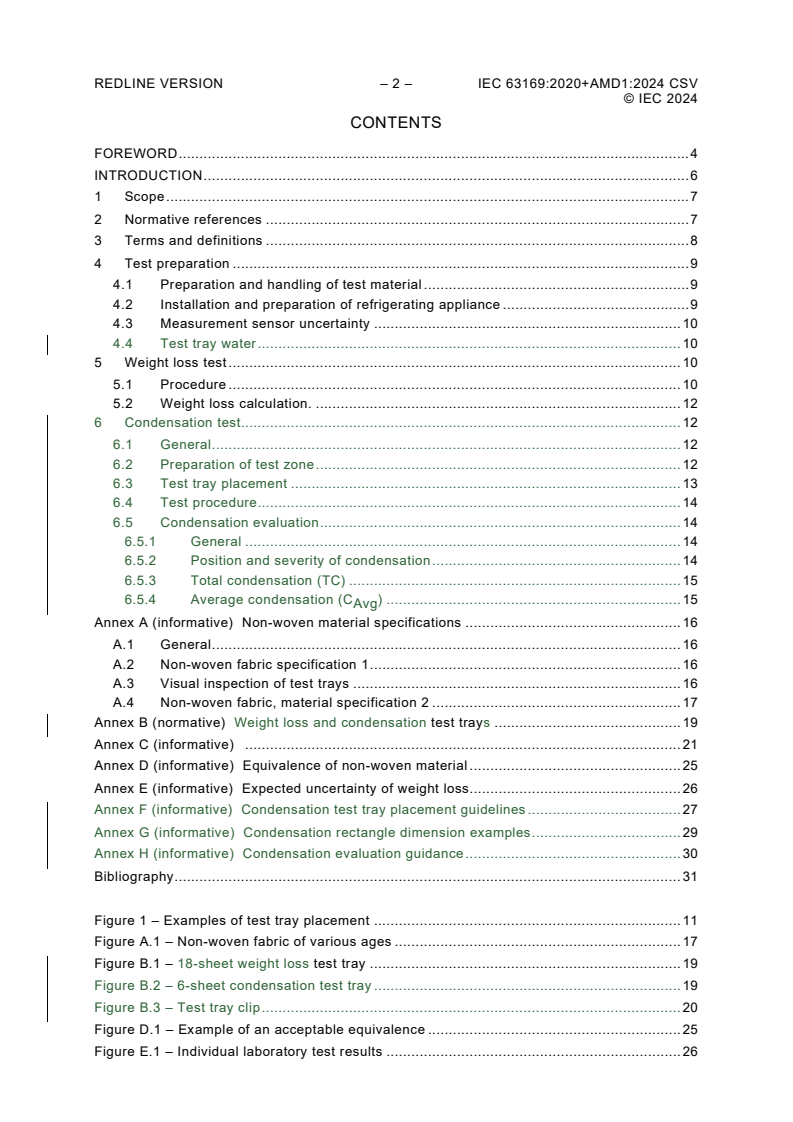
CONTENTS
FOREWORD . 4
INTRODUCTION . 6
1 Scope . 7
2 Normative references . 7
3 Terms and definitions . 8
4 Test preparation . 9
4.1 Preparation and handling of test material . 9
4.2 Installation and preparation of refrigerating appliance . 9
4.3 Measurement sensor uncertainty . 10
4.4 Test tray water . 10
5 Weight loss test . 10
5.1 Procedure . 10
5.2 Weight loss calculation. . 12
6 Condensation test. 12
6.1 General . 12
6.2 Preparation of test zone . 12
6.3 Test tray placement . 13
6.4 Test procedure. 14
6.5 Condensation evaluation . 14
6.5.1 General . 14
6.5.2 Position and severity of condensation . 14
6.5.3 Total condensation (TC) . 15
6.5.4 Average condensation (C ) . 15
Avg
Annex A (informative) Non-woven material specifications . 16
A.1 General . 16
A.2 Non-woven fabric specification 1 . 16
A.3 Visual inspection of test trays . 16
A.4 Non-woven fabric, material specification 2 . 17
Annex B (normative) Weight loss and condensation test trays . 19
Annex C (informative) . 21
Annex D (informative) Equivalence of non-woven material . 25
Annex E (informative) Expected uncertainty of weight loss. 26
Annex F (informative) Condensation test tray placement guidelines . 27
Annex G (informative) Condensation rectangle dimension examples . 29
Annex H (informative) Condensation evaluation guidance . 30
Bibliography . 31
Figure 1 – Examples of test tray placement . 11
Figure A.1 – Non-woven fabric of various ages . 17
Figure B.1 – 18-sheet weight loss test tray . 19
Figure B.2 – 6-sheet condensation test tray . 19
Figure B.3 – Test tray clip . 20
Figure D.1 – Example of an acceptable equivalence . 25
Figure E.1 – Individual laboratory test results . 26
© IEC 2024
Figure F.1 – Sheet layout . 27
Figure F.2 – Alternate sheet layout . 28
Figure G.1 – Examples of condensation rectangle dimensions . 29
Table 1 – Test equipment . 9
Table 2 – Condensation severity score . 15
Table A.1 – Non-woven fabric material specification 2 . 17
Table C.1 – Test results .
Table C.1 – Test settings . 24
a
Table C.2 – Test results – Weight loss – Weight loss rate W . 24
Table C.3 – Test results – Condensation – TC and C . 24
AVG
REDLINE VERSION – 4 – IEC 63169:2020+AMD1:2024 CSV
© IEC 2024
INTERNATIONAL ELECTROTECHNICAL COMMISSION
____________
ELECTRICAL HOUSEHOLD AND SIMILAR COOLING
AND FREEZING APPLIANCES – FOOD PRESERVATION
FOREWORD
1) The International Electrotechnical Commission (IEC) is a worldwide organization for standardization comprising
all national electrotechnical committees (IEC National Committees). The object of IEC is to promote international
co-operation on all questions concerning standardization in the electrical and electronic fields. To this end and
in addition to other activities, IEC publishes International Standards, Technical Specifications, Technical Reports,
Publicly Available Specifications (PAS) and Guides (hereafter referred to as “IEC Publication(s)”). Their
preparation is entrusted to technical committees; any IEC National Committee interested in the subject dealt with
may participate in this preparatory work. International, governmental and non-governmental organizations liaising
with the IEC also participate in this preparation. IEC collaborates closely with the International Organization for
Standardization (ISO) in accordance with conditions determined by agreement between the two organizations.
2) The formal decisions or agreements of IEC on technical matters express, as nearly as possible, an international
consensus of opinion on the relevant subjects since each technical committee has representation from all
interested IEC National Committees.
3) IEC Publications have the form of recommendations for international use and are accepted by IEC National
Committees in that sense. While all reasonable efforts are made to ensure that the technical content of IEC
Publications is accurate, IEC cannot be held responsible for the way in which they are used or for any
misinterpretation by any end user.
4) In order to promote international uniformity, IEC National Committees undertake to apply IEC Publications
transparently to the maximum extent possible in their national and regional publications. Any divergence between
any IEC Publication and the corresponding national or regional publication shall be clearly indicated in the latter.
5) IEC itself does not provide any attestation of conformity. Independent certification bodies provide conformity
assessment services and, in some areas, access to IEC marks of conformity. IEC is not responsible for any
services carried out by independent certification bodies.
6) All users should ensure that they have the latest edition of this publication.
7) No liability shall attach to IEC or its directors, employees, servants or agents including individual experts and
members of its technical committees and IEC National Committees for any personal injury, property damage or
other damage of any nature whatsoever, whether direct or indirect, or for costs (including legal fees) and
expenses arising out of the publication, use of, or reliance upon, this IEC Publication or any other IEC
Publications.
8) Attention is drawn to the Normative references cited in this publication. Use of the referenced publications is
indispensable for the correct application of this publication.
9) IEC draws attention to the possibility that the implementation of this document may involve the use of (a)
patent(s). IEC takes no position concerning the evidence, validity or applicability of any claimed patent rights in
respect thereof. As of the date of publication of this document, IEC had not received notice of (a) patent(s), which
may be required to implement this document. However, implementers are cautioned that this may not represent
the latest information, which may be obtained from the patent database available at https://patents.iec.ch. IEC
shall not be held responsible for identifying any or all such patent rights.
This consolidated version of the official IEC Standard and its amendment has been
prepared for user convenience.
IEC 63169 edition 1.1 contains the first edition (2020-06) [documents 59M/123/FDIS and
59M/125/RVD] and its amendment 1 (2024-12) [documents 59M/174/FDIS and
59M/176/RVD].
In this Redline version, a vertical line in the margin shows where the technical content is
modified by amendment 1. Additions are in green text, deletions are in strikethrough red
text. A separate Final version with all changes accepted is available in this publication.
© IEC 2024
International Standard IEC 63169 has been prepared by subcommittee 59M: Performance of
electrical household and similar cooling and freezing appliances, of IEC technical committee
59: Performance of household and similar electrical appliances.
This document has been drafted in accordance with the ISO/IEC Directives, Part 2.
In this document, the following print types are used:
• terms defined in Clause 3 of this document, and in Clause 3 of IEC 62552-1:2015: Arial
bold.
The committee has decided that the contents of this document and its amendment will remain
unchanged until the stability date indicated on the IEC website under webstore.iec.ch in the
data related to the specific document. At this date, the document will be
• reconfirmed,
• withdrawn, or
• revised.
NOTE The attention of National Committees is drawn to the fact that equipment manufacturers and testing
organizations may need a transitional period following publication of a new, amended or revised IEC publication in
which to make products in accordance with the new requirements and to equip themselves for conducting new or
revised tests.
It is the recommendation of the committee that the content of this publication be adopted for implementation nationally
not earlier than 12 months or later than 36 months from the date of publication.
IMPORTANT – The 'colour inside' logo on the cover page of this publication indicates
that it contains colours which are considered to be useful for the correct understanding
of its contents. Users should therefore print this document using a colour printer.
REDLINE VERSION – 6 – IEC 63169:2020+AMD1:2024 CSV
© IEC 2024
INTRODUCTION
The weight loss test assesses some of the food care aspects of various compartments, sub-
compartments and convenience features within a refrigerator. The test can be performed
with real or artificial foods. Real foods have seasonal and regional variations, making them
difficult for global use for repeatable and reproducible testing.
Research was carried out on materials, which proved that a particular non-woven material was
suitable to use to replicate real food. This non-woven material is used to replicate weight loss
from food in the weight loss test. Consequently, this document contains an artificial material
weight loss test.
As much as possible, alignment has been made with the performance test standards
IEC 62552-1 and IEC 62552-3.
This document contains a link to the SC 59M Supporting Documents that are available on the
IEC website. The SC 59M Supporting Documents include the 3D printing files, referred to in
Annex B. These files are intended to be used as a complement, and do not form an integral
part of the document.
© IEC 2024
ELECTRICAL HOUSEHOLD AND SIMILAR COOLING
AND FREEZING APPLIANCES – FOOD PRESERVATION
1 Scope
This document deals with a test to simulate the weight loss of leafy produce, given certain
conditions of temperature, humidity and air movement in one or more test zones. The test can
only be applied to spaces larger than 200 mm × 150 mm ×100 mm (L × W × H).
The aim of the test is to measure the weight loss rate by measuring the weight of a test tray
prior to the test and after a given duration.
NOTE Weight loss is one of the considerations for shelf life of produce. Other considerations such as condensation
will be addressed in future amendments.
This document deals with two food preservation tests. A weight loss test and a condensation
test.
The weight loss test simulates the weight loss of leafy produce, given certain conditions of
temperature, humidity and air movement in one or more test zones. The aim of the test is to
measure the weight loss rate by measuring the weight of a test tray prior to the test and again
after a given duration.
The condensation test simulates condensation produced by real food on surfaces of the test
zone, given certain conditions of temperature, humidity and air movement in one or more test
zones. This test assesses the condensation in refrigerator test zones by using test trays
filled with non-woven fabric to generate condensation, and then evaluates the condensation
extent and distribution.
The weight loss test and condensation test apply to test zones that have an average
operating temperature greater than 0 °C.
Both the weight loss test and condensation test are performed in series and not in parallel on
the same refrigerator.
Both the weight loss test and the condensation test can only be applied to test zones having
all dimensions exceeding 200 mm × 150 mm × 100 mm (L × W × H).
2 Normative references
The following documents are referred to in the text in such a way that some or all of their content
constitutes requirements of this document. For dated references, only the edition cited applies.
For undated references, the latest
edition of the referenced document (including any amendments) applies.
IEC 62552-1:2015, Household refrigerating appliances – Characteristics and test methods –
Part 1: General requirements
IEC 62552-1:2015/AMD1:2020
IEC 62552-3:2015, Household refrigerating appliances – Characteristics and test methods –
Part 3: Energy consumption and volumes
REDLINE VERSION – 8 – IEC 63169:2020+AMD1:2024 CSV
© IEC 2024
3 Terms and definitions
For the purposes of this document, the terms and definitions given in IEC 62552-1:2015 and
the following apply.
ISO and IEC maintain terminological databases for use in standardization at the following
addresses:
• IEC Electropedia: available at http://www.electropedia.org/
• ISO Online browsing platform: available at http://www.iso.org/obp
3.1
test zone
space inside the refrigeration appliance subject to the weight loss test and the condensation
test
Note 1 to entry: This space is typically a vegetable drawer or crisper but can also be any other compartment, sub-
compartment or convenience feature (see IEC 62552-1:2015, 3.3.1, 3.3.2 and 3.3.3, respectively). The manufacturer
shall fully describe any test zones to be tested.
Note 2 to entry: Any zone in a refrigerator can be a test zone. A test zone needs to be separated or at least
partially sealed from other zones in the same compartment or sub-compartment.
Note 3 to entry: These tests cannot be performed in a compartment that is a non-enclosed space.
Note 4 to entry: The height of the test zone is the lid. If there is no lid, the height is the next horizontal surface
immediately above the test zone.
3.2
test tray
tray of specific dimensions containing a predefined number of test sheets which is charged
with a predefined amount of water
Note 1 to entry: Refer to Annex B for 3D printing files. The weight loss test uses one large 18 test sheet test tray
per test zone.
3.3
weight loss
weight of water lost from the test tray between two moments in time in [g]
3.4
weight loss rate
weight loss divided by the time difference between the two moments in time expressed in
[g/24h]
3.5
test sheet
sheet of the nonwoven fabric specified in Annex A cut to a size of (75 mm × 125 mm) ± 1 mm.
3.6
removable accessory
accessory that is movable, removable, or adjustable by the customer if instructed to do so in
the user instructions to enable a different refrigerator function or configuration to be used
Note 1 to entry: Cleaning is not regarded as a different function so instructions to remove parts for cleaning-only,
do not meet this requirement.
Note 2 to entry: Tools can be required for removal of such parts if so instructed.
3.7
condensation
droplets of water that appear on the cold surfaces of a test zone
© IEC 2024
3.8
total condensation
sum of all the condensation calculated in 6.5.4
3.9
average condensation
total condensation divided by the number of grid rectangles calculated in 6.2
4 Test preparation
4.1 Preparation and handling of test material
Table 1 – Test equipment
Test Tray For 3D printing files (stp and stl files) for the test tray see:
https://www.iec.ch/sc59m/supportingdocuments.
For 3D printing files (stp and stl files) for both the 18-sheet test tray for the weight loss test and the
6-sheet test tray for the condensation test – see normative Annex B. The weight loss test uses a
single large tray The condensation test uses a number of small trays as calculated in 6.2
The test tray shall be non-absorbent and watertight. This may can be achieved by coating the test
tray after the printing process.
Test sheet Test sheets need to shall be cut from a filter material (typically material used for radiator
evaporators). The size of a sheet is 75 mm × 125 mm.
A material is specified in informative Annex A. For a method of proving equivalence of alternate
materials refer to informative Annex D.
If the test tray is not directly used after a test series, it should be stored as follows:
a) leave the test sheets inside the test tray;
b) discard the residual water from the test tray;
c) dry the test tray with the test sheets at ambient temperature and low humidity;
d) store the test tray loaded with test sheets in the fresh food compartment of a refrigerator in
operation.
After storage, the test tray can be recharged with water for new tests. Annex A contains
provisions for checking the quality of the non-woven fabric.
4.2 Installation and preparation of refrigerating appliance
The ambient temperature shall be 25 °C (see A.2.6, A.3.1, A.3.2 and A.4.5 of
IEC 62552-1:2015).
The ambient humidity shall be in accordance with A.2.3 and A.3.6 of IEC 62552-1:2015.
The refrigerating appliance shall be installed in accordance with Annex B of IEC 62552-1:2015.
All internal accessories supplied with the refrigerating appliance shall be in their respective
positions. See 5.1 in case these accessories interfere with the location of the test tray.
Before the test load is added, all compartments and sub-compartments shall be empty. Their
temperatures shall be determined as specified in Annex D of IEC 62552-1:2015. The appliance
shall be run until steady-state conditions are observed. Where user-operated baffles or controls
are provided for adjustment of temperatures in test zones, each shall be adjusted to a setting
in accordance with the instructions provided. If no specific instructions are provided, the setting
shall be adjusted in accordance with the target temperature listed in Table 1 of
IEC 62552-3:2015 within a tolerance of ±1 K.
REDLINE VERSION – 10 – IEC 63169:2020+AMD1:2024 CSV
© IEC 2024
Other compartments and sub-compartments shall be operated with temperatures as close as
possible to the target temperatures as listed in Table 1 of IEC 62552-3:2015.
If the test zone is a sub-compartment, it shall be adjusted to a setting that results in a
temperature of the test zone as close as possible to the specified target temperature in Table 1
of IEC 62552-3:2015. The temperature of the test zone shall be measured.
The temperature of a compartment or sub-compartment temperature shall be the average of
temperature sensors placed in the positions as defined in Annex D of IEC 62552-1:2015.
4.3 Measurement sensor uncertainty
For temperature measurement uncertainty, reference is made to A.2.6 of IEC 62552-1:2015.
Because humidity measurement is optional, no uncertainty level is specified.
4.4 Test tray water
The temperature of the water in the test tray(s) for the weight loss test and condensation
test shall be within ± 2 K of the temperature of the test zone to be evaluated. Each test tray
shall be preconditioned for 24 h to ensure it is within ± 2 K of the temperature of the test zone
to be evaluated. Preconditioning can be in the test zone or in another refrigerator.
5 Weight loss test
5.1 Procedure
Remove any condensation from the test zone prior to placing the test tray.
The test material consists of a single large test tray with 18 test sheets.
The test may be carried out simultaneously on one or more of the test zones.
If some of the test zones are not being tested at this time, then a test tray is placed in each
such test zone prior to starting the test. Weight measurements need not be taken for these test
trays.
The weight loss test load is a single, large, 18-test-sheet, test tray. The test tray can be filled
with dry or wet test sheets. If dry test sheets are used, then the test tray should be charged
with 600 g ± 50 g of distilled water. Less water may be used if the test sheets are already wet.
Before starting the test, the quality of the test tray can be inspected as detailed in Clause A.3.
The test tray shall be placed in the centre of the base area of the test zone to be evaluated. If
it is not possible to place the test tray in the centre (due to the height or shape of the space)
then the test tray shall be placed in the centre of the next biggest area or the next possible
place where the test sheets do not touch the upper surface of the space. The test sheets in
the test tray shall face perpendicular to the refrigerator door if possible.
The test tray shall not touch the walls of the test zone.
Examples of the test tray placement are shown in Figure 1.
© IEC 2024
Figure 1 – Examples of test tray placement
If a test tray cannot be placed due to the presence of an accessory, the accessory shall be
placed in accordance with the instructions and the test tray placed next to it.
If no specific instructions are provided:
a) in the case of a removable accessory at the required position, the accessory shall be
removed;
b) in the case of a non-removable accessory but where it can be shifted with respect to the
required position, the accessory shall be moved in the width direction to the right or in the
depth direction to the back.
If the test tray cannot be placed due to the presence of a removeable accessory, the
accessory can be moved/removed/adjusted in accordance with the manufacturer’s user
instructions.
If the test tray still cannot be placed, then a valid weight loss test cannot be performed.
During the test, the water shall not freeze.
The temperature of the water in the test tray shall be within ±2 K of the temperature of the test
zone to be evaluated. The test tray shall be preconditioned for 24 h to ensure it is within ±2 K
of the temperature of the test zone to be evaluated. Preconditioning can be in the test zone or
in another refrigerator.
A temperature sensing element shall be placed 1 cm in front of the test tray and shall not be
in contact with the test tray. If wired sensors are used, the wires shall be mounted such so they
do not cross sealing surfaces of the test zone.
The maximum duration of door openings for loading and unloading of test trays shall be 1 min.
The test tray is then loaded into the test zone for another 24 h conditioning. After the
conditioning, the weight of the test tray shall be measured (M [g]) and the time (t [h]) taken.
1 1
The weight shall be determined with a resolution of 0,1 g and the time with a resolution of 1 min.
At least 24 hours after time t , the weight of the test tray shall again be measured (M [g]) and
1 2
the time recorded (t [h]). The time taken to measure M shall be less than 2 min.
2 2
The difference between M and M shall not be greater than 200 g.
1 2
REDLINE VERSION – 12 – IEC 63169:2020+AMD1:2024 CSV
© IEC 2024
Immediately after a test, another test may be conducted using the same test zone for the 24 h
conditioning.
5.2 Weight loss calculation.
The weight loss rate is calculated as follows:
W = [(M − M )/(t − t )] × 24 [g/24h]
1 2 2 1
The weight loss test is concluded after the measurement of M and the weight loss rate
calculation.
For a suggested test report format, refer to Annex C. For guidance on expected uncertainty,
refer to Annex E.
6 Condensation test
6.1 General
The condensation test consists of evaluating the condensation in a test zone. This is done
by dividing all 6 test zone surfaces into rectangles. Multiple small test trays are loaded with
water and non-woven fabric. The compartment/refrigerator door is closed. After 72 h, evaluation
is made by assessing the condensation in each rectangle and summing them accordingly.
Clarification of some test zone surfaces is contained in informative Annex H.
6.2 Preparation of test zone
Remove any condensation from the test zone prior to placing the test tray by wiping with a
tissue or paper towel.
The test material consists of a number of small test trays with 6 sheets of non-woven fabric
material as specified in Table A.1.
The number of small test trays is the volume of the test zone (in litres)/3 rounded to the nearest
integer value.
For example, a 25,3 l crisper should load 25,3/3 = 8,43 to be rounded to 8 small test trays, and
a 25,6 l crisper should load 25,6/3 = 8,53 to be rounded to 9 small test trays.
Each surface of the test zone is divided into a grid of rectangles according to the following
method.
• determine each length or height of the test zone in mm and divide by 50;
• round the length or height up to the next whole number and this gives the number of
rectangles for that dimension.
See informative Annex G for examples. This means that there will likely be a different number
of rectangles horizontally and vertically. The maximum dimension of a rectangle will be 50 mm.
Part rectangles (for example a sloping side) are counted as a complete rectangle.
NOTE For practical purposes, examples of usable rectangles could be a grid marked on the test zone before
testing, or a transparency held against the surface during evaluation.
For the condensation test multiple test zones may be tested simultaneously. Any test zones
in the refrigerator that are not being tested do not need to have test trays loaded.
© IEC 2024
6.3 Test tray placement
To allow a trial test tray placement, the test trays are left empty and loaded into the test zone.
The test trays are clipped together using the clips of normative Annex B. If all the test trays
can be placed on the base of the test zone then they are centralised both left to right and front
to back.
If the shape of the test zone prohibits centralising the test trays as above, the test trays are
biased to the front and/or left to try and place them on the base.
If necessary, the test trays can be disconnected from the clips to allow some test trays to
move forward or backward relative to one another (or left or right) but the test trays spacing
shall be at least 5 mm side to side. These 5 mm do not include any spacers which are formed
as part of the test tray.
The test trays can be at angles to each other (preferably a right angle).
If necessary, an upper layer of test trays can be stacked on top of the lower layer. As many
test trays as possible shall be in the lower layer before any additional test trays are stacked.
At all times there shall be at least 10 mm vertical clearance between the top of any test sheet
and the underside of the test zone lid.
If, because of the size and/or shape of the test zone, the required number of test trays cannot
be loaded, then the test trays spacing can be reduced. For the test to remain valid, the following
minimums shall be observed. There shall be at least
• 1 mm spacing between test trays;
• 3 mm spacing between the test trays and test zone walls.
Any upper layer test trays should be centralised over the lower layer biasing to the front and
left if necessary.
If the base of the test zone is angled, then the test trays can sit on the angled base if the
inclination is less than 15 mm high for each 100 mm length of the base. Inclinations greater
than this shall have the test trays supported horizontally by a packer. In all cases, the 10 mm
vertical clearance of any test sheet and the test zone lid shall be observed.
A record (photos or drawings, etc.) of the test trays layout should be in the test report described
in informative Annex C.
Before starting the test, the quality of the non-woven materials can be inspected as detailed in
informative Annex A.
If test trays cannot be placed due to the presence of an accessory, the accessory can be
moved/removed/adjusted in accordance with the manufacturer’s test zone description. If no
specific instructions are provided, in the case of a:
• removeable accessory at the required position, the accessory shall be moved, removed or
adjusted if possible;
• non-removable accessory, test trays may be stacked in 2 layers.
If test trays still cannot be placed, then a valid condensation test cannot be performed.
REDLINE VERSION – 14 – IEC 63169:2020+AMD1:2024 CSV
© IEC 2024
Test trays can be filled with dry or wet test sheets. If dry test sheets are used then the test
tray should be charged with 200 g ± 50 g of distilled water. Less water can be used if wet test
sheets are used.
NOTE Historical weight data of the test tray and test sheets can expedite the addition of an appropriate quantity
of water.
If the test sheets cannot face perpendicular to the refrigerator front door, the test trays shall
be placed with test sheets facing parallel to the door.
See informative Annex F for examples of alternative test tray layouts.
6.4 Test procedure
1) Prepare the test zone as specified in 6.2.
2) Load and place the test trays as specified in 6.3.
3) Close the test zone and/or refrigerator door.
4) Record the start time.
5) Leave the refrigerator door closed during the test.
6) During the test, the water shall not freeze.
7) After 72 h, begin the condensation evaluation.
6.5 Condensation evaluation
6.5.1 General
Condensation evaluation is made by visual assessment of the condensation on each surface
of the test zone. The degree of condensation depends on:
• the position of condensation on the surface of test zone;
• the severity of condensation.
NOTE Guidance on how to carry out the evaluation is given in informative Annex H.
6.5.2 Position and severity of condensation
6.5.2.1 Position of condensation on the surface of test zone
Each rectangle as specified in 6.2 is used when assessing condensation on each test zone
surface.
6.5.2.2 Severity of condensation
Each rectangle is assessed for severity with only the maximum severity being recorded for the
final calculation. Then assess the number of rectangles for each level of condensation. Any
condensation in a rectangle means that rectangle is counted in the final calculation, regardless
of the area of condensation within the rectangle.
Each rectangle is allocated a condensation severity score (CSS) as specified in Table 2.
© IEC 2024
Table 2 – Condensation severity score
Condensation type CSS
Mist/No condensation 0
Drops with any dimension < 10 mm 1
Running water 1
Pooling with any dimension > 10 mm 3
NOTE Pooling is only on the test zone base and is the result of running water
6.5.2.3 Condensation
The condensation on each rectangle is assessed according to 6.5.2.2. Condensation (C) on
each surface is the sum of all of the rectangles on that surface with any condensation,
multiplied by each rectangle’s condensation severity score. Each surface of the test zone is
calculated separately and then added for the total.
6.5.3 Total condensation (TC)
TC = C + C + C + C + C + C
Front Back Top Bottom LH Side RH Side
6.5.4 Average condensation (C )
Avg
C = TC/(Total number of rectangles on all surfaces)
Avg
REDLINE VERSION – 16 – IEC 63169:2020+AMD1:2024 CSV
© IEC 2024
Annex A
(informative)
Non-woven material specifications
A.1 General
The products cited in this annex are examples of suitable products available commercially .
A.2 Non-woven fabric specification 1
Specification for Brune 02 (3614) Humidifier Filter Pads
Product Humidifier filter pad with holes and additive
Raw materials Wetlaid cellulose 330 g/m . Additive added during manufacture is
Wax shell.
Final dimensions (370 mm × 440 mm) ± 5 mm
Wax 440 mm long. Saturated down from one long edge
Punched holes 13 mm from long edge where wax/crush line has been input and 90
mm from each edge forming a gap of 260 mm between the centre of
each hole
• Supplier of already cut sheets
Lerch Raumklima GmbH
Faistenbergerstrasse 6
81545 München
Germany
Tel: +49 (0)89 64 74 95
Fax: +49 (0)89 642 18 68
E-Mail: info@lerch24.de
Internet: www.lerch-raumklima.de
• Supplier of non-woven material
www.brune-humidifier.com/shop/filters/filters-for-radiator-evaporators.html
A.3 Visual inspection of test trays
Figure A.1 gives guidance in deciding whether the test sheets are fit for use or reuse in testing.
Care should be taken to avoid contact between test sheets.
___________
This information is given for the convenience of users of this document and does not constitute an endorsement
by IEC of these brands or suppliers. Equivalent products may be used if they can be shown to lead to the same
results.
© IEC 2024
Figure A.1 – Non-woven fabric of various ages
A.4 Non-woven fabric, material specification 2
Tests have been carried out at the DITF (Deutsche Institute für Textil- und Faserforschung) and
details are found in report No E-0053-TT-18. A summary of the material specification is given
in Table A.1.
Table A.1 – Non-woven fabric material specification 2
Material composition
100 % cotton 330 g/m wetlaid cellulose
Test method Property Value
DIN 53924:1997 Rising height after 15 s (mm) 35 – 42
DIN 53923:1978 Water absorption (%) 570 – 594
ISO 9073-3:1989 Tensile strength (N/5 cm) 94 (length)
86 (cross)
ISO 9073-3:1989 Elongation (%) 3,8 (length)
4,6 (cross)
ISO 9237:1995 224 – 227
Permeability (l/s m ) at pressure
200 Pa/5 cm
REDLINE VERSION – 18 – IEC 63169:2020+AMD1:2024 CSV
© IEC 2024
The test may be carried out
• using the material in the delivery state;
• using the material in the delivery state but after rinsing and drying;
• by placing the fibres in the cross or length direction.
© IEC 2024
Annex B
(normative)
Weight loss and condensation test trays
This annex shows the weight loss and condensation test trays. The 18-sheet weight loss test
tray is shown in Figure B.1. The 6-sheet weight loss test tray is shown in Figure B.2.
Nominal dimensions (mm): 196(L) × 141(W) × 90(H)
Figure B.1 – 18-sheet weight loss test tray
Nominal dimensions (mm): 151(L) × 75(W) × 81(H)
Figure B.2 – 6-sheet condensation test tray
REDLINE VERSION – 20 – IEC 63169:2020+AMD1:2024 CSV
© IEC 2024
3D printing files (stp and stl files) for an 18-sheet test tray are available from the online
dashboard of IEC SC 59M and the 6-sheet test tray can be accessed via SC 59M supporting
documents at the following link: www.iec.ch/sc59m/supportingdocuments
The test tray clip in Figure B.3 may be used for securing and spacing adjacent test trays apart
for the condensation test.
Figure B.3 – Test tray clip
© IEC 2024
Annex C
(informative)
Outline of test report for weight loss test
Test report number
Date
Laboratory details (name & location)
Refrigerator Description.
Brand
Model Number
Test zone descriptions and conditions.
(All test zones to be tested are to be described in detail).
To include:
• voltage and frequency;
• physical description of test zone including sketches/photos etc.;
• position in refrigerator;
• definition of each test zone as per IEC 62552-1;
• identify which test zones are tested in this report;
• features of tested test zone;
• setting of test zone if tested;
• test tray placement in accordance with 5.1;
• settings of untested test zones;
• test tray position in untested zones;
• volume of each test zone;
• average temperature and humidity of test room.
Test conditions
• Average compartment temperature.
• Test zone temperature and humidity (if measured).
Test results
As detailed in Table C.1.
© IEC 2024
Table C.1 – Test results
a a a a
a
Refrigerator/Freezer Compartment t M t M
W
1 1 2 2
Compartment
b
Compartment type
identification
Test zone
Setting Temperature Temperature [h] [g] [h] [g] [g/24h]
setting
a
t , M , t , M and W are in accordance with 5.1 and 5.2
1 1 2 2
b
Compartment types are as specified IEC 62552-1:2015
© IEC 2024
Test report
Are both weight loss test and condensation tests covered in this report? YES/NO
Test report number
Date
Laboratory details (name & location)
Refrigerator description
Brand
Model number
Test zone descriptions and conditions
(All test zones to be tested are to be described in detail).
To include:
• voltage and frequency,
• physical description of test zone including sketches/photos etc.,
• position in refrigerator,
• definition of each test zone as per IEC 62552-1,
• identification of w
...
IEC 63169 ®
Edition 1.0 2020-06
INTERNATIONAL
STANDARD
NORME
INTERNATIONALE
colour
inside
Electrical household and similar cooling and freezing appliances – Food
preservation
Appareils électrodomestiques et appareils de refroidissement et de réfrigération
analogues – Conservation des aliments
All rights reserved. Unless otherwise specified, no part of this publication may be reproduced or utilized in any form
or by any means, electronic or mechanical, including photocopying and microfilm, without permission in writing from
either IEC or IEC's member National Committee in the country of the requester. If you have any questions about IEC
copyright or have an enquiry about obtaining additional rights to this publication, please contact the address below or
your local IEC member National Committee for further information.
Droits de reproduction réservés. Sauf indication contraire, aucune partie de cette publication ne peut être reproduite
ni utilisée sous quelque forme que ce soit et par aucun procédé, électronique ou mécanique, y compris la photocopie
et les microfilms, sans l'accord écrit de l'IEC ou du Comité national de l'IEC du pays du demandeur. Si vous avez des
questions sur le copyright de l'IEC ou si vous désirez obtenir des droits supplémentaires sur cette publication, utilisez
les coordonnées ci-après ou contactez le Comité national de l'IEC de votre pays de résidence.
IEC Central Office Tel.: +41 22 919 02 11
3, rue de Varembé info@iec.ch
CH-1211 Geneva 20 www.iec.ch
Switzerland
About the IEC
The International Electrotechnical Commission (IEC) is the leading global organization that prepares and publishes
International Standards for all electrical, electronic and related technologies.
About IEC publications
The technical content of IEC publications is kept under constant review by the IEC. Please make sure that you have the
latest edition, a corrigendum or an amendment might have been published.
IEC publications search - webstore.iec.ch/advsearchform Electropedia - www.electropedia.org
The advanced search enables to find IEC publications by a The world's leading online dictionary on electrotechnology,
variety of criteria (reference number, text, technical containing more than 22 000 terminological entries in English
committee,…). It also gives information on projects, replaced and French, with equivalent terms in 16 additional languages.
and withdrawn publications. Also known as the International Electrotechnical Vocabulary
(IEV) online.
IEC Just Published - webstore.iec.ch/justpublished
Stay up to date on all new IEC publications. Just Published IEC Glossary - std.iec.ch/glossary
details all new publications released. Available online and 67 000 electrotechnical terminology entries in English and
once a month by email. French extracted from the Terms and Definitions clause of
IEC publications issued since 2002. Some entries have been
IEC Customer Service Centre - webstore.iec.ch/csc collected from earlier publications of IEC TC 37, 77, 86 and
If you wish to give us your feedback on this publication or CISPR.
need further assistance, please contact the Customer Service
Centre: sales@iec.ch.
A propos de l'IEC
La Commission Electrotechnique Internationale (IEC) est la première organisation mondiale qui élabore et publie des
Normes internationales pour tout ce qui a trait à l'électricité, à l'électronique et aux technologies apparentées.
A propos des publications IEC
Le contenu technique des publications IEC est constamment revu. Veuillez vous assurer que vous possédez l’édition la
plus récente, un corrigendum ou amendement peut avoir été publié.
Recherche de publications IEC - Electropedia - www.electropedia.org
webstore.iec.ch/advsearchform Le premier dictionnaire d'électrotechnologie en ligne au
La recherche avancée permet de trouver des publications IEC monde, avec plus de 22 000 articles terminologiques en
en utilisant différents critères (numéro de référence, texte, anglais et en français, ainsi que les termes équivalents dans
comité d’études,…). Elle donne aussi des informations sur les 16 langues additionnelles. Egalement appelé Vocabulaire
projets et les publications remplacées ou retirées. Electrotechnique International (IEV) en ligne.
IEC Just Published - webstore.iec.ch/justpublished Glossaire IEC - std.iec.ch/glossary
Restez informé sur les nouvelles publications IEC. Just 67 000 entrées terminologiques électrotechniques, en anglais
Published détaille les nouvelles publications parues. et en français, extraites des articles Termes et Définitions des
Disponible en ligne et une fois par mois par email. publications IEC parues depuis 2002. Plus certaines entrées
antérieures extraites des publications des CE 37, 77, 86 et
Service Clients - webstore.iec.ch/csc CISPR de l'IEC.
Si vous désirez nous donner des commentaires sur cette
publication ou si vous avez des questions contactez-nous:
sales@iec.ch.
IEC 63169 ®
Edition 1.0 2020-06
INTERNATIONAL
STANDARD
NORME
INTERNATIONALE
colour
inside
Electrical household and similar cooling and freezing appliances – Food
preservation
Appareils électrodomestiques et appareils de refroidissement et de réfrigération
analogues – Conservation des aliments
INTERNATIONAL
ELECTROTECHNICAL
COMMISSION
COMMISSION
ELECTROTECHNIQUE
INTERNATIONALE
ICS 67.040; 97.040.30 ISBN 978-2-8322-8523-7
– 2 – IEC 63169:2020 © IEC 2020
CONTENTS
FOREWORD . 3
INTRODUCTION . 5
1 Scope . 6
2 Normative references . 6
3 Terms and definitions . 6
4 Test preparation . 7
4.1 Preparation and handling of test material . 7
4.2 Installation and preparation of refrigerating appliance . 7
4.3 Measurement sensor uncertainty . 8
5 Weight loss test . 8
5.1 Procedure . 8
5.2 Weight loss calculation. . 10
Annex A (informative) Non-woven material specifications . 11
A.1 General . 11
A.2 Non-woven fabric specification 1 . 11
A.3 Visual inspection of test trays . 11
A.4 Non-woven fabric, material specification 2 . 12
Annex B (normative) Test tray . 14
Annex C (informative) Outline of test report for weight loss test . 15
Annex D (informative) Equivalence of non-woven material . 17
Annex E (informative) Expected uncertainty of weight loss. 18
Bibliography . 19
Figure 1 – Examples of test tray placement . 9
Figure A.1 – Non-woven fabric of various ages . 12
Figure B.1 – Test tray . 14
Figure D.1 – Example of an acceptable equivalence . 17
Figure E.1 – Individual laboratory test results . 18
Table 1 – Test equipment . 7
Table A.1 – Non-woven fabric material specification 2 . 12
Table C.1 – Test results . 16
INTERNATIONAL ELECTROTECHNICAL COMMISSION
____________
ELECTRICAL HOUSEHOLD AND SIMILAR COOLING
AND FREEZING APPLIANCES – FOOD PRESERVATION
FOREWORD
1) The International Electrotechnical Commission (IEC) is a worldwide organization for standardization comprising
all national electrotechnical committees (IEC National Committees). The object of IEC is to promote international
co-operation on all questions concerning standardization in the electrical and electronic fields. To this end and
in addition to other activities, IEC publishes International Standards, Technical Specifications, Technical Reports,
Publicly Available Specifications (PAS) and Guides (hereafter referred to as “IEC Publication(s)”). Their
preparation is entrusted to technical committees; any IEC National Committee interested in the subject dealt with
may participate in this preparatory work. International, governmental and non-governmental organizations liaising
with the IEC also participate in this preparation. IEC collaborates closely with the International Organization for
Standardization (ISO) in accordance with conditions determined by agreement between the two organizations.
2) The formal decisions or agreements of IEC on technical matters express, as nearly as possible, an international
consensus of opinion on the relevant subjects since each technical committee has representation from all
interested IEC National Committees.
3) IEC Publications have the form of recommendations for international use and are accepted by IEC National
Committees in that sense. While all reasonable efforts are made to ensure that the technical content of IEC
Publications is accurate, IEC cannot be held responsible for the way in which they are used or for any
misinterpretation by any end user.
4) In order to promote international uniformity, IEC National Committees undertake to apply IEC Publications
transparently to the maximum extent possible in their national and regional publications. Any divergence between
any IEC Publication and the corresponding national or regional publication shall be clearly indicated in the latter.
5) IEC itself does not provide any attestation of conformity. Independent certification bodies provide conformity
assessment services and, in some areas, access to IEC marks of conformity. IEC is not responsible for any
services carried out by independent certification bodies.
6) All users should ensure that they have the latest edition of this publication.
7) No liability shall attach to IEC or its directors, employees, servants or agents including individual experts and
members of its technical committees and IEC National Committees for any personal injury, property damage or
other damage of any nature whatsoever, whether direct or indirect, or for costs (including legal fees) and
expenses arising out of the publication, use of, or reliance upon, this IEC Publication or any other IEC
Publications.
8) Attention is drawn to the Normative references cited in this publication. Use of the referenced publications is
indispensable for the correct application of this publication.
9) Attention is drawn to the possibility that some of the elements of this IEC Publication may be the subject of patent
rights. IEC shall not be held responsible for identifying any or all such patent rights.
International Standard IEC 63169 has been prepared by subcommittee 59M: Performance of
electrical household and similar cooling and freezing appliances, of IEC technical committee
59: Performance of household and similar electrical appliances.
The text of this International Standard is based on the following documents:
FDIS Report on voting
59M/123/FDIS 59M/125/RVD
Full information on the voting for the approval of this International Standard can be found in the
report on voting indicated in the above table.
This document has been drafted in accordance with the ISO/IEC Directives, Part 2.
In this document, the following print types are used:
• terms defined in Clause 3 of this document, and in Clause 3 of IEC 62552-1:2015: Arial
bold.
– 4 – IEC 63169:2020 © IEC 2020
The committee has decided that the contents of this document will remain unchanged until the
stability date indicated on the IEC website under "http://webstore.iec.ch" in the data related to
the specific document. At this date, the document will be
• reconfirmed,
• withdrawn,
• replaced by a revised edition, or
• amended.
NOTE 1 The attention of National Committees is drawn to the fact that equipment manufacturers and testing
organizations may need a transitional period following publication of a new, amended or revised IEC publication in
which to make products in accordance with the new requirements and to equip themselves for conducting new or
revised tests.
It is the recommendation of the committee that the content of this publication be adopted for implementation nationally
not earlier than 12 months or later than 36 months from the date of publication.
IMPORTANT – The 'colour inside' logo on the cover page of this publication indicates
that it contains colours which are considered to be useful for the correct understanding
of its contents. Users should therefore print this document using a colour printer.
INTRODUCTION
The weight loss test assesses some of the food care aspects of various compartments, sub-
compartments and convenience features within a refrigerator. The test can be performed
with real or artificial foods. Real foods have seasonal and regional variations, making them
difficult for global use for repeatable and reproducible testing.
Research was carried out on materials, which proved that a particular non-woven material was
suitable to use to replicate real food. This non-woven material is used to replicate weight loss
from food in the weight loss test. Consequently, this document contains an artificial material
weight loss test.
As much as possible, alignment has been made with the performance test standards
IEC 62552-1 and IEC 62552-3.
This document contains a link to the SC 59M Supporting Documents that are available on the
IEC website. The SC 59M Supporting Documents include the 3D printing files, referred to in
Annex B. These files are intended to be used as a complement, and do not form an integral
part of the document.
– 6 – IEC 63169:2020 © IEC 2020
ELECTRICAL HOUSEHOLD AND SIMILAR COOLING
AND FREEZING APPLIANCES – FOOD PRESERVATION
1 Scope
This document deals with a test to simulate the weight loss of leafy produce, given certain
conditions of temperature, humidity and air movement in one or more test zones. The test can
only be applied to spaces larger than 200 mm × 150 mm ×100 mm (L × W × H).
The aim of the test is to measure the weight loss rate by measuring the weight of a test tray
prior to the test and after a given duration.
NOTE Weight loss is one of the considerations for shelf life of produce. Other considerations such as condensation
will be addressed in future amendments.
2 Normative references
The following documents are referred to in the text in such a way that some or all of their content
constitutes requirements of this document. For dated references, only the edition cited applies.
For undated references, the latest edition of the referenced document (including any
amendments) applies.
IEC 62552-1:2015, Household refrigerating appliances – Characteristics and test methods –
Part 1: General requirements
IEC 62552-3:2015, Household refrigerating appliances – Characteristics and test methods –
Part 3: Energy consumption and volumes
3 Terms and definitions
For the purposes of this document, the terms and definitions given in IEC 62552-1:2015 and
the following apply.
ISO and IEC maintain terminological databases for use in standardization at the following
addresses:
• IEC Electropedia: available at http://www.electropedia.org/
• ISO Online browsing platform: available at http://www.iso.org/obp
3.1
test zone
space inside the refrigeration appliance subject to the weight loss test
Note 1 to entry: This space is typically a vegetable drawer or crisper but can also be any other compartment, sub-
compartment or convenience feature (see IEC 62552-1:2015, 3.3.1, 3.3.2 and 3.3.3, respectively). The manufacturer
shall fully describe any test zones to be tested.
Note 2 to entry: Any zone in a refrigerator can be a test zone. A test zone needs to be separated or at least
partially sealed from other zones in the same compartment or sub-compartment.
3.2
test tray
tray of specific dimensions containing a predefined number of test sheets which is charged
with a predefined amount of water
Note 1 to entry: Refer to Annex B for 3D printing files. The weight loss test uses one large 18 test sheet test tray
per test zone.
3.3
weight loss
weight of water lost from the test tray between two moments in time in [g]
3.4
weight loss rate
weight loss divided by the time difference between the two moments in time expressed in
[g/24h]
3.5
test sheet
sheet of the nonwoven fabric specified in Annex A cut to a size of (75 mm × 125 mm) ± 1 mm.
4 Test preparation
4.1 Preparation and handling of test material
Table 1 – Test equipment
Test For 3D printing files (stp and stl files) for the test tray see:
Tray https://www.iec.ch/sc59m/supportingdocuments.
The test tray shall be non-absorbent and watertight. This may be achieved by coating the test tray after
the printing process.
Test Test sheets need to be cut from a filter material (typically material used for radiator evaporators). The
sheet size of a sheet is 75 mm × 125 mm.
A material is specified in Annex A. For a method of proving equivalence of alternate materials refer to
Annex D.
If the test tray is not directly used after a test series, it should be stored as follows:
a) leave the test sheets inside the test tray;
b) discard the residual water from the test tray;
c) dry the test tray with the test sheets at ambient temperature and low humidity;
d) store the test tray loaded with test sheets in the fresh food compartment of a refrigerator in
operation.
After storage, the test tray can be recharged with water for new tests. Annex A contains
provisions for checking the quality of the non-woven fabric.
4.2 Installation and preparation of refrigerating appliance
The ambient temperature shall be 25 °C (see A.2.6, A.3.1, A.3.2 and A.4.5 of
IEC 62552-1:2015).
The ambient humidity shall be in accordance with A.2.3 and A.3.6 of IEC 62552-1:2015.
The refrigerating appliance shall be installed in accordance with Annex B of IEC 62552-1:2015.
All internal accessories supplied with the refrigerating appliance shall be in their respective
positions. See 5.1 in case these accessories interfere with the location of the test tray.
– 8 – IEC 63169:2020 © IEC 2020
Before the test load is added, all compartments and sub-compartments shall be empty. Their
temperatures shall be determined as specified in Annex D of IEC 62552-1:2015. The appliance
shall be run until steady-state conditions are observed. Where user-operated baffles or controls
are provided for adjustment of temperatures in test zones, each shall be adjusted to a setting
in accordance with the instructions provided. If no specific instructions are provided, the setting
shall be adjusted in accordance with the target temperature listed in Table 1 of
IEC 62552-3:2015 within a tolerance of ±1 K.
Other compartments and sub-compartments shall be operated with temperatures as close as
possible to the target temperatures as listed in Table 1 of IEC 62552-3:2015.
If the test zone is a sub-compartment, it shall be adjusted to a setting that results in a
temperature of the test zone as close as possible to the specified target temperature in Table 1
of IEC 62552-3:2015. The temperature of the test zone shall be measured.
The temperature of a compartment or sub-compartment temperature shall be the average of
temperature sensors placed in the positions as defined in Annex D of IEC 62552-1:2015.
4.3 Measurement sensor uncertainty
For temperature measurement uncertainty, reference is made to A.2.6 of IEC 62552-1:2015.
Because humidity measurement is optional, no uncertainty level is specified.
5 Weight loss test
5.1 Procedure
Remove any condensation from the test zone prior to placing the test tray.
The test material consists of a single large test tray with 18 test sheets.
The test may be carried out simultaneously on one or more of the test zones.
If some of the test zones are not being tested at this time, then a test tray is placed in each
such test zone prior to starting the test. Weight measurements need not be taken for these test
trays.
The weight loss test load is a single, large, 18-test-sheet, test tray. The test tray can be filled
with dry or wet test sheets. If dry test sheets are used, then the test tray should be charged
with 600 g ± 50 g of distilled water. Less water may be used if the test sheets are already wet.
Before starting the test, the quality of the test tray can be inspected as detailed in Clause A.3.
The test tray shall be placed in the centre of the base area of the test zone to be evaluated. If
it is not possible to place the test tray in the centre (due to the height or shape of the space)
then the test tray shall be placed in the centre of the next biggest area or the next possible
place where the test sheets do not touch the upper surface of the space. The test sheets in
the test tray shall face perpendicular to the refrigerator door if possible.
The test tray shall not touch the walls of the test zone.
Examples of the test tray placement are shown in Figure 1.
Figure 1 – Examples of test tray placement
If a test tray cannot be placed due to the presence of an accessory, the accessory shall be
placed in accordance with the instructions and the test tray placed next to it.
If no specific instructions are provided:
a) in the case of a removable accessory at the required position, the accessory shall be
removed;
b) in the case of a non-removable accessory but where it can be shifted with respect to the
required position, the accessory shall be moved in the width direction to the right or in the
depth direction to the back.
During the test, the water shall not freeze.
The temperature of the water in the test tray shall be within ±2 K of the temperature of the test
zone to be evaluated. The test tray shall be preconditioned for 24 h to ensure it is within ±2 K
of the temperature of the test zone to be evaluated. Preconditioning can be in the test zone or
in another refrigerator.
A temperature sensing element shall be placed 1 cm in front of the test tray and shall not be
in contact with the test tray. If wired sensors are used, the wires shall be mounted such so they
do not cross sealing surfaces of the test zone.
The maximum duration of door openings for loading and unloading of test trays shall be 1 min.
The test tray is then loaded into the test zone for another 24 h conditioning. After the
conditioning, the weight of the test tray shall be measured (M [g]) and the time (t [h]) taken.
1 1
The weight shall be determined with a resolution of 0,1 g and the time with a resolution of 1 min.
At least 24 hours after time t , the weight of the test tray shall again be measured (M [g]) and
1 2
the time recorded (t [h]). The time taken to measure M shall be less than 2 min.
2 2
The difference between M and M shall not be greater than 200 g.
1 2
Immediately after a test, another test may be conducted using the same test zone for the 24 h
conditioning.
– 10 – IEC 63169:2020 © IEC 2020
5.2 Weight loss calculation.
The weight loss rate is calculated as follows:
W = [(M − M )/(t − t )] × 24 [g/24h]
1 2 2 1
The weight loss test is concluded after the measurement of M and the weight loss rate
calculation.
For a suggested test report format, refer to Annex C. For guidance on expected uncertainty,
refer to Annex E.
Annex A
(informative)
Non-woven material specifications
A.1 General
The products cited in this annex are examples of suitable products available commercially .
A.2 Non-woven fabric specification 1
Specification for Brune 02 (3614) Humidifier Filter Pads
Product Humidifier filter pad with holes and additive
Raw materials Wetlaid cellulose 330 g/m . Additive added during manufacture is
Wax shell.
Final dimensions (370 mm × 440 mm) ± 5 mm
Wax 440 mm long. Saturated down from one long edge
Punched holes 13 mm from long edge where wax/crush line has been input and 90
mm from each edge forming a gap of 260 mm between the centre of
each hole
• Supplier of already cut sheets
Lerch Raumklima GmbH
Faistenbergerstrasse 6
81545 München
Germany
Tel: +49 (0)89 64 74 95
Fax: +49 (0)89 642 18 68
E-Mail: info@lerch24.de
Internet: www.lerch-raumklima.de
• Supplier of non-woven material
www.brune-humidifier.com/shop/filters/filters-for-radiator-evaporators.html
A.3 Visual inspection of test trays
Figure A.1 gives guidance in deciding whether the test sheets are fit for use or reuse in testing.
Care should be taken to avoid contact between test sheets.
___________
This information is given for the convenience of users of this document and does not constitute an endorsement
by IEC of these brands or suppliers. Equivalent products may be used if they can be shown to lead to the same
results.
– 12 – IEC 63169:2020 © IEC 2020
Figure A.1 – Non-woven fabric of various ages
A.4 Non-woven fabric, material specification 2
Tests have been carried out at the DITF (Deutsche Institute für Textil- und Faserforschung) and
details are found in report No E-0053-TT-18. A summary of the material specification is given
in Table A.1.
Table A.1 – Non-woven fabric material specification 2
Material composition
100 % cotton 330 g/m wetlaid cellulose
Test method Property Value
DIN 53924:1997 Rising height after 15 s (mm) 35 – 42
DIN 53923:1978 Water absorption (%) 570 – 594
ISO 9073-3:1989 Tensile strength (N/5 cm) 94 (length)
86 (cross)
ISO 9073-3:1989 Elongation (%) 3,8 (length)
4,6 (cross)
ISO 9237:1995 224 – 227
Permeability (l/s m ) at pressure
200 Pa/5 cm
The test may be carried out
• using the material in the delivery state;
• using the material in the delivery state but after rinsing and drying;
• by placing the fibres in the cross or length direction.
– 14 – IEC 63169:2020 © IEC 2020
Annex B
(normative)
Test tray
Figure B.1 – Test tray
3D printing files (stp and stl files) for an 18-sheet test tray are available from the online
dashboard of IEC SC 59M:
https://www.iec.ch/sc59m/supportingdocuments
Annex C
(informative)
Outline of test report for weight loss test
Test report number
Date
Laboratory details (name & location)
Refrigerator Description.
Brand
Model Number
Test zone descriptions and conditions.
(All test zones to be tested are to be described in detail).
To include:
• voltage and frequency;
• physical description of test zone including sketches/photos etc.;
• position in refrigerator;
• definition of each test zone as per IEC 62552-1;
• identify which test zones are tested in this report;
• features of tested test zone;
• setting of test zone if tested;
• test tray placement in accordance with 5.1;
• settings of untested test zones;
• test tray position in untested zones;
• volume of each test zone;
• average temperature and humidity of test room.
Test conditions
• Average compartment temperature.
• Test zone temperature and humidity (if measured).
Test results
As detailed in Table C.1.
– 16 – IEC 63169:2020 © IEC 2020
Table C.1 – Test results
a a a a
a
t M t M
Refrigerator/Freezer Compartment
W
1 1 2 2
Compartment
b
Compartment type
identification
Test zone
Setting Temperature Temperature [h] [g] [h] [g] [g/24h]
setting
a
t , M , t , M and W are in accordance with 5.1 and 5.2
1 1 2 2
b
Compartment types are as specified IEC 62552-1:2015
Annex D
(informative)
Equivalence of non-woven material
If the specified non-woven material is difficult to obtain at any time, an equivalent material may
be used. Equivalence needs to be proven and documented.
Equivalence is proven by testing both the original and replacement non-woven materials under
similar conditions, thus getting a calibration curve (see Figure D.1).
The ideal case for an alternative material is a 1 to 1 correlation to the specified material, that
gives a straight-line equivalence over a wide weight loss rate range (see Figure D.1). As a
consequence, the alternative material is considered to behave in a more or less identical way
to the specified material at both low weight loss rate and high weight loss rate.
Guidance:
• At least 3 evaporation conditions need to be tested.
• More evaporation conditions will need to be tested if the equivalence is not linear.
• The evaporation conditions need to span the conditions of the test zones to be tested.
No extrapolation is allowed.
• The results, including uncertainty, need to be documented and accompany the test
report.
• Figure D.1 shows the result of an acceptable equivalence to Brune 02 (3614) filter pad
material.
• The final results of the weight loss rates need to be calculated back to the Brune non-
woven weight loss rates by means of the calibration curve.
Figure D.1 – Example of an acceptable equivalence
– 18 – IEC 63169:2020 © IEC 2020
Annex E
(informative)
Expected uncertainty of weight loss
During the development of the weight loss testing protocol, measurements have been
undertaken by various companies and institutions in order to understand the practicality,
repeatability and reproducibility of the test procedure. To estimate reproducibility, the testing
also included interlaboratory testing trials. From the test data available, the interlaboratory data
selected is from the CoolFresh project executed in Germany during 2018-2020. This represents
the most extensive ring testing performed following the final procedure laid down in this
document. The data has been accumulated in a single chart as shown Figure E.1. The ring test
included seven laboratories and in total three different test zones were investigated, having a
low, medium and high sealing quality, respectively. Each test was repeated five times. The
individual laboratory test results are shown in Figure E.1 where each test result is compared
with the average result from all test laboratories for the respective bin. In Figure E.1, circles are
drawn that represent twice the standard deviation for each type of test zone.
Figure E.1 – Individual laboratory test results
From this data field, it is possible to estimate a typical uncertainty level (top-down approach)
taking into consideration that there are some outliers in the data. It is believed that this typical
uncertainty (based on 2 times the standard deviation) of the weight loss test procedure is
approximately 14 % of the measured value with a minimum of 1 g/d.
Bibliography
IEC 62552-2:2015, Household refrigerating appliances – Characteristics and test methods –
Part 2: Performance requirements
ISO 9073-3:1989, Textiles – Test methods nonwovens – Part 3: Determination tensile strength
elongation.
ISO 9237:1995, Textiles – Determination of the permeability of fabrics to air
DIN 53923:1978, Testing of textiles; Determination of water absorption of textile fabrics
DIN 53924:1997, Testing of textiles – Velocity of soaking water of textile fabrics (method by
determining the rising height)
____________
– 20 – IEC 63169:2020 © IEC 2020
SOMMAIRE
AVANT-PROPOS . 21
INTRODUCTION . 23
1 Domaine d'application . 24
2 Références normatives . 24
3 Termes et définitions . 24
4 Préparation de l'essai . 25
4.1 Préparation et manipulation du matériau d'essai . 25
4.2 Installation et préparation de l'appareil de réfrigération . 25
4.3 Incertitude du capteur de mesure . 26
5 Essai de perte de poids . 26
5.1 Mode opératoire . 26
5.2 Calcul de la perte de poids. . 28
Annexe A (informative) Spécifications relatives au matériau non tissé . 29
A.1 Généralités . 29
A.2 Etoffe non tissée – Spécification 1 . 29
A.3 Examen visuel des plateaux d'essai . 29
A.4 Etoffe non tissée – Spécification de matériau 2 . 30
Annexe B (normative) Plateau d'essai . 32
Annexe C (informative) Présentation du rapport d'essai de perte de poids . 33
Annexe D (informative) Equivalence des matériaux non tissés . 35
Annexe E (informative) Incertitude prévue de perte de poids . 36
Bibliographie . 37
Figure 1 – Exemples de placement de plateau d'essai . 27
Figure A.1 – Etoffe non tissée d'âges différents . 30
Figure B.1 – Plateau d'essai . 32
Figure D.1 – Exemple d'une équivalence acceptable . 35
Figure E.1 – Résultats d'essai de laboratoire d'individuel . 36
Tableau 1 – Matériel d'essai . 25
Tableau 1 – Etoffe non tissée – Spécification de matériau 2 . 30
Tableau C.1 – Résultats d'essai . 34
COMMISSION ELECTROTECHNIQUE INTERNATIONALE
____________
APPAREILS ELECTRODOMESTIQUES ET APPAREILS DE
REFROIDISSEMENT ET DE REFRIGERATION ANALOGUES –
CONSERVATION DES ALIMENTS
AVANT-PROPOS
1) La Commission Electrotechnique Internationale (IEC) est une organisation mondiale de normalisation composée
de l'ensemble des comités électrotechniques nationaux (Comités nationaux de l’IEC). L’IEC a pour objet de
favoriser la coopération internationale pour toutes les questions de normalisation dans les domaines de
l'électricité et de l'électronique. A cet effet, l’IEC – entre autres activités – publie des Normes internationales,
des Spécifications techniques, des Rapports techniques, des Spécifications accessibles au public (PAS) et des
Guides (ci-après dénommés "Publication(s) de l’IEC"). Leur élaboration est confiée à des comités d'études, aux
travaux desquels tout Comité national intéressé par le sujet traité peut participer. Les organisations
internationales, gouvernementales et non gouvernementales, en liaison avec l’IEC, participent également aux
travaux. L’IEC collabore étroitement avec l'Organisation Internationale de Normalisation (ISO), selon des
conditions fixées par accord entre les deux organisations.
2) Les décisions ou accords officiels de l’IEC concernant les questions techniques représentent, dans la mesure du
possible, un accord international sur les sujets étudiés, étant donné que les Comités nationaux de l’IEC intéressés
sont représentés dans chaque comité d’études.
3) Les Publications de l’IEC se présentent sous la forme de recommandations internationales et sont agréées
comme telles par les Comités nationaux de l’IEC. Tous les efforts raisonnables sont entrepris afin que l’IEC
s'assure de l'exactitude du contenu technique de ses publications; l’IEC ne peut pas être tenue responsable de
l'éventuelle mauvaise utilisation ou interprétation qui en est faite par un quelconque utilisateur final.
4) Dans le but d'encourager l'uniformité internationale, les Comités nationaux de l’IEC s'engagent, dans toute la
mesure possible, à appliquer de façon transparente les Publications de l’IEC dans leurs publications nationales
et régionales. Toutes divergences entre toutes Publications de l’IEC et toutes publications nationales ou
régionales correspondantes doivent être indiquées en termes clairs dans ces dernières.
5) L’IEC elle-même ne fournit aucune attestation de conformité. Des organismes de certification indépendants
fournissent des services d'évaluation de conformité et, dans certains secteurs, accèdent aux marques de
conformité de l’IEC. L’IEC n'est responsable d'aucun des services effectués par les organismes de certification
indépendants.
6) Tous les utilisateurs doivent s'assurer qu'ils sont en possession de la dernière édition de cette publication.
7) Aucune responsabilité ne doit être imputée à l’IEC, à ses administrateurs, employés, auxiliaires ou mandataires,
y compris ses experts particuliers et les membres de ses comités d'études et des Comités nationaux de l’IEC,
pour tout préjudice causé en cas de dommages corporels et matériels, ou de tout autre dommage de quelque
nature que ce soit, directe ou indirecte, ou pour supporter les coûts (y compris les frais de justice) et les dépenses
découlant de la publication ou de l'utilisation de cette Publication de l’IEC ou de toute autre Publication de l’IEC,
ou au crédit qui lui est accordé.
8) L'attention est attirée sur les références normatives citées dans cette publication. L'utilisation de publications
référencées est obligatoire pour une application correcte de la présente publication.
9) L’attention est attirée sur le fait que certains des éléments de la présente Publication de l’IEC peuvent faire l’objet
de droits de brevet. L’IEC ne saurait être tenue pour responsable de ne pas avoir identifié de tels droits de
brevets et de ne pas avoir signalé leur existence.
La Norme internationale IEC 63169 a été établie par le sous-comité 59M: Performances des
appareils électrodomestiques et des appareils de refroidissement et de réfrigération analogues,
du comité d'étude 59 de l'IEC: Aptitude à la fonction des appareils électrodomestiques et
analogues.
Le texte de cette Norme internationale est issu des documents suivants:
FDIS Rapport de vote
59M/123/FDIS 59M/125/RVD
Le rapport de vote indiqué dans le tableau ci-dessus donne toute information sur le vote ayant
abouti à l’approbation de cette Norme internationale.
Ce document a été rédigé selon les Directives ISO/IEC, Partie 2.
– 22 – IEC 63169:2020 © IEC 2020
Dans le présent document, les caractères d'imprimerie suivants sont employés:
• termes définis à l'Article 3 du présent document et à l'Article 3 de l'IEC 62552-1:2015: Arial
gras.
Le comité a décidé que le contenu de ce document ne sera pas modifié avant la date de stabilité
indiquée sur le site web de l’IEC sous "http://webstore.iec.ch" dans les données relatives au
document recherché. A cette date, le document sera
• reconduit,
• supprimé,
• remplacé par une édition révisée, ou
• amendé.
NOTE 1 L'attention des Comités Nationaux est appelée sur le fait que les fabricants d’appareils et les organismes
d’essai peuvent avoir besoin d’une période transitoire après la publication d’une nouvelle publication IEC, ou d’une
publication amendée ou révisée, pour fabriquer des produits conformes aux nouvelles exigences et pour adapter
leurs équipements aux nouveaux essais ou aux essais révisés.
Le comité recommande que le contenu de la présente p
ublication soit entériné au niveau national au plus tôt 12 mois et au plus tard 36 mois après la
date de publication.
IMPORTANT – Le logo "colour inside" qui se trouve sur la page de couverture de cette
publication indique qu'elle contient des couleurs qui sont considérées comme utiles
à une bonne compréhension de son contenu. Les utilisateurs devraient, par
conséquent, imprimer cette publication en utilisant une imprimante couleur.
--
...