IEC 60216-3:2006/COR1:2009
(Corrigendum)Corrigendum 1 - Electrical insulating materials - Thermal endurance properties - Part 3: Instructions for calculating thermal endurance characteristics
Corrigendum 1 - Electrical insulating materials - Thermal endurance properties - Part 3: Instructions for calculating thermal endurance characteristics
General Information
Relations
Standards Content (Sample)
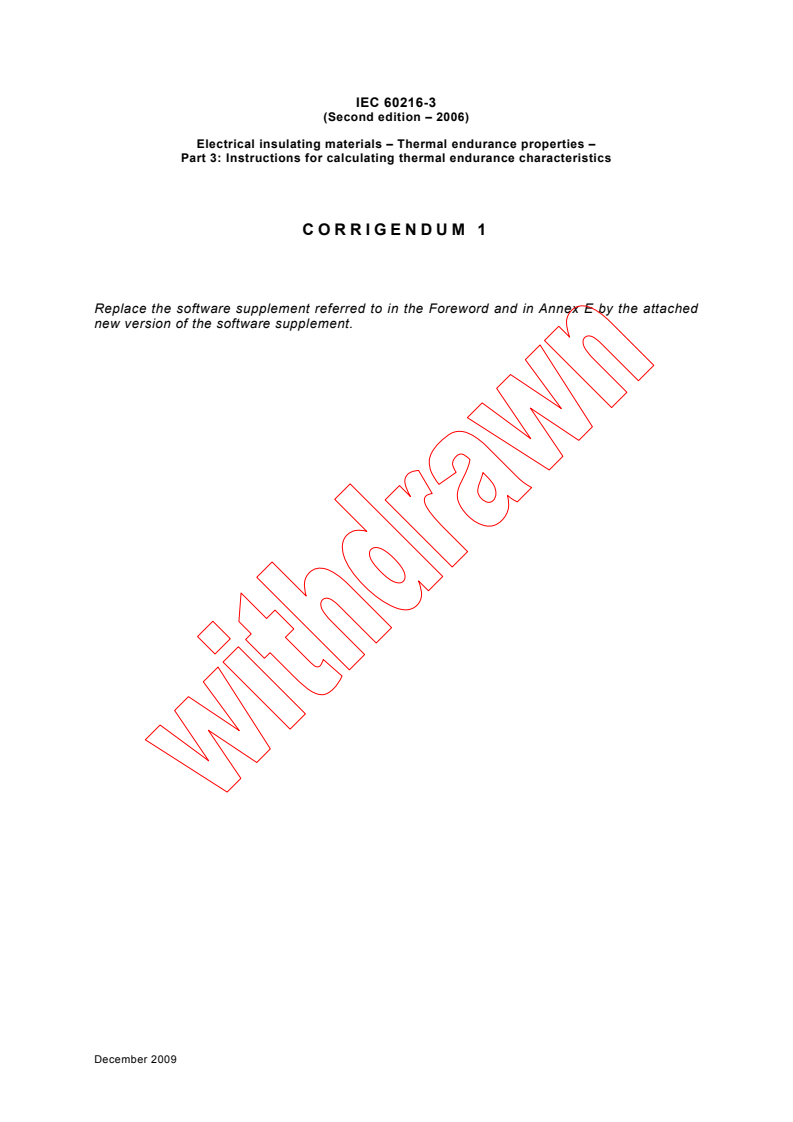
IEC 60216-3
(Second edition – 2006)
Electrical insulating materials – Thermal endurance properties –
Part 3: Instructions for calculating thermal endurance characteristics
CORRIGENDUM 1
...
This May Also Interest You
IEC 60216-3:2021 specifies the calculation procedures used for deriving thermal endurance characteristics from experimental data obtained in accordance with the instructions of IEC 60216-1 and IEC 60216-2, using fixed ageing temperatures and variable ageing times. The experimental data can be obtained using non-destructive, destructive or proof tests. Data obtained from non-destructive or proof tests can be incomplete, in that it is possible that measurement of times taken to reach the end-point will have been terminated at some point after the median time but before all specimens have reached end-point. The procedures are illustrated by worked examples, and suitable computer programs are recommended to facilitate the calculations.
This edition includes the following significant technical changes with respect to the previous edition:
- a new computer program has been included;
- Annex E " has been completely reworked.
- Standard179 pagesEnglish languagesale 15% off
- Standard113 pagesEnglish and French languagesale 15% off
IEC 60216-3:2006 specifies the calculation procedures to be used for deriving thermal endurance characteristics from experimental data obtained in accordance with the instructions of IEC 60216-1 and IEC 60216-2, using fixed ageing temperatures and variable ageing times. The experimental data may be obtained using non-destructive, destructive or proof tests. Data obtained from non-destructive or proof tests may be incomplete, in that measurement of times taken to reach the endpoint may have been terminated at some point after the median time but before all specimens have reached end-point. The procedures are illustrated by worked examples, and suitable computer programs are recommended to facilitate the calculations. The major technical changes with regard to the first edition concern an updating of Table C.2. In addition, the scope has been extended to cover a greater range of data characteristics, particularly with regard to incomplete data, as often obtained from proof test criteria. The greater flexibility of use should lead to more efficient employment of the time available for ageing purposes. Finally, the procedures specified in this part of IEC 60216 have been extensively tested and have been used to calculate results from a large body of experimental data obtained in accordance with other parts of the standard. Annex E "Computer program" has been completely reworked.
Please be aware that the computer program provided in this publication is not compatible with the 64-bit version of Windows 7.
- Standard50 pagesEnglish languagesale 15% off
- Standard10 pagesEnglish and French languagesale 15% off
Specifies the calculation procedures to be used for deriving thermal endurance characteristics from experimental data obtained in accordance with the instructions of IEC 60216-1 and IEC 60216-2. The experimental data may be obtained using non-destructive, destructive or proof tests. Data obtained from non-destructive or proof tests may be incomplete, in that measurement of times taken to reach the endpoint may have been terminated at some point after the median time but before all specimens have reached end-point. The procedures are illustrated by worked examples, and suitable computer programs are recommended to facilitate the calculations.
- Standard125 pagesEnglish and French languagesale 15% off
Covers the minimum requirements for ventilated and heated multi-chamber ovens used for thermal endurance evaluation of electrical insulation and of any other appropriate thermal conditioning application where the use of single-chamber ovens is inappropriate. Covers ovens designated to operate over all or part of the temperature range from 20 K above ambient to 500°C. Gives acceptance tests and in-service monitoring tests for both unloaded and loaded multi-chamber ovens and conditions of use.
- Standard27 pagesEnglish and French languagesale 15% off
IEC TR 61169-1-8:2025 provides a test method for voltage standing wave ratio (VSWR, hereinafter) of single RF connector by double-connector method. This document is applicable to single RF cable connectors and single microstrip RF connectors as well as single adapters if an estimation of the VSWR of a single completely installed RF-connector is used and a time domain feature is not available on the vector network analyzer.
- Technical report18 pagesEnglish languagesale 15% off
IEC 62541-100:2025 defines the information model associated with Devices. This document describes three models which build upon each other as follows:
• The (base) Device Model is intended to provide a unified view of devices and their hardware and software parts irrespective of the underlying device protocols.
• The Device Communication Model adds Network and Connection information elements so that communication topologies can be created.
• The Device Integration Host Model finally adds additional elements and rules required for host systems to manage integration for a complete system. It enables reflecting the topology of the automation system with the devices as well as the connecting communication networks.
This document also defines AddIns that can be used for the models in this document but also for models in other information models. They are:
• Locking model – a generic AddIn to control concurrent access,
• Software update model – an AddIn to manage software in a Device.
This second edition cancels and replaces the first edition published in 2015. This edition constitutes a technical revision.
This edition includes the following significant technical changes with respect to the previous edition:
a a ComponentType that can be used to model any HW or SW element of a device has been defined and a SoftwareType has been added as subtype of ComponentType;
b the new OPC UA interface concept and defined interfaces for Nameplate, DeviceHealth, and SupportInfo has been added.
c) a new model for Software Update (Firmware Update) has been added;
d) a new entry point for documents where each document is represented by a FileType instance has been specified;
e) a model that provides information about the lifetime, related limits and semantic of the lifetime of things like tools, material or machines has been added.
- Standard152 pagesEnglish languagesale 15% off
- Standard158 pagesFrench languagesale 15% off
- Standard310 pagesEnglish and French languagesale 15% off
IEC 62541-7: 2025 specifies value and structure of Profiles in the OPC Unified Architecture.
OPC UA Profiles are used to segregate features with regard to testing of OPC UA products and the nature of the testing. The scope of this document includes defining functionality that can only be tested. The definition of actual TestCases is not within the scope of this document, but the general categories of TestCases are covered by this document.
Most OPC UA applications will conform to several, but not all of the Profiles.
This fourth edition cancels and replaces the third edition published in 2020. This edition constitutes a technical revision.
This edition includes the following significant technical changes with respect to the previous edition:
a) Profiles and ConformanceUnits are not part of this document, but are solely managed in a public database as described in Clause 1.
- Standard160 pagesEnglish languagesale 15% off
- Standard173 pagesFrench languagesale 15% off
- Standard333 pagesEnglish and French languagesale 15% off
IEC 61757-1-4:2025 defines the terminology, structure, and measurement methods of distributed fibre optic sensors for absolute strain measurements based on spectral correlation analysis of Rayleigh backscattering signatures in single-mode fibres, where the fibre is the distributed strain measurement element in a measurement range from about 10 m to tens of km. This document also applies to hybrid sensor systems that combine the advantages of Brillouin and Rayleigh backscattering effects to obtain optimal measurement quality. This document also specifies the most important features and performance parameters of these distributed fibre optic strain sensors defines procedures for measuring these features and parameters. This part of IEC 61757 does not apply to point measurements or to dynamic strain measurements. Distributed strain measurements using Brillouin scattering in single-mode fibres are covered in IEC 61757-1-2. The most relevant applications of this strain measurement technique are listed in Annex A, while Annex B provides a short description of the underlying measurement principle.
- Standard27 pagesEnglish languagesale 15% off
- Standard29 pagesFrench languagesale 15% off
- Standard56 pagesEnglish and French languagesale 15% off
IEC TS 62607-6-27:2025, which is a Technical Specification, establishes a standardized method to determine the key control characteristic
• field-effect mobility
for semiconducting two-dimensional (2D) materials by the
• field-effect transistor (FET) method.
For two-dimensional semiconducting materials, the field-effect mobility is determined by fabricating a FET test structure and measuring the transconductance in a four-terminal configuration.
- This method can be applied to layers of semiconducting two-dimensional materials, such as graphene, black phosphorus (BP), molybdenum disulfide (MoS₂), molybdenum ditelluride (MoTe₂), tungsten disulfide (WS₂), and tungsten diselenide (WSe₂).
- The four-terminal configuration improves accuracy by eliminating parasitic effects from the probe contacts and cables
- Technical specification19 pagesEnglish languagesale 15% off


Questions, Comments and Discussion
Ask us and Technical Secretary will try to provide an answer. You can facilitate discussion about the standard in here.
Loading comments...