

IEC 60684-3-280:2010
(Main)Flexible insulating sleeving - Part 3: Specifications for individual types of sleeving - Sheet 280: Heat-shrinkable, polyolefin sleeving, anti-tracking
General Information
- Abstract
IEC 60684-3-280:2010 gives the requirements for heat-shrinkable, polyolefin sleeving, anti-tracking with a nominal shrink ratio of 3:1. This sleeving has been found suitable for use at temperatures up to 100 °C. Typically: medium wall, internal diameter up to 110 mm.
- Status
- Published
- Publication Date
- 11-Dec-2013
- Technical Committee
- TC 15 - Solid electrical insulating materials
- Drafting Committee
- WG 5 - TC 15/WG 5
- Current Stage
- DELPUB - Deleted Publication
- Start Date
- 20-Aug-2019
- Completion Date
- 12-Oct-2018
Buy Documents
IEC 60684-3-280:2010 - Flexible insulating sleeving - Part 3: Specifications for individual types of sleeving - Sheet 280: Heat-shrinkable, polyolefin sleeving, anti-tracking Released:6/10/2010
IEC 60684-3-280:2010+AMD1:2013 CSV - Flexible insulating sleeving - Part 3: Specifications for individualtypes of sleeving - Sheet 280: Heat-shrinkable, polyolefin sleeving,anti-tracking Released:12/12/2013
Overview
The international standard IEC 60684-3-280:2010 specifies requirements for heat-shrinkable, polyolefin sleeving with anti-tracking properties. This specialized flexible insulating sleeving is engineered for electrical applications, primarily designed to offer robust electrical insulation and resistance to tracking-a phenomenon where surface electrical discharges can occur due to contaminants or moisture. With a nominal shrink ratio of 3:1, this sleeving is suited for use in environments up to 100 °C and is available in medium wall thicknesses with internal diameters up to 110 mm.
As part of the broader IEC 60684 series, this document focuses on Part 3, Sheet 280, establishing guidelines for individual types of sleeving used in medium voltage cable accessories. It helps manufacturers, engineers, and end-users ensure product conformity, safety, and performance by adhering to internationally recognized specifications.
Key Topics
Heat-Shrinkable Polyolefin Sleeving
This sleeving shrinks to fit tightly around cables and components when heated, providing secure insulation and protection against environmental factors.Anti-Tracking Properties
The sleeving minimizes surface tracking, which is crucial to preventing electrical faults caused by environmental contamination, thus enhancing reliability.Nominal Shrink Ratio
The standard defines a shrink ratio of 3:1, meaning the sleeving can reduce its diameter by two-thirds when heated, accommodating various cable sizes.Thermal Performance
Suitable for continuous operation at temperatures up to 100 °C, ensuring stable performance in medium voltage systems.Dimensions and Sizes
Offers a typical medium wall thickness and internal diameters up to 110 mm, with guidance provided for selecting optimal sizes based on application needs.Testing and Conformance
The standard involves rigorous testing procedures covering mechanical performance, dielectric strength, resistance to fluids, and weathering exposure. Tests ensure the sleeving meets tensile strength, elongation, aging, and bending resistance criteria.Colour Coding
Sleeving is commonly supplied in red or brown, with colour designations following IEC 60757, facilitating identification and compliance with electrical installation standards.
Applications
IEC 60684-3-280 heat-shrinkable polyolefin sleeving is widely applied in:
Medium Voltage Cable Accessories
As part of terminations, joints, and splices in medium voltage cables, where electrical insulation and tracking resistance are paramount to system reliability.Electrical Insulation Protection
Provides enhanced insulation barriers around wiring and connectors subjected to environmental stress, mechanical abrasion, and electrical stress.Industrial and Utility Environments
Used in electrical distribution systems, power generation sites, and industrial installations requiring durable thermal and electrical performance.Electrical Maintenance and Repairs
Facilitates retrofit solutions requiring reliable insulation and protection from tracking on existing cables and components.
Related Standards
The IEC 60684-3-280 standard is part of a comprehensive framework addressing flexible insulating sleeving materials:
IEC 60684-1: Definitions and General Requirements
Establishes foundational terms and general properties for flexible insulating sleeving.IEC 60684-2: Methods of Test
Specifies standardized test procedures referenced for assessing properties in IEC 60684-3-280.HD 629 and IEC 60502 Series
Define testing requirements and guidelines for power cable accessories and extruded insulation cables, wherein this sleeving type is often utilized.IEC 60296
Relates to fluids for electrotechnical applications, relevant for testing resistance to insulating oils.ISO 4892-3
Guides exposure methods for weathering tests, ensuring material durability under UV light and environmental factors.
By following IEC 60684-3-280, manufacturers and users ensure that heat-shrinkable, polyolefin, anti-tracking sleeving meets stringent international performance and safety criteria, supporting reliable electrical insulation solutions in critical medium voltage applications.
Relations
- Effective Date
- 25-Aug-2026
- Effective Date
- 05-Sep-2023
- Effective Date
- 05-Sep-2023
Buy Documents
IEC 60684-3-280:2010 - Flexible insulating sleeving - Part 3: Specifications for individual types of sleeving - Sheet 280: Heat-shrinkable, polyolefin sleeving, anti-tracking Released:6/10/2010
IEC 60684-3-280:2010+AMD1:2013 CSV - Flexible insulating sleeving - Part 3: Specifications for individualtypes of sleeving - Sheet 280: Heat-shrinkable, polyolefin sleeving,anti-tracking Released:12/12/2013
Get Certified
Connect with accredited certification bodies for this standard

IMQ S.p.A. (Certification)
Italian electrical product certification.

SLG Prüf- und Zertifizierungs GmbH
German testing and certification body.

UL Solutions
Global safety science company with testing, inspection and certification.
Sponsored listings
Frequently Asked Questions
IEC 60684-3-280:2010 is a standard published by the International Electrotechnical Commission (IEC). Its full title is "Flexible insulating sleeving - Part 3: Specifications for individual types of sleeving - Sheet 280: Heat-shrinkable, polyolefin sleeving, anti-tracking". This standard covers: IEC 60684-3-280:2010 gives the requirements for heat-shrinkable, polyolefin sleeving, anti-tracking with a nominal shrink ratio of 3:1. This sleeving has been found suitable for use at temperatures up to 100 °C. Typically: medium wall, internal diameter up to 110 mm.
IEC 60684-3-280:2010 gives the requirements for heat-shrinkable, polyolefin sleeving, anti-tracking with a nominal shrink ratio of 3:1. This sleeving has been found suitable for use at temperatures up to 100 °C. Typically: medium wall, internal diameter up to 110 mm.
IEC 60684-3-280:2010 is classified under the following ICS (International Classification for Standards) categories: 17.140.50 - Electroacoustics; 29.035.20 - Plastics and rubber insulating materials. The ICS classification helps identify the subject area and facilitates finding related standards.
IEC 60684-3-280:2010 has the following relationships with other standards: It is inter standard links to EN 4840-101:2018, IEC 60684-3-280:2010/AMD1:2013, IEC 60684-3-280:2019. Understanding these relationships helps ensure you are using the most current and applicable version of the standard.
IEC 60684-3-280:2010 is available in PDF format for immediate download after purchase. The document can be added to your cart and obtained through the secure checkout process. Digital delivery ensures instant access to the complete standard document.
Standards Content (Sample)
IEC 60684-3-280 ®
Edition 1.0 2010-06
INTERNATIONAL
STANDARD
NORME
INTERNATIONALE
Flexible insulating sleeving –
Part 3: Specifications for individual types of sleeving –
Sheet 280: Heat-shrinkable, polyolefin sleeving, anti-tracking
Gaines isolantes souples –
Partie 3: Spécifications pour types particuliers de gaines –
Feuille 280: Gaines thermorétractables, en polyoléfine, anti-cheminement
All rights reserved. Unless otherwise specified, no part of this publication may be reproduced or utilized in any form or by
any means, electronic or mechanical, including photocopying and microfilm, without permission in writing from either IEC or
IEC's member National Committee in the country of the requester.
If you have any questions about IEC copyright or have an enquiry about obtaining additional rights to this publication,
please contact the address below or your local IEC member National Committee for further information.
Droits de reproduction réservés. Sauf indication contraire, aucune partie de cette publication ne peut être reproduite
ni utilisée sous quelque forme que ce soit et par aucun procédé, électronique ou mécanique, y compris la photocopie
et les microfilms, sans l'accord écrit de la CEI ou du Comité national de la CEI du pays du demandeur.
Si vous avez des questions sur le copyright de la CEI ou si vous désirez obtenir des droits supplémentaires sur cette
publication, utilisez les coordonnées ci-après ou contactez le Comité national de la CEI de votre pays de résidence.
IEC Central Office
3, rue de Varembé
CH-1211 Geneva 20
Switzerland
Email: inmail@iec.ch
Web: www.iec.ch
About the IEC
The International Electrotechnical Commission (IEC) is the leading global organization that prepares and publishes
International Standards for all electrical, electronic and related technologies.
About IEC publications
The technical content of IEC publications is kept under constant review by the IEC. Please make sure that you have the
latest edition, a corrigenda or an amendment might have been published.
ƒ Catalogue of IEC publications: www.iec.ch/searchpub
The IEC on-line Catalogue enables you to search by a variety of criteria (reference number, text, technical committee,…).
It also gives information on projects, withdrawn and replaced publications.
ƒ IEC Just Published: www.iec.ch/online_news/justpub
Stay up to date on all new IEC publications. Just Published details twice a month all new publications released. Available
on-line and also by email.
ƒ Electropedia: www.electropedia.org
The world's leading online dictionary of electronic and electrical terms containing more than 20 000 terms and definitions
in English and French, with equivalent terms in additional languages. Also known as the International Electrotechnical
Vocabulary online.
ƒ Customer Service Centre: www.iec.ch/webstore/custserv
If you wish to give us your feedback on this publication or need further assistance, please visit the Customer Service
Centre FAQ or contact us:
Email: csc@iec.ch
Tel.: +41 22 919 02 11
Fax: +41 22 919 03 00
A propos de la CEI
La Commission Electrotechnique Internationale (CEI) est la première organisation mondiale qui élabore et publie des
normes internationales pour tout ce qui a trait à l'électricité, à l'électronique et aux technologies apparentées.
A propos des publications CEI
Le contenu technique des publications de la CEI est constamment revu. Veuillez vous assurer que vous possédez
l’édition la plus récente, un corrigendum ou amendement peut avoir été publié.
ƒ Catalogue des publications de la CEI: www.iec.ch/searchpub/cur_fut-f.htm
Le Catalogue en-ligne de la CEI vous permet d’effectuer des recherches en utilisant différents critères (numéro de référence,
texte, comité d’études,…). Il donne aussi des informations sur les projets et les publications retirées ou remplacées.
ƒ Just Published CEI: www.iec.ch/online_news/justpub
Restez informé sur les nouvelles publications de la CEI. Just Published détaille deux fois par mois les nouvelles
publications parues. Disponible en-ligne et aussi par email.
ƒ Electropedia: www.electropedia.org
Le premier dictionnaire en ligne au monde de termes électroniques et électriques. Il contient plus de 20 000 termes et
définitions en anglais et en français, ainsi que les termes équivalents dans les langues additionnelles. Egalement appelé
Vocabulaire Electrotechnique International en ligne.
ƒ Service Clients: www.iec.ch/webstore/custserv/custserv_entry-f.htm
Si vous désirez nous donner des commentaires sur cette publication ou si vous avez des questions, visitez le FAQ du
Service clients ou contactez-nous:
Email: csc@iec.ch
Tél.: +41 22 919 02 11
Fax: +41 22 919 03 00
IEC 60684-3-280 ®
Edition 1.0 2010-06
INTERNATIONAL
STANDARD
NORME
INTERNATIONALE
Flexible insulating sleeving –
Part 3: Specifications for individual types of sleeving –
Sheet 280: Heat-shrinkable, polyolefin sleeving, anti-tracking
Gaines isolantes souples –
Partie 3: Spécifications pour types particuliers de gaines –
Feuille 280: Gaines thermorétractables, en polyoléfine, anti-cheminement
INTERNATIONAL
ELECTROTECHNICAL
COMMISSION
COMMISSION
ELECTROTECHNIQUE
PRICE CODE
INTERNATIONALE
L
CODE PRIX
ICS 29.035.20 ISBN 978-2-88910-964-7
– 2 – 60684-3-280 © IEC:2010
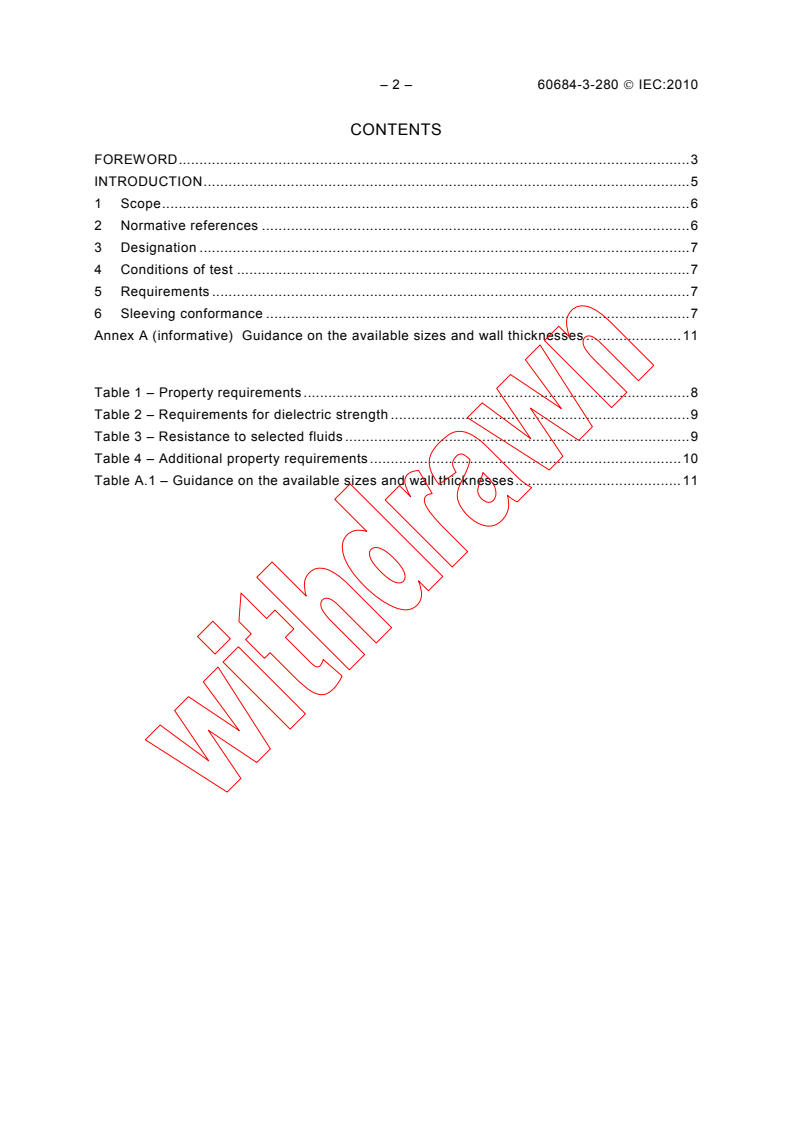
CONTENTS
FOREWORD.3
INTRODUCTION.5
1 Scope.6
2 Normative references .6
3 Designation .7
4 Conditions of test .7
5 Requirements .7
6 Sleeving conformance .7
Annex A (informative) Guidance on the available sizes and wall thicknesses .11
Table 1 – Property requirements .8
Table 2 – Requirements for dielectric strength .9
Table 3 – Resistance to selected fluids .9
Table 4 – Additional property requirements.10
Table A.1 – Guidance on the available sizes and wall thicknesses.11
60684-3-280 © IEC:2010 – 3 –
INTERNATIONAL ELECTROTECHNICAL COMMISSION
______________
FLEXIBLE INSULATING SLEEVING –
Part 3: Specifications for individual types of sleeving –
Sheet 280: Heat-shrinkable, polyolefin sleeving,
anti-tracking
FOREWORD
1) The International Electrotechnical Commission (IEC) is a worldwide organization for standardization comprising
all national electrotechnical committees (IEC National Committees). The object of IEC is to promote
international co-operation on all questions concerning standardization in the electrical and electronic fields. To
this end and in addition to other activities, IEC publishes International Standards, Technical Specifications,
Technical Reports, Publicly Available Specifications (PAS) and Guides (hereafter referred to as “IEC
Publication(s)”). Their preparation is entrusted to technical committees; any IEC National Committee interested
in the subject dealt with may participate in this preparatory work. International, governmental and non-
governmental organizations liaising with the IEC also participate in this preparation. IEC collaborates closely
with the International Organization for Standardization (ISO) in accordance with conditions determined by
agreement between the two organizations.
2) The formal decisions or agreements of IEC on technical matters express, as nearly as possible, an international
consensus of opinion on the relevant subjects since each technical committee has representation from all
interested IEC National Committees.
3) IEC Publications have the form of recommendations for international use and are accepted by IEC National
Committees in that sense. While all reasonable efforts are made to ensure that the technical content of IEC
Publications is accurate, IEC cannot be held responsible for the way in which they are used or for any
misinterpretation by any end user.
4) In order to promote international uniformity, IEC National Committees undertake to apply IEC Publications
transparently to the maximum extent possible in their national and regional publications. Any divergence
between any IEC Publication and the corresponding national or regional publication shall be clearly indicated in
the latter.
5) IEC itself does not provide any attestation of conformity. Independent certification bodies provide conformity
assessment services and, in some areas, access to IEC marks of conformity. IEC is not responsible for any
services carried out by independent certification bodies.
6) All users should ensure that they have the latest edition of this publication.
7) No liability shall attach to IEC or its directors, employees, servants or agents including individual experts and
members of its technical committees and IEC National Committees for any personal injury, property damage or
other damage of any nature whatsoever, whether direct or indirect, or for costs (including legal fees) and
expenses arising out of the publication, use of, or reliance upon, this IEC Publication or any other IEC
Publications.
8) Attention is drawn to the Normative references cited in this publication. Use of the referenced publications is
indispensable for the correct application of this publication.
9) Attention is drawn to the possibility that some of the elements of this IEC Publication may be the subject of
patent rights. IEC shall not be held responsible for identifying any or all such patent rights.
International Standard IEC 60684-3-280 has been prepared by IEC technical committee 15:
Solid electrical insulating materials.
The text of this standard is based on the following documents:
FDIS Report on voting
15/562/FDIS 15/585/RVD
Full information on the voting for the approval of this standard can be found in the report on
voting indicated in the above table.
This publication has been drafted in accordance with the ISO/IEC Directives, Part 2.
– 4 – 60684-3-280 © IEC:2010
A list of all the parts in the IEC 60684 series, published under the general title Flexible
insulating sleeving, can be found on the IEC website.
The committee has decided that the contents of this publication will remain unchanged until
the stability date indicated on the IEC web site under "http://webstore.iec.ch" in the data
related to the specific publication. At this date, the publication will be
• reconfirmed,
• withdrawn,
• replaced by a revised edition, or
• amended.
60684-3-280 © IEC:2010 – 5 –
INTRODUCTION
This International Standard is one of a series which deals with flexible insulating sleeving for
electrical purposes.
The series consists of three parts:
Part 1: Definitions and general requirements (IEC 60684-1)
Part 2: Methods of test (IEC 60684-2)
Part 3: Specifications for individual types of sleeving (IEC 60684-3)
This standard comprises one of the sheets of Part 3 as follows:
Sheet 280: Heat-shrinkable, polyolefin sleeving, anti-tracking
– 6 – 60684-3-280 © IEC:2010
FLEXIBLE INSULATING SLEEVING –
Part 3: Specifications for individual types of sleeving –
Sheet 280: Heat-shrinkable, polyolefin sleeving,
anti-tracking
1 Scope
This part of IEC 60684 gives the requirements for heat-shrinkable, polyolefin sleeving, anti-
tracking with a nominal shrink ratio of 3:1.
This sleeving has been found suitable for use at temperatures up to 100 °C.
Typically: medium wall, internal diameter up to 110 mm.
These sleevings are normally supplied in the colours red or brown.
Since these types of sleevings cover a significantly large range of sizes and wall thicknesses,
Table A.1 in this standard provides guidance on the range of sizes available. The actual size
shall be agreed between the user and the supplier.
Materials which conform to this specification meet established levels of performance.
However, the selection of a material by a user for a specific application should be based on
the actual requirements necessary for adequate performance in that application and not
based on this specification alone.
This sleeving is designed to be used in medium voltage cable accessories and as such
electrical performance must be proven as part of the assembly. Examples of this are
described in HD 629 and IEC 60502 series.
2 Normative references
The following referenced documents are indispensable for the application of this document.
For dated references, only the edition cited applies. For undated references, the latest edition
of the referenced document (including any amendments) applies.
IEC 60296:2003, Fluids for electrotechnical applications – Unused mineral insulating oils for
transformers and switchgear
IEC 60502 (all parts), Power cables with extruded insulation and their accessories for rated
voltages from 1 kV (Um = 1,2 kV) up to 30 kV (Um = 36 kV)
IEC 60684-1:2003, Flexible insulating sleeving – Part 1: Definitions and general requirements
IEC 60684-2:1997, Flexible insulating sleeving – Part 2: Methods of test
Amendment 1 (2003)
Amendment 2 (2005)
IEC 60757:1983, Code for designation of colours
ISO 846:1997, Plastics – Evaluation of the action of micro-organisms
60684-3-280 © IEC:2010 – 7 –
ISO 4892-3:2006, Plastics – Methods of exposure to laboratory light sources – Part 3:
Fluorescent UV lamps
HD 629, Test requirements on accessories for use on power cables of rated voltages from
3,6/6(7,2)kV up to 20,8/36 (42)kV – Part 1: Cables with extruded insulation
3 Designation
The sleeving shall be identified by the following designation:
a
Description IEC publication IEC part IEC sheet Size (expanded and Colour Table 4
number number number recovered internal diameter
code
in millimetres)
↓ ↓ ↓ ↓ ↓ ↓ ↓
Sleeving IEC 60684 - 3 -280 - 60,0/19,0 - Red X
a
The addition of “X” at the end of the designation indicates that the properties contained in Table 4 have been
agreed upon between the user and supplier.
Any colour abbreviation shall comply with IEC 60757, where applicable. Non-standard colours
shall be written out in full.
NOTE This information is for labelling only, in accordance with IEC 60684-1.
4 Conditions of test
Unless otherwise specified, the sleeving shall be shrunk in a forced air circulation oven for
(10 ± 1) min at 200 °C ± 3 K prior to testing.
5 Requirements
In addition to the general requirements given in IEC 60684-1, the sleeving shall comply with
the requirements of Tables 1, 2, 3, and 4 where applicable.
6 Sleeving conformance
Conformance to the requirements of this specification shall normally be based on the results
from typical sizes
– Recovered ID 20 mm - 30 mm
– 8 – 60684-3-280 © IEC:2010
Table 1 – Property requirements
Property IEC 60684-2 Units Max. Requirements Remarks
clause or or
subclause min.
Dimensions 3
– Internal diameter 3.1.2 mm
– Wall thickness 3.3.2 mm
– Concentricity 3.3.3 % To be agreed between
– expanded the purchaser and the
– recovered Min. supplier
Min. 60
Heat shock 6 Heat at
Tensile strength 19.1 and 19.2 MPa Min. 8
150 °C ± 5 K
Elongation at break 19.1 and 19.2 % Min. 200
Longitudinal 9 % Max. +5 Heat expanded sleeving
change –10
at 150 °C ± 3 K for
(10 ± 1) min.
Bending at low 14 – – No cracking Test at – 40 °C.
temperature shall be visible. For strips, the mandrel
shall be between 20
and 22 times the wall
thickness. Full section
sleeving is tested
unfilled and the mandrel
shall be between 20
and 22 times the outer
diameter.
Dimensional 16 – – The dimensions shall See Clause 1 Scope.
stability on storage remain as agreed.
Tensile strength 19.1 and 19.2 MPa Min. 10 Use a jaw separation
Elongation at break 19.1 and 19.2 % Min. 300 rate of 100 mm/min.
Below 6,5 mm ∅ as
sleeving. At 6,5 mm ∅
and above as
dumbbells.
Secant modulus 19.4 MPa Min. 80
at 2 % elongation MPa Max. 160
Dielectric strength See Table 2 of kV/mm Min. Table 2
this document.
Volume resistivity 23 Ω·m Min. 10
at room temperature 23.4.2
Resistance to 25 – Min. Class 2A Specimens shall be
tracking 2,5 kV – 1 h prepared from cross-
2,75 kV – 1h linked moulded plaques
3,0 kV – 1 h
of thickness (6 ± 1) mm.
3,25 kV – 20 min
Specimens should not
be abraded but cleaned
with an appropriate
solvent. The method of
cleaning shall be
recorded.
Resistance to Use the fluids and test
selected fluids 36 temperatures specified
in Table 3.
Tensile strength 19.1 and 19.2 MPa Min. 8
Elongation at break 19.1 and 19.2 % Min. 200 Immersion (24 ± 1)h
Heat ageing 39
Heat at 150 °C ± 3 K.
Tensile strength 19.1 and 19.2 MPa Min. 8
Elongation at break 19.1 and 19.2 % Min. 200
Long term ageing 50 % Min. 150 The ageing temperature
shall be 100 °C ± 3 K.
Elongation at break 19.2
60684-3-280 © IEC:2010 – 9 –
Table 2 – Requirements for dielectric strength
a
Expanded wall thickness Dielectric strength
mm Min.
Expanded ID Dielectric strength
kV/mm
All dimensions
10-25 14
26-59 12
60-120 10
a
Measure the expanded wall thickness and calculate the dielectric strength by dividing the breakdown voltage
by this value.
The breakdown voltage shall be determined by the method described in 21.4 of IEC 60684-2.
The sleeving shall be tested in the expanded condition.
The rate of application of the voltage shall be 500 V/s.
NOTE Care should be taken on selection of sizes based on these values. Refer to the manufacturer for actual
values on installed condition.
Table 3 – Resistance to selected fluids
Test Fluids Type Standard or symbol Immersion temperature
fluid
°C ± 2 K
No.
1 Insulating oil Mineral based IEC 60296 23
2 Isopropyl alcohol 23
3 - Water De-ionized 85
Other fluids and/or temperatures may be specified for customers with specific needs. These
additional fluids and/or temperatures shall be applicable when incorporated in
...
IEC 60684-3-280 ®
Edition 1.1 2013-12
CONSOLIDATED
VERSION
VERSION
CONSOLIDÉE
colour
inside
Flexible insulating sleeving –
Part 3: Specifications for individual types of sleeving – Sheet 280: Heat-
shrinkable, polyolefin sleeving, anti-tracking
Gaines isolantes souples –
Partie 3: Spécifications pour types particuliers de gaines – Feuille 280: Gaines
thermorétractables, en polyoléfine, anti-cheminement
All rights reserved. Unless otherwise specified, no part of this publication may be reproduced or utilized in any form
or by any means, electronic or mechanical, including photocopying and microfilm, without permission in writing from
either IEC or IEC's member National Committee in the country of the requester.
If you have any questions about IEC copyright or have an enquiry about obtaining additional rights to this publication,
please contact the address below or your local IEC member National Committee for further information.
Droits de reproduction réservés. Sauf indication contraire, aucune partie de cette publication ne peut être reproduite ni
utilisée sous quelque forme que ce soit et par aucun procédé, électronique ou mécanique, y compris la photocopie et les
microfilms, sans l'accord écrit de la CEI ou du Comité national de la CEI du pays du demandeur.
Si vous avez des questions sur le copyright de la CEI ou si vous désirez obtenir des droits supplémentaires sur cette
publication, utilisez les coordonnées ci-après ou contactez le Comité national de la CEI de votre pays de résidence.
IEC Central Office Tel.: +41 22 919 02 11
3, rue de Varembé Fax: +41 22 919 03 00
CH-1211 Geneva 20 info@iec.ch
Switzerland www.iec.ch
About the IEC
The International Electrotechnical Commission (IEC) is the leading global organization that prepares and publishes
International Standards for all electrical, electronic and related technologies.
About IEC publications
The technical content of IEC publications is kept under constant review by the IEC. Please make sure that you have the
latest edition, a corrigenda or an amendment might have been published.
Useful links:
IEC publications search - www.iec.ch/searchpub Electropedia - www.electropedia.org
The advanced search enables you to find IEC publications The world's leading online dictionary of electronic and
by a variety of criteria (reference number, text, technical electrical terms containing more than 30 000 terms and
committee,…). definitions in English and French, with equivalent terms in
It also gives information on projects, replaced and additional languages. Also known as the International
withdrawn publications. Electrotechnical Vocabulary (IEV) on-line.
IEC Just Published - webstore.iec.ch/justpublished Customer Service Centre - webstore.iec.ch/csc
Stay up to date on all new IEC publications. Just Published If you wish to give us your feedback on this publication
details all new publications released. Available on-line and or need further assistance, please contact the
also once a month by email. Customer Service Centre: csc@iec.ch.
A propos de la CEI
La Commission Electrotechnique Internationale (CEI) est la première organisation mondiale qui élabore et publie des
Normes internationales pour tout ce qui a trait à l'électricité, à l'électronique et aux technologies apparentées.
A propos des publications CEI
Le contenu technique des publications de la CEI est constamment revu. Veuillez vous assurer que vous possédez
l’édition la plus récente, un corrigendum ou amendement peut avoir été publié.
Liens utiles:
Recherche de publications CEI - www.iec.ch/searchpub Electropedia - www.electropedia.org
La recherche avancée vous permet de trouver des Le premier dictionnaire en ligne au monde de termes
publications CEI en utilisant différents critères (numéro de électroniques et électriques. Il contient plus de 30 000
référence, texte, comité d’études,…). termes et définitions en anglais et en français, ainsi que
Elle donne aussi des informations sur les projets et les les termes équivalents dans les langues additionnelles.
publications remplacées ou retirées. Egalement appelé Vocabulaire Electrotechnique
International (VEI) en ligne.
Just Published CEI - webstore.iec.ch/justpublished
Service Clients - webstore.iec.ch/csc
Restez informé sur les nouvelles publications de la CEI.
Just Published détaille les nouvelles publications parues. Si vous désirez nous donner des commentaires sur
Disponible en ligne et aussi une fois par mois par email. cette publication ou si vous avez des questions
contactez-nous: csc@iec.ch.
IEC 60684-3-280 ®
Edition 1.1 2013-12
CONSOLIDATED
VERSION
VERSION
CONSOLIDÉE
colour
inside
Flexible insulating sleeving –
Part 3: Specifications for individual types of sleeving – Sheet 280: Heat-
shrinkable, polyolefin sleeving, anti-tracking
Gaines isolantes souples –
Partie 3: Spécifications pour types particuliers de gaines – Feuille 280: Gaines
thermorétractables, en polyoléfine, anti-cheminement
INTERNATIONAL
ELECTROTECHNICAL
COMMISSION
COMMISSION
ELECTROTECHNIQUE
INTERNATIONALE
ICS 29.035.20 ISBN 978-2-8322-1312-4
IEC 60684-3-280 ®
Edition 1.1 2013-12
REDLINE VERSION
VERSION REDLINE
colour
inside
Flexible insulating sleeving –
Part 3: Specifications for individual types of sleeving – Sheet 280: Heat-
shrinkable, polyolefin sleeving, anti-tracking
Gaines isolantes souples –
Partie 3: Spécifications pour types particuliers de gaines – Feuille 280: Gaines
thermorétractables, en polyoléfine, anti-cheminement
– 2 – 60684-3-280 IEC:2010+A1:2013
CONTENTS
FOREWORD . 3
INTRODUCTION . 5
INTRODUCTION TO THE AMENDMENT . 6
1 Scope . 7
2 Normative references . 7
3 Designation . 8
4 Conditions of test . 8
5 Requirements . 8
6 Sleeving conformance . 8
Annex A (informative) Guidance on the available sizes and wall thicknesses . 12
Table 1 – Property requirements . 9
Table 2 – Requirements for dielectric strength . 10
Table 3 – Resistance to selected fluids . 10
Table 4 – Additional property requirements . 11
Table A.1 – Guidance on the available sizes and wall thicknesses . 12
60684-3-280 IEC:2010+A1:2013 – 3 –
INTERNATIONAL ELECTROTECHNICAL COMMISSION
______________
FLEXIBLE INSULATING SLEEVING –
Part 3: Specifications for individual types of sleeving –
Sheet 280: Heat-shrinkable, polyolefin sleeving,
anti-tracking
FOREWORD
1) The International Electrotechnical Commission (IEC) is a worldwide organization for standardization comprising
all national electrotechnical committees (IEC National Committees). The object of IEC is to promote
international co-operation on all questions concerning standardization in the electrical and electronic fields. To
this end and in addition to other activities, IEC publishes International Standards, Technical Specifications,
Technical Reports, Publicly Available Specifications (PAS) and Guides (hereafter referred to as “IEC
Publication(s)”). Their preparation is entrusted to technical committees; any IEC National Committee interested
in the subject dealt with may participate in this preparatory work. International, governmental and non-
governmental organizations liaising with the IEC also participate in this preparation. IEC collaborates closely
with the International Organization for Standardization (ISO) in accordance with conditions determined by
agreement between the two organizations.
2) The formal decisions or agreements of IEC on technical matters express, as nearly as possible, an international
consensus of opinion on the relevant subjects since each technical committee has representation from all
interested IEC National Committees.
3) IEC Publications have the form of recommendations for international use and are accepted by IEC National
Committees in that sense. While all reasonable efforts are made to ensure that the technical content of IEC
Publications is accurate, IEC cannot be held responsible for the way in which they are used or for any
misinterpretation by any end user.
4) In order to promote international uniformity, IEC National Committees undertake to apply IEC Publications
transparently to the maximum extent possible in their national and regional publications. Any divergence
between any IEC Publication and the corresponding national or regional publication shall be clearly indicated in
the latter.
5) IEC itself does not provide any attestation of conformity. Independent certification bodies provide conformity
assessment services and, in some areas, access to IEC marks of conformity. IEC is not responsible for any
services carried out by independent certification bodies.
6) All users should ensure that they have the latest edition of this publication.
7) No liability shall attach to IEC or its directors, employees, servants or agents including individual experts and
members of its technical committees and IEC National Committees for any personal injury, property damage or
other damage of any nature whatsoever, whether direct or indirect, or for costs (including legal fees) and
expenses arising out of the publication, use of, or reliance upon, this IEC Publication or any other IEC
Publications.
8) Attention is drawn to the Normative references cited in this publication. Use of the referenced publications is
indispensable for the correct application of this publication.
9) Attention is drawn to the possibility that some of the elements of this IEC Publication may be the subject of
patent rights. IEC shall not be held responsible for identifying any or all such patent rights.
This Consolidated version of IEC 60684-3-280 bears the edition number 1.1. It consists
of the first edition (2010) [documents 15/562/FDIS and 15/585/RVD] and its
amendment 1 (2013) [documents 15/686/CDV and 15/703/RVC]. The technical content is
identical to the base edition and its amendment.
In this Redline version, a vertical line in the margin shows where the technical content
is modified by amendment 1. Additions and deletions are displayed in red, with
deletions being struck through. A separate Final version with all changes accepted is
available in this publication.
This publication has been prepared for user convenience.
– 4 – 60684-3-280 IEC:2010+A1:2013
International Standard IEC 60684-3-280 has been prepared by IEC technical committee 15:
Solid electrical insulating materials.
This publication has been drafted in accordance with the ISO/IEC Directives, Part 2.
A list of all the parts in the IEC 60684 series, published under the general title Flexible
insulating sleeving, can be found on the IEC website.
The committee has decided that the contents of the base publication and its amendment will
remain unchanged until the stability date indicated on the IEC web site under
"http://webstore.iec.ch" in the data related to the specific publication. At this date, the
publication will be
• reconfirmed,
• withdrawn,
• replaced by a revised edition, or
• amended.
IMPORTANT – The “colour inside” logo on the cover page of this publication indicates
that it contains colours which are considered to be useful for the correct understanding
of its contents. Users should therefore print this publication using a colour printer.
60684-3-280 IEC:2010+A1:2013 – 5 –
INTRODUCTION
This International Standard is one of a series which deals with flexible insulating sleeving for
electrical purposes.
The series consists of three parts:
Part 1: Definitions and general requirements (IEC 60684-1)
Part 2: Methods of test (IEC 60684-2)
Part 3: Specifications for individual types of sleeving (IEC 60684-3)
This standard comprises one of the sheets of Part 3 as follows:
Sheet 280: Heat-shrinkable, polyolefin sleeving, anti-tracking
– 6 – 60684-3-280 IEC:2010+A1:2013
INTRODUCTION TO THE AMENDMENT
This amendment changes the test method for resistance to weathering since it is quoted
incorrectly as ISO 4892-3 method 1 .This method does not exist in the 2006 edition of
ISO 4892-3. Also after consulting with users of these types of sleevings, it was decided that a
period of 3 000 hours exposure to this method was adequate.
60684-3-280 IEC:2010+A1:2013 – 7 –
FLEXIBLE INSULATING SLEEVING –
Part 3: Specifications for individual types of sleeving –
Sheet 280: Heat-shrinkable, polyolefin sleeving,
anti-tracking
1 Scope
This part of IEC 60684 gives the requirements for heat-shrinkable, polyolefin sleeving, anti-
tracking with a nominal shrink ratio of 3:1.
This sleeving has been found suitable for use at temperatures up to 100 °C.
Typically: medium wall, internal diameter up to 110 mm.
These sleevings are normally supplied in the colours red or brown.
Since these types of sleevings cover a significantly large range of sizes and wall thicknesses,
Table A.1 in this standard provides guidance on the range of sizes available. The actual size
shall be agreed between the user and the supplier.
Materials which conform to this specification meet established levels of performance.
However, the selection of a material by a user for a specific application should be based on
the actual requirements necessary for adequate performance in that application and not
based on this specification alone.
This sleeving is designed to be used in medium voltage cable accessories and as such
electrical performance must be proven as part of the assembly. Examples of this are
described in HD 629 and IEC 60502 series.
2 Normative references
The following referenced documents are indispensable for the application of this document.
For dated references, only the edition cited applies. For undated references, the latest edition
of the referenced document (including any amendments) applies.
IEC 60296:2003, Fluids for electrotechnical applications – Unused mineral insulating oils for
transformers and switchgear
IEC 60502 (all parts), Power cables with extruded insulation and their accessories for rated
voltages from 1 kV (Um = 1,2 kV) up to 30 kV (Um = 36 kV)
IEC 60684-1:2003, Flexible insulating sleeving – Part 1: Definitions and general requirements
IEC 60684-2:1997, Flexible insulating sleeving – Part 2: Methods of test
Amendment 1 (2003)
Amendment 2 (2005)
IEC 60757:1983, Code for designation of colours
ISO 846:1997, Plastics – Evaluation of the action of micro-organisms
– 8 – 60684-3-280 IEC:2010+A1:2013
ISO 4892-3:2006, Plastics – Methods of exposure to laboratory light sources – Part 3:
Fluorescent UV lamps
HD 629, Test requirements on accessories for use on power cables of rated voltages from
3,6/6(7,2)kV up to 20,8/36 (42)kV – Part 1: Cables with extruded insulation
3 Designation
The sleeving shall be identified by the following designation:
a
Description IEC publication IEC part IEC sheet Size (expanded and Colour Table 4
number number number recovered internal diameter
code
in millimetres)
↓ ↓ ↓ ↓ ↓ ↓ ↓
Sleeving IEC 60684 - 3 -280 - 60,0/19,0 - Red X
a
The addition of “X” at the end of the designation indicates that the properties contained in Table 4 have been
agreed upon between the user and supplier.
Any colour abbreviation shall comply with IEC 60757, where applicable. Non-standard colours
shall be written out in full.
NOTE This information is for labelling only, in accordance with IEC 60684-1.
4 Conditions of test
Unless otherwise specified, the sleeving shall be shrunk in a forced air circulation oven for
(10 ± 1) min at 200 °C ± 3 K prior to testing.
5 Requirements
In addition to the general requirements given in IEC 60684-1, the sleeving shall comply with
the requirements of Tables 1, 2, 3, and 4 where applicable.
6 Sleeving conformance
Conformance to the requirements of this specification shall normally be based on the results
from typical sizes
– Recovered ID 20 mm - 30 mm
60684-3-280 IEC:2010+A1:2013 – 9 –
Table 1 – Property requirements
Property IEC 60684-2 Units Max. Requirements Remarks
clause or or
subclause min.
Dimensions 3
– Internal diameter 3.1.2 mm
– Wall thickness 3.3.2 mm
– Concentricity 3.3.3 % To be agreed between
– expanded the purchaser and the
– recovered Min. supplier
Min. 60
Heat shock 6 Heat at
Tensile strength 19.1 and 19.2 MPa Min. 8
150 °C ± 5 K
Elongation at break 19.1 and 19.2 % Min. 200
Longitudinal 9 % Max. +5 Heat expanded sleeving
change –10
at 150 °C ± 3 K for
(10 ± 1) min.
Bending at low 14 – – No cracking Test at – 40 °C.
temperature shall be visible.
For strips, the mandrel
shall be between 20
and 22 times the wall
thickness. Full section
sleeving is tested
unfilled and the mandrel
shall be between 20
and 22 times the outer
diameter.
Dimensional 16 – – The dimensions shall See Clause 1 Scope.
stability on storage remain as agreed.
Tensile strength 19.1 and 19.2 MPa Min. 10 Use a jaw separation
Elongation at break 19.1 and 19.2 % Min. 300 rate of 100 mm/min.
Below 6,5 mm ∅ as
sleeving. At 6,5 mm ∅
and above as
dumbbells.
Secant modulus 19.4 MPa Min. 80
at 2 % elongation MPa Max. 160
Dielectric strength See Table 2 of kV/mm Min. Table 2
this document.
Volume resistivity 23 Ω·m Min. 10
at room temperature 23.4.2
Resistance to 25 – Min. Class 2A Specimens shall be
tracking 2,5 kV – 1 h prepared from cross-
2,75 kV – 1h linked moulded plaques
3,0 kV – 1 h
of thickness (6 ± 1) mm.
3,25 kV – 20 min
Specimens should not
be abraded but cleaned
with an appropriate
solvent. The method of
cleaning shall be
recorded.
Resistance to Use the fluids and test
selected fluids 36 temperatures specified
in Table 3.
Tensile strength 19.1 and 19.2 MPa Min. 8
Elongation at break 19.1 and 19.2 % Min. 200 Immersion (24 ± 1)h
Heat ageing 39
Heat at 150 °C ± 3 K.
Tensile strength 19.1 and 19.2 MPa Min. 8
Elongation at break 19.1 and 19.2 % Min. 200
Long term ageing 50 % Min. 150 The ageing temperature
shall be 100 °C ± 3 K.
Elongation at break 19.2
– 10 – 60684-3-280 IEC:2010+A1:2013
Table 2 – Requirements for dielectric strength
a
Expanded wall thickness Dielectric strength
mm Min.
Expanded ID Dielectric strength
kV/mm
All dimensions
10-25 14
26-59 12
60-120 10
a
Measure the expanded wall thickness and calculate the dielectric strength by dividing the breakdown voltage
by this value.
The breakdown voltage shall be determined by the method described in 21.4 of IEC 60684-2.
The sleeving shall be tested in the expanded condition.
The rate of application of the voltage shall be 500 V/s.
NOTE Care should be taken on selection of sizes based on these values. Refer to the manufacturer for actual
values on installed condition.
Table 3 – Resistance to selected fluids
Test Fluids Type Standard or symbol Immersion temperature
fluid
°C ± 2 K
No.
1 Insulating oil Mineral based IEC 60296 23
2 Isopropyl alcohol 23
3 - Water De-ionized 85
Other fluids and/or temperatures may be specified for customers with specific needs. These
additional fluids and/or temperatures shall be applicable when incorporated into agreements
between the supplier and the customer.
60684-3-280 IEC:2010+A1:2013 – 11 –
Table 4 – Additional property requirements
Property IEC 60684-2 Units Max. Requirements Remarks
clause or or
subclause min.
Fungus resistance
Tensile strength 19.1 and 19.2 MPa Min. 8 The test method shall
Elongation % Min. 250 be ISO 846,
Method B.
56 days exposure.
ISO 4892-3 Test method to
Method 1 C ISO 4892-3.
Resistance to After 5 000 Samples for test 19.1
weathering 3 000 h and 19.2 should be
test Test to taken from recovered
sleeving which is
flattened. Samples for
Min.
19.1
Test 25 should be taken
MPa
19.2 Min.
from specially prepared
% Class 2A
25 Min.
test sheets (6 ± 0,1)
2,5 kV – 1h
mm thick. All samples
should be cut to the
appropriate size to fit
the sample holders.
Intermediate tests may
also be done at 1 000 h
intervals as an
intermediate check on
performance.
– 12 – 60684-3-280 IEC:2010+A1:2013
Annex A
(informative)
Guidance on the available sizes and wall thicknesses
Table A.1 – Guidance on the available sizes and wall thicknesses
Internal diameter Wall
Expanded Recovered Recovered wall thickness
Min. Max. Min.
mm mm mm
16,0 8,0 1,4
20,0 10,0 1,4
26,0 12,0 2,4
30,0 15,0 2,6
33,0 9,0 3,0
35,0 12,0 3,0
45,0 20,0 3,0
60,0 19,0 3,1
65,0 30,0 3,1
80,0 26,0 3,2
90,0 30,0 3,3
95,0 45,0 3,5
110,0 37,0 3,5
___________
– 14 – 60684-3-280 CEI:2010+A1:2013
SOMMAIRE
AVANT-PROPOS . 15
INTRODUCTION . 17
INTRODUCTION A l'AMENDEMENT . 18
1 Domaine d'application . 19
2 Références normatives . 19
3 Désignation . 20
4 Conditions d'essai . 20
5 Exigences . 20
6 Conformité des gaines . 20
Annexe A (informative) Lignes directrices concernant les dimensions et épaisseurs de
paroi disponibles . 24
Tableau 1 – Propriétés caractéristiques . 21
Tableau 2 – Exigences pour la rigidité diélectrique . 22
Tableau 3 – Résistance à des fluides sélectionnés . 22
Tableau 4 – Exigences de propriétés supplémentaires . 23
Tableau A.1 – Lignes directrices concernant les dimensions et épaisseurs de paroi
disponibles . 24
60684-3-280 CEI:2010+A1:2013 – 15 –
COMMISSION ÉLECTROTECHNIQUE INTERNATIONALE
____________
GAINES ISOLANTES SOUPLES –
Partie 3: Spécifications pour types particuliers de gaines –
Feuille 280: Gaines thermorétractables, en polyoléfine,
anti-cheminement
AVANT-PROPOS
1) La Commission Electrotechnique Internationale (CEI) est une organisation mondiale de normalisation
composée de l'ensemble des comités électrotechniques nationaux (Comités nationaux de la CEI). La CEI a
pour objet de favoriser la coopération internationale pour toutes les questions de normalisation dans les
domaines de l'électricité et de l'électronique. A cet effet, la CEI – entre autres activités – publie des Normes
internationales, des Spécifications techniques, des Rapports techniques, des Spécifications accessibles au
public (PAS) et des Guides (ci-après dénommés "Publication(s) de la CEI"). Leur élaboration est confiée à des
comités d'études, aux travaux desquels tout Comité national intéressé par le sujet traité peut participer. Les
organisations internationales, gouvernementales et non gouvernementales, en liaison avec la CEI, participent
également aux travaux. La CEI collabore étroitement avec l'Organisation Internationale de Normalisation (ISO),
selon des conditions fixées par accord entre les deux organisations.
2) Les décisions ou accords officiels de la CEI concernant les questions techniques représentent, dans la mesure
du possible, un accord international sur les sujets étudiés, étant donné que les Comités nationaux de la CEI
intéressés sont représentés dans chaque comité d’études.
3) Les Publications de la CEI se présentent sous la forme de recommandations internationales et sont agréées
comme telles par les Comités nationaux de la CEI. Tous les efforts raisonnables sont entrepris afin que la CEI
s'assure de l'exactitude du contenu technique de ses publications; la CEI ne peut pas être tenue responsable
de l'éventuelle mauvaise utilisation ou interprétation qui en est faite par un quelconque utilisateur final.
4) Dans le but d'encourager l'uniformité internationale, les Comités nationaux de la CEI s'engagent, dans toute la
mesure possible, à appliquer de façon transparente les Publications de la CEI dans leurs publications
nationales et régionales. Toutes divergences entre toutes Publications de la CEI et toutes publications
nationales ou régionales correspondantes doivent être indiquées en termes clairs dans ces dernières.
5) La CEI elle-même ne fournit aucune attestation de conformité. Des organismes de certification indépendants
fournissent des services d'évaluation de conformité et, dans certains secteurs, accèdent aux marques de
conformité de la CEI. La CEI n'est responsable d'aucun des services effectués par les organismes de
certification indépendants.
6) Tous les utilisateurs doivent s'assurer qu'ils sont en possession de la dernière édition de cette publication.
7) Aucune responsabilité ne doit être imputée à la CEI, à ses administrateurs, employés, auxiliaires ou
mandataires, y compris ses experts particuliers et les membres de ses comités d'études et des Comités
nationaux de la CEI, pour tout préjudice causé en cas de dommages corporels et matériels, ou de tout autre
dommage de quelque nature que ce soit, directe ou indirecte, ou pour supporter les coûts (y compris les frais
de justice) et les dépenses découlant de la publication ou de l'utilisation de cette Publication de la CEI ou de
toute autre Publication de la CEI, ou au crédit qui lui est accordé.
8) L'attention est attirée sur les références normatives citées dans cette publication. L'utilisation de publications
référencées est obligatoire pour une application correcte de la présente publication.
9) L’attention est attirée sur le fait que certains des éléments de la présente Publication de la CEI peuvent faire
l’objet de droits de propriété intellectuelle ou de droits analogues. La CEI ne saurait être tenue pour
responsable de ne pas avoir identifié de tels droits de propriété et de ne pas avoir signalé leur existence.
Cette version consolidée de la CEI 60684-3-280 porte le numéro d'édition 1.1. Elle
comprend la première édition (2010) [documents 15/562/FDIS et 15/585/RVD] et son
amendement 1 (2013) [documents 15/686/CDV et 15/703/RVC]. Le contenu technique est
identique à celui de l'édition de base et à son amendement.
Dans cette version Redline, une ligne verticale dans la marge indique où le contenu
technique est modifié par l’amendement 1. Les ajouts et les suppressions apparaissent
en rouge, les suppressions étant barrées. Une version Finale avec toutes les
modifications acceptées est disponible dans cette publication.
Cette publication a été préparée par commodité pour l’utilisateur.
– 16 – 60684-3-280 CEI:2010+A1:2013
La Norme internationale CEI 60684-3-280 a été établie par le comité d'études 15 de la CEI:
Matériaux isolants électriques solides.
Cette publication a été rédigée selon les Directives ISO/CEI, Partie 2.
Une liste de toutes les parties de la série CEI 60684, publiées sous le titre général Gaines
isolantes souples, peut être consultée sur le site web de la CEI.
Le comité a décidé que le contenu de la publication de base et de son amendement ne sera
pas modifié avant la date de stabilité indiquée sur le site web de la CEI sous
"http://webstore.iec.ch" dans les données relatives à la publication recherchée. A cette date,
la publication sera
• reconduite,
• supprimée,
• remplacée par une édition révisée, ou
• amendée.
IMPORTANT – Le logo "colour inside" qui se trouve sur la page de couverture de cette
publication indique qu'elle contient des couleurs qui sont considérées comme utiles à
une bonne compréhension de son contenu. Les utilisateurs devraient, par conséquent,
imprimer cette publication en utilisant une imprimante couleur.
60684-3-280 CEI:2010+A1:2013 – 17 –
INTRODUCTION
La présente Norme internationale fait partie d'une série traitant des gaines isolantes souples
à usages électriques.
Cette série est composée de trois parties:
Partie 1: Définitions et exigences générales (CEI 60684-1)
Partie 2: Méthodes d'essai (CEI 60684-2)
Partie 3: Spécifications pour types particuliers de gaines (CEI 60684-3)
La présente norme contient une des feuilles constituant la Partie 3, comme suit:
Feuille 280: Gaines thermorétractables, en polyoléfine, anti-cheminement
– 18 – 60684-3-280 CEI:2010+A1:2013
INTRODUCTION À L'AMENDEMENT
Le présent amendement modifie la méthode d'essai relative à la résistance aux intempéries,
en raison du fait qu'elle est citée de manière erronée en tant qu'ISO 4892-3 méthode 1 .Or,
cette méthode n'existe pas dans l'édition 2006 de l'ISO 4892-3. De même, après consultation
des utilisateurs de ces types de gaines, il a été décidé qu'une période de 3 000 heures
d'exposition à cette méthode était adéquate.
60684-3-280 CEI:2010+A1:2013 – 19 –
GAINES ISOLANTES SOUPLES –
Partie 3: Spécifications pour types particuliers de gaines –
Feuille 280: Gaines thermorétractables, en polyoléfine,
anti-cheminement
1 Domaine d'application
La présente partie de la CEI 60684 donne les exigences relatives aux gaines
thermorétractables, en polyoléfine, anti-cheminement, présentant un rapport de rétreint
nominal de 3:1.
Ces gaines se sont révélées être adaptées à des températures jusqu'à 100 °C.
Généralement: paroi moyenne, diamètre intérieur jusqu’à 110 mm.
Ces gaines sont normalement proposées en rouge ou en brun.
Comme ces types de gaines couvrent une gamme très large de dimensions et d’épaisseurs
de paroi, le Tableau A.1 de la présente norme donne des lignes directrices sur la gamme des
dimensions disponibles. La dimension réelle doit faire l’objet d’un accord entre l’utilisateur et
le fournisseur.
Les matériaux conformes à la présente spécification satisfont à des niveaux établis de
performance. Toutefois, il convient que le choix d’un matériau par un utilisateur pour une
application spécifique soit fondé sur les exigences réelles nécessaires pour obtenir des
performances adéquates de l’application concernée et qu’il ne soit pas fondé seulement sur la
présente spécification.
Cette gaine est conçue pour être utilisée dans des accessoires de câbles moyenne tension,
et, en conséquence, il faut que les performances électriques soient établies dans le cadre de
l’assemblage concerné. De tels exemples sont décrits dans le HD 629 et dans la série
CEI 60502.
2 Références normatives
Les documents de référence suivants sont indispensables pour l'application du présent
document. Pour les références datées, seule l'édition citée s'applique. Pour les références
non datées, la dernière édition du document de référence s'applique (y compris les éventuels
amendements).
CEI 60296:2003, Fluides pour applications électrotechniques – Huiles minérales isolantes
neuves pour transformateurs et appareillages de connexion
CEI 60502 (toutes les parties), Câbles d'énergie à isolant extrudé et leurs accessoires pour
des tensions assignées de 1 kV (Um = 1,2 kV) à 30 kV (Um = 36 kV)
CEI 60684-1:2003, Gaines isolantes souples – Partie 1: Définitions et exigences générales
CEI 60684-2:1997, Gaines isolantes souples – Partie 2 : Méthodes d’essai
Amendement 1 (2003)
Amendement 2 (2005)
– 20 – 60684-3-280 CEI:2010+A1:2013
CEI 60757:1983, Code de désignation de couleurs
ISO 846:1997, Plastiques – Evaluation de l’action des micro-organismes
ISO 4892-3:2006, Plastiques – Méthodes d'exposition à des sources lumineuses de laboratoire –
Partie 3: Lampes fluorescentes UV
HD 629, Test requirements on accessories for use on power cables of rated voltages from
3,6/6(7,2)KV up to 20,8/36 (42)KV – Part 1: Cables with extruded insulation (disponible en
anglais seulement)
3 Désignation
Les gaines doivent être identifiées par la désignation suivante:
a
Description Numéro de Numéro Numéro de Dimension (diamètre Couleur Tableau 4
publication CEI de partie feuille CEI intérieur à l'état expansé
code
CEI et rétreint en millimètres)
↓ ↓ ↓ ↓ ↓ ↓ ↓
Gaine CEI 60684 - 3 -280 - 60,0/19,0 - Rouge X
a
L’ajout de “X” à la fin de la désignation indique que les propriétés contenues dans le Tableau 4 ont fait l’objet d’un
accord entre l’utilisateur et le fournisseur.
Toutes les abréviations utilisées pour les couleurs doivent satisfaire à la CEI 60757, lorsque
celle-ci est applicable. Les couleurs non normalisées doivent être indiquées en toutes lettres.
NOTE Cette information n’est destinée qu’à l’étiquetage conformément à la CEI 60684-1.
4 Conditions d'essai
Sauf spécification contraire, la gaine doit être rétreinte dans une étuve à ventilation forcée
pendant (10 ± 1) min à 200 °C ± 3 K avant l'essai.
5 Exigences
Les gaines doivent satisfaire aux exigences données dans les Tableaux 1, 2, 3 et 4, si
applicables, en plus des exigences générales données dans la CEI 60684-1.
6 Conformité des gaines
La conformité aux exigences de la présente spécification doit normalement être fondée sur
les résultats provenant des dimensions types.
– DI Rétreint 20 mm - 30 mm
60684-3-280 CEI:2010+A1:2013 – 21 –
Tableau 1 – Propriétés caractéristiques
Propriété CEI 60684-2 Unités Max. Exigences Remarques
article ou
ou min.
paragraphe
Dimensions 3
– Diamètre intérieur 3.1.2 mm
Doit faire l’objet d’un accord
– Epaisseur des parois 3.3.2 mm
entre l’acheteur et le
– Concentricité 3.3.3 %
fournisseur
– expansée
– rétreinte Min.
Min.
Choc thermique 6 Chaleur à
Résistance à la traction 19.1 et 19.2 MPa Min. 8
150 °C ± 5 K
Allongement à la rupture 19.1 et 19.2 % Min. 200
Variation longitudinale 9 % Max. +5 Chauffer les gaines
–10 expansées à
150 °C ± 3 K pendant
( 10 ± 1 ) min.
Flexion à basse 14 – – Il ne doit pas y avoir de
Essai à – 40 °C
température traces de fendillement.
Pour les bandes, le
mandrin doit corres-
pondre à 20 et 22 fois
l’épaisseur de la paroi.
Les gaines de section
complète sont essayées
non remplies et le
mandrin doit corres-
pondre à une valeur
entre 20 et 22 fois le
diamètre extérieur.
Stabilité des dimensions 16 – – Les dimensions doivent Voir Article 1 Domaine
au stockage rester telles qu’elles ont d’application.
été décidées.
Résistance à la traction 19.1 et 19.2 MPa Min. 10 Utiliser une vitesse de
séparation des mâchoires
Allongement à la 19.1 et 19.2 % Min. 300
de 100 mm/min. En-
rupture
dessous de 6,5 mm de ∅
de gaine. Pour 6,5 mm de
∅ et plus comme haltères
Module sécant 19.4 MPa Min. 80
à 2 % d’allongement
MPa Max. 160
Rigidité diélectrique Voir le Tableau kV/mm Min. Tableau 2
2 du présent
document.
Résistivité transversale 23 Ω·m Min. 10
à température ambiante 23.4.2
Résistance aux 25 _ Min. Classe 2A Les échantillons doivent
courants de 2,5 kV – 1 h être préparés à partir
cheminement 2,75 kV – 1h de plaques moulées
3,0 kV – 1 h réticulées d’une
3,25 kV – 20 min épaisseur de
(6 ±1) mm.
Il convient que les
échantillons ne soient
pas abrasés mais qu’ils
soient nettoyés avec un
solvant approprié. La
méthode de nettoyage
doit être consignée.
Résistance à des fluides Utiliser les fluides et
choisis 36 les températures
d’essai spécifiés au
– 22 – 60684-3-280 CEI:2010+A1:2013
Propriété CEI 60684-2 Unités Max. Exigences Remarques
article ou
ou min.
paragraphe
Tableau 3.
Résistance à la traction 19.1 et 19.2 MPa Min. 8
Immersion (24 ± 1) h
Allongement à la rupture 19.1 et 19.2 % Min. 200
Vieillissement thermique 39
Résistance à la traction 19.1 et 19.2 MPa Min. 8 Chaleur à 150 °C ± 3 K
Allongement à la 19.1 et 19.2 % Min. 200
rupture
Vieillissement à long % Min. 150 La température de
terme 50 vieillissement doit être
de 100 °C ± 3 K.
Allongement à la 19.2
rupture
Tableau 2 – Exigences pour la rigidité diélectrique
a
Epaisseur de paroi expansée Rigidité diélectrique
mm Min.
DI expansé Rigidité diélectrique
kV/mm
Toutes les dimensions
10-25 14
26-59 12
60-120 10
a
Mesurer l’épaisseur de paroi expansée et calculer la rigidité diélectrique en divisant la tension de claquage par
cette valeur.
La tension de claquage doit être déterminée par la méthode décrite en 21.4 de la
CEI 60684-2.
La gaine doit subir les essais en condition expansée.
La vitesse d’application de la tension doit être de 500 V/s.
NOTE Il convient d’apporter un soin particulier à la sélection des dimensions à partir de ces valeurs. S’adresser
au fabricant pour les valeurs réelles dans les conditions installées.
Tableau 3 – Résistance à des fluides sélectionnés
Fluide Fluides Type Norme ou symbole Température
d’essai d'immersion
o
N
°C ± 2 K
1 Huile isolante Base minérale CEI 60296 23
2 Alcool isopropylique 23
3 - Eau Déminéralisée 85
D’autres fluides et/ou températures peuvent être spécifiés pour les clients ayant des besoins
spécifiques. Ces fluides et/ou températures supplémentaires doivent être applicables
lorsqu’ils sont intégrés à des accords entre le fournisseur et le client.
60684-3-280 CEI:2010+A1:2013 – 23 –
Tableau 4 – Exigences de propriétés supplémentaires
Propriété CEI 60684-2 Unités Max. Exigence Remarques
article ou
ou min.
paragraphe
Résistance aux
moisissures
La méthode d’essai doit
Résistance à la 19.1 and 19.2 MPa Min. 8
être celle de l’ISO 846,
traction
Méthode B.
Allongement % Min. 250
56 jours d’exposition
ISO 4892-3 Méthode d’essai selon
Méthode 1 ISO 4892-3.
Résistance aux Après 5 000 Il convient de prendre les
intempéries 3 000 h d'essai échantillons pour les
Essai selon essais 19.1 et 19.2 parmi
19.1 Min. des gaines rétreintes qui
MPa
Min.
19.2 sont aplaties. Il convient
% Class 2A
25 Min. de prendre les
2,5 kV – 1h
échantillons pour l’essai
25 sur des feuilles
d’essai préparées
spécialement de (6 ± 0,1)
mm d’épaisseur. Il
convient que tous les
échantillons soient
coupés à la taille
appropriée pour
s'adapter aux supports.
Des essais intermédiaires
peuvent aussi être
réalisés à 1 000 h
d’intervalle comme
vérification intermédiaire
des performances.
– 24 – 60684-3-280 CEI:2010+A1:2013
Annexe A
(informative)
Lignes directrices concernant les dimensions
et épaisseurs de paroi disponibles
Tableau A.1 – Lignes directrices concernant les dimensions
et épaisseurs de paroi disponibles
Diamètre intérieur Paroi
Expansé Rétreint Epaisseur des parois après rétreint
Min. Max. Min.
mm mm mm
16,0 8,0 1,4
20,0 10,0 1,4
26,0 12,0 2,4
30,0 15,0 2,6
33,0 9,0 3,0
35,0 12,0 3,0
45,0 20,0 3,0
60,0 19,0 3,1
65,0 30,0 3,1
80,0 26,0 3,2
90,0 30,0 3,3
95,0 45,0 3,5
110,0 37,0 3,5
____________
IEC 60684-3-280 ®
Edition 1.1 2013-12
FINAL VERSION
VERSION FINALE
Flexible insulating sleeving –
Part 3: Specifications for individual types of sleeving – Sheet 280: Heat-
shrinkable, polyolefin sleeving, anti-tracking
Gaines isolantes souples –
Partie 3: Spécifications pour types particuliers de gaines – Feuille 280: Gaines
thermorétractables, en polyoléfine, anti-cheminement
– 2 – 60684-3-280 IEC:2010+A1:2013
CONTENTS
FOREWORD . 3
INTRODUCTION . 5
INTRODUCTION TO THE AMENDMENT . 6
1 Scope . 7
2 Normative references . 7
3 Designation .
...