

CISPR 16-1-4:2007
(Main)Specification for radio disturbance and immunity measuring apparatus and methods - Part 1-4: Radio disturbance and immunity measuring apparatus - Ancillary equipment - Radiated disturbances
General Information
- Abstract
This part of CISPR 16 is designated a basic standard, which specifies the characteristics and performance of equipment for the measurement of radiated disturbances in the frequency range 9 kHz to 18 GHz. Specifications for ancillary apparatus are included for: antennas and test sites, TEM cells, and reverberating chambers. The requirements of this publication must be complied with at all frequencies and for all levels of radiated disturbances within the CISPR indicating range of the measuring equipment. Methods of measurement are covered in Part 2-3, and further information on radio disturbance is given in Part 3 of CISPR 16. Uncertainties, statistics and limit modelling are covered in Part 4 of CISPR 16.
- Status
- Published
- Publication Date
- 21-Jan-2008
- Technical Committee
- CIS/A - Radio-interference measurements and statistical methods
- Current Stage
- DELPUB - Deleted Publication
- Start Date
- 27-Apr-2010
- Completion Date
- 28-Aug-2026
Buy Documents
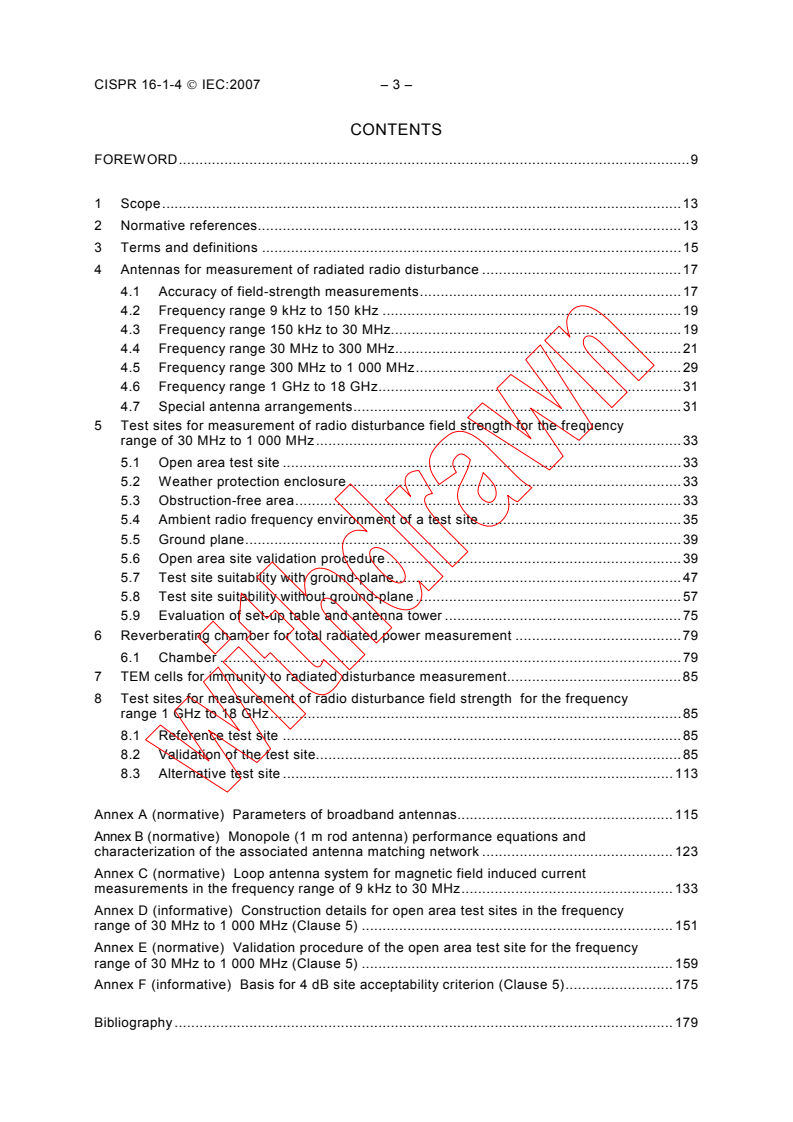
CISPR 16-1-4:2007 - Specification for radio disturbance and immunity measuring apparatus and methods - Part 1-4: Radio disturbance and immunity measuring apparatus - Ancillary equipment - Radiated disturbances Released:2/20/2007
CISPR 16-1-4:2007 - Spécifications des méthodes et des appareils de mesure des perturbations radioélectriques et de l'immunité aux perturbations radioélectriques - Partie 1-4: Appareils de mesure des perturbations radioélectriques et de l'immunité aux perturbations radioélectriques - Matériels auxiliaires - Perturbations rayonnées Released:2/20/2007

CISPR 16-1-4:2007 - Specification for radio disturbance and immunity measuring apparatus and methods - Part 1-4: Radio disturbance and immunity measuring apparatus - Ancillary equipment - Radiated disturbances Released:2/20/2007

CISPR 16-1-4:2007+AMD1:2007 CSV - Specification for radio disturbance and immunity measuring apparatus and methods - Part 1-4: Radio disturbance and immunity measuring apparatus - Ancillary equipment - Radiated disturbances Released:1/22/2008
Overview
CISPR 16-1-4:2007 (IEC) is a basic standard in the CISPR 16 series that specifies the characteristics and performance of equipment for measurement of radiated disturbances in the frequency range 9 kHz to 18 GHz. It covers the required ancillary equipment used when measuring radiated emissions - notably antennas, test sites (open area test sites and alternative sites), TEM cells, and reverberating (reverberation) chambers. The publication defines performance criteria and validation procedures that must be met for reliable field-strength and total radiated power (TRP) measurements across the CISPR indicating range.
Key topics and technical requirements
- Frequency coverage: requirements and antenna guidance spanning 9 kHz–18 GHz, with subranges (9 kHz–150 kHz, 150 kHz–30 MHz, 30 MHz–300 MHz, 300 MHz–1 GHz, 1 GHz–18 GHz).
- Antenna specifications: characteristics and factors for broadband and tuned antennas, monopole and loop antenna treatment, and antenna accuracy for field-strength measurements.
- Test site design and validation: open area test site (OATS) geometry, ground plane requirements, obstruction-free area, site validation procedures (site attenuation measurements) and acceptance criteria (including normative annexes detailing validation and normalized site attenuation).
- TEM cells and reverberating chambers: specifications for immunity testing in TEM cells and for TRP measurements in reverberation chambers (stirrer design, coupling attenuation behaviour).
- Ancillary measurement procedures: positions, polarization, set-up tables and tower/equipment evaluation to ensure repeatable radiated disturbance measurements.
- Normative annexes and guidance: antenna parameters, monopole performance equations, large-loop systems, construction and validation procedures, and an error/uncertainty basis for site acceptability.
Practical applications
- Designing, building and validating open area test sites (OATS) or alternative test sites for EMC compliance testing.
- Selecting and characterizing measurement antennas and matching networks for radiated emissions testing.
- Implementing TEM cell setups for immunity testing and reverberation chamber configurations for accurate TRP measurements.
- Performing site validation and documenting normalized site attenuation for accreditation of EMC test labs.
- Supporting manufacturers and test houses in demonstrating conformance to radiated emissions limits and regulatory requirements.
Who uses this standard
- EMC test laboratory engineers and facility managers
- Compliance and certification engineers at manufacturers of electronic equipment
- Antenna and test-site designers/consultants
- National/regulatory bodies and accreditation assessors
Related standards
- Other parts of the CISPR 16 series: Part 2-3 (measurement methods), Part 3 (further information on radio disturbance), Part 4 (uncertainties, statistics and limit modelling).
- IEC publications and national EMC test standards referencing CISPR measurement apparatus and site validation.
Keywords: CISPR 16-1-4:2007, radiated disturbances, antennas, open area test site, TEM cell, reverberation chamber, field strength measurement, TRP, site validation, EMC test lab.
Relations
- Effective Date
- 05-Sep-2023
- Effective Date
- 05-Sep-2023
- Effective Date
- 05-Sep-2023
- Effective Date
- 05-Sep-2023
- Effective Date
- 05-Sep-2023
- Effective Date
- 05-Sep-2023
- Effective Date
- 05-Sep-2023
Buy Documents
CISPR 16-1-4:2007 - Specification for radio disturbance and immunity measuring apparatus and methods - Part 1-4: Radio disturbance and immunity measuring apparatus - Ancillary equipment - Radiated disturbances Released:2/20/2007
CISPR 16-1-4:2007 - Spécifications des méthodes et des appareils de mesure des perturbations radioélectriques et de l'immunité aux perturbations radioélectriques - Partie 1-4: Appareils de mesure des perturbations radioélectriques et de l'immunité aux perturbations radioélectriques - Matériels auxiliaires - Perturbations rayonnées Released:2/20/2007
CISPR 16-1-4:2007 - Specification for radio disturbance and immunity measuring apparatus and methods - Part 1-4: Radio disturbance and immunity measuring apparatus - Ancillary equipment - Radiated disturbances Released:2/20/2007
CISPR 16-1-4:2007+AMD1:2007 CSV - Specification for radio disturbance and immunity measuring apparatus and methods - Part 1-4: Radio disturbance and immunity measuring apparatus - Ancillary equipment - Radiated disturbances Released:1/22/2008
Get Certified
Connect with accredited certification bodies for this standard

ANCE
Mexican certification and testing association.

Intertek Slovenia
Intertek testing, inspection, and certification services in Slovenia.

LNE (Laboratoire National de Métrologie et d'Essais)
French national laboratory for metrology and testing.
Sponsored listings
Frequently Asked Questions
CISPR 16-1-4:2007 is a standard published by the International Electrotechnical Commission (IEC). Its full title is "Specification for radio disturbance and immunity measuring apparatus and methods - Part 1-4: Radio disturbance and immunity measuring apparatus - Ancillary equipment - Radiated disturbances". This standard covers: This part of CISPR 16 is designated a basic standard, which specifies the characteristics and performance of equipment for the measurement of radiated disturbances in the frequency range 9 kHz to 18 GHz. Specifications for ancillary apparatus are included for: antennas and test sites, TEM cells, and reverberating chambers. The requirements of this publication must be complied with at all frequencies and for all levels of radiated disturbances within the CISPR indicating range of the measuring equipment. Methods of measurement are covered in Part 2-3, and further information on radio disturbance is given in Part 3 of CISPR 16. Uncertainties, statistics and limit modelling are covered in Part 4 of CISPR 16.
This part of CISPR 16 is designated a basic standard, which specifies the characteristics and performance of equipment for the measurement of radiated disturbances in the frequency range 9 kHz to 18 GHz. Specifications for ancillary apparatus are included for: antennas and test sites, TEM cells, and reverberating chambers. The requirements of this publication must be complied with at all frequencies and for all levels of radiated disturbances within the CISPR indicating range of the measuring equipment. Methods of measurement are covered in Part 2-3, and further information on radio disturbance is given in Part 3 of CISPR 16. Uncertainties, statistics and limit modelling are covered in Part 4 of CISPR 16.
CISPR 16-1-4:2007 is classified under the following ICS (International Classification for Standards) categories: 33.100.10 - Emission; 33.100.20 - Immunity. The ICS classification helps identify the subject area and facilitates finding related standards.
CISPR 16-1-4:2007 has the following relationships with other standards: It is inter standard links to CISPR 16-1-4:2007/AMD2:2008, CISPR 16-1-4:2007/AMD1:2007, CISPR 16-1-4:2003/AMD2:2005, CISPR 16-1-4:2010, CISPR 16-1-4:2003/AMD1:2004, CISPR 16-1-4:2003, CISPR 16-1-4:2003/COR1:2005. Understanding these relationships helps ensure you are using the most current and applicable version of the standard.
CISPR 16-1-4:2007 is available in PDF format for immediate download after purchase. The document can be added to your cart and obtained through the secure checkout process. Digital delivery ensures instant access to the complete standard document.
Standards Content (Sample)
INTERNATIONAL
CISPR
ELECTROTECHNICAL
16-1-4
COMMISSION
Second edition
2007-02
INTERNATIONAL SPECIAL COMMITTEE ON RADIO INTERFERENCE
Specification for radio disturbance and immunity
measuring apparatus and methods –
Part 1-4:
Radio disturbance and immunity measuring
apparatus – Ancillary equipment –
Radiated disturbances
This English-language version is derived from the original
bilingual publication by leaving out all French-language
pages. Missing page numbers correspond to the French-
language pages.
Reference number
Consolidated editions
The IEC is now publishing consolidated versions of its publications. For example,
edition numbers 1.0, 1.1 and 1.2 refer, respectively, to the base publication, the
base publication incorporating amendment 1 and the base publication incorporating
amendments 1 and 2.
Further information on IEC publications
The technical content of IEC publications is kept under constant review by the IEC,
thus ensuring that the content reflects current technology. Information relating to
this publication, including its validity, is available in the IEC Catalogue of
publications (see below) in addition to new editions, amendments and corrigenda.
Information on the subjects under consideration and work in progress undertaken
by the technical committee which has prepared this publication, as well as the list
of publications issued, is also available from the following:
• IEC Web Site (www.iec.ch)
• Catalogue of IEC publications
The on-line catalogue on the IEC web site (www.iec.ch/searchpub) enables you
to search by a variety of criteria including text searches, technical committees
and date of publication. On-line information is also available on recently issued
publications, withdrawn and replaced publications, as well as corrigenda.
• IEC Just Published
This summary of recently issued publications (www.iec.ch/online_news/justpub)
is also available by email. Please contact the Customer Service Centre (see
below) for further information.
• Customer Service Centre
If you have any questions regarding this publication or need further assistance,
please contact the Customer Service Centre:
Email: custserv@iec.ch
Tel: +41 22 919 02 11
Fax: +41 22 919 03 00
.
INTERNATIONAL
CISPR
ELECTROTECHNICAL
16-1-4
COMMISSION
Second edition
2007-02
INTERNATIONAL SPECIAL COMMITTEE ON RADIO INTERFERENCE
Specification for radio disturbance and immunity
measuring apparatus and methods –
Part 1-4:
Radio disturbance and immunity measuring
apparatus – Ancillary equipment –
Radiated disturbances
© IEC 2007 Copyright - all rights reserved
No part of this publication may be reproduced or utilized in any form or by any means, electronic or mechanical,
including photocopying and microfilm, without permission in writing from the publisher.
International Electrotechnical Commission, 3, rue de Varembé, PO Box 131, CH-1211 Geneva 20, Switzerland
Telephone: +41 22 919 02 11 Telefax: +41 22 919 03 00 E-mail: inmail@iec.ch Web: www.iec.ch
PRICE CODE
Commission Electrotechnique Internationale XC
International Electrotechnical Commission
Международная Электротехническая Комиссия
For price, see current catalogue
CISPR 16-1-4 © IEC:2007 – 3 –
CONTENTS
FOREWORD.9
Scope.13
2 Normative references.13
3 Terms and definitions .15
4 Antennas for measurement of radiated radio disturbance .17
4.1 Accuracy of field-strength measurements.17
4.2 Frequency range 9 kHz to 150 kHz .19
4.3 Frequency range 150 kHz to 30 MHz.19
4.4 Frequency range 30 MHz to 300 MHz.21
4.5 Frequency range 300 MHz to 1 000 MHz.29
4.6 Frequency range 1 GHz to 18 GHz.31
4.7 Special antenna arrangements.31
5 Test sites for measurement of radio disturbance field strength for the frequency
range of 30 MHz to 1 000 MHz.33
5.1 Open area test site .33
5.2 Weather protection enclosure .33
5.3 Obstruction-free area.33
5.4 Ambient radio frequency environment of a test site .35
5.5 Ground plane.39
5.6 Open area site validation procedure.39
5.7 Test site suitability with ground-plane.47
5.8 Test site suitability without ground-plane .57
5.9 Evaluation of set-up table and antenna tower .75
6 Reverberating chamber for total radiated power measurement .79
6.1 Chamber .79
7 TEM cells for immunity to radiated disturbance measurement.85
8 Test sites for measurement of radio disturbance field strength for the frequency
range 1 GHz to 18 GHz.85
8.1 Reference test site .85
8.2 Validation of the test site.85
8.3 Alternative test site . 113
Annex A (normative) Parameters of broadband antennas. 115
Annex B (normative) Monopole (1 m rod antenna) performance equations and
characterization of the associated antenna matching network . 123
Annex C (normative) Loop antenna system for magnetic field induced current
measurements in the frequency range of 9 kHz to 30 MHz. 133
Annex D (informative) Construction details for open area test sites in the frequency
range of 30 MHz to 1 000 MHz (Clause 5) . 151
Annex E (normative) Validation procedure of the open area test site for the frequency
range of 30 MHz to 1 000 MHz (Clause 5) . 159
Annex F (informative) Basis for 4 dB site acceptability criterion (Clause 5). 175
Bibliography . 179
CISPR 16-1-4 © IEC:2007 – 5 –
Figure 1 – Short dipole antenna factors for R = 50 Ω .23
L
Figure 2 – Obstruction-free area of a test site with a turntable (see 5.3).37
Figure 3 – Obstruction-free area with stationary EUT (see 5.3) .37
Figure 4 – Configuration of equipment for measuring site attenuation in horizontal
polarization (see 5.6 and Annex E) .41
Figure 5 – Configuration of equipment for measuring site attenuation in vertical
polarization using tuned dipoles (see 5.6 and Annex E) .41
Figure 6a – Typical antenna positions for alternative test site – Vertical polarization NSA
measurements .51
Figure 6b – Typical antenna positions for alternative test site – Horizontal polarization
NSA measurements .51
Figure 6c – Typical antenna positions for alternative test site – Vertical polarization NSA
measurements for an EUT that does not exceed a volume of 1 m depth, 1,5 m width,
1,5 m height, with the periphery greater than 1 m from the closest material that may
cause undesirable reflections .53
Figure 6d – Typical antenna positions for alternative test site – Horizontal polarization
NSA measurements for an EUT that does not exceed a volume of 1 m depth, 1,5 m
width and 1,5 m height, with the periphery greater than 1 m from the closest material
that may cause undesirable reflections .53
Figure 6 – Typical antenna positions for alternative test sites.53
Figure 7 – Graph of theoretical free-space NSA as a function of the frequency for
different measurement distances (see Equation 4) .59
Figure 8 – Measurement positions for the site validation procedure.65
Figure 9 – Example of one measurement position and antenna tilt for the site validation
procedure .67
Figure 10 – Typical free-space site reference measurement set-up.73
Figure 11 – Position of the antenna relative to the edge above a rectangle set-up table
(top view).79
Figure 12 – Antenna position above the set-up table (side view) .79
Figure 13 – Example of a typical paddle stirrer .81
Figure 14 – Range of coupling attenuation as a function of frequency for a chamber
using the stirrer in Figure 13.83
Figure 15 – Transmit antenna E-Plane radiation pattern example (for informative
purposes only) .91
Figure 16 – Transmit antenna H-plane radiation pattern (for informative purposes only) .93
Figure 17 – S measurement positions in a horizontal plane – see 8.2.2.2.1 for
VSWR
description .95
Figure 18 – S positions (height requirements) .99
VSWR
Figure 19 – Conditional test position requirements. 111
Figure B.1 – Method using network analyser. 127
Figure B.2 – Method using radio-noise meter and signal generator . 127
Figure B.3 – Example of mounting capacitor in dummy antenna. 129
Figure C.1 – The loop-antenna system, consisting of three mutually perpendicular large-
loop antennas . 135
Figure C.2 – A large-loop antenna containing two opposite slits, positioned
symmetrically with respect to the current probe C . 137
CISPR 16-1-4 © IEC:2007 – 7 –
Figure C.3 – Construction of the antenna slit . 139
Figure C.4 – Example of antenna-slit construction using a strap of printed circuit board
to obtain a rigid construction . 139
Figure C.5 – Construction for the metal box containing the current probe. 141
Figure C.6 – Example showing the routing of several cables from an EUT to ensure that
there is no capacitive coupling from the leads to the loop. 141
Figure C.7 – The eight positions of the balun-dipole during validation of the large-loop
antenna . 143
Figure C.8 – Validation factor for a large loop-antenna of 2 m diameter . 143
Figure C.9 – Construction of the balun-dipole . 145
Figure C.10 – Conversion factors C (for conversion into dB (μA/m)) and C (for
dA dV
conversion into dB (μV/m)) for two standardized measuring distances d. 147
Figure C.11 – Sensitivity S of a large-loop antenna with diameter D relative to a large-
D
loop antenna having a diameter of 2 m . 147
Figure D.1 – The Rayleigh criterion for roughness in the ground plane. 153
Table 1 – Normalized site attenuation (recommended geometries for tuned half-wave
dipoles with horizontal polarization) .55
Table 2 – Normalized site attenuation* (recommended geometries for broadband
antennas).57
Table 3 – Maximum dimensions of test volume versus test distance .63
Table 4 – Frequency ranges and step sizes .69
Table 5 – S test positions . 101
VSWR
Table 6 – S reporting requirements. 113
VSWR
Table E.1 – Normalized site attenuation* (Recommended geometries for broadband
antennas). 167
Table E.2 – Normalized site attenuation (Recommended geometries for tuned half-wave
dipoles, horizontal polarization) . 169
Table E.3 – Normalized site attenuation (Recommended geometries for tuned half-wave
dipoles – vertical polarization) . 171
Table E.4 – Mutual coupling correction factors for geometry using resonant tunable
dipoles spaced 3 m apart . 173
Table F.1 – Error budget . 175
CISPR 16-1-4 © IEC:2007 – 9 –
INTERNATIONAL ELECTROTECHNICAL COMMISSION
INTERNATIONAL SPECIAL COMMITTEE ON RADIO INTERFERENCE
___________
SPECIFICATION FOR RADIO DISTURBANCE AND IMMUNITY
MEASURING APPARATUS AND METHODS –
Part 1-4: Radio disturbance and immunity measuring apparatus –
Ancillary equipment – Radiated disturbances
FOREWORD
1) The International Electrotechnical Commission (IEC) is a worldwide organization for standardization comprising
all national electrotechnical committees (IEC National Committees). The object of IEC is to promote
international co-operation on all questions concerning standardization in the electrical and electronic fields. To
this end and in addition to other activities, IEC publishes International Standards, Technical Specifications,
Technical Reports, Publicly Available Specifications (PAS) and Guides (hereafter referred to as “IEC
Publication(s)”). Their preparation is entrusted to technical committees; any IEC National Committee interested
in the subject dealt with may participate in this preparatory work. International, governmental and non-
governmental organizations liaising with the IEC also participate in this preparation. IEC collaborates closely
with the International Organization for Standardization (ISO) in accordance with conditions determined by
agreement between the two organizations.
2) The formal decisions or agreements of IEC on technical matters express, as nearly as possible, an international
consensus of opinion on the relevant subjects since each technical committee has representation from all
interested IEC National Committees.
3) IEC Publications have the form of recommendations for international use and are accepted by IEC National
Committees in that sense. While all reasonable efforts are made to ensure that the technical content of IEC
Publications is accurate, IEC cannot be held responsible for the way in which they are used or for any
misinterpretation by any end user.
4) In order to promote international uniformity, IEC National Committees undertake to apply IEC Publications
transparently to the maximum extent possible in their national and regional publications. Any divergence
between any IEC Publication and the corresponding national or regional publication shall be clearly indicated in
the latter.
5) IEC provides no marking procedure to indicate its approval and cannot be rendered responsible for any
equipment declared to be in conformity with an IEC Publication.
6) All users should ensure that they have the latest edition of this publication.
7) No liability shall attach to IEC or its directors, employees, servants or agents including individual experts and
members of its technical committees and IEC National Committees for any personal injury, property damage or
other damage of any nature whatsoever, whether direct or indirect, or for costs (including legal fees) and
expenses arising out of the publication, use of, or reliance upon, this IEC Publication or any other IEC
Publications.
8) Attention is drawn to the Normative references cited in this publication. Use of the referenced publications is
indispensable for the correct application of this publication.
9) Attention is drawn to the possibility that some of the elements of this IEC Publication may be the subject of
patent rights. IEC shall not be held responsible for identifying any or all such patent rights.
International Standard CISPR 16-1-4 has been prepared by CISPR subcommittee A: Radio
interference measurements and statistical methods.
This second edition of CISPR 16-1-4 cancels and replaces the first edition published in 2003,
amendment 1 (2004) and amendment 2 (2005).
The document CISPR/A/710/FDIS, circulated to the National Committees as amendment 3, led
to the publication of the new edition.
CISPR 16-1-4 © IEC:2007 – 11 –
The text of this standard is based on the first edition, its Amendment 1, Amendment 2 and the
following documents:
FDIS Report on voting
CISPR/A/710/FDIS CISPR/A/722/RVD
Full information on the voting for the approval of this standard can be found in the report on
voting indicated in the above table.
This publication has been drafted in accordance with the ISO/IEC Directives, Part 2.
A list of all parts of CISPR 16 series, under the general title Specification for radio disturbance
and immunity measuring apparatus and methods, can be found on the IEC website.
CISPR 16-1 consists of the following parts, under the general title Specification for radio
disturbance and immunity measuring apparatus and methods – Radio disturbance and
immunity measuring apparatus:
Part 1-1: Measuring apparatus
Part 1-2: Ancillary equipment – Conducted disturbances
Part 1-3: Ancillary equipment – Disturbance power
Part 1-4: Ancillary equipment – Radiated disturbances
Part 1-5: Antenna calibration test sites for 30 MHz to 1 000 MHz
The committee has decided that the contents of this publication will remain unchanged until the
maintenance result date indicated on the IEC web site under "http://webstore.iec.ch" in the data
related to the specific publication. At this date, the publication will be
• reconfirmed,
• withdrawn,
• replaced by a revised edition, or
• amended.
CISPR 16-1-4 © IEC:2007 – 13 –
SPECIFICATION FOR RADIO DISTURBANCE AND IMMUNITY
MEASURING APPARATUS AND METHODS –
Part 1-4: Radio disturbance and immunity measuring apparatus –
Ancillary equipment – Radiated disturbances
1 Scope
This part of CISPR 16 is designated a basic standard, which specifies the characteristics and
performance of equipment for the measurement of radiated disturbances in the frequency
range 9 kHz to 18 GHz.
Specifications for ancillary apparatus are included for: antennas and test sites, TEM cells, and
reverberating chambers.
The requirements of this publication must be complied with at all frequencies and for all levels
of radiated disturbances within the CISPR indicating range of the measuring equipment.
Methods of measurement are covered in Part 2-3, and further information on radio disturbance
is given in Part 3 of CISPR 16. Uncertainties, statistics and limit modelling are covered in
Part 4 of CISPR 16.
2 Normative references
The following referenced documents are indispensable for the application of this document. For
dated references, only the edition cited applies. For undated references, the latest edition of
the referenced document (including any amendments) applies.
CISPR 16-1-1, Specification for radio disturbance and immunity measuring apparatus and
methods – Part 1-1: Radio disturbance and immunity measuring apparatus – Measuring
apparatus
CISPR 16-2-3, Specification for radio disturbance and immunity measuring apparatus and
methods – Part 2-3: Methods of measurement of disturbances and immunity – Radiated
disturbance measurements
CISPR 16-3, Specification for radio disturbance and immunity measuring apparatus and
methods – Part 3: CISPR technical reports
CISPR 16-4 (all parts), Specification for radio disturbance and immunity measuring apparatus
and methods – Uncertainties, statistics and limit modelling
CISPR 16-4-2:2003, Specification for radio disturbance and immunity measuring apparatus and
methods – Part 4-2: Uncertainties, statistics and limit modelling – Uncertainty in EMC
measurements
IEC 60050-161, International Electrotechnical Vocabulary (IEV) – Chapter 161:
Electromagnetic compatibility
CISPR 16-1-4 © IEC:2007 – 15 –
3 Terms and definitions
For the purposes of this document, the following terms and definitions apply. Also see
IEC 60050(161).
3.1
bandwidth
B
n
width of the overall selectivity curve of the receiver between two points at a stated attenuation,
below the midband response
NOTE The bandwidth is represented by the symbol B , where n is the stated attenuation in decibels.
n
3.2
CISPR indicating range
range specified by the manufacturer which gives the maximum and the minimum meter
indications within which the receiver meets the requirements of this part of CISPR 16
3.3
calibration test site
CALTS
open area test site with metallic ground plane and tightly specified site attenuation performance
in horizontal and vertical electric field polarization
NOTE 1 A CALTS is used for determining the free-space antenna factor of an antenna.
NOTE 2 Site attenuation measurements of a CALTS are used for comparison to corresponding site attenuation
measurements of a compliance test site, in order to evaluate the performance of the compliance test site.
3.4
compliance test site
COMTS
environment which assures valid, repeatable measurement results of disturbance field strength
from equipment under test for comparison to a compliance limit
3.5
antenna
that part of a transmitting or receiving system that is designed to radiate or to receive
electromagnetic waves in a specified way
NOTE 1 In the context of this standard, the balun is a part of the antenna.
NOTE 2 See also the term "wire antenna".
3.6
balun
passive electrical network for the transformation from a balanced to an unbalanced trans-
mission line or device or vice versa
3.7
free-space-resonant dipole
wire antenna consisting of two straight colinear conductors of equal length, placed end to end,
separated by a small gap, with each conductor approximately a quarter-wavelength long such
that at the specified frequency the input impedance of the wire antenna measured across the
gap is pure real when the dipole is located in the free space
NOTE 1 In the context of this standard, this wire antenna connected to the balun is also called the "test antenna".
NOTE 2 This wire antenna is also referred to as "tuned dipole".
CISPR 16-1-4 © IEC:2007 – 17 –
3.8
site attenuation
insertion loss determined by a two-port measurement, when a direct electrical connection
between the generator output and receiver input is replaced by transmitting and receiving
antennas placed at the specified positions
3.9
test antenna
combination of the free-space-resonant dipole and the specified balun
NOTE For the purpose of this standard only.
3.10
wire antenna
a specified structure consisting of one or more metallic wires or rods for radiating or receiving
electromagnetic waves
NOTE A wire antenna does not contain a balun.
3.11
fully anechoic room
FAR
shielded enclosure, the internal surfaces of which are lined with radio-frequency absorbing
material (i.e. RF absorber), which absorbs electromagnetic energy in the frequency range of
interest
3.12
quasi-free space test-site
test-site for which the site attenuation measured with vertically polarized tuned dipoles deviates
by no more than ± 1 dB from the calculated free-space attenuation at any frequency
3.13
test volume
volume in the FAR in which the EUT is positioned
NOTE In this volume the quasi-free space condition is met and this volume is typically 0,5 m or more from the
absorbing material of the FAR.
4 Antennas for measurement of radiated radio disturbance
The antenna and the circuits inserted between it and the measuring receiver shall not
appreciably affect the overall characteristics of the measuring receiver. When the antenna is
connected to the measuring receiver, the measuring system shall comply with the bandwidth
requirements of CISPR 16-1-1 appropriate to the frequency band concerned.
The antenna shall be substantially plane polarized. It shall be orientable so that all
polarizations of incident radiation can be measured. The height of the centre of the antenna
above ground may have to be adjustable according to a specific test procedure.
For additional information about the parameters of broadband antennas see Annex A.
4.1 Accuracy of field-strength measurements
The accuracy of field-strength measurement of a uniform field of a sine-wave shall be better
than ±3 dB when an antenna meeting the requirements of this subclause is used with a
measuring receiver meeting the requirements of CISPR 16-1-1.
NOTE This requirement does not include the effect due to a test site.
CISPR 16-1-4 © IEC:2007 – 19 –
4.2 Frequency range 9 kHz to 150 kHz
Experience has shown that, in this frequency range, it is the magnetic field component that is
primarily responsible for observed instances of interference.
4.2.1 Magnetic antenna
For measurement of the magnetic component of the radiation, either an electrically-screened
loop antenna of dimension such that the antenna can be completely enclosed by a square
having sides of 60 cm in length, or an appropriate ferrite-rod antenna, may be used.
The unit of the magnetic field strength is μA/m or, in logarithmic units, 20 log(μA/m)
= dB(μA/m). The associated emission limit shall be expressed in the same units.
NOTE Direct measurements can be made of the strength of the magnetic component, in dB(μA/m) or μA/m of a
radiated field under all conditions, that is, both in the near field and in the far field. However, many field strength
measuring receivers are calibrated in terms of the equivalent plane wave electric field strength in dB(μV/m), i.e.
assuming that the ratio of the E and H components is 120 π or 377 Ω. This assumption is justified under far-field
conditions at distances from the source exceeding one sixth of a wavelength (λ/2π), and in such cases the correct
value for the H component can be obtained by dividing the E value indicated on the receiver by 377, or by
subtracting 51,5 dB from the E level in dB(μV/m) to give the H level in dB(μA/m).
It should be clearly understood that the above fixed E and H ratio applies only under far-field conditions.
To obtain the reading of H (μA/m), the reading E (μV/m) is divided by 377 Ω:
H (μA/m) = E (μV/m) / 377 Ω (1)
To obtain the reading of H dB(μA/m), 51,5 dB(Ω) is subtracted from the reading E dB(μV/m):
H dB(μA/m) = E dB(μV/m) – 51,5 dB(Ω) (2)
Z = 51,5 dB(Ω), used in the above conversions is a constant originating from
The impedance Z = 377 Ω, with 20 log
the calibration of field strength measuring equipment indicating the magnetic field in μV/m (or dB(μV/m)).
4.2.2 Balance of antenna
The balance of the antenna shall be such that, when the antenna is rotated in a uniform field,
the level in the cross-polarization direction is at least 20 dB below that in the parallel
polarization direction.
4.3 Frequency range 150 kHz to 30 MHz
4.3.1 Electric antenna
For the measurement of the electric component of the radiation, either a balanced or an
unbalanced antenna may be used. If an unbalanced antenna is used, the measurement will
refer only to the effect of the electric field on a vertical rod antenna. The type of antenna used
shall be stated with the results of the measurements.
Information pertaining to calculating the performance characteristics of a 1 m length monopole
(rod) antenna and the characterization of its matching network is specified in Annex B.
Where the distance between the source of radiation and the antenna is 10 m or less, the total
length of the antenna shall be 1 m. For distances greater than 10 m the preferred antenna
length is 1 m, but in no case shall it exceed 10 % of the distance.
The unit of electric field strength shall be μV/m or, in logarithmic units, 20 log(μV/m)
= dB(μVm). The associated emission limit shall be expressed in the same units.
CISPR 16-1-4 © IEC:2007 – 21 –
4.3.2 Magnetic antenna
For the measurement of the magnetic component of the radiation, an electrically-screened loop
antenna, as described in 4.2.1 shall be used.
Tuned electrically balanced loop antennas may be used to make measurements at lower field
strengths than untuned electrically-screened loop antennas.
4.3.3 Balance of antenna
If a balanced electric or a magnetic antenna is used, it shall comply with the requirement of
4.2.2.
4.4 Frequency range 30 MHz to 300 MHz
4.4.1 Electric antenna
The reference antenna shall be a balanced dipole.
4.4.1.1 Balanced dipole
For frequencies 80 MHz or above, the antenna shall be resonant in length, and for frequencies
below 80 MHz it shall have a length equal to the 80 MHz resonant length and shall be tuned
and matched to the feeder by a suitable transforming device. Connection to the input of
the measuring apparatus shall be made through a symmetric-asymmetric transformer
arrangement.
4.4.1.2 Shortened dipole
A dipole shorter than a half wavelength may be used provided:
a) the total length is greater than 1/10 of a wavelength at the frequency of measurement;
b) it is connected to a cable sufficiently well matched at the receiver end to ensure a voltage
standing wave ratio (v.s.w.r.) on the cable of less than 2.0 to 1. The calibration shall take
account of the v.s.w.r.;
c) it has a polarization discrimination equivalent to that of a tuned dipole (see 4.4.2). To obtain
this, a balun may be helpful;
d) for determination of the measured field strength, a calibration curve (antenna factor) is
determined and used in the measuring distance (i.e., at a distance of at least three times
the length of the dipole);
NOTE The antenna factors thus obtained should make it possible to fulfil the requirement of measuring
uniform sine-wave fields with an accuracy not worse than ±3 dB. Examples of calibration curves are given in
Figure 1 which shows the theoretical relation between field strength and receiver input voltage for a receiver of
input impedance of 50 Ω, and for various l/d ratios. On these figures, the balun is considered as an ideal 1:1
transformer. It should be noted, however, that these curves do not account for the losses of the balun, the
cable and any mismatch between the cable and the receiver.
e) in spite of the sensitivity loss of the field-strength meter due to a high antenna factor
attributed to the shortened length of the dipole, the measuring limit of the field-strength
meter (determined for example by the noise of the receiver and the transmission factor of
the dipole) shall remain at least 10 dB below the level of the measured signal.
CISPR 16-1-4 © IEC:2007 – 23 –
l
λ
–3 –2 –1
5 × 10 10 10
2 3 45 2 3 4 5
l
= 30 100 300 1 000
d
Dipole
Balun (1:1)
Field
strength E
I
d Voltmeter
R = 50 Ω
L
U
E
Fa = 20 log Example:
U
I = 3 m
Fa = Fa + Fa
d = 1 cm
1 2 25
24 f = 15 MHz
l
20 = 300
d
l 20
= 0,15
λ
Fa = 33,6 dB
Fa = –9,5 dB
8 2
Fa = Fa + Fa = 24,1 dB
1 2
–4 10
–8
–12
–14 5
0,05 0,1 0,2 0,3 0,4 0,5 1 2 34 5
Dipole length m
IEC 079/07
Figure 1 – Short dipole antenna factors for R = 50 Ω
L
Fa dB
Fa dB
CISPR 16-1-4 © IEC:2007 – 25 –
4.4.1.3 Broadband antenna
A broadband antenna may be used, provided that it meets the requirements given in 4.5.2 for a
complex antenna.
4.4.2 Balance of antenna
4.4.2.1 Introduction
In radiated emission measurements, common-mode (CM) currents may be present on the
cable attached to the receiving antenna (the antenna cable). In turn, these CM currents create
EM fields which may be picked up by the receiving antenna. Consequently, the radiated
emission measuring results may be influenced.
The major contributions to the antenna cable CM currents stem from
a) the electric field generated by the EUT, if that field has a component parallel to the antenna
cable, and
b) the conversion of the differential mode (DM) antenna signal (the desired signal) into a CM
signal by the imperfection of the balun of the receiving antenna.
This subclause considers the balun contribution. Contribution a) is under consideration (see
last sentence of Note 1 of 4.4.2.2).
In general, log-periodic dipole array antennas do not exhibit significant DM/CM conversion and
the following check applies to dipoles, biconical antennas and bicone/log hybrid antennas.
4.4.2.2 Balun DM/CM conversion check
The following method describes the measurement of two voltages, U and U , in the frequency
1 2
range for which the receiving antenna is to be used. The ratio of these voltages, both
expressed in identical units (e.g., dBμV), is a measure for the DM/CM conversion.
1) Set the receiving antenna under test vertically polarized with its centre at a height of 1,5 m
above the ground plane. Lay the cable horizontally for 1,5 m ± 0,1 m behind the rear active
element of the antenna and then drop it vertically by a height of at least 1,5 m to the ground
plane.
2) Place a second (transmitting) antenna vertically polarized at a horizontal distance of 10 m
from the centre of the antenna under test with its tip 0,10 m from the ground plane. If the
range of the site used for emission testing is 3 m, do this check using a distance of 3 m (if
the conversion check has already been made at 10 m distance and shows a change of less
than ±0,5 dB, it is not necessary to take a separate measurement at 3 m). The specification
of the transmitting antenna shall include the frequency range of the antenna under test.
3) Connect the transmitting antenna to a signal source, for example, a tracking generator, set
the level of that generator in such a way that, over the frequency range of interest, the
signal-to-ambient noise at the receiver is larger than 10 dB.
4) Record the voltage U at the receiver over the frequency range of interest.
5) Invert the receiving antenna (rotate that antenna through 180°) without changing anything
else in the set-up, in particular the receiving antenna cable, and without changing the
setting of the signal source.
6) Record the voltage U at the receiver over the frequency range.
CISPR 16-1-4 © IEC:2007 – 27 –
7) The DM/CM conversion is sufficiently low if ⎜20 log (U /U )⎪<1 dB.
1 2
NOTE 1 If the DM/CM conversion criterion is not met, ferrite rings around the antenna cable may reduce the
DM/CM conversion. The addition of ferrites on the antenna cable may also be used to verify whether contribution a)
has a non-negligible effect. Repeat the test with four ferrites spaced approximately 20 cm apart. If the criterion is
met by using these rings, they should be present in the actual emission measurement. Likewise, the interaction with
the cable can be reduced by extending the cable several metres behind the antenna before dropping to ground.
NOTE 2 If the receiving antenna is to be used in a fully anechoic chamber, the DM/CM check may be performed in
that room with the receiving antenna at its usual location and the transmitting antenna in the centre of the test
volume of that room. The room must comply with the ±4 dB criterion.
NOTE 3 The measuring site of which the ground plane forms a part, or the fully anechoic room, should comply
with their respective NSA (normalized site attenuation ) requirements.
NOTE 4 The horizontal distance of 1,5 m over which the antenna cable runs horizontally behind the centre of the
antenna should be kept as a minimum during actual vertically polarized radiated emissions measurements.
NOTE 5 It is not necessary to define a test set-up strictly because this effect is in large part due to the interaction
of the antenna and the part of input cable that lies parallel to the antenna elements. There is a much smaller effect
which is dependent on the uniformity of the field incident on the antenna in normal EMC set-ups on an OATS or in
a fully anechoic room.
NOTE 6 For baluns which have the receive cable connector mounted on the side (90° to the antenna boom),
a right angle connector should be used to reduce the movement of the cable.
4.4.3 Cross-polar performance of antenna
When an antenna is placed in a plane-polarized electromagnetic field, the terminal voltage
when the antenna and field are cross-polarized shall be at least 20 dB below the terminal
voltage when they are co-polarized. It is intended that this test apply to log-periodic dipole array
(LPDA) antennas for which the two halves of each dipole are in echelon. The majority of testing
with such antennas is above 200 MHz, but the requirement applies below 200 MHz. This test is
not intended for in-line dipole and biconical antennas because a cross-polar rejection greater
than 20 dB is intrinsic to their symmetrical design. Such antennas and horn antennas must
have a cross-polar rejection greater than 20 dB and a type test by the manufacturer should
confirm this.
In order to achieve quasi-free space conditions, a high-quality anechoic chamber or towers of
sufficient height above ground on an outdoor range can be used. To minimize ground
reflections, set the antennas vertically polarized. A plane wave shall be set up at the antenna
under test. The separation between the centre of the antenna under test and the source
antenna shall be greater than one wavelength.
NOTE A good-quality site is needed to set up a plane wave at the antenna under test. The cross-polar
discrimination afforded by the plane wave can be proven by transmitting between a pair of horn antennas or open-
ended waveguides and checking that the combination of site error and inherent cross-polar performance of one
horn antenna yields a suppression of the horizontal component by more than 30 dB. If the site errors are very low
and if the horn antennas have identical performance, the cross-polar performance of one horn is approximately 6 dB
lower than the combined cross-polar coupling of the pair of horns.
An interfering signal 20 dB lower in level than the desired signal gives a maximum error on the
desired signal of ±0,9 dB. The maximum error occurs when the cross-polar signal is in phase
with the co-polar signal. If the cross-polar response of the LPDA is worse than 20 dB, the
operator must calculate the uncertainty and declare it with the result. For example a cross-
polar level of 14 dB implies a maximum uncertainty of +1,6 dB to −1,9 dB. Take the larger
value and assume a U-shaped distribution when calculating the standard uncertainty.
To add a signal of 0 dB to another of –14 dB, first convert to relative voltages by dividing by 20
and taking the anti-log. Then add the smaller signal to the unity signal. Take the log and
multiply by 20. The result is the positive decibel error. Repeat, but subtracting the smaller
signal from the unity signal to give the negative decibel error.
CISPR 16-1-4 © IEC:2007 – 29 –
For the purpose of calculating the uncertainty of the result of a radiated emission, if the signal
level measured in one polarization exceeds the signal measured in the orthogonal polarization
by 6 dB or more, then an LPDA whose cross-polar discrimination is only 14 dB will have been
deemed to have met the specification of 20 dB. If the difference between the VP and HP signal
levels is less than 6 dB, additional uncertain
...
COMMISSION
CISPR
ÉLECTROTECHNIQUE
16-1-4
INTERNATIONALE
Deuxième édition
2007-02
COMITÉ INTERNATIONAL SPÉCIAL DES PERTURBATIONS RADIOÉLECTRIQUES
Spécifications des méthodes et des appareils
de mesure des perturbations radioélectriques
et de l’immunité aux perturbations
radioélectriques –
Partie 1-4:
Appareils de mesure des perturbations
radioélectriques et de l’immunité
aux perturbations radioélectriques –
Matériels auxiliaires – Perturbations rayonnées
Cette version française découle de la publication d’origine
bilingue dont les pages anglaises ont été supprimées.
Les numéros de page manquants sont ceux des pages
supprimées.
Numéro de référence
Editions consolidées
Les versions consolidées de certaines publications de la CEI incorporant les
amendements sont disponibles. Par exemple, les numéros d’édition 1.0, 1.1 et 1.2
indiquent respectivement la publication de base, la publication de base incorporant
l’amendement 1, et la publication de base incorporant les amendements 1 et 2
Informations supplémentaires sur les publications de la CEI
Le contenu technique des publications de la CEI est constamment revu par la CEI
afin qu'il reflète l'état actuel de la technique. Des renseignements relatifs à cette
publication, y compris sa validité, sont disponibles dans le Catalogue des
publications de la CEI (voir ci-dessous) en plus des nouvelles éditions, amende-
ments et corrigenda. Des informations sur les sujets à l’étude et l’avancement des
travaux entrepris par le comité d’études qui a élaboré cette publication, ainsi que la
liste des publications parues, sont également disponibles par l’intermédiaire de:
• Site web de la CEI (www.iec.ch)
• Catalogue des publications de la CEI
Le catalogue en ligne sur le site web de la CEI (www.iec.ch/searchpub) vous permet
de faire des recherches en utilisant de nombreux critères, comprenant des
recherches textuelles, par comité d’études ou date de publication. Des informations
en ligne sont également disponibles sur les nouvelles publications, les publications
remplacées ou retirées, ainsi que sur les corrigenda.
• IEC Just Published
Ce résumé des dernières publications parues (www.iec.ch/online_news/justpub)
est aussi disponible par courrier électronique. Veuillez prendre contact avec le
Service client (voir ci-dessous) pour plus d’informations.
• Service clients
Si vous avez des questions au sujet de cette publication ou avez besoin de
renseignements supplémentaires, prenez contact avec le Service clients:
Email: custserv@iec.ch
Tél: +41 22 919 02 11
Fax: +41 22 919 03 00
COMMISSION
CISPR
ÉLECTROTECHNIQUE
16-1-4
INTERNATIONALE
Deuxième édition
2007-02
COMITÉ INTERNATIONAL SPÉCIAL DES PERTURBATIONS RADIOÉLECTRIQUES
Spécifications des méthodes et des appareils
de mesure des perturbations radioélectriques
et de l’immunité aux perturbations
radioélectriques –
Partie 1-4:
Appareils de mesure des perturbations
radioélectriques et de l’immunité
aux perturbations radioélectriques –
Matériels auxiliaires – Perturbations rayonnées
© IEC 2007 Droits de reproduction réservés
Aucune partie de cette publication ne peut être reproduite ni utilisée sous quelque forme que ce soit et par aucun
procédé, électronique ou mécanique, y compris la photocopie et les microfilms, sans l'accord écrit de l'éditeur.
International Electrotechnical Commission, 3, rue de Varembé, PO Box 131, CH-1211 Geneva 20, Switzerland
Telephone: +41 22 919 02 11 Telefax: +41 22 919 03 00 E-mail: inmail@iec.ch Web: www.iec.ch
CODE PRIX
Commission Electrotechnique Internationale XC
International Electrotechnical Commission
Международная Электротехническая Комиссия
Pour prix, voir catalogue en vigueur
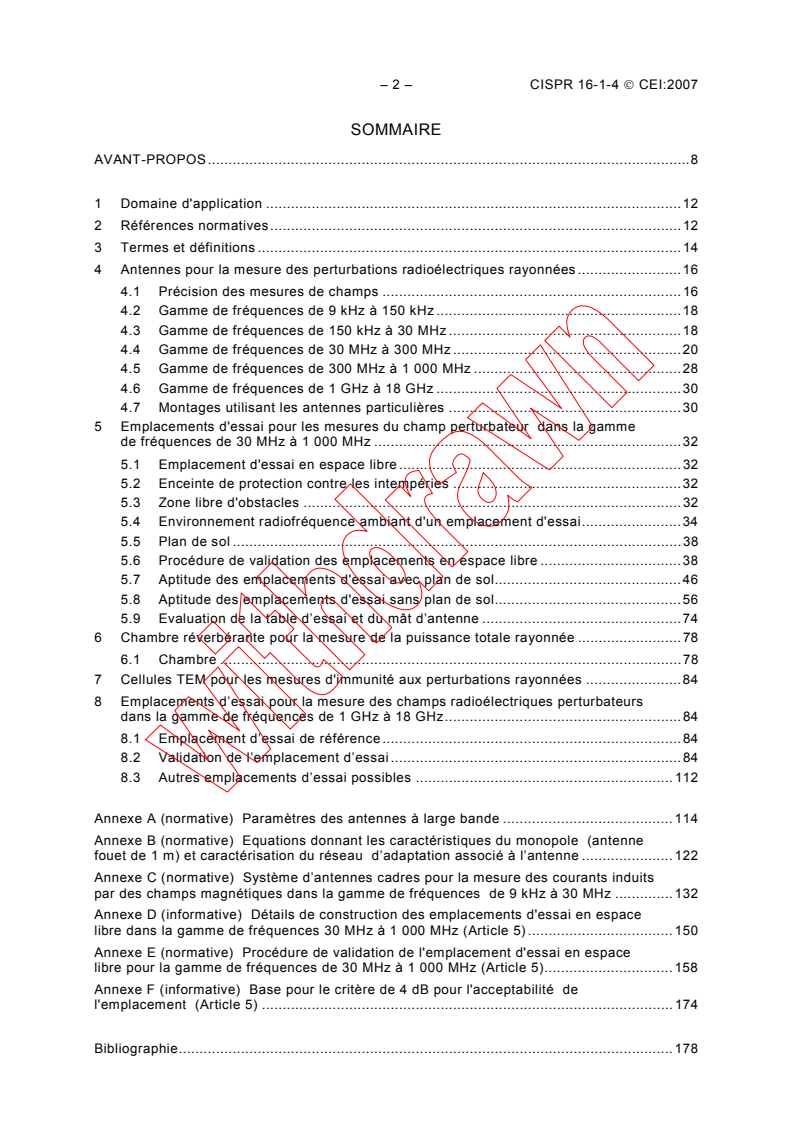
– 2 – CISPR 16-1-4 © CEI:2007
SOMMAIRE
AVANT-PROPOS.8
1 Domaine d'application .12
2 Références normatives.12
3 Termes et définitions .14
4 Antennes pour la mesure des perturbations radioélectriques rayonnées .16
4.1 Précision des mesures de champs .16
4.2 Gamme de fréquences de 9 kHz à 150 kHz .18
4.3 Gamme de fréquences de 150 kHz à 30 MHz .18
4.4 Gamme de fréquences de 30 MHz à 300 MHz .20
4.5 Gamme de fréquences de 300 MHz à 1 000 MHz .28
4.6 Gamme de fréquences de 1 GHz à 18 GHz .30
4.7 Montages utilisant les antennes particulières .30
5 Emplacements d'essai pour les mesures du champ perturbateur dans la gamme
de fréquences de 30 MHz à 1 000 MHz .32
5.1 Emplacement d'essai en espace libre.32
5.2 Enceinte de protection contre les intempéries .32
5.3 Zone libre d'obstacles .32
5.4 Environnement radiofréquence ambiant d'un emplacement d'essai.34
5.5 Plan de sol .38
5.6 Procédure de validation des emplacements en espace libre .38
5.7 Aptitude des emplacements d'essai avec plan de sol.46
5.8 Aptitude des emplacements d'essai sans plan de sol.56
5.9 Evaluation de la table d’essai et du mât d’antenne .74
6 Chambre réverbérante pour la mesure de la puissance totale rayonnée .78
6.1 Chambre .78
7 Cellules TEM pour les mesures d'immunité aux perturbations rayonnées .84
8 Emplacements d’essai pour la mesure des champs radioélectriques perturbateurs
dans la gamme de fréquences de 1 GHz à 18 GHz.84
8.1 Emplacement d’essai de référence.84
8.2 Validation de l’emplacement d’essai .84
8.3 Autres emplacements d’essai possibles .112
Annexe A (normative) Paramètres des antennes à large bande .114
Annexe B (normative) Equations donnant les caractéristiques du monopole (antenne
fouet de 1 m) et caractérisation du réseau d’adaptation associé à l’antenne .122
Annexe C (normative) Système d’antennes cadres pour la mesure des courants induits
par des champs magnétiques dans la gamme de fréquences de 9 kHz à 30 MHz .132
Annexe D (informative) Détails de construction des emplacements d'essai en espace
libre dans la gamme de fréquences 30 MHz à 1 000 MHz (Article 5) .150
Annexe E (normative) Procédure de validation de l'emplacement d'essai en espace
libre pour la gamme de fréquences de 30 MHz à 1 000 MHz (Article 5).158
Annexe F (informative) Base pour le critère de 4 dB pour l'acceptabilité de
l'emplacement (Article 5) .174
Bibliographie.178
– 4 – CISPR 16-1-4 © CEI:2007
Figure 1 – Facteurs d'antenne des doublets courts pour R = 50 Ω .22
L
Figure 2 – Zone libre d'obstacles d'un emplacement d'essai équipé d'une table
tournante (voir 5.3) .36
Figure 3 – Zone libre d'obstacles avec appareil en essai fixe (voir 5.3) .36
Figure 4 – Configuration des équipements pour la mesure en polarisation horizontale
de l'affaiblissement de l'emplacement (voir 5.6 et Annexe E) .40
Figure 5 – Configuration des équipements pour la mesure en polarisation verticale de
l'affaiblissement de l'emplacement avec des dipôles accordés (voir 5.6 et Annexe E) .40
Figure 6a – Positions typiques d'antenne pour d'autres emplacements d’essai –
Mesures d'ANE en polarisation verticale .50
Figure 6b – Positions typiques d'antenne pour d'autres emplacements d’essai –
Mesures d'ANE en polarisation horizontale .50
Figure 6c – Positions typiques d'antenne pour d'autres emplacements d’essai –
Mesure d'ANE en polarisation verticale pour un appareil de volume inférieur à 1 m de
profondeur, 1,5 m de large, 1,5 m de haut et dont la périphérie est à plus de 1 m du
matériau le plus proche susceptible de provoquer des réflexions .52
Figure 6d – Positions typiques d'antenne pour d'autres emplacements d’essai –
Mesure d'ANE en polarisation horizontale pour un appareil de volume inférieur à 1 m
de profondeur, 1,5 m de large, 1,5 m de haut et dont la périphérie est à plus de 1 m du
matériau le plus proche susceptible de provoquer des réflexions .52
Figure 6 – Positions typiques pour d'autres emplacements d’essai .52
Figure 7 – Graphique de l'ANE théorique en espace libre en fonction de la fréquence
pour différentes distances de mesure (voir Equation 4).58
Figure 8 – Positions de mesure pour la procédure de validation de l'emplacement .64
Figure 9 – Exemple d’une position de mesure et inclinaison d’antenne pour la
procédure de validation de l'emplacement .66
Figure 10 – Montage de mesure de la référence type d'emplacement en espace libre.72
Figure 11 – Position de l’antenne par rapport au champ au-dessus d’une table d’essai
rectangulaire (vue de dessus).78
Figure 12 – Position de l’antenne au- dessus de la table d’essai (vue de côté) .78
Figure 13 – Exemple d'agitateur typique à aubes .80
Figure 14 – Gamme de l'affaiblissement de couplage en fonction de la fréquence pour
une chambre utilisant l'agitateur de la Figure 13 .82
Figure 15 – Exemple de diagramme de rayonnement du plan E d’une antenne
d’émission (à titre informatif uniquement).90
Figure 16 – Exemple de diagramme de rayonnement du plan H d’une antenne
d’émission (à titre informatif uniquement).92
Figure 17 – Positions de mesure de S dans un plan horizontal – voir description
VSWR
en 8.2.2.2.1 .94
Figure 18 – Positions de S (exigences en hauteur) .98
VSWR
Figure 19 – Exigences relatives aux positions d’essai conditionnelles.110
Figure B.1 – Méthode utilisant un analyseur de réseau .126
Figure B.2 – Méthode utilisant un appareil de mesure de bruit RF et un générateur de
signal.126
Figure B.3 – Exemple du montage du condensateur pour une antenne fictive .128
Figure C.1 – Système d'antennes cadres, constitué de trois antennes de grand
diamètre, occupant des plans mutuellement perpendiculaires .134
Figure C.2 – Une antenne de grand diamètre, comportant deux fentes diamétralement
opposées, placées à égale distance de la sonde de courant C.136
– 6 – CISPR 16-1-4 © CEI:2007
Figure C.3 – Construction de la fente d'une antenne.138
Figure C.4 – Exemple de construction de fente dont la rigidité est assurée par une
plaquette de circuit imprimé .138
Figure C.5 – Construction du boîtier métallique renfermant la sonde de courant .140
Figure C.6 – Exemple montrant le cheminement de plusieurs câbles de l’appareil en
essai afin de s’assurer qu’il n’y a pas de couplage capacitif entre ces câbles et les
antennes cadres .140
Figure C.7 – Les huit positions du dipôle symétrique/dissymétrique pendant la
validation de l'antenne cadre de grand diamètre .142
Figure C.8 – Facteur de validation d'une antenne cadre de 2 m de diamètre.142
Figure C.9 – Construction du dipôle symétrique/dissymétrique .144
Figure C.10 – Facteurs de conversion C (pour la conversion en dB (μA/m)) et C
dA dV
(pour la conversion en dB (μV/m)) pour les deux distances de mesure normalisées d.146
Figure C.11 – Sensibilité S d'une antenne cadre de diamètre D par rapport à une
D
antenne cadre de 2 m de diamètre.146
Figure D.1 – Critère de Rayleigh pour la rugosité du plan de sol.152
Tableau 1 – Affaiblissement normalisé de l’emplacement (géométries recommandées
pour les doublets demi-onde accordés avec polarisation horizontale) .54
Tableau 2 – Affaiblissement normalisé de l’emplacement* (géométries recommandées
pour les antennes à large bande).56
Tableau 3 – Dimensions maximales du volume d'essai par rapport à la distance d'essai.62
Tableau 4 – Gammes de fréquences et tailles de pas .68
Tableau 5 – Positions d’essai de S .100
VSWR
Tableau 6 – Exigences sur les rapports de S .112
VSWR
Tableau E.1 – Affaiblissement normalisé de l'emplacement* (Géométries conseillées
pour les antennes à large bande).166
Tableau E.2 – Affaiblissement normalisé de l'emplacement (Géométries conseillées
pour les doublets demi-onde accordés, à polarisation horizontale).168
Tableau E.3 – Affaiblissement normalisé de l'emplacement (Géométries conseillées
pour les doublets demi-onde accordés, à polarisation verticale).170
Tableau E.4 – Facteurs de correction de couplage mutuel pour la géométrie utilisant
des doublets résonnants accordables séparés de 3 m .172
Tableau F.1 – Bilan d'erreur.174
– 8 – CISPR 16-1-4 © CEI:2007
COMMISSION ÉLECTROTECHNIQUE INTERNATIONALE
COMITÉ INTERNATIONAL SPÉCIAL DES PERTURBATIONS RADIOÉLECTRIQUES
___________
SPÉCIFICATIONS DES MÉTHODES ET DES APPAREILS
DE MESURE DES PERTURBATIONS RADIOÉLECTRIQUES ET
DE L'IMMUNITÉ AUX PERTURBATIONS RADIOÉLECTRIQUES –
Partie 1-4: Appareils de mesure des perturbations radioélectriques
et de l'immunité aux perturbations radioélectriques –
Matériels auxiliaires – Perturbations rayonnées
AVANT-PROPOS
1) La Commission Electrotechnique Internationale (CEI) est une organisation mondiale de normalisation
composée de l'ensemble des comités électrotechniques nationaux (Comités nationaux de la CEI). La CEI a
pour objet de favoriser la coopération internationale pour toutes les questions de normalisation dans les
domaines de l'électricité et de l'électronique. A cet effet, la CEI – entre autres activités – publie des Normes
internationales, des Spécifications techniques, des Rapports techniques, des Spécifications accessibles au
public (PAS) et des Guides (ci-après dénommés "Publication(s) de la CEI"). Leur élaboration est confiée à des
comités d'études, aux travaux desquels tout Comité national intéressé par le sujet traité peut participer. Les
organisations internationales, gouvernementales et non gouvernementales, en liaison avec la CEI, participent
également aux travaux. La CEI collabore étroitement avec l'Organisation Internationale de Normalisation (ISO),
selon des conditions fixées par accord entre les deux organisations.
2) Les décisions ou accords officiels de la CEI concernant les questions techniques représentent, dans la mesure
du possible, un accord international sur les sujets étudiés, étant donné que les Comités nationaux de la CEI
intéressés sont représentés dans chaque comité d’études.
3) Les Publications de la CEI se présentent sous la forme de recommandations internationales et sont agréées
comme telles par les Comités nationaux de la CEI. Tous les efforts raisonnables sont entrepris afin que la CEI
s'assure de l'exactitude du contenu technique de ses publications; la CEI ne peut pas être tenue responsable
de l'éventuelle mauvaise utilisation ou interprétation qui en est faite par un quelconque utilisateur final.
4) Dans le but d'encourager l'uniformité internationale, les Comités nationaux de la CEI s'engagent, dans toute la
mesure possible, à appliquer de façon transparente les Publications de la CEI dans leurs publications
nationales et régionales. Toutes divergences entre toutes Publications de la CEI et toutes publications
nationales ou régionales correspondantes doivent être indiquées en termes clairs dans ces dernières.
5) La CEI n’a prévu aucune procédure de marquage valant indication d’approbation et n'engage pas sa
responsabilité pour les équipements déclarés conformes à une de ses Publications.
6) Tous les utilisateurs doivent s'assurer qu'ils sont en possession de la dernière édition de cette publication.
7) Aucune responsabilité ne doit être imputée à la CEI, à ses administrateurs, employés, auxiliaires ou
mandataires, y compris ses experts particuliers et les membres de ses comités d'études et des Comités
nationaux de la CEI, pour tout préjudice causé en cas de dommages corporels et matériels, ou de tout autre
dommage de quelque nature que ce soit, directe ou indirecte, ou pour supporter les coûts (y compris les frais
de justice) et les dépenses découlant de la publication ou de l'utilisation de cette Publication de la CEI ou de
toute autre Publication de la CEI, ou au crédit qui lui est accordé.
8) L'attention est attirée sur les références normatives citées dans cette publication. L'utilisation de publications
référencées est obligatoire pour une application correcte de la présente publication.
9) L’attention est attirée sur le fait que certains des éléments de la présente Publication de la CEI peuvent faire
l’objet de droits de propriété intellectuelle ou de droits analogues. La CEI ne saurait être tenue pour
responsable de ne pas avoir identifié de tels droits de propriété et de ne pas avoir signalé leur existence.
La Norme internationale CISPR 16-1-4 a été établie par le sous-comité A du CISPR: Mesures
des perturbations radioélectriques et méthodes statistiques.
Cette seconde édition de la CISPR 16-1-4 annule et remplace la première édition parue en
2003, l’amendement 1 (2004) et l’amendement 2 (2005).
Le document CISPR/A/710/FDIS, circulé comme amendement 3 auprès des Comités
nationaux de la CEI, a conduit à la publication de la nouvelle édition.
– 10 – CISPR 16-1-4 © CEI:2007
Le texte de cette norme est basé sur la première édition, son Amendement 1, son
Amendement 2 et sur les documents suivants:
FDIS Rapport de vote
CISPR/A/710/FDIS CISPR/A/722/RVD
Le rapport de vote indiqué dans le tableau ci-dessus donne toute information sur le vote ayant
abouti à l'approbation de cette norme.
Cette publication a été rédigée selon les Directives ISO/CEI, Partie 2.
Une liste de toutes les parties de la CISPR 16, sous le titre général Spécifications des
méthodes et des appareils de mesure des perturbations radioélectriques et de l'immunité aux
perturbations radioélectriques, est disponible sur le site web de la CEI.
La CISPR 16-1 est constituée des cinq parties suivantes, sous le titre général Spécifications
des méthodes et des appareils de mesure des perturbations radioélectriques et de l'immunité
aux perturbations radioélectriques – Appareils de mesure des perturbations radioélectriques
et de l'immunité aux perturbations radioélectriques:
– Partie 1-1: Appareils de mesure,
– Partie 1-2: Matériels auxiliaires – Perturbations conduites,
– Partie 1-3: Matériels auxiliaires – Puissance perturbatrice,
– Partie 1-4: Matériels auxiliaires – Perturbations rayonnées,
– Partie 1-5: Emplacements d'essai pour l'étalonnage des antennes de 30 MHz à
1 000 MHz.
Le comité a décidé que le contenu de cette publication ne sera pas modifié avant la date de
maintenance indiquée sur le site web de la CEI sous «http://webstore.iec.ch» dans les
données relatives à la publication recherchée. A cette date, la publication sera
• reconduite;
• supprimée;
• remplacée par une édition révisée, ou
• amendée.
– 12 – CISPR 16-1-4 © CEI:2007
SPÉCIFICATIONS DES MÉTHODES ET DES APPAREILS
DE MESURE DES PERTURBATIONS RADIOÉLECTRIQUES ET
DE L'IMMUNITÉ AUX PERTURBATIONS RADIOÉLECTRIQUES –
Partie 1-4: Appareils de mesure des perturbations radioélectriques
et de l'immunité aux perturbations radioélectriques –
Matériels auxiliaires – Perturbations rayonnées
1 Domaine d'application
La présente partie de la CISPR 16 est une norme fondamentale qui spécifie les
caractéristiques et les performances des appareils de mesure de perturbations rayonnées
dans la gamme de fréquences de 9 kHz à 18 GHz.
Elle comprend les spécifications pour les matériels auxiliaires suivants: antenne et
emplacement d'essai, cellules TEM et chambre réverbérante.
Il faut que les exigences de cette publication soient satisfaites à toutes les fréquences et à
tous niveaux de perturbation radioélectrique rayonnée, dans les limites de la plage de lecture
des appareils de mesure du CISPR.
Les méthodes de mesure sont traitées dans la Partie 2-3, et des informations supplémen-
taires sur les perturbations radioélectriques sont données dans la Partie 3 de la CISPR 16.
Les incertitudes, les statistiques et la modélisation des limites sont couvertes par la Partie 4
de la CISPR 16.
2 Références normatives
Les documents de référence suivants sont indispensables pour l'application du présent
document. Pour les références datées, seule l'édition citée s'applique. Pour les références
non datées, la dernière édition du document de référence s'applique (y compris les éventuels
amendements).
CISPR 16-1-1, Spécifications des méthodes et des appareils de mesure des perturbations
radioélectriques et de l'immunité aux perturbations radioélectriques – Partie 1-1: Appareils de
mesure des perturbations radioélectriques et de l'immunité aux perturbations radioélectriques
– Appareils de mesure
CISPR 16-2-3, Spécifications des méthodes et des appareils de mesure des perturbations
radioélectriques et de l'immunité aux perturbations radioélectriques – Partie 2-3: Méthodes de
mesure des perturbations et de l'immunité – Mesures des perturbations rayonnées
CISPR 16-3, Specification for radio disturbance and immunity measuring apparatus and
methods – Part 3: CISPR technical reports
CISPR 16-4 (toutes les parties), Spécifications des méthodes et des appareils de mesure des
perturbations radioélectriques et de l'immunité aux perturbations radioélectriques –
Incertitudes, statistiques et modélisation des limites
CISPR 16-4-2:2003, Spécifications des méthodes et des appareils de mesure des
perturbations radioélectriques et de l'immunité aux perturbations radioélectriques – Partie 4-2:
Incertitudes, statistiques et modélisation des limites – Incertitudes de mesure CEM
CEI 60050-161, Vocabulaire Electrotechnique International (VEI) – Chapitre 161:
Compatibilité électromagnétique
– 20 – CISPR 16-1-4 © CEI:2007
4.3.2 Antenne magnétique
Pour la mesure de la composante magnétique du rayonnement, on doit utiliser le cadre blindé
électriquement décrit en 4.2.1.
Les antennes cadre accordées, électriquement symétriques, peuvent être utilisées pour
effectuer des mesures à des champs plus faibles que les antennes cadre non accordées,
électriquement blindées.
4.3.3 Symétrisation de l'antenne
Si une antenne magnétique ou électrique symétrisée est utilisée, les exigences de 4.2.2
doivent être satisfaites.
4.4 Gamme de fréquences de 30 MHz à 300 MHz
4.4.1 Antenne électrique
L'antenne de référence doit être un doublet symétrisé.
4.4.1.1 Doublet symétrisé
Pour les fréquences égales ou supérieures à 80 MHz, l'antenne doit être accordée, et pour
les fréquences inférieures à 80 MHz, elle doit avoir une longueur égale à la longueur de
l'antenne résonnante à 80 MHz et être accordée et adaptée au conducteur de descente par
un dispositif transformateur approprié. La liaison à l'entrée de l'appareil de mesure doit être
effectuée au travers d'un dispositif de transformation symétrique-asymétrique.
4.4.1.2 Doublet court
Un doublet plus court qu'une demi-longueur d'onde peut être employé à condition:
a) que la longueur totale soit supérieure à 1/10 de la longueur d'onde à la fréquence de
mesure;
b) qu'il soit raccordé à un câble suffisamment bien adapté au récepteur pour assurer un
rapport d'ondes stationnaires (ROS) sur le câble inférieur à 2,0. L'étalonnage doit tenir
compte du ROS;
c) qu'il ait une discrimination de polarisation équivalente à celle d'un doublet accordé
(voir 4.4.2). A cette fin, un symétriseur peut être utile;
d) que, pour la détermination du champ mesuré, une courbe d'étalonnage (facteur d'antenne)
soit définie et utilisée à la distance de mesure spécifiée (c'est-à-dire à une distance au
moins égale à trois fois la longueur du doublet);
NOTE Les facteurs d'antenne ainsi obtenus peuvent permettre de satisfaire à l'exigence de mesure de
champs sinusoïdaux uniformes à ±3 dB près. Des exemples de courbes d'étalonnage sont donnés à la
Figure 1, ils montrent la relation théorique entre le champ et la tension d'entrée du récepteur pour une
impédance d'entrée de récepteur de 50 Ω et pour différents rapports l/d. Sur ces figures, le symétriseur est
considéré comme un transformateur idéal de rapport 1. Il convient toutefois de noter que ces courbes ne
tiennent pas compte des pertes du symétriseur, du câble et des désadaptations éventuelles entre le câble et le
récepteur.
e) qu'en dépit de la réduction de sensibilité du mesureur de champ, à cause d'un facteur
d'antenne élevé attribué à la longueur réduite du doublet, la limite de mesure du mesureur
de champ (déterminée, par exemple, par le bruit du récepteur et le facteur de transmission
du doublet) doit rester inférieure d'au moins 10 dB au niveau du signal mesuré.
– 22 – CISPR 16-1-4 © CEI:2007
l
λ
–3 –2 –1
5 × 10 10 10
2 3 45 2 3 4 5
l
= 30 100 300 1 000
d
Doublet
Symétriseur
(1:1)
Intensité
de champ E
I
d Voltmètre
R = 50 Ω
L
U
E
Fa = 20 log Exemple:
U
I = 3 m
Fa = Fa + Fa d = 1 cm
1 2
f = 15 MHz
l
20 = 300
d
l 20
= 0,15
λ
Fa = 33,6 dB
Fa = –9,5 dB
Fa = Fa + Fa = 24,1 dB 15
1 2
–4 10
–8
–12
–14 5
0,05 0,1 0,2 0,3 0,4 0,5 1 2 34 5
Longueur du doublet m
IEC 079/07
Figure 1 – Facteurs d'antenne des doublets courts pour R = 50 Ω
L
Fa dB
Fa dB
– 24 – CISPR 16-1-4 © CEI:2007
4.4.1.3 Antenne à large bande
Une antenne à large bande peut être utilisée à condition qu'elle satisfasse aux exigences
indiquées en 4.5.2 pour les antennes complexes.
4.4.2 Symétrisation de l'antenne
4.4.2.1 Introduction
Dans les mesures des émissions rayonnées, des courants de mode commun peuvent exister
sur le câble relié à l'antenne de réception (le câble d'antenne). A leur tour, ces courants de
mode commun créent des champs électromagnétiques qui peuvent être captés par l'antenne
de réception. Les résultats de mesure peuvent de ce fait être influencés.
Les contributions majeures aux courants de mode commun dans le câble d'antenne
proviennent
a) du champ électrique produit par l'appareil en essai, si ce champ a une composante
parallèle au câble d'antenne, et
b) de la conversion du mode différentiel du signal d'antenne (signal utile) en un signal de
mode commun du fait de l'imperfection du symétriseur de l'antenne de réception.
Ce paragraphe traite de la contribution du symétriseur. La contribution a) est à l'étude (voir la
dernière phrase de la Note 1 de 4.4.2.2).
En général, les antennes dipôle log-périodique réseau ne présentent pas une conversion de
mode différentiel en mode commun significative et les vérifications qui suivent s'appliquent
aux dipôles, aux antennes biconiques et aux antennes hybrides biconiques/log.
4.4.2.2 Vérification de la conversion de mode différentiel en mode commun
du symétriseur
La méthode suivante décrit la mesure de deux tensions, U et U , dans la bande de
1 2
fréquences pour laquelle l'antenne de réception est utilisée. Le rapport de ces tensions,
exprimées dans la même unité (par exemple en dB), est une mesure de la conversion de
mode différentiel en mode commun.
1) Placer l'antenne de réception en essai en polarisation verticale, la hauteur de son centre
étant de 1,5 m au-dessus du plan de sol. Placer le câble horizontalement sur
1,5 m ± 0,1 m derrière l'élément actif de l'antenne, puis verticalement sur une hauteur
d'au moins 1,5 m jusqu'au plan de sol.
2) Placer une seconde antenne (d'émission) en polarisation verticale à une distance de 10 m
du centre de l'antenne en essai avec sa pointe à 0,10 m du plan de sol. Si la plage de
l'emplacement utilisé pour les essais est de 3 m, effectuer cette vérification à une
distance de 3 m (si la vérification de la conversion a déjà été effectuée à 10 m de distance
et montre une modification de moins ± 0,5 dB, il n'est pas nécessaire d'effectuer une
mesure séparée à 3 m). La spécification de l'antenne d'émission doit comprendre la
gamme de fréquences de l'antenne en essai.
3) Connecter une source de signal à l'antenne d'émission, par exemple un générateur à
poursuite, régler le niveau du générateur de telle sorte que, dans gamme de fréquences
concernée, le rapport signal à bruit ambiant au niveau du récepteur soit supérieur à 10 dB.
4) Enregistrer la tension U au niveau du récepteur dans la gamme de fréquences
concernée.
5) Retourner l'antenne de réception (tourner l'antenne de 180°) sans rien changer d'autre
dans la disposition d'essai, en particulier le câble de l'antenne de réception, et sans
changer le réglage de la source de signal.
6) Enregistrer la tension U au niveau du récepteur sur la gamme de fréquences.
– 26 – CISPR 16-1-4 © CEI:2007
7) La conversion mode différentiel / mode commun est suffisamment faible si
⎜20 log (U /U )⎪<1 dB.
1 2
NOTE 1 Si le critère de conversion mode différentiel / mode commun n'est pas respecté, des anneaux de ferrite
autour du câble peuvent réduire la conversion mode différentiel / mode commun. L'ajout de ferrite peut également
être utilisé pour vérifier si la contribution a) a un effet non négligeable. Répéter l'essai avec quatre ferrites
espacées approximativement de 20 cm. Si le critère est respecté en utilisant ces ferrites, il convient de les utiliser
au cours des mesures d'émission réelles. De la même façon, l'interaction du câble peut être réduite en l'étendant
de plusieurs mètres derrière l'antenne avant de le faire descendre sur le sol.
NOTE 2 Si l'antenne de réception doit être utilisée dans une chambre entièrement anéchoïque, la vérification du
rapport mode différentiel / mode commun peut être effectué dans une telle chambre avec l'antenne de réception à
sa position usuelle et l'antenne d'émission au centre du volume d'essai de cette chambre. Il faut que la chambre
satisfasse au critère des ± 4 dB.
NOTE 3 Il convient que l'emplacement d'essai avec plan de sol ou la chambre entièrement anéchoïque soit
conforme aux exigences d'ANE (affaiblissement normalisé de l'emplacement )respectives.
NOTE 4 Il convient que la distance horizontale de 1,5 m sur laquelle le câble d'antenne s'étend derrière le centre
de l'antenne soit conservée comme un minimum pendant les mesures réelles en polarisation verticale des
émissions rayonnées.
NOTE 5 Il n'est pas nécessaire de définir strictement l'installation d'essai car son effet est largement dû à
l'interaction entre l'antenne et la partie du câble parallèle aux éléments de l'antenne. Les effets dépendant de
l'uniformité du champ incident sur l'antenne dans les installations d'essai CEM sur un emplacement d'essai en
espace libre ou dans une chambre entièrement anéchoïque sont beaucoup plus faibles.
NOTE 6 Pour les symétriseurs dont le connecteur de câble de réception est monté sur le côté (à 90° du bras de
l'antenne), il convient d'utiliser un connecteur à angle droit pour réduire le mouvement du câble.
4.4.3 Performance de polarisation croisée de l'antenne
Lorsque l'antenne est placée dans un champ électromagnétique à polarisation plane, la
tension aux bornes, lorsque l'antenne et le champ sont en polarisation croisée, doit être de
20 dB inférieure à celle en co-polarisation. Cet essai s'applique aux antennes dipôle log-
périodique réseau pour lesquelles les deux moitiés de chaque dipôle sont décalées. La
majorité des essais avec de telles antennes sont effectués au-dessus de 200 MHz, mais ces
exigences s'appliquent en dessous de 200 MHz. Cet essai n'est pas destiné aux dipôles
alignés ou aux antennes bicôniques car une réjection de polarisation croisée supérieure à
20 dB est une caractéristique de leur conception symétrique. Il faut que de telles antennes et
les antennes cornet aient une réjection supérieure à 20 dB et un essai de type effectué par le
fabricant doit le confirmer.
Afin d'obtenir des conditions d'espace quasi-libre, on peut utiliser une chambre anéchoïque
de haute qualité ou une tour de hauteur suffisante par rapport au sol sur un emplacement
extérieur. Pour minimiser les réflexions sur le sol, les antennes sont polarisées verticalement.
Une onde plane doit être envoyée sur l'antenne en essai. La distance entre le centre de
l'antenne en essai et l'antenne source doit être supérieure à une longueur d'onde.
NOTE Il est nécessaire d'avoir un emplacement de bonne qualité pour envoyer une onde plane sur l'antenne en
essai. La discrimination de polarisation croisée peut être démontrée par une transmission entre deux antennes ou
cornet ou deux guides d'onde à extrémité ouverte et en vérifiant que la combinaison du défaut de l'emplacement et
la caractéristique de polarisation croisée propre à une antenne cornet conduit à une suppression de la composante
horizontale de plus de 30 dB. Si les défauts de l'emplacement sont très faibles et si les antennes cornet ont des
caractéristiques identiques, la caractéristique de polarisation croisée d'un cornet est d'environ 6 dB plus faible que
celle de la combinaison de la paire de cornets.
Un signal parasite de 20 dB inférieur à celui du signal utile donne une erreur maximale de
± 0,9 dB sur le signal utile. L'erreur maximale intervient lorsque le signal en polarisation
croisée est en phase avec le signal co-polarisé. Si la réponse en polarisation croisée de
l'antenne log-périodique est moins bonne que 20 dB, il faut que l'opérateur calcule
l'incertitude et la déclare avec les résultats. Par exemple un niveau de polarisation croisée de
14 dB entraîne une incertitude maximale de +1,6 dB à −1,9 dB. On prend la valeur la plus
élevée et on suppose une distribution de forme en U pour calculer l'incertitude-type.
Pour ajouter un signal de 0 dB à un autre de −14 dB, convertir d'abord en tensions relatives
en divisant ces valeurs par 20 et en en prenant l'anti-log. Ajouter ensuite le plus petit signal
au signal unité. Prendre le log et multiplier par 20. Le résultat est l'erreur positive en décibels.
Répéter le calcul mais en soustrayant le plus petit signal pour obtenir l'erreur négative
en décibels.
– 28 – CISPR 16-1-4 © CEI:2007
Pour le calcul de l'incertitude sur le résultat de l'émission rayonnée, si le niveau de signal
mesuré dans une polarisation dépasse celui du signal mesuré dans la polarisation
orthogonale de 6 dB ou plus, l'antenne log-périodique dont la discrimination de polarisation
est de seulement 14 dB sera jugée comme ayant satisfait à la spécification des 20 dB. Si la
différence entre les niveaux en polarisation verticale et en polarisation horizontale et
inférieure à 6 dB, il faut calculer l'incertitude supplémentaire si la somme de cette différence
et de la polarisation croisée est inférieure à 20 dB.
4.5 Gamme de fréquences de 300 MHz à 1 000 MHz
4.5.1 Antenne électrique
Si une antenne doublet est utilisée, celle-ci doit répondre aux exigences des 4.4.1.1 et 4.4.2.
4.5.2 Antenne complexe
Puisque, pour les fréquences de la bande de 300 MHz à 1 000 MHz, la sensibilité d'un
doublet simple est faible, on peut utiliser une antenne plus complexe. Une telle antenne doit
satisfaire aux exigences suivantes.
a) L'antenne doit être essentiellement polarisée dans un plan. Cette qualité doit être
contrôlée comme indiqué pour la symétrisation d'un doublet simple.
b) Le lobe principal du diagramme de rayonnement doit être tel que la réponse de l'antenne
dans la direction du rayonnement direct ne diffère pas de plus de 1 dB de sa réponse
dans la direction du rayonnement réfléchi par le sol.
Afin de vérifier cette condition, l'ouverture dans un plan vertical 2ϕ de l'antenne de
mesure, à l'intérieur de laquelle le gain d'antenne est à moins de 1 dB de sa valeur
maximale, doit être telle que:
1) si l'antenne de mesure est maintenue dans une position horizontale:
–1
ϕ > tan [(h + h )/d]
1 2
2) si l'antenne de mesure est inclinée vers le sol dans la position optimale (de manière
que les rayonnements directs et réfléchis soient à l'intérieur de l'ouverture 2ϕ).
–1 –1
2ϕ > tan [(h + h )/d] – tan [(h – h )/d]
1 2 1 2
où
h est la hauteur de l'antenne de mesure;
h est la hauteur de l'appareil en essai;
d est la distance horizontale entre l'antenne de mesure et l'appareil en essai.
Le diagramme de l'antenne doit être vérifié dans le plan horizontal lorsqu'elle est orientée
pour une polarisation verticale. Il doit être admis que le diagramme et, en particulier,
l'ouverture 2ϕ, est identique lorsqu'elle est orientée pour une polarisation horizontale et
lorsqu'elle est mesurée en polarisation verticale.
Il est essentiel que la variation de la distance effective entre l'antenne et la source soit
prise en considération ainsi que la variation du gain en fonction de la fréquence.
c) Le rapport d'ondes stationnaires, l'antenne étant connectée à son câble, mesuré à l'entrée
de l'appareil de mesure ne doit pas dépasser 2,0.
d) Un facteur d'étalonnage doit être indiqué pour permettre de satisfaire aux exigences
de 4.1.
– 30 – CISPR 16-1-4 © CEI:2007
4.6 Gamme de fréquences de 1 GHz à 18 GHz
La mesure des émissions rayonnées au-dessus de 1 GHz doit être effectuée en utilisant des
antennes étalonnées et polarisées linéairement. Celles-ci comprennent les cornets à double
stries, les cornets à guide d’onde rectangulaire, les cornets pyramidaux, les cornets à gain
optimisé et les cornets à gain standard. Le «faisceau» ou lobe principal du diagramme de
toute antenne utilisée doit être suffisamment large pour englober l’appareil en essai lorsqu’il
est placé à la distance de mesure, ou des dispositions doivent être prises pour «balayer»
l’appareil en essai afin de déterminer la direction ou la source de ses émissions rayonnées.
La largeur du lobe principal est définie comme la largeur du faisceau de l’antenne à 3 dB, et il
convient de fournir des informations permettant de déterminer ce paramètre dans la
documentation de l’antenne. Les dimensions de l’ouverture de ces antennes cornets doivent
être suffisamment faibles pour que la distance de mesure R en mètres soit supérieure ou
m
égale à la distance minimale suivante:
R ≥ D /2λ
m
où
D est la plus grande dimension de l’ouverture de l’antenne, en mètres;
λ est la longueur d’onde en espace libre, en mètres, à la fréquence de mesure.
En cas de litige, des mesures effectuées avec un cornet à gain standard ou une antenne
cornet similaire étalonnée de façon précise doivent prévaloir.
NOTE Toute antenne étalonnée et polarisée linéairement, par exemple une antenne log-périodique, peut être
utilisée pour effectuer ces mesures. Le gain de beaucoup d’antennes autres que des cornets peut ne pas être
approprié dans cette gamme de fréquences si les antennes sont utilisées avec des analyseurs de spectre ou des
mesureurs de bruit radioélectrique plus anciens. Il convient que l’opérateur s’assure que la sensibilité globale de la
mesure est inférieure d’au moins 6 dB à la limite applicable, à la distance de mesure utilisée, et que tous les
moyens utilisés pour accroître la sensibilité, par exemple un préamplificateur, ne produisent pas de distorsion, de
signaux parasites ou d’autres problèmes de saturation. Comme une antenne log-périodique a un faisceau plus
large qu’un cornet, des réflexions sur le plan de sol peuvent produire une erreur significative pour les mesures
effectuées avec une antenne log-périodique.
4.7 Montages utilisant les antennes particulières
4.7.1 Système d’antennes cadres
Dans la
...
CISPR 16-1-4
Edition 2.0 2007-02
INTERNATIONAL
STANDARD
NORME
INTERNATIONALE
INTERNATIONAL SPECIAL COMMITTEE ON RADIO INTERFERENCE
COMITÉ INTERNATIONAL SPÉCIAL DES PERTURBATIONS RADIOÉLECTRIQUES
Specification for radio disturbance and immunity measuring apparatus and
methods –
Part 1-4: Radio disturbance and immunity measuring apparatus – Ancillary
equipment – Radiated disturbances
Spécifications des méthodes et des appareils de mesure des perturbations
radioélectriques et de l'immunité aux perturbations radioélectriques –
Partie 1-4: Appareils de mesure des perturbations radioélectriques et
de l'immunité aux perturbations radioélectriques – Matériels auxiliaires –
Perturbations rayonnées
All rights reserved. Unless otherwise specified, no part of this publication may be reproduced or utilized in any form or by
any means, electronic or mechanical, including photocopying and microfilm, without permission in writing from either IEC or
IEC's member National Committee in the country of the requester.
If you have any questions about IEC copyright or have an enquiry about obtaining additional rights to this publication,
please contact the address below or your local IEC member National Committee for further information.
Droits de reproduction réservés. Sauf indication contraire, aucune partie de cette publication ne peut être reproduite
ni utilisée sous quelque forme que ce soit et par aucun procédé, électronique ou mécanique, y compris la photocopie
et les microfilms, sans l'accord écrit de la CEI ou du Comité national de la CEI du pays du demandeur.
Si vous avez des questions sur le copyright de la CEI ou si vous désirez obtenir des droits supplémentaires sur cette
publication, utilisez les coordonnées ci-après ou contactez le Comité national de la CEI de votre pays de résidence.
IEC Central Office
3, rue de Varembé
CH-1211 Geneva 20
Switzerland
Email: inmail@iec.ch
Web: www.iec.ch
About the IEC
The International Electrotechnical Commission (IEC) is the leading global organization that prepares and publishes
International Standards for all electrical, electronic and related technologies.
About IEC publications
The technical content of IEC publications is kept under constant review by the IEC. Please make sure that you have the
latest edition, a corrigenda or an amendment might have been published.
ƒ Catalogue of IEC publications: www.iec.ch/searchpub
The IEC on-line Catalogue enables you to search by a variety of criteria (reference number, text, technical committee,…).
It also gives information on projects, withdrawn and replaced publications.
ƒ IEC Just Published: www.iec.ch/online_news/justpub
Stay up to date on all new IEC publications. Just Published details twice a month all new publications released. Available
on-line and also by email.
ƒ Electropedia: www.electropedia.org
The world's leading online dictionary of electronic and electrical terms containing more than 20 000 terms and definitions
in English and French, with equivalent terms in additional languages. Also known as the International Electrotechnical
Vocabulary online.
ƒ Customer Service Centre: www.iec.ch/webstore/custserv
If you wish to give us your feedback on this publication or need further assistance, please visit the Customer Service
Centre FAQ or contact us:
Email: csc@iec.ch
Tel.: +41 22 919 02 11
Fax: +41 22 919 03 00
A propos de la CEI
La Commission Electrotechnique Internationale (CEI) est la première organisation mondiale qui élabore et publie des
normes internationales pour tout ce qui a trait à l'électricité, à l'électronique et aux technologies apparentées.
A propos des publications CEI
Le contenu technique des publications de la CEI est constamment revu. Veuillez vous assurer que vous possédez
l’édition la plus récente, un corrigendum ou amendement peut avoir été publié.
ƒ Catalogue des publications de la CEI: www.iec.ch/searchpub/cur_fut-f.htm
Le Catalogue en-ligne de la CEI vous permet d’effectuer des recherches en utilisant différents critères (numéro de référence,
texte, comité d’études,…). Il donne aussi des informations sur les projets et les publications retirées ou remplacées.
ƒ Just Published CEI: www.iec.ch/online_news/justpub
Restez informé sur les nouvelles publications de la CEI. Just Published détaille deux fois par mois les nouvelles
publications parues. Disponible en-ligne et aussi par email.
ƒ Electropedia: www.electropedia.org
Le premier dictionnaire en ligne au monde de termes électroniques et électriques. Il contient plus de 20 000 termes et
définitions en anglais et en français, ainsi que les termes équivalents dans les langues additionnelles. Egalement appelé
Vocabulaire Electrotechnique International en ligne.
ƒ Service Clients: www.iec.ch/webstore/custserv/custserv_entry-f.htm
Si vous désirez nous donner des commentaires sur cette publication ou si vous avez des questions, visitez le FAQ du
Service clients ou contactez-nous:
Email: csc@iec.ch
Tél.: +41 22 919 02 11
Fax: +41 22 919 03 00
CISPR 16-1-4
Edition 2.0 2007-02
INTERNATIONAL
STANDARD
NORME
INTERNATIONALE
INTERNATIONAL SPECIAL COMMITTEE ON RADIO INTERFERENCE
COMITÉ INTERNATIONAL SPÉCIAL DES PERTURBATIONS RADIOÉLECTRIQUES
Specification for radio disturbance and immunity measuring apparatus and
methods –
Part 1-4: Radio disturbance and immunity measuring apparatus – Ancillary
equipment – Radiated disturbances
Spécifications des méthodes et des appareils de mesure des perturbations
radioélectriques et de l'immunité aux perturbations radioélectriques –
Partie 1-4: Appareils de mesure des perturbations radioélectriques et
de l'immunité aux perturbations radioélectriques – Matériels auxiliaires –
Perturbations rayonnées
INTERNATIONAL
ELECTROTECHNICAL
COMMISSION
COMMISSION
ELECTROTECHNIQUE
PRICE CODE
INTERNATIONALE
XC
CODE PRIX
ICS 33.100.10; 33.100.20 ISBN 2-8318-9001-2
CISPR 16-1-4 © IEC:2007 – 3 –– 2 – CISPR 16-1-4 © IEC:2007
CONTENTS
FOREWORD.9
Scope.13
2 Normative references.13
3 Terms and definitions .15
4 Antennas for measurement of radiated radio disturbance .17
4.1 Accuracy of field-strength measurements.17
4.2 Frequency range 9 kHz to 150 kHz .19
4.3 Frequency range 150 kHz to 30 MHz.19
4.4 Frequency range 30 MHz to 300 MHz.21
4.5 Frequency range 300 MHz to 1 000 MHz.29
4.6 Frequency range 1 GHz to 18 GHz.31
4.7 Special antenna arrangements.31
5 Test sites for measurement of radio disturbance field strength for the frequency
range of 30 MHz to 1 000 MHz.33
5.1 Open area test site .33
5.2 Weather protection enclosure .33
5.3 Obstruction-free area.33
5.4 Ambient radio frequency environment of a test site .35
5.5 Ground plane.39
5.6 Open area site validation procedure.39
5.7 Test site suitability with ground-plane.47
5.8 Test site suitability without ground-plane .57
5.9 Evaluation of set-up table and antenna tower .75
6 Reverberating chamber for total radiated power measurement .79
6.1 Chamber .79
7 TEM cells for immunity to radiated disturbance measurement.85
8 Test sites for measurement of radio disturbance field strength for the frequency
range 1 GHz to 18 GHz.85
8.1 Reference test site .85
8.2 Validation of the test site.85
8.3 Alternative test site . 113
Annex A (normative) Parameters of broadband antennas. 115
Annex B (normative) Monopole (1 m rod antenna) performance equations and
characterization of the associated antenna matching network . 123
Annex C (normative) Loop antenna system for magnetic field induced current
measurements in the frequency range of 9 kHz to 30 MHz. 133
Annex D (informative) Construction details for open area test sites in the frequency
range of 30 MHz to 1 000 MHz (Clause 5) . 151
Annex E (normative) Validation procedure of the open area test site for the frequency
range of 30 MHz to 1 000 MHz (Clause 5) . 159
Annex F (informative) Basis for 4 dB site acceptability criterion (Clause 5). 175
Bibliography . 179
CISPR 16-1-4 © IEC:2007CISPR 16-1-4 © IEC:2007 – 5 –– 3 –
Figure 1 – Short dipole antenna factors for R = 50 Ω .23
L
Figure 2 – Obstruction-free area of a test site with a turntable (see 5.3).37
Figure 3 – Obstruction-free area with stationary EUT (see 5.3) .37
Figure 4 – Configuration of equipment for measuring site attenuation in horizontal
polarization (see 5.6 and Annex E) .41
Figure 5 – Configuration of equipment for measuring site attenuation in vertical
polarization using tuned dipoles (see 5.6 and Annex E) .41
Figure 6a – Typical antenna positions for alternative test site – Vertical polarization NSA
measurements .51
Figure 6b – Typical antenna positions for alternative test site – Horizontal polarization
NSA measurements .51
Figure 6c – Typical antenna positions for alternative test site – Vertical polarization NSA
measurements for an EUT that does not exceed a volume of 1 m depth, 1,5 m width,
1,5 m height, with the periphery greater than 1 m from the closest material that may
cause undesirable reflections .53
Figure 6d – Typical antenna positions for alternative test site – Horizontal polarization
NSA measurements for an EUT that does not exceed a volume of 1 m depth, 1,5 m
width and 1,5 m height, with the periphery greater than 1 m from the closest material
that may cause undesirable reflections .53
Figure 6 – Typical antenna positions for alternative test sites.53
Figure 7 – Graph of theoretical free-space NSA as a function of the frequency for
different measurement distances (see Equation 4) .59
Figure 8 – Measurement positions for the site validation procedure.65
Figure 9 – Example of one measurement position and antenna tilt for the site validation
procedure .67
Figure 10 – Typical free-space site reference measurement set-up.73
Figure 11 – Position of the antenna relative to the edge above a rectangle set-up table
(top view).79
Figure 12 – Antenna position above the set-up table (side view) .79
Figure 13 – Example of a typical paddle stirrer .81
Figure 14 – Range of coupling attenuation as a function of frequency for a chamber
using the stirrer in Figure 13.83
Figure 15 – Transmit antenna E-Plane radiation pattern example (for informative
purposes only) .91
Figure 16 – Transmit antenna H-plane radiation pattern (for informative purposes only) .93
Figure 17 – S measurement positions in a horizontal plane – see 8.2.2.2.1 for
VSWR
description .95
Figure 18 – S positions (height requirements) .99
VSWR
Figure 19 – Conditional test position requirements. 111
Figure B.1 – Method using network analyser. 127
Figure B.2 – Method using radio-noise meter and signal generator . 127
Figure B.3 – Example of mounting capacitor in dummy antenna. 129
Figure C.1 – The loop-antenna system, consisting of three mutually perpendicular large-
loop antennas . 135
Figure C.2 – A large-loop antenna containing two opposite slits, positioned
symmetrically with respect to the current probe C . 137
CISPR 16-1-4 © IEC:2007 – 7 –– 4 – CISPR 16-1-4 © IEC:2007
Figure C.3 – Construction of the antenna slit . 139
Figure C.4 – Example of antenna-slit construction using a strap of printed circuit board
to obtain a rigid construction . 139
Figure C.5 – Construction for the metal box containing the current probe. 141
Figure C.6 – Example showing the routing of several cables from an EUT to ensure that
there is no capacitive coupling from the leads to the loop. 141
Figure C.7 – The eight positions of the balun-dipole during validation of the large-loop
antenna . 143
Figure C.8 – Validation factor for a large loop-antenna of 2 m diameter . 143
Figure C.9 – Construction of the balun-dipole . 145
Figure C.10 – Conversion factors C (for conversion into dB (μA/m)) and C (for
dA dV
conversion into dB (μV/m)) for two standardized measuring distances d. 147
Figure C.11 – Sensitivity S of a large-loop antenna with diameter D relative to a large-
D
loop antenna having a diameter of 2 m . 147
Figure D.1 – The Rayleigh criterion for roughness in the ground plane. 153
Table 1 – Normalized site attenuation (recommended geometries for tuned half-wave
dipoles with horizontal polarization) .55
Table 2 – Normalized site attenuation* (recommended geometries for broadband
antennas).57
Table 3 – Maximum dimensions of test volume versus test distance .63
Table 4 – Frequency ranges and step sizes .69
Table 5 – S test positions . 101
VSWR
Table 6 – S reporting requirements. 113
VSWR
Table E.1 – Normalized site attenuation* (Recommended geometries for broadband
antennas). 167
Table E.2 – Normalized site attenuation (Recommended geometries for tuned half-wave
dipoles, horizontal polarization) . 169
Table E.3 – Normalized site attenuation (Recommended geometries for tuned half-wave
dipoles – vertical polarization) . 171
Table E.4 – Mutual coupling correction factors for geometry using resonant tunable
dipoles spaced 3 m apart . 173
Table F.1 – Error budget . 175
CISPR 16-1-4 © IEC:2007CISPR 16-1-4 © IEC:2007 – 9 –– 5 –
INTERNATIONAL ELECTROTECHNICAL COMMISSION
INTERNATIONAL SPECIAL COMMITTEE ON RADIO INTERFERENCE
___________
SPECIFICATION FOR RADIO DISTURBANCE AND IMMUNITY
MEASURING APPARATUS AND METHODS –
Part 1-4: Radio disturbance and immunity measuring apparatus –
Ancillary equipment – Radiated disturbances
FOREWORD
1) The International Electrotechnical Commission (IEC) is a worldwide organization for standardization comprising
all national electrotechnical committees (IEC National Committees). The object of IEC is to promote
international co-operation on all questions concerning standardization in the electrical and electronic fields. To
this end and in addition to other activities, IEC publishes International Standards, Technical Specifications,
Technical Reports, Publicly Available Specifications (PAS) and Guides (hereafter referred to as “IEC
Publication(s)”). Their preparation is entrusted to technical committees; any IEC National Committee interested
in the subject dealt with may participate in this preparatory work. International, governmental and non-
governmental organizations liaising with the IEC also participate in this preparation. IEC collaborates closely
with the International Organization for Standardization (ISO) in accordance with conditions determined by
agreement between the two organizations.
2) The formal decisions or agreements of IEC on technical matters express, as nearly as possible, an international
consensus of opinion on the relevant subjects since each technical committee has representation from all
interested IEC National Committees.
3) IEC Publications have the form of recommendations for international use and are accepted by IEC National
Committees in that sense. While all reasonable efforts are made to ensure that the technical content of IEC
Publications is accurate, IEC cannot be held responsible for the way in which they are used or for any
misinterpretation by any end user.
4) In order to promote international uniformity, IEC National Committees undertake to apply IEC Publications
transparently to the maximum extent possible in their national and regional publications. Any divergence
between any IEC Publication and the corresponding national or regional publication shall be clearly indicated in
the latter.
5) IEC provides no marking procedure to indicate its approval and cannot be rendered responsible for any
equipment declared to be in conformity with an IEC Publication.
6) All users should ensure that they have the latest edition of this publication.
7) No liability shall attach to IEC or its directors, employees, servants or agents including individual experts and
members of its technical committees and IEC National Committees for any personal injury, property damage or
other damage of any nature whatsoever, whether direct or indirect, or for costs (including legal fees) and
expenses arising out of the publication, use of, or reliance upon, this IEC Publication or any other IEC
Publications.
8) Attention is drawn to the Normative references cited in this publication. Use of the referenced publications is
indispensable for the correct application of this publication.
9) Attention is drawn to the possibility that some of the elements of this IEC Publication may be the subject of
patent rights. IEC shall not be held responsible for identifying any or all such patent rights.
International Standard CISPR 16-1-4 has been prepared by CISPR subcommittee A: Radio
interference measurements and statistical methods.
This second edition of CISPR 16-1-4 cancels and replaces the first edition published in 2003,
amendment 1 (2004) and amendment 2 (2005).
The document CISPR/A/710/FDIS, circulated to the National Committees as amendment 3, led
to the publication of the new edition.
CISPR 16-1-4 © IEC:2007 – 11 –– 6 – CISPR 16-1-4 © IEC:2007
The text of this standard is based on the first edition, its Amendment 1, Amendment 2 and the
following documents:
FDIS Report on voting
CISPR/A/710/FDIS CISPR/A/722/RVD
Full information on the voting for the approval of this standard can be found in the report on
voting indicated in the above table.
This publication has been drafted in accordance with the ISO/IEC Directives, Part 2.
A list of all parts of CISPR 16 series, under the general title Specification for radio disturbance
and immunity measuring apparatus and methods, can be found on the IEC website.
CISPR 16-1 consists of the following parts, under the general title Specification for radio
disturbance and immunity measuring apparatus and methods – Radio disturbance and
immunity measuring apparatus:
Part 1-1: Measuring apparatus
Part 1-2: Ancillary equipment – Conducted disturbances
Part 1-3: Ancillary equipment – Disturbance power
Part 1-4: Ancillary equipment – Radiated disturbances
Part 1-5: Antenna calibration test sites for 30 MHz to 1 000 MHz
The committee has decided that the contents of this publication will remain unchanged until the
maintenance result date indicated on the IEC web site under "http://webstore.iec.ch" in the data
related to the specific publication. At this date, the publication will be
• reconfirmed,
• withdrawn,
• replaced by a revised edition, or
• amended.
CISPR 16-1-4 © IEC:2007CISPR 16-1-4 © IEC:2007 – 13 –– 7 –
SPECIFICATION FOR RADIO DISTURBANCE AND IMMUNITY
MEASURING APPARATUS AND METHODS –
Part 1-4: Radio disturbance and immunity measuring apparatus –
Ancillary equipment – Radiated disturbances
1 Scope
This part of CISPR 16 is designated a basic standard, which specifies the characteristics and
performance of equipment for the measurement of radiated disturbances in the frequency
range 9 kHz to 18 GHz.
Specifications for ancillary apparatus are included for: antennas and test sites, TEM cells, and
reverberating chambers.
The requirements of this publication must be complied with at all frequencies and for all levels
of radiated disturbances within the CISPR indicating range of the measuring equipment.
Methods of measurement are covered in Part 2-3, and further information on radio disturbance
is given in Part 3 of CISPR 16. Uncertainties, statistics and limit modelling are covered in
Part 4 of CISPR 16.
2 Normative references
The following referenced documents are indispensable for the application of this document. For
dated references, only the edition cited applies. For undated references, the latest edition of
the referenced document (including any amendments) applies.
CISPR 16-1-1, Specification for radio disturbance and immunity measuring apparatus and
methods – Part 1-1: Radio disturbance and immunity measuring apparatus – Measuring
apparatus
CISPR 16-2-3, Specification for radio disturbance and immunity measuring apparatus and
methods – Part 2-3: Methods of measurement of disturbances and immunity – Radiated
disturbance measurements
CISPR 16-3, Specification for radio disturbance and immunity measuring apparatus and
methods – Part 3: CISPR technical reports
CISPR 16-4 (all parts), Specification for radio disturbance and immunity measuring apparatus
and methods – Uncertainties, statistics and limit modelling
CISPR 16-4-2:2003, Specification for radio disturbance and immunity measuring apparatus and
methods – Part 4-2: Uncertainties, statistics and limit modelling – Uncertainty in EMC
measurements
IEC 60050-161, International Electrotechnical Vocabulary (IEV) – Chapter 161:
Electromagnetic compatibility
CISPR 16-1-4 © IEC:2007 – 15 –– 8 – CISPR 16-1-4 © IEC:2007
3 Terms and definitions
For the purposes of this document, the following terms and definitions apply. Also see
IEC 60050(161).
3.1
bandwidth
B
n
width of the overall selectivity curve of the receiver between two points at a stated attenuation,
below the midband response
NOTE The bandwidth is represented by the symbol B , where n is the stated attenuation in decibels.
n
3.2
CISPR indicating range
range specified by the manufacturer which gives the maximum and the minimum meter
indications within which the receiver meets the requirements of this part of CISPR 16
3.3
calibration test site
CALTS
open area test site with metallic ground plane and tightly specified site attenuation performance
in horizontal and vertical electric field polarization
NOTE 1 A CALTS is used for determining the free-space antenna factor of an antenna.
NOTE 2 Site attenuation measurements of a CALTS are used for comparison to corresponding site attenuation
measurements of a compliance test site, in order to evaluate the performance of the compliance test site.
3.4
compliance test site
COMTS
environment which assures valid, repeatable measurement results of disturbance field strength
from equipment under test for comparison to a compliance limit
3.5
antenna
that part of a transmitting or receiving system that is designed to radiate or to receive
electromagnetic waves in a specified way
NOTE 1 In the context of this standard, the balun is a part of the antenna.
NOTE 2 See also the term "wire antenna".
3.6
balun
passive electrical network for the transformation from a balanced to an unbalanced trans-
mission line or device or vice versa
3.7
free-space-resonant dipole
wire antenna consisting of two straight colinear conductors of equal length, placed end to end,
separated by a small gap, with each conductor approximately a quarter-wavelength long such
that at the specified frequency the input impedance of the wire antenna measured across the
gap is pure real when the dipole is located in the free space
NOTE 1 In the context of this standard, this wire antenna connected to the balun is also called the "test antenna".
NOTE 2 This wire antenna is also referred to as "tuned dipole".
CISPR 16-1-4 © IEC:2007CISPR 16-1-4 © IEC:2007 – 17 –– 9 –
3.8
site attenuation
insertion loss determined by a two-port measurement, when a direct electrical connection
between the generator output and receiver input is replaced by transmitting and receiving
antennas placed at the specified positions
3.9
test antenna
combination of the free-space-resonant dipole and the specified balun
NOTE For the purpose of this standard only.
3.10
wire antenna
a specified structure consisting of one or more metallic wires or rods for radiating or receiving
electromagnetic waves
NOTE A wire antenna does not contain a balun.
3.11
fully anechoic room
FAR
shielded enclosure, the internal surfaces of which are lined with radio-frequency absorbing
material (i.e. RF absorber), which absorbs electromagnetic energy in the frequency range of
interest
3.12
quasi-free space test-site
test-site for which the site attenuation measured with vertically polarized tuned dipoles deviates
by no more than ± 1 dB from the calculated free-space attenuation at any frequency
3.13
test volume
volume in the FAR in which the EUT is positioned
NOTE In this volume the quasi-free space condition is met and this volume is typically 0,5 m or more from the
absorbing material of the FAR.
4 Antennas for measurement of radiated radio disturbance
The antenna and the circuits inserted between it and the measuring receiver shall not
appreciably affect the overall characteristics of the measuring receiver. When the antenna is
connected to the measuring receiver, the measuring system shall comply with the bandwidth
requirements of CISPR 16-1-1 appropriate to the frequency band concerned.
The antenna shall be substantially plane polarized. It shall be orientable so that all
polarizations of incident radiation can be measured. The height of the centre of the antenna
above ground may have to be adjustable according to a specific test procedure.
For additional information about the parameters of broadband antennas see Annex A.
4.1 Accuracy of field-strength measurements
The accuracy of field-strength measurement of a uniform field of a sine-wave shall be better
than ±3 dB when an antenna meeting the requirements of this subclause is used with a
measuring receiver meeting the requirements of CISPR 16-1-1.
NOTE This requirement does not include the effect due to a test site.
CISPR 16-1-4 © IEC:2007 – 19 –– 10 – CISPR 16-1-4 © IEC:2007
4.2 Frequency range 9 kHz to 150 kHz
Experience has shown that, in this frequency range, it is the magnetic field component that is
primarily responsible for observed instances of interference.
4.2.1 Magnetic antenna
For measurement of the magnetic component of the radiation, either an electrically-screened
loop antenna of dimension such that the antenna can be completely enclosed by a square
having sides of 60 cm in length, or an appropriate ferrite-rod antenna, may be used.
The unit of the magnetic field strength is μA/m or, in logarithmic units, 20 log(μA/m)
= dB(μA/m). The associated emission limit shall be expressed in the same units.
NOTE Direct measurements can be made of the strength of the magnetic component, in dB(μA/m) or μA/m of a
radiated field under all conditions, that is, both in the near field and in the far field. However, many field strength
measuring receivers are calibrated in terms of the equivalent plane wave electric field strength in dB(μV/m), i.e.
assuming that the ratio of the E and H components is 120 π or 377 Ω. This assumption is justified under far-field
conditions at distances from the source exceeding one sixth of a wavelength (λ/2π), and in such cases the correct
value for the H component can be obtained by dividing the E value indicated on the receiver by 377, or by
subtracting 51,5 dB from the E level in dB(μV/m) to give the H level in dB(μA/m).
It should be clearly understood that the above fixed E and H ratio applies only under far-field conditions.
To obtain the reading of H (μA/m), the reading E (μV/m) is divided by 377 Ω:
H (μA/m) = E (μV/m) / 377 Ω (1)
To obtain the reading of H dB(μA/m), 51,5 dB(Ω) is subtracted from the reading E dB(μV/m):
H dB(μA/m) = E dB(μV/m) – 51,5 dB(Ω) (2)
Z = 51,5 dB(Ω), used in the above conversions is a constant originating from
The impedance Z = 377 Ω, with 20 log
the calibration of field strength measuring equipment indicating the magnetic field in μV/m (or dB(μV/m)).
4.2.2 Balance of antenna
The balance of the antenna shall be such that, when the antenna is rotated in a uniform field,
the level in the cross-polarization direction is at least 20 dB below that in the parallel
polarization direction.
4.3 Frequency range 150 kHz to 30 MHz
4.3.1 Electric antenna
For the measurement of the electric component of the radiation, either a balanced or an
unbalanced antenna may be used. If an unbalanced antenna is used, the measurement will
refer only to the effect of the electric field on a vertical rod antenna. The type of antenna used
shall be stated with the results of the measurements.
Information pertaining to calculating the performance characteristics of a 1 m length monopole
(rod) antenna and the characterization of its matching network is specified in Annex B.
Where the distance between the source of radiation and the antenna is 10 m or less, the total
length of the antenna shall be 1 m. For distances greater than 10 m the preferred antenna
length is 1 m, but in no case shall it exceed 10 % of the distance.
The unit of electric field strength shall be μV/m or, in logarithmic units, 20 log(μV/m)
= dB(μVm). The associated emission limit shall be expressed in the same units.
CISPR 16-1-4 © IEC:2007CISPR 16-1-4 © IEC:2007 – 21 –– 11 –
4.3.2 Magnetic antenna
For the measurement of the magnetic component of the radiation, an electrically-screened loop
antenna, as described in 4.2.1 shall be used.
Tuned electrically balanced loop antennas may be used to make measurements at lower field
strengths than untuned electrically-screened loop antennas.
4.3.3 Balance of antenna
If a balanced electric or a magnetic antenna is used, it shall comply with the requirement of
4.2.2.
4.4 Frequency range 30 MHz to 300 MHz
4.4.1 Electric antenna
The reference antenna shall be a balanced dipole.
4.4.1.1 Balanced dipole
For frequencies 80 MHz or above, the antenna shall be resonant in length, and for frequencies
below 80 MHz it shall have a length equal to the 80 MHz resonant length and shall be tuned
and matched to the feeder by a suitable transforming device. Connection to the input of
the measuring apparatus shall be made through a symmetric-asymmetric transformer
arrangement.
4.4.1.2 Shortened dipole
A dipole shorter than a half wavelength may be used provided:
a) the total length is greater than 1/10 of a wavelength at the frequency of measurement;
b) it is connected to a cable sufficiently well matched at the receiver end to ensure a voltage
standing wave ratio (v.s.w.r.) on the cable of less than 2.0 to 1. The calibration shall take
account of the v.s.w.r.;
c) it has a polarization discrimination equivalent to that of a tuned dipole (see 4.4.2). To obtain
this, a balun may be helpful;
d) for determination of the measured field strength, a calibration curve (antenna factor) is
determined and used in the measuring distance (i.e., at a distance of at least three times
the length of the dipole);
NOTE The antenna factors thus obtained should make it possible to fulfil the requirement of measuring
uniform sine-wave fields with an accuracy not worse than ±3 dB. Examples of calibration curves are given in
Figure 1 which shows the theoretical relation between field strength and receiver input voltage for a receiver of
input impedance of 50 Ω, and for various l/d ratios. On these figures, the balun is considered as an ideal 1:1
transformer. It should be noted, however, that these curves do not account for the losses of the balun, the
cable and any mismatch between the cable and the receiver.
e) in spite of the sensitivity loss of the field-strength meter due to a high antenna factor
attributed to the shortened length of the dipole, the measuring limit of the field-strength
meter (determined for example by the noise of the receiver and the transmission factor of
the dipole) shall remain at least 10 dB below the level of the measured signal.
CISPR 16-1-4 © IEC:2007 – 23 –– 12 – CISPR 16-1-4 © IEC:2007
l
λ
–3 –2 –1
5 × 10 10 10
2 3 45 2 3 4 5
l
= 30 100 300 1 000
d
Dipole
Balun (1:1)
Field
strength E
I
d Voltmeter
R = 50 Ω
L
U
E
Fa = 20 log Example:
U
I = 3 m
Fa = Fa + Fa
d = 1 cm
1 2 25
24 f = 15 MHz
l
20 = 300
d
l 20
= 0,15
λ
Fa = 33,6 dB
Fa = –9,5 dB
8 2
Fa = Fa + Fa = 24,1 dB
1 2
–4 10
–8
–12
–14 5
0,05 0,1 0,2 0,3 0,4 0,5 1 2 34 5
Dipole length m
IEC 079/07
Figure 1 – Short dipole antenna factors for R = 50 Ω
L
Fa dB
Fa dB
CISPR 16-1-4 © IEC:2007CISPR 16-1-4 © IEC:2007 – 25 –– 13 –
4.4.1.3 Broadband antenna
A broadband antenna may be used, provided that it meets the requirements given in 4.5.2 for a
complex antenna.
4.4.2 Balance of antenna
4.4.2.1 Introduction
In radiated emission measurements, common-mode (CM) currents may be present on the
cable attached to the receiving antenna (the antenna cable). In turn, these CM currents create
EM fields which may be picked up by the receiving antenna. Consequently, the radiated
emission measuring results may be influenced.
The major contributions to the antenna cable CM currents stem from
a) the electric field generated by the EUT, if that field has a component parallel to the antenna
cable, and
b) the conversion of the differential mode (DM) antenna signal (the desired signal) into a CM
signal by the imperfection of the balun of the receiving antenna.
This subclause considers the balun contribution. Contribution a) is under consideration (see
last sentence of Note 1 of 4.4.2.2).
In general, log-periodic dipole array antennas do not exhibit significant DM/CM conversion and
the following check applies to dipoles, biconical antennas and bicone/log hybrid antennas.
4.4.2.2 Balun DM/CM conversion check
The following method describes the measurement of two voltages, U and U , in the frequency
1 2
range for which the receiving antenna is to be used. The ratio of these voltages, both
expressed in identical units (e.g., dBμV), is a measure for the DM/CM conversion.
1) Set the receiving antenna under test vertically polarized with its centre at a height of 1,5 m
above the ground plane. Lay the cable horizontally for 1,5 m ± 0,1 m behind the rear active
element of the antenna and then drop it vertically by a height of at least 1,5 m to the ground
plane.
2) Place a second (transmitting) antenna vertically polarized at a horizontal distance of 10 m
from the centre of the antenna under test with its tip 0,10 m from the ground plane. If the
range of the site used for emission testing is 3 m, do this check using a distance of 3 m (if
the conversion check has already been made at 10 m distance and shows a change of less
than ±0,5 dB, it is not necessary to take a separate measurement at 3 m). The specification
of the transmitting antenna shall include the frequency range of the antenna under test.
3) Connect the transmitting antenna to a signal source, for example, a tracking generator, set
the level of that generator in such a way that, over the frequency range of interest, the
signal-to-ambient noise at the receiver is larger than 10 dB.
4) Record the voltage U at the receiver over the frequency range of interest.
5) Invert the receiving antenna (rotate that antenna through 180°) without changing anything
else in the set-up, in particular the receiving antenna cable, and without changing the
setting of the signal source.
6) Record the voltage U at the receiver over the frequency range.
CISPR 16-1-4 © IEC:2007 – 27 –– 14 – CISPR 16-1-4 © IEC:2007
7) The DM/CM conversion is sufficiently low if ⎜20 log (U /U )⎪<1 dB.
1 2
NOTE 1 If the DM/CM conversion criterion is not met, ferrite rings around the antenna cable may reduce the
DM/CM conversion. The addition of ferrites on the antenna cable may also be used to verify whether contribution a)
has a non-negligible effect. Repeat the test with four ferrites spaced approximately 20 cm apart. If the criterion is
met by using these rings, they should be present in the actual emission measurement. Likewise, the interaction with
the cable can be reduced by extending the cable several metres behind the antenna before dropping to ground.
NOTE 2 If the receiving antenna is to be used in a fully anechoic chamber, the DM/CM check may be performed in
that room with the receiving antenna at its usual location and the transmitting antenna in the centre of the test
volume of that room. The room must comply with the ±4 dB criterion.
NOTE 3 The measuring site of which the ground plane forms a part, or the fully anechoic room, should comply
with their respective NSA (normalized site attenuation ) requirements.
NOTE 4 The horizontal distance of 1,5 m over which the antenna cable runs horizontally behind the centre of the
antenna should be kept as a minimum during actual vertically polarized radiated emissions measurements.
NOTE 5 It is not necessary to define a test set-up strictly because this effect is in large part due to the interaction
of the antenna and the part of input cable that lies parallel to the antenna elements. There is a much smaller effect
which is dependent on the uniformity of the field incident on the antenna in normal EMC set-ups on an OATS or in
a fully anechoic room.
NOTE 6 For baluns which have the receive cable connector mounted on the side (90° to the antenna boom),
a right angle connector should be used to reduce the movement of the cable.
4.4.3 Cross-polar performance of antenna
When an antenna is placed in a plane-polarized electromagnetic field, the terminal voltage
when the antenna and field are cross-polarized shall be at least 20 dB below the terminal
voltage when they are co-polarized. It is intended that this test apply to log-periodic dipole array
(LPDA) anten
...
CISPR 16-1-4
Edition 2.1 2008-01
INTERNATIONAL
STANDARD
NORME
INTERNATIONALE
INTERNATIONAL SPECIAL COMMITTEE ON RADIO INTERFERENCE
COMITÉ INTERNATIONAL SPÉCIAL DES PERTURBATIONS RADIOÉLECTRIQUES
Specification for radio disturbance and immunity measuring apparatus and
methods –
Part 1-4: Radio disturbance and immunity measuring apparatus – Ancillary
equipment – Radiated disturbances
Spécifications des méthodes et des appareils de mesure des perturbations
radioélectriques et de l’immunité aux perturbations radioélectriques –
Partie 1-4: Appareils de mesure des perturbations radioélectriques et de
l’immunité aux perturbations radioélectriques – Matériels auxiliaires –
Perturbations rayonnées
All rights reserved. Unless otherwise specified, no part of this publication may be reproduced or utilized in any form or by
any means, electronic or mechanical, including photocopying and microfilm, without permission in writing from either IEC or
IEC's member National Committee in the country of the requester.
If you have any questions about IEC copyright or have an enquiry about obtaining additional rights to this publication,
please contact the address below or your local IEC member National Committee for further information.
Droits de reproduction réservés. Sauf indication contraire, aucune partie de cette publication ne peut être reproduite
ni utilisée sous quelque forme que ce soit et par aucun procédé, électronique ou mécanique, y compris la photocopie
et les microfilms, sans l'accord écrit de la CEI ou du Comité national de la CEI du pays du demandeur.
Si vous avez des questions sur le copyright de la CEI ou si vous désirez obtenir des droits supplémentaires sur cette
publication, utilisez les coordonnées ci-après ou contactez le Comité national de la CEI de votre pays de résidence.
IEC Central Office
3, rue de Varembé
CH-1211 Geneva 20
Switzerland
Email: inmail@iec.ch
Web: www.iec.ch
About the IEC
The International Electrotechnical Commission (IEC) is the leading global organization that prepares and publishes
International Standards for all electrical, electronic and related technologies.
About IEC publications
The technical content of IEC publications is kept under constant review by the IEC. Please make sure that you have the
latest edition, a corrigenda or an amendment might have been published.
ƒ Catalogue of IEC publications: www.iec.ch/searchpub
The IEC on-line Catalogue enables you to search by a variety of criteria (reference number, text, technical committee,…).
It also gives information on projects, withdrawn and replaced publications.
ƒ IEC Just Published: www.iec.ch/online_news/justpub
Stay up to date on all new IEC publications. Just Published details twice a month all new publications released. Available
on-line and also by email.
ƒ Electropedia: www.electropedia.org
The world's leading online dictionary of electronic and electrical terms containing more than 20 000 terms and definitions
in English and French, with equivalent terms in additional languages. Also known as the International Electrotechnical
Vocabulary online.
ƒ Customer Service Centre: www.iec.ch/webstore/custserv
If you wish to give us your feedback on this publication or need further assistance, please visit the Customer Service
Centre FAQ or contact us:
Email: csc@iec.ch
Tel.: +41 22 919 02 11
Fax: +41 22 919 03 00
A propos de la CEI
La Commission Electrotechnique Internationale (CEI) est la première organisation mondiale qui élabore et publie des
normes internationales pour tout ce qui a trait à l'électricité, à l'électronique et aux technologies apparentées.
A propos des publications CEI
Le contenu technique des publications de la CEI est constamment revu. Veuillez vous assurer que vous possédez
l’édition la plus récente, un corrigendum ou amendement peut avoir été publié.
ƒ Catalogue des publications de la CEI: www.iec.ch/searchpub/cur_fut-f.htm
Le Catalogue en-ligne de la CEI vous permet d’effectuer des recherches en utilisant différents critères (numéro de référence,
texte, comité d’études,…). Il donne aussi des informations sur les projets et les publications retirées ou remplacées.
ƒ Just Published CEI: www.iec.ch/online_news/justpub
Restez informé sur les nouvelles publications de la CEI. Just Published détaille deux fois par mois les nouvelles
publications parues. Disponible en-ligne et aussi par email.
ƒ Electropedia: www.electropedia.org
Le premier dictionnaire en ligne au monde de termes électroniques et électriques. Il contient plus de 20 000 termes et
définitions en anglais et en français, ainsi que les termes équivalents dans les langues additionnelles. Egalement appelé
Vocabulaire Electrotechnique International en ligne.
ƒ Service Clients: www.iec.ch/webstore/custserv/custserv_entry-f.htm
Si vous désirez nous donner des commentaires sur cette publication ou si vous avez des questions, visitez le FAQ du
Service clients ou contactez-nous:
Email: csc@iec.ch
Tél.: +41 22 919 02 11
Fax: +41 22 919 03 00
CISPR 16-1-4
Edition 2.1 2008-01
INTERNATIONAL
STANDARD
NORME
INTERNATIONALE
INTERNATIONAL SPECIAL COMMITTEE ON RADIO INTERFERENCE
COMITÉ INTERNATIONAL SPÉCIAL DES PERTURBATIONS RADIOÉLECTRIQUES
Specification for radio disturbance and immunity measuring apparatus and
methods –
Part 1-4: Radio disturbance and immunity measuring apparatus – Ancillary
equipment – Radiated disturbances
Spécifications des méthodes et des appareils de mesure des perturbations
radioélectriques et de l’immunité aux perturbations radioélectriques –
Partie 1-4: Appareils de mesure des perturbations radioélectriques et de
l’immunité aux perturbations radioélectriques – Matériels auxiliaires –
Perturbations rayonnées
INTERNATIONAL
ELECTROTECHNICAL
COMMISSION
COMMISSION
ELECTROTECHNIQUE
PRICE CODE
INTERNATIONALE
CT
CODE PRIX
ICS 33.100.10; 33.100.20 ISBN 2-8318-9468-9
– 2 – CISPR 16-1-4 © IEC:2007+A1:2007
CONTENTS
FOREWORD.5
INTRODUCTION (to amendment 1).7
1 Scope.8
2 Normative references.8
3 Terms and definitions .9
4 Antennas for measurement of radiated radio disturbance .12
4.1 Physical parameter for radiated emissions measurements .12
4.2 Frequency range 9 kHz to 150 kHz .12
4.3 Frequency range 150 kHz to 30 MHz.13
4.4 Frequency range 30 MHz to 1 000 MHz.13
4.5 Frequency range 1 GHz to 18 GHz.18
4.6 Special antenna arrangements.18
5 Test sites for measurement of radio disturbance field strength for the frequency
range of 30 MHz to 1 000 MHz.19
5.1 Open area test site .19
5.2 Weather protection enclosure .19
5.3 Obstruction-free area.19
5.4 Ambient radio frequency environment of a test site .20
5.5 Ground plane.22
5.6 Open area site validation procedure.22
5.7 Test site suitability with ground-plane.26
5.8 Test site suitability without ground-plane .31
5.9 Evaluation of set-up table and antenna tower .40
6 Reverberating chamber for total radiated power measurement .42
6.1 Chamber .42
7 TEM cells for immunity to radiated disturbance measurement.45
8 Test sites for measurement of radio disturbance field strength for the frequency
range 1 GHz to 18 GHz.45
8.1 Reference test site .45
8.2 Validation of the test site.45
8.3 Alternative test site .59
9 Common mode absorption devices.59
9.1 General .59
9.2 CMAD S-parameter measurements.60
9.3 CMAD test jig .60
9.4 Measurement method using the TRL calibration .60
9.5 CMAD performance (degradation) check using spectrum analyser (SA)
and tracking generator (TG).62
Annex A (normative) Parameters of antennas.66
Annex B (normative) Monopole (1 m rod antenna) performance equations
and characterization of the associated antenna matching network .73
Annex C (normative) Loop antenna system for magnetic field induced current
measurements in the frequency range of 9 kHz to 30 MHz.78
CISPR 16-1-4 © IEC:2007+A1:2007 – 3 –
Annex D (informative) Construction details for open area test sites in the frequency
range of 30 MHz to 1 000 MHz (Clause 5) .87
Annex E (normative) Validation procedure of the open area test site for the frequency
range of 30 MHz to 1 000 MHz (Clause 5) .91
Annex F (informative) Basis for 4 dB site acceptability criterion (Clause 5) .99
Bibliography . 101
Figure 20 – Schematic of radiation from EUT reaching an LPDA antenna directly and via
ground reflections on a 3 m site, showing the half beamwidth, ϕ, at the reflected ray.14
Figure 2 – Obstruction-free area of a test site with a turntable (see 5.3).21
Figure 3 – Obstruction-free area with stationary EUT (see 5.3) .21
Figure 4 – Configuration of equipment for measuring site attenuation in horizontal
polarization (see 5.6 and Annex E) .23
Figure 5 – Configuration of equipment for measuring site attenuation in vertical
polarization using tuned dipoles (see 5.6 and Annex E) .23
Figure 6a – Typical antenna positions for alternative test site – Vertical polarization NSA
measurements .28
Figure 6b – Typical antenna positions for alternative test site – Horizontal polarization
NSA measurements .28
Figure 6c – Typical antenna positions for alternative test site – Vertical polarization NSA
measurements for an EUT that does not exceed a volume of 1 m depth, 1,5 m width,
1,5 m height, with the periphery greater than 1 m from the closest material that may
cause undesirable reflections .29
Figure 6d – Typical antenna positions for alternative test site – Horizontal polarization
NSA measurements for an EUT that does not exceed a volume of 1 m depth, 1,5 m
width and 1,5 m height, with the periphery greater than 1 m from the closest material
that may cause undesirable reflections .29
Figure 6 – Typical antenna positions for alternative test sites.29
Figure 7 – Graph of theoretical free-space NSA as a function of the frequency for
different measurement distances (see Equation 4) .32
Figure 8 – Measurement positions for the site validation procedure.35
Figure 9 – Example of one measurement position and antenna tilt for the site validation
procedure .36
Figure 10 – Typical free-space site reference measurement set-up.39
Figure 11 – Position of the antenna relative to the edge above a rectangle set-up table
(top view).42
Figure 12 – Antenna position above the set-up table (side view) .42
Figure 13 – Example of a typical paddle stirrer .43
Figure 14 – Range of coupling attenuation as a function of frequency for a chamber
using the stirrer in Figure 13.44
Figure 15 – Transmit antenna E-Plane radiation pattern example (for informative
purposes only) .48
Figure 16 – Transmit antenna H-plane radiation pattern (for informative purposes only) .49
Figure 17 – S measurement positions in a horizontal plane – see 8.2.2.2.1
VSWR
for description .50
Figure 18 – S positions (height requirements) .52
VSWR
Figure 19 – Conditional test position requirements.58
– 4 – CISPR 16-1-4 © IEC:2007+A1:2007
Figure 21 – Definition of the reference planes inside the test jig.63
Figure 22 – Example of a 50 Ω adaptor construction in the vertical flange of the jig.63
Figure 23 – Example of a matching adaptor with balun or transformer.64
Figure 24 – Example of a matching adaptor with resistive matching network .64
Figure 25 – The four configurations for the TRL calibration .65
Figure A.1 – Short dipole antenna factors for R = 50 Ω (refer to A.3.2.d), Note) .69
L
Figure B.1 – Method using network analyser.75
Figure B.2 – Method using radio-noise meter and signal generator .75
Figure B.3 – Example of mounting capacitor in dummy antenna.76
Figure C.1 – The loop-antenna system, consisting of three mutually perpendicular large-
loop antennas .79
Figure C.2 – A large-loop antenna containing two opposite slits, positioned
symmetrically with respect to the current probe C .80
Figure C.3 – Construction of the antenna slit .81
Figure C.4 – Example of antenna-slit construction using a strap of printed circuit board
to obtain a rigid construction .81
Figure C.5 – Construction for the metal box containing the current probe.82
Figure C.6 – Example showing the routing of several cables from an EUT to ensure that
there is no capacitive coupling from the leads to the loop.82
Figure C.7 – The eight positions of the balun-dipole during validation of the large-loop
antenna .83
Figure C.8 – Validation factor for a large loop-antenna of 2 m diameter .83
Figure C.9 – Construction of the balun-dipole .84
Figure C.10 – Conversion factors C (for conversion into dB (μA/m)) and C (for
dA dV
conversion into dB (μV/m)) for two standardized measuring distances d.85
Figure C.11 – Sensitivity S of a large-loop antenna with diameter D relative to a large-
D
loop antenna having a diameter of 2 m .85
Figure D.1 – The Rayleigh criterion for roughness in the ground plane.88
Table 1 – Normalized site attenuation (recommended geometries for tuned half-wave
dipoles with horizontal polarization) .30
Table 2 – Normalized site attenuation* (recommended geometries for broadband
antennas).31
Table 3 – Maximum dimensions of test volume versus test distance .34
Table 4 – Frequency ranges and step sizes .37
Table 5 – S test positions .53
VSWR
Table 6 – S reporting requirements.59
VSWR
Table E.1 – Normalized site attenuation* (Recommended geometries for broadband
antennas).95
Table E.2 – Normalized site attenuation (Recommended geometries for tuned half-wave
dipoles, horizontal polarization) .96
Table E.3 – Normalized site attenuation (Recommended geometries for tuned half-wave
dipoles – vertical polarization) .97
Table E.4 – Mutual coupling correction factors for geometry using resonant tunable
dipoles spaced 3 m apart .98
Table F.1 – Error budget .99
CISPR 16-1-4 © IEC:2007+A1:2007 – 5 –
INTERNATIONAL ELECTROTECHNICAL COMMISSION
INTERNATIONAL SPECIAL COMMITTEE ON RADIO INTERFERENCE
___________
SPECIFICATION FOR RADIO DISTURBANCE AND IMMUNITY
MEASURING APPARATUS AND METHODS –
Part 1-4: Radio disturbance and immunity measuring apparatus –
Ancillary equipment – Radiated disturbances
FOREWORD
1) The International Electrotechnical Commission (IEC) is a worldwide organization for standardization comprising
all national electrotechnical committees (IEC National Committees). The object of IEC is to promote
international co-operation on all questions concerning standardization in the electrical and electronic fields. To
this end and in addition to other activities, IEC publishes International Standards, Technical Specifications,
Technical Reports, Publicly Available Specifications (PAS) and Guides (hereafter referred to as “IEC
Publication(s)”). Their preparation is entrusted to technical committees; any IEC National Committee interested
in the subject dealt with may participate in this preparatory work. International, governmental and non-
governmental organizations liaising with the IEC also participate in this preparation. IEC collaborates closely
with the International Organization for Standardization (ISO) in accordance with conditions determined by
agreement between the two organizations.
2) The formal decisions or agreements of IEC on technical matters express, as nearly as possible, an international
consensus of opinion on the relevant subjects since each technical committee has representation from all
interested IEC National Committees.
3) IEC Publications have the form of recommendations for international use and are accepted by IEC National
Committees in that sense. While all reasonable efforts are made to ensure that the technical content of IEC
Publications is accurate, IEC cannot be held responsible for the way in which they are used or for any
misinterpretation by any end user.
4) In order to promote international uniformity, IEC National Committees undertake to apply IEC Publications
transparently to the maximum extent possible in their national and regional publications. Any divergence
between any IEC Publication and the corresponding national or regional publication shall be clearly indicated in
the latter.
5) IEC provides no marking procedure to indicate its approval and cannot be rendered responsible for any
equipment declared to be in conformity with an IEC Publication.
6) All users should ensure that they have the latest edition of this publication.
7) No liability shall attach to IEC or its directors, employees, servants or agents including individual experts and
members of its technical committees and IEC National Committees for any personal injury, property damage or
other damage of any nature whatsoever, whether direct or indirect, or for costs (including legal fees) and
expenses arising out of the publication, use of, or reliance upon, this IEC Publication or any other IEC
Publications.
8) Attention is drawn to the Normative references cited in this publication. Use of the referenced publications is
indispensable for the correct application of this publication.
9) Attention is drawn to the possibility that some of the elements of this IEC Publication may be the subject of
patent rights. IEC shall not be held responsible for identifying any or all such patent rights.
International Standard CISPR 16-1-4 has been prepared by CISPR subcommittee A: Radio
interference measurements and statistical methods.
The document CISPR/A/710/FDIS, circulated to the National Committees as amendment 3, led
to the publication of the new edition.
– 6 – CISPR 16-1-4 © IEC:2007+A1:2007
This consolidated version of CISPR 16-1-4 consists of the second edition (2007) [documents
CISPR/A/710/FDIS and CISPR/A/722/RVD] and its amendment 1 (2007) [documents
CISPR/A/750/FDIS and CISPR/A/760/RVD].
The technical content is therefore identical to the base edition and its amendment and has
been prepared for user convenience.
It bears the edition number 2.1.
A vertical line in the margin shows where the base publication has been modified by
amendment 1.
This publication has been drafted in accordance with the ISO/IEC Directives, Part 2.
A list of all parts of CISPR 16 series, under the general title Specification for radio disturbance
and immunity measuring apparatus and methods, can be found on the IEC website.
CISPR 16-1 consists of the following parts, under the general title Specification for radio
disturbance and immunity measuring apparatus and methods – Radio disturbance and
immunity measuring apparatus:
Part 1-1: Measuring apparatus
Part 1-2: Ancillary equipment – Conducted disturbances
Part 1-3: Ancillary equipment – Disturbance power
Part 1-4: Ancillary equipment – Radiated disturbances
Part 1-5: Antenna calibration test sites for 30 MHz to 1 000 MHz
The committee has decided that the contents of the base publication and its amendments will
remain unchanged until the maintenance result date indicated on the IEC web site under
"http://webstore.iec.ch" in the data related to the specific publication. At this date,
the publication will be
• reconfirmed,
• withdrawn,
• replaced by a revised edition, or
• amended.
CISPR 16-1-4 © IEC:2007+A1:2007 – 7 –
INTRODUCTION
(to amendment 1)
In this amendment, the use of a balanced dipole antenna (the CISPR tuned dipole) as a
physical reference for radiated emission measurements in the frequency range between
30 MHz and 300 MHz is deleted. It is replaced by the requirement that in this frequency range
the quantity to be measured is the electric field strength that can be determined using different
types of antennas, provided that the antenna factor and the associated uncertainty are known.
This fundamental change of measurand in the frequency range between 30 MHz and 300 MHz
was subject to thorough investigations and discussion within CISPR A, and brings it into line
with the measurand that already applies in the rest of the frequency range 9 kHz to 1 GHz, and
indeed above 1 GHz. The decision for this change has been supported by the results of a
questionnaire. More details on the rationale for the decision to introduce the ‘electric field’
measurand instead of the CISPR reference dipoles can be found in the CISPR Maintenance
Cycle Report CISPR/A/541/MCR.
CISPR/A/541/MCR explains that the need for a CISPR reference dipole no longer exists, due to
improvements in the calibration of antennas used for EMC compliance testing and the
increased implementation of quality systems in test and calibration laboratories in accordance
with ISO 17025. Moreover, Clause 4 of CISPR 16-1-4 covers the frequency range 9 kHz to
1 GHz, yet a reference antenna is only specified in the range 30 MHz to 300 MHz, which seems
to make this frequency range an exception to the general rule.
In other words, most measurements of physical quantities are made with an instrument that is
traceable to national standards. There is no need for measurement of electric field strength in
the frequency range 30 MHz to 300 MHz to deviate from this, especially when application of
such a physical reference antenna may give a greater uncertainty to the intended measurand
than a regular calibrated broadband antenna. Moreover, these days, the CISPR reference
dipole is rarely used in practice because it is impractical from a operational point of view (time
consuming). The new measurand is the field strength as defined by the limit level in dBμV/m
and as required by the method of measurement. If various operators follow the same
measurement method, involving calibrated antennas, a high degree of reproducibility is
ensured.
A consequence of using the tuned dipole antenna as a reference is that the antenna
uncertainties in CISPR 16-4-2 require the field strength measured by a broadband antenna to
be referred to the field strength that would have been measured had a tuned dipole been used.
The ramifications would be dependent on the difference in radiation patterns and mutual
coupling of a dipole compared to a broadband antenna (including height dependence of
antenna factor). This practice can actually result in larger EMC measurement uncertainties
than if the field strength were derived from the traceably calibrated broadband antenna. The
relating of the behaviour of the commonly used broadband antenna to the extremely rarely
used tuned dipole in the notes to the uncertainty budget in CISPR 16-4-2, requires specialist
knowledge to understand.
– 8 – CISPR 16-1-4 © IEC:2007+A1:2007
SPECIFICATION FOR RADIO DISTURBANCE AND IMMUNITY
MEASURING APPARATUS AND METHODS –
Part 1-4: Radio disturbance and immunity measuring apparatus –
Ancillary equipment – Radiated disturbances
1 Scope
This part of CISPR 16 is designated a basic standard, which specifies the characteristics and
performance of equipment for the measurement of radiated disturbances in the frequency
range 9 kHz to 18 GHz.
Specifications for ancillary apparatus are included for: antennas and test sites, TEM cells, and
reverberating chambers.
The requirements of this publication must be complied with at all frequencies and for all levels
of radiated disturbances within the CISPR indicating range of the measuring equipment.
Methods of measurement are covered in Part 2-3, and further information on radio disturbance
is given in Part 3 of CISPR 16. Uncertainties, statistics and limit modelling are covered in
Part 4 of CISPR 16.
2 Normative references
The following referenced documents are indispensable for the application of this document. For
dated references, only the edition cited applies. For undated references, the latest edition of
the referenced document (including any amendments) applies.
CISPR 16-1-1, Specification for radio disturbance and immunity measuring apparatus and
methods – Part 1-1: Radio disturbance and immunity measuring apparatus – Measuring
apparatus
CISPR 16-2-3, Specification for radio disturbance and immunity measuring apparatus and
methods – Part 2-3: Methods of measurement of disturbances and immunity – Radiated
disturbance measurements
CISPR 16-3, Specification for radio disturbance and immunity measuring apparatus and
methods – Part 3: CISPR technical reports
CISPR 16-4 (all parts), Specification for radio disturbance and immunity measuring apparatus
and methods – Uncertainties, statistics and limit modelling
CISPR 16-4-2:2003, Specification for radio disturbance and immunity measuring apparatus and
methods – Part 4-2: Uncertainties, statistics and limit modelling – Uncertainty in EMC
measurements
IEC 60050-161, International Electrotechnical Vocabulary (IEV) – Chapter 161:
Electromagnetic compatibility
CISPR 16-1-4 © IEC:2007+A1:2007 – 9 –
3 Terms and definitions
For the purposes of this document, the following terms and definitions apply. Also see
IEC 60050(161).
3.1
bandwidth
B
n
width of the overall selectivity curve of the receiver between two points at a stated attenuation,
below the midband response
NOTE The bandwidth is represented by the symbol B , where n is the stated attenuation in decibels.
n
3.2
CISPR indicating range
range specified by the manufacturer which gives the maximum and the minimum meter
indications within which the receiver meets the requirements of this part of CISPR 16
3.3
calibration test site
CALTS
open area test site with metallic ground plane and tightly specified site attenuation performance
in horizontal and vertical electric field polarization
NOTE 1 A CALTS is used for determining the free-space antenna factor of an antenna.
NOTE 2 Site attenuation measurements of a CALTS are used for comparison to corresponding site attenuation
measurements of a compliance test site, in order to evaluate the performance of the compliance test site.
3.4
compliance test site
COMTS
environment which assures valid, repeatable measurement results of disturbance field strength
from equipment under test for comparison to a compliance limit
3.5
antenna
that part of a transmitting or receiving system that is designed to radiate or to receive
electromagnetic waves in a specified way
NOTE 1 In the context of this standard, the balun is a part of the antenna.
NOTE 2 This term covers various devices such as the wire antenna, free-space-resonant dipole and hybrid
antenna.
3.6
balun
passive electrical network for the transformation from a balanced to an unbalanced trans-
mission line or device or vice versa
3.7
free-space-resonant dipole
wire antenna consisting of two straight colinear conductors of equal length, placed end to end,
separated by a small gap, with each conductor approximately a quarter-wavelength long such
that at the specified frequency the input impedance of the wire antenna measured across the
gap is pure real when the dipole is located in the free space
NOTE 1 In the context of this standard, this wire antenna connected to the balun is also called the "test antenna".
NOTE 2 This wire antenna is also referred to as "tuned dipole".
– 10 – CISPR 16-1-4 © IEC:2007+A1:2007
3.8
site attenuation
site attenuation is defined as the minimum site insertion loss measured between two
polarization-matched antennas located on a test site when one antenna is moved vertically
over a specified height range and the other is set at a fixed height
3.9
site insertion loss
the loss between a pair of antennas placed at specified positions on a test site, when a direct
electrical connection between the generator output and receiver input is replaced by
transmitting and receiving antennas placed at the specified positions
3.10
wire antenna
a specified structure consisting of one or more metallic wires or rods for radiating or receiving
electromagnetic waves
NOTE A wire antenna does not contain a balun.
3.11
fully anechoic room
FAR
shielded enclosure, the internal surfaces of which are lined with radio-frequency absorbing
material (i.e. RF absorber), which absorbs electromagnetic energy in the frequency range of
interest
3.12
quasi-free space test-site
facility for radiated emission measurements, or antenna calibration, that is intended to achieve
free-space conditions. Unwanted reflections from the surroundings are kept to a minimum in
order to satisfy the site acceptance criterion applicable to the radiated emission measurement
or antenna calibration procedure being considered
3.13
test volume
volume in the FAR in which the EUT is positioned
NOTE In this volume the quasi-free space condition is met and this volume is typically 0,5 m or more from the
absorbing material of the FAR.
3.14
cross-polar response
measure of the rejection by the antenna of the cross-polarised field, when the antenna is
rotated in a uniform electromagnetic field
3.15
hybrid antenna
conventional wire-element log-periodic dipole array (LPDA) antenna with boom lengthened at
the open-circuit end to add one broadband dipole (e.g., biconical or bow-tie), such that the
infinite balun (boom) of the LPDA serves as a voltage source for the broadband dipole.
Typically a common-mode choke is used at this end of the boom to minimize parasitic
(unintended) RF currents on the outer conductor of the coaxial cable flowing into the receiver
3.16
low uncertainty antenna
good quality robust biconical or LPDA antenna, whose antenna factor is reproducible to better
than ±0,5 dB, used for the measurement of E-field strength at a defined point in space
NOTE It is further described in A.2.2.
CISPR 16-1-4 © IEC:2007+A1:2007 – 11 –
3.17
semi-anechoic chamber
SAC
shielded enclosure, in which five of the six internal surfaces are lined with radio-frequency-
energy absorbing material (i.e., RF absorber), which absorbs electromagnetic energy in the
frequency range of interest, and the bottom horizontal surface is a conducting ground plane for
use with OATS test set-ups
3.18
common mode absorption device
CMAD
a device that may be applied on cables leaving the test volume in radiated emission
measurements to reduce the compliance uncertainty
3.19
insertion loss
the loss arising from the insertion of a device into a transmission line, expressed as the ratio of
voltages immediately before and after the point of insertion of a device under test, before and
after the insertion. It is equal to the inverse of the transmission S-parameter, |1/S |
3.20
reflection coefficient
the ratio of a common quantity to both the reflected and incident travelling waves. Hence, the
voltage reflection coefficient is defined as the ratio of the complex voltage of the reflected wave
to the complex voltage of the incident wave. The voltage reflection coefficient is equal to the
scattering parameter S
3.21
short-open-load-through (SOLT) or through-open-short-match (TOSM)
calibration method
calibration method for a vector network analyser using three known impedance standards –
short, open, and match/load, and a single transmission standard – through. The SOLT method
is widely used, and the necessary calibration kits with 50 Ω characteristic impedance
components are commonly available. A full two-port error model includes six error terms for
each of the forward and reverse directions, for a total of twelve separate error terms, which
requires twelve reference measurements to perform the calibration
3.22
scattering parameters (S-parameters)
a set of four parameters used to describe the properties of a two-port network inserted into a
transmission line
3.23
through-reflect-line (TRL) calibration
calibration method for a vector network analyser using three known impedance standards
“Through”, “Reflect” and “Line” for the internal or external calibration of the VNA. Four
reference measurements are needed for this calibration
3.24
vector network analyser
VNA
a network analyser capable of measuring complex values of the four S-parameters S , S ,
11 12
S , S
21 22
– 12 – CISPR 16-1-4 © IEC:2007+A1:2007
4 Antennas for measurement of radiated radio disturbance
Antennas of the type that are used for radiated emissions measurements, having been
calibrated, shall be used to measure the field strength, taking into account their radiation
patterns and mutual coupling with their surroundings. The antenna and the circuits inserted
between it and the measuring receiver shall not appreciably affect the overall characteristics of
the measuring receiver. When the antenna is connected to the measuring receiver, the
measuring system shall comply with the bandwidth requirements of CISPR 16-1-1 appropriate
to the frequency band concerned.
The antenna shall be linearly polarised. It shall be orientable so that all polarizations of incident
radiation can be measured. The height of the centre of the antenna above ground or above the
absorber in a FAR may have to be adjustable according to a specific test procedure.
For additional information about the parameters of broadband antennas see Annex A.
4.1 Physical parameter for radiated emissions measurements
The physical parameter for radiated emission measurements made against an emission limit
expressed in volts per metre is E-field strength measured at a defined point in space relative to
the position of the equipment under test (EUT). More specifically, for measurements in the
frequency range 30 MHz to 1 000 MHz on an OATS or in a SAC, the measurand is the
maximum field strength as a function of horizontal and vertical polarization and at heights
between 1 m and 4 m, and at a horizontal distance of 10 m from the EUT, while the EUT is
rotated over all angles in the azimuth plane.
The accuracy of field-strength measurement of a uniform field of a sine-wave shall be better
than ±3 dB when an antenna meeting the requirements of this subclause is used with a
measuring receiver meeting the requirements of CISPR 16-1-1.
NOTE This requirement does not include the effect due to a test site.
4.2 Frequency range 9 kHz to 150 kHz
Experience has shown that, in this frequency range, it is the magnetic field component that is
primarily responsible for observed instances of interference.
4.2.1 Magnetic antenna
For measurement of the magnetic component of the radiation, either an electrically-screened
loop antenna of dimension such that the antenna can be completely enclosed by a square
having sides of 60 cm in length, or an appropriate ferrite-rod antenna, may be used.
The unit of the magnetic field strength is μA/m or, in logarithmic units, 20 log(μA/m)
= dB(μA/m). The associated emission limit shall be expressed in the same units.
NOTE Direct measurements can be made of the strength of the magnetic component, in dB(μA/m) or μA/m of a
radiated field under all conditions, that is, both in the near field and in the far field. However, many field strength
measuring receivers are calibrated in terms of the equivalent plane wave electric field strength in dB(μV/m), i.e.
assuming that the ratio of the E and H components is 120 π or 377 Ω.
To obtain the reading of H (μA/m), the reading E (μV/m) is divided by 377 Ω:
H (μA/m) = E (μV/m) / 377 Ω (1)
To obtain the reading of H dB(μA/m), 51,5 dB(Ω) is subtracted from the reading E dB(μV/m):
H dB(μA/m) = E dB(μV/m) – 51,5 dB(Ω) (2)
The impedance Z = 377 Ω, with 20 log Z = 51,5 dB(Ω), used in the above conversions is a constant originating from
the calibration of field strength measuring equipment indicating the magnetic field in μV/m (or dB(μV/m)).
CISPR 16-1-4 © IEC:2007+A1:2007 – 13 –
4.2.2 Shielding of loop antenna
Inadequate shielding of a loop antenna can result in E-field response. The E-field
discrimination of the antenna shall be evaluated by rotating the antenna in a uniform field, such
that the plane of the loop remains parallel to the E-field vector. When the plane of the loop
antenna is perpendicular to the magnetic flux and then the antenna is rotated so that its plane
is parallel to the magnetic flux the measured response shall decrease by at least 20 dB.
4.3 Frequency range 150 kHz to 30 MHz
4.3.1 Electric antenna
For the measurement of the electric component of the radiation, either a balanced or an
unbalanced antenna may be used. If an unbalanced antenna is used, the measurement will
refer only to the effect of the electric field on a vertical rod antenna. The type of antenna used
shall be stated with the results of the measurements.
Information pertaining to calculating the performance characteristics of a monopole (rod)
antenna and the characterization of its matching network is specified in Annex B. Annex B
states that the antenna
...