

IEC 60461:2001
(Main)Time and control code for video tape recorders
General Information
- Abstract
Specifies a digital time and control code for use in television, film and accompanying audio systems.
- Status
- Published
- Publication Date
- 21-Feb-2001
- Technical Committee
- TC 100 - Audio, video and multimedia systems and equipment
- Current Stage
- DELPUB - Deleted Publication
- Start Date
- 30-Mar-2010
- Completion Date
- 28-Aug-2026
Overview
IEC 60461:2001 is an international standard published by the International Electrotechnical Commission (IEC) that specifies a digital time and control code for video tape recorders. This standard is critical for television, film, and associated audio systems, providing a precise and standardized method for time representation and control in video recording and playback environments. The third edition, released in 2001, ensures compatibility and synchronization for various frame rate systems, including NTSC and PAL, facilitating reliable editing, broadcasting, and archiving of audiovisual content.
Key Topics
Time Representation in Video Systems
The standard details time code representations for different frame rates:- 30 frames per second (fps), common in NTSC systems
- 25 fps, typical of PAL television systems
- 24 fps, often used in film production
Frame Addressing and Color Identification
The standard defines how each video frame is addressed in time code, including provisions for drop frame and non-drop frame modes in NTSC systems. It also specifies identification flags for color frames in 525/60 and 625/50 television systems.Bit Structure and Flags
IEC 60461 outlines the bit-level structure of the time and control code, including time address bits, drop frame flags, color frame flags, and binary group flags. This structure supports multiple functionalities such as error detection, synchronization, and metadata embedding.Linear Time Code Application
The document explains the format and content of linear time code words and their modulation methods. This includes timing synchronization with television signals and detailed electrical interface characteristics to ensure signal integrity.Frame-Based Time Code Application
It specifies the encoding of time codes embedded within video frames, including synchronization bits, cyclic redundancy checks for error detection, modulation schemes, and the exact position of the time code within video signals for various TV standards.
Applications
Broadcast Television Production
IEC 60461 time codes are vital for precise editing, cueing, and synchronization of video material in live and recorded TV broadcasts.Film Post-Production
The standard's support for 24 fps systems makes it essential for syncing picture and sound in feature film editing and mastering.Archiving and Restoration
Accurate time and control codes assist in cataloging and retrieving video content, enabling efficient restoration and digital transfer of analog video tapes.Video Tape Recorder Manufacturers
Ensures consistent implementation of timing and control codes to maintain interoperability across equipment from different vendors.Audio-Video Synchronization
Crucial for synchronizing accompanying audio tracks with video content for both professional and consumer recording systems.
Related Standards
IEC 60034 Series – Governs publication numbering and references relevant to electrotechnical standards.
Other IEC Video Signal Standards – Complement IEC 60461 by defining modulation, encoding, and signal characteristics for digital video and audio systems.
SMPTE Time Code Standards – While IEC 60461 defines codes for video tape recorders, SMPTE standards provide industry-wide time code formats used in broader digital video applications.
Broadcast Television Standards (e.g., ITU-R BT.601, BT.656) – Define video signal formats compatible with the time codes specified by IEC 60461 for synchronization.
Keywords: IEC 60461, time code, control code, video tape recorders, digital time code, television systems, NTSC, PAL, frame addressing, drop frame, color frame flag, video synchronization, broadcast standards, film post-production, video editing, audio-video sync.
Relations
- Effective Date
- 05-Sep-2023
Get Certified
Connect with accredited certification bodies for this standard

ANCE
Mexican certification and testing association.

Intertek Slovenia
Intertek testing, inspection, and certification services in Slovenia.

LNE (Laboratoire National de Métrologie et d'Essais)
French national laboratory for metrology and testing.
Sponsored listings
Frequently Asked Questions
IEC 60461:2001 is a standard published by the International Electrotechnical Commission (IEC). Its full title is "Time and control code for video tape recorders". This standard covers: Specifies a digital time and control code for use in television, film and accompanying audio systems.
Specifies a digital time and control code for use in television, film and accompanying audio systems.
IEC 60461:2001 is classified under the following ICS (International Classification for Standards) categories: 33.160.40 - Video systems; 33.170 - Television and radio broadcasting. The ICS classification helps identify the subject area and facilitates finding related standards.
IEC 60461:2001 has the following relationships with other standards: It is inter standard links to IEC 60461:2010. Understanding these relationships helps ensure you are using the most current and applicable version of the standard.
IEC 60461:2001 is available in PDF format for immediate download after purchase. The document can be added to your cart and obtained through the secure checkout process. Digital delivery ensures instant access to the complete standard document.
Standards Content (Sample)
NORME CEI
INTERNATIONALE IEC
INTERNATIONAL
Troisième édition
STANDARD
Third edition
2001-02
Code temporel de commande
pour les magnétoscopes
Time and control code for video tape recorders
Numéro de référence
Reference number
CEI/IEC 60461:2001
Numérotation des publications Publication numbering
Depuis le 1er janvier 1997, les publications de la CEI As from 1 January 1997 all IEC publications are
sont numérotées à partir de 60000. Ainsi, la CEI 34-1 issued with a designation in the 60000 series. For
devient la CEI 60034-1. example, IEC 34-1 is now referred to as IEC 60034-1.
Editions consolidées Consolidated editions
Les versions consolidées de certaines publications de la The IEC is now publishing consolidated versions of its
CEI incorporant les amendements sont disponibles. Par publications. For example, edition numbers 1.0, 1.1
exemple, les numéros d’édition 1.0, 1.1 et 1.2 indiquent and 1.2 refer, respectively, to the base publication,
respectivement la publication de base, la publication de the base publication incorporating amendment 1 and
base incorporant l’amendement 1, et la publication de the base publication incorporating amendments 1
base incorporant les amendements 1 et 2. and 2.
Informations supplémentaires Further information on IEC publications
sur les publications de la CEI
Le contenu technique des publications de la CEI est The technical content of IEC publications is kept
constamment revu par la CEI afin qu'il reflète l'état under constant review by the IEC, thus ensuring that
actuel de la technique. Des renseignements relatifs à the content reflects current technology. Information
cette publication, y compris sa validité, sont dispo- relating to this publication, including its validity, is
nibles dans le Catalogue des publications de la CEI available in the IEC Catalogue of publications
(voir ci-dessous) en plus des nouvelles éditions, (see below) in addition to new editions, amendments
amendements et corrigenda. Des informations sur les and corrigenda. Information on the subjects under
sujets à l’étude et l’avancement des travaux entrepris consideration and work in progress undertaken by the
par le comité d’études qui a élaboré cette publication, technical committee which has prepared this
ainsi que la liste des publications parues, sont publication, as well as the list of publications issued,
également disponibles par l’intermédiaire de: is also available from the following:
• Site web de la CEI (www.iec.ch) • IEC Web Site (www.iec.ch)
• Catalogue des publications de la CEI • Catalogue of IEC publications
Le catalogue en ligne sur le site web de la CEI The on-line catalogue on the IEC web site
(www.iec.ch/catlg-f.htm) vous permet de faire des (www.iec.ch/catlg-e.htm) enables you to search
recherches en utilisant de nombreux critères, by a variety of criteria including text searches,
comprenant des recherches textuelles, par comité technical committees and date of publication. On-
d’études ou date de publication. Des informations line information is also available on recently
en ligne sont également disponibles sur les issued publications, withdrawn and replaced
nouvelles publications, les publications rempla- publications, as well as corrigenda.
cées ou retirées, ainsi que sur les corrigenda.
• IEC Just Published
• IEC Just Published
Ce résumé des dernières publications parues
This summary of recently issued publications
(www.iec.ch/JP.htm) est aussi disponible par
(www.iec.ch/JP.htm) is also available by email.
courrier électronique. Veuillez prendre contact
Please contact the Customer Service Centre (see
avec le Service client (voir ci-dessous) pour plus
below) for further information.
d’informations.
• Service clients
• Customer Service Centre
Si vous avez des questions au sujet de cette
If you have any questions regarding this
publication ou avez besoin de renseignements
publication or need further assistance, please
supplémentaires, prenez contact avec le Service
contact the Customer Service Centre:
clients:
Email: custserv@iec.ch
Email: custserv@iec.ch
Tél: +41 22 919 02 11
Tel: +41 22 919 02 11
Fax: +41 22 919 03 00
Fax: +41 22 919 03 00
.
NORME CEI
INTERNATIONALE IEC
INTERNATIONAL
Troisième édition
STANDARD
Third edition
2001-02
Code temporel de commande
pour les magnétoscopes
Time and control code for video tape recorders
IEC 2001 Droits de reproduction réservés Copyright - all rights reserved
Aucune partie de cette publication ne peut être reproduite ni No part of this publication may be reproduced or utilized in
utilisée sous quelque forme que ce soit et par aucun procédé, any form or by any means, electronic or mechanical,
électronique ou mécanique, y compris la photocopie et les including photocopying and microfilm, without permission in
microfilms, sans l'accord écrit de l'éditeur. writing from the publisher.
International Electrotechnical Commission 3, rue de Varembé Geneva, Switzerland
Telefax: +41 22 919 0300 e-mail: inmail@iec.ch IEC web site http://www.iec.ch
CODE PRIX
Commission Electrotechnique Internationale
V
PRICE CODE
International Electrotechnical Commission
Pour prix, voir catalogue en vigueur
For price, see current catalogue
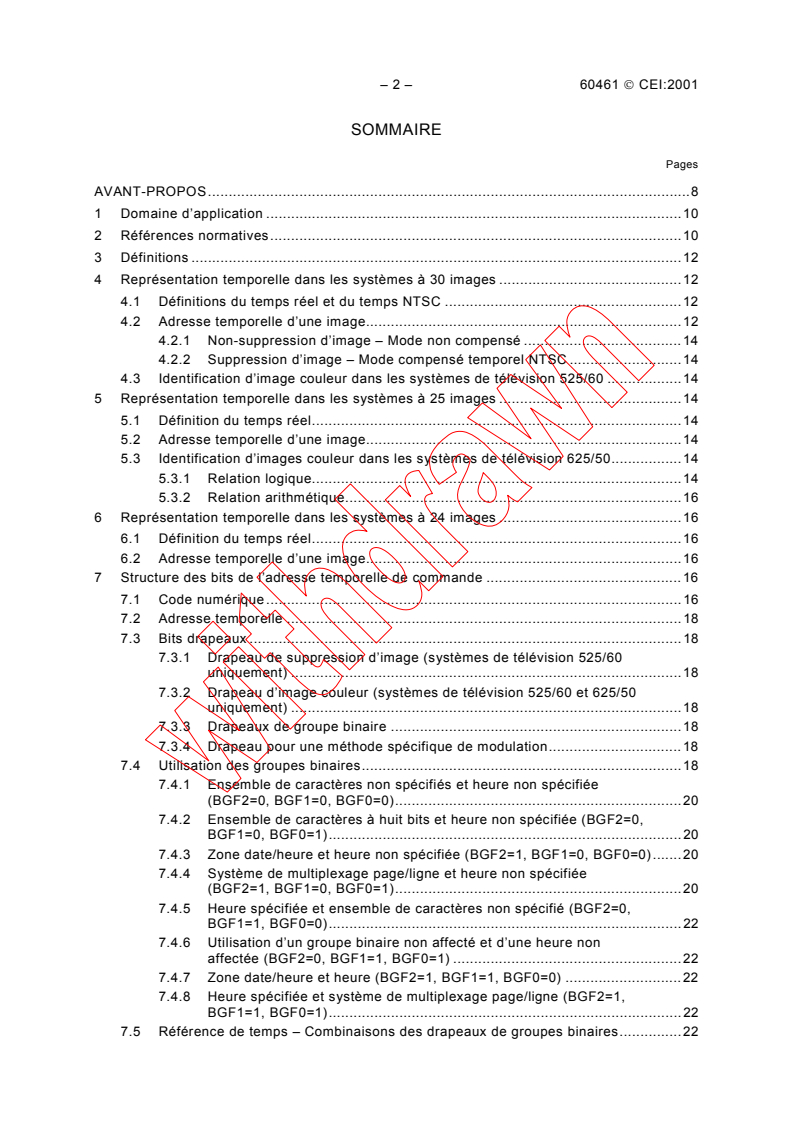
– 2 – 60461 CEI:2001
SOMMAIRE
Pages
AVANT-PROPOS.8
1 Domaine d’application .10
2 Références normatives.10
3 Définitions .12
4 Représentation temporelle dans les systèmes à 30 images .12
4.1 Définitions du temps réel et du temps NTSC .12
4.2 Adresse temporelle d’une image.12
4.2.1 Non-suppression d’image – Mode non compensé .14
4.2.2 Suppression d’image – Mode compensé temporel NTSC .14
4.3 Identification d’image couleur dans les systèmes de télévision 525/60 .14
5 Représentation temporelle dans les systèmes à 25 images .14
5.1 Définition du temps réel.14
5.2 Adresse temporelle d’une image.14
5.3 Identification d’images couleur dans les systèmes de télévision 625/50.14
5.3.1 Relation logique.14
5.3.2 Relation arithmétique.16
6 Représentation temporelle dans les systèmes à 24 images .16
6.1 Définition du temps réel.16
6.2 Adresse temporelle d’une image.16
7 Structure des bits de l’adresse temporelle de commande .16
7.1 Code numérique.16
7.2 Adresse temporelle .18
7.3 Bits drapeaux .18
7.3.1 Drapeau de suppression d’image (systèmes de télévision 525/60
uniquement) .18
7.3.2 Drapeau d’image couleur (systèmes de télévision 525/60 et 625/50
uniquement) .18
7.3.3 Drapeaux de groupe binaire .18
7.3.4 Drapeau pour une méthode spécifique de modulation.18
7.4 Utilisation des groupes binaires.18
7.4.1 Ensemble de caractères non spécifiés et heure non spécifiée
(BGF2=0, BGF1=0, BGF0=0).20
7.4.2 Ensemble de caractères à huit bits et heure non spécifiée (BGF2=0,
BGF1=0, BGF0=1).20
7.4.3 Zone date/heure et heure non spécifiée (BGF2=1, BGF1=0, BGF0=0).20
7.4.4 Système de multiplexage page/ligne et heure non spécifiée
(BGF2=1, BGF1=0, BGF0=1).20
7.4.5 Heure spécifiée et ensemble de caractères non spécifié (BGF2=0,
BGF1=1, BGF0=0).22
7.4.6 Utilisation d’un groupe binaire non affecté et d’une heure non
affectée (BGF2=0, BGF1=1, BGF0=1) .22
7.4.7 Zone date/heure et heure (BGF2=1, BGF1=1, BGF0=0) .22
7.4.8 Heure spécifiée et système de multiplexage page/ligne (BGF2=1,
BGF1=1, BGF0=1).22
7.5 Référence de temps – Combinaisons des drapeaux de groupes binaires.22
60461 IEC:2001 – 3 –
CONTENTS
Page
FOREWORD.9
1 Scope.11
2 Normative references.11
3 Definitions .13
4 Time representation in 30-frame systems.13
4.1 Definitions of real time and NTSC time.13
4.2 Time address of a frame.13
4.2.1 Non-drop frame – Uncompensated mode .15
4.2.2 Drop frame – NTSC time compensated mode.15
4.3 Colour frame identification in 525/60 television systems .15
5 Time representation in 25-frame systems.15
5.1 Definition of real time.15
5.2 Time address of a frame.15
5.3 Colour frame identification in 625/50 television systems .15
5.3.1 Logical relationship .15
5.3.2 Arithmetic relationship .17
6 Time representation in 24-frame systems.17
6.1 Definition of real time.17
6.2 Time address of a frame.17
7 Structure of the time address and control bits.17
7.1 Digital code .17
7.2 Time address .19
7.3 Flag bits .19
7.3.1 Drop frame flag (525/60 television system only) .19
7.3.2 Colour frame flag (525/60 and 625/50 television systems only) .19
7.3.3 Binary group flags.19
7.3.4 Modulation method specific flag .19
7.4 Use of the binary groups.19
7.4.1 Character set not specified and unspecified clock time (BGF2=0,
BGF1=0, BGF0=0) .21
7.4.2 Eight-bit character set and unspecified clock time (BGF2=0, BGF1=0,
BGF0=1).21
7.4.3 Date/time zone and unspecified clock time (BGF2=1, BGF1=0,
BGF0=0).21
7.4.4 Page/line multiplex system and unspecified clock time (BGF2=1,
BGF1=0, BGF0=1) .21
7.4.5 Clock time specified and unspecified character set (BGF2=0,
BGF1=1, BGF0=0) .23
7.4.6 Unassigned binary group usage and unassigned clock time (BGF2=0,
BGF1=1, BGF0=1) .23
7.4.7 Date/time zone and clock time (BGF2=1, BGF1=1, BGF0=0) .23
7.4.8 Specified clock time and page/line multiplex system (BGF2=1,
BGF1=1, BGF0=1) .23
7.5 Clock time reference – Binary group flag combinations.23
– 4 – 60461 CEI:2001
8 Application du code temporel linéaire .22
8.1 Format du mot code .22
8.2 Contenu des données du mot code .22
8.2.1 Adresse temporelle.24
8.2.2 Bits drapeaux .24
8.2.3 Groupes binaires .24
8.2.4 Mot de synchronisation.26
8.2.5 Correction de la polarité du bit d’identification biphase .28
8.3 Méthode de modulation .28
8.4 Débit binaire.30
8.5 Synchronisation du mot code par rapport à un signal de télévision .30
8.5.1 Systèmes de télévision 525/60 .30
8.5.2 Systèmes de télévision 1125/60 .30
8.5.3 Systèmes de télévision 625/50 .32
8.6 Caractéristiques électriques et mécaniques de l’interface du code temporel
linéaire .32
8.6.1 Temps de montée/descente.32
8.6.2 Distorsion d’amplitude .32
8.6.3 Synchronisation des transitions .32
8.6.4 Connecteur d’interface .32
8.6.5 Impédance de sortie .32
8.6.6 Amplitude du signal de sortie.32
9 Application aux trames – Systèmes de télévision.42
9.1 Format du mot code .42
9.2 Contenu des données du mot code .42
9.2.1 Adresse temporelle.50
9.2.2 Bits drapeaux .50
9.2.3 Groupes binaires .50
9.2.4 Drapeau d’indication de trame .52
9.2.5 Bits de synchronisation.52
9.2.6 Code de vérification de redondance cyclique .52
9.3 Méthode de modulation .54
9.4 Synchronisation des bits.54
9.5 Synchronisation du mot code par rapport au signal de télévision.56
9.5.1 Systèmes de télévision 525/60 .56
9.5.2 Systèmes de télévision 1125/60 .56
9.5.3 Systèmes de télévision 625/50 .56
9.6 Position du signal correspondant au code d’adresse dans la trame .56
9.6.1 Systèmes de télévision 525/60 .56
9.6.2 Systèmes de télévision 1125/60 .56
9.6.3 Systèmes de télévision 625/50 .56
9.7 Redondance.56
9.8 Caractéristiques de la forme d’onde du code temporel de trame.58
9.8.1 Niveau logique.58
9.8.2 Temps de montée/descente.58
9.8.3 Distorsion d’amplitude .58
60461 IEC:2001 – 5 –
8 Linear time code application.23
8.1 Code word format .23
8.2 Code word data content .23
8.2.1 Time address.25
8.2.2 Flag bits .25
8.2.3 Binary groups .25
8.2.4 Synchronization word .27
8.2.5 Biphase mark polarity correction .29
8.3 Modulation method .29
8.4 Bit rate .31
8.5 Timing of the code word relative to a television signal .31
8.5.1 525/60 television systems .31
8.5.2 1125/60 television systems .31
8.5.3 625/50 television systems .33
8.6 Linear time code interface electrical and mechanical characteristics.33
8.6.1 Rise/fall time.33
8.6.2 Amplitude distortion .33
8.6.3 Timing of the transitions.33
8.6.4 Interface connector .33
8.6.5 Output impedance.33
8.6.6 Output amplitude .33
9 Vertical interval application – Television systems .43
9.1 Code word format .43
9.2 Code word data content .43
9.2.1 Time address.51
9.2.2 Flag bits .51
9.2.3 Binary groups .51
9.2.4 Field mark flag.53
9.2.5 Synchronization bits.53
9.2.6 Cyclic redundance check code .53
9.3 Modulation method .55
9.4 Bit timing .55
9.5 Timing of the code word relative to the television signal .57
9.5.1 525/60 television system .57
9.5.2 1125/60 television system .57
9.5.3 625/50 television system .57
9.6 Location of the address code signal in the vertical interval .57
9.6.1 525/60 television system .57
9.6.2 1125/60 television system .57
9.6.3 625/50 television system .57
9.7 Redundancy .57
9.8 Vertical interval time code waveform characteristics.59
9.8.1 Logic level .59
9.8.2 Rise/fall time.59
9.8.3 Amplitude distortion .59
– 6 – 60461 CEI:2001
10 Relation entre le code LTC et le code VITC .58
10.1 Données d’adresse temporelle .58
10.2 Données de groupe binaire .58
10.2.1 Transfert de données de groupe binaire de trame vers des données
de groupe binaire linéaire .60
10.2.2 Transfert de données de groupe binaire linéaire vers les données de
groupe binaire de trame.60
10.3 Comparaison des mot du code VITC et du code LTC.60
Annexe A (informative) Notes explicatives .64
A.1 Précision temporelle.64
A.2 Corrections des changements de secondes.64
Bibliographie.66
Figure 1 – Forme d’onde du signal de sortie de la source de code temporel linéaire .30
Figure 2a – Exemple de code temporel linéaire 30 images (système de télévision
525/60) .34
Figure 2b – Exemple de code temporel linéaire 30 images (système de télévision
1125/60) .36
Figure 2c – Exemple de code temporel linéaire 25 images (système de télévision
625/50) .38
Figure 2d – Exemple de code temporel linéaire 24 images (système pour film 24
images).40
Figure 3a – Affectation et synchronisation des bits d’adresse du code temporel pour
les trames 525/60 .44
Figure 3b – Affectation et synchronisation des bits d’adresse du code temporel pour
les trames 1125/60 .46
Figure 3c – Affectation et synchronisation des bits d’adresse du code temporel pour
les trames 625/50 .48
Figure 4 – Forme d’onde du code temporel de trame .54
Tableau 1 – Affectations du drapeau de groupe binaire.20
Tableau 2 – Positions des bits d’adresse temporelle du code LTC .24
Tableau 3 – Positions du bit drapeau du code LTC .24
Tableau 4 – Positions du bit du groupe binaire du code LTC.26
Tableau 5 – Positions et valeur du bit du mot de synchronisation de code LTC.26
Tableau 6 – Positions des bits d’adresse temporelle du code VITC.50
Tableau 7 – Positions des bits drapeaux du code VITC.50
Tableau 8 – Positions des bits des groupes binaires du code VITC.52
Tableau 9 – Positions du bit du code CRC .54
Tableau 10 – Gammes de niveaux logiques du code VITC.58
Tableau 11 – Complément aux définitions des bits des mots codes des codes VITC et
LTC .60
60461 IEC:2001 – 7 –
10 Relationship between LTC and VITC .59
10.1 Time address data.59
10.2 Binary group data .59
10.2.1 Transferring vertical interval binary group data to linear binary group
data.61
10.2.2 Transferring linear binary group data to vertical interval binary group
data.61
10.3 VITC and LTC code word comparison .61
Annex A (informative) Explanatory notes .65
A.1 Time precision .65
A.2 Leap second corrections .65
Bibliography .67
Figure 1 – Linear time code source output waveform .31
Figure 2a – 30-frame linear time code example (525/60 television system) .35
Figure 2b – 30-frame linear time code example (1125/60 television system) .37
Figure 2c – 25-frame linear time code example (625/50 television system) .39
Figure 2d – 24-frame linear time code example (24-frame film system).41
Figure 3a – 525/60 vertical interval time code address bit assignment and timing.45
Figure 3b –1125/60 vertical interval time code address bit assignment and timing.47
Figure 3c – 625/50 vertical interval time code address bit assignment and timing.49
Figure 4 – Vertical interval time code waveform .55
Table 1 – Binary group flag assignments .21
Table 2 – LTC time address bit positions .25
Table 3 – LTC flag bit positions .25
Table 4 – LTC binary group bit positions.27
Table 5 – LTC synchronization word bit positions and values .27
Table 6 – VITC time address bit positions.51
Table 7 – VITC flag bit positions.51
Table 8 – VITC binary group bit positions .53
Table 9 – CRC bit positions.55
Table 10 – VITC logic level ranges .59
Table 11 – Summation of VITC and LTC code word bit definitions .61
– 8 – 60461 CEI:2001
COMMISSION ÉLECTROTECHNIQUE INTERNATIONALE
____________
CODE TEMPOREL DE COMMANDE
POUR LES MAGNÉTOSCOPES
AVANT-PROPOS
1) La CEI (Commission Electrotechnique Internationale) est une organisation mondiale de normalisation
composée de l'ensemble des comités électrotechniques nationaux (Comités nationaux de la CEI). La CEI a
pour objet de favoriser la coopération internationale pour toutes les questions de normalisation dans les
domaines de l'électricité et de l'électronique. A cet effet, la CEI, entre autres activités, publie des Normes
internationales. Leur élaboration est confiée à des comités d'études, aux travaux desquels tout Comité national
intéressé par le sujet traité peut participer. Les organisations internationales, gouvernementales et non
gouvernementales, en liaison avec la CEI, participent également aux travaux. La CEI collabore étroitement
avec l'Organisation Internationale de Normalisation (ISO), selon des conditions fixées par accord entre les
deux organisations.
2) Les décisions ou accords officiels de la CEI concernant les questions techniques représentent, dans la mesure
du possible, un accord international sur les sujets étudiés, étant donné que les Comités nationaux intéressés
sont représentés dans chaque comité d’études.
3) Les documents produits se présentent sous la forme de recommandations internationales. Ils sont publiés
comme normes, spécifications techniques, rapports techniques ou guides, et agréés comme tels par les
Comités nationaux.
4) Dans le but d'encourager l'unification internationale, les Comités nationaux de la CEI s'engagent à appliquer de
façon transparente, dans toute la mesure possible, les Normes internationales de la CEI dans leurs normes
nationales et régionales. Toute divergence entre la norme de la CEI et la norme nationale ou régionale
correspondante doit être indiquée en termes clairs dans cette dernière.
5) La CEI n’a fixé aucune procédure concernant le marquage comme indication d’approbation et sa responsabilité
n’est pas engagée quand un matériel est déclaré conforme à l’une de ses normes.
6) L’attention est attirée sur le fait que certains des éléments de la présente Norme internationale peuvent faire
l’objet de droits de propriété intellectuelle ou de droits analogues. La CEI ne saurait être tenue pour
responsable de ne pas avoir identifié de tels droits de propriété et de ne pas avoir signalé leur existence.
La Norme internationale CEI 60461 a été établie par le sous-comité 100B: Systèmes de
stockage d’informations multimédia, vidéo et audio, du comité d'études 100: Systèmes et
appareils audio, vidéo et multimédia, de la CEI.
Cette troisième édition annule et remplace la deuxième édition parue en 1986, dont elle
constitue une révision technique.
Le texte de cette norme est issu des documents suivants:
FDIS Rapport de vote
100B/280/FDIS 100B/286/RVD
Le rapport de vote indiqué dans le tableau ci-dessus donne toute information sur le vote ayant
abouti à l'approbation de cette norme.
Cette publication a été rédigée selon les Directives ISO/CEI, Partie 3.
L’annexe A est donnée uniquement à titre d’information.
Le comité a décidé que le contenu de cette publication ne sera pas modifié avant 2006-01.
A cette date, la publication sera
• reconduite;
• supprimée;
• remplacée par une édition révisée, ou
• amendée.
60461 IEC:2001 – 9 –
INTERNATIONAL ELECTROTECHNICAL COMMISSION
____________
TIME AND CONTROL CODE
FOR VIDEO TAPE RECORDERS
FOREWORD
1) The IEC (International Electrotechnical Commission) is a worldwide organization for standardization comprising
all national electrotechnical committees (IEC National Committees). The object of the IEC is to promote
international co-operation on all questions concerning standardization in the electrical and electronic fields. To
this end and in addition to other activities, the IEC publishes International Standards. Their preparation is
entrusted to technical committees; any IEC National Committee interested in the subject dealt with may
participate in this preparatory work. International, governmental and non-governmental organizations liaising
with the IEC also participate in this preparation. The IEC collaborates closely with the International Organization
for Standardization (ISO) in accordance with conditions determined by agreement between the two
organizations.
2) The formal decisions or agreements of the IEC on technical matters express, as nearly as possible, an
international consensus of opinion on the relevant subjects since each technical committee has representation
from all interested National Committees.
3) The documents produced have the form of recommendations for international use and are published in the form
of standards, technical specifications, technical reports or guides and they are accepted by the National
Committees in that sense.
4) In order to promote international unification, IEC National Committees undertake to apply IEC International
Standards transparently to the maximum extent possible in their national and regional standards. Any
divergence between the IEC Standard and the corresponding national or regional standard shall be clearly
indicated in the latter.
5) The IEC provides no marking procedure to indicate its approval and cannot be rendered responsible for any
equipment declared to be in conformity with one of its standards.
6) Attention is drawn to the possibility that some of the elements of this International Standard may be the subject
of patent rights. The IEC shall not be held responsible for identifying any or all such patent rights.
International Standard IEC 60461 has been prepared by subcommittee 100B: Audio, video and
multimedia information storage systems, of IEC technical committee 100: Audio, video and
multimedia systems and equipment.
This third edition cancels and replaces the second edition published in 1986, of which it
constitutes a technical revision.
The text of this standard is based on the following documents:
FDIS Report on voting
100B/280/FDIS 100B/286/RVD
Full information on the voting for the approval of this standard can be found in the report on
voting indicated in the above table.
This publication has been drafted in accordance with the ISO/IEC Directives, Part 3.
Annex A is for information only.
The committee has decided that the contents of this publication will remain unchanged until
2006-01. At this date, the publication will be
• reconfirmed;
• withdrawn;
• replaced by a revised edition, or
• amended.
– 10 – 60461 CEI:2001
CODE TEMPOREL DE COMMANDE
POUR LES MAGNÉTOSCOPES
1 Domaine d’application
La présente Norme internationale spécifie un code numérique temporel de commande destiné
à être utilisé dans les systèmes de télévision, films et systèmes audio annexes, fonctionnant
à des vitesses de 30, 25, et 24 images par seconde.
Les articles 4, 5 et 6 spécifient le mode de représentation du temps dans les systèmes à base
d’images. L’article 7 décrit la structure des bits de l’adresse temporelle et de commande du
code, et fixe des orientations pour stocker les données utilisateurs dans le code. L’article 8
spécifie la méthode de modulation et les caractéristiques d’interface d’une source de code
temporel linéaire (LTC: linear time code). L’article 9 spécifie la méthode de modulation pour
insérer le code dans l’intervalle vertical d’un signal de télévision. L’article 10 résume la
relation existant entre les deux formes de code temporel et de commande.
2 Références normatives
Les documents normatifs suivants contiennent des dispositions qui, par suite de la référence
qui y est faite, constituent des dispositions valables pour la présente Norme internationale.
Pour les références datées, les amendements ultérieurs ou les révisions de ces publications
ne s’appliquent pas. Toutefois, les parties prenantes aux accords fondés sur la présente
Norme internationale sont invitées à rechercher la possibilité d'appliquer les éditions les plus
récentes des documents normatifs indiqués ci-après. Pour les références non datées, la
dernière édition du document normatif en référence s’applique. Les membres de la CEI et de
l'ISO possèdent le registre des Normes internationales en vigueur.
ISO/IEC 646:1991, Technologies de l’information – Jeu ISO de caractères codés à 7 éléments
pour l’échange d’informations (disponible en anglais seulement)
ISO/IEC 2022:1994, Technologies de l’information – Structure de code de caractères et
techniques d'extension (disponible en anglais seulement)
SMPTE 170M:1999, Television – Composite Analog Video Signal – NTSC for Studio
Applications
SMPTE 240M:1995, Television – Signal Parameters – 1125-Line High-Definition Production
Systems
SMPTE 258M:1993, Television – Transfer of Edit Decision Lists
SMPTE 262M:1995, Television, Audio and Film – Binary Groups of Time and Control Codes –
Storage and Transmission of Data
SMPTE 309M: Television – Transmission of Date and Time Zone Information in Binary
Groups of Time and Control Code
SMPTE RP 164:1996, Location of Vertical Interval Time Code
UIT-R BT.470-6:1994, Systèmes de télévision classiques
60461 IEC:2001 – 11 –
TIME AND CONTROL CODE
FOR VIDEO TAPE RECORDERS
1 Scope
This International Standard specifies a digital time and control code for use in television, film,
and accompanying audio systems operating at 30, 25, and 24 frames per second.
Clauses 4, 5, and 6 specify the manner in which time is represented in frame-based systems.
Clause 7 describes the structure of the time address and control bits of the code, and sets
guidelines for storage of user data in the code. Clause 8 specifies the modulation method and
interface characteristics of a linear time code (LTC) source. Clause 9 specifies the modulation
method for inserting the code into the vertical interval of a television signal. Clause 10
summarizes the relationship between the two forms of time and control code.
2 Normative references
The following normative documents contain provisions which, through reference in this text,
constitute provisions of this International Standard. For dated references, subsequent
amendments to, or revisions of, any of these publications do not apply. However, parties to
agreements based on this International Standard are encouraged to investigate the possibility
of applying the most recent editions of the normative documents indicated below. For undated
references, the latest edition of the normative document referred to applies. Members of IEC
and ISO maintain registers of currently valid International Standards.
ISO/IEC 646:1991, Information technology – ISO 7-bit coded character set for information
interchange
ISO/IEC 2022:1994, Information technology – Character code structure and extension
techniques
SMPTE 170M:1999, Television – Composite Analog Video Signal – NTSC for Studio
Applications
SMPTE 240M:1995, Television – Signal Parameters – 1125-Line High-Definition Production
Systems
SMPTE 258M:1993, Television – Transfer of Edit Decision Lists
SMPTE 262M:1995, Television, Audio and Film – Binary Groups of Time and Control Codes –
Storage and Transmission of Data
SMPTE 309M: Television – Transmission of Date and Time Zone Information in Binary Groups
of Time and Control Code
SMPTE RP 164:1996, Location of Ver
...