


IEC 60249-2-11:1987/AMD4:2000
(Amendment)Amendment 4 - Base materials for printed circuits. Part 2: Specifications. Specification No. 11: Thin epoxide woven glass fabric copper-clad laminated sheet, general purpose grade for use in the fabrication of multilayer printed boards
General Information
- Abstract
- Status
- Withdrawn
- Publication Date
- 23-Aug-2000
- Withdrawal Date
- 14-Oct-2002
- Technical Committee
- TC 91 - Electronics assembly technology
- Drafting Committee
- WG 1 - TC 91/WG 1
- Current Stage
- WPUB - Publication withdrawn
- Start Date
- 09-Aug-2002
- Completion Date
- 28-Aug-2026
Buy Documents
IEC 60249-2-11:1987/AMD4:2000 - Amendment 4 - Base materials for printed circuits. Part 2: Specifications. Specification No. 11: Thin epoxide woven glass fabric copper-clad laminated sheet, general purpose grade for use in the fabrication of multilayer printed boards Released:8/24/2000
Buy Documents
IEC 60249-2-11:1987/AMD4:2000 - Amendment 4 - Base materials for printed circuits. Part 2: Specifications. Specification No. 11: Thin epoxide woven glass fabric copper-clad laminated sheet, general purpose grade for use in the fabrication of multilayer printed boards Released:8/24/2000
Frequently Asked Questions
IEC 60249-2-11:1987/AMD4:2000 is a standard published by the International Electrotechnical Commission (IEC). Its full title is "Amendment 4 - Base materials for printed circuits. Part 2: Specifications. Specification No. 11: Thin epoxide woven glass fabric copper-clad laminated sheet, general purpose grade for use in the fabrication of multilayer printed boards". This standard covers: Amendment 4 - Base materials for printed circuits. Part 2: Specifications. Specification No. 11: Thin epoxide woven glass fabric copper-clad laminated sheet, general purpose grade for use in the fabrication of multilayer printed boards
Amendment 4 - Base materials for printed circuits. Part 2: Specifications. Specification No. 11: Thin epoxide woven glass fabric copper-clad laminated sheet, general purpose grade for use in the fabrication of multilayer printed boards
IEC 60249-2-11:1987/AMD4:2000 is classified under the following ICS (International Classification for Standards) categories: 31.180 - Printed circuits and boards. The ICS classification helps identify the subject area and facilitates finding related standards.
IEC 60249-2-11:1987/AMD4:2000 is available in PDF format for immediate download after purchase. The document can be added to your cart and obtained through the secure checkout process. Digital delivery ensures instant access to the complete standard document.
Standards Content (Sample)
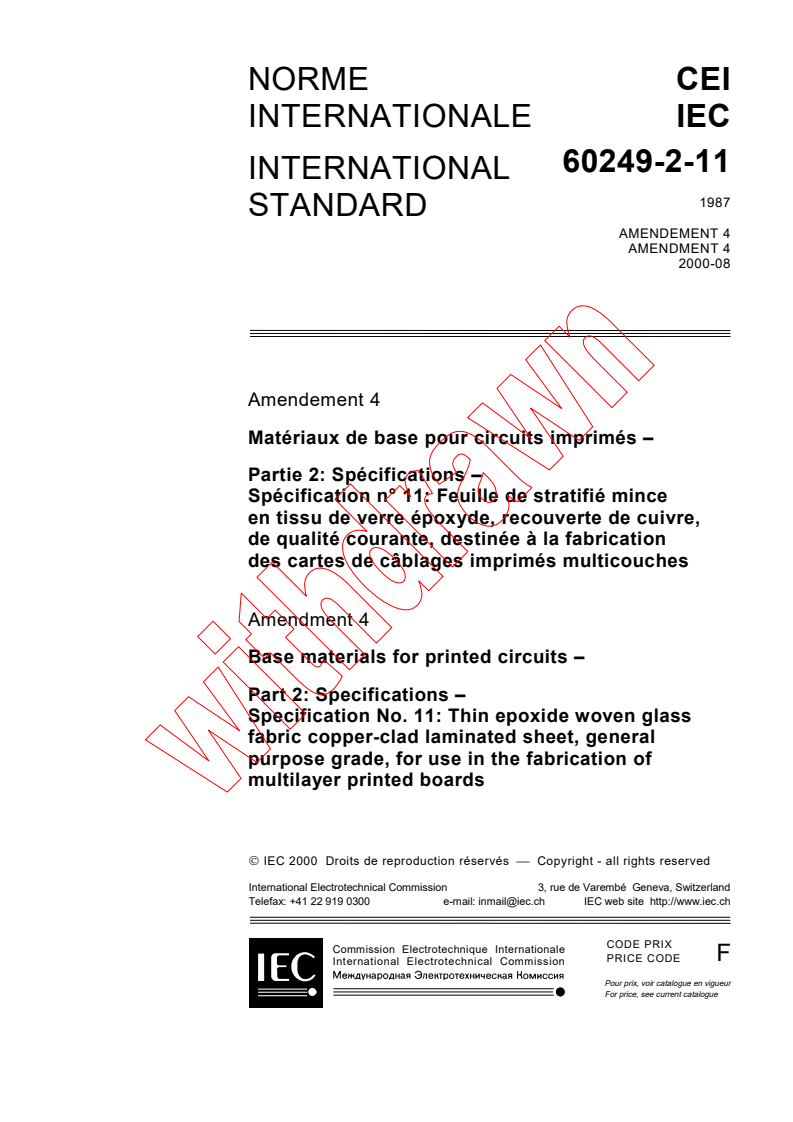
NORME CEI
INTERNATIONALE IEC
60249-2-11
INTERNATIONAL
STANDARD
AMENDEMENT 4
AMENDMENT 4
2000-08
Amendement 4
Matériaux de base pour circuits imprimés –
Partie 2: Spécifications –
Spécification n° 11: Feuille de stratifié mince
en tissu de verre époxyde, recouverte de cuivre,
de qualité courante, destinée à la fabrication
des cartes de câblages imprimés multicouches
Amendment 4
Base materials for printed circuits –
Part 2: Specifications –
Specification No. 11: Thin epoxide woven glass
fabric copper-clad laminated sheet, general
purpose grade, for use in the fabrication of
multilayer printed boards
IEC 2000 Droits de reproduction réservés Copyright - all rights reserved
International Electrotechnical Commission 3, rue de Varembé Geneva, Switzerland
Telefax: +41 22 919 0300 e-mail: inmail@iec.ch IEC web site http://www.iec.ch
CODE PRIX
Commission Electrotechnique Internationale
F
PRICE CODE
International Electrotechnical Commission
Pour prix, voir catalogue en vigueur
For price, see current catalogue
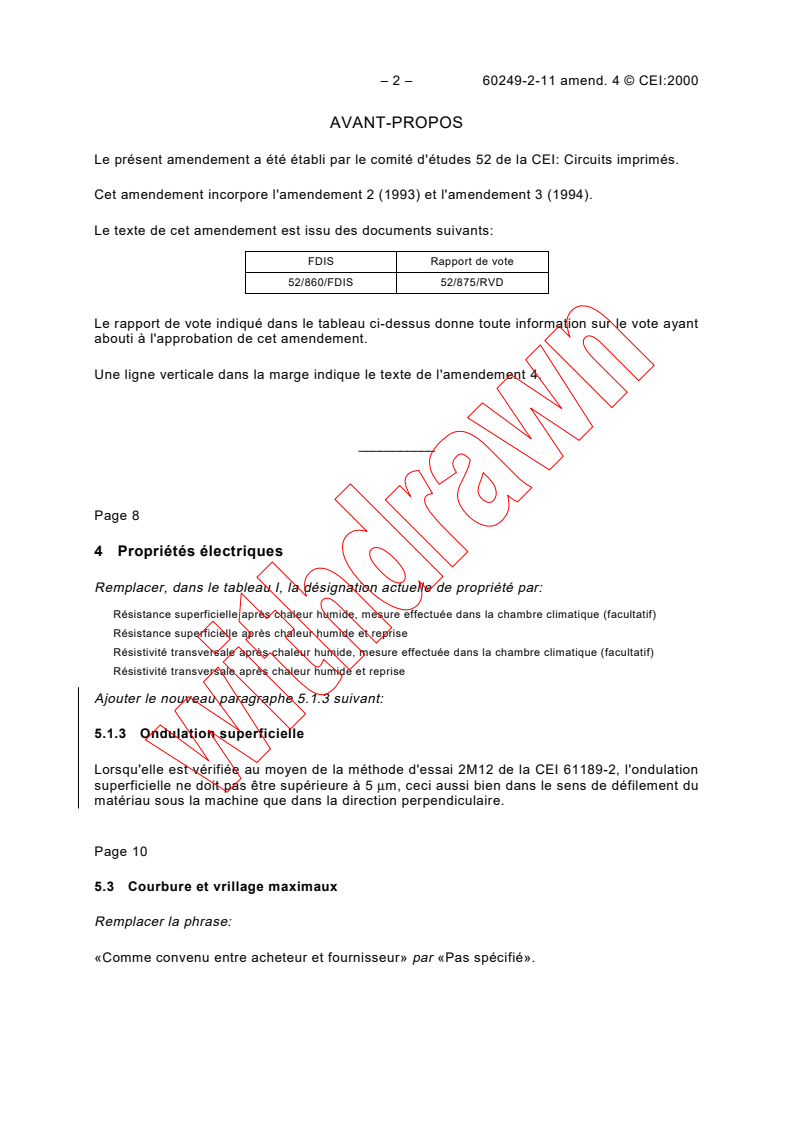
– 2 – 60249-2-11 amend. 4 © CEI:2000
AVANT-PROPOS
Le présent amendement a été établi par le comité d'études 52 de la CEI: Circuits imprimés.
Cet amendement incorpore l'amendement 2 (1993) et l'amendement 3 (1994).
Le texte de cet amendement est issu des documents suivants:
FDIS Rapport de vote
52/860/FDIS 52/875/RVD
Le rapport de vote indiqué dans le tableau ci-dessus donne toute information sur le vote ayant
abouti à l'approbation de cet amendement.
Une ligne verticale dans la marge indique le texte de l'amendement 4.
___________
Page 8
4 Propriétés électriques
Remplacer, dans le tableau I, la désignation actuelle de propriété par:
Résistance superficielle après chaleur humide, mesure effectuée dans la chambre climatique (facultatif)
Résistance superficielle après chaleur humide et reprise
Résistivité transversale après chaleur humide, mesure effectuée dans la chambre climatique (facultatif)
Résistivité transversale après chaleur humide et reprise
Ajouter le nouveau paragraphe 5.1.3 suivant:
5.1.3 Ondulation superficielle
Lorsqu'elle est vérifiée au moyen de la méthode d'essai 2M12 de la CEI 61189-2, l'ondulation
superficielle ne doit pas être supérieure à 5 μm, ceci aussi bien dans le sens de défilement du
matériau sous la machine que dans la direction perpendiculaire.
Page 10
5.3 Courbure et vrillage maximaux
Remplacer la phrase:
«Comme convenu entre acheteur et fournisseur» par «Pas spécifié».
60249-2-11 Amend. 4 © IEC:2000 – 3 –
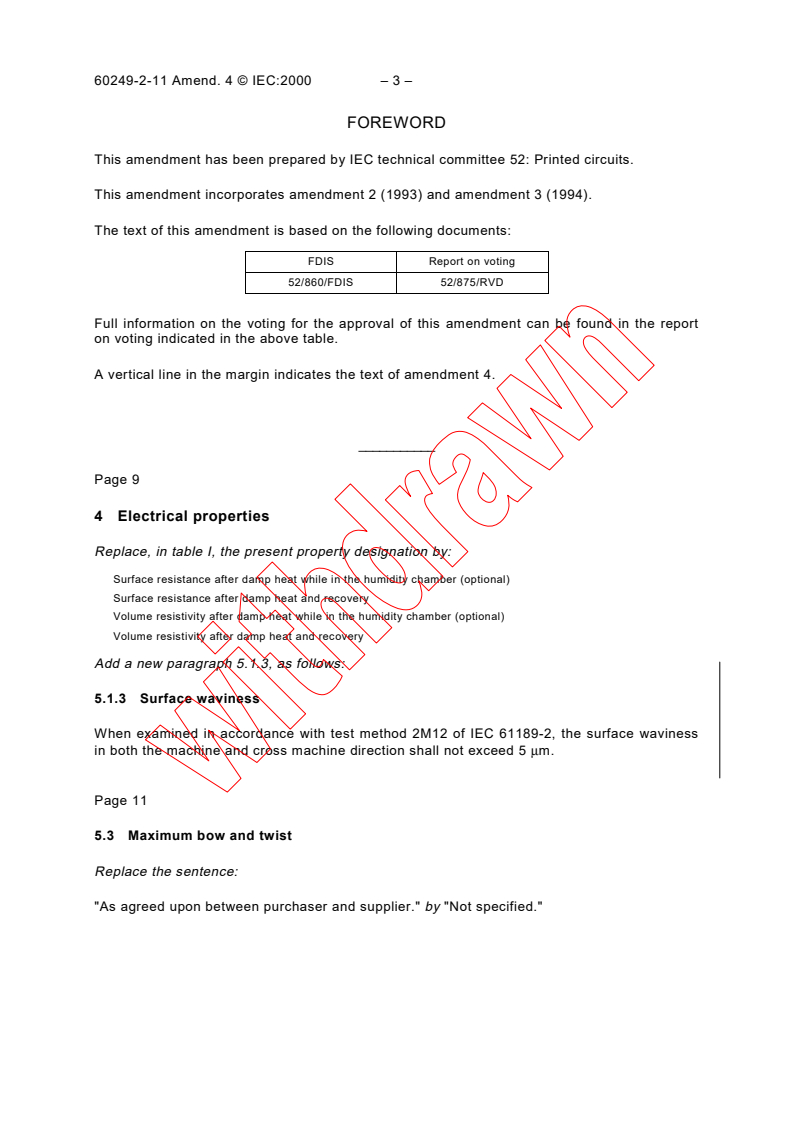
FOREWORD
This amendment has been prepared by IEC technical committee 52: Printed circuits.
This amendment incorporates amendment 2 (1993) and amendment 3 (1994).
The text of this amendment is based on the following documents:
FDIS Report on voting
52/860/FDIS 52/875/RVD
Full information on the voting for the approval of this amendment can be found in the report
on voting indicated in the above table.
A vertical line in the margin indicates the text of amendment 4.
___________
Page 9
4 Electrical properties
Replace, in table I, the present property designation by:
Surface resistance after damp heat while in the humidity chamber (optional)
Surface resistance after damp heat and recovery
Volume resistivity after damp heat while in the humidity chamber (optional)
Volume resistivity after damp heat and recovery
Add a new paragraph 5.1.3, as follows:
5.1.3 Surface waviness
When examined in accordance with test method 2M12 of IEC 61189-2, the surface waviness
in both the machine and cross machine direction shall not exceed 5 μm.
Page 11
5.3 Maximum bow and twist
Replace the sentence:
"As agreed upon between purchaser and supplier." by "Not specified."
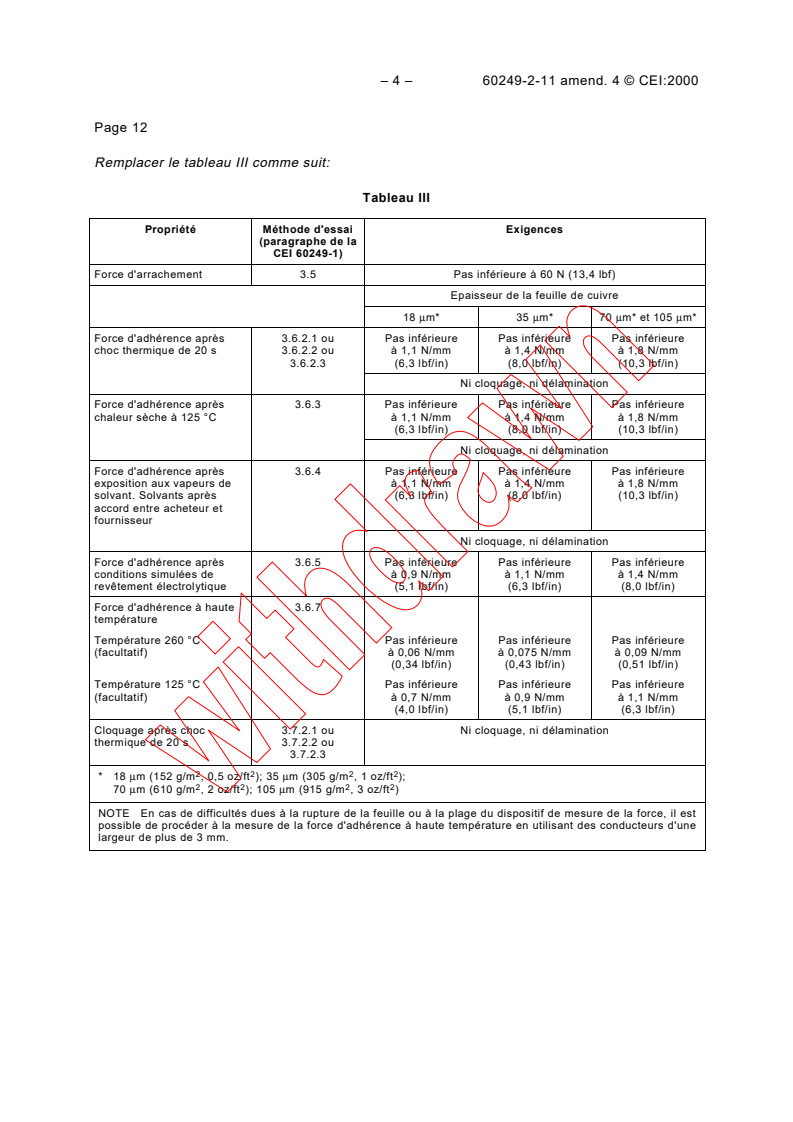
– 4 – 60249-2-11 amend. 4 © CEI:2000
Page 12
Remplacer le tableau III comme suit:
Tableau III
Propriété Méthode d'essai Exigences
(paragraphe de la
CEI 60249-1)
Force d'arrachement 3.5 Pas inférieure à 60 N (13,4 lbf)
Epaisseur de la feuille de cuivre
18 m* 35 m* 70 m* et 105 m*
μ μ μ μ
Force d'adhérence après 3.6.2.1 ou Pas inférieure Pas inférieure Pas inférieure
choc thermique de 20 s 3.6.2.2 ou à 1,1 N/mm à 1,4 N/mm à 1,8 N/mm
3.6.2.3 (6,3 lbf/in) (8,0 lbf/in) (10,3 lbf/in)
Ni cloquage, ni délamination
Force d'adhérence après 3.6.3 Pas inférieure Pas inférieure Pas inférieure
chaleur sèche à 125 °C à 1,1 N/mm à 1,4 N/mm à 1,8 N/mm
(6,3 lbf/in) (8,0 lbf/in) (10,3 lbf/in)
Ni cloquage, ni délamination
Force d'adhérence après 3.6.4 Pas inférieure Pas inférieure Pas inférieure
exposition aux vapeurs de à 1,1 N/mm à 1,4 N/mm à 1,8 N/mm
solvant. Solvants après (6,3 lbf/in) (8,0 lbf/in) (10,3 lbf/in)
accord entre acheteur et
fournisseur
Ni cloquage, ni délamination
Force d'adhérence après 3.6.5 Pas inférieure Pas inférieure Pas inférieure
conditions simulées de à 0,9 N/mm à 1,1 N/mm à 1,4 N/mm
revêtement électrolytique (5,1 lbf/in) (6,3 lbf/in) (8,0 lbf/in)
Force d'adhérence à haute 3.6.7
température
Température 260 °C Pas inférieure Pas inférieure Pas inférieure
(facultatif) à 0,06 N/mm à 0,075 N/mm à 0,09 N/mm
(0,34 lbf/in) (0,43 lbf/in) (0,51 lbf/in)
Température 125 °C Pas inférieure Pas inférieure Pas inférieure
(facultatif) à 0,7 N/mm à 0,9 N/mm à 1,1 N/mm
(4,0 lbf/in) (5,1 lbf/in) (6,3 lbf/in)
Cloquage après choc 3.7.2.1 ou Ni cloquage, ni délamination
thermique de 20 s 3.7.2.2 ou
3.7.2.3
2 2 2 2
* 18 μm (152 g/m , 0,5 oz/ft ); 35 μm (305 g/m , 1 oz/ft );
2 2 2 2
70 μm (610 g/m , 2 oz/ft ); 105 μm (915 g/m , 3 oz/ft )
NOTE En cas de difficultés dues à la rupture de la feuille ou à la plage du dispositif de mesure de la force, il est
possible de procéder à la mesure de la force d'adhérence à haute température en utilisant des conducteurs d'une
largeur de plus de 3 mm.
60249-2-11 Amend. 4 © IEC:2000 – 5 –
Page 13
Replace table III as follows:
Table III
Property Test method Requirement
(subclause of
IEC 60249-1)
Pull-off strength 3.5 Not less than 60 N (13,4 lbf)
Thickness of the copper foil
18 m* 35 m* 70 m* and 105 m*
μ μ μ μ
Peel strength after heat 3.6.2.1 or Not less than Not less than Not less than
shock of 20 s 3.6.2.2 or 1,1 N/mm 1,4 N/mm 1,8 N/mm
3.6.2.3 (6,3 lbf/in) (8,0 lbf/in) (10,3 lbf/in)
No blistering nor delamination
Peel strength after dry heat 3.6.3 Not less than Not less than Not less than
at 125 °C 1,1 N/mm 1,4 N/mm 1,8 N/mm
(6,3 lbf/in) (8,0 lbf/in) (10,3 lbf/in)
No blistering nor delamination
Peel strength after exposure 3.6.4 Not less than Not less than Not less than
to solvent vapour. Solvents 1,1 N/mm 1,4 N/mm 1,8 N/mm
as agreed upon between (6,3 lbf/in) (8,0 lbf/in) (10,3 lbf/in)
purchaser and supplier
No blistering nor delamination
Peel strength after 3.6.5 Not less than Not less than Not less than
simulated plating 0,9 N/mm 1,1 N/mm 1,4 N/mm
(5,1 lbf/in) (6,3 lbf/in) (8,0 lbf/in)
Peel strength at high 3.6.7
temperature
Temperature 260 °C Not less than Not less than
...