

IEC 63341-1:2025
(Main)Railway applications - Hydrogen and fuel cell systems for rolling stock - Part 1: Fuel cell power system
General Information
- Abstract
IEC 63341-1:2025 applies to fuel cell power systems installed onboard rolling stock for railway applications (e.g. light rail vehicles, tramways, streetcars, metros, commuter trains, regional trains, high speed trains, locomotives). Fuel cell power systems specified in this document are used for the traction power and the auxiliary supply of railway vehicles such as hybrid vehicles, and in case of use as an auxiliary onboard power source. This document applies to the fuel cell technology called proton exchange membrane fuel cell (PEMFC), with the use of hydrogen as fuel source and the use of air as oxidant source. This document does not apply for hydrogen fuel system which is specified in IEC 63341-2, as HFS is not within the scope of this document. This document does not apply for power conversion equipment which is specified in IEC 61287-1 and is not within the scope this document.
This document specifies:
- the scope of supply and the description of the interfaces (fluidic, electrical, thermal and mechanical) of the fuel cell power system;
- the description of the environmental conditions;
- the specification and description of all the requirements to ensure the fuel cell power system conformance with a railway application;
- the process to validate the fuel cell power system sizing required for a specific load profile;
- the safety, reliability and protection requirements to design the fuel cell power system for a railway application;
- the marking and labelling requirements;
- the requirements related to storage, transportation, installation and maintenance;
- the tests (type, routine and investigation) required to validate the fuel cell power system.
- Status
- Published
- Publication Date
- 09-Oct-2025
- Technical Committee
- TC 9 - Electrical equipment and systems for railways
- Drafting Committee
- JWG 51 - TC 9/JWG 51
- Current Stage
- PPUB - Publication issued
- Start Date
- 10-Oct-2025
- Completion Date
- 26-Sep-2025
Buy Documents
IEC 63341-1:2025 - Railway applications - Hydrogen and fuel cell systems for rolling stock - Part 1: Fuel cell power system Released:10/10/2025
IEC 63341-1:2025 - Applications ferroviaires - Systemes a hydrogene et a pile a combustible pour le matériel roulant - Partie 1: Systeme a pile a combustible Released:10/10/2025
IEC 63341-1:2025 - Railway applications - Hydrogen and fuel cell systems for rolling stock - Part 1: Fuel cell power system Released:10/10/2025
Overview
IEC 63341-1:2025 - "Railway applications - Hydrogen and fuel cell systems for rolling stock - Part 1: Fuel cell power system" is an IEC international standard that defines requirements for onboard fuel cell power systems (FCPS) using proton exchange membrane fuel cell (PEMFC) technology with hydrogen as fuel and air as oxidant. It applies to rolling stock such as light rail vehicles, trams, metros, commuter and regional trains, high-speed trains and locomotives, where fuel cell systems are used for traction power, hybrid configurations or as auxiliary onboard power.
Key topics and technical requirements
The standard covers the full lifecycle and technical integration needs of an FCPS, including:
- Scope of supply and interfaces: detailed description of fluidic, electrical, thermal and mechanical interfaces between the FCPS and vehicle systems.
- Environmental requirements: operating and installation conditions (e.g., rooftop, tunnel, altitude, temperature limits).
- Performance and sizing: methods and validation process for FCPS sizing against specific load profiles; calculations for electric efficiency and hydrogen consumption.
- Design requirements: system and subsystem requirements (fuel cell power module, fuel management, thermal management, exhaust management, electrical power management, monitoring and control).
- Safety, reliability and protection: hazard identification, safety analysis, hydrogen risk management, fire/smoke considerations and maintenance safety.
- Marking, labelling and documentation: nameplates, safety signs and required technical documentation.
- Storage, transportation, installation and maintenance: handling and serviceability requirements for railway environments.
- Testing: comprehensive test regime including type, routine and investigative tests - examples listed include polarization-curve, load-profile, hydrogen leakage, dielectric strength, flammable concentration, thermal rise, EMC and (optional) endurance and component-level tests.
Practical applications
IEC 63341-1:2025 is used to ensure that PEMFC-based power systems are safe, interoperable and fit-for-duty in railway operations. Practical use cases include:
- Onboard traction systems for hydrogen-powered or hybrid trains
- Auxiliary power units supplying hotel loads and onboard services
- Retrofit projects replacing or supplementing diesel generators with fuel cells
- Validation and certification of new fuel cell modules for rolling stock
Who should use this standard
- Fuel cell system manufacturers and integrators targeting rolling stock
- Railway vehicle designers and OEMs specifying propulsion and auxiliary power
- Test laboratories and certification bodies conducting type and routine tests
- Operators and maintenance organizations establishing installation and service procedures
- Regulators and procurement teams defining safety and performance acceptance criteria
Related standards
- IEC 63341-2 - covers hydrogen fuel systems (HFS); IEC 63341-1 explicitly excludes HFS scope
- IEC 61287-1 - covers power conversion equipment; IEC 63341-1 does not cover power conversion equipment specified in this standard
Keywords: IEC 63341-1:2025, fuel cell power system, PEMFC, hydrogen, rolling stock, railway applications, traction power, fuel cell tests, safety, interfaces.
Buy Documents
IEC 63341-1:2025 - Railway applications - Hydrogen and fuel cell systems for rolling stock - Part 1: Fuel cell power system Released:10/10/2025
IEC 63341-1:2025 - Applications ferroviaires - Systemes a hydrogene et a pile a combustible pour le matériel roulant - Partie 1: Systeme a pile a combustible Released:10/10/2025
IEC 63341-1:2025 - Railway applications - Hydrogen and fuel cell systems for rolling stock - Part 1: Fuel cell power system Released:10/10/2025
Get Certified
Connect with accredited certification bodies for this standard

DNV
DNV is an independent assurance and risk management provider.

Lloyd's Register
Lloyd's Register is a global professional services organisation specialising in engineering and technology.
DNV Energy Systems
Energy and renewable energy certification.
Sponsored listings
Frequently Asked Questions
IEC 63341-1:2025 is a standard published by the International Electrotechnical Commission (IEC). Its full title is "Railway applications - Hydrogen and fuel cell systems for rolling stock - Part 1: Fuel cell power system". This standard covers: IEC 63341-1:2025 applies to fuel cell power systems installed onboard rolling stock for railway applications (e.g. light rail vehicles, tramways, streetcars, metros, commuter trains, regional trains, high speed trains, locomotives). Fuel cell power systems specified in this document are used for the traction power and the auxiliary supply of railway vehicles such as hybrid vehicles, and in case of use as an auxiliary onboard power source. This document applies to the fuel cell technology called proton exchange membrane fuel cell (PEMFC), with the use of hydrogen as fuel source and the use of air as oxidant source. This document does not apply for hydrogen fuel system which is specified in IEC 63341-2, as HFS is not within the scope of this document. This document does not apply for power conversion equipment which is specified in IEC 61287-1 and is not within the scope this document. This document specifies: - the scope of supply and the description of the interfaces (fluidic, electrical, thermal and mechanical) of the fuel cell power system; - the description of the environmental conditions; - the specification and description of all the requirements to ensure the fuel cell power system conformance with a railway application; - the process to validate the fuel cell power system sizing required for a specific load profile; - the safety, reliability and protection requirements to design the fuel cell power system for a railway application; - the marking and labelling requirements; - the requirements related to storage, transportation, installation and maintenance; - the tests (type, routine and investigation) required to validate the fuel cell power system.
IEC 63341-1:2025 applies to fuel cell power systems installed onboard rolling stock for railway applications (e.g. light rail vehicles, tramways, streetcars, metros, commuter trains, regional trains, high speed trains, locomotives). Fuel cell power systems specified in this document are used for the traction power and the auxiliary supply of railway vehicles such as hybrid vehicles, and in case of use as an auxiliary onboard power source. This document applies to the fuel cell technology called proton exchange membrane fuel cell (PEMFC), with the use of hydrogen as fuel source and the use of air as oxidant source. This document does not apply for hydrogen fuel system which is specified in IEC 63341-2, as HFS is not within the scope of this document. This document does not apply for power conversion equipment which is specified in IEC 61287-1 and is not within the scope this document. This document specifies: - the scope of supply and the description of the interfaces (fluidic, electrical, thermal and mechanical) of the fuel cell power system; - the description of the environmental conditions; - the specification and description of all the requirements to ensure the fuel cell power system conformance with a railway application; - the process to validate the fuel cell power system sizing required for a specific load profile; - the safety, reliability and protection requirements to design the fuel cell power system for a railway application; - the marking and labelling requirements; - the requirements related to storage, transportation, installation and maintenance; - the tests (type, routine and investigation) required to validate the fuel cell power system.
IEC 63341-1:2025 is classified under the following ICS (International Classification for Standards) categories: 27.070 - Fuel cells; 45.060.01 - Railway rolling stock in general. The ICS classification helps identify the subject area and facilitates finding related standards.
IEC 63341-1:2025 is available in PDF format for immediate download after purchase. The document can be added to your cart and obtained through the secure checkout process. Digital delivery ensures instant access to the complete standard document.
Standards Content (Sample)
IEC 63341-1 ®
Edition 1.0 2025-10
INTERNATIONAL
STANDARD
Railway applications - Hydrogen and fuel cell systems for rolling stock -
Part 1: Fuel cell power system
ICS 45.060.01; 27.070 ISBN 978-2-8327-0719-7
All rights reserved. Unless otherwise specified, no part of this publication may be reproduced or utilized in any form or
by any means, electronic or mechanical, including photocopying and microfilm, without permission in writing from either
IEC or IEC's member National Committee in the country of the requester. If you have any questions about IEC copyright
or have an enquiry about obtaining additional rights to this publication, please contact the address below or your local
IEC member National Committee for further information.
IEC Secretariat Tel.: +41 22 919 02 11
3, rue de Varembé info@iec.ch
CH-1211 Geneva 20 www.iec.ch
Switzerland
About the IEC
The International Electrotechnical Commission (IEC) is the leading global organization that prepares and publishes
International Standards for all electrical, electronic and related technologies.
About IEC publications
The technical content of IEC publications is kept under constant review by the IEC. Please make sure that you have the
latest edition, a corrigendum or an amendment might have been published.
IEC publications search - IEC Products & Services Portal - products.iec.ch
webstore.iec.ch/advsearchform Discover our powerful search engine and read freely all the
The advanced search enables to find IEC publications by a publications previews, graphical symbols and the glossary.
variety of criteria (reference number, text, technical With a subscription you will always have access to up to date
committee, …). It also gives information on projects, content tailored to your needs.
replaced and withdrawn publications.
Electropedia - www.electropedia.org
The world's leading online dictionary on electrotechnology,
IEC Just Published - webstore.iec.ch/justpublished
Stay up to date on all new IEC publications. Just Published containing more than 22 500 terminological entries in English
details all new publications released. Available online and and French, with equivalent terms in 25 additional languages.
once a month by email. Also known as the International Electrotechnical Vocabulary
(IEV) online.
IEC Customer Service Centre - webstore.iec.ch/csc
If you wish to give us your feedback on this publication or
need further assistance, please contact the Customer
Service Centre: sales@iec.ch.
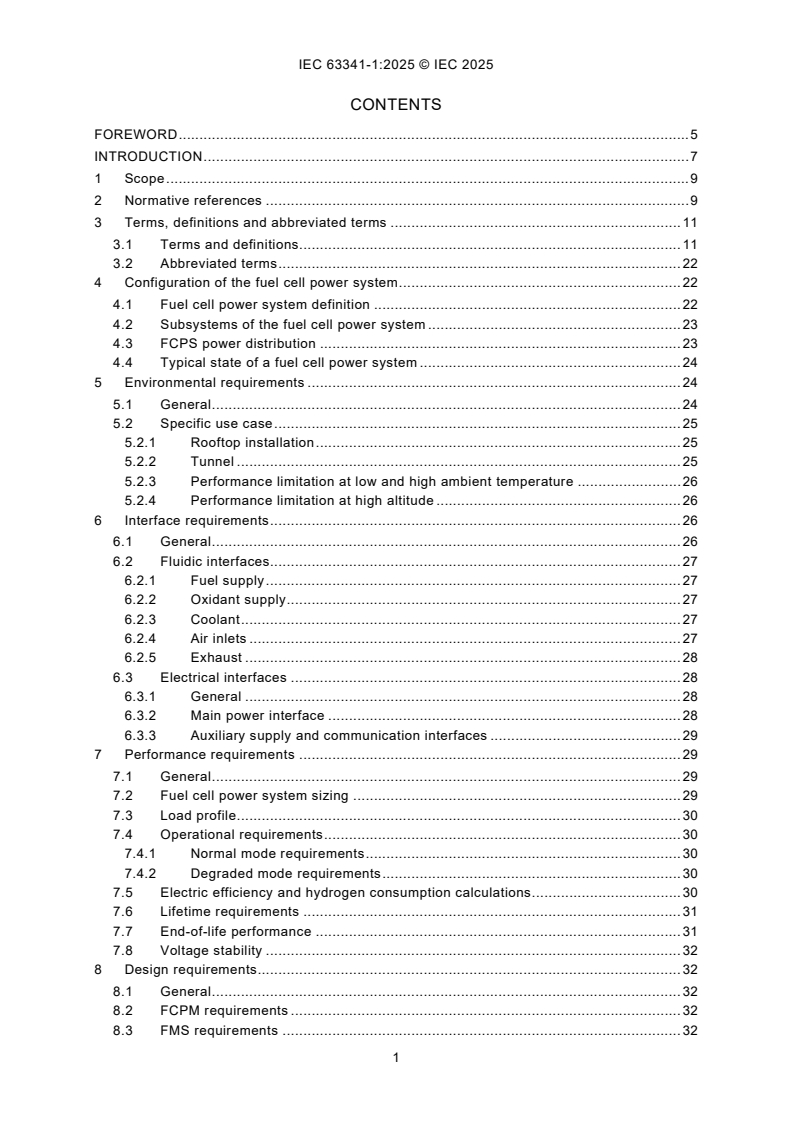
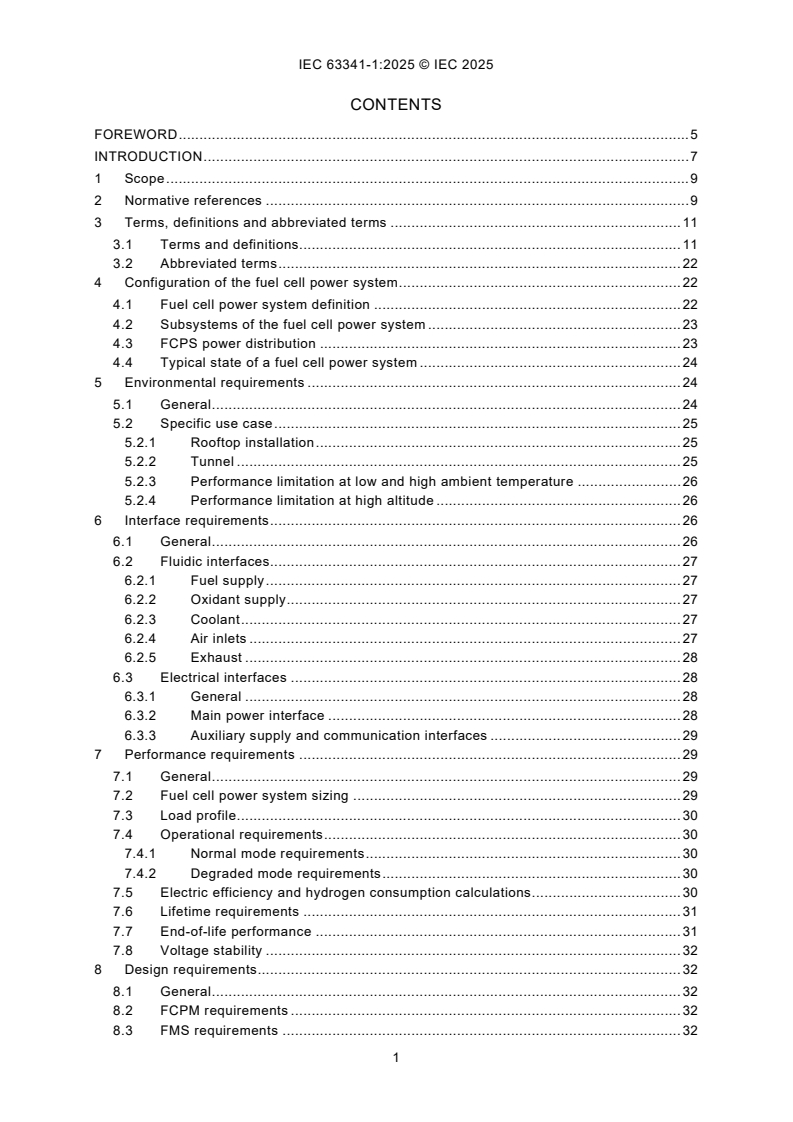
CONTENTS
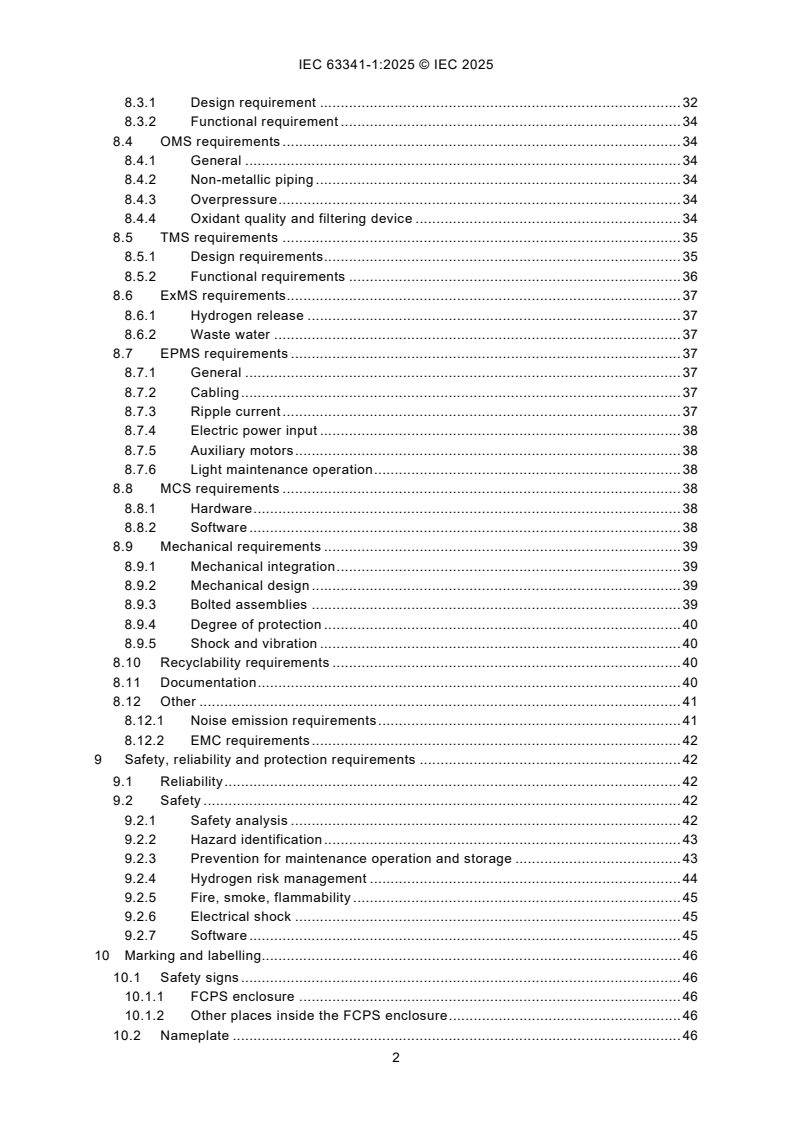
FOREWORD . 5
INTRODUCTION . 7
1 Scope . 9
2 Normative references . 9
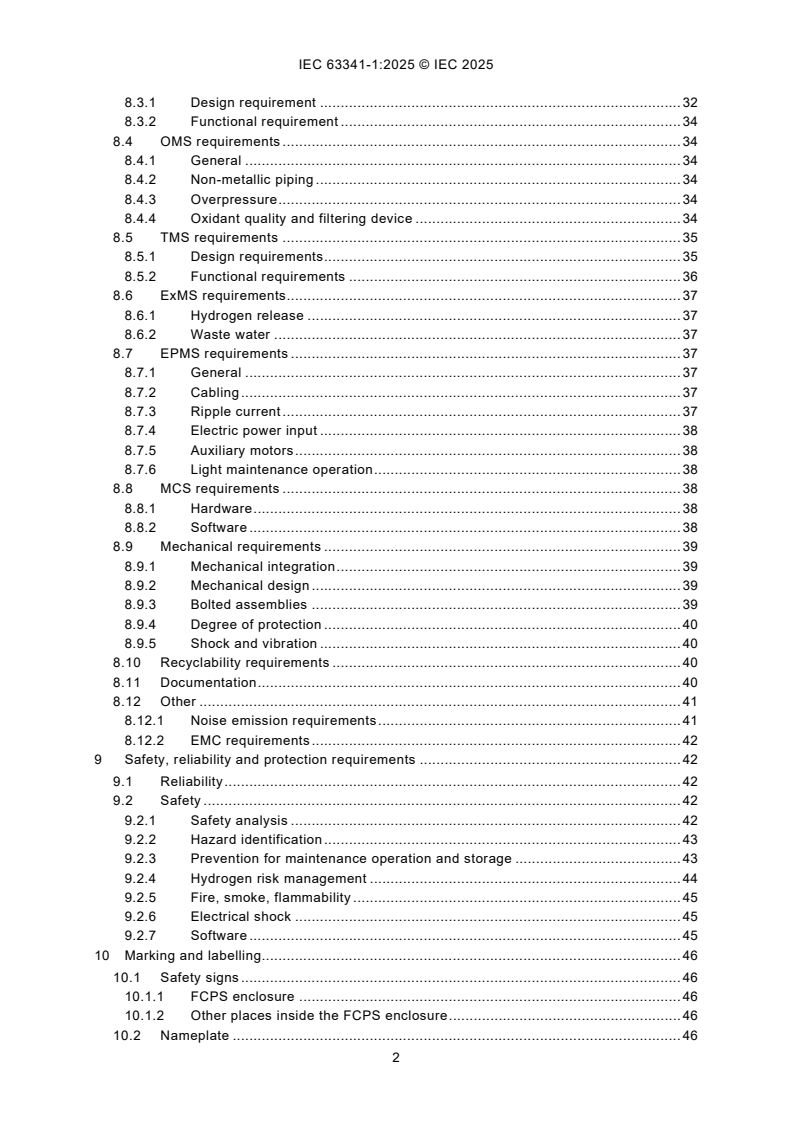
3 Terms, definitions and abbreviated terms . 11
3.1 Terms and definitions. 11
3.2 Abbreviated terms . 22
4 Configuration of the fuel cell power system . 22
4.1 Fuel cell power system definition . 22
4.2 Subsystems of the fuel cell power system . 23
4.3 FCPS power distribution . 23
4.4 Typical state of a fuel cell power system . 24
5 Environmental requirements . 24
5.1 General . 24
5.2 Specific use case . 25
5.2.1 Rooftop installation . 25
5.2.2 Tunnel . 25
5.2.3 Performance limitation at low and high ambient temperature . 26
5.2.4 Performance limitation at high altitude . 26
6 Interface requirements . 26
6.1 General . 26
6.2 Fluidic interfaces. 27
6.2.1 Fuel supply . 27
6.2.2 Oxidant supply . 27
6.2.3 Coolant . 27
6.2.4 Air inlets . 27
6.2.5 Exhaust . 28
6.3 Electrical interfaces . 28
6.3.1 General . 28
6.3.2 Main power interface . 28
6.3.3 Auxiliary supply and communication interfaces . 29
7 Performance requirements . 29
7.1 General . 29
7.2 Fuel cell power system sizing . 29
7.3 Load profile . 30
7.4 Operational requirements . 30
7.4.1 Normal mode requirements . 30
7.4.2 Degraded mode requirements . 30
7.5 Electric efficiency and hydrogen consumption calculations . 30
7.6 Lifetime requirements . 31
7.7 End-of-life performance . 31
7.8 Voltage stability . 32
8 Design requirements. 32
8.1 General . 32
8.2 FCPM requirements . 32
8.3 FMS requirements . 32
8.3.1 Design requirement . 32
8.3.2 Functional requirement . 34
8.4 OMS requirements . 34
8.4.1 General . 34
8.4.2 Non-metallic piping . 34
8.4.3 Overpressure . 34
8.4.4 Oxidant quality and filtering device . 34
8.5 TMS requirements . 35
8.5.1 Design requirements . 35
8.5.2 Functional requirements . 36
8.6 ExMS requirements . 37
8.6.1 Hydrogen release . 37
8.6.2 Waste water . 37
8.7 EPMS requirements . 37
8.7.1 General . 37
8.7.2 Cabling . 37
8.7.3 Ripple current . 37
8.7.4 Electric power input . 38
8.7.5 Auxiliary motors . 38
8.7.6 Light maintenance operation . 38
8.8 MCS requirements . 38
8.8.1 Hardware . 38
8.8.2 Software . 38
8.9 Mechanical requirements . 39
8.9.1 Mechanical integration . 39
8.9.2 Mechanical design . 39
8.9.3 Bolted assemblies . 39
8.9.4 Degree of protection . 40
8.9.5 Shock and vibration . 40
8.10 Recyclability requirements . 40
8.11 Documentation . 40
8.12 Other . 41
8.12.1 Noise emission requirements . 41
8.12.2 EMC requirements . 42
9 Safety, reliability and protection requirements . 42
9.1 Reliability . 42
9.2 Safety . 42
9.2.1 Safety analysis . 42
9.2.2 Hazard identification . 43
9.2.3 Prevention for maintenance operation and storage . 43
9.2.4 Hydrogen risk management . 44
9.2.5 Fire, smoke, flammability . 45
9.2.6 Electrical shock . 45
9.2.7 Software . 45
10 Marking and labelling. 46
10.1 Safety signs . 46
10.1.1 FCPS enclosure . 46
10.1.2 Other places inside the FCPS enclosure . 46
10.2 Nameplate . 46
10.2.1 FCPS enclosure . 46
10.2.2 Nameplates on sub-assemblies inside the box . 47
11 Installation and maintenance . 47
11.1 General . 47
11.2 Installation . 47
11.3 Maintenance . 47
11.3.1 General . 47
11.3.2 Maintenance accessibility . 47
11.3.3 Technical documentation . 47
12 FCPS storage and transportation conditions . 49
12.1 General . 49
12.2 Transportation . 49
12.3 Storage . 49
13 Testing . 49
13.1 General . 49
13.2 Parameter measurements . 49
13.3 Parameter measurement tolerances . 49
13.4 Reference conditions of tests . 50
13.4.1 Installation and operating conditions of the system . 50
13.4.2 Quality of hydrogen . 50
13.4.3 Quality of power input . 50
13.5 Type test. 50
13.5.1 General . 50
13.5.2 Visual checks . 50
13.5.3 Mass . 50
13.5.4 Communication network test . 50
13.5.5 Dielectric voltage strength test . 51
13.5.6 Insulation impedance (optional) . 51
13.5.7 Sub-equipment functional tests (optional) . 51
13.5.8 Operating test for stabilized operations . 51
13.5.9 Operating test for dynamic operations . 51
13.5.10 Polarization curve test . 51
13.5.11 Load profile test . 51
13.5.12 Hydrogen leakage test . 52
13.5.13 Ultimate strength pressure test . 52
13.5.14 Flammable concentration test . 52
13.5.15 Thermal rising test . 52
13.5.16 Endurance test (optional) . 52
13.5.17 Safety test in abnormal conditions . 53
13.5.18 Hydrogen emissions . 53
13.5.19 Environmental tests . 53
13.5.20 Acoustic noise emissions . 54
13.5.21 EMC test . 55
13.5.22 Type tests at component level (optional) . 55
13.6 Routine test . 55
13.6.1 Visual checks . 55
13.6.2 Communication network test . 55
13.6.3 Dielectric test . 55
13.6.4 Insulation impedance test (optional) . 55
13.6.5 Normal operation test . 55
13.6.6 Hydrogen leakage test . 56
13.6.7 Overpressure test . 56
Annex A (informative) Datasheet template . 57
Annex B (informative) Local laws, regulations and standards applicable . 60
B.1 Europe . 60
B.2 Japan . 61
B.3 China . 61
Bibliography . 62
Figure 1 – Hierarchy of standards related to IEC 63341 . 8
Figure 2 – Example of the main block diagrams for a fuel cell power system for railway
applications . 23
Figure 3 – FCPS power distribution . 24
Figure 4 – Typical state diagram for the FCPS . 24
Table A.1 – Datasheet template proposal. 57
INTERNATIONAL ELECTROTECHNICAL COMMISSION
____________
Railway applications -
Hydrogen and fuel cell systems for rolling stock -
Part 1: Fuel cell power system
FOREWORD
1) The International Electrotechnical Commission (IEC) is a worldwide organization for standardization comprising
all national electrotechnical committees (IEC National Committees). The object of IEC is to promote international
co-operation on all questions concerning standardization in the electrical and electronic fields. To this end and
in addition to other activities, IEC publishes International Standards, Technical Specifications, Technical Reports,
Publicly Available Specifications (PAS) and Guides (hereafter referred to as “IEC Publication(s)”). Their
preparation is entrusted to technical committees; any IEC National Committee interested in the subject dealt with
may participate in this preparatory work. International, governmental and non-governmental organizations liaising
with the IEC also participate in this preparation. IEC collaborates closely with the International Organization for
Standardization (ISO) in accordance with conditions determined by agreement between the two organizations.
2) The formal decisions or agreements of IEC on technical matters express, as nearly as possible, an international
consensus of opinion on the relevant subjects since each technical committee has representation from all
interested IEC National Committees.
3) IEC Publications have the form of recommendations for international use and are accepted by IEC National
Committees in that sense. While all reasonable efforts are made to ensure that the technical content of IEC
Publications is accurate, IEC cannot be held responsible for the way in which they are used or for any
misinterpretation by any end user.
4) In order to promote international uniformity, IEC National Committees undertake to apply IEC Publications
transparently to the maximum extent possible in their national and regional publications. Any divergence between
any IEC Publication and the corresponding national or regional publication shall be clearly indicated in the latter.
5) IEC itself does not provide any attestation of conformity. Independent certification bodies provide conformity
assessment services and, in some areas, access to IEC marks of conformity. IEC is not responsible for any
services carried out by independent certification bodies.
6) All users should ensure that they have the latest edition of this publication.
7) No liability shall attach to IEC or its directors, employees, servants or agents including individual experts and
members of its technical committees and IEC National Committees for any personal injury, property damage or
other damage of any nature whatsoever, whether direct or indirect, or for costs (including legal fees) and
expenses arising out of the publication, use of, or reliance upon, this IEC Publication or any other IEC
Publications.
8) Attention is drawn to the Normative references cited in this publication. Use of the referenced publications is
indispensable for the correct application of this publication.
9) IEC draws attention to the possibility that the implementation of this document may involve the use of (a)
patent(s). IEC takes no position concerning the evidence, validity or applicability of any claimed patent rights in
respect thereof. As of the date of publication of this document, IEC had not received notice of (a) patent(s), which
may be required to implement this document. However, implementers are cautioned that this may not represent
the latest information, which may be obtained from the patent database available at https://patents.iec.ch. IEC
shall not be held responsible for identifying any or all such patent rights.
IEC 63341-1 has been prepared by IEC technical committee 9: Electrical equipment and
systems for railways. It is an International Standard.
The text of this International Standard is based on the following documents:
Draft Report on voting
9/3212/FDIS 9/3254/RVD
Full information on the voting for its approval can be found in the report on voting indicated in
the above table.
The language used for the development of this International Standard is English.
This document was drafted in accordance with ISO/IEC Directives, Part 2, and developed in
accordance with ISO/IEC Directives, Part 1 and ISO/IEC Directives, IEC Supplement, available
at www.iec.ch/members_experts/refdocs. The main document types developed by IEC are
described in greater detail at www.iec.ch/publications.
A list of all parts in the IEC 63341 series, published under the general title Railway
applications – Hydrogen and fuel cell systems for rolling stock, can be found on the IEC website.
The committee has decided that the contents of this document will remain unchanged until the
stability date indicated on the IEC website under webstore.iec.ch in the data related to the
specific document. At this date, the document will be
– reconfirmed,
– withdrawn, or
– revised.
INTRODUCTION
This document considers general requirements for all fuel cell power systems installed onboard
rolling stock for railway applications.
IEC TC 105 is developing the IEC 62282 series, covering generic fuel cell technologies in
different industrial sectors:
– IEC 62282-2 series on fuel cell modules;
– IEC 62282-3 series on stationary fuel cell power systems;
– IEC 62282-4 series on fuel cell power systems for propulsion and auxiliary power units
These documents are often generic and do not cover the specific requirements for railway
applications.
Therefore, this document has been developed to specify the requirements for railway
applications.
This document is linked to IEC 63341-3, which specifies the performance test method to
validate the fuel cell power system performance.
This document with the other parts is used in conjunction with other related IEC standards for
auxiliary equipment used for railway rolling stock applications. In addition, IEC TC 9 has
developed the following standards for the subsystems, which are related or have interfaces to
the fuel cell power system:
• IEC 62864-1:2016, Railway applications - Rolling stock - Power supply with onboard energy
storage system - Part 1: Series hybrid system
• IEC 61287-1, Railway applications - Power converters installed on board rolling stock -
Part 1: Characteristics and test methods
• IEC 60349 (all parts), Electric traction - Rotating electrical machines for rail and road
vehicles
• IEC 62928, Railway applications - Rolling stock - Onboard lithium-ion traction batteries
IEC 62864-1:2016 specifies the general requirements for the onboard energy storage system
as a system level. The hierarchy of standards is shown in Figure 1. The list is not exhaustive.
Figure 1 – Hierarchy of standards related to IEC 63341
1 Scope
This part of IEC 63341 applies to fuel cell power systems installed onboard rolling stock for
railway applications (e.g. light rail vehicles, tramways, streetcars, metros, commuter trains,
regional trains, high speed trains, locomotives). Fuel cell power systems specified in this
document are used for the traction power and the auxiliary supply of railway vehicles such as
hybrid vehicles, and in case of use as an auxiliary onboard power source.
This document applies to the fuel cell technology called proton exchange membrane fuel cell
(PEMFC), with the use of hydrogen as fuel source and the use of air as oxidant source.
This document does not apply for hydrogen fuel system which is specified in IEC 63341-2, as
HFS is not within the scope of this document.
This document does not apply for power conversion equipment which is specified in
IEC 61287-1 and is not within the scope this document.
This document specifies:
– the scope of supply and the description of the interfaces (fluidic, electrical, thermal and
mechanical) of the fuel cell power system;
– the description of the environmental conditions;
– the specification and description of all the requirements to ensure the fuel cell power system
conformance with a railway application;
– the process to validate the fuel cell power system sizing required for a specific load profile;
– the safety, reliability and protection requirements to design the fuel cell power system for a
railway application;
– the marking and labelling requirements;
– the requirements related to storage, transportation, installation and maintenance;
– the tests (type, routine and investigation) required to validate the fuel cell power system.
2 Normative references
The following documents are referred to in the text in such a way that some or all of their content
constitutes requirements of this document. For dated references, only the edition cited applies.
For undated references, the latest edition of the referenced document (including any
amendments) applies.
IEC 60034-14, Rotating electrical machines - Part 14: Mechanical vibration of certain machines
with shaft heights 56 mm and higher - Measurement, evaluation and limits of vibration severity
IEC 60077-1, Railway applications - Electric equipment for rolling stock - Part 1: General service
conditions and general rules
IEC 60529, Degrees of protection provided by enclosures (IP Code)
___________
1 PEM fuel cells are typically limited to less than 120 °C due to stability of the membrane and evaporation of water.
More practically, they are limited to 85 °C to 90 °C in high or peak temperature application to limit the
electrochemical degradations and preserve their lifetime.
Because of the thin membrane, and low resistance losses, PEM fuel cells tend to deliver high power density and
offer the advantages of low mass and volume, compared to other fuel cell types. The low temperature operation
also allows them to start quickly (less warm-up time) and to start from freeze condition, which makes them
particularly well suited for transportation applications.
IEC 60571, Railway applications - Electronic equipment used on rolling stock
IEC 60617, Graphical symbols for diagrams, available at http://std.iec.ch/iec60617
IEC 61373, Railway applications - Rolling stock equipment - Shock and vibration tests
IEC 61709, Electric components - Reliability - Reference conditions of failure rates and stress
models for conversion
IEC 61991, Railway applications - Rolling stock - Protective provisions against electrical
hazards
IEC 62236-3-2, Railway applications - Electromagnetic compatibility - Part 3-2: Rolling stock -
Apparatus
IEC 62282-2-100:2020, Fuel cell technologies - Part 2-100: Fuel cell modules - Safety
IEC 62282-3-100:2019, Fuel cell technologies - Part 3-100: Stationary fuel cell power systems
- Safety
IEC 62282-4-101:2022, Fuel cell technologies - Part 4-101: Fuel cell power systems for
electrically powered industrial trucks - Safety
IEC 62497-1, Railway applications - Insulation coordination - Part 1: Basic requirements -
Clearances and creepage distances for all electrical and electronic equipment
IEC 62498-1:2010, Railway applications - Environmental conditions for equipment - Part 1:
Equipment on board rolling stock
IEC 62635, Guidelines for end-of-life information provided by manufacturers and recyclers and
for recyclability rate calculation of electrical and electronic equipment
IEC 63341-3:2025, Railway applications - Hydrogen and fuel cell systems for rolling stock -
Part 3: Performance test methods for fuel cell power system
IEC 61375-1, Electronic railway equipment - Train communication network (TCN) - Part 1:
General architecture
ISO 3744, Acoustics - Determination of sound power levels and sound energy levels of noise
sources using sound pressure - Engineering methods for an essentially free field over a
reflecting plane
ISO 3746, Acoustics - Determination of sound power levels and sound energy levels of noise
sources using sound pressure - Survey method using an enveloping measurement surface over
a reflecting plane
ISO 7010, Graphical symbols - Safety colours and safety signs - Registered safety signs,
available at https://www.iso.org/obp
ISO 9227, Corrosion tests in artificial atmospheres - Salt spray tests
ISO 14687, Hydrogen fuel quality - Product specification
ISO 21106, Railway applications - Recyclability and recoverability calculation method for rolling
stock
ISO 23828, Fuel cell road vehicles - Energy consumption measurement - Vehicles fuelled with
compressed hydrogen
3 Terms, definitions and abbreviated terms
For the purposes of this document, the following terms and definitions apply.
ISO and IEC maintain terminology databases for use in standardization at the following
addresses:
– IEC Electropedia: available at https://www.electropedia.org/
– ISO Online browsing platform: available at https://www.iso.org/obp
3.1 Terms and definitions
3.1.1
fuel cell power system
FCPS
generator system that uses one or more fuel cell power modules to generate electric power and
heat
Note 1 to entry: The fuel cell power system typically includes the following subsystems: fuel cell power module,
oxidant management system, fuel management system, thermal management system, exhaust management system,
electrical and power management system, and their monitoring and control system.
[SOURCE: IEC 60050-485:2020, 485-09-01, modified – In the definition, "fuel cell modules" has
been replaced with "fuel cell power modules". Note 1 to entry has been added.]
3.1.2
fuel cell stack
FCS
equipment assembly of two or more cells, separators, cooling plates, manifolds and a support
structure that electrochemically converts, typically, hydrogen rich gas and air reactants to
electric power, heat and other reactant bi-products
[SOURCE: IEC 60050-485:2020, 485-06-01, modified – In the definition, "equipment", "two or
more", and "bi-" have been added, "supporting" has been replaced with "support", "hydrogen-
rich" has been replaced with "hydrogen rich", "DC" has been replaced with "electric", and
"reaction" has been replaced with "reactant".]
3.1.3
fuel cell
FC
electrochemical device that converts the chemical energy of a fuel and
an oxidant to electrical energy (DC power), heat and reaction products
Note 1 to entry: The fuel and oxidant are typically stored outside of the fuel cell and transferred into the fuel cell as
they are consumed.
[SOURCE: IEC 60050-485:2020, 485-08-01, modified – In the definition, "electric" has been
replaced with "electrical".]
3.1.4
fuel cell power module
fuel cell module
FCPM
assembly incorporating one or more fuel cell stacks and other main and, if applicable, additional
components, which is intended to be integrated into a power system
Note 1 to entry: A fuel cell power module can contain the following equipment: its control system and optionally,
the cell voltage monitoring device, the fuel recirculation device, the humidification device for reactants, sensors,
valves and actuators. This subsystem is a part of the fuel cell power system.
[SOURCE: IEC 60050-485:2020, 485-09-03, modified – "fuel cell power module" has been
added as the first preferred term. In the definition, "other main and" has been added, "that" has
been replaced with "which", and "or a vehicle" has been deleted. Note 1 to entry has been
modified.]
3.1.5
oxidant management system
OMS
system including filtering and pressurizing equipment (and optionally humidifying equipment),
sensors and valves, able to manage the incoming oxidant to supply the fuel cell power
module (3.1.4) or fuel cell stack
Note 1 to entry: The oxidant management system is a part of the fuel cell power system.
Note 2 to entry: Air from the environment is one example of incoming oxidant.
3.1.6
fuel management system
FMS
system including filtering and de-pressurizing equipment, sensor and valve able to manage the
incoming fuel from the hydrogen fuel system to supply the fuel cell power module or fuel cell
stack
Note 1 to entry: The fuel management system is a part of the fuel cell power system.
3.1.7
thermal management system
TMS
thermal loop including pump, heat exchanger, fan, heater, sensors and valves, and optionally
ion removal device, able to manage the temperature of the fuel cell power system and coolant
for cooling purpose and heating purpose
Note 1 to entry: The thermal management system is a part of the fuel cell power system.
3.1.8
exhaust management system
ExMS
fluidic circuit able to manage the gas exhaust from the fuel cell power system to the environment
Note 1 to entry: The exhaust management system is a part of the fuel cell power system.
3.1.9
electrical and power management system
EPMS
electrical distribution able to supply power for the auxiliary equipment within the fuel cell power
system and to deliver the power to the power converter
Note 1 to entry: The electrical and power management system is a part of the fuel cell power system
3.1.10
monitoring and control system
MCS
system including the monitoring device, the control and communication units to manage the
different subsystems of the fuel cell power system (3.1.1) and to communicate with the external
systems and vehicle control
Note 1 to entry: The different subsystems of the fuel cell power system are fuel management system, oxidant
management system, fuel cell power module, thermal management system, electrical and power management
system, exhaust management system.
Note 2 to entry: The monitoring and control system is a part of the fuel cell power system.
3.1.11
hydrogen fuel system
HFS
system designed to store hydrogen and to process it to supply the fuel cell power system
Note 1 to entry: It includes compressed hydrogen storage system (3.1.68), on-board fuelling devices, fuel and purge
and discharge lines, pressure regulator, monitoring and control and safety devices.
3.1.12
energy storage unit
ESU
physical equipment which is comprised of energy storage technologies such as batteries,
capacitors, flywheel, etc.
[SOURCE: IEC 62864-1:2016, 3.1.20, modified – In the definition, "EDLC" has been replaced
with "capacitors".]
3.1.13
energy storage system
ESS
physical equipment which consists of one or more energy storage units (3.1.12) and the other
equipment required to connect to the DC link such as converters, control and monitoring
systems, inductors, protection devices, cooling systems
[SOURCE: IEC 62864-1:2016, 3.1.22, modified – In the definition, “physical system” has been
replaced with “physical equipment”.]
3.1.14
power converter
electronic power converter
operative unit for electronic power conversion, comprising one or more electronic valve devices,
transformers and filters if necessary and auxiliaries if any
Note 1 to entry: A power converter can be a DC/DC converter (insulated type) or a chopper (non-insulated type).
[SOURCE: IEC 60050-551:1998, 551-12-01, modified – “power converter” has been added as
first preferred term and “electronic power converter” as second preferred term. Note 1 to entry
has been modified.]
3.1.15
hybrid vehicle
vehicle that can store energy in an onboard energy storage system (3.1.13) and is driven by
using the stored energy as well as electric power from a generator, overhead lines or third rail
[SOURCE: IEC 62864-1:2016, 3.1.4, modified – In the definition, "or third rail" has been added.]
3.1.16
purge
gas purge
protective operation to remove gases or liquids, such as hydrogen, air or water,
from a fuel cell power system
[SOURCE: IEC 60050-485:2020, 485-09-10, modified – In the definition, "fuel," has been
deleted and "or liquids, or both" has been replaced with "or liquids".
3.1.17
continuous grade of release
release which is continuous or is expected to occur frequently or for long periods
Note 1 to entry: Both "frequently" and "long" are the terms which are intended to describe a very high likelihood of
a potential release. In that respect, these terms are not necessarily quantified.
[SOURCE: IEC 60050-426:2020, 426-03-10, modified – Note 1 to entry has been added.]
3.1.18
secondary grade of release
release which is not expected to occur in normal operation and, if it does occur, is likely to do
so only infrequently and for short periods
[SOURCE: IEC 60050-426:2020, 426-03-12]
3.1.19
explosive atmosphere
mixture with air, under atmospheric conditions, of flammable substances in the form of gas or
vapour, which, after ignition, permits self-sustaining flame propagation
[SOURCE: IEC 60050-426:2020, 426-01-06, modified – In the definition, “gas, vapour, or dust”
has been replaced with “gas or vapour” and “flame” has been deleted.]
3.1.20
pressure relief device
PRD
pressure activated device used to prevent the pressure from rising above a predetermined
maximum and thereby prevent failure of a pressurized part or system
[SOURCE: IEC 62282-4-101:2022, 3.18, modified – In the definition, "and/or temperature" has
been deleted.]
3.1.21
end of life
EOL
point at which the fuel cell power system cannot fulfil the required
functionality or operational pattern as initially agreed among the user and the manufacturers
EXAMPLE Point at which the fuel cell stack voltage drops below the specified minimum value, or at which the H
consumption increases above the specified maximum value.
[SOURCE: IEC 62864-1:2016, 3.1.15, modified – In the definition, "ESU" has been replaced
with "fuel cell power system". The example has been added.]
-------------
...
IEC 63341-1 ®
Edition 1.0 2025-10
NORME
INTERNATIONALE
Applications ferroviaires - Systèmes à hydrogène et à pile à combustible pour le
matériel roulant -
Partie 1: Système à pile à combustible
ICS 45.060.01; 27.070 ISBN 978-2-8327-0719-7
Droits de reproduction réservés. Sauf indication contraire, aucune partie de cette publication ne peut être reproduite ni
utilisée sous quelque forme que ce soit et par aucun procédé, électronique ou mécanique, y compris la photocopie et
les microfilms, sans l'accord écrit de l'IEC ou du Comité national de l'IEC du pays du demandeur. Si vous avez des
questions sur le copyright de l'IEC ou si vous désirez obtenir des droits supplémentaires sur cette publication, utilisez
les coordonnées ci-après ou contactez le Comité national de l'IEC de votre pays de résidence.
IEC Secretariat Tel.: +41 22 919 02 11
3, rue de Varembé info@iec.ch
CH-1211 Geneva 20 www.iec.ch
Switzerland
A propos de l'IEC
La Commission Electrotechnique Internationale (IEC) est la première organisation mondiale qui élabore et publie des
Normes internationales pour tout ce qui a trait à l'électricité, à l'électronique et aux technologies apparentées.
A propos des publications IEC
Le contenu technique des publications IEC est constamment revu. Veuillez vous assurer que vous possédez l’édition la
plus récente, un corrigendum ou amendement peut avoir été publié.
Recherche de publications IEC - IEC Products & Services Portal - products.iec.ch
webstore.iec.ch/advsearchform Découvrez notre puissant moteur de recherche et consultez
La recherche avancée permet de trouver des publications gratuitement tous les aperçus des publications, symboles
IEC en utilisant différents critères (numéro de référence, graphiques et le glossaire. Avec un abonnement, vous aurez
texte, comité d’études, …). Elle donne aussi des toujours accès à un contenu à jour adapté à vos besoins.
informations sur les projets et les publications remplacées
ou retirées. Electropedia - www.electropedia.org
Le premier dictionnaire d'électrotechnologie en ligne au
IEC Just Published - webstore.iec.ch/justpublished monde, avec plus de 22 500 articles terminologiques en
Restez informé sur les nouvelles publications IEC. Just anglais et en français, ainsi que les termes équivalents
dans 25 langues additionnelles. Egalement appelé
Published détaille les nouvelles publications parues.
Disponible en ligne et une fois par mois par email. Vocabulaire Electrotechnique International (IEV) en ligne.
Service Clients - webstore.iec.ch/csc
Si vous désirez nous donner des commentaires sur cette
publication ou si vous avez des questions contactez-
nous: sales@iec.ch.
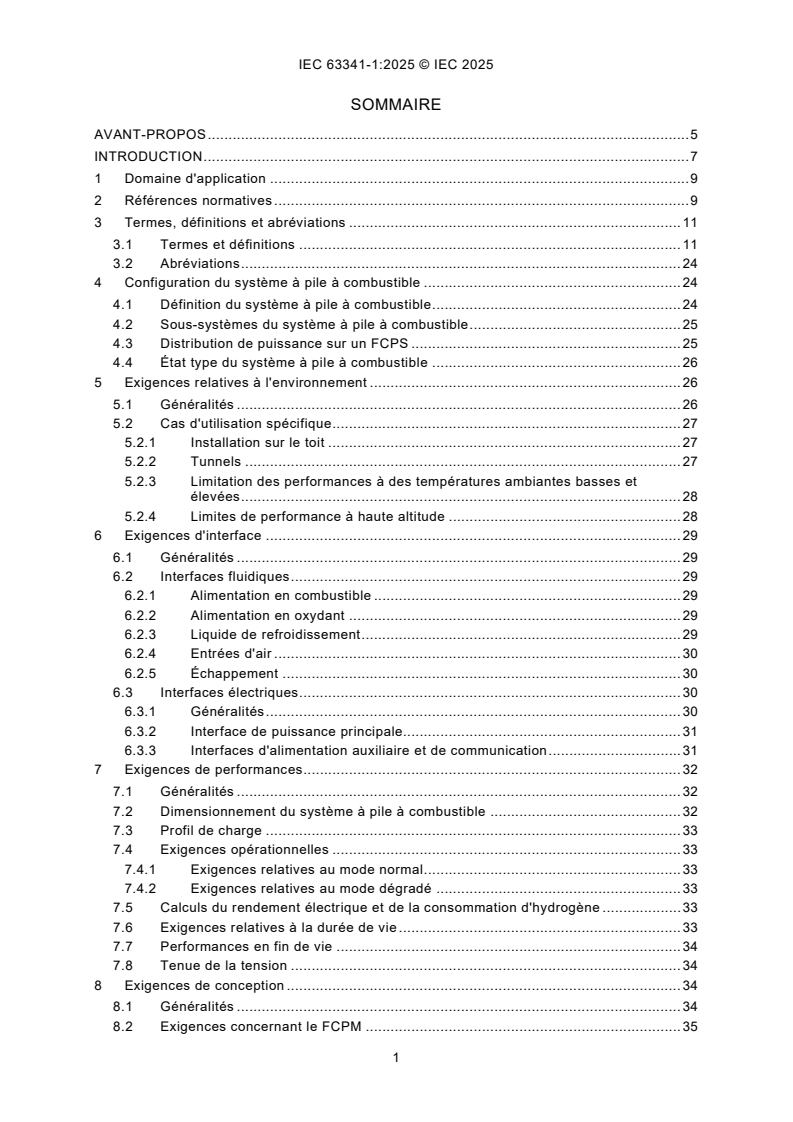
SOMMAIRE
AVANT-PROPOS . 5
INTRODUCTION . 7
1 Domaine d'application . 9
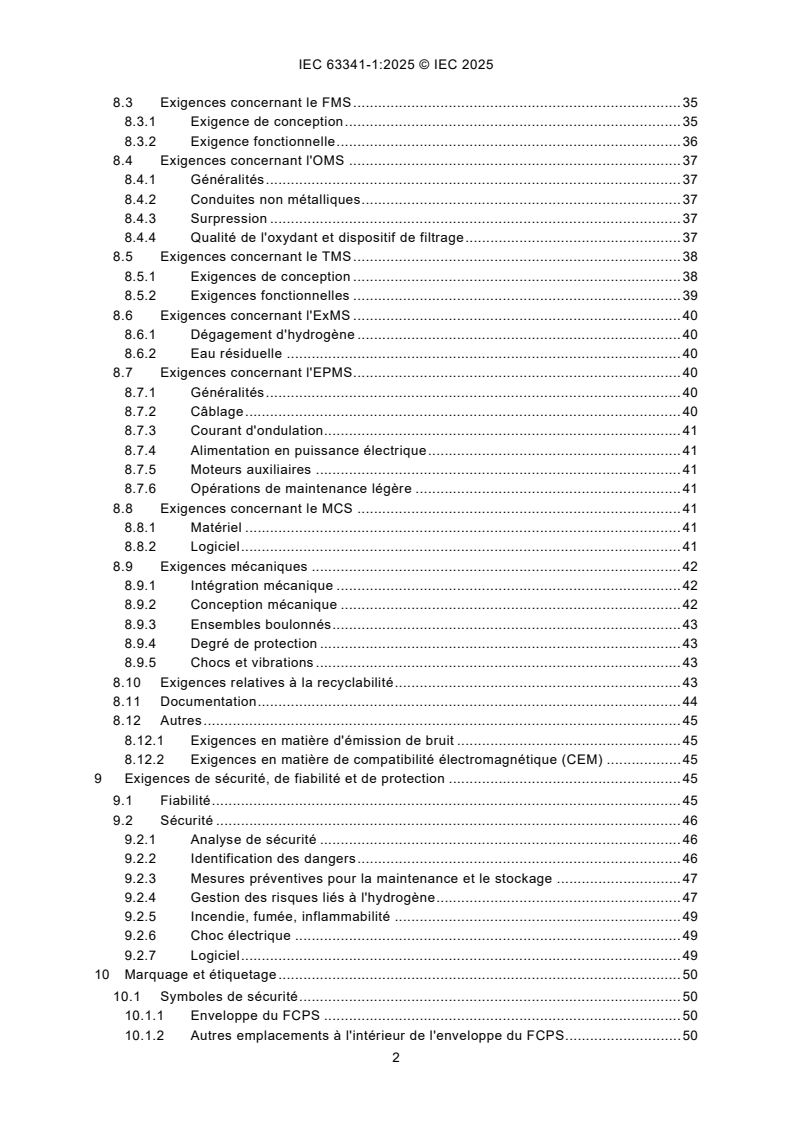
2 Références normatives . 9
3 Termes, définitions et abréviations . 11
3.1 Termes et définitions . 11
3.2 Abréviations . 24
4 Configuration du système à pile à combustible . 24
4.1 Définition du système à pile à combustible . 24
4.2 Sous-systèmes du système à pile à combustible . 25
4.3 Distribution de puissance sur un FCPS . 25
4.4 État type du système à pile à combustible . 26
5 Exigences relatives à l'environnement . 26
5.1 Généralités . 26
5.2 Cas d'utilisation spécifique . 27
5.2.1 Installation sur le toit . 27
5.2.2 Tunnels . 27
5.2.3 Limitation des performances à des températures ambiantes basses et
élevées . 28
5.2.4 Limites de performance à haute altitude . 28
6 Exigences d'interface . 29
6.1 Généralités . 29
6.2 Interfaces fluidiques . 29
6.2.1 Alimentation en combustible . 29
6.2.2 Alimentation en oxydant . 29
6.2.3 Liquide de refroidissement . 29
6.2.4 Entrées d'air . 30
6.2.5 Échappement . 30
6.3 Interfaces électriques . 30
6.3.1 Généralités . 30
6.3.2 Interface de puissance principale. 31
6.3.3 Interfaces d'alimentation auxiliaire et de communication . 31
7 Exigences de performances . 32
7.1 Généralités . 32
7.2 Dimensionnement du système à pile à combustible . 32
7.3 Profil de charge . 33
7.4 Exigences opérationnelles . 33
7.4.1 Exigences relatives au mode normal . 33
7.4.2 Exigences relatives au mode dégradé . 33
7.5 Calculs du rendement électrique et de la consommation d'hydrogène . 33
7.6 Exigences relatives à la durée de vie . 33
7.7 Performances en fin de vie . 34
7.8 Tenue de la tension . 34
8 Exigences de conception . 34
8.1 Généralités . 34
8.2 Exigences concernant le FCPM . 35
8.3 Exigences concernant le FMS . 35
8.3.1 Exigence de conception . 35
8.3.2 Exigence fonctionnelle . 36
8.4 Exigences concernant l'OMS . 37
8.4.1 Généralités . 37
8.4.2 Conduites non métalliques . 37
8.4.3 Surpression . 37
8.4.4 Qualité de l'oxydant et dispositif de filtrage . 37
8.5 Exigences concernant le TMS . 38
8.5.1 Exigences de conception . 38
8.5.2 Exigences fonctionnelles . 39
8.6 Exigences concernant l'ExMS . 40
8.6.1 Dégagement d'hydrogène . 40
8.6.2 Eau résiduelle . 40
8.7 Exigences concernant l'EPMS . 40
8.7.1 Généralités . 40
8.7.2 Câblage . 40
8.7.3 Courant d'ondulation . 41
8.7.4 Alimentation en puissance électrique . 41
8.7.5 Moteurs auxiliaires . 41
8.7.6 Opérations de maintenance légère . 41
8.8 Exigences concernant le MCS . 41
8.8.1 Matériel . 41
8.8.2 Logiciel . 41
8.9 Exigences mécaniques . 42
8.9.1 Intégration mécanique . 42
8.9.2 Conception mécanique . 42
8.9.3 Ensembles boulonnés . 43
8.9.4 Degré de protection . 43
8.9.5 Chocs et vibrations . 43
8.10 Exigences relatives à la recyclabilité . 43
8.11 Documentation . 44
8.12 Autres . 45
8.12.1 Exigences en matière d'émission de bruit . 45
8.12.2 Exigences en matière de compatibilité électromagnétique (CEM) . 45
9 Exigences de sécurité, de fiabilité et de protection . 45
9.1 Fiabilité . 45
9.2 Sécurité . 46
9.2.1 Analyse de sécurité . 46
9.2.2 Identification des dangers . 46
9.2.3 Mesures préventives pour la maintenance et le stockage . 47
9.2.4 Gestion des risques liés à l'hydrogène . 47
9.2.5 Incendie, fumée, inflammabilité . 49
9.2.6 Choc électrique . 49
9.2.7 Logiciel . 49
10 Marquage et étiquetage . 50
10.1 Symboles de sécurité . 50
10.1.1 Enveloppe du FCPS . 50
10.1.2 Autres emplacements à l'intérieur de l'enveloppe du FCPS . 50
10.2 Plaque signalétique . 50
10.2.1 Enveloppe du FCPS . 50
10.2.2 Plaques signalétiques sur les sous-ensembles à l'intérieur de la caisse
de groupement . 51
11 Installation et maintenance . 51
11.1 Généralités . 51
11.2 Installation . 51
11.3 Maintenance . 51
11.3.1 Généralités . 51
11.3.2 Accessibilité pour les opérations de maintenance . 51
11.3.3 Documentation technique . 51
12 Conditions de stockage et de transport du FCPS . 53
12.1 Généralités . 53
12.2 Transport . 53
12.3 Stockage . 53
13 Essai . 53
13.1 Généralités . 53
13.2 Mesurages des paramètres . 54
13.3 Tolérances de mesure relatives aux paramètres . 54
13.4 Conditions de référence des essais . 54
13.4.1 Conditions d'installation et de fonctionnement du système . 54
13.4.2 Qualité de l'hydrogène . 54
13.4.3 Qualité de l'alimentation de puissance . 54
13.5 Essai de type . 54
13.5.1 Généralités . 54
13.5.2 Vérifications visuelles . 54
13.5.3 Masse. 55
13.5.4 Essai du réseau de communication . 55
13.5.5 Essai de résistance à la tension diélectrique . 55
13.5.6 Impédance d'isolement (facultative) . 55
13.5.7 Essais fonctionnels des sous-équipements (facultatifs). 55
13.5.8 Essai de fonctionnement pour les opérations stabilisées . 55
13.5.9 Essai de fonctionnement pour les opérations dynamiques . 56
13.5.10 Essai de courbe de polarisation . 56
13.5.11 Essai de profil de charge . 56
13.5.12 Essai de fuite d'hydrogène . 56
13.5.13 Essai de pression de résistance maximale . 56
13.5.14 Essai de concentration de gaz inflammable . 56
13.5.15 Essai d'échauffement . 57
13.5.16 Essai d'endurance (facultatif). 57
13.5.17 Essai de sécurité dans des conditions anormales . 57
13.5.18 Émissions d'hydrogène . 57
13.5.19 Essais d'environnement . 57
13.5.20 Émissions de bruit acoustique . 59
13.5.21 Essai CEM . 59
13.5.22 Essais de type au niveau des composants (facultatifs) . 59
13.6 Essai individuel de série . 59
13.6.1 Vérifications visuelles . 59
13.6.2 Essai du réseau de communication . 59
13.6.3 Essai diélectrique . 59
13.6.4 Essai d'impédance d'isolement (facultatif) . 59
13.6.5 Essai en fonctionnement normal . 60
13.6.6 Essai de fuite d'hydrogène . 60
13.6.7 Essai de surpression . 60
Annexe A (informative) Modèle de fiche technique . 61
Annexe B (informative) Lois, réglementations et normes locales applicables . 65
B.1 Europe . 65
B.2 Japon . 66
B.3 Chine . 66
Bibliographie . 67
Figure 1 – Hiérarchie des normes associées à l’IEC 63341 . 8
Figure 2 – Exemple des principaux diagrammes de blocs d'un système à pile à
combustible destiné aux applications ferroviaires . 25
Figure 3 – Distribution de puissance sur un FCPS . 26
Figure 4 – Diagramme d'états type du FCPS . 26
Tableau A.1 – Proposition de modèle de fiche technique . 61
COMMISSION ÉLECTROTECHNIQUE INTERNATIONALE
____________
Applications ferroviaires -
Systèmes à hydrogène et à pile à combustible pour le matériel roulant -
Partie 1: Système à pile à combustible
AVANT-PROPOS
1) La Commission Électrotechnique Internationale (IEC) est une organisation mondiale de normalisation composée
de l'ensemble des comités électrotechniques nationaux (Comités nationaux de l’IEC). L’IEC a pour objet de
favoriser la coopération internationale pour toutes les questions de normalisation dans les domaines de
l'électricité et de l'électronique. A cet effet, l’IEC – entre autres activités – publie des Normes internationales,
des Spécifications techniques, des Rapports techniques, des Spécifications accessibles au public (PAS) et des
Guides (ci-après dénommés «Publication(s) de l’IEC»). Leur élaboration est confiée à des comités d'études, aux
travaux desquels tout Comité national intéressé par le sujet traité peut participer. Les organisations
internationales, gouvernementales et non gouvernementales, en liaison avec l’IEC, participent également aux
travaux. L’IEC collabore étroitement avec l'Organisation Internationale de Normalisation (ISO), selon des
conditions fixées par accord entre les deux organisations.
2) Les décisions ou accords officiels de l’IEC concernant les questions techniques représentent, dans la mesure du
possible, un accord international sur les sujets étudiés, étant donné que les Comités nationaux de l’IEC intéressés
sont représentés dans chaque comité d’études.
3) Les Publications de l’IEC se présentent sous la forme de recommandations internationales et sont agréées
comme telles par les Comités nationaux de l’IEC. Tous les efforts raisonnables sont entrepris afin que l’IEC
s'assure de l'exactitude du contenu technique de ses publications; l’IEC ne peut pas être tenue responsable de
l'éventuelle mauvaise utilisation ou interprétation qui en est faite par un quelconque utilisateur final.
4) Dans le but d'encourager l'uniformité internationale, les Comités nationaux de l’IEC s'engagent, dans toute la
mesure possible, à appliquer de façon transparente les Publications de l’IEC dans leurs publications nationales
et régionales. Toutes divergences entre toutes Publications de l’IEC et toutes publications nationales ou
régionales correspondantes doivent être indiquées en termes clairs dans ces dernières.
5) L’IEC elle-même ne fournit aucune attestation de conformité. Des organismes de certification indépendants
fournissent des services d'évaluation de conformité et, dans certains secteurs, accèdent aux marques de
conformité de l’IEC. L’IEC n'est responsable d'aucun des services effectués par les organismes de certification
indépendants.
6) Tous les utilisateurs doivent s'assurer qu'ils sont en possession de la dernière édition de cette publication.
7) Aucune responsabilité ne doit être imputée à l’IEC, à ses administrateurs, employés, auxiliaires ou mandataires,
y compris ses experts particuliers et les membres de ses comités d'études et des Comités nationaux de l’IEC,
pour tout préjudice causé en cas de dommages corporels et matériels, ou de tout autre dommage de quelque
nature que ce soit, directe ou indirecte, ou pour supporter les coûts (y compris les frais de justice) et les dépenses
découlant de la publication ou de l'utilisation de cette Publication de l’IEC ou de toute autre Publication de l’IEC,
ou au crédit qui lui est accordé.
8) L'attention est attirée sur les références normatives citées dans cette publication. L'utilisation de publications
référencées est obligatoire pour une application correcte de la présente publication.
9) L’IEC attire l’attention sur le fait que la mise en application du présent document peut entraîner l’utilisation d’un
ou de plusieurs brevets. L’IEC ne prend pas position quant à la preuve, à la validité et à l’applicabilité de tout
droit de brevet revendiqué à cet égard. À la date de publication du présent document, l’IEC n'avait pas reçu
notification qu’un ou plusieurs brevets pouvaient être nécessaires à sa mise en application. Toutefois, il y a lieu
d’avertir les responsables de la mise en application du présent document que des informations plus récentes
sont susceptibles de figurer dans la base de données de brevets, disponible à l'adresse https://patents.iec.ch.
L'IEC ne saurait être tenue pour responsable de ne pas avoir identifié de tels droits de propriété et averti de leur
existence.
L’IEC 63341-1 a été établie par le comité d'études 9 de l'IEC: Matériels et systèmes électriques
ferroviaires. Il s’agit d’une Norme internationale.
Le texte de cette Norme internationale est issu des documents suivants:
Projet Rapport de vote
9/3212/FDIS 9/3254/RVD
Le rapport de vote indiqué dans le tableau ci-dessus donne toute information sur le vote ayant
abouti à l'approbation de cette norme.
La langue employée pour l'élaboration de cette Norme internationale est l'anglais.
Cette publication a été rédigée selon les Directives ISO/IEC, Partie 2, et élaborée selon les
Directives ISO/IEC, Partie 1 et les Directives ISO/IEC, Supplément IEC, disponibles à l'adresse
suivante: www.iec.ch/members_experts/refdocs. Les principaux types de documents élaborés
par l'IEC sont décrits plus en détail sur le site internet: www.iec.ch/publications.
Une liste de toutes les parties de la série IEC 63341, publiées sous le titre général Applications
ferroviaires - Systèmes à hydrogène et à pile à combustible pour matériel roulant, se trouve sur
le site web de l'IEC.
Le comité a décidé que le contenu de cette publication ne sera pas modifié avant la date de
stabilité indiquée sur le site web de l'IEC sous webstore.iec.ch dans les données relatives au
document recherché. A cette date, la publication sera
– reconduite,
– supprimée, ou
– révisée.
INTRODUCTION
Le présent document tient compte des exigences générales applicables à l'ensemble des
systèmes à pile à combustible installés à bord du matériel roulant destiné aux applications
ferroviaires.
Le comité d'études IEC TC 105 développe la série IEC 62282, qui couvre les technologies
génériques des piles à combustible dans différents secteurs industriels:
– la série IEC 62282-2 sur les modules à piles à combustible;
– la série IEC 62282-3 sur les systèmes à piles à combustible stationnaires;
– la série IEC 62282-4 sur les systèmes à piles à combustible pour les groupes auxiliaires de
puissance et de propulsion
Ces documents sont souvent génériques et ne couvrent pas les exigences spécifiques aux
applications ferroviaires.
Le présent document a ainsi été élaboré dans le but de spécifier les exigences relatives aux
applications ferroviaires.
Le présent document est lié à l’IEC 63341-3, qui spécifie la méthode d'essai de performance
pour valider la performance du système à pile à combustible.
Le présent document, ainsi que les autres parties de la série, sont à utiliser conjointement avec
les autres normes applicables de l'IEC couvrant les équipements auxiliaires destinés aux
applications ferroviaires pour le matériel roulant. En outre, le comité d'études IEC TC 9 a
élaboré les normes suivantes pour les sous-systèmes qui sont associés au système à pile à
combustible ou qui ont des interfaces avec celui-ci:
• IEC 62864-1:2016, Applications ferroviaires - Matériel roulant - Alimentation équipée d'un
système embarqué de stockage de l'énergie - Partie 1: Système hybride série
• IEC 61287-1, Applications ferroviaires - Convertisseurs de puissance embarqués sur le
matériel roulant - Partie 1: Caractéristiques et méthodes d'essai
• IEC 60349 (toutes les parties), Traction électrique - Machines électriques tournantes des
véhicules ferroviaires et routiers
• IEC 62928, Applications ferroviaires - Matériel roulant - Batteries d'accumulateurs de
traction embarquées au lithium-ion
L'IEC 62864-1:2016 spécifie les exigences générales relatives au système embarqué de
stockage de l'énergie au niveau du système. La Figure 1 montre la hiérarchie des normes. Cette
liste n'est pas exhaustive.
Figure 1 – Hiérarchie des normes associées à l’IEC 63341
1 Domaine d'application
La présente partie de l’IEC 63341 s'applique aux systèmes à pile à combustible installés à bord
du matériel roulant destiné aux applications ferroviaires (par exemple, véhicules ferroviaires
légers, tramways, métros, trains de banlieue, trains régionaux, trains à grande vitesse,
locomotives, etc.). Les systèmes à pile à combustible spécifiés dans le présent document sont
utilisés pour assurer la puissance de traction et l'alimentation auxiliaire des véhicules
ferroviaires tels que les véhicules hybrides, ou bien comme source d'alimentation auxiliaire à
bord.
Le présent document s'applique à la technologie de piles à combustible à membrane à échange
de protons (PEMFC) qui utilise l'hydrogène comme combustible et l'air comme oxydant.
Le présent document ne s'applique pas au système à hydrogène spécifié dans l'IEC 63341-2,
car le HFS ne fait pas partie du domaine d'application du présent document.
Le présent document ne s'applique pas au matériel de conversion de puissance qui est spécifié
dans l'IEC 61287-1 et ne fait pas partie du domaine d'application du présent document.
Le présent document spécifie:
– le contrat de fourniture et la description des interfaces (fluidiques, électriques, thermiques
et mécaniques) du système à pile à combustible;
– la description des conditions d'environnement;
– la spécification et la description de l'ensemble des exigences afin d'assurer la conformité
du système à pile à combustible pour les applications ferroviaires;
– le processus de validation du dimensionnement du système à pile à combustible requis pour
un profil de charge spécifique;
– les exigences de sécurité, de fiabilité et de protection applicables au moment de la
conception du système à pile à combustible pour les applications ferroviaires;
– les exigences relatives au marquage et à l'étiquetage;
– les exigences relatives au stockage, au transport, à l'installation et à la maintenance;
– les essais (essais de type, essais individuels de série et essais d'investigation) requis pour
valider le système à pile à combustible.
2 Références normatives
Les documents suivants sont cités dans le texte de sorte qu’ils constituent, pour tout ou partie
de leur contenu, des exigences du présent document. Pour les références datées, seule
l’édition citée s’applique. Pour les références non datées, la dernière édition du document de
référence s'applique (y compris les éventuels amendements).
IEC 60034-14, Machines électriques tournantes - Partie 14: Vibrations mécaniques de
certaines machines de hauteur d'axe supérieure ou égale à 56 mm - Mesurage, évaluation et
limites de l'intensité vibratoire
___________
1 Les piles à combustible à membrane à échange de protons sont généralement limitées à moins de 120 °C en
raison de la stabilité de la membrane et de l'évaporation de l'eau. Dans la pratique, la limite est de 85 °C à 90 °C
dans les applications à haute température pour limiter les dégradations électrochimiques et préserver la durée
de vie des systèmes.
Étant données la finesse de la membrane et les faibles pertes de résistance, les piles à combustible à membrane
à échange de protons offrent généralement une densité de puissance élevée et présentent l'avantage d'une
masse et d'un volume faibles par rapport aux autres types de piles à combustible. Le fonctionnement à basse
température leur permet également de démarrer rapidement (moins de temps de préchauffage) ou dans des
conditions de gel, ce qui les rend particulièrement adaptées aux applications de transport.
IEC 60077-1, Applications ferroviaires - Équipements électriques du matériel roulant - Partie 1:
Conditions générales de service et règles générales
IEC 60529, Degrés de protection procurés par les enveloppes (Code IP)
IEC 60571, Applications ferroviaires - Équipements électroniques utilisés sur le matériel roulant
IEC 60617, Symboles graphiques pour schémas, disponible à l’adresse
http://std.iec.ch/iec60617
IEC 61373, Applications ferroviaires - Matériel roulant - Essais de chocs et vibrations
IEC 61709, Composants électriques - Fiabilité - Conditions de référence pour les taux de
défaillance et modèles de contraintes pour la conversion
IEC 61991, Applications ferroviaires - Matériel roulant - Mesures de protection vis-à-vis des
dangers d'origine électrique
IEC 62236-3-2, Applications ferroviaires - Compatibilité électromagnétique - Partie 3-2:
Matériel roulant – Appareils
IEC 62282-2-100:2020, Technologies des piles à combustible - Partie 2-100: Modules à piles à
combustible - Sécurité
IEC 62282-3-100:2019, Technologies des piles à combustible - Partie 3-100: Systèmes à piles
à combustible stationnaires - Sécurité
IEC 62282-4-101:2022, Technologies des piles à combustible - Partie 4-101: Systèmes à pile
à combustible pour chariots de manutention électriques - Sécurité
IEC 62497-1, Applications ferroviaires - Coordination de l'isolement - Partie 1: Exigences
fondamentales - Distances d'isolement dans l'air et lignes de fuite pour tout matériel électrique
et électronique
IEC 62498-1:2010, Applications ferroviaires - Conditions d'environnement pour le matériel -
Partie 1: Équipement embarqué du matériel roulant
IEC 62635, Guidelines for end-of-life information provided by manufacturers and recyclers and
for recyclability rate calculation of electrical and electronic equipment (disponible en anglais
seulement)
IEC 63341-3:2025, Applications ferroviaires - Systèmes à pile à combustible pour matériel
roulant - Partie 3: Méthodes d'essai des performances pour système à pile à combustible
IEC 61375-1, Matériel électronique ferroviaire - Réseau embarqué de train (TCN) - Partie 1:
Architecture générale
ISO 3744, Acoustique - Détermination des niveaux de puissance acoustique et des niveaux
d'énergie acoustique émis par les sources de bruit à partir de la pression acoustique - Méthodes
d'expertise pour des conditions approchant celles du champ libre sur plan réfléchissant
ISO 3746, Acoustique - Détermination des niveaux de puissance acoustique et des niveaux
d'énergie acoustique émis par les sources de bruit à partir de la pression acoustique - Méthode
de contrôle employant une surface de mesure enveloppante au-dessus d'un plan réfléchissant
ISO 7010, Symboles graphiques - Couleurs de sécurité et signaux de sécurité - Signaux de
sécurité enregistrés, disponible à l’adresse https://www.iso.org/obp
ISO 9227, Essais de corrosion en atmosphères artificielles - Essais aux brouillards salins
ISO 14687, Qualité du carburant hydrogène - Spécification de produit
ISO 21106, Applications ferroviaires - Méthode de calcul de recyclabilité et valorisabilité pour
matériel roulant
ISO 23828, Véhicules routiers avec pile à combustible - Mesurage de la consommation
d'énergie - Véhicules alimentés par hydrogène comprimé
3 Termes, définitions et abréviations
Pour les besoins du présent document, les termes et définitions suivants s'appliquent.
L'ISO et l'IEC tiennent à jour des bases de données terminologiques destinées à être utilisées
en normalisation, consultables aux adresses suivantes:
– IEC Electropedia: disponible à l'adresse https://www.electropedia.org/
– ISO Online browsing platform: disponible à l'adresse https://www.iso.org/obp
3.1 Termes et définitions
3.1.1
système à pile à combustible
FCPS
système générateur qui utilise un ou plusieurs modules d'alimentation à pile à combustible pour
produire de l'énergie électrique et de la chaleur
Note 1 à l'article: Le système à pile à combustible contient généralement les sous-systèmes suivants: un module
d'alimentation à pile à combustible, un système de gestion de l'oxydant, un système de gestion du carburant, un
système de gestion thermique, un système de gestion de l'échappement, un système de gestion de l'alimentation
électrique et de la puissance et leur système de surveillance et de contrôle.
Note 2 à l'article: L'abréviation «FCPS» est dérivée du terme anglais développé correspondant «Fuel Cell Power
System».
[SOURCE: IEC 60050-485:2020, 485-09-01, modifiée – Dans la définition, le terme «modules
à pile à combustible» a été remplacé par «modules d'alimentation à pile à combustible». La
Note 1 à l'article a été ajoutée.]
3.1.2
pile à combustible
FCS
équipement constitué de deux cellules élémentaires ou plus, de séparateurs, de plaques de
refroidissement, de collecteurs et d'une structure de support qui convertit typiquement, par un
procédé électrochimique, un gaz riche en hydrogène et des réactifs de l'air en courant
électrique, en chaleur et en d'autres sous-produits de réactif
Note 1 à l'article: L'abréviation «FCS» est dérivée du terme anglais développé correspondant «Fuel Cell Stack».
[SOURCE: IEC 60050-485:2020, 485-06-01, modifiée – Dans la définition, «équipement»,
«deux ou plus» et «sous-» a été ajouté, «supporting» a été remplacé par «support» et
«hydrogen-rich» a été remplacé par «hydrogen rich» dans la version anglaise, «courant
continu» a été remplacé par «courant électrique» et «de réaction» a été remplacé par «de
réactif».]
3.1.3
cellule élémentaire à combustible
FC
dispositif électrochimique qui convertit l'énergie
chimique d'un combustible et d'un oxydant en énergie électrique (courant continu), en chaleur
et en produits de réaction
Note 1 à l'article: Le combustible et l'oxydant sont normalement stockés en dehors de la cellule élémentaire à
combustible et transférés dans la cellule élémentaire à combustible lorsqu'ils sont consommés.
Note 2 à l'article: L'abréviation «FC» est dérivée du terme anglais développé correspondant «Fuel Cell».
[SOURCE: IEC 60050-485:2020, 485-08-01, modifiée – Dans la définition anglaise, «electric»
a été remplacé par «electrical».]
3.1.4
module d'alimentation à pile à combustible
module à pile à combustible
FCPM
assemblage incorporant une ou plusieurs piles à combustible et autres composants principaux
et, le cas échéant, supplémentaires, qui est destiné à être intégré dans une installation
Note 1 à l'article: Un module de pile à combustible peut comporter les équipements suivants: son système de contrôle
et, à titre facultatif, le dispositif de surveillance de la tension de la cellule élémentaire, le dispositif de recirculation
du carburant, le dispositif d'humidification des réactifs, des capteurs, des soupapes et des actionneurs. Ce sous-
système fait partie du système à pile à combustible.
Note 2 à l'article: L'abréviation «FCPM» est dérivée du terme anglais développé correspondant «Fuel Cell Power
Module».
[SOURCE: IEC 60050-485:2020, 485-09-03, modifiée – Le terme «module d'alimentation à pile
à combustible» a été ajouté comme terme privilégié. L'expression «et, le cas échéant, des
composants supplémentaires» a été remplacée par «et autres composants principaux et, le cas
échéant, supplémentaires». L'expression «ou un véhicule» a été supprimée. La Note 1 à l'article
a été modifiée.]
3.1.5
système de gestion de l'oxydant
OMS
système comprenant un équipement de filtrage et de mise sous pression (et, en option, les
équipements d'humidification), des capteurs et des soupapes, capable de gérer l'oxydant
entrant pour alimenter le module d'alimentation à pile à combustible (3.1.4) ou la pile à
combustible
Note 1 à l'article: Le système de gestion de l'oxydant fait partie du système à pile à combustible.
Note 2 à l'article: L'air issu de l'environnement est un exemple de l'oxydant entrant.
Note 3 à l'article: L'abréviation «OMS» est dérivée du terme anglais développé correspondant «Oxidant
Management System».
3.1.6
système de gestion du carburant
FMS
système comprenant un équipement de filtrage et de décompression, un capteur et une
soupape, capable de gérer le combustible entrant depuis le système à hydrogène pour
alimenter le module d'alimentation à pile à combustible ou la pile à combustible
Note 1 à l'article: Le système de gestion du carburant fait partie du système à pile à combustible.
Note 2 à l'article: L'abréviation «FMS» est dérivée du terme anglais développé correspondant «Fuel Management
System».
3.1.7
système de gestion thermique
TMS
boucle thermique comprenant une pompe, un échangeur de chaleur, un ventilateur, un dispositif
de chauffage, des capteurs et des soupapes et, à titre facultatif, un dispositif de déionisation,
capable de gérer la température du système d'alimentation du système à pile à combustible et
du liquide de refroidissement, à des fins de refroidissement et de chauffage
Note 1 à l'article: Le système de gestion thermique fait partie du système à pile à combustible.
Note 2 à l'article: L'abréviation «TMS» est dérivée du terme anglais développé correspondant «Thermal
Management System».
3.1.8
système de gestion de l'échappement
ExMS
circuit fluidique capable de gérer l'échappement des gaz générés par le système à pile à
combustible jusqu'à leur libération dans l'environnement
Note 1 à l'article: Le système de gestion de l'échappement fait partie du système à pile à combustible.
Note 2 à l'article: L'abréviation «ExMS» est dérivée du terme anglais développé correspondant «Exhaust
Management System».
3.1.9
système de gestion de l'alimentation électrique et de la puissance
EPMS
distribution électrique capable d'alimenter l'équipement auxiliaire du système à pile à
combustible et d'alimenter le convertisseur de puissance
Note 1 à l'article: Le système de gestion de l'alimentation électrique et de la puissance fait partie du système à pile
à combustible.
Note 2 à l'article: L'abréviation «EPMS» est dérivée du terme anglais développé correspondant «Electrical And
Power Management System».
3.1.10
système de surveillance et de contrôle
...
IEC 63341-1 ®
Edition 1.0 2025-10
INTERNATIONAL
STANDARD
NORME
INTERNATIONALE
Railway applications - Hydrogen and fuel cell systems for rolling stock -
Part 1: Fuel cell power system
Applications ferroviaires - Systèmes à hydrogène et à pile à combustible pour le
matériel roulant -
Partie 1: Système à pile à combustible
ICS 45.060.01, 27.070 ISBN 978-2-8327-0719-7
All rights reserved. Unless otherwise specified, no part of this publication may be reproduced or utilized in any form or
by any means, electronic or mechanical, including photocopying and microfilm, without permission in writing from either
IEC or IEC's member National Committee in the country of the requester. If you have any questions about IEC copyright
or have an enquiry about obtaining additional rights to this publication, please contact the address below or your local
IEC member National Committee for further information.
Droits de reproduction réservés. Sauf indication contraire, aucune partie de cette publication ne peut être reproduite ni
utilisée sous quelque forme que ce soit et par aucun procédé, électronique ou mécanique, y compris la photocopie et
les microfilms, sans l'accord écrit de l'IEC ou du Comité national de l'IEC du pays du demandeur. Si vous avez des
questions sur le copyright de l'IEC ou si vous désirez obtenir des droits supplémentaires sur cette publication, utilisez
les coordonnées ci-après ou contactez le Comité national de l'IEC de votre pays de résidence.
IEC Secretariat Tel.: +41 22 919 02 11
3, rue de Varembé info@iec.ch
CH-1211 Geneva 20 www.iec.ch
Switzerland
About the IEC
The International Electrotechnical Commission (IEC) is the leading global organization that prepares and publishes
International Standards for all electrical, electronic and related technologies.
About IEC publications
The technical content of IEC publications is kept under constant review by the IEC. Please make sure that you have the
latest edition, a corrigendum or an amendment might have been published.
IEC publications search - IEC Products & Services Portal - products.iec.ch
webstore.iec.ch/advsearchform Discover our powerful search engine and read freely all the
The advanced search enables to find IEC publications by a publications previews, graphical symbols and the glossary.
variety of criteria (reference number, text, technical With a subscription you will always have access to up to date
committee, …). It also gives information on projects, content tailored to your needs.
replaced and withdrawn publications.
Electropedia - www.electropedia.org
IEC Just Published - webstore.iec.ch/justpublished The world's leading online dictionary on electrotechnology,
Stay up to date on all new IEC publications. Just Published containing more than 22 500 terminological entries in English
details all new publications released. Available online and and French, with equivalent terms in 25 additional languages.
once a month by email. Also known as the International Electrotechnical Vocabulary
(IEV) online.
IEC Customer Service Centre - webstore.iec.ch/csc
If you wish to give us your feedback on this publication or
need further assistance, please contact the Customer
Service Centre: sales@iec.ch.
A propos de l'IEC
La Commission Electrotechnique Internationale (IEC) est la première organisation mondiale qui élabore et publie des
Normes internationales pour tout ce qui a trait à l'électricité, à l'électronique et aux technologies apparentées.
A propos des publications IEC
Le contenu technique des publications IEC est constamment revu. Veuillez vous assurer que vous possédez l’édition la
plus récente, un corrigendum ou amendement peut avoir été publié.
Recherche de publications IEC - IEC Products & Services Portal - products.iec.ch
webstore.iec.ch/advsearchform Découvrez notre puissant moteur de recherche et consultez
La recherche avancée permet de trouver des publications gratuitement tous les aperçus des publications, symboles
IEC en utilisant différents critères (numéro de référence, graphiques et le glossaire. Avec un abonnement, vous aurez
texte, comité d’études, …). Elle donne aussi des toujours accès à un contenu à jour adapté à vos besoins.
informations sur les projets et les publications remplacées
ou retirées. Electropedia - www.electropedia.org
Le premier dictionnaire d'électrotechnologie en ligne au
IEC Just Published - webstore.iec.ch/justpublished monde, avec plus de 22 500 articles terminologiques en
Restez informé sur les nouvelles publications IEC. Just anglais et en français, ainsi que les termes équivalents
Published détaille les nouvelles publications parues. dans 25 langues additionnelles. Egalement appelé
Disponible en ligne et une fois par mois par email. Vocabulaire Electrotechnique International (IEV) en ligne.
Service Clients - webstore.iec.ch/csc
Si vous désirez nous donner des commentaires sur cette
publication ou si vous avez des questions contactez-
nous: sales@iec.ch.
CONTENTS
FOREWORD . 5
INTRODUCTION . 7
1 Scope . 9
2 Normative references . 9
3 Terms, definitions and abbreviated terms . 11
3.1 Terms and definitions. 11
3.2 Abbreviated terms . 22
4 Configuration of the fuel cell power system . 22
4.1 Fuel cell power system definition . 22
4.2 Subsystems of the fuel cell power system . 23
4.3 FCPS power distribution . 23
4.4 Typical state of a fuel cell power system . 24
5 Environmental requirements . 24
5.1 General . 24
5.2 Specific use case . 25
5.2.1 Rooftop installation . 25
5.2.2 Tunnel . 25
5.2.3 Performance limitation at low and high ambient temperature . 26
5.2.4 Performance limitation at high altitude . 26
6 Interface requirements . 26
6.1 General . 26
6.2 Fluidic interfaces. 27
6.2.1 Fuel supply . 27
6.2.2 Oxidant supply . 27
6.2.3 Coolant . 27
6.2.4 Air inlets . 27
6.2.5 Exhaust . 28
6.3 Electrical interfaces . 28
6.3.1 General . 28
6.3.2 Main power interface . 28
6.3.3 Auxiliary supply and communication interfaces . 29
7 Performance requirements . 29
7.1 General . 29
7.2 Fuel cell power system sizing . 29
7.3 Load profile . 30
7.4 Operational requirements . 30
7.4.1 Normal mode requirements . 30
7.4.2 Degraded mode requirements . 30
7.5 Electric efficiency and hydrogen consumption calculations . 30
7.6 Lifetime requirements . 31
7.7 End-of-life performance . 31
7.8 Voltage stability . 32
8 Design requirements. 32
8.1 General . 32
8.2 FCPM requirements . 32
8.3 FMS requirements . 32
8.3.1 Design requirement . 32
8.3.2 Functional requirement . 34
8.4 OMS requirements . 34
8.4.1 General . 34
8.4.2 Non-metallic piping . 34
8.4.3 Overpressure . 34
8.4.4 Oxidant quality and filtering device . 34
8.5 TMS requirements . 35
8.5.1 Design requirements . 35
8.5.2 Functional requirements . 36
8.6 ExMS requirements . 37
8.6.1 Hydrogen release . 37
8.6.2 Waste water . 37
8.7 EPMS requirements . 37
8.7.1 General . 37
8.7.2 Cabling . 37
8.7.3 Ripple current . 37
8.7.4 Electric power input . 38
8.7.5 Auxiliary motors . 38
8.7.6 Light maintenance operation . 38
8.8 MCS requirements . 38
8.8.1 Hardware . 38
8.8.2 Software . 38
8.9 Mechanical requirements . 39
8.9.1 Mechanical integration . 39
8.9.2 Mechanical design . 39
8.9.3 Bolted assemblies . 39
8.9.4 Degree of protection . 40
8.9.5 Shock and vibration . 40
8.10 Recyclability requirements . 40
8.11 Documentation . 40
8.12 Other . 41
8.12.1 Noise emission requirements . 41
8.12.2 EMC requirements . 42
9 Safety, reliability and protection requirements . 42
9.1 Reliability . 42
9.2 Safety . 42
9.2.1 Safety analysis . 42
9.2.2 Hazard identification . 43
9.2.3 Prevention for maintenance operation and storage . 43
9.2.4 Hydrogen risk management . 44
9.2.5 Fire, smoke, flammability . 45
9.2.6 Electrical shock . 45
9.2.7 Software . 45
10 Marking and labelling. 46
10.1 Safety signs . 46
10.1.1 FCPS enclosure . 46
10.1.2 Other places inside the FCPS enclosure . 46
10.2 Nameplate . 46
10.2.1 FCPS enclosure . 46
10.2.2 Nameplates on sub-assemblies inside the box . 47
11 Installation and maintenance . 47
11.1 General . 47
11.2 Installation . 47
11.3 Maintenance . 47
11.3.1 General . 47
11.3.2 Maintenance accessibility . 47
11.3.3 Technical documentation . 47
12 FCPS storage and transportation conditions . 49
12.1 General . 49
12.2 Transportation . 49
12.3 Storage . 49
13 Testing . 49
13.1 General . 49
13.2 Parameter measurements . 49
13.3 Parameter measurement tolerances . 49
13.4 Reference conditions of tests . 50
13.4.1 Installation and operating conditions of the system . 50
13.4.2 Quality of hydrogen . 50
13.4.3 Quality of power input . 50
13.5 Type test. 50
13.5.1 General . 50
13.5.2 Visual checks . 50
13.5.3 Mass . 50
13.5.4 Communication network test . 50
13.5.5 Dielectric voltage strength test . 51
13.5.6 Insulation impedance (optional) . 51
13.5.7 Sub-equipment functional tests (optional) . 51
13.5.8 Operating test for stabilized operations . 51
13.5.9 Operating test for dynamic operations . 51
13.5.10 Polarization curve test . 51
13.5.11 Load profile test . 51
13.5.12 Hydrogen leakage test . 52
13.5.13 Ultimate strength pressure test . 52
13.5.14 Flammable concentration test . 52
13.5.15 Thermal rising test . 52
13.5.16 Endurance test (optional) . 52
13.5.17 Safety test in abnormal conditions . 53
13.5.18 Hydrogen emissions . 53
13.5.19 Environmental tests . 53
13.5.20 Acoustic noise emissions . 54
13.5.21 EMC test . 55
13.5.22 Type tests at component level (optional) . 55
13.6 Routine test . 55
13.6.1 Visual checks . 55
13.6.2 Communication network test . 55
13.6.3 Dielectric test . 55
13.6.4 Insulation impedance test (optional) . 55
13.6.5 Normal operation test . 55
13.6.6 Hydrogen leakage test . 56
13.6.7 Overpressure test . 56
Annex A (informative) Datasheet template . 57
Annex B (informative) Local laws, regulations and standards applicable . 60
B.1 Europe . 60
B.2 Japan . 61
B.3 China . 61
Bibliography . 62
Figure 1 – Hierarchy of standards related to IEC 63341 . 8
Figure 2 – Example of the main block diagrams for a fuel cell power system for railway
applications . 23
Figure 3 – FCPS power distribution . 24
Figure 4 – Typical state diagram for the FCPS . 24
Table A.1 – Datasheet template proposal. 57
INTERNATIONAL ELECTROTECHNICAL COMMISSION
____________
Railway applications -
Hydrogen and fuel cell systems for rolling stock -
Part 1: Fuel cell power system
FOREWORD
1) The International Electrotechnical Commission (IEC) is a worldwide organization for standardization comprising
all national electrotechnical committees (IEC National Committees). The object of IEC is to promote international
co-operation on all questions concerning standardization in the electrical and electronic fields. To this end and
in addition to other activities, IEC publishes International Standards, Technical Specifications, Technical Reports,
Publicly Available Specifications (PAS) and Guides (hereafter referred to as “IEC Publication(s)”). Their
preparation is entrusted to technical committees; any IEC National Committee interested in the subject dealt with
may participate in this preparatory work. International, governmental and non-governmental organizations liaising
with the IEC also participate in this preparation. IEC collaborates closely with the International Organization for
Standardization (ISO) in accordance with conditions determined by agreement between the two organizations.
2) The formal decisions or agreements of IEC on technical matters express, as nearly as possible, an international
consensus of opinion on the relevant subjects since each technical committee has representation from all
interested IEC National Committees.
3) IEC Publications have the form of recommendations for international use and are accepted by IEC National
Committees in that sense. While all reasonable efforts are made to ensure that the technical content of IEC
Publications is accurate, IEC cannot be held responsible for the way in which they are used or for any
misinterpretation by any end user.
4) In order to promote international uniformity, IEC National Committees undertake to apply IEC Publications
transparently to the maximum extent possible in their national and regional publications. Any divergence between
any IEC Publication and the corresponding national or regional publication shall be clearly indicated in the latter.
5) IEC itself does not provide any attestation of conformity. Independent certification bodies provide conformity
assessment services and, in some areas, access to IEC marks of conformity. IEC is not responsible for any
services carried out by independent certification bodies.
6) All users should ensure that they have the latest edition of this publication.
7) No liability shall attach to IEC or its directors, employees, servants or agents including individual experts and
members of its technical committees and IEC National Committees for any personal injury, property damage or
other damage of any nature whatsoever, whether direct or indirect, or for costs (including legal fees) and
expenses arising out of the publication, use of, or reliance upon, this IEC Publication or any other IEC
Publications.
8) Attention is drawn to the Normative references cited in this publication. Use of the referenced publications is
indispensable for the correct application of this publication.
9) IEC draws attention to the possibility that the implementation of this document may involve the use of (a)
patent(s). IEC takes no position concerning the evidence, validity or applicability of any claimed patent rights in
respect thereof. As of the date of publication of this document, IEC had not received notice of (a) patent(s), which
may be required to implement this document. However, implementers are cautioned that this may not represent
the latest information, which may be obtained from the patent database available at https://patents.iec.ch. IEC
shall not be held responsible for identifying any or all such patent rights.
IEC 63341-1 has been prepared by IEC technical committee 9: Electrical equipment and
systems for railways. It is an International Standard.
The text of this International Standard is based on the following documents:
Draft Report on voting
9/3212/FDIS 9/3254/RVD
Full information on the voting for its approval can be found in the report on voting indicated in
the above table.
The language used for the development of this International Standard is English.
This document was drafted in accordance with ISO/IEC Directives, Part 2, and developed in
accordance with ISO/IEC Directives, Part 1 and ISO/IEC Directives, IEC Supplement, available
at www.iec.ch/members_experts/refdocs. The main document types developed by IEC are
described in greater detail at www.iec.ch/publications.
A list of all parts in the IEC 63341 series, published under the general title Railway
applications – Hydrogen and fuel cell systems for rolling stock, can be found on the IEC website.
The committee has decided that the contents of this document will remain unchanged until the
stability date indicated on the IEC website under webstore.iec.ch in the data related to the
specific document. At this date, the document will be
– reconfirmed,
– withdrawn, or
– revised.
INTRODUCTION
This document considers general requirements for all fuel cell power systems installed onboard
rolling stock for railway applications.
IEC TC 105 is developing the IEC 62282 series, covering generic fuel cell technologies in
different industrial sectors:
– IEC 62282-2 series on fuel cell modules;
– IEC 62282-3 series on stationary fuel cell power systems;
– IEC 62282-4 series on fuel cell power systems for propulsion and auxiliary power units
These documents are often generic and do not cover the specific requirements for railway
applications.
Therefore, this document has been developed to specify the requirements for railway
applications.
This document is linked to IEC 63341-3, which specifies the performance test method to
validate the fuel cell power system performance.
This document with the other parts is used in conjunction with other related IEC standards for
auxiliary equipment used for railway rolling stock applications. In addition, IEC TC 9 has
developed the following standards for the subsystems, which are related or have interfaces to
the fuel cell power system:
• IEC 62864-1:2016, Railway applications - Rolling stock - Power supply with onboard energy
storage system - Part 1: Series hybrid system
• IEC 61287-1, Railway applications - Power converters installed on board rolling stock -
Part 1: Characteristics and test methods
• IEC 60349 (all parts), Electric traction - Rotating electrical machines for rail and road
vehicles
• IEC 62928, Railway applications - Rolling stock - Onboard lithium-ion traction batteries
IEC 62864-1:2016 specifies the general requirements for the onboard energy storage system
as a system level. The hierarchy of standards is shown in Figure 1. The list is not exhaustive.
Figure 1 – Hierarchy of standards related to IEC 63341
1 Scope
This part of IEC 63341 applies to fuel cell power systems installed onboard rolling stock for
railway applications (e.g. light rail vehicles, tramways, streetcars, metros, commuter trains,
regional trains, high speed trains, locomotives). Fuel cell power systems specified in this
document are used for the traction power and the auxiliary supply of railway vehicles such as
hybrid vehicles, and in case of use as an auxiliary onboard power source.
This document applies to the fuel cell technology called proton exchange membrane fuel cell
(PEMFC), with the use of hydrogen as fuel source and the use of air as oxidant source.
This document does not apply for hydrogen fuel system which is specified in IEC 63341-2, as
HFS is not within the scope of this document.
This document does not apply for power conversion equipment which is specified in
IEC 61287-1 and is not within the scope this document.
This document specifies:
– the scope of supply and the description of the interfaces (fluidic, electrical, thermal and
mechanical) of the fuel cell power system;
– the description of the environmental conditions;
– the specification and description of all the requirements to ensure the fuel cell power system
conformance with a railway application;
– the process to validate the fuel cell power system sizing required for a specific load profile;
– the safety, reliability and protection requirements to design the fuel cell power system for a
railway application;
– the marking and labelling requirements;
– the requirements related to storage, transportation, installation and maintenance;
– the tests (type, routine and investigation) required to validate the fuel cell power system.
2 Normative references
The following documents are referred to in the text in such a way that some or all of their content
constitutes requirements of this document. For dated references, only the edition cited applies.
For undated references, the latest edition of the referenced document (including any
amendments) applies.
IEC 60034-14, Rotating electrical machines - Part 14: Mechanical vibration of certain machines
with shaft heights 56 mm and higher - Measurement, evaluation and limits of vibration severity
IEC 60077-1, Railway applications - Electric equipment for rolling stock - Part 1: General service
conditions and general rules
IEC 60529, Degrees of protection provided by enclosures (IP Code)
___________
1 PEM fuel cells are typically limited to less than 120 °C due to stability of the membrane and evaporation of water.
More practically, they are limited to 85 °C to 90 °C in high or peak temperature application to limit the
electrochemical degradations and preserve their lifetime.
Because of the thin membrane, and low resistance losses, PEM fuel cells tend to deliver high power density and
offer the advantages of low mass and volume, compared to other fuel cell types. The low temperature operation
also allows them to start quickly (less warm-up time) and to start from freeze condition, which makes them
particularly well suited for transportation applications.
IEC 60571, Railway applications - Electronic equipment used on rolling stock
IEC 60617, Graphical symbols for diagrams, available at http://std.iec.ch/iec60617
IEC 61373, Railway applications - Rolling stock equipment - Shock and vibration tests
IEC 61709, Electric components - Reliability - Reference conditions of failure rates and stress
models for conversion
IEC 61991, Railway applications - Rolling stock - Protective provisions against electrical
hazards
IEC 62236-3-2, Railway applications - Electromagnetic compatibility - Part 3-2: Rolling stock -
Apparatus
IEC 62282-2-100:2020, Fuel cell technologies - Part 2-100: Fuel cell modules - Safety
IEC 62282-3-100:2019, Fuel cell technologies - Part 3-100: Stationary fuel cell power systems
- Safety
IEC 62282-4-101:2022, Fuel cell technologies - Part 4-101: Fuel cell power systems for
electrically powered industrial trucks - Safety
IEC 62497-1, Railway applications - Insulation coordination - Part 1: Basic requirements -
Clearances and creepage distances for all electrical and electronic equipment
IEC 62498-1:2010, Railway applications - Environmental conditions for equipment - Part 1:
Equipment on board rolling stock
IEC 62635, Guidelines for end-of-life information provided by manufacturers and recyclers and
for recyclability rate calculation of electrical and electronic equipment
IEC 63341-3:2025, Railway applications - Hydrogen and fuel cell systems for rolling stock -
Part 3: Performance test methods for fuel cell power system
IEC 61375-1, Electronic railway equipment - Train communication network (TCN) - Part 1:
General architecture
ISO 3744, Acoustics - Determination of sound power levels and sound energy levels of noise
sources using sound pressure - Engineering methods for an essentially free field over a
reflecting plane
ISO 3746, Acoustics - Determination of sound power levels and sound energy levels of noise
sources using sound pressure - Survey method using an enveloping measurement surface over
a reflecting plane
ISO 7010, Graphical symbols - Safety colours and safety signs - Registered safety signs,
available at https://www.iso.org/obp
ISO 9227, Corrosion tests in artificial atmospheres - Salt spray tests
ISO 14687, Hydrogen fuel quality - Product specification
ISO 21106, Railway applications - Recyclability and recoverability calculation method for rolling
stock
ISO 23828, Fuel cell road vehicles - Energy consumption measurement - Vehicles fuelled with
compressed hydrogen
3 Terms, definitions and abbreviated terms
For the purposes of this document, the following terms and definitions apply.
ISO and IEC maintain terminology databases for use in standardization at the following
addresses:
– IEC Electropedia: available at https://www.electropedia.org/
– ISO Online browsing platform: available at https://www.iso.org/obp
3.1 Terms and definitions
3.1.1
fuel cell power system
FCPS
generator system that uses one or more fuel cell power modules to generate electric power and
heat
Note 1 to entry: The fuel cell power system typically includes the following subsystems: fuel cell power module,
oxidant management system, fuel management system, thermal management system, exhaust management system,
electrical and power management system, and their monitoring and control system.
[SOURCE: IEC 60050-485:2020, 485-09-01, modified – In the definition, "fuel cell modules" has
been replaced with "fuel cell power modules". Note 1 to entry has been added.]
3.1.2
fuel cell stack
FCS
equipment assembly of two or more cells, separators, cooling plates, manifolds and a support
structure that electrochemically converts, typically, hydrogen rich gas and air reactants to
electric power, heat and other reactant bi-products
[SOURCE: IEC 60050-485:2020, 485-06-01, modified – In the definition, "equipment", "two or
more", and "bi-" have been added, "supporting" has been replaced with "support", "hydrogen-
rich" has been replaced with "hydrogen rich", "DC" has been replaced with "electric", and
"reaction" has been replaced with "reactant".]
3.1.3
fuel cell
FC
electrochemical device that converts the chemical energy of a fuel and
an oxidant to electrical energy (DC power), heat and reaction products
Note 1 to entry: The fuel and oxidant are typically stored outside of the fuel cell and transferred into the fuel cell as
they are consumed.
[SOURCE: IEC 60050-485:2020, 485-08-01, modified – In the definition, "electric" has been
replaced with "electrical".]
3.1.4
fuel cell power module
fuel cell module
FCPM
assembly incorporating one or more fuel cell stacks and other main and, if applicable, additional
components, which is intended to be integrated into a power system
Note 1 to entry: A fuel cell power module can contain the following equipment: its control system and optionally,
the cell voltage monitoring device, the fuel recirculation device, the humidification device for reactants, sensors,
valves and actuators. This subsystem is a part of the fuel cell power system.
[SOURCE: IEC 60050-485:2020, 485-09-03, modified – "fuel cell power module" has been
added as the first preferred term. In the definition, "other main and" has been added, "that" has
been replaced with "which", and "or a vehicle" has been deleted. Note 1 to entry has been
modified.]
3.1.5
oxidant management system
OMS
system including filtering and pressurizing equipment (and optionally humidifying equipment),
sensors and valves, able to manage the incoming oxidant to supply the fuel cell power
module (3.1.4) or fuel cell stack
Note 1 to entry: The oxidant management system is a part of the fuel cell power system.
Note 2 to entry: Air from the environment is one example of incoming oxidant.
3.1.6
fuel management system
FMS
system including filtering and de-pressurizing equipment, sensor and valve able to manage the
incoming fuel from the hydrogen fuel system to supply the fuel cell power module or fuel cell
stack
Note 1 to entry: The fuel management system is a part of the fuel cell power system.
3.1.7
thermal management system
TMS
thermal loop including pump, heat exchanger, fan, heater, sensors and valves, and optionally
ion removal device, able to manage the temperature of the fuel cell power system and coolant
for cooling purpose and heating purpose
Note 1 to entry: The thermal management system is a part of the fuel cell power system.
3.1.8
exhaust management system
ExMS
fluidic circuit able to manage the gas exhaust from the fuel cell power system to the environment
Note 1 to entry: The exhaust management system is a part of the fuel cell power system.
3.1.9
electrical and power management system
EPMS
electrical distribution able to supply power for the auxiliary equipment within the fuel cell power
system and to deliver the power to the power converter
Note 1 to entry: The electrical and power management system is a part of the fuel cell power system
3.1.10
monitoring and control system
MCS
system including the monitoring device, the control and communication units to manage the
different subsystems of the fuel cell power system (3.1.1) and to communicate with the external
systems and vehicle control
Note 1 to entry: The different subsystems of the fuel cell power system are fuel management system, oxidant
management system, fuel cell power module, thermal management system, electrical and power management
system, exhaust management system.
Note 2 to entry: The monitoring and control system is a part of the fuel cell power system.
3.1.11
hydrogen fuel system
HFS
system designed to store hydrogen and to process it to supply the fuel cell power system
Note 1 to entry: It includes compressed hydrogen storage system (3.1.68), on-board fuelling devices, fuel and purge
and discharge lines, pressure regulator, monitoring and control and safety devices.
3.1.12
energy storage unit
ESU
physical equipment which is comprised of energy storage technologies such as batteries,
capacitors, flywheel, etc.
[SOURCE: IEC 62864-1:2016, 3.1.20, modified – In the definition, "EDLC" has been replaced
with "capacitors".]
3.1.13
energy storage system
ESS
physical equipment which consists of one or more energy storage units (3.1.12) and the other
equipment required to connect to the DC link such as converters, control and monitoring
systems, inductors, protection devices, cooling systems
[SOURCE: IEC 62864-1:2016, 3.1.22, modified – In the definition, “physical system” has been
replaced with “physical equipment”.]
3.1.14
power converter
electronic power converter
operative unit for electronic power conversion, comprising one or more electronic valve devices,
transformers and filters if necessary and auxiliaries if any
Note 1 to entry: A power converter can be a DC/DC converter (insulated type) or a chopper (non-insulated type).
[SOURCE: IEC 60050-551:1998, 551-12-01, modified – “power converter” has been added as
first preferred term and “electronic power converter” as second preferred term. Note 1 to ent
...