

IEC 62321-3-4:2023
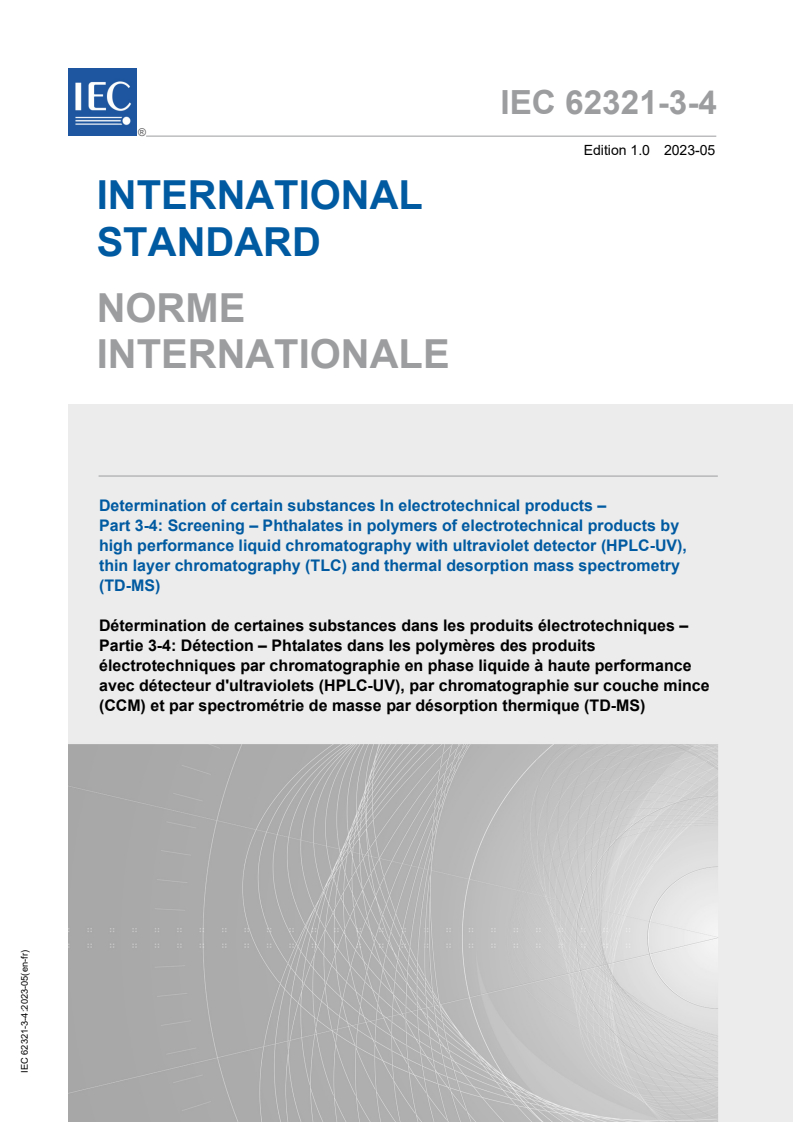
(Main)Determination of certain substances in electrotechnical products - Part 3-4: Screening - Phthalates in polymers of electrotechnical products by high performance liquid chromatography with ultraviolet detector (HPLC-UV), thin layer chromatography (TLC) and thermal desorption mass spectrometry (TD-MS)
General Information
- Abstract
IEC 62321-3-4:2023 specifies procedures for the screening of di-isobutyl phthalate (DIBP), di-n-butyl phthalate (DBP), benzyl butyl phthalate (BBP), di-(2-ethylhexyl) phthalate (DEHP) in polymers of electrotechnical products by using high performance liquid chromatography with ultraviolet detector (HPLC-UV), thin layer chromatography (TLC) and thermal desorption mass spectrometry (TD-MS).
High performance liquid chromatography with ultraviolet detector (HPLC-UV), thin layer chromatography (TLC) and thermal desorption mass spectrometry (TD-MS) techniques are described in the normative part of this document. Fourier transform infrared spectroscopy (FT-IR) is described in the informative annexes of this document.
- Status
- Published
- Publication Date
- 02-May-2023
- Technical Committee
- TC 111 - Environmental standardization for electrical and electronic products and systems
- Drafting Committee
- WG 3 - TC 111/WG 3
- Current Stage
- PPUB - Publication issued
- Start Date
- 03-May-2023
- Completion Date
- 19-May-2023
Buy Documents
IEC 62321-3-4:2023 - Determination of certain substances in electrotechnical products - Part 3-4: Screening - Phthalates in polymers of electrotechnical products by high performance liquid chromatography with ultraviolet detector (HPLC-UV), thin layer chromatography (TLC) and thermal desorption mass spectrometry (TD-MS)
Overview
IEC 62321-3-4:2023 is an international standard developed by the International Electrotechnical Commission (IEC) that specifies screening procedures for detecting phthalates in polymers of electrotechnical products. These phthalates include di-isobutyl phthalate (DIBP), di-n-butyl phthalate (DBP), benzyl butyl phthalate (BBP), and di-(2-ethylhexyl) phthalate (DEHP). The standard focuses on reliable screening methods using High Performance Liquid Chromatography with Ultraviolet Detector (HPLC-UV), Thin Layer Chromatography (TLC), and Thermal Desorption Mass Spectrometry (TD-MS).
Adopted in 2023, IEC 62321-3-4 provides standardized analytical techniques essential for compliance verification, quality control, and environmental safety assessments. It supports manufacturers, testing laboratories, and regulators in consistent detection and quantification of phthalate content in electrical and electronic equipment polymers.
Key Topics
Screening Phthalates in Polymers
The standard outlines procedures for identifying key phthalates in polymeric materials used within electrotechnical products.Analytical Techniques
- HPLC-UV: Provides separation and quantification of phthalates by liquid chromatography paired with ultraviolet detection.
- Thin Layer Chromatography (TLC): Offers a rapid screening tool using chromatographic separation on thin layers with visualization methods.
- Thermal Desorption Mass Spectrometry (TD-MS): Enables direct measurement of phthalates with high sensitivity through thermal desorption coupled with mass spectrometry detection.
Quality Assurance and Control
The standard details precision, sensitivity, and reliability assessment methods to ensure accurate and repeatable results.Sampling and Sample Preparation
Guidelines for sampling electrotechnical polymer products and preparing samples before analysis are clearly defined.Informative Annexes
Additional techniques such as Fourier Transform Infrared Spectroscopy (FT-IR) are included in annexes for supplementary screening information and validation.
Applications
IEC 62321-3-4:2023 is critical for stakeholders involved in electrotechnical product manufacturing and testing, as it facilitates:
Regulatory Compliance
Helps manufacturers verify that their products meet international and regional restrictions on phthalates, supporting compliance with environmental directives like RoHS and REACH.Material Safety and Environmental Health
Enables consistent monitoring of harmful substances, reducing environmental and health risks associated with phthalate exposure.Quality Control in Production
Assists quality assurance teams in identifying phthalate concentrations during polymer selection and product development processes.Testing Laboratories
Provides laboratories with standardized methods to perform reliable screening tests, ensuring harmonized global testing practices.Product Certification
Assists certification bodies in verifying the absence or regulated levels of phthalates in electrical and electronic equipment.
Related Standards
IEC 62321 Series
IEC 62321 encompasses the determination of various hazardous substances in electrotechnical products, including metals and brominated flame retardants. Part 3-4 focuses specifically on phthalate screening methods.RoHS Directive Compliance Testing Standards
Provides methodologies pertinent to compliance verification under the Restriction of Hazardous Substances directive.IEC 62321-3-1:2013
Covers screening methods for brominated flame retardants; often used in conjunction with Part 3-4 when comprehensive chemical testing is required.Testing and Analytical Standards for Polymers
Related ISO and IEC documents provide complementary procedures on polymer characterization and safety evaluation.
Keywords: IEC 62321-3-4, phthalates, electrotechnical products, polymers, HPLC-UV, thin layer chromatography, thermal desorption mass spectrometry, screening methods, di-isobutyl phthalate, di-n-butyl phthalate, benzyl butyl phthalate, di-(2-ethylhexyl) phthalate, environmental compliance, RoHS testing, IEC standards, polymer analysis, hazardous substances detection.
Buy Documents
IEC 62321-3-4:2023 - Determination of certain substances in electrotechnical products - Part 3-4: Screening - Phthalates in polymers of electrotechnical products by high performance liquid chromatography with ultraviolet detector (HPLC-UV), thin layer chromatography (TLC) and thermal desorption mass spectrometry (TD-MS)
Get Certified
Connect with accredited certification bodies for this standard

BSI Group
BSI (British Standards Institution) is the business standards company that helps organizations make excellence a habit.

Bureau Veritas
Bureau Veritas is a world leader in laboratory testing, inspection and certification services.

DNV
DNV is an independent assurance and risk management provider.
Sponsored listings
Frequently Asked Questions
IEC 62321-3-4:2023 is a standard published by the International Electrotechnical Commission (IEC). Its full title is "Determination of certain substances in electrotechnical products - Part 3-4: Screening - Phthalates in polymers of electrotechnical products by high performance liquid chromatography with ultraviolet detector (HPLC-UV), thin layer chromatography (TLC) and thermal desorption mass spectrometry (TD-MS)". This standard covers: IEC 62321-3-4:2023 specifies procedures for the screening of di-isobutyl phthalate (DIBP), di-n-butyl phthalate (DBP), benzyl butyl phthalate (BBP), di-(2-ethylhexyl) phthalate (DEHP) in polymers of electrotechnical products by using high performance liquid chromatography with ultraviolet detector (HPLC-UV), thin layer chromatography (TLC) and thermal desorption mass spectrometry (TD-MS). High performance liquid chromatography with ultraviolet detector (HPLC-UV), thin layer chromatography (TLC) and thermal desorption mass spectrometry (TD-MS) techniques are described in the normative part of this document. Fourier transform infrared spectroscopy (FT-IR) is described in the informative annexes of this document.
IEC 62321-3-4:2023 specifies procedures for the screening of di-isobutyl phthalate (DIBP), di-n-butyl phthalate (DBP), benzyl butyl phthalate (BBP), di-(2-ethylhexyl) phthalate (DEHP) in polymers of electrotechnical products by using high performance liquid chromatography with ultraviolet detector (HPLC-UV), thin layer chromatography (TLC) and thermal desorption mass spectrometry (TD-MS). High performance liquid chromatography with ultraviolet detector (HPLC-UV), thin layer chromatography (TLC) and thermal desorption mass spectrometry (TD-MS) techniques are described in the normative part of this document. Fourier transform infrared spectroscopy (FT-IR) is described in the informative annexes of this document.
IEC 62321-3-4:2023 is classified under the following ICS (International Classification for Standards) categories: 01.110 - Technical product documentation; 13.020.01 - Environment and environmental protection in general; 29.100.01 - Components for electrical equipment in general. The ICS classification helps identify the subject area and facilitates finding related standards.
IEC 62321-3-4:2023 is available in PDF format for immediate download after purchase. The document can be added to your cart and obtained through the secure checkout process. Digital delivery ensures instant access to the complete standard document.
Standards Content (Sample)
IEC 62321-3-4 ®
Edition 1.0 2023-05
INTERNATIONAL
STANDARD
NORME
INTERNATIONALE
Determination of certain substances In electrotechnical products –
Part 3-4: Screening – Phthalates in polymers of electrotechnical products by
high performance liquid chromatography with ultraviolet detector (HPLC-UV),
thin layer chromatography (TLC) and thermal desorption mass spectrometry
(TD-MS)
Détermination de certaines substances dans les produits électrotechniques –
Partie 3-4: Détection – Phtalates dans les polymères des produits
électrotechniques par chromatographie en phase liquide à haute performance
avec détecteur d'ultraviolets (HPLC-UV), par chromatographie sur couche mince
(CCM) et par spectrométrie de masse par désorption thermique (TD-MS)
All rights reserved. Unless otherwise specified, no part of this publication may be reproduced or utilized in any form
or by any means, electronic or mechanical, including photocopying and microfilm, without permission in writing from
either IEC or IEC's member National Committee in the country of the requester. If you have any questions about IEC
copyright or have an enquiry about obtaining additional rights to this publication, please contact the address below or
your local IEC member National Committee for further information.
Droits de reproduction réservés. Sauf indication contraire, aucune partie de cette publication ne peut être reproduite ni
utilisée sous quelque forme que ce soit et par aucun procédé, électronique ou mécanique, y compris la photocopie et
les microfilms, sans l'accord écrit de l'IEC ou du Comité national de l'IEC du pays du demandeur. Si vous avez des
questions sur le copyright de l'IEC ou si vous désirez obtenir des droits supplémentaires sur cette publication, utilisez
les coordonnées ci-après ou contactez le Comité national de l'IEC de votre pays de résidence.
IEC Secretariat Tel.: +41 22 919 02 11
3, rue de Varembé info@iec.ch
CH-1211 Geneva 20 www.iec.ch
Switzerland
About the IEC
The International Electrotechnical Commission (IEC) is the leading global organization that prepares and publishes
International Standards for all electrical, electronic and related technologies.
About IEC publications
The technical content of IEC publications is kept under constant review by the IEC. Please make sure that you have the
latest edition, a corrigendum or an amendment might have been published.
IEC publications search - webstore.iec.ch/advsearchform IEC Products & Services Portal - products.iec.ch
The advanced search enables to find IEC publications by a Discover our powerful search engine and read freely all the
variety of criteria (reference number, text, technical publications previews. With a subscription you will always have
committee, …). It also gives information on projects, replaced access to up to date content tailored to your needs.
and withdrawn publications.
Electropedia - www.electropedia.org
IEC Just Published - webstore.iec.ch/justpublished
The world's leading online dictionary on electrotechnology,
Stay up to date on all new IEC publications. Just Published
containing more than 22 300 terminological entries in English
details all new publications released. Available online and once
and French, with equivalent terms in 19 additional languages.
a month by email.
Also known as the International Electrotechnical Vocabulary
(IEV) online.
IEC Customer Service Centre - webstore.iec.ch/csc
If you wish to give us your feedback on this publication or need
further assistance, please contact the Customer Service
Centre: sales@iec.ch.
A propos de l'IEC
La Commission Electrotechnique Internationale (IEC) est la première organisation mondiale qui élabore et publie des
Normes internationales pour tout ce qui a trait à l'électricité, à l'électronique et aux technologies apparentées.
A propos des publications IEC
Le contenu technique des publications IEC est constamment revu. Veuillez vous assurer que vous possédez l’édition la
plus récente, un corrigendum ou amendement peut avoir été publié.
Recherche de publications IEC - Découvrez notre puissant moteur de recherche et consultez
webstore.iec.ch/advsearchform gratuitement tous les aperçus des publications. Avec un
La recherche avancée permet de trouver des publications IEC abonnement, vous aurez toujours accès à un contenu à jour
en utilisant différents critères (numéro de référence, texte, adapté à vos besoins.
comité d’études, …). Elle donne aussi des informations sur les
projets et les publications remplacées ou retirées. Electropedia - www.electropedia.org
Le premier dictionnaire d'électrotechnologie en ligne au monde,
IEC Just Published - webstore.iec.ch/justpublished
avec plus de 22 300 articles terminologiques en anglais et en
Restez informé sur les nouvelles publications IEC. Just
français, ainsi que les termes équivalents dans 19 langues
Published détaille les nouvelles publications parues.
additionnelles. Egalement appelé Vocabulaire
Disponible en ligne et une fois par mois par email.
Electrotechnique International (IEV) en ligne.
Service Clients - webstore.iec.ch/csc
Si vous désirez nous donner des commentaires sur cette
publication ou si vous avez des questions contactez-nous:
sales@iec.ch.
IEC Products & Services Portal - products.iec.ch
IEC 62321-3-4 ®
Edition 1.0 2023-05
INTERNATIONAL
STANDARD
NORME
INTERNATIONALE
Determination of certain substances In electrotechnical products –
Part 3-4: Screening – Phthalates in polymers of electrotechnical products by
high performance liquid chromatography with ultraviolet detector (HPLC-UV),
thin layer chromatography (TLC) and thermal desorption mass spectrometry
(TD-MS)
Détermination de certaines substances dans les produits électrotechniques –
Partie 3-4: Détection – Phtalates dans les polymères des produits
électrotechniques par chromatographie en phase liquide à haute performance
avec détecteur d'ultraviolets (HPLC-UV), par chromatographie sur couche mince
(CCM) et par spectrométrie de masse par désorption thermique (TD-MS)
INTERNATIONAL
ELECTROTECHNICAL
COMMISSION
COMMISSION
ELECTROTECHNIQUE
INTERNATIONALE
ICS 01.110; 13.020.01; 29.100.01 ISBN 978-2-8322-6853-7
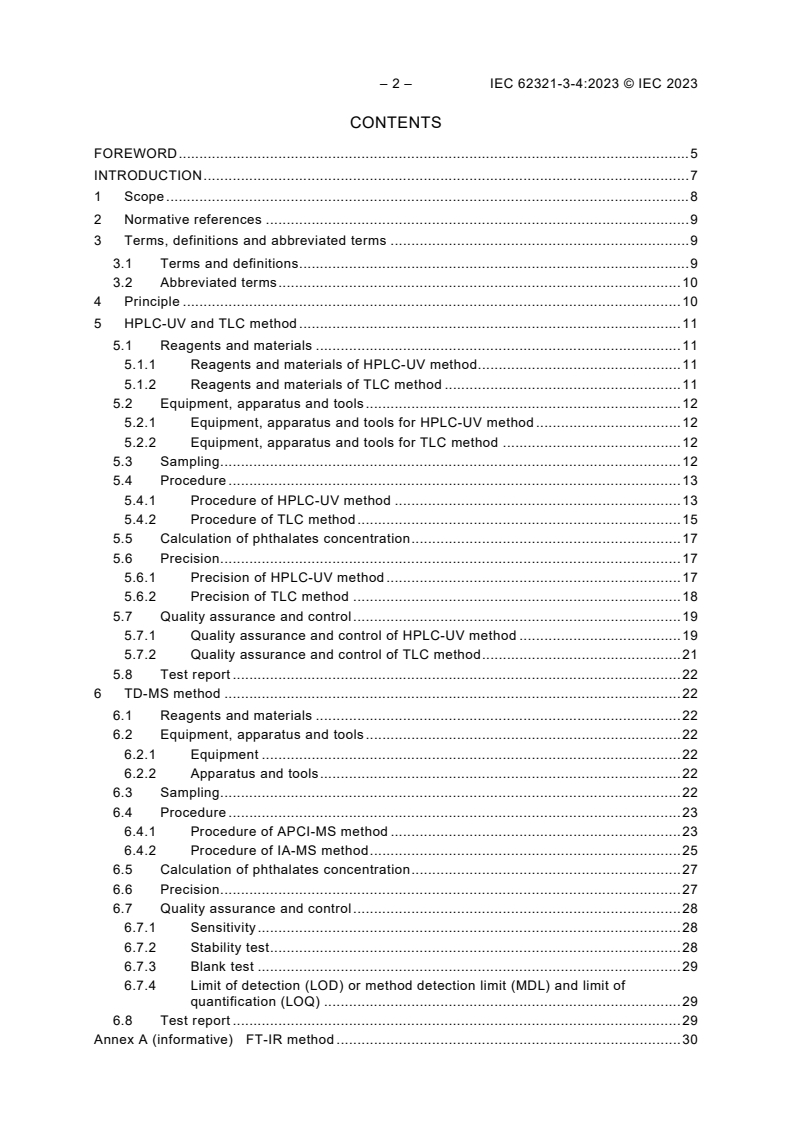
– 2 – IEC 62321-3-4:2023 © IEC 2023
CONTENTS
FOREWORD . 5
INTRODUCTION . 7
1 Scope . 8
2 Normative references . 9
3 Terms, definitions and abbreviated terms . 9
3.1 Terms and definitions . 9
3.2 Abbreviated terms . 10
4 Principle . 10
5 HPLC-UV and TLC method . 11
5.1 Reagents and materials . 11
5.1.1 Reagents and materials of HPLC-UV method . 11
5.1.2 Reagents and materials of TLC method . 11
5.2 Equipment, apparatus and tools . 12
5.2.1 Equipment, apparatus and tools for HPLC-UV method . 12
5.2.2 Equipment, apparatus and tools for TLC method . 12
5.3 Sampling. 12
5.4 Procedure . 13
5.4.1 Procedure of HPLC-UV method . 13
5.4.2 Procedure of TLC method . 15
5.5 Calculation of phthalates concentration . 17
5.6 Precision . 17
5.6.1 Precision of HPLC-UV method . 17
5.6.2 Precision of TLC method . 18
5.7 Quality assurance and control . 19
5.7.1 Quality assurance and control of HPLC-UV method . 19
5.7.2 Quality assurance and control of TLC method . 21
5.8 Test report . 22
6 TD-MS method . 22
6.1 Reagents and materials . 22
6.2 Equipment, apparatus and tools . 22
6.2.1 Equipment . 22
6.2.2 Apparatus and tools . 22
6.3 Sampling. 22
6.4 Procedure . 23
6.4.1 Procedure of APCI-MS method . 23
6.4.2 Procedure of IA-MS method . 25
6.5 Calculation of phthalates concentration . 27
6.6 Precision . 27
6.7 Quality assurance and control . 28
6.7.1 Sensitivity . 28
6.7.2 Stability test . 28
6.7.3 Blank test . 29
6.7.4 Limit of detection (LOD) or method detection limit (MDL) and limit of
quantification (LOQ) . 29
6.8 Test report . 29
Annex A (informative) FT-IR method . 30
A.1 Principle . 30
A.2 Reagents and materials . 32
A.3 Apparatus . 32
A.4 Sampling. 33
A.5 Procedure . 33
A.5.1 Sample preparation . 33
A.5.2 Instrumental parameters . 33
A.5.3 Calibration . 33
A.6 Calculation of phthalates concentration . 34
A.7 Precision . 34
A.8 Quality assurance and control . 35
A.9 Test report . 35
Annex B (informative) Details of analysis by TLC method . 36
B.1 Separation by TLC . 36
B.2 Detection by image analysis. 36
B.3 Re-measurement . 38
Annex C (informative) Examples of spectrums and chromatograms at suggested
conditions . 41
C.1 FT-IR spectrum . 41
C.2 HPLC-UV chromatogram . 41
C.3 TLC chromatogram . 42
C.4 APCI-MS mass spectrum . 42
C.5 IA-MS mass spectrum . 43
Annex D (informative) Commercially available reference materials and solutions
considered suitable for the suggested methods . 44
Annex E (informative) Flowchart of test methods . 45
Annex F (informative) Commonly used phthalates. 46
Annex G (informative) Results of international inter-laboratory study 3-4 (IIS 3-4). 47
Bibliography . 51
Figure 1 – Polymer samples in glass vials with acetonitrile (tightened with sealing tape) . 15
Figure A.1 – Phthalate analysis in polymers (check) . 31
Figure A.2 – Phthalate analysis in polymers with pre-treatment . 31
Figure B.1 – Usage of TLC plate (20 cm × 10 cm) . 36
Figure B.2 – Set-up of camera-equipment for TLC (inside of darkroom) . 37
Figure B.3 – TLC chromatogram . 38
Figure B.4 – Separation by re-measurement conditions (in case of pattern a)) . 39
Figure B.5 – Peak shift affected by large amount of DEHA . 39
Figure B.6 – TLC re-measurement by standard addition method (in case of pattern b)) . 40
Figure C.1 – Spectrum of FT-IR . 41
Figure C.2 – Chromatogram of HPLC-UV . 41
Figure C.3 – Developed TLC plate exposed to UV light of 254 nm . 42
Figure C.4 – Image processed TLC chromatogram of Figure C.3 . 42
Figure C.5 – Mass spectrums of APCI-MS . 43
Figure C.6 – Mass spectrums of IA-MS . 43
Figure E.1 – Flowchart for screening step and verification test step . 45
– 4 – IEC 62321-3-4:2023 © IEC 2023
Table 1 – Standard mixture solution concentrations . 13
Table 2 – Measurement conditions of HPLC-UV . 14
Table 3 – Standard mixture solution concentrations . 15
Table 4 – Measurement conditions of TLC . 16
Table 5 – IIS 3-4 Repeatability and reproducibility of HPLC-UV . 18
Table 6 – IIS 3-4 Repeatability and reproducibility of TLC . 19
Table 7 – Measurement conditions of APCI-MS . 24
Table 8 – Measurement conditions of IA-MS . 26
Table 9 – IIS 3-4 Repeatability and reproducibility of TD-MS . 28
Table A.1 – IIS 3-4 Repeatability and reproducibility of FT-IR . 34
Table B.1 – Conditions of photography . 37
Table B.2 – Range of Rf values of target phthalates . 38
Table D.1 – Example list of commercially available reference materials . 44
Table F.1 – Example list of commonly used phthalates in products . 46
Table G.1 – Formulation of samples. 47
Table G.2 – Statistical data for HPLC-UV . 48
Table G.3 – Statistical data for TLC . 49
Table G.4 – Statistical data for TD-MS . 50
Table G.5 – Statistical data for FT-IR . 50
INTERNATIONAL ELECTROTECHNICAL COMMISSION
____________
DETERMINATION OF CERTAIN SUBSTANCES
IN ELECTROTECHNICAL PRODUCTS –
Part 3-4: Screening – Phthalates in polymers of electrotechnical
products by high performance liquid chromatography with ultraviolet
detector (HPLC-UV), thin layer chromatography (TLC) and thermal
desorption mass spectrometry (TD-MS)
FOREWORD
1) The International Electrotechnical Commission (IEC) is a worldwide organization for standardization comprising
all national electrotechnical committees (IEC National Committees). The object of IEC is to promote international
co-operation on all questions concerning standardization in the electrical and electronic fields. To this end and
in addition to other activities, IEC publishes International Standards, Technical Specifications, Technical Reports,
Publicly Available Specifications (PAS) and Guides (hereafter referred to as "IEC Publication(s)"). Their
preparation is entrusted to technical committees; any IEC National Committee interested in the subject dealt with
may participate in this preparatory work. International, governmental and non-governmental organizations liaising
with the IEC also participate in this preparation. IEC collaborates closely with the International Organization for
Standardization (ISO) in accordance with conditions determined by agreement between the two organizations.
2) The formal decisions or agreements of IEC on technical matters express, as nearly as possible, an international
consensus of opinion on the relevant subjects since each technical committee has representation from all
interested IEC National Committees.
3) IEC Publications have the form of recommendations for international use and are accepted by IEC National
Committees in that sense. While all reasonable efforts are made to ensure that the technical content of IEC
Publications is accurate, IEC cannot be held responsible for the way in which they are used or for any
misinterpretation by any end user.
4) In order to promote international uniformity, IEC National Committees undertake to apply IEC Publications
transparently to the maximum extent possible in their national and regional publications. Any divergence between
any IEC Publication and the corresponding national or regional publication shall be clearly indicated in the latter.
5) IEC itself does not provide any attestation of conformity. Independent certification bodies provide conformity
assessment services and, in some areas, access to IEC marks of conformity. IEC is not responsible for any
services carried out by independent certification bodies.
6) All users should ensure that they have the latest edition of this publication.
7) No liability shall attach to IEC or its directors, employees, servants or agents including individual experts and
members of its technical committees and IEC National Committees for any personal injury, property damage or
other damage of any nature whatsoever, whether direct or indirect, or for costs (including legal fees) and
expenses arising out of the publication, use of, or reliance upon, this IEC Publication or any other IEC
Publications.
8) Attention is drawn to the Normative references cited in this publication. Use of the referenced publications is
indispensable for the correct application of this publication.
9) Attention is drawn to the possibility that some of the elements of this IEC Publication may be the subject of patent
rights. IEC shall not be held responsible for identifying any or all such patent rights.
IEC 62321-3-4 has been prepared IEC technical committee 111: Environmental standardization
for electrical and electronic products and systems. It is an International Standard.
The text of this International Standard is based on the following documents:
Draft Report on voting
111/695/FDIS 111/701/RVD
Full information on the voting for its approval can be found in the report on voting indicated in
the above table.
The language used for the development of this International Standard is English.
– 6 – IEC 62321-3-4:2023 © IEC 2023
This document was drafted in accordance with ISO/IEC Directives, Part 2, and developed in
accordance with ISO/IEC Directives, Part 1 and ISO/IEC Directives, IEC Supplement, available
at www.iec.ch/members_experts/refdocs. The main document types developed by IEC are
described in greater detail at www.iec.ch/publications.
A list of all parts in the IEC 62321 series, published under the general title Determination of
certain substances in electrotechnical products, can be found on the IEC website.
The committee has decided that the contents of this document will remain unchanged until the
stability date indicated on the IEC website under webstore.iec.ch in the data related to the
specific document. At this date, the document will be
• reconfirmed,
• withdrawn,
• replaced by a revised edition, or
• amended.
INTRODUCTION
The widespread use of electrotechnical products has drawn increased attention to their impact
on the environment. In many countries all over the world, this has resulted in the adaptation of
regulations affecting wastes, substances and energy use of electrotechnical products.
The use of certain substances (e.g. lead (Pb), cadmium (Cd), polybrominated diphenyl ethers
(PBDEs) and specific phthalates) in electrotechnical products is a source of concern in current
and proposed regional legislation.
The purpose of the IEC 62321 series is therefore to provide test methods that will allow the
electrotechnical industry to determine the levels of certain substances of concern in
electrotechnical products on a consistent global basis.
This first edition of IEC 62321-3-4 introduces a new part in the IEC 62321 series.
Appropriate test methods are required in order to facilitate the monitoring of the contents of
certain substances in affected materials. Faced with the enormous task of testing a diversity of
electronic and electric equipment, the industry adopted the concept of 'screening' in order to
reduce the amount of testing. As defined in IEC 62321-1:2013, 3.1.10, "…screening is an
analytical procedure to determine the presence or absence of substances in the representative
part or section of a product, relative to the value or values chosen as the criterion for presence,
absence or further testing". Executed as a predecessor to any other test analysis of the product,
the main objective of screening is to quickly, expediently, inexpensively and preferably in a non-
destructive manner, determine whether the screened product:
– contains a certain substance at a concentration significantly higher than its value accepted
as criterion, and therefore can be rejected as being above the threshold;
– contains a certain substance at a concentration significantly lower than its value accepted
as criterion, and therefore can be considered below the threshold;
– contains a certain substance at a concentration so close to the value accepted as criterion
that when all possible errors of measurement and safety factors and measurement
uncertainty are considered, no conclusive decision can be made about the absence or
presence of substance and, therefore, a follow-up action can be required, such as another,
more specific or more precise and accurate analysis.
WARNING – Persons using this document should be familiar with normal laboratory practice.
This document does not purport to address all of the safety problems, if any, associated with
its use. It is the responsibility of the user to establish appropriate safety and health practices
and to ensure compliance with any national regulatory conditions.
– 8 – IEC 62321-3-4:2023 © IEC 2023
DETERMINATION OF CERTAIN SUBSTANCES
IN ELECTROTECHNICAL PRODUCTS –
Part 3-4: Screening – Phthalates in polymers of electrotechnical
products by high performance liquid chromatography with ultraviolet
detector (HPLC-UV), thin layer chromatography (TLC) and thermal
desorption mass spectrometry (TD-MS)
1 Scope
This part of IEC 62321 specifies procedures for the screening of di-isobutyl phthalate (DIBP),
di-n-butyl phthalate (DBP), benzyl butyl phthalate (BBP), di-(2-ethylhexyl) phthalate (DEHP) in
polymers of electrotechnical products by using high performance liquid chromatography with
ultraviolet detector (HPLC-UV), thin layer chromatography (TLC) and thermal desorption mass
spectrometry (TD-MS).
High performance liquid chromatography with ultraviolet detector (HPLC-UV), thin layer
chromatography (TLC) and thermal desorption mass spectrometry (TD-MS) techniques are
described in the normative part of this document. Fourier transform infrared spectroscopy
(FT-IR) is described in the informative annexes of this document.
The HPLC-UV and TLC techniques are suitable for screening and semi-quantitative analysis of
DIBP, DBP, BBP and DEHP in polymers that are used as parts in electrotechnical products
above 300 mg/kg.
Theu TD-MS technique is suitable for screening and semi-quantitative analysis of DIBP, DBP,
BBP and DEHP in polymers that are used as parts in electrotechnical products above 300 mg/kg.
The FT-IR technique is suitable for preliminary screening of total phthalates (DIBP, DBP, BBP,
DEHP and so forth) in polymers that are used as parts in electrotechnical products above
50 000 mg/kg.
These test methods have been evaluated by testing polyethylene (PE), polyvinyl chloride (PVC)
materials containing individual phthalates between 500 mg/kg to 3 000 mg/kg as depicted in
this document. The use of the methods described in this document for other polymer types,
phthalate compounds or concentration ranges other than those specified above has not been
specifically evaluated.
A flow chart is given as an example of how each method included in this document can be used
for screening. The test methods in this document differ from those given in IEC 62321-8 [1] in
that not all phthalates in this scope are separated from each other. Detectable combinations
are DIBP + DBP + BBP and DEHP for the HPLC-UV technique, DIBP + DBP, BBP and DEHP
for the TLC technique and TD-MS technique, total phthalates for the FT-IR technique. FT-IR is
a suitable analytical technique for preliminary screening in the first step of phthalates screening.
These test methods are characterized by a shorter measuring time compared with IEC 62321-8
because all phthalates in this scope are not separated from each other.
NOTE See Annex F for commonly used phthalates in products.
This document has the status of a horizontal publication in accordance with IEC Guide 108 [2].
___________
Numbers in square brackets refer to the Bibliography.
2 Normative references
The following documents are referred to in the text in such a way that some or all of their content
constitutes requirements of this document. For dated references, only the edition cited applies.
For undated references, the latest edition of the referenced document (including any
amendments) applies.
IEC 62321-1:2013, Determination of certain substances in electrotechnical products – Part 1:
Introduction and overview
IEC 62321-2:2021, Determination of certain substances in electrotechnical products – Part 2:
Disassembly, disjointment and mechanical sample preparation
3 Terms, definitions and abbreviated terms
3.1 Terms and definitions
For the purposes of this document, the following terms and definitions apply.
ISO and IEC maintain terminology databases for use in standardization at the following
addresses:
• IEC Electropedia: available at https://www.electropedia.org/
• ISO Online browsing platform: available at https://www.iso.org/obp
3.1.1
screening
analytical procedure to determine the presence or absence of substances in the representative
part or section of a product, relative to the value or values chosen as the criterion for presence,
absence or further testing
Note 1 to entry: If the screening method produces values that are not conclusive, then additional analysis or other
follow-up actions may be necessary to make a final presence/absence decision.
[SOURCE: IEC 62321-1:2013, 3.1.10]
3.1.2
semi-quantitative
level of accuracy in a measurement amount where the relative uncertainty of the result is
typically 30 % or better at a defined level of confidence of 68 %
[SOURCE: IEC 62321-6:2015, 3.1.1 [3]]
3.1.3
calibrant
calibration standard
substance in solid or liquid form with known and stable concentration(s) of the analyte(s) of
interest used to establish instrument response (calibration curve) with respect to analyte(s)
concentration(s)
– 10 – IEC 62321-3-4:2023 © IEC 2023
3.2 Abbreviated terms
ACN acetonitrile
APCI atmospheric pressure chemical ionization
APCI-MS atmospheric pressure chemical ionization mass spectrometry
BBP benzyl butyl phthalate
CRM certified reference material
DBP di-n-butyl phthalate
DEHP di-(2-ethylhexyl) phthalate
DIBP di-isobutyl phthalate
DIP direct injection probe
DNOP di-n-octyl phthalate
FT-IR Fourier Transform infrared spectroscopy
HPLC-UV high performance liquid chromatography with ultraviolet detector
IA-MS ion attachment mass spectrometry
TLC thin layer chromatography
IS internal standard
LOD limit of detection
LOQ limit of quantification
MDL method detection limit
MS mass spectrometry
PVC polyvinyl chloride
QC quality control
SIM selected ion monitoring
TD-MS thermal desorption mass spectrometry
THF tetrahydrofuran
4 Principle
In the HPLC-UV method, DIBP, DBP, BBP and DEHP are determined using ultrasonic extraction
followed by high-pressure, liquid chromatography separation and ultraviolet detection. Owing
to the peak overlapping of DIBP, DBP and BBP, occurrence of the peak indicates only
qualitative information of possible presence of DIBP, DBP and BBP or a combination of one or
two of either of these phthalates.
The TLC method, as well as the HPLC method, is one of the liquid chromatography methods
and can be performed with simple instruments. In the TLC method, DIBP, DBP, BBP and DEHP
in the polymer are separated by TLC after ultrasonic extraction and detected by image analysis
after photography under UV light. DIBP and DBP are detected as sum peaks because it is
difficult to separate them by TLC.
TD-MS techniques use a thermal desorption system directly connected to mass spectrometry
with ionization systems such as an atmospheric pressure chemical ionization or ion attachment
to screen for the presence of DIBP, DBP, BBP and DEHP in polymers. This method allows for
the direct analysis of a polymer sample without pre-treatment process. For example:
+
– The APCI-MS method has an ion source that attaches H to target molecules by a corona
discharge under atmospheric pressure and is coupled with a furnace stabilized at 330 °C
and a sample heater. The sample heater is programmed to heat up to 230 °C to thermally
desorb sample molecules. The thermally desorbed sample molecules (M) form adducts
+ +
(M + H ) with H in the reaction and are analysed by a mass spectrometer via select ion
monitoring.
+ +
– The IA-MS method includes a Li attachment reaction chamber with a Li emitter and is
coupled with a direct injection probe (DIP). The DIP is programmed to heat up to 350 °C to
thermally desorb sample molecules. The thermally desorbed sample molecules (M) form
+ +
adducts (M + Li ) with Li in the reaction chamber and those adducts are analysed by a
mass spectrometer via select ion monitoring.
Therefore, target molecules with the same molecular weight such as DBP and DIBP, DEHP and
Di-n-octyl phthalate (DNOP) are detected as sum peaks by TD-MS techniques.
The principle of phthalate detection by FT-IR can be referenced in Annex A.
These test methods are based on the concept of performance. Apparatus, sampling and
calibration are specified in this document in relatively general terms. It is the responsibility of
the user to document all procedures developed in the laboratory that uses the test methods
described in this document. The user shall establish a written procedure for all cases denoted
in the test methods described in this document by the term "work instructions". A flowchart is
provided in Annex E as an example of how these methods can be used for screening.
5 HPLC-UV and TLC method
5.1 Reagents and materials
5.1.1 Reagents and materials of HPLC-UV method
All chemicals shall be tested for contamination and blank values prior to application, as follows:
a) methanol (HPLC grade, purity greater than a volume fraction of 99,7 %);
b) THF (HPLC grade, purity greater than a volume fraction of 99,7 %);
c) ethanol (HPLC grade, purity greater than a volume fraction of 99,7 %);
d) ultrapure water (HPLC grade);
e) standard mixture solution or reference polymer materials as calibrants:
one contains approximately 1 000 mg/kg of phthalates.
NOTE Commercially available reference materials are listed in Annex D.
5.1.2 Reagents and materials of TLC method
All chemicals shall be tested for contamination and blank values prior to application, as follows:
a) acetonitrile;
b) methanol;
c) standard mixture solution or reference polymer materials as calibrants:
one contains approximately 1 000 mg/kg of phthalates;
NOTE Commercially available reference materials are listed in Annex D.
– 12 – IEC 62321-3-4:2023 © IEC 2023
5.2 Equipment, apparatus and tools
5.2.1 Equipment, apparatus and tools for HPLC-UV method
The following equipment shall be used for the analysis:
a) high-performance liquid chromatography (HPLC) system equipped with a UV or PDA/UV
detector, auto sampler, pump and column oven;
b) analytical balance capable of measuring accurately to 0,000 1 g (0,1 mg);
c) ultrasonic bath (capable of heating above 50 °C);
The following equipment should be used for sample preparation as necessary:
d) cryogenic grinding or milling with liquid N cooling.
The following items shall be used for the analysis:
e) column;
f) glass vials for HPLC-UV;
g) glass vials for extraction (40 ml volume is recommended);
h) volumetric flask;
i) adjustable pipettes;
j) paper filters, medium-fast filtration, general laboratory use.
NOTE The size of the required glass vial for HPLC depends on the instrument.
5.2.2 Equipment, apparatus and tools for TLC method
The following equipment shall be used for the analysis:
a) ultrasonic bath (capable of heating above 60 °C);
b) analytical balance (capable of measuring accurately to 0,000 1 g (0,1 mg));
c) TLC plate (stationary phase C18, size 20 cm × 20 cm, cut in half to 20 cm × 10 cm);
d) TLC developing chamber;
e) UV lamp (λ = 254 nm, 2 units required);
f) digital camera (with UV lens filter for ultraviolet adsorption as optional);
g) clamp (for fixing UV lamps and a camera);
h) desktop darkroom.
The following items shall be used for the analysis:
a) glass vials for extraction (4 ml volume is recommended);
d) capillary (capacity 1 µl);
c) volumetric flask;
d) adjustable pipettes or micro syringes;
e) scissors or cutter knife.
5.3 Sampling
Unless otherwise specified in this document, the sampling procedure described in IEC 62321-2
shall be referred to.
All items used in the samples preparation for measurements shall be shown to be free of
contamination, specific for the analytes of this TLC method. This means that all grinding
materials, solvents, fluxes, etc. shall not contain detectable quantities of phthalates (DIBP, DBP,
BBP, and DEHP).
Tools used in the handling of samples shall be chosen to minimize contamination by the
analytes of this TLC test method as well as by any other elements or species. The procedures
which will be used for cleaning different tools shall not introduce any contaminants.
5.4 Procedure
5.4.1 Procedure of HPLC-UV method
5.4.1.1 Sample preparation
5.4.1.1.1 General
Sample preparation requires clean glassware (e.g. single use items) to avoid cross
contamination.
5.4.1.1.2 Polymer sample
a) Cryogenic grinding with liquid N cooling is recommended to achieve a particle size under
1 mm.
b) Weigh 150 mg ± 20 mg of the sample and transfer it into a glass vial for extraction. Record
the mass to the nearest 0,1 mg.
c) Transfer 5 ml of THF to the vial.
d) Tightly cap the sample vial. Place it in an ultrasonic bath (50 °C) and sonicate for 60 min
until the sample has dissolved. A small piece of adhesive tape may be used to prevent the
cap from loosening due to vibration.
e) After the sample is dissolved, allow the vial to cool to ambient temperature.
f) Accurately add 10 ml of ethanol dropwise into the vial to precipitate the sample matrix.
g) Allow the polymer to settle or filter the mixture through a paper filter made of hydrophilic
polytetrafluoroethylene.
5.4.1.1.3 Standard solution
Whenever possible, the solvent used for the HPLC sample and standard solutions shall be the
same to avoid any potential solvent effects.
The standard mixture solutions of phthalates given in Table 1 are used for calibration. A
reference polymer material which concentration is approximately 1 000 mg/kg can be used for
preparing the standard stock solution. When using reference polymer materials, the standard
mixture solution shall be prepared in accordance with 5.4.1.1.2.
Table 1 – Standard mixture solution concentrations
No. DIBP DBP BBP DEHP
10 µg/ml 10 µg/ml 10 µg/ml 10 µg/ml
(equivalent to (equivalent to (equivalent to (equivalent to
1 000 mg/kg) 1 000 mg/kg) 1 000 mg/kg) 1 000 mg/kg)
5.4.1.2 Instrumental parameters
Different conditions can be necessary to optimize a specific HPLC-UV system to achieve
effective determination of phthalates and meet the requirements of 5.7.1 (Quality assurance
and control).
– 14 – IEC 62321-3-4:2023 © IEC 2023
The following parameters given in Table 2 have been found suitable and are provided as an
example. For every measurement the peaks for each phthalate shall be identified by the
retention times with the standard stock solution. Deviation of retention times shall not exceed
±5 % within a batch.
NOTE See Annex C for examples of chromatogram at suggested conditions.
Table 2 – Measurement conditions of HPLC-UV
Liquid (mobile) phase 95 % methanol / 5 % water (volume fraction)
C18 stationary phase, 150 mm in length and 4,6 mm in diameter, 5 μm particle
Stationary (column) phase
size or equivalent
Measurement conditions
Run time 15 min
Flow rate 1,0 ml/min
Wavelength 254 nm
Injection volume 10 µl
Column temperature 40 °C ± 2 °C
NOTE In the measurement conditions described in this Table 2, examples of retention time of each phthalate are
for DIBP/DBP/BBP: 2,5 min to 3,5 min, for DEHP: 5,5 min to 6,0 min.
5.4.1.3 Calibration
The HPLC-UV method shall be calibrated taking into account interference effects and any other
effects that influence the determination of the peak area.
To produce calibration straight lines, the peak area is plotted against the absolute amount (ng)
of each phthalate.
A slope of a one-point calibration curve is calculated by using Equation (1).
a = A / m (1)
where
a is the slope of the calibration curve;
A is the peak area of each phthalate in the standard mixture solution or the extract of reference
polymer material;
m is the absolute amount of each phthalate in the standard mixture solution or the extract of
referenced polymer material (ng).
The calibration curve is specified by using Equation (2):
y =ax
(2)
where
y is the peak area of each phthalate in the sample;
x is the absolute amount of each phthalate in the sample (ng);
a is the slope of the calibration curve calculated by Equation (1).
5.4.2 Procedure of TLC method
5.4.2.1 Sample preparation
5.4.2.1.1 General
Sampl
...