

IEC 61124:2012
(Main)Reliability testing - Compliance tests for constant failure rate and constant failure intensity
General Information
- Abstract
IEC 61124:2012 gives a number of optimized test plans, the corresponding operating characteristic curves and expected test times. In addition the algorithms for designing test plans using a spreadsheet program are also given, together with guidance on how to choose test plans. This standard specifies procedures to test whether an observed value of: failure rate, failure intensity, meantime to failure (MTTF), and mean operating time between failures (MTBF). The main changes with respect to the previous edition are as follows:
- A number of new test plans have been added based on the Russian standard GOST R 27.402 [1], and it is intended to align the new edition of MIL-HDBK-781 [2] with this edition. Algorithms for optimizing test plans using a spreadsheet program are given and a number of optimized test plans are listed. Furthermore, emphasis is laid on the fact that the test should be repeated following design changes;
- Discrepancies in test plans A, B as well as Annexes A and B that originated in IEC 60605-7 [3], now withdrawn, have been corrected so these test plans differ from those given in previous editions of IEC 61124. As requested by the National Committees, mathematical background material and spreadsheet program information has been moved to informative annexes. In addition, the symbol lists have been divided, so that some annexes have separate lists of symbols;
- Guidance on how to choose test plans has been added as well as guidance on how to use spreadsheet programs to create them. Test plans A.1 to A.9 and B.1 to B.13 have been corrected;
- Subcluses 8.1, 8.2, 8.3, Clause 9, Annex C, Clauses G.2, I.2, I.3 and Annex J are unchanged, except for updated terminology and references. The contents of the corrigendum of January 2013 have been included in this copy.
- Status
- Published
- Publication Date
- 22-May-2012
- Technical Committee
- TC 56 - Dependability
- Current Stage
- DELPUB - Deleted Publication
- Start Date
- 24-Feb-2023
- Completion Date
- 04-Oct-2019

Overview
IEC 61124:2012 is an international standard established by the International Electrotechnical Commission (IEC) that focuses on reliability testing for products and systems. This standard provides comprehensive methodologies for conducting compliance tests aimed at verifying a constant failure rate or constant failure intensity. It delivers a range of optimized test plans, corresponding operating characteristic curves, expected test durations, and includes practical algorithms for designing these test plans using spreadsheet software. This enables manufacturers and testers to effectively assess critical reliability parameters such as failure rate, failure intensity, Mean Time To Failure (MTTF), and Mean Time Between Failures (MTBF).
The 2012 edition introduces updated and new test plans influenced by the Russian standard GOST R 27.402 and aims to align closely with MIL-HDBK-781. Key enhancements include corrections of previous inconsistencies, expanded guidance on test plan selection, and making mathematical and spreadsheet design tools more accessible through informative annexes.
Key Topics
Test Plan Types: The standard covers multiple test plan categories:
- Sequential test plans
- Fixed time/failure terminated test plans
- Alternative time/failure terminated test plans
- Calendar time/failure terminated test plans
- Combined test plans
Test Procedures & Data Recording: IEC 61124 specifies detailed steps on how to perform tests under predefined conditions, record relevant data accurately, and calculate accumulated test time for thorough analysis.
Decision Criteria: The standard defines clear criteria for determining pass/fail outcomes based on the number of observed failures relative to statistical accept/reject lines.
Operating Characteristic (OC) Curves: It provides graphical tools essential for understanding the probability of acceptance against various true failure rates, enabling better risk assessment.
Spreadsheet Algorithms: The inclusion of algorithms and design guidelines facilitates the creation and optimization of test plans, promoting efficiency and adaptability in reliability testing.
Updated Terminology and Reference Alignment: Terminology has been reviewed and aligned with current international standards, ensuring consistent communication among stakeholders.
Applications
IEC 61124:2012 is vital for industries where product and system reliability are critical. Its practical applications include:
Electronics and Electrical Equipment: Assessing reliability of components, assemblies, and systems to meet design and regulatory requirements.
Aerospace and Defense: Ensuring constant failure rates in mission-critical components and systems, supporting military and aerospace standards alignment.
Manufacturing and Quality Control: Providing guidance for repeatable testing after design or process changes, essential for maintaining and improving product quality.
Automotive and Transportation: Validating reliability claims for safety-critical systems by monitoring failure intensity.
Warranty and Service Prediction: Using MTTF and MTBF data derived from compliance tests to forecast product lifespan and optimize maintenance schedules.
By adhering to IEC 61124:2012, organizations can validate reliability claims efficiently, reduce time and resource consumption in testing, and enhance confidence in product endurance.
Related Standards
GOST R 27.402: Russian reliability test standards that influenced additions and refinements in IEC 61124:2012, particularly regarding optimized test plans.
MIL-HDBK-781: U.S. military handbook that aligns with the IEC 61124 framework for constant failure rate testing methodologies.
IEC 60605-7: A previously withdrawn standard whose discrepancies in test plans were corrected and accounted for in IEC 61124's latest edition.
IEC 61123:1991: Provides methods and tables supportive for fixed calendar time tests referenced within IEC 61124.
IEC Electropedia: For terminology and definitions related to electrotechnical vocabulary, ensuring clear understanding of test-related terms.
Keywords: IEC 61124:2012, reliability testing, constant failure rate, constant failure intensity, compliance tests, MTTF, MTBF, test plans, operating characteristic curves, reliability standards, failure rate testing, spreadsheet algorithms, quality control, electronics reliability, aerospace standards.
Relations
- Effective Date
- 05-Sep-2023
- Effective Date
- 05-Sep-2023
- Effective Date
- 05-Sep-2023
Get Certified
Connect with accredited certification bodies for this standard

BSI Group
BSI (British Standards Institution) is the business standards company that helps organizations make excellence a habit.

Bureau Veritas
Bureau Veritas is a world leader in laboratory testing, inspection and certification services.

DNV
DNV is an independent assurance and risk management provider.
Sponsored listings
Frequently Asked Questions
IEC 61124:2012 is a standard published by the International Electrotechnical Commission (IEC). Its full title is "Reliability testing - Compliance tests for constant failure rate and constant failure intensity". This standard covers: IEC 61124:2012 gives a number of optimized test plans, the corresponding operating characteristic curves and expected test times. In addition the algorithms for designing test plans using a spreadsheet program are also given, together with guidance on how to choose test plans. This standard specifies procedures to test whether an observed value of: failure rate, failure intensity, meantime to failure (MTTF), and mean operating time between failures (MTBF). The main changes with respect to the previous edition are as follows: - A number of new test plans have been added based on the Russian standard GOST R 27.402 [1], and it is intended to align the new edition of MIL-HDBK-781 [2] with this edition. Algorithms for optimizing test plans using a spreadsheet program are given and a number of optimized test plans are listed. Furthermore, emphasis is laid on the fact that the test should be repeated following design changes; - Discrepancies in test plans A, B as well as Annexes A and B that originated in IEC 60605-7 [3], now withdrawn, have been corrected so these test plans differ from those given in previous editions of IEC 61124. As requested by the National Committees, mathematical background material and spreadsheet program information has been moved to informative annexes. In addition, the symbol lists have been divided, so that some annexes have separate lists of symbols; - Guidance on how to choose test plans has been added as well as guidance on how to use spreadsheet programs to create them. Test plans A.1 to A.9 and B.1 to B.13 have been corrected; - Subcluses 8.1, 8.2, 8.3, Clause 9, Annex C, Clauses G.2, I.2, I.3 and Annex J are unchanged, except for updated terminology and references. The contents of the corrigendum of January 2013 have been included in this copy.
IEC 61124:2012 gives a number of optimized test plans, the corresponding operating characteristic curves and expected test times. In addition the algorithms for designing test plans using a spreadsheet program are also given, together with guidance on how to choose test plans. This standard specifies procedures to test whether an observed value of: failure rate, failure intensity, meantime to failure (MTTF), and mean operating time between failures (MTBF). The main changes with respect to the previous edition are as follows: - A number of new test plans have been added based on the Russian standard GOST R 27.402 [1], and it is intended to align the new edition of MIL-HDBK-781 [2] with this edition. Algorithms for optimizing test plans using a spreadsheet program are given and a number of optimized test plans are listed. Furthermore, emphasis is laid on the fact that the test should be repeated following design changes; - Discrepancies in test plans A, B as well as Annexes A and B that originated in IEC 60605-7 [3], now withdrawn, have been corrected so these test plans differ from those given in previous editions of IEC 61124. As requested by the National Committees, mathematical background material and spreadsheet program information has been moved to informative annexes. In addition, the symbol lists have been divided, so that some annexes have separate lists of symbols; - Guidance on how to choose test plans has been added as well as guidance on how to use spreadsheet programs to create them. Test plans A.1 to A.9 and B.1 to B.13 have been corrected; - Subcluses 8.1, 8.2, 8.3, Clause 9, Annex C, Clauses G.2, I.2, I.3 and Annex J are unchanged, except for updated terminology and references. The contents of the corrigendum of January 2013 have been included in this copy.
IEC 61124:2012 is classified under the following ICS (International Classification for Standards) categories: 03.120.30 - Application of statistical methods; 19.020 - Test conditions and procedures in general; 21.020 - Characteristics and design of machines, apparatus, equipment. The ICS classification helps identify the subject area and facilitates finding related standards.
IEC 61124:2012 has the following relationships with other standards: It is inter standard links to IEC 61124:2012/COR1:2013, IEC 61124:2023, IEC 61124:2006. Understanding these relationships helps ensure you are using the most current and applicable version of the standard.
IEC 61124:2012 is available in PDF format for immediate download after purchase. The document can be added to your cart and obtained through the secure checkout process. Digital delivery ensures instant access to the complete standard document.
Standards Content (Sample)
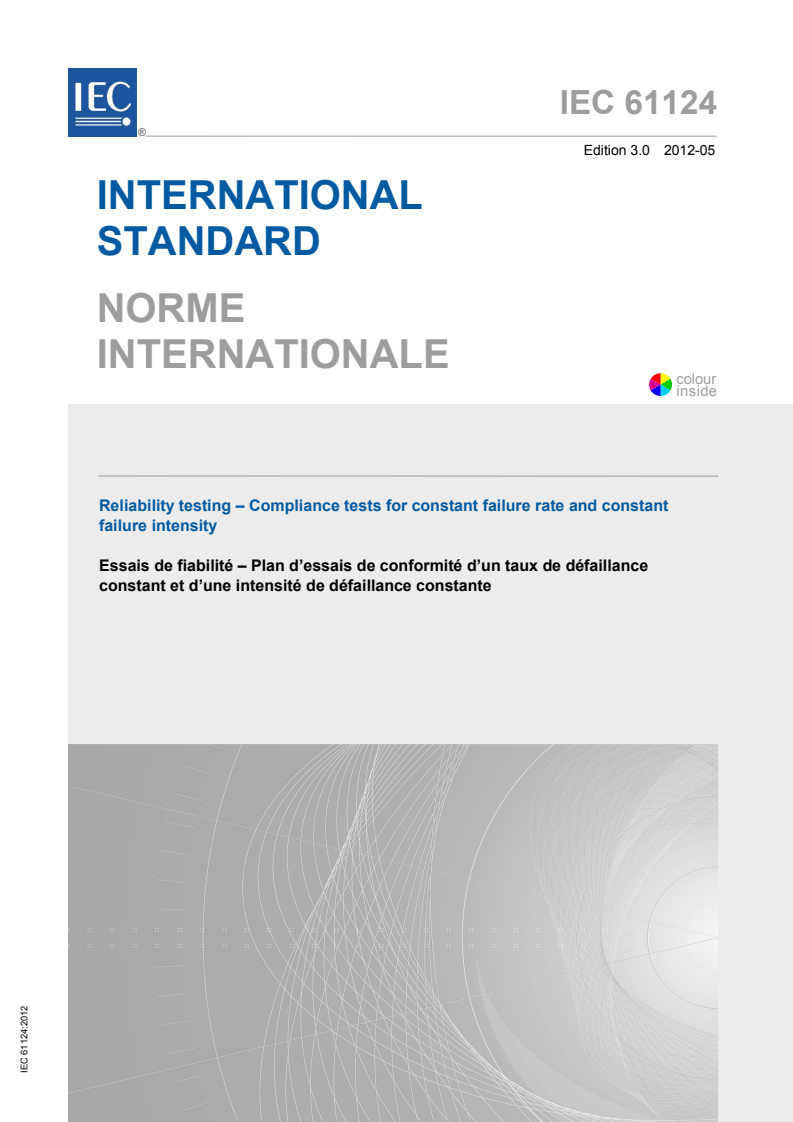
IEC 61124 ®
Edition 3.0 2012-05
INTERNATIONAL
STANDARD
NORME
INTERNATIONALE
colour
inside
Reliability testing – Compliance tests for constant failure rate and constant
failure intensity
Essais de fiabilité – Plan d’essais de conformité d’un taux de défaillance
constant et d’une intensité de défaillance constante
All rights reserved. Unless otherwise specified, no part of this publication may be reproduced or utilized in any form
or by any means, electronic or mechanical, including photocopying and microfilm, without permission in writing from
either IEC or IEC's member National Committee in the country of the requester.
If you have any questions about IEC copyright or have an enquiry about obtaining additional rights to this publication,
please contact the address below or your local IEC member National Committee for further information.
Droits de reproduction réservés. Sauf indication contraire, aucune partie de cette publication ne peut être reproduite ni
utilisée sous quelque forme que ce soit et par aucun procédé, électronique ou mécanique, y compris la photocopie et les
microfilms, sans l'accord écrit de la CEI ou du Comité national de la CEI du pays du demandeur.
Si vous avez des questions sur le copyright de la CEI ou si vous désirez obtenir des droits supplémentaires sur cette
publication, utilisez les coordonnées ci-après ou contactez le Comité national de la CEI de votre pays de résidence.
IEC Central Office Tel.: +41 22 919 02 11
3, rue de Varembé Fax: +41 22 919 03 00
CH-1211 Geneva 20 info@iec.ch
Switzerland www.iec.ch
About the IEC
The International Electrotechnical Commission (IEC) is the leading global organization that prepares and publishes
International Standards for all electrical, electronic and related technologies.
About IEC publications
The technical content of IEC publications is kept under constant review by the IEC. Please make sure that you have the
latest edition, a corrigenda or an amendment might have been published.
Useful links:
IEC publications search - www.iec.ch/searchpub Electropedia - www.electropedia.org
The advanced search enables you to find IEC publications The world's leading online dictionary of electronic and
by a variety of criteria (reference number, text, technical electrical terms containing more than 30 000 terms and
committee,…). definitions in English and French, with equivalent terms in
It also gives information on projects, replaced and additional languages. Also known as the International
withdrawn publications. Electrotechnical Vocabulary (IEV) on-line.
IEC Just Published - webstore.iec.ch/justpublished Customer Service Centre - webstore.iec.ch/csc
Stay up to date on all new IEC publications. Just Published If you wish to give us your feedback on this publication
details all new publications released. Available on-line and or need further assistance, please contact the
also once a month by email. Customer Service Centre: csc@iec.ch.
A propos de la CEI
La Commission Electrotechnique Internationale (CEI) est la première organisation mondiale qui élabore et publie des
Normes internationales pour tout ce qui a trait à l'électricité, à l'électronique et aux technologies apparentées.
A propos des publications CEI
Le contenu technique des publications de la CEI est constamment revu. Veuillez vous assurer que vous possédez
l’édition la plus récente, un corrigendum ou amendement peut avoir été publié.
Liens utiles:
Recherche de publications CEI - www.iec.ch/searchpub Electropedia - www.electropedia.org
La recherche avancée vous permet de trouver des Le premier dictionnaire en ligne au monde de termes
publications CEI en utilisant différents critères (numéro de électroniques et électriques. Il contient plus de 30 000
référence, texte, comité d’études,…). termes et définitions en anglais et en français, ainsi que
Elle donne aussi des informations sur les projets et les les termes équivalents dans les langues additionnelles.
publications remplacées ou retirées. Egalement appelé Vocabulaire Electrotechnique
International (VEI) en ligne.
Just Published CEI - webstore.iec.ch/justpublished
Service Clients - webstore.iec.ch/csc
Restez informé sur les nouvelles publications de la CEI.
Just Published détaille les nouvelles publications parues. Si vous désirez nous donner des commentaires sur
Disponible en ligne et aussi une fois par mois par email. cette publication ou si vous avez des questions
contactez-nous: csc@iec.ch.
IEC 61124 ®
Edition 3.0 2012-05
INTERNATIONAL
STANDARD
NORME
INTERNATIONALE
colour
inside
Reliability testing – Compliance tests for constant failure rate and constant
failure intensity
Essais de fiabilité – Plan d’essais de conformité d’un taux de défaillance
constant et d’une intensité de défaillance constante
INTERNATIONAL
ELECTROTECHNICAL
COMMISSION
COMMISSION
ELECTROTECHNIQUE
PRICE CODE
INTERNATIONALE
CODE PRIX XF
ICS 03.120.30; 19.020; 21.020 ISBN 978-2-88912-061-1
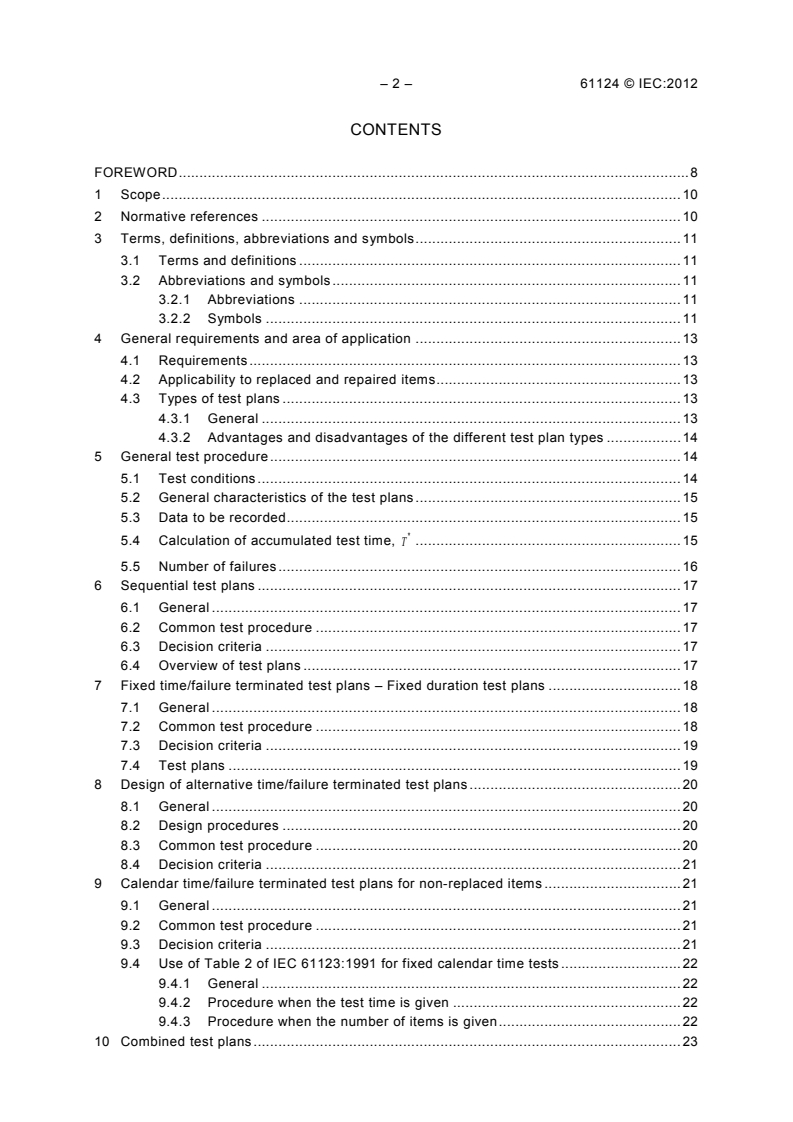
– 2 – 61124 © IEC:2012
CONTENTS
FOREWORD . 8
1 Scope . 10
2 Normative references . 10
3 Terms, definitions, abbreviations and symbols . 11
3.1 Terms and definitions . 11
3.2 Abbreviations and symbols . 11
3.2.1 Abbreviations . 11
3.2.2 Symbols . 11
4 General requirements and area of application . 13
4.1 Requirements . 13
4.2 Applicability to replaced and repaired items . 13
4.3 Types of test plans . 13
4.3.1 General . 13
4.3.2 Advantages and disadvantages of the different test plan types . 14
5 General test procedure . 14
5.1 Test conditions . 14
5.2 General characteristics of the test plans . 15
5.3 Data to be recorded . 15
*
5.4 Calculation of accumulated test time, T . 15
5.5 Number of failures . 16
6 Sequential test plans . 17
6.1 General . 17
6.2 Common test procedure . 17
6.3 Decision criteria . 17
6.4 Overview of test plans . 17
7 Fixed time/failure terminated test plans – Fixed duration test plans . 18
7.1 General . 18
7.2 Common test procedure . 18
7.3 Decision criteria . 19
7.4 Test plans . 19
8 Design of alternative time/failure terminated test plans . 20
8.1 General . 20
8.2 Design procedures . 20
8.3 Common test procedure . 20
8.4 Decision criteria . 21
9 Calendar time/failure terminated test plans for non-replaced items . 21
9.1 General . 21
9.2 Common test procedure . 21
9.3 Decision criteria . 21
9.4 Use of Table 2 of IEC 61123:1991 for fixed calendar time tests . 22
9.4.1 General . 22
9.4.2 Procedure when the test time is given . 22
9.4.3 Procedure when the number of items is given . 22
10 Combined test plans . 23
61124 © IEC:2012 – 3 –
10.1 General . 23
10.2 Common test procedure . 23
10.3 Decision criteria . 23
10.4 Test plans . 24
11 Performing the test . 24
12 Presentation of results . 24
Annex A (normative) Tables and graphs for sequential test plans . 25
Annex B (normative) Graphs for fixed time/failure terminated test plans . 44
Annex C (normative) Graphs for alternative time/failure terminated test plans . 53
Annex D (normative) Tables and graphs for combined test plans and additional
sequential test plans . 60
Annex E (informative) Examples and mathematical references for sequential test
plans . 78
Annex F (informative) Design of sequential test plans using a common spreadsheet
program . 86
Annex G (informative) Examples and mathematical references for fixed time/failure
terminated test plans – Fixed duration test plans . 97
Annex H (informative) Design of fixed duration time/failure terminated test plans using
a spreadsheet program . 99
Annex I (informative) Examples and mathematical references for the design of
alternative time/failure terminated test plans . 105
Annex J (informative) Examples and mathematical references for the calendar time
terminated test plans . 112
Annex K (informative) Derivation and mathematical reference for the optimized test
plans of GOST R 27 402 . 114
Bibliography . 122
Figure A.1 – Accept and reject lines for test plan A.1 . 25
Figure A.2 – Test plan A.1 – Operating characteristic curve . 26
Figure A.3 – Test plan A.1 – Expected accumulated test time to decision . 27
Figure A.4 – Accept and reject lines for test plan A.2 . 27
Figure A.5 – Test plan A.2 – Operating characteristic curve . 28
Figure A.6 – Test plan A.2 – Expected accumulated test time to decision . 29
Figure A.7 – Accept and reject lines for test plan A.3 . 29
Figure A.8 – Test plan A.3 – Operating characteristic curve . 30
Figure A.9 – Test plan A.3 – Expected accumulated test time to decision . 31
Figure A.10 – Accept and reject lines for test plan A.4 . 31
Figure A.11 – Test plan A.4 – Operating characteristic curve . 32
Figure A.12 – Test plan A.4 – Expected accumulated test time to decision . 33
Figure A.13 – Accept and reject lines for test plan A.5 . 33
Figure A.14 – Test plan A.5 – Operating characteristic curve . 34
Figure A.15 – Test plan A.5 – Expected accumulated test time to decision . 35
Figure A.16 – Accept and reject lines for test plan A.6 . 35
Figure A.17 – Test plan A.6 − Operating characteristic curve . 36
Figure A.18 – Test plan A.6 – Expected accumulated test time to decision . 37
Figure A.19 – Accept and reject lines for test plan A.7 . 37
– 4 – 61124 © IEC:2012
Figure A.20 – Test plan A.7 – Operating characteristic curve . 38
Figure A.21 – Test plan A.7 – Expected accumulated test time to decision . 39
Figure A.22 – Accept and reject lines for test plan A.8 . 40
Figure A.23 – Test plan A.8 – Operating characteristic curve . 41
Figure A.24 – Test plan A.8 – Expected accumulated test time to decision . 41
Figure A.25 – Accept and reject lines for test plan A.9 . 42
Figure A.26 – Test plan A.9 – Operating characteristic curve . 43
Figure A.27 – Test plan A.9 – Expected accumulated test time to decision . 43
Figure B.1 – Operating characteristic curves for test plans B.1, B.2, B.3 and B.4 . 44
Figure B.2 – Test plan B.1 – Expected test time to decision . 45
Figure B.3 – Test plan B.2 – Expected test time to decision . 45
Figure B.4 – Test plan B.3 – Expected test time to decision . 46
Figure B.5 – Test plan B.4 – Expected test time to decision . 46
Figure B.6 – Operating characteristic curves for test plans B.5, B.6, B.7 and B.8 . 47
Figure B.7 – Test plan B.5 – Expected test time to decision . 47
Figure B.8 – Test plan B.6 – Expected test time to decision . 48
Figure B.9 – Test plan B.7 – Expected test time to decision . 48
Figure B.10 – Test plan B.8 – Expected test time to decision . 49
Figure B.11 – Operating characteristic curves for test plans B.9, B.10 and B.11 . 49
Figure B.12 – Test plan B.9 – Expected test time to decision . 50
Figure B.13 – Test plan B.10 – Expected test time to decision . 50
Figure B.14 – Test plan B.11– Expected test time to decision . 51
Figure B.15 – Operating characteristic curves for test plans B.12 and B.13. 51
Figure B.16 – Test plan B.12 – Expected test time to decision . 52
Figure B.17 – Test plan B.13 – Expected test time to decision . 52
Figure C.1 – Discrimination ratio, D, and the acceptable number of failures, c = 0 to 8,
as a function of the expected number of failures, µ , for recommended values, 2,5 %,
5 %, 10 %, 20 %, and 30 % of α = β. 56
Figure C.2 – Operation characteristic curves for c = 0 to 8; probability of acceptance
P as a function of the (unknown) true expected number of failures, µ . 57
a 0
Figure C.3 – Discrimination ratio, D, as a function of the expected number of failures,
µ , for recommended values, 2,5 %, 5 %, 10 %, 15 %, 20 % and 30 % of α = β . 58
Figure C.4 – Acceptable number of failures, c, minus expected number of failures, µ
(Δµ = c – µ ) as a function of the expected number of failures µ for recommended
0 0 0
values 2,5 %, 5 %, 10 %, 20 %, and 30 % of α = β . 59
Figure D.1 – Accept and reject lines . 61
∗
Figure D.2 – Expected test time to decision T . 62
e
∗
Figure D.3 – Expected test time to decision of acceptance T (+) . 62
e
Figure D.4 – Operating characteristic P . 62
a
Figure D.5 – Accept and reject lines . 63
∗
T
Figure D.6 – Expected test time to decision . 64
e
∗
Figure D.7 – Expected test time to decision of acceptance T (+) . 64
e
Figure D.8 – Operating characteristic P . 64
a
61124 © IEC:2012 – 5 –
Figure D.9 – Accept and reject lines . 65
∗
Figure D.10 – Expected test time to decision T . 66
e
∗
Figure D.11 – Expected test time to decision of acceptance T (+) . 66
e
Figure D.12 – Operating characteristic P . 67
a
Figure D.13 – Accept and reject lines . 68
∗
Figure D.14 – Expected test time to decision T . 69
e
∗
Figure D.15 – Expected test time to decision of acceptance T (+) . 69
e
Figure D.16 – Operating characteristic P . 69
a
Figure D.17 – Accept and reject lines . 70
∗
Figure D.18 – Expected test time to decision T . 71
e
∗
T (+)
Figure D.19 – Expected test time to decision of acceptance . 71
e
Figure D.20 – Operating characteristic P . 71
a
Figure D.21 – Accept and reject lines . 72
∗
Figure D.22 – Expected test time to decision T . 73
e
∗
Figure D.23 – Expected test time to decision of acceptance T (+) . 73
e
Figure D.24 – Operating characteristic P . 73
a
Figure D.25 – Accept and reject lines . 74
∗
Figure D.26 – Expected test time to decision . 74
T
e
∗
Figure D.27 – Expected test time to decision of acceptance . 74
T (+)
e
Figure D.28 – Operating characteristic P . 75
a
Figure D.29 – Accept and reject lines . 75
*
Figure D.30 – Expected test time to decision T . 76
e
∗
Figure D.31 – Expected test time to decision of acceptance T (+) . 76
e
Figure D.32 – Operating characteristic P . 76
a
Figure E.1 – Example of a sequential test using test plan A.3 – α = β = 10 %, D = 3,
T *
= 1,11×10 h; r versus . 80
m
mo
Figure F.1 – SPRT spreadsheet graphing example . 92
Figure F.2 – OC curve for probability of acceptance, P . 95
a
Figure F.3 – Expected test time for making a decision . 95
Figure H.1 – OC curve plotted from the spreadsheet calculations . 104
Figure K.1 – Test plan types and terminology . 115
Figure K.2 – Principle of test plans . 117
Figure K.3 – Partitioning of the test plan graph . 117
Figure K.4 – Interior nodes and border nodes . 118
Figure K.5 – Paths to the accept line . 118
Figure K.6 – Paths to the reject line . 118
Figure K.7 – Probabilities of paths transfer between nodes . 119
– 6 – 61124 © IEC:2012
Figure K.8 – The recurrent element – Two cases . 121
Table 1 – Advantages and disadvantages for the different test plan types . 14
Table 2 – Overview of the sequential test plans given in Annex A and D . 18
Table 3 – Fixed time/failure terminated test plans . 19
Table 4 – Combined test plans in Annex D . 24
Table A.1 – Accept and reject lines for test plan A.1 . 26
Table A.2 – Accept and reject lines for test plan A.2 . 28
Table A.3 – Accept and reject lines for test plan A.3 . 30
Table A.4 – Accept and reject lines for test plan A.4 . 32
Table A.5 – Accept and reject lines for test plan A.5 . 34
Table A.6 – Accept and reject lines for test plan A.6 . 36
Table A.7 – Accept and reject lines for test plan A.7 . 38
Table A.8 – Accept and reject lines for test plan A.8 . 40
Table A.9 – Accept and reject lines for test plan A.9 . 42
Table D.1 – Sequential test plans in this annex . 60
Table D.2 – Combined test plans in this annex . 60
Table D.3 – Accept and reject lines . 61
Table D.4 – Expected test time to decision and operating characteristic P . 62
a
Table D.5 – Accept and reject lines . 63
Table D.6 – Expected test time to decision and operating characteristic P . 65
a
Table D.7 – Accept and reject lines . 66
Table D.8 – Expected test time to decision and operating characteristic P . 67
a
Table D.9 – Accept and reject lines . 68
Table D.10 – Expected test time to decision and operating characteristic P . 69
a
Table D.11 – Accept and reject lines . 70
Table D.12 – Expected test time to decision and operating characteristic P . 71
a
Table D.13 – Accept and reject lines . 72
Table D.14 – Expected test time to decision and operating characteristic P . 73
a
Table D.15 – Accept and reject lines . 74
Table D.16 – Expected test time to decision and operating characteristic P . 75
a
Table D.17 – Accept and reject lines . 76
Table D.18 – Expected test time to decision and operating characteristic P . 77
a
Table E.1 – Example for a sequential test using test plan A.3 (with example data) . 80
Table E.2 – Constants for border line formulae and their coordinates for sequential test
plans A.1 to A.9 . 85
Table F.1 – Beginning of the spreadsheet prepared to obtain a sequential test graph . 87
Table F.2 – Continuation of parameters calculation for the lines necessary for the
SPRT graph . 88
Table F.3 – Calculations of accept and reject line for the SPRT graph . 88
Table F.4 – Determination of the test termination time . 89
Table F.5 – Formulae for accept and reject line along with the test termination . 91
Table F.6 – Spreadsheet set-up for construction of the OC curves for the SPRT . 94
61124 © IEC:2012 – 7 –
Table H.1 – Set-up of the spreadsheet with embedded formulae – Example . 100
Table H.2 – Formulae embedded into the spreadsheet shown in Table H.1 . 101
Table H.3 – OC curve for the time/failure terminated fixed duration test . 103
Table I.1 – Cumulative normal distribution for fixed u values . 111
γ
Table I.2 – Inverse cumulative normal distribution for fixed 1–γ values . 111
– 8 – 61124 © IEC:2012
INTERNATIONAL ELECTROTECHNICAL COMMISSION
____________
RELIABILITY TESTING –
COMPLIANCE TESTS FOR CONSTANT FAILURE RATE
AND CONSTANT FAILURE INTENSITY
FOREWORD
1) The International Electrotechnical Commission (IEC) is a worldwide organization for standardization comprising
all national electrotechnical committees (IEC National Committees). The object of IEC is to promote
international co-operation on all questions concerning standardization in the electrical and electronic fields. To
this end and in addition to other activities, IEC publishes International Standards, Technical Specifications,
Technical Reports, Publicly Available Specifications (PAS) and Guides (hereafter referred to as “IEC
Publication(s)”). Their preparation is entrusted to technical committees; any IEC National Committee interested
in the subject dealt with may participate in this preparatory work. International, governmental and non-
governmental organizations liaising with the IEC also participate in this preparation. IEC collaborates closely
with the International Organization for Standardization (ISO) in accordance with conditions determined by
agreement between the two organizations.
2) The formal decisions or agreements of IEC on technical matters express, as nearly as possible, an international
consensus of opinion on the relevant subjects since each technical committee has representation from all
interested IEC National Committees.
3) IEC Publications have the form of recommendations for international use and are accepted by IEC National
Committees in that sense. While all reasonable efforts are made to ensure that the technical content of IEC
Publications is accurate, IEC cannot be held responsible for the way in which they are used or for any
misinterpretation by any end user.
4) In order to promote international uniformity, IEC National Committees undertake to apply IEC Publications
transparently to the maximum extent possible in their national and regional publications. Any divergence
between any IEC Publication and the corresponding national or regional publication shall be clearly indicated in
the latter.
5) IEC itself does not provide any attestation of conformity. Independent certification bodies provide conformity
assessment services and, in some areas, access to IEC marks of conformity. IEC is not responsible for any
services carried out by independent certification bodies.
6) All users should ensure that they have the latest edition of this publication.
7) No liability shall attach to IEC or its directors, employees, servants or agents including individual experts and
members of its technical committees and IEC National Committees for any personal injury, property damage or
other damage of any nature whatsoever, whether direct or indirect, or for costs (including legal fees) and
expenses arising out of the publication, use of, or reliance upon, this IEC Publication or any other IEC
Publications.
8) Attention is drawn to the Normative references cited in this publication. Use of the referenced publications is
indispensable for the correct application of this publication.
9) Attention is drawn to the possibility that some of the elements of this IEC Publication may be the subject of
patent rights. IEC shall not be held responsible for identifying any or all such patent rights.
International Standard IEC 61124 has been prepared by IEC technical committee 56:
Dependability.
This third edition of IEC 61124 cancels and replaces the second edition, published in 2006,
and constitutes a technical revision.
The main changes with respect to the previous edition are as follows:
– A number of new test plans have been added based on the Russian standard GOST R
27.402 [1] , and it is intended to align the new edition of MIL-HDBK-781 [2] with this
edition. Algorithms for optimizing test plans using a spreadsheet program are given and a
number of optimized test plans are listed. Furthermore, emphasis is laid on the fact that
the test should be repeated following design changes.
———————
Figures in square brackets refer to the bibliography.
61124 © IEC:2012 – 9 –
– Discrepancies in test plans A, B as well as Annexes A and B that originated in IEC 60605-
7 [3], now withdrawn, have been corrected so these test plans differ from those given in
previous editions of IEC 61124. As requested by the National Committees, mathematical
background material and spreadsheet program information has been moved to informative
annexes. In addition, the symbol lists have been divided, so that some annexes have
separate lists of symbols.
– Guidance on how to choose test plans has been added as well as guidance on how to use
spreadsheet programs to create them. Test plans A.1 to A.9 and B.1 to B.13 have been
corrected.
– Subclauses 8.1, 8.2, 8.3, Clause 9, Annex C, Clauses G.2, I.2, I.3 and Annex J are
unchanged, except for updated terminology and references.
– Corrections to the second edition proposed by National Committees have been
implemented.
The text of this standard is based on the following documents:
FDIS Report on voting
56/1461/FDIS 56/1468/RVD
Full information on the voting for the approval of this standard can be found in the report on
voting indicated in the above table.
This publication has been drafted in accordance with the ISO/IEC Directives, Part 2.
The committee has decided that the contents of this publication will remain unchanged until
the stability date indicated on the IEC web site under "http://webstore.iec.ch" in the data
related to the specific publication. At this date, the publication will be
• reconfirmed,
• withdrawn,
• replaced by a revised edition, or
• amended.
The contents of the corrigendum of January 2013 have been included in this copy.
IMPORTANT – The 'colour inside' logo on the cover page of this publication indicates
that it contains colours which are considered to be useful for the correct
understanding of its contents. Users should therefore print this document using a
colour printer.
– 10 – 61124 © IEC:2012
RELIABILITY TESTING –
COMPLIANCE TESTS FOR CONSTANT FAILURE RATE
AND CONSTANT FAILURE INTENSITY
1 Scope
This International Standard gives a number of optimized test plans, the corresponding
operating characteristic curves and expected test times. In addition the algorithms for
designing test plans using a spreadsheet program are also given, together with guidance on
how to choose test plans.
This standard specifies procedures to test whether an observed value of
– failure rate,
– failure intensity,
– mean time to failure (MTTF),
– mean operating time between failures (MTBF),
conforms to a given requirement.
It is assumed, except where otherwise stated, that during the accumulated test time, the times
to failure or the operating times between failures are independent and identically
exponentially distributed. This assumption implies that the failure rate or failure intensity is
constant.
Four types of test plans are described as follows:
– truncated sequential tests;
– time/failure terminated tests;
– fixed calendar time terminated tests without replacement;
– combined test plans.
This standard does not cover guidance on how to plan, perform, analyse and report a test.
This information can be found in IEC 60300-3-5.
This standard does not describe test conditions. This information can be found in IEC 60605-2
and in IEC 60300-3-5.
2 Normative references
The following documents, in whole or in part, are normatively referenced in this document and
are indispensable for its application. For dated references, only the edition cited applies. For
undated references, the latest edition of the referenced document (including any
amendments) applies.
IEC 60050-191, International Electrotechnical Vocabulary (IEV) – Chapter 191: Dependability
and quality of service
IEC 60300-3-5:2001, Dependability management – Part 3-5: Application guide – Reliability
test conditions and statistical test principles
61124 © IEC:2012 – 11 –
IEC 60605-2, Equipment reliability testing – Part 2: Design of test cycles
IEC 60605-4:2001, Equipment reliability testing – Part 4: Statistical procedures for
exponential distribution – Point estimates, confidence intervals, prediction intervals and
tolerance intervals
IEC 60605-6, Equipment reliability testing – Part-6: Tests for the validity and estimation of the
constant failure rate and constant failure intensity
IEC 61123:1991, Reliability testing – Compliance test plans for success ratio
3 Terms, definitions, abbreviations and symbols
3.1 Terms and definitions
For the purposes of this document the terms and definitions given in IEC 60050-191 apply.
The terms "failure rate" and "failure intensity" are used as meaning constant failure rate and
constant failure intensity.
3.2 Abbreviations and symbols
3.2.1 Abbreviations
MTBF mean operating time between failures
MTTF mean time to failure
OC operating characteristic
SPRT sequential probability ratio test (in some literature called probability ratio sequential
test (PRST)).
3.2.2 Symbols
The generic symbol λ is used in the following for failure rate and failure intensity.
The symbol m is used to denote both the following reliability measures:
– mean operating time between failures, MTBF;
– mean time to failure, MTTF.
When used, the relationship between the above quantities, under the given assumptions, is:
λ =
m
Sequential test plans (see Clause 6) and fixed time/failure terminated test plans (see
Clause 7) are based on m as a reliability measure, thus in these cases:
m =
λ
c acceptable number of failures during the test
discrimination ratio; D = m m or D = λ λ
D
0 1 1 0
k summation variable for failures
– 12 – 61124 © IEC:2012
MTBF mean operating time between failures
MTTF mean time to failure
m true MTBF or MTTF
m specified MTTF or MTBF m = 1 λ (design goal)
0 0 0
m lower limit for MTTF or MTBF m = 1 λ
1 1 1
n number of test items at the beginning of the test
P
probability of acceptance
a
p
acceptable failure ratio
q acceptable success ratio, q = 1 – p
0 0 0
R(t) reliability at time t
observed number of failures during the test
r
r
test truncation failure number for sequential tests (SPRT)
*
T accumulated test time
*
accumulated test time stated as accept criterion
T
a
T * minimum test time for r = 0 stated as accept criterion
a, min
*
T expected accumulated test time to decision
e
∗
T (+) expected accumulated test time to acceptance
e
*
T accumulated test time stated as reject criterion
r
*
T accumulated test time stated as termination criterion
t
t test time
∗
test truncation time
t
∗
test time for each test item (assumed here to be the same for all test items)
t
t
t
life time of failed item i
i
*
t calendar test time stated as termination criterion
cal, t
P(r)
probability of r failures
∆µ auxiliary quantity for determination of c, ∆µ = c − µ
0 0 0
α nominal producer’s risk (type I risk)
α′
true producer’s risk (type I risk)
β
nominal consumer’s risk (type II risk)
β ′
true consumer’s risk (type II risk)
λ true failure rate per item
λ
expected failure rate per item (design goal)
λ
upper limit for constant failure rate per item
61124 © IEC:2012 – 13 –
µ
expected number of failures during the test at the true λ
NOTE µ is not necessarily an integer.
µ expected number of failures during the test at the specified λ as parameter of the
0 0
∗ ∗
Poisson distribution µ = T / m = λ T
0 t 0 0 t
4 General requirements and area of application
4.1 Requirements
It is assumed, except where otherwise stated, that during the accumulated test time the times
to failure or the operating times between failures are independent, and identically
exponentially distributed. This assumption implies that the failure rate or failure intensity is
constant. Under this assumption there is no difference between failure rate and failure
intensity. Therefore they are both called λ and referred to in the following as failure rate.
It is assumed that the requirement is specified in one of the terms: the acceptable constant
failure rate λ , or the acceptable mean number of failures per time unit, λ or the acceptable
0 0
mean time to failure or mean operating time between failures, m .
If it is necessary to test the constant failure rate/constant failure intensity assumption, the
procedures given in IEC 60605-6 should be used.
4.2 Applicability to replaced and repaired items
The sequential test plans (see Clause 6), the time/failure terminated test plans (see Clause 7)
and the combined test plans (see Clause 10) are applicable to the following:
– replacement of failed items;
– without replacement of failed items;
under the assumption that
– an item can be replaced by repair of the item itself;
– the accumulated test time is calculated as elapsed operating item-time, in accordance
with 5.4;
– replaced items belong to the same population as the original items;
– repaired items can be considered to have the same failure intensity after repair as they
had before they failed.
The calendar time/failure terminated test plans in Clause 9, however, are applicable to c
...