

IEC 61249-4-16:2009
(Main)Materials for printed boards and other interconnecting structures - Part 4-16: Sectional specification set for prepreg materials, unclad (for the manufacture of multilayer boards) - Multifunctional non-halogenated epoxide woven E-glass prepreg of defined flammability (vertical burning test) for lead-free assembly
General Information
- Abstract
IEC 61249-4-16:2009 gives requirements for properties of prepreg that are mainly intended to be used as bonding sheets in connection with laminates according IEC 61249-2-37 when manufacturing multilayer boards according to IEC 62326-4. Multilayer boards comprised of these materials are suitable for lead-free assembly processes. This material may also be used to bond other types of laminates. Prepreg according to this standard is of defined flammability (vertical burning test). The flammability rating on fully cured prepreg is achieved through the use of non-halogenated flame retardants contained as an integral part of the polymeric structure. After curing of the prepreg according to the supplier's instructions, the glass transition temperature is defined to be 150 °C and 200 °C.
- Status
- Published
- Publication Date
- 25-May-2009
- Technical Committee
- TC 91 - Electronics assembly technology
- Drafting Committee
- WG 4 - TC 91/WG 4
- Current Stage
- PPUB - Publication issued
- Start Date
- 26-May-2009
- Completion Date
- 15-Jun-2009
Buy Documents
IEC 61249-4-16:2009 - Materials for printed boards and other interconnecting structures - Part 4-16: Sectional specification set for prepreg materials, unclad (for the manufacture of multilayer boards) - Multifunctional non-halogenated epoxide woven E-glass prepreg of defined flammability (vertical burning test) for lead-free assembly Released:5/26/2009
IEC 61249-4-16:2009 - Materials for printed boards and other interconnecting structures - Part 4-16: Sectional specification set for prepreg materials, unclad (for the manufacture of multilayer boards) - Multifunctional non-halogenated epoxide woven E-glass prepreg of defined flammability (vertical burning test) for lead-free assembly Released:5/26/2009
Overview
IEC 61249-4-16:2009 specifies requirements for unclad prepreg materials used as bonding sheets in the manufacture of rigid multilayer printed boards (PCBs), specifically targeting materials suitable for lead-free assembly. The standard covers a multifunctional non‑halogenated epoxide resin system impregnated into woven E‑glass reinforcement, with defined flammability performance assessed by the vertical burning test. After supplier-recommended cure, the prepreg’s glass transition temperature (Tg) is specified at 150 °C and 200 °C (as applicable per product class).
Key topics and technical requirements
- Material construction
- Woven E‑glass reinforcement impregnated with modified non‑halogenated epoxide resin (B‑stage prepreg).
- Resin system limits: maximum total halogens 1500 ppm; max chlorine 900 ppm, max bromine 900 ppm.
- Curing agent restriction: dicyandiamide is not permitted.
- Flammability
- Defined flammability rating based on the vertical burning test; flame retardancy achieved as an integral part of the polymeric structure.
- B‑stage (uncured) properties
- Typical characteristics used for qualification: resin content, treated weight, resin flow, scaled flow thickness, melting viscosity, gel time, volatile content.
- Post‑cure properties
- Electrical strength, relative permittivity and dissipation factor, cured thickness, Tg, decomposition temperature, thermal resistance, Z‑axis expansion.
- Appearance and workmanship limits
- Defect tolerances (examples): no dewetted areas >10 mm; up to 10 fish‑eye defects ≤10 mm per 300×300 mm; distortion of weave yarns ≤10% over 300 mm; edge resin loss due to cutting ≤2 mm.
- Supply, QA and logistics
- Delivery forms: rolls, sheets, cut panels. Requirements include qualification inspection, quality conformance inspection, certificate of conformance, safety data sheet and shelf‑life/packaging provisions.
Applications and who uses the standard
IEC 61249-4-16 is intended for:
- PCB laminate and prepreg manufacturers qualifying materials for multilayer boards.
- PCB fabricators and EMS providers selecting bonding sheets for lead‑free assembly processes.
- OEMs, design engineers and procurement teams specifying material performance for high‑reliability multilayer PCBs.
- Quality, compliance and R&D engineers verifying flammability, thermal and electrical properties for product certification and process compatibility.
Practical benefits include consistent material selection for lead‑free assembly, reliable flammability performance, and standardized acceptance criteria for multilayer PCB production.
Related standards
- IEC 61249-2-37 (reinforced base materials/clad laminates for lead‑free assembly)
- IEC 62326-4 (rigid multilayer printed boards - sectional specification)
- IEC 61189-2 (test methods for electrical materials and printed boards)
- ISO 11014-1 (safety data sheet content)
Buy Documents
IEC 61249-4-16:2009 - Materials for printed boards and other interconnecting structures - Part 4-16: Sectional specification set for prepreg materials, unclad (for the manufacture of multilayer boards) - Multifunctional non-halogenated epoxide woven E-glass prepreg of defined flammability (vertical burning test) for lead-free assembly Released:5/26/2009
IEC 61249-4-16:2009 - Materials for printed boards and other interconnecting structures - Part 4-16: Sectional specification set for prepreg materials, unclad (for the manufacture of multilayer boards) - Multifunctional non-halogenated epoxide woven E-glass prepreg of defined flammability (vertical burning test) for lead-free assembly Released:5/26/2009
Frequently Asked Questions
IEC 61249-4-16:2009 is a standard published by the International Electrotechnical Commission (IEC). Its full title is "Materials for printed boards and other interconnecting structures - Part 4-16: Sectional specification set for prepreg materials, unclad (for the manufacture of multilayer boards) - Multifunctional non-halogenated epoxide woven E-glass prepreg of defined flammability (vertical burning test) for lead-free assembly". This standard covers: IEC 61249-4-16:2009 gives requirements for properties of prepreg that are mainly intended to be used as bonding sheets in connection with laminates according IEC 61249-2-37 when manufacturing multilayer boards according to IEC 62326-4. Multilayer boards comprised of these materials are suitable for lead-free assembly processes. This material may also be used to bond other types of laminates. Prepreg according to this standard is of defined flammability (vertical burning test). The flammability rating on fully cured prepreg is achieved through the use of non-halogenated flame retardants contained as an integral part of the polymeric structure. After curing of the prepreg according to the supplier's instructions, the glass transition temperature is defined to be 150 °C and 200 °C.
IEC 61249-4-16:2009 gives requirements for properties of prepreg that are mainly intended to be used as bonding sheets in connection with laminates according IEC 61249-2-37 when manufacturing multilayer boards according to IEC 62326-4. Multilayer boards comprised of these materials are suitable for lead-free assembly processes. This material may also be used to bond other types of laminates. Prepreg according to this standard is of defined flammability (vertical burning test). The flammability rating on fully cured prepreg is achieved through the use of non-halogenated flame retardants contained as an integral part of the polymeric structure. After curing of the prepreg according to the supplier's instructions, the glass transition temperature is defined to be 150 °C and 200 °C.
IEC 61249-4-16:2009 is classified under the following ICS (International Classification for Standards) categories: 31.180 - Printed circuits and boards. The ICS classification helps identify the subject area and facilitates finding related standards.
IEC 61249-4-16:2009 is available in PDF format for immediate download after purchase. The document can be added to your cart and obtained through the secure checkout process. Digital delivery ensures instant access to the complete standard document.
Standards Content (Sample)
IEC 61249-4-16 ®
Edition 1.0 2009-05
INTERNATIONAL
STANDARD
Materials for printed boards and other interconnecting structures –
Part 4-16: Sectional specification set for prepreg materials, unclad (for the
manufacture of multilayer boards) – Multifunctional non-halogenated epoxide
woven E-glass prepreg of defined flammability (vertical burning test) for lead-
free assembly
All rights reserved. Unless otherwise specified, no part of this publication may be reproduced or utilized in any form
or by any means, electronic or mechanical, including photocopying and microfilm, without permission in writing from
either IEC or IEC's member National Committee in the country of the requester.
If you have any questions about IEC copyright or have an enquiry about obtaining additional rights to this publication,
please contact the address below or your local IEC member National Committee for further information.
IEC Central Office
3, rue de Varembé
CH-1211 Geneva 20
Switzerland
Email: inmail@iec.ch
Web: www.iec.ch
About the IEC
The International Electrotechnical Commission (IEC) is the leading global organization that prepares and publishes
International Standards for all electrical, electronic and related technologies.
About IEC publications
The technical content of IEC publications is kept under constant review by the IEC. Please make sure that you have the
latest edition, a corrigenda or an amendment might have been published.
ƒ Catalogue of IEC publications: www.iec.ch/searchpub
The IEC on-line Catalogue enables you to search by a variety of criteria (reference number, text, technical committee,…).
It also gives information on projects, withdrawn and replaced publications.
ƒ IEC Just Published: www.iec.ch/online_news/justpub
Stay up to date on all new IEC publications. Just Published details twice a month all new publications released. Available
on-line and also by email.
ƒ Electropedia: www.electropedia.org
The world's leading online dictionary of electronic and electrical terms containing more than 20 000 terms and definitions
in English and French, with equivalent terms in additional languages. Also known as the International Electrotechnical
Vocabulary online.
ƒ Customer Service Centre: www.iec.ch/webstore/custserv
If you wish to give us your feedback on this publication or need further assistance, please visit the Customer Service
Centre FAQ or contact us:
Email: csc@iec.ch
Tel.: +41 22 919 02 11
Fax: +41 22 919 03 00
IEC 61249-4-16 ®
Edition 1.0 2009-05
INTERNATIONAL
STANDARD
Materials for printed boards and other interconnecting structures –
Part 4-16: Sectional specification set for prepreg materials, unclad (for the
manufacture of multilayer boards) – Multifunctional non-halogenated epoxide
woven E-glass prepreg of defined flammability (vertical burning test) for lead-
free assembly
INTERNATIONAL
ELECTROTECHNICAL
COMMISSION
PRICE CODE
N
ICS 31.180 ISBN 978-2-88910-468-0
– 2 – 61249-4-16 © IEC:2009(E)
CONTENTS
FOREWORD.4
1 Scope.6
2 Normative references .6
3 Materials and construction.6
3.1 Reinforcement.6
3.2 Resin system.7
4 Properties.7
4.1 Properties related to the appearance of the prepreg .7
4.1.1 Dewetted areas (fish eyes) .7
4.1.2 Broken filaments.7
4.1.3 Distortion.7
4.1.4 Creases.7
4.1.5 Edge conditions.7
4.2 Properties related to B-stage prepreg.8
4.2.1 Resin content .8
4.2.2 Treated weight.8
4.2.3 Resin flow .8
4.2.4 Scaled flow thickness .8
4.2.5 Melting viscosity .9
4.2.6 Gel time.9
4.2.7 Volatile content.9
4.3 Properties related to prepreg after curing .9
4.3.1 Electric strength .9
4.3.2 Flammability .9
4.3.3 Relative permittivity and dissipation factor .10
4.3.4 Cured thickness.10
4.3.5 Glass transition temperature (Tg) .10
4.3.6 Decomposition temperature (Td).10
4.3.7 Thermal resistance .10
4.3.8 Z-axis expansion .10
5 Delivery form .11
5.1 Rolls.11
5.2 Sheets.11
5.3 Cut panels.11
6 Quality assurance.11
6.1 Quality system.11
6.2 Responsibility for inspection .11
6.3 Qualification inspection .11
6.4 Quality conformance inspection.12
6.5 Certificate of conformance.12
6.6 Safety data sheet .12
7 Packaging and marking .12
8 Shelf life.12
9 Ordering information.13
Bibliography.14
61249-4-16 © IEC:2009(E) – 3 –
Table 1 – Flammability, vertical burning test .9
Table 2 – Decomposition temperature requirements .10
Table 3 – Thermal resistance requirements .10
Table 4 – Z-axis expansion requirements.11
– 4 – 61249-4-16 © IEC:2009(E)
INTERNATIONAL ELECTROTECHNICAL COMMISSION
_____________
MATERIALS FOR PRINTED BOARDS AND
OTHER INTERCONNECTING STRUCTURES –
Part 4-16: Sectional specification set for prepreg materials,
unclad (for the manufacture of multilayer boards) –
Multifunctional non-halogenated epoxide woven E-glass prepreg
of defined flammability (vertical burning test) for lead-free assembly
FOREWORD
1) The International Electrotechnical Commission (IEC) is a worldwide organization for standardization comprising
all national electrotechnical committees (IEC National Committees). The object of IEC is to promote
international co-operation on all questions concerning standardization in the electrical and electronic fields. To
this end and in addition to other activities, IEC publishes International Standards, Technical Specifications,
Technical Reports, Publicly Available Specifications (PAS) and Guides (hereafter referred to as “IEC
Publication(s)”). Their preparation is entrusted to technical committees; any IEC National Committee interested
in the subject dealt with may participate in this preparatory work. International, governmental and non-
governmental organizations liaising with the IEC also participate in this preparation. IEC collaborates closely
with the International Organization for Standardization (ISO) in accordance with conditions determined by
agreement between the two organizations.
2) The formal decisions or agreements of IEC on technical matters express, as nearly as possible, an international
consensus of opinion on the relevant subjects since each technical committee has representation from all
interested IEC National Committees.
3) IEC Publications have the form of recommendations for international use and are accepted by IEC National
Committees in that sense. While all reasonable efforts are made to ensure that the technical content of IEC
Publications is accurate, IEC cannot be held responsible for the way in which they are used or for any
misinterpretation by any end user.
4) In order to promote international uniformity, IEC National Committees undertake to apply IEC Publications
transparently to the maximum extent possible in their national and regional publications. Any divergence
between any IEC Publication and the corresponding national or regional publication shall be clearly indicated in
the latter.
5) IEC provides no marking procedure to indicate its approval and cannot be rendered responsible for any
equipment declared to be in conformity with an IEC Publication.
6) All users should ensure that they have the latest edition of this publication.
7) No liability shall attach to IEC or its directors, employees, servants or agents including individual experts and
members of its technical committees and IEC National Committees for any personal injury, property damage or
other damage of any nature whatsoever, whether direct or indirect, or for costs (including legal fees) and
expenses arising out of the publication, use of, or reliance upon, this IEC Publication or any other IEC
Publications.
8) Attention is drawn to the Normative references cited in this publication. Use of the referenced publications is
indispensable for the correct application of this publication.
9) Attention is drawn to the possibility that some of the elements of this IEC Publication may be the subject of
patent rights. IEC shall not be held responsible for identifying any or all such patent rights.
International Standard IEC 61249-4-16 has been prepared by IEC technical committee 91:
Electronics assembly technology.
The text of this standard is based on the following documents:
FDIS Report on voting
91/852/FDIS 91/864/RVD
Full information on the voting for the approval of this standard can be found in the report on
voting indicated in the above table.
This publication has been drafted in accordance with the ISO/IEC Directives, Part 2.
61249-4-16 © IEC:2009(E) – 5 –
A list of all parts of the IEC 61249 series, under the general title Materials for printed boards
and other interconnecting structures, can be found on the IEC website.
The committee has decided that the contents of this publication will remain unchanged until
the maintenance result date indicated on the IEC web site under "http://webstore.iec.ch" in
the data related to the specific publication. At this date, the publication will be
• reconfirmed,
• withdrawn,
• replaced by a revised edition, or
• amended.
A bilingual version of this publication may be issued at a later date.
– 6 – 61249-4-16 © IEC:2009(E)
MATERIALS FOR PRINTED BOARDS AND
OTHER INTERCONNECTING STRUCTURES –
Part 4-16: Sectional specification set for prepreg materials,
unclad (for the manufacture of multilayer boards) –
Multifunctional non-halogenated epoxide woven E-glass prepreg
of defined flammability (vertical burning test) for lead-free assembly
1 Scope
This part of IEC 61249 gives requirements for properties of prepreg that are mainly intended
to be used as bonding sheets in connection with laminates according IEC 61249-2-37 when
manufacturing multilayer boards according to IEC 62326-4. Multilayer boards comprised of
these materials are suitable for lead-free assembly processes. This material may also be used
to bond other types of laminates.
Prepreg according to this standard is of defined flammability (vertical burning test). The
flammability rating on fully cured prepreg is achieved through the use of non-halogenated
flame retardants contained as an integral part of the polymeric structure. After curing of the
prepreg according to the supplier’s instructions, the glass transition temperature is defined to
be 150 °C and 200 °C.
2 Normative references
The following referenced documents are indispensable for the application of this document.
For dated references, only the edition cited applies. For undated references, the latest edition
of the referenced document (including any amendments) applies.
IEC 61189-2:2006, Test methods for electrical materials, printed boards and other
interconnection structures and assemblies – Part 2: Test methods for materials for
interconnection structures
IEC 61249-2-37, Materials for printed boards and other interconnecting structures –
Part 2-37: Reinforced base materials, clad and unclad – Modified non-hal
...
IEC 61249-4-16 ®
Edition 1.0 2009-05
INTERNATIONAL
STANDARD
NORME
INTERNATIONALE
Materials for printed boards and other interconnecting structures –
Part 4-16: Sectional specification set for prepreg materials, unclad (for the
manufacture of multilayer boards) – Multifunctional non-halogenated epoxide
woven E-glass prepreg of defined flammability (vertical burning test) for lead-
free assembly
Matériaux pour cartes imprimées et autres structures d'interconnexion –
Partie 4-16: Série de spécifications intermédiaires pour matériaux préimprégnés,
non plaqués (pour la fabrication des cartes multicouches) – Tissu de verre
époxyde préimprégné multifonctionnel non halogéné de type E d'inflammabilité
définie (essai de combustion verticale) destiné aux assemblages sans plomb
All rights reserved. Unless otherwise specified, no part of this publication may be reproduced or utilized in any form or by
any means, electronic or mechanical, including photocopying and microfilm, without permission in writing from either IEC or
IEC's member National Committee in the country of the requester.
If you have any questions about IEC copyright or have an enquiry about obtaining additional rights to this publication,
please contact the address below or your local IEC member National Committee for further information.
Droits de reproduction réservés. Sauf indication contraire, aucune partie de cette publication ne peut être reproduite
ni utilisée sous quelque forme que ce soit et par aucun procédé, électronique ou mécanique, y compris la photocopie
et les microfilms, sans l'accord écrit de la CEI ou du Comité national de la CEI du pays du demandeur.
Si vous avez des questions sur le copyright de la CEI ou si vous désirez obtenir des droits supplémentaires sur cette
publication, utilisez les coordonnées ci-après ou contactez le Comité national de la CEI de votre pays de résidence.
IEC Central Office
3, rue de Varembé
CH-1211 Geneva 20
Switzerland
Email: inmail@iec.ch
Web: www.iec.ch
About the IEC
The International Electrotechnical Commission (IEC) is the leading global organization that prepares and publishes
International Standards for all electrical, electronic and related technologies.
About IEC publications
The technical content of IEC publications is kept under constant review by the IEC. Please make sure that you have the
latest edition, a corrigenda or an amendment might have been published.
ƒ Catalogue of IEC publications: www.iec.ch/searchpub
The IEC on-line Catalogue enables you to search by a variety of criteria (reference number, text, technical committee,…).
It also gives information on projects, withdrawn and replaced publications.
ƒ IEC Just Published: www.iec.ch/online_news/justpub
Stay up to date on all new IEC publications. Just Published details twice a month all new publications released. Available
on-line and also by email.
ƒ Electropedia: www.electropedia.org
The world's leading online dictionary of electronic and electrical terms containing more than 20 000 terms and definitions
in English and French, with equivalent terms in additional languages. Also known as the International Electrotechnical
Vocabulary online.
ƒ Customer Service Centre: www.iec.ch/webstore/custserv
If you wish to give us your feedback on this publication or need further assistance, please visit the Customer Service
Centre FAQ or contact us:
Email: csc@iec.ch
Tel.: +41 22 919 02 11
Fax: +41 22 919 03 00
A propos de la CEI
La Commission Electrotechnique Internationale (CEI) est la première organisation mondiale qui élabore et publie des
normes internationales pour tout ce qui a trait à l'électricité, à l'électronique et aux technologies apparentées.
A propos des publications CEI
Le contenu technique des publications de la CEI est constamment revu. Veuillez vous assurer que vous possédez
l’édition la plus récente, un corrigendum ou amendement peut avoir été publié.
ƒ Catalogue des publications de la CEI: www.iec.ch/searchpub/cur_fut-f.htm
Le Catalogue en-ligne de la CEI vous permet d’effectuer des recherches en utilisant différents critères (numéro de référence,
texte, comité d’études,…). Il donne aussi des informations sur les projets et les publications retirées ou remplacées.
ƒ Just Published CEI: www.iec.ch/online_news/justpub
Restez informé sur les nouvelles publications de la CEI. Just Published détaille deux fois par mois les nouvelles
publications parues. Disponible en-ligne et aussi par email.
ƒ Electropedia: www.electropedia.org
Le premier dictionnaire en ligne au monde de termes électroniques et électriques. Il contient plus de 20 000 termes et
définitions en anglais et en français, ainsi que les termes équivalents dans les langues additionnelles. Egalement appelé
Vocabulaire Electrotechnique International en ligne.
ƒ Service Clients: www.iec.ch/webstore/custserv/custserv_entry-f.htm
Si vous désirez nous donner des commentaires sur cette publication ou si vous avez des questions, visitez le FAQ du
Service clients ou contactez-nous:
Email: csc@iec.ch
Tél.: +41 22 919 02 11
Fax: +41 22 919 03 00
IEC 61249-4-16 ®
Edition 1.0 2009-05
INTERNATIONAL
STANDARD
NORME
INTERNATIONALE
Materials for printed boards and other interconnecting structures –
Part 4-16: Sectional specification set for prepreg materials, unclad (for the
manufacture of multilayer boards) – Multifunctional non-halogenated epoxide
woven E-glass prepreg of defined flammability (vertical burning test) for lead-
free assembly
Matériaux pour cartes imprimées et autres structures d'interconnexion –
Partie 4-16: Série de spécifications intermédiaires pour matériaux préimprégnés,
non plaqués (pour la fabrication des cartes multicouches) – Tissu de verre
époxyde préimprégné multifonctionnel non halogéné de type E d'inflammabilité
définie (essai de combustion verticale) destiné aux assemblages sans plomb
INTERNATIONAL
ELECTROTECHNICAL
COMMISSION
COMMISSION
ELECTROTECHNIQUE
PRICE CODE
INTERNATIONALE
N
CODE PRIX
ICS 31.180 ISBN 978-2-88910-469-7
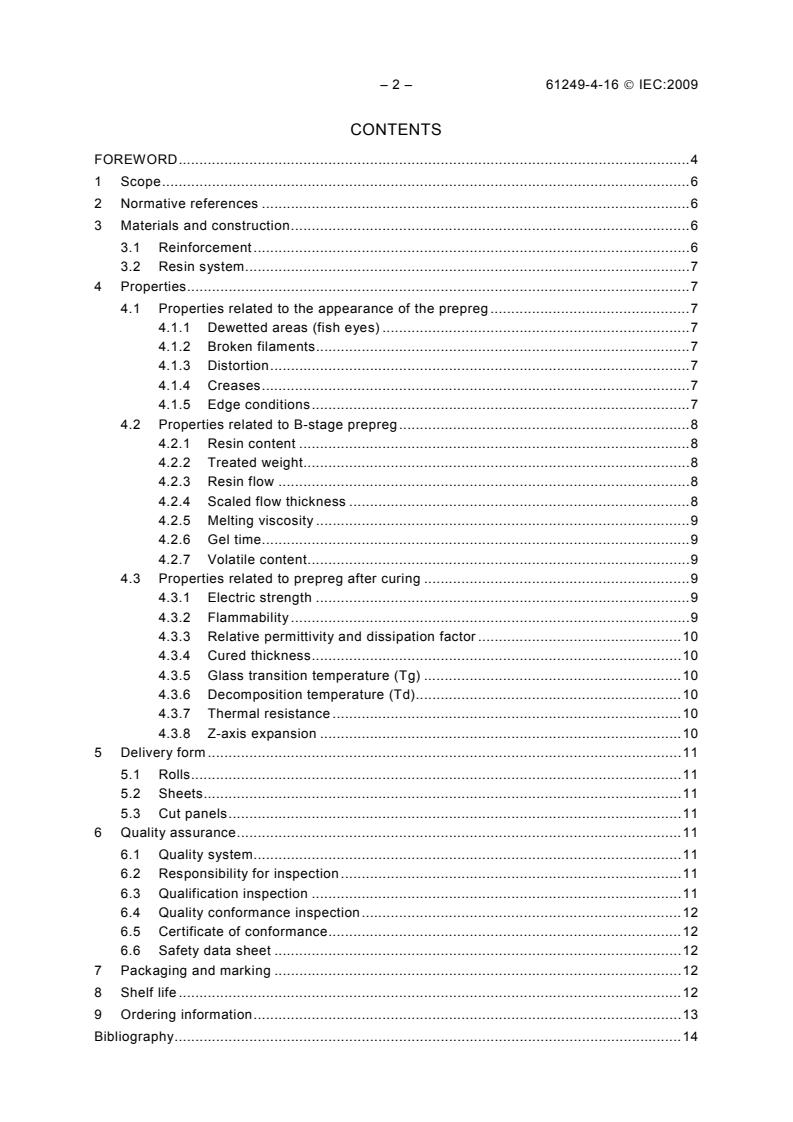
– 2 – 61249-4-16 © IEC:2009
CONTENTS
FOREWORD.4
1 Scope.6
2 Normative references .6
3 Materials and construction.6
3.1 Reinforcement.6
3.2 Resin system.7
4 Properties.7
4.1 Properties related to the appearance of the prepreg .7
4.1.1 Dewetted areas (fish eyes) .7
4.1.2 Broken filaments.7
4.1.3 Distortion.7
4.1.4 Creases.7
4.1.5 Edge conditions.7
4.2 Properties related to B-stage prepreg.8
4.2.1 Resin content .8
4.2.2 Treated weight.8
4.2.3 Resin flow .8
4.2.4 Scaled flow thickness .8
4.2.5 Melting viscosity .9
4.2.6 Gel time.9
4.2.7 Volatile content.9
4.3 Properties related to prepreg after curing .9
4.3.1 Electric strength .9
4.3.2 Flammability .9
4.3.3 Relative permittivity and dissipation factor .10
4.3.4 Cured thickness.10
4.3.5 Glass transition temperature (Tg) .10
4.3.6 Decomposition temperature (Td).10
4.3.7 Thermal resistance .10
4.3.8 Z-axis expansion .10
5 Delivery form .11
5.1 Rolls.11
5.2 Sheets.11
5.3 Cut panels.11
6 Quality assurance.11
6.1 Quality system.11
6.2 Responsibility for inspection .11
6.3 Qualification inspection .11
6.4 Quality conformance inspection.12
6.5 Certificate of conformance.12
6.6 Safety data sheet .12
7 Packaging and marking .12
8 Shelf life.12
9 Ordering information.13
Bibliography.14
61249-4-16 © IEC:2009 – 3 –
Table 1 – Flammability, vertical burning test .9
Table 2 – Decomposition temperature requirements .10
Table 3 – Thermal resistance requirements .10
Table 4 – Z-axis expansion requirements.11
– 4 – 61249-4-16 © IEC:2009
INTERNATIONAL ELECTROTECHNICAL COMMISSION
_____________
MATERIALS FOR PRINTED BOARDS AND
OTHER INTERCONNECTING STRUCTURES –
Part 4-16: Sectional specification set for prepreg materials,
unclad (for the manufacture of multilayer boards) –
Multifunctional non-halogenated epoxide woven E-glass prepreg
of defined flammability (vertical burning test) for lead-free assembly
FOREWORD
1) The International Electrotechnical Commission (IEC) is a worldwide organization for standardization comprising
all national electrotechnical committees (IEC National Committees). The object of IEC is to promote
international co-operation on all questions concerning standardization in the electrical and electronic fields. To
this end and in addition to other activities, IEC publishes International Standards, Technical Specifications,
Technical Reports, Publicly Available Specifications (PAS) and Guides (hereafter referred to as “IEC
Publication(s)”). Their preparation is entrusted to technical committees; any IEC National Committee interested
in the subject dealt with may participate in this preparatory work. International, governmental and non-
governmental organizations liaising with the IEC also participate in this preparation. IEC collaborates closely
with the International Organization for Standardization (ISO) in accordance with conditions determined by
agreement between the two organizations.
2) The formal decisions or agreements of IEC on technical matters express, as nearly as possible, an international
consensus of opinion on the relevant subjects since each technical committee has representation from all
interested IEC National Committees.
3) IEC Publications have the form of recommendations for international use and are accepted by IEC National
Committees in that sense. While all reasonable efforts are made to ensure that the technical content of IEC
Publications is accurate, IEC cannot be held responsible for the way in which they are used or for any
misinterpretation by any end user.
4) In order to promote international uniformity, IEC National Committees undertake to apply IEC Publications
transparently to the maximum extent possible in their national and regional publications. Any divergence
between any IEC Publication and the corresponding national or regional publication shall be clearly indicated in
the latter.
5) IEC itself does not provide any attestation of conformity. Independent certification bodies provide conformity
assessment services and, in some areas, access to IEC marks of conformity. IEC is not responsible for any
services carried out by independent certification bodies.
6) All users should ensure that they have the latest edition of this publication.
7) No liability shall attach to IEC or its directors, employees, servants or agents including individual experts and
members of its technical committees and IEC National Committees for any personal injury, property damage or
other damage of any nature whatsoever, whether direct or indirect, or for costs (including legal fees) and
expenses arising out of the publication, use of, or reliance upon, this IEC Publication or any other IEC
Publications.
8) Attention is drawn to the Normative references cited in this publication. Use of the referenced publications is
indispensable for the correct application of this publication.
9) Attention is drawn to the possibility that some of the elements of this IEC Publication may be the subject of
patent rights. IEC shall not be held responsible for identifying any or all such patent rights.
International Standard IEC 61249-4-16 has been prepared by IEC technical committee 91:
Electronics assembly technology.
The text of this standard is based on the following documents:
FDIS Report on voting
91/852/FDIS 91/864/RVD
Full information on the voting for the approval of this standard can be found in the report on
voting indicated in the above table.
This bilingual version, published in 2010-01, corresponds to the English version.
61249-4-16 © IEC:2009 – 5 –
This publication has been drafted in accordance with the ISO/IEC Directives, Part 2.
The French version of this standard has not been voted upon.
A list of all parts of the IEC 61249 series, under the general title Materials for printed boards
and other interconnecting structures, can be found on the IEC website.
The committee has decided that the contents of this publication will remain unchanged until
the maintenance result date indicated on the IEC web site under "http://webstore.iec.ch" in
the data related to the specific publication. At this date, the publication will be
• reconfirmed,
• withdrawn,
• replaced by a revised edition, or
• amended.
– 6 – 61249-4-16 © IEC:2009
MATERIALS FOR PRINTED BOARDS AND
OTHER INTERCONNECTING STRUCTURES –
Part 4-16: Sectional specification set for prepreg materials,
unclad (for the manufacture of multilayer boards) –
Multifunctional non-halogenated epoxide woven E-glass prepreg
of defined flammability (vertical burning test) for lead-free assembly
1 Scope
This part of IEC 61249 gives requirements for properties of prepreg that are mainly intended
to be used as bonding sheets in connection with laminates according IEC 61249-2-37 when
manufacturing multilayer boards according to IEC 62326-4. Multilayer boards comprised of
these materials are suitable for lead-free assembly processes. This material may also be used
to bond other types of laminates.
Prepreg according to this standard is of defined flammability (vertical burning test). The
flammability rating on fully cured prepreg is achieved through the use of non-halogenated
flame retardants contained as an integral part of the polymeric structure. After curing of the
prepreg according to the supplier’s instructions, the glass transition temperature is defined to
be 150 °C and 200 °C.
2 Normative references
The following referenced documents are indispensable for the application of this document.
For dated references, only the edition cited applies. For undated references, the latest edition
of the referenced document (including any amendments) applies.
IEC 61189-2:2006, Test methods for electrical materials, printed boards and other
interconnection structures and assemblies – Part 2: Test methods for materials for
interconnection structures
IEC 61249-2-37, Materials for printed boards and other interconnecting structures –
Part 2-37: Reinforced base materials, clad and unclad – Modified non-halogenated epoxide
woven E-glass laminate sheets of defined flammability (vertical burning test), copper-clad for
lead-free assembly
IEC 62326-4, Printed boards – Part 4: Rigid multilayer printed boards with interlayer
connections – Sectional specification
ISO 11014-1:1994, Safety data sheet for chemical products – Part 1: Content and order of
sections
3 Materials and construction
The prepreg consists of a reinforcing E-glass fabric which is impregnated modified epoxide
resin and partially cured to the B-stage.
3.1 Reinforcement
Woven E-glass as specified in the future IEC 61249-6-3 (under consideration), woven E-glass
fabric (for the manufacture of prepreg and copper-clad laminate).
61249-4-16 © IEC:2009 – 7 –
3.2 Resin system
Majority di-functional non-halogenated epoxide and modified non-halogenated epoxide with a
glass transition temperature after curing according to the manufacturer’s instructions of
150 °C to 200 °C. The maximum total halogens contained in the resin plus reinforcement
matrix is 1500 ppm with a maximum chlorine of 900 ppm and maximum bromine being
900 ppm.
The curing agent shall not be dicyandiamide. The flammability rating is achieved through the
use of bromine reacted into the polymer. Inorganic fillers may be used. Contrast agents may
be added to enhance processing such as automated optical inspection (AOI).
Its flame resistance is defined in terms of the flammability requirements of 4.3.2.
4 Properties
4.1 Properties related to the appearance of the prepreg
The prepreg shall be substantially free from defects that may have an impact on the material’s
fitness for use for the intended purpose.
For the following specific defects, the requirements of method 2V01 (under consideration) of
IEC 61189-2 will apply as soon as this test will be available.
4.1.1 Dewetted areas (fish eyes)
Dewetted areas with a diameter >10 mm are not permissible.
Dewetted areas with a diameter ≤10 mm are permitted to an extent of a maximum 10 fish
eyes in any 300 mm × 300 mm area of the prepreg.
4.1.2 Broken filaments
When judging the presence of broken filaments, not only are their size and frequency of
occurrence important for assessing acceptability, but the flow characteristic of the prepreg
shall also be taken into consideration. The acceptance conditions for broken filaments shall
be as agreed upon between user and supplier.
4.1.3 Distortion
When the prepreg will be tested in accordance with test method 2M29 (under consideration)
of IEC 61189-2, the distortion or non-perpendicular orientation of the fill or weft yarns in the
glass fabric shall not exceed 10 % measured over any 300 mm test distance.
4.1.4 Creases
Creases caused by handling of the prepreg where only a negligible loss of resin has occurred
are permitted.
Creases where the glass yarns are exposed due to loss of resin are not permitted.
4.1.5 Edge conditions
Cut-to-size panels shall have even edges and shall not show loss of resin at the edge due to
the cutting process of more than 2 mm. Excessive occurrence of resin dust released during
the cutting shall be removed before packaging for shipment.
– 8 – 61249-4-16 © IEC:2009
4.2 Properties related to B-stage prepreg
A number of characteristics can describe thickness, reactivity and rheology of B-stage
prepreg. The choice of characteristics to be used as qualification and quality conformance
testing as well as the nominal performance levels are as agreed upon between user and
supplier.
Several of the characteristics shown below are interrelated and should not be specified
individually. Ordering requirements should preferably be restricted to the glass style, one
characteristic marked (a) in combination with one characteristic marked (b). One or both of
the optional characteristic (c) of B-stage prepreg may be included.
Glass style
Thickness parameter
• Resin content (a)
• Treated weight (a)
Reactivity/rheology parameter
• Resin flow (b)
• Scaled flow thickness (b)
• Melt viscosity (b)
• Cured thickness (b)
Optional parameter
• Volatile content (c)
• Gel time (c)
4.2.1 Resin content
When tested in accordance with test method 2C03 or 2C10 of IEC 61189-2, the nominal resin
content shall be as agreed upon between user and supplier.
The tolerance around the ordered nominal value shall be ±3 %, e.g. (45 ± 3) %.
4.2.2 Treated weight
When tested in accordance with test method 2C03 of IEC 61189-2, the nominal treated weight
shall be as agreed upon between user and supplier.
The tolerance around the ordered nominal value shall be ±3 %, e.g. (350 ± 10,5) g.
4.2.3 Resin flow
When tested in accordance with test method 2M09 of IEC 61189-2, the nominal resin flow
shall be as agreed upon between user and supplier.
The tolerance around the ordered nominal value shall be ±5 %, e.g. (25 ± 5) %.
4.2.4 Scaled flow thickness
When tested in accordance with test method 2M26 of IEC 61189-2, the nominal scaled flow
and the tolerance shall be as agreed upon between user and supplier.
61249-4-16 © IEC:2009 – 9 –
4.2.5 Melting viscosity
When tested in accordance with test method 2C09 of IEC 61189-2, the nominal melt viscosity
shall be as agreed upon between user and supplier.
The tolerance around the ordered nominal value shall be ±20 m Pa s, e.g. (240 ± 20) m Pa s.
4.2.6 Gel time
When tested in accordance with test method 2C02 of IEC 61189-2, the nominal gel time shall
be as agreed upon between user and supplier.
The tolerance around the ordered nominal value shall be ±20 s, e.g. (160 ± 20) s.
4.2.7 Volatile content
When tested in accordance with test method 2C04 of IEC 61189-2, the volatile content shall
be 0,75 % maximum.
4.3 Properties related to prepreg after curing
4.3.1 Electric strength
A total of 2 plies of prepreg of minimum size 300 mm × 300 mm shall be bonded together and
cured in accordance with the manufacturer’s recommendations whereupon the thickness shall
be determined using a micrometer.
When tested in accordance with test method 2E11 of IEC 61189-2, the minimum electric
strength shall be 25 V/μm.
4.3.2 Flammability
A number of plies of minimum size 300 mm × 300 mm of the prepreg under test shall be
bonded together and fully cured in accordance with the manufacturer’s recommendations. The
number of plies shall be chosen so that a specimen thickness of approximately (0,4 to
0,5) mm is obtained as measured with a micrometer.
When tested in accordance with test method 2C06 of IEC 61189-2, the flammability shall be
as shown in Table 1.
Table 1 – Flammability, vertical burning test
Test method
Property Requirements
(IEC 61189-2)
Flammability 2C06 Designation
FV 0
Flaming combustion time after each
≤10 s
application of the flame for each test
specimen
Total flaming combustion time for the 10
≤50 s
flame applications for each set of five
specimens
Glowing combustion time after the second
≤30 s
removal of the test flame
Flaming or glowing combustion up to the
None
holding clamp
Dripping flaming particles that ignite the
None
tissue paper
– 10 – 61249-4-16 © IEC:2009
4.3.3 Relative permittivity and dissipation factor
A total of 2 plies of prepreg of minimum size 300 mm × 300 mm shall be bonded together and
fully cured in accordance with the manufacturer’s recommendations whereupon the thickness
shall be determined using a micrometer.
When tested in accordance with test method 2E10 of IEC 61189-2, the relative permittivity
and dissipation factor at 1 MHz shall be 5,4 and 0,035 maximum respectively.
4.3.4 Cured thickness
The nominal thickness and the tolerance of the cured prepreg shall be as agreed upon
between user and supplier. The prepreg under test shall be bonded together and fully cured in
accordance with the manufacturer’s recommendations. The test method shall be as agreed
upon between user and supplier.
4.3.5 Glass transition temperature (Tg)
The glass transition temperature of the cured prepreg shall be (150 – 200) °C as determined
by test method 2M10 or 2M11 of IEC 61189-2. The prepreg under test shall be bonded
together and fully cured in accordance with the manufacturer’s recommendations.
4.3.6 Decomposition temperature (Td)
The requirement for decomposition temperature is found in Table 2. The prepreg under test
shall be bonded together and fully cured in accordance with the manufacturer’s
recommendations.
Table 2 – Decomposition temperature requirements
Property Test method Requirements
(IEC 61189-2)
Decomposition temperature 2MXX
≥325 °C
4.3.7 Thermal resistance
The requirements for thermal resistance are found in Table 3. The prepreg under test shall be
bonded together and fully cured in accordance with the manufacturer’s recommendations. The
specimen shall not have copper foil on any layer.
Table 3 – Thermal resistance requirements
Property Test method Requirements
(IEC 61189-2)
T260 2MXX
≥30 min
T288
≥5 min
T300 TBD
4.3.8 Z-axis expansion
The requirements for Z-axis expansion are found in Table 4. The prepreg under test shall be
bonded together and fully cured in accordance with the manufacturer’s recommendations.
61249-4-16 © IEC:2009 – 11 –
Table 4 – Z-axis expansion requirements
Property Test method Requirements
(IEC 61189-2)
Z-axis alpha 1 2MXX
≤60 ppm / °C
Z-axis alpha 2 ≤300 ppm / °C
Z-axis % 50 °C to 260 °C 3,5 % maximum
5 Delivery form
Prepreg may be ordered and delivered as rolls, sheets or cut panels.
5.1 Rolls
Roll sizes shall be as agreed upon between user and supplier. For rolls ≥50 m in length, cut-
outs from quality conformance inspection are allowed. The size of the roll delivered by the
supplier shall not deviate by more than +20/-0 mm in the width and ±5 m in length from the
ordered size. Extra linear meters shall be added to compensate for any cut-outs for quality
conformance testing.
5.2 Sheets
Sheet sizes shall be as agreed upon between user and supplier. The size of the sheet
delivered shall not deviate by more than +20/-0 mm from the ordered size.
5.3 Cut panels
Cut panel sizes shall be as agreed upon between user and supplier. The size of the cut
panels delivered shall not deviate by more than ±3 mm from the ordered size.
6 Quality assurance
6.1 Quality system
The supplier shall operate a quality system, ISO 9000 or similar, to support quality
conformance inspection.
The supplier shall operate a quality system, ISO 14000 or similar, to support environmental
considerations.
6.2 Responsibility for inspection
The supplier is responsible for the inspection of the manufactured material. Inspection is
auditable by the purchaser or an appointed third party.
6.3 Qualification inspection
Prepregs furnished under this standard shall be qualified. Qualification testing shall be
performed to demonstrate the manufacturer’s ability to meet the requirements of this standard.
Qualification testing shall be conducted at a laboratory in compliance with IEC laboratory
requirements. The manufacturer shall retain on file the data which supports that the materials
meet this standard and shall be readily available for review upon request.
– 12 – 61249-4-16 © IEC:2009
6.4 Quality conformance inspection
The supplier shall operate a quality plan to assure product conformance to this standard.
Such a quality plan, when appropriate, should utilize statistical methods rather than lot-by-lot
inspection. It is the responsibility of the supplier based on the quality plan to determine the
frequency of test to assure conforming products.
A combination of the following techniques may be used to show compliance with the
requirements which can be used to reduce the frequency of testing. The data supporting the
reduction of testing frequency shall be available for review upon request.
– In process parameter control
– In process inspection
– Periodic final inspection
– Final lot inspection
6.5 Certificate of conformance
The supplier shall, on request from the purchaser, issue a certificate of conformance to this
standard in electronic or paper format.
6.6 Safety data sheet
A safety data sheet in accordance with ISO 11014-1 shall be available for products
manufactured and delivered in accordance with this standard.
7 Packaging and marking
Prepreg in rolls, sheets and cut panels shall be packaged in a manner which will provide
adequate protection against deterioration and physical damage during shipment and storage.
If not otherwise specified in the purchase order, prepreg shall be marked on the smallest
package with the manufacturer’s designation, lot number and date of manufacture.
The shipping container shall have a label that shall remain securely affixed and legible during
normal handling. Location of the label and the type of marking shall be as specified in the
drawing or ordering data, or if not specified shall be the supplier’s standard labelling and
marking. The following information is to be included:
a) type of material;
b) manufacturer’s designation;
c) lot number;
d) date of manufacture
e) quantity;
f) dimensions;
g) gross weight;
h) manufacturer’s name and address;
i) date of packaging.
8 Shelf life
Prepreg shall be capable of being stored at either of the described conditions below for the
specified time and still be fit for its intended use.
61249-4-16 © IEC:2009 – 13 –
Condition 1:
Temperature ≤5 °C, relative humidity not specified, minimum 6 months after shipping to the
customer.
Condition 2:
Temperature ≤20 °C, relative humidity ≤50 %, minimum 3 months after shipment to the
customer.
Prepreg should not be stored in a catalytic environment such as UV light or excessive
radiation. Material that has been stored at lower temperature should be allowed to equilibrate
to ambient temperature before the packaging
...