

IEC 62228-2:2016
(Main)Integrated circuits - EMC evaluation of transceivers - Part 2: LIN transceivers
General Information
- Abstract
IEC 62228-2:2016 specifies test and measurement methods for EMC evaluation of LIN transceiver ICs under network condition. It defines test configurations, test conditions, test signals, failure criteria, test procedures, test setups and test boards. It is applicable for standard LIN transceiver ICs and ICs with embedded LIN transceiver and covers:
- the emission of RF disturbances,
- the immunity against RF disturbances,
- the immunity against impulses and
- the immunity against electrostatic discharges (ESD).
- Status
- Published
- Publication Date
- 17-Nov-2016
- Technical Committee
- SC 47A - Integrated circuits
- Drafting Committee
- WG 9 - TC 47/SC 47A/WG 9
- Current Stage
- PPUB - Publication issued
- Start Date
- 18-Nov-2016
- Completion Date
- 15-Jan-2017
Overview
IEC 62228-2:2016 is an International Electrotechnical Commission (IEC) standard focused on integrated circuits (ICs), specifically defining methods for evaluating electromagnetic compatibility (EMC) of Local Interconnect Network (LIN) transceiver ICs under network conditions. The standard provides comprehensive guidelines for test setups, measurement procedures, conditions, and criteria to ensure that LIN transceivers meet EMC requirements in actual applications.
This standard applies to both standalone LIN transceiver ICs and ICs with embedded LIN transceivers, encompassing:
- RF emission (electromagnetic disturbances)
- Immunity against RF disturbances
- Immunity against impulses
- Immunity against electrostatic discharges (ESD)
IEC 62228-2:2016 provides a structured, reproducible framework for assessing the EMC performance of LIN transceivers-critical components in the automotive and electronics industries.
Key Topics
IEC 62228-2:2016 covers several core areas for EMC evaluation of LIN transceivers:
- Test Configurations: Defines required network and board setups for both powered operation and unpowered conditions, ensuring real-world relevance and repeatability.
- Test Signals: Specifies format, amplitude, frequency, and timing of signals for routine operation and wake-up modes to simulate normal LIN network communication.
- Test Methods: Details procedures and parameters for:
- Emission of RF disturbances via direct coupling methods
- RF immunity testing using direct RF power injection (DPI)
- Impulse immunity using non-synchronous transient injection
- ESD immunity tests aligned with automotive industry practices
- Failure and Evaluation Criteria: Establishes pass/fail conditions for each EMC test, covering both powered “functional” and unpowered “passive” modes.
- Test Boards and Setups: Recommends soldered ICs on purpose-designed boards to minimize artifacts and ensure consistency.
Applications
IEC 62228-2:2016 is directly relevant for:
- Automotive Electronics: LIN transceivers are key in automotive communication networks. Compliance with this standard ensures reliable in-vehicle communication, data transmission, and robust response to EMC disturbances.
- IC Design and Validation: Semiconductor manufacturers, design engineers, and testing labs use IEC 62228-2 to verify new or existing LIN transceiver products meet EMC requirements before production release.
- Automotive System Integration: Integrators and OEMs rely on standard-compliant LIN transceivers for safer, more reliable vehicles. The standard supports evaluations under realistic network conditions, including the effects of network filtering.
- Conformance and Certification: Ensures global consistency in product testing, certification, and regulatory submission.
The standard is indispensable for professionals targeting robust EMC performance in LIN-based systems, offering a reliable benchmark for automotive communication ICs.
Related Standards
IEC 62228-2:2016 references and aligns with several related international standards, including:
- IEC 61967-1 & IEC 61967-4 - Methods for measuring electromagnetic emissions from integrated circuits.
- IEC 62132-1 & IEC 62132-4 - Immunity measurement standards for ICs, including DPI techniques.
- IEC 62215-3 - Procedures for impulse immunity evaluation using non-synchronous transient injection.
- ISO 7637-2 - Automotive standard for electrical transients from conduction and coupling.
- ISO 10605 - Automotive test methods for immunity against electrostatic discharge (ESD).
- ISO 17987-6 - LIN network protocol conformance testing.
By following IEC 62228-2:2016 alongside these referenced standards, users ensure comprehensive, harmonized EMC testing of LIN transceivers for automotive and related electronic applications.
Frequently Asked Questions
IEC 62228-2:2016 is a standard published by the International Electrotechnical Commission (IEC). Its full title is "Integrated circuits - EMC evaluation of transceivers - Part 2: LIN transceivers". This standard covers: IEC 62228-2:2016 specifies test and measurement methods for EMC evaluation of LIN transceiver ICs under network condition. It defines test configurations, test conditions, test signals, failure criteria, test procedures, test setups and test boards. It is applicable for standard LIN transceiver ICs and ICs with embedded LIN transceiver and covers: - the emission of RF disturbances, - the immunity against RF disturbances, - the immunity against impulses and - the immunity against electrostatic discharges (ESD).
IEC 62228-2:2016 specifies test and measurement methods for EMC evaluation of LIN transceiver ICs under network condition. It defines test configurations, test conditions, test signals, failure criteria, test procedures, test setups and test boards. It is applicable for standard LIN transceiver ICs and ICs with embedded LIN transceiver and covers: - the emission of RF disturbances, - the immunity against RF disturbances, - the immunity against impulses and - the immunity against electrostatic discharges (ESD).
IEC 62228-2:2016 is classified under the following ICS (International Classification for Standards) categories: 31.200 - Integrated circuits. Microelectronics. The ICS classification helps identify the subject area and facilitates finding related standards.
IEC 62228-2:2016 is available in PDF format for immediate download after purchase. The document can be added to your cart and obtained through the secure checkout process. Digital delivery ensures instant access to the complete standard document.
Standards Content (Sample)
IEC 62228-2 ®
Edition 1.0 2016-11
INTERNATIONAL
STANDARD
NORME
INTERNATIONALE
colour
inside
Integrated circuits – EMC evaluation of transceivers –
Part 2: LIN transceivers
Circuits intégrés – Évaluation de la CEM des émetteurs-récepteurs –
Partie 2: Émetteurs-récepteurs LIN
All rights reserved. Unless otherwise specified, no part of this publication may be reproduced or utilized in any form
or by any means, electronic or mechanical, including photocopying and microfilm, without permission in writing from
either IEC or IEC's member National Committee in the country of the requester. If you have any questions about IEC
copyright or have an enquiry about obtaining additional rights to this publication, please contact the address below or
your local IEC member National Committee for further information.
Droits de reproduction réservés. Sauf indication contraire, aucune partie de cette publication ne peut être reproduite
ni utilisée sous quelque forme que ce soit et par aucun procédé, électronique ou mécanique, y compris la photocopie
et les microfilms, sans l'accord écrit de l'IEC ou du Comité national de l'IEC du pays du demandeur. Si vous avez des
questions sur le copyright de l'IEC ou si vous désirez obtenir des droits supplémentaires sur cette publication, utilisez
les coordonnées ci-après ou contactez le Comité national de l'IEC de votre pays de résidence.
IEC Central Office Tel.: +41 22 919 02 11
3, rue de Varembé Fax: +41 22 919 03 00
CH-1211 Geneva 20 info@iec.ch
Switzerland www.iec.ch
About the IEC
The International Electrotechnical Commission (IEC) is the leading global organization that prepares and publishes
International Standards for all electrical, electronic and related technologies.
About IEC publications
The technical content of IEC publications is kept under constant review by the IEC. Please make sure that you have the
latest edition, a corrigenda or an amendment might have been published.
IEC Catalogue - webstore.iec.ch/catalogue Electropedia - www.electropedia.org
The stand-alone application for consulting the entire The world's leading online dictionary of electronic and
bibliographical information on IEC International Standards, electrical terms containing 20 000 terms and definitions in
Technical Specifications, Technical Reports and other English and French, with equivalent terms in 15 additional
documents. Available for PC, Mac OS, Android Tablets and languages. Also known as the International Electrotechnical
iPad. Vocabulary (IEV) online.
IEC publications search - www.iec.ch/searchpub IEC Glossary - std.iec.ch/glossary
The advanced search enables to find IEC publications by a 65 000 electrotechnical terminology entries in English and
variety of criteria (reference number, text, technical French extracted from the Terms and Definitions clause of
committee,…). It also gives information on projects, replaced IEC publications issued since 2002. Some entries have been
and withdrawn publications. collected from earlier publications of IEC TC 37, 77, 86 and
CISPR.
IEC Just Published - webstore.iec.ch/justpublished
Stay up to date on all new IEC publications. Just Published IEC Customer Service Centre - webstore.iec.ch/csc
details all new publications released. Available online and If you wish to give us your feedback on this publication or
also once a month by email. need further assistance, please contact the Customer Service
Centre: csc@iec.ch.
A propos de l'IEC
La Commission Electrotechnique Internationale (IEC) est la première organisation mondiale qui élabore et publie des
Normes internationales pour tout ce qui a trait à l'électricité, à l'électronique et aux technologies apparentées.
A propos des publications IEC
Le contenu technique des publications IEC est constamment revu. Veuillez vous assurer que vous possédez l’édition la
plus récente, un corrigendum ou amendement peut avoir été publié.
Catalogue IEC - webstore.iec.ch/catalogue Electropedia - www.electropedia.org
Application autonome pour consulter tous les renseignements
Le premier dictionnaire en ligne de termes électroniques et
bibliographiques sur les Normes internationales,
électriques. Il contient 20 000 termes et définitions en anglais
Spécifications techniques, Rapports techniques et autres
et en français, ainsi que les termes équivalents dans 15
documents de l'IEC. Disponible pour PC, Mac OS, tablettes
langues additionnelles. Egalement appelé Vocabulaire
Android et iPad.
Electrotechnique International (IEV) en ligne.
Recherche de publications IEC - www.iec.ch/searchpub
Glossaire IEC - std.iec.ch/glossary
65 000 entrées terminologiques électrotechniques, en anglais
La recherche avancée permet de trouver des publications IEC
en utilisant différents critères (numéro de référence, texte, et en français, extraites des articles Termes et Définitions des
comité d’études,…). Elle donne aussi des informations sur les publications IEC parues depuis 2002. Plus certaines entrées
projets et les publications remplacées ou retirées. antérieures extraites des publications des CE 37, 77, 86 et
CISPR de l'IEC.
IEC Just Published - webstore.iec.ch/justpublished
Service Clients - webstore.iec.ch/csc
Restez informé sur les nouvelles publications IEC. Just
Published détaille les nouvelles publications parues. Si vous désirez nous donner des commentaires sur cette
Disponible en ligne et aussi une fois par mois par email. publication ou si vous avez des questions contactez-nous:
csc@iec.ch.
IEC 62228-2 ®
Edition 1.0 2016-11
INTERNATIONAL
STANDARD
NORME
INTERNATIONALE
colour
inside
Integrated circuits – EMC evaluation of transceivers –
Part 2: LIN transceivers
Circuits intégrés – Évaluation de la CEM des émetteurs-récepteurs –
Partie 2: Émetteurs-récepteurs LIN
INTERNATIONAL
ELECTROTECHNICAL
COMMISSION
COMMISSION
ELECTROTECHNIQUE
INTERNATIONALE
ICS 31.200 ISBN 978-2-8322-3776-2
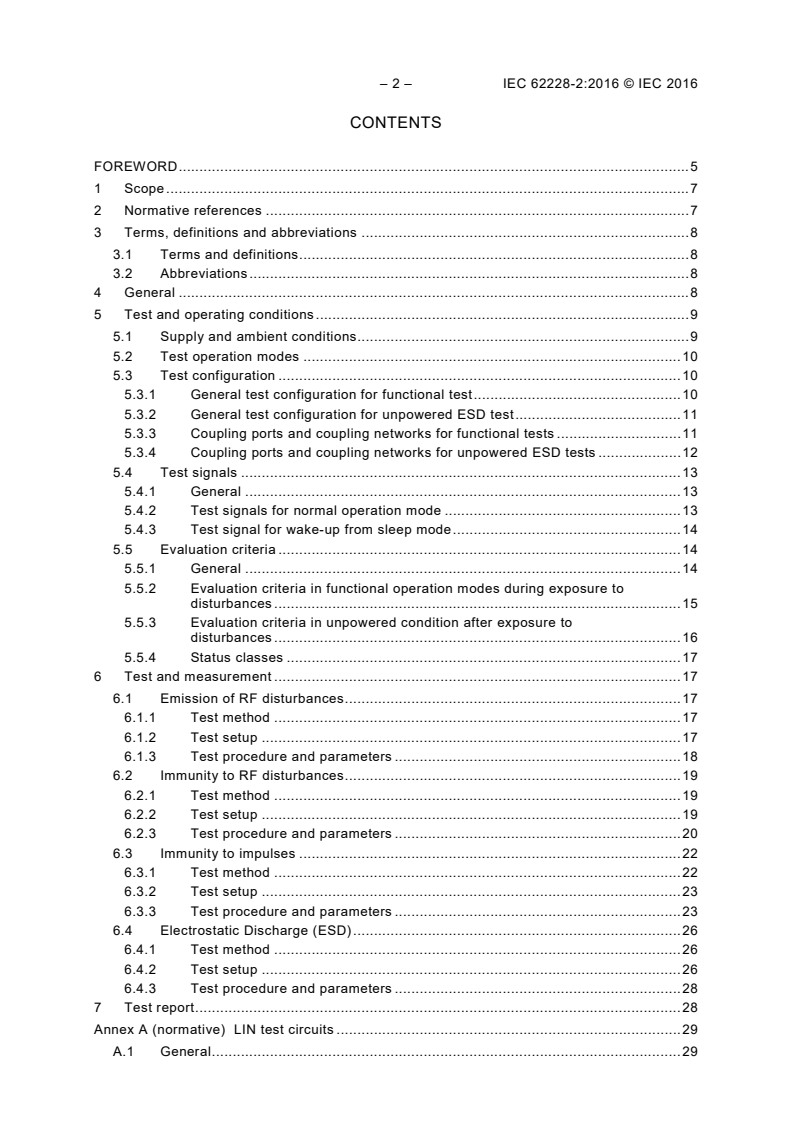
– 2 – IEC 62228-2:2016 © IEC 2016
CONTENTS
FOREWORD . 5
1 Scope . 7
2 Normative references . 7
3 Terms, definitions and abbreviations . 8
3.1 Terms and definitions . 8
3.2 Abbreviations . 8
4 General . 8
5 Test and operating conditions . 9
5.1 Supply and ambient conditions. 9
5.2 Test operation modes . 10
5.3 Test configuration . 10
5.3.1 General test configuration for functional test . 10
5.3.2 General test configuration for unpowered ESD test . 11
5.3.3 Coupling ports and coupling networks for functional tests . 11
5.3.4 Coupling ports and coupling networks for unpowered ESD tests . 12
5.4 Test signals . 13
5.4.1 General . 13
5.4.2 Test signals for normal operation mode . 13
5.4.3 Test signal for wake-up from sleep mode . 14
5.5 Evaluation criteria . 14
5.5.1 General . 14
5.5.2 Evaluation criteria in functional operation modes during exposure to
disturbances . 15
5.5.3 Evaluation criteria in unpowered condition after exposure to
disturbances . 16
5.5.4 Status classes . 17
6 Test and measurement . 17
6.1 Emission of RF disturbances . 17
6.1.1 Test method . 17
6.1.2 Test setup . 17
6.1.3 Test procedure and parameters . 18
6.2 Immunity to RF disturbances . 19
6.2.1 Test method . 19
6.2.2 Test setup . 19
6.2.3 Test procedure and parameters . 20
6.3 Immunity to impulses . 22
6.3.1 Test method . 22
6.3.2 Test setup . 23
6.3.3 Test procedure and parameters . 23
6.4 Electrostatic Discharge (ESD) . 26
6.4.1 Test method . 26
6.4.2 Test setup . 26
6.4.3 Test procedure and parameters . 28
7 Test report . 28
Annex A (normative) LIN test circuits . 29
A.1 General . 29
A.2 LIN test circuit for standard LIN transceiver ICs for functional tests . 29
A.3 LIN test circuit for IC with embedded LIN transceiver for functional tests . 31
A.4 LIN test circuit for LIN transceiver ICs for unpowered ESD test . 32
Annex B (normative) Test circuit boards. 33
B.1 Test circuit board for functional tests . 33
B.2 ESD test . 33
Annex C (informative) Examples for test limits for LIN transceiver in automotive
application . 35
C.1 General . 35
C.2 Emission of RF disturbances . 35
C.3 Immunity to RF disturbances . 36
C.4 Immunity to impulses . 37
C.5 Electrostatic Discharge (ESD) . 37
Annex D (informative) Test of indirect ESD discharge . 38
D.1 General . 38
D.2 Test setup . 38
D.3 Typical current wave form for indirect ESD test . 39
D.4 Test procedure and parameters . 39
Figure 1 – General test configuration for tests in functional operation modes . 10
Figure 2 – General test configuration for unpowered ESD test . 11
Figure 3 – Coupling ports and networks for functional tests . 11
Figure 4 – Coupling ports and networks for unpowered ESD tests . 12
Figure 5 – Principal drawing of the maximum deviation on an I-V characteristic . 16
Figure 6 – Test setup for measurement of RF disturbances . 18
Figure 7 – Test setup for DPI tests. 19
Figure 8 – Test setup for impulse immunity tests . 23
Figure 9 – Test setup for direct ESD tests . 27
Figure A.1 – General drawing of the circuit diagram of test network for standard LIN
transceiver ICs for functional test . 30
Figure A.2 – General drawing of the circuit diagram of the test network for ICs with
embedded LIN transceiver for functional test . 32
Figure A.3 – General drawing of the circuit diagram for direct ESD tests of LIN
transceiver ICs in unpowered mode . 32
Figure B.1 – Example of IC interconnections of LIN signal . 33
Figure B.2 – Example of ESD test board for LIN transceiver ICs . 34
Figure C.1 – Example of limits for RF emission . 36
Figure C.2 – Example of limits for RF immunity for functional status class A . 36
IC
Figure C.3 – Example of limits for RF immunity for functional status class C or D . 37
IC IC
Figure D.1 – Test setup for indirect ESD tests . 38
Figure D.2 – Example of ESD current wave form for indirect ESD test at V = -8 kV . 39
ESD
Table 1 – Overview of required measurements and tests . 9
Table 2 – Supply and ambient conditions for functional operation . 10
Table 3 – Definition of coupling ports and coupling network component values for
functional tests . 12
– 4 – IEC 62228-2:2016 © IEC 2016
Table 4 – Definitions of coupling ports for unpowered ESD tests . 13
Table 5 – Communication test signal TX1 . 13
Table 6 – Communication test signal TX2 . 14
Table 7 – Wake-up test signal TX3 . 14
Table 8 – Evaluation criteria for Standard LIN transceiver IC in functional operation
modes . 15
Table 9 – Evaluation criteria for ICs with embedded LIN transceiver in functional
operation modes . 16
Table 10 – Definition of functional status classes . 17
Table 11 – Parameters for emission measurements . 18
Table 12 – Settings of the RF measurement equipment . 19
Table 13 – Specifications for DPI tests . 20
Table 14 – Required DPI tests for functional status class A evaluation of standard
IC
LIN transceiver ICs . 21
Table 15 – Required DPI tests for functional status class A evaluation of ICs with
IC
embedded LIN transceiver . 22
Table 16 – Required DPI tests for functional status class C or D evaluation of
IC IC
standard LIN transceiver ICs and ICs with embedded LIN transceiver . 22
Table 17 – Specifications for impulse immunity tests . 24
Table 18 – Parameters for impulse immunity test . 24
Table 19 – Required impulse immunity tests for functional status class A evaluation
IC
of standard LIN transceiver ICs . 25
Table 20 – Required impulse immunity tests for functional status class A evaluation
IC
of ICs with embedded LIN transceiver . 25
Table 21 – Required impulse immunity tests for functional status class C or D
IC IC
evaluation of standard LIN transceiver ICs and ICs with embedded LIN transceiver . 26
Table 22 – Recommendations for direct ESD tests. 28
Table B.1 – Parameter ESD test circuit board . 34
Table C.1 – Example of limits for impulse immunity for functional status class C or
IC
D 37
IC
Table D.1 – Specifications for indirect ESD tests . 40
INTERNATIONAL ELECTROTECHNICAL COMMISSION
____________
INTEGRATED CIRCUITS –
EMC EVALUATION OF TRANSCEIVERS –
Part 2: LIN transceivers
FOREWORD
1) The International Electrotechnical Commission (IEC) is a worldwide organization for standardization comprising
all national electrotechnical committees (IEC National Committees). The object of IEC is to promote
international co-operation on all questions concerning standardization in the electrical and electronic fields. To
this end and in addition to other activities, IEC publishes International Standards, Technical Specifications,
Technical Reports, Publicly Available Specifications (PAS) and Guides (hereafter referred to as “IEC
Publication(s)”). Their preparation is entrusted to technical committees; any IEC National Committee interested
in the subject dealt with may participate in this preparatory work. International, governmental and non-
governmental organizations liaising with the IEC also participate in this preparation. IEC collaborates closely
with the International Organization for Standardization (ISO) in accordance with conditions determined by
agreement between the two organizations.
2) The formal decisions or agreements of IEC on technical matters express, as nearly as possible, an international
consensus of opinion on the relevant subjects since each technical committee has representation from all
interested IEC National Committees.
3) IEC Publications have the form of recommendations for international use and are accepted by IEC National
Committees in that sense. While all reasonable efforts are made to ensure that the technical content of IEC
Publications is accurate, IEC cannot be held responsible for the way in which they are used or for any
misinterpretation by any end user.
4) In order to promote international uniformity, IEC National Committees undertake to apply IEC Publications
transparently to the maximum extent possible in their national and regional publications. Any divergence
between any IEC Publication and the corresponding national or regional publication shall be clearly indicated in
the latter.
5) IEC itself does not provide any attestation of conformity. Independent certification bodies provide conformity
assessment services and, in some areas, access to IEC marks of conformity. IEC is not responsible for any
services carried out by independent certification bodies.
6) All users should ensure that they have the latest edition of this publication.
7) No liability shall attach to IEC or its directors, employees, servants or agents including individual experts and
members of its technical committees and IEC National Committees for any personal injury, property damage or
other damage of any nature whatsoever, whether direct or indirect, or for costs (including legal fees) and
expenses arising out of the publication, use of, or reliance upon, this IEC Publication or any other IEC
Publications.
8) Attention is drawn to the Normative references cited in this publication. Use of the referenced publications is
indispensable for the correct application of this publication.
9) Attention is drawn to the possibility that some of the elements of this IEC Publication may be the subject of
patent rights. IEC shall not be held responsible for identifying any or all such patent rights.
International Standard IEC 62228-2 has been prepared by subcommittee 47A: Integrated
circuits, of IEC technical committee 47: Semiconductor devices.
The text of this standard is based on the following documents:
FDIS Report on voting
47A/994/FDIS 47A/998/RVD
Full information on the voting for the approval of this standard can be found in the report on
voting indicated in the above table.
This publication has been drafted in accordance with the ISO/IEC Directives, Part 2.
– 6 – IEC 62228-2:2016 © IEC 2016
A list of all parts in the IEC 62228 series, published under the general title Integrated
circuits – EMC evaluation of transceivers, can be found on the IEC website.
The committee has decided that the contents of this publication will remain unchanged until
the stability date indicated on the IEC website under "http://webstore.iec.ch" in the data
related to the specific publication. At this date, the publication will be
• reconfirmed,
• withdrawn,
• replaced by a revised edition, or
• amended.
IMPORTANT – The 'colour inside' logo on the cover page of this publication indicates
that it contains colours which are considered to be useful for the correct
understanding of its contents. Users should therefore print this document using a
colour printer.
INTEGRATED CIRCUITS –
EMC EVALUATION OF TRANSCEIVERS –
Part 2: LIN transceivers
1 Scope
This part of IEC 62228 specifies test and measurement methods for EMC evaluation of LIN
transceiver ICs under network condition. It defines test configurations, test conditions, test
signals, failure criteria, test procedures, test setups and test boards. It is applicable for
standard LIN transceiver ICs and ICs with embedded LIN transceiver and covers
• the emission of RF disturbances,
• the immunity against RF disturbances,
• the immunity against impulses and
• the immunity against electrostatic discharges (ESD).
2 Normative references
The following documents are referred to in the text in such a way that some or all of their
content constitutes requirements of this document. For dated references, only the edition
cited applies. For undated references, the latest edition of the referenced document (including
any amendments) applies.
IEC 61967-1, Integrated circuits – Measurement of electromagnetic emissions 150 kHz to
1 GHz – Part 1: General conditions and definitions
IEC 61967-4, Integrated circuits – Measurement of electromagnetic emissions 150 kHz to
1 GHz – Part 4: Measurement of conducted emissions – 1 Ω /150 Ω direct coupling method
IEC 62132-1, Integrated circuits – Measurement of electromagnetic immunity – Part 1:
General conditions and definitions
IEC 62132-4, Integrated circuits – Measurement of electromagnetic immunity 150 kHz to
1 GHz – Part 4: Direct RF power injection method
IEC 62215-3, Integrated circuits – Measurement of impulse immunity – Part 3: Non-
synchronous transient injection method
ISO 7637-2, Road vehicles — Electrical disturbances from conduction and coupling – Part 2:
Electrical transient conduction along supply lines only
ISO 10605, Road vehicles – Test methods for electrical disturbances from electrostatic
discharge
ISO 17987-6.2 , Road vehicles – Local interconnect network (LIN) – Part 6: Protocol
conformance test specification
___________
To be published.
– 8 – IEC 62228-2:2016 © IEC 2016
3 Terms, definitions and abbreviations
3.1 Terms and definitions
For the purposes of this document, the terms and definitions given in IEC 61967-1,
IEC 62132-1, as well as the following apply.
3.1.1
global pin
pin that carries a signal or power, which enters or leaves the application board without any
active component in between
3.1.2
standard LIN transceiver IC
stand alone LIN transceiver according to ISO 17987 or IC with integrated LIN transceiver cell
with access to LIN RxD and TxD signal
3.1.3
IC with embedded LIN transceiver
IC with integrated LIN transceiver cell and LIN protocol handler but without access to LIN RxD
or TxD signal
3.2 Abbreviations
DUT Device under test
DPI Direct RF power injection
Inhibit
INH
LIN Local interconnect network
PCB Printed circuit board
RxD Receive data
SBC System base chip
TxD Transmit data
4 General
The intention of this document is to evaluate the EMC performance of LIN transceiver ICs
under application conditions in a minimal network. LIN transceiver ICs are in general available
in two types as standard LIN transceiver IC and as IC with embedded LIN transceiver.
The evaluation of the EMC characteristics of LIN transceivers shall be performed in functional
operation modes under network condition for RF emission, RF immunity and impulse immunity
tests and on a single unpowered transceiver IC for electrostatic discharge tests.
The aim of these tests is to determine the EMC performance on dedicated global pins of the
LIN transceiver which are considered as EMC relevant in the application. For a standard LIN
transceiver IC, these pins are LIN, VBAT and local WAKE and for an IC with an embedded
LIN transceiver, these pins are at least LIN and VBAT.
The test methods used for the EMC characterization are based on the international standards
for IC EMC tests and are described in Table 1.
Table 1 – Overview of required measurements and tests
Transceiver mode Required test Test method Evaluation Functional
operation mode
150 Ω direct
RF emission
Spectrum Normal
coupling
(EMI)
(IEC 61967-4)
RF immunity Normal
DPI
Functional (powered)
Function
(IEC 62132-4)
(RF) Sleep
Impulse immunity Normal
Impulse immunity
Function
(IEC 62215-3)
(IMP)
Sleep
Contact discharge
Passive (unpowered) ESD Damage Off
(ISO 10605)
The 150 Ω direct coupling, DPI and impulse immunity test methods are chosen for the
evaluation of the EMC characteristic of transceivers in functional modes. These three test
methods are based on the same approach using conductive coupling. Therefore it is possible
to use the same test board for all tests in functional operation mode, which reduces the effort
and increases the reproducibility and comparability of test results.
The ESD test is performed on passive transceiver IC on a separate test board.
All measurements and tests should be done with soldered transceivers on special test boards
as described in Annex B to ensure application like conditions and avoid setup effects by
sockets.
In general, the test definition is done for standard LIN transceiver ICs. For ICs with embedded
LIN transceivers some adaptations are necessary which are mainly described in this
document. Finally such adaptations have to be done individually for the dedicated IC but shall
follow the general definitions.
In order to verify filter effects on the EMC performance of LIN transceivers, configurations
with and without a bus filter at the LIN pin, with values based on ISO 17987, are defined in
this document. In consequence the frequency characteristic of these filter elements have to
be taken into account for the interpretation of the test results.
5 Test and operating conditions
5.1 Supply and ambient conditions
For all tests and measurements under operating conditions the settings are based on systems
with 12 V power supply, which is the main application of LIN transceivers. If a transceiver is
designed or targeted for higher power supply voltages the test conditions and test targets
shall be adapted and documented accordingly. The defined supply and ambient conditions for
functional operation are given in Table 2.
– 10 – IEC 62228-2:2016 © IEC 2016
Table 2 – Supply and ambient conditions for functional operation
Parameter Value
Voltage supply V (14 ± 0,2) V (default)
BAT
Voltage supply V (5 ± 0,1) V (default)
CC
Test temperature
(23 ± 5) °C
For RF Emission measurements the ambient noise floor shall be at least 6 dB below the
applied target limit and documented in the test report.
Unpowered ESD tests shall be carried out without any supply voltage and the requirements of
ISO 10605 climatic environmental conditions shall be applied.
5.2 Test operation modes
The LIN transceiver ICs shall be tested in powered functional operation modes and passive in
unpowered off mode. Functional operation modes are normal mode and sleep mode.
5.3 Test configuration
5.3.1 General test configuration for functional test
The test configuration in general consists of LIN transceivers with mandatory external
components and components for filtering and decoupling (LIN node) in a minimal test network,
where filtered power supplies, signals, monitoring probes and coupling networks are
connected as shown in Figure 1.
Monitoring and stimulation/mode
control
e.g. TxD, RxD, INH
Test network
Node 1
Bus filter Transceiver Decoupling
LIN network for
(optional) stimulation and
monitoring
Coupling ports and
coupling networks
Node 2
Bus filter Transceiver Decoupling
LIN network for
(optional) stimulation and
monitoring
Power supply with decoupling
networks
e.g. VBAT, VCC
IEC
Figure 1 – General test configuration for tests in functional operation modes
For evaluation of RF emission, RF immunity and impulse immunity characteristic of a LIN
transceiver in functional operation mode a minimal LIN test network consisting of two LIN
transceiver ICs shall be used. Depending on the type of transceiver the following network
configurations are defined:
• two transceivers of same type in case of standard LIN transceiver IC (DUT), or
• one IC with embedded LIN transceiver (DUT) and one standard LIN transceiver IC.
NOTE In specific cases or for analyses a deviation from this setup can be agreed between the users of this
document and will be noted in the test report.
General drawings of schematics with more details for both types of LIN transceivers test
networks are given in Annex A.
5.3.2 General test configuration for unpowered ESD test
The general test configuration for unpowered ESD test of LIN transceiver ICs consists of a
single LIN transceiver IC with mandatory external components and components for filtering on
a test board with discharge coupling networks as shown in Figure 2.
Unpowered transceiver
Coupling ports and
Bus filter Transceiver
coupling networks
LIN
(optional)
IEC
Figure 2 – General test configuration for unpowered ESD test
5.3.3 Coupling ports and coupling networks for functional tests
The coupling ports and coupling networks are used to transfer disturbances to or from the test
network with a defined transfer characteristic. The schematic of the coupling ports, networks
and pins are shown in Figure 3. The values of the components are dependent on the test
method and defined in Table 3. The tolerance of the components shall be 1 % or less.
Coupling Coupling networks Pins
ports
C R
CP1 CP1
CP1 LIN LIN
R
CP1t
RF
connector
C R
CP2 CP2
CP2 V
BAT V
BAT
R
CP2t
RF
connector
C R
CP3 CP3
CP3 Wake
Wake
R
CP3t
IEC
Figure 3 – Coupling ports and networks for functional tests
– 12 – IEC 62228-2:2016 © IEC 2016
Table 3 – Definition of coupling ports and coupling
network component values for functional tests
Port Type Purpose Component
R C R
CP1.3 CP1.3 CP1.3t
EMI1 RF emission measurement on LIN 120 Ω 4,7 nF 51 Ω
CP1 RF1 RF coupling for immunity test on LIN 4,7 nF not used
0 Ω
IMP1 Impulse coupling on LIN 0 Ω 1,0 nF not used
EMI2 RF emission measurement on V 120 Ω 6,8 nF 51 Ω
BAT
CP2 RF2 RF coupling for immunity test on V 6,8 nF not used
0 Ω
BAT
IMP2 Impulse coupling on V 0 Ω Shorted not used
BAT
EMI3 RF emission measurement on Wake 120 Ω 6,8 nF 51 Ω
CP3 RF3 RF coupling for immunity test on Wake 6,8 nF not used
0 Ω
IMP3 Impulse coupling on Wake 1,0 nF not used
0 Ω
The test configurations with coupling ports and coupling networks connected to the LIN test
network are given in the general drawing of schematics in Figure A.1 for standard LIN
transceiver ICs and in Figure A.2 for ICs with embedded LIN transceiver.
The characterization of the coupling ports and coupling networks is carried out as follows:
The magnitude of insertion losses (S21 measurement) between the ports CP1 to CP3 and the
respective transceiver signal pads on the test board shall be measured and documented in
the test report. For this characterization the coupling port shall be configured for RF immunity
test and the LIN transceiver ICs shall be removed. All other components which are directly
connected to the coupling port (e.g. filter to power supply or loads) remain on the test board.
5.3.4 Coupling ports and coupling networks for unpowered ESD tests
The coupling ports and coupling networks used for unpowered direct ESD tests connect the
discharge points to the LIN transceiver IC test circuitry. The schematic and definitions of the
coupling ports, networks and pins are given in Figure 4 and Table 4.
Coupling
Coupling networks Pins
ports
CP1 LIN
LIN
R1 (optional)
Discharge
points
CP2 V
V
BAT
BAT
R2 (optional)
Discharge
point
CP3 Wake Wake
R3 (optional)
IEC
Figure 4 – Coupling ports and networks for unpowered ESD tests
Table 4 – Definitions of coupling ports for unpowered ESD tests
Port Type Purpose Components
a
CP1 ESD1 ESD coupling on LIN metal trace for galvanic connection
a
CP2 ESD2 ESD coupling on V metal trace for galvanic connection
BAT
a
CP3 ESD3 ESD coupling on Wake metal trace for galvanic connection
a
The optional resistors R1 to R3 with R ≥ 200 kΩ are used to avoid static pre-charge of discharge point caused
by the ESD generator. A spark over at these resistors at high test levels shall be avoided. If a static pre-
charge is prevented by the ESD generator construction these resistors are not needed. Alternatively an
external resistor can be used to remove pre-charges of each discharge point before each single test.
5.4 Test signals
5.4.1 General
Depending on the transceiver type, different test signals are defined for communication in
normal operation mode and wake-up from sleep mode of the LIN transceiver ICs.
5.4.2 Test signals for normal operation mode
The communication test signal TX1 shall be used for testing standard LIN transceiver ICs in
normal operation mode. For ICs with embedded LIN transceiver TX1 is used to analyze if the
DUT effects other LIN communication which is not addressed to it. The parameters of this
periodical signal are defined in Table 5.
Table 5 – Communication test signal TX1
Test signal TX1
Frame Recessive
High
TxD
Signal type
Low
50 µs
4 ms
9 ms
IEC
Frequency 10 kHz
Cycle time 9 ms
Frame length 4 ms
Amplitude
VCC ± 0,1 V
The communication test signal TX2 shall be used for tests of ICs with embedded LIN
transceiver in normal mode. The signal is defined as a LIN frame with the parameters given in
Table 6 where the embedded LIN transceiver has to transmit and/or respond depending on its
designed or programmed functionality.
– 14 – IEC 62228-2:2016 © IEC 2016
Table 6 – Communication test signal TX2
Test signal TX2
Signal type LIN frame
a
Protocol ISO 17987-6.2
b
Data bit rate 19,2 kb/s
PID and Data depending on designed or programmed functionality of LIN transceiver IC under test
Cycle time 9 ms (default)
Amplitude
VCC ± 0,1 V
a
If possible it should be used for all tests. Optional testing using other protocol version is possible.
b
The given bit data rate is defined as default. If possible it should be used for all tests. Optional testing using
other bit data rate is possible.
5.4.3 Test signal for wake-up from sleep mode
The wake-up test signal TX3 shall be used for test of wanted wake-up from sleep mode for
Standard LIN transceiver ICs and ICs with embedded LIN transceiver. The parameters of this
signal are defined in Table 7. It shall be send only once as wake-up request.
Depending on the transceiver under test a second signal with a data frame or longer wake-up
request might be necessary to get a data response from the transceiver under test or set the
DUT back in sleep mode before the next test.
Table 7 – Wake-up test signal TX3
Test signal TX3
5 bit wake-up
request
High
Signal type
TxD
Low
250 µs
IEC
Amplitude VCC ± 0,1 V
5.5 Evaluation criteria
5.5.1 General
For immunity performance evaluation of LIN transceiver ICs different evaluation criteria are
defined for functional operation modes during exposure to disturbances and for unpowered
condition after exposure to disturbances.
LIN transceiver ICs with access to RxD and TxD shall be tested following the definitions for
Standard LIN transceivers even if they have additional functionality (e.g. System Base Chip).
If necessary for the test purpose some other functions of such ICs can be used for monitoring.
The resulting functional status of the LIN transceiver IC shall be classified in status classes
A C or D according to IEC 62132-1 following the definitions in 5.5.4.
IC, IC IC
5.5.2 Evaluation criteria in functional operation modes during exposure to
disturbances
The evaluation criteria in functional operation mode are defined for Standard LIN transceiver
ICs in Table 8 and for ICs with embedded LIN transceiver in Table 9.
The specified boundary values shall be used for failure monitoring. The failure validation
applies to all transceivers in the test network if not otherwise defined. As soon as a
transceiver under test violates the specific boundary values, an error event for this test case
is generated. The reference values of the monitored signals depend on the transceiver under
test and have to be captured in undisturbed conditions before the test. These reference
signals combined with the boundary values are used to generate the failure validation masks.
Deviations from the defined boundary values can be agreed and have to be noted in the test
report.
In normal operation mode, the communication and effects on other functions will be evaluated.
Effect on other functions is evaluated by crosstalk to INH for Standard LIN transceivers and
by feedback to other communication for ICs with embedded LIN transceiver. In sleep mode
the wanted and unwanted wake-up functionality will be evaluated.
Table 8 – Evaluation criteria for Standard LIN
transceiver IC in functional operation modes
Maximum variations
Monitoring condition
voltage / time
Transceiver
Purpose Test signal
mode
Trigger Observation RxD INH
window
Communicati
first falling edge -60 µs / ±0,9 V / -5,0 V /
Normal on & cross TX1
a
of TX1 signal –
+140 µs ±7,5 µs
talk
unwanted +0,9 V / +3,0 V /
without Auto trigger
200 µs
a a
wake-up – –
b
Sleep
wanted first rising edge -300 µs / ±0,9 V / -5,0 V /
TX3
c
wake-up of TX3 signal +700 µs ±100 µs ±100 µs
Different boundary values can be agreed for special cases and have to be noted in the test report.
a
static signal, independent of the duration
b
RxD or INH evaluation depends on functionality of LIN transceiver
c
One transceiver (DUT) of the test network is set to sleep mode. The second transceiver is in normal mode and
sends the signal TX3 to be detected as wake-up by the DUT. Only the DUT is monitored and shall wake-up
after the first dominant to recessive transition of test signal TX3.
For ICs with embedded LIN transceiver the failure validation has to be composed dependent
on its functionality following the definitions. The feedback of IC with embedded LIN
transceiver (DUT) to other communication shall be verified on the other transceiver (node 1)
in the test network by monitoring its RxD signal.
– 16 – IEC 62228-2:2016 © IEC 2016
Table 9 – Evaluation criteria for ICs with embedded LIN
transceiver in functional operation modes
Maximum variations
Monitoring condition
voltage / time
LIN data
Transceiver Test
Purpose monitoring
Trigger Observation RxD Other
mode signal
wi
...