

IEC 61189-5-504:2020
(Main)Test methods for electrical materials, printed boards and other interconnection structures and assemblies - Part 5-504: General test methods for materials and assemblies - Process ionic contamination testing (PICT)
General Information
- Abstract
IEC 61189-5-504:2020 is a test method designed to determine the proportion of soluble ionic residues present upon a circuit board, electronic component or assembly. The conductivity of the solution used to dissolve the ionic residues is measured to evaluate the level of ionic residues.
- Status
- Published
- Publication Date
- 20-Apr-2020
- Technical Committee
- TC 91 - Electronics assembly technology
- Drafting Committee
- WG 3 - TC 91/WG 3
- Current Stage
- PPUB - Publication issued
- Start Date
- 21-Apr-2020
- Completion Date
- 08-May-2020
Buy Documents
IEC 61189-5-504:2020 - Test methods for electrical materials, printed boards and other interconnection structures and assemblies - Part 5-504: General test methods for materials and assemblies - Process ionic contamination testing (PICT) Released:4/21/2020
Overview
IEC 61189-5-504:2020 is an international standard published by the International Electrotechnical Commission (IEC). This standard defines a general test method, known as Process Ionic Contamination Testing (PICT), for evaluating the level of soluble ionic residues on circuit boards, electronic components, and assemblies. The primary focus of this test method is to measure the conductivity of a solution used to dissolve ionic contaminants, expressing the result as an equivalence to sodium chloride (NaCl) per unit area. Effective ionic contamination testing helps ensure the reliability and quality of electronic assemblies by monitoring contamination that can cause electrical failures or degradation over time.
Key Topics
- Process Ionic Contamination Testing (PICT): Outlines methods to detect and quantify ionic residues using a solution of deionized water and propan-2-ol (isopropyl alcohol), which extracts contaminants from surfaces for conductivity measurement.
- Measurement Methods: Describes two apparatus configurations:
- Closed loop: Preferred method for recirculating the test solution through the sample, then measuring extracted contaminants.
- Open loop: Alternative method where the solution continuously passes through a regeneration filter during testing.
- Test Solutions: Specifies ratios of deionised water and propan-2-ol for optimal extraction and sensitivity, typically 50:50 or 75:25 by volume.
- Calibration and System Verification: Emphasizes instrument calibration with known NaCl solutions and regular monitoring of solution conductivity, temperature, and specific gravity.
- Specimen Handling: Stresses the importance of using gloves and clean handling techniques to prevent additional contamination.
- Data Interpretation: Results are generally reported as micrograms of NaCl equivalent per square centimetre, providing a quantifiable level of ionic cleanliness.
Applications
IEC 61189-5-504:2020 offers practical value throughout the electronics manufacturing industry, particularly for:
- Quality Control: Ensuring printed circuit boards (PCBs) and assemblies meet cleanliness requirements and reducing the potential for corrosion, dendrite growth, or leakage currents due to ionic contamination.
- Process Validation: Verifying and optimizing cleaning processes in PCB fabrication and electronic assembly lines to achieve industry-accepted contamination levels.
- Supplier Assessment: Standardizing contamination testing among suppliers and electronics manufacturing services (EMS) providers to ensure compliance with customer and industry specifications.
- Product Reliability: Supporting ongoing reliability testing to lower defect rates over time and enhance field performance, especially in high-reliability sectors like aerospace, medical devices, automotive, and telecommunications.
Related Standards
IEC 61189-5-504:2020 is part of a broader family of standards and is closely related to several other international and industry standards, including:
- IEC 60068 Series – Environmental testing methods for electronic components and assemblies.
- IEC 60194 – Terms and definitions for printed boards and assemblies.
- IEC 61189-5-502 – Surface insulation resistance (SIR) testing for assemblies.
- IEC 61190-1-3 – Requirements for electronic-grade solder alloys and fluxes.
- IPC-TM-650 – Industry test methods, including surface insulation resistance measurements.
- IPC 9202 & IPC 9203 – Test protocols and guides for electrochemical performance assessment.
By following IEC 61189-5-504, organizations can implement standardized, repeatable, and internationally accepted test procedures to ensure the cleanliness and dependability of electrical assemblies, supporting optimal product performance and customer satisfaction.
Buy Documents
IEC 61189-5-504:2020 - Test methods for electrical materials, printed boards and other interconnection structures and assemblies - Part 5-504: General test methods for materials and assemblies - Process ionic contamination testing (PICT) Released:4/21/2020
Frequently Asked Questions
IEC 61189-5-504:2020 is a standard published by the International Electrotechnical Commission (IEC). Its full title is "Test methods for electrical materials, printed boards and other interconnection structures and assemblies - Part 5-504: General test methods for materials and assemblies - Process ionic contamination testing (PICT)". This standard covers: IEC 61189-5-504:2020 is a test method designed to determine the proportion of soluble ionic residues present upon a circuit board, electronic component or assembly. The conductivity of the solution used to dissolve the ionic residues is measured to evaluate the level of ionic residues.
IEC 61189-5-504:2020 is a test method designed to determine the proportion of soluble ionic residues present upon a circuit board, electronic component or assembly. The conductivity of the solution used to dissolve the ionic residues is measured to evaluate the level of ionic residues.
IEC 61189-5-504:2020 is classified under the following ICS (International Classification for Standards) categories: 01 - GENERALITIES. TERMINOLOGY. STANDARDIZATION. DOCUMENTATION; 31.180 - Printed circuits and boards. The ICS classification helps identify the subject area and facilitates finding related standards.
IEC 61189-5-504:2020 is available in PDF format for immediate download after purchase. The document can be added to your cart and obtained through the secure checkout process. Digital delivery ensures instant access to the complete standard document.
Standards Content (Sample)
IEC 61189-5-504 ®
Edition 1.0 2020-04
INTERNATIONAL
STANDARD
NORME
INTERNATIONALE
colour
inside
Test methods for electrical materials, printed board and other interconnection
structures and assemblies –
Part 5-504: General test methods for materials and assemblies – Process ionic
contamination testing (PICT)
Méthodes d'essai pour les matériaux électriques, les cartes imprimées et autres
structures d'interconnexion et ensembles –
Partie 5-504: Méthodes d'essai générales pour les matériaux et les ensembles –
Essai de contamination ionique des procédés (PICT)
All rights reserved. Unless otherwise specified, no part of this publication may be reproduced or utilized in any form
or by any means, electronic or mechanical, including photocopying and microfilm, without permission in writing from
either IEC or IEC's member National Committee in the country of the requester. If you have any questions about IEC
copyright or have an enquiry about obtaining additional rights to this publication, please contact the address below or
your local IEC member National Committee for further information.
Droits de reproduction réservés. Sauf indication contraire, aucune partie de cette publication ne peut être reproduite
ni utilisée sous quelque forme que ce soit et par aucun procédé, électronique ou mécanique, y compris la photocopie
et les microfilms, sans l'accord écrit de l'IEC ou du Comité national de l'IEC du pays du demandeur. Si vous avez des
questions sur le copyright de l'IEC ou si vous désirez obtenir des droits supplémentaires sur cette publication, utilisez
les coordonnées ci-après ou contactez le Comité national de l'IEC de votre pays de résidence.
IEC Central Office Tel.: +41 22 919 02 11
3, rue de Varembé info@iec.ch
CH-1211 Geneva 20 www.iec.ch
Switzerland
About the IEC
The International Electrotechnical Commission (IEC) is the leading global organization that prepares and publishes
International Standards for all electrical, electronic and related technologies.
About IEC publications
The technical content of IEC publications is kept under constant review by the IEC. Please make sure that you have the
latest edition, a corrigendum or an amendment might have been published.
IEC publications search - webstore.iec.ch/advsearchform Electropedia - www.electropedia.org
The advanced search enables to find IEC publications by a The world's leading online dictionary on electrotechnology,
variety of criteria (reference number, text, technical containing more than 22 000 terminological entries in English
committee,…). It also gives information on projects, replaced and French, with equivalent terms in 16 additional languages.
and withdrawn publications. Also known as the International Electrotechnical Vocabulary
(IEV) online.
IEC Just Published - webstore.iec.ch/justpublished
Stay up to date on all new IEC publications. Just Published IEC Glossary - std.iec.ch/glossary
details all new publications released. Available online and 67 000 electrotechnical terminology entries in English and
once a month by email. French extracted from the Terms and Definitions clause of
IEC publications issued since 2002. Some entries have been
IEC Customer Service Centre - webstore.iec.ch/csc collected from earlier publications of IEC TC 37, 77, 86 and
If you wish to give us your feedback on this publication or CISPR.
need further assistance, please contact the Customer Service
Centre: sales@iec.ch.
A propos de l'IEC
La Commission Electrotechnique Internationale (IEC) est la première organisation mondiale qui élabore et publie des
Normes internationales pour tout ce qui a trait à l'électricité, à l'électronique et aux technologies apparentées.
A propos des publications IEC
Le contenu technique des publications IEC est constamment revu. Veuillez vous assurer que vous possédez l’édition la
plus récente, un corrigendum ou amendement peut avoir été publié.
Recherche de publications IEC - Electropedia - www.electropedia.org
webstore.iec.ch/advsearchform Le premier dictionnaire d'électrotechnologie en ligne au
La recherche avancée permet de trouver des publications IEC monde, avec plus de 22 000 articles terminologiques en
en utilisant différents critères (numéro de référence, texte, anglais et en français, ainsi que les termes équivalents dans
comité d’études,…). Elle donne aussi des informations sur les 16 langues additionnelles. Egalement appelé Vocabulaire
projets et les publications remplacées ou retirées. Electrotechnique International (IEV) en ligne.
IEC Just Published - webstore.iec.ch/justpublished Glossaire IEC - std.iec.ch/glossary
Restez informé sur les nouvelles publications IEC. Just 67 000 entrées terminologiques électrotechniques, en anglais
Published détaille les nouvelles publications parues. et en français, extraites des articles Termes et Définitions des
Disponible en ligne et une fois par mois par email. publications IEC parues depuis 2002. Plus certaines entrées
antérieures extraites des publications des CE 37, 77, 86 et
Service Clients - webstore.iec.ch/csc CISPR de l'IEC.
Si vous désirez nous donner des commentaires sur cette
publication ou si vous avez des questions contactez-nous:
sales@iec.ch.
IEC 61189-5-504 ®
Edition 1.0 2020-04
INTERNATIONAL
STANDARD
NORME
INTERNATIONALE
colour
inside
Test methods for electrical materials, printed board and other interconnection
structures and assemblies –
Part 5-504: General test methods for materials and assemblies – Process ionic
contamination testing (PICT)
Méthodes d'essai pour les matériaux électriques, les cartes imprimées et autres
structures d'interconnexion et ensembles –
Partie 5-504: Méthodes d'essai générales pour les matériaux et les ensembles –
Essai de contamination ionique des procédés (PICT)
INTERNATIONAL
ELECTROTECHNICAL
COMMISSION
COMMISSION
ELECTROTECHNIQUE
INTERNATIONALE
ICS 31.180 ISBN 978-2-8322-8111-6
– 2 – IEC 61189-5-504:2020 IEC 2020
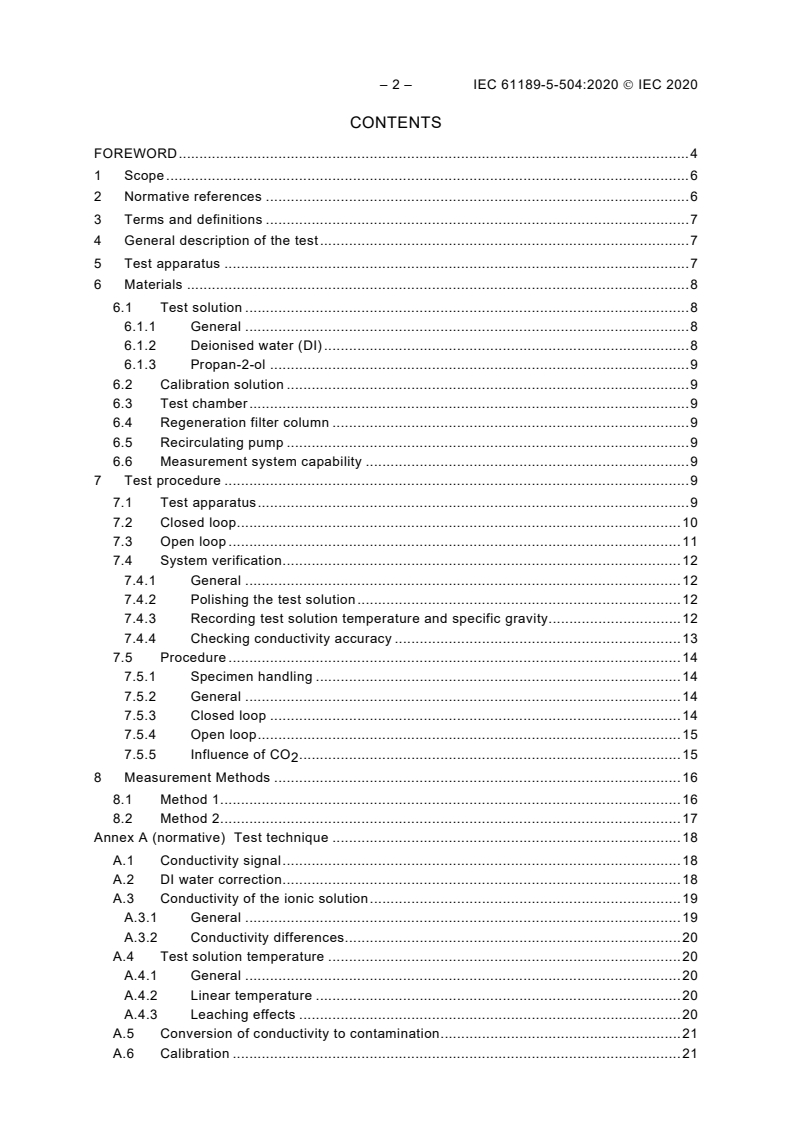
CONTENTS
FOREWORD . 4
1 Scope . 6
2 Normative references . 6
3 Terms and definitions . 7
4 General description of the test . 7
5 Test apparatus . 7
6 Materials . 8
6.1 Test solution . 8
6.1.1 General . 8
6.1.2 Deionised water (DI) . 8
6.1.3 Propan-2-ol . 9
6.2 Calibration solution . 9
6.3 Test chamber . 9
6.4 Regeneration filter column . 9
6.5 Recirculating pump . 9
6.6 Measurement system capability . 9
7 Test procedure . 9
7.1 Test apparatus . 9
7.2 Closed loop . 10
7.3 Open loop . 11
7.4 System verification . 12
7.4.1 General . 12
7.4.2 Polishing the test solution . 12
7.4.3 Recording test solution temperature and specific gravity. 12
7.4.4 Checking conductivity accuracy . 13
7.5 Procedure . 14
7.5.1 Specimen handling . 14
7.5.2 General . 14
7.5.3 Closed loop . 14
7.5.4 Open loop . 15
7.5.5 Influence of CO . 15
8 Measurement Methods . 16
8.1 Method 1. 16
8.2 Method 2. 17
Annex A (normative) Test technique . 18
A.1 Conductivity signal . 18
A.2 DI water correction . 18
A.3 Conductivity of the ionic solution . 19
A.3.1 General . 19
A.3.2 Conductivity differences. 20
A.4 Test solution temperature . 20
A.4.1 General . 20
A.4.2 Linear temperature . 20
A.4.3 Leaching effects . 20
A.5 Conversion of conductivity to contamination . 21
A.6 Calibration . 21
Annex B (informative) Measurement methods . 22
B.1 Method 1. 22
B.2 Method 2. 24
Bibliography . 25
Figure 1 – Typical test instrument . 8
Figure 2 – Closed-loop method in regeneration mode . 10
Figure 3 – Closed loop in test mode . 11
Figure 4 – Open loop method . 12
Figure 5 – 50 % specific gravity chart . 13
Figure 6 – 75 % specific gravity chart . 13
Figure 7 – Example of result measuring the influence of CO . 16
Figure A.1 – Conductivity against voltage curve . 18
Figure A.2 – Deionised water correction. 19
Figure B.1 – Test pass . 23
Figure B.2 – Test fail . 23
Table B.1 – Pass/Fail value method 1 worked example . 22
– 4 – IEC 61189-5-504:2020 IEC 2020
INTERNATIONAL ELECTROTECHNICAL COMMISSION
____________
TEST METHODS FOR ELECTRICAL MATERIALS, PRINTED BOARDS
AND OTHER INTERCONNECTION STRUCTURES AND ASSEMBLIES –
Part 5-504: General test methods for materials and assemblies –
Process ionic contamination testing (PICT)
FOREWORD
1) The International Electrotechnical Commission (IEC) is a worldwide organization for standardization comprising
all national electrotechnical committees (IEC National Committees). The object of IEC is to promote
international co-operation on all questions concerning standardization in the electrical and electronic fields. To
this end and in addition to other activities, IEC publishes International Standards, Technical Specifications,
Technical Reports, Publicly Available Specifications (PAS) and Guides (hereafter referred to as "IEC
Publication(s)"). Their preparation is entrusted to technical committees; any IEC National Committee interested
in the subject dealt with may participate in this preparatory work. International, governmental and non-
governmental organizations liaising with the IEC also participate in this preparation. IEC collaborates closely
with the International Organization for Standardization (ISO) in accordance with conditions determined by
agreement between the two organizations.
2) The formal decisions or agreements of IEC on technical matters express, as nearly as possible, an international
consensus of opinion on the relevant subjects since each technical committee has representation from all
interested IEC National Committees.
3) IEC Publications have the form of recommendations for international use and are accepted by IEC National
Committees in that sense. While all reasonable efforts are made to ensure that the technical content of IEC
Publications is accurate, IEC cannot be held responsible for the way in which they are used or for any
misinterpretation by any end user.
4) In order to promote international uniformity, IEC National Committees undertake to apply IEC Publications
transparently to the maximum extent possible in their national and regional publications. Any divergence
between any IEC Publication and the corresponding national or regional publication shall be clearly indicated in
the latter.
5) IEC itself does not provide any attestation of conformity. Independent certification bodies provide conformity
assessment services and, in some areas, access to IEC marks of conformity. IEC is not responsible for any
services carried out by independent certification bodies.
6) All users should ensure that they have the latest edition of this publication.
7) No liability shall attach to IEC or its directors, employees, servants or agents including individual experts and
members of its technical committees and IEC National Committees for any personal injury, property damage or
other damage of any nature whatsoever, whether direct or indirect, or for costs (including legal fees) and
expenses arising out of the publication, use of, or reliance upon, this IEC Publication or any other IEC
Publications.
8) Attention is drawn to the Normative references cited in this publication. Use of the referenced publications is
indispensable for the correct application of this publication.
9) Attention is drawn to the possibility that some of the elements of this IEC Publication may be the subject of
patent rights. IEC shall not be held responsible for identifying any or all such patent rights.
International Standard IEC 61189-5-504 has been prepared by IEC technical committee 91:
Electronics assembly technology.
The text of this International Standard is based on the following documents:
FDIS Report on voting
91/1639/FDIS 91/1644/RVD
Full information on the voting for the approval of this International Standard can be found in
the report on voting indicated in the above table.
This document has been drafted in accordance with the ISO/IEC Directives, Part 2.
A list of all parts in the IEC 61189 series, published under the general title Test methods for
electrical materials, printed boards and other interconnection structures and assemblies, can
be found on the IEC website.
The committee has decided that the contents of this document will remain unchanged until the
stability date indicated on the IEC website under "http://webstore.iec.ch" in the data related to
the specific document. At this date, the document will be
• reconfirmed,
• withdrawn,
• replaced by a revised edition, or
• amended.
IMPORTANT – The 'colour inside' logo on the cover page of this publication indicates
that it contains colours which are considered to be useful for the correct
understanding of its contents. Users should therefore print this document using a
colour printer.
– 6 – IEC 61189-5-504:2020 IEC 2020
TEST METHODS FOR ELECTRICAL MATERIALS, PRINTED BOARDS
AND OTHER INTERCONNECTION STRUCTURES AND ASSEMBLIES –
Part 5-504: General test methods for materials and assemblies –
Process ionic contamination testing (PICT)
1 Scope
This part of IEC 61189 is a test method designed to determine the proportion of soluble ionic
residues present upon a circuit board, electronic component or assembly. The conductivity of
the solution used to dissolve the ionic residues is measured to evaluate the level of ionic
residues.
2 Normative references
The following documents are referred to in the text in such a way that some or all of their
content constitutes requirements of this document. For dated references, only the edition
cited applies. For undated references, the latest edition of the referenced document (including
any amendments) applies.
IEC 60068-1, Environmental testing – General and guidance
IEC 60068-2-20, Environmental testing – Part 2-20: Tests – Test T: Test methods for
solderability and resistance to soldering heat of devices with leads
IEC 60068-2-58, Environmental testing – Part 2-58: Tests – Test Td: Test methods for
solderability, resistance to dissolution of metallization and to soldering heat of surface
mounting devices (SMD)
IEC 60079-7, Explosive atmospheres – Part 7: Equipment protection by increased safety "e"
IEC 60194, Printed board design, manufacture and assembly – Terms and definitions
IEC 61189-5-502, Test methods for electrical materials, printed boards and other
interconnection structures and assemblies – Part 5-502: General test methods for materials
and assemblies – Surface insulation resistance (SIR) testing of assemblies
IEC 61190-1-3, Attachment materials for electronic assembly – Part 1-3: Requirements for
electronic grade solder alloys and fluxed and non-fluxed solid solder for electronic soldering
applications
IPC-TM-650 method 2.6.3.7, Surface Insulation Resistance
IPC 9202, Material and Process Characterisation / Qualification Test Protocol for Assessing
Electrochemical Performance
IPC 9203, Users Guide to IPC 9202 and the IPC-B-52 Standard Test Vehicle
3 Terms and definitions
For the purposes of this document, the terms and definitions given in IEC 60068-1,
IEC 60068-2-20:2008, IEC 60068-2-58, IEC 60194, and IEC 61190-1-3 apply.
4 General description of the test
The test measures the conductivity of a test solution that comprises a mixture of de-ionised
water and alcohol (propan-2-ol). The test equipment shall measure the total current flow and
the result shall be expressed as an equivalence of sodium chloride (NaCl) mass per unit area
(μg/cm ≡ NaCl).
The test is used to monitor levels of ionic residues of printed circuit boards, electrical and
electronic components or printed circuit assemblies. The measured values are compared to
the user’s performance specification.
Ionic residues emanate from multiple processes during the manufacture of electronic circuit
boards, components and assemblies. Examples of ionic residues include: ammonium chloride
– citric acid – diethylamine hydrochloride – hydrochloric acid – methylamine hydrohalide –
sulphuric acid – finger salts – carboxilic acid.
When an ionic contaminant comes into contact with water, the conductance value of the water
will increase owing to the dissolution of the contaminant into the water. If the surface area and
the type of contamination are also known it is possible to express the amount of
contamination present, as a given weight per unit area of board.
This test does not measure any surface ionic materials that are not brought into solution
owing to insolubility, physical entrapment or inadequate exposure to the extracting solvent.
Additionally, non-ionic components of the soil are not measured. Not all ionic contaminants
are easily soluble in water, particularly those trapped within process residues such as solder
flux. These contaminants do however have increased solubility in alcohol.
The addition of a strongly ionized salt to deionized water will enhance its electrical
conductance to a degree that is nearly proportional to the concentration of the salt.
Conductance measurement can thus be used to indicate concentration of an ionic salt
extracted into a solution.
Amounts of ionic materials in the test solution are expressed by a conductivity factor that is
equivalent to the measured conductivity contributed by a known amount of a standard,
strongly ionized salt such as sodium chloride (NaCl). Ionic residues are therefore usually
expressed as equivalents of sodium chloride in micrograms per unit surface area (X μg/cm ≡
NaCl) of the sample under test. This does not imply that the contamination is NaCl, but that it
exhibits conductivity equivalence to that of the expressed amount of NaCl if it were in solution
instead of the ionic soil.
Measurements of ionic conductivity obtained by this test method do not differentiate between
different ionic species, they simply measure conductivity that can be related to the total
amounts of ionic materials present in the test solution.
5 Test apparatus
The test requires measurement apparatus, corresponding generally to that shown in Figure 1.
– 8 – IEC 61189-5-504:2020 IEC 2020
Key
1 test chamber
2 measurement cell
3 recirculation pump
4 control valve(s)
5 regeneration filter column
6 control valve(s)
Figure 1 – Typical test instrument
6 Materials
6.1 Test solution
6.1.1 General
Ionic soils can be dissociated in water, and the conductance measured to give an indication of
the contaminate level. The test solution however is more than just water; it contains propan-2-
ol, a non-polar liquid that aids the dissolution of the soil and, as a non-ionic hydrophilic
solvent, its presence does not influence the reading except insofar as it "dilutes" the water
bearing the dissociated ions. The test employs a test solution that comprises a specific ratio
of 50 % V/V propan-2-ol and 50 % V/V deionised water or 75 % V/V propan-2-ol and 25 % V/V
de-ionised water.
The 50:50 mixed solution is an optimal compromise between the sensitivity and the solvency
when using immersion test methods.
The 75:25 mixed solution with the higher alcohol content will reduce sensitivity but increase
solvency and vice versa with respect to water.
6.1.2 Deionised water (DI)
The detection of ionic impurities in water uses a well-established conductivity test method.
The electrical conductivity of pure water is 0,055 μS/cm at 25 °C. This value is temperature-
dependent.
−9
The addition of 1 × 10 parts of NaCl increases the conductivity of pure water from
0,055 µS/cm to 0,057 µS/cm at 25 °C [1] .
6.1.3 Propan-2-ol
Propan-2-ol, also commonly known as iso-propyl alcohol (IPA), is used to increase the
dissolution of ionic material that is inorganic in nature and trapped by an organic residue.
6.2 Calibration solution
The calibration solution contains a known value of NaCl, typically 0,1 %, and deionised water.
The calibration solution shall be marked with an expiry date and shall not be used beyond this
expiry date.
6.3 Test chamber
For optimum accuracy, the relationship between the test specimen surface area and the
volume of test solution in the test chamber should be 1cm per 10 ml [2].
When testing smaller specimens, the size criterion can be met by testing multiple specimens
simultaneously.
The test chamber should always have a lid to minimise the absorption effect of surrounding
CO and other pollutants.
6.4 Regeneration filter column
The regeneration filter column contains a pre-mixed de-ionising resin that comprises chelate,
cation and anion resins.
The test solution is pumped through the filter column where, by ionic exchange, the solution is
polished until it reaches a predetermined level of conductivity < 0,1 µS/cm.
6.5 Recirculating pump
The test solution is re-circulated by using a pump that shall comply with IEC 60079-7.
6.6 Measurement system capability
The measurement system shall have an accuracy of ±0,05 µS/cm.
The instrument should be capable of avoiding polarisation effects between electrodes such as
those that can occur when using DC test currents. Equally, error signals caused by both DC
and AC currents should be avoided to ensure optimum accuracy at low conductivity values.
7 Test procedure
7.1 Test apparatus
The test can be run using one of two variants of test apparatus:
• closed loop (preferred),
• open loop.
___________
Numbers in square brackets refer to the Bibliography.
– 10 – IEC 61189-5-504:2020 IEC 2020
7.2 Closed loop
The test solution in the test chamber is pumped via the regenerating filter, until it reaches a
predetermined level of conductivity.
The test specimen is introduced into the test chamber and the test solution begins to
recirculate, bypassing the filter (see Figure 2 and Figure 3).
Key
1 test chamber
2 measurement cell
3 recirculation pump
4 & 6 control valves
5 regeneration filter column
Figure 2 – Closed-loop method in regeneration mode
Key
1 test chamber
2 measurement cell
3 recirculation pump
4 & 6 control valves
5 regeneration filter column
Figure 3 – Closed loop in test mode
7.3 Open loop
The test solution in the test chamber is pumped via a regenerating filter comprising a mixture
of chelate, cation and anion resins, until it reaches a predetermined level of conductivity.
The test specimen is introduced into the test chamber and the test solution begins to
recirculate, through the filter (see Figure 4).
– 12 – IEC 61189-5-504:2020 IEC 2020
Key
1 test chamber
2 measurement cell
3 recirculation pump
4 & 6 control valve(s)
5 regeneration filter column
Figure 4 – Open loop method
7.4 System verification
7.4.1 General
The specific gravity and temperature of the test solution shall be checked at least once per
working shift before using the system.
7.4.2 Polishing the test solution
The test solution is re-circulated through the regeneration filter column containing mixed resin
that shall "polish" the solution to a conductivity level of 0,1 µS/cm.
7.4.3 Recording test solution temperature and specific gravity
Check and record the test solution temperature and verify the specific gravity (SG) using a
hydrometer. The SG for the 50 % V/V to 50 % V/V test solution should be at a density of 0,921
± 0,020 at 20 °C.
For other temperatures, refer to Figure 5.
Figure 5 – 50 % specific gravity chart
The SG for the 75 % V/V to 25 % V/V test solution should be at a density of 0,858 5 ± 0,020 at
20 °C .
For other temperatures refer to Figure 6.
Figure 6 – 75 % specific gravity chart
7.4.4 Checking conductivity accuracy
Cycle the instrument to the pre-test starting condition, as specified by the manufacturer, which
is typically lower than 0,05 µS/cm.
– 14 – IEC 61189-5-504:2020 IEC 2020
A calibration solution, as specified by the manufacturer, of a known concentration of NaCl,
typically 0,1 %, in de-ionised water is injected. The volume to be injected to the test cell is
provided by the manufacturer. For this calibration, other constants maybe provided, such as a
nominal board area. Run the measurement cycle for the time specified by the manufacturer,
typically 2 min, to achieve a stable reading, and log the result. Repeat this process three
times. All readings shall be within the calibrated value to ±0,05 µS/cm.
NOTE If this procedure cannot be completed, then it is likely the resin in the filter column needs to be replaced,
and that manufacturer needs to carry out a calibration.
7.5 Procedure
7.5.1 Specimen handling
All specimens should be handled with gloved hands to prevent contamination, and with
suitable precautions against electrostatic discharge. Gloves should be made of nitrile, latex,
or a similar material.
7.5.2 General
With the test solution at a conductivity level < 0,1 µS/cm, the instrument is ready to run a test.
Measure the dimensions of the specimen ensuring that proper allowance is made for the
surface area of the components. Refer to 6.3 for the relationship of test solution to surface
area.
Remove the lid and place the test specimen into the test chamber, replace the lid and initiate
the test programme.
The test time should not exceed 15 min, at the end of which the conductivity level should be
recorded.
Additional information can be found on the test technique in Annex A.
7.5.3 Closed loop
The test solution in the test chamber is pumped via the regenerating filter until it reaches a
predetermined level of conductivity. Refer to 6.4.
The test specimen is introduced into the test chamber and the test solution begins to
recirculate, bypassing the filter.
The measurement cell shall be situated in the recirculating circuit and record the conductivity
measurements.
After a maximum of 15 min, the test is terminated, and the conductivity measurements are
collected and converted.
Each equipment manufacturer may employ different formulae to express the results in
μg/cm ≡ NaCl.
Additional information can be found on the test technique in Annex A.
7.5.4 Open loop
The test solution in the test chamber is pumped via a regenerating filter until it reaches a
predetermined level of conductivity.
The test specimen is introduced into the test chamber and the test solution begins to
recirculate through the filter.
As this technique accumulates data, the test duration can need to be extended. There is a risk
of the leaching of ions from within the components, for example flame retardants used in the
printed circuit board dielectric, by the de-ionised solution on the test specimen.
The measurement cell shall be situated in the recirculating circuit and record the conductivity
measurements.
After a maximum 15 min, the test is terminated and the conductivity measurements are
collected and converted.
Each equipment manufacturer may employ different formulae to express the results in
μg/cm ≡ NaCl.
Additional information can be found on the test technique in Annex A.
7.5.5 Influence of CO
The test solution will dissolve carbon dioxide (CO ) from the atmosphere to form carbonic
acid and alter the test solution conductivity (see Figure 7). It is important to minimise the test
solution exposure to the surrounding atmosphere by keeping a lid on the test chamber (see
6.3).
If the test instrument is operated in a polluted atmosphere the potential to increase the
conductivity from atmospheric effects will be increased.
– 16 – IEC 61189-5-504:2020 IEC 2020
Test conditions and parameters
PCB Name : Low PCB Area test
PCB Reference : 50 ul
Test date and time : 28/10/2010 11:36:52
Area
: 2 500 mm
Component area : 0 mm
Solution temperature : 25,2 °C
Pass/fail
File name : D:\PROGRA∼1\XXSE∼1\Low PCB Area Test\Low PCB Area Test
Length of true measurement : 14 min 55 s
Value at cut
: 1,051 µg/cm equiv.NaCl
Def limit (Pass/fail)
: Pass :1,500 µg/cm equiv.NaCl
Mil limit (Pass/fail) : Pass :1,300 µg/cm equiv.NaCl
User limit (Pass/fail)
: Fail :1,050 µg/cm equiv.NaCl
Figure 7 – Example of result measuring the influence of CO
8 Measurement Methods
8.1 Method 1
Establish the standard deviation using an acceptable product from the production process.
NOTE A worked example of this method is in Annex B, Method 1.
8.2 Method 2
First characterise the board or assembly process by an independent quantitative method such
as SIR/ECM test method IEC 61189-5-502 or IPC-TM-650 2.3.6.7, together with IPC 9202 and
IPC 9203.
Once the assembly production process has been characterised, then a Pass/Fail value can be
determined by running this test on specimens that have provided satisfactory SIR results.
NOTE A worked example of this method is in Annex B, Method 2.
– 18 – IEC 61189-5-504:2020 IEC 2020
Annex A
(normative)
Test technique
A.1 Conductivity signal
Amplified signals are combined in a small analogue calculator circuit to produce a voltage in
relation to the temperature-compensated conductivity value. The function is non-linear, so
changes in the low end of the range will produce a significantly greater voltage change than
towards the high end, as shown in Figure A.1.
Figure A.1 – Conductivity against voltage curve
A.2 DI water correction
The DI water correction assumes that the sample is pure water contaminated with sodium
chloride (NaCl). The measured conductivity is the sum of the conductivity from water and the
conductivity from the sodium and chloride ions.
Figure A.2 shows how the high-purity water correction works.
Figure A.2 – Deionised water correction
Point 1 is the raw conductivity.
The procedure is to first subtract the conductivity of pure water at the measurement
temperature from the raw conductivity. Point 2 is the conductivity of sodium and chloride.
Next, the conductivity of sodium and chloride is converted to the value at 25 °C, point 3.
Finally, the conductivity of pure water is added to the result to give the corrected conductivity
at 25 °C, point 4.
The total conductivity is the sum of the conductivity from water and sodium chloride ions. The
large increase in the conductivity of water as temperature increases is caused primarily by the
increased ionization of water at high temperature.
A.3 Conductivity of the ionic solution
A.3.1 General
The conductive of an ionic solution is determined using the following formula:
all ions
−3
K•= 10 Λ C
∑ ° i
i
i
where
K is the conductivity (S/cm);
Λ is the molar conductivity (S-cm /mol) of ion i at infinite dilution;
i°
C is the concentration (mol/l) of ion i
i
The measured conductivity is the sum of the conductivity from water and the conductivity from
the sodium and chloride ions.
This does not imply that the contamination is NaCl, but that it exhibits a level of conductivity
equivalent to that of the expressed amount of NaCl if it were in solution instead of the ionic
soil.
– 20 – IEC 61189-5-504:2020 IEC 2020
A.3.2 Conductivity differences
The conductivity results from the test solution at a ratio of 50 % V/V propan-2-ol and 50 % V/V
deionised water will be different to those obtained from a 75 % V/V propan-2-ol and 25 % V/V
deionised water.
A.4 Test solution temperature
A.4.1 General
There have been arguments as to whether the test solution should be heated to enhance the
dissolution of the contaminants. Whilst there is no argument as to the effectiveness of
elevating the temperature, both for better temperature control and higher solubility of the
contaminants, caution shall be exercised on two counts outlined in A.4.2 and A.4.3.
A.4.2 Linear temperature
The linear temperature correction is widely used. It is based on the observation that the
conductivity of an electrolyte changes by about the same percentage for every °C change in
temperature. The equation (see [3]) is:
C
t
C =
1+ α(t− 25)
where
C is the calculated conductivity at 25 °C;
C is the conductivity at t °C;
t
α is the linear temperature coefficient expressed as a decimal fraction.
Although a single temperature coefficient can be used with reasonable accuracy over a range
of 22 °C to 29 °C, accuracy can be improved by calculating a coefficient specifically for the
sample temperature.
A.4.3 Leaching effects
As detailed in 7.5.4, this particular test technique accumulates data, generally requiring a
longer test duration than the recommended maximum of 15 min.
Because the test solution is deionised, it will aggressively seek out ions. There are many
different process steps involved in the manufacture of circuit assemblies, the majority of which
include ionic species.
There is always a risk of the leaching of ions from within the components, for example flame
retardants used in the printed circuit board dielectric, because of the de-ionised solution on
the test specimen. Many of these are required to ensure satisfactory performance of the
finished circuit assembly. It is therefore necessary to minimise the risk of a leaching effect
that will cause these ionic species to be "pulled" onto the circuit surface, even through the
laminate and solder resist.
For this reason, a maximum test duration of 15 min should be observed.
A.5 Conversion of conductivity to contamination
The formula to convert in μS to μg/cm is:
( c K v)
x=
2a+ b/ 100 / 100
((( ) ) )
where
x is the contamination (NaCl Equivalent) in µg/cm ;
c is the test solution ratio (eg. 50:50 or 75:25);
K is the conductivity in µS/cm;
𝑣𝑣 is the total tank volume in ml;
a is the surface area of the test specimen (single side) in mm ;
b is the surface area of the components in mm .
A.6 Calibration
Fill the test solution to the height specified by the equipment manufacturer and allow the
solution to settle. Place a calibrated hydrometer in the test solution until it comes to
equilibrium. Read the specific gravity at the lowest part of the solution meniscus. A solution of
75 % propan-2-ol should have a specific gravity of 0,858 5 ± 0,020 at 20 °C. A solution of 50 %
propan-2-ol should have a specific gravity of 0,921 ± 0,020 at 20 °C.
Insert a calibrated thermometer into the test solution and read the temperature to the nearest
0,5 °C.
Use the charts in Figure 5 or Figure 6 to determine if propan-2-ol or deionized water should
be added to the solution composition to bring it into compliance. If the measured specific
gravity is within the bands indicated in Figure 5 and Figure 6, no additions are necessary.
– 22 – IEC 61189-5-504:2020 IEC 2020
Annex B
(informative)
Measurement methods
B.1 Method 1
A sample of at least 10 printed circuit boards, electrical or electronic components or printed
circuit assemblies shall be taken out of the production line at the point where ionic
contamination is to be measured. Run the test and record the results. As with any statistical
measure, the more samples tested, the more accurate the Pass/Fail will be.
Once all of the tests are complete, calculate the average (mean) result by adding all the
results together and dividing by the number of results taken.
A worked example of this method can be found in Table B.1 and the text below that.
Pass/Fail = X + 3σ
Table B.1 – Pass/Fail value method 1 worked example
Board
Number 1 2 3 4 5 6 7 8 9 10
0,556 0,737 0,708 0,642 0,705 0,807 0,662 0,839 0,597 0,648
Average/mean:
(0,556 + 0,737 + 0,708 + 0,642 + 0,705 + 0,807 + 0,662 + 0,839 + 0,597 + 0,648) / 10 = 0,690
Standard deviation:
2 2 2 2 2
(0,556 – 0,690) + (0,737 – 0,690) + (0,708 – 0,690) + (0,642 – 0,690) + (0,705 – 0,690) +
2 2 2 2 2
(0,807 – 0,690) + (0,662 – 0,690) + (0,839 – 0,690) + (0,597 – 0,690) + (0,648 – 0,690) =
0,070 1
0,070 1 / (10 − 1) = 0,007 789
0,007 789 = 0,088 25
Pass/Fail = 0,690 + (0,088 25 × 3) = 0,955
Therefore, your Pass/Fail value for this production line should be 0,955 μg/cm ≡ NaCl.
Figure B.1 shows an example of a test pass, and Figure B.2 shows an example of a test fail.
Figure B.1 – Test pass
Figure B.2 – Test fail
– 24 – IEC 61189-5-504:2020 IEC 2020
B.2 Method 2
First characterize the board or assembly process using the SIR/ECM test method described in
IEC 61189-5-502, or IPC-TM-650 2.3.6.7, together with IPC 9202 and IPC 9203.
Once the assembly production process has been characterised, then a Pass/Fail value can be
determined by running this test on specimens that have completed SIR testing with
satisfactory results.
EXAMPLE SIR tested specimens yield 0,4 μg/cm ≡ NaCl using this test. The user may then impose a range
2 2
between 0,45 μg/cm ≡ NaCl and 0,35 μg/cm ≡ NaCl.
Both methods will produce a Pass/Fail value that can be used so
...