


IEC 60950-22:2016
(Main)Information technology equipment - Safety - Part 22: Equipment to be installed outdoors
General Information
- Abstract
EC 60950-22:2016 applies to information technology equipment intended to be installed in an outdoor location. The requirements for outdoor equipment also apply, where relevant, to outdoor enclosures suitable for direct installation in the field and supplied for housing information technology equipment to be installed in an outdoor location. Each installation may have particular requirements. Some examples are given in 4.2. In addition, requirements for protection of the outdoor equipment against the effects of direct lightning strikes are not covered by the standard. For information on this subject, see IEC 62305-1. This second edition cancels and replaces the first edition published in 2005. It constitutes a technical revision. This edition includes the following significant technical changes with respect to the previous edition: More extensive requirements for battery ventilation. Key words: Outdoor Equipment, Outdoor Locations, Outdoor Enclosure
This publication is to be read in conjunction with IEC 60950-1:2005.
- Status
- Withdrawn
- Publication Date
- 06-Jan-2016
- Withdrawal Date
- 28-Mar-2024
- Technical Committee
- TC 108 - Safety of electronic equipment within the field of audio/video, information technology and communication technology
- Drafting Committee
- MT 2 - TC 108/MT 2
- Current Stage
- WPUB - Publication withdrawn
- Start Date
- 02-Apr-2024
- Completion Date
- 29-Mar-2024
Buy Documents
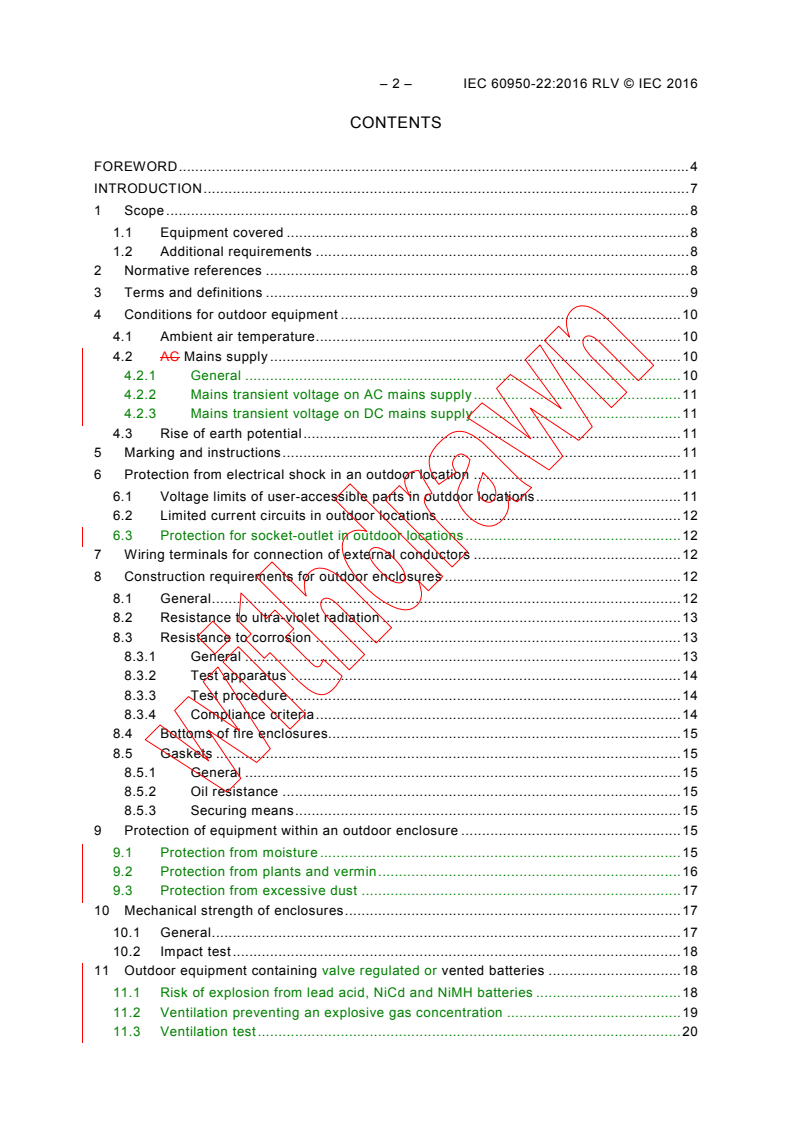
IEC 60950-22:2016 RLV - Information technology equipment - Safety - Part 22: Equipment to be installed outdoors Released:1/7/2016
IEC 60950-22:2016 - Information technology equipment - Safety - Part 22: Equipment to be installed outdoors Released:1/7/2016
Relations
- Effective Date
- 05-Sep-2023
Buy Documents
IEC 60950-22:2016 RLV - Information technology equipment - Safety - Part 22: Equipment to be installed outdoors Released:1/7/2016
IEC 60950-22:2016 - Information technology equipment - Safety - Part 22: Equipment to be installed outdoors Released:1/7/2016
Get Certified
Connect with accredited certification bodies for this standard

BSI Group
BSI (British Standards Institution) is the business standards company that helps organizations make excellence a habit.

IMQ S.p.A. (Certification)
Italian electrical product certification.

SLG Prüf- und Zertifizierungs GmbH
German testing and certification body.
Sponsored listings
Frequently Asked Questions
IEC 60950-22:2016 is a standard published by the International Electrotechnical Commission (IEC). Its full title is "Information technology equipment - Safety - Part 22: Equipment to be installed outdoors". This standard covers: EC 60950-22:2016 applies to information technology equipment intended to be installed in an outdoor location. The requirements for outdoor equipment also apply, where relevant, to outdoor enclosures suitable for direct installation in the field and supplied for housing information technology equipment to be installed in an outdoor location. Each installation may have particular requirements. Some examples are given in 4.2. In addition, requirements for protection of the outdoor equipment against the effects of direct lightning strikes are not covered by the standard. For information on this subject, see IEC 62305-1. This second edition cancels and replaces the first edition published in 2005. It constitutes a technical revision. This edition includes the following significant technical changes with respect to the previous edition: More extensive requirements for battery ventilation. Key words: Outdoor Equipment, Outdoor Locations, Outdoor Enclosure This publication is to be read in conjunction with IEC 60950-1:2005.
EC 60950-22:2016 applies to information technology equipment intended to be installed in an outdoor location. The requirements for outdoor equipment also apply, where relevant, to outdoor enclosures suitable for direct installation in the field and supplied for housing information technology equipment to be installed in an outdoor location. Each installation may have particular requirements. Some examples are given in 4.2. In addition, requirements for protection of the outdoor equipment against the effects of direct lightning strikes are not covered by the standard. For information on this subject, see IEC 62305-1. This second edition cancels and replaces the first edition published in 2005. It constitutes a technical revision. This edition includes the following significant technical changes with respect to the previous edition: More extensive requirements for battery ventilation. Key words: Outdoor Equipment, Outdoor Locations, Outdoor Enclosure This publication is to be read in conjunction with IEC 60950-1:2005.
IEC 60950-22:2016 is classified under the following ICS (International Classification for Standards) categories: 29.020 - Electrical engineering in general; 35.020 - Information technology (IT) in general. The ICS classification helps identify the subject area and facilitates finding related standards.
IEC 60950-22:2016 has the following relationships with other standards: It is inter standard links to IEC 60950-22:2005. Understanding these relationships helps ensure you are using the most current and applicable version of the standard.
IEC 60950-22:2016 is available in PDF format for immediate download after purchase. The document can be added to your cart and obtained through the secure checkout process. Digital delivery ensures instant access to the complete standard document.
Standards Content (Sample)
IEC 60950-22 ®
Edition 2.0 2016-01
REDLINE VERSION
INTERNATIONAL
STANDARD
colour
inside
Information technology equipment – Safety –
Part 22: Equipment to be installed outdoors
All rights reserved. Unless otherwise specified, no part of this publication may be reproduced or utilized in any form
or by any means, electronic or mechanical, including photocopying and microfilm, without permission in writing from
either IEC or IEC's member National Committee in the country of the requester. If you have any questions about IEC
copyright or have an enquiry about obtaining additional rights to this publication, please contact the address below or
your local IEC member National Committee for further information.
IEC Central Office Tel.: +41 22 919 02 11
3, rue de Varembé Fax: +41 22 919 03 00
CH-1211 Geneva 20 info@iec.ch
Switzerland www.iec.ch
About the IEC
The International Electrotechnical Commission (IEC) is the leading global organization that prepares and publishes
International Standards for all electrical, electronic and related technologies.
About IEC publications
The technical content of IEC publications is kept under constant review by the IEC. Please make sure that you have the
latest edition, a corrigenda or an amendment might have been published.
IEC Catalogue - webstore.iec.ch/catalogue Electropedia - www.electropedia.org
The stand-alone application for consulting the entire The world's leading online dictionary of electronic and
bibliographical information on IEC International Standards, electrical terms containing 20 000 terms and definitions in
Technical Specifications, Technical Reports and other English and French, with equivalent terms in 15 additional
documents. Available for PC, Mac OS, Android Tablets and languages. Also known as the International Electrotechnical
iPad. Vocabulary (IEV) online.
IEC publications search - www.iec.ch/searchpub IEC Glossary - std.iec.ch/glossary
The advanced search enables to find IEC publications by a 65 000 electrotechnical terminology entries in English and
variety of criteria (reference number, text, technical French extracted from the Terms and Definitions clause of
committee,…). It also gives information on projects, replaced IEC publications issued since 2002. Some entries have been
and withdrawn publications. collected from earlier publications of IEC TC 37, 77, 86 and
CISPR.
IEC Just Published - webstore.iec.ch/justpublished
Stay up to date on all new IEC publications. Just Published IEC Customer Service Centre - webstore.iec.ch/csc
details all new publications released. Available online and If you wish to give us your feedback on this publication or
also once a month by email. need further assistance, please contact the Customer Service
Centre: csc@iec.ch.
IEC 60950-22 ®
Edition 2.0 2016-01
REDLINE VERSION
INTERNATIONAL
STANDARD
colour
inside
Information technology equipment – Safety –
Part 22: Equipment to be installed outdoors
INTERNATIONAL
ELECTROTECHNICAL
COMMISSION
ICS 29.020; 35.020 ISBN 978-2-8322-3127-2
– 2 – IEC 60950-22:2016 RLV © IEC 2016
CONTENTS
FOREWORD . 4
INTRODUCTION . 7
1 Scope . 8
1.1 Equipment covered . 8
1.2 Additional requirements . 8
2 Normative references . 8
3 Terms and definitions . 9
4 Conditions for outdoor equipment . 10
4.1 Ambient air temperature . 10
4.2 AC Mains supply . 10
4.2.1 General . 10
4.2.2 Mains transient voltage on AC mains supply . 11
4.2.3 Mains transient voltage on DC mains supply . 11
4.3 Rise of earth potential . 11
5 Marking and instructions . 11
6 Protection from electrical shock in an outdoor location . 11
6.1 Voltage limits of user-accessible parts in outdoor locations . 11
6.2 Limited current circuits in outdoor locations . 12
6.3 Protection for socket-outlet in outdoor locations . 12
7 Wiring terminals for connection of external conductors . 12
8 Construction requirements for outdoor enclosures . 12
8.1 General . 12
8.2 Resistance to ultra-violet radiation . 13
8.3 Resistance to corrosion . 13
8.3.1 General . 13
8.3.2 Test apparatus . 14
8.3.3 Test procedure . 14
8.3.4 Compliance criteria . 14
8.4 Bottoms of fire enclosures. 15
8.5 Gaskets . 15
8.5.1 General . 15
8.5.2 Oil resistance . 15
8.5.3 Securing means . 15
9 Protection of equipment within an outdoor enclosure . 15
9.1 Protection from moisture . 15
9.2 Protection from plants and vermin . 16
9.3 Protection from excessive dust . 17
10 Mechanical strength of enclosures . 17
10.1 General . 17
10.2 Impact test . 18
11 Outdoor equipment containing valve regulated or vented batteries . 18
11.1 Risk of explosion from lead acid, NiCd and NiMH batteries . 18
11.2 Ventilation preventing an explosive gas concentration . 19
11.3 Ventilation test . 20
Annex A (normative) Water-saturated sulphur dioxide atmosphere (see 8.3.2
and 8.3.3) . 21
Annex B (normative) Water spray test (see 9.1) . 22
Annex C (normative) Ultraviolet light conditioning test (see 8.2) . 25
C.1 Test apparatus . 25
C.2 Mounting of test samples . 25
C.3 Carbon-arc light-exposure apparatus . 25
C.4 Xenon-arc light-exposure apparatus . 25
Annex D (normative) Gasket tests (see 8.5) . 26
D.1 Gasket tests . 26
D.2 Tensile strength and elongation tests . 26
D.3 Compression test . 26
D.4 Oil immersion test . 27
Annex E (informative) Rationale . 28
E.1 General . 28
E.2 Electric shock . 28
E.3 Energy related hazards . 28
E.4 Fire . 28
E.5 Mechanical hazards . 29
E.6 Heat related hazards . 29
E.7 Radiation . 29
E.8 Chemical hazards . 29
E.9 Biological hazards . 29
E.10 Explosion hazards. 30
Bibliography . 31
Figure B.1 – Water-spray test spray-head piping . 23
Figure B.2 – Water-spray test spray head . 24
Figure D.1 – Gasket test . 27
Table 1 – Minimum property retention limits after UV exposure . 13
Table 2 – Examples of the provision of pollution degree environments . 16
Table 3 – Values for current I and I , factors f and f , and voltages U
float boost g s float
and U . 19
boost
– 4 – IEC 60950-22:2016 RLV © IEC 2016
INTERNATIONAL ELECTROTECHNICAL COMMISSION
____________
INFORMATION TECHNOLOGY EQUIPMENT – SAFETY –
Part 22: Equipment to be installed outdoors
FOREWORD
1) The International Electrotechnical Commission (IEC) is a worldwide organization for standardization comprising
all national electrotechnical committees (IEC National Committees). The object of IEC is to promote
international co-operation on all questions concerning standardization in the electrical and electronic fields. To
this end and in addition to other activities, IEC publishes International Standards, Technical Specifications,
Technical Reports, Publicly Available Specifications (PAS) and Guides (hereafter referred to as “IEC
Publication(s)”). Their preparation is entrusted to technical committees; any IEC National Committee interested
in the subject dealt with may participate in this preparatory work. International, governmental and non-
governmental organizations liaising with the IEC also participate in this preparation. IEC collaborates closely
with the International Organization for Standardization (ISO) in accordance with conditions determined by
agreement between the two organizations.
2) The formal decisions or agreements of IEC on technical matters express, as nearly as possible, an international
consensus of opinion on the relevant subjects since each technical committee has representation from all
interested IEC National Committees.
3) IEC Publications have the form of recommendations for international use and are accepted by IEC National
Committees in that sense. While all reasonable efforts are made to ensure that the technical content of IEC
Publications is accurate, IEC cannot be held responsible for the way in which they are used or for any
misinterpretation by any end user.
4) In order to promote international uniformity, IEC National Committees undertake to apply IEC Publications
transparently to the maximum extent possible in their national and regional publications. Any divergence
between any IEC Publication and the corresponding national or regional publication shall be clearly indicated in
the latter.
5) IEC itself does not provide any attestation of conformity. Independent certification bodies provide conformity
assessment services and, in some areas, access to IEC marks of conformity. IEC is not responsible for any
services carried out by independent certification bodies.
6) All users should ensure that they have the latest edition of this publication.
7) No liability shall attach to IEC or its directors, employees, servants or agents including individual experts and
members of its technical committees and IEC National Committees for any personal injury, property damage or
other damage of any nature whatsoever, whether direct or indirect, or for costs (including legal fees) and
expenses arising out of the publication, use of, or reliance upon, this IEC Publication or any other IEC
Publications.
8) Attention is drawn to the Normative references cited in this publication. Use of the referenced publications is
indispensable for the correct application of this publication.
9) Attention is drawn to the possibility that some of the elements of this IEC Publication may be the subject of
patent rights. IEC shall not be held responsible for identifying any or all such patent rights.
This redline version of the official IEC Standard allows the user to identify the changes
made to the previous edition. A vertical bar appears in the margin wherever a change
has been made. Additions are in green text, deletions are in strikethrough red text.
International Standard IEC 60950-22 has been prepared by IEC TC 108: Safety of electronic
equipment within the field of audio/video, information technology and communication
technology.
This second edition cancels and replaces the first edition published in 2005. It constitutes a
technical revision.
This edition includes the following significant technical changes with respect to the previous
edition:
– more extensive requirements for battery ventilation.
The text of this standard is based on the following documents:
FDIS Report on voting
108/615/FDIS 108/634/RVD
Full information on the voting for the approval of this standard can be found in the report on
voting indicated in the above table.
This publication has been drafted in accordance with the ISO/IEC Directives, Part 2.
This Part 22 of IEC 60950 is intended to be used with IEC 60950-1:2005. The subclauses of
IEC 60950-1 apply as far as reasonable. Where safety aspects are similar to those of Part 1
the relevant Part 1 clause or subclause is shown for reference in parentheses after the clause
or subclause title in Part 22. Where a requirement in Part 22 refers to a requirement or
criterion of Part 1, a specific reference to IEC 60950-1, is made.
A list of all parts in the IEC 60950 series, published under the general title Information
technology equipment – Safety, can be found on the IEC website.
In this standard, the following print types are used:
– requirements proper and normative annexes: roman type;
– compliance statements and test specifications: italic type;
– notes in the text and in tables: smaller roman type;
– terms that are defined on Clause 3 and in IEC 60950-1: SMALL CAPITALS.
The following differing practices of a less permanent nature exist in the countries indicated
below.
– 4.1: Outdoor equipment demand special design at temperatures down to –50 °C (Finland,
Norway, Sweden)
– 4.3: Rise of earth potential requirements (USA, Canada)
– 8.5.1: Enclosure types specifications (USA, Canada).
– D.4: In Canada and United States, IRM Immersion Oil No. 903 is accepted (USA, Canada).
– 6 – IEC 60950-22:2016 RLV © IEC 2016
The committee has decided that the contents of this publication will remain unchanged until
the stability date indicated on the IEC website under "http://webstore.iec.ch" in the data
related to the specific publication. At this date, the publication will be
• reconfirmed,
• withdrawn,
• replaced by a revised edition, or
• amended.
IMPORTANT – The “colour inside” logo on the cover page of this publication indicates
that it contains colours which are considered to be useful for the correct understanding
of its contents. Users should therefore print this publication using a colour printer.
INTRODUCTION
This standard proposes safety requirements for information technology equipment intended to
be installed, when exposed wholly or partly, in a location where protection from the weather
and other outdoor influences such as rain, dust, etc. normally provided by a building or other
structure is limited or non-existent. There are many examples of information technology
equipment in use throughout the world that are housed in special ENCLOSURES located on
pavements, mounted on telecommunications poles and situated underground. Presently,
IEC 60950 has no requirements for such equipment and this proposal would rectify this
omission. The proposed requirements would not apply to portable or transportable equipment
that may be occasionally used outdoors, but are not intended to be installed in conditions of
inclement weather.
It is expected that IEC TC108 will continue to coordinate the output of its work with other
technical committees dealing with equipment installed outdoors, such as IEC TC70 (Degrees
of protection by enclosures, responsible for IEC 60529) and IEC TC48 (Electromechanical
Components Electrical connectors and mechanical structures for electrical and electronic
equipment).
Annex E describes the rationale behind the treatment of specific safety aspects in this
standard.
– 8 – IEC 60950-22:2016 RLV © IEC 2016
INFORMATION TECHNOLOGY EQUIPMENT – SAFETY –
Part 22: Equipment to be installed outdoors
1 Scope
1.1 Equipment covered
This part of IEC 60950 applies to information technology equipment intended to be installed in
an OUTDOOR LOCATION.
The requirements for OUTDOOR EQUIPMENT also apply, where relevant, to empty OUTDOOR
ENCLOSURES suitable for direct installation in the field and supplied for housing information
technology equipment to be installed in an OUTDOOR LOCATION.
1.2 Additional requirements
Each installation may have particular requirements. Some examples are given in 4.2. In
addition, requirements for protection of the OUTDOOR EQUIPMENT against the effects of direct
lightning strikes are not covered by the standard. For information on this subject, see
IEC 61024-1 62305-1.
2 Normative references
The following documents, in whole or in part, are normatively referenced in this document and
are indispensable for its application. For dated references, only the edition cited applies. For
undated references, the latest edition of the referenced document (including any
amendments) applies.
IEC 60068-2-11:1981, Environmental testing procedures – Part 2-11: Tests – Test Ka: Salt
mist
IEC 60364 (all parts), Low-voltage electrical installations of buildings
IEC 60364-4-43:2001, Electrical installations of buildings – Part 4-43: Protection for safety –
Protection against overcurrent
IEC 60529:1989, Degrees of protection provided by enclosures (IP Code)
IEC 60529:1989/AMD1:1999
IEC 60529:1989/AMD2:2013
IEC 60950-1:2005, Information technology equipment – Safety – Part 1: General requirements
IEC 60950-1:2005/AMD1:2009
IEC 60950-1:2005/AMD2:2013
IEC 61643 (all parts), Low-voltage surge protective devices
IEC 62368-1:2014, Audio/video, information and communication technology equipment –
Part 1: Safety requirements
ISO 178, Plastics – Determination of flexural properties
ISO 179 (all parts), Plastics – Determination of Charpy impact strength properties
ISO 180, Plastics – Determination of Izod impact strength
ISO 527 (all parts), Plastics – Determination of tensile properties
ISO 3231, Paints and varnishes – Determination of resistance to humid atmospheres
containing sulfur dioxide
ISO 4628-3, Paints and varnishes – Evaluation of degradation of coatings – Designation of
quantity and size of defects, and of intensity of uniform changes in appearance – Part 3:
Assessment of degree of rusting
ISO 4892-1, Plastics – Methods of exposure to laboratory light sources – General guidance
ISO 4892-2, Plastics – Methods of exposure to laboratory light sources – Xenon-arc sources
lamps
ISO 4892-4, Plastics – Methods of exposure to laboratory light sources – Open-flame carbon-
arc lamps
ISO 8256, Plastics – Determination of tensile-impact strength
ISO/TS 18173:2005, Non-destructive testing – General terms and definitions
ASTM D471-98, Standard Test Method for Rubber Property-Effect of Liquids
3 Terms and definitions
For the purposes of this document, the terms and definitions given in IEC 60950-1 and the
following apply.
3.1
OUTDOOR LOCATION
location for equipment where protection from the weather and other outdoor influences
provided by a building or other structure is limited or non-existent
3.2
OUTDOOR EQUIPMENT
equipment specified by the manufacturer to be installed where exposed wholly or partly to the
conditions in an OUTDOOR LOCATION
Note 1 to entry: TRANSPORTABLE EQUIPMENT, for example, a laptop or notebook computer, or a telephone, is not
OUTDOOR EQUIPMENT unless specified by the manufacturer for continuous use in an OUTDOOR LOCATION.
3.3
OUTDOOR ENCLOSURE
part of OUTDOOR EQUIPMENT that is exposed to the adverse conditions in an OUTDOOR LOCATION
and that is intended to protect the interior of the equipment from those conditions
Note 1 to entry: An OUTDOOR ENCLOSURE can also perform the functions of one or more of the following: a FIRE
ENCLOSURE; an ELECTRICAL ENCLOSURE; a MECHANICAL ENCLOSURE.
Note 2 to entry: A separate cabinet or housing into which the equipment is placed can provide the function of an
OUTDOOR ENCLOSURE.
– 10 – IEC 60950-22:2016 RLV © IEC 2016
4 Conditions for outdoor equipment
4.1 Ambient air temperature
OUTDOOR EQUIPMENT and OUTDOOR ENCLOSURES shall be suitable for use at any temperature in
the range specified by the manufacturer. If not specified by the manufacturer, the range shall
be taken as:
– minimum ambient temperature: –33 ºC;
– maximum ambient temperature: +40 ºC.
Compliance is checked by inspection and by evaluation of the data provided by the
manufacturer.
NOTE 1 The temperature values are based on IEC 60721-3-4 class 4K2. These temperatures do not take into
account severe environments (for example, extremely cold or extremely warm), nor do they include provision for
heating by radiation from the sun (solar loading).
NOTE 2 Attention is drawn to IEC 61587-1 for additional information on performance levels C1, C2 and C3.
NOTE 3 In Finland, Norway and Sweden, the temperature in winter may can be extremely low. For OUTDOOR
EQUIPMENT this will demand special design so that the equipment can stand transport, erection and
operation/service at temperatures down to –50 °C.
4.2 AC Mains supply
4.2.1 General
Mains-operated OUTDOOR EQUIPMENT shall be suitable for the highest Overvoltage Category
MAINS TRANSIENT VOLTAGE expected in the installation location.
Consideration shall be given to the following:
– the prospective fault current of the supply to OUTDOOR EQUIPMENT can be higher than for
indoor equipment, see IEC 60364-4-43; and
– the Overvoltage Category MAINS TRANSIENT VOLTAGE for OUTDOOR EQUIPMENT can be higher
than for indoor equipment.
Equipment that is part of the building installation, or that may be subject to transient
overvoltages exceeding those for Overvoltage Category II, shall be designed for Overvoltage
Category III or IV, unless additional protection is to be provided internal or external to the
equipment. In this case, the installation instructions shall state the need for such additional
protection.
It is permitted to include Within a certain overvoltage category, components within OUTDOOR
EQUIPMENT that reduce the Overvoltage Category MAINS TRANSIENT VOLTAGE or the prospective
fault current. Components used to reduce the Overvoltage Category shall comply with the
requirements of the IEC 61643-series.
NOTE 1 Annex G of IEC 60950-1 only provides a method of determining minimum CLEARANCES for transient
voltages corresponding to Overvoltage Categories III and IV. Other parts of the insulation system, for example
requirements for solid insulation and for electric strength testing, must be capable of withstanding the higher
transient voltages (see IEC 60664-1).
NOTE 1 The overvoltage category of OUTDOOR EQUIPMENT is normally considered to be one of the following:
– if powered via the normal building installation wiring, overvoltage category II;
– if powered directly from the mains distribution system, overvoltage category III;
– if at, or in the proximity of, the origin of the electrical installation, overvoltage category IV.
NOTE 2 For further information regarding protection from overvoltages, see IEC 60364-5-53.
Compliance is checked by inspection of the equipment and the installation instructions.
4.2.2 Mains transient voltage on AC mains supply
Equipment that is part of the building installation, or that may be subject to transient
overvoltages exceeding those for overvoltage category II, shall be designed for overvoltage
category III or IV, unless additional protection is to be provided internally or externally to the
equipment. In this case, the installation instructions shall state the need for such additional
protection. Clearances in equipment designed for overvoltage category III or IV shall comply
with Annex G of IEC 60950-1:2005. The insulation system used in such equipment shall be
capable of withstanding the test voltage given in Table 5C of IEC 60950-1:2005/AMD2:2013.
4.2.3 Mains transient voltage on DC mains supply
The transient on a D.C. MAINS SUPPLY depends on the source and the installation of the D.C.
MAINS SUPPLY. When determining the D.C. MAINS TRANSIENT VOLTAGE, the installation and the
source of the D.C. MAINS shall be taken into account. If these are not known, the MAINS
TRANSIENT VOLTAGE on the D.C. MAINS SUPPLY shall be assumed to be 1,5 kV.
The manufacturer shall declare the MAINS TRANSIENT VOLTAGE on the D.C. MAINS SUPPLY in the
installation instructions.
4.3 Rise of earth potential
Attention is drawn to the fact that during fault clearing conditions, HAZARDOUS VOLTAGES may
exist and be accessible for longer periods than for indoor equipment and special earthing
conditions may be necessary. These are typically specified in local installation codes.
NOTE In the USA, these requirements are contained in the National Electrical Code. In Canada, they are
contained in the Canadian Electrical Code.
Compliance is checked by evaluation of the installation instructions.
5 Marking and instructions
The installation instructions for OUTDOOR EQUIPMENT shall include details of any special
features needed for protection from conditions in the OUTDOOR LOCATION (see 1.7.2 of
IEC 60950-1:2005).
If a manufacturer of an OUTDOOR ENCLOSURE classifies a product in accordance with
IEC 60529, the IP code shall be declared, however it is not required to mark the IP code on
the OUTDOOR ENCLOSURE. It is not required to make such a declaration for OUTDOOR EQUIPMENT.
Compliance is checked by inspection.
6 Protection from electrical shock in an outdoor location
6.1 Voltage limits of user-accessible parts in outdoor locations
USER-accessible conductive parts in an OUTDOOR LOCATION shall meet the requirements for an
SELV CIRCUIT in 2.2.2 and 2.2.3 of IEC 60950-1:2005/AMD2:2013, except that the voltage
limits shall not exceed:
– 15 V a.c., 21,2 V peak, or 30 V d.c. under normal operating conditions (see 2.2.2),
– 15 V a.c., 21,2 V peak, or 30 V d.c. for longer than 0,2 s under single fault conditions (see
2.2.3). Moreover, the voltage shall not exceed 30 V a.c., 42,4 V peak or 60 V d.c.
The exception in 2.2.3 of IEC 60950-1:2005/AMD2:2013 relating to 2.3.2.1 b) of the same
publication, does not apply to USER-accessible conductive parts.
– 12 – IEC 60950-22:2016 RLV © IEC 2016
NOTE 1 Lower voltage limits apply because the contact resistance of the body is reduced when subjected to wet
conditions.
NOTE 2 In Denmark, the installation rules require the maximum safe to touch nominal voltage to be 6 V a.c. r.m.s.
or 15 V ripple-free d.c. for outside environment, where the installation normally can be humid or wet due to the
weather condition including area with shelters, but not in protected walls e.g. carports.
Compliance is checked by measurement.
6.2 Limited current circuits in outdoor locations
The requirements of 2.4 of IEC 60950–1:2005/AMD1:2009/AMD2:2013, apply without change.
6.3 Protection for socket-outlet in outdoor locations
A residual current protective device (RCD) with rated residual operating current not exceeding
30 mA shall be used in the MAINS SUPPLY to socket-outlets intended for general use and with a
rated current not exceeding 20 A.
The RCD shall be an integral part of the equipment or of the building installation. If the RCD is
part of the building installation, instructions for installations of the RCD shall be provided with
the equipment.
7 Wiring terminals for connection of external conductors
The mains supply terminations for OUTDOOR EQUIPMENT that is intended to be powered:
– via the normal building installation wiring, shall be as specified in 3.3 of
IEC 60950-1:2005/AMD2:2013;
– directly from the mains distribution system, shall be as specified in the IEC 60364 parts.
NOTE For other terminals, IEC 60950-1 applies.
Compliance is checked by inspection.
8 Construction requirements for outdoor enclosures
8.1 General
Protection against corrosion shall be provided by the use of suitable materials or by the
application of a protective coating applied to the exposed surface, taking into account the
intended conditions of use.
Parts, such as dials or connectors, that serve as a functional part of an OUTDOOR ENCLOSURE
shall comply with the same environmental protection requirements as for the OUTDOOR
ENCLOSURE.
NOTE 1 Aspects affecting safety which require the integrity of the OUTDOOR ENCLOSURE through the life of the
product include:
– continued protection against impact access to hazardous parts, including after mechanical strength tests;
– continued protection against ingress of dust and water;
– continued provision of earth continuity.
An OUTDOOR ENCLOSURE shall not be used to carry current during normal operation if this
could cause corrosion that would impair safety. This does not preclude connection of a
conductive part of an OUTDOOR ENCLOSURE to protective earth for the purpose of carrying fault
currents.
NOTE 2 The action of a current flowing through a joint can increase corrosion under wet conditions.
Where a conductive part of an OUTDOOR ENCLOSURE is connected to protective earth for the
purpose of carrying fault currents, the resulting connection shall meet the requirements of 2.6
of IEC 60950-1:2005/AMD1:2009/AMD2:2013, after the appropriate weather conditioning tests,
see 8.3.
Compliance is checked by inspection and, if necessary, by the tests of 2.6 of
IEC 60950-1:2005/AMD1:2009/AMD2:2013 and 8.3 of this standard.
8.2 Resistance to ultra-violet radiation
Non-metallic parts of an OUTDOOR ENCLOSURE required for compliance with this standard shall
be sufficiently resistant to degradation by ultra-violet (UV) radiation.
Table 1 – Minimum property retention limits after UV exposure
Standard for the Minimum retention
Parts to be tested Property test method after test
a
Tensile strength IS0 527 70 %
or
Parts providing mechanical support
a, b
Flexural strength ISO 178 70 %
c
Charpy impact ISO 179 70 %
or
c
Parts providing impact resistance Izod impact ISO 180 70 %
or
c
Tensile impact ISO 8256 70 %
d
All parts Flammability 1.2.12 and Annex A of see
classification IEC 60950-1:2005
a
Tensile strength and flexural strength tests are to be conducted on specimens no thicker than the actual
thicknesses.
b
The side of the sample exposed to UV radiation is to be in contact with the two loading points when using the
three-point loading method.
c
Tests conducted on 3,0 mm thick specimens for Izod impact and tensile impact tests and 4,0 mm thick
specimens for Charpy impact tests are considered representative of other thicknesses, down to 0,8 mm.
d
The flammability classification may change as long as it does not fall below that specified in Clause 4 of
IEC 60950-1:2005/AMD1:2009/AMD2:2013.
Compliance is checked by examination of the construction and of available data regarding the
UV resistance characteristics of the ENCLOSURE material and any associated protective
coating. If such data is not available, the tests in Table 1 are carried out on the parts.
Samples taken from the parts, or consisting of identical material, are prepared according to
the standard for the test to be carried out. They are then conditioned according to Annex C.
After conditioning, the samples shall show no signs of significant deterioration, such as
crazing or cracking. They are then kept at room ambient conditions for not less than 16 h and
not more than 96 h, after which they are tested according to the standard for the relevant test.
In order to evaluate the percent retention of properties after test, samples that have not been
conditioned according to Annex C are tested at the same time as the conditioned samples.
The retention shall be as specified in Table 1.
8.3 Resistance to corrosion
8.3.1 General
OUTDOOR ENCLOSURES, with or without protective coatings, shall be resistant
Metallic parts of
to the effects of water-borne contaminants.
– 14 – IEC 60950-22:2016 RLV © IEC 2016
Compliance is checked by either:
– inspection, and by evaluation of data provided by the manufacturer; or, if necessary, by
– the tests and criteria as specified in 8.3.2 through 8.3.4; or
– Compliance with the applicable performance level (A1, A2 or A3) of IEC 61587-1 is to be
considered an acceptable alternative to complying with 8.3.2 through 8.3.4.
8.3.2 Test apparatus
The apparatus for the salt spray test comprises shall consist of a test chamber and spraying
devices as described in IEC 60068-2-11.
The apparatus for the test in a water-saturated sulphur dioxide atmosphere comprises shall
consist of an inert, hermetically sealed, chamber containing a water-saturated sulphur dioxide
atmosphere (see Annex A) in which the test specimens and their supports are held. The
chamber is as described in ISO 3231.
8.3.3 Test procedure
The test is comprised shall consist of two identical and successive 12 day periods.
Each 12 day period is comprised consists of test a) followed by test b):
test a) – 168 h of exposure to the salt spray atmosphere. The concentration of the saline
solution forming the salt spray atmosphere is 5 % ± 1 % by weight and the
temperature of the test chamber is maintained at 35 °C ± 2 °C.
test b) – 5 exposure cycles each consisting of an 8 h exposure to a water-saturated sulphur
dioxide-rich atmosphere, (see Annex A), during which the temperature of the test
chamber is maintained at 40 °C ± 3 °C , followed by 16 h at rest with the test
chamber door open.
After each 12 day period, the test specimens are washed with demineralized water.
Alternatively, the test procedures as described in the following standards may be used to
show compliance:
– ISO 21207 Method B; or
– ISO 14993; or
– any other equivalent standard.
8.3.4 Compliance criteria
Compliance is checked by visual inspection. The equipment shall not show rust, cracking or
other deterioration other than surface corrosion of the protective coating, cracking or other
deterioration that will jeopardize the safety aspects as follows: In case of doubt, reference
shall be made to ISO 4628-3 to verify that the samples conform to specimen Ri1.
– continued protection against access to hazardous parts, including after mechanical
strength tests; and
– continued protection against ingress of dust and water; and
– continued provision of earth continuity.
However, surface corrosion of the protective coating is permitted.
8.4 Bottoms of fire enclosures
The bottom of a FIRE ENCLOSURE of OUTDOOR EQUIPMENT shall comply with 4.6.2 of
IEC 60950-1:2005, except there are no requirements for the bottoms of FIRE ENCLOSURES of
OUTDOOR EQUIPMENT provided that the installation instructions specify that the equipment is to
be mounted directly and permanently on a non-combustible surface (such as concrete or
metal). There is no need for a marking on the equipment.
Compliance is checked by inspection.
8.5 Gaskets
8.5.1 General
When gaskets are used as the method providing protection against the ingress of potential
contaminants, 8.5.1 through 8.5.3 shall apply as appropriate.
NOTE In Canada and the United States, ENCLOSURE types are specified in the Canadian Electrical Code and the
U.S. National Electrical Code.
Joints for all devices closing openings into the equipment cavity of an ENCLOSURE subjected to
splashing or seepage of oil, as well as any door or cover for such an ENCLOSURE, shall include
a gasket in the full length of the joint.
A gasket of elastomeric or thermoplastic material, or a composition gasket utilizing an
elastomeric material that is provided on an ENCLOSURE subjected to water or dust, shall meet
requirements of this standard.
Compliance is checked by inspection and by applying the relevant tests of Annex D.
8.5.2 Oil resistance
A gasket provided on an ENCLOSURE subjected to oil or coolant shall be oil resistant.
Compliance is checked by inspection and by the oil immersion test of Clause D.4.
8.5.3 Securing means
A gasket shall be secured with adhesive or by mechanical means. The gasket and its securing
means shall not be damaged when the joint is opened.
Compliance is checked by inspection.
9 Protection of equipment within an outdoor enclosure
9.1 Protection from moisture
The OUTDOOR ENCLOSURE shall provide adequate protection from the effect of moisture on the
enclosed equipment. Examples of constructions regarded as meeting the requirements are
shown in Table 2.
NOTE 1 This does not preclude OUTDOOR ENCLOSURE or OUTDOOR EQUIPMENT being constructed with segmented
volumes, each providing a different pollution degree.
NOTE 2 For consideration of the effects of the presence of conductive pollution, as opposed to non-conductive
pollution which may can become conductive only due to the presence of moisture, see the relevant requirements in
IEC 60529.
– 16 – IEC 60950-22:2016 RLV © IEC 2016
Table 2 – Examples of the provision of pollution degree environments
Pollution degree Method of achievement
Pollution degree 3 The use of an ENCLOSURE meeting IPX4 or the Annex B requirements relating
to the ingress of water is considered to provide a pollution degree 3
environment within the ENCLOSURE.
Reduction of pollution degree 3 Control Reduction of the pollution degree 3 environment to pollution degree 2
to pollution degree 2 can be accomplished by either:
– providing continuous energization of the enclosed equipment; or
– providing separate climate conditioning which prevents condensation
within the OUTDOOR EQUIPMENT or OUTDOOR ENCLOSURE; or
– the use of an ENCLOSURE meeting IP54.
Reduction to pollution degree 1 Control of the environment at the insulation surface to pollution degree 1 can
be accomplished by the methods in IEC 60950-1, for example, encapsulation,
potting or coating.
Where necessary, the ENCLOSURE of OUTDOOR EQUIPMENT shall be provided with drain holes to
control the accumulation of moisture due to:
– entrance of water through openings; and
– condensation, when this is likely to occur (for example, keeping the equipment energized
or separately heating the equipment is considered to keep it free of condensation).
The provision of drain holes and their location shall be taken into consideration when
determining the IP rating.
Compliance is checked by inspection and, if necessary, by the relevant tests of IEC 60529 or
Annex B.
Prior to testing, the equipment shall be mounted, so far as is reasonably prac
...
IEC 60950-22 ®
Edition 2.0 2016-01
INTERNATIONAL
STANDARD
NORME
INTERNATIONALE
Information technology equipment – Safety –
Part 22: Equipment to be installed outdoors
Matériels de traitement de l'information – Sécurité –
Partie 22: Matériels destinés à être installés à l'extérieur
All rights reserved. Unless otherwise specified, no part of this publication may be reproduced or utilized in any form
or by any means, electronic or mechanical, including photocopying and microfilm, without permission in writing from
either IEC or IEC's member National Committee in the country of the requester. If you have any questions about IEC
copyright or have an enquiry about obtaining additional rights to this publication, please contact the address below or
your local IEC member National Committee for further information.
Droits de reproduction réservés. Sauf indication contraire, aucune partie de cette publication ne peut être reproduite
ni utilisée sous quelque forme que ce soit et par aucun procédé, électronique ou mécanique, y compris la photocopie
et les microfilms, sans l'accord écrit de l'IEC ou du Comité national de l'IEC du pays du demandeur. Si vous avez des
questions sur le copyright de l'IEC ou si vous désirez obtenir des droits supplémentaires sur cette publication, utilisez
les coordonnées ci-après ou contactez le Comité national de l'IEC de votre pays de résidence.
IEC Central Office Tel.: +41 22 919 02 11
3, rue de Varembé Fax: +41 22 919 03 00
CH-1211 Geneva 20 info@iec.ch
Switzerland www.iec.ch
About the IEC
The International Electrotechnical Commission (IEC) is the leading global organization that prepares and publishes
International Standards for all electrical, electronic and related technologies.
About IEC publications
The technical content of IEC publications is kept under constant review by the IEC. Please make sure that you have the
latest edition, a corrigenda or an amendment might have been published.
IEC Catalogue - webstore.iec.ch/catalogue Electropedia - www.electropedia.org
The stand-alone application for consulting the entire The world's leading online dictionary of electronic and
bibliographical information on IEC International Standards, electrical terms containing 20 000 terms and definitions in
Technical Specifications, Technical Reports and other English and French, with equivalent terms in 15 additional
documents. Available for PC, Mac OS, Android Tablets and languages. Also known as the International Electrotechnical
iPad. Vocabulary (IEV) online.
IEC publications search - www.iec.ch/searchpub IEC Glossary - std.iec.ch/glossary
The advanced search enables to find IEC publications by a 65 000 electrotechnical terminology entries in English and
variety of criteria (reference number, text, technical French extracted from the Terms and Definitions clause of
committee,…). It also gives information on projects, replaced IEC publications issued since 2002. Some entries have been
and withdrawn publications. collected from earlier publications of IEC TC 37, 77, 86 and
CISPR.
IEC Just Published - webstore.iec.ch/justpublished
Stay up to date on all new IEC publications. Just Published IEC Customer Service Centre - webstore.iec.ch/csc
details all new publications released. Available online and If you wish to give us your feedback on this publication or
also once a month by email. need further assistance, please contact the Customer Service
Centre: csc@iec.ch.
A propos de l'IEC
La Commission Electrotechnique Internationale (IEC) est la première organisation mondiale qui élabore et publie des
Normes internationales pour tout ce qui a trait à l'électricité, à l'électronique et aux technologies apparentées.
A propos des publications IEC
Le contenu technique des publications IEC est constamment revu. Veuillez vous assurer que vous possédez l’édition la
plus récente, un corrigendum ou amendement peut avoir été publié.
Catalogue IEC - webstore.iec.ch/catalogue Electropedia - www.electropedia.org
Application autonome pour consulter tous les renseignements
Le premier dictionnaire en ligne de termes électroniques et
bibliographiques sur les Normes internationales,
électriques. Il contient 20 000 termes et définitions en anglais
Spécifications techniques, Rapports techniques et autres
et en français, ainsi que les termes équivalents dans 15
documents de l'IEC. Disponible pour PC, Mac OS, tablettes
langues additionnelles. Egalement appelé Vocabulaire
Android et iPad.
Electrotechnique International (IEV) en ligne.
Recherche de publications IEC - www.iec.ch/searchpub
Glossaire IEC - std.iec.ch/glossary
65 000 entrées terminologiques électrotechniques, en anglais
La recherche avancée permet de trouver des publications IEC
en utilisant différents critères (numéro de référence, texte, et en français, extraites des articles Termes et Définitions des
comité d’études,…). Elle donne aussi des informations sur les publications IEC parues depuis 2002. Plus certaines entrées
projets et les publications remplacées ou retirées. antérieures extraites des publications des CE 37, 77, 86 et
CISPR de l'IEC.
IEC Just Published - webstore.iec.ch/justpublished
Service Clients - webstore.iec.ch/csc
Restez informé sur les nouvelles publications IEC. Just
Published détaille les nouvelles publications parues. Si vous désirez nous donner des commentaires sur cette
Disponible en ligne et aussi une fois par mois par email. publication ou si vous avez des questions contactez-nous:
csc@iec.ch.
IEC 60950-22 ®
Edition 2.0 2016-01
INTERNATIONAL
STANDARD
NORME
INTERNATIONALE
Information technology equipment – Safety –
Part 22: Equipment to be installed outdoors
Matériels de traitement de l'information – Sécurité –
Partie 22: Matériels destinés à être installés à l'extérieur
INTERNATIONAL
ELECTROTECHNICAL
COMMISSION
COMMISSION
ELECTROTECHNIQUE
INTERNATIONALE
ICS 29.020; 35.020 ISBN 978-2-8322-3108-1
– 2 – IEC 60950-22:2016 © IEC 2016
CONTENTS
FOREWORD . 4
INTRODUCTION . 6
1 Scope . 7
1.1 Equipment covered . 7
1.2 Additional requirements . 7
2 Normative references . 7
3 Terms and definitions . 8
4 Conditions for outdoor equipment . 8
4.1 Ambient air temperature . 8
4.2 Mains supply . 9
4.2.1 General . 9
4.2.2 Mains transient voltage on AC mains supply . 9
4.2.3 Mains transient voltage on DC mains supply . 9
4.3 Rise of earth potential . 10
5 Marking and instructions . 10
6 Protection from electrical shock in an outdoor location . 10
6.1 Voltage limits of user-accessible parts in outdoor locations . 10
6.2 Limited current circuits in outdoor locations . 10
6.3 Protection for socket-outlet in outdoor locations . 10
7 Wiring terminals for connection of external conductors . 11
8 Construction requirements for outdoor enclosures . 11
8.1 General . 11
8.2 Resistance to ultra-violet radiation . 11
8.3 Resistance to corrosion . 12
8.3.1 General . 12
8.3.2 Test apparatus . 12
8.3.3 Test procedure . 13
8.3.4 Compliance criteria . 13
8.4 Bottoms of fire enclosures. 13
8.5 Gaskets . 13
8.5.1 General . 13
8.5.2 Oil resistance . 14
8.5.3 Securing means . 14
9 Protection of equipment within an outdoor enclosure . 14
9.1 Protection from moisture . 14
9.2 Protection from plants and vermin . 15
9.3 Protection from excessive dust . 15
9.3.1 General . 15
9.3.2 IP5X equipment . 15
9.3.3 IP6X equipment . 16
10 Mechanical strength of enclosures . 16
10.1 General . 16
10.2 Impact test . 16
11 Outdoor equipment containing valve regulated or vented batteries . 16
11.1 Risk of explosion from lead acid, NiCd and NiMH batteries . 16
11.2 Ventilation preventing an explosive gas concentration . 17
11.3 Ventilation test . 19
Annex A (normative) Water-saturated sulphur dioxide atmosphere (see 8.3.2 and 8.3.3 . 20
Annex B (normative) Water spray test (see 9.1) . 21
Annex C (normative) Ultraviolet light conditioning test (see 8.2) . 24
C.1 Test apparatus . 24
C.2 Mounting of test samples . 24
C.3 Carbon-arc light-exposure apparatus . 24
C.4 Xenon-arc light-exposure apparatus . 24
Annex D (normative) Gasket tests (see 8.5) . 25
D.1 Gasket tests . 25
D.2 Tensile strength and elongation tests . 25
D.3 Compression test . 25
D.4 Oil immersion test . 26
Annex E (informative) Rationale . 27
E.1 General . 27
E.2 Electric shock . 27
E.3 Energy related hazards . 27
E.4 Fire . 27
E.5 Mechanical hazards . 28
E.6 Heat related hazards . 28
E.7 Radiation . 28
E.8 Chemical hazards . 28
E.9 Biological hazards . 28
E.10 Explosion hazards. 29
Bibliography . 30
Figure B.1 – Water-spray test spray-head piping . 22
Figure B.2 – Water-spray test spray head . 23
Figure D.1 – Gasket test . 26
Table 1 – Minimum property retention limits after UV exposure . 12
Table 2 – Examples of the provision of pollution degree environments . 14
Table 3 – Values for current I and I , factors f and f , and voltages U
float boost g s float
and U . 18
boost
– 4 – IEC 60950-22:2016 © IEC 2016
INTERNATIONAL ELECTROTECHNICAL COMMISSION
____________
INFORMATION TECHNOLOGY EQUIPMENT – SAFETY –
Part 22: Equipment to be installed outdoors
FOREWORD
1) The International Electrotechnical Commission (IEC) is a worldwide organization for standardization comprising
all national electrotechnical committees (IEC National Committees). The object of IEC is to promote
international co-operation on all questions concerning standardization in the electrical and electronic fields. To
this end and in addition to other activities, IEC publishes International Standards, Technical Specifications,
Technical Reports, Publicly Available Specifications (PAS) and Guides (hereafter referred to as “IEC
Publication(s)”). Their preparation is entrusted to technical committees; any IEC National Committee interested
in the subject dealt with may participate in this preparatory work. International, governmental and non-
governmental organizations liaising with the IEC also participate in this preparation. IEC collaborates closely
with the International Organization for Standardization (ISO) in accordance with conditions determined by
agreement between the two organizations.
2) The formal decisions or agreements of IEC on technical matters express, as nearly as possible, an international
consensus of opinion on the relevant subjects since each technical committee has representation from all
interested IEC National Committees.
3) IEC Publications have the form of recommendations for international use and are accepted by IEC National
Committees in that sense. While all reasonable efforts are made to ensure that the technical content of IEC
Publications is accurate, IEC cannot be held responsible for the way in which they are used or for any
misinterpretation by any end user.
4) In order to promote international uniformity, IEC National Committees undertake to apply IEC Publications
transparently to the maximum extent possible in their national and regional publications. Any divergence
between any IEC Publication and the corresponding national or regional publication shall be clearly indicated in
the latter.
5) IEC itself does not provide any attestation of conformity. Independent certification bodies provide conformity
assessment services and, in some areas, access to IEC marks of conformity. IEC is not responsible for any
services carried out by independent certification bodies.
6) All users should ensure that they have the latest edition of this publication.
7) No liability shall attach to IEC or its directors, employees, servants or agents including individual experts and
members of its technical committees and IEC National Committees for any personal injury, property damage or
other damage of any nature whatsoever, whether direct or indirect, or for costs (including legal fees) and
expenses arising out of the publication, use of, or reliance upon, this IEC Publication or any other IEC
Publications.
8) Attention is drawn to the Normative references cited in this publication. Use of the referenced publications is
indispensable for the correct application of this publication.
9) Attention is drawn to the possibility that some of the elements of this IEC Publication may be the subject of
patent rights. IEC shall not be held responsible for identifying any or all such patent rights.
International Standard IEC 60950-22 has been prepared by IEC TC 108: Safety of electronic
equipment within the field of audio/video, information technology and communication
technology.
This second edition cancels and replaces the first edition published in 2005. It constitutes a
technical revision.
This edition includes the following significant technical changes with respect to the previous
edition:
– more extensive requirements for battery ventilation.
The text of this standard is based on the following documents:
FDIS Report on voting
108/615/FDIS 108/634/RVD
Full information on the voting for the approval of this standard can be found in the report on
voting indicated in the above table.
This publication has been drafted in accordance with the ISO/IEC Directives, Part 2.
This Part 22 of IEC 60950 is intended to be used with IEC 60950-1:2005. The subclauses of
IEC 60950-1 apply as far as reasonable. Where safety aspects are similar to those of Part 1
the relevant Part 1 clause or subclause is shown for reference in parentheses after the clause
or subclause title in Part 22. Where a requirement in Part 22 refers to a requirement or
criterion of Part 1, a specific reference to IEC 60950-1, is made.
A list of all parts in the IEC 60950 series, published under the general title Information
technology equipment – Safety, can be found on the IEC website.
In this standard, the following print types are used:
– requirements proper and normative annexes: roman type;
– compliance statements and test specifications: italic type;
– notes in the text and in tables: smaller roman type;
– terms that are defined on Clause 3 and in IEC 60950-1: SMALL CAPITALS.
The following differing practices of a less permanent nature exist in the countries indicated
below.
– 4.1: Outdoor equipment demand special design at temperatures down to –50 °C (Finland,
Norway, Sweden)
– 4.3: Rise of earth potential requirements (USA, Canada)
– 8.5.1: Enclosure types specifications (USA, Canada).
– D.4: In Canada and United States, IRM Immersion Oil No. 903 is accepted (USA, Canada).
The committee has decided that the contents of this publication will remain unchanged until
the stability date indicated on the IEC website under "http://webstore.iec.ch" in the data
related to the specific publication. At this date, the publication will be
• reconfirmed,
• withdrawn,
• replaced by a revised edition, or
• amended.
– 6 – IEC 60950-22:2016 © IEC 2016
INTRODUCTION
This standard proposes safety requirements for information technology equipment intended to
be installed, when exposed wholly or partly, in a location where protection from the weather
and other outdoor influences such as rain, dust, etc. normally provided by a building or other
structure is limited or non-existent. There are many examples of information technology
equipment in use throughout the world that are housed in special ENCLOSURES located on
pavements, mounted on telecommunications poles and situated underground. Presently,
IEC 60950 has no requirements for such equipment and this proposal would rectify this
omission. The proposed requirements would not apply to portable or transportable equipment
that may be occasionally used outdoors, but are not intended to be installed in conditions of
inclement weather.
It is expected that IEC TC108 will continue to coordinate the output of its work with other
technical committees dealing with equipment installed outdoors, such as IEC TC70 (Degrees
of protection provided by enclosures, responsible for IEC 60529) and IEC TC 48 (Electrical
connectors and mechanical structures for electrical and electronic equipment).
Annex E describes the rationale behind the treatment of specific safety aspects in this
standard.
INFORMATION TECHNOLOGY EQUIPMENT – SAFETY –
Part 22: Equipment to be installed outdoors
1 Scope
1.1 Equipment covered
This part of IEC 60950 applies to information technology equipment intended to be installed in
an OUTDOOR LOCATION.
The requirements for OUTDOOR EQUIPMENT also apply, where relevant, to OUTDOOR
ENCLOSURES suitable for direct installation in the field and supplied for housing information
technology equipment to be installed in an OUTDOOR LOCATION.
1.2 Additional requirements
Each installation may have particular requirements. Some examples are given in 4.2. In
addition, requirements for protection of the OUTDOOR EQUIPMENT against the effects of direct
lightning strikes are not covered by the standard. For information on this subject, see
IEC 62305-1.
2 Normative references
The following documents, in whole or in part, are normatively referenced in this document and
are indispensable for its application. For dated references, only the edition cited applies. For
undated references, the latest edition of the referenced document (including any
amendments) applies.
IEC 60068-2-11, Environmental testing procedures – Part 2-11: Tests – Test Ka: Salt mist
IEC 60364 (all parts), Low-voltage electrical installations
IEC 60529:1989, Degrees of protection provided by enclosures (IP Code)
IEC 60529:1989/AMD1:1999
IEC 60529:1989/AMD2:2013
IEC 60950-1:2005, Information technology equipment – Safety – Part 1: General requirements
IEC 60950-1:2005/AMD1:2009
IEC 60950-1:2005/AMD2:2013
IEC 62368-1:2014, Audio/video, information and communication technology equipment –
Part 1: Safety requirements
ISO 178, Plastics – Determination of flexural properties
ISO 179 (all parts), Plastics – Determination of Charpy impact properties
ISO 180, Plastics – Determination of Izod impact strength
ISO 527 (all parts), Plastics – Determination of tensile properties
– 8 – IEC 60950-22:2016 © IEC 2016
ISO 3231, Paints and varnishes – Determination of resistance to humid atmospheres
containing sulfur dioxide
ISO 4892-1, Plastics – Methods of exposure to laboratory light sources – General guidance
ISO 4892-2, Plastics – Methods of exposure to laboratory light sources – Xenon-arc lamps
ISO 4892-4, Plastics – Methods of exposure to laboratory light sources – Open-flame carbon-
arc lamps
ISO 8256, Plastics – Determination of tensile-impact strength
ISO/TS 18173:2005, Non-destructive testing – General terms and definitions
ASTM D471-98, Standard Test Method for Rubber Property-Effect of Liquids
3 Terms and definitions
For the purposes of this document, the terms and definitions given in IEC 60950-1 and the
following apply.
3.1
OUTDOOR LOCATION
location for equipment where protection from the weather and other outdoor influences
provided by a building or other structure is limited or non-existent
3.2
OUTDOOR EQUIPMENT
equipment specified by the manufacturer to be installed where exposed wholly or partly to the
conditions in an OUTDOOR LOCATION
Note 1 to entry: TRANSPORTABLE EQUIPMENT, for example, a laptop or notebook computer, or a telephone, is not
OUTDOOR EQUIPMENT unless specified by the manufacturer for continuous use in an OUTDOOR LOCATION.
3.3
OUTDOOR ENCLOSURE
part of OUTDOOR EQUIPMENT that is exposed to the adverse conditions in an OUTDOOR LOCATION
and that is intended to protect the interior of the equipment from those conditions
Note 1 to entry: An OUTDOOR ENCLOSURE can also perform the functions of one or more of the following: a FIRE
ENCLOSURE; an ELECTRICAL ENCLOSURE; a MECHANICAL ENCLOSURE.
Note 2 to entry: A separate cabinet or housing into which the equipment is placed can provide the function of an
OUTDOOR ENCLOSURE.
4 Conditions for outdoor equipment
4.1 Ambient air temperature
OUTDOOR EQUIPMENT and OUTDOOR ENCLOSURES shall be suitable for use at any temperature in
the range specified by the manufacturer. If not specified by the manufacturer, the range shall
be taken as:
– minimum ambient temperature: –33 ºC;
– maximum ambient temperature: +40 ºC.
Compliance is checked by inspection and by evaluation of the data provided by the
manufacturer.
NOTE 1 The temperature values are based on IEC 60721-3-4 class 4K2. These temperatures do not take into
account severe environments (for example, extremely cold or extremely warm), nor do they include provision for
heating by radiation from the sun (solar loading).
NOTE 2 Attention is drawn to IEC 61587-1 for additional information on performance levels C1, C2 and C3.
NOTE 3 In Finland, Norway and Sweden, the temperature in winter can be extremely low. For OUTDOOR
EQUIPMENT this will demand special design so that the equipment can stand transport, erection and
operation/service at temperatures down to –50 °C.
4.2 Mains supply
4.2.1 General
Mains-operated OUTDOOR EQUIPMENT shall be suitable for the highest MAINS TRANSIENT
VOLTAGE expected in the installation location.
Consideration shall be given to the following:
– the prospective fault current of the supply to OUTDOOR EQUIPMENT can be higher than for
indoor equipment, see IEC 60364-4-43; and
– the MAINS TRANSIENT VOLTAGE for OUTDOOR EQUIPMENT can be higher than for indoor
equipment.
Within a certain overvoltage category, components within OUTDOOR EQUIPMENT that reduce the
MAINS TRANSIENT VOLTAGE or the prospective fault current shall comply with the requirements
of the IEC 61643-series.
NOTE 1 The overvoltage category of OUTDOOR EQUIPMENT is normally considered to be one of the following:
– if powered via the normal building installation wiring, overvoltage category II;
– if powered directly from the mains distribution system, overvoltage category III;
– if at, or in the proximity of, the origin of the electrical installation, overvoltage category IV.
NOTE 2 For further information regarding protection from overvoltages, see IEC 60364-5-53.
Compliance is checked by inspection of the equipment and the installation instructions.
4.2.2 Mains transient voltage on AC mains supply
Equipment that is part of the building installation, or that may be subject to transient
overvoltages exceeding those for overvoltage category II, shall be designed for overvoltage
category III or IV, unless additional protection is to be provided internally or externally to the
equipment. In this case, the installation instructions shall state the need for such additional
protection. Clearances in equipment designed for overvoltage category III or IV shall comply
with Annex G of IEC 60950-1:2005. The insulation system used in such equipment shall be
capable of withstanding the test voltage given in Table 5C of IEC 60950-1:2005/AMD2:2013.
4.2.3 Mains transient voltage on DC mains supply
The transient on a D.C. MAINS SUPPLY depends on the source and the installation of the D.C.
MAINS SUPPLY. When determining the D.C. MAINS TRANSIENT VOLTAGE, the installation and the
source of the D.C. MAINS shall be taken into account. If these are not known, the MAINS
TRANSIENT VOLTAGE on the D.C. MAINS SUPPLY shall be assumed to be 1,5 kV.
The manufacturer shall declare the MAINS TRANSIENT VOLTAGE on the D.C. MAINS SUPPLY in the
installation instructions.
– 10 – IEC 60950-22:2016 © IEC 2016
4.3 Rise of earth potential
Attention is drawn to the fact that during fault clearing conditions, HAZARDOUS VOLTAGES may
exist and be accessible for longer periods than for indoor equipment and special earthing
conditions may be necessary. These are typically specified in local installation codes.
NOTE In the USA, these requirements are contained in the National Electrical Code. In Canada, they are
contained in the Canadian Electrical Code.
Compliance is checked by evaluation of the installation instructions.
5 Marking and instructions
The installation instructions for OUTDOOR EQUIPMENT shall include details of any special
features needed for protection from conditions in the OUTDOOR LOCATION (see 1.7.2 of
IEC 60950-1:2005).
If a manufacturer of an OUTDOOR ENCLOSURE classifies a product in accordance with
IEC 60529, the IP code shall be declared, however it is not required to mark the IP code on
the OUTDOOR ENCLOSURE. It is not required to make such a declaration for OUTDOOR EQUIPMENT.
Compliance is checked by inspection.
6 Protection from electrical shock in an outdoor location
6.1 Voltage limits of user-accessible parts in outdoor locations
USER-accessible conductive parts in an OUTDOOR LOCATION shall meet the requirements for an
SELV CIRCUIT in 2.2.2 and 2.2.3 of IEC 60950-1:2005/AMD2:2013, except that the voltage
limits shall not exceed:
– 15 V a.c., 21,2 V peak, or 30 V d.c. under normal operating conditions (see 2.2.2),
– 15 V a.c., 21,2 V peak, or 30 V d.c. for longer than 0,2 s under single fault conditions (see
2.2.3). Moreover, the voltage shall not exceed 30 V a.c., 42,4 V peak or 60 V d.c.
The exception in 2.2.3 of IEC 60950-1:2005/AMD2:2013 relating to 2.3.2.1 b) of the same
publication, does not apply to USER-accessible conductive parts.
NOTE 1 Lower voltage limits apply because the contact resistance of the body is reduced when subjected to wet
conditions.
NOTE 2 In Denmark, the installation rules require the maximum safe to touch nominal voltage to be 6 V a.c. r.m.s.
or 15 V ripple-free d.c. for outside environment, where the installation normally can be humid or wet due to the
weather condition including area with shelters, but not in protected walls e.g. carports.
Compliance is checked by measurement.
6.2 Limited current circuits in outdoor locations
The requirements of 2.4 of IEC 60950–1:2005/AMD1:2009/AMD2:2013, apply without change.
6.3 Protection for socket-outlet in outdoor locations
A residual current protective device (RCD) with rated residual operating current not exceeding
30 mA shall be used in the MAINS SUPPLY to socket-outlets intended for general use and with a
rated current not exceeding 20 A.
The RCD shall be an integral part of the equipment or of the building installation. If the RCD is
part of the building installation, instructions for installations of the RCD shall be provided with
the equipment.
7 Wiring terminals for connection of external conductors
The mains supply terminations for OUTDOOR EQUIPMENT that is intended to be powered:
– via the normal building installation wiring, shall be as specified in 3.3 of
IEC 60950-1:2005/AMD2:2013;
– directly from the mains distribution system, shall be as specified in the IEC 60364 parts.
NOTE For other terminals, IEC 60950-1 applies.
Compliance is checked by inspection.
8 Construction requirements for outdoor enclosures
8.1 General
Protection against corrosion shall be provided by the use of suitable materials or by the
application of a protective coating applied to the exposed surface, taking into account the
intended conditions of use.
Parts, such as dials or connectors, that serve as a functional part of an OUTDOOR ENCLOSURE
shall comply with the same environmental protection requirements as for the OUTDOOR
ENCLOSURE.
NOTE 1 Aspects affecting safety which require the integrity of the OUTDOOR ENCLOSURE through the life of the
product include:
– continued protection against access to hazardous parts, including after mechanical strength tests;
– continued protection against ingress of dust and water;
– continued provision of earth continuity.
An OUTDOOR ENCLOSURE shall not be used to carry current during normal operation if this
could cause corrosion that would impair safety. This does not preclude connection of a
conductive part of an OUTDOOR ENCLOSURE to protective earth for the purpose of carrying fault
currents.
NOTE 2 The action of a current flowing through a joint can increase corrosion under wet conditions.
Where a conductive part of an OUTDOOR ENCLOSURE is connected to protective earth for the
purpose of carrying fault currents, the resulting connection shall meet the requirements of 2.6
of IEC 60950-1:2005/AMD1:2009/AMD2:2013, after the appropriate weather conditioning tests,
see 8.3.
Compliance is checked by inspection and, if necessary, by the tests of 2.6 of
IEC 60950-1:2005/AMD1:2009/AMD2:2013 and 8.3 of this standard.
8.2 Resistance to ultra-violet radiation
OUTDOOR ENCLOSURE required for compliance with this standard shall
Non-metallic parts of an
be sufficiently resistant to degradation by ultra-violet (UV) radiation.
– 12 – IEC 60950-22:2016 © IEC 2016
Table 1 – Minimum property retention limits after UV exposure
Standard for the Minimum retention
Parts to be tested Property test method after test
a
Tensile strength IS0 527 70 %
or
Parts providing mechanical support
a, b
Flexural strength ISO 178 70 %
c
Charpy impact ISO 179 70 %
or
c
Parts providing impact resistance Izod impact
ISO 180 70 %
or
c
Tensile impact ISO 8256 70 %
d
All parts Flammability 1.2.12 and Annex A of see
classification IEC 60950-1:2005
a
Tensile strength and flexural strength tests are to be conducted on specimens no thicker than the actual
thicknesses.
b
The side of the sample exposed to UV radiation is to be in contact with the two loading points when using the
three-point loading method.
c
Tests conducted on 3,0 mm thick specimens for Izod impact and tensile impact tests and 4,0 mm thick
specimens for Charpy impact tests are considered representative of other thicknesses, down to 0,8 mm.
d
The flammability classification may change as long as it does not fall below that specified in Clause 4 of
IEC 60950-1:2005/AMD1:2009/AMD2:2013.
Compliance is checked by examination of the construction and of available data regarding the
UV resistance characteristics of the ENCLOSURE material and any associated protective
coating. If such data is not available, the tests in Table 1 are carried out on the parts.
Samples taken from the parts, or consisting of identical material, are prepared according to
the standard for the test to be carried out. They are then conditioned according to Annex C.
After conditioning, the samples shall show no signs of significant deterioration, such as
crazing or cracking. They are then kept at room ambient conditions for not less than 16 h and
not more than 96 h, after which they are tested according to the standard for the relevant test.
In order to evaluate the percent retention of properties after test, samples that have not been
conditioned according to Annex C are tested at the same time as the conditioned samples.
The retention shall be as specified in Table 1.
8.3 Resistance to corrosion
8.3.1 General
Metallic parts of OUTDOOR ENCLOSURES, with or without protective coatings, shall be resistant
to the effects of water-borne contaminants.
Compliance is checked by either:
− inspection and by evaluation of data provided by the manufacturer; or
− the tests and criteria as specified in 8.3.2 through 8.3.4; or
− the applicable performance level (A1, A2 or A3) of IEC 61587-1.
8.3.2 Test apparatus
The apparatus for the salt spray test shall consist of a test chamber and spraying devices as
described in IEC 60068-2-11.
The apparatus for the test in a water-saturated sulphur dioxide atmosphere shall consist of an
inert, hermetically sealed, chamber containing a water-saturated sulphur dioxide atmosphere
(see Annex A) in which the test specimens and their supports are held. The chamber is as
described in ISO 3231.
8.3.3 Test procedure
The test shall consist of two identical and successive 12 day periods.
Each 12 day period consists of test a) followed by test b):
test a) – 168 h of exposure to the salt spray atmosphere. The concentration of the saline
solution forming the salt spray atmosphere is 5 % ± 1 % by weight and the
temperature of the test chamber is maintained at 35 °C ± 2 °C.
test b) – 5 exposure cycles each consisting of an 8 h exposure to a water-saturated sulphur
dioxide-rich atmosphere, (see Annex A), during which the temperature of the test
chamber is maintained at 40 °C ± 3 °C , followed by 16 h at rest with the test
chamber door open.
After each 12 day period, the test specimens are washed with demineralized water.
Alternatively, the test procedures as described in the following standards may be used to
show compliance:
– ISO 21207 Method B; or
– ISO 14993; or
– any other equivalent standard.
8.3.4 Compliance criteria
Compliance is checked by visual inspection. The equipment shall not show rust, other than
surface corrosion of the protective coating, cracking or other deterioration that will jeopardize
the safety aspects as follows:
– continued protection against access to hazardous parts, including after mechanical
strength tests; and
– continued protection against ingress of dust and water; and
– continued provision of earth continuity.
However, surface corrosion of the protective coating is permitted.
8.4 Bottoms of fire enclosures
The bottom of a FIRE ENCLOSURE of OUTDOOR EQUIPMENT shall comply with 4.6.2 of
IEC 60950-1:2005, except there are no requirements for the bottoms of FIRE ENCLOSURES of
OUTDOOR EQUIPMENT provided that the installation instructions specify that the equipment is to
be mounted directly and permanently on a non-combustible surface (such as concrete or
metal). There is no need for a marking on the equipment.
Compliance is checked by inspection.
8.5 Gaskets
8.5.1 General
When gaskets are used as the method providing protection against the ingress of potential
contaminants, 8.5.1 through 8.5.3 shall apply as appropriate.
– 14 – IEC 60950-22:2016 © IEC 2016
NOTE In Canada and the United States, ENCLOSURE types are specified in the Canadian Electrical Code and the
U.S. National Electrical Code.
Joints for all devices closing openings into the equipment cavity of an ENCLOSURE subjected to
splashing or seepage of oil, as well as any door or cover for such an ENCLOSURE, shall include
a gasket in the full length of the joint.
A gasket of elastomeric or thermoplastic material, or a composition gasket utilizing an
elastomeric material that is provided on an ENCLOSURE subjected to water or dust, shall meet
requirements of this standard.
Compliance is checked by inspection and by applying the relevant tests of Annex D.
8.5.2 Oil resistance
A gasket provided on an ENCLOSURE subjected to oil or coolant shall be oil resistant.
Compliance is checked by inspection and by the oil immersion test of Clause D.4.
8.5.3 Securing means
A gasket shall be secured with adhesive or by mechanical means. The gasket and its securing
means shall not be damaged when the joint is opened.
Compliance is checked by inspection.
9 Protection of equipment within an outdoor enclosure
9.1 Protection from moisture
The OUTDOOR ENCLOSURE shall provide adequate protection from the effect of moisture on the
enclosed equipment. Examples of constructions regarded as meeting the requirements are
shown in Table 2.
NOTE 1 This does not preclude OUTDOOR ENCLOSURE or OUTDOOR EQUIPMENT being constructed with segmented
volumes, each providing a different pollution degree.
NOTE 2 For consideration of the effects of the presence of conductive pollution, as opposed to non-conductive
pollution which can become conductive only due to the presence of moisture, see the relevant requirements in
IEC 60529.
Table 2 – Examples of the provision of pollution degree environments
Pollution degree Method of achievement
Pollution degree 3 The use of an ENCLOSURE meeting IPX4 or the Annex B requirements relating
to the ingress of water is considered to provide a pollution degree 3
environment within the ENCLOSURE.
Reduction of pollution degree 3 Reduction of the pollution degree 3 environment to pollution degree 2 can be
to pollution degree 2 accomplished by either:
– providing continuous energization of the enclosed equipment; or
– providing separate climate conditioning which prevents condensation
within the OUTDOOR EQUIPMENT or OUTDOOR ENCLOSURE; or
– the use of an ENCLOSURE meeting IP54.
Reduction to pollution degree 1 Control of the environment at the insulation surface to pollution degree 1 can
be accomplished by the methods in IEC 60950-1, for example, encapsulation,
potting or coating.
Where necessary, the ENCLOSURE of OUTDOOR EQUIPMENT shall be provided with drain holes to
control the accumulation of moisture due to:
– entrance of water through openings; and
– condensation, when this is
...