


CISPR 13:2009
(Main)Sound and television broadcast receivers and associated equipment - Radio disturbance characteristics - Limits and methods of measurement
General Information
- Abstract
CISPR 13:2009 applies to the generation of electromagnetic energy from sound and television receivers for the reception of broadcast and similar transmissions and from associated equipment. CISPR 13:2009 describes the methods of measurement applicable to sound and television receivers or associated equipment and specifies limits for the control of disturbance from such equipment. The frequency range covered extends from 9 kHz to 400 GHz. This fifth edition of CISPR 13 cancels and replaces the fourth edition published in 2001, its Amendment 1 (2003) and Amendment 2 (2006). This edition constitutes the introduction of the RMS-average detector as an alternative to quasi-peak and average detector for conducted and radiated emission measurements.
- Status
- Replaced
- Publication Date
- 27-Jan-2015
- Current Stage
- WPUB - Publication withdrawn
- Start Date
- 26-Apr-2017
- Completion Date
- 26-Apr-2017
Buy Documents
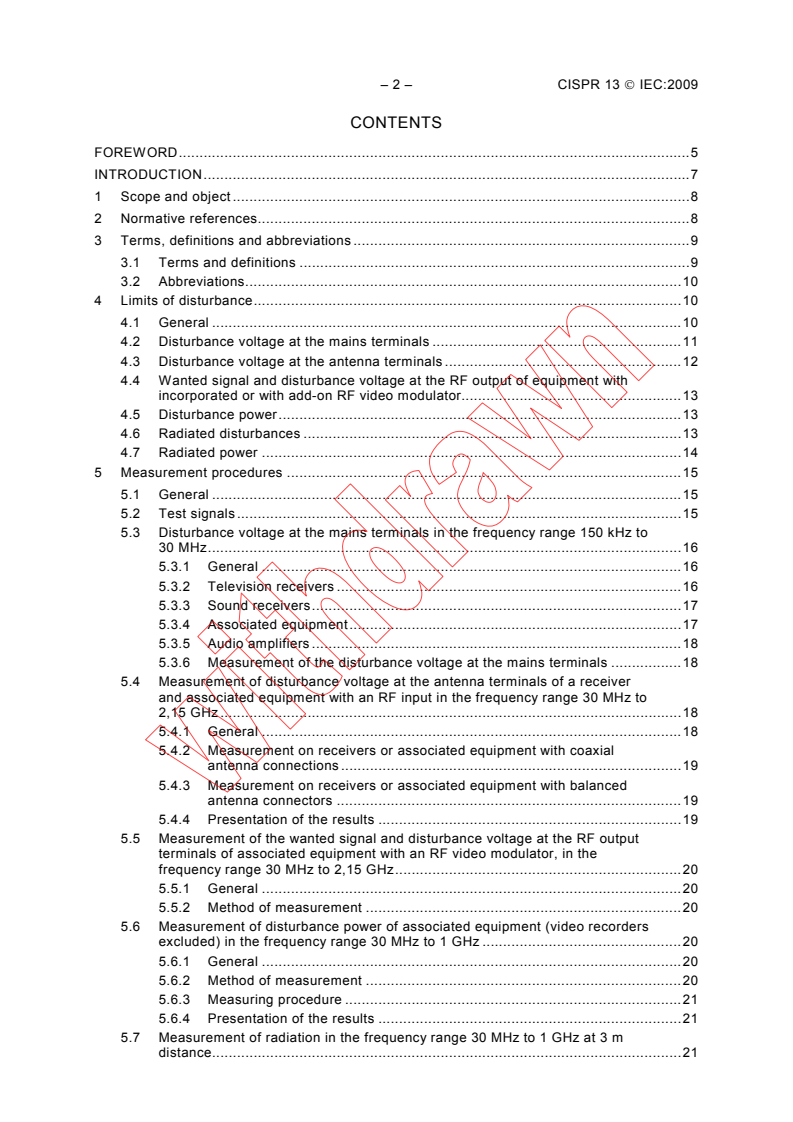
CISPR 13:2009 - Sound and television broadcast receivers and associated equipment - Radio disturbance characteristics - Limits and methods of measurement Released:6/29/2009

CISPR 13:2009+AMD1:2015 CSV - Sound and television broadcast receivers and associated equipment -Radio disturbance characteristics - Limits and methods of measurement Released:1/28/2015
Relations
- Replaced By
CISPR 32:2015 - Electromagnetic compatibility of multimedia equipment - Emission requirements - Effective Date
- 05-Sep-2023
- Effective Date
- 05-Sep-2023
- Effective Date
- 05-Sep-2023
- Effective Date
- 05-Sep-2023
- Effective Date
- 05-Sep-2023
Buy Documents
CISPR 13:2009 - Sound and television broadcast receivers and associated equipment - Radio disturbance characteristics - Limits and methods of measurement Released:6/29/2009
CISPR 13:2009+AMD1:2015 CSV - Sound and television broadcast receivers and associated equipment -Radio disturbance characteristics - Limits and methods of measurement Released:1/28/2015
Get Certified
Connect with accredited certification bodies for this standard

ANCE
Mexican certification and testing association.

Intertek Slovenia
Intertek testing, inspection, and certification services in Slovenia.

LNE (Laboratoire National de Métrologie et d'Essais)
French national laboratory for metrology and testing.
Sponsored listings
Frequently Asked Questions
CISPR 13:2009 is a standard published by the International Electrotechnical Commission (IEC). Its full title is "Sound and television broadcast receivers and associated equipment - Radio disturbance characteristics - Limits and methods of measurement". This standard covers: CISPR 13:2009 applies to the generation of electromagnetic energy from sound and television receivers for the reception of broadcast and similar transmissions and from associated equipment. CISPR 13:2009 describes the methods of measurement applicable to sound and television receivers or associated equipment and specifies limits for the control of disturbance from such equipment. The frequency range covered extends from 9 kHz to 400 GHz. This fifth edition of CISPR 13 cancels and replaces the fourth edition published in 2001, its Amendment 1 (2003) and Amendment 2 (2006). This edition constitutes the introduction of the RMS-average detector as an alternative to quasi-peak and average detector for conducted and radiated emission measurements.
CISPR 13:2009 applies to the generation of electromagnetic energy from sound and television receivers for the reception of broadcast and similar transmissions and from associated equipment. CISPR 13:2009 describes the methods of measurement applicable to sound and television receivers or associated equipment and specifies limits for the control of disturbance from such equipment. The frequency range covered extends from 9 kHz to 400 GHz. This fifth edition of CISPR 13 cancels and replaces the fourth edition published in 2001, its Amendment 1 (2003) and Amendment 2 (2006). This edition constitutes the introduction of the RMS-average detector as an alternative to quasi-peak and average detector for conducted and radiated emission measurements.
CISPR 13:2009 is classified under the following ICS (International Classification for Standards) categories: 33.100.10 - Emission. The ICS classification helps identify the subject area and facilitates finding related standards.
CISPR 13:2009 has the following relationships with other standards: It is inter standard links to CISPR 32:2015, CISPR 13:2009/AMD1:2015, CISPR 13:2001, CISPR 13:2001/AMD1:2003, CISPR 13:2001/AMD2:2006. Understanding these relationships helps ensure you are using the most current and applicable version of the standard.
CISPR 13:2009 is available in PDF format for immediate download after purchase. The document can be added to your cart and obtained through the secure checkout process. Digital delivery ensures instant access to the complete standard document.
Standards Content (Sample)
CISPR 13 ®
Edition 5.0 2009-06
INTERNATIONAL
STANDARD
NORME
INTERNATIONALE
INTERNATIONAL SPECIAL COMMITTEE ON RADIO INTERFERENCE
COMITÉ INTERNATIONAL SPÉCIAL DES PERTURBATIONS RADIOÉLECTRIQUES
Sound and television broadcast receivers and associated equipment – Radio
disturbance characteristics – Limits and methods of measurement
Récepteurs de radiodiffusion et de télévision et équipements associés –
Caractéristiques des perturbations radioélectriques – Limites et méthodes de
mesure
All rights reserved. Unless otherwise specified, no part of this publication may be reproduced or utilized in any form or by
any means, electronic or mechanical, including photocopying and microfilm, without permission in writing from either IEC or
IEC's member National Committee in the country of the requester.
If you have any questions about IEC copyright or have an enquiry about obtaining additional rights to this publication,
please contact the address below or your local IEC member National Committee for further information.
Droits de reproduction réservés. Sauf indication contraire, aucune partie de cette publication ne peut être reproduite
ni utilisée sous quelque forme que ce soit et par aucun procédé, électronique ou mécanique, y compris la photocopie
et les microfilms, sans l'accord écrit de la CEI ou du Comité national de la CEI du pays du demandeur.
Si vous avez des questions sur le copyright de la CEI ou si vous désirez obtenir des droits supplémentaires sur cette
publication, utilisez les coordonnées ci-après ou contactez le Comité national de la CEI de votre pays de résidence.
IEC Central Office
3, rue de Varembé
CH-1211 Geneva 20
Switzerland
Email: inmail@iec.ch
Web: www.iec.ch
About the IEC
The International Electrotechnical Commission (IEC) is the leading global organization that prepares and publishes
International Standards for all electrical, electronic and related technologies.
About IEC publications
The technical content of IEC publications is kept under constant review by the IEC. Please make sure that you have the
latest edition, a corrigenda or an amendment might have been published.
ƒ Catalogue of IEC publications: www.iec.ch/searchpub
The IEC on-line Catalogue enables you to search by a variety of criteria (reference number, text, technical committee,…).
It also gives information on projects, withdrawn and replaced publications.
ƒ IEC Just Published: www.iec.ch/online_news/justpub
Stay up to date on all new IEC publications. Just Published details twice a month all new publications released. Available
on-line and also by email.
ƒ Electropedia: www.electropedia.org
The world's leading online dictionary of electronic and electrical terms containing more than 20 000 terms and definitions
in English and French, with equivalent terms in additional languages. Also known as the International Electrotechnical
Vocabulary online.
ƒ Customer Service Centre: www.iec.ch/webstore/custserv
If you wish to give us your feedback on this publication or need further assistance, please visit the Customer Service
Centre FAQ or contact us:
Email: csc@iec.ch
Tel.: +41 22 919 02 11
Fax: +41 22 919 03 00
A propos de la CEI
La Commission Electrotechnique Internationale (CEI) est la première organisation mondiale qui élabore et publie des
normes internationales pour tout ce qui a trait à l'électricité, à l'électronique et aux technologies apparentées.
A propos des publications CEI
Le contenu technique des publications de la CEI est constamment revu. Veuillez vous assurer que vous possédez
l’édition la plus récente, un corrigendum ou amendement peut avoir été publié.
ƒ Catalogue des publications de la CEI: www.iec.ch/searchpub/cur_fut-f.htm
Le Catalogue en-ligne de la CEI vous permet d’effectuer des recherches en utilisant différents critères (numéro de référence,
texte, comité d’études,…). Il donne aussi des informations sur les projets et les publications retirées ou remplacées.
ƒ Just Published CEI: www.iec.ch/online_news/justpub
Restez informé sur les nouvelles publications de la CEI. Just Published détaille deux fois par mois les nouvelles
publications parues. Disponible en-ligne et aussi par email.
ƒ Electropedia: www.electropedia.org
Le premier dictionnaire en ligne au monde de termes électroniques et électriques. Il contient plus de 20 000 termes et
définitions en anglais et en français, ainsi que les termes équivalents dans les langues additionnelles. Egalement appelé
Vocabulaire Electrotechnique International en ligne.
ƒ Service Clients: www.iec.ch/webstore/custserv/custserv_entry-f.htm
Si vous désirez nous donner des commentaires sur cette publication ou si vous avez des questions, visitez le FAQ du
Service clients ou contactez-nous:
Email: csc@iec.ch
Tél.: +41 22 919 02 11
Fax: +41 22 919 03 00
CISPR 13 ®
Edition 5.0 2009-06
INTERNATIONAL
STANDARD
NORME
INTERNATIONALE
INTERNATIONAL SPECIAL COMMITTEE ON RADIO INTERFERENCE
COMITÉ INTERNATIONAL SPÉCIAL DES PERTURBATIONS RADIOÉLECTRIQUES
Sound and television broadcast receivers and associated equipment – Radio
disturbance characteristics – Limits and methods of measurement
Récepteurs de radiodiffusion et de télévision et équipements associés –
Caractéristiques des perturbations radioélectriques – Limites et méthodes de
mesure
INTERNATIONAL
ELECTROTECHNICAL
COMMISSION
COMMISSION
ELECTROTECHNIQUE
PRICE CODE
INTERNATIONALE
X
CODE PRIX
ICS 33.100.10 ISBN 978-2-88910-005-7
– 2 – CISPR 13 © IEC:2009
CONTENTS
FOREWORD.5
INTRODUCTION.7
1 Scope and object .8
2 Normative references.8
3 Terms, definitions and abbreviations .9
3.1 Terms and definitions .9
3.2 Abbreviations.10
4 Limits of disturbance.10
4.1 General .10
4.2 Disturbance voltage at the mains terminals .11
4.3 Disturbance voltage at the antenna terminals .12
4.4 Wanted signal and disturbance voltage at the RF output of equipment with
incorporated or with add-on RF video modulator.13
4.5 Disturbance power.13
4.6 Radiated disturbances .13
4.7 Radiated power .14
5 Measurement procedures .15
5.1 General .15
5.2 Test signals.15
5.3 Disturbance voltage at the mains terminals in the frequency range 150 kHz to
30 MHz.16
5.3.1 General .16
5.3.2 Television receivers .16
5.3.3 Sound receivers.17
5.3.4 Associated equipment.17
5.3.5 Audio amplifiers .18
5.3.6 Measurement of the disturbance voltage at the mains terminals .18
5.4 Measurement of disturbance voltage at the antenna terminals of a receiver
and associated equipment with an RF input in the frequency range 30 MHz to
2,15 GHz .18
5.4.1 General .18
5.4.2 Measurement on receivers or associated equipment with coaxial
antenna connections .19
5.4.3 Measurement on receivers or associated equipment with balanced
antenna connectors .19
5.4.4 Presentation of the results .19
5.5 Measurement of the wanted signal and disturbance voltage at the RF output
terminals of associated equipment with an RF video modulator, in the
frequency range 30 MHz to 2,15 GHz.20
5.5.1 General .20
5.5.2 Method of measurement .20
5.6 Measurement of disturbance power of associated equipment (video recorders
excluded) in the frequency range 30 MHz to 1 GHz .20
5.6.1 General .20
5.6.2 Method of measurement .20
5.6.3 Measuring procedure .21
5.6.4 Presentation of the results .21
5.7 Measurement of radiation in the frequency range 30 MHz to 1 GHz at 3 m
distance.21
CISPR 13 © IEC:2009 – 3 –
5.7.1 General .21
5.7.2 Measuring site requirements .22
5.7.3 Disposition of the equipment under test.23
5.7.4 Disposition of the field-strength meter .24
5.7.5 Measurement procedure .24
5.8 Measurement of radiation in the frequency range 1 GHz to 18 GHz .24
5.8.1 Measuring set-up .24
5.8.2 Test site validation.25
5.8.3 Measuring procedure .26
5.8.4 Presentation of the results .26
5.9 Measurement of the local oscillator power at the input terminal of the outdoor
unit.26
6 Interpretation of CISPR radio disturbance limits .26
6.1 Compliance with this standard .26
6.2 Significance of a CISPR limit .26
6.3 Compliance with limits on a statistical basis .27
Annex A (normative) Broadcast receivers for digital signals .34
Annex B (informative) Specification of the wanted signal .38
Bibliography .43
Figure 1 – Colour bar signal levels according to ITU-R Recommendation BT 471-1 (see
5.2) (“red” signal) .28
Figure 2 – Teletext picture (see 5.2) .28
Figure 3 – Example of an artificial mains network 50 Ω-50 μH (see 5.3.1) .29
Figure 4 – Example of artificial mains network 50 Ω-50 μH-5 Ω (see 5.3.1) .29
Figure 5 – Measurement of the radiofrequency disturbance voltage injected into the
mains (see 5.3.1) .30
Figure 6 – Measurement of the radiofrequency disturbance voltage injected into the
mains (top view) (see 5.3.1) .30
Figure 7 – Circuit arrangement for the measurement of disturbance voltages at the
coaxial antenna terminals (see 5.4.2) .31
Figure 8 – Circuit arrangement for receivers with balanced antenna connections (see
5.4.3) .31
Figure 9 – Circuit arrangement for the measurement of the wanted signal and
disturbance voltage at the RF output of video recorders (see 5.5.2) .31
Figure 10 – Circuit arrangement for the measurement of disturbance power of
associated equipment (video recorders excluded) (see 5.6.3) .32
Figure 11 – Measuring site (see 5.7.2).32
Figure 12 – Check of the site suitability (see 5.7.2).32
Figure 13 – Theoretical site attenuation curve for the range 80 MHz to 1 GHz (see
5.7.2) .33
Figure 14 – Open-field measurement at 3 m distance (see 5.7.3).33
Figure A.1 – Measurement of the radiofrequency disturbance voltage injected into the
mains in the frequency range 150 kHz to 30 MHz (side view) .36
Figure A.2 – Example of isolation transformer for 46 MHz to 1,5 GHz .36
Figure A.3 – Typical size of isolation transformer for 46 MHz to 1,5 GHz.37
Figure A.4 – Typical characteristic of insertion loss of isolation transformer for 46 MHz
to 1,5 GHz .37
– 4 – CISPR 13 © IEC:2009
Table 1 – Limits of disturbance voltage at the mains terminals.11
Table 2 – Limits of disturbance voltage at the antenna terminals.12
Table 3 – Limits of the wanted signal and disturbance voltage at RF output terminals of
equipment with RF video modulator.13
Table 4 – Limits of disturbance power .13
Table 5 – Limits of radiated disturbances at 3 m distance .14
Table 6 – Limits of radiated power of tuner units of direct to home satellite receivers .14
Table 7 – Limits of radiated power of outdoor units of direct to home satellite receivers .15
CISPR 13 © IEC:2009 – 5 –
INTERNATIONAL ELECTROTECHNICAL COMMISSION
INTERNATIONAL SPECIAL COMMITTEE ON RADIO INTERFERENCE
__________
SOUND AND TELEVISION BROADCAST RECEIVERS
AND ASSOCIATED EQUIPMENT –
RADIO DISTURBANCE CHARACTERISTICS –
LIMITS AND METHODS OF MEASUREMENT
FOREWORD
1) The International Electrotechnical Commission (IEC) is a worldwide organization for standardization comprising
all national electrotechnical committees (IEC National Committees). The object of IEC is to promote
international co-operation on all questions concerning standardization in the electrical and electronic fields. To
this end and in addition to other activities, IEC publishes International Standards, Technical Specifications,
Technical Reports, Publicly Available Specifications (PAS) and Guides (hereafter referred to as “IEC
Publication(s)”). Their preparation is entrusted to technical committees; any IEC National Committee interested
in the subject dealt with may participate in this preparatory work. International, governmental and non-
governmental organizations liaising with the IEC also participate in this preparation. IEC collaborates closely
with the International Organization for Standardization (ISO) in accordance with conditions determined by
agreement between the two organizations.
2) The formal decisions or agreements of IEC on technical matters express, as nearly as possible, an international
consensus of opinion on the relevant subjects since each technical committee has representation from all
interested IEC National Committees.
3) IEC Publications have the form of recommendations for international use and are accepted by IEC National
Committees in that sense. While all reasonable efforts are made to ensure that the technical content of IEC
Publications is accurate, IEC cannot be held responsible for the way in which they are used or for any
misinterpretation by any end user.
4) In order to promote international uniformity, IEC National Committees undertake to apply IEC Publications
transparently to the maximum extent possible in their national and regional publications. Any divergence
between any IEC Publication and the corresponding national or regional publication shall be clearly indicated in
the latter.
5) IEC provides no marking procedure to indicate its approval and cannot be rendered responsible for any
equipment declared to be in conformity with an IEC Publication.
6) All users should ensure that they have the latest edition of this publication.
7) No liability shall attach to IEC or its directors, employees, servants or agents including individual experts and
members of its technical committees and IEC National Committees for any personal injury, property damage or
other damage of any nature whatsoever, whether direct or indirect, or for costs (including legal fees) and
expenses arising out of the publication, use of, or reliance upon, this IEC Publication or any other IEC
Publications.
8) Attention is drawn to the Normative references cited in this publication. Use of the referenced publications is
indispensable for the correct application of this publication.
9) Attention is drawn to the possibility that some of the elements of this IEC Publication may be the subject of
patent rights. IEC shall not be held responsible for identifying any or all such patent rights.
International Standard CISPR 13 has been prepared by CISPR subcommittee I:
Electromagnetic compatibility of information technology equipment, multimedia equipment and
receivers.
This fifth edition of CISPR 13 cancels and replaces the fourth edition published in 2001, its
Amendment 1 (2003) and Amendment 2 (2006).This edition constitutes the introduction of the
RMS-average detector as an alternative to quasi-peak and average detector for conducted and
radiated emission measurements.
The document CISPR/I/296/FDIS, circulated to the National Committees as Amendment 3, led
to the publication of the new edition.
– 6 – CISPR 13 © IEC:2009
The text of this standard is based on the fourth edition, Amendment 1, Amendment 2 and the
following documents:
FDIS Report on voting
CISPR/I/296/FDIS CISPR/I/297/RVD
Full information on the voting for the approval of this standard can be found in the report on
voting indicated in the above table.
This publication has been drafted in accordance with the ISO/IEC Directives, Part 2.
The committee has decided that the contents of this publication will remain unchanged until the
maintenance result date indicated on the IEC web site under "http://webstore.iec.ch" in the data
related to the specific publication. At this date, the publication will be
• reconfirmed,
• withdrawn,
• replaced by a revised edition, or
• amended.
CISPR 13 © IEC:2009 – 7 –
INTRODUCTION
The CISPR recommends that the limits and methods of measurement of radio disturbance
characteristics of sound and television receivers contained in the latest edition of CISPR 13,
including amendments, be used, without regional or national addenda or modifications. The
requirements are considered sufficient to reach adequate emission levels to protect radio
broadcast and telecommunication services and to allow other apparatus to operate as intended
at a reasonable distance.
– 8 – CISPR 13 © IEC:2009
SOUND AND TELEVISION BROADCAST RECEIVERS
AND ASSOCIATED EQUIPMENT –
RADIO DISTURBANCE CHARACTERISTICS –
LIMITS AND METHODS OF MEASUREMENT
1 Scope and object
This International Standard applies to the generation of electromagnetic energy from sound
and television receivers for the reception of broadcast and similar transmissions and from
associated equipment. The frequency range covered extends from 9 kHz to 400 GHz.
No measurements need be performed at frequencies where no limits are specified.
Receiving systems for collective reception, in particular:
– cable distribution head ends (Community Antenna Television, CATV);
– community reception systems (Master Antenna Television, MATV)
are covered by IEC 60728-2.
Broadcast receivers for digital signals are covered by Annex A and Annex B.
Information technology equipment (ITE) is excluded, even if intended to be connected to a
television broadcast receiver.
The telecommunication port of broadcast receivers, intended to be connected to a tele-
communication network, is covered by CISPR 22.
In addition, measurements at the telecommunication port are performed with the broadcast
reception functions, which are independent from the telecommunication function, disabled
during the measurement.
PC tuner cards are measured according to the relevant clauses of this standard.
This standard describes the methods of measurement applicable to sound and television
receivers or associated equipment and specifies limits for the control of disturbance from such
equipment.
For multifunction equipment which is subjected simultaneously to different clauses of this
standard and/or other standards, details are given in 4.1.
2 Normative references
The following referenced documents are indispensable for the application of this document. For
dated references, only the edition cited applies. For undated references, the latest edition of
the referenced document (including any amendments) applies.
CISPR 13 © IEC:2009 – 9 –
CISPR 16-1-1:2006, Specification for radio disturbance and immunity measuring apparatus and
methods – Part 1-1: Radio disturbance and immunity measuring apparatus – Measuring
apparatus
Amendment 1 (2006)
Amendment 2 (2007)
CISPR 16-1-2:2003, Specification for radio disturbance and immunity measuring apparatus and
methods – Part 1-2: Radio disturbance and immunity measuring apparatus – Ancillary
equipment – Conducted disturbances
Amendment 1 (2004)
Amendment 2 (2006)
CISPR 16-1-3:2004, Specification for radio disturbance and immunity measuring apparatus and
methods – Part 1-3: Radio disturbance and immunity measuring apparatus – Ancillary
equipment – Disturbance power
CISPR 16-1-4:2007, Specification for radio disturbance and immunity measuring apparatus and
methods – Part 1-4: Radio disturbance and immunity measuring apparatus – Ancillary
equipment – Radiated disturbances
Amendment 1 (2007)
Amendment 2 (2008)
CISPR 16-2-2:2003, Specification for radio disturbance and immunity measuring apparatus and
methods – Part 2-2: Methods of measurement of disturbances and immunity – Measurement of
disturbance power
Amendment 1 (2004)
Amendment 2 (2005)
CISPR 22:2008, Information technology equipment – Radio disturbance characteristics – Limits
and methods of measurement
IEC 60050-161:1990, International Electrotechnical Vocabulary (IEV) – Chapter 161:
Electromagnetic compatibility
Amendment 1 (1997)
Amendment 2 (1998)
IEC 60728-2:2002, Cabled distribution systems for television and sound signals – Part 2:
Electromagnetic compatibility for equipment (only available in English)
ITU-R BT 471-1, Nomenclature and description of colour bar signals
3 Terms, definitions and abbreviations
3.1 Terms and definitions
For the purposes of this document, the following terms, definitions and abbreviations apply.
3.1.1
sound broadcast receivers
appliances intended for the reception of sound broadcast and similar services for terrestrial,
cable and satellite transmission, regardless whether the input signals are digital or analog
___________
There exists a consolidated edition 2.2 (2007) including edition 2.0, its Amendment 1 (2006) and its Amendment 2 (2007).
There exists a consolidated edition 1.2 (2006) including edition 1.0, its Amendment 1 (2004) and its Amendment 2 (2006).
There exists a consolidated edition 2.1 (2008) including edition 2.0 and its Amendment 1 (2007).
There exists a consolidated edition 1.2 (2005) including edition 1.0, its Amendment 1 (2004) and its Amendment 2 (2005).
– 10 – CISPR 13 © IEC:2009
3.1.2
television receivers
appliances intended for the reception of television broadcast and similar services for terrestrial,
cable and satellite transmissions, regardless whether the input signals are digital or analog
3.1.3
associated equipment
equipment either intended to be connected directly to sound or television broadcast receivers,
or to generate or reproduce audio or visual information
NOTE 1 Tuners may be provided with a broadcast-satellite-receiving stage and with demodulators, decoders,
demultiplexers, D/A converters, encoders (e.g. NTSC, PAL or SECAM encoders), etc.
NOTE 2 Frequency converters may be provided with a broadcast-satellite-receiving stage and with devices which
convert the signals to other frequency bands.
NOTE 3 Receivers, tuners, or frequency converters may be tuneable or may only be able to receive a fixed
frequency.
3.1.4
PC tuner cards
sound broadcast receiver cards and television broadcast receiver cards, either to be inserted in
personal computers or permanently integrated therein
3.1.5
outdoor unit of direct to home satellite receiving systems for individual reception
unit consisting of the antenna, the feeding network and the low-noise amplifier with its
associated down-converter. The intermediate frequency amplifier and the demodulator are not
included
3.1.6
multifunction equipment
appliances in which two or more functions are provided in the same unit, for instance television
reception, radio reception, digital clock, tape-recorder or disc player, etc.
3.2 Abbreviations
AM Amplitude Modulation
CATV Community Antenna Television
CD Compact Disc
EUT Equipment Under Test
FM Frequency Modulation
ITE Information Technology Equipment
ITU-R International Telecommunication Union – Radio
LW, MW and SW Long-, Medium- and Short-Waves
MATV Master Antenna Television
PC Personal Computer
RF Radio Frequency
4 Limits of disturbance
4.1 General
For RF disturbances the level shall not exceed the limits specified in 4.2 to 4.7 when measured
using the methods given in Clause 5. Where there is frequency duplication at the boundary of
CISPR 13 © IEC:2009 – 11 –
two ranges, the lower limit shall apply. For equipment in large-scale production, it is required
that, with 80 % confidence, at least 80 % of production complies with the limits (see Clause 6).
Multifunction equipment which is subjected simultaneously to different clauses of this standard
and/or other standards shall be tested with each function operated in isolation, if this can
be achieved without modifying the equipment internally. The equipment thus tested shall be
deemed to have complied with the requirements of all clauses/standards when each function
has satisfied the requirements of the relevant clause/standard.
For equipment for which it is not practical to test with each function operated in isolation, or
where the isolation of a particular function would result in the equipment being unable to fulfil
its primary function, the equipment shall be deemed to have complied if it meets the provisions
of the relevant clause/standard with the necessary functions operative.
4.2 Disturbance voltage at the mains terminals
Measurements shall be made in accordance with 5.3.
Table 1 – Limits of disturbance voltage at the mains terminals
Limit
Frequency
dB(μV)
Equipment type
MHz
Quasi-peak Average a
RMS-average
b b b
0,15 to 0,5 66 to 56 56 to 46 60 to 50
Television and sound receivers
0,5 to 5 56 46 50
and associated equipment
5 to 30 60 50 54
a
The r.m.s average limits can be applied as an alternative to quasi-peak and average limits.
b
Decreasing linearly with the logarithm of the frequency.
NOTE 1 If the limits for the average detector are met when using the quasi-peak detector, then the
limits for the measurements with the average detector are considered to be met.
NOTE 2 The higher value measured with and without the outer conductor screen of the antenna terminal connected
to earth is considered.
NOTE 3 Television receivers with teletext facilities should be tested in teletext mode with teletext picture.
– 12 – CISPR 13 © IEC:2009
4.3 Disturbance voltage at the antenna terminals
Measurements of the antenna terminal voltage shall be made in accordance with 5.4.
The limit values specified correspond to a nominal impedance of 75 Ω.
The limit values for receivers with nominal impedance other than 75 Ω are calculated according
to the following formula:
L = L + 10 log (Z/75) dB(μV)
Z
Table 2 – Limits of disturbance voltage at the antenna terminals
Limit Limit
Frequency
dB(μV) 75 Ω dB(μV) 75 Ω
Equipment type Source
MHz
a b
Quasi-peak RMS-average
Television Local oscillator ≤1 000 Fundamental 46 Fundamental 46
receivers, video
30 to 950 Harmonics 46 Harmonics 46
recorders and PC
tuner cards working
950 to 2 150 Harmonics 54 Harmonics 54
in channels
Other 30 to 2 150 46 46
between
30 MHz and 1 GHz
Television receivers Local oscillator 950 to 2 150 Fundamental 54 Fundamental 54
for broadcast
950 to 2 150 Harmonics 54 Harmonics 54
satellite
transmissions and
Other 30 to 2 150 46 46
c
tuner units
Frequency Local oscillator ≤1 000 Fundamental 54 Fundamental 54
modulation sound
30 to 300 Harmonics 50 Harmonics 50
receivers and
300 to 1 000 Harmonics 52 Harmonics 52
PC tuner cards
Other 30 to 1 000 46 46
Frequency Local oscillator ≤1 000 Fundamental 66 Fundamental 66
modulation car
30 to 300 Harmonics 59 Harmonics 59
radios
300 to 1 000 Harmonics 52 Harmonics 52
Other 30 to 1 000 46 46
Associated Other 30 to 2 150 46 46
equipment with an
RF input, e.g. video
tape player, laser
disc player
a
At frequencies above 1 GHz, the peak detector is used.
b
The RMS-average limits can be applied as an alternative to quasi-peak limits in the entire frequency range.
c
For tuner units, "antenna terminal" means "first intermediate frequency input terminal".
NOTE For AM broadcast receivers for LW, MW and SW, no limits apply.
CISPR 13 © IEC:2009 – 13 –
4.4 Wanted signal and disturbance voltage at the RF output of equipment with
incorporated or with add-on RF video modulator
Measurements of the wanted signal and disturbance voltage at the RF output terminals of
equipment with incorporated or with add-on RF video modulator (e.g. of video recorders and
decoders) shall be made in accordance with 5.5. If the nominal impedance of the RF output is
different from 75 Ω, the limit level shall be calculated with the formula given in 4.3.
Table 3 – Limits of the wanted signal and disturbance voltage at RF
output terminals of equipment with RF video modulator
Limit Limit
Frequency
dB(μV) 75 Ω dB(μV) 75 Ω
Equipment type Source
MHz
a b
Quasi-peak RMS-average
Wanted signal Carrier frequencies and Carrier frequencies and
Equipment with RF
sidebands 76 sidebands 76
video modulator
(e.g. video
30 to 950 Harmonics 46 Harmonics 46
recorders,
950 to 2 150 Harmonics 54 Harmonics 54
camcorders and
decoders)
Other 30 to 2 150 46
a
At frequencies above 1 GHz, the peak detector is used.
b
The RMS-average limits can be applied as an alternative to quasi-peak limits in the entire frequency range.
4.5 Disturbance power
Measurements shall be made in accordance with 5.6.
Table 4 – Limits of disturbance power
Limit
Frequency
dB(pW)
Equipment type
MHz
Quasi-peak Average a
RMS-average
Associated equipment 30 to 300 b b b
45 to 55
35 to 45 39 to 49
(video recorders excluded)
a
The RMS-average limits can be applied as an alternative to quasi-peak and average limits.
b
Increasing linearly with the frequency.
NOTE If the limits for the average detector are met when using the quasi-peak detector, then the limits for the
measurements with the average detector are considered to be met.
4.6 Radiated disturbances
Measurements of the disturbance field due to the local oscillator at its fundamental and
harmonic frequencies and due to all other sources shall be made in accordance with 5.7.
– 14 – CISPR 13 © IEC:2009
Table 5 – Limits of radiated disturbances at 3 m distance
Limit Limit
Frequency
dB(μV/m) dB(μV/m)
Equipment type Source
MHz
a a, b
Quasi-peak RMS-average
Television Local oscillator ≤1 000 a a
Fundamental 57 Fundamental 57
receivers, video
30 to 300
recorders and PC Harmonics 52 Harmonics 52
tuner cards
300 to 1 000
Harmonics 56 Harmonics 56
Other
30 to 230
40 40
230 to 1 000
47 47
Television and Other 30 to 230 40 40
sound receivers for
230 to 1 000 47 47
broadcast satellite
transmissions
(except outdoor
units),
Infrared remote
control units and
Infrared headphone
systems
Frequency Local oscillator ≤1 000 Fundamental 60 Fundamental 60
modulation sound
Harmonics 52 Harmonics 52
30 to 300
receivers and PC
tuner cards
Harmonics 56 Harmonics 56
300 to 1 000
Other 40 40
30 to 230
47 47
230 to 1 000
a
In Japan: 57 dB(μV/m) is relaxed to 66 dB(μV/m) for operating channels <300 MHz and to 70 dB(μV/m) for operating
channels >300 MHz.
b
The RMS-average limits can be applied as an alternative to quasi-peak limits.
NOTE For car radio receivers and for LW, MW and SW AM broadcast receivers, no radiation limits apply.
4.7 Radiated power
Measurement of the radiated power due to the local oscillator at its fundamental and harmonic
frequencies and due to all other sources shall be made in accordance with 5.8.
Table 6 – Limits of radiated power of tuner units of direct to home satellite receivers
Frequency Limit
Equipment type Source
GHz dB(pW)
Television and sound receivers Local oscillator 1 to 3 Fundamental 57
for broadcast satellite
1 to 3 Harmonics 57
transmissions:
tuner units
CISPR 13 © IEC:2009 – 15 –
Table 7 – Limits of radiated power of outdoor units of direct to home satellite receivers
Frequency Limit
Equipment type Source
GHz dB(pW)
Outdoor units of direct to Local oscillator leakage 0,9 to 18 Fundamental 30
home satellite receivers radiated from the antenna
within ±7° of the main
a
beam axis
Equivalent radiated power 1 to 2,5 43
from outdoor unit
2,5 to 18 57
including the local
b
oscillator leakage
a
The direct measurement is carried out according to 5.9. When the reflector of the parabolic antenna cannot be
removed, the indirect measurement according to 5.8 is carried out. In that case, the antenna gain shall be taken
into account.
b
Measurement of the equivalent radiated power shall be in accordance with 5.8. No requirements within ±7° off the
main beam axis of the antenna.
5 Measurement procedures
5.1 General
This clause deals with standardized measurement procedures and measuring equipment.
Deviations from this standard are allowed (e.g. the use of broad-band antennas, the
dimensions of the screened room) provided that the measurement results are comparable to
those resulting from the standardized method and the deviations are noted in the test report.
In case of controversy, the procedure as formulated in this standard shall take precedence.
5.2 Test signals
The standard test signal for television receivers and for other equipment with video signal
input/output and/or an RF modulator is a standard television colour bar signal according to
ITU-R BT 471-1 (see Figure 1). The modulation of the video and the audio signals on the RF
carrier shall be according to the system for which the equipment is intended.
In the case of television receivers, the wanted signal shall be a vision carrier modulated by a
complete video waveform including a colour burst together with an unmodulated sound carrier
of the correct relative amplitude and frequency.
The teletext picture shall preferably be the one shown in Figure 2, consisting of rows of
numbers completely filling the screen. If this picture is not available, measurement shall be
done with the main index page of the national teletext broadcast service. In the latter case the
picture used shall be indicated with the results.
NOTE For countries using non-alphabetical systems, the test pattern of the national teletext broadcast service
also can be used.
– 16 – CISPR 13 © IEC:2009
The standard test signals for radio receivers are:
a) Band II: an RF signal frequency modulated with a monophonic signal at 1 kHz with 37,5 kHz
deviation;
b) LW/MW/SW: an RF signal amplitude modulated with a signal at 1 kHz with 50 %
modulation.
The standard test signals for associated equipment are:
a) audio amplifiers and infrared headphones: a sinusoidal signal at 1 kHz;
b) associated audio equipment e.g. audio tape recorders, record players, CD players: a tape
or disc recorded 1 kHz audio signal with a standard sound level specified by the
manufacturer of the equipment under test;
c) associated video equipment, e.g. video tape players, camcorders, laser disc players: a tape
or disc recorded standard television colour bar signal with 1 kHz audio signal, with a
standard sound level specified by the manufacturer of the equipment under test;
d) electronic organs: a signal derived from depressing the upper C note (approximately
523 Hz);
e) infrared remote controls: a permanent transmission of a typical control function.
For equipment for which the wanted signals are not explicitly described in this standard, the
nominal signals as specified by the manufacturer shall be applied during the tests. (This is e.g.
the case for broadcast receivers for digital signals, decoders, etc.) The manufacturer shall
specify in his technical report which input signal was applied during the tests.
An infrared remote control is considered as a part of the main unit and tested together. Remote
controls marketed separately are only tested on radiated disturbances (Table 5).
5.3 Disturbance voltage at the mains terminals in the frequency
range 150 kHz to 30 MHz
5.3.1 General
The measured voltage includes narrow-band interference from the time-base, video circuits
and broad-band interference such as that produced by semiconductor rectifiers.
An artificial mains V-network is required to provide defined impedances at high frequencies
between the mains terminals of the equipment under test and reference earth. The network
also provides a suitable filter to isolate the equipment under test circuit from unwanted RF
voltages that may be present on the supply mains.
An artificial mains network according to CISPR 16-1-2 shall be used, which is suitable for
measuring the disturbance voltage between each mains terminal of the equipment under test
and the reference earth in the frequency range 0,15 MHz to 30 MHz (see also Figures 3 and 4).
Disturbance voltage measurements should be carried out in a screened room as depicted in
Figures 5 and 6.
NOTE Floor-standing equipment should be placed directly on the floor. If the cabinet of the equipment under test
is of conducting material and not provided with insulating legs or wheels, the points of contact should be separated
from the metallic ground-plane by insulating material of up to 12 mm thickness.
5.3.2 Television receivers
The television receiver shall be tuned to a standard test signal as defined in 5.2. A small pick-
up antenna (see Figures 5 and 6) is connected to the receiver for this purpose. If the receiver
is provided with a built-in antenna, this one shall be used (the pick-up antenna shall be
disconnected).
CISPR 13 © IEC:2009 – 17 –
In case of monitor TV, a video signal generator producing the standard television signal as
defined in 5.2 shall be connected to the video input connector of the monitor via an isolation
transformer.
NOTE 1 The isolation may be provided by an isolation transformer with common impedance to earth of 75 Ω for
the frequency range 0,15 MHz to 30 MHz. Alternatively, the video signal could be applied in series with toroidal RF
chokes (one in each conductor) of 60 μH impedance, connected by very short leads to the video input connector.
The input signal shall be sufficiently strong to give a noise-free picture.
The controls of the equipment under test for contrast, brightness and colour saturation, shall be
set to produce a normal picture.
This is obtained with the following luminance values:
– black part of the test pattern: 2 cd/m ;
– magenta part of the test pattern: 30 cd/m ;
– white part of the test pattern: 80 cd/m .
NOTE 2 The luminance of the magenta part of the test pattern should be set to 30 cd/m . If this level cannot be
reached, the luminance should be set to the maximum possible. If a value different from 30 cd/m is used, it should
be stated together
...
CISPR 13 ®
Edition 5.1 2015-01
CONSOLIDATED VERSION
INTERNATIONAL
STANDARD
NORME
INTERNATIONALE
colour
inside
INTERNATIONAL SPECIAL COMMITTEE ON RADIO INTERFERENCE
COMITÉ INTERNATIONAL SPÉCIAL DES PERTURBATIONS RADIOÉLECTRIQUES
Sound and television broadcast receivers and associated equipment – Radio
disturbance characteristics – Limits and methods of measurement
Récepteurs de radiodiffusion et de télévision et équipements associés –
Caractéristiques des perturbations radioélectriques – Limites et méthodes de
mesure
All rights reserved. Unless otherwise specified, no part of this publication may be reproduced or utilized in any form
or by any means, electronic or mechanical, including photocopying and microfilm, without permission in writing from
either IEC or IEC's member National Committee in the country of the requester. If you have any questions about IEC
copyright or have an enquiry about obtaining additional rights to this publication, please contact the address below or
your local IEC member National Committee for further information.
Droits de reproduction réservés. Sauf indication contraire, aucune partie de cette publication ne peut être reproduite
ni utilisée sous quelque forme que ce soit et par aucun procédé, électronique ou mécanique, y compris la photocopie
et les microfilms, sans l'accord écrit de l'IEC ou du Comité national de l'IEC du pays du demandeur. Si vous avez des
questions sur le copyright de l'IEC ou si vous désirez obtenir des droits supplémentaires sur cette publication, utilisez
les coordonnées ci-après ou contactez le Comité national de l'IEC de votre pays de résidence.
IEC Central Office Tel.: +41 22 919 02 11
3, rue de Varembé Fax: +41 22 919 03 00
CH-1211 Geneva 20 info@iec.ch
Switzerland www.iec.ch
About the IEC
The International Electrotechnical Commission (IEC) is the leading global organization that prepares and publishes
International Standards for all electrical, electronic and related technologies.
About IEC publications
The technical content of IEC publications is kept under constant review by the IEC. Please make sure that you have the
latest edition, a corrigenda or an amendment might have been published.
IEC Catalogue - webstore.iec.ch/catalogue Electropedia - www.electropedia.org
The stand-alone application for consulting the entire The world's leading online dictionary of electronic and
bibliographical information on IEC International Standards, electrical terms containing more than 30 000 terms and
Technical Specifications, Technical Reports and other definitions in English and French, with equivalent terms in 15
documents. Available for PC, Mac OS, Android Tablets and additional languages. Also known as the International
iPad. Electrotechnical Vocabulary (IEV) online.
IEC publications search - www.iec.ch/searchpub IEC Glossary - std.iec.ch/glossary
The advanced search enables to find IEC publications by a More than 60 000 electrotechnical terminology entries in
variety of criteria (reference number, text, technical English and French extracted from the Terms and Definitions
committee,…). It also gives information on projects, replaced clause of IEC publications issued since 2002. Some entries
and withdrawn publications. have been collected from earlier publications of IEC TC 37,
77, 86 and CISPR.
IEC Just Published - webstore.iec.ch/justpublished
Stay up to date on all new IEC publications. Just Published IEC Customer Service Centre - webstore.iec.ch/csc
details all new publications released. Available online and If you wish to give us your feedback on this publication or
also once a month by email. need further assistance, please contact the Customer Service
Centre: csc@iec.ch.
A propos de l'IEC
La Commission Electrotechnique Internationale (IEC) est la première organisation mondiale qui élabore et publie des
Normes internationales pour tout ce qui a trait à l'électricité, à l'électronique et aux technologies apparentées.
A propos des publications IEC
Le contenu technique des publications IEC est constamment revu. Veuillez vous assurer que vous possédez l’édition la
plus récente, un corrigendum ou amendement peut avoir été publié.
Catalogue IEC - webstore.iec.ch/catalogue Electropedia - www.electropedia.org
Application autonome pour consulter tous les renseignements
Le premier dictionnaire en ligne de termes électroniques et
bibliographiques sur les Normes internationales,
électriques. Il contient plus de 30 000 termes et définitions en
Spécifications techniques, Rapports techniques et autres
anglais et en français, ainsi que les termes équivalents dans
documents de l'IEC. Disponible pour PC, Mac OS, tablettes
15 langues additionnelles. Egalement appelé Vocabulaire
Android et iPad.
Electrotechnique International (IEV) en ligne.
Recherche de publications IEC - www.iec.ch/searchpub
Glossaire IEC - std.iec.ch/glossary
La recherche avancée permet de trouver des publications IEC Plus de 60 000 entrées terminologiques électrotechniques, en
en utilisant différents critères (numéro de référence, texte, anglais et en français, extraites des articles Termes et
comité d’études,…). Elle donne aussi des informations sur les Définitions des publications IEC parues depuis 2002. Plus
projets et les publications remplacées ou retirées. certaines entrées antérieures extraites des publications des
CE 37, 77, 86 et CISPR de l'IEC.
IEC Just Published - webstore.iec.ch/justpublished
Service Clients - webstore.iec.ch/csc
Restez informé sur les nouvelles publications IEC. Just
Published détaille les nouvelles publications parues. Si vous désirez nous donner des commentaires sur cette
Disponible en ligne et aussi une fois par mois par email. publication ou si vous avez des questions contactez-nous:
csc@iec.ch.
CISPR 13 ®
Edition 5.1 2015-01
CONSOLIDATED VERSION
INTERNATIONAL
STANDARD
NORME
INTERNATIONALE
colour
inside
INTERNATIONAL SPECIAL COMMITTEE ON RADIO INTERFERENCE
COMITÉ INTERNATIONAL SPÉCIAL DES PERTURBATIONS RADIOÉLECTRIQUES
Sound and television broadcast receivers and associated equipment – Radio
disturbance characteristics – Limits and methods of measurement
Récepteurs de radiodiffusion et de télévision et équipements associés –
Caractéristiques des perturbations radioélectriques – Limites et méthodes de
mesure
INTERNATIONAL
ELECTROTECHNICAL
COMMISSION
COMMISSION
ELECTROTECHNIQUE
INTERNATIONALE
ICS 33.100.10 ISBN 978-2-8322-2250-8
CISPR 13 ®
Edition 5.1 2015-01
CONSOLIDATED VERSION
REDLINE VERSION
VERSION REDLINE
colour
inside
INTERNATIONAL SPECIAL COMMITTEE ON RADIO INTERFERENCE
COMITÉ INTERNATIONAL SPÉCIAL DES PERTURBATIONS RADIOÉLECTRIQUES
Sound and television broadcast receivers and associated equipment – Radio
disturbance characteristics – Limits and methods of measurement
Récepteurs de radiodiffusion et de télévision et équipements associés –
Caractéristiques des perturbations radioélectriques – Limites et méthodes de
mesure
– 2 – CISPR 13:2009
+AMD1:2015 CSV IEC 2015
CONTENTS
FOREWORD . 5
INTRODUCTION . 7
1 Scope and object . 8
2 Normative references. 8
3 Terms, definitions and abbreviations . 9
3.1 Terms and definitions . 9
3.2 Abbreviations . 10
4 Limits of disturbance . 11
4.1 General . 11
4.2 Disturbance voltage at the mains terminals . 11
4.3 Disturbance voltage at the antenna terminals . 11
4.4 Wanted signal and disturbance voltage at the RF output of equipment with
incorporated or with add-on RF video modulator. 12
4.5 Disturbance power . 13
4.6 Radiated disturbances . 13
4.7 Radiated power . 14
5 Measurement procedures . 15
5.1 General . 15
5.2 Test signals . 15
5.3 Disturbance voltage at the mains terminals in the frequency range 150 kHz to
30 MHz . 16
5.3.1 General . 16
5.3.2 Television receivers . 16
5.3.3 Sound receivers . 17
5.3.4 Associated equipment . 17
5.3.5 Audio amplifiers . 18
5.3.6 Measurement of the disturbance voltage at the mains terminals . 18
5.4 Measurement of disturbance voltage at the antenna terminals of a receiver
and associated equipment with an RF input in the frequency range 30 MHz to
2,15 GHz . 18
5.4.1 General . 18
5.4.2 Measurement on receivers or associated equipment with coaxial
antenna connections . 19
5.4.3 Measurement on receivers or associated equipment with balanced
antenna connectors . 19
5.4.4 Presentation of the results . 19
5.5 Measurement of the wanted signal and disturbance voltage at the RF output
terminals of associated equipment with an RF video modulator, in the
frequency range 30 MHz to 2,15 GHz . 20
5.5.1 General . 20
5.5.2 Method of measurement . 20
5.6 Measurement of disturbance power of associated equipment (video recorders
excluded) in the frequency range 30 MHz to 1 GHz . 20
5.6.1 General . 20
5.6.2 Method of measurement . 20
5.6.3 Measuring procedure . 21
5.6.4 Presentation of the results . 21
+AMD1:2015 CSV IEC 2015
5.7 Measurement of radiation in the frequency range 30 MHz to 1 GHz at 3 m
distance. 21
5.7.1 General . 21
5.7.2 Measuring site requirements . 22
5.7.3 Disposition of the equipment under test . 23
5.7.4 Disposition of the field-strength meter . 24
5.7.5 Measurement procedure . 24
5.8 Measurement of radiation in the frequency range 1 GHz to 18 GHz . 25
5.8.1 Measuring set-up . 25
5.8.2 Test site validation . 25
5.8.3 Measuring procedure . 26
5.8.4 Presentation of the results . 26
5.9 Measurement of the local oscillator power at the input terminal of the outdoor
unit . 26
6 Interpretation of CISPR radio disturbance limits . 26
6.1 Compliance with this standard . 26
6.2 Significance of a CISPR limit . 26
6.3 Compliance with limits on a statistical basis . 27
7 Measurement uncertainty . 27
Annex A (normative) Broadcast receivers for digital signals . 35
Annex B (informative) Specification of the wanted signal . 39
Bibliography . 44
Figure 1 – Colour bar signal levels according to ITU-R Recommendation BT 471-1 (see
5.2) (“red” signal) . 28
Figure 2 – Teletext picture (see 5.2) . 28
Figure 3 – Example of an artificial mains network 50 Ω-50 µH (see 5.3.1) . 29
Figure 4 – Example of artificial mains network 50 Ω-50 µH-5 Ω (see 5.3.1) . 29
Figure 5 – Measurement of the radiofrequency disturbance voltage injected into the
mains (see 5.3.1) . 30
Figure 6 – Measurement of the radiofrequency disturbance voltage injected into the
mains (top view) (see 5.3.1) . 30
Figure 7 – Circuit arrangement for the measurement of disturbance voltages at the
coaxial antenna terminals (see 5.4.2) . 31
Figure 8 – Circuit arrangement for receivers with balanced antenna connections (see
5.4.3) . 31
Figure 9 – Circuit arrangement for the measurement of the wanted signal and
disturbance voltage at the RF output of video recorders (see 5.5.2) . 31
Figure 10 – Circuit arrangement for the measurement of disturbance power of
associated equipment (video recorders excluded) (see 5.6.3) . 32
Figure 11 – Measuring site (see 5.7.2). 32
Figure 12 – Check of the site suitability (see 5.7.2) . 32
Figure 13 – Theoretical site attenuation curve for the range 80 MHz to 1 GHz (see
5.7.2) . 33
Figure 14 – Open-field measurement at 3 m distance (see 5.7.3) . 34
Figure A.1 – Measurement of the radiofrequency disturbance voltage injected into the
mains in the frequency range 150 kHz to 30 MHz (side view) . 37
Figure A.2 – Example of isolation transformer for 46 MHz to 1,5 GHz . 37
– 4 – CISPR 13:2009
+AMD1:2015 CSV IEC 2015
Figure A.3 – Typical size of isolation transformer for 46 MHz to 1,5 GHz . 38
Figure A.4 – Typical characteristic of insertion loss of isolation transformer for 46 MHz
to 1,5 GHz . 38
Table 1 – Limits of disturbance voltage at the mains terminals . 11
Table 2 – Limits of disturbance voltage at the antenna terminals . 12
Table 3 – Limits of the wanted signal and disturbance voltage at RF output terminals of
equipment with RF video modulator . 13
Table 4 – Limits of disturbance power . 13
Table 5 – Limits of radiated disturbances at 3 m distance . 14
Table 6 – Limits of radiated power of tuner units of direct to home satellite receivers . 14
Table 7 – Limits of radiated power of outdoor units of direct to home satellite receivers . 15
+AMD1:2015 CSV IEC 2015
INTERNATIONAL ELECTROTECHNICAL COMMISSION
INTERNATIONAL SPECIAL COMMITTEE ON RADIO INTERFERENCE
__________
SOUND AND TELEVISION BROADCAST RECEIVERS
AND ASSOCIATED EQUIPMENT –
RADIO DISTURBANCE CHARACTERISTICS –
LIMITS AND METHODS OF MEASUREMENT
FOREWORD
1) The International Electrotechnical Commission (IEC) is a worldwide organization for standardization comprising
all national electrotechnical committees (IEC National Committees). The object of IEC is to promote
international co-operation on all questions concerning standardization in the electrical and electronic fields. To
this end and in addition to other activities, IEC publishes International Standards, Technical Specifications,
Technical Reports, Publicly Available Specifications (PAS) and Guides (hereafter referred to as “IEC
Publication(s)”). Their preparation is entrusted to technical committees; any IEC National Committee interested
in the subject dealt with may participate in this preparatory work. International, governmental and non-
governmental organizations liaising with the IEC also participate in this preparation. IEC collaborates closely
with the International Organization for Standardization (ISO) in accordance with conditions determined by
agreement between the two organizations.
2) The formal decisions or agreements of IEC on technical matters express, as nearly as possible, an international
consensus of opinion on the relevant subjects since each technical committee has representation from all
interested IEC National Committees.
3) IEC Publications have the form of recommendations for international use and are accepted by IEC National
Committees in that sense. While all reasonable efforts are made to ensure that the technical content of IEC
Publications is accurate, IEC cannot be held responsible for the way in which they are used or for any
misinterpretation by any end user.
4) In order to promote international uniformity, IEC National Committees undertake to apply IEC Publications
transparently to the maximum extent possible in their national and regional publications. Any divergence
between any IEC Publication and the corresponding national or regional publication shall be clearly indicated in
the latter.
5) IEC itself does not provide any attestation of conformity. Independent certification bodies provide conformity
assessment services and, in some areas, access to IEC marks of conformity. IEC is not responsible for any
services carried out by independent certification bodies.
6) All users should ensure that they have the latest edition of this publication.
7) No liability shall attach to IEC or its directors, employees, servants or agents including individual experts and
members of its technical committees and IEC National Committees for any personal injury, property damage or
other damage of any nature whatsoever, whether direct or indirect, or for costs (including legal fees) and
expenses arising out of the publication, use of, or reliance upon, this IEC Publication or any other IEC
Publications.
8) Attention is drawn to the Normative references cited in this publication. Use of the referenced publications is
indispensable for the correct application of this publication.
9) Attention is drawn to the possibility that some of the elements of this IEC Publication may be the subject of
patent rights. IEC shall not be held responsible for identifying any or all such patent rights.
This consolidated version of the official IEC Standard and its amendment has been
prepared for user convenience.
CISPR 13 edition 5.1 contains the fifth edition (2009-06) [documents CISPR/I/296/FDIS
and CISPR/I/297/RVD] and its amendment 1 (2015-01) [documents CIS/I/491/FDIS and
CIS/I/499/RVD].
In this Redline version, a vertical line in the margin shows where the technical content
is modified by amendment 1. Additions and deletions are displayed in red, with
deletions being struck through. A separate Final version with all changes accepted is
available in this publication.
– 6 – CISPR 13:2009
+AMD1:2015 CSV IEC 2015
International Standard CISPR 13 has been prepared by CISPR subcommittee I:
Electromagnetic compatibility of information technology equipment, multimedia equipment and
receivers.
This publication has been drafted in accordance with the ISO/IEC Directives, Part 2.
The committee has decided that the contents of the base publication and its amendment will
remain unchanged until the stability date indicated on the IEC web site under
"http://webstore.iec.ch" in the data related to the specific publication. At this date, the
publication will be
• reconfirmed,
• withdrawn,
• replaced by a revised edition, or
• amended.
IMPORTANT – The 'colour inside' logo on the cover page of this publication indicates
that it contains colours which are considered to be useful for the correct understanding
of its contents. Users should therefore print this document using a colour printer.
+AMD1:2015 CSV IEC 2015
INTRODUCTION
The CISPR recommends that the limits and methods of measurement of radio disturbance
characteristics of sound and television receivers contained in the latest edition of CISPR 13,
including amendments, be used, without regional or national addenda or modifications. The
requirements are considered sufficient to reach adequate emission levels to protect radio
broadcast and telecommunication services and to allow other apparatus to operate as intended
at a reasonable distance.
– 8 – CISPR 13:2009
+AMD1:2015 CSV IEC 2015
SOUND AND TELEVISION BROADCAST RECEIVERS
AND ASSOCIATED EQUIPMENT –
RADIO DISTURBANCE CHARACTERISTICS –
LIMITS AND METHODS OF MEASUREMENT
1 Scope and object
This International Standard applies to the generation of electromagnetic energy from sound
and television receivers for the reception of broadcast and similar transmissions and from
associated equipment. The frequency range covered extends from 9 kHz to 400 GHz.
No measurements need be performed at frequencies where no limits are specified.
Receiving systems for collective reception, in particular:
– cable distribution head ends (Community Antenna Television, CATV);
– community reception systems (Master Antenna Television, MATV)
are covered by IEC 60728-2.
Broadcast receivers for digital signals are covered by Annex A and Annex B.
Information technology equipment (ITE) is excluded, even if intended to be connected to a
television broadcast receiver.
The telecommunication port of broadcast receivers, intended to be connected to a tele-
communication network, is covered by CISPR 22.
In addition, measurements at the telecommunication port are performed with the broadcast
reception functions, which are independent from the telecommunication function, disabled
during the measurement.
PC tuner cards are measured according to the relevant clauses of this standard.
This standard describes the methods of measurement applicable to sound and television
receivers or associated equipment and specifies limits for the control of disturbance from such
equipment.
For multifunction equipment which is subjected simultaneously to different clauses of this
standard and/or other standards, details are given in 4.1.
2 Normative references
The following referenced documents are indispensable for the application of this document. For
dated references, only the edition cited applies. For undated references, the latest edition of
the referenced document (including any amendments) applies.
+AMD1:2015 CSV IEC 2015
CISPR 16-1-1:2006, Specification for radio disturbance and immunity measuring apparatus and
methods – Part 1-1: Radio disturbance and immunity measuring apparatus – Measuring
apparatus
Amendment 1 (2006)
Amendment 2 (2007)
CISPR 16-1-2:2003, Specification for radio disturbance and immunity measuring apparatus and
methods – Part 1-2: Radio disturbance and immunity measuring apparatus – Ancillary
equipment – Conducted disturbances
Amendment 1 (2004)
Amendment 2 (2006)
CISPR 16-1-3:2004, Specification for radio disturbance and immunity measuring apparatus and
methods – Part 1-3: Radio disturbance and immunity measuring apparatus – Ancillary
equipment – Disturbance power
CISPR 16-1-4:2007, Specification for radio disturbance and immunity measuring apparatus and
methods – Part 1-4: Radio disturbance and immunity measuring apparatus – Ancillary
equipment – Radiated disturbances
Amendment 1 (2007)
Amendment 2 (2008)
CISPR 16-2-2:2003, Specification for radio disturbance and immunity measuring apparatus and
methods – Part 2-2: Methods of measurement of disturbances and immunity – Measurement of
disturbance power
Amendment 1 (2004)
Amendment 2 (2005)
CISPR 16-4-2:2011, Specification for radio disturbance and immunity measuring apparatus and
methods – Part 4-2: Uncertainties, statistics and limit modelling – Measurement instrumentation
uncertainty
CISPR 22:2008, Information technology equipment – Radio disturbance characteristics – Limits
and methods of measurement
IEC 60050-161:1990, International Electrotechnical Vocabulary (IEV) – Chapter 161:
Electromagnetic compatibility
Amendment 1 (1997)
Amendment 2 (1998)
IEC 60728-2:2002, Cabled distribution systems for television and sound signals – Part 2:
Electromagnetic compatibility for equipment (only available in English)
ITU-R BT 471-1, Nomenclature and description of colour bar signals
3 Terms, definitions and abbreviations
3.1 Terms and definitions
For the purposes of this document, the following terms, definitions and abbreviations apply.
___________
There exists a consolidated edition 2.2 (2007) including edition 2.0, its Amendment 1 (2006) and its Amendment 2 (2007).
There exists a consolidated edition 1.2 (2006) including edition 1.0, its Amendment 1 (2004) and its Amendment 2 (2006).
There exists a consolidated edition 2.1 (2008) including edition 2.0 and its Amendment 1 (2007).
There exists a consolidated edition 1.2 (2005) including edition 1.0, its Amendment 1 (2004) and its Amendment 2 (2005).
– 10 – CISPR 13:2009
+AMD1:2015 CSV IEC 2015
3.1.1
sound broadcast receivers
appliances intended for the reception of sound broadcast and similar services for terrestrial,
cable and satellite transmission, regardless whether the input signals are digital or analog
3.1.2
television receivers
appliances intended for the reception of television broadcast and similar services for terrestrial,
cable and satellite transmissions, regardless whether the input signals are digital or analog
3.1.3
associated equipment
equipment either intended to be connected directly to sound or television broadcast receivers,
or to generate or reproduce audio or visual information
NOTE 1 Tuners may be provided with a broadcast-satellite-receiving stage and with demodulators, decoders,
demultiplexers, D/A converters, encoders (e.g. NTSC, PAL or SECAM encoders), etc.
NOTE 2 Frequency converters may be provided with a broadcast-satellite-receiving stage and with devices which
convert the signals to other frequency bands.
NOTE 3 Receivers, tuners, or frequency converters may be tuneable or may only be able to receive a fixed
frequency.
3.1.4
PC tuner cards
sound broadcast receiver cards and television broadcast receiver cards, either to be inserted in
personal computers or permanently integrated therein
3.1.5
outdoor unit of direct to home satellite receiving systems for individual reception
unit consisting of the antenna, the feeding network and the low-noise amplifier with its
associated down-converter. The intermediate frequency amplifier and the demodulator are not
included
3.1.6
multifunction equipment
appliances in which two or more functions are provided in the same unit, for instance television
reception, radio reception, digital clock, tape-recorder or disc player, etc.
3.1.7
audio/video player integrated within a television receiver
subsystem intended for playback of audio and/or visual information from external, inserted or
attached media, which has been combined with a television receiver to form an integrated
appliance
3.2 Abbreviations
AM Amplitude Modulation
CATV Community Antenna Television
CD Compact Disc
EUT Equipment Under Test
FM Frequency Modulation
ITE Information Technology Equipment
ITU-R International Telecommunication Union – Radio
LW, MW and SW Long-, Medium- and Short-Waves
MATV Master Antenna Television
+AMD1:2015 CSV IEC 2015
PC Personal Computer
RF Radio Frequency
4 Limits of disturbance
4.1 General
For RF disturbances the level shall not exceed the limits specified in 4.2 to 4.7 when measured
using the methods given in Clause 5. Where there is frequency duplication at the boundary of
two ranges, the lower limit shall apply. For equipment in large-scale production, it is required
that, with 80 % confidence, at least 80 % of production complies with the limits (see Clause 6).
Multifunction equipment which is subjected simultaneously to different clauses of this standard
and/or other standards shall be tested with each function operated in isolation, if this can
be achieved without modifying the equipment internally. The equipment thus tested shall be
deemed to have complied with the requirements of all clauses/standards when each function
has satisfied the requirements of the relevant clause/standard.
For equipment for which it is not practical to test with each function operated in isolation, or
where the isolation of a particular function would result in the equipment being unable to fulfil
its primary function, the equipment shall be deemed to have complied if it meets the provisions
of the relevant clause/standard with the necessary functions operative.
An integrated audio/video player of a television receiver is deemed to comply with the emission
requirements when it meets the provisions of the relevant clauses for television receivers with
the audio/video player function in operation.
4.2 Disturbance voltage at the mains terminals
Measurements shall be made in accordance with 5.3.
Table 1 – Limits of disturbance voltage at the mains terminals
Limit
Frequency
dB(µV)
Equipment type
MHz
Quasi-peak Average a
RMS-average
b b b
0,15 to 0,5 66 to 56 56 to 46 60 to 50
Television and sound receivers
0,5 to 5 56 46 50
and associated equipment
5 to 30 60 50 54
a
The r.m.s average limits can be applied as an alternative to quasi-peak and average limits.
b
Decreasing linearly with the logarithm of the frequency.
NOTE 1 If the limits for the average detector are met when using the quasi-peak detector, then the
limits for the measurements with the average detector are considered to be met.
NOTE 2 The higher value measured with and without the outer conductor screen of the antenna terminal connected
to earth is considered.
NOTE 3 Television receivers with teletext facilities should be tested in teletext mode with teletext picture.
4.3 Disturbance voltage at the antenna terminals
Measurements of the antenna terminal voltage shall be made in accordance with 5.4.
The limit values specified correspond to a nominal impedance of 75 Ω.
– 12 – CISPR 13:2009
+AMD1:2015 CSV IEC 2015
The limit values for receivers with nominal impedance other than 75 Ω are calculated according
to the following formula:
L = L + 10 log (Z/75) dB(µV)
Z
Table 2 – Limits of disturbance voltage at the antenna terminals
Limit Limit
Frequency
Equipment
dB(µV) 75 Ω dB(µV) 75 Ω
Source
type
MHz
a b
Quasi-peak RMS-average
Television Local oscillator ≤1 000 Fundamental 46 Fundamental 46
receivers, video
30 to 950 Harmonics 46 Harmonics 46
recorders, DAB
d
receivers and
950 to 2 150 Harmonics 54 Harmonics 54
PC tuner cards
Other 30 to 2 150 46 46
working in
channels
between
30 MHz and
1 GHz
Television Local oscillator 950 to 2 150 Fundamental 54 Fundamental 54
receivers for
950 to 2 150 Harmonics 54 Harmonics 54
broadcast
satellite
Other 30 to 2 150 46 46
transmissions
and tuner units
c
Frequency Local oscillator ≤1 000 Fundamental 54 Fundamental 54
modulation
30 to 300 Harmonics 50 Harmonics 50
sound receivers
and
300 to 1 000 Harmonics 52 Harmonics 52
PC tuner cards
Other 30 to 1 000 46 46
Frequency Local oscillator ≤1 000 Fundamental 66 Fundamental 66
modulation car
30 to 300 Harmonics 59 Harmonics 59
radios
300 to 1 000 Harmonics 52 Harmonics 52
Other 30 to 1 000 46 46
Associated Other 30 to 2 150 46 46
equipment with
an RF input,
e.g. video tape
player, laser
disc player
a
At frequencies above 1 GHz, the peak detector is used.
b
The RMS-average limits can be applied as an alternative to quasi-peak limits in the entire frequency range.
c
For tuner units, "antenna terminal" means "first intermediate frequency input terminal".
d
For DAB receivers operating in the L-Band (1 452 MHz à 1 492 MHz) the limit for the fundamental frequency of the
local oscillator is equal to the 54 dB(µV) limit given for harmonics of the local oscillator.
For car DAB receiver the same limits apply.
NOTE For AM broadcast receivers for LW, MW and SW, no limits apply.
4.4 Wanted signal and disturbance voltage at the RF output of equipment with
incorporated or with add-on RF video modulator
Measurements of the wanted signal and disturbance voltage at the RF output terminals of
equipment with incorporated or with add-on RF video modulator (e.g. of video recorders and
decoders) shall be made in accordance with 5.5. If the nominal impedance of the RF output is
different from 75 Ω, the limit level shall be calculated with the formula given in 4.3.
+AMD1:2015 CSV IEC 2015
Table 3 – Limits of the wanted signal and disturbance voltage at RF
output terminals of equipment with RF video modulator
Limit Limit
Frequency
Equipment type Source dB(µV) 75 Ω dB(µV) 75 Ω
MHz
a b
Quasi-peak RMS-average
Wanted signal Carrier frequencies and Carrier frequencies and
Equipment with RF
sidebands 76 sidebands 76
video modulator
(e.g. video
30 to 950 Harmonics 46 Harmonics 46
recorders,
950 to 2 150 Harmonics 54 Harmonics 54
camcorders and
decoders)
Other 30 to 2 150 46 46
a
At frequencies above 1 GHz, the peak detector is used.
b
The RMS-average limits can be applied as an alternative to quasi-peak limits in the entire frequency range.
4.5 Disturbance power
Measurements shall be made in accordance with 5.6.
Table 4 – Limits of disturbance power
Limit
Frequency
dB(pW)
Equipment type
MHz
a
Quasi-peak Average
RMS-average
Associated equipment 30 to 300 b b b
45 to 55
35 to 45 39 to 49
(video recorders excluded)
a
The RMS-average limits can be applied as an alternative to quasi-peak and average limits.
b
Increasing linearly with the frequency.
NOTE If the limits for the average detector are met when using the quasi-peak detector, then the limits for the
measurements with the average detector are considered to be met.
4.6 Radiated disturbances
Measurements of the disturbance field due to the local oscillator at its fundamental and
harmonic frequencies and due to all other sources shall be made in accordance with 5.7.
– 14 – CISPR 13:2009
+AMD1:2015 CSV IEC 2015
Table 5 – Limits of radiated disturbances at 3 m distance
Limit Limit
Frequency
dB(µV/m) dB(µV/m)
Equipment type Source
MHz a, c, d a, b, c, d
Quasi-peak RMS-average
Television Local oscillator a a
≤1 000
Fundamental 57 Fundamental 57
receivers, video
30 to 300
Harmonics 52 Harmonics 52
recorders, DAB
receivers (band
300 to1 000
Harmonics 56 Harmonics 56
e
III) and PC
Other 30 to 230
tuner cards 40 40
230 to1 000
47 47
Television and Other 30 to 230 40 40
sound receivers
230 to1 000 47 47
for broadcast
satellite
transmissions
(except outdoor
units) and DAB
receiver (L-
Band),
Infrared remote
control units and
Infrared
headphone
systems
Frequency Local oscillator Fundamental 60 Fundamental 60
≤1 000
modulation
Harmonics 52 Harmonics 52
30 to 300
sound receivers
and PC tuner
300 to1 000 Harmonics 56 Harmonics 56
cards
Other 30 to 230 40 40
47 47
230 to1 000
a
In Japan: 57 dB(µV/m) is relaxed to 66 dB(µV/m) for operating channels <300 MHz and to 70 dB(µV/m) for
operating channels >300 MHz.
b
The RMS-average limits can be applied as an alternative to quasi-peak limits.
c It is allowed to measure at 10 m distance using 3 m limits minus 10 dB.
d The maximum size of the EUT shall be within the test volume defined during NSA test site validation.
e The limit for other disturbances applies also for fundamental and harmonics disturbances from DAB receiver
operating in band III.
NOTE For car radio receivers and for LW, MW and SW AM broadcast receivers, no radiation limits apply.
NOTE No limits for radiated disturbances are defined in the frequency range 150 kHz to 30 MHz. Guidance to
measure the magnetic field component can be found in IEC PAS 62825.
4.7 Radiated power
Measurement of the radiated power due to the local oscillator at its fundamental and harmonic
frequencies and due to all other sources shall be made in accordance with 5.8.
Table 6 – Limits of radiated power of tuner units of direct to home satellite receivers
Frequency Limit
Equipment type Source
GHz dB(pW)
Television and sound receivers Local oscillator 1 to 3 Fundamental 57
for broadcast satellite
1 to 3 Harmonics 57
transmissions:
tuner units
+AMD1:2015 CSV IEC 2015
Table 7 – Limits of radiated power of outdoor units of direct to home satellite receivers
Frequency Limit
Equipment type Source
GHz dB(pW)
Outdoor units of direct to Local oscillator leakage 0,9 to 18 Fundamental 30
home satellite receivers radiated from the antenna
within ±7° of the main
a
beam axis
Equivalent radiated power 1 to 2,5 43
from outdoor unit
2,5 to 18 57
including the local
b
oscillator leakage
a
The direct measurement is carried out according to 5.9. When the reflector of the parabolic antenna cannot be
removed, the indirect measurement according to 5.8 is carried out. In that case, the antenna gain shall be taken
into account.
b
Measurement of the equivalent radiated power shall be in accordance with 5.8. No requirements within ±7° off the
main beam axis of the antenna.
5 Measurement procedures
5.1 General
This clause deals with standardized measurement procedures and measuring equipment.
Deviations from this standard are allowed (e.g. the use of broad-band antennas, the
dimensions of the screened room) provided that the measurement results are comparable to
those resulting from the standardized method and the deviations are noted in the test report.
The output terminals of audio amplifiers shall be terminated with a resistive load equal to the
rated load impedance. In case the rated load impedance has a certain range, a value of the
rated load for which the equipment under test attains maximum power shall be used.
The level of the audio output signal shall be adjusted by the volume control to be 1/8 of the
rated output power for each output. The setting of the other controls shall be in middle or
neutral position.
An infrared remote control is considered as a part of the main unit and tested together. Remote
controls marketed separately are only tested on radiated disturbances (Table 5).
In case of controversy, the procedure as formulated in this standard shall take precedence.
5.2 Test signals
The standard test signal for television receivers and for other equipment with video signal
input/output and/or an RF modulator is a standard television colour bar signal according to
ITU-R BT 471-1 (see Figure 1). The modulation of the video and the audio signals on the RF
carrier shall be according to the system for which the equipment is intended.
In the case of television receivers, the wanted signal shall be a vision carrier modulated by a
complete video waveform including a colour burst together with an unmodulated sound carrier
of the correct relative amplitude and frequency.
The teletext picture s
...