

CISPR 32:2012
(Main)Electromagnetic compatibility of multimedia equipment - Emission requirements
General Information
- Abstract
CISPR 32:2012 International Standard applies to multimedia equipment (MME) having a rated r.m.s. AC or DC supply voltage not exceeding 600 V. Equipment within the scope of CISPR 13 or CISPR 22 is within the scope of this publication. MME intended primarily for professional use is within the scope of this publication. The radiated emission requirements in this standard are not intended to be applicable to the intentional transmissions from a radio transmitter as defined by the ITU, nor to any spurious emissions related to these intentional transmissions. Equipment, for which emission requirements in the frequency range covered by this publication are explicitly formulated in other CISPR publications (except CISPR 13 and CISPR 22), are excluded from the scope of this publication. This document does not contain requirements for in-situ assessment. Such testing is outside the scope of this publication and may not be used to demonstrate compliance with it. This publication covers two classes of MME (Class A and Class B). The objectives of this publication are to establish requirements which provide an adequate level of protection of the radio spectrum, allowing radio services to operate as intended in the frequency range 9 kHz to 400 GHz and to specify procedures to ensure the reproducibility of measurement and the repeatability of results. The contents of corrigendum of March 2012 and August 2012 have been included in this copy.
- Status
- Published
- Publication Date
- 29-Jan-2012
- Current Stage
- DELPUB - Deleted Publication
- Start Date
- 31-Mar-2015
- Completion Date
- 28-Aug-2026
Overview
CISPR 32:2012 is an International Electrotechnical Commission (IEC) standard that specifies electromagnetic compatibility (EMC) emission requirements for multimedia equipment (MME). The standard applies to MMEs with a rated root mean square (r.m.s.) AC or DC supply voltage not exceeding 600 V. It covers a broad category of equipment including those intended for professional use and includes products falling within the scope of CISPR 13 and CISPR 22.
The purpose of CISPR 32:2012 is to protect the radio spectrum and ensure the proper operation of radio services by limiting electromagnetic emissions from multimedia equipment. It specifies both radiated and conducted emission limits and sets out measurement procedures to assure reproducibility and repeatability of test results.
Key Topics
Scope and Applicability
CISPR 32 sets emission requirements for MMEs operating between 9 kHz and 400 GHz. Intentional radio transmissions and emissions regulated by other CISPR standards (beyond CISPR 13 and 22) are excluded.Classification of Equipment
The standard defines two emission classes for MME:- Class A (equipment suitable for industrial environments)
- Class B (equipment suitable for residential environments)
Emission Limits
CISPR 32 details limits for:- Radiated emissions classified by frequency range up to 400 GHz
- Conducted emissions from AC mains power ports and other interfaces
- Differential and asymmetric mode conducted emissions
These limits help minimize interference with radio communication and broadcasting services.
Measurement Procedures
The standard outlines meticulous test setups including:- Equipment under test (EUT) positioning
- Use of auxiliary equipment and cabling arrangements
- Calibration methods and instrumentation for radiated and conducted emissions
- Use of detectors such as quasi-peak, average, and peak for measuring emission levels
Test Signal and Equipment Exercise
Guidance is provided for stimulus and exercising of MMEs during emission measurements, including displays, video ports, and data communication interfaces.Documentation and Compliance
CISPR 32 requires detailed documentation of test methods, results, and measurement uncertainties to demonstrate compliance.
Applications
CISPR 32 is essential for manufacturers, test laboratories, and regulatory authorities involved in electrical and electronic multimedia equipment, including but not limited to:
- Consumer Electronics such as TVs, set-top boxes, computers, and audio-visual devices
- Professional Multimedia Equipment used in broadcasting, video production, and similar industries
- Information Technology Equipment where multimedia functions are integrated
- Design and Conformity Testing for EMC compliance to gain market access and meet regulatory requirements worldwide
- Environmental EMC Management enabling coexistence of multiple radio services by limiting electromagnetic pollution
By adhering to CISPR 32 requirements, businesses help ensure their products meet international EMC standards, reduce interference-related failures, and maintain high quality and reliability in electromagnetic performance.
Related Standards
Several IEC and CISPR standards complement and relate to CISPR 32:2012, including:
- CISPR 13 - EMC requirements for broadcast receivers and audio equipment
- CISPR 22 - EMC requirements for information technology equipment, now replaced in part by CISPR 32 for multimedia functions
- ITU Radio Regulations - governing intentional radio transmissions, outside CISPR 32 scope
- IEC 61000 series - general EMC standards that address immunity and environment conditions
- CISPR 11, 15 - covering industrial and household apparatus electromagnetic emission requirements, respectively
Professionals working with CISPR 32 should reference the latest editions and corrigenda for updates and corrections. The publication emphasizes reproducibility and repeatability of emissions measurement, critical in global EMC certification processes.
By complying with IEC CISPR 32:2012, manufacturers ensure effective control of electromagnetic emissions from multimedia equipment, supporting robust electromagnetic coexistence and regulatory approval worldwide.
Relations
- Effective Date
- 05-Sep-2023
- Effective Date
- 05-Sep-2023
- Revised
CISPR 32:2015 - Electromagnetic compatibility of multimedia equipment - Emission requirements - Effective Date
- 05-Sep-2023
Get Certified
Connect with accredited certification bodies for this standard

ANCE
Mexican certification and testing association.

Intertek Slovenia
Intertek testing, inspection, and certification services in Slovenia.

LNE (Laboratoire National de Métrologie et d'Essais)
French national laboratory for metrology and testing.
Sponsored listings
Frequently Asked Questions
CISPR 32:2012 is a standard published by the International Electrotechnical Commission (IEC). Its full title is "Electromagnetic compatibility of multimedia equipment - Emission requirements". This standard covers: CISPR 32:2012 International Standard applies to multimedia equipment (MME) having a rated r.m.s. AC or DC supply voltage not exceeding 600 V. Equipment within the scope of CISPR 13 or CISPR 22 is within the scope of this publication. MME intended primarily for professional use is within the scope of this publication. The radiated emission requirements in this standard are not intended to be applicable to the intentional transmissions from a radio transmitter as defined by the ITU, nor to any spurious emissions related to these intentional transmissions. Equipment, for which emission requirements in the frequency range covered by this publication are explicitly formulated in other CISPR publications (except CISPR 13 and CISPR 22), are excluded from the scope of this publication. This document does not contain requirements for in-situ assessment. Such testing is outside the scope of this publication and may not be used to demonstrate compliance with it. This publication covers two classes of MME (Class A and Class B). The objectives of this publication are to establish requirements which provide an adequate level of protection of the radio spectrum, allowing radio services to operate as intended in the frequency range 9 kHz to 400 GHz and to specify procedures to ensure the reproducibility of measurement and the repeatability of results. The contents of corrigendum of March 2012 and August 2012 have been included in this copy.
CISPR 32:2012 International Standard applies to multimedia equipment (MME) having a rated r.m.s. AC or DC supply voltage not exceeding 600 V. Equipment within the scope of CISPR 13 or CISPR 22 is within the scope of this publication. MME intended primarily for professional use is within the scope of this publication. The radiated emission requirements in this standard are not intended to be applicable to the intentional transmissions from a radio transmitter as defined by the ITU, nor to any spurious emissions related to these intentional transmissions. Equipment, for which emission requirements in the frequency range covered by this publication are explicitly formulated in other CISPR publications (except CISPR 13 and CISPR 22), are excluded from the scope of this publication. This document does not contain requirements for in-situ assessment. Such testing is outside the scope of this publication and may not be used to demonstrate compliance with it. This publication covers two classes of MME (Class A and Class B). The objectives of this publication are to establish requirements which provide an adequate level of protection of the radio spectrum, allowing radio services to operate as intended in the frequency range 9 kHz to 400 GHz and to specify procedures to ensure the reproducibility of measurement and the repeatability of results. The contents of corrigendum of March 2012 and August 2012 have been included in this copy.
CISPR 32:2012 is classified under the following ICS (International Classification for Standards) categories: 33.100.10 - Emission. The ICS classification helps identify the subject area and facilitates finding related standards.
CISPR 32:2012 has the following relationships with other standards: It is inter standard links to CISPR 32:2012/COR1:2012, CISPR 32:2012/COR2:2012, CISPR 32:2015. Understanding these relationships helps ensure you are using the most current and applicable version of the standard.
CISPR 32:2012 is available in PDF format for immediate download after purchase. The document can be added to your cart and obtained through the secure checkout process. Digital delivery ensures instant access to the complete standard document.
Standards Content (Sample)
CISPR 32 ®
Edition 1.0 2012-01
INTERNATIONAL
STANDARD
NORME
INTERNATIONALE
colour
inside
INTERNATIONAL SPECIAL COMMITTEE ON RADIO INTERFERENCE
COMITÉ INTERNATIONAL SPÉCIAL DES PERTURBATIONS RADIOÉLECTRIQUES
Electromagnetic compatibility of multimedia equipment –
Emission requirements
Compatibilité électromagnétique des équipements multimédia –
Exigences d’émission
All rights reserved. Unless otherwise specified, no part of this publication may be reproduced or utilized in any form
or by any means, electronic or mechanical, including photocopying and microfilm, without permission in writing from
either IEC or IEC's member National Committee in the country of the requester.
If you have any questions about IEC copyright or have an enquiry about obtaining additional rights to this publication,
please contact the address below or your local IEC member National Committee for further information.
Droits de reproduction réservés. Sauf indication contraire, aucune partie de cette publication ne peut être reproduite ni
utilisée sous quelque forme que ce soit et par aucun procédé, électronique ou mécanique, y compris la photocopie et les
microfilms, sans l'accord écrit de la CEI ou du Comité national de la CEI du pays du demandeur.
Si vous avez des questions sur le copyright de la CEI ou si vous désirez obtenir des droits supplémentaires sur cette
publication, utilisez les coordonnées ci-après ou contactez le Comité national de la CEI de votre pays de résidence.
IEC Central Office Tel.: +41 22 919 02 11
3, rue de Varembé Fax: +41 22 919 03 00
CH-1211 Geneva 20 info@iec.ch
Switzerland www.iec.ch
About the IEC
The International Electrotechnical Commission (IEC) is the leading global organization that prepares and publishes
International Standards for all electrical, electronic and related technologies.
About IEC publications
The technical content of IEC publications is kept under constant review by the IEC. Please make sure that you have the
latest edition, a corrigenda or an amendment might have been published.
Useful links:
IEC publications search - www.iec.ch/searchpub Electropedia - www.electropedia.org
The advanced search enables you to find IEC publications The world's leading online dictionary of electronic and
by a variety of criteria (reference number, text, technical electrical terms containing more than 30 000 terms and
committee,…). definitions in English and French, with equivalent terms in
It also gives information on projects, replaced and additional languages. Also known as the International
withdrawn publications. Electrotechnical Vocabulary (IEV) on-line.
IEC Just Published - webstore.iec.ch/justpublished Customer Service Centre - webstore.iec.ch/csc
Stay up to date on all new IEC publications. Just Published If you wish to give us your feedback on this publication
details all new publications released. Available on-line and or need further assistance, please contact the
also once a month by email. Customer Service Centre: csc@iec.ch.
A propos de la CEI
La Commission Electrotechnique Internationale (CEI) est la première organisation mondiale qui élabore et publie des
Normes internationales pour tout ce qui a trait à l'électricité, à l'électronique et aux technologies apparentées.
A propos des publications CEI
Le contenu technique des publications de la CEI est constamment revu. Veuillez vous assurer que vous possédez
l’édition la plus récente, un corrigendum ou amendement peut avoir été publié.
Liens utiles:
Recherche de publications CEI - www.iec.ch/searchpub Electropedia - www.electropedia.org
La recherche avancée vous permet de trouver des Le premier dictionnaire en ligne au monde de termes
publications CEI en utilisant différents critères (numéro de électroniques et électriques. Il contient plus de 30 000
référence, texte, comité d’études,…). termes et définitions en anglais et en français, ainsi que
Elle donne aussi des informations sur les projets et les les termes équivalents dans les langues additionnelles.
publications remplacées ou retirées. Egalement appelé Vocabulaire Electrotechnique
International (VEI) en ligne.
Just Published CEI - webstore.iec.ch/justpublished
Service Clients - webstore.iec.ch/csc
Restez informé sur les nouvelles publications de la CEI.
Just Published détaille les nouvelles publications parues. Si vous désirez nous donner des commentaires sur
Disponible en ligne et aussi une fois par mois par email. cette publication ou si vous avez des questions
contactez-nous: csc@iec.ch.
CISPR 32 ®
Edition 1.0 2012-01
INTERNATIONAL
STANDARD
NORME
INTERNATIONALE
colour
inside
INTERNATIONAL SPECIAL COMMITTEE ON RADIO INTERFERENCE
COMITÉ INTERNATIONAL SPÉCIAL DES PERTURBATIONS RADIOÉLECTRIQUES
Electromagnetic compatibility of multimedia equipment –
Emission requirements
Compatibilité électromagnétique des équipements multimédia –
Exigences d’émission
INTERNATIONAL
ELECTROTECHNICAL
COMMISSION
COMMISSION
ELECTROTECHNIQUE
PRICE CODE
INTERNATIONALE
CODE PRIX XC
ICS 33.100.10 ISBN 978-2-88912-884-6
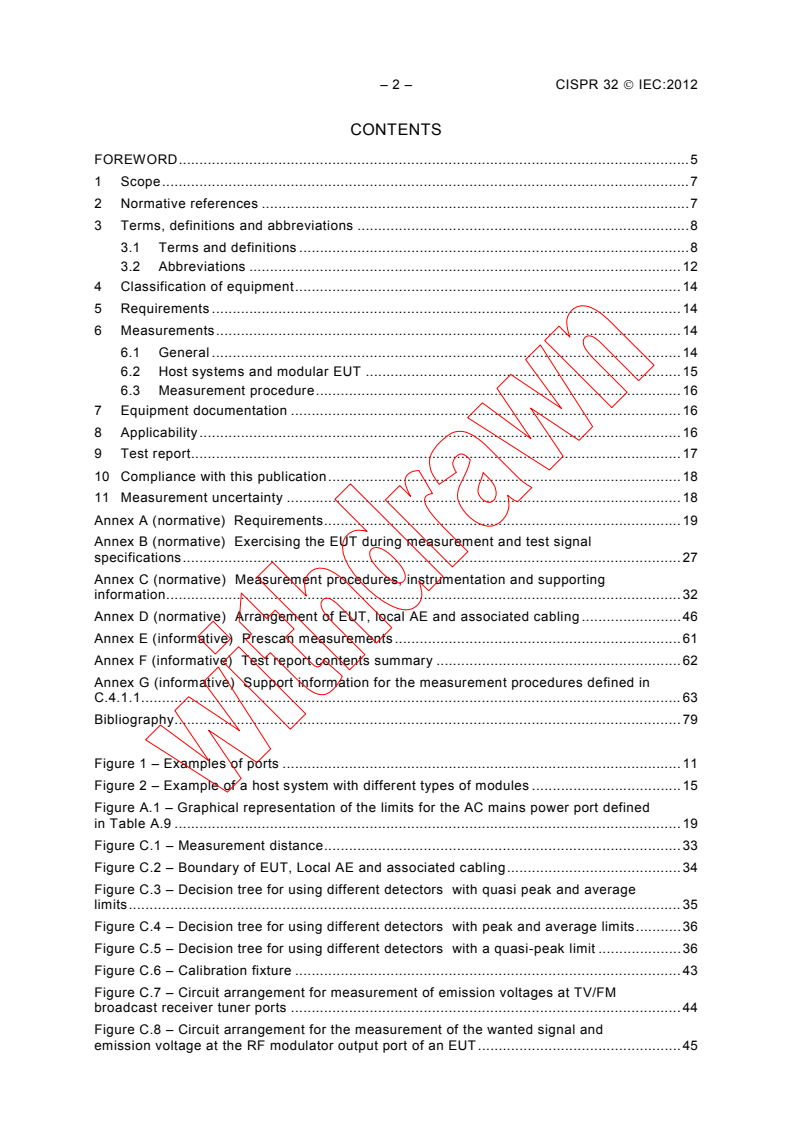
– 2 – CISPR 32 IEC:2012
CONTENTS
FOREWORD . 5
1 Scope . 7
2 Normative references . 7
3 Terms, definitions and abbreviations . 8
3.1 Terms and definitions . 8
3.2 Abbreviations . 12
4 Classification of equipment . 14
5 Requirements . 14
6 Measurements . 14
6.1 General . 14
6.2 Host systems and modular EUT . 15
6.3 Measurement procedure . 16
7 Equipment documentation . 16
8 Applicability . 16
9 Test report. 17
10 Compliance with this publication . 18
11 Measurement uncertainty . 18
Annex A (normative) Requirements . 19
Annex B (normative) Exercising the EUT during measurement and test signal
specifications . 27
Annex C (normative) Measurement procedures, instrumentation and supporting
information. 32
Annex D (normative) Arrangement of EUT, local AE and associated cabling . 46
Annex E (informative) Prescan measurements . 61
Annex F (informative) Test report contents summary . 62
Annex G (informative) Support information for the measurement procedures defined in
C.4.1.1 . 63
Bibliography . 79
Figure 1 – Examples of ports . 11
Figure 2 – Example of a host system with different types of modules . 15
Figure A.1 – Graphical representation of the limits for the AC mains power port defined
in Table A.9 . 19
Figure C.1 – Measurement distance . 33
Figure C.2 – Boundary of EUT, Local AE and associated cabling . 34
Figure C.3 – Decision tree for using different detectors with quasi peak and average
limits . 35
Figure C.4 – Decision tree for using different detectors with peak and average limits . 36
Figure C.5 – Decision tree for using different detectors with a quasi-peak limit . 36
Figure C.6 – Calibration fixture . 43
Figure C.7 – Circuit arrangement for measurement of emission voltages at TV/FM
broadcast receiver tuner ports . 44
Figure C.8 – Circuit arrangement for the measurement of the wanted signal and
emission voltage at the RF modulator output port of an EUT . 45
CISPR 32 IEC:2012 – 3 –
Figure D.1 – Example measurement arrangement for table-top EUT (Conducted and
radiated emission) (Top view) . 52
Figure D.2 – Example measurement arrangement for table-top EUT (Conducted
emission measurement – alternative 1) . 53
Figure D.3 – Example measurement arrangement for table-top EUT (Conducted
emission measurement – alternative 2) . 54
Figure D.4 – Example measurement arrangement for table-top EUT measuring in
accordance with C.4.1.6.4. 55
Figure D.5 – Example measurement arrangement for table-top EUT (Conducted
emission measurement – alternative 2, showing AAN position) . 56
Figure D.6 – Example measurement arrangement for floor standing EUT (Conducted
emission measurement) . 57
Figure D.7 – Example measurement arrangement for combinations of EUT (Conducted
emission measurement) . 58
Figure D.8 – Example measurement arrangement for table-top EUT (Radiated
emission measurement) . 58
Figure D.9 – Example measurement arrangement for floor standing EUT (Radiated
emission measurement) . 59
Figure D.10 – Example measurement arrangement for combinations of EUT (Radiated
emission measurement) . 60
Figure G.1 – Example AAN for use with unscreened single balanced pairs . 63
Figure G.2 – Example AAN with high LCL for use with either one or two unscreened
balanced pairs . 64
Figure G.3 – Example AAN with high LCL for use with one, two, three, or four
unscreened balanced pairs . 65
Figure G.4 – Example AAN, including a 50 Ω source matching network at the voltage
measuring port, for use with two unscreened balanced pairs . 66
Figure G.5 – Example AAN for use with two unscreened balanced pairs . 67
Figure G.6 – Example AAN, including a 50 Ω source matching network at the voltage
measuring port, for use with four unscreened balanced pairs . 68
Figure G.7 – Example AAN for use with four unscreened balanced pairs . 69
Figure G.8 – Example AAN for use with coaxial cables, employing an internal common
mode choke created by bifilar winding an insulated centre-conductor wire and an
insulated screen-conductor wire on a common magnetic core (for example, a ferrite
toroid) . 70
Figure G.9 – Example AAN for use with coaxial cables, employing an internal common
mode choke created by miniature coaxial cable (miniature semi-rigid solid copper
screen or miniature double-braided screen coaxial cable) wound on ferrite toroids . 70
Figure G.10 – Example AAN for use with multi-conductor screened cables, employing
an internal common mode choke created by bifilar winding multiple insulated signal
wires and an insulated screen-conductor wire on a common magnetic core (for
example, a ferrite toroid) . 71
Figure G.11 – Example AAN for use with multi-conductor screened cables, employing
an internal common mode choke created by winding a multi-conductor screened cable
on ferrite toroids . 72
Figure G.12 – Basic circuit for considering the limits with defined common mode
impedance of 150 Ω . 75
Figure G.13 – Basic circuit for the measurement with unknown common mode
impedance . 75
Figure G.14 – Impedance layout of the components in the method described
in C.4.1.6.3 . 76
– 4 – CISPR 32 IEC:2012
Figure G.15 – Basic measurement setup to measure combined impedance of the
150 Ω and ferrites . 78
Table 1 – Required highest frequency for radiated measurement . 17
Table A.1 – Radiated emissions, basic standards and the limitation of the use of
particular methods . 20
Table A.2 – Requirements for radiated emissions at frequencies up to 1 GHz for
Class A equipment . 21
Table A.3 – Requirements for radiated emissions at frequencies above 1 GHz for
Class A equipment . 21
Table A.4 – Requirements for radiated emissions at frequencies up to 1 GHz for Class
B equipment . 21
Table A.5 – Requirements for radiated emissions at frequencies above 1 GHz for
Class B equipment . 22
Table A.6 – Requirements for radiated emissions from FM receivers . 22
Table A.7 – Conducted emissions, basic standards and the limitation of the use of
particular methods . 23
Table A.8 – Requirements for conducted emissions from the AC mains power ports of
Class A equipment . 23
Table A.9 – Requirements for conducted emissions from the AC mains power ports of
Class B equipment . 24
Table A.10 – Requirements for asymmetric mode conducted emissions from Class A
equipment . 24
Table A.11 – Requirements for asymmetric mode conducted emissions from Class B
equipment . 25
Table A.12 – Requirements for conducted differential voltage emissions from Class B
equipment . 26
Table B.1 – Methods of exercising displays and video ports . 28
Table B.2 – Display and video parameters . 28
Table B.3 – Methods used to exercise ports . 29
Table B.4 – Examples of digital broadcast signal specifications . 30
Table C.1 – Analogue/digital data port emission procedure selection . 38
Table C.2 – LCL values . 39
Table C.3 – 5 m OATS/SAC NSA figures . 45
Table D.1 – Arrangement spacing, distances and tolerances . 48
Table F.1 – Summary of information to include in a test report . 62
Table G.1 – Summary of advantages and disadvantages of the procedures described
in C.4.1.6 . 73
CISPR 32 IEC:2012 – 5 –
INTERNATIONAL ELECTROTECHNICAL COMMISSION
____________
ELECTROMAGNETIC COMPATIBILITY
OF MULTIMEDIA EQUIPMENT –
Emission requirements
FOREWORD
1) The International Electrotechnical Commission (IEC) is a worldwide organization for standardization comprising
all national electrotechnical committees (IEC National Committees). The object of IEC is to promote
international co-operation on all questions concerning standardization in the electrical and electronic fields. To
this end and in addition to other activities, IEC publishes International Standards, Technical Specifications,
Technical Reports, Publicly Available Specifications (PAS) and Guides (hereafter referred to as “IEC
Publication(s)”). Their preparation is entrusted to technical committees; any IEC National Committee interested
in the subject dealt with may participate in this preparatory work. International, governmental and non-
governmental organizations liaising with the IEC also participate in this preparation. IEC collaborates closely
with the International Organization for Standardization (ISO) in accordance with conditions determined by
agreement between the two organizations.
2) The formal decisions or agreements of IEC on technical matters express, as nearly as possible, an international
consensus of opinion on the relevant subjects since each technical committee has representation from all
interested IEC National Committees.
3) IEC Publications have the form of recommendations for international use and are accepted by IEC National
Committees in that sense. While all reasonable efforts are made to ensure that the technical content of IEC
Publications is accurate, IEC cannot be held responsible for the way in which they are used or for any
misinterpretation by any end user.
4) In order to promote international uniformity, IEC National Committees undertake to apply IEC Publications
transparently to the maximum extent possible in their national and regional publications. Any divergence
between any IEC Publication and the corresponding national or regional publication shall be clearly indicated in
the latter.
5) IEC itself does not provide any attestation of conformity. Independent certification bodies provide conformity
assessment services and, in some areas, access to IEC marks of conformity. IEC is not responsible for any
services carried out by independent certification bodies.
6) All users should ensure that they have the latest edition of this publication.
7) No liability shall attach to IEC or its directors, employees, servants or agents including individual experts and
members of its technical committees and IEC National Committees for any personal injury, property damage or
other damage of any nature whatsoever, whether direct or indirect, or for costs (including legal fees) and
expenses arising out of the publication, use of, or reliance upon, this IEC Publication or any other IEC
Publications.
8) Attention is drawn to the Normative references cited in this publication. Use of the referenced publications is
indispensable for the correct application of this publication.
9) Attention is drawn to the possibility that some of the elements of this IEC Publication may be the subject of
patent rights. IEC shall not be held responsible for identifying any or all such patent rights.
International Standard CISPR 32 has been prepared by CISPR subcommittee I:
Electromagnetic compatibility of information technology equipment, multimedia equipment and
receivers.
The text of this publication is based on the following documents:
FDIS Report on voting
CIS/I/391/FDIS CIS/I/398/RVD
Full information on the voting for the approval of this publication can be found in the report on
voting indicated in the above table.
This publication has been drafted in accordance with the ISO/IEC Directives, Part 2.
– 6 – CISPR 32 IEC:2012
The committee has decided that the contents of this publication will remain unchanged until
the stability date indicated on the IEC web site under "http://webstore.iec.ch" in the data
related to the specific publication. At this date, the publication will be
• reconfirmed,
• withdrawn,
• replaced by a revised edition, or
• amended.
The contents of the corrigenda of March 2012 and August 2012 have been included in this
copy.
IMPORTANT – The 'colour inside' logo on the cover page of this publication indicates
that it contains colours which are considered to be useful for the correct
understanding of its contents. Users should therefore print this document using a
colour printer.
CISPR 32 IEC:2012 – 7 –
ELECTROMAGNETIC COMPATIBILITY
OF MULTIMEDIA EQUIPMENT –
Emission requirements
1 Scope
NOTE Blue coloured text within this document indicates text aligned with CISPR 35.
This International Standard applies to multimedia equipment (MME) as defined in 3.1.23 and
having a rated r.m.s. AC or DC supply voltage not exceeding 600 V.
Equipment within the scope of CISPR 13 or CISPR 22 is within the scope of this publication.
MME intended primarily for professional use is within the scope of this publication.
The radiated emission requirements in this standard are not intended to be applicable to the
intentional transmissions from a radio transmitter as defined by the ITU, nor to any spurious
emissions related to these intentional transmissions.
Equipment, for which emission requirements in the frequency range covered by this
publication are explicitly formulated in other CISPR publications (except CISPR 13 and
CISPR 22), are excluded from the scope of this publication.
This document does not contain requirements for in-situ assessment. Such testing is outside
the scope of this publication and may not be used to demonstrate compliance with it.
This publication covers two classes of MME (Class A and Class B). The MME classes are
specified in Clause 4.
The objectives of this publication are:
1) to establish requirements which provide an adequate level of protection of the radio
spectrum, allowing radio services to operate as intended in the frequency range 9 kHz to
400 GHz;
2) to specify procedures to ensure the reproducibility of measurement and the repeatability of
results.
2 Normative references
The following reference documents are indispensable for the application of this publication.
For dated references, only the edition cited applies. For undated references, the latest edition
of the referenced document (including any amendments) applies.
CISPR 16-1-1:2010, Specification for radio disturbance and immunity measuring apparatus
and methods – Part 1-1: Radio disturbance and immunity measuring apparatus – Measuring
apparatus
Amendment 1 (2010)
CISPR 16-1-2:2003, Specification for radio disturbance and immunity measuring apparatus
and methods – Part 1-2: Radio disturbance and immunity measuring apparatus – Ancillary
equipment – Conducted disturbances
Amendment 1 (2004)
Amendment 2 (2006)
– 8 – CISPR 32 IEC:2012
CISPR 16-1-4:2010, Specification for radio disturbance and immunity measuring apparatus
and methods – Part 1-4: Radio disturbance and immunity measuring apparatus – Antennas
and test sites for radiated disturbance measurements
CISPR 16-2-1:2008, Specification for radio disturbance and immunity measuring apparatus
and methods – Part 2-1: Methods of measurement of disturbances and immunity – Conducted
disturbance measurements
Amendment 1 (2010)
CISPR 16-2-3:2010, Specification for radio disturbance and immunity measuring apparatus
and methods – Part 2-3: Methods of measurement of disturbances and immunity – Radiated
disturbance measurements
Amendment 1 (2010)
CISPR 16-4-2:2011, Specification for radio disturbance and immunity measuring apparatus
and methods – Part 4-2: Uncertainties, statistics and limit modelling – Measurement
instrumentation uncertainty
CISPR/TR 16-4-3:2004, Specification for radio disturbance and immunity measuring
apparatus and methods – Part 4-3: Uncertainties, statistics and limit modelling – Statistical
considerations in the determination of EMC compliance of mass-produced products
Amendment 1 (2006)
IEC 60050-161:1990, International Electrotechnical Vocabulary – Chapter 161:
Electromagnetic compatibility
IEC 61000-4-6:2008, Electromagnetic compatibility (EMC) – Part 4-6: Testing and
measurement techniques – Immunity to conducted disturbances, induced by radio-frequency
fields
ISO/IEC 17025:2005, General requirements for the competence of testing and calibration
laboratories
IEEE Sdt 802.3, IEEE Standard for Information technology – Specific requirements – Part 3:
Carrier Sense Multiple Access with Collision Detection (CMSA/CD) Access Method and
Physical Layer Specifications
ANSI C63.5-2006, American National Standard (for) Electromagnetic Compatibility - Radiated
Emission Measurements in Electromagnetic Interference (EMI) Control - Calibration of
Antennas (9 kHz to 40 GHz)
3 Terms, definitions and abbreviations
3.1 Terms and definitions
For the purposes of this document, the following terms and definitions apply.
NOTE Terms and definitions related to EMC and to relevant phenomena are given in IEC 60050-161. It should be
noted that a common set of definitions has been written for both CISPR 32 and CISPR 35 (to be published). It is
noted that some terms and definitions will only be used in one of these two publications but for purposes of
consistency they are intentionally included in both.
3.1.1
AC mains power port
port used to connect to the mains supply network
NOTE Equipment with a DC power port which is powered by a dedicated AC/DC power converter is defined as AC
mains powered equipment.
CISPR 32 IEC:2012 – 9 –
3.1.2
analogue/digital data port
signal/control port (3.1.28), antenna port (3.1.3), wired network port (3.1.30), broadcast
receiver tuner port (3.1.8), or optical fibre port (3.1.24) with metallic shielding and/or metallic
strain relief member(s)
3.1.3
antenna port
port, other than a broadcast receiver tuner port (3.1.8), for connection of an antenna used for
intentional transmission and/or reception of radiated RF energy
3.1.4
arrangement
physical layout of all the parts of the EUT, local AE and any associated cabling within the
measurement or test area
3.1.5
associated equipment
AE
equipment needed to exercise and/or monitor the operation of the EUT
3.1.6
audio equipment
equipment which has a primary function of either (or a combination of) generation, input,
storage, play, retrieval, transmission, reception, amplification, processing, switching or control
of audio signals
3.1.7
broadcast receiver equipment
equipment containing a tuner that is intended for the reception of broadcast services
NOTE These broadcast services are typically television and radio services, including terrestrial broadcast,
satellite broadcast and/or cable transmission.
3.1.8
broadcast receiver tuner port
port intended for the reception of a modulated RF signal carrying terrestrial, satellite and/or
cable transmissions of audio and/or video broadcast and similar services
NOTE This port may be connected to an antenna, a cable distribution system, a VCR or similar device.
3.1.9
broadcast satellite outdoor system
antenna and the low-noise amplifier with its associated down-converter, forming part of a
satellite reception system
NOTE The indoor receiver’s intermediate frequency amplifier and demodulator are excluded.
3.1.10
common mode impedance
asymmetrical mode (see CISPR 16-2-1) impedance between a cable attached to a port and
the Reference Ground Plane (RGP)
NOTE The complete cable is seen as one wire of the circuit and the RGP is seen as the other wire of the circuit.
The common mode current flowing around this circuit can lead to the emission of radiated energy of EUT.
3.1.11
configuration
operational conditions of the EUT and AE, consisting of the set of hardware elements
selected to comprise the EUT and AE, mode of operation (3.1.22) used to exercise the EUT
and arrangement (3.1.4) of the EUT and AE
– 10 – CISPR 32 IEC:2012
3.1.12
converted common mode current
asymmetrical mode current converted from differential mode current by the unbalance of a
cable or network not forming part of an EUT
3.1.13
DC network power port
port, not powered by a dedicated AC/DC power converter and not supporting communication,
that connects to a DC supply network
NOTE 1 Equipment with a DC power port which is powered by a dedicated AC/DC power converter is considered
to be AC mains powered equipment.
NOTE 2 DC power ports supporting communications are considered to be wired networks ports, for example
Ethernet ports which include Power Over Ethernet (POE).
3.1.14
enclosure port
physical boundary of the EUT through which electromagnetic fields may radiate
3.1.15
entertainment lighting control equipment
equipment generating or processing electrical signals for controlling the intensity, colour,
nature or direction of the light from a luminaire, where the intention is to create artistic effects
in theatrical, televisual or musical productions and visual presentations
3.1.16
Equipment Under Test
EUT
multimedia equipment (MME) being evaluated for compliance with the requirements of this
standard
3.1.17
formal measurement
measurement used to determine compliance
NOTE This is often the final measurement performed. It may be carried out following a prescan measurement. It
is the measurement recorded in the test report.
3.1.18
function
operation carried out by a MME
NOTE Functions are related to basic technologies incorporated in the MME such as: displaying, recording,
processing, controlling, reproducing, transmitting, or receiving single medium or multimedia content. The content
may be data, audio or video, either individually or in combination.
3.1.19
highest internal frequency
F
x
highest fundamental frequency generated or used within the EUT or highest frequency at
which it operates
NOTE This includes frequencies which are solely used within an integrated circuit.
3.1.20
Information Technology Equipment
ITE
equipment having a primary function of either (or a combination of) entry, storage, display,
retrieval, transmission, processing, switching, or control of data and/or telecommunication
messages and which may be equipped with one or more ports typically for information
transfer
CISPR 32 IEC:2012 – 11 –
NOTE Examples include data processing equipment, office machines, electronic business equipment and
telecommunication equipment.
3.1.21
launched common mode current
asymmetric mode current produced by internal circuitry and appearing at the wired network
port of the EUT
NOTE Measurement of the launched common mode current requires the EUT port to be loaded by a perfectly
balanced termination.
3.1.22
mode of operation
set of operational states of all functions of an EUT during a test or measurement
3.1.23
MultiMedia Equipment
MME
equipment that is information technology equipment (3.1.20), audio equipment (3.1.6), video
equipment (3.1.29), broadcast receiver equipment (3.1.7), entertainment lighting control
equipment (3.1.15) or combinations of these
3.1.24
optical fibre port
port at which an optical fibre is connected to an equipment
3.1.25
port
physical interface through which electromagnetic energy enters or leaves the EUT
NOTE See Figure 1.
EUT
Optical fibre port AC mains power port
Enclosure port
RF modulator output
DC network power port
port
Broadcast receiver
tuner port
Antenna
Wired network port
Antenna port
Signal/control port
IEC 004/12
Figure 1 – Examples of ports
3.1.26
primary function
any function of an MME considered essential for the user or for the majority of users that
needs to be monitored directly or indirectly during immunity testing
– 12 – CISPR 32 IEC:2012
NOTE MME may have more than one primary function. For example the primary functions of a basic television set
include broadcast reception, audio reproduction and display.
3.1.27
RF modulator output port
port intended to be connected to a broadcast receiver tuner port in order to transmit a signal
to the broadcast receiver
3.1.28
signal/control port
port intended for the interconnection of components of an EUT, or between an EUT and local
AE and used in accordance with relevant functional specifications (for example for the
maximum length of cable connected to it)
NOTE Examples include RS-232, Universal Serial Bus (USB), High-Definition Multimedia Interface (HDMI), IEEE
Standard 1394 (“Fire Wire”).
3.1.29
video equipment
equipment which has a primary function of either (or a combination of) generation, input,
storage, display, play, retrieval, transmission, reception, amplification, processing, switching,
or control of video signals
3.1.30
wired network port
point of connection for voice, data and signalling transfers intended to interconnect widely-
dispersed systems by direct connection to a single-user or multi-user communication network
(for example CATV, PSTN, ISDN, xDSL, LAN and similar networks)
NOTE These ports may support screened or unscreened cables and may also carry AC or DC power where this is
an integral part of the telecommunication specification.
3.2 Abbreviations
For the purposes of this document, the following abbreviations apply.
AAN Asymmetric Artificial Network
AC Alternating Current
AC-3 ATSC standard: digital Audio Compression (AC-3)
AE Associated Equipment, see 3.1.5.
AM Amplitude Modulation
AMN Artificial Mains Network
ATSC Advanced Television Systems Committee
AV Audio Visual
BPSK Binary Phase Shift Keying
CATV Cable TV network
CISPR International special committee on radio interference
CM Common Mode
CMAD Common Mode Absorbing Device
CVP Capacitive Voltage Probe
DC Direct Current
DMB-T Digital Multimedia Broadcast – Terrestrial
DQPSK Differential Quadrature Phase Shift Keying
DSL Digital Subscriber Line
CISPR 32 IEC:2012 – 13 –
DVB-C Digital Video Broadcast – Cable
DVB-S Digital Video Broadcast – Satellite
DVB-T Digital Video Broadcast – Terrestrial
DVD Digital Versatile Disc
(an optical disc format also known as a Digital Video Disc)
DVB Digital Video Broadcast
EMC ElectroMagnetic Compatibility
EUT Equipment Under Test, see 3.1.16
FAR Fully Anechoic Room
FM Frequency Modulation
FSOATS Free Space Open Area Test Site
HDMI High-Definition Multimedia Interface
HID Human Interface Device
IEC International Electrotechnical Commission
IF Intermediate Frequency
ISDB Integrated Services Digital Broadcasting
ISDB-S Integrated Services Digital Broadcasting – Satellite
ISDN Integrated Services Digital Network
ISO International Standardisation Organisation
ITE Information Technology Equipment, see 3.1.20
ITU International Telecommunication Union
ITU-R International Telecommunication Union – Radio Communication Sector
ITU-T International Telecommunication Union – Telecommunication Sector
LAN Local Area Network
LCL Longitudinal Conversion Loss
LNB Low-Noise Block converter
MME Multimedia Equipment, see 3.1.23
MPEG Moving Picture Experts Group
NSA Normalized Site Attenuation
OATS Open Area Test Site
OFDM Orthogonal Frequency Division Multiplexing
PC Personal Computer
POE Power Over Ethernet
POS Point Of Sale
PSTN Public Switched Telephone Network
PSU Power Supply Unit (including a AC/DC power converter)
QAM Quadrature Amplitude Modulation
QPSK Quadrature Phase Shift Keying
RF Radio Frequency
RGP Reference Ground Plane
SAC Semi Anechoic Chamber
TV Television
UHF Ultra High Frequency
– 14 – CISPR 32 IEC:2012
USB Universal Serial Bus
VCR Video Cassette Recorder
VHF Very High Frequency
VSB Vestigial Side Band
xBase-T Where x is 10, 100 and 1 000 as defined in the IEEE 802.3 series of standards
xDSL Generic term for all types of DSL technology
4 Classification of equipment
This standard defines Class A equipment and Class B equipment associated with two types of
end-use environment.
Class A equipment is equipment which meets the requirements given in Table A.2, Table A.3,
Table A.8, and Table A.10, using the limitations defined in Table A.1 and Table A.7.
Class B equipment is equipment which meets the requirements given in Table A.4, Table A.5,
Table A.6, Table A.9, Table A.11 and Table A.12, using the limitations defined in Table A.1
and Table A.7.
The Class B requirements for equipment are intended to offer adequate protection to
broadcast services within the residential environment.
Equipment intended primarily for use in a residential environment shall meet the Class B
limits. All other equipment shall comply with the Class A limits.
Broadcast receiver equipment is class B equipment.
NOTE Equipment meeting Class A requirements may not offer adequate protection to broadcast services within a
residential environment.
5 Requirements
The requirements for equipment covered within the scope of this publication are defined in
Annex A.
6 Measurements
6.1 General
This clause defines the measurement facilities and instrumentation specific to the
measurement of emissions from MME; it includes by reference the relevant basic
requirements given in the CISPR 16 series and other standards shown in the normative
references in this standard. It also defines how to configure and arrange the EUT, local AE
and associated cabling, and provides the relevant measurement procedures.
The specification of the measurement facility, measurement equipment, procedures, and the
arrangement of the measurement equipment to be used are given in the basic standards
referred to in the tables in Annex A. Unless otherwise specified, the basic standards shall be
used for all aspects of the measurement.
Where there are conflicts in the information presented in the CISPR 16 series and this
publication, the content of this publication takes precedence.
The procedures to be used for measurement of emission levels depend upon several
elements. These include but are not limited to:
CISPR 32 IEC:2012 – 15 –
• the type of EUT,
• the type of port,
• the types of cables used,
• the frequency range,
• the mode of operation.
If a single port satisfies the definition of more than one of the types of port defined in this
publication, it is subject to the requirements for each of the port types that it satisfies. Where
a port is specified by the manufacturer for use with both screened and unscreened cables, the
port shall be evaluated with both cable types.
6.2 Host systems and modular EUT
This subclause describes how to configure EUTs that are a host system or modular in nature.
Modular systems can comprise different types of module(s), for example the EUT can be:
• an external module, for example an infra-red remote control;
• an internal module, for example a computer hard disk;
• a plug-in module, for example a memory stick;
• a mounted module, for example a sound card or a video card.
Modules intended to be marketed and/or sold separately from a host shall be assessed with at
least one representative host system. The modules may be internal, mounted, plug-in or
external as illustrated in Figure 2. The port(s) of any module being assessed shall be
terminated in accordance with Annex D. The functions of the host device that are specific to
the module being assessed shall be exercised during the measurements. Modules shown to
meet the requirements of this publication in any one representative host are deemed to meet
the requirements of this publication when used in any host. The host and modules used
during measurements shall be listed in the test report.
Host
Internal module
...